Thailand aborts the colour revolution
By M. K. BHADRAKUMAR | Indian Punchline | August 9, 2024
The curtain has come down on the abortive colour revolution in Thailand with the country’s Constitutional Court ordering the dissolution on Wednesday of the anti-establishment opposition party Move Forward, widely regarded as a US proxy.
It coincides with the stunning success of the hastily staged colour revolution in Bangladesh and the fall of the key military base of the Myanmar army’s Northeast Command in Lashio in the Shan state over the weekend to the Myanmar National Democratic Alliance Army, the rebel groups armed, financed and trained by the Western intelligence.
The Shan people who belong to the Tai ethnic group of Southeast Asia are the biggest minority of Myanmar (10% of the population) and they have cultural affinity with the Northern Thai peoples and also have a significant presence in the adjacent regions of Assam and Meghalaya in India.
The capture of Lashio by the alliance of militias of ethnic minority groups supported by the western intelligence is seen as a serious blow to the regime in Myanmar, which enjoys the backing of the military leadership in Thailand and is a strong ally of Russia.
Lashio is situated on an important trade route and is about 100 kms only from the Chinese border. Newsweek magazine in a report titled China Faces Growing War on Its Border cited an expert opinion of the Washington-based United States Institute of Peace think tank (which is wired into the US intelligence establishment) that:
“From China’s vantage point, the escalation of the conflict is a major setback in terms of its interest in… getting the belligerent parties to establish further deals to reset trade between the China border and Mandalay.
“China seems very concerned, as it will be very difficult for the Myanmar military to bounce back from this setback, yet the Myanmar military is not signalling a desire to return to the table or an interest in making significant concessions to the northern EAOs (alliance of tribal groups), which is what China has been pressuring it to do.”
According to latest reports, American and British “volunteers” have been lately joining the ranks of the rebels fighting the Myanmar military — although, these are early days and Myanmar has not experienced yet the same wave of international volunteers seen in conflicts such as Ukraine or Syria, and there are no coordinated efforts apparent to enlist foreign recruits.
The Myanmar military supremo General Min Aung Hlaing has alleged that the rebel alliance is receiving weapons, including drones and short-range missiles, from “foreign” sources. “It is necessary to analyse the sources of monetary and technological power,” he said. Myanmar’s military has 14 regional commands across the country, and the Northeast Command is the first to fall to armed rebel groups.
Meanwhile, the Arakan Army (AA) — a powerful ethnic armed group which is fighting to establish an independent Rakhine polity in western Myanmar — has been on the move committing atrocities against the Rohingya minority population taking advantage of the military’s current overstretch.
AA has made significant gains in Rakhine State in the recent months and reportedly exercises control over more than half of the state’s 17 townships. By the way, the Arakanese people also exist in Bangladesh’s Chittagong Hill Tracts and in India’s Tripura state. (Interestingly, Arakan Division was originally a part of British India.)
Coming back to Bangkok, the Thai generals are evidently circling the wagons sensing the Time of Troubles ahead as the Five Eyes is creating a cauldron in Myanmar that can ensnare the neighbouring regions. Bangkok, a western ally previously, is traditionally a hotbed of western intelligence — Five Eyes — and the authorities are well aware of the resentment in the US that their ties with Beijing have expanded and deepened and assumed a strategic character in the recent years.
The unkindest cut of all is that Thailand (along with Malaysia) has formally applied for membership of the BRICS, which carries huge resonance in the geopolitics of southeast Asia and the ASEAN and impacts the regional balance at a juncture when the US is striving to create an anti-China bloc.
Thailand is a keen participant in China’s Belt and Road Initiative. From a long term perspective, the 873-km high-speed rail project connecting Bangkok with Kunming, capital of China’s Yunnan province, via Laos is expected to be operational latest by 2028.
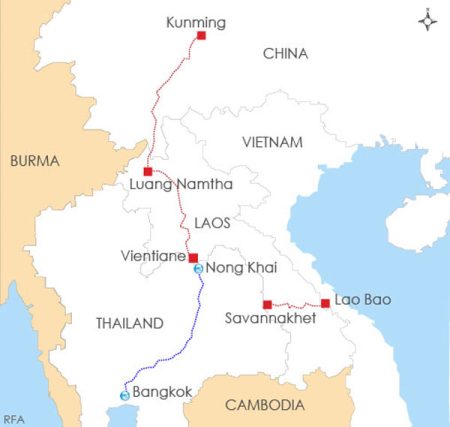
The railway project, estimated to cost anywhere up to $10 billion will not only enhance regional connectivity but profoundly reset the economic geography of Asia, given its massive potential for accelerating the increased integration between China and the ASEAN countries. People would be able to travel between Kunming and Bangkok by train for about $100, which is half to a third of the cost of an airline ticket. According to Xinhua, the railway is expected to bring two million more Chinese tourists to Thailand every year.
Washington is livid that its proxy, Move Forward led by a young man educated in the US and groomed to spearhead a colour revolution, has been banned. The Thai authorities understand that the western intention is to break up the ancient crust of their country’s polity, which is the only way to make inroads into what is otherwise a deeply Buddhist culture — specifically, to demolish the so-called lèse-majesté law protecting the institution of monarchy, an institution that dates back more than 700 years and is a pillar of stability in the country symbolising the unity of the Thai communities. By the way, Christian missionary work is active in both Thailand and Myanmar — as in next-door north-eastern region of India. And the evangelicals are an influential pressure group in the US politics.
The Thai authorities have shied away from confronting the US. Thai culture values serenity and avoids conflict and displays of anger. Even disagreements are to be handled with a smile, without assigning blame. Hence the circuitous route to squash Move Forward on legal grounds.
Move Forward won 151 seats in the 500 member parliament in the elections in May last year where sixty-seven parties contested, but was unable to form a coalition government after being functionally blocked by allies of the monarchy and military. Move Forward made the electoral pledge to abolish lèse-majesté law (which is tantamount to a crime.)
The US and its allies are furious but cannot do anything about the development. All the good work to stage a colour revolution in phases has come to naught. The exasperation shows in the statements from Washington and Canberra. (here and here)
However, all is not lost. The regime change in Bangladesh may open a new pathway for the western intervention in Myanmar. India and Thailand refused to back the western-backed rebels fighting the Myanmar military. Former Bangladesh Prime Minister Sheikh Hasina also stayed away from the power struggle in Myanmar. But that may change.
The Rohingya issue provides an alibi. The ascendance of Pakistani intelligence and the larger-than life role of the Jamaat-i-Islami will trigger an assertion of Bangladesh’s Muslim identity. The Pakistani army chief lost no time to underscore that the developments in Bangladesh underscore the raison d’être of the two-nation theory!
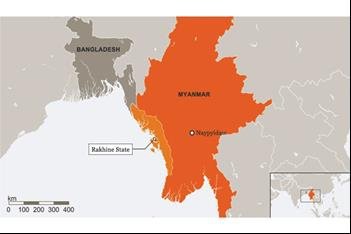
So, the regime change in Bangladesh may turn out to be a game changer for the West’s regime change agenda in Myanmar. On the other hand, at the secondary and tertiary level, any strengthening of the western-backed rebel alliance in Myanmar cannot but cast shadows on India’s northeast, which has a large Christian population with tribal affinities across the border.
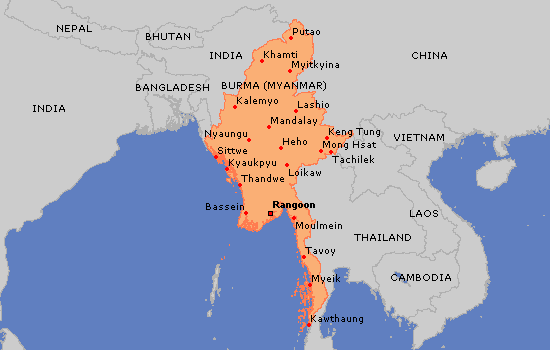
An awareness is lacking that any weakening of Thailand’s state structure or the dissipation of Thai culture rooted in Buddhist traditions will isolate India in the region’s civilisational tapestry. Indians tend to take an episodic view of current events in their immediate neighbourhood.
Prior to the rise of Theravada Buddhism, both Indian Brahminical religion and Mahayana Buddhism were present in Thailand, and influences from both these traditions can still be seen in present-day Thai folklore. A colour revolution in Thailand leading to western dominance and the eclipse of the Thai monarchy and Buddhist cosmology would have profound implications for South Asia.
Henry Kissinger and his legacy as a war criminal

Press TV – January 11, 2024
Henry Kissinger was one of the most influential US statesmen of the 20th century, who shamelessly used his position to manipulate the United States into providing unequivocal support to Israel.
As a hardcore Zionist, Kissinger was incredibly Machiavellian, but unlike his modern-day equivalents, he was not stupid and he certainly was not demented. Kissinger was also the architect of some of the 20th century’s worst human rights abuses and war crimes.
Henry Kissinger, his life and legacy
The passing of a war criminal, the death of Henry Kissinger at 100 years old marks the end of a bloody life.
Kissinger is well known for his role in engineering the coup that brought General Pinochet to power in Chile and overthrowing the democratically elected leader, Salvador Allende.
Kissinger’s fingerprints were all over the wars from Vietnam to Cambodia to East Timor to Bangladesh.
Less well known though, is Kissinger’s role in the neutralization of Egypt as an effective actor in the struggle against Zionism and the marginalization of Palestinians by regional allies.
It’s fair to say you would not have the same level of Egyptian complicity that you have today, including the genocidal blockade on Gaza at the Rafah crossing, without Kissinger’s work to subvert the powerful Arab state.
As Secretary of State under Richard Nixon, Kissinger was intimately involved in saving Israel in the 1973 war of attrition fought by Syria, Egypt, and Libya against the settler entity.
When the Zionists suffered consecutive losses, Kissinger and Nixon organized the emergency supply of weapons to the entity in a move known as Operation Nickel Grass.
The operation consisted of the US Air Force Military Airlift Command, delivering 22,325 tons of tanks, ammunition, and military equipment, over 32 days, directly to the battlefield.
Following the war, Egyptian leader Anwar Sadat sent a secret message to Zionist Prime Minister Golda Meir: “When I threatened war, I meant it; when I talk of peace now, I mean it. We have never had contact before, We now have the services of Dr. Kissinger. Let us use him and talk to each other through him”, asserted Sadat.
It was Kissinger who took Sadat under his wing and convinced him of the benefit of normalizing with the temporary entity. This work culminated with the visit of the Egyptian leader to the Israeli parliament, where he addressed the Israeli political elite, stating his desire for peace with the entity.
The infrastructure of collaboration that was set up during his time remains in place. When marking the death of Kissinger, Israeli President, Isaac Herzog, credited the former US Secretary of State with laying the cornerstone of the peace agreement between Egypt and the Zionist entity.
Israel lobbyist and former US ambassador to Israel, Martin Indyk, wrote a book about Kissinger’s political career with a special concentration on his services to Israel in 1981.
In reference to his diplomatic work in the Middle East, Kissinger asserted that his main objective was to isolate the Palestinians.
The truth is that Palestinians are not isolated, and support for them has outlived Henry Kissinger.
Five countries ask ICC to probe war crimes in Gaza
Palestine Information Center – November 18, 2023
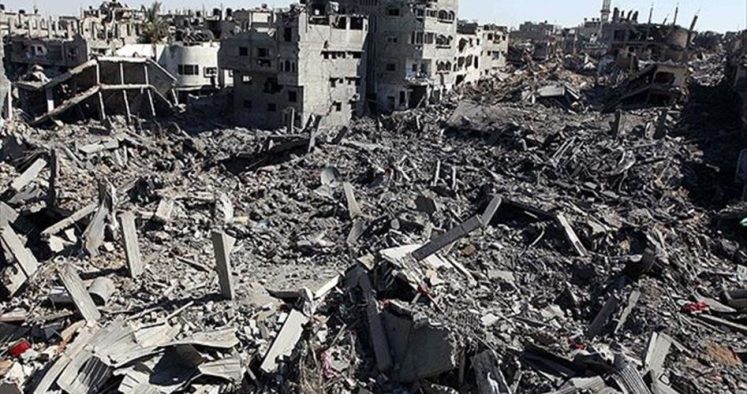
GAZA – The International Criminal Court (ICC) announced that it received referrals from five states seeking an investigation into Israeli war crimes in Gaza.
ICC Prosecutor Karim Khan disclosed that South Africa, Bangladesh, Bolivia, Comoros, and Djibouti submitted the referrals.
Khan confirmed in a statement that the ICC is already investigating the situation in Gaza.
“In accordance with the Rome Statute of the International Criminal Court, a State Party may refer to the Prosecutor a situation in which one or more crimes within the jurisdiction of the Court appear to have been committed requesting the Prosecutor to investigate the situation for the purpose of determining whether one or more specific persons should be charged with the commission of such crimes,” he said.
Khan mentioned the establishment of a specialized team upon assuming his term in June 2021, aimed at advancing the investigation in Palestine.
The prosecutor emphasized that the team will probe crimes suspected to be committed during the Israeli aggression on Gaza.
South Africa declared that it had submitted the referral request with “other countries that share the same concerns”, demanding that the International Criminal Court would urgently pay “attention to the seriousness of the current situation.”
The South African Ministry of Foreign Affairs stressed in a statement that Pretoria “urges other signatory states to the Rome Statute to join this referral request, or to submit their referral requests independently.”
The ICC opened an investigation in 2021 into war crimes suspected to be committed by the Israeli occupation forces in Palestine.
Since October 7, Israel has been waging a bloody aggression on the Gaza Strip, resulting in the martyrdom of more than 12,000 Palestinian civilians, most of whom are children and women.
No rise in temps or rainfall in Bangladesh for 100 years, despite alarmists pointing to it as ‘canary in the coalmine’
BY CHRIS MORRISON | THE DAILY SCEPTIC | DECEMBER 28, 2022
The country of Bangladesh is mostly a floodplain. Over 80% of the territory is classified as such, while 75% of the land is less than 10 metres above sea level. Heavy monsoons and widespread flooding are common. In an average year, 18% of the landmass is inundated, a figure that rose to 75% in 1988. What better place for western guilt-trippers to highlight and claim that all the natural tribulations are down to humans changing the climate? And what better ‘poster child’ for grant-hungry activists and local politicians to highlight when demanding large amounts of ‘compensation’ from developed nations to assuage the sins of industrialisation?
Earlier this year, Bangladesh was hit by the regular monsoon rains and flooding. Sky News reported that “experts say that climate change is increasing the frequency, ferocity and unpredictability of floods in Bangladesh”. Needless to say, the BBC made the same point, adding that “experts say that climate change is increasing the likelihood of events like this happening around the world”.
Presumably, when they talk about climate change, Sky and the BBC are worried about flooding being caused by rising temperatures and increased rainfall. It might therefore be considered curious that these climate changes do not seem to have affected Bangladesh.
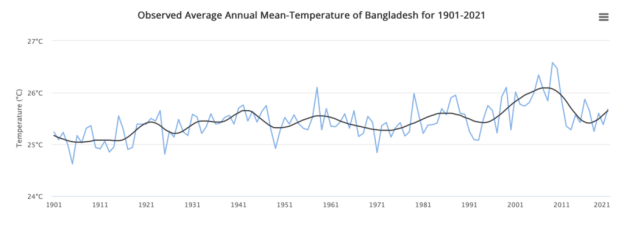
According to figures compiled for the World Bank, the average temperature in Bangladesh is the same today as it was 100 years ago. There are the usual cyclical changes, but global warming is not much in evidence around the Bay of Bengal.
Let’s try rainfall.
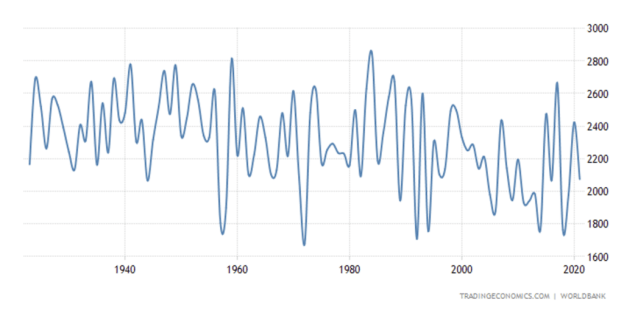
Again according to the World Bank, we see little change in the overall trend going back 100 years. If anything, rainfall has slightly decreased, and there‘s certainly nothing unusual in the recent past. The graph shows that rainfall can vary widely between years. Severe monsoons in the past have caused enormous damage and heavy loss of life. Six catastrophic floods were recorded in the 19th century and 18 in the 20th. These days, hundreds of people can die in the flooding; in the past the figures could run into hundreds of thousands.
In a recent article in Climate Home News, it was said that Bangladeshis were dealing with wave after wave of climate chaos. The article “sponsored” by the international ngo Helvetas told its Western audience that one of the impacts of these disasters is “forced migration”. Of course, this plays into another common climate scare, suggesting, without any discernible evidence, that huge numbers of people will become ‘climate refugees’ in the future, mostly from tropical areas, and inevitably seeking to move northwards to ‘safety’.
Making Bangladesh a poster country for Western Armageddonites spreading the pseudoscientific notion that humans are causing the climate to radically change, does the country few favours. It is sited in many geographically fragile areas, and is prone to tropical cyclones. But over 160 million people are sustained by good agriculture, increased manufacturing development, and economic growth of around 6% per annum.
As countries become more prosperous, they can become more resilient in the face of what nature has always thrown at them. This appears to have happened in the case of Bangladesh, where the number of fatalities from flooding has significantly declined over the last 50 years. Surely, this is the good news story that should be spread in mainstream media, and probably would be if the climate change narrative was not embedded in every part of the discourse.
As we have reported throughout the year, it has been a disastrous period for climate alarmists preaching their gospel of doom to inflict a controlling Net Zero political agenda across the world. Global warming ran out of steam years ago, and no amount of ‘adjusting’ of surface temperature databases can hide that fact. Weather events are cyclical, and attributing any one event to human activity is model-driven junk science. Summer Arctic sea ice stopped declining over a decade ago, but David Attenborough still says it could all be gone by 2035. Polar bears, penguins and coral – all doing nicely thank you. More prosperous and healthier societies are learning to protect themselves against the ravages of Mother Nature. Small increases in carbon dioxide, otherwise known as plant food, continue to green up the planet, leading to higher food yields, reduced famine and healthier eco systems.
Protests Erupt in Bangladesh as Government Raises Fuel Prices While Seeking IMF Loans
Samizdat – 07.08.2022
Bangladesh has approached the International Monetary Fund (IMF) for a multibillion-dollar loan, making it the third South Asian country – after Sri Lanka and Pakistan – to have sought financial help from the multi-lateral lender in the past two months.
Sporadic protests erupted in several of Bangladesh’s cities on Saturday in response to a significant rise in oil and gas prices. After the price rise, public transport fares also rocketed up to 35 percent. Several organizations related to transportation have suspended their operations for 24 hours and declared their sales would resume on Monday.
The Bangladesh Tank-Lorry Owners’ Association and the Petrol Pump Owners’ Association staged a 24-hr strike on Sunday. They stopped collecting fuel from the Padma, Meghna, and Jamuna depots – major oil repositories for the country in the Khulna division.
“The strike started at 8am and will continue until 8am on Monday,” Md Farhad Hossain, an official of Bangladesh Tank-Lorry Owners’
The association has been demanding 7.5 percent commission on the present fuel price.
The Sheikh Hasina government on Friday raised the diesel price by 34 Taka ($0.36) to 114 Taka ($1.20) per liter, and the octane price by 46 Taka (0.49 USD) to 135 Taka ($1.42) per liter.
Protesters alleged that instead of lowering fuel prices as the rest of the world was, the government had raised costs to “appease the IMF”, which “is unacceptable and anti-people.”
“We urge the government to return fuel prices to their previous rates immediately,” said Bangladesh Jatri Kalyan Samity, a group working for the welfare of commuters, in a statement.
Bangladesh is reportedly seeking $4.5Bln in loans from the IMF as the country’s forex reserves plummeted below $40Bln.
On 3 August, the US-led lender said it would work with Dhaka to design an IMF-supported reform program that would be required for the loan.
“As part of the policy response, Bangladesh’s request for a Resilience and Sustainability Trust and an accompanying IMF-supported program will provide safeguards in the event of further deterioration of external conditions,” the Fund added.
Bangladesh reported a fall in export earnings because of dwindling consumer demand in the west. European Union registered a 3 percent fall in consumer demand this week.
Bangladesh’s appeal to the IMF comes as Sri Lanka and Pakistan have also been negotiating financial aid. The economic slowdown and inflation has also hit these south Asian economies.
Imran Khan hits out at West for treating Pakistanis like ‘slaves’

Russian President Vladimir Putin and Pakistani Prime Minister Imran Khan in Moscow, February 24, 2022 © Mikhail Klimentyev / Sputnik
RT | March 7, 2022
Prime Minister Imran Khan lashed out at foreign diplomats who pressured Pakistan to join a UN resolution condemning Russia over its military attack on Ukraine, accusing the envoys of treating Pakistan like “slaves.”
At a rally on Sunday, Khan shot back at a March 1 letter from diplomats representing 22 missions, including countries in the European Union along with Japan, Switzerland, Canada, the UK, and Australia, which called on Pakistan to drop its neutrality and join them in condemning Moscow.
“What do you think of us? Are we your slaves… that whatever you say, we will do?” questioned Khan, before asking EU ambassadors whether they wrote “such a letter to India,” which also remains neutral.
Khan claimed that Pakistan had suffered for previously supporting NATO’s military action in Afghanistan and declared, “We are friends with Russia, and we are also friends with America; we are friends with China and with Europe; we are not in any camp.”
Pakistan, along with 34 other countries, abstained from voting on the UN’s resolution condemning Russian “aggression against Ukraine” last week. Pakistan’s neighbors India, Bangladesh, China, Iran, Sri Lanka, Tajikistan, Kyrgyzstan, and Kazakhstan also abstained.
Khan met with Russian President Vladimir Putin in the Kremlin on February 24, the day Moscow launched its military operation in Ukraine, to discuss bilateral ties and regional issues.
Moscow maintains that the attack was launched with the purpose of “demilitarization” and “denazification” of Ukraine, and that it was the only possible option left to protect the people of eastern Ukraine following years of a grueling blockade that claimed thousands of lives. Kiev insists the invasion was unprovoked, saying it had no plans to retake the breakaway Donetsk and Lugansk republics by force.
Indian diplomacy faces tropical summer in Male
By M K Bhadrakumar | Indian Punchline | February 8, 2018
Writing in the Guardian newspaper, J. J. Robinson, the well-known journalist and author of Maldives: Islamic Republic, Tropical Autocracy, reflected as follows:
- Ultimately the ongoing telenovela of Maldivian political intrigue is a distraction from the real crisis – the illegitimacy of the judiciary. Handpicked by Gayoom during his rule and illegally given life tenure under the new constitution in 2010, the judges have been at the centre of most of the Maldives’ recent ills; at least 50% of the 200-odd judges and magistrates have less than seventh-grade education, while a quarter had actual criminal records, including convictions for sexual misconduct, embezzlement, violence and disruption of public harmony.
- Resoundingly discredited by groups such as the International Committee of Jurists and the UN’s special rapporteur on the independence of judges and lawyers, the institution demands wholesale reform, and likely the presence of foreign judges on the bench. However excited the opposition at their recent good fortune, current events are far from a triumph of judicial independence.
The Maldives President Abdulla Yameen hit the nail on the head when he disclosed on Tuesday that the Chief Justice of Supreme Court Abdulla Saeed was bribed to give such a ruling on February 1, by ordering the release of a clutch of politicians viscerally opposed to the regime and reinstating 12 erstwhile lawmakers (which would have made the ruling Progressive Party of Maldives forfeit majority support in the parliament.) Yameen didn’t say who bribed Saeed but he referred to a plot to overthrow him and vowed to get to the bottom of it.
One can only hope that Yameen doesn’t mention India in a fit of rancor. He has an alibi if he wants to put India on the mat, since Chief Justice Abdulla Saeed (who is in police custody) had paid an extended official visit to New Delhi in late October, soon after the visit by former president Mohamed Nasheed to India in end-August. By the way, while in Delhi, Nasheed addressed a panel at Brookings India to present his case for regime change in Maldives, openly soliciting Indian support. Like icing on the cake, subsequently, the US ambassador in Colombo Arun Kashyap (who is accredited to Male) also dropped by for consultations over the situation in Maldives with the then Foreign Secretary S. Jaishankar.
Nasheed himself is based in Colombo. But why would Sri Lankan government encourage Nasheed to overthrow Yameen? To my mind, all this looks like a replay of the botched-up attempt by the CIA to eliminate Turkish President Recep Erdogan in July 2015. The US state department statement on Tuesday, here, betrays a sense of fury and despair that Yameen survived.
India should distance itself from the tragic happenings in Maldives. Importantly, we should nip in the bud any misperceptions arising of being party even remotely to an American plot to overthrow the leadership of a friendly neighboring country. Therefore, we should reach out to Yameen quickly, decisively and demonstrably. After all, he had sent his foreign minister as special envoy to Delhi only recently (soon after Nasheed, Saeed and Kashyap’s visit) in an extraordinary diplomatic gesture to convey to PM Modi that ‘India first’ has been, still is and will forever be the cornerstone of Male’s foreign policy priorities. See the reports on the special envoy’s talks with the Indian leadership on January 11 in New Delhi — here, here and here.)
A hot summer lies ahead for Indian diplomacy since elections are due in the Maldives and Yameen will pull out all the stops to consolidate his position. Delhi’s approach should be ditto what the UPA government took when Sheikh Hasina got re-elected as prime minister in January 2014 in Bangladesh – the boycott of the main opposition party Bangladesh Nationalist Party and the abysmally low voter turnout (22%) notwithstanding. We had rejected Washington’s entreaties to join its campaign to arm-twist Hasina and get a ‘pro-American’ leadership installed in Dhaka.
But the heart of the matter is that times have changed during the past three years. The Indian establishment seemed to think that what was good for Uncle Sam was ditto what India should work for and that all that crap about ‘strategic autonomy’ had become archaic. Basically, bureaucrats had a field day setting their own agenda in the absence of assertive political leadership.
We should never have entertained Kashyap and Brookings India (franchise of a notorious American think tank of Cold War vintage with links to the US intelligence) should never have sponsored activities directed against India’s friendly neighbors. We do not realize that India’s small neighbors take us very seriously and read meanings and motives into our behavior.
BBC Peddle Fake Claims About India Monsoon

http://www.bbc.co.uk/iplayer/episode/b0938tj7/victoria-derbyshire-01092017
By Paul Homewood | Not A Lot Of People Know That | September 2, 2017
Just when you thought the BBC could not get any worse.
Standing in for Victoria Derbyshire on her current affairs programme yesterday morning, Matthew Price ran a report on the heavy floods this summer in Nepal and Bangladesh.
After telling us this had been one of the heaviest monsoons on record, he went on to interview Mark Pierce, Save the Children’s Director in Bangladesh, and Francis Markus of the International Red Cross in Nepal. (About 32 minutes in).
It did not take long for him to blame climate change for the floods.
He first directly asked Pierce :
“In a place like Bangladesh, do people start to say things are getting worse, it is something to do with climate change?”
Pierce unsurprisingly agreed, and said that even farmers could see climate change everyday, and see their land either flooded every year or facing drought.
Price then asked a similar question of Markus:
“In Nepal, do people at the sharp end relate this to climate change?”
In reply, Markus talks of immense changes in climate, and states “All the farmers in Nepal are kind of noticing that yields are less and less from year to year”, and goes on to tell us there has been nothing but nothing but droughts and floods in recent years.
Well, as you will all know by now, the UN Food and Agricultural Organisation publish data which tells us exactly what is going on.
First, Bangladesh.
We can see that both yields and production of cereals has been steadily rising since the 1980s. Also, the prevalence of undernourishment has halved since the 1990s, despite a large increase in population:


http://www.fao.org/faostat/en/#country/16
And we find exactly the same story in Nepal:


http://www.fao.org/faostat/en/#country/149
Clearly neither the Red Cross nor the Save The Children representatives were telling us the truth, which does not surprise me. Meanwhile the naive BBC presenter has been so indoctrinated by global warming propaganda, that he never even thought for a second that he was being lied to.
As for “one of the heaviest monsoons on record”, this year’s has so far been perfectly normal, with 3% less rain than normal.

http://hydro.imd.gov.in/hydrometweb/(S(stqraz451440dcbecbun0x55))/PdfPageImage.aspx?imgUrl=PRODUCTS\Rainfall_Graphs\Monsoon\Monsoon_BARGRAPH_CUMULATIVE_RAINFALL_COUNTRY_INDIA_c.JPG&landingpage=landing
As for the East and North East, where the rainfall has been heaviest, rainfall is bang on average:

http://hydro.imd.gov.in/hydrometweb/(S(stqraz451440dcbecbun0x55))/PdfPageImage.aspx?imgUrl=PRODUCTS\Rainfall_Graphs\Monsoon\Monsoon_BARGRAPH_CUMULATIVE_RAINFALL_REGION_CODE_EAST%20AND%20NORTH%20EAST%20INDIA_c.JPG&landingpage=landing
And what about the longer trends, and claims of floods and droughts?
Well, the whole history of Indian monsoons is one of recurrent floods and droughts.

http://www.tropmet.res.in/~kolli/MOL/Monsoon/Historical/air.html
Drought conditions were particularly prevalent between 1900 and 1920, and again in the 1960s to 1980s, when the world was cooling down.
Conversely, the worst of the flooding took place in the late 19thC and 1940s and 50s.
Drought conditions prevailed in 2015 and 2016, but this was because of strong El Nino conditions. Indian scientists are well aware of this connection, which has nothing to do with global warming.
In short, the whole story reported by the BBC is a pack of lies. Indian monsoons are not becoming more extreme. If anything, the opposite is true.
Even Madhav Khandekar, IPCC lead author on extreme weather, accepts that there is nothing unusual about recent flooding in India. In a 2014 paper, he concluded that:
The floods and unfortunate deaths of several dozen people in the Kashmir region of India in September 2014 reignited the debate about increasing human emissions of carbon dioxide and their putative linkage to extreme weather events such as floods, droughts and heat waves. What is missing from many of the media reports and scientific publications on this subject is critical analysis of past weather extremes to determine if there has been an increase in recent years.
In this brief report, past floods and droughts in the Indian monsoon are examined carefully and it is shown that such events have occurred throughout the excellent 200-year-long summer monsoon rainfall dataset. It is further documented that such floods and droughts are caused by natural variability of regional and global climate, and not by human carbon dioxide emissions.
In fact, if Price had bothered to check with the BBC Delhi correspondent, he would have discovered that the heavier the monsoon rainfall is , the better it is for India’s economy and many other things:

They are finally here, the monsoons, India’s most important weather phenomenon.
After days of speculation about the date, the Indian Meteorological Department (IMD) announced on Wednesday that the monsoons had arrived in Kerala. India receives 80% of its annual rainfall during the monsoon season, which runs between June and September.
The monsoon will gradually spread across India by 15 July, bringing cheer, hope, insects, relief from the heat, better farm output, GDP growth and lower inflation.
The arrival of the monsoons is like finding a river after crossing a desert. This year, a deluge is predicted. Weather forecasters expect at least 5-6% more rainfall than usual. This will affect things ranging from bank interest to the fortunes of the fertiliser industry. It will also alleviate the drinking water crisis in many parts by replenishing ground water.
But the joy doesn’t last long.
The hot summer gives way to complaints of “It’s not the heat it’s the humidity”. Meanwhile insects and mosquitoes multiply, bringing diseases in their wake.
As the Indian farmer sows a new crop, the city folk face water-logging that makes it difficult to get out. Sometimes it rains so much, especially in the financial nerve centre of Mumbai, that the city is flooded.
Israel behind murders of Bangladesh bloggers, minister suggests
Press TV – June 7, 2016
Bangladesh’s home minister says Israel is spearheading an “international conspiracy” behind the serial killings of secular intellectuals and religious minorities in the Asian country.
Asaduzzaman Khan said on Monday that there was evidence of an “international conspiracy” against the Muslim-majority country, which backs the Palestinian cause and has no diplomatic ties with Tel Aviv.
“Bangladesh has become the target of an international conspiracy. And a foreign intelligence agency has joined the conspiracy,” Khan said.
He touched upon a meeting between an opposition politician and an Israeli intelligence agent as evidence of the Israeli involvement in the murders.
“You must have noticed that an Israeli intelligence agent had a meeting with a politician, it does not need to be verified further, all [Bangladeshis] know about it.”
Opposition MP Aslam Chowdhury was recently arrested and accused of sedition after his photographs with Israeli politician Mendi Safadi in India were published.
Chowdhury has denied the meeting and said he was on a business trip to India.
Reacting to Khan’s remarks, Emmanuel Nahshon, a spokesman of the Israeli Ministry for Foreign Affairs, described the accusation as “utter drivel.”
Serial murders
Khan’s remarks came on the same day that police found the dead body of Ananda Gopal Ganguly, 70-year-old Hindu priest, near his home in a village of western Jhenidah District.
According to police, the victim had his head nearly severed from his body.
A day earlier, a senior police officer’s wife, Mahmuda Aktar, had also been stabbed and shot dead in front of her six-year-old son in the city of Chittagong.
Also on Sunday, Sunil Gomes, a Christian grocer, was hacked to death in the village of Bonpara in an attack claimed by the Daesh terrorist group.
Police say more than 40 people have been killed since January 2015 in the spate of killings.
Most of the attacks against the secular bloggers, academics and members of religious minorities, including Shia Muslims, Hindus and Christians, were claimed by Daesh or al-Qaeda-linked groups.
However, Dhaka has disputed the claims and blamed opposition parties or local militant groups for the killings.
Israel is believed to be among the staunch supporters of the Takfiri outfits operating against the government in Syria over the past five years.
‘UK trains armies on its own human rights blacklist’
Press TV – May 23, 2016
The British government is providing military training to the majority of nations it has blacklisted for human rights violations, a new report reveals.
In a report published on Sunday, the Independent revealed that 16 of the 30 countries on the Foreign & Commonwealth Office (FCO)’s “human rights priority” watchlist are receiving military support from the UK despite being accused by London itself of issues ranging from internal repression to the use of sexual violence in armed conflicts.
According to the UK Ministry of Defense, since 2014, British armed forces have provided “either security or armed forces personnel” to the military forces of Saudi Arabia , Bahrain, Afghanistan, Bangladesh, Myanmar, Burundi, China, Colombia, Egypt, Iraq, Libya, Pakistan, Somalia, Sudan, Yemen and Zimbabwe.
Britain is a major provider of weapons and equipment such as cluster bombs and fighter jets to Saudi Arabia in its year-long military aggression against Yemen that has killed nearly 9,400 people, among them over 2,230 children.
Since the conflict began in March 2015, the British government has licensed the sale of nearly $4 billion worth of weaponry to the Saudi kingdom.
British commandos also train Bahraini soldiers in using sniper rifles, despite allegations that the Persian Gulf monarchy uses such specialist forces to suppress a years-long pro-democracy uprising in the country.
Bahraini forces visited the Infantry Battle School in Wales last week, accompanied by troops from Nigeria, the Defense Ministry said.
Nigeria’s top military generals are accused by Amnesty International of committing war crimes by causing the deaths of 8,000 people through murder, starvation, suffocation and torture during security operations against the Boko Haram Takfiri terrorists, according to the report.
Andrew Smith, with the Campaign Against Arms Trade, said Britain should not be “colluding” with countries known for being “some of the most authoritarian states in the world.”
Featured Video

Liberty Cannot Exist Inside a Panopticon
or go to
Aletho News Archives – Video-Images
From the Archives
Left-leaning despisers of 9/11 Truth movement: Do you really believe in miracles?
David Ray Griffin | Global Research | 06 Jul 2010
An Open Letter to Terry Allen, Noam Chomsky, Alexander Cockburn, David Corn, Chris Hayes, George Monbiot, Matthew Rothschild, and Matt Taibbi.
[1]According to several left-leaning critics of the 9/11 Truth Movement, some of its central claims, especially about the destruction of the World Trade Center, show its members to be scientifically challenged. In the opinion of some of these critics, moreover, claims made by members of this movement are sometimes unscientific in the strongest possible sense, implying an acceptance of magic and miracles. … Full article
Blog Roll
 Aletho News
- Plan for more US-Israel integration puts our military tech at risk
- Another Round Against Iran Will Break What Is Left of the Gulf
- SVR Report on Ukraine’s Mexican Drug Gang Links Could Pressure Zelensky, Won’t Change US Policy
- British Government Employees Were Fact-Checking the News at the BBC. Nobody Told You.
- Albania on fire: who’s behind the riots?
- Egypt’s Civil Democratic Movement rejects involvement in regional war
- Egypt collaborates with Israel to build ‘Green Rafah’ project over erased Palestinian city
- Rising fuel prices and shortages have helped drive ongoing protests and rioting in France
- Tokyo protests demand Takaichi’s resignation over support for ‘Israel’
- Jennifer Kavanagh: Why the U.S. Should Pull Back From the First Island Chain
- If Americans Knew
- Fourth winter arrives in wartorn Gaza, too early – Daily Update
- More on how Bari Weiss is using CBS on behalf of Israel
- What the UK Is Doing to Pro-Palestine Novelist Sally Rooney Is an Act of Orwellian Villainy
- ‘We will build palaces for Jews in Gaza’: Right-wing activists establish new outpost near border
- ‘You see us burning, you stay silent’: Family’s agony over mother and sons burned to death in Gaza tent
- Israel keeps Palestinian journalist Bushra al-Tawil in isolation for 46 days
- US-Israel integration plan puts US military tech in Israel’s hands
- Israeli Strike Burns Gaza Mother Alive in Front of Toddler, ‘Without Generating Any Headlines’
- ‘The Israel Experience with Mike Huckabee’: The Ambassador’s Family Sells Trips to Israel
- As Gazans carry out mass burial, food insecurity is getting worse – Daily Update
- No Tricks Zone
- Predictions Made By Renowned Climate Proifessor Over Past Decades Have Been Proven To Be Poor
- New Study Suggests Large Regions Of The Pacific Ocean Have Been Cooling For The Last 80 Years
- Germany’s Green Energy Debacle: High Energy Costs Force Kahla Porzellan to Close After 182 Years!
- New Study: 50 Years Of The Most Aggressive ‘Net Zero’ Policies Can Only Affect The Global Climate By 0.03°C
- US September “Heat” Was No Record…Many Records Set Decades Ago
- Latest European Green Energy Debacle; Portugal’s Largest Flagship Solar Park Insolvent!
- Green Energy Debacle: German Expert Professor Fritz Vahrenholt Warns Of Severe Economic And Social Consequences
- Two More Paleo Reconstructions Affirm Meters-Higher Sea Levels Across Ireland, Brazil 7000-6000 Years Ago
- New Study: Earth And Venus Surface Warmth Largely Explained By Convection And Lapse Rate, Not CO2 Or Radiation
- 2025 Nature Paper Claiming Worsening Global Drought Gets RETRACTED …Heavily Flawed


