How to stop the commemoration of WWI becoming a justification for future wars
By John Rees | No Glory | January 30, 2014
The effect of the Parliament’s decision not to attack Syria last year is still reverberating through the Western military establishment.
Let’s not forget that the decision was forced on the political elite. In the days before the vote the BBC was openly speculating that any such decision would re-ignite Iraq war levels of protest. They cited opinion polling going back a decade to show that anti-war opinion had become entrenched in the UK.
Many MPs in the lobbies did not hide the fact that they were embarrassed at the Iraq vote in 2003 and were unwilling to follow the government into another deeply unpopular conflict.
More recently the Guardian has reported that the Ministry of Defence is worried that multi-culturalism in Britain has made the country systematically averse to war: ‘The MoD is still taking stock of the surprise decision of the House of Commons last summer to reject military intervention to punish President Assad of Syria for the use of chemical weapons against rebel forces’.
In fact the situation is so serious that it is impacting on the defence review, ‘A growing reluctance in an increasingly multicultural Britain to see UK troops deployed on the ground in future operations abroad is influencing the next two strategic defence reviews, according to senior figures at the Ministry of Defence’.
In the wake of the Syria vote, Robert Gates, US imperial Grandee and former Defense Secretary and director of the CIA who served under both Bush and Obama, has said the defence spending cuts in the UK mean that the ‘special relationship’ is over and that Britain ‘won’t have full spectrum capabilities and the ability to be a full partner as they have been in the past’.
This combination of a crisis in public support for military adventures and the usual push-back from the military over defence cuts is casting a new light over the debate about the 100 year commemoration of the First World War.
David Cameron has long made it clear that huge set-piece public spectaculars are part of the government’s way of getting through the recession. The Queen’s Jubilee and the Olympics were part of this ‘no bread and circuses’ strategy.
The First World War commemoration was initially thought of mainly in this register, although it was always also going to be about refurbishing the standing of the military as well.
But now, as neo-con Michael Gove’s recent intervention into the debate has made clear, it’s become an ideological offensive bound up with the post-Syria vote crisis of interventionism. Remember Gove was incandescent at the loss of the Syria vote, publically and abusively bawling out Labour MPs in the House of Commons corridors because the vote, he said, had ‘got to him’.
So make no mistake, this will be a full scale British establishment operation.
The Queen will be at a special event at Glasgow Cathedral on 4th August because the city is hosting the Commonwealth Games which end the day before. The plan is that across the country, flags on public buildings will fly at half mast on the anniversary of the outbreak of war. The day will end with a vigil at Westminster Abbey to be ‘attended by scouts, cubs and brownies’ as well as members of the Armed Forces. This will be replicated around Britain in churches, town halls, and other venues.
Ministers hope this will allow people to mark the conflict which ravaged the continent ‘with sorrow and with pride’ and have set aside £10 million just for funding art, drama and music projects linked to the war, from a total government funding for the commemoration of £50 million. According to the Daily Telegraph, a government source said ‘We are keen to ensure that this [will be] a centenary programme that the country can come together on’.
The BBC are planning major, all year coverage. There will be 1,000 books published this year alone on the First World War.
The anti-war movement must meet this ideological operation by the government just as it has met its previous pro-war propaganda efforts. The No Glory campaign, initiated by the Stop the War Coalition, has made a great start. Its initial letter is approaching 15,000 signatures, its website is drawing thousands of visitors every week, the No Glory pamphlet, The Real History of World War One, is a best seller and thousands of pounds were donated in the first few hours of its financial appeal to help fund its events and activities.
But we need to do more. No pro-war article, speech or event should go unchallenged. We need to get into the colleges and schools where these commemorations are being planned. We need to sustain the cultural events that are critical of the war.
The image of the First World War has been established in the popular mind as the most disastrous war ever. The Tories and the establishment hate that fact. And they are out to reverse it.
We cannot let that happen. The more the dead and injured of the First World War are forgotten in a rush of chauvinistic nostalgia, the more likely it is that dead will pile up in future conflicts. This is not just a battle to remember the past correctly. It’s about political priorities in the present. It’s about keeping the peace in the future.

Terrorism with a “Human Face”: Syria Al Qaeda “Freedom Fighters” are “Not Killing Civilians”
By Prof Michel Chossudovsky | Global Research | February 10, 2014
The attacks by opposition forces largely integrated by Al Qaeda terrorists can no longer be denied.
What is now occurring is a re-branding of the various terrorist formations covertly support by Western intelligence.
The latest slur of media disinformation consists in providing a “human face” to Al Qaeda.
While the media acknowledges that the Al Nusrah front is integrated by Al Qaeda affiliated rebels, the Islamist rebels affiliated with the New Islamic Front –which has received Washington’s ascent– are now portrayed as “freedom fighters” involved strictly in para-military operations.
Media Fabrications
According to the media reports:
1. The opposition rebels are predominantly Syrian nationals.
2. They are not targeting innocent civilians.
3. They are acting in a responsible fashion. They are no longer involved in terrorist acts. They are targeting government forces and the pro-government National Defense Force militia, set up in towns and villages across Syria.
The attack on an Alawite village in the province of Hama
A Reuters report pertaining to a recent rebel attack on an Alawite village in the province of Hama suggests that civilians deaths are few in number, largely the result of “collateral damage”, attributable to “neglect” pertaining to the government evacuation programs from the areas of combat.
Read carefully (emphasis added). The Reuters report casually denies the atrocities committed by US-NATO-Saudi sponsored terrorists:
Islamist fighters battling Syrian President Bashar al-Assad’s forces seized control of an Alawite village in the central province of Hama on Sunday, part of an offensive to try to cut off supply routes from Damascus to the north of the country.
The report denies, despite ample evidence, that the “freedom fighters” killed civilians. Detailed government data on civilian casualties are dismissed;
But the government said the dead were mainly women and children and accused the fighters of committing a massacre on the eve of the resumption of peace talks in Geneva.”
Reuters prefers to quote the “evidence” provided by the fake UK based Syrian Observatory. Those killed were part of the government’s militia forces:
The Syrian Observatory for Human Rights monitoring group said the Islamists killed 25 people in the village of Maan, mainly from a pro-Assad National Defence Force militia.
Residents of Maan, around 5 miles east of Syria’s main north-south highway, are from the same Alawite minority as the Assad family which has ruled Syria for the last four decades.
…
The Observatory said most women and children had been evacuated from the village before it was taken over.
(Reuters report Chicago Tribune, February 9, 2014
The “freedom fighters” are “overwhelmingly” Syrian national
The Reuters report fails to acknowledge something which is amply documented by media reports and official data: most of the rebels are mercenaries recruited in Turkey, Qatar and Saudi Arabia, not to mention several European countries including Britain and France.
The “freedom fighters” are “overwhelmingly” Syrian nationals according to Reuters:
Rebels fighting to overthrow Assad are overwhelmingly from the country’s Sunni Muslim majority, backed by Islamist and jihadi fighters from across the Islamic world.
“Video footage released on Sunday showed a rebel fighter performing Muslim prayers on top of a municipal building after the seizure of Maan, one of several sites in Hama targeted by the rebels in recent days. Another video showed the dead body of a pro-Assad fighter.
The Observatory said most women and children had been evacuated from the village before it was taken over.
(Reuters report Chicago Tribune, February 9, 2014
Yarmouk: The Palestinian Urban Suburb
A BBC report pertaining to the Palestinian Yarmouk, urban suburb of Damascus, sustains the legend of opposition “activists” and “freedom fighters” coming to the rescue of Palestinians:
The situation has grown desperate since last summer when the Syrian army blocked regular supplies to the camp in an attempt to force out rebels [Al Qaeda terrorists supported by US-NATO] holed up inside.
Activists’ videos and photographs have shown little children crying in hunger and with visible signs of malnutrition. Residents told the BBC that recently there have been about 100 deaths from starvation.

The strategy of the Al Qaeda rebels advised by Western and Israeli Special Forces has been to block the supply routes of food and essential commodities. And then the media comes in and blames the government:
“Babies also died because there was no milk. Their mothers couldn’t breastfeed them because they were sick and undernourished.”
Palestinians in Yarmouk say they have resorted to eating boiled herbs and plants found growing near their homes.
The insinuation is that government forces –which have acted in support of the Palestinians– are responsible for the humanitarian crisis in Yarmouk.
At the same time, the BBC refutes its own lies. It acknowledges that the Syrian authorities supported the Palestinians from the very outset:
The unofficial camp was set up as a home for refugees who left or were forced from their original homes because of the 1948 war that led to the creation of Israel.
Although the Syrian authorities did not give citizenship to refugees, they had full access to employment and social services. Many say they had relatively good lives compared to their counterparts in other Arab countries.
Yet the BBC in its coverage of Yarmouk, insinuates that the terrorists integrated by Western advisers had the support of the Palestinians against the Syrian government and that ultimately the “freedom fighters” allowed the supply routes to be opened to the United Nations relief programs led by the UNRWA:
Armed rebels fighting President Bashar al-Assad moved into the camp and found support among some Palestinian groups.
After months of negotiations, a deal was struck at the end of last year between the Syrian authorities and Palestinian representatives to allow food to be delivered to the camp. BBC, February 10, 2014.
70% want BBC licence fee to be cut or abolished, poll finds
Press TV – November 3, 2013
Seventy percent of voters paticipating in a new ICM poll for The Telegraph believe the British Broadcasting Corporation’s (BBC) exclusive right to the television licence fee should be cut or scrapped.
According to the poll, 21 percent of voters believe the BBC must face a cut in the amount it receives or have to share with other broadcasters while about 50 percent said the charge should be scrapped entirely.
Only 10 percent of the voters say they want to see the fee increase in the BBC’s Charter in 2016.
Chairman of the Commons media select committee John Whittingdale said the poll shows “considerable public dissatisfaction” with the current system of funding.
He added that there was a strong case for allowing other broadcasters to compete for licence fee funding to put an end on the BBC’s “monopoly”.
According to earlier reports, British ministers are willing to consider licence fee reforms if the BBC fails to undertake changes in the wake of a series of scandals hitting the corporation.
Earlier last week, the Conservative party chairman Grant Shapps said the corporation needs to tackle a culture of “secrecy” following the Jimmy Savile and Stuart Hall scandals as well as disclosures about pay-offs to senior executives.
The licence fee, which is currently frozen at £145.50 annually, brings the broadcaster some £3.6 billion in revenue.
Related articles
The role of the BBC in the Syrian conflict
“The following report contains disturbing images”
This is how the BBC website introduces a report by its BBC Panorama’s Syria correspondents Ian Pannell and Darren Conway on August the 30th, 2013. The story contained a video, ostensibly shot near Aleppo, Northern Syria, by an anonymous school headmaster, and documenting the aftermath of a napalm attack on his school, supposedly perpetrated by the Syrian armed forces on August 26th. According to the story, the “evil” forces of Bashar al-Assad, at a time when they had just about established their strategic advantage over the anti-government rebel forces and the foreign mercenaries they had been fighting for over two years, had found nothing better to do than attack a school, a target which presented no military interest whatsoever, with napalm – no less – just so the international media, and BBC Panorama in particular, could pick the story and broadcast it to Western audiences, in perfect timing to coincide with the British Parliament’s vote on the so-called “humanitarian intervention” in Syria, which was being pushed for by Prime Minister David Cameron, ostensibly to prevent precisely this kind of atrocities.
Were Assad’s forces really that stupid? Of course not.
It did not take long before several international commentators and observers pointed out the many implausibilities in the video and the story in general. Among them, Italian author Francesco Santoianni, showed how incongruent the whole story was, sparking the suspicion that the entire video might have been a fabrication. What follows is his analysis.
First of all, Napalm is a substance which generates temperatures between 800 and 1,200 degrees Celsius: in other words, no one has ever survived direct exposure. These physical characteristics mean that when Napalm was utilised in theatres of war, it was primarily used to defoliate areas covered with thick vegetation, and not urban areas, where white phosphorus is more often used, as the United States Armed Forces did in Falluja in 2005, and the Israeli Defence Forces did in Gaza in 2008. Nevertheless, the BBC expected its viewers to believe that Assad’s forces had employed the obsolete napalm on a school. Of course, a school with no teaching resources in sight, but somehow a swimming pool in the back. Oh, and a swing. Case closed: it MUST be a school. Although, we are told by our sources in Syria that the school year did not start until September 15: so what exactly were all those people doing in a locked-up school?
In the video, we were also shown a pair of winter shoes – not clear how they ended up there: it was after all August – and a woman’s shoe. Was all this footwear worn by the victims? How did it remain intact?
Almost every British newspaper which reported the story informed us that “The attack killed more than ten pupils and left many more seriously injured”: and yet, despite the warning against graphic images, we are not shown the bodies, or the grieving parents.
There is – to be sure – a child, seeing shaking in one scene. His skin is actually intact, and so is his hair: certainly not consistent with napalm, or anything like it. And what is the white stuff on his body? Surely, it cannot be the chemical fired from the fighter jets – that wouldn’t have left his hair intact – therefore we must assume that it’s some kind of first-aid ointment, of sorts? Whoever administered it could not even be bothered to remove the watch from the kid’s wrist. In fact, no one seems to be attending this child: the only person with some kind of interest is the cameraman.
Somewhat less convincing is a couple, seen in the video going through the well-rehearsed motions of cursing in Arabic. There is a problem though: the woman’s face is covered in that same white stuff: and the couple has just arrived to the so-called hospital, so it cannot be “some kind of first-aid ointment”. It must be the “napalm-like chemical”. We are expected to believe that a “napalm-like” chemical, fired from a fighter jet, somehow ended up sprayed on this woman’s face leaving her veil intact?
We also see what is supposed to be a makeshift hospital. On the floor, five adult males are shaking – three of them still have their clothes perfectly intact, of course – although one of them at some point stands up and walks off, having presumably decided that he’s had enough.
By the way, we keep seeing paramedics from the so-called charity Hand in Hand for Syria supposedly handling chemical burns victims without any gloves on – but wearing gas masks, for some reason. And even a dust mask: what’s that? The woman in question is of course Dr. Rola, the star of this video [segment introducing Dr. Rola]
Then, of course, we get the obligatory segment showing a distraught local, venting his powerless rage at the International Community, invariably denounced as inefficient and perennially locked in futile negotiations. The Public Relations rules dictate that such a character must be somehow connected with the tragedy (no details given), and that, when he addresses the camera, he must not speak in the local language – which would only sound like terrorist gibberish to most Western audiences: rather, he has to produce an impromptu speech in an impeccable English, so impeccable to the point of sounding scripted and well-rehearsed, or even read off a prompter. After all, these PR rules did work for Libya.
All these absurdities were exposed almost immediately after the release of the video on the BBC’s channels. So why talk about them again now?
Well, one reason is that the BBC itself, presumably after receiving dozens of complaints from viewers who didn’t appreciate their intelligence being insulted, decided to salvage what little they could from the story, and delete the biggest blooper of all. And this is where it gets creepy. Because what follows leads one to believe that this was not the case of the BBC naively buying into a story packaged and sold to them by the anti-Assad PR machine (it wouldn’t have been the first time), but rather that the BBC itself actively created a product that was intended to steer the public opinion towards a more interventionist position. For such a product, there can only be one definition: propaganda.
What happened was that Human Rights activist Craig Murray, among others, realised that, between the first and the second release of the video, something was different in the lines spoken by Dr. Rola. Listen to the original one, containing references to napalm.
The reference to napalm has disappeared in the redacted version.
Both audio clips have the same identical sound quality: of course, there is very little that cannot be accomplished with the kind of technology that’s available to the British Broadcasting Corporation, thanks in part to the fact that Dr. Rola was wearing her exaggerated dust mask, which conveniently did away with all the challenges involved in dubbing, lip-synch, etc. However, the redacted audio clip must have been added at a much later stage, for reasons we have just explored, which prompts us to ask: how can we even be sure that the original audio clip was not scripted and recorded in a studio? Also, Robert Stuart, writing on the Media Lenses Forum, points out that Dr Saleyha Ahsan, featured in the new version of the video, is a filmmaker with a military background: a former Captain in the Royal Army Medical Corps and a freelance current affairs journalist. Was she involved in packaging this product?
The background of Dr. Rola herself is also interesting. Of course, she’s no stranger to the BBC:here she can be seen appearing on a political programme, advocating for the bombing of Syria.
Also of interest is the fact that the Charity Hand in Hand for Syria, where Dr. Rola supposedly works as a volunteer medic, happens to sport a flag of the French colonial era on its logo – a flag now adopted by the Anti-Assad Coalition. This is an affiliation which the BBC did not see fit to disclose to its viewers.
For those who still believe in whatever is left of the BBC’s reputation for upholding the mediatic standards of fair and balanced reporting, here is some useful information about another so-called “charity”. The BBC Media Action (formerly the BBC World Service Trust), with its catchy slogan: “Transforming Lives through Media around the World”.
In an interesting report available on its website, BBC Media Action explains: “In 2008, BBC Media Action launched its three-year project ‘Socially Responsible Media Platforms in the Arab World’ with funding from the UK Foreign and Commonwealth Office. Syria News was the official Syrian partner, endorsed by the Ministry of Information on behalf of the BBC. The project aimed to set up an interactive online training platform, the Ara2 [opinions] Academy, for Syria’s journalistic and blogging communities, creating networks between the two. This reflected the changing status of bloggers in the regional media and responded to their aspiration to be seen as credible social commentators. The project also supported Syria News as an example of a sustainable independent media organisation, with managerial staff taking part in study tours in London and in business development training. BBC Media Action did not work with a local partner on blogger training, as this could have alienated and excluded parts of the blogging community. Instead, the BBC collaborated with an informal network of bloggers from across the country and recruited mentors for the distance learning system (the Ara2 Academy) who were trained at workshops in London and Damascus”.
One could not have wished for a clearer description of a Trojan horse, funded by one government in order to destabilize another. Just to go over the timeline again: the three-year BBC Action Syria Project started in 2008. The “Syrian uprising” began in February 2011.
Related article
John Humphrys’ ignorance about Iran is par for the course in all Western media
By Peter Oborne | The Telegraph | September 26, 2013
… Mr Humphrys told listeners that “there will be high-level meetings to find ways of Iran giving up its nuclear weapons programme in exchange for sanctions being dropped”. Unfortunately for Humphrys, Iran does not have a nuclear weapons programme… Read full article
CASMII – September 27, 2013
In BBC Today’s programme today John Humphreys referred to Iran’s “nuclear weapons programme”, something that BBC does now and again.
Interviewing the Israeli government’s spokesman, Mark Gregory, he did not challenge him on his numerous lies and accusations, including describing Iran’s programme as “an aggressive nuclear weapons programme”, a phrase that Humphrey repeated! Neither did he challenge Gregory on the lie that the current Iranian government has threatened Israel with “obliteration” in the past couple of weeks.
It is crucial that people individually write to the BBC and John Humphreys and not allow such venomous propaganda to go unchallenged.
You can listen to the interview here. It starts at around 1.33.49
Mind the gap! Democratic deficit in UK, US has never been bigger
By Neil Clark | RT | September 6, 2013
The issue of Syria has demonstrated the massive gap that has opened up between the elite and ordinary people in both the US and Britain.
Poll after poll after poll shows very large majorities against strikes on Syria. People are war-weary, and the last thing they want is for their countries to become embroiled in another Middle-East war.
One Congressman in the US tweeted earlier this week that he had asked 200 people if they supported strikes on Syria and only four said ‘Yes’– that’s just 2 percent. Another said that 99 percent of calls to his office were against military action.
Let’s get one thing straight: the only people who are keen on war with Syria in the US and UK are the elites. Ordinary people on both sides of the Atlantic want absolutely nothing to do with it.
In Britain, the overwhelming majority of people were delighted that our parliament voted against war last week and that enough of our legislators finally listened to the people to defeat the serial warmongers.
A BBC poll showed that 71 percent of people thought parliament had made the right decision. Yet our neocon/’liberal interventionist’ elite is furious that legislators listened to the views of ordinary members of the public and not them. “You’re a disgrace,” screeched neocon Minister Michael Gove at MPs who voted against the government. Behaving like spoilt brats having a temper tantrum because they were not allowed to get their own way, the Permanent War brigade have been calling for a “second vote” in parliament, showing arrogant contempt for the views of the majority of ordinary people who don’t want war with Syria.
Neocon historian Andrew Roberts threw a hissy fit in a newspaper column last Sunday, attacking the “hideously amoral selfishness” of “new Britain” for not supporting war with Syria. Serial warmonger and drama queen Lord Paddy Ashdown declared “In 50 years trying to serve my country I have never felt so depressed/ashamed” – after parliament finally listened to public opinion and not to warmongers like Ashdown.
Nick Cohen, poster boy for Britain’s pro-war faux-left tweeted “Can’t help thinking that the British parliament’s vote will be remembered as a low and mean point in our history.” Have you got that? Parliament listening to ordinary members of the public is a “low and mean point.” Such is the fundamentally undemocratic neocon/liberal interventionist mindset, which says that no point of view on foreign policy counts except their own and that of their neocon pals.
Since last week’s parliamentary vote, UK establishment figures have been lining up to give Ed Miliband, the Labour leader, a jolly good thrashing for daring to defy the War Party’s line on Syria. Writing in The Times, aptly described as ‘The Warmongers Gazette’ by anti-war conservative writer Peter Hitchens, David Aaronovitch called Miliband a ‘political vulture’. Aaronovitch’s attack on Miliband was hailed as ‘devastating’ by Ian Katz, the editor of Newsnight, the BBC’s flagship Current Affairs program, which wheeled out a ‘Dr. Rola’ from ‘Hand in Hand For Syria’ to criticize Miliband’s failure to back the government.
Since the vote Newsnight has promoted a series of pro-intervention figures, seemingly desperate to try and get us plebs to change our minds. What part of ‘WE DON’T WANT WAR WITH SYRIA’ do our elite not understand? Now the high priest of ‘Liberal Interventionism’, the multi-millionaire war criminal Tony Blair, has joined the ‘Get Miliband’ lynch mob, saying that he was “disappointed” that parliament hadn’t supported the government, adding, “This is something where I just have to disagree with the leadership of the [Labour] party.”
For our neocon/liberal interventionist elite, Miliband is a shocker, a bounder, a rotter, and a ‘political vulture’. But most ordinary people in Britain are very pleased that he and his party listened to the public and opposed the government on Syria. You’d never have known it from listening to neocon newspaper columns, but after last week’s vote, bookmakers shortened the odds of Labour winning the next election to 8-13.
If Miliband and his party had voted the way the neocons wanted, then it’s highly likely that earlier this week US and British forces would have launched their attack on Syria. Which is why of course the Permanent War gang are so angry with him.
The pro-war lobby may be numerically tiny, but in both the US and UK it is massively overrepresented in the mainstream media. Despite the Iraq debacle, the same columnists who urged on that particular catastrophe, are still in front of their keyboards, propagandizing for yet another Middle East ‘intervention’, and are still treated with enormous deference whenever they appear on the likes of CNN or the BBC. Which is very, very often.
“Did you know there are people who supported the Iraq War getting invited on news programs to talk about Syria?” tweets comedy writer Graham Linehan. S’TRUE!!!
The disproportionate voice that necons and ‘liberal interventionists’ have in the UK and US media makes it appear that their views are more widely held in the public at large than they are. But in fact their extremist pro-war views are very rarely found outside elite, Establishment circles.
The gap between the elites in the US and the UK is now larger than at any time in the last 100 years. If we do go to war with Syria, despite the overwhelming public opposition, then it will show that democracy is well and truly dead in both our countries.
Are we countries where the views of the majority are listened to, or are we countries where a tiny, unrepresentative, pro-war clique always gets their way? We’re about to find out.
 Neil Clark is a journalist, writer and broadcaster. His award winning blog can be found at www.neilclark66.blogspot.com. Follow him on Twitter
Related articles
Simon Schama’s The Story of the Jews – History Vs. Chicken Soup
Review by Gilad Atzmon | September 3, 2013
On the day we learned that the BBC’s new Middle East editor, Raffi Berg, urged colleagues to downplay Israel’s siege of Gaza, the British broadcaster launched Simon Schama’s The Story of the Jews. I have only watched the 1st episode of this new BBC 2 grandiose series. But I already learned from Schama about Jewish greatness, the formation of his people and the continuum between the ancient Israelites and their contemporary followers: Schama and his local reform Synagogue in North West London. I also learned about Jehovah, the God that was invented by the Jews to choose them over all other people.
But will Schama or the BBC manage to answer the most crucial questions to do with Jewish history and identity? Will he be able to put current Jewish politics into ‘historical’ context? Will he be able to tell us why the Jewish lobby in the USA, Britain and France push relentlessly for global conflicts in general and wars against Iran and Syria in particular? Will Schama manage to enlighten us and suggest why Jews were “Stalin’s willing executioners” as Yuri Slezkin suggests in his invaluable book The Jewish Century? Will the BBC manage to elaborate on Israeli prominent writer Sever Plocker’s confession that “some of greatest murderers of modern times were Jewish”? Will the BBC be able to elucidate the crimes committed by the Jewish State in the name of the Jewish people? Will the BBC manage to delve on Anti-Semitism, It’s History and Causes following the incredible enlightening work of Bernard Lazare or will they fall into the same trap and agree amongst themselves that something is ‘pathologically wrong with the Goyim’?
I don’t hold my breath. Schama is obviously a master of concealment. When he speaks about the ‘godless Jew’ Freud, he presents him as a refugee ‘driven out by the Nazis’ but for some reason he fails to mention Freud’s vile contempt to the Aryans in particular (which predates Nazism and the rise of Hitler) and the Goyim in general.
History becomes a meaningful event when it exchanges with the present and our imaginary future – when the past throws light on the present and the future gazes at its origin with hesitance.
The Jewish past, as we know it, is an endless chain of blood baths and holocausts. Lame Jewish history, that is all too common, is an attempt to conceal this past. Will Schama unveil the concealed? Will he or the BBC manage to reduce all those Shoas and disasters into a historical principle? Did Schama learn the only valuable lesson from his godless Jew Freud and ‘unveil the concealed’, or is he cooking another therapeutic chicken soup?
We will have to wait and see.
BBC and Democracy Now! Syrian Chemical Weapons Coverage: An exercise in Imperial deception
By William Bowles — August 23, 2013
Over the past three days, since the story first broke, the BBC’s news Website (I use the word news advisedly) has carried twelve stories on the alleged chemical weapons attack that took place in a suburb of Damascus. Today’s offerings include, Hague believes Assad behind attack (23/8/13), without offering a shred of proof that the Assad government is behind the alleged attack or even that it took place, takes foreign secretary Hague’s ‘belief’ as a given. The lead paragraph tells it all:
UK Foreign Secretary William Hague says he believes President Assad was behind a chemical attack in Syria.
What Hague’s belief is based upon is not revealed, instead we get more of the same:
“I know that some people in the world would like to say that this is some kind of conspiracy brought about by the opposition in Syria,” said Mr Hague.
Now why does Hague feel compelled to bring in the issue of a conspiracy? Perhaps because it is a conspiracy? A conspiracy dreamed up to justify the overthrow of the sovereign government of Syria. Hague then makes the most astonishing statement:
“I think the chances of that are vanishingly small [that it was a conspiracy] and so we do believe that this is a chemical attack by the Assad regime.”
‘So we do believe’ intones Hague but the BBC article offers not a shred of actual proof that one, gas was actually used and two, if gas was used who it was used by?
Now you have to ask why the BBC feels it necessary to propagandise on behalf of the UKUS governments? What’s in it for the BBC? Well if it was an independent organisation, there could be no justification for promoting an allegation as fact even when its main UK advocate, Hague himself, can only offer his “belief”. But given as the BBC is the de facto mouthpiece for the UK state, it clearly has to peddle the ‘party line’. The piece continues:
“Pressing for UN weapons inspectors to be given access to the site, the UK foreign secretary said: “It seems the Assad regime has something to hide.
“Why else have they not allowed the UN team to go there?”
But who says the Syrian government have denied access to Ghouta? Given as firstly, the area in question is under the control of the rebels (isn’t that the reason why all we have to go on are the rebels presentations, which judging by the videos I’ve seen, look suspiciously staged?), at the point of writing, there’s nothing the Syrian government can do about it. Second, just a few miles away there’s the newly arrived UN inspection team, who given the chance, I’m sure will want to check out the situation for themselves. In fact, they have, see here.
Even Barack Obama says “the alleged used of chemical weapons” and doesn’t actually name the Assad government. Once burned, twice shy perhaps, considering that the last alleged Syrian government use of chemical weapons turned out to have been used by the rebels. Do I detect a pattern here?
But by the last section of the article we read:
He [Hague] added: “This is what we are focused on and we are working with countries all over the world to try to bring this about and to try to establish the truth to the satisfaction of the world about what is clearly a terrible atrocity.
Well at least now the man is admitting that he doesn’t actually know what really happened, and it makes a nonsense of the BBC’s title. But just how compelling the propaganda assault has been (it reminds me somewhat of the media’s coverage of the Boston Bombing), is that ‘progressive’ media outlet, Democracy Now! has just published a piece that’s pretty much in step with the BBC’s coverage, though it does at least entertain the idea that if the Syrian government had done it it had shot itself in the foot and opened the door to direct (as opposed to indirect) foreign intervention, which is what Hague is proposing we do. Thus proof is is crucial.
“The only possible explanation of what we have been able to see is that it was a chemical attack and clearly many, many hundreds of people have been killed, some of the estimates are well over 1,000.
“There is no other plausible explanation for casualties so intense in such a small area on this scale.” – Hague
There is nothing clear about anything at this point in time, not even that chemical weapons were actually used. We have only the conveniently supplied rebel footage, which when viewed objectively, tells us nothing much at all, except that some appeared to be dead but not how they died and in some of the footage it’s not even clear the people are actually dead. Another part of Democracy Now!’s footage shows people, young an old, walking around rather aimlessly and clearly very aware of the camera’s presence, too aware I think.
The entire event registers as false, as contrived and just too damn convenient and to have happened on the same day as the UN inspection team arrived? That’s a coincidence? At the end of the day, it’s the latest and the most elaborate provocation staged to try and justify direct, foreign intervention by the Imperialist powers, given that the ‘rebels’ appear to be on the run.
Yesterday, the 22nd of August, the BBC put out another propaganda piece titled, Obama’s thick red line on Syria by the BBC’s North American Editor, Mark Mardell. The title tells it all doesn’t it? Obama is indecisive, unsure of what to do (the issue of the chemical weapons is not even mentioned directly, it’s just assumed that it was the Assad government that used them):
President Obama clearly has a problem, and will be accused of inaction and dithering.
Mardell gives the game away when he writes:
The president’s main military adviser has cancelled a planned news conference. Chairman of the Joint Chiefs of Staff General Martin Dempsey was due to answer questions at the foreign press centre.
Perhaps he’s had to call it off because he is busy planning what happens next in Syria. [my emph.]
‘Busy planning what happens next in Syria’ says it all really. Syria is just another place to blow up and decide if it has a future. The BBC speaks with an Imperialist tongue, that’s why the BBC is so gung ho about invading Syria to the point that it’s entire coverage of the events in Ghouta are based on nothing more than supposition and allegation? This outrageous piece of out and out warmongering ends thus:
In either case, Mr Obama is likely to insist on going the full UN route to gather the maximum possible support for any action – and that means waiting for the inspector’s report on earlier incidents at the very least.
I could be very wrong. The bombers could be in the air by this afternoon.
But at the moment all Mr Obama plans for today is a talk about the cost of college education and “a better deal for the middle classes”.
I suspect his red line is very thick indeed.
Obviously too thick for the BBC aka the state.
In another, later Mardell piece, quoting from Obama’s speech on the subject we read (just in case we didn’t get it with the earlier piece):
[Obama] calls the attack “troublesome” and says it touches on core national interests of the US, but quickly adds: “Sometimes what we’ve seen is that folks will call for immediate action, jumping into stuff, that does not turn out well, gets us mired in very difficult situations, can result in us being drawn into very expensive, difficult, costly interventions that actually breed more resentment in the region.”
Damn these dithering imperialists, Mardell seems to be telling us! Get on with it and bomb the crap out of Assad! Mardell continues:
You might think a private punishment is not much of a deterrent and anything that happens now will have to be a lot more public.
/../
It does not sound like a man gung ho for military action. It sounds like the pleading of man being dragged, pushed and pulled by allies and world opinion to do something but who wants to be certain it doesn’t end up in a new war.
Mardell is pissed off because Obama doesn’t want to start bombing another country (yet)! What is going on here when a journalist, paid for out of the public purse and purportedly working for a media outfit that is bound by law to be objective and impartial, can act as point man for the Empire and its fucking wars?!
The Media Deception About the Bombings in Lebanon
By Mahdi Darius NAZEMROAYA | Strategic Culture Foundation | 21.08.2013
There has been an ongoing information war being fought for hearts and minds inside and outside of the Middle East. The war has mostly been tied to Syria. As the US and its allies begin to focus their attention on Hezbollah in Lebanon, the media war now includes the events in Lebanon. This, however, has not stopped the media attempts to depict the fighting in Syria in sectarian terms as a regional war between Shias and Sunnis or to demonize Syria’s allies…
In regards to Syria, the Israeli media, the Saudi media, and Lebanon’s Hariri-owned media — which belongs to Hezbollah’s US/Saudi-supported rivals — have all carried the same August 2013 AFP story or some derivative of it that deceitfully reports that Iran and Hezbollah are now running Syria. The Jerusalem Post, Arutz Sheva, the Daily Star, Ya Libnan, Al-Arabiya, the Saudi Gazette, Hürriyet, Naharnet, France 24, Fox News, and the Dubai-based Gulf News are examples of the type of media that carried this so-called news. Here is an extract of the text which sums up the entire image that the article is trying to engrain into the minds of its readers: “Assad ‘no longer runs Syria. The real rulers of Syria are the Iranian (elite) Revolutionary Guard… with the participation of Hezbollah fighters,’ Jarba said.” The entire report is built around a quote by Ahmad Al-Jarba, the leader of the foreign-controlled and funded Syrian National Coalition.
How the Mainstream Media Legitimizes Terrorism Against Lebanese Civilians
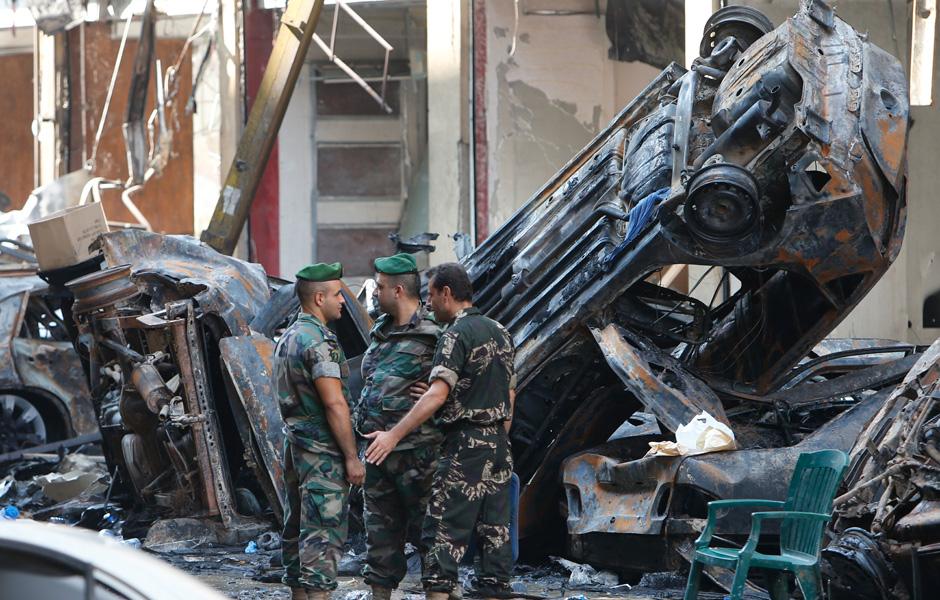 Next the same media outlets finessed the news about the terrorist bombs planted in Beirut’s southern suburb of Dahiyeh. The August 15, 2013 terrorist bombings in the neighbourhood of Al-Rouweiss (Al-Rweiss) were downplayed and, in a manner of speaking, legitimized by the media through their selective use of language. The attack on Al-Rouweiss come about a month after the July 9, 2013 terrorist attack on the neighbourhood of Bir Al-Abed. Both are densely populated neighbourhoods in Dahiyeh. The Institute for Public Accuracy (IPA) in the United States took quick notice of the biased media framing. IPA asked the following, on August 16, 2013, through the title of report: “Why Isn’t Beirut Bombing Called ‘Terrorist’? What’s Behind It?”
The Lebanese newspaper Al-Akbar is worth looking at to get a grasp of the biased media reporting that has been used to reframe the events as legitimate. It commented thus on August 17, 2013: “The Western media have double standards when it comes to ‘terrorism.’ Within hours after two bombs were detonated at the Boston Marathon last April, many in the media had christened it a ‘terrorist attack.’ Meanwhile, the August 15 bombing in Rouweiss that killed at least two dozen is a ‘blast’ that occurred in a ‘Hezbollah stronghold.’” As Al-Akhbar observes, the phrase “Hezbollah stronghold” plays a prominent role in giving the impression that the civilian neighbourhoods bombed in Beirut were armed barracks. Al-Akhbar even nicely sums up some of the biased titles used to describe the terrorist attacks:
Wall Street Journal: «Car Bomb Blasts Hezbollah Stronghold in Lebanon»
BBC: «Deadly Lebanon Blast in Beirut Stronghold of Hezbollah»
LA Times: «Massive Explosion in Beirut Rocks Hezbollah Stronghold»
Washington Post: «Bomb Explodes in Hezbollah Stronghold in Beirut, Injuring Dozens»
Reuters: «Over 50 Hurt as Car Bomb Hits Hezbollah Beirut Stronghold»
Associated Press: «Car Bomb Rocks Hezbollah Stronghold in Lebanon»
France24: «Car Bomb Rocks Hezbollah Stronghold in Beirut»
Mixed with the other narratives that the same media outlets are painting, the terrorist attacks are being tacitly portrayed as some type of legitimate retaliation. Readers are basically led to think that that the terrorist attacks in Dahiyeh were a military act against some type of Hezbollah base.
How the Mainstream Media Lies and Deliberately Places the Blame on Sunni Muslims
Sheikh Hassan Nasrallah, the secretary-general of Hezbollah, responded to the terrorist attack on Al-Rouweiss by categorically saying that the attacks were not the work of Sunni Muslims. He gave a speech saying that there were going to be those groups and individuals that would try to blame the terrorist attacks in Beirut on the Sunnis and said that these groups and individuals should be outright dismissed. In fact, he said that anyone that used this divisive logic was an “Israeli” and a partner in the goal of creating massacres. He made it clear that the individuals who planted the bomb did not represent the Sunni Muslims or the Arabs or the Syrians or the Palestinians. In a message to the US and its allies, he also said clearly stated that Hezbollah was aware that the intelligence services of the US and its allies had infiltrated various terrorist groups and manipulate them as tools.
Despite Nasrallah’s clarity, his words were totally changed by the same media outlets that were legitimizing the terrorist attacks in Beirut. The Israeli media, the state-run British Broadcasting Corporation (BBC), Al Jazeera, and Al Arabiya would blatantly fabricate the news and claim that Nasrallah “blamed the Sunnis” or try to manipulate readers into getting the impression that he did. The New York Times titled an August 16, 2003 article on the terrorist attacks as the following: “Hezbollah Makes Vow to Step Up Sunni Fight”. It never even mentioned that Nasrallah went out of his way to say that the people involved in the terrorist attacks were the tools of the US and Israeli government and not really Sunni Muslims. Instead Ben Hubbard focused on sectarianism in Lebanon and wrote: “In short, Hezbollah has more enemies than it used to have.”
The BBC wrote a similar article on August 16. It also used a grossly misleading title. The title being “Hezbollah blames Sunnis for bomb”. After a large number of people caught it, the BBC changed the title to “Beirut bomb: Hezbollah’s Nasrallah blames Sunni radicals”.
Exposing the Yellow Journalism at Work as a Tool of War
Aside from their direct or indirect links to these media outlets, even the political actors involved show that the way the news is reported is not isolated. Saad Hariri, the leader of the Future Party and a Saudi client, even responded to Hassan Nasrallah’s speech by saying that he had no right to designate what groups are terrorists. Hariri’s overlords in Saudi Arabia, on the other hand, refused to even condemn the terrorist attacks. This again is tied to the attempts to reframe the terrorist attacks in Beirut as a legitimate military act.
This type of yellow journalism that relies on misleading headlines that essentially say everything while the hollow articles carry and have little or no newsworthy material is not politically neutral. It is a weapon of war. All these articles are agitating for bloodletting in the Middle East, specifically between Shias and Sunnis. This type of journalism either directly or indirectly stokes the fires of sectarianism in Lebanon and the Middle East with the intentions of spreading sectarian animosity. This is why it deliberately ignores and refuses to even acknowledge the main points of Nasrallah’s speech that clearly pointed the finger at Israel and the US and said that the terrorist attacks had nothing to do with Sunni Muslims.
Related article
Breaking News! Seventh First Climate Refugees Discovered!
By Willis Eschenbach | WUWT | August 9, 2013
Well, my heart fell when I saw the recent BBC article which proudly proclaimed that the people of Kivalina were slated to become “America’s first climate change refugees” …
 Figure 1. The Alaskan native village of Kivalina. SOURCE: BBC
My heart fell for three reasons. First, because once again we are being presented with natural, expected changes in a shifting, unstable barrier island that are falsely claimed to be the result of “climate change”. Folks, barrier islands are just a pile of sand, and they erode, change, and alter their shape with every change in the ocean that built them. As the residents of the barrier islands of the US East Coast regularly discover (although apparently to their infinitely renewed shock and never-lessening total surprise and outrage), when a storm wanders through their neighborhood, the ocean is more than happy to totally reshape any barrier island at any time. The ocean thinks nothing of cutting a barrier island in two, it’s an everyday occurrence around the planet. And the ocean particularly messes with a location like Kivalina, which as you can see from the article is right at the main channel … where all of the water goes through with every tide, where runoff from a huge storm has to force its way out to the ocean, and where as a result the erosive forces are both the strongest and the most unpredictable.
Second, I was bummed that they’d built such a joke of a seawall, because as the photo clearly shows and the article mentions, the seawall there is having unexpected effects which are not all beneficial. As is common with such amateur attempts to tame the sea, it’s building up sand at one end and being eaten away and undermined at the other. No surprise there, except that this was the Army Corps of Engineers and it was built in 2008 … as I discuss below, they are way, way behind the times if that’s their idea of how to protect Kivalina.
The third reason I was saddened was that I immediately suspected the fine hand of some melanin-deficient historical BIA (Bureau of Indian Affairs) official in the original location of the village. The BIA has been the cause of huge grief for just about all of the people under its jurisdiction, so why not Kivalina? Plus, I doubted greatly that any group of nomadic northern hunters would choose to live right there, they’re generally much smarter than that.
When you look at the location of Kivalina on Google Earth, you have to say, what on earth were the BIA thinking? Never mind, they weren’t.
 Figure 2. Overview of the entire island on which Kivalina is located, in the winter, with ice on the ocean. Note the sediment being discharged out the channel by Kivalina, and the areas of reduced ice outside both channels through the barrier islands.
In my previous post on this subject, aptly titled the “Sixth First Climate Refugees“, it was pointed out that the Fifth First Climate Refugees in the Alaskan village of Shishmaref was located on a barrier island because they’d been moved to that spot by the US government. Years ago, there was a big push to stop the traditional residents from being nomads. Nomads drive governments nuts, you can’t control them. So the government very foolishly insisted the people settle in a terrible location, the barrier island where the town of Shishmaref is now located. Now, nomadic traditional people are far from stupid. You can assume that they were all too familiar with the fragility and changeability of barrier islands, because they only put temporary hunting camps on such islands, and wisely lived on the mainland behind the protection that such barrier islands until they were forced offshore. And the same forced resettlement was the story for the Sixth First Climate Refugees, those in Newtok, Alaska.
So when I saw the picture above, my first thought was, “BIA strikes again”. And sadly, my guess was right. The NANA, the Alaska Native Corporation of the northern peoples, tells the story of Kivalina on their web site:
HISTORY
For more than 1,500 years, the barrier reef where Kivalina is located has been a stopping-off place for seasonal travelers between the Arctic coastal areas and the Kotzebue Sound region. In 2009 human remains and artifacts were discovered near Kivalina representing the Ipiutak, a non-whaling Eskimo culture that was present in northwestern Alaska from the 2nd to 6th centuries A.D. The Ipiutak people inhabited the coastal region only in the spring and summer months, moving inland for the rest of the year.
According to elder knowledge, the original permanent settlement known as Kivalina was located on the coast of the mainland, a few miles north of Kivalliik Channel. The people of Kivalina, like the Ipiutak before them, utilized the barrier reef only as seasonal hunting grounds, making camp there in warm-weather months.The first recorded history of Kivalina occurred in 1847 when a Russian naval officer mistook a seasonal hunting camp at the north end of Kivalina Lagoon—a few miles from the location of modern-day Kivalina—as a permanent settlement, the name of which he logged as “Kivualinagmut.”
From 1896 to 1902, United States federal programs transported reindeer to the Kivalina area and funded the training of some residents as reindeer herders.
Kivalina was relocated to its current location in 1905 when the Bureau of Indian Affairs repeated the error of the Russian naval officer by mistaking a seasonal camp on the barrier reef for a year-round village. The BIA in short order built a school on the southern tip of the island and declared that any inhabitants of the barrier reef and surrounding region who did not enroll their children would be imprisoned. This order compelled the people of the original Kivalina as well as communities inland and north and south along the coast to migrate to the Kivalina created by the BIA.
Like I figured, the locals were far too smart to build permanent villages on a barrier island. They “utilized the barrier reef only as seasonal hunting grounds“. So the village is in such a dangerous, shifting location because white guys with guns threatened to throw anyone who didn’t move there in jail … charming.
Now, in response to the predictable erosion and change in the barrier island, the inhabitants of Kivalina sued ExxonMobil, claiming that CO2 was the cause of their problems … and wisely the Supreme Court threw it out.
The fact remains, however, that just as with Shishmaref and Newtok, the cause of the problems are human actions, although they have nothing to do with CO2. All three villages are in ridiculously unstable, shifting, dangerous locations for the same reason—they were rounded up by the BIA and forced to settle there.
So if I came from one of those villages, I’d want to bring suit as well … but I’d want to bring suit against the Bureau of Indian Affairs. Of course, I assume that in the usual Catch-22 fashion, you can’t do that, because the Feds are immune to most suits … grrr. I can see why the Kivalina folks are upset. I’m just afraid that they don’t have a lot of choices, and as a result they sued the wrong folks.
There is one possibility, however. Modern coastal engineering has progressed since the “just build a vertical wall” style of attempted protection represented in the picture above. The modern practice is to use cement-filled tubes of geotextile fabric that run perpendicular to the beach along the bottom of the ocean. These don’t attempt to stop the ocean, like the vertical seawall pictured above. Here’s the challenge.
Anyone wanting to change the shape of a barrier island first needs to realize that the lovely sand beach is not a solid object. It is a river of sand. Sand is constantly being picked up and moved by each and every wave, either up or down the beach. Now, if you put in a vertical seawall like the one shown in the picture, when the waves hit the seawall their energy is not dispersed. Instead, the energy is reflected down the beach. You can see the outcome in Figure 1.
First, note that in the more distant section of the island just beyond the far end of the seawall, the beach is much wider than after the start of the seawall. For the reason, look at the direction that the waves are striking. The problem is that instead of the wave energy being absorbed by the beach, it is being reflected to run parallel the seawall as a long-shore current. You can see how over time this long-shore current has scoured away the sand from the far end of the seawall, and it has deposited it at the near end.
And eventually, the seawall will be undercut entirely, because a vertical seawall also directs some of the wave energy straight downwards at the base of the wall. This scours the sand out directly under the seawall itself, and will eventually lead to its destruction and collapse. The people up in Shishmaref the Fourth First Climate Refugees, have exactly the same problem. There, a poorly designed seawall has shifted the wave energy to where it’s now eating away the town itself. Seawalls just move the wave energy parallel to the coast.
With the modern practice, however, no such vertical seawall is built. Here’s a picture of such an installation, just after construction:
 Figure 3. Three concrete-filled tubes of geotextile fabric, two directly on the sand, and a third one on top of those two.
Note that instead of going along the shoreline, the concrete-filled tubes go perpendicular to the beach, straight offshore into deeper water. Now, remember that a beach is essentially a river of sand. Here’s the important fact—the amount of sand that can be picked up by the water depends entirely on the speed of the water. Fast-moving water can carry more sand than slow-moving water.
So as a corollary of that, if you can slow down the water that is moving the river of sand along parallel to the shore, it will drop its load of sand, and your beach will fill in and stabilize further out into the ocean. And that’s what the tubes full of concrete do. They don’t try to stop the water. They just slow it down a bit, as though the water stubs its toe whenever it goes over one of these tubes. When it slows, it drops its sand, filling in the area in between parallel tubes. A year or so after the picture above was taken, the concrete-filled tubes you see were totally buried in the sand, and the beach extended out well beyond the point of land. Counter-intuitive in a way, because there’s no seawall parallel to the coast at all … but it works like a champ, because it works with nature, not against it like a vertical seawall tries to do. Here’s a before-and-after picture of a larger project:

Figure 4. The waves were undercutting the bluffs, threatening the highway running along the top of the cliff. The system shown in Figure 3 was used all along the coastline. You can see parts of a couple of the concrete-filled tubes perpendicular to the land near the foot of the bluff at the lower right in the second picture.
So while the existing seawall is failing, that doesn’t mean that the folks in Kivalina are out of options. Here’s the link to a main company doing this type of installation, Holmberg Technologies. The pictures above are from their website. (I have no connection with them.) If I lived in Kivalina, I’d get all my ducks in a row tomorrow, and I’d have Holmberg’s on the phone tomorrow. I’d pitch it as Holmberg’s chance to a) get some great publicity, and b) to help to right a historical wrong. The Native Corporation might even be such that Holmberg could get a tax write-off for any contributions, I’d investigate that first. Then I’d call Holmbergs, and offer that the village would provide all the labor, and pay for the concrete, if Holmberg would do the coastal engineering and provide the special geotextile fabric tubes and oversee the project. I’d offer to put their name up all over the project, and mention them prominently in all of the publicity. Can’t hurt to ask … and if they say yes, then I’d hit up the nearest concrete company to provide the concrete as a donation for the same reason. Hey, why not? Could happen. You often don’t get what you ask for, I know that … but it’s rare to get something you don’t ask for, so it’s sure worth a few phone calls. Even if Holmberg says no, I’d get an estimate from them and a plan, asking them for their best possible rates for the reasons stated above, publicity and righting a wrong. Then I’d go out and raise the money, somewhere, somehow, to hire them to do it. See if Crowley Marine or another tug company might contribute towards barging the materials there. Looking at the beach in Figure 4, you can see that by Holmberg’s standards Kivalina would be a fairly small project … just in the middle of nowhere.
Now, the best option is still for the village to move, because no matter what they do to their island, it’s still just a bog-standard barrier island, which means a shifting pile of sand in an incredibly powerful ocean. There are no guarantees in that situation, even with the best coastal engineering advice on the planet.
For example, note in Figure 2 that at the ends of the island where Kivalina is located, both of the channels are located directly across from the main river outlet on the mainland. This is a common situation with barrier islands. Gaps in the islands across from the main rivers allow flood waters running of the land to go straight out to sea.
Now, look at all of the abandoned channels in the mainland … and consider that in the past those have been the main channel, and could be again. Not “if” but when that happens, it will likely cut through or greatly change Kivalina’s island. So staying is problematic in the long term.
But given the cost of moving the village all at once, If I Ran The Zoo I think what I’d do is first hustle up the donations and the $ to install the new concrete-filled tubes to build up the protective beach on the seaside of Kivalina. That will buy some time. Then I’d pick a good spot for the village on the mainland, maybe even the spot of the ancestral village if that’s a possibility. I’d do all of the necessary local ceremonies to bless the choice, get everyone involved so it’s a true community grassroots decision. I’d divide it up into lots based on what the locals say is fair, plenty of different ways to do that, and offer them to the villagers to move to. There’s got to be better land owned by the tribe or controlled by the BIA somewhere in the area. And that way, over the next decades the population could slowly shift to their new homes, without an immediate costs of millions of dollars.
But all in all, there’s no real good answer. Tragically, it’s more of the usual kind of pain and suffering that trails the actions of the BIA like a bad smell. They have been highly corrupt and totally inefficient since their inception. They’ve screwed their “wards” out of millions and millions of dollars. They’ve taken children from their parents and forced them to stop speaking their native languages. The list of their misdeeds is very long, broken treaties and false promises and government obfuscation and embezzlement at each new page in their sordid history. Every Indian or Eskimo I’ve ever known has said that the Bureau of Indian Affairs is nothing but a nest of crooks and thieves, and in my reading I’ve never found anything to contradict that in the slightest …
Anyhow, that’s the story of the Seventh First Climate Refugees. Turns out that they aren’t climate refugees at all, they are BIA refugees. Just another in a long parade of Alaskan and other tribes who have been shafted by the BIA, forcibly settled in a totally unsuitable location, and as a result left with few good options.
Best regards to all, and as a melanin-deficient person myself, other than my poor ideas about fixing the situation, all I have to offer to the good people of Kivalina are my apologies for the historical actions of people who looked like me, and my sincere wishes for success.
PS—BBC, your climate reporting is pathetic. Doesn’t anyone there think to check up on some dewy-eyed reporter gushing on about the tragic fate of the latest batch of pseudo-refugees? Missing the facts in this story would have been understandable a decade ago, but in 2013, you guys are a running joke. Something on the order of …
How many BBC climate editors does it take to change a light bulb?
No one knows, it appears their lights went out years ago and haven’t been replaced since …
Related articles
- PHOTOS: The Disappearing Village (huffingtonpost.com)
- The Inhabitants of Kivalina are the First US Climate Change Refugees (strangesounds.org)
- America’s first climate refugees (thedailystar.net)
- Alaskan Village Underwater In a Decade: America’s First Climate Change Refugees (PHOTOS/VIDEO) (hngn.com)
- Kivalina: America’s first climate change refugees: Hundreds forced to flee their Alaskan village before it disappears underwater within a decade (thisismoney.co.uk)
- Kivalina: America’s first climate change refugees: Hundreds forced to flee their Alaskan village before it disappears underwater within a decade (dailymail.co.uk)
- What is Climate Justice? (triplepundit.com)
- This Tiny Alaskan Village Will Be Underwater In Just 10 Years (fastcoexist.com)
Anger at BBC’s insistence that all of Jerusalem is Israeli city
MEMO | July 25, 2013
The BBC’s insistence on describing Jerusalem as an Israeli city, despite such a status not being recognised under international law, has been condemned by Palestine Solidarity Campaign (PSC).
In a ruling delivered this week, the BBC Trust appears to have accepted Israel’s facts on the grounds, namely that Jerusalem is a united Israeli city.
Writing to PSC, the Trust quotes the BBC’s Senior Editorial Strategy Advisor, Leanne Buckle, in her assessment of the BBC’s decision to describe Jerusalem as an Israeli city.
The Trust writes: “The advisor [Buckle] acknowledged that Israel’s sovereignty over the whole of Jerusalem was not recognized under international law. However, she considered that Israel had de facto control over the entire city in a political, administrative and military sense. She also noted that Jerusalem was administered as a single entity by the Jerusalem municipal authority which made no distinction between East and West.”
Based on this, the Trust has said it will not consider a complaint by PSC that BBC journalists are breaching the BBC’s Editorial Guidelines on Accuracy when they refer to Jerusalem as an Israeli city.
Under international law, only West Jerusalem is considered to be under Israeli de facto control, not the whole of Jerusalem. East Jerusalem is described by the UN as Occupied Palestinian Territory that has been illegally occupied and annexed by Israel.
In recent months, items on the BBC’s Today and The World Tonight programmes have described the whole of Jerusalem as being an Israeli city. The country profile page for Israel on the BBC website states that Israel’s seat of government is ‘Jerusalem’.
To date, the BBC continues to insist that it will not change this entry to ‘West Jerusalem’.
Sarah Colborne, Director of PSC, said: “The BBC’s refusal to distinguish between East and West Jerusalem flies in the face of international law and international opinion.
“Instead, Leanne Buckle’s comments reveal that Israel’s illegal creation of facts on the ground appear to have been accepted in BBC newsrooms and by BBC senior management. What’s more, the BBC seems willing to elevate this illegality above international law in its reporting. This is extremely disturbing.”
Colborne added: “The status of Jerusalem is a sensitive issue, and all reporting relating to it should be subject to the highest standards of accuracy by responsible news organisations. The BBC appears to have thrown accuracy out of the window, along with international law. Moreover, it seems to have airbrushed Palestinians and East Jerusalem out of the picture.”
“All we’re asking is that the BBC inserts the word ‘West’ before ‘Jerusalem’ when referring to the part of the divided city that is recognised under international law as being under de facto Israeli control. It’s a question of accuracy. Why is the BBC fighting so hard against it?”
Related articles
- Siam family from Sheikh Jarrah, struggling against eviction order and not giving up (palsolidarity.org)
- New Israeli Ethnic Cleansing Policy in Jerusalem (ramyabdeljabbar.wordpress.com)
Featured Video

Chinese jet fuel and the myth of energy independence
or go to
Aletho News Archives – Video-Images
Book Review
Former Insiders Criticize Iran Policy as U.S. Hegemony
By GARETH PORTER | CounterPunch | February 27, 2013
“Going to Tehran” arguably represents the most important work on the subject of U.S.-Iran relations to be published thus far.
Flynt Leverett and Hillary Mann Leverett tackle not only U.S. policy toward Iran but the broader context of Middle East policy with a systematic analytical perspective informed by personal experience, as well as very extensive documentation.
More importantly, however, their exposé required a degree of courage that may be unparalleled in the writing of former U.S. national security officials about issues on which they worked. They have chosen not just to criticise U.S. policy toward Iran but to analyse that policy as a problem of U.S. hegemony. … continue
Blog Roll
 Aletho News
- What is fueling unrest across the EU?
- Why no power can undermine Iran’s eternal dominance over the Strait of Hormuz
- Is The War Against Iran Over?
- Iran war will leave long-term ‘scar’ on Wall Street, investors warn
- How Iran decimated US power projection in West Asia: Military lessons of 40-day war
- Iran’s report details US-Israeli war crimes in targeting schools, hospitals, livelihoods
- NATO’s Slow Fracture: How Trump’s Iran War Exposed the Instrument of Hegemony
- Chinese jet fuel and the myth of energy independence
- Ukraine Sea Drone Fired From Libya Hit Russian Tanker in Mediterranean
- IRGC: Iranian forces launched no attacks during ceasefire hours
- If Americans Knew
- DNC Shoots Down Resolutions Calling Out AIPAC and Limiting Arms to Israel
- TCN: Is Israel Blackmailing President Trump?
- Israel killed at least 303 Lebanese yesterday – who were they? Daily Update
- Amnesty: Urgent – Protect Lebanese civilians from brutal escalation in Israeli attacks
- Is The War Against Iran Over?
- Inside the Israeli army’s propaganda wing
- Hundreds of Gaza Amputees Stranded in Legal Limbo
- The gallows law: Israel moves toward executing Palestinian children
- Tucker Carlson: The Path to Peace requires ending ‘special alliance’ with Israel
- This is ceasefire? Israel’s biggest massacre yet in Lebanon, another journalist killed in Gaza – Daily Update
- No Tricks Zone
- An Inconvenient Tree: Uncovered In Alps… Europe Much Warmer Than Today 6000 Years Ago
- New Study Reports A 60% Slowdown In Greenland’s Ice Loss Rate In The Last Decade
- Low Intensity Tornado Wrecks Major Solar Farm, Creating A Potential Toxic Dump
- New Study Finds Warming Saves Lives…Cold Temperatures 12 Times More Deadly Than Excess Heat
- German Science Blog Accuses PIK Climate Institute Of Hallucinating Climate Tipping Points
- Devastating Assessment Of Comirnaty Vaccine By Former Senior Pfizer Europe Toxicologist
- New Study: CO2 Is ‘Effectively Negligible’ As An Explanatory Climate Change Factor Since 2000
- Former Pfizer Toxicologist Dr. Helmut Sterz Tells Bundestag Hearing Pfizer Vaccine Should Have Never Been Approved
- Energy Expert: Germany’s Nuclear Phaseout Was A “500 Billion Euro Mistake”
- New Research: South Australia’s Mid-Holocene Sea Surface Temperatures Were 4°C Warmer Than Today
 Aletho News