I am unreservedly delighted at Jeremy Corbyn’s election. He made a quite excellent speech, specifically rejecting an attack on Syria, marketization in the NHS and the new anti-union legislation. Hopefully the scale of his victory will give pause to the Blairites who will realise they are not as all-important as they thought.
There is no doubt whatsoever that the vast majority of the Labour establishment, as represented by the people in that hall, are hostile to Corbyn. The question now is whether Corbyn can overhaul party mechanisms in such a way as to bring the opinions of the membership to bear on policy and override that right wing “elite” who have been in charge of the party.
The first few weeks are key. Most Blairites are above all careerists. If they think Corbyn can carry through his personal dominance into control of policy and party mechanisms, then many of the Blairites will look at their constituency members and suddenly discover they had left-wing principles after all. If the Blairites think that a resistance and undermining campaign against Corbyn will succeed (and there will certainly be one), they will go for that. In short, most “Blairites” are out for themselves and will join what they perceive will be the winning side Corbyn’s winning margin, and the fact he won overwhelmingly among full members, gives him a very strong base.
I have shared anti-war and pro-Palestinian platforms with Jeremy, and have the greatest respect for him. I also expect that he will have the strength to stand against both the smothering blandishments and the attacks of the neo-con establishment. The “Corbyn’s election is a disaster” narrative is being pushed by the BBC relentlessly in every question and comment – for example they just asked Ed Miliband “In retrospect was it a mistake for you to resign the day after the election?”, the clear sub-text being that Corbyn’s election was undesirable.
Ever since I realised that Blair’s New Labour was entirely subservient to the neo-con agenda I have regarded Labour as the enemy, as a fake opposition so close to the Tories as to make no difference. I viewed its leadership as utterly unscrupulous careerists fully signed up to a vicious pro-wealthy agenda at home and completely subservient to US/Israeli foreign policy abroad. This new careerism tied in very nicely with a pre-existing rotten borough corruption in Scotland and Northern England. I utterly detested the Labour Party.
So it is difficult for me to find the Labour Party led by a man whom I know, much respect, and with whom I disagree on almost nothing except Scottish independence. I also continue to believe that once consolidated, Jeremy will make it clear he has no hostility to Scottish independence and will support a second referendum whenever the Scottish government wants it.
But the problem is that the Labour Party hierarchy, and particularly their parliamentary party, is still full of people who are neo-cons, Red Tories, appallingly corrupt, careerists and in several cases war criminals. To know what attitude to adopt to the Labour Party must depend on how the battle for control of the party pans out. The scale of Corbyn’s victory, and the total rejection of the direct interference of Tony Blair, give Corbyn a great start. Those Blairite bastions – the Guardian and the BBC – are spluttering incoherently.
Jeremy Corbyn has just won the battle for party leadership. But the battle for control of the Labour Party just started.
September 12, 2015
Posted by aletho |
Mainstream Media, Warmongering | BBC, Jeremy Corbyn, The Guardian, UK |
Leave a comment
It is an astonishing fact that, despite near universal recognition now that the war in Iraq was a disaster, no major British social institution is headed by a single one of the majority of the population wo were opposed to the war.
Every Cabinet Minister actively supported the war. Of the fifteen Tory MPs who rebelled and voted against the war, not one is a minister. Civil servants officially have no politics but privately their opinions are known. There is not one single Permanent Under Secretary of a UK government department who was known to be against the war and most were enthusiasts. Simon Fraser, PUS at the FCO, was an active Blairite enthusiast for the war. Though no Blairite, the Head of MI6 Alex Younger was also an enthusiast.
The BBC was of course gutted following its revealing of the truth about Iraqi WMD, and the subsequent murder of David Kelly. Following the ousting of Greg Dyke, both Governors and Directors-Generals have been known supporters of the war. Of the 107 bureaucrats in the BBC who earn over 100,000 pounds pa, insiders estimate that only five were opponents of the war. Craig Oliver – who has now left the BBC for Cameron’s media operation – and James Purnell are absolutely typical of the BBC Iraqocracy.
Every current editor of a UK national newspaper supported the Iraq war. At the time of the war there was one editor opposed – Piers Morgan – who subsequently became a derided and marginalised figure. Not only are the editors firmly from the neo-con alliance, but the high profile commentators who cheered on the war – David Aaronovich, Nick Cohen, Melanie Phillips, John Rentoul, Rod Liddle etc. – have all seen their careers flourish. None has suffered from their appalling lack of judgement. There is no similar raft of commentators who were against the war who enjoy such constant media promotion and massive salaries. Many, like Peter Oborne, have suffered unexpected career glitches. There is no head of a major TV channel in the UK who was against the war in Iraq.
The theme runs through all the public professions. Of the hundreds of academics who took firm positions against the Iraq War, I cannot find a single example who went on to become a University Vice-Chancellor or Principal. By contrast actual war criminals Richard Dearlove and Valerie Amos were parachuted into academic leadership posts. The Chiefs of Staff of the armed forces were all true believers, compared to the massive scepticism that existed among senior officers.
The Iraq test even extends into the heads of institutions apparently quite unrelated, such as City of London banks and insurance companies. There are a tiny number of heads of FTSE 100 companies who were against the war.
It is not that there is an Iraq test. It is that Iraq is the touchstone for adherence to the neo-liberal consensus. All these professionally successful people share a number of attitudes, of which support for the Iraq War is a good indicator. There is a very strong correlation between support for the Iraq War and fierce Zionism. But there is also a strong correlation between support for the Iraq War and support for austerity economics. The strongest correlation of all lies in support for the Iraq War and for “business-friendly” tolerance of corporatism, TTIP, multinational tax avoidance, low taxation and marketization of public services including in education and health.
To return to where I started, the quite extraordinary thing is that there is a near-universal recognition in wider society that the Iraq War was both completely unjustified and a dreadful strategic blunder. Yet its support is a major pre-condition for membership of the governing elite.
The answer of course lies in its value as an indicator for a broad range of neo-liberal consensus attitudes. That is why both the SNP and Jeremy Corbyn provide such a threat to the Establishment, through denying those attitudes. The fascinating thing is that the SNP and the Labour Party could be the only public institutions in the UK of any note with an anti-Iraq War leadership. The significance is that, in slightly different ways, both the prominence of the SNP and of Jeremy Corbyn are the result of a public revolt which the Establishment has been trying, absolutely desperately, to cut off.
Ed Miliband did not actually vote against the Iraq War, contrary to popular myth. Having both the Labour and SNP parties led by people who reject the raft of values symbolised by the Iraq test, who have broken through the depleted uranium ceiling, is a massive, massive threat to the meritlessocracy. Institutional control appeared to be complete and impermeable. Suddenly they face the danger of the opinions of ordinary people carrying weight. Expect the media control mechanisms to whir into still greater overdrive.
September 1, 2015
Posted by aletho |
Economics, Ethnic Cleansing, Racism, Zionism, Militarism, Timeless or most popular, War Crimes | BBC, Iraq War, Jeremy Corbyn, SNP, UK, Zionism |
Leave a comment
The propaganda machine in the west is once again ramping up and spewing out one false claim after another about the shoot down of MH17 last year over eastern Ukraine and each story is more absurd than the one before it. On the 13th of August the British newspaper, mistakenly called The Independent, made the bizarre claim that Russia has “stoked tensions with the West by burning Dutch flowers in what is regarded as a political statement over the investigation into the Malaysian Airlines flight disaster headed by The Netherlands.”
The Independent states that its source for this garbage rests on unnamed “critics” and then goes on to repeat the NATO party line that Russia is trying to block the facts from coming out.
Just two days before this the BBC claimed a leak from the Dutch investigation indicated Russian missile parts were found at the site. However they failed to mention later that Dutch investigators refuted this mysterious leak and stated their investigation did not conclude that at all. Both these stories made sure to repeat that Russia had blocked a UN tribunal from being formed to look into the crash and punish those responsible.
Dr. Alexander Yakovenko, the Russian Ambassador to the UK and former deputy foreign minister, captured the situation in this statement made on July 31, 2015, in regard to the call for a UN tribunal,
“Why the rush? Is it to help the investigation, or rather to replace it? Progress towards justice must be seen. So far, we have seen nothing. Our partners preferred to conduct a vote that is impossible to explain by any other motive than seeking a fresh pretext for pointing a finger at Russia. It is only to be regretted that the unity and authority of the Security Council has once again become hostage to political ambitions having nothing to do with either justice or a peaceful resolution of the crisis in Ukraine in its entirety. For its part, Russia will continue to seek both.”
He went on to correctly point out that the only ones blocking the findings of the investigation from coming out are the NATO countries and its ally Australia who refuse to release any of the findings of the investigators and have delayed the report until October of 2015. Russia is not blocking anything. It was the first country to demand a full and independent investigation into the matter and, to ensure that, helped to pushed through Security Council Resolution 2166 on July 21, 2014 that deplored the incident, stressed the need for a full, thorough and independent investigation in accordance with civil aviation guidelines, called for the involvement of the International Civil Aviation Organization, called for securing the crash site and safety of investigators and demanded that those responsible be held accountable.
What did the Americans and their puppets in Kiev do? Nothing except to launch an immediate and intense propaganda campaign against Russia going so far as to pin responsibility on President Putin personally. They even claimed that they had evidence. But they have produced none. Russia asked them for this purported evidence multiple times and each time they were met with silence followed by another volley of propaganda aimed at confusing the western public and covering up the fact that they do not want the Dutch report released for if that investigation had evidence that Russia was involved we can be sure it would have been plastered all over the mass media long ago, instead of these small leaks that drip out on a regular basis to keep the pot boiling.
While NATO engaged in propaganda games Russia insistently called for a transparent, independent and honest investigation, quickly supplied to the investigators its satellite and radar data, eyewitness reports, and technical information regarding Buk missile systems and offered to assist in the investigation. The Americans have said nothing about any of this information of course because all of it points to their allies in Kiev being responsible for the shoot down and because the United States was involved or became complicit by protecting its allies from facing responsibility for their actions.
As for the MH17 tribunal demanded by the probable culprits the United States and its dependencies in NATO and Kiev, Russia was correct to reject that demand and correct to veto the draft resolution.
There is no doubt whatsoever that the push by NATO countries for a UN tribunal to investigate and prosecute those responsible for the shoot down was an intentional provocation against Russia. There was no other purpose for this NATO initiative than to use it to demonize the Russian leadership, to increase the negative war propaganda being put out by the NATO alliance and ultimately to use it as justification for further aggression against the peoples of east Ukraine and Russia.
There must be no doubt in any reasonable person’s mind that the only result of the creation of such a tribunal by the Security Council was to be an indictment against President Putin himself accusing him of some type of command responsibility. Once Putin was indicted as a war criminal, the anti-Russian propaganda in the west would increase beyond even the intense levels it now has reached.
We saw what happened to President Milosevic of Yugoslavia when the Yugoslav tribunal indicted him with war crimes at a point during the NATO attack in 1999 when the French and Germans were looking for a political solution. The US driven indictment, arranged through their agent Louise Arbour, effectively killed a political solution since as Arbour stated, and I paraphrase, “you can’t negotiate with a war criminal.”
The same happened to Muammar Gaddafi. The International Criminal Court, again through its US marionettes in the prosecution, labelled him a war criminal and used it to justify their destruction of Libya. Both Milosevic and Gaddafi ended up dead at NATO’s hands.
What’s more the UN Charter does not give the Security Council the right or jurisdiction to create these ad hoc tribunals and in fact this possibility was explicitly excluded when the International Court of Justice was created which has very limited jurisdiction and none over criminal matters. Of course tribunals have been created as a matter of fact despite this problem but an illegal precedent is still illegal no matter how many times it is repeated.
It is clear that the ad hoc tribunals previously set up for Yugoslavia and Rwanda were set up during a period when Russia was under the sway of President Yeltsin and others willing to act in US interests without caring about the implications for Russian and world interests. Russia, and China lost all control over the funding, staffing and running of these tribunals from the very beginning which, from the personal experience of this writer and other defence counsel, are controlled at all levels by western intelligence assets.
The indictments and evidence at these tribunals are concocted against selected accused for three reason; to defame the leaders targeted, to justify the western aggression against these countries, and finally to cover up the real role of the west in these wars.
A further problem with the proposed MH17 tribunal was the claim that it was a matter under Chapter VII of the UN Charter, that is, a matter of international peace and security. The fact that the other ad hoc tribunals have been created under Chapter VII reveals their true political nature. But in the case of MH17, no such argument can be validly made since there has never been an example of a plane being brought down in any circumstances that has triggered the use of Chapter VII of the UN Charter. No call was made by anyone to create a UN tribunal with regard to the downing of the Iranian, Libyan and Korean airliners or even the downing of the plane carrying Dag Hammarskjold, the UN Secretary General, in 1961. It seems when western interests might be affected, the less that is known, the better.
But there was another problem with the proposal that reveals its true political nature. A court can only try those accused of a crime determined to have taken place and can only try accused against whom there is evidence. In regard to MH17 there is the NATO propaganda on one side claiming Donbass militias were involved, aided and abetted by Russia, but without any evidence of this being produced, and, on the other hand, evidence supplied by eye witnesses, air traffic controllers, Ukrainian military pilots and Russian radar plots that indicate that it was more likely shot down by a Ukrainian government Sukhoi jet fighter. In any case, whatever the facts really are, the investigation is not complete and not complete because the NATO alliance refuses to release information that is necessary to make a determination as to who is responsible and what their motives were.
Since NATO is not willing to offer this information to investigators now nor to make it public why would they do so if a tribunal were created? They would not. They would have used that tribunal as a forum to bash Russia, fabricate evidence and used it to justify even more western aggression.
The proposal was clearly a trap for Russia and so its veto of July 29th was welcome news. Russia will continue to face criticism from the usual suspects in NATO and more ravings by Samantha Power in the Security Council and more bizarre stories in the western press that it is trying to stop “justice” or is afraid of the investigation, but better to treat these false accusations with a dismissive wave of the hand than to have taken the bait and be faced with the constant harassment, and injustice that would have surely followed if such a tribunal had been approved.
But the constant propaganda clearly signals the intent of the NATO countries and that is to try to overthrow the government of Russia one way or another. Russia avoided the NATO tribunal trap, but there is no doubt that other traps will be set and one of them and perhaps the most important is the propaganda trap we in the west must learn to recognise and avoid so that we do not fall into the worst trap of all, supporting aggression that profits the few but risks the nuclear annihilation of us all.
Christopher Black is an international criminal lawyer based in Toronto, he is a member of the Law Society of Upper Canada and he is known for a number of high-profile cases involving human rights and war crimes.
August 25, 2015
Posted by aletho |
Deception, Mainstream Media | BBC, MH17, NATO, Russia, Ukraine |
Leave a comment
BBC’s HARDtalk program interviewed the former president of Georgia and fugitive from Georgian justice, Mikheil Saakashvili, on July 15. Saakashvili was appointed last month to the post of “governor” of the region of Odessa by Ukrainian president Petro Poroshenko. While some important questions were asked of him–the criminal charges he faces in Georgia, his appointment as a foreigner to govern one of Ukraine’s most important cities and industrial regions–questions on other subjects were avoided. These included questions about the Odessa Massacre of May 2, 2014, the subsequent failure of authorities to properly investigate, the vigilante justice currently prevailing in the streets of Odessa and the plans of the Kyiv government to privatize the remaining state-owned industries and services of Ukraine, many of which are located in Odessa.
BBC also avoided questioning Saakashvili over his role as then-president of Georgia in provoking a war in South Ossetia in 2008, including his decision to intensely shell the capital city of the territory. (The BBC host voiced the Western interpretation that Saakashvili’s unfortunate adventure in 2008 led to “Russian occupation” of former regions of the country, including South Ossetia and Abkhazia.)
July 17, 2015
Posted by aletho |
Mainstream Media, Warmongering | BBC, Saakashvili, Ukraine |
Leave a comment
The corporate media in both the UK and US are attempting to portray the Iranian desire to have the arms embargo lifted, as a new and extraneous demand that could torpedo the nuclear deal. This is an entirely false portrayal.
The issue has been included in the talks since, quite literally, the very first Iranian position document. And there is a reason for that. It is absolutely part and parcel of the issue and in no way extraneous to it. If there were any real journalists employed by the corporate media, that is obvious right on the face of UN Security Council Resolution 1747 of 2007 which imposed the arms embargo. The sole and exclusive reason given for the arms embargo is Iran’s nuclear enrichment programme. And it specifically states that, once the nuclear proliferation issue is resolved, the embargo will be lifted.
Paragraph 13 reads:
(b) that it shall terminate the measures specified in paragraphs 3, 4, 5, 6, 7
and 12 of resolution 1737 (2006) as well as in paragraphs 2, 4, 5, 6 and 7 above as
soon as it determines, following receipt of the report referred to in paragraph 12
above, that Iran has fully complied with its obligations under the relevant
resolutions of the Security Council and met the requirements of the IAEA Board of
Governors, as confirmed by the IAEA Board;
It is the United States, not Iran, which is introducing extraneous factors, banging on about Yemen, Iran and Hezbollah, which are nowhere mentioned in the Security Council Resolutions.
The way this is being reported in the media is the exact opposite of the truth. The United States is attempting to welch on a deal which was not only open, but forms the very text of the security council resolution. None of the BBC’s highly paid analysts, reporters, or guest commenters is capable of noting this basic fact.
July 13, 2015
Posted by aletho |
Deception, Mainstream Media, Warmongering | BBC, Sanctions against Iran, UK, United States |
Leave a comment
A truly disgraceful piece of distortion from the BBC’s Lyse Doucet.
The title of this film is a clear hint of the propaganda to come, based, as ever, on the fatuous ‘two sides’ narrative. There was no ‘war’, only another orchestrated massacre, a campaign of civil terror, in order to maintain Israel’s wicked, illegal siege. From the first minute of this shoddy film, one just wants to urge Doucet: tell the truth, give the context!
Yes, children suffer and die, but why is this happening? Why have so many Palestinians been murdered? Why have over 500 children been slaughtered? Why are an entire population, notably the children, so deeply traumatised? Tell the truth, provide the context!
Israel is the aggressor force. Gaza is the key target. It lies in ruins. Yet, this truly despicable film affects to argue that Sderot is part of the same ‘war zone’.
Continual reference is made to Israel targeting populated areas from where, it’s claimed, Hamas were launching rockets, just part of the loaded message that Hamas are largely responsible for the carnage.
A key section of the film is given over to Hamas fighters, youth camp training and wielding weaponry. But there’s not a single frame of an Israeli soldier, or the mass military operation engaged in the attempted annihilation of Gaza’s people. There’s no questioning, either, of how Israel has socialised so much of its youth to hate and fear Palestinians.
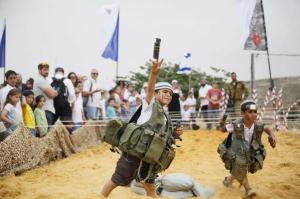 Standing at a Hamas training camp, Doucet laments: “For the outside world it’s hard to comprehend why parents would put children in situations like this.” But there’s no exploration of how Israel as a militarist, occupying state has conditioned so much of its own population to join in the historic oppression and mass murder of Palestinians. Indeed, the word ‘occupation’ is never used.
At one point, Doucet sits with the smiling Gazan kids and asks one of them: ‘Why do you want to be a journalist?’ The child replies in lovely innocence: ‘So I can tell people what’s going on in wars like this one’. If only Doucet could aspire to that same basic aim. One might ask Doucet, in turn: Why do you want to be a stenographer rather than a journalist?
We see more pictures of Gaza’s ruins. Doucet says: “The donors promise a lot. But politics on all sides gets in the way.” This is the extent of her ‘explanation’ of the carnage Israel has caused, the devastation it’s unleashed, its refusal to help rebuild.
Doucet’s grating commentary, over inappropriately lilting music, continues, with affected questions on whether the hate and suspicion can ever be overcome.
A scene of more families coming to settle in Israel’s border locale raises not a word of comment on the nature of Israel’s land appropriation, historic displacement of people and enduring occupation. The indoctrination of Israeli children in defending this is never mentioned, nor is the stark privilege of Israeli kids against the appalling conditions and despair of the children in Gaza. Doucet just smiles and says nothing of the staggering disparities.
I hope the families that Doucet interviewed in Gaza get to see how they’ve been used and exploited in this shabby, deceitful film.
An end credit announces that both Israel and Hamas could be indicted for war crimes, and that: ‘In May and June there were more rounds of rockets fired from Gaza and Israeli airstrikes’, the clear inference, as throughout this deeply-loaded film, that Israel is always ‘responding’ to provocative weaponry.
This is one of the worst examples of ‘two sides’ reportage ever shown. Israel couldn’t have hoped for a greater piece of mitigating hasbara. Doucet’s film is one of the most shameful pieces of ‘war journalism’ ever put out by the BBC.
She doesn’t lack human empathy for the suffering Palestinian kids, such as little Syed, still haunted by the murder of his brother and three cousins on Gaza’s beach. What she lacks, much more profoundly, is a sense of compassionate duty to say why these appalling things happened, and are still happening, to name the principal perpetrators, to be a witness for truth and justice.
Doucet’s film is an abuse of journalism, and, in its pretentious evasions, an abuse of Gaza’s suffering children.
July 9, 2015
Posted by aletho |
Deception, Ethnic Cleansing, Racism, Zionism, Film Review, Mainstream Media, Warmongering | BBC, Gaza, Israel, Lyse Doucet, Palestine, Zionism |
Leave a comment
There’s a massive spike in cancer cases in Argentina that is strongly associated with glyphosate-based herbicides. These herbicides are a huge earner for agribusiness. But don’t worry, Patrick Moore says you can drink a whole quart and it won’t harm you. Who needs independent testing? He says people regularly try to commit suicide with it but fail. They survived – just. So what’s the problem? Perfectly safe. Patrick Moore says he is ‘not an idiot’. So he must be right. Right?
Anyway, all that scare mongering about GMOs and glyphosate is a conspiracy by a bunch of whinging lavishly funded green-blob types. Former UK environment minister Owen Paterson said as much. He says those self-serving anti-GMO people are damaging the interests of the poor and are profiting handsomely. They are condemning “billions” to lives of poverty.
He voted for the illegal invasion of Iraq, which has led to the death of almost 1.5 million Iraqis. His government has plunged millions into poverty and food insecurity in the UK. He now wants to help the poor by giving them GM courtesy of self-interested, corporations and their lavishly paid executives. What was that about self-serving, lavishly funded groups? As a staunch believer in doublespeak, hypocrisy and baseless claims by self-appointed humanitarians with awful track records, Paterson’s sound-bite smears and speeches are good enough for me.
So with that cleared up, hopefully we can move on.
Then there’s all that ‘anti-capitalist twaddle’ (another pearl of wisdom from Patrick Moore) about smallholders being driven from their lands and into poverty due to a corporate takeover aimed at expanding (GM) chemical-intensive agriculture. I showed Mr Moore a paper by an economics professor who had studied the devastation caused by the above in Ethiopia. That’s where the ‘anti-capitalist twaddle’ retort came in. As I’m also a staunch believer in the power of baseless, ill-informed abuse, I was once again convinced.
What about all that rubbish about GM not having enhanced the world’s ability to feed itself? You know, all that stuff about the way it has been used has merely led to greater food insecurity. Nonsense. I watched a prime-time BBC programme recently. Some scientist in a white coat in a lab said that GM can feed the world. He’d proved it in his lab. In reality (not in a lab), the fact it hasn’t done anything of the sort over the past 20-odd years doesn’t matter. He wore a white coat and held GM patents, so he definitely knows best!
I once read that industrialised agriculture is less productively efficient than smallholder agriculture that feeds most of the world. And then I read that the world can feed itself without GMOs. According to all of this, it is current policies and the global system of food production that militate against achieving global food security.
That’s just a big old load of rubbish put together by a bunch of conspiracy mongers. Who are these people? Food and trade policy analysts, political scientists, economics professors and the like. A bunch of whining anti-capitalist promoters of twaddle. None of them have studied molecular biology so how can they possibly be qualified to talk on this? I’d rather listen to a man in a lab who says GM can feed the world. He’s much more qualified to speak on politics, trade, the environment or anthropology than a bunch of lefties who don’t know one side of a petri dish from the other.
I happen to believe a profitable techno-fix is the way to go. A techno-fix that comes courtesy of the same companies whose global influence and power are helping to destroy indigenous agriculture across the world. But this is for the good of the traditional smallholder because these companies really, really care about the poor. Okay, okay, I know the top execs over at Monsanto are bringing in a massive annual cheque – but $12.4 million per year helps motivate a CEO to get out of bed in the morning and to develop empathy with the poor – unlike that elitist, self-serving green blob lot who rake in big money – according to hero-of-the-poor, the handsomely rewarded millionaire Owen Paterson… err, let’s swiftly move on.
To divert your attention away from all that scare mongering, conspiracy theory twaddle, I want you to concentrate solely on the science of GM and nothing else. But only on the version of ‘science’ as handed down from the great lawgiver in St Louis which creates it in its own image, not least by dodging any problematic questions that may have prevented GM from going on the market in the first place. Some troublemaker recently wrote a book about that, but someone said it wasn’t worth reading – so I didn’t bother (‘Altered Genes, Twisted…’ something or other – the word escapes me; it doesn’t appear in my lexicon).
So how about joining like-minded humanitarians and the handsomely-paid people over at big bioworld? We believe in mouthing platitudes about freedom and choice while serving interests that eradicate both. And let me add that scientists know that anyone who disagrees with them is just plain dim. C S Prakash recently posted a claim that implied such on Twitter. He’s a molecular biologist, so it must be true. Of course, there are scientists who disagree with us but they are quite clearly wrong – wrong methodology, wrong findings, wrong career turn – we’ll make sure of that!
In finishing, let me make the case for GM clear, based on logic and clear-headed rationality. There are those who are just too dim to understand any of the issues to do with GM so they should put up, shut up or go away and read or write about conspiracy theories on their blogs or in their peer-reviewed non-science journals that aren’t worth the paper they are written on given that the ‘peers’ in question are probably also a bunch of left-leaning wing nuts.
By comparison, unlike those self-serving ideologues, we are totally non-political. Okay, we might be firmly supporting a neoliberalism that is dominated by unaccountable big corporations which have captured policy-making space nationally and internationally, but any discussion of that is to be avoided by labelling those who raise such matters as politically motivated. We get you to focus on ‘the science’ – that is ‘our science’ – and nothing else. The fact that some of us tend to label anyone who disagrees with us as anti-science, anti-capitalist, socialists or enemies of the poor (or even ‘murdering bastards‘) says nothing at all about our political agenda.
And the lavish funds and powerful strategic position of big agribusiness means the pro-GMO lobby can smear, exert huge political influence and also restrict choice by preventing the labelling of GM food. You see, too much choice confuses people. We take the public for fools who will swallow anything – hopefully GMOs and our sound-bite deceptions.
So rests the case for GMOs. Eloquently put? I certainly think so. But I would say that, wouldn’t I? I’m paid to.
Colin Todhunter is an extensively published independent writer and former social policy researcher based in the UK and India.
July 8, 2015
Posted by aletho |
Corruption, Deception, Economics, Environmentalism, Science and Pseudo-Science | BBC, Glyphosate, GMOs |
Leave a comment
There’s something truly disturbing about the fact that British prime minister David Cameron’s efforts to decide how the media refer to Islamic State are being taken seriously. So seriously, in fact, that 120 MPs have backed the idea that the BBC should not use the name Islamic State and refer to the group by the Arabic acronym “Daesh” instead. Cameron’s argument is that Islamic State is neither Islamic nor a state.
The coverage has implied that the BBC is taking a brave editorial stand and refusing to kowtow to Cameron’s diktat. But there are already signs that the BBC may capitulate. In a statement, the BBC said: “We call the group by the name it uses itself, and regularly review our approach. We also use additional descriptions to help make it clear we are referring to the group as they refer to themselves, such as ‘so-called Islamic State’.”
Let’s put this debate in a little perspective. The Israeli army calls itself the “Israel Defence Forces”, or “IDF” for short. And yet it is not “Israeli” in the sense that it does not respresent all Israelis, especially the fifth of the population who are Palestinian, and it is not a defence force because its primary role is to enforce a belligerent occupation of Palestinians. So according to Cameron’s logic, he and the media should be referring to it as the “Zionist Occupation Forces”. I wonder if he can get 120 MPs to sign up to that idea.
Meanwhile, can we imagine the BBC issuing a statement saying that, though they refer to the Israel Defence Forces by the name they use for themselves, the broadcaster tries when possible to be clearer by using additional descriptions such as “the so-called Israel Defence Forces”?
And while we are on the subject, the world might look a very different place if groups could only call themselves names that reflected their true character. Not least Cameron’s own party would have to abandon its name the “Conservatives”. Since Margaret Thatcher began leading the party in the mid-1970s, there has been nothing “conservative” about the party in the sense that it believes in conserving tradition. At that point it became a party of neoliberal revolution, breaking up British society’s major institutions and implementing changes to allow financial speculators to sell off the family silver.
So let us agree that Cameron can insist on the BBC calling Islamic State “Daesh” when he also insists on the broadcaster referring to the Conservatives as the “Revolutionary Neoliberal Party”.
July 8, 2015
Posted by aletho |
Mainstream Media, Warmongering | BBC, UK, Zionism |
Leave a comment
Muad’Dib’s latest film about the July 7 2005 London bombings.
After being unlawfully jailed for 157 days based on trumped-up charges, and following on from the BBC making a dedicated hit-piece on the original 7/7 Ripple Effect, the film-maker Muad’Dib expands upon the original film and has added over 60 minutes of new material connecting the dots of what most likely really did happen in London on July 7th 2005, when 3 tube-trains and a double-decker bus were exploded.
“It is an example of critical journalism thatdraws wholly on public news sources to formulate a controversial, but plausible, theory. After deploying three different theories of truth to develop insights into new and existing evidence, it is the BBC / Government theory that has a lower level of correspondence with known .facts., is incoherent to the point of being implausible, and is more likely to distort its reports because of institutional controls and political pressures.”
– Rory Ridley-Duff Ph.D., senior lecturer in human resource management
and organisation behaviour, Sheffield Hallam University.
July 5, 2015
Posted by aletho |
Deception, False Flag Terrorism, Timeless or most popular, Video | 7/7, BBC, UK |
Leave a comment
There was nothing surprising about Israel finding itself not culpable for the killing of four boys on a Gaza beach in July last year, as it did in a military judgment released a few days ago. Israel’s investigations into its own crimes aren’t known for delivering guilty verdicts.
What was interesting, however, was the reaction of some mainstream journalists — journalists who felt they had a vested interest in this case because they had witnessed the strikes which killed the four boys from the Baker family as they played football one afternoon during Israel’s 51-day assault on Gaza.
Articles by Peter Beaumont in The Guardian and Robert Tait in The Daily Telegraph give off a sense of disbelief and indignation that the investigation by the Israeli army into the attack cleared all personnel involved and declared the incident “a tragic accident.”
Both these journalists, and Paul Mason in his blog for Channel 4 News, describe how their own observations, both during and after the attack, refute Israel’s allegations that it was targeting Palestinian fighters.
But the sense that there has been a miscarriage of justice by a reputable organization, rather than an outright cover-up by a rogue army, remains.
Struck in error?
This journalistic respect for Israel’s army is highlighted in Tait’s article, as he writes that the slaughter of the boys was “surely an indication that something had gone badly wrong in Israel’s military procedures for such a deadly strike to have been aimed at what were clearly children.”
By which he indicates his belief, shared by many mainstream journalists, that, unlike the killing of the Baker boys, the rest of Israel’s military procedures in Gaza last summer were not acts of indiscriminate slaughter.
Bombardments which leveled homes, mosques and entire neighborhoods, massacring whoever was in the vicinity, babies and children included, weren’t, according to Tait’s reasoning, deliberate acts of terror, but acceptable military activity.
The BBC, true to form, goes one step further in the esteem in which it holds the Israeli army. Its online article into Israel’s findings does nothing but quote chunks from the Israeli army report and is headlined “Gaza beach attack: Israel ‘struck boys in error.’”
There is no attempt to critically analyze the report’s conclusions, as Tait, Beaumont and Mason all did for their respective news organizations, and no Palestinian comment.
Instead, the BBC simply provides a platform for Israel’s self-exonerating report to be aired, free from the inconvenience of journalistic scrutiny.
And it ends, of course, in typical BBC fashion, by giving Israel’s excuse for attacking Gaza last July and August — “to put an end to rocket-fire and remove the threat of attacks by militants tunneling under the border” — with no mention of the Palestinian reality of occupation, siege and resistance.
Damage limitation
It is this high regard in which many mainstream journalists hold the Israeli army which explains, perhaps, their shock that its soldiers could deliberately target children and then their disbelief that its commanders could dub that deliberate targeting an accident.
The question then is, why are mainstream journalists so easily taken in by Israeli propaganda, appearing to believe Israel’s refrain that it has “the most moral army in the world?”
The truth they ignore, and consequently fail to convey to their audiences, is that Israel kills Palestinians at will and with impunity.
Its army only announces investigations into a killing or killings on the rare occasion that Western journalists or politicians become agitated about Palestinian life being taken — usually because the killing has been caught on camera and can’t be hidden.
Those same journalists seem unware of the reality that an Israeli announcement of an “independent investigation” is nothing more than a damage limitation exercise, an exercise in “public relations” to quieten the critics, and that the word “independent” is meaningless in these cases.
It is meaningless because the outcome of an Israeli investigation into Israeli crimes will almost exclusively be a finding of Israeli innocence. There is nothing independent about the process, and it shouldn’t be reported as such.
Wake up to reality
The military’s absolution of blame for the slaughter of the Baker boys wasn’t a one-off, as the resultant mainstream reporting seemed to suggest. It was part of a pattern which will be repeated over and over until the occupation ends.
Israel is a colonial power. It will kill whoever it has to (Palestinians, >US activists, British media workers, Turkish humanitarians, UN staff) to make its colonial goals a reality. And it will lie, cover up and propagandize in exactly the same way that all colonial powers did in centuries past to get away with its crimes.
Mainstream media journalists need to wake up to these facts. They need to be sharper, more intelligent and more astute in the way they cover Israel and the occupation. They need to read and understand history, especially European colonial history, and they need to embrace, rather than dismiss, context in their reporting.
Israel didn’t just kill those four young boys last summer. Its warplanes, warships and tanks wiped out 89 entire Palestinian families, wiped out 504 Palestinian children at an average rate of 10 a day, wiped out a total of more than 2,200 Palestinians.
Its politicians and military should be tried for all these crimes. And they should be tried in a properly independent manner — or as independently as the world allows — at the International Criminal Court. This is what the mainstream media should be clamoring for. Not expressing polite surprise that an “independent” Israeli inquiry acquitted Israel of deliberately slaying four little Palestinian boys who dared to play football in Gaza.
June 19, 2015
Posted by aletho |
Ethnic Cleansing, Racism, Zionism, Mainstream Media, Warmongering, War Crimes | BBC, Israel, Palestine, The Guardian, Zionism |
Leave a comment
The BBC has acknowledged that its presenter Sarah Montague did not adequately challenge controversial comments made by Israeli Defense Minister Moshe Ya’alon about Palestine on the broadcaster’s flagship Radio 4 “Today” program.
Head of Editorial Complaints Fraser Steel wrote to complainants admitting that, while there were some mitigating reasons, the interview with Ya’alon fell below the standards of impartiality required of the BBC.
“Mr Ya’alon was allowed to make several controversial statements on those matters without any meaningful challenge and the program makers have accepted that the interviewer ought to have interrupted him and questioned him on his assertions.”
In a statement, a BBC spokesman said: “The BBC has reached a provisional finding that the complaints should be upheld and will be taking comments from the complainants into account before finalizing the outcome.”
The interview, which took place on March 19, saw the minister make a number of contestable claims which political groups say went unchallenged.
These include Ya’alon’s claim that Palestinians “enjoy already political independence. They have their own political system, government, parliament, municipalities and so forth. And we are happy with it. We don’t want to govern them whatsoever.”
On its website, the Palestine Solidarity Campaign (PSC) said Montague failed to raise a number of obvious counterpoints, including the point that “Palestinians don’t have political independence. They live under occupation and, in Gaza, under siege.”
The PSC also said: “In the West Bank, Israel arrests and detains Palestinian MPs, often without charge or trial. West Bank Palestinians’ taxes are collected by Israel and then handed to the Palestinian Authority.
“Israel regularly withholds the tax revenue from the PA when it goes against its wishes.”
One of the most prominent complaints came from filmmaker and activist Ken Loach. His letter, sent via the Palestine Solidarity Campaign, read: “You understand, I’m sure, that this interview is a serious breach of the requirement for impartiality. Unlike all other Today interviews, the minister was allowed to speak without challenge. Why?”
“You and your interviewer have seriously betrayed your obligation to report impartially and to challenge assertions that are unsustainable.”
In March, BBC Director-General Lord Hall said reporting on the Israel-Palestine conflict was “tough,” but insisted the corporation aimed to be balanced in its coverage.
Hall added that the broadcaster was committed to its coverage of the Middle East, including Israel and Palestine.
Speaking before a 200-person audience at ORT UK’s business breakfast on Tuesday, the BBC boss said: “It is hard … tough. We do aim to give as impartial coverage as [best] we can across the period.”
“I do not want you to doubt for one second our commitment to the coverage of Israel and Palestine – but also the wider Middle East,” he said.
An independent review of the BBC’s Israel-Palestine coverage published in 2006 found the corporation offered an “incomplete” and “misleading” picture of the conflict.
Chaired by Sir Quentin Thomas, the report said the BBC failed to “convey adequately the disparity in the Israeli and Palestinian experience, reflecting the fact that one side is in control and the other lives under occupation.”
June 3, 2015
Posted by aletho |
Deception, Ethnic Cleansing, Racism, Zionism, Illegal Occupation, Mainstream Media, Warmongering | BBC, Israel, Mass media, Middle East, Palestine, UK, War, Zionism |
Leave a comment



