
THE BBC last week re-published yet another video article – Climate Change: The Facts – featuring David Attenborough. It shows scenes of calamity and collapse and has a single main message: ‘Act now or we are all doomed.’
Despite its title, there is no attempt whatsoever at a balanced analysis of ‘the facts’. The video includes a comment from the discredited Michael Mann, whose faulty algorithm created the famous ‘hockey stick‘ chart of supposed global warming that so exercised Al Gore and Greta Thunberg – who has no scientific credentials, or arguably any right at all to be included in a ‘fact-based’ video.
Towards the end of his presentation, Attenborough declares: ‘We now stand at a unique point in our planet’s history, one where we must all share responsibility both for our present wellbeing and for the future of life.’
Hyperbole, hubris, hysteria … but no humility. We have apparently become the gods of ancient Greece, able to control all aspects of life, including the planet.
It is unclear how we all have responsibility for ‘the future of life’, which managed very well before humans existed and, according to experts of Attenborough’s ilk, will inevitably change according to the laws of evolution in any case.
However, we surely do have responsibility towards each other, especially not to cause unwarranted alarm, and to support the mental health of our young people, which according to many reports is at a nadir.
One large survey found that nearly 60 per cent of young people approached said they felt very worried or extremely worried about the climate issue.
More than 45 per cent said such feelings affected their daily lives. Some 75 per cent thought the future was frightening, while 56 per cent think humanity is doomed.
Take a minute to digest this. The survey, led by Bath University in collaboration with five other universities, spanned ten countries. It amassed responses from 10,000 people aged between 16 and 25 and found that a staggering majority are so scared and depressed that they feel they have no future.
This devastating situation has not happened spontaneously. Nor is it a rational response to the actual evidence. Rather it is the result of years of uninhibited scaremongering by older people who prefer to be part of a lucrative alarmist club than set a decent example of balanced reasoning.
Most traditional societies revere and respect their elders, for their life experience and wisdom. And in return the elders quietly and calmly protect the young, beneficently pointing to the good things in life that may come.
This seemingly timeless human – and indeed animal – circle of life has come close to breaking with astonishing speed. Many of our prominent elders, who should be sage, measured and knowing, are behaving like reckless toddlers in a sandpit they think is all theirs.
They spent 2020 and much of 2021 locking young people away from their schools, their friends, and their elderly relatives, terrifying them with useless masks and distancing to ‘protect’ them from a virus that poses hardly any risk to them.
These thoughtless adults constantly say how much they care for the future of humanity but show, with every poorly-researched exaggeration, that they don’t give two hoots for the psychological wellbeing of the young who actually are the future.
Whether through guilt, ignorance, psychological bias or just the misplaced desire to show how powerful they are, such infantile elders display little awareness of the damage they are causing. And if they have even an inkling of how they are harming the young, they show no restraint.
Their imagined certainties do not exist. We do not know everything there is to know about viruses and we certainly do not know everything about the climate of a vast and complex planet. We cannot possibly say with any confidence what will happen to us, and we cannot control Nature. Nor should we try.
Young people do not need to be saved by anyone, not least these false prophets of doom. They need the wherewithal to live fulfilled lives – with knowledge, curiosity, social support, friendships, honesty and, above all, the modesty to accept human limitations, without self-righteous hectoring from older adults who have lived most of their own lives in circumstances where the future held promise rather than terror.
Those such as David Attenborough and the rest of the climate establishment presumably have the best of intentions. But their obsession with controlling the uncontrollable has completely blinded them to the awful damage their blinkered obsessiveness has caused our young.
They have abjectly failed to provide sensible information and an inquisitive, questioning environment. They should be setting an example of gentle wisdom, where problems are solved by open minds. Instead, they have caused a huge avoidable mental health crisis, and have barely noticed what they have done.
November 10, 2021
Posted by aletho |
Fake News, Mainstream Media, Warmongering, Science and Pseudo-Science, Timeless or most popular | BBC, David Attenborough |
Leave a comment
A series of articles have been appearing lately in Big Media, piling pressure on Facebook to step up censorship of what’s considered to be “climate misinformation” on the giant platform.
These reports published by the BBC, The Guardian, and The Verge – all citing and giving a lot of space to a study into climate-related content on Facebook produced by several fairly obscure advocacy groups – came shortly after Big Tech declared “climate misinformation” and “climate denial” to be its next censorship target.
One of these groups, “The Real Facebook Oversight Board,” announced on Twitter that it is publishing a quarterly report that documents “Facebook’s harms on climate change.”
The outfit, which states to be a part of the the-citizens.com site (that for now has a landing page and is funded, among others, by Luminate – an offshoot of billionaire Pierre Omidyar’s organization), said it was working with “Stop Funding Heat” and “Sum of Us” to produce the report.
The Verge bases its article on the “study” published on the Stop Funding Heat website, which accuses Facebook of “fact-checking” less than 4 percent of posts for climate misinformation, that is said to have increased by as much as 77% since January, to garner between about 800,000 and 1.3 million views.
“Facebook has been told over and over, through public reports and in private meetings, that its platform is a breeding ground for climate misinformation. Either they don’t care or they don’t know how to fix it,” Stop Funding Heat’s Sean Buchan is cited as stating.
“The Real Facebook Oversight Board” crops up again in a Guardian article dedicated to the same issue, which reveals that a majority of the 195 Facebook pages the activist groups analyzed mostly share memes ridiculing some politicians’ focus on climate change as a policy issue.
Facebook is singled out as being “among the world’s biggest purveyors of climate disinformation,” while the giant’s perceived inaction in censoring content skeptical of climate change is seen as harmful to the “the battle” led by the elites who gathered in Glasgow for UN’s COP26 summit.
The BBC also covered the topic of the allegedly rampant climate misinformation on Facebook, choosing to cite a study which said only 8% of the 7,000 posts they consider misleading were labeled as misinformation.
November 6, 2021
Posted by aletho |
Civil Liberties, Full Spectrum Dominance, Mainstream Media, Warmongering, Science and Pseudo-Science | BBC, Human rights, The Guardian, The Verge |
Leave a comment
According to Dr. Fatih Birol, $4 trillion per year of global renewable investment would reduce European dependence on Russian Gas, though Russia is also to blame for the recent energy crisis for not sending more gas.
IEA: Green energy needed to avoid turbulent prices
By Jonathan Josephs
Business reporter, BBC News
A failure to invest sufficiently in green energy means “we may well see more and more turbulence in the energy markets”, the head of the International Energy Agency has told the BBC.
Dr Fatih Birol said that “is not good news for the global economy.”
Energy prices in the UK, Europe and Asia have hit record highs in recent weeks triggering inflation concerns.
IEA’s annual World Energy Outlook warns clean energy and infrastructure need a $4 trillion a year investment.
Such an outlay would mean the world could limit the rise in global temperatures to 1.5 degrees above pre-industrial levels, as agreed in Paris six years ago.
The warning has been timed to greet the COP26 climate change summit, due to take place in Glasgow at the end of this month. Dr Birol said it was up to world leaders to incentivise the necessary investment at the summit.
“If you push clean energy, energy efficiency, solar electric cars and other [solutions], you don’t need any more to use fossil fuels, you switch to clean energy sources. […]
Russia, which is one of the world’s biggest producers of natural gas has been accused of withholding supplies that could ease those price pressures for political reasons. Dr Birol said “Russia could have been, and still can be more helpful. Our numbers show that Russia can easily increase the gas it is sending to Europe by 15%, which could underscore that they could be qualified as a reliable partner.
“There are some statements coming from Moscow, which are helpful. But in addition to the statements, I would be very happy to see some gas volumes come to Europe”. […]
The IEA boss says that government money could be the trigger for renewed private investment in clean energy and the he is optimistic about what can be achieved in Glasgow.
“It’s also very important that in COP government leaders around the world come together, unite and give a unmistakable signal to investors, saying that you investor, you see we are united to build a clean energy future”, but that “if you continue to invest in the old energy [such as fossil fuels], you may well lose money.”
“If you invest in the clean energy, you can make handsome profits. That’s [the] political signal I hope will go to investors.”
Read more: https://www.bbc.com/news/business-58901566
My question to Dr. Birol – how is Russia expected to supply more gas to Europe, without investing in “old energy”? Is IEA head Dr. Fatih Birol demanding Russian investors sacrifice themselves for the greater good of Europe?
Can you imagine what it must be like for Russian trade representatives discussing energy sales with their European counterparts? “You guys are evil, but please send some more evil right now, because your withholding of evil is evil.”
No doubt President Putin has tears of laughter streaming from his eyes, whenever he receives an update of the latest insanity of his trading partners.
October 17, 2021
Posted by aletho |
Mainstream Media, Warmongering, Progressive Hypocrite, Russophobia | BBC |
Leave a comment
SINCE February, the BBC have been urging pregnant women to take the Covid vaccination despite the fact that no manufacturer will complete a trial in expectant mothers before December this year. Instead, British health chiefs have relied on information from women in the US who accidentally found themselves pregnant after taking the Covid jab, and reported the results of their pregnancy to the V-safe app. V-safe is hosted by the US Centers for Disease Control (CDC) but it is not a scientific study.
This fact has been ignored, notably by Lucy Chappell, Professor in Obstetrics at King’s College London, and the BBC, to tell women it is safe to go ahead and get the jab.
If that were the case, there would be no related adverse reactions reported to the Medicines and Healthcare products Regulatory Agency (MHRA), the drug company-funded government body collating information on Covid vaccination safety.
But it is there in black and white: miscarriages, stillbirths and one foetal death have been reported, 590 to date, 12 last week alone. Pfizer have one third more reports than AstraZeneca and Moderna, primarily because the AZ jab has been suspended for under-40s and the Moderna has been in use only since April, while the Pfizer has been available since December 2020. Women in their 30s were invited to receive the jab in May so those of child-bearing age have officially been receiving the vaccine for around four months.
The MHRA is not concerned about the figures and says: ‘The numbers of reports of miscarriage and stillbirth are low in relation to the number of pregnant women who have received Covid-19 vaccines to date (more than 92,000 up to end of August 2021) and how commonly these events occur in the UK outside of the pandemic. There is no pattern from the reports to suggest that any of the Covid-19 vaccines used in the UK, or any reactions to these vaccines, increase the risk of miscarriage or stillbirth.’ No further detail is provided so it is not possible to scrutinise the figures.
This sounds reassuring, but when American investigative journalist Jefferey Jaxen analysed a study by 21 authors analysing data from V-safe published in the prestigious New England Journal of Medicine, he discovered they had manipulated the figures. He was not the only one and Dr Hong Sun PhD, from Dedalus Healthcare, Antwerp, Belgium, complained to the NEJM editor.
The published figures showed a rate of 12.6 per cent miscarriage in women 20 weeks pregnant and under, which is similar to pre-Covid figures and raises no red flags. They did not include 700 reports of miscarriage in women over 20 weeks pregnant. Once those figures were added, the miscarriage rate increased to 82 per cent.
As always, the devil is in the detail, and without additional detail from the MHRA or Big Pharma, it is impossible to tell whether British women should be worried.
Latest Yellow Card scheme figures are published below with 1,698 fatalities reported. That’s an increase of 66 deaths in the three weeks since we published the last figures from September 9.
Updated report published October 7, 2021
MHRA Yellow Card Reporting up to September 29, 2021
• Pfizer BioNTech: 22.5million people – 42.1m doses – Yellow Card reporting rate 1 in 189 people impacted
• Oxford/AstraZeneca: 24.9m people – 48.9m doses – Yellow Card reporting rate 1 in 106 people impacted
• Moderna: 1.4m people – 2.6m doses – Yellow Card reporting rate 1 in 84 people impacted
Overall, 1 in 132 people injected experiences and reports a Yellow Card Adverse Event. A significant proportion require urgent medical care, and the effects may be life-changing or long-lasting. The MHRA says as few as 10 per cent of reactions may be reported.
Reactions – 335,344 (Pfizer) + 830,818 (AZ) + 53,032 (Moderna) + 3,372 (Unknown) = 1,222,566
Reports – 118,970 (Pfizer) + 233,904 (AZ) + 16,582 (Moderna) + 1118 (Unknown) = 370,574 people impacted
Fatal – 552 (Pfizer) + 1097 (AZ) + 19 (Moderna) + 30 (Unknown) = 1,698
Blood Disorders – 11,342 (Pfizer) + 7474 (AZ) + 972 (Moderna) + 47 (Unknown) = 19,835
Anaphylaxis – 486 (Pfizer) + 820 (AZ) + 40 (Moderna) + 1 (Unknown) = 1,347
Acute Cardiac – 5,734 (Pfizer) + 9,474 (AZ) + 671 (Moderna) + 42 (Unknown) = 15,921
Pericarditis/Myocarditis (Heart inflammation) – 560 (Pfizer) + 288 (AZ) + 126 (Moderna) + 2 (Unknown) = 976
Infections – 7,902 (Pfizer) + 18,572 (AZ) + 883 (Moderna) + 96 (Unknown) = 27,453
Herpes – 1,666 (Pfizer) + 2,524 (AZ) + 93 (Moderna) + 15 (Unknown) = 4,298
Headaches & Migraines – 26,145 (Pfizer) + 92,289 (AZ) + 3610 (Moderna) + 266 (Unknown) = 122,310
Eye Disorders – 5,562 (Pfizer) + 14,044 (AZ) + 601 (Moderna) + 62 (Unknown) = 20,269
Blindness – 107 (Pfizer) + 292 (AZ) + 16 (Moderna) + 4 (Unknown) = 419
Deafness – 205 (Pfizer) + 372 (AZ) + 17 (Moderna) + 2 (Unknown) = 596
Spontaneous Abortions – 346 + 8 stillbirth/foetal death (Pfizer) + 207 + 3 stillbirth (AZ) + 35 + 1 foetal death (Moderna) + 2 (Unknown) = 590 + 12
Skin Disorders – 23,303 (Pfizer) + 51,098 (AZ) + 7,418 (Moderna) + 238 (Unknown) = 82,057
Psychiatric Disorders – 6,970 (Pfizer) + 17,425 (AZ) + 1,070 (Moderna) + 77 (Unknown) = 25,542
Facial Paralysis incl. Bell’s Palsy – 757 (Pfizer) + 913 (AZ) + 58 (Moderna) + 7 (Unknown) = 1,735
Strokes and CNS haemorrhages – 525 (Pfizer) + 2094 (AZ) + 19 (Moderna) + 10 (Unknown) = 2,648
Guillain-Barré Syndrome – 53 (Pfizer) + 428 (AZ) + 3 (Moderna) + 5 (Unknown) = 489
Nervous System Disorders – 57,975 (Pfizer) + 176,644 (AZ) + 8,321 (Moderna) + 633 (Unknown) = 243,573
BCG Scar Reactivation – 46 (Pfizer) + 35 (AZ) + 30 (Moderna) + 1 (Unknown) = 112
Respiratory Disorders – 14,352 (Pfizer) + 29,009 (AZ) + 1420 (Moderna) + 120 (Unknown) = 43,901
Pulmonary Embolism & Deep Vein Thrombosis – 618 (Pfizer) + 2,806 (AZ) + 23 (Moderna) + 20 (Unknown) = 3,467
Seizures – 789 (Pfizer) + 1,926 (AZ) + 140 (Moderna) + 12 (Unknown) = 2,867
Paralysis – 327 (Pfizer) + 786 (AZ) + 42 (Moderna) + 6 (Unknown) = 1,161
Nosebleeds – 782 (Pfizer) + 2242 (AZ) + 82 (Moderna) + 9 (Unknown) = 3,115
Dizziness – 9,123 (Pfizer) + 24,486 (AZ) + 1654 (Moderna) + 91 (Unknown) = 35,354
Renal/Urinary Disorders – 915 (Pfizer) + 2,590 (AZ) + 116 (Moderna) + 23 (Unknown) = 3,644
Vomiting – 3,609 (Pfizer) + 11,423 (AZ) + 657 (Moderna) + 42 (Unknown) = 15,731
Reproductive/Breast Disorders – 21,797 (Pfizer) + 18,593 (AZ) + 2893 (Moderna) + 149 (Unknown) = 43,432
See Annex One for full reports.
October 12, 2021
Posted by aletho |
Fake News, Mainstream Media, Warmongering | BBC, COVID-19 Vaccine |
Leave a comment
The powerful are wealthy, and the wealthy are powerful. They’ll also often go to great lengths to avoid paying taxes. Those are the conclusions from some 12 million financial files leaked to reporters last week and covered widely.
Known as the Pandora Papers, the revelations were handed to the Organized Crime and Corruption Reporting Project (OCCRP) and then picked up on Sunday by the BBC and The Guardian newspaper. The secret documents reveal how some 400 former and current world leaders, government officials and billionaires have funnelled their money through offshore accounts to buy property incognito and avoid paying taxes.
Oh, and in case you wondered what the fuss is all about, it all somehow leads back to Russia and President Vladimir Putin – though quite how is never properly explained. Suffice it to say that readers are meant to be shocked at the apparent corruption of the world’s elites, led by the most corrupt of them all – the Russians. Curiously though, none of those exposed are Americans. This may be because the American tax system allows its wealthy citizens to evade taxes without resorting to offshore companies. Or it could have something to do with the fact that the OCCRP is funded by, among others, the US Agency for International Development and the US Department of State.
Regardless, its discovery that the wealthy are good at tax evasion is hardly a huge surprise. Moreover, the revealed transactions all appear to be entirely legal.
For instance, the papers discuss how King Abdullah of Jordan purchased properties worth £70 million ($95 million) in the US and UK via a network of offshore companies. They also show how the wife of former British prime minister Tony Blair avoided paying over £300,000 ($408,651) in stamp duty by setting up a company to purchase a building from the offshore organization that owned it. But neither transaction was illegal. As lawyers for King Abdullah noted, it is “common practice for high profile individuals to purchase properties via offshore companies for privacy and security reasons.”
If there’s a scandal here, it’s that countries like the UK have set up their financial systems in such a way as to allow the wealthy to avoid stumping up the money that ordinary folk has to pay. Oddly, though, that’s not the way that the press has decided to play the story. Instead, the words “Russia,” “Putin,” and “Kremlin” have led the way, as if clever tax dodges were somehow part and parcel of a web of corruption leading back to Moscow.
So it is that BBC’s lead story starts off with a big picture of Putin, Azerbaijani President Ilham Aliev, and King Abdullah, before telling readers that the leak “links Russian President Vladimir Putin to secret assets in Monaco.” Meanwhile, on The Guardian’s website, the biggest headlines all mention Russia, referring to “the Kremlin,” a “Russian tycoon’s links to alleged corruption” and “Putin’s inner circle.” A group of headshots of several prominent world leaders sits atop the Guardian headlines, with Putin’s head by far the largest of them all.
This is odd, because the name “Vladimir Putin” never appears in the Pandora Papers even once.
This doesn’t stop The Guardian mentioning the name “Putin” no less than 50 times in an article entitled “Pandora papers reveal hidden riches of Putin’s inner circle.” The obsession with a person not even mentioned in the papers seems rather excessive. Moreover, the alleged “inner circle” consists of just two people, and no evidence is provided to connect Putin to those persons’ financial dealings. In short, the “link” to Putin is decidedly thin.
The nature of the alleged connection is that in 2003, a wealthy Russian woman named Svetlana Krivonogikh purchased a luxury flat in Monaco via a complex network of offshore companies. The Russian media outlet Proekt has alleged that in the late 1990s and early 2000s, Krivonogikh was Putin’s lover and gave birth to his daughter, allegations that have never been substantiated.
In short, 20 years ago, somebody who may, or may not, have been Putin’s lover bought an apartment in Monaco. That’s it. As stories go, it’s not very exciting.
Nor is the other Putin “link” revealed in the papers. Krivonogikh’s apartment purchase was supposedly set up by a British accountancy and tax firm whose other clients include a long-standing friend of the Russian president – Gennady Timchenko.
And, that’s it, folks. That’s all that The Guardian has got. It can’t even come up with some allegedly crooked dealings by Timchenko and his British pals. And it most definitely doesn’t show that Putin himself is stashing cash away in Monaco, or anywhere else for that matter. But that doesn’t stop The Guardian’s ever-reliable mis-reporter Luke Harding from stirring up the dirt.
For Timchenko, you see, was a founder of Swiss-based oil trading company Guvnor, which is worth several billion dollars. This provides Harding with an opportunity to bring up allegations made by Moscow political scientist Stanislav Belkovsky that Putin is the real owner of Guvnor, supposedly making him a multi-billionaire.
The problem with Belkovsky’s claim is that absolutely no evidence has been produced to substantiate it. The entire story is one completely unconnected person’s entirely unsupported allegation. One would imagine that journalists devoted to reporting reliable information would give it a wide berth. Harding, however, devotes nearly 150 words to repeating the claim in depth. You can tell that he wants you to believe it.
It is a very curious piece of journalism. A set of leaked documents that have absolutely nothing to do with Putin are used as an excuse to throw out lots of articles mentioning his name over and over, and as an opportunity to dig out old and unverified rumours that are entirely irrelevant to the story in question.
The problem, one suspects, is that having got their hands on millions of pages of financial documents showing the wheelings and dealings of the rich and powerful, the massed ranks of Western journalism were left with the awkward reality that none of it shows any obvious wrongdoing. In fact, it’s all completely above board. There’s no scandal there – save for that of the fact it’s legal in the first place. So one has to be invented. At which point, Harding et al. turn to their favorite targets – Russia and Vladimir Putin – and make them their focus of attention. It’s a fairly shoddy tactic.
So what do the Pandora Papers actually tell us? Nothing about Russia. Merely that there are rich people out there; that power and money go together; and that the wealthy have the means and opportunity to exploit tax loopholes that ordinary mortals do not. In short, the rules favor the rich. Not quite the bombshell some had hoped for.
Paul Robinson is a professor at the University of Ottawa. He writes about Russian and Soviet history, military history and military ethics, and is the author of the Irrussianality blog.
October 6, 2021
Posted by aletho |
Fake News, Mainstream Media, Warmongering | BBC, The Guardian, UK, United States |
Leave a comment
The plan, devised by the Canadian Joint Operations Command, relied on propaganda techniques like those used during the Afghan war. What on earth is going on in the upper echelons of Ottawa?
High-up elements of the Canadian Forces have been waging psychological operations on the public over Covid-19 to manipulate their emotions and thoughts, and to gauge their reactions. While this is not uncommon around the world, getting caught is.
A new article in Canada’s National Post states that the Canadian Joint Operations Command used “propaganda techniques similar to those employed during the Afghanistan war” on the Canadian public.
The Post cites a December 2020 investigation by retired Major-General Daniel Gosselin, who was asked to look into it by then-Chief of the Defence Staff General Jon Vance.
According to the article, the federal government was innocent and not aware of the plan – a claim I find unbelievable, considering the amount of gaslighting and knowingly pointless regulations the government has subjected Canadians to since the start of the pandemic scare.
The plan involved “shaping” and “exploiting” information, the Post noted, to “head off civil disobedience by Canadians” and “bolster government messages about the pandemic.”
Among the stranger aspects was scaring Canadians with stories of a wolf invasion.
This, according to the Post, involved Canadian Forces’ military information operations staff forging a letter from the Nova Scotia government warning about wolves on the loose, in September 2020.
The Post claims the letter’s release was inadvertent, and basically ran with the Canadian Forces’ claim that this was down to a few bad apples, reservists who “lacked formal training and policies governing the use of propaganda techniques.”
Canadian journalist Dan Dicks, who was among the first to report on and analyze the wolves story, noted at the time that it was a classic example of a psychological operation.
Dicks has also pointed out what the National Post omitted, highlighting:
“They created a fake letter from the government saying there are dangerous wolves, and they set up loudspeakers in the area, projecting out wolf noises. This isn’t just research, this isn’t just a training exercise, they’re actively engaging in this psychological operation to scare people using loudspeakers.
‘Psyops’, he noted, is a term used “to denote any action which is practiced mainly by psychological methods with the aim of evoking a planned psychological reaction in other people,” and they are “aimed at influencing a target audience’s value system, belief system, emotions, motives, reasoning, or behaviour.”
Canadian journalist James Corbett likewise commented on this at the time, pointing out how a rumour is floated to see how the public reacts:
“This entire coordinated campaign to convince an entire public of a threat that doesn’t exist, in order to test how they will react to that, what will the public respond to and how will they respond? That really speaks volumes to the world we are living in. And you really think they are going to do all of that, but they are never going to use that for any nefarious purposes?”
An article in the Ottawa Citizen noted at the time that Canada’s Department of National Defence claimed: “The fake letter wasn’t meant to be released to the public and an investigation is underway to determine how that happened. The letter was an aid for the propaganda training.”
The department also claimed to not know why the loudspeaker was set up to transmit wolf sounds.
I guess a member of the public who read the letter must have taken it upon themselves to set up the loudspeaker then, hey?
The same Ottawa Citizen article cites Bard College professor Emma Briant, who specializes in researching military propaganda, calling the stunt a “major violation of ethics.”
UK “anti-masker” razor-blade poster hoax
The “shaping” and “exploiting” of information on Covid-19 to gauge and shape the public mood is, of course, not unique to Canada. To give another example, in May 2020, the UK Column obtained a leaked internal document of the Scientific Advisory Group for Emergencies (SAGE) from March 26, 2020, which advised:
“Use the media to increase the sense of personal threat. Use the media to increase the sense of responsibility of others. Use the media to promote positive messaging around actions. Tailor the messaging and use and promote social approval for desired behaviours.”
I recently spoke to UK-based journalist Iain Davis on a variety of issues pertaining to fear porn and media hype around the issue of Covid-19.
In our interview, Davis spoke of another hoax that appeared on the BBC last July: a Cardiff woman who claimed she had been cut by a razor blade allegedly stuck on the back of an ‘anti-mask’ poster.
What the BBC did not bother investigating was that the poster in question was laminated, thus stiff, and the razor blade stuck flat to the back of it, making it virtually impossible that the woman had actually cut herself.
“When you took it off the wall, it would have been like a card, not a piece of paper you could scrunch up, it would have been a stiff card,” David said.
https://twitter.com/troonpilled/status/1436001205176700939?ref_src=twsrc%5Etfw%7Ctwcamp%5Etweetembed%7Ctwterm%5E1436001212583796737%7Ctwgr%5E%7Ctwcon%5Es2_&ref_url=https%3A%2F%2Fingaza.wordpress.com%2F2021%2F09%2F29%2Fits-utterly-unacceptable-that-canadas-military-ran-a-secret-psyops-campaign-to-manipulate-control-the-publics-views-on-covid%2F
Nor did the BBC question why she threw away the ‘evidence’ instead of turning it over to the police she had contacted. They didn’t look into her apparent history of outlandish and improbable claims, like being disemboweled and walking to hospital holding her intestines in, nor her admitted history of self-harming, lending credence to the likelihood she staged the sliced-hand photo.
While this story seemingly originated from an unstable individual, it was pushed unquestioningly by British state-owned media.
Further, as Davis noted, the nonsensical razor poster story re-emerged two months later, this time with London transport warning of “anti-mask posters with razor blades.”
In this story, the Rail, Maritime and Transport (RMT) union cited by the BBC actually said it wasn’t aware of any razor-blade incidents. Yet the BBC ran with the claims nonetheless (using the previous unstable person’s photo to support the claims).
These were not the first razor-blade poster stories, though. In 2020, the BBC and other media ran stories claiming razor blades (and needles) had been put behind anti-5G posters, again not providing any actual evidence to back the claims.
Anti-mask, anti-5G… and ‘razor-blade posters’. Clearly, this looks like another psyop to indoctrinate the public into equating people who have legitimate and science-based concerns about particular issues as being not only bat-s**t crazy, but dangerous, a menace to society.
But these stories are being cooked up in underhand ways by some powerful forces that shouldn’t be engaged in these matters, while the masses actually concerned about these issues are raising their concerns in peaceful manners: petitions, peaceful demonstrations, scientific papers… All that is easily obscured by a few tabloid stories with screaming headlines.
According to Davis, the point is “to seed the idea into the public imagination to associate people that question vaccines with extremism, ultimately with terrorism. There is a lineage going back quite a few years where you can see this narrative being seeded into the public consciousness. It has really ramped up in the last couple of months.”
Indeed, in November 2020, the Ottawa Citizen revealed the Canadian Forces’ desire to “establish a new organization that will use propaganda and other techniques to try to influence the attitudes, beliefs and behaviours of Canadians,” noting they’ve already spent over $1 million to “train public affairs officers on behaviour modification techniques of the same sort used by the parent firm of Cambridge Analytica.”
While noting nominal opposition and concern by the defence minister, the Citizen reported that “work is already underway on some aspects of the plan and some techniques have been already tested on the Canadian public,” as well as that “a series of town halls were already conducted last week for a number of military personnel on the strategies contained in the draft plan.”
Dan Dicks, in his commentary on the wolves scare story, aptly opined, “It frustrates me so much that the government is actively trying to silence me as being ‘fake news’ or putting out ‘false information’, when they are actively engaged in propaganda campaigns to distribute false information designed to scare Canadians.”
Indeed, we who speak out on uncomfortable issues are censored, ostracized, and labeled as ‘conspiracy theorists’, while governments are actively spewing misinformation and manipulating the masses.
September 29, 2021
Posted by aletho |
Fake News, Mainstream Media, Warmongering | BBC, Canada, Covid-19, UK |
Leave a comment
By Johanna Ross | September 25, 2021
The scene: a British nuclear submarine. A detective has been sent to investigate the death of a sailor. When she asks the Naval Commander why there needs to be so much secrecy, as Britain is not at war, he responds ‘That is an illusion. We have always been at war’.
The series, entitled ‘Vigil’ is the BBC’s most watched drama of the year, and has been well publicised, attracting an audience of 10.2 million over its first week. It depicts a fight with an illusive, ruthless adversary that successfully manages to infiltrate a UK submarine to ‘knock out Britain’s nuclear deterrent’, killing British citizens in the process. The murder weapon of choice is a nerve agent; can you guess who the enemy is yet?
Of course it’s Russia. Nuclear submarines, nerve agent, a treacherous opponent; from the opening sequence with video footage of Vladimir Putin and Dmitry Medvedev projected onto a submarine, the audience is under no illusion as to who this adversary is. Nowadays, the British public almost expects it to be Russia.
For years now the UK population has been schooled on ‘evil Russia’ across all media platforms – from the news to TV dramas to films – with the line between fiction and reality becoming increasingly blurred. One of the most Googled questions about the ‘Vigil’ drama series is ‘is it real?’ This is hardly surprising given the sheer volume of anti-Russian content, with cinema often dramatising real life events and vice versa.
Take the Skripal case, for instance. The apparent poisoning with ‘Novichok’ of the former spy Sergei Skripal and his daughter took place just a few months after a British/American TV series ‘Strike Back’ was released, in which a ‘rogue Russian biochemist‘ was working on a substance of the very same name. That was probably the first time that western audiences had ever heard the word ‘Novichok’, and yet, by extraordinary coincidence, it was to appear on our TV screens just a few months later, in the news. The finger of blame was immediately pointed at Moscow, just as preparations were being made for Russia to host the 2018 world cup. The timing could not have been worse for the Kremlin, and yet it helped Britain considerably in its bid to discredit Russia in its hosting of the sporting event.
TV and cinema being used by governments as instruments to sway and foster public opinion is nothing new. In the book ‘Propaganda and empire: the manipulation of British public opinion, 1880-1960’ John M MacKenzie explores the plethora of ways the British government promoted imperialism throughout the empire’s existence, not only through cinema, but using everything from cigarette cards to school textbooks. During the war, the British Ministry of Information also pumped out films with instructive government messaging under the direction of Humphrey Jennings. These documentaries were more about what to do and what not to do, promoting slogans such as ‘grow your own’ and ‘make do and mend’ to aid the war effort on the home front.
The ‘Vigil’ drama obviously had a considerable budget. And its political function is twofold; it highlights the ‘threat’ from Russia, and the question of the Trident’s future in an independent Scotland. By playing up the idea of a real, imminent danger from Russia, it persuades the viewer of the importance of retaining Britain’s nuclear deterrent. As tensions grow between East and West, and Boris Johnson pursues his ‘Global Britain’ strategy, we will no doubt see more programmes emphasising Britain’s military strength countering Russia and let’s not forget, China. Sadly, such manipulation of the population doesn’t encourage understanding between peoples and instead, fosters division and discrimination. At best it is Britain using Russia as a scapegoat to bolster its sense of national pride; at worse, it is laying the groundwork for a future conflict with Russia.
Johanna Ross is a journalist based in Edinburgh, Scotland.
September 25, 2021
Posted by aletho |
Book Review, Film Review, Mainstream Media, Warmongering, Russophobia | BBC, UK |
Leave a comment
Richard Sharp, BBC Chairman, is likely to back proposals to increase regulation of the world’s largest social networks and platforms to combat “fake news” and “disinformation.”
It is pertinent to ask “urgent questions” about these platforms, since platforms have allowed lies, conspiracy theories, and falsehoods to spread rapidly, the chairman claimed in a speech to the Royal Television Society convention.
Since assuming office in February, Sharp will make his first significant public statement, calling for an update to outdated Communications Act of 2003, calling for a crackdown on speech online.
He continued stating that he wants the BBC “to define itself globally as a pre-eminent purveyor of facts in the disinformation age.”
Sharp also claimed that “The pandemic and ‘infodemic’ that has spread alongside have left us in no doubt of how vulnerable we all are. But it has also suggested that some are more vulnerable than others…. The magnetic draw of conspiracy theories in our societies is getting stronger. And we can no longer pretend it doesn’t have real-life consequences – whether it’s pulling down 5G masts, driving down vaccine take up, or leaving the results of democratic elections in doubt, ” Televisual reported.
Even though the provision of fact-checking services and coordinating efforts between platforms and credible news organizations to detect misinformation is important, Sharp alleged more needed to be done.
“There are urgent questions to be answered about the future media world we want to live in. We need to rethink the regulatory environment in this country – and replace a Communications Act that predates Facebook with one that can deliver on a clear vision,” the chairman said.
“But we also need to look at where the digital world comes up against the fundamental rights, freedoms and privacies we sign up to as societies and individuals. Does the principle of media freedom need to be redefined and re-enshrined for the digital age? Do we need to claim our personal data as a human right, rather than an asset to be bought and sold?”
September 15, 2021
Posted by aletho |
Civil Liberties, Full Spectrum Dominance | BBC, COVID-19 Vaccine, UK |
Leave a comment
Pinter & Martin; paperback, £9.99. Published 17 May 2021
IN HER INTRODUCTION to ‘A State Of Fear’, Laura Dodsworth writes, “We don’t like to believe we can be manipulated, let alone that we have been manipulated – this book may hurt.”
Hurt it will, pitilessly exposing by turns the damage that fear has done to us over the past year, the way that terror eclipses reason or common-sense, and the way it has been weaponised to control us by the Government’s behavioural scientists. If you care about the future of liberty and democracy in the UK, this book will not help you sleep at night. It may however find a place at the top the pile on your bedside table: its hard-hitting chapters read once with shock and maybe, for some, a degree of incredulity, but then referred to again with increasing belief and conviction as a new revelation, campaign or headline brings home a key theme or passage.
It’s well researched and rigorously factual, but passion and anger shine through every page. They turn it from a dry analysis into a page-turning thriller in which we repeatedly discover ourselves as protagonist, victim, or supporting cast. The anecdotes and observations resonate with moments from our own lives over the past eighteen months, making personal the revelations about the polished levers and engines which generated them.
In a book about fear, perhaps the most frightening point of all is just how easy it now is to control a democratic society through the levers of behavioural science. Without debate or public consent, the Government has built capabilities in department after department to control how we think, feel, and act subliminally using cutting-edge psychology, research and communication. The advent of Covid-19 turbocharged these teams, which were headed by the SPI-B behavioural science committee and handed almost unlimited power and money. As the discipline with the greatest representation on SAGE, behavioural scientists carried more weight in the pandemic even than virologists and medical experts.
Likely anticipating the charge that she has succumbed to the dark theories of those who smell conspiracy in every action of Government, Dodsworth has rigorously researched and checked her claims. What emerges is comprehensive, informative and authoritative: page after page rings true and makes one nod as an anecdote of the past year strikes a chord.
Dodsworth vividly illuminates not just the effects fear has had, but how it influences us and why we are so prone to these extreme reactions. The expert insight and personal testimony show both how fear was created and how it took control of the population, often driving victims to extremes of behaviour that they view in hindsight as totally out of character.
Little here is speculative: the book deals in what we can see and know of events over the past year. It draws on highly-placed sources, though sadly many of those with real inside knowledge are quoted anonymously as they were too frightened of losing their careers to go on the record. This inevitably raises questions over the credibility of their claims, but it’s impossible to dismiss what they say because the substantiation is robust, the evidence convincing, and it so often chimes with personal experience.
At one point, a source in Government is quoted as saying,
“Hancock is quite paranoid and a total ‘wet’. He’s a real panicker.”
This will surprise few people – we can all see Hancock’s shortcomings – but these moments of recognition are important in building our understanding of the way in which politicians moved so quickly from championing freedom to enforcing repression. ‘The fear spread from the health department to the other departments and they all fell under the spell of the SAGE scientists foretelling doom’.
This was a different kind of fear to that felt by the public: fear not of the illness itself, but of its political fall-out. Politicians were terrified of failing in any step which might later be found to have saved lives. The virus might not represent a deadly threat to the vast majority of British people, but it could certainly be lethal to their own prospects for electoral success.
An insider tells Dodsworth that ministers fear ‘they’ll get hauled through the press for their own mistakes and that’s worse for them than ruining people’s businesses.’
This spectre still stalks Whitehall. I’m told that from March 2020 onwards, any Civil Servant minded to reject tough restrictions has simply been asked, ‘what will you tell the Inquiry?’ Few are brave enough to resist that threat. Yet it only works one way – deaths and suffering from Covid-19 may bring retribution. Deaths and suffering caused by restrictions are so unimportant to the decision-makers that they have not even bothered to consider whether the harm of measures may outweigh the benefits. Recovery has been campaigning since its launch for the coming Covid-19 inquiry to be comprehensive, investigating the full impact of the measures taken, positive and negative: this is why it’s so important.
We now know beyond question that the consequences of the Government action will be devastating for many, from the thousands who have not been treated or diagnosed with cancers over the past year to the millions whose livelihoods have gone. The mental health impact alone has been enormous and experts warn that some will bear the scars for life – including many children. This is vividly brought to life via the personal experiences which preface each chapter of the book.
Yet fear sells above all else. Broadcasters have enjoyed unprecedented viewing figures while Covid-19 has raged. An Ofcom report in September found that the average UK adult spent 6 hours 25 minutes watching content in April 2020 – up by an hour and a half from 2019.
That kind of power over eyeballs brings huge influence and profits, so broadcasters who gorge on drama and sensation grow fat. The reporters who provide it win pay rises and awards. For them, the best scientist is not the most accurate or eminent expert, but the one who produces the most wild and exciting prediction: the one which will really get viewers scared.
Reporters rush from No.10 conference to Covid ward with breathless anticipation of a child at a theme park racing from the dodgems to a rollercoaster. It’s what happens next that matters: the next scary number, the next variant. Checking whether the last prediction came true is dull. Boring old cancer and heart disease may be the bigger killers, but they’re old news. No-one has pushed a camera in the face of the grieving relatives of a cancer patient who was turned away for treatment or a worried oncologist. If you want to be heard, you have to talk Covid.
The pressure on Government is no longer to do what is best for the country, but what is best for the story. Over and over again, this leads to poor decision-making. Leaders are rewarded not for good policy, but for media-friendly sound-bites. Today, the business of Government has become less about doing what is right and more about doing what will play out best on the airwaves. Managing the opinion of the country has become more important than managing the country. Behind closed doors, our leaders have taken the logical next step.
Dodsworth reveals how successive governments have assembled a vast interconnected machine for producing and weaponizing fear with the explicit aim of controlling behaviour. Those who operate it argue that their intentions are good.
It’s the old paternalist thinking with a high-tech upgrade. People can’t be trusted to make the correct choices if they are given access to information and left to decide for themselves. So they must be subliminally ‘nudged’ in the right direction (or, during Covid-19, bludgeoned). Information which might disrupt the narrative is suppressed. Those who choose for us won’t admit the possibility that they could get it wrong. We, the ordinary people, are fallible; they are not. As Dodsworth says,
“Nudge is clever people in government making sure the not-so-clever people do what they want.”
All this was already happening prior to Covid-19. Yet it was little studied. A colossal machine was assembled out of public sight without any consideration as to the ethics and consequences, since those involved saw their goals as good and the ends as justifying the means.
As Dodsworth finds, its workings are wrapped in shadow. Attempting to dissect its component parts, she identifies some of the departments involved, but beyond confirming their existence, no-one in Government will answer her questions. In a book which contains many shocks, not least is how much of all this is being hidden from us in our supposedly free and democratic society. Not only are our strings to be pulled without our conscious knowledge, the details of how and why we are being manipulated must be hidden from us, lest we see through the tricks and hold the puppet-masters to account.
Behavioural science regards the mass of humanity as no more than rats in a maze, to be prodded down one alley and forbidden another. The scientists wish to control the rats: they do not accept that the rats should have any control over them.
These are disturbing claims, but the more they are researched, the more substantiation can be found. For example, she refers to the questionable role of Ofcom in enforcing a distorted narrative across the broadcast media, citing the guidance issued to broadcasters on 23 March 2020. This says that any report featuring content around Covid-19 which ‘may be harmful’ will be subject to statutory sanction.
As she points out, these comparatively innocuous words in practice force broadcasters to censure a huge amount of critical content, even where it is accurate, especially where it tends to calm fears or reassure people, since fear has been used to maximise compliance with restrictions.
An online search reveals that this was followed by additional Ofcom guidance on 27 March 2020, which is chillingly explicit. For example, it prohibits the broadcasting of ‘medical or other advice which… discourages the audience from following official rules and guidance.’ There’s no ambiguity here. Ofcom is telling broadcasters that they cannot allow informed, expert opinion, no matter how accurate or important, if it conflicts with the official guidance. This is extraordinary.
It gives added bite to her central point: ‘any regulator charged with upholding freedom of expression – as is the case with Ofcom – should proceed to restrict that freedom only on a closely reasoned basis. That is something Ofcom has manifestly failed to do.”
In the process, it has turned our theoretically impartial broadcasters into mere cheerleaders for restrictions. She argues that what they report is no longer news: “There is a word for only sharing information which is biased and used to promote a political cause: propaganda.”
Could the BBC have done more to preserve its integrity? When reporting restrictions were imposed on it during the Gulf War, it prefaced reports with a reminder that restrictions were in place. It could have done the same here, alerting viewers to the controls on pandemic reporting. It chose not to do so and therefore the public is unaware that anything has changed.
Her interview with Piers Robinson, Co-Director of the Organisation for Propaganda Studies, concludes with the stark warning, ”It is not inconceivable that we are walking into an absolute nightmare in which freedom of speech and debate become significantly curtailed.”
It’s one of many moments in the book where you catch yourself thinking, ‘can this really be happening?’ It’s hard to believe that we have lost so many freedoms without a whisper from the supposed parliamentary Opposition, or that a leader who has championed our liberties so loudly in the past has moved so decisively to remove them.
‘A State Of Fear’ is essential reading if you want to understand how majority backing for the uniquely repressive response to Covid-19 was engineered so quickly. It’s a deeply troubling tale. However, it raises broader concerns about a world in which the combined power of psychology, technology, media and research are increasingly being used to dictate our choices without our knowledge or consent.
These questions go to the heart of our humanity and the kind of world we want for ourselves and our children. How many of us really want to live in fear, even if it means we are protected from our own misjudgements? Can governments be trusted with subliminal tools so powerful that they can instruct us what to think? With ‘A State Of Fear’, Laura Dodsworth has launched a vital debate.
About Recovery
Recovery formed last October to campaign for the Five Reasonable Demands for good government during Covid-19, a moderate, balanced alternative to the Government’s damaging approach to Covid-19, which experts have warned will end up costing many more lives than it saves and the Government itself says has already cost the country as much as the entire Second World War.
For Recovery’s campaign against fear go to: www.timeforrecovery.org/fear
Jon Dobinson, is a co-founder and Campaign Director of Recovery, and MD of award winning advertising agency Other. He is a former D&AD judge and Chair of the Creative Jury of the International Business Awards.
September 14, 2021
Posted by aletho |
Book Review, Civil Liberties, Full Spectrum Dominance, Mainstream Media, Warmongering | BBC, Covid-19, Ofcom, UK |
Leave a comment
The BBC’s Climate Check is unsurprisingly about hurricanes, and equally unsurprisingly does not tell the truth:

Ben Rich repeats the BBC’s frequent lie, that climate change is making hurricanes stronger, expressed of course in the usual “scientists say” way. These are his exact words:
“Climate scientists believe that global warming is making them stronger”
It is of course true that some scientists say this, but equally many hurricane experts maintain the opposite, something you might have thought the BBC would have reported.
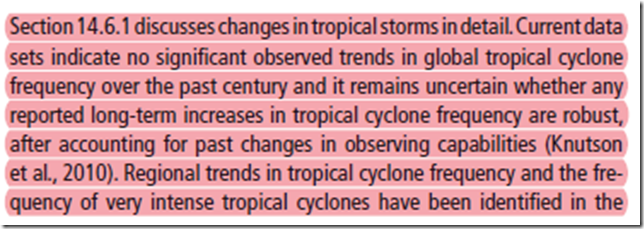
And, given this is supposed to be a “Climate Check”, you might have thought the BBC would actually have provided some facts, rather than just opinions. The IPCC were quite clear in their last Assessment Review, AR5:

IPCC AR5
They could find no evidence whatsover of any “significant observed trends” in tropical cyclone activity over the past century. All they could find was an increasing intensity of North Atlantic hurricanes since the 1970s, which hurricane experts such as Chris Landsea believe is part of the multidecadal cycle, the AMO. This is borne out by the fact no that robust trends in major hurricanes has been found in the North Atlantic in the past 100 years.
Little has changed in the latest AR6, which can still find no long term trends.
One particular omission in the video is the role of wind shear, high level winds which act to break up hurricanes. While Rich mentions this factor, he omits to tell viewers that scientists believe that global warming will increase wind shear.
This Climate Check has little to do with facts, and is little more than propaganda.
September 12, 2021
Posted by aletho |
Fake News, Mainstream Media, Warmongering, Science and Pseudo-Science | BBC |
Leave a comment
This is another fairy tale to scare the kids which comes around once a year without fail:

The number of weather-related disasters to hit the world has increased five-fold over the past 50 years, says the World Meteorological Organization. … Full article
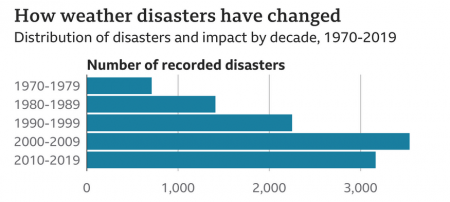
In fact, according to the BBC’s own chart, the number of disasters has declined in the last decade, hardly supporting their story.
But why do disasters seem much more common now than in the 1970s, when even the IPCC says there is no evidence that weather is getting more extreme? Simple- better reporting systems mean that we record weather events now that would have been missed in the past.
We have, of course, been down this road before! The WMO data comes from Centre for Research on the Epidemiology of Disasters (CRED) database EM-DAT. CRED, who only began publishing data in 1998, themselves warned in 2004 that earlier data was incomplete:


Despite this warning, false claims that weather disasters are on the increase keep being made. Last year, it was the UN, and the before it was the left wing IPPR. And as surely as night follows day, their claims are faithfully trumpeted by the BBC and the rest of the gullible [alarmist] media.
September 6, 2021
Posted by aletho |
Deception, Fake News, Mainstream Media, Warmongering, Science and Pseudo-Science | BBC |
Leave a comment
AN insight into the propaganda currently putting our world at risk of a Covid vaccine disaster was provided by a BBC News report yesterday, dismissing fears that the vaccines could harm fertility or cause miscarriages.
The report especially criticises Dr Mike Yeadon, the former Pfizer senior researcher who last week reiterated his concerns about particular risks from the vaccines to women of child-bearing age.
As so often in these acrimonious arguments, some of the report’s targets are ‘Aunt Sallies’ drawn from the internet. People who cannot believe their governments could be so foolhardy as to medicate millions with an experimental product post angry and often exaggerated claims.
Yesterday’s BBC ‘reality check’, however, begins by mentioning a relevant Japanese study that has caused several leading researchers (see here, here and here) much concern. So let’s fact-check the BBC fact-checker.
Most governments, in line with World Health Organisation guidance, have not required manufacturers to show what happens to their vaccine once injected into the body. Japan appears to have been unique in requiring such a ‘biodistribution’ study, performed mainly on rats.
Under the heading ‘A study shows the vaccine accumulating in the ovaries – False’, the BBC report claims:
1. The theory comes from a misreading of the study, which ‘involved giving rats a much higher dose of vaccine than that given to humans (1,333 times higher)’.
In fact, the study (commissioned by Pfizer) used a 50 microgram dose, hardly more than the 30 micrograms standard dose in Pfizer’s human trial. Even if we acknowledge that rats are more than 100 times smaller than humans, the figure of 1,333 times higher is FALSE. Besides, if the study in rats was to give meaningful results, the researchers could be expected to use a proportionately larger dose in these tiny animals.
2. ‘Only 0.1 per cent of the total dose ended up in the animals’ ovaries, 48 hours after injection. Far more – 53 per cent after one hour and 25 per cent after 48 hours – was found at the injection site. The next most common place was the liver (16 per cent after 48 hours), which helps get rid of waste products from the blood.’
No mention of the study’s finding that the jab was cleared at a vastly lower rate from the ovaries, in particular, as well as from the spleen and adrenals, compared with the injection site and the liver. So there IS accumulation in the ovaries. Verdict: FALSE.
3. ‘The vaccine is delivered using a bubble of fat containing the virus’s genetic material, which kick-starts the body’s immune system. Those promoting this claim cherry-picked a figure which actually referred to the concentration of fat found in the ovaries. Fat levels in the ovaries did increase in the 48 hours after the jab, as the vaccine contents moved from the injection site around the body. But, crucially, there was no evidence it still contained the virus’s genetic material.’
In fact, the study itself states that the distribution in the body of the vaccine’s active component ‘is considered to depend on the LNP distribution’ – the lipid nanoparticles, or ‘bubbles of fat’ as the BBC reassuringly calls them. So once again, the BBC’s assertion is FALSE.
4. Finally, the BBC ‘fact-checker’ challenges the claim that the study was leaked, ‘though it was in fact publicly available online’.
It is available now, but it certainly wasn’t. It was obtained through a request by international researchers to the Japanese regulatory agency. Anyone who actually looks at it will see immediately that every page is marked ‘Pfizer confidential’. And the translation is poor, indicating that it is a far from official release. Verdict: FALSE.
The BBC report goes on to criticise Yeadon, described as ‘a scientific researcher who has made other misleading statements about Covid’, for claiming that the spike protein produced by the vaccines is similar to one involved in forming the placenta. One of his concerns is that the protein might produce antibodies that could block pregnancy.
The BBC quotes a US fertility doctor who has not seen any such effect in a study of 143 of his patients, and who says he can’t see why antibodies produced in response to the vaccine could harm fertility while antibodies from a natural infection would not.
Apart from the tiny number of patients involved, compared with the billions taking the vaccine, it seems obvious that an injection now known to distribute a toxic component throughout the body could bring risks not present in a person whose immune system meets and deals with the virus naturally.
Yeadon worked for 32 years in the drug industry, leaving Pfizer ten years ago as the most senior scientist in charge of respiratory research. He went on to found his own biotechnology company, which he sold for hundreds of millions of dollars, and has been a consultant to 30 biotech start-ups.
He has said that the small minority of people who risk being killed by Covid-19 are probably better off taking the vaccine rather than not. But he spoke out again last week, at a Truth for Health Foundation conference called Stop The Shot, about the special dangers to women of child-bearing age from the gene-based vaccines.
‘We’re being lied to . . . The authorities are not giving us full information about the risks of these products,’ Yeadon said, listing three concerns about the impact of the vaccines in reproductive health, fertility and pregnancy.
‘The first is that we never, ever give experimental medicines to pregnant women.’ The thalidomide tragedy of the 1950s and 60s, in which a new product for morning sickness gave rise to at least 10,000 birth malformations, ‘taught us that babies are not safe and protected inside the uterus, which is what we used to think’. Interference by a chemical or something else at a critical stage of development could lead irreparable damage.
‘Our government is urging pregnant women and women of childbearing age to get vaccinated, and they’re telling them they’re safe. And that’s a lie, because those studies have simply not been done. Reproductive toxicology has not been undertaken with any of these products, certainly not a full battery of tests that you would want.
‘That’s bad enough. Because it tells me there’s recklessness. No one cares. The authorities do not care what happens. But it’s much worse than that.’
Yeadon said he had seen a copy of the biodistribution report obtained from the Japanese regulator. ‘I’m entirely able to read and interpret it. And to my horror, what we find is the vaccine doesn’t just distribute around the body and then wash out again, which is what you’d hope. It concentrates in the ovaries of rats, at least 20-fold over the concentration in other background tissues like muscles. And a general rule of thumb in toxicology is: if you don’t have any data to contradict what you’ve learned [from the animal studies], that’s the assumption you make for humans.
‘So my assumption at the moment is that these vaccines are concentrating in the ovaries of every female who has been given them. We don’t know what that will do, but it cannot be benign and it could be seriously harmful.’
His third concern, shared by a German doctor in a petition to the European Medicines Agency eight months ago, is that the spike protein produced by the vaccine ‘is faintly similar – not very strongly – to an essential protein in your placenta, something that’s absolutely required for both fertilisation and formation and maintenance of the placenta.’
The worry was that an immune response to the spike protein might cause antibodies to bind to the placental protein as well.
He said a study has just come out which reinforces that concern. Researchers drew blood samples every few days from 15 women given the Pfizer vaccine. ‘They measured antibodies against the spike protein, which took several weeks to appear. They also measured antibodies against the placenta, and they found within the first one to four days an increase of two and a half to three times – so, 300 per cent – in the antibodies against their own placenta.
‘I think you can only expect that that is happening in every woman of childbearing potential. What the effect will be, we can’t be certain, but it can’t be benign.
‘So I’m here to warn you that if you are of child-bearing potential or younger, so not at menopause, I would strongly recommend you do not accept these vaccines.’
Pfizer themselves say on their website that available data on their Covid vaccine administered to pregnant women ‘are insufficient to inform vaccine-associated risks in pregnancy.’
That, at least, is TRUE.
August 12, 2021
Posted by aletho |
Mainstream Media, Warmongering, Science and Pseudo-Science, Timeless or most popular | BBC, COVID-19 Vaccine |
Leave a comment




 Aletho News