EU demands more online censorship
RT | April 25, 2023
The European Commission has designated 19 online platforms under its Digital Services Act, a move that opens them up to hefty fines if they target advertisements at certain users, publish illegal content, or fail to “address the spread of disinformation.”
In an announcement on Tuesday, the commission named 17 “Very Large Online Platforms” and two “Very Large Online Search Engines,” defined as those reaching at least 45 million monthly active users. Among the platforms cited are Facebook, Instagram, TikTok, and Twitter, while Google and Microsoft’s Bing are the two designated search engines.
The decision means that as of August, these platforms must be in compliance with the EU’s Digital Services Act (DSA), a wide-ranging piece of legislation that came into force in November.
To avoid fines of up to 6% of their global annual turnover, the commission stated that these platforms must label all advertisements as such and avoid targeting ads at users based on “sensitive data” such as their ethnicity, sexuality, or political orientation.
Targeting ads toward children will no longer be permitted, and platforms will have to “redesign their systems to ensure a high level of privacy, security, and safety of minors,” the commission said.
Regarding content moderation, platforms will be required to restrict the “dissemination of illegal content” and “address the spread of disinformation.” The entire text of the DSA mentions the word “disinformation” 13 times without defining it. Free speech activists have argued that the term is often used by governments to silence factually correct yet politically inconvenient narratives.
The commission also warned that platforms and search engines will need to address “negative effects on freedom of expression,” a requirement that could clash with the demand to tackle “disinformation.”
While the DSA was being drafted last year, EU officials singled out Twitter as a company that would be forced to comply with its requirements. Immediately after billionaire Elon Musk bought the platform and set about rolling back some of its restrictive speech policies, EU industry chief Thierry Breton declared that “in Europe, the bird will fly by our European rules.”
Two months later, EU Commissioner for Values and Transparency Vera Jourova warned that Twitter would face “sanctions” if it breached the DSA. Jourova cited Musk’s banning of several prominent journalists – who shared information on his whereabouts – as potential DSA violations.
Are They Essentially Erasing Most Of The Internet?
By Michael Snyder | End Of The American Dream | August 14, 2022
What I am about to share with you is incredibly alarming, and so I hope that you will share this article as widely as you can. The Internet has made it possible for us to communicate directly with one another on an absolutely massive scale. For many years it truly served as a very robust “marketplace of ideas”, and it was not difficult to find a multitude of viewpoints on just about any topic that you could possibly imagine. Unfortunately, things have completely changed. As you will see in this article, much of the Internet has essentially been erased at this point. If you don’t understand what I am talking about, just keep reading.
For most of us, search engines are the primary tools that we use to find information on the Internet.
When they originally came on the scene, search engines could generally be trusted to present information in a neutral manner. The most relevant information was supposed to come up first, and less relevant information was supposed to be pushed farther down the listings.
Of course bias eventually started to creep in, and that was extremely unfortunate. Certain sources of information were purposely elevated while other disfavored sources of information were purposely suppressed.
But what if I was to tell you that we have now gotten to a point where the vast majority of the information on any particular topic is being purposely excluded altogether?
I know that this may sound crazy, and so I am going to take some time and prove it to you.
Google is the most prominent search engine in the world, and so let’s start there. Go to Google and do a search for “Donald Trump” and look at the top of the page to see how many “results” you get.
I just did that, and it says that there are about 451,000,000 results.
That should be plenty of information, because nobody would ever have the time to go through 451,000,000 results.
But the truth is that the search engine doesn’t actually give us that many results.
Scroll down and go to page 2. For me, it still says that there are about 451,000,000 results.
Most people would stop there, and the big search engines know this.
But I want you to try something. Just keep going to the next page for as long as you can.
For me, everything looks the same until I get to page 12. At the top of the page, it says “Page 12 of about 118 results”.
Wow.
Needless to say, 118 results is a far smaller number than 451,000,000, and the vast majority of the 118 results that I have been given come from corporate media sources that generally have similar opinions of Trump.
At the bottom of page 12, there is a message that will seemingly allow me to pull up the rest of the 451,000,000 results. This is what it says…
In order to show you the most relevant results, we have omitted some entries very similar to the 118 already displayed.
If you like, you can repeat the search with the omitted results included.
That sounded good to me, and so I clicked on the link.
But it didn’t give me 451,000,000 results.
Instead, I can now click through 40 pages of results that mostly come from corporate media sources and that’s it.
The top of page 40 says “Page 40 of about 398 results”, and there is absolutely no option to go farther.
Do you understand what this means?
All but 398 of the 451,000,000 potential results have been purposely excluded.
You may be tempted to believe that this is just because Donald Trump is such a controversial figure.
So let’s try an example that is completely and utterly uncontroversial.
Let’s try putting the term “quilting” into Google.
I just did that, and the top of page 1 tells me that there are about 228,000,000 results.
And it keeps telling me that there are about 228,000,000 results until I get to page 26.
Once I get to page 26, the top of the page tells me that there are only 258 results.
But once again I am given the option of repeating the search with the omitted results included by clicking a link at the bottom of the page.
I just did that, and now I have been given 42 pages of results.
At the top of page 42, it tells me that there are only 414 results and it will not allow me to go any farther.
No matter what you search for, the pattern will always be the same.
You will only be given hundreds of results, and those results will generally be from certain types of sources.
Bing is the second largest search engine, and they do things a little differently.
If you do a search for “Donald Trump” on Bing, it will tell you that there are 194,000,000 results.
But for me, once I got to page 14 I noticed that they started to give me the same results on each page over and over again.
For dozens of pages, it was just the same results.
Do they really think that people wouldn’t notice?
Try it for yourself. Go to Bing and type in “Donald Trump” and just keep scrolling through the pages and you will notice this very odd pattern.
So at this point, the largest search engines are purposely restricting the amount of information that they give us.
And the vast majority of the listings that they do come up with are generally from certain types of sources that they wish to promote.
Yes, it is still possible to find truly independent sources of information, but it is becoming much more difficult to do so.
For example, once this article has been discovered by the search engines you will be able to find it if you type in the exact title.
But the vast majority of people just type in a single word or a short phrase when they are searching for something online, and those searches are going to be overwhelmingly dominated by certain types of sources.
In other words, the big tech companies have essentially put you and me in a box at this point.
We are going to be repeatedly fed information that they want us to consume.
As for everything else, what we are not allowed to find may as well not even exist.
Facebook, Twitter and the other big social media platforms do the same thing. They promote the things they want you to see, and they suppress information that they want you to avoid.
The information that they are keeping from us is still out there, but at this point the tech giants have pretty much been successful in essentially deleting most of the Internet for the vast majority of the population.
The inspiration for this article was a great YouTube video that was produced by a guy named Jimmy Corsetti. I would encourage you to share his video with everyone that you can, because he does a great job of breaking all of this down.
I still believe that search engines and social media platforms could be such helpful tools if they would just present information to us in a neutral way.
My hope is that many people that work in the tech industry will read this and that it will inspire them to push for reform.
Trying to greatly restrict the amount of information that we have access to is fundamentally wrong.
A vibrant “marketplace of ideas” is essential for any free society, and right now our “marketplace of ideas” is dying right in front of our eyes.
The Trust Project: Big Media and Silicon Valley’s Weaponized Algorithms Silence Dissent

Trust Project founder Sally Lehrman speaks at the 2018 organization of News Ombudsmen conference. Photo | ONO
By Whitney Webb | MintPress News | June 7, 2019
After the failure of Newsguard — the news rating system backed by a cadre of prominent neoconservative personalities — to gain traction among American tech and social media companies, another organization has quietly stepped in to direct the news algorithms of tech giants such as Google, Facebook, and Microsoft.
Though different from Newsguard, this group, known as “The Trust Project,” has a similar goal of restoring “trust” in corporate, mainstream media outlets, relative to independent alternatives, by applying “trust indicators” to social-media news algorithms in a decidedly untransparent way. The funding of “The Trust Project” — coming largely from big tech companies like Google; government-connected tech oligarchs like Pierre Omidyar; and the Knight Foundation, a key Newsguard investor — suggests that an ulterior motive in its tireless promotion of “traditional” mainstream media outlets is to limit the success of dissenting alternatives.
Of particular importance is the fact that the Trust Project’s “trust indicators” are already being used to control what news is promoted and suppressed by top search engines like Google and Bing and massive social-media networks like Facebook. Though the descriptions of these “trust indicators” — eight of which are currently in use — are publicly available, the way they are being used by major tech and social media companies is not.
The Trust Project’s goal is to increase public trust in the very same traditional media outlets that Newsguard favored and to use HTML-embedded codes in favored news articles to promote their content at the expense of independent alternatives. Even if its effort to promote “trust” in establishment media fail, its embedded-code hidden within participating news sites allow those establishment outlets to skirt the same algorithms currently targeting their independent competition, making such issues of “trust” largely irrelevant as it moves to homogenize the online media landscape in favor of mainstream media.
The Trust Project’s director, Sally Lehrman, made it clear that, in her view, the lack of public trust in mainstream media and its declining readership is the result of unwanted “competition by principle-free enterprises [that] further undermines its [journalism’s] very role and purpose as an engine for democracy.”
Getting to know the Trust Project
The Trust Project describes itself as “a consortium of top news companies” involved in developing “transparency standards that help you easily assess the quality and credibility of journalism.” It has done this by creating what it calls “Trust Indicators,” which the project’s website describes as “a digital standard that meets people’s needs.” However, far from meeting “people’s needs,” the Trust Indicators seem aimed at manipulating search engine and social-media news algorithms to the benefit of the project’s media partners, rather than to the benefit of the general public.
The origins of the Trust Project date back to a 2012 “roundtable” hosted by the Markkula Center for Applied Ethics at Santa Clara University, a center funded by former Apple CEO Mike Markkula. That roundtable became known as the Roundtable on Digital Journalism Ethics and was created by journalist Sally Lehrman, then working at the Markkula Center, in connection with the New Media Executive Roundtable and Online Credibility Watch of the Society of Professional Journalists. Lehrman has explicitly stated that the Trust Project is open only to “news organizations that adhere to traditional standards.”
The specific idea that spurred the creation of the Trust Project itself was born at a 2014 meeting of that roundtable, when Lehrman “asked a specialist in machine learning at Twitter, and Richard Gingras, head of Google News, if algorithms could be used to support ethics instead of hurting them, and they said yes. Gingras agreed to collaborate.” In other words, the idea behind the Trust Project, from the start, was aimed at gaming search-engine and social-media algorithms in collusion with major tech companies like Google and Twitter.

Sally Lehrman discusses the Trust Project at 2018 WordCamp For Publishers
As the Trust Project itself notes, the means of altering algorithms were developed in tandem with tech-giant executives like Gingras and “top editors in the industry from 80 news outlets and institutions,” all of which are corporate, mainstream media outlets. Notably, the Trust Project’s media partners, involved in creating these new “standards” for news algorithms, include major publications owned by wealthy oligarchs: the Washington Post, owned by the world’s richest man, Jeff Bezos; the Economist, directed by the wealthy Rothschild family; and the Globe and Mail, owned by Canada’s richest family, the Thomsons, who also own Thomson Reuters. Other Trust Project partners include The New York Times, Mic, Hearst Television, the BBC and the USA Today network.
Other major outlets are represented on the News Leadership Council of the Markkula Center, including the Financial Times, Gizmodo Media, and The Wall Street Journal. That council — which also includes Gingras and Andrew Anker, Facebook’s Director of Product Management — “guides the Trust Project on our Trust Indicators.”
These “Trust Indicators” are the core of the Trust Project’s activities and reveal one of the key mechanisms through which Google, Twitter and Facebook have been altering their algorithms to favor outlets with good “Trust Indicator” scores. Trust Indicators, on their face, are aimed at making news publications “more transparent” as a means of generating increased trust with the public. Though a total of 37 have been developed, it appears only eight of them are currently being used.
These eight indicators are listed and described by the Trust Project as follows:
- Best Practices: What are the news outlet’s standards? Who funds it? What is the outlet’s mission? Plus commitments to ethics, diverse voices, accuracy, making corrections and other standards.
- Author/Reporter Expertise: Who made this? Details about the journalist, including their expertise and other stories they have worked on.
- Type of Work: What is this? Labels to distinguish opinion, analysis and advertiser (or sponsored) content from news reports.
- Citations and References: What’s the source? For investigative or in-depth stories, access to the sources behind the facts and assertions.
- Methods: How was it built? Also for in-depth stories, information about why reporters chose to pursue a story and how they went about the process.
- Locally Sourced? Was the reporting done on the scene, with deep knowledge about the local situation or community? Lets you know when the story has local origin or expertise.
- Diverse Voices: What are the newsroom’s efforts and commitments to bringing in diverse perspectives? Readers noticed when certain voices, ethnicities, or political persuasions were missing.
- Actionable Feedback: Can we participate? A newsroom’s efforts to engage the public’s help in setting coverage priorities, contributing to the reporting process, ensuring accuracy and other areas. Readers want to participate and provide feedback that might alter or expand a story.
How the Trust Project makes these indicators available to the public can be seen in its new project, the Newsroom Transparency Tracker, where it provides a table of “transparency” for participating media outlets. Notably, that table conflates actual transparency practices with simply providing the Trust Project with outlet policies and guidelines related to the above indicators.
For example, The Economist gets a perfect transparency “score” for having provided the Trust Project links to its ethics policy, mission statement and other information requested by the project. However, the fact that those policies exist and are provided to the Trust Project does not mean that the publication’s policies are, in fact, transparent or ethical in terms of their content or in practice. The fact that The Economist provided links to its policies does not make the publication more transparent, but — in the context of the Newsroom Transparency Tracker’s table — it provides the appearance of transparency, though such policy disclosures by The Economist are unlikely to translate into any changes to its well-known biases and slanted reporting towards certain issues.
Trust Indicators manipulate big tech algorithms
The true power of the Trust Indicators comes in a form that is not visible to the general public. These Trust Indicators, while occasionally displayed on partner websites, are also coupled with “machine-readable signals” embedded in the HTML code of participating websites and articles used by Facebook, Google, Bing and Twitter. As Lehrman noted in a 2017 article, the Trust Project was then “already working with these four companies, all of which have said they want to use our indicators to prioritize honest, well-reported news over fakery and falsehood.” Gingras of Google News also noted that the Trust Indicators are used by Google as “cues to help search engines better understand and rank results … [and] to help the myriad algorithmic systems that mold our media lives.”
A press release from the Trust Project last year further underscores the importance of the embedded “indicators” to alter social-media and search-engine algorithms:
While each Indicator is visible to users on the pages of the Project’s news partners, it is also embedded in the article and site code for machines to read — providing the first, standardized technical language that offers contextual information about news sites’ commitments to transparency.”
Despite claiming to increase public knowledge of “news sites’ commitments to transparency,” the way that major tech companies like Google and Facebook are using these indicators is anything but transparent. Indeed, it is largely unknown how these indicators are used, though there are a few clues.
For instance, CBS News cited Craig Newmark — the billionaire founder of Craigslist, who provided the Trust Project’s seed funding — as suggesting that “Google’s search algorithm could rank trusted sources above others in search results” by using the project’s Trust Indicators.
Last year, the Trust Project stated that Bing used “the ‘Type of Work’ Trust Indicator to display whether an article is news, opinion or analysis.” It also stated that “when Facebook launched its process to index news Pages, they worked with the Trust Project to make it easy for any publisher to add optional information about their Page.” In Google’s case, Gingras was quoted as saying that Google News uses the indicators “to assess the relative authoritativeness of news organizations and authors. We’re looking forward to developing new ways to use the indicators.”
Notably, the machine-readable version of these Trust Indicators is available only to participating institutions, which are currently corporate, mainstream publications. Though WordPress and Drupal plug-ins are being developed to make those embedded signals to search engines and social media available to smaller publishers, it will be made available only to “qualified publishers,” a determination that will presumably be made by the Trust Project and its associates.
Richard Gingras, in a statement made in 2017, noted that “the indicators can help our algorithms better understand authoritative journalism — and help us to better surface it to consumers.” Thus, it is abundantly clear that these indicators, which are embedded only into “qualified” and “authoritative” news websites, will be used to slant search-engine and social-media news algorithms in favor of establishment news websites.
The bottom line is that these embedded and exclusive indicators allow certain news outlets to avoid the crushing effects of recent algorithm changes that have seen traffic to many news websites, including MintPress, plummet in recent years. This is leading towards a homogenization of the online news landscape by starving independent competitors of web traffic while Trust Project-approved outlets are given an escape valve through algorithm manipulation.
The tech billionaires behind the Trust Project
Given the Trust Project’s rich-get-richer impact on the online news landscape, it is not surprising to find that it is funded by rich and powerful figures and forces with a clear stake in controlling the flow of news and information online.
According to its website, the Trust Project currently receives funding from Craig Newmark Philanthropies, Google, Facebook, eBay founder Pierre Omidyar’s Democracy Fund, the John S. and James L. Knight Foundation (often abbreviated as the Knight Foundation), and the Markkula Foundation. Its website also states that Google was “an early financial supporter” and that it had originally been funded by Craig Newmark, the founder of Craigslist. As previously mentioned, the Trust Project’s co-founder is Richard Gingras, current Google vice president of News. The Trust Project’s website described Gingras’s current role with the organization as “a powerful evangelist” who “can always be counted upon for expert advice and encouragement.” Newmark’s current role at the Trust Project is described as that of a “funder and valued connector.”
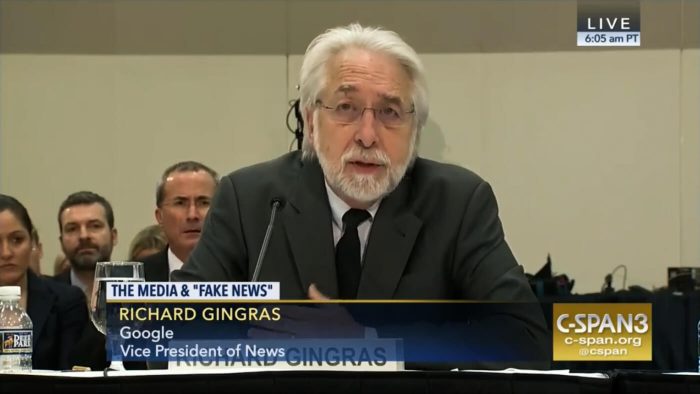
Google VP Richard Gingras testifies at a British Committee Hearing on “Fake News”
Newmark, through Craig Newmark Philanthropies, who provided the initial funding for the Trust Project, and has also funded other related initiatives like the News Integrity Initiative at the City University of New York, which shares many of the same financiers as the Trust Project, including Facebook, Omidyar’s Democracy Fund, and the Knight Foundation. The Trust Project is listed as a collaborator of the News Integrity Initiative. Newmark is also very active in several news-related NGOs with similar overlap. For instance, he sits on the board of the Electronic Frontier Foundation (EFF), a longtime recipient of massive grants from the Omidyar Network, and Politifact.com, which is funded in part by Omidyar’s Democracy Fund.
Newmark is currently working with Vivian Schiller as his “strategic adviser” in his media investments. Schiller is a member of the Council on Foreign Relations, former head of news at Twitter, and a veteran of well-known mainstream outlets like NPR, CNN, The New York Times and NBC News. She is also a director of the Scott Trust, which owns The Guardian.
The Markkula Foundation, one of the key funders of the Trust Project, exercises considerable influence over the organization through the Markkula Center for Applied Ethics, which originally incubated the organization and whose News Leadership Council plays an important role at the Trust Project. That council’s membership includes representatives of Facebook, The Wall Street Journal, The Washington Post, Financial Times and Google, and “guides the Trust Project on our Trust Indicators and advises on core issues related to information literacy and rebuilding trust in journalism within a fractious, so-called post-fact environment.”
Both the Markkula Foundation and the Markkula Center for Applied Ethics were founded by A. M. “Mike” Markkula, former CEO of Apple. The Markkula Center’s Journalism Ethics program is currently headed by Subramaniam Vincent, a former software engineer and consultant for Intel and Cisco Systems who has worked to bring together big data with local journalism and is an advocate for the use of “ethical-AI [artificial intelligence] to ingest, sort, and classify news.”
The John S. and James L. Knight Foundation is another interesting funder of the Trust Project, given that this same foundation is also a key investor in Newsguard, the controversial, biased news rating system with deep connections to government insiders and self-described government propagandists. There is considerable overlap between Newsguard and the Trust Project, with the latter citing Newsguard as a partner and also stating that Newsguard’s demonstrably biased ratings use the project’s “trust indicators” in its full-length reviews of news websites, which Newsguard calls “nutrition labels.” In addition, becoming a Trust Project participant is a factor that “supports a positive evaluation” from Newsguard, according to a press release from last year.
Notably, Sally Lehrman, who leads the Trust Project, described the project’s trust indicators for news as ”along the lines of a nutrition label on a package of food” when the Trust Project was created nearly a year before Newsguard launched, suggesting some intellectual overlap.
A previous MintPress exposé revealed Newsguard’s numerous conflicts of interest and a ratings system strongly biased in favor of well-known, traditional media outlets — even when those outlets have a dubious track record of promoting so-called “fake news.” It should come as no surprise that the Trust Project’s goal is to increase public trust in the very same traditional media outlets that Newsguard favored and to use HTML-embedded codes in news articles to promote their content at the expense of independent alternatives.
A familiar face in the war against independent media
The Democracy Fund, another top funder of the Trust Project and a bipartisan foundation that was established by eBay founder and PayPal owner Omidyar in 2011 “out of deep respect for the U.S. Constitution and our nation’s core democratic values.” It is a spin-off of the Omidyar Network and, after splitting off as an independent company in 2014, became a member of the Omidyar Group. The fund’s National Advisory Committee includes former Bush and Obama administration officials and representatives of Facebook, Microsoft, NBC News, ABC News and Gizmodo Media group.
The Democracy Fund’s involvement in the Trust Project is notable because of the other media projects it funds, such as the new media empire of arch-neoconservative Bill Kristol, who has a long history of creating and disseminating falsehoods that have been used to justify the U.S. war in Iraq and other hawkish foreign policy stances. As a recent MintPress series revealed, Omidyar’s Democracy Fund provides financial support to Kristol’s Defending Democracy Together initiative and also supports Kristol’s Alliance for Securing Democracy, a project of the German Marshall Fund think tank that is best known for its cryptic Hamilton68 “Russian bot” dashboard. Omidyar’s Democracy Fund has also donated to the German Marshall Fund’s Defending Digital Democracy project and directly to the German Marshall Fund itself. In addition, Charles Sykes, a co-founder and editor-at-large of Kristol’s new publication The Bulwark, is on the Democracy Fund’s National Advisory Committee.
An acolyte of Kristol’s who works at the German Marshall Fund, Jamie Fly, stated last October that the coordinated social-media purges of independent media pages known for their criticisms of U.S. empire and U.S. police violence was “just the beginning” and hinted that the German Marshall Fund had a hand in past social media purges and, presumably, a role in future purges. Thus, the Democracy Fund’s links to neoconservatives who promote the censoring of independent media sites that are critical of militaristic U.S. foreign policy jibe with the fund’s underlying interest in the Trust Project.
Omidyar’s involvement with the Trust Project is interesting for another reason, namely that Omidyar is the main backer behind the efforts of the controversial Anti-Defamation League (ADL) to become a key driver of which outlets are censored by Silicon Valley tech giants. The ADL was initially founded to “stop the defamation of the Jewish people and to secure justice and fair treatment to all” but critics say that over the years it has begun labeling critics of Israel’s government as “anti-Semites.”
For example, content that characterizes Israeli policies towards Palestinians as “racist” or “apartheid-like” is considered “hate speech” by the ADL, as is accusing Israel of war crimes or attempted ethnic cleansing. The ADL has even described explicitly Jewish organizations that are critical of Israel’s government as being “anti-Semitic.”
In March 2017, the Omidyar Network provided the “critical seed capital” need to launch the ADL’s “new Silicon Valley center aimed at tackling this rising wave of intolerance and to collaborate more closely with technology companies to promote democracy and social justice.” That Omidyar-funded ADL center allowed the ADL to team up with Facebook, Twitter, Google and Microsoft — all of whom also collaborate with the Trust Project — to create a Cyberhate Problem-Solving Lab. Since then, these companies and their subsidiaries, including Google’s YouTube, have relied on the ADL to flag “controversial” content.
Given the fact that the Trust Project shares with the ADL a key funder (Pierre Omidyar) and several external tech partners, it remains to be seen whether there is overlap between how major tech companies like Google and Facebook use the Trust Indicators in its algorithms and the influence of the ADL on those very same algorithms.
Outsourcing censorship
Of course, the most interesting and troubling donors of the Trust Project are Google and Facebook, both of which are using the very project they fund as a “third party” to justify their manipulation of newsfeed and search-engine algorithms. Google’s intimate involvement from the very inception of the Trust Project tags it as an extension of Google that has since been marketed as an “independent” organization tasked with justifying algorithm changes that favor certain news outlets over others.
Facebook, similarly, funds the Trust Project and also employs the “trust indicators” it funds to alter its newsfeed algorithm. Facebook’s other partners in altering this algorithm include the Atlantic Council — funded by the U.S. government, NATO, and weapons manufacturers, among others — and Facebook has also directly teamed up with foreign governments, such as the government of Israel, to suppress accurate yet dissenting information that the government in question wanted removed from the social-media platform.
The murkiness between “private” censorship, censorship by tech oligarchs, and censorship by government is particularly marked in the Trust Project. The private financiers of the Trust Project that also use its product to promote certain news content over others — namely Google and Facebook — have ties to the U.S. government, with Google being a government contractor and Facebook sporting a growing body of former-government officials in top company positions, including a co-author of the controversial Patriot Act as the company’s general counsel.
A similar tangle surrounds Pierre Omidyar, funder of the Trust Project through the Democracy Fund, who is extremely well-connected to the U.S. government, especially the military-industrial complex and intelligence communities. And partnering with media outlets like the Washington Post, whose owner is Jeff Bezos, spawns more conflicts of interests, given that Bezos’ company, Amazon, is also a major U.S. government contractor.
This growing nexus binding Silicon Valley companies and oligarchs, mainstream media outlets and the government suggests that these entities have increasingly similar and complementary interests, among which is the censorship of independent watchdog journalists and news outlets that seek to challenge their power and narratives.
The Trust Project was created as a way of outsourcing censorship of independent news sites while attempting to salvage the tattered reputation of mainstream media outlets and return the U.S. and international media landscape to years past when such outlets were able to dominate the narrative.
While it seems unlikely that’s its initiatives will succeed in restoring trust to mainstream media given the many recent and continuing examples of those same “traditional” media outlets circulating fake news and failing to cover crucial aspects of events, the Trust Project’s development of hidden algorithm-altering codes in participating websites shows that its real goal is not about improving public trust but about providing a facade of independence to Silicon Valley censorship of independent media outlets that speak truth to power.
Whitney Webb is a MintPress News journalist based in Chile. She has contributed to several independent media outlets including Global Research, EcoWatch, the Ron Paul Institute and 21st Century Wire, among others. She has made several radio and television appearances and is the 2019 winner of the Serena Shim Award for Uncompromised Integrity in Journalism.
Featured Video

Theodore Postol: Iran’s Missiles & Drones Were Underestimated
or go to
Aletho News Archives – Video-Images
From the Archives
What is the Israeli Lobby in Australia Doing in Interfaith Dialogue?
By Ali Kazak | Dissident Voice | October 11, 2015
For years Israel and its lobby around the world have been trying to normalise their relations with Arabs and Muslims without solving the Palestine Question.
One of the methods they resorted to in the last few years is using human rights and community organizations such as interfaith dialogue and Multiculturalism to achieve this objective and to: isolate the Palestinians, marginalise the Palestine question, end Israel’s isolation, and prevent criticism of Israel, knowing that these organisations will be the first to stand against Israel’s violations, racial and religious discrimination.
The group responsible for this task in Australia is The Australia/Israel & Jewish Affairs Council (AIJAC); its Director of International & Community Affairs, Jeremy Jones is in charge of lobbying religious community organizations, specifically Muslims and Christians. Consequently he convened the Faith Communities for Reconciliation, founding participant in the Australian Partnership of Religious Organisations and the Australian National Dialogue of Christians, Muslims & Jews.
AIJAC is a private political propaganda group. It is recognised as the main Israeli lobby in Australia. It coordinates its activities and works intimately with the Israeli embassy in Canberra and different institutions in Israel. It is privately funded by some Jewish businessmen. It monitors closely Australian politicians, the media, ethnic and religious groups, (especially Arabs and Muslims), unions and academics on their stands towards Israel and the Palestine question. … continue
Blog Roll
 Aletho News
- The Most Important Bet You’ve Never Heard Of
- The killing of three Indonesian soldiers in Lebanon should remind Jakarta that Israel does not want peace
- Defeated and delusional: Netanyahu’s remarks reveal $80bn war failure, says analyst
- Iran’s friends are about to make life much more difficult for Israel and the US
- The war of liberation of the Arab and Islamic peoples expands across the Gulf
- Envoy warns UN on Trump’s threat to ‘obliterate’ Iran’s civilian infrastructure
- The Larak Corridor: Iran’s Rial Gate With No US, No Israel, and No Way Around
- ‘Economic terrorism’: Steel facilities hit again in US-Israeli strike
- ‘War Crime’: Iran condemns attacks on Arak, Ardakan nuclear sites
- Two-thirds of Americans want quick end to Iran war even if goals unmet
- If Americans Knew
- Gaza families reunite years after babies evacuated amid Israel’s war
- International Rescue Committee warns Gaza’s children face grave protection risks
- Iran’s Alleged 47-Year War on America: Debunking the 1,050 American Deaths Canard
- Israel wants US to bomb more of Iran’s civilian structures (113,000 is not enough) – Not a ceasefire Day 173
- Ann Coulter Rips Into Fox News for Iran War Coverage
- Joe Kent Urges Americans To Call White House and Congress To Object To Sending Troops Into Iran
- DNC Resolution to Reject AIPAC Funding Puts Democratic Leaders in the Hot Seat
- Swedish foundation to build 400 schools as over 650,000 Gaza children remain without education for 2 years
- Israeli army admits photshopping image of slain Lebanese journalist
- This is how Israel is systematically killing health workers under the cover of war in Lebanon
- No Tricks Zone
- New Study Finds Warming Saves Lives…Cold Temperatures 12 Times More Deadly Than Excess Heat
- German Science Blog Accuses PIK Climate Institute Of Hallucinating Climate Tipping Points
- Devastating Assessment Of Comirnaty Vaccine By Former Senior Pfizer Europe Toxicologist
- New Study: CO2 Is ‘Effectively Negligible’ As An Explanatory Climate Change Factor Since 2000
- Former Pfizer Toxicologist Dr. Helmut Sterz Tells Bundestag Hearing Pfizer Vaccine Should Have Never Been Approved
- Energy Expert: Germany’s Nuclear Phaseout Was A “500 Billion Euro Mistake”
- New Research: South Australia’s Mid-Holocene Sea Surface Temperatures Were 4°C Warmer Than Today
- Storing Green Energy To Last Germany 10 Days Would Require A 60-Million Tonne Battery
- New Studies: UK Sea Levels Were 4 Meters Higher Than Today During The Mid-Holocene
- Destructive Green New Deal: German Energy And Metal Group Warns Of Drastic Crisis
 Aletho News