Interpol Activates Arrest Warrant Against Morales at Bolivia’s Request – Interior Minister
Sputnik – 09.01.2020
The International Criminal Police Organization (Interpol) has activated an international arrest warrant for former Bolivian President Evo Morales per the Bolivian government’s request, according to the country’s interior minister, Arturo Murillo.
“I have given the order at 6:00 [10:00 GMT on Wednesday] to Interpol to activate the international order [against Morales]”, Bolivian President Evo Murillo said during a press conference on Wednesday, as quoted by the state Agencia Boliviana de Informacion.
He added that it was important for Morales be held to account for his actions in his own country.
In December, the Bolivian authorities issued an arrest order for ousted Morales, accusing him of sedition, terrorism, and sponsoring terrorism. Morales claimed he was not afraid of the warrant, calling it illegal and unconstitutional.
Late last year, Bolivia experienced a change in leadership following mass protests against the results of the October general election. Morales stepped down as president on November 10 and fled to Mexico. Most of Bolivia’s senior officials resigned in his wake. This resulted in the senate’s second vice speaker, opposition lawmaker Jeanine Anez, declaring herself interim president. Morales has characterized the situation as a coup.
MAS Can Get Over 40 Percent of Vote Even Without Morales as Its Candidate – Bolivian Journalist
By Ekaterina Blinova – Sputnik – 09.01.2020
Bolivia’s highest electoral body has set the date for the country’s general vote. Although Evo Morales’ Movement Towards Socialism (MAS) was eventually allowed to participate, the chances of the de facto government committing fraud to upend a MAS victory are high, says Alberto Echazu, a journalist from the media platform La Resistencia Bolivia.
On Sunday, the Supreme Electoral Tribunal of Bolivia declared that the country would hold a general vote on 3 May 2020 with the candidates having to be submitted to the electoral authority by 3 February.
The de facto government in La Paz, meanwhile, continues to crack down on Evo Morales’ supporters and leftist media sources.
Alberto Echazu, a journalist with the left-wing media outlet La Resistencia Bolivia, which has recently been subjected to arrests and intimidation, has described the unfolding situation as the country braces for new general elections.
Sputnik: The Supreme Electoral Tribunal (TSE) of Bolivia announced on 31 December that Evo Morales’ MAS will be able to participate in the 2020 general elections. Why did the de facto interim government request TSE to decide the fate of MAS? Did they hope to somehow weaken MAS’ positions or expel the party from the election race? What are MAS’ chances in the upcoming May 2020 elections and what obstacles could the party face, in your opinion?
Alberto Echazu: The de facto regime is trying to block and nullify MAS’ legal status as a national party so that it cannot be an electoral option in the upcoming elections. Using the false idea that MAS is the party of a government that committed fraud, the regime is trying to criminalise it and expel it from the election race. This is all because they are very aware of MAS’ strength, it being the only party that can obtain a vote higher than 40 percent even without Evo Morales as its candidate.
Some media sources have performed surveys of how residents intend to vote, and despite MAS’ candidate not having been decided yet, the party is leading in the polls against a group of right-wing candidates such as Fernando Camacho, Carlos Mesa, and others.
MAS has every chance of winning the elections as it is still the biggest and strongest party nationwide, however, the chances of the regime actually committing fraud in order to avoid a MAS victory are fairly high. The regime has not held back from using every resource at hand, regularly violating constitutional rights and even international treaties and international human rights.
Sputnik: Who are the most likely MAS presidential candidates to take part in the 2020 general elections? What’s your take on the candidacy of Andronico Rodriguez, named by some media outlets as Morales political heir? Is he charismatic enough to unify the Left?
Alberto Echazu: The most likely MAS’ pairing is Luis Arce as presidential candidate and Andronico Rodriguez as vice president. Luis Arce was Evo Morales’ minister of economy and is seen as the one responsible for the country’s economic stability and success in the last 14 years.
The economic model, labelled Modelo Económico Social Comunitario Productivo (Social Communal Productive Economic Model) was one of the most important reasons behind Bolivia’s economic miracle, giving Arce a great reputation and prestige among the urban middle class, him being the main thinker behind it. He is also highly respected among MAS’ supporters as he was not only a technical cadre in Morales’ government but also very committed politically, having been a member of the Socialist Party before joining Morales’ government.
Andronico Rodriguez has great charisma among MAS’ supporters as he was named Morales’ successor and is seen as an important young cadre. Because of his age he is not expected to be the presidential candidate (he is 30 years old).
This pairing has great acceptance among MAS’ supporters and could receive a large number of votes, both of them being very respected figures and having Morales’ trust and blessing.
Sputnik: Could you please shed light on the political persecution of leftist journalists, in particular, La Resistencia Bolivia, that provided the coverage of the Bolivian coup. Have any international human rights organisations or entities protecting journalists paid attention to these incidents so far?
Alberto Echazu: Political persecution against members of the alternative media platform La Resistencia Bolivia, of which I am a member, is due to our work broadcasting and informing about the coup in our country and all of the assassinations and violations of human rights during the coup and the de facto government.
The regime silenced the rest of the media that tried to inform with some kind of impartiality as soon as it took power and forced to halt the broadcast of any media outlet that refused to comply with the regime’s policies of legitimising the coup and the de facto government.
Two members of La Resistencia Bolivia were arrested on New Year’s Eve. The charges are “sedition” and “misuse of state assets”, even though the police have no evidence. They have been unjustly detained for a week and spent New Year in judicial cells. It is all clearly for political reasons.
The timing of the detentions was strategically planned so that there was not any social protest or support against this injustice, but in spite of that there has been a lot of support on social media, and as people go back to normality after the festive period the denouncing of this abuse has increased, given that La Resistencia has gained a lot of respect and followers for being almost the only media outlet left that informs about what is going on in Bolivia.
In that regard, different human rights organisations have expressed their solidarity towards our detained members and the persecution against the platform like Defensoría del Pueblo (People’s Defence), and Asociación de Madres de Plaza de Mayo from Argentina, but the police intimidation of society in general has stopped people from protesting, as happened in other cases of abuse and arrests as well.
Evo Morales’ potential successor speaks out
The Grayzone | December 28, 2019
Andrónico Rodríguez could be the next president of Bolivia. The 30-year-old labor organizer spoke with Wyatt Reed about the far-right US-backed coup against President Evo Morales, repression of their leftist MAS party, and how the upcoming election may be rigged.
Mexico orders ambassador in Bolivia to return after she declared non grata
Press TV – December 30, 2019
Mexico has ordered its ambassador in Bolivia to return to the country in order to ensure her safety.
The Mexican Foreign Ministry said on Monday that the order was issued after Bolivia declared Mexico’s Ambassador Maria Teresa Mercado a “persona non grata.”
Bolivia’s interim leader Jeanine Anez announced Monday that the country has decided to expel Mexico’s ambassador and two Spanish diplomats.
“The constitutional government that I preside over has decided to declare persona non grata the ambassador of Mexico in Bolivia, Maria Teresa Mercado, the charge d’affaires of Spain, Cristina Borreguero, and the (Spanish) consul, Alvaro Fernandez,” Anez said.
The announcement came after Bolivia accused Spanish embassy staff of trying to infiltrate the Mexican mission in the Bolivian capital, La Paz, with a group of masked men to take out former Bolivian president Evo Morales’s aide.
Madrid has strongly denied the accusation.
“The ministry wishes to clarify that the charge d’affaires was purely making a courtesy visit and vehemently denies there was any aim to facilitate the exit of people holed up inside the building,” Spain’s Foreign Ministry said in a statement.
The Mexican embassy in La Paz has become the center of the diplomatic row after it housed nine officials from Morales’s former government.
On Thursday, Mexico said the Bolivian regime is “harassing” and “intimidating” its diplomatic personnel in La Paz in what seems to be retribution for the granting of asylum by Mexico to Morales.
Mexico City said Bolivia has, among other things, boosted police presence outside the Mexican diplomatic mission in La Paz since Monday, intimidating the diplomats.
Last month, Mexican President Andres Manuel Lopez Obrador gave political asylum to Morales, who had been forced to resign under pressure from the country’s military.
Morales has since relocated to Argentina.
Morales, who had already been president since 2006, won his country’s presidential election in October, but the Bolivian military and opposition claimed that the election had been rigged, inciting deadly street protests.
The 60-year-old president, who enjoys a broad popular base both at home and in Latin America, nevertheless decided to step down and go into exile in Mexico amid threats of violence against him and with an apparent intention not to push the country toward further instability.
Bolivian Vassals Are Merely Aping Their Imperial Masters
By Stephen Karganovic | Strategic Culture Foundation | December 30, 2019
A serious diplomatic row with significant international law implications has erupted between the government of Mexico and the Bolivian coup regime installed by foreign interests in November 2019. Readers will recall that the legal President of Bolivia, Evo Morales, notwithstanding his overwhelming electoral victory in October 2019, was made to resign shortly thereafter under the duress of traitorous elements of the police and military apparatus who were bribed by the ruling imperial power in the Western hemisphere and directed to remove him. The coup was, as usual in these situations, justified by alleged electoral fraud. Morales was replaced by a racist and quasi-fascist de facto regime. The President initially received political asylum in Mexico and since then has moved to Argentina, where he also was granted refuge. Several of his cabinet officials and parliamentarians of his party, Movement Toward Socialism (MAS), took refuge in the Mexican embassy in La Paz, where they still remain.
The coup regime, fearing a groundswell of popular support for Morales and his party, and seeking to detain potential candidates from the MAS leadership who might run in the new elections promised to take place a few months from now, demanded that Mexico hand over the officials (about 20 at the end of November) who had taken refuge in its embassy. They are being pursued on specious charges of “terrorism and corruption,” also fully consistent with the color revolution playbook. The intentions of the usurpers toward the officials of the legitimate government are rather plainly reflected in the ominous terminology they used to denounce Argentina for granting refuge to Morales and Mexico for doing the same for officials who were left behind in Bolivia. According to Roxana Lizarraga, the regime “minister of communication,” both countries “have become a refuge for criminals.” When the Mexican government refused to comply, coup regime forces proceeded to encircle the Mexican diplomatic compound in La Paz and to interfere with its normal operation, brazenly disregarding clear prescriptions of the Vienna Convention, which enshrines the absolute inviolability of diplomatic premises. Mexican President Lopez Obrador very pointedly condemned the conduct of the lawless Bolivian coup authorities as “something that it would not have occurred even to Pinochet to do.”
In Latin American terms, it should be pointed out, the terminology to which the Mexican President resorted is anything but hyperbole. Latin American countries have a long history of coups and revolutions and, quite apart from the prescriptions of the relatively recently adopted (1969) Vienna Convention, they have a lengthy tradition of respecting each other’s diplomatic premises as places of refuge where today’s rulers may end up seeking shelter tomorrow. The siege of Mexico’s diplomatic mission in La Paz is therefore doubly obnoxious. It is a crude infringement of a positive norm of international law, but at the same time also violates a deeply ingrained Latin American tradition.
At a press conference on December 26, Mexican Foreign Minister Marcelo Ebrard disclosed that at least 29 countries, most from Latin America but also member states of the European Union, have contacted the Mexican diplomatic mission in La Paz to express their concern for its safety and support for its inviolability. What followed was a truly bombshell announcement of the Mexican Foreign Minister that in response to the abuse and illegal conduct of Bolivian coup regime forces Mexico will file suit at the International Court of Justice to seek a cease and desist order against the Bolivian authorities (also here). To which the coup regime “interior minister” Arturo Murillo laconically responded: “See you in court.”
But it so happens that Murillo’s insolence is not entirely baseless. He is an official of an illegally installed puppet regime, and he is also a sharp student and very mindful of the atrocious example disseminated by his puppet-masters. He is following their obnoxious model to the smallest detail.
Murrillo’s nonchalance is quite understandable, for instance, in light of the 1986 ICJ case where tiny Nicaragua squared off against Murillo’s imperial puppet masters, who were charged with supporting a seditious proxy army and mining Nicaragua’s harbors. Amazingly, the Court ruled in Nicaragua’s favor and even awarded it damages. But the imperial cowboys simply brushed it off on the pretext that they had no obligation to abide by judgments that were “contrary to [their] national interest.” That was effectively the end of the matter, and who can blame Murillo today for being unconvinced that the breach of international law complained of by Mexico will ever be punished, regardless of the way the International Court of Justice might rule in the Mexican lawsuit?
Is there any particular need to recall a more recent outrage in London? Independent journalist Julian Assange was unceremoniously seized by the British police within the premises of the Ecuadorian embassy, with the full connivance of the Ecuadorian puppet regime, and in complete disregard of not just the fact that Assange was a political refugee fully protected by the Vienna Convention, but also of his status as an Ecuadorian citizen?
But for the ultimate model of these lawless operations, we need go no further than the sarcastically named “Operation Nifty Package,” by which Panamanian leader Manuel Noriega was extracted from the Vatican Nunciature in Panama City, where he had taken refuge following the armed invasion of his country by Murillo’s scofflaw imperial mentors. Just like their Bolivian acolytes, the invaders surrounded the Vatican diplomatic mission, resolving to “smoke out” their prey by making life inside it unbearable both for him and the diplomatic staff: “The plan involved music, mostly heavy metal and rock, with a few ballads thrown in. It was blasted on loudspeakers, at deafening volumes, around the clock.” A “nifty package,” indeed, and so in keeping with the dignity of a hyperpower, which impressionable Bolivian janissaries have now updated with dozens of drones intimidatingly overflying the Mexican compound in La Paz and armed goons harassing Mexican diplomatic personnel, including the ambassador, who venture outside.
The emerging pattern of lawlessness in virtually every segment of international affairs is acutely exemplified in this truly postmodern diplomatic row.
Media, Human Rights Groups Silent Over Politically-Motivated Murder of Journalist in Bolivia
By Alan Macleod | MintPress News | December 20, 2019
Argentinian journalist Sebastian Moro was found unconscious, left for dead, covered in bruises, scratches and other signs of violence on November 10. Moro was wearing a vest identifying him as press covering the dramatic U.S.-backed coup against democratically elected President Evo Morales in Bolivia.
The 40-year-old worked for the influential Argentinian newspaper Pagina/12. Hours earlier he had denounced what he saw as a far-right takeover of power. His last known words, published in his newspaper hours before he was found, were denouncing the kidnappings of government officials, and mob attacks on journalists and media outlets. He had been one of the only voices exposing the local opposition’s campaign of terror to the world. Moro spent six days in a La Paz hospital before finally succumbing to his injuries.
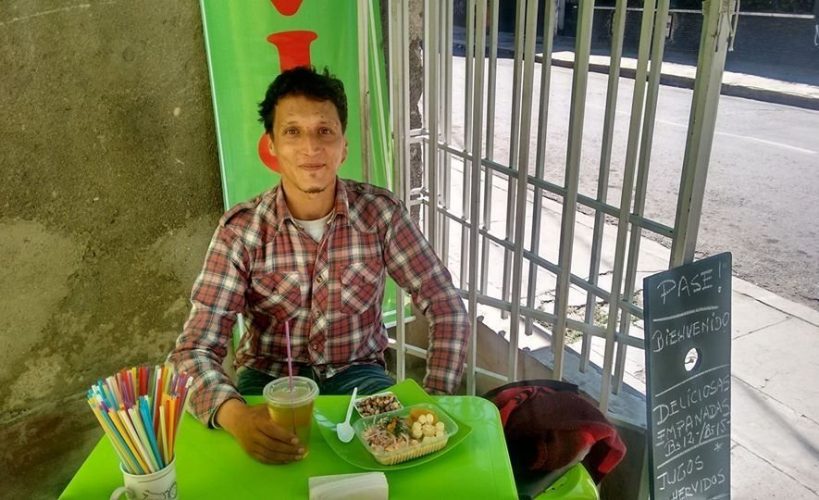
A photo of Sebastian Moro at a cafe in Bolivia not long before his death. Photo | Facebook
Despite the world’s attention being focused on the Andean country, media has steadfastly ignored the likely beating to death of a foreign journalist for political reasons. No mention of Moro has been made in the New York Times, CNN, MSNBC, Fox News or any mainstream Western outlet, despite his story being well known in his native Argentina. Nor has his case been mentioned by the major human rights networks such as Amnesty International or Human Rights Watch. Even the Committee to Protect Journalists has not acknowledged his killing. Its list of deceased journalists in 2019 shows none across South America.
In fact, both media and the human rights industry have been leading a campaign to legitimize the new coup administration of Jeanine Añez and whitewash her crackdown on independent media. Taking their line from the Trump administration, corporate media refused to call the events in Bolivia a coup, preferring instead to frame it as Morales “resigning.” The New York Times welcomed the end of the “increasingly autocratic” Morales and expressed its relief that the country was in the hands of more “responsible” leaders. Meanwhile, the Wall Street Journal’s headline read “a democratic breakout in Bolivia.”
Human Rights Watch, too, has been key in pushing through the U.S.-backed overthrow of a democratically elected head of state and whitewashing the violence that still engulfs Bolivia. Its director Ken Roth claimed that the coup was an “uprising” aimed at “defending democracy” from a “strongman” while the organization described Añez’s law giving Bolivia’s notorious police and armed forces complete immunity from all crimes while they massacred protestors as merely a “problematic decree.”
In fact, the only English language source that has reported on Moro’s death is the Orinoco Tribune, a tiny Venezuelan website with a staff of two people, according to its website. The Tribune translated an Argentinian article and published it on its website. MintPress News reached out to the Tribune for comment on the story. The editor replied that Moro’s case, as well as the total media silence over it, highlighted the need to create and encourage new grassroots media outlets. It also noted that after the coup against Honduran President Manuel Zelaya in 2009:
One [of the] very first gestures the U.S. coup against Zelaya made in Honduras was to shut down community radio and snatch journalists. Tortured reporters were then tossed out on the highway as a warning for others. The lucky ones lived. The coup in Bolivia seems to be on the same learning curve.”
As MintPress has reported, there has been a coordinated assault on independent media in Bolivia. New Communications Minister Roxana Lizarraga announced that this was part of the “dismantling of the propaganda apparatus of the dictatorial regime of Evo Morales,” claiming that Morales’ “militants who misused the state media system” are being “withdrawn.” Outlets like TeleSUR and RT en Español have been shut down and reporters have been shot. Lizarraga also declared that she would persecute any journalists involved in what she called “sedition,” noting that she already had a list of “troublesome” individuals and outlets.
Human rights groups have also been subject to oppression. New Interior Minister Arturo Murillo directly threatened a newly arrived human rights delegation from Argentina. “We recommend these foreigners who are arriving…to be careful,” he said, “We are looking at you. We are following you,” warning them that there will be “zero tolerance.” He added that “At the first false move that they make, trying to commit terrorism and sedition, they will have to deal with the police.” Fourteen members of the group were subsequently arrested, to silence in the press.
The largest NGOs exist primarily to protect and advance power under the guise of standing up for human rights. Human Rights Watch started as an anti-Soviet Cold War propaganda machine, Amnesty International’s co-founder was an FBI asset involved in the murder of Black Panther leaders like Fred Hampton. This explains their disinterest in Moro’s murder amid the wider crescendo of violence in Bolivia. Those that stand up to power are rarely remembered fondly in corporate media.
Alan MacLeod is a MintPress Staff Writer as well as an academic and writer for Fairness and Accuracy in Reporting. His book, Bad News From Venezuela: Twenty Years of Fake News and Misreporting was published in April.
Bolivia’s New US-Backed Interim Gov’t Wastes No Time Privatizing Economy
By Alan Macleod | MintPress News | December 16, 2019
It has been barely one month since the administration of Jeanine Añez seized power in a military coup in Bolivia, but it has wasted no time in attempting to transform the economy and society. Its latest move is aimed at privatizing the country’s economy. A government spokesperson confirmed the fears of many, claiming that “I believe the government should reduce its own size” and a protagonistic role should be given to private enterprises. In case that was not clear enough, he emphasized, “Yes, I’m talking about privatization.” Bolivia’s economy is dependent on its nationalized oil and gas industries.
After military generals appeared on television demanding his resignation, longtime president Evo Morales stepped down, citing the growing, targeted paramilitary violence against his MAS (Movement towards Socialism Party) colleagues. Morales, and his Vice-President Alvaro Garcia Linera, fled to Mexico for safety. The military chose Senator Jeanine Añez as his successor.
Añez is a strongly conservative Christian who has described Bolivia’s indigenous majority as “satanic” and vowed to bring the Bible back into politics. She has also provided the military carte blanche to use unlimited force in suppressing all resistance to her rule, even creating a squad of masked, heavily armed death squads aimed at uprooting leftist and foreign “terrorists.” Despite this, large areas of the country are in open rebellion and completely uncontrolled by the new government.
For a supposed “transitional” government, a caretaker regime holding the reins until imminent elections are organized, the Añez administration has certainly made some bold moves. It has already pulled Bolivia out of multiple international and intercontinental political and economic organizations, such as ALBA (the Bolivarian Alternative for the Americas) and UNASUR (the Union of South American Nations), both of which had a more left-of-center outlook.
Meanwhile, it has expelled large numbers of foreign nationals, including around 700 Cuban doctors that made up the backbone of the country’s new free healthcare system. It has also recognized U.S.-backed anti-president Juan Guaidó as the rightful ruler of Venezuela. With U.S. support, Guaidó attempted another Bolivia-style coup last month. Interior Minister Arturo Murillo has accused the Venezuelan government of being at the head of a vast narcotics conspiracy, ignoring his own boss’s ties to drug-runners (Añez’s nephew was caught with more than half a ton of cocaine in Brazil).
Murillo has formally requested the Israeli military come to train Bolivia’s armed forces and has eliminated entry visas for Americans and Israelis. Considering the IDF’s expertise in suppressing an indigenous population, Murillo’s intentions are worrying an increasing number of his countrymen. The government has also participated in a crackdown on dissenting journalism, closing down many TV networks including Bolivia TV, RT and TeleSUR. Even foreign journalists have been assaulted, detained and killed.
This latest move at privatizing the economy is part of an effort to “dismantle the apparatus of the dictatorial regime of Evo Morales,” as the Minister of Communication, Roxana Lizarraga, put it. On the orders of the International Monetary Fund, criticized by many as simply an extension of the U.S. government, the country’s oil and gas industries were privatized in 1996. International corporations like Enron, Shell and Repsol YPF were not even required to pay for their shares, making the move tantamount to the biggest giveaway in modern Bolivian history. Furthermore, royalties paid to the government were slashed to just 18 percent.
Water was also privatized. Bechtel, an American corporation, increased the prices to levels almost no Bolivian could afford to the point where water and sewage cost over half of an average Bolivian’s yearly wage. Bechtel also persuaded the government to privatize the sky, making it illegal to gather rainwater. The result was mass thirst that led to nationwide protests that became known as the Water War.
Within months of gaining office, Morales made good on his promise to nationalize key sectors of the economy. The move generated an extra $31.5 billion in government revenue over the next decade. He used the money to fund ambitious social programs. For example, over 11 percent of the revenues went to fund public universities, indigenous associations and a basic income grant to all low-income Bolivians over 60 years old.
Under Morales’ guidance, poverty halved and extreme poverty fell even further as citizens felt the benefits of the country’s natural resources. This, the Center for Economic Policy Research stresses, could not have been possible without nationalizing the hydrocarbons industry. Perhaps more important than all this, however, was the newfound dignity Bolivia’s indigenous majority felt at seeing the first indigenous president in the country’s history. The community is often treated with contempt bordering on revulsion by the light-skinned elite, but Morales has been part of a movement that inspired them to organize and take a protagonistic role in their country’s politics and society.
With the U.S. and the local elite back in charge of Bolivia and promising to re-privatize the economy, both their newly won social status and their improved economic circumstances are at imminent risk. A reversal of this policy will take coordinated resistance on the scale of the 2000 Water War.
Alan MacLeod is a MintPress Staff Writer as well as an academic and writer for Fairness and Accuracy in Reporting. His book, Bad News From Venezuela: Twenty Years of Fake News and Misreporting was published in April.
Now the Interim of US Self-Deception Over Bolivia
To read the mainstream press on what just happened to Evo Morales is to enter a hall of mirrors
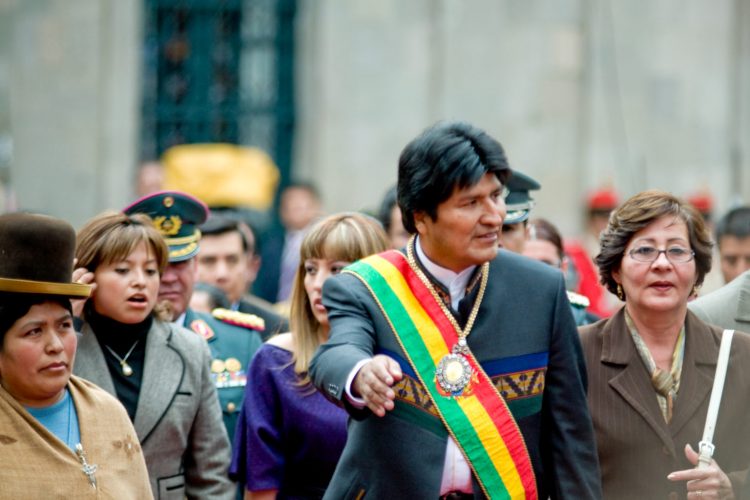
Bolivia’s Evo Morales in 2008. (Joel Alvarez, Wikimedia Commons)
By Patrick Lawrence | Consortium News | November 25, 2019
Years from now, maybe a generation from now, it will be permissible to describe Evo Morales’s resignation-at-gunpoint two weeks ago as what it was: a coup the U.S. cultivated just as it has dozens of others since it emerged as a superpower in 1945. The acknowledgement will not matter then. The events in question will be comfortably distant in time. Those responsible for deposing the Bolivian president will be either retired or deceased. Americans will not have fooled any Bolivians, for this autumn will be etched in their memories, but Americans will have once again fooled themselves.
This is how it often goes when Washington crushes the democratic aspirations of others by toppling legitimately elected leaders and replacing them with figures — usually corrupt, often dictatorial, by definition undemocratic — to its liking. It took decades for the U.S. to acknowledge the C.I.A.–directed coup in 1953 against the Mossadegh government in Iran: President Barack Obama did so (without apologizing) in 2009. Forty-five years after the fact, Bill Clinton spent half a day in Guatemala expressing regret for the coup that brought down President Jacobo Árbenz in 1954.
This is what awaits us now in the case of Bolivia — a long interim of self-deception, ending only when the truth makes little difference and responsibility can no longer be assigned.
Here is some of what Bill Clinton, president at the time, said in Guatemala City in March 1999. He spoke shortly after Guatemala’s Historical Clarification Commission — a name one has to love — concluded that in deposing Árbenz the U.S. was responsible for the blood-soaked human rights abuses that followed during 36 years of civil war:
“It is important that I state clearly that support for military forces or intelligence units which engaged in violent and widespread repression of the kind described in the report was wrong. And the United States must not repeat that mistake. We must and we will instead continue to support the peace and reconciliation process in Guatemala.”
Dishonesty & Consequences
This is a complacently dishonest statement, and it is essential to recognize not only Clinton’s dishonesty but also its consequences. These bear directly on the Bolivia question now.
Clinton was explicit in asserting that the Árbenz coup was an injustice that will not happen again. The past was evil, but evil has passed: This is a sound summation of his message. Having followed Clinton’s Central American tour at the time, I remain convinced that he addressed Americans at least as much Guatemalans when he made the just-quoted remarks. Some of us intervened violently in another country and caused much suffering, he told us norteamericanos, but we are not those people. They are gone now and we are better than they were.
This is the message implicit in all of the apologies U.S. officials occasionally make for misdeeds safely packed away in history’s deep freeze. In it we find the grand illusion of America’s present-day innocence. And it is by this illusion that the U.S. regularly repeats the mistake Clinton mentions, always certain that its injustices lie in a past for which Americans alive in the present bear no burden of guilt.
What are we to make of America’s apologies to others in view of the record before and after one or another of these expressions of regret? In Latin America alone, the Guatemalan “mistake” in 1954 was repeated, successfully or otherwise, in Cuba (1961, Bay of Pigs), Chile (1973), Nicaragua (1981–90, the Contra insurgency), and Honduras (2009). Washington has been trying for years to repeat its mistake in Venezuela and is currently trying again in Nicaragua. In the Venezuela case, sanctions have already succeeded in destabilizing the nation’s economy.
We have just watched it make this mistake in Bolivia. John Bolton, in his noted “troika of tyranny” speech a year ago, lumped Cuba with Venezuela and Nicaragua. Trump’s now-departed national security adviser unabashedly promised coups in all three nations.
The past is evil, all right, but evil has not passed.
Fighting for Plain Speech
Language is the battleground in the Bolivian case, as in all others like it in the past. This is as it should be. The fight for plain, spade-a-spade language is one worth fighting. It is by naming things and events honestly that we shed our illusions of innocence. This is the essential first step if America is to alter its ruinous conduct abroad. To fail in this is to protect the illegal practices of a disorderly hegemonic power from scrutiny.
Our corporate media have treated us to a remarkable display of hand-wringing and verbal contortions to avoid using the term “coup” in describing the events in La Paz from Oct. 20, when Morales was elected to a fourth term, and Nov. 10, when his high command forced him into exile. “Was there a coup in Bolivia?” The Economist asked after Morales sought asylum in Mexico. “Coup isn’t the right word,” the reliably neoliberal Foreign Policy protested as if in response. This is the same journal that published a piece in mid–2018 headlined, “It’s Time for a Coup in Venezuela.”
To read the mainstream press on Bolivia is to enter a hall of mirrors. The violent overthrow of an elected president struck a blow for the restoration of order and the rule of law. Christian fundamentalists of European descent, racist to the core and explicitly contemptuous of Bolivia’s indigenous majority, are “democrats” worthy of our support. Bolivia’s first indigenous president, highly popular for lifting an impressive percentage of Bolivians out of poverty, was a hated, “tyrannical dictator.”
This, the Orwellian touch, is routine — and is routinely reported in the American press. When the murderous General Abdul–Fattah al–Sisi took power in Egypt in a coup six years ago, John Kerry, as U.S. secretary of state, applauded him for “restoring democracy.” For good measure the secretary of state added, “The military did not take over.”
Islands of Responsible Coverage
Accurate, responsible accounts of the events surrounding Morales’s ouster are perfectly available, even if they appear amid a sea of mis– and disinformation. The Grayzone’s reporting on Bolivia this autumn is second to no one’s. Last week Fairness and Accuracy in Reporting, FAIR, carried a highly informed and informative interview with Alex Main of the Center for Economic and Policy Research in Washington.
These publications make the truth of events in Bolivia easily legible. There was no “drastic change” in the vote count late in the polling process, as the U.S.–controlled Organization of American States alleged. Neither was there a suspicious interruption in official reports of the final results, as also alleged. Many of the key figures in the coup have dense ties to Washington; some, including Williams Kalimán Romero, the since-replaced commander of the armed forces at the time of the coup, were trained at WHINSEC, the military training base in the U.S. state of Georgia previously (and infamously) known as the School of the Americas.
Just as it has elsewhere — Venezuela and Ukraine are recent examples — Washington was supporting right-wing political parties and opposition “civil society” groups even before Morales first won office in 2006. The first U.S.–cultivated coup attempt against him came two years later.
Do we have prima facie proof of Washington’s involvement in the coup against Morales? This is rarely available in such circumstances as these. As in many other cases, we may have to wait for the historians and the declassification of foreign- relations records. The closest we come so far in the Bolivia case is a set of 16 audio recordings released Nov. 10 by El Periódico, an independent publication in Costa Rica. These appear to record top coup plotters as they plan actions against the Morales government and, in one, discuss the support they receive from Senators Marco Rubio, Ted Cruz, and Bob Menendez — all of whom have taken a hand in previous Latin American interventions.
The recordings are here with English-language summaries of each recording, and here in the original El Periódico version. Provenance, chain of custody, the identities of those who made the recordings and those whose voices are recorded: None of this is clear. El Periódico did not reply to queries sent by email. But given how closely these audios align with established procedures in U.S.–cultivated coups (such as a leaked audio regarding the coup in Ukraine), and the formidable accumulation of compelling circumstantial evidence, they cannot be dismissed pending needed verifications.
What just happened in Bolivia happened in Guatemala 65 years ago, 66 in Iran, and so on. Coups were conducted in more or less the same fashion, without so much as a procedural update. Now as on previous occasions, most Americans are kept ignorant of what has been done in their name — and, atop this, remain indifferent to their ignorance. This is a media failure as much as a moral failure. When Bolton openly promises coups across Latin America, and liberal magazines such as FP cheer on such plans in banner headlines, we must conclude that in our late-imperial phase we are a numbed nation.
Washington has just degraded Bolivia’s long effort to climb out of poverty, to take control of its resources and its destiny, and to escape from centuries of exploitation at the hands of Westerners. This is shameful. The silent consent of most Americans after many decades of unlearned lessons is equally so.
Patrick Lawrence, a correspondent abroad for many years, chiefly for the International Herald Tribune, is a columnist, essayist, author and lecturer. His most recent book is “Time No Longer: Americans After the American Century” (Yale). Follow him on Twitter @thefloutist. His web site is Patrick Lawrence.
Bolivia’s Coup Government Targets Alternative Media as Crackdown Turns Increasingly Violent
By Alan Macleod | MintPress News | November 22, 2019
Facing increased resistance to its rule, the new “transition” government of Jeanine Añez in Bolivia has begun to purge and censor potential threats to its authority, including in the media. TeleSUR, an international media network that began as a collaboration between left-wing Latin American nations, including deposed President Evo Morales’ Bolivia and Venezuela’s Hugo Chavez, and which espouses an openly leftist and anti-imperialist outlook, received confirmation that it would be taken off the airwaves as part of what the government calls a “reorganization” of the airwaves. TeleSUR openly opposed the U.S.-backed military coup d’état that installed Añez as head of state earlier this month.
New Communications Minister Roxana Lizárraga announced that this was part of the “dismantling of the propaganda apparatus of the dictatorial regime of Evo Morales,” claiming that Morales’ “militants who misused the state media system” are being “withdrawn.”
TeleSUR was originally conceived as a counterweight to the Western-dominated media system and attempted to bring the voices of working-class Latin Americans to the fore. It also offers an alternative to local mainstream media, overwhelmingly owned and controlled by Latin American elites who have been particularly hostile to progressive governments such as Morales.’
This is the latest episode in a general assault on the media, as the Añez administration attempts to gain control over Bolivia’s means of communication. Multiple journalists have been shot, while Al-Jazeera correspondent Teresa Bo was tear-gassed in the face live on air at point-blank range by riot police as she stood alone, away from the protests, talking to the camera. Last week Lizárraga appeared on television announcing she would persecute any journalists involved in what she called “sedition,” noting that she already had a list of “troublesome” individuals and outlets. Bolivia TV was also taken off the air earlier this week.
In its efforts to neutralize dissent, the Añez administration has found a keen and enthusiastic ally in the local mainstream press. In a shocking moment captured on film, local media harassed an independent journalist, detaining him and handing him over to the armed forces. The local press has largely endorsed the events and celebrated Morales’ demise, presenting the situation as a democratic transition rather than as a coup.
The crackdown extends beyond media, as the new government has effectively declared the deposed Movement to Socialism (MAS) party illegal, arresting MAS officials and forcing others into hiding or exile in what new government minister Arturo Murillo called a “hunting” down of political opponents. “They’re drowning the Bolivian people in blood,” declared deposed Vice-President Álvaro García Linera from Mexico, where he was granted asylum.
Añez has granted security forces immunity from all crimes committed during the “re-establishment of order.” Those same forces reportedly carried out massacres in the city of Cochabamba and the town of Senkata, just south of the country’s capital, La Paz.
Tens of thousands of demonstrators, many carrying the Wiphala flag, a symbol of indigenous identity, marched to La Paz alongside the coffins carrying the victims of the Senkata massacre, demanding the resignation of Añez and an end to the bloodshed. The march stretched out for miles. MintPress News cameras captured the events.
Once the march came into contact with security forces in the capital, it was met with a barrage of tear gas, and downtown La Paz was engulfed in smoke as tens of thousands of Bolivians were gassed during rush hour. Mourners were forced to abandon the coffins of their loved ones in the street as fumes overcame them.
“La Paz, 5:30 pm. They’re gassing commuters and protesters alike. Can only imagine how many people will wander into the path of the police & military with the Bolivian media’s under-reporting. I saw mothers with infants gassed, they were not part of the procession,” reported one TeleSUR journalist on the scene.
From exile in Mexico, former President Morales denounced the attack on the funeral procession. “The de facto government of Añez does not respect the dead in their coffins, nor forgive their relatives, women and children marching peacefully in support of life and democracy”, he said. “We condemn the violence against our brothers and sisters.”
Morales won an unprecedented third term in office on October 20, gaining 47% of the vote in the presidential elections. However, opposition parties cried foul, claiming that there were election irregularities, an accusation repeated by the Organization of American States and the U.S. government. On November 10, military generals appeared on television and demanded Morales resign. As he fled to Mexico, the military selected Jeanine Añez – whose right-wing Democrat Social Movement Party received 4% of the vote – as President. Añez, a strongly conservative Christian, declared that Bolivia’s indigenous majority was “satanic” and promised to bring Christianity back to the government. The White House strongly supported the events, “applauding” what it saw as a significant and positive moment for democracy. On the other hand, Democratic Presidential candidates such as Bernie Sanders and Tulsi Gabbard have condemned it.
MintPress News is covering the events in Bolivia extensively. Full coverage can be found here and on Twitter.
Alan MacLeod is a MintPress Staff Writer as well as an academic and writer for Fairness and Accuracy in Reporting. His book, Bad News From Venezuela: Twenty Years of Fake News and Misreporting was published in April.
The OAS lied to the public about the Bolivian election and coup
Facts show nothing suspicious about the re-election of Evo Morales
By Mark Weisbrot | MarketWatch | November 19, 2019
What is the difference between an outright lie — stating something as a fact while knowing that it is false — and a deliberate material representation that accomplishes the same end? Here is an example that really pushes the boundary between the two, to the point where the distinction practically vanishes.
And the consequences are quite serious; this misrepresentation (or lie) has already played a major role in a military coup in Bolivia last week. This military coup overthrew the government of President Evo Morales before his current term was finished — a term to which nobody disputes that he was democratically elected in 2014.
More violent repression and even a civil war could follow.
OAS mission
The Organization of American States (OAS) sent an Electoral Observation Mission to Bolivia, entrusted with monitoring the Oct. 20 national election there. The day after the election, before all the votes were even counted, the mission put out a press release announcing its “deep concern and surprise at the drastic and hard-to-explain change in the trend of the preliminary results…”
Here is what the OAS was referring to: there is an unofficial “quick count” of the voting results that involves contractors who upload results at intervals, as the tally sheets are available. At 7:40 p.m. on election day, they had reported about 84% of the votes and then stopped reporting for 23 hours (more on that below).
When they resumed reporting results at 95% of votes counted, Morales’s lead had increased from 7.9% before the interruption to just over 10%.
This margin was important because in order to win without a second-round runoff, a candidate needs either an absolute majority, or at least 40% and a 10-point margin over the second-place finisher. This margin — which grew to 10.6% when all the votes were counted in the official count — re-elected Morales without a second round.
Morales’s lead grew steadily
Now, if you had any experience with elections or maybe even arithmetic, what is the first thing you would want to know about the votes that came in after the interruption? You might ask, were people in those areas any different from people in the average precinct in the first 84%?
And was the change in Morales’s margin sudden, or was it a gradual trend that continued as more vote tally sheets were reported?
You might even want to ask these questions before expressing “deep concern and surprise” about what happened, especially in a politically very polarized situation that was already turning violent. … continue
Bolivia: More Than 68,000 Fake Twitter Accounts Supported Coup
teleSUR | November 19, 2019
More than 68,000 fake Twitter accounts were created to support the coup d’état in Bolivia, revealed a recent study by Julián Macías Tovar, head of social networks for the Spanish party Podemos.
The specialist found that these false accounts used several labels to try to legitimize the departure of Evo Morales from power and justify violence and repression against demonstrators who reject the coup.
The accounts in this social network have also served to increase the number of followers of the main actors who participated in the anti-democratic outrage, such as the head of the Santa Cruz Civic Committee, Luis Fernando Camacho, and Senator Jeanine Áñez, self-proclaimed interim president.
Macías Tovar pointed out that Camacho’s account went from 2,000 followers to 130,000 in 15 days, 50,000 of them created in November 2019.
The same thing happened with Áñez, who, in that period, went from having 8,000 followers to 150,000, of which 40,000 are newly created accounts.
When analyzing the false accounts of both politicians, Macías Tovar counted more than 68,000 different false accounts, which have not been detected by Twitter and are still operating, although the social network prohibits the use of robots to amplify messages.
Another study, released on November 13, noted that in just two days 4,000 fake Twitter accounts were created and attempted to position the tag #BoliviaNoHayGolpe.
The research was carried out by the political communication specialist Luciano Galup.
Although the platform has an anti-spam system and has dedicated itself to closing Chavista and Cuban accounts, it has not reacted to these thousands of false anti-democratic accounts that support the end of Morales’ constitutional government.
OAS election observers subvert Bolivian democracy
By Yves Engler · November 18, 2019
Organization of American States election observers have played an important role in subverting Bolivian democracy.
While some may find it hard to believe that a regional electoral monitoring body would consciously subvert democracy, their actions in the South American country are not dissimilar to previous US/Canada backed OAS missions in Haiti.
“The OAS Election Audit That Triggered Morales’ Fall in Bolivia”, explained a New York Times headline. For his part, Bolivian President Evo Morales said the OAS “is in the service of the North American empire.”
After the October 20 presidential election, the OAS immediately cried foul. The next day the organization released a statement that expressed “its deep concern and surprise at the drastic and hard-to-explain change in the trend of the preliminary results [from the quick count] revealed after the closing of the polls.” Two days later they followed that statement up with a preliminary report that repeated their claim that “changes in the TREP [quick count] trend were hard to explain and did not match the other measurements available.”
But, the “hard-to-explain” changes cited by the OAS were entirely expected, as detailed in the Centre for Economic Policy Research’s report “What Happened in Bolivia’s 2019 Vote Count? The Role of the OAS Electoral Observation Mission”. The CEPR analysis points out that Morales’ percentage lead over the second place candidate Carlos Mesa increased steadily as votes from rural, largely indigenous, areas were tabulated. Additionally, the 47.1% of the vote Morales garnered aligns with pre-election polls and the vote score for his Movement toward Socialism party. The hullabaloo about the quick count stopping at 83% of the vote was preplanned and there is no evidence there was a pause in the actual counting.
But, the OAS’ statements gave oxygen to opposition protests. Their unsubstantiated criticism of the election have also been widely cited internationally to justify Morales’ ouster. In response to OAS claims, protests and Washington and Ottawa saying they would not recognize Morales’s victory, the Bolivian President agreed to a “binding” OAS audit of the first round of the election. Unsurprisingly the OAS’ preliminary audit report alleged “irregularities and manipulation” and called for new elections overseen by a new electoral commission. Immediately after the OAS released its preliminary audit US Secretary of State Mike Pompeo went further, saying “all government officials and officials of any political organizations implicated in the flawed October 20 elections should step aside from the electoral process.” What started with an easy-to-explain discrepancy between the quick count and final results of the actual counting spiraled into the entire election is suspect and anyone associated with it must go.
At Tuesday’s Special Meeting of the OAS Permanent Council on Bolivia the representative of Antigua and Barbuda criticized the opaque way in which the OAS electoral mission to Bolivia released its statements and reports. She pointed out how the organization made a series of agreements with the Bolivian government that were effectively jettisoned. A number of Latin American countries echoed this view.
US and Canadian representatives, on the other hand, applauded the OAS’ work in Bolivia. Canada’s representative to the OAS boasted that two Canadian technical advisers were part of the audit mission to Bolivia and that Canada financed the OAS effort that discredited Bolivia’s presidential election. Canada is the second largest contributor to the OAS, which receives between 44% and 57% of its budget from Washington.
It’s not surprising that an electoral mission from the Washington-based organization would subvert Bolivian democracy. OAS electoral observers have played more flagrant role in undermining Haitian democracy. In late 2010/early-2011 the US/Canada used an OAS election “Expert Verification Mission” to help extreme right-wing candidate Michel Martelly become president. Canada put up $6 million for elections that excluded Fanmi Lavalas from participating and following the first round of voting in November 2010, forced the candidate whom Haiti’s electoral council had in second place, Jude Celestin, out of the runoff. After Martelly’s supporters protested their candidate’s third place showing, a six person OAS mission, including a Canadian representative, concluded that Martelly deserved to be in the second round. But, in analyzing the OAS methodology, the CEPR determined that “the Mission did not establish any legal, statistical, or other logical basis for its conclusions.” Nevertheless, Ottawa and Washington pushed the Haitian government to accept the OAS’s recommendations. Foreign minister Lawrence Cannon said he “strongly urges the Provisional Electoral Council to accept and implement the [OAS] report’s recommendations and to proceed with the next steps of the electoral process accordingly.” In an interview he warned that “time is running out”, adding that “our ambassador has raised this with the president [Rene Préval] himself.” The CEPR described the intense western lobbying. “The international community, led by the US, France, and Canada, has been intensifying the pressure on the Haitian government to allow presidential candidate Michel Martelly to proceed to the second round of elections instead of [ruling party candidate] Jude Celestin.” This pressure included some Haitian officials having their US visas revoked and there were threats that aid would be cut off if Martelly’s vote total was not increased as per the OAS recommendation.
Half of Haiti’s electoral council agreed to the OAS changes, but the other half did not. The second round was unconstitutional, noted Haïti Liberté, as “only four of the eight-member Provisional Electoral Council (CEP) have voted to proceed with the second round, one short of the five necessary. Furthermore, the first-round results have not been published in the journal of record, Le Moniteur, and President Préval has not officially convoked Haitians to vote, both constitutional requirements.”
The absurdity of the whole affair did not stop the Canadian government from supporting the elections. Official election monitors from this country gave a thumbs-up to this exercise in what they said was democracy. After Martelly won the second round with 16.7 percent of registered voters support Cannon declared: “We congratulate the people of Haiti, who exercised their fundamental democratic right to choose who will govern their country and represent them on the world stage.” The left weekly Haiti Progrès took a different view. Describing the fraudulent nature of the elections, the paper explained: “The form of democracy that Washington, Paris and Ottawa want to impose on us is becoming a reality.”
A decade earlier another OAS election mission helped sabotage democracy in Haiti. After voting for 7,000 positions an OAS team on site described the May 2000 elections as “a great success for the Haitian population which turned out in large and orderly numbers to choose both their local and national governments.”
As the opposition protested the scope of Fanmi Lavalas’ victory, the OAS jumped on a technicality in the counting of eight Senate seats to subsequently characterize the elections as “deeply flawed”. The 50 percent plus one vote required for a first-round victory was determined by calculating the percentages from the votes for the top four candidates, while the OAS contended that the count should include all candidates. OAS concerns were disingenuous since they worked with the electoral council to prepare the elections and were fully aware of the counting method beforehand. The same procedure was used in prior elections, but they failed to voice any concerns until Fanmi Lavalas’ landslide victory. Finally, using the OAS method would not have altered the outcome of the elections and even after Jean Bertrand Aristide got the seven Lavalas senators to resign (one was from another party) the “deeply flawed” description remained.
Haiti’s political opposition used the OAS criticism of the election to justify boycotting the November 2000 presidential election, which they had little chance of winning. The US and Canada used the claims of electoral irregularities to justify withholding aid and Inter-American Development Bank loans to the Haitian government. OAS Resolutions 806 and 822 gave non-elected opposition parties an effective veto over the resumption of foreign aid to Aristide’s government. The OAS claims of “deeply flawed” elections played an important part in a multipronged campaign to oust Aristide’s government.
In an editorial responding to the coup in Bolivia, People’s Voice called for Canada to withdraw from the Washington dominated OAS. Internationalist minded Canadians should support that position.
But we should also recognize the blow Morales’ ouster represents to any effort to subvert the OAS. The Bolivian President’s removal is a further setback to the Latin American integration efforts represented in forums such as the Community of Latin American and Caribbean States. A potential replacement for the OAS, CELAC included all Latin American and Caribbean nations. But Canada and the US were excluded. By helping oust Morales the OAS has taken revenge on a politician who pushed an alternative, non-Washington based, model for ‘Nuestra America’.
Featured Video
No Threat Can Force Iran’s Surrender /Trita Parsi & Lt Cl Daniel Davis
or go to
Aletho News Archives – Video-Images
From the Archives
An Expert Military Analysis of War with China
Actually, None is Necessary
By Fred Reed • Unz Review • December 13, 2020
The Correlation of Armed Forces: U.S. goods and services trade with China totaled an estimated $634.8 billion in 2019. Exports were $163.0 billion; imports were $471.8 billion. The U.S. goods and services trade deficit with China was $308.8 billion in 2019. Trade in services with China (exports and imports) totaled an estimated $76.7 billion in 2019. Services exports were $56.5 billion; services imports were $20.1 billion. The U.S. services trade surplus with China was $36.4 billion in 2019.
There is talk within the Washingtoniat of a possible war with China. Steve Bannon, who apparently was dropped on his head as a child, actually favors such a war. We hear the usual shoo-the-boobs alarm about how the Chinese are doing something terrible and we must gird our loins and American values and show them what for, bow wow, woof. The danger is that the current game of who-blinks-first in Asian waters might actually provoke a shooting war. You know the kind of thing: One warship refuses to get out of the way of another, a collision ensues, some retard lieutenant who signed up on waivers opens fire, and we’re off and running. It is not a good idea to let children play with matches.
The said war is discussed either in emotional terms by idiots or in purely naval terms by those familiar with such things, so we hear of the First Island Chain and the Second Island Chain and whose missiles against the other’s missiles and so on. This would be appropriate if we were fighting World War Two again. Which we aren’t. Let’s take a quick-and-dirty look at how such a war might go.
To begin the war, America would overestimate itself and underestimate China. This is doctrine in the Pentagon. … continue
Blog Roll
 Aletho News
- Iran To Target Military Industrial-Tech Complex That Facilitated Gaza Genocide
- Collapsing Empire: The Resistance Disarms ‘Israel’
- Suicide Should Not Be a Government Service
- Rethinking America’s greatest threat: Iran vs. Israel-Firsters
- Iran accuses adversaries of false flags to strain Turkey ties
- Poland rules out sending Patriot missiles to US/Israel amid war on Iran
- Tehran approves new Hormuz plan with major restrictions
- No Threat Can Force Iran’s Surrender /Trita Parsi & Lt Cl Daniel Davis
- UK’s New Pandemic Plan Would Turn Big Tech Into a Mass Location Tracking Network
- Growing insecurity, soaring prices fuel protests in north as regime bans evacuation: Sources
- If Americans Knew
- Ann Coulter Rips Into Fox News for Iran War Coverage, Compares to False Rigged 2020 Election Reporting
- Joe Kent Urges Americans To Call White House and Congress To Object To Sending Troops Into Iran
- DNC Resolution to Reject AIPAC Funding Puts Democratic Leaders in the Hot Seat
- Swedish foundation to build 400 schools as over 650,000 Gaza children remain without education for 2 years
- Israeli army admits photshopping image of slain Lebanese journalist
- This is how Israel is systematically killing health workers under the cover of war in Lebanon
- Carrying life under fire: Israeli invasion of Lebanon leaves pregnant women facing deadly risks
- Champagne all around for the new death penalty (for Palestinians) law – Not a ceasefire Day 172
- Why are Palestinian books struggling to be seen on Amazon?
- The Line Between Affinity and Conspiracy
- No Tricks Zone
- New Study Finds Warming Saves Lives…Cold Temperatures 12 Times More Deadly Than Excess Heat
- German Science Blog Accuses PIK Climate Institute Of Hallucinating Climate Tipping Points
- Devastating Assessment Of Comirnaty Vaccine By Former Senior Pfizer Europe Toxicologist
- New Study: CO2 Is ‘Effectively Negligible’ As An Explanatory Climate Change Factor Since 2000
- Former Pfizer Toxicologist Dr. Helmut Sterz Tells Bundestag Hearing Pfizer Vaccine Should Have Never Been Approved
- Energy Expert: Germany’s Nuclear Phaseout Was A “500 Billion Euro Mistake”
- New Research: South Australia’s Mid-Holocene Sea Surface Temperatures Were 4°C Warmer Than Today
- Storing Green Energy To Last Germany 10 Days Would Require A 60-Million Tonne Battery
- New Studies: UK Sea Levels Were 4 Meters Higher Than Today During The Mid-Holocene
- Destructive Green New Deal: German Energy And Metal Group Warns Of Drastic Crisis
 Aletho News