Bolivia’s Struggle to Restore Democracy after OAS Instigated Coup
By Frederick B. Mills, Rita Jill Clark-Gollub, Alina Duarte | Council on Hemispheric Affairs | July 9, 2020
On October 21, 2019, the Organization of American States (OAS) issued a fateful communique on the presidential elections in Bolivia: “The OAS Mission expresses its deep concern and surprise at the drastic and hard-to-explain change in the trend of the preliminary results revealed after the closing of the polls.”[1] The mission’s report came in a highly polarized political context. Rather than wait for a careful and fair-minded analysis of the election results, it raised unsubstantiated doubts about the legitimacy of President Evo Morales’ lead as some of the later vote tallies were being reported. This was a bombshell report at a time when it appeared that Morales had garnered a sufficient margin of victory over his right wing opponent, Carlos Mesa, to avoid a runoff election.
The manufactured electoral fraud was quickly debunked by experts in the field. Detailed analyses of the election results were conducted by the Center for Economic and Policy Research (CEPR)[2] and Walter R. Mebane, Jr., professor of Political Science and Statistics at the University of Michigan in early November 2019.[3] These were later corroborated by researchers at MIT’s Election Data and Science Lab[4] and more recently by an article published by the New York Times[5] featuring the study of three academics: Nicolás Idrobo (University of Pennsylvania), Dorothy Kronick (University of Pennsylvania), and Francisco Rodríguez (Tulane University)[6].
All of these professional and academic analyses found the charges of fraud by the OAS to have been unfounded.
The OAS electoral mission, however, had already poisoned the well. The false narrative of electoral fraud gave ammunition to anti-Bolivarian forces in the OAS and the right wing opposition inside Bolivia to contest the outcome of the election and go on the offensive against Morales and his party, the Movement Towards Socialism (Movimiento al Socialismo, MAS). During a three-week period, a right wing coalition led protests over the alleged electoral fraud, while pro-government counter protesters defended the constitutional government. The military and police cracked down on the pro-Morales protesters, while showing sympathy for right wing demonstrators. Then, on November 10, 2019, in its “Electoral integrity analysis,” the OAS doubled down on its dubious claims, impugning “the integrity of the results of the election on October 20, 2019.”[7]
The track record of the OAS electoral mission, which was invited to observe and assess the election by the Bolivian government of Evo Morales, had already been stained by its 2015 debacle in Haiti.[8] In the case of Bolivia, the mission politicized election results and set the stage for murder by a coup regime. It appears that there is not much political daylight between the judgment of the OAS electoral commission and the rabidly anti-Bolivarian OAS Secretary, Luis Almagro. Far from finding that the coup against Morales constituted a breach in the democratic order of Bolivia, the OAS simply exploited its position as arbiter of the election to rally behind the right wing coup leaders.
Morales resigns and a “de facto” right wing regime unleashes a wave of repression
Despite the relentless drive by Washington against Bolivarian governments in the region, President Morales was apparently unprepared for the disloyalty within his security forces and he was caught off guard by the OAS propensity to serve US interests in the region. MAS activists, legislators, union activists, Indigenous organizations, and social movement activists, however, continued to resist the coup even as they faced arrest and violence from the de facto regime.
The coup forces exercised extreme violence against authorities of the Morales’ administration and MAS legislators (the majority of Congress). Several houses were burned down and some relatives of authorities were kidnapped and injured, all with total impunity and without protection by the security forces.[9]
With the OAS-instigated coup gaining traction within the security forces and police, as well as Morales’ political adversaries, the President chose the path of accommodation. He offered to reconstitute the electoral authority and hold fresh elections. This concession to OAS authority was met by calls from the police and military for his resignation. Rather than launch a campaign of resistance from the MAS stronghold of Chapare, Morales resigned his post, opting for exile in an unsuccessful bid to avoid further bloodshed. Jeanine Áñez, an opposition party senator with Plan Progreso para Bolivia Convergencia Nacional, proclaimed herself President after the resignation of Senate President Adriana Salvatierra, who refused to legitimize the coup with an unjustified “succession.”[10]
The scenes in the streets of Cochabamba turned ugly. It was a field day for racist attacks on the majority Indigenous population. The Indigenous flag–the wiphala–was burned in the streets, and much fanfare was made when Áñez, surrounded by right wing legislators, held up a large leather bible and declared, “The Bible has returned to the palace.” Such attempts to resubordinate Bolivia’s plurinational heritage were met with widespread resistance.
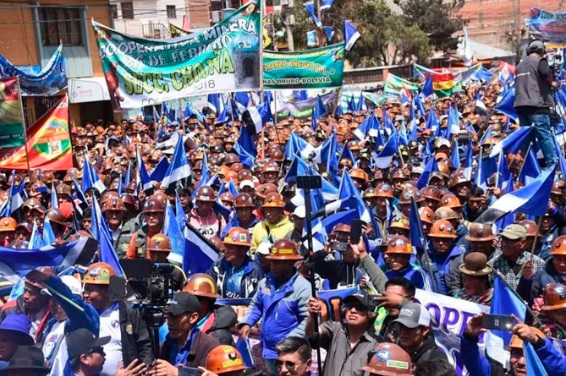
Workers of all industries and sectors continue protests against Áñez and to protect social rights created under Morales’s government (photo credit: MAS-IPSP, http://www.masipsp.bo).
After thirteen years of impressive economic growth, poverty reduction, recovery of the nation’s natural resources, and the inclusion of formerly marginalized sectors in the political life of the country under the leadership of President Evo Morales, Bolivia had now suffered an enormous blow to the liberatory project of the 2009 Constitution. But the coup fit perfectly into the US-OAS drive to recolonize the Americas.
Secretary General Luis Almagro, who would never let an opportunity to attack the Bolivarian cause go to waste, immediately recognized self-proclaimed President, Senator Jeanine Áñez, adding yet one more crime to the long list from his shameful tenure at the OAS.[11] At a special meeting of the OAS on November 12, 2020 Almagro declared, “There was a coup in the State of Bolivia; it happened when an electoral fraud gave the triumph to Evo Morales in the first round.”[12]
During the meeting, 14 member states of the OAS (Argentina, Brasil, Canada, Chile, Colombia, Costa Rica, Ecuador, the US, Guatemala, Guyana, Honduras, Panama, Paraguay, Peru) and the unelected US-backed shadow government of Venezuela called for new elections in Bolivia “as soon as possible,” while Mexico, Uruguay and Nicaragua warned against the precedent being set by the “coup” against Evo Morales. The ambassador of Mexico to the OAS, Luz Elena Baños, described the coup against Morales as “a serious breach in the constitutional order by means of a coup d’etat,” adding “the painful days when the Armed Forces sustained and deposed governments ought to remain in the past.” [13] The Trump administration echoed Almagro’s declaration and moved quickly to endorse what was now a “de facto” government.[14] The OAS was now at the service of two unelected, US-backed, self-proclaimed presidents (Juan Guaidó for Venezuela and Jeanine Áñez for Bolivia).
What followed was the brutal repression of widespread protests amid grass roots clamor for the return of President Morales,[15] who, from his exile in Mexico and later Argentina, still held great clout among rank and file MAS militants and the popular movements. The horrific massacre in Sacaba, on November 15, followed by a massacre in Senkata, on November 19, carried out by the security forces, exposes the coup regime to future prosecution for crimes against humanity.[16] Rather than pacify the country, the repression only galvanized the MAS, which still held a majority in the legislature, as well as the peasant unions and grassroots organizations in their struggle to restore Bolivian democracy. There was indeed a coup, but it had not and still has not been consolidated.
New elections could be compromised by lawfare
Today, Bolivia stands at a crossroads. In June 2020, popular calls were mounting for new elections and the restoration of democracy, despite the ongoing repression. In response to this pressure, on June 22, Áñez signed off on legislation to hold new elections in September. Former president Carlos Mesa (2003-2005) of the right wing Citizens Community Party would face off against the MAS candidate, former Minister of Finance (2006-2019), Luis Arce. Áñez’s decision drew the ire of Minister of Government, Arturo Murillo, who characterizes the most popular political party in the country as narco-terrorist. Murillo even threatened MAS legislators with arrest if they refused to approve promotions for the very military officials responsible for the repression.[17]
Should democratic elections prevail, recent polls do not look good for the “de facto” regime. In a poll taken by CELAG between June 13 and July 3, the MAS candidate, Luis Arce, leads with 41.9% support, followed by Carlos Mesa, with 26.8%, and Áñez, with 13.3%.[18]

Luis Arce, from the MAS party, leads the presidential race in Bolivia (Source: CELAG, https://www.celag.org/wp-content/uploads/2020/07/panorama-politico-y-social-bolivia-web-2.pdf)
Although Áñez initially said she would not run for president,[19] she later decided to do so even over the objections of her fellow opposition members.[20] The latter said that this went against her purported objective of only serving as a transition government until new elections could be held—initially on May 3, but later canceled due to the COVID-19 pandemic. Not only was Áñez never a favorite in the polls, her de facto government has been unrelenting in its attempts to persecute the MAS and kick it out of the race.
On March 30 a government oversight agency (Gestora Pública de Seguridad Social de Largo Plazo) filed formal charges against MAS presidential candidate Luis Arce for “economic damages to the State” while he was Minister of Finance. According to the Bolivian Information Agency, his alleged crimes are linked to the contracting of two foreign companies to provide software for the administration of the national pension system.[21]
The charges state that the previous administration paid US$3 million as an advance for a contract valued at US$5.1 million to the Panamanian company Sysde International Inc. However, said company never delivered the software. Consequently, the MAS administration contracted the Colombian company Heinsohn Business Technology for US$10.4 million, on top of which payments were to be made of US$1.6 million annually for the license and source code.
Luis Arce responded to the charges during a press conference,[22] stating that during his tenure, “We entered into a contract for a system and the company failed us, so we filed suit against the company.” But he stressed that the charges simply seek to disqualify the MAS to prevent the party from participating in the presidential election.
Evo Morales took to Twitter to say, “The imminent electoral defeat of the de facto government is leading it to trump up new charges against the MAS-IPSP every day. Now, as we have denounced, they have filed charges based on false conjecture against our candidate to ban him from running for office because he is leading in the polls.”[23]
On July 6, the Attorney General of Bolivia charged Evo Morales himself. The charges are terrorism and financing of terrorism coordinated from exile, and preventive detention has been requested. This is a rehashing of similar charges brought last November, charges denied by Morales.[24]
The persecution against the overthrown government has not stopped. Seven former officials remain asylees at the Mexican Embassy in La Paz: the former Minister of the Presidency, Juan Ramón Quintana Taborga; the former Minister of Defense, Javier Zavaleta; the former government minister, Hugo Moldiz Mercado; the former Minister of Justice, Héctor Arce Zaconeta; the former Minister of Cultures, Wilma Alanoca Mamani; the former governor of the Department of Oruro, Víctor Hugo Vásquez; and the former director of the Information Technology Agency, Nicolás Laguna.
The current Minister of Government, Arturo Murillo, affirmed upon assuming power that the authorities of the constitutional government of Evo Morales would be “hunted” and imprisoned before any arrest warrant was issued.[25] And now, eight months after the coup d’etat, the de facto government has refused to deliver safeguards to the asylum seekers at the embassy even though Bolivia and Mexico are parties to the American Convention on Human Rights, which in its article 22 establishes the right to seek and receive asylum[26].
Calls for free and fair elections without subversion by the OAS
The consequences of the OAS’ bad faith monitoring of the 2019 Bolivian election cannot be overstated. Not only were lives lost in the chaos and violence spurred by the statements of the OAS Electoral Observation Mission, which also resulted in scores of injuries and detentions. But the de facto regime continues its reign of terror, even repressing people protesting hunger during the pandemic lockdown,[27] while it dismantles the extensive social programs put into place during the years of MAS government.[28] Despite the repression, grassroots social movements in Bolivia, most notably peasant and Indigenous women who have bravely withstood attacks by the de facto regime, continue to insist on true democracy. They are inspired by the 2009 Constitution creating the Plurinational State, with its promise of a “democratic, productive, peace-loving and peaceful Bolivia, committed to the full development and free determination of the peoples.”[29]
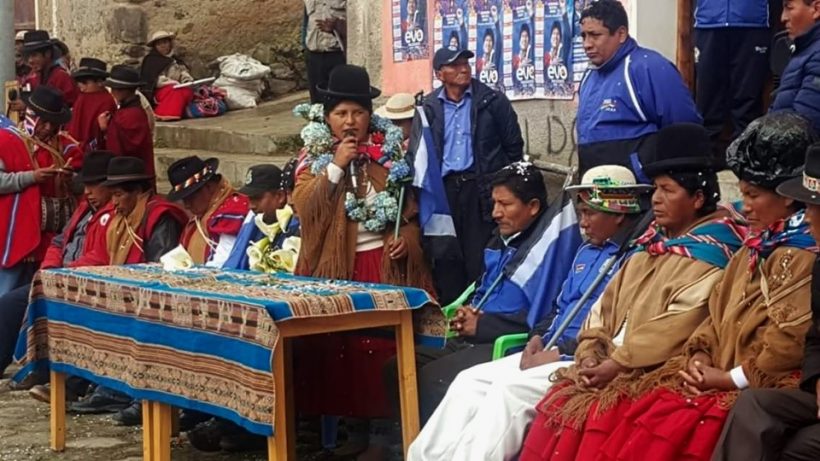
Indigenous women have been at the forefront of the fight to restore democracy in Bolivia (photo credit: MAS-IPSP, http://www.masipsp.bo).
On July 8, the MAS-IPSP “categorically” rejected the participation of an OAS electoral mission for the September presidential election, on account of their responsibility for the coup against the constitutional government.[30] The communique declared that “it is not ethical for [the OAS electoral mission] to participate again for having been part of and complicit with a coup against the democracy and Social State of Constitutional Law of Bolivia”, and “that [the OAS] is not an impartial organization to defend and guarantee peace, democracy and transparency, but rather a sponsor of petty interests that are foreign to the democratic will of the Bolivian people.” [31]
Bolivia is at a crossroads. Will the de facto regime of Jeanine Áñez, having completed a coup and in command of the security forces, allow a return to democratic procedures to resolve political differences? Or will she join her Minister of Government, Arturo Murillo, in seeking to undermine, through political persecution and lawfare, any chance that the MAS ticket will be on the ballot, let alone allow free elections to take place?
The condemnation of the coup by Mexico, Nicaragua and Uruguay on November 12 was just the start of international solidarity with the call for a return to democracy in Bolivia. On November 21, 31 US organizations denounced “the civic-military coup in Bolivia.” [32] On June 29, 2020 the Grupo de Puebla, a forum that convenes former presidents, intellectuals, and progressive leaders of the Americas, released a statement condemning the actions of the OAS. “The Puebla Group considers that what happened in Bolivia casts serious doubts on the role of the OAS as an impartial electoral observer in the future.”[33] The international community can honor the clamour for free and fair elections in Bolivia by condemning the de facto regime’s use of political persecution and lawfare, supporting democratic elections in September, and rejecting any further role of the OAS in monitoring elections in the Americas.
Patricio Zamorano provided editorial support and research for this article.
Translations from Spanish to English are by the authors.
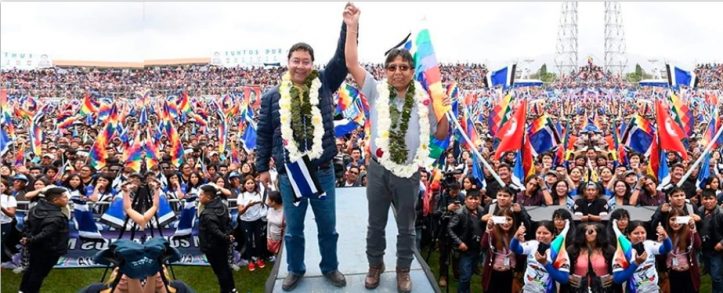
Luis Arce, presidential candidate, and David Choquehuanca, running for the vice-presidency. They lead all surveys so far (photo credit: MAS-IPSP, http://www.masipsp.bo/).
End notes
[1] “Statement of the OAS Electoral Observation Mission in Bolivia,” https://www.oas.org/en/media_center/press_release.asp?sCodigo=E-085/19
[2] “What Happened in Bolivia’s 2019 Vote Count?” https://cepr.net/report/bolivia-elections-2019-11/
[3] “Evidence Against Fraudulent Votes Being Decisive in the Bolivia Election,” http://www-personal.umich.edu/~wmebane/Bolivia2019.pdf
[4] “Bolivia dismissed its October elections as fraudulent. Our research found no reason to suspect fraud,” https://www.washingtonpost.com/politics/2020/02/26/bolivia-dismissed-its-october-elections-fraudulent-our-research-found-no-reason-suspect-fraud/
[5] “New York Times Admits Key Falsehoods that Drove Last Year’s Coup in Bolivia: Falsehoods Peddled by the US, its Media, and the Times,” https://theintercept.com/2020/06/08/the-nyt-admits-key-falsehoods-that-drove-last-years-coup-in-bolivia-falsehoods-peddled-by-the-u-s-its-media-and-the-nyt/. See also the study by CELAG, “Sobre la OEA y las elecciones en Bolivia”, (Nov. 19, 2019). CELAG conducted a study of both the OAS report and CEPR’s analysis and concluded: “The findings of the analysis allow us to affirm that the preliminary report of the OAS does not provide any evidence that could be definitive to demonstrate the alleged “fraud” alluded to by Secretary General, Luis Almagro, at the Permanent Council meeting held on November 12 . On the contrary, instead of sticking to a technically grounded electoral audit, the OAS produced a questionable report to induce a false deduction in public opinion: that the increase in the gap in favor of Evo Morales in the final section of the count was expanding by fraudulent causes and not by the sociopolitical characteristics and the dynamics of electoral behavior that occur between the rural and urban world in Bolivia.” https://www.celag.org/sobre-la-oea-y-las-elecciones-en-bolivia/
[6] “Do Shifts in Late-Counted Votes Signal Fraud? Evidence From Bolivia,” https://papers.ssrn.com/sol3/papers.cfm?abstract_id=3621475
[7] “Preliminary Findings Report to the General Secretariat,” http://www.oas.org/documents/eng/press/Electoral-Integrity-Analysis-Bolivia2019.pdf
[8] “Elections in Haiti pose post-electoral crisis, by Clément Doleac and Sabrina Hervé, Dec. 10, 2015. COHA. https://www.coha.org/elections-in-haiti-pose-post-electoral-crisis/
[9] “El Grupo de Puebla rechazó el golpe contra Evo Morales y se solidarizó con el pueblo boliviano,” https://www.infonews.com/el-grupo-puebla-rechazo-el-golpe-contra-evo-morales-y-se-solidarizo-el-pueblo-boliviano-n281357
[10] “Salvatierra: Mi renuncia fue coordinada con Evo y Alvaro,” https://www.google.com/url?q=https://www.paginasiete.bo/nacional/2020/1/24/salvatierra-mi-renuncia-fue-coordinada-con-evo-alvaro-244454.html&sa=D&ust=1593696030403000&usg=AFQjCNE_kAMqtAOBGCXdjJV5nkBsfQEWPQ
[11] “Almagro: Evo Morales fue quien cometió un “golpe de Estado,” DW. https://www.dw.com/es/almagro-evo-morales-fue-quien-cometi%C3%B3-un-golpe-de-estado/a-51218739
[12] https://twitter.com/oas_official/status/1194389549037830145?lang=en
[13] “La OEA y la crisis en Bolivia: un choque de relatos irreconciliables”, EFE, Nov. 12, 2019. https://www.efe.com/efe/usa/politica/la-oea-y-crisis-en-bolivia-un-choque-de-relatos-irreconciliables/50000105-4109588
[14] “Statement from President Donald J. Trump Regarding the Resignation of Bolivian President Evo Morales,” https://www.whitehouse.gov/briefings-statements/statement-president-donald-j-trump-regarding-resignation-bolivian-president-evo-morales/
[15] “With the Right-wing coup in Bolivia nearly complete, the junta is hunting down the last remaining dissidents,” https://thegrayzone.com/2019/11/27/right-wing-coup-bolivia-complete-junta-hunting-dissidents/
[16] “Brutal Repression in Cochabamba, Bolivia: So far nine killed, scores wounded,” COHA. https://www.coha.org/brutal-repression-in-cochabamba-bolivia-november-15-2019/
[17] “Bolivian regime threatens to imprison lawmakers, officials,” https://www.telesurenglish.net/news/Bolivian-Regime-Threatens-to-Imprison-Lawmakers-Officials-20200524-0004.html
[18] “Encuesta Bolivia, July 2020”, CELAG, https://www.celag.org/encuesta-bolivia-julio-2020/
[19] “Evo Morales busca un candidato y Añez dice que no participará en elecciones”, https://www.lavoz.com.ar/mundo/evo-morales-busca-un-candidato-y-anez-dice-que-no-participara-en-elecciones
[20] “A Jeanine Añez hasta los aliados le critican su candidatura”, https://www.pagina12.com.ar/244221-a-jeanine-anez-hasta-los-aliados-le-critican-su-candidatura
[21] Gestora Pública denuncia formalmente al exministro Luis Arce por daño económico al Estado” https://www1.abi.bo/abi_/?i=452014
[22] “Luis Arce asegura que la denuncia en su contra busca inhabilitar su participación en las elecciones”, https://www.youtube.com/watch?v=-DYvPUk643w
[23] “Fiscalía boliviana acusa de terrorismo a Evo Morales.” https://www.eltiempo.com/mundo/latinoamerica/fiscalia-boliviana-acusa-de-terrorismo-a-evo-morales-515054
[24] “Fiscalía boliviana acusa a Morales de terrorismo y pide su arresto,” https://www.hispantv.com/noticias/bolivia/470654/anez-morales-terrorismo-detencion
[25] “¿Quién es Arturo Murillo?”, https://www.pagina12.com.ar/239232-quien-es-arturo-murillo
[26] “American Convention on Human Rights,” https://www.cidh.oas.org/basicos/english/basic3.american%20convention.htm
[27] “Valiente resistencia en K’ara K’ara enfrenta represión policial y militar”, https://www.laizquierdadiario.com/Valiente-resistencia-en-K-ara-K-ara-enfrenta-represion-policial-y-militar
[28] “Bolivia’s Coup President has Unleashed a Campaign of Terror,” https://www.jacobinmag.com/2020/05/bolivia-coup-jeanine-anez-evo-morales-mas
[29] “Bolivia (Plurinational State of) Constitution of 2009,” https://www.constituteproject.org/constitution/Bolivia_2009.pdf
[30] MAS-IPSP tweet, July 8, rejecting OAS mission for September elections.
[31] “El MAS rechaza observadores de la OEA en elecciones bolivianas,” July 9, Telesur. https://www.telesurtv.net/news/bolivia-movimiento-socialismo-rechazo-observadores-oea-20200709-0002.html
[32] “31 US organizations denounce the brutal repression in Bolivia,” COHA. https://www.coha.org/31-us-organizations-denounce-the-brutal-repression-in-bolivia/
[33] ttps://www.telesurtv.net/news/grupo-puebla-rechaza-oea-observador-internacional-20200629-0085.html
Twitter Targets Accounts of MintPress and Other Outlets Covering Unrest in Bolivia
By Alan Macleod | MintPress News | June 29, 2020
Social media giant Twitter took the step of suspending the official account of MintPress News on Saturday. Without warning, the nine-year-old account with 64,000 followers was abruptly labeled as “fake” or “spam” and restricted. This move is becoming a frequent occurrence for alternative media, especially those that openly challenge U.S. power globally.
Immediately preceding the ban, MintPress had been sharing stories about Israeli government crimes against Palestinians, the Saudi-led onslaught in Yemen (both funded and supported by Washington), and about activists challenging chemical giant Monsanto’s latest plans. However, MintPess correspondent Ollie Vargas, stationed in Bolivia and covering the coup and other events there, had another theory on the suspension. Vargas noted that his account, along with union leader Leonardo Loza and independent Bolivian outlets Kawsachun Coca and Kawsachun News were all suspended at the same time. “There was a coordinated takedown of numerous users & outlets based in Chapare, Bolivia. Thousands of fake accounts appeared after the coup. We believe they’re being mobilized to mass report those who criticize the regime,” he said. Since the November coup, Bolivia has been the sight of intense political struggle, with MintPress one of the only Western outlets, large or small, extensively covering the situation (and from a perspective that directly challenges the official US government line). Vargas added that all those accounts suspended appeared in his Twitter bio.
In December, MintPress reported how the strongly conservative Bolivian elite is treating social media as a key battleground in pushing the coup forward, with over 5,000 accounts created on the day of the insurrection tweeting using pro-coup hashtags. With the new administration still lacking both legitimacy and public support, it appears the next step is to simply silence dissenting voices online like they have been silenced inside the country. Kawsachun Coca and Kawsachun News, located in the Chapare region, still not under government control, are among the only remaining outlets critical of the Añez administration.
As Twitter has developed into a worldwide medium of communication, it has also grown an increasingly close relationship with Western state power. In September, a senior Twitter executive was unmasked as an active duty officer in a British Army brigade whose specialty was online and psychological warfare. It was almost entirely ignored by corporate media; the one and only journalist at a major publication covering the story was pushed out of his job weeks later. Earlier this month, Twitter announced it worked with a hawkish U.S.- and Australian-government sponsored think tank to purge nearly 200,000 Chinese, Russian and Iranian accounts from its platform. It has also worked hard to remove Venezuelan users critical of U.S. regime change, including large numbers of government members. Meanwhile, despite detailed academic work exposing them, Venezuelan opposition bot networks remain free to promote intervention.
Facebook has also been working hand-in-hand with the Atlantic Council, a NATO think tank, to determine what users and posts are legitimate and what is fake news, effectively giving control over what its 2.4 billion users see in their news feeds to the military organization. Reddit, another huge social media platform, recently appointed a former deputy director at the council to be its head of policy.
Earlier this year, Facebook announced that it was banning all positive appraisals of Qassem Soleimani, the Iranian general and statesman assassinated by the Trump administration. This, it explained, was because Trump had labeled the Iranian Revolutionary Guard Corps (IRGC) a terrorist organization. “We operate under U.S. sanctions laws, including those related to the U.S. government’s designation of the IRGC and its leadership,” it said in a statement. This is particularly worrying, as Soleimani was the country’s most popular public figure, with over 80 percent of Iranians holding a positive view of him, according to a University of Maryland poll. Therefore, because of the whims of the Trump administration, Facebook began suppressing a majority view shared by Iranians with other Iranians in Farsi across all its platforms, including Instagram. Thus, the line between the state, the military industrial complex, and big media platforms whose job should be to hold them to account has blurred beyond distinction. The incident also once again highlights that big tech monopolies are not public resources, but increasingly tightly controlled American enterprises working in conjunction with Washington.
More worryingly, it is the tech companies themselves who are pushing for this integration. “What Lockheed Martin was to the twentieth century,” wrote Google executives Eric Schmidt and Larry Cohen in their book, The New Digital Age, “technology and cyber-security companies [like Google] will be to the twenty-first.” The book was heartily endorsed by Atlantic Council director Henry Kissinger.
After an online outcry including journalists like Ben Norton directly appealing to administrators, the accounts were reinstated today. However, the weekend’s events are another point of reference in the trend of harassing and suppressing independent, alternative or foreign media that challenges the U.S. state power, an increasingly large part of which is linked to the big online media platforms we rely on for free exchange of ideas, opinions and discourse.
On the incident, MintPress founder Mnar Muhawesh said:
Twitter’s ban hammer and censorship army of flaggers is an attempt to re-tighten state and corporate control over the free flow of information. That’s why it’s no wonder independent media like MintPress News, Kawsachun, and watchdog journalists covering state crimes like Ollie Vargas have been targeted in what appears to be an organized effort to silence and censor dissent. Twitter’s message is very clear: our first amendment is not welcome, as long as it challenges establishment narratives.”
Alan MacLeod is a Staff Writer for MintPress News. After completing his PhD in 2017 he published two books: Bad News From Venezuela: Twenty Years of Fake News and Misreporting and Propaganda in the Information Age: Still Manufacturing Consent.
Parliament summons Jeanine Áñez to clarify corruption scandal
By Lucas Leiroz | May 29, 2020
The coup d’état carried out in Bolivia was the starting point for a major wave of social, political and economic setbacks in the country. Bolivia is the poorest country in South America, with very high poverty rates, however, during the years of Evo Morales, the country’s growth was enormous, reaching the point of being the South American country with the greatest economic growth. The seizure of power by the coup d’état represented the return of the worst growth rates, in addition to a huge escalation of violence against indigenous populations – extremely respected previously by Evo Morales – and gigantic corruption scandals.
Bolivia’s interim president, Jeanine Añez, recently proved the nature behind the new government by being indicted in a lawsuit. Añez and the Minister of Foreign Affairs, Karen Longaric, were the first people summoned to provide information for a current investigation. The charge against both is of involvement in corruption networks during the purchase of ventilators and other medical supplies to – supposedly – fight the pandemic.
The corruption scandal in Bolivia started a few weeks ago, when health professionals reported that the Spanish ventilators acquired by the Bolivian State were of low quality and unfit for hospital use with the purpose of facing a pandemic. According to official sources, the Bolivian government has spent more than $27,000 on each device (about 170 devices), while domestic producers (Bolivians) charge about $1,000.
“This investigation will summon Jeanine Áñez, Longaric and other officials involved in this purchase that has become theft of the pockets of the entire Bolivian people,” lawmaker Édgar Montaño told reporters. According to the parliamentarian, Áñez must acknowledge that she knew all the details of the agreement, which she herself had ordered, while Longaric must explain why no action was taken after the Bolivian consul in Barcelona sent a report with the details of the contract. It is also worth remembering that, on Wednesday (May 20), Bolivia’s Minister of Health, Marcelo Navajas, was arrested and dismissed from office on suspicion of involvement in the corruption scandal.
As investigations progress, the situation becomes increasingly serious for Bolivian domestic politics, as major corruption schemes and illicit deals are discovered, revealed, and meticulously used as political weapons in party disputes within the country. Some people and groups that support the legitimate Bolivian president, Evo Morales, are innocently celebrating the performance of the Bolivian Parliament “against the coup”, but, in fact, there is no reason to celebrate so far.
If, on the one hand, there is something positive in the fact that the illicit activities of the coup government are being exposed, on the other, the central objective of the coup is being accomplished: the intention of the groups that financed and supported the overthrow of Morales was never to put Jeanine Añez (or any other politician) in power, but to completely destabilize the Bolivian State, creating a scenario of absolute political chaos, with total institutional bankruptcy, thus facilitating the transformation of Bolivia into a land of foreign interference.
In fact, we can predict that from now on it is likely that the next presidents of Bolivia, be they left or right (terms absolutely outdated and geopolitically irrelevant), will fall in succession, without completing their mandates and the country’s command will remain, thus, vulnerable and without a central guardian of law and order. Within the chaotic scenario, the irregular action of external agents and foreign meddling in Bolivia will be simpler and, in addition to structural problems such as poverty and hunger, Bolivians would have to deal with a situation of total subordination to foreign powers – which it did not exist in the time of Morales, when the country tried to chart a sovereign and independent way, besides achieving diverse progress in many social indices.
What now happens in Bolivia can also be seen when we analyze several previous experiences. Countries victimized by the so-called “colorful revolutions” – hybrid wars disguised under the mask of democratic revolutions – tend to be characterized after the outcome of such “revolutions” by the establishment of true “zombie states”, which consist of nothing more than innocuous institutions and without any strength to deal with the real problems of their countries.
With the presidential election situation still uncertain in the midst of the pandemic – the Executive Branch and the Judiciary made different decisions and, amid institutional chaos, nothing is yet fully defined – the future of the Bolivian government is really unknown, but the scenario is very pessimistic, with few expectations of overcoming the crisis. The tendency is for Jeanine to fall and, after her, the next president will also not fulfill his mandate completely. In contemporary hybrid warfare, attacks are continuous and “colorful revolutions” tend to be permanent.
Lucas Leiroz is a research fellow in international law at the Federal University of Rio de Janeiro.
Bolivia’s Public Companies Are Being Dismantled, Morales Says
teleSUR | May 8, 2020
Bolivia’s former President Evo Morales denounced that the coup-born regime led by Jeanine Añez is dismantling state-owned companies such as Yacimientos Petroliferos Fiscales Bolivianos (YPFB), Bolivian Airlines (BoA), and Bolivian Telecommunications (Entel).
“Jeanine Áñez’s trusted men, Herland Soliz and Elio Montes, embezzled from the Bolivian Oil Company and the Bolivian Telecommunications enterprises… A similar fate awaits to Bolivian Aviation Company (BOA)” Morales tweeted.
In February, the Entel director Elio Montes was arrested at a U.S. airport because he was carrying a high amount of money. Under his management, the Bolivian authorities investigated unjustified expenses in the telecommunications company.
“The Bolivian people fought for their natural resources and against plundering and privatization. In 2006, we nationalized the petroleum industry… Today it is at risk because of mismanagement and corruption,” the Movement Towards Socialism (MAS) presidential candidate Luis Arce tweeted.
“We, Bolivians, along with our social organizations, have the duty to defend strategic companies,” Morales said and warned that “if we don’t protect them, it will be tough to get out of the crisis.”
In late 2019, the Santa Cruz’s Parliamentary Group president Erick Moran denounced that the Añez regime had appointed private entrepreneurs as managers of the aviation company.
Even though the self-proclaimed president said that the capital of this company would increase, its financial sustainability has worsened.
“The de facto government is destroying what Bolivians had a hard time recovering,” Morales added.
Washington Post Admits OAS Bolivia Election Report It Defended During Coup Was ‘Deeply Flawed’
By Morgan Artyukhina | Sputnik | February 27, 2020
The Washington Post reported Thursday on a study concluding the Organization of American States’ claims of voter fraud in the October 2019 Bolivian election “appear deeply flawed.” However, the paper’s editorial board consistently pushed the narrative that Evo Morales was “undermin[ing] Bolivia’s democracy” during the crisis leading to his ouster.
‘Deeply Flawed’ Conclusions
“Bolivia dismissed its October elections as fraudulent. Our research found no reason to suspect fraud,” reads a Thursday headline in the Washington Post’s analysis section. Penned by Massachusetts Institute of Technology’s Election Data and Science Lab researchers John Curiel and Jack R. Williams, the piece based on their study closely examines data from the October 20 Bolivian election and methods used by the Organization of American States (OAS) to determine the vote count had been fraudulent.
“There is not any statistical evidence of fraud that we can find – the trends in the preliminary count, the lack of any big jump in support for Morales after the halt, and the size of Morales’s margin all appear legitimate,” the duo concluded. “All in all, the OAS’s statistical analysis and conclusions would appear deeply flawed.”

MIT Graph showing Morales’ Movement for Socialism steadily gained ground as votes were tallied, explaining Evo Morales’ late victory
According to the researchers, the OAS’ conclusion relies on an undemonstrated assumption: that actual voting results are accurately reflected by unofficial counts and by reported voter preferences, and that deviation between these heavily points to voter fraud by the Bolivian government once official counting was resumed the day after election day. La Paz had previously promised to count four-fifths of preliminary votes on election night and count the rest the next day, but when Morales’ standing began to improve after the resumption of counting, the OAS cried foul.
“Our results were straightforward. There does not seem to be a statistically significant difference in the margin before and after the halt of the preliminary vote,” Curiel and Williams wrote. “Instead, it is highly likely that Morales surpassed the 10-percentage-point margin in the first round.”

MIT Graph showing correlation margin of voting precincts’ results before and after tallying was paused, demonstrating no new irregularities
The researchers ran 1,000 simulations to see if the difference between votes for Morales and his closest competitor, Carlos Masa, could be predicted. “In our simulations, we found that Morales could expect at least a 10.49 point lead over his closest competitor, above the necessary 10-percentage-point threshold necessary to win outright. Again, this suggests that any increase in Morales’s margin after the stop can be explained entirely by the votes already counted.”

MIT Graph showing Evo Morales’ margin of victory in 1,000 simulations of the October 20, 2019 Bolivian election
The study was reprinted by the Center for Economic and Policy Research (CEPR), which noted in a disclosure that it “contracted with the authors to see if the numerical and statistical results of CEPR’s November 2019 study could be independently verified. Any analysis and interpretation of findings in this report express the sole views of the authors, researchers at MIT Election Data and Science Lab.”
“The OAS greatly misled the media and the public about what happened in Bolivia’s elections, and helped to foster a great deal of mistrust in the electoral process and the results,” economist and CEPR Co-Director Mark Weisbrot said in a Thursday statement about the MIT report. “The OAS needs to explain why it made these statements and why anyone should trust it when it comes to elections.”
Parallel Findings Prior to Coup Ignored
However, at the time of the crisis, Washington Post editors seemed uninterested in CEPR’s analysis, deferring instead to the OAS, whose faults CEPR had already seen through even before Morales was ousted.
The day after the OAS statement and two days after the election, Weisbrot called on the body to retract its “irresponsible” statement on the election.
“The OAS statement implies that there is something wrong with the vote count in Bolivia because later-reporting voting centers showed a different margin than earlier ones,” Weisbrot said. “But it provides absolutely no evidence – no statistics, numbers, or facts of any kind – to support this idea. And in fact, a preliminary analysis of the voting data at all of the more than 34,000 voting tables – which is all publicly available and can be downloaded by anyone – shows no evidence of irregularity.”
“This kind of change in voting results, due to later-reporting areas being politically or demographically different than earlier ones, is quite common in election returns – as anyone who has watched election returns come in on CNN in the United States knows,” Weisbrot continued. “That is why it is wrong to draw conclusions from a change in the voting pattern without any statistical analysis or even looking closely at the data.”
“As this narrative gets repeated in the media, it will take on a life of its own, and will be difficult to correct, even as more people look at the data, or produce statistical analysis,” he warned.
CEPR’s formal report was published on November 8, titled, “No Evidence That Bolivian Election Results Were Affected by Irregularities or Fraud, Statistical Analysis Shows.” Two days later, opposition forces, urged on by supportive western powers including the United States, forced Morales from office, and the opposition and began a violent and bloody purge against the Movement for Socialism–Political Instrument for the Sovereignty of the Peoples (MAS-IPSP), Morales’ indigenous-working class umbrella party.
Newspaper Beat Coup Drums During Crisis
As Weisbrot predicted, the media did perpetuate this narrative – and the Washington Post played a key role in building momentum for Morales’ ouster.
On October 14, six days before the election, the Post ran a story titled “How Evo Morales running again – and again – undermines Bolivia’s democracy,” which warned that “depending on how the election goes,” Morales’ next term “could place democracy itself at risk in the Andean country.”
“In a tight race, international scrutiny and a strong, unified response to any electoral irregularities could be what allows Bolivians to salvage their democracy from the brink,” the opinion piece warns.
.@washingtonpost now reports fraud allegations in Morales’ October 2019 reelection had no basis – but its editorial board wasted no effort demonizing @evoespueblo & claiming he was “undermining democracy” in #Bolivia in the crucial weeks between the election & coup. pic.twitter.com/sDuEO2LQbT
— Morgan Artyukhina (@LavenderNRed) February 27, 2020
However, four days after the election, on October 24, the Washington Post’s editorial board made its official voice known, declaring that “There’s still time for Bolivia’s president to right the path to democracy.” The article justifies its position using the OAS La Paz observer statement from October 21 and a similar one by the US State Department, which was adamantly pro-coup.
Then on November 10, the coup came, and Morales was forced to resign and flee the country. After pro-opposition police forces and far-right militias acted to block MAS senators from attending a key Senate session on November 12, the highest-ranking opposition senator, Jeanine Añez, declared herself the country’s interim president. Añez moved quickly to prepare de facto martial law, and the army and police massacred dozens of Morales supporters who rallied against the seizure of power.

© AP Photo / Natacha Pisarenko A backer of former President Evo Morales scuffles with police in La Paz, Bolivia, Wednesday, Nov. 13, 2019.
The opposition senator who has claimed Bolivia’s presidency, Jeanine Anez, faces the challenge of stabilizing the nation and organizing national elections within three months at a time of political disputes that pushed Morales to fly off to self-exile in Mexico after 14 years in power.
The Washington Post, meanwhile, built a bulwark of pro-coup support for its readers in the nation’s capital and around the world. On November 11, during the interregnum, the Post’s editorial board once again made its voice heard: “Bolivia is in danger of slipping into anarchy. It’s Evo Morales’s fault.”
“Mr. Morales, who had grown increasingly autocratic in nearly 14 years in office, insisted on running for a fourth term even after he lost a national referendum on whether he could seek it. The electoral tribunal, which he controls, then moved to falsify the results of the Oct. 20 vote so as to hand him a first-round victory,” the paper’s editors wrote, stating as fact what had previously been merely warned to be suspected. “The result was predictable: Angry Bolivians took to the streets all over the country. They had been demonstrating for weeks when, on Sunday, an audit released by the Organization of American States reported massive irregularities in the vote count and called for a fresh election.”
Two days later, the day after Añez seized power, the Post ran another story by the title “It’s not just a ‘coup’: Bolivia’s democracy is in meltdown.” Then on the 15th came the laconically titled piece, “The Bolivian ‘coup’ that wasn’t.” While the two stories quibble over what to call the opposition’s seizure of power, the underlying point is the same: Morales tried to steal the election and went against world opinion and domestic popular will by clinging to power.
With the publication of Curiel’s and Williams’ findings, the Post has helped to unring the bell it shook so hard during the election crisis. However, it doesn’t change the fact that the paper helped provide ideological cover for the ouster of yet another democratically elected leader in a Third World nation by uncritically accepting and repeating the US State Department’s positions and those of international bodies like the OAS that help forward its policies.
Ocasio-Cortez to Constituents on Bolivian Coup: Drop Dead
By Jacob Levich | CounterPunch | February 14, 2020
Alexandria Ocasio-Cortez, the celebrity who moonlights as my Congressional representative, has repeatedly claimed to speak for “ordinary people,” but she refuses listen to them, even if they are constituents.
In late November, shortly after the US-backed military coup that unseated the legitimate president of Bolivia, I together with my life companion requested a meeting with Rep. Ocasio-Cortez, whose local offices are located just a short walk from our Jackson Heights apartment building. Working on behalf of a group of anti-imperialists opposing the fascist junta, we hoped to persuade her of the need to act quickly to thwart the coup and defend the lives and rights of the Bolivian people.
Although we never got past the reception desk, we were permitted to present a petition signed by leading academics and anti-imperialist organizers on behalf of the people of Bolivia. We provided all personal data and contact info requested by the office. We were promised that we would be contacted promptly to discuss scheduling a meeting.
We were not contacted. For weeks. After pressing the issue, always taking care to remain courteous and respectful of process, we were subjected to a galling and contemptuous bureaucratic runaround that sometimes felt like applying to – and being rejected by – an exclusive private school.
This three-month process involved repeated visits to her office, where our reception ranged from chilly to downright intimidating, endless emails and telephone calls, bureaucratic excuses and dissimulations, and eventually, after much persistence on our part, a half-hour vetting via conference call by a Washington staffer.
The result? As we say in Queens, bubkes.
By contrast, a group of imperialist sympathizers who had been promoting the coup for months were granted instant access. On November 16, four days after the military coup that destroyed Bolivian democracy, Ocasio-Cortez met with a group of pro-Áñez, pro-Camacho activists led by one Ana Carola Traverso. Traverso’s connections to the Bolivian coup plotters have been extensively documented online.
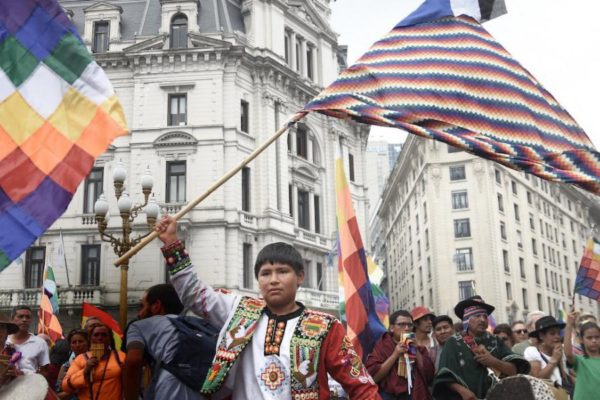
Rep. Ocasio-Cortez symbolically embraced the coup by posing for a photo with this group as they brandished the tricolor Bolivian flag, which during that period had become a signal of support for the golpistas (as opposed to the Wiphala flag, which symbolized popular resistance to the takeover). She told them that she supports their “democratic grassroots movement” and offered them “direct lines of communication.”
In sum, a gang of coup supporters, not constituents, were granted instant access, a photo op and promises of ongoing support. Actual constituents, opposing the coup, were shown the door.
Our reception by Rep. Ocasio-Cortez was radically different from that I received from her predecessor, Joe Crowley. When, in 2004, I requested a meeting on behalf of the Queens Antiwar Coalition, we were granted prompt and respectful access to the Congressman. We did not have high hopes of changing his vote on the Iraq war, but we felt it was important that he hear from his constituents.
So, apparently, did he. We were greeted warmly in his rather funky local office – a striking contrast with AOC’s soulless corporate-style digs, where underlings refer to her as “the Boss” – and were encouraged to speak our piece. Crowley never pretended to be an opponent of US imperialism, but he gave us a respectful hearing, stated his position, and engaged in what felt like meaningful discussion of the war. At a minimum, as Twitter’s bluecheck pundits would say, we felt “seen.”
AOC, by contrast, has no time for people who cannot help her to burnish her brand as she prepares to run for higher office. As a local staffer (who declined to introduce himself) proudly informed us: “She refuses 99 percent of meeting requests from constituents.”
Meanwhile, she happily clears her schedule for interviews about her makeup routine, canned videos in which she postures as a fearless progressive, and closed-door meetings with regime-change sympathizers.
But she will not make time for residents of her district. So much for “ordinary people.”
Bolivia: An election in the midst of an ongoing coup
By Vijay Prashad | Globetrotter | February 12, 2020
On May 3, 2020, the Bolivian people will go to the polls once more. They return there because President Evo Morales had been overthrown in a coup in November 2019. Morales had just won a presidential election in October for a term that would have begun in January 2020. Based on a preliminary investigation by the Organization of American States (OAS) that claimed that there was fraud in the election, Morales was prematurely removed from office; the term for his 2014 presidential election victory did not end until January. Yet, he was told by the military to leave office. An interim president—Jeanine Áñez—appointed herself. She said she was taking this office only on an interim basis and would not run for election when Bolivia held another election. She is a candidate for the May 3 election. (For more information on what is happening in Bolivia, see this overview from Tricontinental: Institute for Social Research.)
Meanwhile, Morales has been in exile in Argentina. His party—the Movement for Socialism (MAS)—has candidates for the presidency and the vice presidency, but their party cadres and followers are facing a difficult time making their case to the people. Their radio stations have been blocked, their leaders arrested or exiled (or sitting in foreign embassies waiting for asylum), their cadre beaten up and intimidated.
The United Nations secretary-general’s personal envoy Jean Arnault released a statement on February 3 that expressed caution about the elections. The situation in Bolivia, Arnault said, is “characterized by an exacerbated polarization and mixed feelings of hope, but also of uncertainty, restlessness and resentment after the serious political and social crisis of last year.” This careful language of the UN needs to be looked at closely. When Arnault says there is “exacerbated polarization,” he means that the situation is extremely tense. When he asks that the interim government “outlaw hate speech and direct or indirect incitement to violence or discrimination,” he means that the government and its far-right followers need to be very careful about what they say and how much violence they use in this election.
On February 6, Morales spoke in Buenos Aires, where he urged an end to the violence so that the election could bring the fractured country together. He called for a national agreement between all sides to end the dangerous situation. In a pointed way, Morales called upon the government to respect diversity, noting that people wearing distinct clothes and wearing the signs of a certain political party were facing intimidation and violence. He meant the indigenous population of Bolivia, and the supporters of MAS; it is widely accepted that the violence has been coming from the far right’s paramilitary shock troops, and the intimidation has been coming from the government.
For instance, the Bolivian authorities have been routinely charging MAS leaders with sedition, terrorism, and incitement to violence. Morales faced these charges, along with dozens of important MAS leaders, most recently Gustavo Torrico who has been arrested. Matters are so bad that the UN’s special rapporteur on the independence of judges and lawyers, Diego García-Sayán, took to Twitter to express his concern at the “use of judicial and fiscal institutions for the purpose of political persecution. The number of illegal detentions grows.” This has not stopped Áñez, who says she will move her government to investigate at least 592 people who held high office in Morales’ 14 years in government. This means that the entirety of the MAS leadership will likely face harassment between now and the May 3 election.
U.S. Interference
In 2013, Morales expelled the U.S. government agency USAID; he accused USAID of working to undermine his elected government. Before that, Morales, as is his constitutional right, informed Salvador Romero—the head of the election agency (TSE)—that when his term ended in 2008, he would not be retained. This is a normal practice.
Romero went to the U.S. Embassy to complain. He met with U.S. Ambassador Philip Goldberg to complain about this and urged the U.S. to do something. It was clear that Romero and Goldberg knew each other well. When Romero left his post at the TSE, the U.S. establishment took care of him. He went to work at the National Democratic Institute in Honduras. The National Democratic Institute, based in Washington, is loosely affiliated with the U.S. Democratic Party, and is part of the universe that includes the National Endowment for Democracy. These are all U.S. government-funded agencies that operate overseas to “oversee” what is known as “democracy promotion,” including elections.
Romero essentially worked for the U.S. government in Honduras during the first election after the U.S.-instigated coup of 2009. During this election in 2013, violence against the supporters of Xiomara Castro, the candidate of the left-wing Libre Party, was routine. The day before the election, for instance, two leaders of the National Center of Farmworkers (CNTC)—María Amparo Pineda Duarte and Julio Ramón Maradiaga—were killed as they returned home from a training for Libre election workers. This was the atmosphere of this very tight election, which returned to power the U.S.-backed conservative candidate Juan Orlando Hernández of the National Party. Romero, at that time, was quite pleased with the results. He told the New York Times then that “despite ‘the general perception of fraud,’” the election was just fine.
Right after the coup in November, Áñez brought Romero back to La Paz as the head of the election court, the TSE. He has his old job back. This would have made Bruce Williamson, the U.S. charge d’affaires to Bolivia, very happy. The U.S. has its man at the helm of the May 3 election in Bolivia.
And then Trump said he is sending USAID to Bolivia to help prepare the ground for the election. On January 9, the USAID team arrived to “give technical aid to the electoral process in Bolivia.” Technical aid. The phrase should give a reasonable person pause.
Ten days later, Trump’s legal adviser Mauricio Claver-Carone arrived in La Paz and gave a series of interviews in which he accused Morales of terrorism and creating instability. This was a direct attack at MAS and interference with Bolivia’s electoral process.
If the U.S. intervenes in Bolivia, that is just “democracy promotion.”
But even with the violence from the government and its fascistic paramilitaries, even with Romero at the helm of the TSE, even with USAID on the ground, and even with the shenanigans of Claver-Carone, MAS is fighting to win. The candidates for MAS are Luis Arce Catacora (president) and David Choquehuanca Céspedes (vice president). Catacora was the minister of economy and public finance under Morales and the architect of the administration’s economic success. Céspedes was the foreign minister in that government. He managed Bolivia’s policy of international sovereignty and is an important person to Bolivia’s indigenous and peasant movements. Early polls show that the MAS ticket is in first place.
Vijay Prashad is an Indian historian, editor and journalist. He is a writing fellow and chief correspondent at Globetrotter, a project of the Independent Media Institute. He is the chief editor of LeftWord Books and the director of Tricontinental: Institute for Social Research. He has written more than twenty books, including The Darker Nations: A People’s History of the Third World (The New Press, 2007), The Poorer Nations: A Possible History of the Global South (Verso, 2013), The Death of the Nation and the Future of the Arab Revolution (University of California Press, 2016) and Red Star Over the Third World (LeftWord, 2017). He writes regularly for Frontline, the Hindu, Newsclick, AlterNet and BirGün.
First Israel-Bolivia diplomatic meeting since 2009
MEMO | February 4, 2020
Israel’s Ambassador to the United Nations, Danny Danon, met with his Bolivian counterpart, Ruben Suarez, in an official meeting, which is the first of its kind since Bolivia cut ties with Israel in 2009, according to Hebrew media.
Yedioth Ahronoth reported on Monday that the meeting took place last week at the United Nations headquarters in New York.
According to the newspaper, the two ambassadors discussed setting up an embassy for Bolivia in Israel, strengthening cooperation in the fields of water technology and agriculture, and permitting Israeli tourists to revisit the South American country.
Danon invited Suarez to visit Israel as part of a planned visit by a delegation of UN ambassadors next April.
In November 2019, Bolivia announced the resumption of its relations with Israel after cutting diplomatic ties in light of the Israeli aggression on the Gaza Strip (27 December 2008 – 28 January 2009), reported the newspaper.
According to the same source, the relations between the two countries were resumed following the end of Evo Morales’s presidential term (January 2006 – November 2019), “ who was known for his hostility towards Israel, and the arrival of a transitional pro-US government.”
The newspaper said that the recent appointment of Suarez as Bolivia’s representative to the United Nations “will boost Israeli moves at the United Nations.”
The newspaper also considered Suarez’s predecessor Sacha Lorenti to have “anti-Israel” stands.
Bolivian Ex-President Morales’ Cabinet Chief Hermosa Handed Six Month Detention
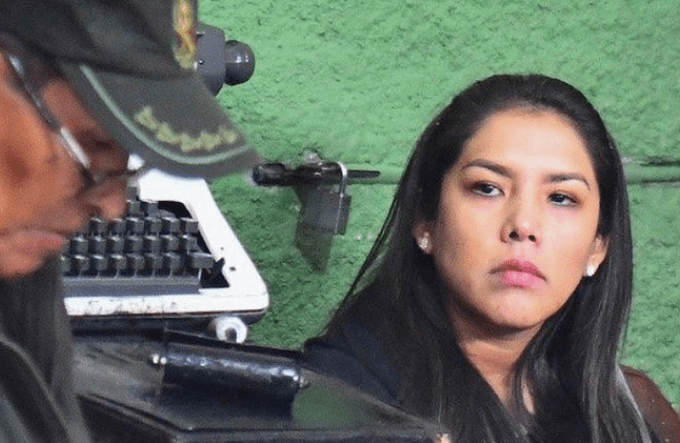
Sputnik – February 3, 2020
Patricia Hermosa, the former cabinet chief of ex-Bolivian President Evo Morales’ administration, has been handed a six-month preventive detention order by a Bolivian court, El Diario daily reported.
Bolivian prosecutors pushed for Hermosa to be placed in preventive detention, claiming that she was both a flight risk and could potentially obstruct the investigation. The court on Sunday agreed with prosecutors, and ordered the former cabinet chief to spend six months in preventive detention, the newspaper reported.
Hermosa was first detained in December as part of the new Bolivian government’s ongoing investigation into Morales but was initially released due to insufficient evidence. However, she was arrested once again this past week after authorities claimed to possess recordings of Hermosa’s telephone conversations with leading Bolivian officials. She is charged with sedition, terrorism and financing terrorism.
The news comes just one day after two ministers of ousted President Morales’ administration left Bolivia for Mexico. Many members of Morales’ former government have been living at the Mexican ambassador’s residence in Bolivia while waiting for their asylum requests to be processed. Morales himself is currently living in Argentina after fleeing Bolivia.
On Friday, Morales reported that Hermosa was detained by Bolivian law enforcement officials, who also seized personal documents belonging to the ex-president during the former cabinet chief’s apprehension.
Bolivia’s Coup-Born Regime Arrests Socialist Political Refugees

Former Mining Minister Cesar Navarro (L) and former Agriculture Minister Pedro Dorado (R), Bolivia. | Photo: Twitter/ @ATBDigital
teleSUR | February 1, 2020
Bolivia’s Former Mining Minister Cesar Navarro and former Agriculture Minister Pedro Dorado were arrested at the El Alto airport on Saturday when they were about to board a plane as political refugees.
For the past 82 days, these Socialists politicians remained at the Mexican embassy. Yesterday, they received a safe-conduct allowing their free departure from the country.
“The Mexican embassy transferred the asylees to the El Alto airport with the guarantee granted by the safe-conduct extended by the Bolivian government. In that sense, the asylees should be transferred to Mexico without any problem,” the Mexican diplomatic delegation tweeted.
 Even though international mediators accompanied the Socialist politicians, the Interior Ministry arrested them disrespecting the safe-conduct granted by its government.
Latin American social organizations immediately began to criticize harshly Karen Longari, the Foreign Minister appointed by the U.S.-backed, self-proclaimed president Jeanina Añez, who is ultimately responsible for the ongoing persecution against the Movement Towards Socialism (MAS) militants.
“We repudiate the arbitrary and illegal act of detention of former ministers Navarro and Damian, which violates all international standards. Solidarity!,” the Sao Paulo Forum secretary Monica Valente said.
Navarro was provisionally released a few hours after his arrest. According to his daughter, the former minister would have been beaten by paramilitary groups during his detention.
Later, Interior Minister Arturo Murillo said that Navarro and Dorado “had been arrested by mistake” and they will leave the country in the next hours. So far, however, their exact legal status is unknown.
Their detention is part of the long list of MAS supporters persecuted by the Interim government installed after the coup d’etat against Evo Morales, which took place on Nov. 10, 2019.
Under fire for presidency bid, Bolivia interim leader asks all ministers to resign
Press TV – January 27, 2020
Bolivia’s interim leader Jeanine Anez has asked all cabinet ministers to resign months ahead of general elections amid growing criticisms of her bid to run for president despite an earlier pledge not to do so.
A presidential statement on Sunday said that Anez’s decision was in line with efforts in the management of the country’s “democratic transition,” months after she rose to power on the back of an an effective coup d’état that forced ex-President Evo Morales to resign.
Anez said she will name the new cabinet “as soon as possible.”
The move came a day after Communication Minister Roxana Lizarraga resigned in protest at Anez’s decision to compete in the presidential election on May 3.
When Anez assumed interim presidency last November, she said she had no intention of becoming president.
In a U-turn on Friday, Anez announced her candidacy in the 2020 election.
Lizarraga, who was appointed by Anez on November 13, 2019, criticized the interim president for having “lost sight of her objectives,” adding, “This is not the path the citizenry has signaled to us.”
Anez’s presidential bid has drawn widespread criticisms from other Bolivian politicians, including Morales —now in exile in Argentina.
Morales reminded Anez that “she promised not to be a candidate,” although he said “it is her right.”
Former president Carlos Mesa, 66, said, “I think she’s making a big mistake” because “she has not been appointed to propose herself as a candidate for the presidency.”
Ex-presidential candidate Samuel Doria Medina voiced his opposition.
Meanwhile, lawmaker Luis Felipe Dorado said he would consult the Constitutional Court about the matter.
Anez came only fourth on 12 percent in an opinion poll published on Sunday that was led by Morales’s Movement for Socialism (MAS) candidate with 26 percent.
MAS headed the survey by Mercados y Muestras and published in the Pagina Siete newspaper.
“In all the polls we are first,” Morales tweeted in reaction, adding, “We are ready to beat the coup and regain the homeland.”
Bolivia: MAS Presidential Candidate Becomes Target of Lawfare
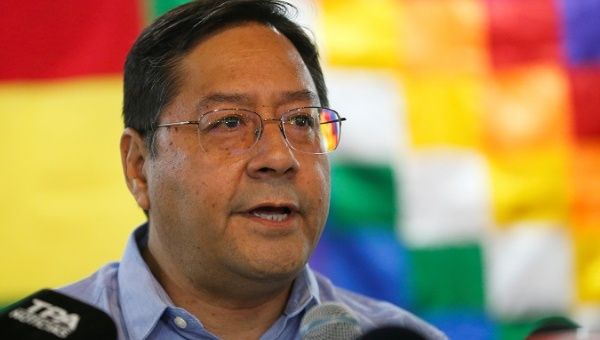
Luis Arce at a news conference after being announced as the Movement to Socialism’s presidential candidate, in Buenos Aires, Argentina Jan. 20, 2020. | Photo: Reuters
teleSUR | January 22, 2020
Bolivia’s Office of the Prosecutor expanded an investigation against Evo Morales’ former officials, among whom is Luis Arce, the Movement Towards Socialism (MAS) presidential candidate.
The announcement was made by prosecutor Heidi Gil one day after the MAS unveiled that Arce would be its presidential candidate in the upcoming elections in May.
The judicial process is related to the alleged diversion of public resources from the Indigenous Development Fund (Fondioc), a case in which former Presidency’s Minister Juan Ramon Quintana has also been mentioned.
“If the Prosecutor finds enough evidence during the extension of the investigation, they will be called to testify,” Gil said referring to Arce and Quintana.
The extension of the judicial investigation was requested by the current Fondioc director, Rafael Quispe, a well-known opponent of the Morales administration who was appointed to that position by the government of Jeanine Añez.
Since the coup d’etat consummated on November 10 in Bolivia, numerous MAS militants have been subject to judicial persecution.
In this regard, the MAS leader Evo Morales said that the current U.S.-backed de facto regime does not seek justice but “revenge and impunity.”
Former Minister of Economy Luis Arce is one of the intellectuals who designed the economic model that allowed Bolivia to keep high growth rates for more than a decade.
Featured Video
We Don’t Have to Live This Way
or go to
Aletho News Archives – Video-Images
From the Archives
9/11 Was an Israeli Job
How America was neoconned into World War IV
By Laurent Guyénot • Unz Review • September 10, 2018
… 9/11 was made possible by an alliance between secret worshippers of Israel and corrupted American elements. The question is: who, of the two, were the masterminds of this incredibly daring and complex operation, and for what “higher purpose”? … Read full article
Blog Roll
 Aletho News
- Persian Gulf states to meet in Oman to discuss regional security, Hormuz navigation: Iran
- Araghchi: US acknowledgment of Bahrain damage exposes cost of Israel’s wars
- YAF secure Bab al-Mandab, advance toward Dhubab
- Ansar Allah’s Victory Is A U.S. Defeat
- Insider trading proves 9/11 foreknowledge
- Most Kids Can Fight Measles Naturally — and Having the Virus May Even Make Them Stronger
- We Don’t Have to Live This Way
- The Saudi cutout and the CIA shadow over 9/11
- US tanker strikes fail to deter Iran, drain interceptors: Bloomberg
- Yemeni Official Underlines Safety of Navigation after Expelling of Pro-Saudi Mercenaries from Coastal Areas
- If Americans Knew
- Israeli Documentary ‘NAZA’ Exposes ‘System of Killing’ in Gaza From Eyes of Secret Intelligence Unit
- Confessions of an Israeli Army Drone Operator
- Maximum Territory, Minimum Population
- Is the Israel Lobby Doomed?
- Israel kills 9, including family of 4, in Gaza – Daily Update
- Secret systems used by Israel in mass killings of Gaza civilians revealed in new film
- Israel Bombs South Lebanon as Report Documents 23 White Phosphorus Attacks
- Nakba and Gaza: Zionism’s Century-Long History of Genocide
- ISRAELI MEDIA: ‘Baby, an Update: He’s Just Died’: Israeli Prison Guards’ Texts Expose a Routine of Abuse
- Three Major Revelations About The Gaza Holocaust In The Israeli Press
- No Tricks Zone
- New Study: The Antarctic Ice Sheet Gained Mass From 2020-2024 Due To Staggering Snow And Ice Accumulation
- Study: Ocean Heating Rates From Thousands Of Years Ago ‘Dwarf’ Modern Ocean Heating Rates
- Climate Extremists Target, Attack Large-Scale Power Grid Infrastructure In Germany!
- New Study: Antarctic Ice Melt Has Contributed Less Than 1 Centimeter To Sea Level Rise In The Last 30 Years
- Fear Of Debate: Alarmist German Climate Scientist Calls On Mainstream Media To Discredit Skeptic Voices
- End-Of-August Arctic Sea Ice Extent Hasn’t Fallen In 20 Years, Official Data Show!
- News-Making Nepal Region Has Had As-Warm Or Warmer Periods Than The 2000s In The 1600s, 1700s, 1800s
- 2025 Study: ‘There Exists No Unequivocal Experimental Evidence For The CO2 Greenhouse Effect’
- 2026 Atlantic Cyclone Energy Index Running At 85% Below Normal!
- New Research Shows Soil Respiration And Temperature Drive CO2 Change, Not Humans
 Aletho News