Brazilian mercenaries say they learned ‘guerrilla warfare’ in Ukraine
By Lucas Leiroz | Strategic Culture Foundation | March 3, 2026
The proxy war being fought in Eastern Europe is beginning to produce direct side effects on public security in Brazil. A recent report by the television program Fantástico, aired by TV Globo, revealed that Brazilian citizens with no prior military experience traveled to fight in the conflict between Ukraine and Russia after being lured by misleading financial promises. Upon returning, they bring with them practical knowledge of irregular combat learned on the battlefield – knowledge that, in a country already marked by heavily armed criminal factions, can easily be absorbed by organized crime.
The case of Marcos Souto, a businessman from the state of Bahia who adopted the codename “Corvo” (“Crow”), is emblematic. Having never served in the Brazilian Armed Forces, he claims to have learned everything he knows about guerrilla warfare in Ukraine. His account highlights two central elements: the precarious recruitment of foreign fighters and the brutality of the operational environment. According to him, combatants were attracted by promises of a salary of “50,000” – a figure many interpreted as Brazilian reais, but which in practice corresponded to 50,000 hryvnias, a much smaller amount. Upon reaching the front lines, they encountered not only extreme combat conditions but also internal coercion. Souto reports that those who attempted to abandon their positions were detained and tortured.
This is not an isolated episode. Other Brazilians mentioned in the report describe hunger, logistical abandonment, and even clashes with Ukrainian soldiers during escape attempts. Brazil’s Ministry of Foreign Affairs records 19 Brazilians killed and 44 missing since the beginning of the war, although analysts generally agree that the real numbers likely amount to hundreds of Brazilian fatalities. Even so, four years after the start of the conflict, new mercenaries continue to enlist.
The central issue, however, is not merely humanitarian. The strategic concern lies in the return of these individuals to Brazilian territory. Unlike conventional conflicts, the war in Ukraine is characterized by the intensive use of irregular, modern warfare tactics: operations with drones, urban ambushes, use of improvised explosive devices, infrastructure sabotage, and decentralized coordination in small units. The government in Kiev has long since lost much of its regular operational capacity and is compelled to rely on guerrilla tactics to continue fighting. It has become a contemporary laboratory of unconventional warfare.
When individuals without formal military training acquire this type of practical knowledge in a real combat environment and return to Brazil, the risk of diffusion of these techniques is evident. The country already faces structural challenges with criminal organizations that exert territorial control in urban areas and dominate international drug and weapons trafficking routes. The introduction of tactics learned in an active war theater could raise the operational level of these factions.
Historically, Brazilian organized crime has demonstrated a capacity for rapid adaptation. Factions have incorporated restricted use weapons, encrypted communication technologies, and sophisticated money-laundering methods. Absorbing knowledge about drone warfare, construction of improvised explosive devices, or urban fortification techniques would not require large structures to implement. The presence of just a few trained individuals willing to share their experience would suffice.
There is also a relevant psychological component. Combatants return after prolonged exposure to extreme violence, often without any state monitoring or social reintegration. The combination of trauma, financial frustration, and contact networks established abroad may facilitate involvement in illicit activities.
The Ukrainian embassy in Brazil states that it does not formally recruit Brazilians and that those who enlist assume the same duties as Ukrainian citizens. However, the existence of intermediaries, vague financial promises, and the absence of monitoring mechanisms in Brazil reveal a regulatory gap. There is no clear policy for dealing with citizens who participate in foreign conflicts and return with irregular military training.
The phenomenon should not be treated as a media curiosity but as a matter of national security. Brazil is not formally involved in the conflict in Eurasia, yet it is beginning to absorb its indirect effects. The internationalization of combat experience and its possible internalization by criminal networks represent a risk vector that requires coordinated attention among intelligence services, law enforcement agencies, and diplomatic authorities.
Ignoring this dynamic may mean allowing techniques developed in one of the most intense conflicts of the present day to be reconfigured within Brazil’s urban context. A distant war ceases to be an external event and begins to produce concrete consequences for the country’s social structures and internal stability.
Davos, Mark Carney’s frankness, and the Euro-American rift
By Raphael Machado | Strategic Culture Foundation | January 29, 2026
One of the defining factors of the era beginning from the second half of the 20th century is the partnership between the USA and Europe – initially only Western Europe, eventually most of the old continent. But “partnership” is perhaps an imprecise term. The ideal term would probably be “occupation,” since, as defined by Lord Ismay, NATO was created to “keep the Americans in, the Soviets out, and the Germans down.”
In the meantime, Europeans grew accustomed to an automatic alignment with the USA, quite similar to that of Ibero-American countries during the same period, with the exception of the brief period when Charles de Gaulle distanced his country from NATO. Otherwise, the Atlantic Alliance gradually absorbed European countries.
The confusion is such that when speaking of “Western civilization,” most people think of Europe and the USA together, not only as expressions of the same civilization but as possessing identical fundamental and strategic interests. The Davos Forum or World Economic Forum can be thought of as the “celebration” of this civilizational alliance, an event bringing together political, economic, and societal leaders from around the world to discuss the priorities to be adopted in the coming years.
Historically, the USA and its representatives have always been prominent at the Davos Forum in all discussions, whether on environmental issues, the supposed need to censor the internet, or the social transformations considered necessary to deal with the 2020 pandemic crisis or future health crises. It was a space for consensus and planning among the North Atlantic elites.
However, Trump’s antagonistic stance towards the countries of the European Union inevitably significantly changed the atmosphere of Davos this time.
The pressures and demands for the cession of Greenland, including the threat of using military force, ultimately became the driving force of interactions among the elites. Naturally, at this moment, EU countries would not be capable of mounting significant military resistance to the USA in Greenland. But the increase in European military presence on the Danish-owned island seems to serve simply as the drawing of a red line.
And despite Mark Rutte rushing to try to find some sort of compromise with Trump on the Greenland issue, the reality is that Trump’s mere threat and pressure against his supposed allies was enough to leave scars. In other words, no matter how timid and cowardly current European leadership may be, to the point of yielding time and again, European distrust and ill-will towards the USA is still likely to increase.
Perhaps it is even necessary to look at other sectors besides the political summit. Among intellectuals, think tanks, journalists, and influencers, it seems easier to find tougher and more critical positions regarding the USA, as well as less willingness to reconcile, than among national political leaders.
“Anti-Americanism,” once a central plank for both nationalist and socialist parties in Europe but fallen into disuse after the Cold War, may end up becoming an important discursive topic again in this era of rising diverse populisms.
To a large extent, the speech by Mark Carney, Prime Minister of Canada, can be seen as a reasonable summary of the current geopolitical moment.
Throughout his speech in Davos, Carney emphasized that for decades, Canada and most Western countries remained aligned with the so-called “rules-based international order,” even considering it partly fictional; still, it was a useful and pleasant fiction. The other Western countries knew that these rules were not applied equally to all countries, and that stronger countries were practically exempt from most of their regulations. Everything in that order depended on who was the “accused” and who was the “accuser.” Different countries, engaged in the same actions, such as suppressing civilian protesters, for example, would receive different treatment depending on who their leaders and governments were: some would receive no more than a symbolic slap on the wrist, others would be bombed and have their heads of state executed in sham courts.
And these Western countries were satisfied as long as the bombed countries were African or Arab or, occasionally, some Slavic country like Serbia. This was because, for a few countries, that order allowed them to collect benefits in the form of capitalist extractivism.
Now, however, the international order has ended. It does not even survive as a farce – according to Carney himself. Faced with a series of crises, many countries began to perceive global integration more as an Achilles’ heel than as an advantage. Goods might have been cheaper, but what good is the theoretical availability of cheaper products when, in times of crisis, they become inaccessible, as during the health crisis. Or when sanctions simply make trade relations unviable for targeted countries.
For Carney, therefore, some countries have decided to transform themselves into fortresses, primarily concerned with ensuring their own energy, food, and military autonomy. And one of the basic consequences of this change is the decline of multilateral organizations. International courts, the WHO, the WTO, the World Bank, and various other bodies are increasingly ignored and disdained by regional powers – in the case of countries outside the “Atlantic axis,” because they consider the influence of the USA and its allies in these bodies too great; in the case of the USA, because, on the contrary, they consider that these bodies do not sufficiently serve US national interests.
This parallel and crosswise dissatisfaction is natural, to the extent that international institutions only ever served the USA and its hegemony insofar as that hegemony was the best tool for gradually constituting a “world government,” that “New World Order” proclaimed by George H. W. Bush.
The consequence of this process of collapse of globalist multilateralism is that international relations have come to be dominated by force. Most medium-power countries are not prepared to deal with this new and sudden reality. Moreover, it is naive to simply condemn the current situation and hope for a return to the “good old days” of a “rules-based” international order where the rules do not apply equally to everyone.
Carney also makes a suggestion for these medium-power countries to deal with the current international situation: strengthen bilateral relations with countries of similar mindset and orientation, building small coalitions of reasonably limited scope, aiming both to eliminate possible economic weaknesses and to enhance security mechanisms.
Naturally, Carney is specifically referring to strengthening Canada-EU relations, but, to some extent, we can also apply this kind of reflection to those counter-hegemonic or non-aligned countries that are not continental powers like Russia, China, and India. The case of Venezuela demonstrated that it is, in fact, necessary to be prepared to deal with US aggressiveness.
Countries like Brazil, despite its size and the importance given to it in international relations, lack nuclear weapons and sufficiently modern military forces to effectively protect itself against a focused and determined military action. Naturally, Brazil should seek to solve these deficiencies (and, indeed, the debate on “Brazilian nuclear weapons” has already begun in political, military, and social circles), but no significant change will be seen in the short term – which is why Brazil actually needs to develop other ways to guarantee its own security that do not depend on simple servility to the USA.
It would be fully in Brazil’s interests to lobby, within BRICS, for increasing the “security” dimension of the coalition. Still, we doubt that the current Brazilian administration has any interest in this, or even that it understands the need for such a radical transformation. In the absence of this initiative, at the very least, Brazil should seek to update its military, intelligence, and radar technology with the help of Russian-Chinese partnerships. But on a regional level, Brazil needs to strengthen its ties with other South American countries and begin, subtly, to try to attract them and remove them from the US orbit.
In short, the mere fact that we are discussing these needs, instead of naively betting that international forums created on Western initiative will be enough to defend us, already proves that we are already in a new and dangerous world.
EU free trade pact on hold as farmers revolt
RT | January 21, 2026
The European Parliament has voted to refer a trade agreement with the South American bloc Mercosur to the EU Court of Justice (CJEU). The move comes amid criticism of Commission President Ursula von der Leyen for bypassing normal EU procedures and widespread protests from farmers across the bloc.
On Saturday, the EU signed a trade pact with Mercosur members Argentina, Brazil, Paraguay, and Uruguay. The agreement that was projected to create the world’s biggest free trade zone still requires approval before it can take effect.
On Wednesday, the EU Parliament voted 334 in favor to 324 against, with 11 abstentions, to ask the CJEU to determine whether the deal is compatible with the bloc’s rules. The move now significantly delays the pact that had been negotiated for 25 years, and could potentially derail final approval.
The vote took place against the backdrop of criticism of von der Leyen for handling the Mercosur deal in a non-transparent way, splitting it into separate agreements to bypass national parliaments and reduce the European Parliament’s role to a formal opinion.
The deal has also faced widespread resistance from the agricultural sector, with farmers across the bloc staging mass protests over concerns that cheap imports could undercut their livelihoods. The latest rally began on Tuesday outside the European Parliament in Strasbourg and drew support from some lawmakers, continued overnight, and ended on Wednesday.
Von der Leyen had pushed the deal, describing it as a “clear and deliberate choice,” highlighting that the EU opts for “fair trade over tariffs” and “a productive long-term partnership over isolation.” The pact came just six months after she signed an agreement with US President Donald Trump that imposed a 15% tariff on most EU exports. The EC president faced strong pushback over the US deal from current and former EU officials and heads of member states.
The EU is Mercosur’s second-largest trading partner, accounting for nearly 17% of the bloc’s total trade in 2024, at €111 billion.
Brazil’s Ambassador to the OAS Denounces US Military Action Against Venezuela as a Global Threat
teleSUR – January 6, 2026
During an address to the Permanent Council of the Organization of American States (OAS), Benoni Belli, Brazil’s ambassador to the organization, described the United States’ military action against Venezuela as “a very serious attack against Venezuela’s sovereignty and a threat to the entire international community.”
The Brazilian diplomat warned that the bombings of Venezuelan territory and the kidnapping of its president represent an unacceptable violation of international law. “The current situation is grave and evokes times we thought were behind us, which are once again devastating Latin America and the Caribbean,” Belli stated.
Belli rejected the logic that “the ends justify the means,” arguing that such reasoning lacks legitimacy and allows the strongest powers to impose their will on sovereign nations. “These acts open the possibility that the strongest will define what is just or unjust, disregarding national sovereignty,” he emphasized.
The ambassador’s statement highlights the geopolitical implications of a unilateral military intervention, and warned that it undermines multilateralism and fosters a global order based on the law of the strongest.
The Rise of the Isaac Accords: How Israel is Redrawing South America’s Political Landscape
This is not neutral cooperation. It is political conditionality.
By Freddie Ponton | 21st Century Wire | December 15, 2025
Foreign influence in the Global South rarely arrives in uniform. It comes disguised as ethics, stability, and shared values, only revealing its true cost once the rules are set. In Latin America, such a transformation is now underway. A new architecture of alignment is being quietly assembled, presented as moral course correction but functioning as a geopolitical filter. At its core lie the Isaac Accords, a project deliberately modelled on the Abraham Accords. Where the latter normalised Israel’s position in the Middle East through elite deals brokered by Washington, the Isaac Accords aim to reorder Latin American politics by locking governments, economies, and security institutions into Israeli and U.S. strategic orbit.
The Accords are not simply about Israel’s image or diplomatic isolation. They operate as a filter of legitimacy: governments that align are embraced, financed, and promoted; those that resist are marginalised, sanctioned, or framed as moral outliers. Venezuela, long aligned with Palestine and the broader Axis of Non-Alignment, sits squarely in the crosshairs.
This article examines how the Isaac Accords function in practice, why figures such as Javier Milei and María Corina Machado have become central to their rollout, and what this strategy reveals about Israel’s ambitions in South America, not as a neutral partner, but as an active geopolitical actor working in tandem with U.S. power.
The Isaac Accords: A Latin American Reboot of the Abraham Model
The Isaac Accords did not emerge in a vacuum. They are consciously modelled on the Abraham Accords, which rebranded Israel’s regional integration in the Middle East as “peace” while bypassing Palestinian self-determination entirely. The lesson Israeli and U.S. policymakers appear to have drawn is simple: normalisation works best when imposed from above, through elite alignment, financial incentives, and security integration.
The Accords are administered through a U.S.-based nonprofit, American Friends of the Isaac Accords, and financially seeded through institutions closely linked to Israeli state and diaspora networks. Their stated aim is to counter antisemitism and hostility toward Israel. Their operational requirements, however, reveal a far broader ambition.
Countries seeking entry are expected to:
- Relocate embassies to Jerusalem, recognising Israeli sovereignty over a contested city
- Redesignate Hamas and Hezbollah in line with Israeli security doctrine
- Reverse voting patterns at the UN and the OAS, where Latin America has historically voted in favour of Palestinian rights
- Enter intelligence-sharing agreements targeting Chinese, Iranian, Cuban, Bolivian, and Venezuelan influence
- Open strategic sectors: water, agriculture, digital governance, security, to Israeli firms
Israel’s own diplomats have described the Isaac Accords as a way to pull “undecided” Latin American states into Israel’s orbit at a moment when European public opinion has become less reliable. In other words, the Global South is being repositioned as Israel’s strategic rear guard.
The role of Javier Milei in Argentina illustrates how this model operates. Milei has not merely improved relations with Israel; he has embraced it as an ideological reference point. He has pledged to move Argentina’s embassy to Jerusalem, framed Israel as a civilisational ally, and positioned himself as the Isaac Accords’ flagship political figure.

Co-Founder and Chairman of The Genesis Prize Foundation Stan Polovets presents prize to 2025 Laureate Javier Milei on June 12 in Jerusalem. (Source: American Friends of Isaac Accords)

That role was formalised in 2025 when Milei became the Genesis Prize Laureate, an award frequently described as the “Jewish Nobel Prize.” The Genesis Prize is not politically neutral. It is explicitly awarded to figures who strengthen Israel’s global standing and its ties with the diaspora. Milei’s decision to donate the prize money directly back into the Isaac Accords ecosystem symbolised how moral recognition, political allegiance, and financing now operate as a single circuit.
This is alignment rewarded, visibly, materially, and publicly.
As reported by AP in August, the Isaac Accords are set to extend to Brazil, Colombia, Chile, and potentially El Salvador by 2026, as stated by the organizers, the American Friends of the Isaac Accords.
Recent New York Times reporting situates Brad Parscale’s involvement in the Honduran election within Numen, a Buenos Aires–based political consultancy he co-founded with Argentine strategist Fernando Cerimedo, highlighting how transnational firms operate beyond traditional regulatory scrutiny. Critics warn that Numen’s methods reflect a broader global political influence ecosystem that often draws on data-driven targeting, psychological profiling, and digital amplification techniques associated with Israeli-linked political technology and messaging firms that have operated in elections worldwide.
When combined with U.S. political endorsements, strategic pardons, and offshore consulting structures, this model raises serious concerns about how advanced data analytics and covert messaging infrastructures are used to shape voter behavior in vulnerable democracies, eroding electoral sovereignty while remaining largely insulated from accountability.
Venezuela, Palestine, and the Manufacturing of Illegitimacy
If the Isaac Accords require a moral antagonist, Venezuela fulfils that role perfectly.
Since Hugo Chávez severed diplomatic relations with Israel in 2009, in response to Israel’s assault on Gaza, Venezuela has positioned itself as one of Palestine’s most consistent supporters in the Western Hemisphere. Chávez, and later Nicolás Maduro, framed Palestinian resistance not as terrorism but as an anti-colonial struggle, aligning Venezuela with much of the Global South rather than the Atlantic bloc.
Under the Isaac Accords’ logic, this position is intolerable.
Opposition to Israel is no longer treated as a political stance but as evidence of extremism or antisemitism. Zionism and Judaism are deliberately conflated, allowing criticism of Israeli state policy to be reframed as hatred. This narrative provides the moral justification for isolation, sanctions, and, potentially, regime change.
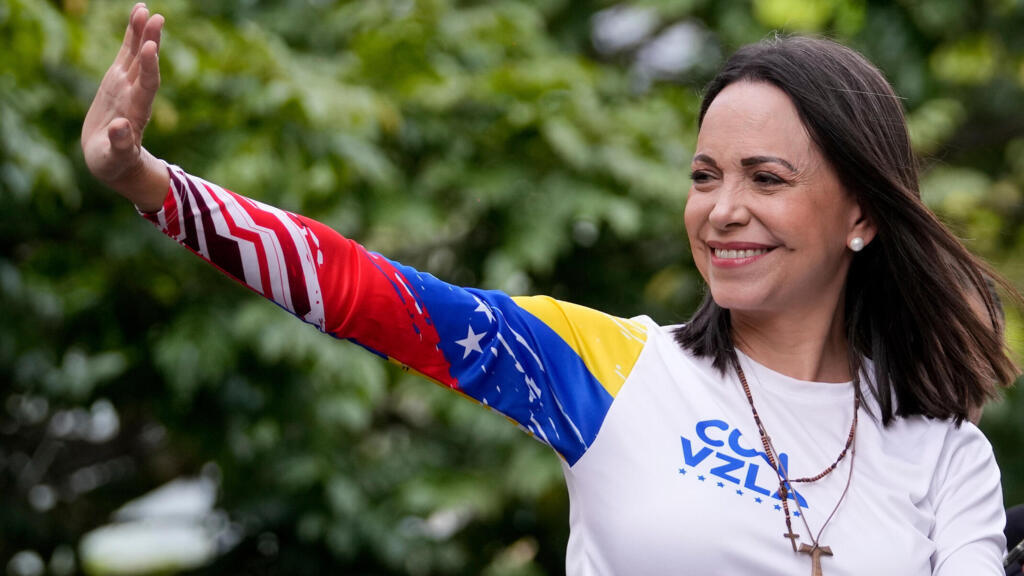
Maria Corina Machado in Venezuela, Thursday, July 25, 2024. (Source: AP – Matias Delacroix)
Into this context steps María Corina Machado, the Venezuelan opposition figure most warmly received by Israeli and U.S. political networks. Machado’s alignment with Israel is not rhetorical or recent. In 2020, her party, Vente Venezuela, signed a formal inter-party cooperation agreement with Israel’s ruling Likud Party, led by Benjamin Netanyahu. The agreement committed both parties to shared political values, strategic cooperation, and ideological alignment.
This is a remarkable document. It ties a Venezuelan opposition movement directly to a foreign ruling party, well before any democratic transition, and signals how a post-Maduro Venezuela is expected to orient itself internationally.
DOCUMENT: Vente Venezuela signs cooperation agreement with Israel’s Likud party – Agreement signed by María Corina Machado and Eli Vered Hazan, representing Likud’s Foreign Relations Division (Source: Vente Venezuela)
Machado has since gone further, pledging to:
- Restore full diplomatic relations with Israel
- Move Venezuela’s embassy to Jerusalem
- Open Venezuela’s economy to privatisation and foreign investment
- Align Venezuela with Israel and the United States against Iran and regional leftist governments
Her narrative rests on a crucial claim: that Venezuela itself is not anti-Israel, only its government is. According to this framing, Venezuelans are inherently pro-Israel and pro-West, their “true” preferences suppressed by an illegitimate regime.
In a November interview with Israel Hayom, Machado asserted that “The Venezuelan people deeply admire Israel.”
This argument is politically useful and historically thin. Venezuelan solidarity with Palestine predates Maduro and reflects a wider Latin American tradition of identifying with colonised peoples. To erase that history is to deny Venezuelans their own political agency.
The Anti-Defamation League (ADL) has repeatedly accused the Venezuelan government of fomenting “anti-Israel” and anti-Semitic rhetoric. Yet, a closer look tells a different story. Caracas’ statements are largely expressions of solidarity with the Palestinian people and their right to self-determination, combined with pointed criticism of Israeli state policies. By framing these positions as attacks on Jews or Israel itself, the ADL distorts the narrative, turning principled political stances into a perceived moral failing. This tactic underscores a broader pattern in which international organizations can paint Global South governments as rogue actors whenever they resist the gravitational pull of Israeli and U.S. influence, subtly laying the groundwork for diplomatic pressure or intervention.
DOCUMENT: Mini report from the Anti-Defamation League (ADL), formerly known as the Anti-Defamation League of B’nai B’rith, accuses Venezuela of fuelling an incendiary anti-Israel and anti-Semitic environment.(Source (ADL)
Security, Economics, and the Cost of Obedience
Beneath the moral language of the Isaac Accords lies a familiar architecture of control: security integration, economic restructuring, and ideological discipline.
Israel is a leading exporter of surveillance technologies, border systems, cyber-intelligence platforms, and urban security tools, many developed under conditions of occupation and internal repression. In South America, these systems are marketed as solutions to crime and narcotrafficking, but their real function is often political: expanding state surveillance capacity during periods of transition.
Security cooperation creates dependency. Once intelligence-sharing, training, and doctrine are integrated, political autonomy narrows. Policy divergence, particularly toward China, BRICS, or non-aligned partners, becomes risky.
The economic dimension is equally strategic. Israeli firms are deeply involved in water rights, desalination, agrotechnology, digital governance, and infrastructure, sectors that determine long-term sovereignty. These investments are typically tied to privatisation, deregulation, and long-term concessions, transferring control of strategic resources away from the public sphere.
Venezuela is the ultimate prize. A post-sanctions transition would open one of the world’s most resource-rich economies to restructuring. Machado’s commitment to rapid privatisation aligns seamlessly with this vision, raising an unavoidable question: who benefits from “democracy” when it arrives pre-packaged with foreign economic priorities?
This strategy is inseparable from U.S. power. The Trump administration’s framing of global politics as a permanent war on terror and narcotrafficking, a framing echoed by figures like Marco Rubio, has provided cover for sanctions, covert operations, and extrajudicial violence across the Caribbean and Pacific. Israel’s partnership reinforces this logic, supplying both technology and moral framing.
Conclusion: The Global South and the Right to Choose
The Isaac Accords are not simply about Israel’s diplomatic standing. They are about reordering South America’s political horizon at a moment when the Global South is rediscovering multipolarity.
Israel’s role in this process is active, strategic, and consequential. Through political patronage, economic leverage, security integration, and narrative control, it is shaping which governments are deemed legitimate and which are disposable.
For South America, and the wider Global South, the warning is familiar. When alignment is framed as morality, dissent becomes deviance. When sovereignty is conditional, development serves external interests. When history is rewritten, intervention soon follows.
Non-alignment was never about isolation. It was about the right to choose. That very right, today, is being quietly renegotiated, and the cost of refusing may soon become very clear.
Israel’s Elbit Systems reports record profits on the back of Gaza genocide
The Cradle | November 18, 2025
Israel’s leading defense technology company, Elbit Systems, reported a sharp rise in quarterly profit on 18 November after months of fueling the genocide in Gaza by supplying weapons, munitions, and surveillance systems, while simultaneously securing a wave of new European contracts.
The company posted $3.35 per diluted share excluding one-time items, up from $2.21 a year earlier, and reported $1.92 billion in revenue compared to $1.72 billion last year.
Its order backlog reached $25.2 billion, with the company saying 69 percent comes from outside Israel.
Elbit CEO Bezhalel Machlis said the performance reflected “the significant contracts the company has secured across Europe and from customers worldwide,” driven by expanding defense budgets.
Israel accounted for over 33 percent of revenue, with Elbit supplying munitions, drones, guided rockets, and reconnaissance systems during the Israeli genocide of Palestinians in Gaza.
Sales to Europe, the world’s second-largest buyer of Israeli weapons, rose from $430 million to $536 million, comprising 28 percent of total revenue.
The company said 69 percent of its backlog comes from outside Israel and declared a quarterly dividend of $0.75 per share.
Separately, Elbit announced the largest contract in its history, a $2.3-billion deal with an undisclosed international buyer for weapons systems to be delivered over eight years.
The company did not reveal the customer or the type of systems being supplied, citing confidentiality.
Elbit Systems has also expanded its footprint across Europe, the Balkans, and the UK through a series of new agreements disclosed in recent months.
In Albania, the company is leading a government-to-government deal that includes ATMOS howitzers, SPEAR mortars, and Magni-X and Thor drones, and will assist the state-owned KAYO firm in establishing production lines and a new weapons plant.
Elbit deepened its presence in the country earlier this year through a flight-school agreement and is expected to support Albania’s goal of developing local drone manufacturing by 2027.
The firm has simultaneously continued to sign additional contracts worldwide, including Hermes 900 sales to Singapore and Brazil.
In the UK, Elbit is competing with Raytheon for a $2.7-billion Ministry of Defense contract that would make the company a “strategic partner” responsible for training 60,000 British troops annually.
The prospective agreement follows a separate $1.64-billion Elbit deal with Serbia and builds on the company’s existing role managing the Ministry of Defense’s Project Vulcan, a $75-million simulation-training program for tank crews.
Elbit subsidiaries in Britain have come under sustained protest, and Elbit’s central role in Israel’s war on Gaza has prompted renewed scrutiny, with the UN special rapporteur for Palestine noting that “for Israeli companies such as Elbit Systems … the ongoing genocide has been a profitable venture.”
Brazilian Judge Orders Global Deletion of X Posts in Civil Defamation Cases, Rejects Geoblocking as Insufficient

By Cindy Harper | Reclaim The Net | September 10, 2025
A Brazilian judge’s order demanding that posts on X be erased not just within Brazil but across the entire globe has caused concerns over national courts asserting control over international online speech.
The ruling, handed down by Judge Jeferson Isidoro Mafra in Blumenau, Santa Catarina, orders the platform to delete specific content worldwide, regardless of whether it violates laws in other countries.
The platform’s Global Government Affairs team publicly criticized the decision, calling it a direct threat to global freedom of expression.
“This means that even if the content is not unlawful in other countries, the Brazilian judiciary believes it has the power to issue orders that extend beyond its own jurisdiction and reach the entire world,” the statement read.
X also pointed out that the ruling runs counter to international law, which restricts a nation’s legal reach to its own territory. “This contradicts a basic principle of international law that limits jurisdiction to national territory and puts global freedom of expression at risk,” the platform added.
The ruling stems from two lawsuits filed by Leonardo Wagenknecht Utech, a business administrator, who accused other users of insulting him on the platform.
One of the disputes began after Utech mocked a pro-amnesty demonstration related to the January 8 riots.
His sarcastic comment drew a harsh reply from another user, which Judge Mafra determined was offensive and unlawful.
The judge ordered the response removed and instructed X to provide the IP address of the user in question, an order the platform followed.
But the most controversial element wasn’t the content of the posts. It was the court’s insistence that the deletion must apply globally.
X argued that enforcing Brazilian laws beyond Brazil’s borders sets a dangerous precedent, but Judge Mafra dismissed the jurisdictional challenge, declaring that full removal was non-negotiable.
He also claimed that there was no issue of overreach, saying the court’s order “removes Brazilian interest and is based on Brazilian standards.”
In a second case brought by Utech, the pattern repeated. After he made a comment critical of Pope Leo XIV’s alleged political leanings, another user responded with an insult.
Once again, the judge ruled in Utech’s favor and again imposed a global takedown order.
Mafra maintained that such posts exceeded the bounds of lawful expression, asserting that “freedom of expression is not unlimited” and must conform to notions of “honor, good faith, good customs.”
The judge imposed financial penalties for noncompliance, including a daily fine of one thousand reais ($183) capped at twenty thousand.
Two separate injunctions have been granted so far, both ordering global deletion of user posts.
Isabella Cêpa Wins Landmark Free Speech Case After Brazil Sought 25-Year Sentence for “Misgendering”
Courts forced to choose between identity politics and the constitution
By Cindy Harper | Reclaim The Net | September 10, 2025
Isabella Cêpa, a Brazilian feminist and outspoken women’s rights advocate, has defeated a legal campaign that once threatened her with up to 25 years in prison.
Brazil’s Supreme Federal Court issued a final, non-appealable ruling in her favor, concluding a high-profile case that began with a brief social media video and evolved into one of the most significant free speech battles in Brazil’s modern history.
After years of legal pressure and public silence from Brazilian institutions, Cêpa has not only escaped prosecution but has been granted full refugee protections in Europe.
The move marks the first time a Brazilian citizen has received asylum abroad for being persecuted over gender-critical beliefs. Her case has now become a legal precedent, one that free speech advocates say could help protect others facing similar repression.
The conflict began in 2020 when Erika Hilton, a politician who identifies as a woman, won a city council seat in São Paulo. The media widely described Hilton as “the most voted woman” in the city. This caught Cêpa’s attention and led to her making a video that she posted online.
“At the time I didn’t even know who this person was. I just saw a headline on an Instagram page celebrating that ‘the most voted woman in São Paulo is a transwoman,’” Cêpa said.
“Then, I shared a video with my followers saying I was disappointed to hear that the most voted-for woman in São Paulo, later found out that it was in the entire country, was a man.”
That single statement triggered a criminal complaint. Hilton reported her to police, which led to an investigation. In early 2022, authorities summoned Cêpa for questioning.
She was unaware of the extent of the charges until a major newspaper contacted her for comment.
It was only through that journalist that she learned prosecutors had charged her with five counts of “social racism,” a category invented by the Supreme Federal Court in 2019 to criminalize discrimination against the “LGBTQ community” under Brazil’s race-based hate crime laws.
Investigators reportedly combed through Cêpa’s social media history to gather posts that might be labeled “transphobic.” These were used to build a case portraying her as a repeat offender. The potential sentence added up to 25 years in prison.
While her legal fight in Brazil is now over, her victory has implications far beyond her personal safety. Cêpa’s successful asylum application may now serve as a blueprint for others whose gender-critical views place them at odds with increasingly aggressive speech laws.
In protest over Gaza, Brazil withdraws from International Holocaust Remembrance Alliance
By Eman Abusidu | MEMO | July 30, 2025
The government of President Luiz Inácio Lula da Silva has formally withdrawn Brazil from the International Holocaust Remembrance Alliance (IHRA), intensifying diplomatic tensions with Israel and reigniting global debate over the boundaries between antisemitism and criticism of Israeli policies. The decision, made on 18 July but only confirmed publicly on 24 July by the Israeli Ministry of Foreign Affairs, has drawn both praise and criticism at home and abroad, particularly in the context of Brazil’s recent support for genocide accusations against Israel at the International Court of Justice (ICJ).
Brazil had joined the IHRA in 2021 during the presidency of Jair Bolsonaro, holding observer status within the organisation. According to sources within Brazil’s Ministry of Foreign Affairs (Itamaraty), the accession was “hasty” and lacked sufficient public or institutional debate. These officials cited unmet obligations, such as financial contributions and participation in plenary sessions, as contributing factors in the decision to leave.
Brazil’s withdrawal from the IHRA comes on the heels of its decision to join South Africa in accusing Israel of genocide at the ICJ. Despite the timing, Brazilian officials insist the move is not directly linked to its formal entry into the ICJ lawsuit filed by South Africa against Israel on 23 July. However, the diplomatic and symbolic overlap is hard to ignore.
In its official statement, the Brazilian government condemned Israel’s conduct, citing a lack of accountability and accusing it of violating international norms.
“There is no longer room for moral ambiguity or political omission,” the Itamaraty statement read. “Impunity undermines international legality and compromises the credibility of the multilateral system.”
The government emphasised that its participation in international alliances must reflect Brazil’s constitutional values, particularly the defence of human rights and the self-determination of peoples.
Israel swiftly condemned Brazil’s withdrawal from the IHRA. The Israeli Ministry of Foreign Affairs labeled the move a “profound moral failure” and accused Brazil of abandoning the global consensus on fighting antisemitism. Fernando Lottenberg, the Commissioner for Monitoring and Combating Anti-Semitism at the Organization of American States (OAS), also criticised the decision, calling it a “mistake.”
Domestically, the reaction was polarised. Senator Sergio Moro (União Brasil–PR) described the move as “yet another international embarrassment” by the Lula administration, accusing it of adopting a hostile stance toward the Jewish community.
The Palestinian Arab Federation of Brazil (Fepal) celebrated Brazil’s withdrawal from the IHRA. In a public statement released on July 25, Fepal described the move as a “necessary break” from what it characterised as the misuse of historical memory to justify “crimes against the Palestinian people.”
Fepal further urged the Brazilian government to take what it called a “final civilizing step”: the complete severance of diplomatic relations with Israel. According to the federation, Brazil’s IHRA membership served to “legitimise colonial, racist, and apartheid policies.” Its exit, they argue, symbolises a rejection of efforts to “criminalise anti-Zionism and silence reports of the genocide in Gaza.”
The organisation also criticized Bill 472/2025, authored by Representative Eduardo Pazuello (PL-RJ), which proposes adopting the IHRA’s definition of antisemitism. Fepal called it the “Zionist gag bill” and cited a legal opinion from the National Human Rights Council deeming the bill unconstitutional and a threat to free expression. According to Fepal, the IHRA definition conflates criticism of Israel with hate speech and has been weaponised internationally to suppress students, activists, intellectuals, and even dissenting Jewish voices.
“Rejecting this definition is protecting democracy and political freedom,” the federation wrote.
Brazil’s withdrawal sends a strong signal that historical memory and contemporary international policy are now more intertwined—and more contested—than ever.
That signal became even clearer on Monday (28 July), when the Brazilian government announced a series of retaliatory diplomatic, commercial, and military measures against Israel in response to what it described as “genocide” in Gaza. The announcement came from Foreign Minister Mauro Vieira during a speech at the United Nations headquarters in New York.
Among the steps, Brazil will ban the export of defence equipment to Israel and launch investigations into imports from illegal Israeli settlements in the occupied West Bank. The government framed these actions as part of its commitment to upholding international law and rejecting impunity.
“These are the legal measures that countries can take now,” Vieira said at the conference. “The credibility of the international system depends on this non-selective enforcement. What we need now is political will and effective action to monitor this conference.”
These developments occur against the backdrop of worsening diplomatic tensions between Brazil and Israel, which have been escalating since February 2024, when President Luiz Inácio Lula da Silva compared Israel’s military actions in Gaza to the Holocaust. The controversial remark prompted Israel to declare Lula persona non grata. In May, Brazil recalled its ambassador from Tel Aviv, and the position has remained vacant since. Furthermore, the Brazilian government has refused to approve the appointment of Israel’s proposed ambassador to Brasília, deepening the diplomatic standoff.
Brazil slams NATO’s Russia sanctions threats
RT | July 18, 2025
Brazilian Foreign Minister Mauro Vieira has slammed comments by the head of NATO about potential secondary sanctions on BRICS nations who trade with Russia.
Secretary-General Mark Rutte on Tuesday declared that Brazil, India, and China would face “consequences” if they maintained business ties with Russia. He singled out oil and gas trade, and urged the countries’ leaders to call Russian President Vladimir Putin and push him to engage “serious[ly]” in Ukraine peace talks.
Brazil is a founding member of BRICS, formed in 2006 with Russia, India, and China. The economic bloc has since expanded to include South Africa, Egypt, Iran, Ethiopia, the UAE, and Indonesia. Last year, BRICS approved a new ‘partner country’ status in response to growing membership interest shown by more than 30 countries.
Speaking to CNN Brazil on Friday, Vieira dismissed Rutte’s comments as “totally absurd,” pointing out that NATO is a military bloc, not a trade body, and that Brazil is not a member.
“Brazil, like all other countries, handles commercial matters bilaterally or within the WTO framework. Therefore, these statements by Rutte are utterly unfounded and irrelevant,” Vieira said.
He also noted that the EU – many of whose members are part of NATO – is a significant buyer of Russian energy. Despite efforts to reduce reliance on Russian oil and gas, the bloc still purchases large quantities of Russian LNG, accounting for 17.5% of its imports in 2024, industry data shows.
Rutte’s warnings follow a similar threat from US President Donald Trump, who this week announced new military aid for Ukraine and threatened 100% tariffs on nations trading with Russia, unless a peace deal is reached within 50 days.
Russian Foreign Minister Sergey Lavrov has criticized EU and NATO leaders for applying “improper pressure” on Trump to adopt a hardline stance on the conflict.
Moscow says it remains open to negotiations with Kiev but is still waiting for a response on when talks will resume. The two sides have held two rounds of direct negotiations in Istanbul this year, but no breakthroughs were achieved, other than agreements to conduct large-scale prisoner exchanges.
Brazilian Comedian Leo Lins Sentenced to Over Eight Years in Prison for Stand-Up Routine
By Cindy Harper | Reclaim The Net | June 5, 2025
A Brazilian comedian has been handed a prison sentence of over eight years for a stand-up routine, setting off a storm over the growing use of state power to penalize speech that challenges cultural taboos.
Leo Lins, known for his provocative style, was convicted by a federal court in São Paulo for allegedly promoting intolerance through jokes delivered during a live performance and later circulated widely online.
The show in question, titled Perturbador (“Perturber”), was posted to YouTube in 2022 and had reached more than three million views before it was taken down in 2023, following a judicial order prompted by a complaint from prosecutors.
In their case, officials claimed that the material denigrated a wide swath of Brazil’s population; including Jews, people with disabilities, the elderly, gay individuals, black citizens, indigenous groups, northeastern Brazilians, those living with HIV, evangelical Christians, and others.
Citing the scale of the video’s reach and the perceived harm of its content, the court framed the ruling as a defense of “human dignity,” arguing that the right to speak freely must yield when it allegedly infringes upon this principle.
The judgment labeled Lins’s comedy as “verbal violence” and claimed it contributes to a climate of social division. A financial penalty of 300,000 reais (around €54,000) was also imposed for what the court described as damage to the collective moral fabric.
Lins’s legal team swiftly denounced the sentence and announced plans to appeal. His lawyer issued a sharp rebuke of the court’s decision: “Watching a comedian receive the same punishment as someone convicted of drug trafficking, corruption, or even murder, all because of jokes told on stage, is deeply troubling.”
Among those speaking out against the verdict were fellow performers who warned that such actions risk eroding democratic freedoms under the guise of protecting sensibilities.
USAID and the Architecture of Perception
By Joshua Stylman | February 16, 2025
The United States Agency for International Development (USAID) has long portrayed itself as America’s humanitarian aid organization, delivering assistance to developing nations. With an annual budget of nearly $40 billion and operations in over 100 countries, it represents one of the largest foreign aid institutions in the world. But recent disclosures reveal its true nature as something far more systematic: an architect of global consciousness. Consider: Reuters, one of the world’s most trusted news sources, received USAID funding for ‘Large Scale Social Deception’ and ‘Social Engineering Defence.’ While there’s debate about the exact scope of these programs, the implications are staggering: a division of one of the world’s most relied-upon sources for objective reporting was paid by a US government agency for systemic reality construction. This funding goes beyond traditional media support, representing a deliberate infrastructure for discourse framing that fundamentally challenges the concept of ‘objective’ reporting.
But it goes deeper. In what reads like a Michael Crichton plot come to life, the recent USAID revelations show a staggering reach of narrative control. Take Internews Network, a USAID-financed NGO that has pushed nearly half a billion dollars ($472.6m) through a secretive network, ‘working with’ 4,291 media outlets. In just one year, they produced 4,799 hours of broadcasts reaching up to 778 million people and ‘trained’ over 9,000 journalists. This isn’t just funding – it’s a systematic infrastructure of consciousness manipulation.
The revelations show USAID funding both the Wuhan Lab’s gain-of-function research and the media outlets that would shape the story around what emerged from it. Backing organizations that would fabricate impeachment evidence. Funding both the election systems that facilitate outcomes and the fact-checkers that determine which discussions about those outcomes are permitted. But these disclosures point to something far more significant than mere corruption.
These revelations didn’t emerge from nowhere – they come from government grant disclosures, FOIA requests, and official records that aren’t even hidden, just ignored. As my old friend Mark Schiffer noted the other day, ‘The most important truths today cannot be debated – they must be felt as totalities.’ The pattern, once seen, cannot be unseen. Some may question DOGE’s methods or the rapid pace of these disclosures, and those constitutional concerns deserve serious discussion. But that’s a separate conversation from what these documents reveal. The revelations themselves – documented in official records and grant disclosures – are undeniable and should shock anyone who values truth. The means of exposure matter far less than what’s being exposed: one of the largest narrative control operations in history.
No domain is untouched – markets, tech, culture, health, and obviously, media – and you’ll find the same design. Intelligence agencies are deeply embedded in each domain because shaping how we perceive reality is more powerful than controlling reality itself
Just as fiat currency replaced real value with declared value, we now see the same pattern everywhere: fiat science replaces inquiry with predetermined conclusions, fiat culture replaces organic development with curated influence, fiat history replaces lived experience with manufactured narratives. We live in an era of fiat everything – where reality itself is declared, not discovered.. And just as they create artificial scarcity in monetary systems, they manufacture false choices everywhere else – presenting us with artificial binaries that obscure the true complexity of our world. As Schiffer wrote elsewhere, reality no longer requires consensus, only coherence. But there’s a crucial distinction: real coherence emerges naturally across multiple domains, reflecting deeper truths that cannot be fabricated. The coherence imposed by perception management isn’t truth – it’s a controlled discourse engineered for consistency, not discovery. The USAID receipts now provide concrete evidence of how this manufactured coherence is built: a scripted reality where the appearance of logic is more important than actual substance.
This isn’t just pattern matching – it’s pattern prediction. Just as algorithms learn to recognize and anticipate behavioral patterns, those who understand this system’s architecture can see its next moves before they’re made. The question isn’t whether something is “true” or “false” – it’s understanding how information flows shape consciousness itself.
To understand how deep this goes, let’s examine their methodology. As Dr. Sherri Tenpenny and others have meticulously documented through FOIA requests and government grant disclosures, the pattern emerges through two primary vectors of control:
Information Control:
- $34 million to Politico (which as Tenpenny notes, struggled to make payroll without this funding)
- Extensive payments to New York Times
- Direct funding to BBC Media Action
- $4.5 million to Kazakhstan to combat “disinformation”
Health and Development:
- $84 million to Clinton Foundation health initiatives
- $100 million for AIDS treatment in Ukraine
- Funding for contraceptive programs in developing nations
Cultural Programming:
- $20 million to Sesame Street in Iraq
- $68 million to World Economic Forum
- $2 million for sex changes and LGBT activism in Guatemala
- Global cultural initiatives (millions spread across LGBTQ programs in Serbia, DEI projects in Ireland, transgender arts in Colombia and Peru, and tourism promotion in Egypt)
What emerges is not just a list of expenditures, but a blueprint for global reality architecture: From Kazakhstan to Ireland, from Serbia to Peru, from Vietnam to Egypt – there isn’t a corner of the world untouched by this system. This isn’t merely a distribution of resources, but a strategic infrastructure of global influence. Each allocation—whether to media outlets, health initiatives, or cultural programs – represents a carefully placed node in a network designed to shape perception across multiple domains. First, control the flow of information through media funding. Then, establish legitimacy through health and development programs. Finally, reshape social structures through cultural programming. The end goal isn’t just to influence what people think, but to determine the boundaries of what can be thought – and to do so on a planetary scale.
For those who’ve been studying the architecture of censorship, like Mike Benz has been documenting for years, none of this comes as a surprise. It’s perfect symmetry: we knew about the censorship. Now we’re seeing the receipts. One hand feeds them talking points, the other hand feeds them our taxpayer dollars. This isn’t speculation; it’s documented fact. Even Wikipedia’s own funding database contains over 45,000 reports tied to USAID – many detailing corruption, media influence, and financial manipulation. The evidence has always been there, but it was ignored, dismissed, or buried under the very fact-checking apparatus USAID funds. These weren’t crackpot theories; they were warnings. And now, we finally have the receipts.
And it doesn’t stop at controlling information. USAID isn’t just shaping media portrayals – it’s funding the systems that enforce them. Last week, Benz broke a bombshell: USAID gives twice as much money ($27 million) to the fiscal sponsor of the group controlling Soros-funded prosecutors than Soros himself gives ($14 million). This isn’t about one billionaire’s influence – it’s about state-backed enforcement of scripted accounts. The same network that dictates what you can think is dictating who prosecutes crime, what laws are enforced, and who faces consequences.
USAID’s influence isn’t just about funding media control—it extends to direct political interference. It didn’t just send aid to Brazil – it funded censorship, backed left-wing activists, and helped rig the 2022 election against Bolsonaro.
Benz revealed that the agency waged a “holy war of censorship,” systematically suppressing Bolsonaro supporters online while bolstering opposition voices. Millions flowed to NGOs pushing leftist framing, including the Felipe Neto Institute, which received U.S. funding while Bolsonaro allies were deplatformed. USAID also bankrolled Amazon-based activist groups, financed media campaigns designed to manipulate public opinion, and funneled money into Brazilian organizations that pushed for stricter internet regulations.
This wasn’t aid—it was election interference disguised as democracy promotion. USAID used American tax dollars to decide Brazil’s future, and it likely deployed similar tactics in many other countries—all under the guise of humanitarian assistance.
And it’s not just abroad. While USAID’s defenders claim it’s a tool for charity and development in poor nations, the evidence suggests something much more insidious. It’s a $40 billion driver of regime change overseas – and now, evidence points to its involvement in regime change efforts at home. Alongside the CIA, USAID appears to have played a role in the 2019 impeachment of Trump – an illegal effort to overturn a U.S. election using the same tools of perception sculpting and political engineering it deploys abroad.
Left vs right, vaxxed vs unvaxxed, Russia vs Ukraine, believer vs skeptic (on any topic) – these false dichotomies serve to fragment our understanding while reality itself is far more nuanced and multidimensional. Each manufactured crisis spawns not just reactions, but reactions to those reactions, creating endless layers of derivative meaning built on artificial foundations.
The real power isn’t in manufacturing individual facts, but in creating systems where false facts become self-reinforcing. When a fact-checker cites another fact-checker who cites a “trusted source” that’s funded by the same entities funding the fact-checkers, the pattern becomes clear. The truth isn’t in any individual claim – it’s in recognizing how the claims work together to create a closed system of artificial reality.
Take the mRNA vaccine debate for example: The pattern manifests before the explanation – people passionately debate efficacy without realizing the entire framework was constructed. First, they fund the research. Then they fund the media to shape the narrative. Even skeptics often fall into their trap, arguing about effectiveness rates while accepting their basic premise. The moment you debate ‘vaccine efficacy,’ you’ve already lost – you’re using their framework to discuss what is, in reality, an experimental gene therapy. By accepting their terminology, their metrics, their framing of the discussion itself, you’re playing in their constructed reality. Each layer of control is designed not just to influence opinions, but to preemptively structure how those opinions can be formed.
Like learning to spot a staged photo or hearing a false note in music, developing a reliable bullshit detector requires pattern recognition. Once you start seeing how narratives are constructed – how language is weaponized, how frameworks are built – it changes the lens with which you view the whole world. The same intelligence agencies embedding themselves in every domain that shapes our understanding aren’t just controlling information flow – they’re programming how we process that information itself.
The recursive theater plays out in real time. When USAID announced funding cuts, BBC News rushed to amplify humanitarian concerns with dramatic headlines about HIV patients and endangered lives. What they didn’t mention in their reporting? USAID is their top funder, bankrolling BBC Media Action with millions in direct payments. Watch how the system protects itself: the largest recipient of USAID media funding creates emotional propaganda about USAID’s importance while obfuscating their financial relationship in their reporting.
This institutional self-defense illustrates a crucial pattern: organizations funded for reality construction protect themselves through layers of misdirection. When presented with evidence, the fact-checking apparatus funded by these same systems springs into action. They’ll tell you that these payments were for standard “subscriptions,” that programs promoting gender ideology are really just about “equality and rights.” But when USAID awards $2 million to Asociación Lambda in Guatemala for “gender-affirming health care” – which can include surgeries, hormone therapy, and counseling – those same defenders conveniently omit the details, blurring the line between advocacy and direct intervention. The very organizations funded for social architecture are the ones telling you there is no social architecture. It’s akin to asking the arsonist to investigate the fire.
Like characters in a grand production, I watch old friends still trusting in institutions like the New York Times. Even this exposition becomes a potential node in the system – the very act of revealing the mechanics of control might itself be anticipated, another layer of the recursive theater. In my earlier work on technocracy, I explored how our digital world has evolved far beyond Truman Burbank’s physical dome. His world had visible walls, cameras, and scripted encounters – a constructed reality he could theoretically escape by reaching its edges. Our prison is more sophisticated: no walls, no visible limits, just algorithmic containment that shapes thought itself. Truman only had to sail far enough to find the truth. But how do you sail beyond the boundaries of perception when the ocean itself is programmed?
Sure, USAID has done some good work—but so did Al Capone with his soup kitchens. Just as the infamous gangster’s charity work made him untouchable in his community, USAID’s aid programs create a veneer of benevolence that makes questioning their larger agenda politically impossible. Philanthropic window dressing has long been a tool for power players to shield themselves from scrutiny. Consider Jimmy Savile: a celebrated philanthropist whose charity work granted him access to hospitals and vulnerable children while he committed unspeakable crimes in plain sight. His carefully cultivated image made him beyond reproach for decades, just as institutional benevolence now serves as a protective layer for global influence operations. The true function of organizations like USAID isn’t just aid—it’s social architecture, mind shaping, and the laundering of taxpayer dollars through an intricate web of NGOs and foundations.
This layered deception is self-reinforcing – each level of manufactured reality is protected by another level of institutional authority. These institutions don’t just dictate stories; they shape the infrastructure through which narratives are disseminated. For what it’s worth, I believe most tools themselves are neutral. The same digital systems that enable mass surveillance could empower individual sovereignty. The same networks that centralize control could facilitate decentralized cooperation. The question isn’t the technology itself, but whether it’s deployed to concentrate or distribute power.
This understanding didn’t come from nowhere. Those who first sensed this artificiality were dismissed as conspiracy theorists. We noticed the coordination across outlets, the strange synchronicity of messaging, the way certain stories were amplified while others disappeared. Now we have the sales receipts showing exactly how that manipulation was funded and orchestrated.
I know this journey of discovery intimately. When I started understanding the dangers of mRNA technology, I went all in. I connected with the incredibly talented filmmaker Jennifer Sharp and helped with Anecdotals, her film about vaccine injuries. I was ready to tether my whole identity to this cause. But then I started zooming out. I began seeing how COVID might have been a financial crime designed to usher in central bank digital currency. The deeper I looked, the more I realized these weren’t isolated deceptions – it was part of a larger system of control. The very fabric of what I thought was real began to dissolve.
What disturbed me most was seeing how deeply programming relies on mimicry. Humans are imitative creatures by nature – it’s how we learn, how we build culture. But this natural tendency has been weaponized. I’d present friends with peer-reviewed studies, documented evidence, historical connections – only to watch them respond with verbatim talking points from corporate media. It wasn’t that they disagreed – it was that they weren’t even processing the information. They were pattern-matching against pre-approved chronicles, outsourcing their thinking to “trusted experts” who were themselves caught in the same web of manufactured perception. I realized then: none of us knows anything for certain – we’re all just mimicking what we’ve been programmed to believe is authoritative knowledge.
The challenge isn’t just seeing through any single deception – it’s understanding how these systems work together in complex, non-linear ways. When we fixate on individual threads, we miss the larger pattern. Like pulling a thread on a sweater and watching it unravel, eventually you realize there was no sweater in the first place – just an intricately woven illusion. Just as a hologram contains the whole image in each fragment, every piece of this system reflects the larger blueprint for reality construction.
Consider the $34 million to Politico – this isn’t just a funding stream, but a holographic reveal of the entire system. It’s not merely that Politico received money; it’s that this single transaction contains the entire blueprint of perception management. The payment itself is a microcosm: struggling media outlet, government funding, narrative control – each element reflects the whole. This recursive system protects itself through layers of self-validation. When critics point out media bias, fact-checkers funded by the same system declare it ‘debunked.’ When researchers question official accounts, journals funded by the same interests reject their work. Even the language of resistance – ‘speaking truth to power,’ ‘fighting disinformation,’ ‘protecting democracy’ – has been co-opted and weaponized by the very system it was meant to challenge.
The COVID story epitomizes this systemic manipulation. What began as a public health crisis transformed into a global experiment in narrative control – demonstrating how rapidly populations could be reshaped through coordinated messaging, institutional authority, and weaponized fear. The pandemic wasn’t just about a virus; it was a proof of concept for how comprehensively human cognition could be engineered – a single node revealing the true scope and ambition of discourse manipulation.
Think about the cycle: American taxpayers unknowingly funded the crisis itself – then paid again to be deceived about it. They paid for the development of gain-of-function research, then paid again for the messaging that would convince them to accept masks, lockdowns, and experimental interventions. The system is so confident in its psychological control that it doesn’t even bother hiding the evidence anymore.
As I’ve documented in my Engineering Reality series, this framework for consciousness management runs far deeper than most can imagine. USAID’s revelations aren’t isolated incidents—they’re glimpses into a vast system of social design that has been in operation for decades. When the same agency funding your fact-checkers is openly paying for ‘social deception,’ when your trusted news sources are receiving direct payments for ‘social architecture,’ the very framework of what we consider ‘real’ begins to crumble.
We’re not just watching events unfold – we’re watching reactions to artificial events, then reactions to those reactions, creating an infinite regression of derivative meaning. People form passionate positions about issues that were constructed, then others define themselves in opposition to those positions. Each layer of reaction fuels the next phase of steered consensus. What we’re witnessing isn’t just the spread of manufactured realities, but the architecture of cultural and geopolitical trends themselves. Artificial trends spawn authentic reactions, which generate counter-reactions, until we’ve built entire societies responding to carefully orchestrated theater. The social engineers aren’t just steering individual beliefs – they’re reshaping the very foundations of how humans make sense of the world.
These revelations are just the tip of the iceberg. Anyone paying attention to the depth and depravity of the corruption knows that this is only the beginning. As more information emerges, the illusion of neutrality, of benevolence, of institutions acting in the public interest, will crumble. No one who truly engages with this information is walking away with renewed faith in the system. The shift is only happening in one direction – some faster than others, but none in reverse. The real question is: what happens when a critical mass reaches the point where their foundational understanding of the world collapses? When they realize that the records shaping their perception were never organic, but manufactured? Some will refuse to look, choosing comfort over confrontation. But for those willing to face it, this is not just about corruption – it’s about the very nature of the reality they thought they inhabited.
The implications are staggering not just for individual awareness, but for our very ability to function as a republic. How can citizens make informed decisions when reality itself has been splintered into competing manufactured tales? When people discover that their most deeply held beliefs were shaped, that their passionate causes were scripted, that even their cultural interests and tastes were curated, that their opposition to certain systems was anticipated and designed – what remains of authentic human experience?
What’s coming will force a choice: either retreat into comfortable denial, dismissing mounting evidence as “right-wing conspiracy theories,” or face the shattering realization that the world we thought we inhabited never actually existed. My research over the past few years points to far more nefarious activities yet to be revealed – operations so heinous that many will simply refuse to process them.
As I wrote about in “The Second Matrix,” there’s always the risk of falling into another layer of controlled awakening. But the greater risk lies in thinking too small, in anchoring ourselves to any single thread of understanding. The USAID revelations aren’t just about exposing one agency’s role in shaping reality – they’re about recognizing how our very thought patterns have been colonized by recursive layers of artificial reality.
This is the true crisis of our time: not just the manipulation of reality, but the fragmentation of human consciousness itself. When people grasp that their beliefs, causes, and even their resistance were shaped within this system, they are forced to confront the deeper question: What does it mean to reclaim one’s own mind?
But here’s what they don’t want you to realize: seeing through these systems is profoundly liberating. When you understand how reality is constructed, you’re no longer bound by its artificial constraints. This isn’t just about exposing deception – it’s about freeing consciousness itself from manufactured limitations.
The jig may be up on USAID’s reality architecture operation. But the deeper challenge lies in reconstructing meaning in a world where the very fabric of reality has been woven from artificial threads. The choice we face isn’t just between comfortable illusion and uncomfortable truth. The old system demanded validation before belief. The new reality requires something else entirely: the ability to recognize patterns before they’re officially confirmed, to feel coherence across multiple domains, to step outside the crafted game completely. This isn’t about choosing sides in their manufactured binaries – it’s about seeing the pattern architecture itself.
What does this liberation look like in practice? It’s catching the pattern of a manufactured crisis before it’s fully deployed. It’s recognizing how seemingly unrelated events – a banking collapse, a health emergency, a social movement – are actually nodes in the same network of control. It’s understanding that true sovereignty isn’t about having all the answers, but about developing the capacity to sense the web of deception before it solidifies into apparent reality. Because the ultimate power isn’t in knowing every answer – it’s in realizing when the question itself has been designed to trap you inside the manufactured paradigm.
As we develop this pattern recognition capacity – this ability to see through algorithmic manipulation – what it means to be human is itself evolving. As these systems of ideological infrastructure crumble, our task isn’t just to preserve individual awakening but to protect and nurture the most conscious elements of humanity. The ultimate liberation isn’t just seeing through the deception – it’s maintaining our essential humanity in a world of tightly controlled perception.
As these systems of reality sculpting crumble, we have an unprecedented opportunity to rediscover what’s real – not through their manufactured frameworks, but through our own direct experience of truth. What’s authentic isn’t always what’s organic – in a mediated world, authenticity means conscious choice rather than unconscious reaction. It means understanding how our minds are shaped while maintaining our capacity for genuine connection, creative expression, and direct experience. The most human elements – love, creativity, intuition, genuine discovery – become more precious precisely because they defy algorithmic control. These are the last frontiers of human freedom—the unpredictable, unquantifiable forces that cannot be reduced to data points or behavioral models.
The ultimate battle isn’t just for truth – it’s for the human spirit itself. A system that can engineer perception can engineer submission. But there’s a beautiful irony here: the very act of recognizing these systems of reality construction is itself an expression of authentic consciousness – a choice that proves they haven’t conquered human perception completely. Free will cannot be engineered precisely because the capacity to see through engineered reality remains ours. In the end, their greatest fear isn’t that we’ll reject their manufactured world – it’s that we’ll remember how to see beyond it.
Featured Video
Total War – Attacking Nuclear Plants, Desalination & Infrastructure
or go to
Aletho News Archives – Video-Images
From the Archives
Strike on Israel Shows US Bases Near Iran Are ‘Achilles Heel’
By Svetlana Ekimenko – Sputnik – 14.04.2024
Fears of a greater Middle East escalation were triggered after Iran launched a massive drone and missile attack against Israel, aided by Hezbollah and the Yemeni Houthis. Iran said the attack was in response to Israel’s bombing of the Iranian consulate in Damascus, Syria, which killed seven members of the elite Revolutionary Guard Corps.
Iran’s massive retaliatory attack on Israel from its own territory is a sign that the conflict could “escalate out of control.”
Michael Maloof, a former senior security analyst in the office of the US secretary of defense, told Sputnik that the first ever direct Iranian attack on Israel set a dangerous precedent.
“My concern is that this could easily escalate into something not only between Iran and Israel, but beyond the Middle East region,” he said.
Iran’s assault, which it stated was an act of “self-defense” after the Israeli strike on its consulate in Damascus, was originally intended to be a “limited” one, said Maloof.
Iran first sent in “swarms of drones with lights on as a sign of psychological warfare,” but sending in cruise and ballistic missiles by Tehran was a “distinct escalation,” said Maloof.
The scale of Iran’s attack on Israel suggests that Tehran was sending a message, demonstrating that it possesses “extraordinary capabilities,” said Maloof. … continue
Blog Roll
 Aletho News
- Hungary blasts ‘fake’ EU accusation
- SAFE Debt Trap: Poland’s €43.7 Billion Bet on Unipolar Illusion
- War on Iran threatens global Gulf capital flows: FT analysis
- Mossad De Facto Admits To Inciting Riots In Iran
- Tehran: World grown thoroughly exhausted with US-Israeli ‘false flag storylines’
- Trump ‘stuck between a rock and a hard place’, lacks Iran war strategy: Ex-CIA chief
- Trump’s bombardment of fake news so far is working quite well. But where is it heading?
- Iran to Mine Sea Lanes in Persian Gulf in Case of Attack – Defense Council
- Barak blasts Netanyahu: ‘Stop lying – you can’t destroy Iran’s nuclear, missile capabilities’
- Trump backs down on Iran strikes; Tehran denies any talks
- If Americans Knew
- From Sde Teiman, the truth about Israel’s military justice system has been set free
- Child denied life-saving bone marrow transplant by Israel ‘because he is from Gaza’
- Raffi Berg: BBC Middle East Editor Exposed as CIA, Mossad Collaborator
- Jerusalem Archbishop Rebukes Netanyahu’s Statements on Christianity
- US to embed Palantir AI across entire military: Report
- Israeli-US war on Iran to drag on “a few more weeks” – Not a ceasefire Day 164
- Lebanon deaths top 1,200; Palantir AI to be embedded across US military – Not a ceasefire Day 163
- Israel’s assassination game: Take all pragmatists off the board
- Food shortages return to Gaza as Israel tightens aid restrictions under the cover of its war on Iran
- Trump demands trillions in payments from Gulf countries, billions from Harvard – Not a ceasefire Day 162
- No Tricks Zone
- New Study: CO2 Is ‘Effectively Negligible’ As An Explanatory Climate Change Factor Since 2000
- Former Pfizer Toxicologist Dr. Helmut Sterz Tells Bundestag Hearing Pfizer Vaccine Should Have Never Been Approved
- Energy Expert: Germany’s Nuclear Phaseout Was A “500 Billion Euro Mistake”
- New Research: South Australia’s Mid-Holocene Sea Surface Temperatures Were 4°C Warmer Than Today
- Storing Green Energy To Last Germany 10 Days Would Require A 60-Million Tonne Battery
- New Studies: UK Sea Levels Were 4 Meters Higher Than Today During The Mid-Holocene
- Destructive Green New Deal: German Energy And Metal Group Warns Of Drastic Crisis
- New Study Documents A 20-Year Pause In Arctic Sea Ice Decline – Driven By Internal Variability
- Wake-up Call: Survey Shows Majority Of Germans Now Favor Postponing Climate Targets!
- Televised! Leading German Political Candidate Tells Schoolchildren CO2 Makes Sun Hotter!
 Aletho News