Russia comments on UN Security Council expansion prospects
Samizdat | July 4, 2022
Moscow supports expanding the UN Security Council (UNSC), but not by admitting Germany and Japan, the Russian ambassador to China, Andrey Denisov, said on Monday.
Speaking during the plenary session of the UN World Peace Forum in Beijing, Denisov, whose key statements have been published on the embassy’s social media accounts, claimed that the Security Council has become a place where “the Western colleagues carry out propaganda, presenting their views as the ultimate truth.”
Therefore, he argued, there is a pressing need to reform the UN.
“Our country is in favor of expanding the composition of the UN Security Council on the basis of a broad consensus. To do this, it is necessary to increase the share of African, Asian and Latin American states,” Denisov said, explaining that this would make the council “more democratic.”
He added that Russia is open to the idea of membership for India and Brazil, but not Germany and Japan, “since this will not change the internal balance in any way.”
His remarks followed multiple calls from Ukrainian President Volodymyr Zelensky to strip Russia of its membership, amid Moscow’s military operation in his country. The US, however, has repeatedly made it clear that Russia will remain a permanent member of the UNSC, as there is no way to exclude the country.
There have been discussions about increasing the number of permanent Security Council members since the approval of the UN Charter in 1945. Brazil, Germany, India, and Japan have made the strongest demands.
The UNSC, whose primary responsibility is “the maintenance of international peace and security,” is the only UN body authorized to issue binding resolutions on member states.
Its five permanent members – China, France, Russia, the UK, and US – can block any resolution. The bloc of Western democratic and generally aligned permanent members – France, the UK, and US – is often called the ‘P3’.
BRICS Leaders Vow to Enhance & Expand New Development Bank
Samizdat – 23.06.2022
The leaders of Brazil, Russia, India, China, and South Africa held their 14th annual summit on Thursday virtually. This year, the summit was chaired by China.
BRICS members vowed to widen the Shanghai-based New Development Bank (NDB) on Thursday, following the successful admission of Bangladesh, Egypt, the United Arab Emirates (UAE) and Uruguay in September 2021.
“We look forward to further membership expansion in a gradual and balanced manner in terms of geographic representation and comprising of both developed and developing countries, to enhance the NDB’s international influence as well as the representation and voice of Emerging Market and Developing Countries (EMDCs) in global governance,” the 75-point joint declaration released after the summit read.
BRICS has supported the NDB’s goals of attaining the highest possible credit rating and institutional development. The BRICS member nations have also stressed that they have a similar approach to the global economic governance, and their mutual cooperation can make a valuable contribution to the post-Covid economic recovery.
Geopolitical Concerns
Leaders also discussed the ongoing crisis in Eastern Europe, recalling their national positions at different global forums, including the United Nations’ Security Council and General Assembly.
“We support talks between Russia and Ukraine. We have also discussed our concerns over the humanitarian situation in and around Ukraine,” the joint declaration said.
Amid border tensions between India and China, the leaders committed to “respect the sovereignty and territorial integrity of all States,” stressing the peaceful resolution of differences and disputes through dialogue and consultation.
The BRICS countries – which represent 24 percent of the global GDP and 16 percent of worldwide trade – further reiterated the need to resolve the Iranian nuclear issue through peaceful and diplomatic means as per international law. They stressed the importance of preserving the Joint Comprehensive Plan of Action, a deal reached between Iran and the five permanent members of the UN Security Council in 2015. The stand-off between Iran and western nations continues following the US’ withdrawal from the JCPOA in May 2018.
Brazilian front-runner slams US billions for Ukraine
Samizdat | June 2, 2022
Brazilian presidential candidate Luiz Inacio Lula da Silva called out US President Joe Biden in two campaign speeches this week, citing the $40 billion in military aid Washington has pledged to Ukraine. Lula is polling far ahead of the incumbent, Jair Bolsonaro, in the upcoming presidential election.
“Biden, who has never made a speech to give $1 to those who are starving in Africa, announces $40 billion to help Ukraine buy weapons,” Lula said on Wednesday in Porto Alegre. “This can’t be!” he added.
The 76-year-old is the candidate of the leftist Party of Workers (PT), and currently the favorite to win the presidential election in October.
Speaking in Sao Paulo on Tuesday, Lula brought up the $40 billion in another context. How is it possible, he asked, that the world’s supposedly strongest economy is reduced to scouring the globe for baby formula – amid shortages in the US – even as Biden pledges billions in weapons sales to Kiev?
About half of the $40 billion package is directly earmarked for US weapons headed to Ukraine, while the rest would fund the government in Kiev, replenish the depleted Pentagon stockpiles, and fund US military deployments in Europe. Biden signed it on May 21 after both chambers of Congress passed it with token Republican opposition. The physical bill was flown to Asia, where Biden was visiting at the time, so he could formally attach his signature.
Lula has previously criticized Biden over the conflict in Ukraine, saying the US leader could have prevented it, but instead chose to give a blank check to Ukrainian President Volodymyr Zelensky.
“The United States has a lot of political clout. And Biden could have avoided [the conflict], not incited it,” Lula said in an interview with Time magazine in early May.
“And now we are going to have to foot the bill because of the war on Ukraine. Argentina, Bolivia will also have to pay. You’re not punishing [Russian President Vladimir] Putin. You’re punishing many different countries, you’re punishing mankind,” he added.
Lula was president of Brazil from 2003 to 2010 and remains one of the most popular Brazilian politicians ever. He was convicted on corruption charges and jailed in 2018 – during the interim presidency that had impeached his successor, Dilma Rousseff – but the conviction was annulled in 2021. The Brazilian Supreme Court ruled that Lula did not receive a fair trial, and cleared him to run for office again.
The most recent polls by Datafolha show Lula with a 21-point lead over Bolsonaro.
Brazil rejected US oil request
Samizdat | May 10, 2022
The US asked Brazil in March to increase its crude oil output to curb soaring prices amid international sanctions against Russia, but Brazil refused, Reuters reported on Tuesday.
US government officials approached Brazil’s state-run oil company Petrobras, the outlet quoted its sources as saying, as crude prices started to rise against the backdrop of Russia’s military operation in Ukraine and the ensuing international sanctions.
The officials came away empty-handed, however, as Petrobras said that output levels were determined by business strategy rather than diplomacy and also that a significant short-term production boost would not be logistically possible, Reuters says.
Brazil is the world’s 11th largest oil exporter, with most of its crude going to China, the US, and India, according to the Observatory of Economic Complexity (OEC).
Also in March, the US approached Venezuela, which has the world’s largest proven oil reserves, offering to ease some of the sanctions on the country in exchange for increased oil exports to the US. However, Washington later backtracked on the issue.
Washington banned the import of Russian oil in early March, with US Energy Secretary Jennifer Granholm saying that the country was on “war footing,” and calling on domestic producers to boost output. Last year, the US got 8% of its total petroleum imports from Russia, according to the US Energy Information Administration, with other major suppliers being Canada, Mexico, and Saudi Arabia.
Google complains about Brazil’s “fake news” bill, says it ignores “negative and unintended consequences”
By Cindy Harper | Reclaim The Net | March 17, 2022
Despite, in many cases, making itself the arbiter of what is and isn’t true, Big Tech giant Google is now concerned that Brazil’s proposed anti-fake news bill will do more harm than good.
The bill has previously been criticized by other online platforms, including Facebook and Twitter, as well as free speech groups.
In an open letter, Google Brazil’s president Fábio Coelho, criticized the proposed legislation, whose purpose is to handle “misinformation” and disinformation on platforms with more than 2 million users.
“We recognize the importance of debating solutions to this problem, but we are concerned that Congress is doing so without considering the negative and unintended consequences the bill could bring,” Coelho argued.
According to Coelho, the bill, which is yet to be voted by Congress, would make it easier to spread fake news.
The bill includes rules that would require platforms like Google to reveal how their algorithms work. These rules make Google’s services less secure, according to Coelho, and would have a negative impact on how small companies market their products.
He said that the rules Google would need to comply with could “significantly impair Google’s ability to combat abuse and spam and protect our users from scams.” He also argued that complying with the rules could “make search engines less secure for everyone and more susceptible to abuse and fraud.”
Coelho also warned that by exposing how its systems work, Google would provide malicious actors instructions on how to bypass its protections and harm the quality of search results.
He explained: “With this, they could manipulate this information to obtain a better position in our search ranking, harming in the process those who produce reliable and relevant content.”
In a joint letter published in February, Facebook, Twitter, and Mercado Libre, an online marketplace, also criticized the proposed legislation.
They said the bill had the potential to,”restrict people’s access to diverse and plural sources of information; discourage platforms from taking steps to maintain a healthy online environment; and negatively impact millions of small and medium businesses looking to connect with their consumers through advertising and digital services.”
NY Times Claims Brazil Is Turning Into Desert, As Foliage Growth Surges
By James Taylor | ClimateRealism | December 6, 2021
The New York Times published an article Friday titled, “A Slow-Motion Climate Disaster: The Spread of Barren Land.” The article claims global warming is causing drought in northeastern Brazil, turning the region into a desert. Objective satellite measurements of vegetation, however, show increasing vegetation in northeast Brazil and throughout Brazil as a whole, not the other way around. The Times article is merely another example of agenda-driven fake climate news.
In its subtitle, the article claims, “Brazil’s northeast, long a victim of droughts, is now effectively turning into desert. The cause? Climate change and the landowners who are most affected.” The article adds, “Climate change is intensifying droughts in Brazil’s northeast, leaving the land barren. The phenomenon, called desertification, is happening across the planet.”
NASA satellite instruments have precisely measured the amount of vegetation throughout the Earth since the early 1980s. NASA reported its findings in an article titled “Carbon Dioxide Fertilization Greening Earth, Study Finds.” According to NASA, “From a quarter to half of Earth’s vegetated lands has shown significant greening over the last 35 years largely due to rising levels of atmospheric carbon dioxide.” Most of the rest of the land shows little change one way or the other, while a very small amount of land shows a decline in vegetation.
As a whole, “The greening represents an increase in leaves on plants and trees equivalent in area to two times the continental United States,” NASA reports.
In the chart below, provided by NASA, you can see that nearly all of Brazil, including nearly all of northeast Brazil, is enjoying a significant increase in vegetation. Only a few, very small areas of Brazil and northeast Brazil are seeing a decline in vegetation.
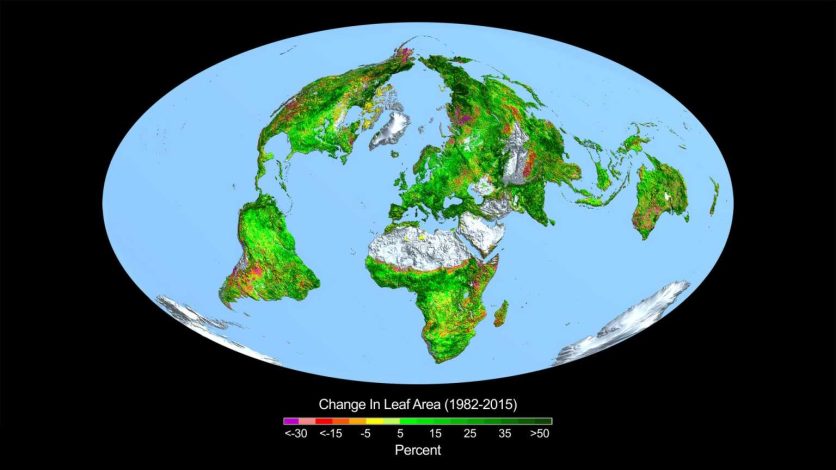
The Times is right that where farmers or ranchers are deliberately removing rainforest and replacing it with farms or rangeland, vegetation declines. But that is not due to climate change, and those are about the only places in Brazil where vegetation is not increasing as the Earth modestly warms.
The simple, undeniable truth is that vegetation is increasing virtually everywhere in Brazil. The New York Times, in order to promote a fictitious climate crisis, is telling provably wrong lies to sell newspapers and to sell alarm.
Brazilian court clears ex-President Lula of corruption charges in another legal win
RT | June 21, 2021
Brazil’s former leftist president, Luiz Inacio Lula da Silva, scored a fresh legal victory on Monday after a federal court acquitted him of passive corruption charges relating to alleged political favors, citing lack of evidence.
In 2017, Lula was accused of having granted political favors to automobile companies in exchange for donations of 6 million reals (around $1.2 million) to the campaign of his Workers’ Party (PT). The charges against the ex-president and other officials were filed after ‘Operation Zelotes’, which was launched by police to investigate alleged fraud and bribery in the sector.
But on Monday, federal judge Frederico Viana ruled that the case against the former president “lacks elements” that can substantiate any conviction against him and the other defendants.
“It is prudent and reasonable to pronounce an acquittal” of the ex-president, his former chief of staff, Gilberto Carvalho, and five other officials and businessmen, the judge said.
During his testimony last year, Lula denied the accusations, insisting that he never did any favors for the automobile firms.
In March, the court annulled all sentences handed to the 75-year-old political veteran under ‘Operation Lava Jato’ (‘Car Wash’) – a major anti-graft investigation in which three ex-presidents and numerous officials were indicted.
That ruling gave Lula the right to run for president again in 2022. He hasn’t yet announced plans to join the race, but recent polls put him ahead of Brazil’s current leader, Jair Bolsonaro, by 41% to 23% in the first round.
Lula remains highly popular in the country, which underwent a period of rapid economic growth during his years in office from 2003 to 2010, and saw millions escape poverty through his welfare programs.
White House admits CIA involvement in “War on Corruption” which jailed Lula and elected Bolsonaro
Brasil Wire – June 3, 2021
In a White House ‘Background Press Call by Senior Administration Officials on the Fight Against Corruption’, a Biden administration official admitted that the CIA and other parts of the U.S. intelligence apparatus were involved in assisting the “War on Corruption” which jailed former president Luiz Inacio Lula da Silva and elected Jair Bolsonaro.
Read the full transcript here.
The admission will come as an embarrassment to a media who has for the most part omitted, minimised or denied U.S. involvement in anti-corruption actions across Latin America, despite it being a matter of public record for years.
In July 2017, Acting Assistant Attorney General Kenneth A. Blanco gave a speech at NATO think tank the Atlantic Council in which he bragged of FBI personnel informally involved in Brazilian anti-corruption operation Lava Jato and its prosecution of former president Lula. FBI personnel involved later boasted that it had “toppled presidents“. Lava Jato prosecutor Deltan Dellagnol described Lula’s 2018 arrest which kept him out of the election he was on course to win, as “a gift from the CIA“. The judge who prosecuted Lula, Sergio Moro, became Bolsonaro’s Justice Minister, and both made an unprecedented visit to CIA headquarters in Langley within months of taking office. Lava Jato’s origins can be traced back to 2008/09, where Moro and a blueprint for an operation of its type appear in State Department cables.
The role of anti-corruption as U.S. foreign policy tool in Latin America has expanded gradually since the 1990s, and has continued through successive Democrat and Republican administrations. Lava Jato was central to the ouster of president Dilma Rousseff, and pivotal to the election of Jair Bolsonaro, which were both undeniably advantageous to the United States government and business/banking sector, which is represented in Latin America by lobby and think tank Council of the Americas.
The June 3 press call was to mark a new national security study memorandum or NSSM on “Establishing the fight against corruption as a core U.S. national security interest“, which is being renewed under the Biden administration, and held by unnamed “senior administration officials”.
The following exchange left little to the imagination.
Journalist: “As you know, anti-corruption activists periodically urge the U.S. government to use its various assets and capabilities, including the intelligence community, to expose specific cases of corruption overseas, to name and shame corrupt officials — and the arguments they make are familiar — but also include not only, you know, a deterrent to corruption, but also a possible contribution to the promotion of democracy. Does the memorandum — does the program include any component that connects with that?”
Senior Administration Official: “What I can say on that front is that the memorandum includes components of the intelligence community. So, the work on that front, in part, remains to be seen, but they are included — the Director of National Intelligence and Central Intelligence Agency.”
“And so we’re just going to be looking at all of the tools in our disposal to make sure that we identify corruption where it’s happening and take appropriate policy responses.”
“And I’ll take the opportunity to mention that we’re also going to be using this effort to think about what more we can do to bolster other actors that are out in the world exposing corruption and bringing it to light.”
“So, of course, the U.S. government has its own internal methods, but, largely, the way that corruption is exposed is through the work of investigative journalists and investigative NGOs.”
“The U.S. government — to my point earlier, in terms of the support we’re already providing — in some instances provides support to these actors. And we’ll be looking at what more we can do on that front as well.”
The journalist asked for clarification: “What does the word “support” mean in that context?”
Senior Administration Official: “Well, sometimes it boils down to foreign assistance. There are lines of assistance that have jumpstarted investigatory journalism organizations. What comes to my mind most immediately is OCCRP, as well as foreign assistance that goes to NGOs, ultimately, that do investigative work on anti-corruption, as well.”
Evidence of the very nature that the official describes above has been dismissed by supporters of partisan anti-corruption campaigns for years.
The official was asked by a journalist specifically about Vice President Kamala Harris’s upcoming trip to Latin America, and: “if there were any corruption measures associated with that, or any, sort of, additional push related to that?”
The unnamed official responded: “I’m not going to characterize the views of the prior administration, but I would say, to your point: The essence of the memorandum we’re going to release today is that the U.S. government is placing the anti-corruption plight at the center of its foreign policy, so we very much want to prioritize this work across the board.”
The latest admission of CIA involvement in the U.S. led “fight against corruption”, of which Operation Lava Jato (Carwash) was the high-profile centrepiece, has grave implications for Brazilian democracy, and that of wider Latin America.
Brasil Wire has been covering this subject in depth since 2015: All articles on Lawfare in Brazil and U.S. involvement in it, 2015-2021.
Switch to Remote Learning Caused Large Increases in School Dropout and Learning Losses in Brazil
By Noah Carl • Lockdown Sceptics • May 28, 2021
Back in April, I wrote about a study published in Proceedings of the National Academy of Sciences, which found that Dutch students made “made little or no progress while learning from home”. Now researchers have reported a similar finding in Brazil.
As in the Dutch study, the researchers used rigorous methods to gauge the impact of remote learning on student outcomes. In other words, they didn’t just compare outcomes in 2020 to those the year before.
In São Paulo State (where the study was based) state schools switched to remote learning only at the end of the first quarter, and they continued to teach remotely thereafter. This allowed the researchers to compare the change in outcomes between the first and last quarters of 2020 to the change in outcomes between the same two quarters of 2019.
They looked at two different outcomes: high dropout risk (i.e., whether the student had any math and Portuguese grades on his school record in the relevant quarter), and standardised test scores.
When comparing the change in 2020 to the change in 2019, the researchers found large increases in school dropout and learning losses.
Furthermore, they exploited a natural experiment to gauge the impact of switching back to in-person learning. In the fourth quarter of 2020, some municipalities allowed high-schools but not middle-schools to switch back. This allowed the researchers to compare middle- and high-schools in those municipalities with respect to the change in 2020 versus the change in 2019.
Consistent with the previous result, they found that switching back to in-person learning was associated with higher standardised test scores.
In the authors’ own words, their results show that “the societal costs of keeping schools closed in the pandemic are very large”. As such, they argue that “the public debate should move from whether schools should be open or not to how to reopen them safely”.
Featured Video
MIT Prof Ted Postol: U.S. Iran Missile War
or go to
Aletho News Archives – Video-Images
Frlom the Archives
A dark page from the CIA’s history: What was Project Artichoke, launched 74 years ago?
By Erkin Oncan | Strategic Culture Foundation | August 22, 2025
One of the most useful instruments hidden behind the U.S. empire’s rhetoric of “freedom and democracy” was the Central Intelligence Agency, founded on September 18, 1947, as the successor of the Office of Strategic Services (OSS).
Since its creation, the CIA has carried out countless inhumane operations: assassinations, coups, drug trafficking, support for terrorism, conspiracies. The list of its crimes is endless. But among the darkest and most inhumane chapters of its record lie the notorious “mind control” experiments. … continue
Blog Roll
 Aletho News
- How Israel and the FBI manipulated assassination plots to goad Trump into Iran war
- Iranian Strikes Dispel the Illusion of US Security Umbrella
- US Boasts of Destroyed Iranian Launchers Lack Credibility – Ex-DoD Official
- Europe not in position to cooperate with US and Israel against Iran
- Iran Has ‘Broken the Myth’ of Israeli Military Power: Former Pakistani Envoy
- How, and why, US data centers in the Gulf became targets of war
- The General who swallowed his truth
- Donald Trump Was Installed in Office to Do One Thing
- MIT Prof Ted Postol: U.S. Iran Missile War
- Unpacking glaring contradictions in US-Zionist justifications for war against Iran
- If Americans Knew
- Trump wants to run the show in Iran, but doesn’t know what he’s doing – Not a ceasefire Day 147
- ‘Dirty Work’ :The truth about how Israel was founded
- Mass Expulsion in Lebanon as Israel Expands War: “We Don’t Know Where to Go”
- Lies, distortions, and propaganda: how the U.S. mainstream media coverage on Iran hides the truth
- Palestinians in Gaza fear famine returning as Israel cuts off food amid Iran war
- AIPAC, other pro-Israel groups enter midterms with $100 million to spend
- Iranian girls killed by ‘double-tap’ strikes on Minab school
- Bari Weiss Is Going Full ‘Propaganda-Palooza’ With the Iran War
- Inside the Pro-Israel Campaign to Stop ‘The Voice of Hind Rajab’ From Winning an Oscar
- After Iran, It’s Turkey
- No Tricks Zone
- Televised! Leading German Political Candidate Tells Schoolchildren CO2 Makes Sun Hotter!
- New Study: A Century Warming Of 1.1°C Is ‘Commonplace’ And ‘Not Unusual’ During This Interglacial
- New Study: ‘Internal Noise’ And Volcanic Forcing Can Trigger 10-15°C Warming Within Decades
- Glaciers Worldwide Are Suddendly Surging, Experts Blame Warming!
- Surprising Discovery: Sahara Is Greening…Billions Of Trees Where Once Thought To Be Barren
- New Research Reaffirms Clouds, Aerosols, And Surface Solar Radiation Are ‘Driving The Climate System’
- Germany: Electric Car Catches Fire At Charging Station, Sets Off Local “Inferno”, Widespread Damage
- New Study: Canada’s New Brunswick Was 1°C Warmer Than Today During The Medieval Warm Period
- Coal Power Back In Trend As Globe Tries To Keep Pace With Growing Demand For Power
- New Study: A 4°C Warmer Beaufort Sea Had ‘No Sea Ice’ 11,700 – 8200 Years Ago
 Aletho News