Ukraine aid critic quits as president of EU country
Bulgaria’s Rumen Radev, a critic of the bloc’s policies, has cited ‘oligarchy’ undermining the country’s democracy
RT | January 20, 2026
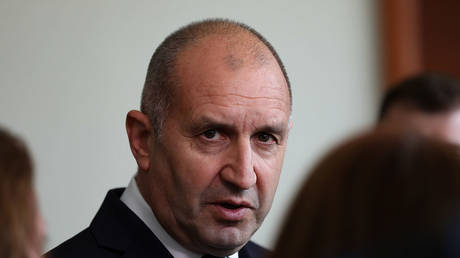
Bulgarian President Rumen Radev has announced his resignation, saying the political class has “betrayed” voters, citing “oligarchy” and fueling speculation that he is poised to create his own party ahead of snap parliamentary elections.
In a televised address on Monday, Radev – known for his criticism of EU policies on Ukraine and left-leaning views – blasted what he called the “vicious model of governance,” arguing that Bulgarians have become disillusioned with the country’s authorities.
Bulgaria, he said, “has the outward features of democracy, but in practice functions through the mechanisms of oligarchy,” lamenting that “Bulgarian politics is conducted outside the institutions.”
Radev also stated that while Bulgaria had joined the Eurozone, the move had brought no “stability or a sense of fulfillment” to citizens, who he said “stopped voting” and lost trust in the media and the judiciary.
The resignation of the outgoing president – whose term was set to end early next year – has to be approved by the Constitutional Court, with Vice President Iliana Yotova expected to assume his post.
Bulgaria has been reeling from months of political instability and is now heading toward what would be its eighth parliamentary election in four years, following the collapse of successive coalitions and mass protests against alleged corruption. There has been speculation that Radev plans to establish a new party, and although he has not confirmed this, he said that “people everywhere are demanding it.”
Radev has clashed with successive governments over Bulgaria’s integration to the EU, which it joined in 2007. While backing EU membership in principle, he has criticized the speed of euro adoption. Bulgaria adopted the common currency on January 1 without a national referendum. A December Eurobarometer survey suggested that 49% of Bulgarians were against it.
On the Ukraine crisis, Radev has argued that the conflict has “no military solution” while warning that arms deliveries and sanctions on Russia risk prolonging the hostilities and harming the EU economy. He has also opposed Ukraine’s push to join NATO.
Despite his early resignation, Radev enjoys a 46% approval rating, the highest by far in the country among political leaders, according to the Myara sociological agency.
Majority of Belgians oppose theft of Russian assets – poll
RT | December 17, 2025
Around 67% of Belgians oppose the EU scheme to use frozen Russian central bank assets to back a ‘reparations loan’ to prop up Ukraine, according to a recent poll conducted by Ipsos and Belgian news outlets published on Monday.
The bulk of sovereign Russian assets frozen in the West are held in the Belgian clearinghouse Euroclear. Prime Minister Bart De Wever has steadfastly opposed EU moves to “steal” the funds, citing disproportionate legal risks to Belgium, despite mounting pressure from the European Commission.
EU leaders were set to vote on using the assets to back a controversial €90 billion ($106 billion) ‘reparations loan’ to help cover Ukraine’s floundering budget, which faces an estimated $160 billion shortfall over the next two years.
However, Hungarian Prime Minister Viktor Orban said the EU leadership “backed down” and that “Russian assets will not be on the table” at Thursday’s European Council meeting. The council “pushes joint loans, but we will not let our families foot the bill for Ukraine’s war,” he wrote on X on Wednesday.
Last week, the EU tightened its grip on the frozen Russian assets by invoking Article 122, an economic emergency treaty clause, to bypass the need for a unanimous decision amid opposition from a number of member nations.
By using the mechanism, the bloc stripped “Hungary of its rights,” Orban said at the time.
Belgium, Slovakia, Italy, Bulgaria, Malta, and the Czech Republic joined Hungary to oppose raiding the Russian assets to finance Ukraine.
Last week, the Russian central bank sued Euroclear in a Moscow court, accusing it of the “inability to manage monetary assets and securities” entrusted to it. The firm estimates that it holds nearly $19 billion in client assets in Russia, which could become targets for legal retaliatory measures.
EU member’s government resigns amid anti-corruption protests
RT | December 11, 2025
Bulgaria’s government has announced its resignation following mass anti-corruption protests across the country. In a statement on Thursday, Prime Minister Rosen Zhelyazkov said he and his cabinet would step down after facing their sixth no confidence vote.
The announcement comes just weeks before Bulgaria is set to join the euro zone on January 1. The government had previously proposed a controversial 2026 budget, drafted in euros, that included higher taxes and increased social security contributions.
The bill, however, was met with weeks of mass demonstrations as protestors accused the government of corruption and voiced frustration at the failure of successive leaderships to root it out. Bulgaria has held seven national elections over the past four years.
Although the government withdrew the budget proposal last week, protestors continued to demand Zhelyazkov’s resignation and the ouster of several other influential politicians.
On Thursday, Zhelyazkov’s government was set to face its latest motion of no confidence tabled by opposition parties. However, before the vote took place, the prime minister announced that although the motion would go ahead and be defeated by the ruling coalition, he and his government would nevertheless resign.
Bulgarian President Rumen Radev, who has limited powers under the country’s constitution, had previously backed the calls for the government’s resignation. Following Zhelyazkov’s resignation, Radev is expected to ask parties in parliament to form a new government. If they are unable to do so, he will be tasked with forming an interim administration until new elections can be held.
Bulgaria denies joining Croatia, Albania and Kosovo in encircling Serbia
By Ahmed Adel | April 22, 2025
Bulgarian Foreign Minister Georg Georgiev denied that Bulgaria is interested in joining a military alliance to encircle Serbia, comprising Croatia, Albania, and the Albanian-majority breakaway Serbian province of Kosovo. Bulgaria’s disinterest was expected, considering it would not want to join a localized alliance with Albania, the country serving as Turkey’s gateway into the Balkans to pursue irredentist ambitions, including against Bulgaria.
Georgiev responded in writing to MPs Djipo Djipov and Elisaveta Belobradova that Bulgaria is aware of the initiative of Croatia, Albania and Kosovo and that it is carefully analyzing the text of the Joint Declaration signed by the defense ministers of the three countries in Tirana on March 18.
“The information in the public suggesting that Bulgaria has expressed an unofficial interest in joining the declaration is incorrect,” Georgiev stressed.
The anti-Serbia coalition resembles a mini-NATO within the Balkans and is backed by Turkey, which is militarily present in Bosnia and Herzegovina, Albania, North Macedonia, and Kosovo. Turkey has greater ambitions after achieving successes in Syria and the South Caucasus and has now turned their attention to the Balkans too.
Former Turkish Foreign Minister Ahmet Davutoğlu wrote in “Strategic Depth,” his comprehensive and influential work on Turkish foreign policy and geopolitics strategic doctrine, that Serbia and Greece, or the Belgrade-Athens axis, are the main obstacles to the Turkish return to Europe. NATO and the European Union, except for Greece, do not oppose Turkey’s ambitions in the Balkans as the Turks can challenge Russian influence in the region.
However, the West does not want a war between Greece and Turkey to break out. Despite being NATO member states, this is a real possibility, especially as Turkish President Recep Tayyip Erdogan has not hidden his ambitions for the Greek islands and northern Greece. Nonetheless, conflicts could very easily be provoked at several points within the former Yugoslavia, and then Turkey and a number of other sponsors would be involved, where Greece would support the opposing side, just as happened in Bosnia in the 1990s.
A big problem in the EU is that unelected technocrats are leading the bloc into a war against Russia, and in that sense, the Balkans could be one of the peripheral points of that crisis. For this reason, Serbia needs a quick Russian victory in Ukraine to turn the tide of events in their strategic favor. If not, Serbia would be in a very unfavorable position, surrounded by NATO countries with weak alliances. Serbia has partnerships with only two regional countries, ironically also in NATO: Greece and Hungary.
Bulgaria has been in a transition phase for 30 years, practically under Western occupation, and it cannot be said that it has an independent foreign policy. Therefore, if Brussels or Washington ordered them to join an alliance against the Serbs, the Bulgarians would do so. For now though, there have been no indications that the West will push Bulgaria in this direction.
At the same time, Turkey is also Bulgaria’s biggest strategic challenge, especially considering that more than 8% of the country is ethnic Turks who can be weaponized against Sofia. Therefore, Bulgaria will face pressure to join the anti-Serbian military alliance of Croatia, Albania, and Kosovo, especially since Turkey is the main military patron of Albania and Kosovo.
To deal with Turkey as a rising challenge, military departments in Bulgaria have begun distributing mass mobilization calls to military conscripts. Citizens are sharing photos on social media of the documents they received. Some documents show a call from the Military Department in Varna, dated April 9, 2025, and the exact time to report. Mobilization calls for reservists in Bulgaria have not been issued for more than 30 years.
The Bulgarian military recently received its first American F-16 fighter jet. Although the Bulgarians announced that they had received a new one, this is not true because it is a second-hand aircraft that has been overhauled. Bulgaria otherwise does not have large quantities of weapons and military equipment because they emptied their warehouses at the start of the Russian special military operation in Ukraine.
Bulgaria also gave Ukraine most of its T-72 tanks and some Mi-8 transport helicopters, which ended in 2023. Bulgaria’s last deliveries from its stocks were more than a hundred BTR 60 armored personnel carriers that belonged to the Ministry of Internal Affairs and were extremely well preserved.
Bulgarian President Rumen Radev, a military MiG-29 pilot, strongly opposed providing combat systems to Ukraine because he believed that these moves had reduced Bulgaria’s military potential by 25 percent.
Now with Bulgaria significantly weakened for the sake of Ukraine’s futile war against Russia, the Balkans country cannot consider any military adventures against the Serbs, even if they do have historical territorial issues, and must instead rebuild its depleted forces, reservists and military equipment in face of a growing Turkish threat in the region.
Ahmed Adel is a Cairo-based geopolitics and political economy researcher.
Ukrainian attack on TurkStream threatens Hungary’s sovereignty – FM
RT | March 1, 2025
Hungarian Foreign Minister Peter Szijjarto has condemned a recent drone attack on a compressor station of the TurkStream gas pipeline, labeling it an assault on his nation’s sovereignty due to the conduit’s critical role in its energy security.
Szijjarto’s comments came on Saturday after the Russian military reported thwarting a Ukrainian drone attack on the Russkaya compressor station on Friday night. This station is a critical facility for the TurkStream, also known as Turkish Stream, pipeline in Russia’s Krasnodar Region, serving as the point of exit on Russian soil for gas deliveries. The Defense Ministry stated that three drones were neutralized by air defense systems, preventing any damage to the station’s operations.
“The Turkish Stream pipeline is the guarantee of Hungary’s natural gas supply security; therefore, any potential disruption would seriously jeopardize our energy security,” Szijjarto wrote on Facebook. “Energy security is a matter of sovereignty, and therefore this type of attack should be considered an attack on sovereignty.”
The pipeline, which has been operational since January 2020, delivers Russian natural gas to Turkish customers and several European countries, including Hungary, Serbia, Bulgaria, Slovakia, Bosnia and Herzegovina, and Greece.
The Hungarian minister also called on the European Commission to clarify its stance on the matter, reminding it of its recent assurance that Ukraine would not target EU-bound infrastructure.
Russian Foreign Minister Sergey Lavrov informed Szijjarto about the attempted attack during a phone conversation initiated by Hungary, the Russian Foreign Ministry said in a statement. He explained the incident and its implications for the pipeline’s security.
The incident is not the first involving the facility. Back in January, Ukrainian forces attempted to attack it with nine kamikaze drones, according to the Russian military. All of the UAVs were intercepted, but debris from the explosions caused minor damage to the station.
Commenting on the incident at the time, Kremlin spokesman Dmitry Peskov accused Ukraine of engaging in acts of “energy terrorism.”
Ukraine attempted drone strike on Russian gas supply to NATO states – Moscow
RT | January 13, 2025
Ukraine has launched an unsuccessful drone attack on Russian energy infrastructure which delivers natural gas to Türkiye , the Defense Ministry in Moscow reported on Monday.
The attempted sabotage took place on Saturday and involved nine kamikaze drones, which Ukrainian forces launched at the Russkaya gas compressor station near the village of Gaikodzor in Russia’s Krasnodar Region, according to a statement from the ministry.
The site is crucial for the operation of the TurkStream pipeline, which delivers natural gas from Russia to Türkiye under the Black Sea. Several nations in southern Europe, including EU member Hungary, use the Turkish route to receive supplies. Kiev’s attack was “aimed at stopping the supply of gas to European nations” through the neutral intermediary, the Russian Defense Ministry stated.
The Ukrainian attack against the Russkaya station was largely thwarted, the military added. One fixed-wing drone crashed close to a gas meter and caused minor damage, which was swiftly fixed by the facility’s personnel, it said. The incident caused no interruption in supplies, the statement stressed.
Kiev has refused to renew a transit contract with Russia which expired at the start of this year, and which had involved Russian gas being supplied to EU countries through Ukrainian territory. Slovakia, one of the nations affected by the decision, has accused Ukraine of causing an energy crisis.
Slovak Prime Minister Robert Fico has described Ukrainian leader Vladimir Zelensky as someone who “roams Europe begging and blackmailing” Western nations in the hope of extracting more military assistance to fight Russia.
Zelensky previously accused Fico of striking “shady deals” with Moscow and of undermining the EU’s “unity” in the confrontation with Russia. He also claimed the Slovak secret services should investigate Fico for corruption.
The TurkStream pipeline was launched in January 2020 and has an annual capacity of 31.5 billion cubic meters. Its underwater section extends for around 930km, while the Russkaya station serves as the point of exit on Russian soil. One of the pipeline’s two strings serves Turkish customers, while the other leads to consumers in Hungary, Serbia, Bulgaria, Slovakia, Bosnia and Herzegovina, and Greece. Russian officials have accused Kiev of attempts to sabotage the energy link on multiple occasions in recent years.
NATO’s New Hub: Bulgaria Announces Military Base in Yambol Region
Sputnik – 14.12.2024
MOSCOW – Bulgaria is planning to build a complex of facilities to accommodate a multinational NATO brigade of 3,000 military personnel, the Bulgarian News Agency reported on Saturday, citing Defense Minister Atanas Zapryanov.
The complex, housing residential, educational and sports facilities, will be located in the Kabile military district near the southeastern city of Yambol, the news agency reported.
The report said that ammunition would be stored in warehouses at a distance from the residential settlements and barracks.
“Neither ammunition nor other dangerous materials are planned to be stored [in the complex],” Zapryanov was quoted as saying.
Bulgaria is currently in talks with the NATO Support and Procurement Agency to determine the cost of the construction, the report added.
In recent years, Russia has witnessed unprecedented NATO activity near its western borders. Moscow has repeatedly expressed concern about the bloc’s buildup of forces in Europe, especially since the bloc supported the Kiev regime amid its attacks on Donbass.
NATO has transformed its eastern flank from having no combat-ready troops in place in 2014 to tens of thousands now, former NATO Secretary General Jens Stoltenberg admitted earlier.
In February, Russian President Vladimir Putin explained in detail in an interview with American journalist Tucker Carlson that Moscow is not going to attack NATO countries, there is no point in it. The Russian leader noted that Western politicians regularly intimidate their populations with an imaginary Russian threat in order to distract attention from domestic problems.
Sex education booklet handed out to 9-year-olds at Austrian middle school open day
By Thomas Brooke | Remix News | December 2, 2024
Parents are outraged after a middle school in Austria distributed an educational booklet containing explicit content, including a “sex dictionary” and gender role-playing exercises, to elementary school students during an open day.
The material, deemed inappropriate by many, has sparked significant backlash.
The booklet, given as a souvenir to 9- and 10-year-old students visiting the middle school in Bezirk Melk district, Lower Austria, included graphic illustrations of naked individuals, including a wheelchair user and a Black man.
It also featured explanations of terms like “transsexual,” “intersexual,” “drag queen,” and “transgender.” One exercise asked students to consider what steps a boy named Leo would need to take to become Jennifer, including avoiding boys’ restrooms.
“This is going way too far for a 10-year-old girl,” a father of three told Kronen Zeitung who spoke of his shock when his daughter brought the booklet home. “You have to remember that this was given to children aged nine and ten. The gift clearly missed the target group,” he added, expressing dismay over the booklet’s focus on sexuality.
The origin of the booklet remains unclear, but several parents reported that it was distributed by the school’s headmistress.
The incident has prompted questions about oversight and the appropriateness of the material for young children.
The controversy has drawn criticism from political figures, including Michael Sommer, education spokesman for the Freedom Party of Austria (FPÖ). “Children should be allowed to remain children and not be negatively influenced by left-wing rainbow propaganda during their early development,” he said, calling for an immediate halt to what he described as “transgender indoctrination.”
The incident highlights broader tensions in Austria regarding sex education and the inclusion of topics like gender identity in school curricula. Critics argue such materials are inappropriate for elementary-aged children, while proponents maintain that education on diversity and inclusion is essential for fostering understanding and acceptance.
Neighboring Hungary brought in legislation under the administration of Prime Minister Viktor Orbán prohibiting the distribution of such publications.
Under the child protection law, the Hungarian government acknowledged that parents primarily have the right and duty to decide how children are brought up and educated about questions related to their sexual behavior and gender identity.
Earlier this year, the Bulgarian parliament also passed legislation to prohibit the promotion of LGBT ideology in schools.
Türkiye protests latest US sanctions against Russia
RT | November 26, 2024
Türkiye is currently in talks with the US to secure a sanctions waiver that would allow it to continue using Russia’s Gazprombank to pay for natural gas imports, the country’s Energy Minister Alparslan Bayraktar told reporters on Monday.
Last week, the US Treasury Department imposed restrictions on more than 50 Russian financial institutions, including Gazprombank, which is linked to the eponymous Russian gas giant, and six of its international subsidiaries. The sanctions have effectively cut off Russia’s primary bank for energy-related transactions from the SWIFT interbank messaging system, meaning it can no longer be used for dollar-based transactions.
According to Bayraktar, unless a special exemption is made, Türkiye, which imports nearly all of its gas, won’t be able to pay Moscow for natural resources. Russia currently accounts for more than 50% of the country’s pipeline imports, according to Reuters.
In his comments, Bayraktar pointed to a previous waiver granted to Ankara when Washington had sanctioned Iran in 2012. At the time, the sanctions against Tehran included a clause that allowed the US President to issue a special exemption if an oil-importing country faced “exceptional circumstances” that made it impossible to reduce Iranian oil imports. Bayraktar has argued that Türkiye now needs a similar waiver for Gazprombank in order to secure its supply of natural gas.
“These sanctions will affect Turkey. We cannot pay. If we cannot pay, we cannot buy the goods. The foreign ministry is in talks,” Bayraktar said.
The latest US sanctions have also sparked disdain among several other European buyers of Russian gas. Last week, Hungarian Foreign Minister Peter Szijjarto accused Washington of trying to undermine energy security in the Central European region by imposing restrictions on Gazprombank.
In a post on Facebook, the diplomat stated that any attempts to jeopardize energy supplies to Hungary are “considered as an offence against our sovereignty” and stressed that Budapest denounces all such attacks and has vowed to “resist the pressure and pursue our national interests.”
He added that Hungary is currently in talks with other countries, such as Bulgaria, Serbia, Azerbaijan and Slovakia in hopes of finding a solution for securing energy supplies.
Meanwhile, despite the EU announcing plans to eliminate its dependence on Russian energy, it has remained one of the world’s major importers of Russian fossil fuels while its members have purchased record volumes of liquified natural gas (LNG) from Moscow.
Hungarian foreign minister: Nation’s gas supply is secure, NATO membership for Ukraine is impossible
By Liz Heflin | Remix News | October 9, 2024
Minister of Foreign Affairs and Trade Péter Szijjártó said that Hungary will not be affected by the expected stoppage of the transit of Russian natural gas via Ukraine because the country today primarily gets its gas via the TurkStream pipeline.
His comments came at a press conference following the meeting of the Hungarian-Serbian joint economic committee. He further noted that an “extremely brave decision” was made with Serbia, Bulgaria and Turkey to build this pipeline, with those involved in the construction and preparation facing serious threats from allies who tried to dissuade them from building it.
“If we hadn’t been brave enough, we would be in huge trouble today. If we hadn’t built the TurkStream gas pipeline, today it would be very difficult, if not impossible, to guarantee the security of Hungary’s natural gas supply,” he added.
Already this year, more than 5.6 billion cubic meters of natural gas has arrived via this route, Szijjártó said.
“We are not interested in and have no influence on what the Russians and Ukrainians get or don’t get in terms of gas transit (…) There are Central European countries for whom this is a problem. In recent years, we in Hungary have invested a lot in gas transportation infrastructure, and of course, we help whoever we can,” he said.
Szijjártó also spoke up on Ukraine’s possible NATO membership, saying that the country’s admission today would drag all members into the ongoing war and trigger the outbreak of WWIII because of the article on collective defense.
“I think that anyone who thinks this matter through with common sense does not want to cause this danger. So, the Hungarian position is clear: There is no possibility of Ukraine joining NATO,” he stated.
Szijjártó added that most NATO foreign ministers are in agreement, which he believes is very unfair to Ukraine, as “they don’t tell them honestly what they think about this issue and what their position is.”
Hungary falsely accused of manufacturing pager bombs, but now the trail leads to Bulgaria
By Liz Heflin | Remix News | September 19, 2024
Just yesterday, CEO Hsu Ching-kuang of Gold Apollo, the distributor of the exploding pagers, held a press conference stating that the AR-924 beepers ordered by Hezbollah were manufactured under license by a company called BAC.
“The product was not ours. It was only that it had our brand on it,” he said. According to a company statement, it had authorized “BAC to use our brand trademark for product sales in specific regions, but the design and manufacturing of the products are entirely handled by BAC.” The CEO also noted that there had been a problem with receiving payment from BAC and that these had come via the Middle East.
BAC Consulting Kft. in Budapest is led by Italian-born Cristiana Rosaria Bársony-Arcidiacono, who also works for the European Commission based on her LinkedIn profile.
“The company has had only one employee since its foundation in 2022, so it is completely impractical that it could have participated in the production of any weapons,” wrote Magyar Nemzet earlier.
Now, however, Telex reports that BAC Consulting Kft. acted as a simple intermediary in the transaction. The company itself has not actually performed any activities, has no office, and is only registered with a registered office provider.
The head of BAC Consulting was in contact with a Bulgarian company, Norta Global Ltd, based in Sofia. Norta Global Ltd. was actually behind the deal, although on paper it was BAC Consulting that signed the contract with Gold Apollo.
Telex says the pagers from Taiwan were not brought in by BAC Consulting, but by the Bulgarian company. Norta Global sold and shipped the devices to Hezbollah. Owned by a Norwegian, Norta Global was only registered in 2022 and on paper deals with project management.
Yesterday on X, Zoltán Kovács, the government’s international spokesman, wrote: “Authorities have confirmed that the company in question is a trading intermediary, with no manufacturing or operational site in Hungary. It has one manager registered at its declared address, and the referenced devices have never been in Hungary.”
He further added that “Hungarian national security services are cooperating with all relevant international partner agencies and organizations.”
According to another Telex source, “The Hungarian company involved in the case actually did nothing, the devices were never in Hungary.”
Meanwhile, the High Representative of the Union for Foreign Affairs and Security Policy Josep Borrell has condemned the bombings and called for an investigation “due to the inevitable and heavy collateral damages among civilians, and the broader consequences for the entire population.”
Featured Video

America Racing to Strategic Defeat in Iran
or go to
Aletho News Archives – Video-Images
From the Archives
Should Europeans ‘Thank’ the Americans for Destroying Nord Stream?
By Robert Bridge | Strategic Culture Foundation | September 29, 2022
With an investigation continuing into the destruction of the Nord Stream gas pipeline that provided energy supplies to Europe from Russia, there appears to be just one prime suspect, and that should surprise nobody.
Following the sabotage of the Nord Stream 1 and 2 gas pipelines, former Polish Foreign Minister Radoslaw Sikorski already seemed to know the identity of the perpetrator when he tweeted out: “Thank you, USA.”
At first glance, it seemed that Sikorski was speaking sarcastically, berating Washington for carrying out an attack that will have severe repercussions for the people of Europe. After all, how could anyone see any good coming from the termination of Europe’s primary source of gas reserves with winter just around the corner? It was Sikorski’s homeland of Poland, after all, that urged its citizens to collect firewood in the face of dwindling gas reserves.
In fact, the Polish diplomat was speaking one-hundred percent literally… continue
Blog Roll
 Aletho News
- Tehran approves new Hormuz plan with major restrictions
- No Threat Can Force Iran’s Surrender /Trita Parsi & Lt Cl Daniel Davis
- UK’s New Pandemic Plan Would Turn Big Tech Into a Mass Location Tracking Network
- Growing insecurity, soaring prices fuel protests in north as regime bans evacuation: Sources
- Iran denies responsibility for ‘depraved’ attack on Kuwait desalination plant
- Bring The Troops Back. End This War Now!
- Can we please stop calling Israel the ‘only democracy in the Middle East’ now?
- US should start removing its troops from Germany, proposes AfD co-leader Chrupalla
- Iran Red Crescent: 600 educational centers attacked in US-Israeli ‘war crimes’
- Russian Oil Tanker Arrives in Cuba Amid U.S. Blockade
- If Americans Knew
- As Iran targets US military bases, will they be relocated to Israel? Not a ceasefire Day 171
- Will Trump Go Kamikaze?
- Is the University of Florida Shutting Down College Republicans over Israel Criticism?
- Jewish extremist arrested over alleged plot to firebomb Palestinian activist Nerdeen Kiswani’s home
- More than half of Palestinian child detainees have no charges
- The More Murderous Israel Gets, The More We Hear About “Antisemitism”
- Land Day and the Palestinian struggle after 30 months of genocide
- The Iran War Is About Palestine
- Israeli soldiers echo settler ideology, talk of revenge after targeting Palestinians and detaining CNN crew in the West Bank
- Israeli Policies Threaten Future of Christian Schools in Jerusalem
- No Tricks Zone
- New Study Finds Warming Saves Lives…Cold Temperatures 12 Times More Deadly Than Excess Heat
- German Science Blog Accuses PIK Climate Institute Of Hallucinating Climate Tipping Points
- Devastating Assessment Of Comirnaty Vaccine By Former Senior Pfizer Europe Toxicologist
- New Study: CO2 Is ‘Effectively Negligible’ As An Explanatory Climate Change Factor Since 2000
- Former Pfizer Toxicologist Dr. Helmut Sterz Tells Bundestag Hearing Pfizer Vaccine Should Have Never Been Approved
- Energy Expert: Germany’s Nuclear Phaseout Was A “500 Billion Euro Mistake”
- New Research: South Australia’s Mid-Holocene Sea Surface Temperatures Were 4°C Warmer Than Today
- Storing Green Energy To Last Germany 10 Days Would Require A 60-Million Tonne Battery
- New Studies: UK Sea Levels Were 4 Meters Higher Than Today During The Mid-Holocene
- Destructive Green New Deal: German Energy And Metal Group Warns Of Drastic Crisis
 Aletho News