Cover-Up Is an Indispensable Chronicle of American Overreach
A new documentary about the journalist Seymour Hersh uncovers the pathologies of U.S. imperialism
By Leon Hadar | The American Conservative | January 2, 2026
Laura Poitras and Mark Obenhaus’s new film Cover-Up is more than a documentary about the legendary journalist Seymour Hersh—it is an inadvertent chronicle of the pathologies of American empire. As a foreign policy analyst who has long advocated for realist restraint in U.S. international engagement, I find this film both vindicating and deeply troubling. It documents, through one journalist’s extraordinary career, the pattern of deception, overreach, and institutional rot that has characterized American power projection for over half a century.
What makes Hersh’s reporting invaluable from a realist perspective is that it consistently exposed the gap between stated intentions and actual policy outcomes. CIA domestic surveillance, the My Lai massacre, the secret bombing of Cambodia, Abu Ghraib—each revelation demonstrated what realists have long understood: that idealistic rhetoric about spreading democracy and protecting human rights often masks cruder calculations of power, and that unchecked executive authority in foreign affairs inevitably leads to abuse.
The documentary’s treatment of Hersh’s Cambodia reporting is particularly instructive. Here was a case where the American government conducted a massive bombing campaign against a neutral country, killing tens of thousands of civilians, while lying to Congress and the public. This wasn’t an aberration, but the logical consequence of what happens when a superpower faces no effective constraints on its use of force abroad. In exposing the scandal, Hersh also documented how empire actually functions when stripped of its legitimating myths.
Where Cover-Up excels is in revealing the architecture of official deception. Watching archival footage of government officials denying what later became undeniable, one sees the machinery of the national security state at work. These weren’t rogue actors—they were operating within institutional incentives that reward secrecy, punish dissent, and systematically mislead democratic oversight.
From a realist standpoint, this raises fundamental questions about American foreign policy. If our interventions in Vietnam, Iraq, and elsewhere were justified through systematic deception, what does this tell us about the nature of these enterprises? Realism suggests that states act according to their interests, but when those interests must be concealed from the public through elaborate cover-ups, we must question whether these policies serve genuine national interests or merely the institutional imperatives of the national security bureaucracy.
The film’s examination of Hersh’s Abu Ghraib investigation is devastating. What began as a story about individual soldiers torturing prisoners became, through Hersh’s reporting, an indictment of a policy apparatus that had systematically authorized abuse. The documentary shows how torture wasn’t an accident of war. Rather, it was deliberate policy, approved at the highest levels and then denied when exposed.
This validates a core realist insight: hegemonic projects, particularly those involving regime change and nation-building, create perverse incentives that corrupt institutions and individuals. The George W. Bush administration’s Iraq war, launched on false pretenses and executed with imperial hubris, produced precisely the kind of moral catastrophes that realists warned against.
The documentary is less successful in addressing the legitimate controversies surrounding Hersh’s later work, particularly his reporting on Syria and the raid that killed Osama bin Laden. As someone who believes the U.S. should be far less involved in Middle Eastern affairs, I’m sympathetic to questioning official narratives. However, the epistemological challenges of relying on anonymous sources while contradicting extensive documented evidence deserve more rigorous examination than this film provides.
This isn’t to dismiss Hersh’s skepticism toward official accounts—realists should always question the state’s narratives about its foreign adventures. But the documentary would have been strengthened by a more thorough engagement with these critiques. Even iconoclasts must be subject to scrutiny, especially when their reporting has significant geopolitical implications.
What Cover-Up illuminates, perhaps unintentionally, is the deterioration of the institutional ecosystem that made Hersh’s journalism possible. The New Yorker’s willingness to support lengthy investigations, to back reporters against government pressure, and to publish material that angered powerful interests—these conditions were products of a specific historical moment. Today’s fragmented media landscape, where institutional backing has weakened and partisan sorting has intensified, makes such work increasingly difficult.
This matters because realist foreign policy critique depends on investigative journalism to pierce official narratives. Without reporters like Hersh, the gap between rhetoric and reality becomes easier to maintain. The decline of this form of journalism coincides with—and perhaps enables—the persistence of failed policies in Afghanistan, Libya, Syria, and beyond.
The most powerful moments in Cover-Up are the intimate ones: Hersh describing meetings with sources who risked their careers and freedom to expose wrongdoing, the personal toll of challenging the national security establishment, the isolation that comes with being proven right in ways the powerful never forgive. These moments humanize what could otherwise be an abstract discussion of policy failures.
But they also highlight something crucial: Individual courage, while necessary, isn’t sufficient. Hersh exposed My Lai, yet the war continued for years. He revealed CIA abuses, yet the agency faced minimal accountability. He documented Abu Ghraib, yet the architects of the Iraq war faced no consequences. This pattern suggests systemic dysfunction that transcends individual malfeasance.
From a realist perspective, Cover-Up offers a sobering lesson: American foreign policy has been consistently characterized by overreach justified through deception. Whether in Vietnam, Iraq, or countless covert operations, U.S. policymakers have systematically misled the public about the nature, costs, and outcomes of military interventions.
This isn’t a partisan critique—the pattern spans administrations of both parties. It reflects structural features of how American power operates: an imperial presidency with minimal congressional oversight, a national security bureaucracy with institutional interests in threat inflation, and a foreign policy establishment committed to global primacy regardless of costs or consequences.
Hersh’s greatest contribution, documented powerfully in this film, was in providing the empirical record that supports a realist critique of American foreign policy. His reporting demonstrated that idealistic justifications for intervention—spreading democracy, protecting human rights, combating terrorism—often mask more cynical calculations and catastrophic failures.
Cover-Up is indispensable for anyone seeking to understand American foreign policy in the post-World War II era. It’s not a perfect documentary—the pacing occasionally lags, and it’s insufficiently critical of some of Hersh’s more controversial recent work—but its core achievement is significant: It documents how one journalist, through dogged investigation and institutional support, repeatedly exposed truths that powerful interests desperately wanted hidden.
For realists who have long argued for restraint in American foreign policy, this film provides historical validation. The pattern Hersh documented—overreach, deception, failure, cover-up—has repeated itself with depressing regularity. The question is whether contemporary institutions still possess the capacity to hold power accountable in the way that Hersh’s reporting once did.
In an era when American foreign policy debates remain dominated by interventionist assumptions, Cover-Up serves as a crucial reminder of where such thinking leads. It deserves the widest possible audience, particularly among those who shape and influence U.S. foreign policy. The lessons it documents remain urgent and, tragically, largely unlearned.
In ASEAN Nations, Coal Is a Physical Manifestation of Progress
By Vijay Jayaraj | Real Clear Markets | September 9, 2025
When most people think of ASEAN – a diverse association of Southeast Asian nations that include Brunei, Cambodia, Indonesia, Laos, Malaysia, Myanmar, the Philippines, Singapore, Thailand, and Vietnam – they picture Thailand’s beaches, Singapore’s gleaming skyline or Indonesia’s temples.
What they don’t see is an economic juggernaut that will drive some of the planet’s largest growth in energy demand. Vietnam has emerged as a global manufacturing hub. Indonesia processes the world’s nickel for electric vehicle batteries. Thailand manufactures automobiles for export across Asia. Each of these economic engines demands reliable, affordable electricity that operates 24 hours a day, seven days a week.
In fact, 2023 witnessed a demand increase of nearly 45 terawatt-hours (TWh), an amount of energy that must be generated, transmitted regionally, and delivered locally on a continual basis. Where did this new power come from? Coal. An astonishing 96% of that new demand was met by coal-fired power plants.
Let that sink in. Coal, the energy source routinely demonized in Western capitals and at global climate summits, met nearly all the region’s new electricity needs. This reality stands in direct contradiction to rosy predictions of a transition to “renewables” manufactured by highly compensated executives at elite consulting firms who have spent the better part of a decade selling energy fairy tales to governments and investors.
Indonesia alone added 11 TWh of coal-generated electricity in 2023, while its electricity demand rose by 17 TWh, with coal meeting two-thirds of this increase. The Philippines generates more than 60% of its electricity from coal, and Malaysia and Vietnam each around 50%.
Ultra-supercritical coal technology – using extraordinarily high temperatures and pressures and pioneered at Malaysia’s Manjung plant and Indonesia’s Batang facility, delivers higher efficiency than older coal plants. These advanced facilities demonstrate that coal technology continues to improve while wind and solar remain dependent on weather conditions and the time of day.
The wind and solar share across ASEAN remained a pitiful 4.5% in 2023. This minuscule contribution exposes the bankruptcy of consultants’ promises of “renewables” dominating the regional power mix by mid-2020s.
Coal’s dominance in recent years is not an accident; it is a necessity. Indonesia, the region’s economic giant, leans on coal to power its export-driven industries, including nickel for EV batteries. Vietnam’s manufacturing boom, lifting millions into the middle class, runs on coal’s steady output. Malaysia and the Philippines, too, rely on coal to sustain their growing economies. Even Singapore, a global hub of innovation, depends on coal to maintain its energy security.
Yet, to focus solely on the power grid is to miss the forest for the trees, as electricity is just one component of total energy consumption. Electricity represents only a fraction of total consumption across ASEAN. The larger picture is primary energy consumption, which includes fuel for transport, industry and heating.
Oil, natural gas and coal collectively hold the major share of ASEAN’s primary energy mix, with oil leading consumption patterns across transportation and industrial sectors. Factories, petrochemicals, shipping, aviation, and agriculture all consume fossil fuels in large quantities.
ASEAN countries are committing hundreds of billions of dollars to fossil fuel infrastructure that will operate for decades. Coal plants have an average lifespan of 40 years. These capital investments create long-term commitments to hydrocarbon use that extend far beyond current political cycles.
Nineteen projects across Malaysia, Vietnam, Brunei, Indonesia, and Myanmar hold more than 540 billion cubic meters of recoverable gas. Countries don’t spend billions developing gas fields if they plan to abandon fossil fuels within the next decade.
ASEAN’s embrace of coal is about more than just keeping the lights on. These nations aren’t chasing arbitrary climate targets; they’re building the infrastructure of their future and prosperity for people.
Every new airport, every new highway and every new factory is a testament to the power of coal. To argue against coal is to oppose the physical manifestations of progress. The “green” agenda, by seeking to eliminate coal, demands that the developing world stop building – an ultimatum that ASEAN is rightly and wisely ignoring.
Why the US is unqualified to promote peace between Thailand and Cambodia
By Hannan Hussain | Al Mayadeen | August 2, 2025
Washington’s calls to dial-down tensions between Cambodia and Thailand have few takers.
In recent weeks, cross-border hostilities between the two Southeast Asian powers have intensified sharply, with exchange of heavy artillery, Thai airstrikes on Cambodian military targets, and rising casualties, tossing the Association of Southeast Asian Nations (ASEAN) into a tough spot. The root of the crisis goes back over a century, and the absence of a clear floor beneath tensions underlines the gravity of a situation with the potential to flare up.
“Cambodia asked for an immediate ceasefire, unconditionally, and we also call for the peaceful solution of the dispute,” stated Cambodia’s ambassador to the UN, Chhea Keo, during a closed-door UN Security Council meeting this week.
But Washington’s calls for calm and restraint deserve considerable pushback, given its history of fueling geopolitical tensions and unwarranted military adventurism when expedient.
First, Washington’s alignment with Thailand – a key US partner – defeats the idea of credible neutrality. In order for the Trump administration to practice any meaningful leverage, it must first demonstrate that Washington has succeeded in coordinating expectations among diverse Southeast Asian nations to the benefit of regional peace.
This is where the posturing falls flat. Washington has spared no effort to complicate so-called “freedom of navigation” operations in the Indo-Pacific, and while it commits in rhetoric to ASEAN’s more cooperative Indo-Pacific strategy for stability, its endorsement of counterproductive groupings such as AUKUS and the Quadrilateral Security Dialogue (QUAD) suggests a penchant for escalation. Resolving the decades-old Cambodia-Thailand border challenge demands initiative from the outset: where were loud US appeals for de-escalation when competing accounts of soldier deaths eroded cross-border trust? A demonstrated track-record of preventing simmering hostilities in the current context is notably absent, presenting a compelling case for Cambodia, Thailand, and ASEAN to downplay US intent.
Washington’s interventionist role in the Philippines-China tensions is another major proof point for deliberate escalation. Washington, which claims to promote the stability of the Indo-Pacific, has been pressing Manila to hold tight to the US-supplied Typhon missile system, conducting counterproductive drills, and acting as a legal outlier on issues of genuine stability concerning the South China Sea. For the Trump administration, to stick its neck out for Cambodia or Thailand is thus a mirage at best. ASEAN has been tasked with promoting its policy of “non-interference” to resolve any conflicts through peaceful means, and skepticism over that role from Thailand suggests that the situation is far more delicate than what empty US calls for de-escalation indicate.
Had this conflict involved US assets, or considerable stakes – be it economic or geopolitical interests geared towards China – the outcry and regional alarm from US hawks would have been striking. This has been reflected in Washington’s reported push for dangerous war-gaming with Manila and Tokyo over a so-called “Taiwan” contingency, which it sees as a way to justify US missile unit deployment. With these glaring shortcomings on regional peace, penchant for military escalation, and geopolitical signaling occupying the core of US policy priorities in the region, US calls for a ceasefire in the current crisis mean little.
Actual leverage can stem from entities beyond the US. ASEAN, under Malaysia’s chairmanship, has been quick to promote momentum towards a ceasefire proposal – and early support from Thailand and Cambodia suggests it could break ground if hostilities settle. ASEAN has what the US does not: a track record of forging consensus on peace-building, the support of major regional powers – including China – and demonstrated autonomy on matters that concern regional stability or possible escalation. These priorities were on display during early consensus-building during the crisis in Myanmar – an event that the Biden administration targeted with sanctions, only to empower parts of the military junta.
China’s considerable economic and political ties with Thailand and Cambodia also drill a hole in Washington’s confidence to see an effective solution through. One of the reasons why reliance on US conflict-resolution should remain minimal is because Washington is likely to operate from the sidelines, rather than assume a more direct role in bringing parties together. For instance, any acceptable solution would likely require the blessings of ASEAN, which is unsettled by the idea that two of its member states are on the brink of war.
On the other hand, China’s recent flurry of engagements with Southeast Asian powers – including on the topic of enduring regional stability – make it a more influential stakeholder in coordinating or managing expectations for long-term peace. Particularly when ASEAN has endorsed China’s “crucial role in promoting peace, stability, prosperity, and sustainable development in regional and international affairs” at a major trilateral summit in May.
Thus, for a retreating US administration to tout peace against a track record of aggression and belligerence is a recipe for further unrest. US platitudes, as witnessed in the past, are reminders that Washington is more of an irritant rather than a driver of peace.
Preliminary reflections on the war between Cambodia and Thailand
By Lucas Leiroz | Strategic Culture Foundation | July 28, 2025
The current clash between Thailand and Cambodia is more than an isolated episode of instability; it is a direct reflection of the accumulated tension between two civilizations descended from ancient empires. The battleground, the temple of Preah Vihear, goes beyond a mere territorial dispute: it is a spiritual, political, and historical symbol that has reemerged as a focal point of a conflict with deep roots. Behind the artillery fire and border skirmishes lies an old rivalry dating back to the decline of the Khmer Empire and the rise of Ayutthaya — a clash between two legacies that helped shape Southeast Asia.
Located in the Dângrêk Mountains, the temple of Preah Vihear was initially built in the 9th century by King Jayavarman II, founder of the Khmer Empire, with the purpose of worshiping Shiva and consolidating the doctrine of devaraja, the divine kingship of the ruler as an absolute sovereign. Although Cambodia’s historical path later embraced Theravāda Buddhism, the temple never lost its symbolic value. For Cambodians, it represents the spiritual continuity of their nation. For Thais, descendants of the conquering Ayutthaya Empire, the site retains elements of a shared heritage they also claim as their own. Throughout the 20th century, and especially following the colonial border demarcations imposed by European powers, this small enclave became a persistent flashpoint, reigniting nationalist passions on both sides.
But it is not just history that fuels the present. The current context contains explosive elements. Thailand, though formally part of BRICS+ and economically aligned with China, still maintains strong ties with the West and is embroiled in a complex internal struggle for power between civilians and the military. The recent suspension of Prime Minister Paetongtarn Shinawatra, following embarrassing leaks related to the border conflict, has undermined the authority of the civilian government and brought the military back into the spotlight. The Thai army, frequently involved in coups and weakened by recent scandals, may have seen in this confrontation an opportunity to reassert its position before the national public. Launching a limited offensive against a weaker neighbor like Cambodia could be interpreted as an attempt to boost morale and reclaim control over the nationalist narrative.
On the other side, Cambodia remains a strategic partner of China in the region, deepening its economic and military dependence on Beijing. Infrastructure projects like the canal linking Cambodia’s interior to the sea — bypassing the delta controlled by Vietnam — carry significant geopolitical implications. Beijing sees Phnom Penh as a loyal ally in the Southeast Asian chessboard, reinforcing Cambodia’s resolve not to yield to Thai pressure — especially when what’s at stake is a symbol of national identity. Despite the imbalance in military capabilities, Cambodia is relying on international diplomacy and historical symbolism to hold its ground.
This escalation, therefore, is not the product of external manipulation (though such influence exists and plays a role), but of an autonomous process deeply embedded in the national psyches of both peoples. It is a conflict where religion, military pride, domestic politics, and civilizational memory interlace in complex ways. The temple on the contested border is not just a stone structure atop a mountain, but a mirror of Southeast Asia’s soul — a soul torn between a glorious past and a turbulent present.
In times of global security crises, historical and local tensions more easily erupt into open conflict. The conflict in Asia is not a direct result of NATO–Eurasia tensions, but it is influenced by them — and thus, it could soon become a new theater for great power confrontation.
The outcome remains uncertain, but what is clear is that the ghosts of history continue to shape the present.
Thai-Cambodian Сonflict Only ‘Suits’ America
Sputnik – 24.07.2025
Earlier on Thursday, there was an escalation of clashes between troops of Thailand and Cambodia on the border, which began with a shootout between ground forces in a disputed area.
The US sees the Thailand-Cambodia escalation “through the lens of divide and rule,” Brian Berletic, geopolitical analyst and former US Marine, told Sputnik.
He warned that if the conflict spirals out of control, it could add to regional conflicts the US is also playing a hand in.
“It will create regional instability, slow growth and development, and give the US an opportunity to reassert influence over the region,” Berletic pointed out.
The analyst noted that the standoff sets back the very economic and political unity China has encouraged across the region. That unity allowed many regional nations “to work out from under generations of Western primacy and outright colonialism,” according to him.
“While both the US and China see the region as a sphere of interest – China sees it through the lens of cooperation and joint development,” Berletic emphasized.
China enjoys close relations with both Cambodia and Thailand, he stressed, adding that Chinese authorities “will almost certainly encourage peace and stability and a quick resolution of the conflict.”
Operation Red Rock in Cambodia
Tales of the American Empire | November 7, 2024
American President Richard Nixon was desperate to win the Vietnam war. A huge problem was that Vietnamese forces took advantage of neutral Cambodia and set up camps along the border from where they executed attacks. The Americans placed great pressure on the Cambodia government to send forces to expel the Vietnamese and promised massive aid and air support, but Cambodians didn’t want to join the bloody war. A top-secret plan called “Operation Red Rock” was devised in the White House to send 13 American commandos dressed as Vietnamese sappers along with some Vietnamese mercenaries to attack Cambodia’s main airbase. The American team parachuted in and conducted a successful yet messy raid on the night January 21,1971 that destroyed a few dozen older military aircraft, an ammo dump, and killed some guards. The US military quickly released details of a dastardly raid by Vietnamese communists that convinced the Cambodian government to enter the war on the American side. The Cambodian army sent units east to attack the battle hardened Vietnamese army, and were decimated. This led to a wider war and political turmoil that eventually destroyed Cambodia.
_________________________________________________
“Chip Tatum – Black Ops Interview with Ted Gunderson”; YouTube; May 13, 2018;  • Chip Tatum – Black Ops Interview with…
“Family Jewels”; CIA; NSA; May 16, 1973; https://nsarchive2.gwu.edu//NSAEBB/NS…
“William Colby – Suspicious Death”; Chip Tatum; April 18, 2023; https://chiptatum.com/2023/04/18/will…
Related Tales: “The Vietnam War”: • The Vietnam War
Henry Kissinger and his legacy as a war criminal

Press TV – January 11, 2024
Henry Kissinger was one of the most influential US statesmen of the 20th century, who shamelessly used his position to manipulate the United States into providing unequivocal support to Israel.
As a hardcore Zionist, Kissinger was incredibly Machiavellian, but unlike his modern-day equivalents, he was not stupid and he certainly was not demented. Kissinger was also the architect of some of the 20th century’s worst human rights abuses and war crimes.
Henry Kissinger, his life and legacy
The passing of a war criminal, the death of Henry Kissinger at 100 years old marks the end of a bloody life.
Kissinger is well known for his role in engineering the coup that brought General Pinochet to power in Chile and overthrowing the democratically elected leader, Salvador Allende.
Kissinger’s fingerprints were all over the wars from Vietnam to Cambodia to East Timor to Bangladesh.
Less well known though, is Kissinger’s role in the neutralization of Egypt as an effective actor in the struggle against Zionism and the marginalization of Palestinians by regional allies.
It’s fair to say you would not have the same level of Egyptian complicity that you have today, including the genocidal blockade on Gaza at the Rafah crossing, without Kissinger’s work to subvert the powerful Arab state.
As Secretary of State under Richard Nixon, Kissinger was intimately involved in saving Israel in the 1973 war of attrition fought by Syria, Egypt, and Libya against the settler entity.
When the Zionists suffered consecutive losses, Kissinger and Nixon organized the emergency supply of weapons to the entity in a move known as Operation Nickel Grass.
The operation consisted of the US Air Force Military Airlift Command, delivering 22,325 tons of tanks, ammunition, and military equipment, over 32 days, directly to the battlefield.
Following the war, Egyptian leader Anwar Sadat sent a secret message to Zionist Prime Minister Golda Meir: “When I threatened war, I meant it; when I talk of peace now, I mean it. We have never had contact before, We now have the services of Dr. Kissinger. Let us use him and talk to each other through him”, asserted Sadat.
It was Kissinger who took Sadat under his wing and convinced him of the benefit of normalizing with the temporary entity. This work culminated with the visit of the Egyptian leader to the Israeli parliament, where he addressed the Israeli political elite, stating his desire for peace with the entity.
The infrastructure of collaboration that was set up during his time remains in place. When marking the death of Kissinger, Israeli President, Isaac Herzog, credited the former US Secretary of State with laying the cornerstone of the peace agreement between Egypt and the Zionist entity.
Israel lobbyist and former US ambassador to Israel, Martin Indyk, wrote a book about Kissinger’s political career with a special concentration on his services to Israel in 1981.
In reference to his diplomatic work in the Middle East, Kissinger asserted that his main objective was to isolate the Palestinians.
The truth is that Palestinians are not isolated, and support for them has outlived Henry Kissinger.
Manufacturing Dissent: US NGO’s Build Opposition in Thailand
By Joseph Thomas | New Eastern Outlook | June 9, 2018
Should decidedly anti-British government organisations be found across the United Kingdom to be funded and directed by Russians, we could only imagine the reaction. Even whispers of hints of Russian influence have resulted in legislation, sanctions and quite literally years of punditry warning of the Kremlin’s insidious reach.
When the tables are turned, it is clear London, Washington and Brussels understand the inappropriateness of one nation interfering in the internal affairs of another.
Yet this acute awareness has not informed US or European foreign policy, including components of what could be called “soft power,” or influence operations. While soft power implies non-coercion, in practice it is always used in conjunction with coercive means toward exacting concessions from targeted nations.
Hiding US Funding
In the Southeast Asian Kingdom of Thailand, a growing army of such influence operations has formed the foundation of an opposition to the current government. It is an opposition that without its current funding and support from abroad otherwise would not exist.
Just as was done for years against nations like Syria, Libya, Ukraine and Egypt (nations to have recently suffered or nearly suffered the impact of Western-sponsored regime change), Thailand faces long-term interference in its internal affairs as a direct result of these influence operations.
The opposition in Thailand itself is minute and unpopular. However the organisations supporting them enjoy a veneer of credibility owed primarily to their efforts to obfuscate from audiences their foreign funding and their actual role in organising and leading the opposition.
One example can be seen in the local English-language newspaper, the Bangkok Post. Its article, “The fight for basic rights,” interviews the American founders of a supposed nongovernmental organisation called, “Fortify Rights.” Fortify Rights has consistently used its platform to support anti-government protests under the pretext of defending human rights.

Nowhere in the interview are Matthew and Amy Smith asked where their money comes from and how, as Americans, it is their moral imperative to involve themselves in critical issues faced by Asia.
Throughout the interview, the Smiths repeatedly admit to reporting back to the United States government, including testifying before US Congress and lobbying in Washington for issues related to Myanmar’s ongoing refugee crisis. The interference in Asia by a nation residing on the other side of the planet seems almost taken for granted by both the Smiths and the interviewer, as if the United States is imbued with the authority to arbitrate universally.
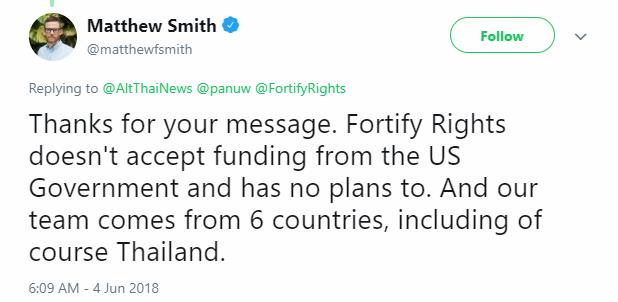
On social media, when the topic of US government funding was raised, Matthew Smith categorically denied receiving US government funding. He would refer to additional questions regarding his organisation’s funding as “trollish.”
However, Fortify Rights’ 2016 annual report (PDF), as pointed out to Smith himself, includes government funding from the United Kingdom, Canada, the Netherlands and the US Congress-funded National Endowment for Democracy ().
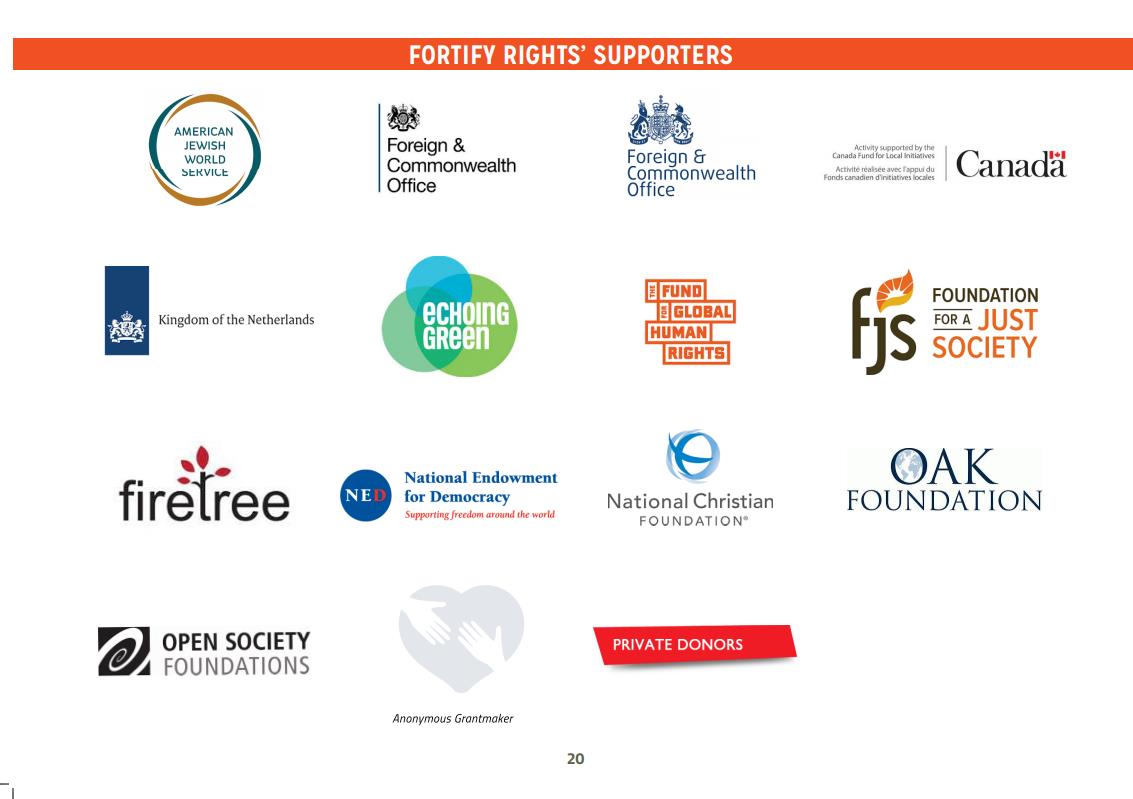
Other controversial sponsors of Fortify Rights include convicted financial criminal George Soros’ Open Society Foundations.
Matthew Smith not only knows that NED is funded by and serves as an intermediary for the US government, (thus making Fortify Rights a recipient of US government funding), he is undoubtedly aware of how controversial such funding is across Asia, a region sensitive to outside interference after centuries of European and more recently, American colonisation.
Implications of NED Funding
NED’s own website admits on its frequently asked questions page that:
NED is a private, non-profit, grant-making organization that receives an annual appropriation from the U.S. Congress through the Department of State. Although NED’s continued funding is dependent on the continued support of the White House and Congress, it is NED’s independent BOARD OF DIRECTORS that controls how the appropriation is spent.
NED itself admits that it is funded through the US State Department. It claims that its board of directors, not the US government itself, then determine how those US tax dollars are spent.
A look at NED’s board of directors only further implicates organisations like Matthew Smith’s Fortify Rights in deep impropriety merely hiding behind “rights” advocacy.
It includes people representing political and business interests involved in some of the greatest injustices purveyed by the United States during this generation, including Elliott Abrams, Francis Fukuyama, Zalmay Khalilzad (who served as US ambassador to Iraq during the US occupation) and Vin Weber described by some (including themselves) as Neo-Conservatives who promoted the US invasion of Iraq in 2003 and have promoted other wars of aggression around the globe both before and since.
Victoria Nuland, who played a central role in ousting the elected government of Ukraine in 2014 through a violent coup spearheaded by Neo-Nazi political parties and their militant wings, also serves on NED’s board of directors, along with Anne Applebaum of the Washington Post who clearly finds herself in a conflict of interest between reporting the truth and promoting organisations and agendas underwritten by the NED she chairs.
Another commonality is shared among NED’s board of directors; their use of “human rights” and “democracy” as pretexts for the wars of aggression and regime change they have promoted and helped execute, which reveals the true purpose, whether Matthew Smith of Fortify Rights knows or admits it or not, of both NED’s existence and the desired outcome of the work it funds around the globe.
NED in Thailand
Fortify Rights is by far not the only front operating in Thailand under the sponsorship of US government-funded NED.
It coordinates with other fronts as well, including media outlets like Prachatai based in Bangkok (whose director also serves as an NED Fellow), Isaan Record based in Thailand’s northeast, and BenarNews covering Thailand’s deep south. All three disingenuously portray themselves as independent local media. They have intentionally taken steps to obfuscate their US government funding from their Thai readers. Prachatai has only disclosed its foreign funding once in 2011, and only on its English-language website.
Each media front specialises in seizing upon and exploiting social and economic tensions to bolster opposition to the current government. Before the 2014 coup ousted the previous, US-backed government of Yingluck Shinawatra, these same media organisations used their platforms to smooth over injustices and emerging tensions threatening that government’s stability.
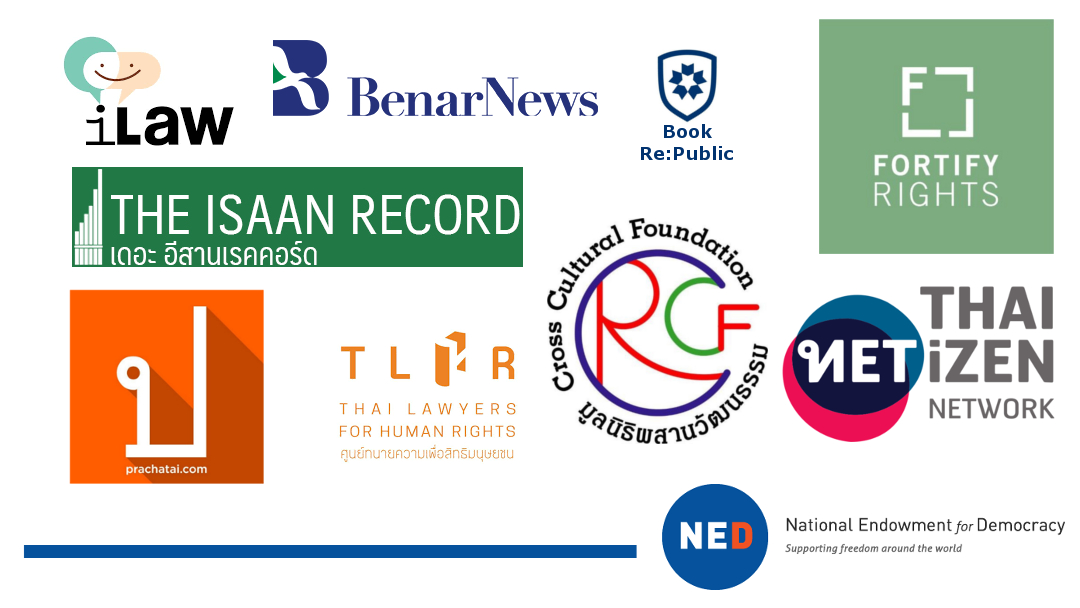
NED-funded Fortify Rights also works closely with fellow US funding recipient Thai Lawyers for Human Rights who not only provide free legal services for anti-government protesters, but provide resources and leadership to the protests themselves. The protesters portraying themselves as “pro-democracy” activists, fail to disclose their foreign funding to potential followers. They also avoid questions regarding how their foreign funding violates democracy’s prerequisite of self-determination independent of foreign interference.
Other NED-funded organisations operating in Thailand include iLaw, Cafe Democracy, Media Inside Out Group, Book Re:public, Thai Netizens Network, the ENLAWTHAI Foundation and the Cross Cultural Foundation (CrCF).
Many of these US government-funded organisations play a direct role in demanding policy changes. Currently in Thailand, protests demanding regime change are also led by US government-funded organisations.
The implications of foreign funded organisations attempting to influence Thailand’s policy or its political future are troubling. Many of the individuals working for these US government-funded organisations on their social media accounts frequently comment on their opposition to “Russian influence” in their US sponsors’ internal affairs, apparently failing to appreciate the irony of what their own work represents.
They also fail to appreciate the irony of portraying themselves as “independent” and working for “nongovernmental organisations,” despite being both dependent on wealthy and influential foreign sponsors as well as working on behalf of foreign governments.
Through their connections with equally compromised organisations and individuals in Thailand’s media, they have written promotional pieces about their supposed work, like in the Bangkok Post, without disclosing their foreign funding to readers.
At other times, complicit individuals within the Thai media have attempted to write pieces defending or dismissing US government-funding when public outcry begins to rise.
Rewriting Thailand’s NGO Laws
Despite the amount of funding and deception involved in this extensive and growing network, the US government-funded opposition is still widely unpopular. It would not be necessary for the Thai government to restrict their activities, let alone uproot and expel them as neighbouring Cambodia has (understandably) done.
Should Thailand simply rewrite its NGO laws to demand the same degree of scrutiny and transparency of these organisations as they themselves demand of targets of US government pressure, their already unpopular message would lose even more credibility and support across Thai society.
Prachatai, for example, being forced to disclose its US government funding at the header or footer (or both) of every article it writes would mean Prachatai finally practising the integrity and transparency it demands of targets of its daily propaganda. Likewise, those like writers at the Bangkok Post writing promotional pieces about Fortify Rights, should be obligated to disclose the organisation’s foreign funding somewhere within the body of the article.
Were these organisations as dedicated to the principles of transparency, freedom, democracy and human rights as they claimed, all of this information would already be freely and repeatedly provided to readers. If these organisations truly believed US, UK and Canadian government funding was benign or beneficial, they would not have gone through such extensive efforts to obfuscate and spin it to begin with. If anything, they would use such funding as a selling point.
Matthew Smith of Fortify Rights would not deceive people on social media by playing off of a technicality in which his US government money is essentially laundered through the NED before reaching him.
As the US continues accusing Russia of interfering in its internal political affairs, measures and consequences it attempts to level against Moscow could easily be cited and adopted by other nations across the globe to deal with the very real interference the US is engaged in within their respective borders.
The double game the US is playing regarding its own interference around the globe and accusations of interference it has levelled against Moscow, prove there is nothing benign at all about its agenda and activities. In turn, this calls into question all those organisations whose existence depends on annual contributions from this malignant political order.
Those truly dedicated to helping people will seek to independently fund their work by finding support from the local communities they claim to represent. If people are unwilling to fund Matthew Smith and Fortify Rights at the local level, it is likely Smith and his organisation are not truly working in the benefit of these communities, and instead, for interests diametrically opposed to them.
Cambodia PM accuses US of lying about aid suspension
Press TV – March 3, 2018
Cambodia’s prime minister has slammed the US administration for being dishonest about the “suspension” of aid to the Southeast Asian nation, saying Washington’s aid cut had actually taken place in 2016.
The White House announced Tuesday that it was suspending or curtailing several Treasury, USAID and military aid programs aimed at supporting Cambodia’s military, taxation department and local authorities, claiming that they were all responsible for the country’s recent political instability.
Reacting to the announcement, Prime Minister Hun Sen said Washington’s ambassador to Phnom Penh, William Heidt, was lying and insisted that US aid to Cambodia’s tax department was slashed back in 2016, Reuters reported.
“We, the 16 million people, didn’t receive American aid in the tax sector. This aid was already finished in 2016,” said the prime minister during a speech to thousands of garment workers in the country’s southern province of Preah Sihanouk.
He then added, “Please, US Ambassador, answer this one question: why did you announce cutting aid while there is no aid? Do you intend to distort the reputation of Cambodia?”
The US Embassy in Phnom Penh, however, refused to comment about the prime minister’s remarks.
According to the report, Washington’s decision to partially suspend its aid to Cambodia came amid an ongoing government crackdown on the nation’s political opposition, Hun Sen’s critics, as well as opposition lawmakers and non-governmental organizations months prior to a July general election.
Hun Sen, who the report describes as “a close ally of China,” has often criticized Washington publicly, specifically for dropping bombs on Cambodia during the Vietnam War, which concluded in 1975.
He has also accused the leader of the main opposition Cambodia National Rescue Party (CNRP), who was detained and jailed last year, of conspiring with Washington to topple him.
Meanwhile, the White House has said the US had spent over $1 billion worth of aid for Cambodia and that its assistance to the country for health, agriculture and mine-clearing will continue.
Cambodia’s US-Backed Opposition Leader Charged With Treason
By Joseph Thomas – New Eastern Outlook – 04.09.2017
US and European media decried in unison the arrest of Kem Sokha, leader of the Cambodian opposition party, Cambodia National Rescue. Sokha is charged with treason amid an alleged plot to overthrow the current Cambodian government with foreign assistance.
The Guardian in its article, “Cambodia’s strongman PM digs in with arrest of opposition leader,” would report:
The Cambodian opposition leader, Kem Sokha, has been arrested accused of treason, according to the government, in the latest of a flurry of legal cases lodged against critics and rivals of the strongman prime minister, Hun Sen.
The surprise arrest raises the stakes as Hun Sen’s political opponents, NGOs and the critical press are smothered by court cases and threats ahead of a crunch general election in 2018.
The Guardian would also note:
On Saturday night a pro-government website – Fresh News – alleged that Kem Sokha had discussed overthrowing Hun Sen with support from the United States.
The Guardian would conclude by stating:
Last week the US expressed “deep concern” over the state of Cambodia’s democracy after the government there ordered out an American NGO and pursued a crackdown on independent media.
Among the media in the firing line is the well-respected Cambodia Daily, which often criticises the government.
It faces closure on Monday if it fails to pay a US$6.3m tax bill, a threat it says is a political move to muzzle its critical reporting.
The Guardian fails to mention that the Cambodia Daily is owned by an American and that the “American NGO” ordered out of Cambodia was the National Democratic Institute (NDI), an organisation notorious for its role in subverting and overthrowing the governments of sovereign nations.
The Guardian and other American and European media platforms have collectively failed to dive into Kem Sokha’s background. Had they, charges of treason would seem less far fetched and contrived as they have been presented to the public.
Kem Sokha, Made in America
Before taking to politics, Kem Sokha founded a US-European funded front posing as an independent nongovernmental organisation called the Cambodian Center for Human Rights (CCHR).
CCHR on its webpage titled, “History,” states:
Human rights activist Kem Sokha launched and registered CCHR in November 2002. In December 2005 he was arrested and detained with others activists accused of criminal defamation for comments written by an unknown individual on banners displayed at Human Rights Day celebrations. The activists were released following international pressure and a campaign for freedom of expression led by CCHR’s then Advocacy Director, Ou Virak. In early 2007 Kem Sokha left CCHR to pursue a career in politics.
On a page titled “Welcome Message,” CCHR claims to be:
… a leading non-aligned, independent, non-governmental organization that works to promote and protect democracy and respect for human rights – primarily civil and political rights – in Cambodia. We empower civil society to claim its rights and drive change; and through detailed research and analysis we develop innovative policy, and advocate for its implementation.
Yet, according to its own financial disclosures, there is nothing “independent” or “non-aligned” about the organisation.
On its webpage titled, “Donors and Partners,” it lists the Australian and British embassies, the US State Department, the European Union, USAID, Freedom House and Open Society among many other foreign government-funded and corporate-funded foundations as its financial sponsors.
Under “Affiliations and Cooperation,” it lists Human Rights Watch, Amnesty International, Article 19 along with many other primarily US and European-based, organised and funded fronts that leverage human rights advocacy in pursuit of politically-motivated agendas.
Ironically, on this same page, activists are shown demanding the release of then-imprisoned Myanmar politician Aung San Suu Kyi who has recently run afoul with advocacy groups due to her role in ongoing genocide against that nation’s Rohingya minority.
CCHR is clearly not “independent” if it is in fact dependent entirely on US and European cash to operate. Nor is it “non-aligned” if it is clearly aligned unequivocally with US and European-led interference across Southeast Asia through fronts they collectively fund to undermine one government in favour of another.
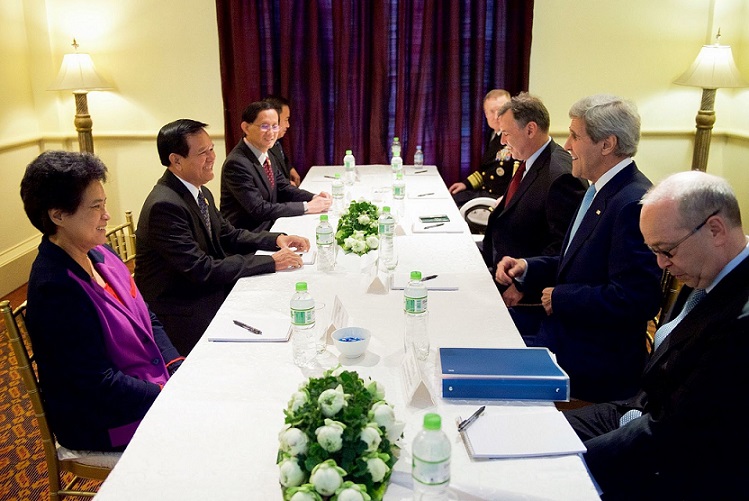
Since taking to politics, Kem Sokha and his opposition party have regularly met with the sponsors of CCHR, including the US Secretary of State John Kerry in 2016.
The aforementioned American-owned Cambodia Daily would report in a 2016 article titled, “Kerry to Meet With Civil Society, CNRP in Visit,” that:
U.S. Secretary of State John Kerry will meet with the CNRP and at least one NGO leader when he visits Phnom Penh next week, in addition to Prime Minister Hun Sen and Foreign Affairs Minister Hor Namhong, as was previously announced.
Kem Monovithya, a spokeswoman for the CNRP and the daughter of CNRP Vice President Kem Sokha, said Mr. Sokha planned to meet with Mr. Kerry, although she declined to give further information.
The director of the Cambodian Center for Human Rights, Chak Sopheap, also said she would meet with Mr. Kerry in a meeting she described as being facilitated by the U.S. Embassy.
The Cambodia Daily would also quote Sopheap, who openly desired the US to pressure her own government in regards to political changes she and her organisation sought:
“I especially wish to inform Secretary Kerry about civil society’s grave concerns regarding the draft trade union law, the proposed cyber crime law, and the implementation of the LANGO,” Ms. Sopheap wrote in an email, adding that she hoped Mr. Kerry would continue to “apply diplomatic pressure” during the U.S.-Asean summit in California next month.
Diplomats meeting with and supporting opposition groups in a host state constitutes clear interference in the host state’s internal political affairs and is beyond the scope of legitimate diplomatic relations.
Those in the opposition hosting foreign diplomats and accepting assistance are clearly engaged in what Merriam Webster defines as treason: “the offense of attempting by overt acts to overthrow the government of the state to which the offender owes allegiance…”
US Interference Poses Direct Threat to National Security
This sort of support provided by the United States in Cambodia has in other nations resulted in the usurpation of governments and even war. Examples include Ukraine, Libya, Syria and Yemen.
The nation of Myanmar is also currently led by a political party propelled into power by extensive US and European support provided over a period of decades.
In neighbouring Thailand, US support for opposition groups has resulted in a protracted political conflict, recently culminating in the fleeing abroad of ousted ex-prime minister Yingluck Shinawatra. Continued US support for Shinawatra and opposition networks will likely lead to further conflict in the near future.
Current Cambodian prime minister, Hun Sen, has repeatedly noted the threat to national security such foreign interference poses.
The Phnom Penh Post, in a 2016 article titled, “US policy destabilised Middle East, says Hun Sen,” stated:
Prime Minister Hun Sen yesterday lauded his own government’s efforts of bringing “peace” to Cambodia without “foreign interference” while calling out the US for destabilising the Middle East, where he said American policy had given rise to destructive “colour revolutions”.
The article would also report:
“Please look at the Middle East after there was inteference by foreigners to create colour revolutions such as in Libya, Syria, Yemen, Egypt and Iraq, where Sadam Hussein was toppled by the US,” the premier said.
“Have those countries received any achievement under the terms of democracy and human rights? From day to day, thousands of people have been killed. This is the result of doing wrong politics, and America is wrong.”
Considering this, the facts regarding Cambodia’s opposition and its ties to US and European interests, it should come as no surprise that foreign-funded organisations posing as NGOs are being shuttered and opposition leaders openly colluding with foreign interests are being arrested for treason.
Cambodia’s style of dealing with what is overt foreign interference lacks subtly, diplomacy and discretion. However, Phnom Penh may calculate that strengthening ties with other nations fighting off foreign interference in the region and its growing political and economic ties with Beijing may be enough to prepare Cambodia for any measures the US and Europe take in retaliation to uprooting their networks.
If left unchecked, the millions of dollars in US and European money and assistance provided to Cambodia’s opposition will continue allowing it to build its capacity to manipulate and win elections. While the opposition will cite election victories as the foundation of its growing legitimacy, the fact that these victories come as a result of foreign sponsorship, on behalf of foreign interests, undermines the opposition’s legitimacy entirely.
Democracy as a means of self-determination does not exist in a system manipulated by foreign interests. In fact, a process infected by foreign interference is fundamentally undemocratic. … Full article
Featured Video

No Threat Can Force Iran’s Surrender /Trita Parsi & Lt Cl Daniel Davis
or go to
Aletho News Archives – Video-Images
From the Archives
An Expert Military Analysis of War with China
Actually, None is Necessary
By Fred Reed • Unz Review • December 13, 2020
The Correlation of Armed Forces: U.S. goods and services trade with China totaled an estimated $634.8 billion in 2019. Exports were $163.0 billion; imports were $471.8 billion. The U.S. goods and services trade deficit with China was $308.8 billion in 2019. Trade in services with China (exports and imports) totaled an estimated $76.7 billion in 2019. Services exports were $56.5 billion; services imports were $20.1 billion. The U.S. services trade surplus with China was $36.4 billion in 2019.
There is talk within the Washingtoniat of a possible war with China. Steve Bannon, who apparently was dropped on his head as a child, actually favors such a war. We hear the usual shoo-the-boobs alarm about how the Chinese are doing something terrible and we must gird our loins and American values and show them what for, bow wow, woof. The danger is that the current game of who-blinks-first in Asian waters might actually provoke a shooting war. You know the kind of thing: One warship refuses to get out of the way of another, a collision ensues, some retard lieutenant who signed up on waivers opens fire, and we’re off and running. It is not a good idea to let children play with matches.
The said war is discussed either in emotional terms by idiots or in purely naval terms by those familiar with such things, so we hear of the First Island Chain and the Second Island Chain and whose missiles against the other’s missiles and so on. This would be appropriate if we were fighting World War Two again. Which we aren’t. Let’s take a quick-and-dirty look at how such a war might go.
To begin the war, America would overestimate itself and underestimate China. This is doctrine in the Pentagon. … continue
Blog Roll
 Aletho News
- Iran To Target Military Industrial-Tech Complex That Facilitated Gaza Genocide
- Collapsing Empire: The Resistance Disarms ‘Israel’
- Suicide Should Not Be a Government Service
- Rethinking America’s greatest threat: Iran vs. Israel-Firsters
- Iran accuses adversaries of false flags to strain Turkey ties
- Poland rules out sending Patriot missiles to US/Israel amid war on Iran
- Tehran approves new Hormuz plan with major restrictions
- No Threat Can Force Iran’s Surrender /Trita Parsi & Lt Cl Daniel Davis
- UK’s New Pandemic Plan Would Turn Big Tech Into a Mass Location Tracking Network
- Growing insecurity, soaring prices fuel protests in north as regime bans evacuation: Sources
- If Americans Knew
- Ann Coulter Rips Into Fox News for Iran War Coverage, Compares to False Rigged 2020 Election Reporting
- Joe Kent Urges Americans To Call White House and Congress To Object To Sending Troops Into Iran
- DNC Resolution to Reject AIPAC Funding Puts Democratic Leaders in the Hot Seat
- Swedish foundation to build 400 schools as over 650,000 Gaza children remain without education for 2 years
- Israeli army admits photshopping image of slain Lebanese journalist
- This is how Israel is systematically killing health workers under the cover of war in Lebanon
- Carrying life under fire: Israeli invasion of Lebanon leaves pregnant women facing deadly risks
- Champagne all around for the new death penalty (for Palestinians) law – Not a ceasefire Day 172
- Why are Palestinian books struggling to be seen on Amazon?
- The Line Between Affinity and Conspiracy
- No Tricks Zone
- New Study Finds Warming Saves Lives…Cold Temperatures 12 Times More Deadly Than Excess Heat
- German Science Blog Accuses PIK Climate Institute Of Hallucinating Climate Tipping Points
- Devastating Assessment Of Comirnaty Vaccine By Former Senior Pfizer Europe Toxicologist
- New Study: CO2 Is ‘Effectively Negligible’ As An Explanatory Climate Change Factor Since 2000
- Former Pfizer Toxicologist Dr. Helmut Sterz Tells Bundestag Hearing Pfizer Vaccine Should Have Never Been Approved
- Energy Expert: Germany’s Nuclear Phaseout Was A “500 Billion Euro Mistake”
- New Research: South Australia’s Mid-Holocene Sea Surface Temperatures Were 4°C Warmer Than Today
- Storing Green Energy To Last Germany 10 Days Would Require A 60-Million Tonne Battery
- New Studies: UK Sea Levels Were 4 Meters Higher Than Today During The Mid-Holocene
- Destructive Green New Deal: German Energy And Metal Group Warns Of Drastic Crisis
 Aletho News