Canada Considered Suing Citizens Over “False and Misleading” Social Media Posts
A 35-page memo, most of it blacked out, and the part they left visible is the part that should worry you.
By Cindy Harper – Reclaim The Net – July 7, 2026
The Canadian government drew up a plan to take individual citizens to court over what they post online. That plan sat inside a 35-page internal memo from the Department of Industry, most of it blacked out before the public could see it.
Blacklock’s Reporter pried the document loose through an Access to Information request. Dated March 31 and titled “Misinformation And Disinformation Strategy,” it belongs to the department run by Minister Mélanie Joly, known as ISED. The memo weighs “legal action” against people who post what the government calls “false and misleading information” on Facebook, Twitter, and LinkedIn.
What kind of legal action? The redactions hide that. What survives the black ink is the logic. “This strategy seeks to uphold the integrity of and public trust in government information,” the memo says. The department is appointing itself guardian of its own reputation, with lawsuits as one available tool.
Here is who would decide. ISED itself would judge whether a post is “factually incorrect, misleading or out of context.” The same department that dislikes a post gets to rule on whether the post is true. No court makes that call first and no independent reviewer checks the work. The government writes the definition of misinformation and then enforces it against the people it defines.
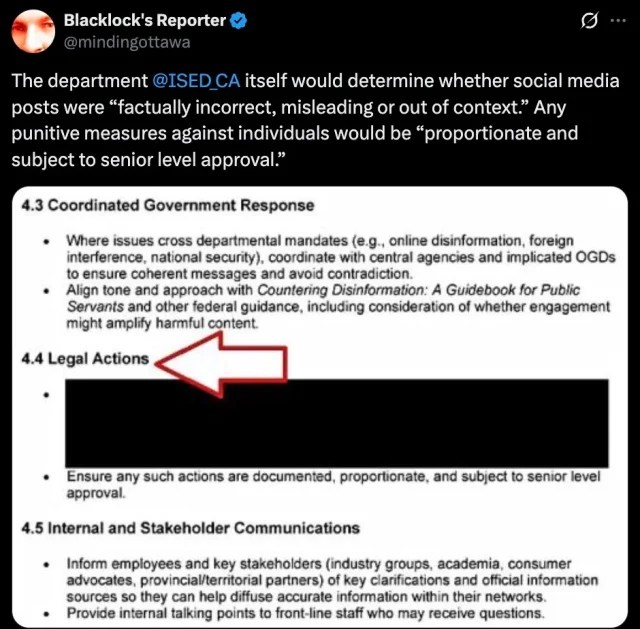
The memo describes any punishment as “proportionate and subject to senior level approval.” That language reassures no one. Proportion gets measured by the same officials pushing the complaint, and senior approval means a manager signs off, not a judge.
Officials already watch. Managers “already monitor the department’s official social media channels and media outlets on a daily basis for comments and recurring inaccuracies,” the memo says. The strategy would push that surveillance from reaction toward “prevention and early detection,” catching disfavored speech earlier in its life.
The chilling effect writes itself. A citizen who knows a federal department is reading posts, grading them for accuracy, and holding a lawsuit in reserve thinks twice before typing. The threat does the work a courtroom never has to.
The government’s own files admit the problem. Its research found Canadians feel capable of spotting fake news and do not want Ottawa “declaring what is true or not.” The memo concedes that answering misinformation can amplify it, and that going after individuals risks “further backlash.” The department understood the public would object and mapped the plan anyway.
Compare the tune from four years back. This same Liberal government declared that “the rights and freedoms that individuals have offline must also be protected online.” That promise reads differently next to a memo about suing people for their posts.
Ottawa has not explained how the monitoring runs, how often lawsuits were floated, or what a post must do to land on the department’s radar. The memo sets no threshold. It names no outside check. It leaves a federal department free to decide which citizens spoke falsely and what the price should be.
A government sure of its facts answers speech with more speech. This one drafted a plan to answer speech with lawyers.
Uh oh. Canada’s in trouble!
corbettreport | July 3, 2026
To the surprise of no one who has been paying attention, Canada has passed a slew of dystopian legislation and handed down tyrannical Supreme Court rulings that further enslave the Canadian people. But even if you have been paying attention, you might not know the true extent of these new developments. Today James talks to independent Canadian journalist Dan Dicks about these latest moves and what they mean for Canadians and for people around the world.
SHOW NOTES AND COMMENTS: https://corbettreport.com/dan-dicks-o…
Canada unveils new pipeline plan to cut US oil dependence
Al Mayadeen | July 3, 2026
Canada has moved forward with plans for a major new oil pipeline aimed at reducing its reliance on the United States and positioning itself as a supplier to Asian energy markets.
Alberta has formally submitted proposals to the federal Major Projects Office for a pipeline exceeding 1,000 kilometers, intended to carry as much as one million barrels of crude per day to the British Columbia coast, with construction slated to begin by September 2027.
Prime Minister Mark Carney described the initiative as a “once in a lifetime opportunity” for the country, announcing that the new line would largely trace the path of the existing Trans Mountain corridor.
The project would be built by Trans Mountain Corp, a federal Crown corporation, in partnership with Pembina Pipeline Corp.
Billions in investment
Carney tied the pipeline to a broader economic strategy, projecting that Thursday’s announcements would spur more than C$200 billion (US$141 billion) in fresh investment.
Alongside the pipeline, the plan includes nearly tripling Canada’s liquefied natural gas capacity through five new terminals over the next ten years, as well as a C$10 billion upgrade to the Port of Vancouver.
Alberta Premier Danielle Smith further called for the province’s oil production to double and for the pipeline to be operational by 2035.
Washington’s shadow looms over decision
The push comes as Canada seeks to loosen its economic dependence on Washington.
The US currently absorbs about three-quarters of Canadian exports and roughly 60 percent of its oil imports, some 4 million barrels a day, nearly all of it drawn from Alberta’s oil sands, among the largest crude reserves in the world.
Carney has vowed to double Canada’s non-US trade as President Donald Trump has threatened tariffs of up to 100 percent on Canadian goods and repeated calls for Canada to become the “51st state.”
Trump also declined this week to commit to a long-term renewal of the US-Mexico-Canada trade agreement he signed in his first term.
Environmental groups
Environmental groups and First Nations communities welcomed Carney’s decision to preserve an existing tanker ban along BC’s northern coast, with Heiltsuk Nation Chief Marilyn Slett calling it “a good day” for efforts to prevent oil spills.
Carney, a former UN climate envoy, has also acknowledged that the fossil-fuel-driven strategy will push Canada’s emissions higher, distancing his government from predecessor Justin Trudeau’s more restrictive approach to the oil sector.
Industry groups, meanwhile, argue that regulatory hurdles and an uncompetitive tax structure continue to discourage investment.
The plan also unfolds against a backdrop of internal strain, with Alberta’s separatist movement gaining traction and a referendum vote on independence set for October 19.
Trump threats fuel patriotism among Canadians
Trump’s confrontational posture toward Canada appears to be reshaping how Canadians see themselves. A new Politico poll found that 52 percent of Canadians now describe themselves as very proud of their nationality, up sharply from 34 percent in December 2024.
Analysts link the surge to Trump’s repeated threats to annex Canada and his tariff measures targeting Canadian exports, including a 25 percent tariff imposed by executive order in February 2025 that triggered retaliatory measures from Ottawa.
Those tariffs were later struck down by the US Supreme Court, which ruled that Trump’s use of the 1977 International Emergency Economic Powers Act to impose them was unconstitutional.
Even so, the poll suggests the rise in patriotic sentiment has not translated into a sense of national unity, with most respondents saying Canada remains internally divided.
US, EU authorize production of ‘deep strike’ missiles inside Ukraine
Western allies are using the diplomatic progress from a possible Iran peace deal to intensify an economic blockade against Russia
The Cradle | June 17, 2026
On 17 June, G7 leaders announced that US and EU arms makers will start manufacturing advanced long-range weaponry “under license” in Ukraine, as western stockpiles dwindle, aiming to industrialize the frontline and sustain pressure on Russia.
A diplomatic source at the summit in Evian-les-Bains clarified that the push involves “not just air defense systems, but deep strike capabilities,” allowing Ukraine to threaten targets much deeper into Russian territory, Le Parisien reported.
The official noted that local production is essential as Ukrainian forces currently deploy approximately 20 Patriot missiles to counter every massive Russian offensive, straining global stocks.
The move effectively entrenches a permanent industrial infrastructure for offensive warfare capabilities within Ukrainian territory.
In a joint statement, G7 leaders from Canada, France, Germany, Italy, Japan, the UK, the US, and the EU expressed their “readiness to grant Ukraine licenses enabling it to increase its military production.”
German Chancellor Friedrich Merz explained that US firms will grant these licenses to European and Ukrainian manufacturers to address current industrial shortages.
Merz stated he was “grateful to [US] President [Donald] Trump for this great willingness to cooperate,” adding, “We are all currently producing too little, and this can be compensated for by granting licenses to companies that have these production capacities, including European and Ukrainian companies.”
This military support coincides with a G7 agreement to escalate economic pressure on Moscow by tightening sanctions on the Russian oil and gas sectors, with leaders citing the reopening of the Strait of Hormuz following the Iran–US memorandum of understanding (MoU) as the catalyst for these measures.
“We consider this the right moment to proceed with additional measures, as President Trump has delivered a deal that we support in reopening the Strait of Hormuz,” the leaders declared.
The move follows the US reinstatement on Tuesday of oil sanctions that had been temporarily suspended during the war on Iran, which now may end with the signing of the MoU on Friday in Switzerland.
The summit highlighted a shift in US foreign policy. Canadian Prime Minister Mark Carney described the new US stance as “harder toward Russia and more realistic, in our view, of the situation on the ground of the war.”
Trump, who told assembled leaders “I’m the boss,” pledged to “do everything” to help end the conflict.
While Ukrainian President Volodymyr Zelensky welcomed the “important results” regarding the military contracts, he remained cautious following a February 2025 meeting with US Vice President JD Vance and a demand that Ukraine provide resources as “compensation” for aid.
French diplomatic sources added that G7 members now “acknowledge that there is momentum on the ground” in Ukraine’s favor.
The new western military push comes after the EU had approved an approximately $105 billion loan for Ukraine on 22 April to fund critical defense needs and financial assistance.
The funding was released following a months-long deadlock after Ukraine resumed Russian oil flows through the Druzhba pipeline to Hungary and Slovakia.
Hungary had vetoed the loan, accusing Kiev of using “technical repairs” from a drone strike as a pretext to weaponize energy and exert political pressure.
Time for Trump to Tell Benjamin Netanyahu to Go Away!
Netanyahu always says “What you own belongs to me”
By Philip Giraldi • Unz Review • June 14, 2026
In addition to the regular lethal American and Israeli attacks on Iran, last week alone the Israeli military killed 13 Gazans and 13 Lebanese. Gaza is now 70% Israeli occupied, contrary to what was agreed upon in the ceasefire arrangement, as is much of south Lebanon. More than 1,000 Gazans have been murdered by Israel since the temporary ceasefire was declared in October 2025. And one might add to the toll the constant aggression in south Syria, where Israel is creating an army base presence to be followed by settlers that creeps ever closer to the capital Damascus. It is an encroachment that Prime Minister Benjamin Netanyahu and his band of war criminals intend to turn into a component of “Greater Israel” together with Gaza and Lebanon.
Armed Jewish settlers are meanwhile devastating what remains of the Palestinian West Bank, destroying farms and livelihoods as well as entire villages. Taybeh, the last Christian village, was made uninhabitable last week after weeks of raids killing livestock, poisoning water and cutting down olive trees. If a Palestinian tried to intervene he was beaten and in some cases killed. Churches and Mosques on the West Bank are routinely desecrated and non-Jews in religious attire or trying to enter a holy site are frequently spat upon particularly in Jerusalem. The Israel Defense Force (IDF), meanwhile, regularly stands by and watches the displays of wanton brutality and does nothing. Lest there be any confusion regarding what is coming, the Knesset has now authorized $51 million to build more than 60 new completely illegal settlements on Palestinian land in the occupied West Bank.
What all these places have in common apart from the cruel Israeli hand is that the United States, often in the form of Trump personally, has been a guarantor of the ceasefires as well as the source of the so-called but utterly dysfunctional Board of Peace, has done nothing to stop the slaughter. Rather, it is continuing to provide Israel with weapons, money and political cover. It is therefore complicit in the war crimes. Here at home, Trump is promoting the Israeli program by supporting the criminalization of anyone who speaks up against the crimes against humanity being committed by his “best friend” Bibi, choosing to destroy freedom of speech rather than allowing any exposure of Israel’s crimes. This is reminiscent of June 8th 1967, when Israel attacked the USS Liberty, killing 34 American crewmen and injuring 172 more. A cover-up followed to protect Israel, coordinated by President Lyndon B Johnson, a hideous excuse for a human being who would likely have found it pleasant to have a chat about “values” with Trump.
If there is one thing that is most definitely true it is that the United States gains absolutely nothing in either the national interest nor in the well being of the average American from the bondage to Israel and Netanyahu. If opinion polls mean anything, the public in the US has figured that out and has turned sharply against the Jewish state and now favors both the Palestinian cause and the drive to end the totally meaningless war against Iran. That means that it is past time for the United States to cut the tie that binds with Israel and look to its own interests. That is necessary even if Congress and President Donald Trump continue to push in the opposite direction to complete their subjugation by the Israelis, which now includes a planned fusion of the US and Israeli defense and intel bureaucracies.
If we have learned anything from all of the above and more, there is one thing true about the President Donald Trump administration and that is its particular incompetence at foreign relations, i.e. how it deals with other nations, and, by extension, how it mismanages national security. Part of the blame surely belongs to Trump himself as he has little or no empathy for other human beings unless they are either capable of doing him harm or profiting him personally, as do Netanyahu and the Jewish billionaires. And he also has a tendency to change direction spontaneously and without much concern for the actual issues that might be important to his audience. All that matters is whatever he happens to think will make him look good at any given moment, which recently has manifested itself as plastering his own name on public buildings. Responding to a recent journalist’s question about the rising inflation rate, he answered that he “Loved the inflation!” It was like saying “Goodbye midterms!”
Witness for example how on Thursday last week Trump announced in the morning that he would be attacking Iran that night to seize its major oil export facility on Kharg Island as part of a plan to cripple the country’s ability to sustain energy shipments. By 2 o’clock in the afternoon, however, he had called off the planned attack due to his perception that the US and Iran are now on the verge of an agreement to end the fighting and settle the various issues that have created the conflict in the first place. The mediating Pakistani Prime Minister did, for what it’s worth, confirm a possible peace agreement on Friday even though knowledgeable observers immediately commented that the claim was unsustainable as no negotiations were actually going on between parties and Iran has denied any such progress over key issues. As of Saturday, nothing was confirmed but Trump again asserted that there would be a “signing” of a “memorandum of understanding” as a first step to a peace agreement on Sunday, presumably to coincide with his birthday. Most observers however continue to argue that a weak-kneed and vulnerable Trump, though desperate to disengage from a disastrous Iran war, is only staying with it due to intense pressure from Israel and its domestic US lobby which may be prepared to employ “Epstein” blackmail on the president to maintain American participation in the conflict. If Trump were even to consider withdrawing from his ring of fire around Iran Israel would immediately take whatever steps are necessary to blow-up the agreement and resume fighting, be it by way of a false flag to drag the US back in or possibly exploiting the “Iran has a nuke” lie.
So it would be wise to accept that Donald Trump is a ship without a rudder and interactions with most of the Middle East will continue to be driven by Israel while bilateral talks elsewhere with major players like Russia and China appear to have dried up completely. Appointing real estate billionaires Steve Witkoff and son-in-law Jared Kushner as personal presidential representatives, both of whom are inexperienced and ardent Zionists, certainly did not improve prospects for what passed for negotiations with anyone. No one can trust Trump.
Israel’s reach far exceeds the country’s size and real power. A recent “friend” of Trump is Argentine Prime Minister Javier Milei, who, surprise-surprise, is also a great friend of Israel, having made the usual obeisance trip to the Wailing Wall in Jerusalem during a State Visit to Israel shortly after being elected. Raised a Catholic, Milei reportedly wanted to convert to Judaism but decided not to as its “no work on Saturday” rule would have interfered with serving as prime minister. Not content with taking all the Middle East, Israel’s Jews are also looking farther afield. Patagonia in Argentina has reportedly been particularly targeted by Israeli buyers with the assistance of the Milei regime which helped get around environmental restrictions. Israelis are also buying up numerous properties in Cyprus as well as in Greece, nearby states which would be convenient as refuges if Israel finally provokes one too many of its neighbors and it finds itself on the receiving end of a nuke. Benjamin Netanyahu’s resident American spy Jonathan Pollard reportedly has mentioned both Turkey and Egypt as “next” to feel the wrath of Zion after Iran is finished off. Either army could easily defeat the chickenshits in the Israeli army who are better at raping and torturing than they are at fighting.
But one story that has caught some attention illustrates clearly the Israeli manic desire to steal other peoples’ property, most particularly land, no matter what it takes to carry out the theft. As is always the case, they are not held accountable for their criminality by Donald Trump who has his own soft spot for stealing the property of others and chooses to cut corners, witness the grandiose plans for a Trump Riviera luxury development on the beachfront of Gaza. And then there are the current shenanigans on an island off Albania which is being multi-billion dollar “developed” by daughter Ivanka and son-in-law Jared Kushner using United Arab Emirates (UAE) cash to become a major resort for the rich and famous. Kushner got the money as a benefit derived from his family connection and fortunately a lot of Albanians are mad as hell about the deal that was struck and are demonstrating!
But the story out of the United States and Canada as well as over the weekend in London tops many of the Trump/Israeli tricks due to its sheer audacity and criminality. Amnesty International UK is demanding the British government stop a real estate event scheduled to take place in London that includes companies openly advertising the sale of land in Israeli settlements in the illegally occupied West Bank.
The ‘Great Israeli Real Estate Event’ is a traveling roadshow that has held events in Canada and the United States and has now been planning for the sale in London on Sunday. The events are organized by Israeli real estate firm called My Home in Israel. It sells land to prospective buyers through a team of US-based real estate agents with the sales normally taking place in synagogues or other Jewish-owned and operated buildings. There have inevitably been protests against the sales in cities like Los Angeles and New York, where the “lots” have been promoted to the local Jewish communities. The lots being sold include considerable sections located in illegal settlements on the Palestinian West Bank, land that has been stolen from its owners. The Amnesty International report published last week in opposition to the London show exposed Israel’s state-led ethnic cleansing campaign in the West Bank – “documenting the displacement of at least 5,910 Palestinian Bedouin and herding community members since 2023, the demolition of over 3,400 homes and structures in [Palestinian West Bank] Area C, and an unprecedented surge in state-backed settler violence and land grabs.”
So there you have it, whatever Israel wants Israel takes without any concern for those who die or lose their homes in the process. And the United States government sits by and watches as Netanyahu spins lie after lie. Well, enough is enough. America is hated almost as much as Israel for its behavior and if it continues there will be severe consequences. Time to show Netanyahu the door and tell him and his supporting cast of AIPAC and Jewish billionaire buddies to get the hell out.
Philip M. Giraldi, Ph.D., is Executive Director of the Council for the National Interest, a 501(c)3 tax deductible educational foundation (Federal ID Number #52-1739023) that seeks a more interests-based U.S. foreign policy in the Middle East. Website is https://councilforthenationalinterest.org address is P.O. Box 2157, Purcellville VA 20134 and its email is inform@cnionline.org.
Settlers, sanctions and impunity

By Ramona Wadi | MEMO | June 10, 2026
From 1st January 2008 to 31st December 2025, Israeli settlers killed 61 Palestinians and injured 3,778. The findings of the Independent International Commission of Inquiry on the Occupied Palestinian Territory, including East Jerusalem, and Israel, which partly discusses settler violence, note that “Israeli authorities have consistently acknowledged settler violence as a problem, while promoting structural conditions that enable it.”
The recently published report details the overt nature of Israeli settler violence – the claiming of responsibility for settler attacks on Palestinians as part of the process to ‘Greater Israel’, the unequivocal assertion that attacks are unprovoked, and the indoctrination of settler children by family members and settler organisations. Supporting the entire spectrum of settler-colonial violence is the Israeli government, with Prime Minister Benjamin Netanyahu downplaying the attacks against Palestinians as attributed to “a small group of unruly youth”. The report notes how government settlement expansion policy contributes to settler violence, and provides the framework for settler impunity. Mentioning prominent Israeli ministers and settler leaders, the report states, “They [the officials] have explicitly permitted or condoned settler violence as an instrument to achieve a broader agenda.”
As the UK, France, Canada, Australia, New Zealand and Norway imposed sanctions on networks that collaborate with settler violence in the occupied West Bank, the Commission of Inquiry’s report details the structure that supports settler violence against Palestinians. Reacting to the sanctions, Israel’s Ministry of Foreign Affairs Spokesman Oren Marmorstein declared, “The real essence of these steps is the attempt to impose a political stance regarding the right of Jews to settle in the Land of Israel and concerning the Israeli-Palestinian conflict – camouflaged as measures against violence.”
Of course the decision is political. However, as the report shows, the six countries’ decision to impose sanctions does not even scratch the surface of the politics and policies that support Israel’s settler-colonial expansion. Israel and its institutions have created a protective structure for settler violence, and Marmorstein’s statement illustrates how central settler violence is to completing the process of Greater Israel.
Without settler violence contributing to the forced displacement of the Palestinian people, Israel would have a difficult time maintaining its structure.
The discrepancy, however lies in world leaders’ decision to target entities and individuals rather than Israel itself. For example, the report highlights that the line between settlers and soldiers has blurred since regional brigades were formed and gun licenses were handed out by Israeli National Security Minister Itamar Ben Gvir. Settlers are being given power by Israel’s colonial structure, therefore sanctioning settlers is unlikely to make a difference in halting colonial expansion.
International diplomacy is still viewing Israeli settler-colonialism in manageable sections, and detached from Israel’s expansionist policies.
Targeting settlers with sanctions simply encourages Israel to provide more impunity for those doing its work on the ground, while the Israeli government continues with settlement construction.
As the Commission of Inquiry’s report shows, Israel cannot be discussed separately from settler violence. Sanctions, therefore, need to appropriately target the colonial framework itself, which would then have an impact on the settler-colonial society in its entirety.
Canada’s Carney Revives Online Censorship Bill
The bill that died with Trudeau’s election call is back, and so is the advisory panel that wrote it.
By Christina Maas | Reclaim The Net | April 18, 2026
Canada’s Liberal government is preparing to revive legislation that would hand the state new powers over what Canadians can say online, with Prime Minister Mark Carney’s team signaling that a rebooted “online harms” law is coming.
A report submitted to the Senate social affairs committee confirms the direction.
The Department of Industry told senators that Ottawa is working toward a “future online safety regime” aimed at reducing online “harms,” a category the government itself gets to define. To shape the proposal, officials have brought back the Expert Advisory Group on Online Safety, the same body that helped design the previous censorship attempt.
“To advise on this proposal, the government has recently reconvened the Expert Advisory Group on Online Safety, whose members previously contributed to the development of online harms legislation, to engage on new and emerging issues related to online harms,” the department said.
“Any future legislative proposal would be subject to parliamentary scrutiny, and details will be made public at the appropriate time.”
One of the members back at the table is Bernie Farber of the Canadian Anti-Hate Network. The advisory group helps shape what the government will treat as hateful, harmful, or dangerous.
That definition, once written into law, determines which posts get deleted, which accounts get silenced, and which Canadians face fines or house arrest for saying the wrong thing online.
Canadian Culture Minister Marc Miller telegraphed the timing this week, suggesting a new law targeting “online harms” is needed and likely coming soon. With the Liberals now holding a majority after three byelection wins and the defection of five MPs from the Conservatives and NDP, the procedural obstacles that killed previous attempts have largely disappeared. A social media ban for children is also on the table.
The last attempt, Bill C-63, known as the Online Harms Act, was introduced under the familiar justification of protecting children from online exploitation.
The bill died when former Prime Minister Justin Trudeau called the 2025 federal election. Its actual reach went well beyond child safety. It targeted lawful internet content that authorities deemed “likely to foment detestation or vilification of an individual or group,” wording broad enough to sweep up political argument, satire, religious commentary, and journalism, depending on who was reading it. Breaking the rule carried fines of up to $70,000 or house arrest.
Before C-63 there was Bill C-36, a 2021 effort to amend the Criminal Code along similar lines. Neither bill made it through. Both kept returning in slightly different forms.
The Justice Centre for Constitutional Freedoms, Canada’s leading constitutional freedom organization, has launched a national campaign urging the Carney government to abandon the project entirely.
The JCCF warned that the Online Harms Act would “dramatically expand government censorship powers, punish lawful expression online, and authorize preemptive restrictions on individual liberty.”
“In doing so, it would represent a fundamental departure from Canada’s long-standing commitment to freedom of expression and due process,” the organization said.
Preemptive restrictions, the legal mechanism the previous bill contained, mean punishing or silencing someone before they have said anything unlawful. Canadian courts have historically treated prior restraint as the most serious form of speech suppression. The revived framework appears to contemplate it as a feature.
The chilling effect is already setting in. Writers, commentators, and small publishers in Canada began adjusting what they posted during the C-63 debate, well before any law took effect. The threat alone was enough to quiet a portion of online political speech.
A reintroduced bill, backed by a majority government and an advisory panel stacked with people who see the internet as a venue that needs controlling, makes that quieting louder.
The Liberal government has said repeatedly that some version of Bill C-63 is coming back. What it has not said, in any substantive form, is who decides what counts as hate, what counts as harm, and what counts as the kind of speech a democracy is supposed to tolerate even when it finds it ugly. Those definitions will sit with the same government promising the law, and the same advisory group promising to help write it.
Villains of Judea: Charles Bronfman
A deep dive into how Charles Bronfman and his family shaped a century of shadow politics
José Niño Unfiltered | April 14, 2026
The Jeffrey Epstein files continue to spill their secrets. With each new document release, each newly unsealed court record, the spotlight inches closer to a network of Jewish billionaires who operated in the shadows long before the convicted sex trafficker became a household name. The names in Epstein’s black book read like a roster of Jewish power. But behind those individual names lies something even more intriguing, a structure, an architecture of influence that Epstein exploited with devastating effectiveness.
At the center of that architecture stands a mysterious organization that most Americans have never heard of. It was founded in 1991 by two men, one of whom would become Epstein’s most consequential patron, granting him sweeping power of attorney over his billion-dollar fortune. The other was a Canadian-American billionaire whose family name once adorned the world’s largest liquor company and whose philanthropic fingerprints can be found on nearly every major Jewish institution in North America.
His name is Charles Bronfman.
The Bronfman Empire
Charles Rosner Bronfman was born on June 27, 1931, into a Jewish family in Montreal, the youngest of four children born to Samuel Bronfman, the founder of Distillers Corporation Limited and later the Seagram Company. The Bronfman family’s origins trace to Bessarabia in the Russian Empire, from which they fled from ethnic tensions in 1889 to settle in the Canadian prairies.
Samuel Bronfman, known simply as “Mr. Sam,” built the Seagram empire partly through the shrewd exploitation of American Prohibition-era demand for Canadian whiskey. A 1927 Canadian inquiry found the family had gone years without paying income taxes. A brother-in-law was murdered at a family liquor warehouse in 1922. In 1934, Samuel and his brothers were charged with evading duties on over $5 million, though the case collapsed when investigators could not obtain the family’s account books. From these controversial origins, the family built what would become the world’s largest distilling firm.
Charles grew up as the self-described quiet one. In his 2017 memoir Distilled: A Memoir of Family, Seagram, Baseball, and Philanthropy, he described himself as less dominated by ego than his brother Edgar. He was educated at elite anglophone institutions before attending McGill University. His family kept a kosher home and provided the children with Jewish religious schooling. He began his philanthropic activity at the age of 17.
In 1951, his father gave him a 33% ownership stake in Cemp Investments, a holding company for him and his three siblings that controlled the family’s corporate empire. After Samuel Bronfman’s death in 1971, Charles and Edgar inherited and co-chaired the Seagram Company Ltd., which at its peak was one of the largest spirits companies in the world.
The family’s fortunes were severely damaged in the late 1990s when Edgar Bronfman Jr., Charles’s nephew, led a disastrous pivot into entertainment, culminating in the 2000 sale of Seagram to the French media conglomerate Vivendi. Charles had strongly opposed this move, calling it “a disaster, it is a disaster, it will be a disaster” and “a family tragedy.” The family’s paper losses on the deal exceeded $3 billion as Vivendi’s stock plummeted.
The Founding of the Mega Group
In 1991, Charles Bronfman and Leslie Wexner, founder of The Limited and Victoria’s Secret, co-founded what they called the “Study Group.” The innocuous name concealed something far more significant. This was an invitation-only club of approximately 20 of the wealthiest and most influential Jewish businesspeople in America, a number that would eventually swell to nearly 50 by 2001.
The group became publicly known as the Mega Group after a Wall Street Journal investigative report in May 1998, headlined “Titans of Industry Join Forces To Work for Jewish Philanthropy,” pulled back the curtain on its existence. Annual dues reportedly ran approximately $30,000. Members met twice a year for two-day seminars on philanthropy and Jewish identity. But the guest list alone suggested this was no ordinary study circle.
Members included Les Wexner, Charles Bronfman, Edgar Bronfman Sr., Max Fisher, Michael Steinhardt, Leonard Abramson, Harvey Meyerhoff, Laurence Tisch, Charles Schusterman, Lester Crown, Ronald Lauder, Marvin Lender, and Hollywood director Steven Spielberg. These were men who controlled billions in personal wealth and sat on the boards of the most powerful Jewish organizations in America.
Bronfman’s 1998 Wall Street Journal comment, “From the beginning, we didn’t want to be seen as a threat to anybody… We don’t want to be seen as the Sanhedrin,” functioned as a classic tactical admission. By explicitly citing the ancient Jewish governing body as the image he sought to avoid, he inadvertently confirmed that such a structure of Jewish influence was indeed the functional reality he managed.
Yet critics and investigative journalists described the Mega Group as something far more consequential than a philanthropic book club. It was an informal political machine, a network through which billions in charitable funds could be directed to shape U.S. policy on Israel. Executive Intelligence Review and other outlets reported that the group had contacts with Israeli intelligence and served as a base for influence operations in the United States.
The Wexner Affair
The connection between the Mega Group and Jeffrey Epstein runs directly through Leslie Wexner, Charles Bronfman’s partner in founding the organization. Wexner was Epstein’s most consequential patron. He granted Epstein power of attorney over his personal finances in July 1991, giving Epstein, in Wexner’s own words, “wide latitude to act on my behalf” — effectively making Epstein his personal money manager for years. Epstein exploited Wexner’s network to establish relationships with influential political, business, and philanthropic figures across the globe.
Epstein also used his status as a purported model scout for Wexner’s Victoria’s Secret brand to lure young women into his sex trafficking enterprise. Because Bronfman co-founded the Mega Group with Wexner, and owing to how the group’s membership overlapped extensively with Epstein’s social and financial network, Bronfman’s name appears regularly in analyses of the Epstein web. The connection has raised uncomfortable questions about what the members of this secretive group knew, when they knew it, and what they chose not to see.
A more direct Bronfman family connection runs through Edgar Bronfman Jr., Charles’s nephew, whose name and contact details appear in Epstein’s notorious “little black book,” the private directory of contacts that became public through court disclosures. Edgar Bronfman Sr., Charles’s older brother, is identified in some accounts as one of Epstein’s clients during his years at Bear Stearns in the late 1970s and early 1980s, when Epstein advised wealthy clients on tax mitigation strategies.
Epstein victim Maria Farmer has publicly connected Epstein’s network to the Mega Group and to Leslie Wexner specifically. In a phone interview with journalist Whitney Webb, Farmer described the group as connected through Wexner, whom she called “the head of the snake.”
Perhaps most striking is an observation made by Jeffrey Solomon, the longtime president of the Andrea and Charles Bronfman Philanthropies. In a 2019 interview with Inside Philanthropy, Solomon noted that “successful people don’t want to be the ones who have to deal with uncomfortable situations” and drew an explicit parallel between his own role at ACBP and Epstein’s role with Wexner — both served as the person who absorbs uncomfortable decisions so the principal does not have to. “It was very much part of our job to say no so that they don’t have to,” Solomon told Inside Philanthropy.
The Philanthropic Empire
Charles Bronfman extended his influence far beyond business into the institutional architecture of global Jewry. In December 1986, he founded the CRB Foundation, whose twin founding principles were “to enhance Canadianism” and to promote “unity of the Jewish people whose soul is in Jerusalem.” The CRB Foundation was the cornerstone of what became the Andrea and Charles Bronfman Philanthropies. Over its 30-year life, ACBP distributed more than $340 million to approximately 1,820 grantees.
The signature achievement of Bronfman’s philanthropic career is Taglit-Birthright Israel, which he co-founded in 1999 alongside Michael Steinhardt, another Mega Group member, in partnership with the Israeli government. The program offers free 10-day educational trips to Israel for young Jewish adults, explicitly designed to strengthen their Jewish identity and connection to the Jewish state. Since its founding, it has sent more than 900,000 young Jews to Israel, making it the world’s largest educational tourism organization.
From 1999 to 2001, Bronfman served as the first chairman of the United Jewish Communities, the merged organization comprising the United Jewish Appeal, the Council of Jewish Federations, and United Israel Appeal. According to Executive Intelligence Review, when his term expired, he was succeeded by a son of Laurence Tisch, another Mega Group charter member.
The philanthropic initiatives born from the Mega Group are substantial. The Partnership for Excellence in Jewish Education, Birthright Israel, and the renewal of Hillel International all emerged from the group’s deliberations. In 2003, the Mega Group hired Republican political consultant Frank Luntz to help members mobilize public support for Israel.
In early 2001, Mega Group members Leonard Abramson, Edgar Bronfman Sr., and Michael Steinhardt launched “Emet,” Hebrew for “truth,” described by its founders as a pro-Israel think tank aimed at improving Israeli public relations in North America. The $7 million initiative — with an additional $1 million pledged from Israel’s Foreign Ministry — drew scrutiny both from Israeli diplomats who felt American Jews were encroaching on their turf and from commentators who questioned whether it would promote a hard-line approach to the peace process.
The Scandals
Bronfman’s career has not been without direct controversy. The most serious and well-documented centers on illegal campaign financing in Israel. In the 1999 Israeli election, Bronfman, along with Jonathan Kolber, the CEO of Koor Industries, allegedly channeled funds through an Israeli non-profit organization called ROVAD to support the campaign of Labor candidate Ehud Barak. A special investigation by Israel’s Registrar of Non-Profit Organizations found that ROVAD was used as a financial pipeline for Barak’s election campaign rather than fulfilling its stated social purpose.
In September 2001, Israeli police opened a formal investigation against Bronfman and Kolber under the Party Financing Law and Non-Profit Organizations Law. Barak’s One Israel party was ultimately fined more than $3 million after the revelation that large amounts of foreign money had been funneled through nonprofits.
This was not an isolated incident. ABC News reported that as early as the 1988 Israeli election, Bronfman had given $1.6 million to Shimon Peres’s campaign, donations that were legal at the time but contributed to the policy environment that eventually led Israel to reform its campaign finance laws to ban foreign contributions to Israeli parties.
Bronfman’s chairmanship of Koor Industries, one of Israel’s largest investment holding companies, ended in significant financial loss. His approximately $500 million investment lost around 70% of its value as the company’s aggressive tech pivot was devastated by the global tech bust. In 1989, Bronfman also joined British press magnate Robert Maxwell in a joint bid to buy a controlling stake in The Jerusalem Post from Koor, which was selling its shares. Maxwell, who would later be widely reported as having ties to Israeli intelligence, described the venture with Bronfman as aimed at “developing The Jerusalem Post and expanding its influence among world Jewry.”
In 2017, the Paradise Papers implicated Stephen Bronfman, Charles’s son and chief Liberal Party fundraiser for Canadian Prime Minister Justin Trudeau. Documents showed that Stephen’s investment firm Claridge had close business ties to a Cayman Islands trust linked to the Kolber family, raising questions about unpaid taxes. Stephen Bronfman denied any impropriety, stating he and his family “have always conducted themselves in accordance with the highest legal and ethical standards.”
The extended Bronfman family faced its own scandal when Charles’s nieces Clare and Sara Bronfman, daughters of his brother Edgar Sr., became deeply enmeshed in NXIVM. Founded in 1998 by Keith Raniere and Nancy Salzman, NXIVM operated as an ostensible self-improvement organization that prosecutors proved was in reality a criminal enterprise involving sex trafficking, racketeering, and a secret society in which women were branded with Raniere’s initials. Clare spent more than $100 million funding the organization and was sentenced to six years and nine months in federal prison in September 2020 for conspiracy to conceal illegal immigrants and fraudulent use of identification.
The Last Known Meeting
The Mega Group held what is believed to be its last documented meeting on May 3 and 4, 2001, at Edgar Bronfman’s Manhattan mansion. The group operated entirely behind closed doors and received minimal mainstream press attention until its connection to Wexner, and through Wexner to Jeffrey Epstein, brought renewed scrutiny beginning in 2019.
Investigative journalist Whitney Webb and others have reported that Epstein’s connections to suspected Mossad asset Robert Maxwell, former Israeli Prime Minister Ehud Barak, and the Mega Group network have raised persistent questions about whether Epstein was working for Israeli intelligence. These questions remain unanswered, and the full truth may never be known.
What is known is that Charles Bronfman, now in his 90s with an estimated net worth of $2.5 billion, remains one of the most consequential figures in the institutional architecture of global Jewry.
In the final accounting, Charles Bronfman is not merely a man of wealth, but a pillar of a shadow-governance structure that has rendered the traditional legislative bodies obsolete. Our elected officials have been reduced to mere stage actors, reciting lines written by an unelected inner circle of organized Jewish interests that treat sovereign nations like proprietary assets. As the Epstein files continue to strip away the veneer of legitimacy from the elite, we are forced to confront an undeniable reality: the levers of state have been seized by a cohesive Jewish network whose loyalties reside solely within their tribe. Recognizing this hostile architecture is the prerequisite for the struggle ahead—a definitive political confrontation, Gentile versus Jew, that is the only path to reclaiming our country.
Alberta Bill Would Fine Political Deepfakes $10,000 Without Satire Exemptions
By Cindy Harper | Reclaim The Net | April 7, 2026
Alberta’s government wants the power to fine people $10,000 for creating a political deepfake. The bill makes no distinction between a fake video designed to suppress votes and a satirical meme poking fun at the premier.
Justice Minister Mickey Amery tabled Bill 23, the Justice Statutes Amendment Act, 2026, on March 30.
The legislation would prohibit individuals and entities from creating or distributing deepfakes that are likely to mislead voters about the conduct or statements of a party leader, minister, leadership or nomination contestant, MLA candidate, the chief electoral officer, the election commissioner, Elections Alberta employees or election officers.
We obtained a copy of the bill for you here.
The ban’s reach is notable for what it doesn’t say. There is no carve-out for satire, no exemption for parody, no protection for political memes. A deepfake clearly labelled as humor could still be prosecuted if someone, somewhere, decided it was “likely to mislead voters” about a politician’s statements. Who decides what’s likely to mislead? The election commissioner, the same office empowered by the bill to issue directions to stop the creation, distribution, or publication of content it deems in violation.
Officials said the prohibition would apply at all times, not only during the election cycle. The ban operates year-round, every year, regardless of whether Albertans are anywhere near a ballot box. It applies to content about sitting politicians even when no one is voting.
“We know that deepfake technology is going to continue to improve, and the distinction between what is reality and what is fake is becoming more and more difficult to distinguish,” Amery said.
Alberta’s bill takes a different approach. Rather than relying on existing fraud and election interference laws to prosecute genuine bad actors, it creates a broad new category of banned speech and gives a government appointee the power to enforce it.
“Bill 23 ensures that our elections will remain fair and honest,” Amery said. “This is why Bill 23 will prohibit the creation and distribution of deepfakes that are likely to mislead voters about the statements or conduct of a candidate. Public confidence is essential to a healthy democracy.”
The phrase “likely to mislead” is where the real power sits. A deepfake of a premier singing a ridiculous song, obviously fake to any viewer, could technically be argued to mislead someone about the premier’s “conduct.” A satirical clip of a justice minister saying something absurd could be classified as a misleading depiction of their “statements.” The legislation provides no guidance on how to distinguish a genuine attempt at voter suppression from a political joke that happens to use AI-generated media.
Those who violate the rules face fines of up to $10,000, and entities up to $100,000. Additional fines could be imposed for each day of non-compliance. Those are serious penalties for speech that may well be constitutionally protected under the Canadian Charter. The chilling effect is predictable. An Alberta resident thinking about making a satirical AI video about their MLA now has a strong incentive to not bother. The government doesn’t need to prosecute anyone for the law to work exactly as a speech restriction always works, by making people think twice before they speak.
The bill also happens to be buried inside a much larger piece of legislation that quietly reshapes how Albertans can challenge their own government. Bill 23 would create a 12-month blackout period before and after provincial elections for starting or continuing a citizen initiative petition. It would also repeal deadlines for the government to call a referendum for any future successful policy or constitutional petition. A citizen petition that gathers enough signatures no longer comes with any deadline for the government to actually act on it. A petition delayed long enough is a petition that never matters.
Alberta already has laws against fraud and election interference. The question is whether a province needs a new law that bans a broad category of political expression, with vague definitions and no protections for satire or parody, enforced by fines that would bankrupt most individuals.
Opposition parties have indicated tentative support for the bill, which is unsurprising.
The deepfake provisions will probably pass. They’ll sit on the books alongside the citizen petition restrictions, the removed referendum deadlines, and the expanded government oversight of the signature verification process. Bill 23 gives the Alberta government more tools to control what citizens say about their politicians and fewer obligations to respond when citizens try to hold those politicians accountable.
Featured Video

Trita Parsi: Israel Set a Trap for Total War in the Region
or go to
Aletho News Archives – Video-Images
Book Review
Why the War on Conspiracy Theories Is Bad Public Policy
By Kevin Barrett • Unz Review • February 1, 2019
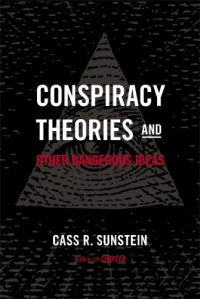 A Review of Conspiracy Theories and Other Dangerous Ideas by Cass Sunstein (based on an earlier paper co-authored with Adrian Vermeule); In Defense of Troublemakers: The Power of Dissent in Life and Business by Charlan Nemeth; and Conspiracy Theories and the People Who Believe Them, edited by Joseph E. Uscinski
On January 25 2018 YouTube unleashed the latest salvo in the war on conspiracy theories, saying “we’ll begin reducing recommendations of borderline content and content that could misinform users in harmful ways—such as videos promoting a phony miracle cure for a serious illness, claiming the earth is flat, or making blatantly false claims about historic events like 9/11.”
At first glance that sounds reasonable. Nobody wants YouTube or anyone else to recommend bad information. And almost everyone agrees that phony miracle cures, flat earthism, and blatantly false claims about 9/11 and other historical events are undesirable.
But if we stop and seriously consider those words, we notice a couple of problems. First, the word “recommend” is not just misleading but mendacious. YouTube obviously doesn’t really recommend anything. When it says it does, it is lying. … continue
Blog Roll
 Aletho News
- How the Cambridge Analytica scandal still haunts Mark Zuckerberg
- The Ongoing Cancellation Campaign Against a Dissenting Academic in Norway
- Yemen and ‘the Houthis’: Challenging Sami Hamdi’s Narrative
- No, Christians did not invent Zionism
- AIPAC-led lobbying network opens branches in Cypriot, Greek parliaments
- Araghchi blasts ‘parasitic’ alliance as US taxpayers pay for Israel’s war on Iran
- Easy fix for Europe’s chaos? Stop fueling war against Russia
- Putin’s key remarks on peace talks and Europe’s ‘schizophrenia’
- Trita Parsi: Israel Set a Trap for Total War in the Region
- Trump’s Iran war is on an Israeli leash
- If Americans Knew
- Damning report shows the media must confront its failures on Gaza
- BBC senior broadcaster speaks out on Gaza coverage
- Netanyahu vows vast West Bank invasion in response to 20-minute skirmish that left 2 Israeli soldiers and 2 Palestinian fighters dead
- Tied up and tortured: Israel using US-made electroshock weapons on Palestinian detainees
- The outsourced risk: how newsrooms rely on Gaza’s freelancers without protecting them
- Gaza bakeries forced to shut as Israel blocks flour shipments
- Gaza’s breast cancer patients face a deadly wait for treatment amid Israel’s genocide
- DAILY UPDATE: Latest essential news on Palestine, Israel, & region
- The Israel Lobby’s Changing Fortunes
- AIPAC has become such a political liability that it’s shifting to a more “nimble” approach to buying politicians
- No Tricks Zone
- E-Cars Reduce CO2 Emissions By Only 41% Compared To Internal Combustion Engine Vehicles
- Predictions Made By Renowned Climate Professor Over Past Decades Have Been Proven To Be Poor
- New Study Suggests Large Regions Of The Pacific Ocean Have Been Cooling For The Last 80 Years
- Germany’s Green Energy Debacle: High Energy Costs Force Kahla Porzellan to Close After 182 Years!
- New Study: 50 Years Of The Most Aggressive ‘Net Zero’ Policies Can Only Affect The Global Climate By 0.03°C
- US September “Heat” Was No Record…Many Records Set Decades Ago
- Latest European Green Energy Debacle; Portugal’s Largest Flagship Solar Park Insolvent!
- Green Energy Debacle: German Expert Professor Fritz Vahrenholt Warns Of Severe Economic And Social Consequences
- Two More Paleo Reconstructions Affirm Meters-Higher Sea Levels Across Ireland, Brazil 7000-6000 Years Ago
- New Study: Earth And Venus Surface Warmth Largely Explained By Convection And Lapse Rate, Not CO2 Or Radiation

