Justin Trudeau Ducks the Great Trucker Revolt
BY JEFFREY A. TUCKER | BROWNSTONE INSTITUTE | JANUARY 27, 2022
The resistance reveals itself always in unexpected ways. As I type, thousands of truckers (numbers are in flux and are in dispute) are part of a 50-mile-long convoy in Canada, headed to the capital city of Ottawa in protest against an egregious vaccine mandate imposed by Prime Minister Justin Trudeau. They will be joined upon arrival by vast numbers of protestors who are defying the restrictions, closures, and mandates of the last nearly two years.
The triple-vaccinated Trudeau, meanwhile, has decided that he has to go into deep hiding because he was exposed to Covid. A clean, ruling-class, fit, and fashionable lefty like him cannot be expected to face such a pathogen directly. As a member of the vanguard of the lockdown elite, he must never take risks (however small) and must keep himself safe. It is merely a matter of coincidence that he will be locked away in hiding as the truckers arrive together with hundreds of thousands of citizens who are fed up with being treated like lab rats.
Previously, Trudeau had said nearly two years ago that the truckers were heroes. On March 31, 2020, he tweeted: “While many of us are working from home, there are others who aren’t able to do that – like the truck drivers who are working day and night to make sure our shelves are stocked. So when you can, please #ThankATrucker for everything they’re doing and help them however you can.”
It’s true. Like many “essential workers” in the US, these truckers bravely faced the virus and many already gained natural immunity, which Canadian law does not recognize. Trudeau decided that they needed to be forced to get the vaccine anyway. Keep in mind: these are the people who get food to the stores, packages to homes, and all products that keep life moving. If they don’t drive, the people don’t eat. It’s that simple.
Few events in modern times have revealed the vast chasm that exists between the ruled and rulers, especially as it pertains to class. For nearly two years, the professional class has experienced a completely different reality than the working class. In the US, this only began to change once the highly vaccinated Zoom class got Covid anyway. Only then did we start seeing articles about how there is no shame in getting sick. It appears that in many countries, the working class that was forced into early confrontation with the virus are saying that they aren’t going to take it anymore (and many are playing that song to make the point).
It’s a massive workers’ strike but not the kind of communist dreams. This is a “working class” movement that stands squarely for freedom against all the impositions of the last two years, which were imposed by an overclass with almost no consultation from legislatures. Canada has had some of the worst, much to the shock of its citizens. The convoy is an enormous show of power concerning who really keeps the country running.
The convoy is being joined by truckers from all over the US too, rising up in solidarity. This is easily the most meaningful and impactful protest to emerge in North America. It is being joined by as many as half a million Canadian citizens, who overwhelmingly support this protest, as one can observe from the cheers on the highway along the way. Indeed, it’s likely to break the record for the largest trucker convoy in history, as well as the most loved.
Trudeau, meanwhile, has dismissed the whole thing as a “small fringe” of extremists and says it means nothing to him and will change nothing. This is because, he says, these truckers hold “unacceptable views.”
This is setting up to be one of the most significant clashes in the world in the great battle between freedom and those governments have set out to crush it.
Meanwhile, I’m looking now for information on this in the mainstream media. It is almost nonexistent outside social media. Fox is covering some of it but that’s about it. The Epoch Times is a wonderful exception, as we’ve come to expect in recent months. It’s not being covered in any depth in Canadian papers and TV. All the usual subjects in the US have completely ignored this mighty movement. It’s almost like these venues have created an alternate version of reality, one that denies the astonishing reality that anyone can see outside the window.
Yes, I know that we have all come to expect that the corporate media will not cover what actually matters, and much of what it does cover it does only with a strong bias toward narratives crafted by ruling elites. Even so, it seems to stretch credulity beyond any plausible extent for the major media to pretend that this isn’t happening. It is and it has massive implications for the present and the future.
This is not really or just about vaccine mandates. It’s about what they represent: government taking possession of our lives. If they can force you to get an injection in your arm over which you have doubts, all bets for freedom are off. There must be evidence that you complied. The phone app is next, which gets tied to your bank account and your job and your access to communications and your ability to pay your rent or mortgage. It means eventually 100% government control over the whole of life. The technology already exists. Everything going on now with these passports is driving to this point.
This is why the truckers are striking this way. It is an act of bravery but also of desperation. Once the tyranny of health passports arrives, there will be no escape. The window of opportunity to do something about this will have closed. So this is the moment. There might not be another one. Something needs to be done to fight for human rights and freedom, and put in place systems that make lockdowns and mandates impossible in the future.
This is the largest and latest example of the revolt and one that could make the biggest difference yet. But it is only one sign among many that the ruling elites in most countries have overplayed their hand. They have arrogantly imposed their plans for everyone else based on the opinions of only a few and without real consultation with experts with differences of opinion or with the people whose lives have been profoundly affected by the pandemic response.
In the US the revolt is taking many forms. There was the rally in DC this past weekend. It was impressive. Also the latest polls on political alliances show that the Democrats have lost a major part of their base. Virginia right now points to where this is headed. The party lost vast amounts of its political power in elections last year and now Republicans rule the state with great popularity.
Meanwhile, I’m looking at Biden’s latest poll numbers. I almost cannot believe my eyes. We are talking about an overall 14-point split between approve and disapprove. If this is an indication of what happens to the pro-lockdown political elite, it stands to reason that Trudeau should be worried.
In the Vietnam War, many Americans fled the draft by going to the safe haven on the northern border. That’s one way that Canada had earned its long reputation for being delightfully normal, peaceful, and mercifully boring. Pandemic policies in Canada changed that, with some of the longest-lasting stringencies in the world.
No one asked the workers. Now they are rising up. Nor does it matter that 90% of the Canadian public is vaccinated. Possessing that status alone does not mean that people no longer feel resentment for being forced to accept what they do not believe they needed and did not want in the first place. The vaccinated do not automatically give up their longing to be free and to have their human rights recognized.
The resistance to tyranny in our times is taking many unexpected forms. There will be many confrontations on the way, and there is still a very long way to go. At some point, and no one knows when or how, something has to give.
Walmart introduces vaccine passports in Quebec, will require the unvaccinated to be escorted by staff as they shop
By Tom Parker | Reclaim The Net | January 25, 2022
Walmart has introduced a two-class vaccine passport system in the Canadian province of Quebec which restricts those without proof of vaccination to grocery and pharmacy products only and requires them to wait in a box before being escorted by staff as they shop.
Under the new rules, those who show proof of vaccination will be free to shop. Those who don’t show proof of vaccination will be told to wait in a blue box until a member of staff is available to escort them as they shop. This member of staff will then follow them around the store and make sure they don’t buy any prohibited goods.
The new restrictions were introduced in response to an expansion of Quebec’s vaccine passport rules which now require all stores with surface areas of 1,500 [sq. meters?] or more to demand that customers show a vaccine passport unless they’re shopping for groceries or pharmacy products.
This two-tier vaccine passport system has been blasted by store owners with many expressing concern about potential backlash from customers and their struggles to find staff to enforce this vaccine passport system amid ongoing labor shortages.
“Mainly, we’re disappointed, especially after being considered an essential business for two years,” Patrick Delisle, marketing director for the Canac hardware and construction chain, told the Montreal Gazette.
“We’ll need to tell clients we can’t serve them and, because of the delays it causes, there will be moments when it’s minus 30 outside and there could very well be 50, 60, or 75 people waiting in line,” Delisle added.
Delisle said Canac has hired GardaWorld security guards for each of its 31 stores and will be assigning one or two employees to the task of vaccine passport enforcement at each store. He estimates the cost of complying with the new rules will be a staggering $100,000 per week.
On Twitter, Walmart’s vaccine passport rules also faced mass pushback with “#BoycottWalmart” trending for several hours and Twitter users describing the measures as “cruel and humiliating” and the blue box as “a box of shame for the unvaccinated.”
The introduction of vaccine passports at Walmart and other big-box stores follows the Quebec government mandating vaccine passports in alcohol and cannabis stores last week.
This vaccine passport expansion is the latest example of how this technology, which was initially positioned as a way to slow the spread of the coronavirus, is being used to surveil the population and crush civil liberties.
The Centers for Disease Control and Prevention (CDC) has already admitted that Omicron breakthrough infections in people who are fully vaccinated are “likely to occur” and Canada’s Council of Chief Medical Officers of Health (CCMOH) says that it’s still “gathering information on how well vaccines work against transmission.”
Despite these admissions from leading health authorities and groups, vaccine passport systems continue to expand and impose additional burdens on the unvaccinated.
Queensland recently announced similar rules that will allow essential businesses like grocery stores and pharmacies to introduce vaccine passports. In Italy, vaccine passports have been mandated in banks and post offices – a policy that could make it difficult to claim their pensions. And in Washington, vaccine passports have been combined with photo ID.
French President Emmanuel Macron went one step further in a recent interview where he acknowledged that he wants to “piss off” those without a vaccine passport.
In an interview with the Montreal Gazette, Dr. Benoît Barbeau, a virologist at the Université du Québec à Montréal, said he believes the latest vaccine passport restrictions in Quebec are largely punitive in nature and noted that while it’s possible for transmission in larger stores, he believes they’re less risky than smaller, more contained spaces.
Wrong Again, Atlantic, High Lumber Prices Are Not Being Caused by ‘Climate Change’
By Linnea Lueken | ClimateRealism | January 19, 2022
Near the top of the results of a Google search for “climate change” was a story in The Atlantic, titled “Lumber Prices Are off the Rails Again. Blame Climate.” This is false. The evidence shows supply chain disruptions are responsible for higher lumber prices.
The article claims that recent high lumber prices and volatility are due to climate change severely impacting the lumber supply coming from Canada.
“When it comes to lumber, climate change has manifested itself in extreme volatility, lack of supply, and a paradigm shift in how lumber markets have behaved for decades. Lumber prices are the second highest they’ve ever been, today, this moment—ever. And it was precipitated by mudslides, which was precipitated by burning, which was precipitated by beetle kill. There’s an infrastructure story in there. There’s a climate story.”
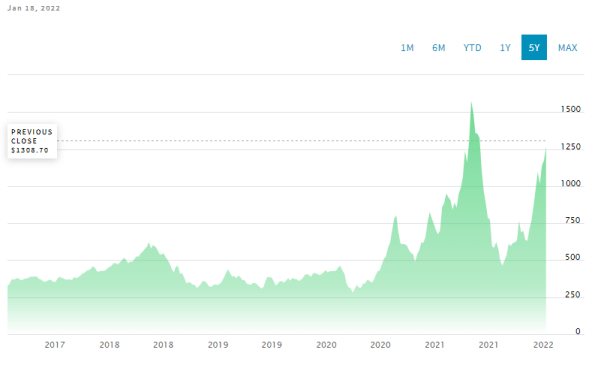
While it is true that lumber prices are currently abnormally high, as shown by this screenshot of a five-year trend from the NASDAQ report on lumber (LUM), climate change is not to blame.
Screenshot taken from NASDAQ: https://www.nasdaq.com/market-activity/commodities/lbs
The recent spike in lumber prices is due to the post-pandemic supply chain and shipping bottlenecks. The already climbing prices were exacerbated by the destruction of infrastructure like roads and rail lines in British Columbia and the North-Western United States due to heavy rainfall that struck the region this winter. Parts of major highways like British Columbia Highway 1 were closed for repairs or debris clearing after the flooding and associated mud slides.
This atmospheric river event that carried rain to the West this winter is not an unprecedented climate event, but is instead a weather event. Climate Realism discusses the difference between weather events and climate change here and here, for example.
A recent Climate Realism article showed the claim that the recent atmospheric river event spanning the Pacific Northwest was caused by climate change was false. In the article, Cliff Mass, Ph.D., of the University of Washington, cited rainfall data proving the recent weather event was not sign of climate change. Mass analyzed the rainfall data from Bellingham and Clearbrook Washington, which goes back more than a hundred years, and found no evidence to support the claim that there has been an increase in heavy rainfall.
“There is NO HINT of a trend towards more extreme precipitation at either of these sites.” Dr. Mass said.
Atmospheric rivers have occurred in the region many times throughout history, and have been much more severe in the decades prior to the Industrial Revolution, as described by meteorologist Anthony Watts:
“The highest rainfall ever in California during recorded history likely occurred in January 1862, during the “Great Flood”. This was an atmospheric river event like we are experiencing now, but lasted several days, dumping 24.63 inches of rain in San Francisco, 66 inches in Los Angeles, leaving downtown Sacramento underwater.”
Strong weather events always have been, and always will be potential causes of infrastructure damage and supply-chain disruptions. The potential for localized natural disasters should be factored into infrastructure plans. Corporate media outlets like The Atlantic are wrong to blame climate change every time the skies open.
As Protests Erupt, Some Countries Backtrack on COVID Mandates While Others Double Down
By Michael Nevradakis, Ph.D. | The Defender | January 14, 2022
As protests grow in EU countries and worldwide against COVID-19 vaccine mandates and so-called “vaccine passports,” some countries appear to be backtracking or at least harboring second thoughts about enforcing such measures.
Some policymakers point to evidence COVID is here to stay and we need to live with it, since Omicron is similar to the common cold or seasonal flu. Others appear more willing to accept natural immunity in lieu of vaccination.
Still, other governments are digging in their heels and moving forward with punitive restrictions on the unvaccinated.
Here’s a look at the latest shifting policies outside the U.S.
Austria, citing ‘technical complications,’ won’t enforce mandates until at least April
Austria garnered much attention in November 2021 when it became the first country in the world to impose an all-encompassing vaccine mandate for its entire adult population and minors 14 years old and up.
This mandate, set to take effect in February, would be accompanied by fines of up to 3,600 euros per quarter. To that end, Austria recently reportedly began hiring “headhunters” to track down those who continue to remain unvaccinated.
The mandate has resulted in frequent large-scale protests against the mandate, as well as a political movement opposing this policy.
An open letter recently sent to Austria’s Interior Minister, Gerhard Karner, signed by 600 police officers, also expressed opposition to mandatory vaccination.
This opposition may be having an impact. Recently, the firm responsible for the technical implementation of the mandate announced that due to “technical complications,” the mandatory vaccination law cannot be enforced until at least April.
This news came amidst calls in Austria that the mandate should be reevaluated in light of the spread of the Omicron variant.
Germany struggling with mandate implementation; support not unanimous
Similar concerns over the feasibility of rapid implementation of a vaccine mandate have been raised in Germany, which has also mulled the implementation of compulsory vaccinations and has already approved such a mandate for healthcare workers.
In December 2021, Germany’s Ethics Council also gave its stamp of approval for vaccine mandates.
Nevertheless, concerns have been raised in Germany that parliamentary debate and subsequent technical implementation of a vaccination database cannot be completed before June at the earliest, calling into question the feasibility of the mandate in light of rapidly changing conditions.
Such hesitation comes despite renewed calls from German President Frank-Walter Steinmeier for an immediate full parliamentary debate on a potential vaccine mandate, and from German Chancellor Olaf Scholz for COVID vaccines to be mandated.
Similarly, German Health Minister Karl Lauterbach recently suggested vaccine mandates, not natural herd immunity stemming from the rapid spread of the Omicron variant — which he described as “dirty vaccination” — represent the only way “out” of the crisis.
In November 2021, Lauterbach’s predecessor, Jens Spahn, publicly predicted that by the end of the coming winter, everyone would be “vaccinated, recovered, or dead” — due to the Delta variant.
Soon thereafter, in December 2021, U.S. President Joe Biden made a similar warning, predicting a winter of “severe illness and death” for the non-vaccinated.
Despite these public proclamations from German politicians though, recent reports suggest support for a vaccine mandate in Germany’s three-party governing coalition is far from unanimous.
Nevertheless, some localities in Germany are moving ahead with their own innovative means of confirming individuals’ vaccination status.
The city of Saarbrücken will soon launch a system where individuals who received a COVID vaccine or who have recovered from infection can voluntarily wear a colored wristband to indicate their status.
Greece pushes ahead with age 60+ mandate policy, threatens fines for unvaxxed
Greece was one of the first countries in Europe to implement a vaccine mandate for a portion of its general population when, in December 2021, it imposed such a policy for everyone age 60 and over.
The policy is set to take effect Jan. 16, with fines of 100 euros per month levied against anyone who doesn’t comply.
Despite this policy, which has received broad and highly sensational media attention in Greece, and despite the burden the policy would place on pensioners in a country where the average pension is just over 700 euros per month, a significant number of individuals 60 and older appear to have opted to remain unvaccinated.
In late December 2021, it was reported that 400,000 people in this age group had not received the COVID vaccine.
In a televised appearance on Jan. 11, Greek government spokesperson Giannis Oikonomou stated that 200,000 people aged 60 and over had gotten vaccinated as a result of this mandate, touting this as a “big success.”
However, this would suggest approximately half of the relevant population in question had chosen to remain unvaccinated, despite the looming threat of a financial penalty.
It is perhaps, for this reason, the Greek government reportedly “froze” any further discussion of expanding the mandatory vaccination policy to those aged 50 and over, while it has been suggested the measure is unconstitutional and may eventually be struck down judicially.
However, despite rumors that the enforcement of fines against individuals 60 and older who have not been vaccinated would be postponed, Greece’s far-right Interior Minister Makis Voridis announced the policy would be enforced as originally planned.
Nevertheless, the Greek government will now extend existing measures, which include a midnight curfew and ban on music for dining and entertainment venues, and a 1,000-spectator capacity limit at sporting events, for at least an additional week past the original sunset date of Jan. 16.
In Balkans, protests lead to standstill on mandates
Major protests against the so-called “Green Pass,” or vaccine passport, took place recently in both Bulgaria and Romania.
In Bulgaria, protesters on Jan. 12 stormed the parliament building in opposition to the “Green Pass” and other restrictions. Attempts to enter parliament resulted in clashes with police and multiple arrests.
Similar events transpired recently in Romania, where on Dec. 21, 2021, protesters attempted to enter Romania’s parliament as part of a protest against proposed legislation making the “Green Pass” mandatory for workers.
Disagreements that have since followed between the parties which comprise Romania’s governing coalition have resulted in talks on this proposed policy coming to a standstill.
Notably, Bulgaria and Romania have the lowest and second-lowest COVID vaccination rate in the EU as of this writing.
Herd immunity as official policy?
As attempted moves toward wide-ranging vaccine mandates and broader implementation of vaccine passports appear to be floundering in Europe, such hesitation has increasingly been accompanied by ever more vocal suggestions that a form of herd immunity, via natural infection stemming from the rapid spread of the milder Omicron variant, should be considered at the policymaking level.
In Israel, for instance, a country that was among the first to move forward with a mass vaccination and booster campaign against COVID, health officials are mulling a “mass infection model.”
On Jan. 11, EU regulators, who had previously supported the administration of COVID booster shots every three months, had a sudden about-face, warning about the dangers the continued administration of boosters could pose for the human immune system.
That same day, the World Health Organization issued a remarkably similar warning, stating that “a vaccination strategy based on repeated booster doses of the original vaccine composition is unlikely to be appropriate or sustainable.”
Just one day prior, on Jan. 10, Spanish Prime Minister Pedro Sánchez suggested European officials should move towards treating COVID as an endemic illness, calling for a debate on the issue and for a move away from the detailed pandemic case tracking system in place since early 2020.
Dr. Clive Dix, former chairman of the UK’s vaccine task force, Nick Moakes, chief investment officer of the Wellcome Trust (Britain’s largest independent funder of medical research) made similar remarks. Moakes suggested coronavirus be treated like the common cold.
Meanwhile, certain European countries appear to be shifting away from considering a mandatory vaccination policy for their populations. Irish Prime Minister Michael Martin said his country will maintain a system of voluntary vaccination, while Belgian Prime Minister Alexander De Croo said his intention to give people a “free choice” on the matter.
This shift is occurring despite remarks made on Dec. 1, 2021, by Ursula von der Leyen, president of the EU Commission, who said it is time to “potentially think about mandatory vaccination within the European Union” and to have a “discussion” about this possibility.
Punitive measures continue elsewhere
The gradual shift away from vaccine mandate policies in Europe and elsewhere is far from uniform, with punitive restrictions and policies continuing to be implemented in several countries.
In Italy, for instance, mandatory vaccination was expanded on Jan. 5 to everyone age 50 and older. The unvaxxed will face a potential fine ranging from 600 to 1,500 euros.
French President Emmanuel Macron made waves in an interview with the Le Parisien newspaper on Jan. 4, justifying the implementation of his country’s “Green Pass” by stating “I really want to piss them off, and we’ll carry on doing this — to the end” and that “irresponsible people [the unvaccinated] are no longer citizens.”
Despite uproar and protests that his comments generated, Macron later doubled down on these remarks.
On Jan. 11, the premier of the Canadian province of Quebec, Francois Legault, stated adults who refuse the COVID vaccine will face a “significant” financial penalty.
This statement came on the heels of remarks made on Jan. 7 by Canadian Health Minister Jean-Yves Duclos. When asked whether mandatory vaccination was on the horizon in Canada, Duclos stated, “I personally think we will get there at some point.”
Canadian Prime Minister Justin Trudeau previously stated, in May 2021, that “[w]e’re not a country that makes vaccination mandatory.”
Other countries have resorted to more extreme, albeit “temporary,” measures.
Non-vaccinated individuals in one Australian state, the Northern Territory, were recently required to stay home for a four-day period, with limited exceptions. The conclusion of this four-day ban coincided with the launch of vaccine passports in the territory.
And in the Philippines, the country’s president, Rodrigo Duterte, called for the arrest of non-vaccinated citizens who venture outside their homes, in light of what he described as the “galloping” spread of the coronavirus.
This nevertheless may represent a milder stance on the part of Duterte, who in April 2020, empowered the police and military with shoot-to-kill orders against lockdown violators.
Michael Nevradakis, Ph.D., is an independent journalist and researcher based in Athens, Greece.
© 2022 Children’s Health Defense, Inc. This work is reproduced and distributed with the permission of Children’s Health Defense, Inc. Want to learn more from Children’s Health Defense? Sign up for free news and updates from Robert F. Kennedy, Jr. and the Children’s Health Defense. Your donation will help to support us in our efforts.
Rumble CEO Chris Pavlovski speaks out against Canada’s “concerning” internet censorship bill
By Tom Parker | Reclaim The Net | January 13, 2022
Chris Pavlovski, the CEO of free speech video sharing platform Rumble, has warned that Canada’s controversial internet regulation proposal, Bill C-10, will give the government the power to “control what you see” and noted that this bill and other internet regulation proposals are making it tough for companies like Rumble to compete with the tech giants.
“The legislation that is gonna come that…I think is even more concerning is Bill C-10 in Canada where they wanna have the government actually regulate what kind of content you are displaying… through the CRTC [Canadian Radio-television and Telecommunications Commission] and think about that, they’re gonna control what you see now,” Pavlovski said during an appearance on the Timcast IRL podcast.
Bill C-10 failed to pass the Senate before the summer break last year and is currently awaiting Senate approval. Then-Heritage Minister Steven Guilbeault, who promoted the bill, said its purpose is to “regulate the internet and social media in the same way that it regulates national broadcasting.” Free speech advocates have warned that it’s a “censorship bill that would allow governments to control what you see and say online.”
While it’s unclear if Bill C-10 will pass, Pavlovski noted that Canada has proposed other internet regulations that could be introduced in the next year and that Rumble is preparing for potential new laws in the country by moving its headquarters to Florida this year.
Pavlovski also discussed how these types of regulations add complexity and create barriers to entry for smaller companies like Rumble who are attempting to compete with tech giants such as YouTube.
“We have to find a way to meet the laws of every country,” Pavlovski said. “This gets so complicated.”
Pavlovski said Rumble has to have lawyers help it in every jurisdiction and that this makes operating in multiple countries difficult.
“The barrier of entry just to enter this market is, is so difficult,” Pavlovski said. “To be like YouTube and to compete against YouTube, you need, like, significant financing, significant legal help… it is a lot to navigate, it’s so complicated.”
Although Bill C-10 is currently in limbo, Trudeau’s government is pushing another internet censorship law – Bill C-36.
“People think that C-10 was controversial,” Guilbeault said when promoting Bill C-36. “Wait until we table this legislation.”
Bill C-36 proposes holding social media companies liable for “hurtful content” and will allow Canadians to anonymously flag hurtful content to have it taken down. It also suggests fines of up to $50,000 for online “hate speech.”
Canada is one of many jurisdictions pushing national online speech laws that create the barriers to entry for smaller Big Tech competitors that Pavlovski described. The UK is pushing an “Online Safety Bill” that would block social media platforms that fail to remove “legal but harmful content,” Australia recently passed an “Online Safety Act” that fines platforms that fail to remove content when ordered, and Greece recently passed a law that criminalizes “fake news.”
Turning point
eugyppius | January 8, 2022
“Where’s the vaccine mandate they promised us?” whines Daniel Brössler, reporter for the Süddeutsche Zeitung, disappointed because yesterday’s Corona summit of German minister presidents returned nothing but some adjustments to quarantine and sharpened testing rules. The double vaccinated will now have to submit negative tests if they want to eat at restaurants. Markus Söder, lockdown- and vaccine mandate-loving minister president of Bavaria, criticised even these milquetoast restrictions, with some bluster about how he’d already taken a hard line against bars and discos. This is after leading German Corona astrologer, Christian Drosten, used his state media podcast to suggest that Germany should start tolerating some of degree of SARS-2 transmission, and that breakthrough infections among the vaccinated should be considered normal. Such statements, which almost surely reflect sentiments within the coalition government, destroy most of the rationale for ongoing restrictions and vaccine mandates.
Meanwhile, in Austria, the thrice-vaccinated chancellor Karl Nehammer has tested positive for Corona. The news comes as Austria announces they will delay implementing their vaccine mandate by two months. It will now take effect in April, if at all. Gerald Gartlehner, an epidemiologist and sometime governmental adviser, suggested that mandates (or at least their enforcement) might have to be re-evaluated in light of Omicron and the widespread immunity the new variant will elicit across the Austrian population. There is every reason to think that Austria will be past the peak of the Omicron wave in April, and that a majority of Austrians will have SARS-2 antibodies by then.
In the United States, former Biden advisers have published a series of editorials in the Journal of the American Medical Association, arguing that it is time to normalise containment and begin managing SARS-2 as one of various seasonal respiratory infections.
It is obvious that we are at a turning point, even if everyone has yet to realise it – even if France is sharpening vaccine requirements, even if Italy has imposed vaccine mandates for everyone over 50, and even if Canada is for the moment determined to remain a prison state. This is the first time since the Floyd riots in America, that major political leaders and public health authorities have said that preventing Corona can no longer be the highest goal of western society.
It is a commonplace observation, but a true one: Since the vaccines began to fail in August, the vaccinators have been progressing through the proverbial five stages of grief. They spent a lot of time in denial, before becoming very angry and punitive. Then they began bargaining, hoping that SARS-2 would go away after four doses, or after five, with just the right dosing intervals, with a return to double masking, with child vaccinations. Now they appear to be drifting finally into depression and acceptance. They have realised, not a second too soon, that there is nothing to be done [outside of improving personal health and early treatment protocols].
Omicron is a highly contagious variant with immune escape features. The vaccinators can vaccinate all they want, but their vaccines will not stop the waves of infection to come. A lot of the hyperbolic rhetoric about Corona was put about in the hopes that most everyone wouldn’t be infected. They thought they could terrify people for a few years, vaccinate them, and harvest their gratitude for saving them from the worst respiratory virus since SARS. Now, though, it’s clear that everyone will have personal experience with Corona infection, whether or not they are vaccinated. This will destroy popular faith measures, it will erode their confidence in the vaccines, and it will do away with their fear of the virus. Maybe a few people somewhere will still support containment, after two years of heavy restrictions, mandated vaccinations, and infection, but I doubt there will be very many of them. It’s the beginning of the end.
Former Ontario privacy chief says never trust the government with coronavirus cell phone tracking
By Ken Macon | Reclaim The Net | December 31, 2021
Ontario’s former privacy commissioner Ann Cavoukian has warned that the government cannot be trusted with cellphone tracking amid the pandemic. The warning came after it was revealed last week that a federal agency has been using cellphone data to track the movements of Canadians since the beginning of the pandemic.
“It concerns me enormously that this would enable the government to collect more and more information,” Ann Cavoukian told The Epoch Times.
“I do not want to [see] a trend where the government is consistently doing this and starting now. You can’t trust the government.”
Last week, the Public Health Agency of Canada (PHAC) confirmed it has been using cellphone data to analyze movements for the purposes of pandemic policies. The agency plans to continue with the data analysis until 2026, expanding it to other health issues.
“In March 2020, [Prime Minister Justin] Trudeau said that tracking cell phone users was not being considered. Well, they did it, PHAC’s been doing it, and they want to do it even more,” Cavoukian said.
“[Officials] say ‘as soon as the emergency is over, we’re going to return to privacy.’ They don’t. The privacy invasive measures that are introduced during emergencies, pandemics, etc., often continue well after the emergency is over,” she added.
According to the former privacy commissioner, who served from 1997 to 2014, PHAC kept the data collection a secret because “they know people do not want their mobile devices tracked.”
Cavoukian was particularly concerned with the PHAC partnering with other unknown data providers, like the Communications Research Center (CRC).
“In partnership with CRC, PHAC has been producing report summaries to look at how movement trends of the Canadian population have changed over the course of the pandemic, including identifying new patterns to help direct public health messaging, planning and policy development,” PHAC said in a statement to The Epoch Times.
The agency insisted that it did not “receive or collect any individual mobility data” and that it has not stored or acquired individual level data.
On December 16, the PHAC posted a Research for Proposal for a contractor that could “provide it with a steady flow de-identified cell phone data,” reported The Epoch Times.
In a statement, the agency said it “requires access to cell-tower/operator location data that is secure, processed, and timely in addition to being adequately vetted for security, legal, privacy and transparency considerations to assist in the response to the COVID-19 pandemic.”
According to Cavoukian the language in the RFP “reflects an intention to collect this data and retain it.”
She is concerned that the de-identification of data could be done so poorly that it could easily be re-identified.
“At the very least, the Privacy Commissioner’s Office should be all over this, and saying we need to examine exactly what measures you introduced to do this and how you’re going to protect privacy and de-identify data such that it cannot be re-identified,” she said.
“Examine this from end to end. Look under the hood.”
Health agency spied on millions during Covid lockdowns
RT | December 26, 2021
Canada’s Public Health Agency has admitted to secretly tracking location data from at least 33 million mobile devices to analyze people’s movements during Covid-19 lockdowns.
The agency earlier this year collected data, including geolocation information from cell-towers, “due to the urgency of the pandemic,” a PHAC spokesperson told the National Post, essentially confirming a report by Blacklock’s Reporter. The tracking data was allegedly only used to evaluate the effectiveness of lockdown measures and identify possible links between the movement of people and the spread of Covid-19.
PHAC obtained the information, which was “de-identified and aggregated,” through an outside contractor, Canadian telecommunications giant Telus. The contract ran from last March to October, and PHAC said it no longer had access to the data after the deal expired.
However, the agency plans to similarly track the movements of citizens over the next five years toward such ends as preventing the spread of other infectious diseases and improving mental health. PHAC last week posted a notice to prospective contractors seeking anonymous mobile data dating as far back as January 2019 and running through at least May 2023.
Critics argued that government tracking of citizens is likely more extensive than has been revealed and may become more troublesome in the years ahead.
“I think that the Canadian public will find out about many other such unauthorized surveillance initiatives before the pandemic is over—and afterwards,” privacy advocate David Lyon told the Post. He noted, too, that “de-identified” data can easily be “re-identified.”
Author Julius Reuchel said the tracking initiative smacks of a surveillance state spying on citizens “for your safety.” Another author, Paul Alves, said that with its new contract, PHAC will have direct access to all mobile location data, and expressed fear that “contact tracing will no longer require permission or a warrant.”
Featured Video

Bombing Hitler’s Hometown
or go to
Aletho News Archives – Video-Images
From the Archives
‘Conspiracy Theory’ Now Fact: Greater Israel Has Arrived
By Kit Klarenberg | Mint Press News | January 28, 2025
Ever since Tel Aviv’s 1948 creation, much has been said and written about ‘Greater Israel’ – the notion Zionism’s ultimate end goal is the forcible annexation and ethnic cleansing of vast swaths of Arab and Muslim lands for Jewish settlement, based on Biblical claims this territory was promised to Jews by God. The mainstream media typically dismisses this concept as antisemitic conspiracy theory, or at most the fringe fantasy of a minuscule handful of extremist Israelis.
In reality … continue
Blog Roll
 Aletho News
- Trump admits Iran hit USS Ford carrier: ‘We ran for our lives’
- Battle for Hungary: EU attacks on Orban are a sign of worse things to come
- Iraqi resistance conducts drone strike on US-run base in Syria
- Failing to Defeat Hezbollah, Israel & US Pressure Syria’s Ahmed al-Sharaa to Join War
- US-Israeli war on Iran drives global fertilizer prices up 40%
- Hezbollah’s Surprise Weapons Redefine Ground Battle with Israel
- Yemen joins fight against US, Israel by firing missiles at occupied territories
- Seizing the Kharg: Washington’s path to defeat in the Persian Gulf
- Iran reports 500 US casualties in strikes on covert US military sites
- Pro-Israel terrorist arrested before assassination of pro-Palestinian activist
- If Americans Knew
- Over 300 US service members wounded, majority have brain injuries – Not a ceasefire Day 169
- Researchers at Human Rights Watch Resign Over Blocked Report on Palestinian Refugee Return
- Jewish Groups Are Backing a War Americans Don’t Want
- Eric Fingerhut Thinks He’s the President of the Jews
- Top Jewish Philanthropists, Rabbis Urge Israeli President to Take Action Against ‘Jewish Extremists’
- Don’t Be Fooled. Zionist Leaders Have Always Wanted to Control Southern Lebanon
- Israel’s widespread use of torture is a core element of its genocide against the Palestinian people
- In Israel’s War on Iran, Many Middle East US Bases Rendered “All But Uninhabitable”
- ‘Burn the lawn’: Israel pursues ‘Rafah model’ in southern Lebanon
- A genocide here, an amputation there
- No Tricks Zone
- Devastating Assessment Of Comirnaty Vaccine By Former Senior Pfizer Europe Toxicologist
- New Study: CO2 Is ‘Effectively Negligible’ As An Explanatory Climate Change Factor Since 2000
- Former Pfizer Toxicologist Dr. Helmut Sterz Tells Bundestag Hearing Pfizer Vaccine Should Have Never Been Approved
- Energy Expert: Germany’s Nuclear Phaseout Was A “500 Billion Euro Mistake”
- New Research: South Australia’s Mid-Holocene Sea Surface Temperatures Were 4°C Warmer Than Today
- Storing Green Energy To Last Germany 10 Days Would Require A 60-Million Tonne Battery
- New Studies: UK Sea Levels Were 4 Meters Higher Than Today During The Mid-Holocene
- Destructive Green New Deal: German Energy And Metal Group Warns Of Drastic Crisis
- New Study Documents A 20-Year Pause In Arctic Sea Ice Decline – Driven By Internal Variability
- Wake-up Call: Survey Shows Majority Of Germans Now Favor Postponing Climate Targets!
 Aletho News