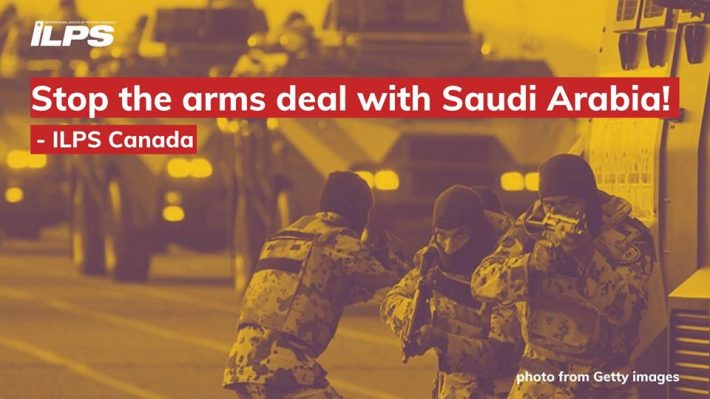
Stop Canada’s arms deal with Saudi Arabia!
International League of Peoples’ Struggle, Canada | June 12, 2020
After stalling for two years, the Canadian government has renegotiated a sale of light armored vehicles to Saudi Arabia for $14 billion. The deal was put on hold in 2018 because of political pressure against Saudi Arabia’s war on Yemen and the murder of Jamal Khashoggi, a journalist. This news is jolting because, in December 2018, Prime Minister Justin Trudeau had said he would not go ahead with the sale. However, the Minister of Foreign Affairs Francois-Philippe Champagne announced that the contract was back on the table on Thursday, April 9, 2020.
The government claims it must proceed with the deal because thousands of jobs and substantial revenues might otherwise be lost. General Dynamics is the supplier building the vehicles to be sold. The government its sales rep. General Dynamics stands to lose profits from the transaction. However, it could be involved in the manufacture of other machinery for domestic and foreign use.
In response to the objection that the items to be sold to Saudi Arabia will likely be used for war, Minister Champagne tells the people not to worry.
“Under our law, Canadian goods cannot be exported where there is a substantial risk that they would be used to commit or to facilitate serious violations of international humanitarian law, international human rights law or serious acts of gender-based violence.” (The Defense Post, April 10, 2020).
If that is the case, then, no military items should be exported. Champagne added that there are protections in that export permits be delayed or canceled if it learns of goods sold not used for the buyers’ stated purposes. Well, it is pretty clear that military items are for military use, just as it is clear that Saudi Arabia is an aggressor who will likely use military equipment in its aggression against Yemen and elsewhere. Saudi Arabia is committing human rights violations and crimes against humanity. The fact that the war inhibits health care and safety responses to COVID-19 is even more reprehensible.
The Canadian Chapter of the International League of Peoples’ Struggles has opposed all military contracts with Saudi Arabia all along. We have stood in solidarity with the people of Yemen who have been suffering under assault after assault by Saudi forces, calling for Saudi Arabia keep its hands off Yemen. According to Dr. Yahyia Mohammed Saleh Mushed of the Union of Arab Academics at Sana’a University, the war has displaced around 200,000 people and left the country in misery (Sanctions Kill webinar, May 31, 2020). We deplore the coalition states (US, UK, France and Canada) that arms and supports these assaults. Furthermore, we find no justify for the blockade against Yemen, and join in the calls for the illegal economic coercive measures against Yemen and all countries to be lifted, especially in view of the humanitarian concerns during a pandemic.
Canada has been on the war path for the past two decades. It stands by the US imperialist war machine steadfastly and plays a deadly role as its most fervent ally. It itself is an imperialist state with ambitions for market expansion abroad. Prime Minister Justin Trudeau voices intolerance against states that dare to follow an independent course away from the dictates and norms set by the US. His negative relations with Venezuela are the starkest example. Also, his government has been increasing the national military budget and expanding the Canadian armed forces, favouring more active engagement. Money for health care and housing has been siphoned for the folly of war.
Now with the determination to rise against domestic militarization and resist its racist blades, let us also decry international militarization and organize to dismantle NATO, the US military bases and imperialist military agreements, and send the troops home. Let us expose and put pressure against the arms trade that encourages instability and feeds off bloody conflict. Let us call for a reduction of military budgets and redirect more tax money into social services and regional economic development.
Stop the Sales of Arms to Saudi Arabia!
Reject the arms trade!
Stop US and Canadian imperialism!
Dismantle NATO!
Close all foreign military bases!
End the coercive economic measures against all targeted countries!
International League of Peoples’ Struggle is an an alliance of organizations and movements that promotes, supports and develops the anti-imperialist and democratic struggles of the peoples of the world against imperialism and all reaction.
Canada’s Bid of Hypocrisy
By Rifat Audeh | Palestine Chronicle | June 12, 2020
On May 31st, the world commemorated the tenth anniversary of this Israeli attack (in international waters) on the humanitarian Gaza Freedom Flotilla. The Flotilla aimed to break the inhumane Israeli blockade imposed on the people of Gaza, described as collective punishment and therefore illegal according to international reports and scholars, including a UN panel of experts. Two other Canadians and myself were aboard the main ship attacked, the Mavi Marmara.
Ironically, on the day of the attack, Israeli PM Benjamin Netanyahu was in Canada, meeting with former Canadian PM Harper and other governmental officials. Yet despite this, the Conservative government did not demand our release nor was there any condemnation of Israel’s piracy against Canadians and other internationals, as we explained to the public in an open letter to Stephen Harper at the time.
To the contrary, the Canadian government implicitly justified Israeli actions against its own citizens. The timid visit I received by embassy representatives at the prison along with fellow Canadians, was punctuated by the fact that they had no response to my question of what the Canadian government will do about our illegal kidnapping and detainment.
If it was not for immense Turkish political pressure on Israel, there is no doubt in my mind that our government would have left us in an Israeli prison indefinitely. This was further confirmed to me when I visited our embassy in Jordan a while after my release when an embassy representative sadly defended Israeli actions even more vociferously than the Israelis themselves.
After the ascendance of the Liberals to power, I was hopeful that this foreign policy will change, and that our government would adopt an approach consistent with international law and human rights, particularly in relation to Palestine. In retrospect, I confess that I was quite naive.
In one of the first set of UN General Assembly sessions in the post-Conservative era, the Trudeau government voted against UN General Assembly Resolution A/RES/71/98, a resolution that emphasizes “the right of all people in the region to the enjoyment of human rights as enshrined in the international human rights covenants”. The same resolution demands that Israel, as the occupying power “cease all practices and actions that violate the human rights of the Palestinian people”.
Shamefully, this pattern of voting against the human rights of Palestinians and against upholding international law has continued ever since then, with Canada either voting against such resolutions or abstaining, thus isolating itself from the vast majority of the world.
A recent exception to this policy of blindly siding with Israel -at the expense of Palestinian human rights- took place in November, when Canada supported a UN resolution endorsing Palestinian self-determination. Yet PM Trudeau was quick to reassure pro-Israelis that this vote does not represent a shift from Canada’s support to Israel.
This is why many critics have speculated that the only reason Canada voted with the majority in this instance, is to try and secure a seat on the UN Security Council. The UN ambassadors will soon select new members to the UN Security Council, and there are bids by Canada, Ireland and Norway for “a place at the table”.
Accordingly and for the reasons shown above, I have signed a letter to the UN Ambassadors and a petition against Canada joining the UNSC. Although the council is clearly deficient already in many ways, this does not negate the fact that in addition to this, our country has clearly not earned its stripes to gain ascension to it.
In 2018, Canada’s Foreign Affairs Minister stated that the country’s presence on the council can be “an asset for Israel”, while hypocritically stating in the same speech: “Nor can we stand idly by when human rights are violated, wherever that may be.” Well, unless they are Palestinian human rights of course.
– Rifat Audeh is a lifelong human rights activist and award-winning filmmaker. His writings have appeared in various media outlets and he has a Masters’s degree in Media and Journalism.
Palestinian solidarity unsettles Canadian diplomats

By Yves Engler | June 11, 2020
The Palestinian solidarity movement is unsettling Canada’s diplomatic apparatus. In the final week of their multi-year campaign for a seat on the United Nations Security Council they’ve been forced to respond to a strong, well-documented, campaign in defence of Palestinian rights.
Yesterday, Canada’s Permanent Representative to the UN, Marc-André Blanchard, delivered a letter to all UN ambassadors defending Canadian policy on Palestinian rights. Blanchard was responding to an Open Letter organized by Just Peace Advocates signed by more than 100 organizations and dozens of prominent individuals. Over the past week more than 1000 individuals have used that letter as a template to contact all 193 UN ambassadors to ask them to vote for Ireland and Norway instead of Canada for two seats available on the Security Council.
Canada’s ambassador claims the Just Peace Advocates’ letter contains “significant inaccuracies”, but he doesn’t identify a single one of those “inaccuracies” (Blanchard probably hoped his letter wouldn’t be put online).
Here is the Palestinian solidarity letter sent to all UN ambassadors:
“As humanity reels from the Covid-19 pandemic, you will soon select the world’s representatives on the UN’s highest decision-making body. As organizations and individuals advocating in Canada and elsewhere for a just peace in Palestine/Israel, we respectfully ask you to reject Canada’s bid for a seat on the UN Security Council.
As you choose seats on the Security Council between the bids of Canada, Ireland and Norway for the two Western Europe and Other States, the UN’s historic contribution to Palestinian dispossession and responsibility to protect their rights must be front of mind. In these uncertain times, Palestinians are particularly vulnerable to Covid-19 due to Israel’s military occupation and violations of UN resolutions.The Canadian government for at least a decade and a half has consistently isolated itself against world opinion on Palestinian rights at the UN. Since coming to power – after the dubious record of the Harper government – the Trudeau government has voted against more than fifty UN resolutions upholding Palestinian rights that were backed by the overwhelming majority of member states. Continuing this pattern, Canada “sided with Israel by voting No” on most UN votes on the Question of Palestine in December. Three of these were Canada’s votes on Palestinian Refugees, on UNRWA and on illegal settlements, each distinguishing Canada as in direct opposition to the “Yes” votes of Ireland and Norway.
The Canadian government has refused to abide by 2016 UN Security Council Resolution 2334, calling on member states to “distinguish, in their relevant dealings, between the territory of the State of Israel and the territories occupied in 1967.” On the contrary, Ottawa extends economic and trade assistance to Israel’s illegal settlement enterprise.
Canada has repeatedly sided with Israel. Ottawa justified Israel’s killing of “Great March of Return” protesters in Gaza and has sought to deter the International Criminal Court from investigating Israeli war crimes. In fact, Canada’s foreign affairs minister announced that should it win a seat on the UNSC, it would act as an “asset for Israel” on the Council.
When deciding who represents the international community on the UN’s highest decision-making body, we urge you to consider the UN-established rights of the long-suffering Palestinians, and to vote for Ireland and Norway, which have better records on the matter than Canada.”
In reality, the letter only touches on the current government’s anti-Palestinian record. They’ve also celebrated Canadians who fight in the Israeli military, threatened to cut off funding to the International Criminal Court for investigating Israeli crimes, protected Israeli settlement wine producers, added Palestinian organizations to Canada’s terrorism list, adopted a definition of antisemitism explicitly designed to marginalize those who criticize Palestinian dispossession and repeatedly slandered the pro-Palestinian movement. None of this is secret. In fact, Liberal MP and former chair of the government’s Justice and Human Rights Committee, Anthony Housefather, has repeatedly boasted that the Trudeau government’s voting record at the UN was more anti-Palestinian than the Stephen Harper government!
The Trudeau government has almost entirely acquiesced to Housefather, B’nai B’rith, Centre for Israel and Jewish Affairs and the rest of the Israel lobby’s positions. But, they understand that there is sympathy for Palestinians within the UN General Assembly. And they need those individuals to vote for Canada’s Security Council bid if they don’t want to suffer an embarrassing defeat.
To be forced to respond at this late hour in their Security Council campaign represents a setback to the Liberals. But, we won’t know how significant the damage is until after next week’s vote. In the meantime please send a letter to all UN ambassadors calling on them to vote for Canada’s competitors, Norway and Ireland, for the two non-permanent Security Council spots open for Western countries.
As Just Peace Advocates’ Karen Rodman has pointed out, “the letter is seeking to pull at the heartstrings of the individuals who cast the secret ballots for the Security Council seat. We want to remind UN ambassadors that Canada has consistently isolated itself against world opinion when it comes to the long-suffering Palestinians.”
Fantasy Wish List Masquerades as Climate Poll
Green lobby group invites public to endorse green fantasies

click for source
By Donna Laframboise | Big Picture News | June 1, 2020
Last week, a raft of newspaper headlines declared “Canadians still support climate action: poll.” We are intended to believe that “COVID-19’s economic and health challenges haven’t diminished” ordinary people’s enthusiasm for green policies. But this poll has oodles of problems.
First, it was sponsored by Clean Energy Canada. Embedded within the term clean energy is the philosophical argument/political statement/moral judgment that our current, dominant forms of fossil fuel-based energy are dirty.

A ‘clean energy’ outfit isn’t neutral. Its entire purpose is to promote some ideas and to disparage others. What actually happened here is an organization with an agenda drew up a fantastical wish list, and then invited Canadians to agree that the items on that wish list are awesome.
Big surprise that lots of people think upgrading broadband Internet service and public transit are a good idea – especially when the pollster, Abacus Data, declares them “part of an effort to attract companies to invest and grow businesses in Canada.”
Big surprise that lots of people like the idea of “Creating more spaces in towns and cities where people can walk and cycle without fear of vehicles.” But the realistic questions, surely, are:
– how much do such projects cost?
– what other ways might we need/choose to spend the same money?
Big surprise that, in the words of Clean Energy Canada’s press release,
91% are interested in the idea of Canada as the world leader in electric buses.
As if that were a likely scenario. Canada contains half of 1% of the world’s total population. We are a geographically huge country, with an exceptionally low population density. This is just delusional.
Big surprise that many people are in of favour “Making public transit free to help get more cars off the road and reduce emissions and congestion.” But nothing is free. The germane questions are:
– who should cover some portion of public transit costs – those actually using it, or everyone via their tax contributions to various levels of government?
– is a devastating economic crisis the right time to increase government expenditures and responsibility?
This poll would have been truly useful had it asked people whether the coronavirus pandemic has changed their attitudes toward using public transit. Are they now more likely to pack themselves into crowded commuter trains, city buses, and subways than a year ago? Less likely? Or the same?
I relied on public transit during the three decades I lived in downtown Toronto. Prior to this pandemic, I would never have described myself as a germophobe. But I now reside in a small town – and the world has changed.
The next time I visit Toronto, I’m unlikely to repeat my previous routine – parking the car an hour away, boarding a commuter train, relying on subways, buses, and streetcars within the city, then boarding another commuter train.
I now see public transit as risky. For me and for others. The idea of taking any form of public transit during rush hour fills me with dread.
I can’t be the only one.
Public transit has always struggled. Ridership was already in decline is many jurisdictions, before the pandemic struck (see here, here, here, here, here, here, here, and here).
Services such as Uber had already altered the landscape. During these widespread lockdowns, more people have discovered that working from home is possible and desirable. Add in infection concerns, and public transit may never recover.
Racism, Magical Thinking & the Coronavirus
Rather than quarantining travelers, our leaders chose a course of action that led to entire countries being locked down.

January 28th article, published in Canada’s largest circulation newspaper; click for source
By Donna Laframboise | Big Picture News | May 25, 2020
By the third week of January, the entire world knew the Chinese government was so spooked by a lethal, never-before-seen virus that it had locked down Wuhan. That city is home to 10 million people, about the same number as reside in Paris, London, and Chicago.
Back in January, Wuhan had a shortage of hospital beds and a shortage of doctors. Medical personnel from other parts of the country had been deployed, but the caseload remained overwhelming.
In January, the entire world knew flights from Wuhan to other parts of China had been halted. Highways were being closed. Soldiers wearing face masks were barricading the train station. Because the virus was raging in a particular locale, it was eminently sensible try to prevent its spread within China.
Elsewhere, governments watched these events unfold. Rather than safeguarding their own citizens and their own economies, rather than taking immediate, concrete steps to prevent the virus from spreading beyond China, they indulged in magical thinking.
If only they avoided doing anything discriminatory, all would be well. If only they walked on eggshells, careful not to fuel anti-Asian stereotypes, this infectious disease would apparently evaporate of its own accord.

January 28th article, disseminated by Canada’s national, publicly-funded broadcaster; click for source
Thus, a medical problem connected to a specific geographical location was transformed, reconfigured, and repackaged. Journalists, left wing media outlets, and petty politicians accomplished this in a trice.
Politically correct thought is rote dogmatism. It is non-thought. It is knee-jerk, censorious, and uncharitable. But its grip is compelling. In January 2020, among Canada’s political class, fear of being labelled a racist far outweighed anyone’s fear of a deadly virus. Please read that sentence again. We desperately need to learn this lesson.
Juanita Nathan, the chair of a north Toronto school board (whose left wing, community activist credentials are described here), lectured parents about “demonstrating bias and racism”:
while the virus can be traced to a province in China, we have to be cautious that this not be seen as a Chinese virus…At times such as this, we must come together as Canadians and avoid any hint of xenophobia, which in this case can victimize our East Asian Chinese community…Situations such as these can regrettably give rise to discrimination based on perceptions, stereotypes and hate. [bold added; see here, here, and here]
Heaven deliver us from elected officials who imagine their job is to instruct taxpayers on how to think or speak about any issue. In the Canadian political system, school trustees are bottom of the barrel. This is a part-time job in which budgets are overseen, and parental concerns are addressed. Trustees are not priests, and have no business preaching morality to anyone.
Concerned parents, many of whom were Asian, were told by Nathan not to send their children to school with face masks, even though classmates had just returned from visits to China. Parents were told mask wearing “heightens anxiety.” In the words of Nathan:
Wearing a mask really singles out some kids in the classroom when they don’t need to and that’s what we’re addressing at the moment – just having those conversations to give knowledge to the parents why they don’t need to at this moment.
And so it went. Leaders of the world’s most advanced economies assured the public the risk was low. We were told to wash our hands, that seasonal influenza was more dangerous, that everything was under control.
But things weren’t under control. Flights from China were not halted. Nor were flights from other hot spots. Travelers returning home weren’t required to self-quarantine until it was far too late.
An information sheet published by the Canadian government on February 24th didn’t instruct returning travelers to self-quarantine. Rather, these people were asked to monitor themselves for “fever, cough and difficulty breathing” and to “avoid places where you cannot easily separate yourself from others if you become ill.”
Self-isolation was recommended only if they developed symptoms. Since many infected people suffer no symptoms, mild symptoms, or symptoms other than those listed by the Canadian government, such measures were wholly inadequate.
Weeks ticked by. Thousands of international flights continued to take off and land. People visiting China, Iran, and Italy brought the virus back home with them. To Seattle. To New York City. To Brazil, India, South Africa, Australia, and to Canada (see here, here, here, and here).
By the time they were diagnosed, some of these people had infected those who’d shared the same flight or the same airport shuttle. They’d spread the virus at their workplaces, on public transit, at houses of worship, birthday parties, and funerals. As late as March 22nd, the Times of London ran a story about Heathrow airport, headlined Coronavirus: Flights from Italy, Iran and China still landing.
Today, four months after the lockdown of Wuhan, a grim milestone will be achieved. The number of Americans who’ve died of the coronavirus is expected to surpass 100,000.
Here in Canada, 6,400 people have perished so far (back in 2003, SARS claimed 44 Canadian lives).
Between them, Italy, Spain, and France have lost 90,000 souls.
In Brazil, where the virus is still gathering steam, the death toll exceeds 22,700 already.
Public health officials, including the World Health Organization, let this happen. Politicians let this happen. There was a time to take targeted action. There was a time to respond strategically and decisively. They failed.
The sorrow associated with those hundreds of thousands of corpses is just the beginning of this disaster. Entire populations have spent weeks to months confined to their homes, harassed by the police for walking their dog. The economic damage is monstrous – for individuals, business, and nations.
Disruption. Job loss. Home repossession. Despair.
Rather than shutting down a few flights, our leaders chose a course of action that led to virtually all flights, everywhere, being grounded. For goodness knows how long.
Rather than quarantining a subset of travelers for a couple of weeks, our leaders chose a course of action that led to entire populations being locked down. For goodness knows how long.
This is where politically correct thought leads. This is where our ugly, destructive preoccupation with hints of xenophobia takes us.
Legitimate concern about the spread of a pernicious virus was silenced. Leaders who wanted to do the right thing faced serious social disincentives. No one wants to be called a racist.
Going forward, we can live in a community in which our leaders think clearly and act sensibly. Or we can stifle other important discussions – and pay a terrible price.
Canada’s record on Palestinian rights should disqualify it from Security Council race
By Yves Engler · May 21, 2020
Canada’s anti-Palestinian voting record should disqualify it from a seat on the UN Security Council. Hopefully when member states pick amongst Ireland, Norway and Canada for the two Western Europe and Others positions on the Security Council they consider the international body’s responsibility to Palestinians. If they do it will be a rebuke to Canada’s embarrassing history of institutional racism against the Palestinian people.
Compared to Canada, Ireland and Norway have far better records on upholding Palestinian rights at the UN. According to research compiled by Karen Rodman of Just Peace Advocates, since 2000 Canada has voted against 166 General Assembly resolutions critical of Israel’s treatment of Palestinians. Ireland and Norway haven’t voted against any of these resolutions. Additionally, Ireland and Norway have voted yes 251 and 249 times respectively on resolutions related to Palestinian rights during this period. Canada has managed 87 yes votes, but only two since 2010.
In maybe the most egregious example of Ottawa being offside with world opinion, Canada sided with the US, Israel and some tiny Pacific island states in opposing a UN resolution supporting Palestinian statehood that was backed by 176 nations in December 2017.
The only time since the end of the colonial period Canada has somewhat aligned with international opinion regarding Palestinian rights was in the 1990s and early 2000s under Jean Chretien. In the early 1990s Norman Finkelstein labeled Canada “probably Israel’s staunchest ally after the United States at the United Nations” while a 1983 Globe and Mail article referred to “Canada’s position as Israel’s No. 2 friend at the UN.” In the early 1980s Ottawa sided with Israel on a spate of UN resolutions despite near unanimity of international opposition. In July 1980 Canada voted with the US and Israel (nine European countries abstained) against a resolution calling on Israel to withdraw completely and unconditionally from all Palestinian and Arab territories occupied since 1967. On December 11, 1982 the Globe and Mail reported that the “United Nations General Assembly called yesterday for the creation of an independent Palestinian state and for Israel’s unconditional withdrawal from territories it occupied in 1967. Israel, Canada, the United States and Costa Rica cast the only negative votes as the assembly passed the appeal by 113 votes to 4, with 23 abstentions.”
Canada’s voting record on Palestinian rights at the UN is an abomination. It’s made worse by the fact that Canada contributed significantly to the international body’s role in dispossessing Palestinians. Canadian officials were important players in the UN negotiations to create a Jewish state on Palestinian land. Lester Pearson promoted the Zionist cause in two different committees dealing with the British Mandate of Palestine. After moving assiduously for a US and Soviet accord on the anti-Palestinian partition plan he was dubbed “Lord Balfour of Canada” by Zionist groups. Canada’s representative on the UN Special Committee on Palestine, Supreme Court justice Ivan C. Rand, is considered the lead architect of the partition plan.
Despite owning less than seven percent of the land and making up a third of the population, the UN partition plan gave the Zionist movement 55% of Palestine. A huge boost to the Zionists’ desire for an ethnically based state, it contributed to the displacement of at least 700,000 Palestinians. Scholar Walid Khalidi complained that UN (partition) Resolution 181 was “a hasty act of granting half of Palestine to an ideological movement that declared openly already in the 1930s its wish to de-Arabise Palestine.” Palestinians statelessness seven decades later remains a stain on the UN.
Over the past year the Canadian government has devoted significant energy and resources to winning a seat on the Security Council. In recent days, Canada’s foreign affairs minister has taken to calling individual UN ambassadors in the hopes of convincing them to vote for Canada.
To combat this pressure, a small group of Palestine solidarity activists have organized an open letter drawing attention to Canada’s anti-Palestinian voting record. Signed by dozens of organizations, the letter will be delivered to all UN ambassadors in the hope that some of them will cast their ballots with an eye to the UN’s responsibility to Palestinians.
Please sign and share this petition against Canada’s Security Council bid: https://www.foreignpolicy.ca/petition
Ottawa’s ties with far right Colombian president undermines human rights rhetoric regarding Venezuela

By Yves Engler · May 13, 2020
A week ago a former Canadian soldier instigated a harebrained bid to kidnap or kill Venezuelan President Nicolás Maduro. Launched from Colombia, the plot failed spectacularly with most of the men captured or killed.
Still, the leader of the invasion Jordan Goudreau, a veteran of the Canadian military and US special forces, has been remarkably forthright about the involvement of opposition figure Juan Guaidó. A leaked contract between Guaidó’s representative in Florida and Goudreau’s Silvercorp USA describes plans for a multi month occupation force, which after ousting Maduro would “convert to a National Asset Unit that will act under the direction of the [Guaidó] Administration to counter threats to government stability, terror threats and work closely” with other armed forces. Apparently, Goudreau was hoping for a big payday from Venezuela’s opposition. He also had his eyes on the $15 million bounty Washington put up in March for Maduro’s capture as well as tens of millions dollars for other members of the government.
As the plot has unraveled, Ottawa has refused to directly criticize the invasion launched from Colombia. The military has also refused to release information regarding Goudreau’s time in the Canadian forces. What’s more, since the plot began Canada’s foreign affairs minister has reached out to regional opponents of Maduro and reasserted Ottawa’s backing for Guaidó. The PM also discussed Venezuela with his Colombian counterpart.
The Trudeau government’s reaction to recent events suggest the global pandemic has not deterred them from brazenly seeking to overthrow Venezuela’s government. In a bid to elicit “regime change”, over the past couple years Ottawa has worked to isolate Caracas, imposed illegal sanctions, took that government to the International Criminal Court, financed an often-unsavoury opposition and decided a marginal opposition politician was the legitimate president.
The day after the first phase of the invasion was foiled foreign minister François-Philippe Champagne spoke to his Colombian, Peruvian and Brazilian counterparts concerning the “Venezuela crisis and the humanitarian needs of Venezuelans.” Four days later Champagne tweeted, “great call with Venezuela Interim President Juan Guaidó. Canada will always stand with the people of Venezuela in their desire to restore democracy and human rights in their country.”
On Monday Prime Minister Justin Trudeau spoke with Colombian President Iván Duque Márque. According to the official release, they “discussed the crisis in Venezuela and its humanitarian impact in the region which is heightened by the pandemic. They underscored the need for continued close collaboration and a concerted international effort to address this challenging situation.” Over the past 18 months Trudeau has repeatedly discussed Venezuela with a Colombian president who has offered up his country to armed opponents of Maduro.
The Trudeau government has been chummy with Duque more generally. After he won a close election marred by fraud allegations then Foreign Minister Chrystia Freeland “congratulated” Duque and said, “Canada and Colombia share a commitment to democracy and human rights.” In August 2018 Trudeau tweeted, “today, Colombia’s new President, Ivan Duque, took office and joins Swedish PM, Norway PM, Emmanuel Macron, Pedro Sánchez, and others with a gender-equal cabinet. Iván, I look forward to working with you and your entire team.” A month later he added, “thanks to President Ivan Duque for a great first meeting at UNGA this afternoon, focused on growing our economies, addressing the crisis in Venezuela, and strengthening the friendship between Canada & Colombia.”
But, Duque is from the extreme right — “le champion du retour de la droite dure en Colombie”, according to a Le Soleil headline. The Colombian president has undercut the peace accord the previous (right, but not far right) government signed with the Revolutionary Armed Forces of Colombia (FARC) to end Colombia’s 50-year civil war, which left some 220,000 dead. Duque’s policies have increased violence towards the ex-rebels and social activists. Seventy-seven former FARC members were killed in 2019. Even more human rights defenders were murdered. The United Nations High Commissioner for Human Rights found that at least 107 Colombian, mostly Indigenous, rights defenders were killed in 2019.
Through the first part of this year the pace at which social leaders and demobilized FARC members have been killed has increased. According to the UN observer mission in Colombia, 24 demobilized guerrillas have already been assassinated and a recent Patriotic March report on the “The other pandemic lived in Colombia” details 95 social leaders, human rights defenders and former guerrillas killed in the first four months of 2020.
Trudeau’s dalliance with Duque is difficult to align with his stated concern for human rights in Venezuela.
The same can be said for Ottawa’s failure to condemn the recent invasion attempt. The Trudeau government should be questioned on whether it was involved or had foreknowledge of the recent plot to invade Venezuela.
Trudeau makes Covid-19 aid intended to ‘save Canadian jobs’ conditional on meeting climate change goals
RT | May 11, 2020
Adding insult to the injury of Covid-19 closures, Canadian Prime Minister Justin Trudeau has announced that businesses seeking emergency payroll funding will have to demonstrate their compliance with ‘climate charge’ guidelines.
Citing the need to protect “Canadian middle-class jobs and safeguard our economy,” Trudeau on Monday rolled out the expansion of the Large Employer Emergency Financing Facility (LEEFF), intended to provide bridge liquidity to companies unable to meet their payroll due to the shutdown.
There is, of course, a catch. Among the standard safeguards listed in the government announcement – limits on stock buybacks, verification of a company’s tax status, protections for unions and pensions, among other things – there was this as well:
“In addition, recipient companies would be required to commit to publish annual climate-related disclosure reports… including how their future operations will support environmental sustainability and national climate goals.”
Asked whether the aid would be given to oil and gas companies, Trudeau said the government expects them to “put forward a frame within which they will demonstrate their commitments to reducing emissions and fighting climate change,” and that many have already made commitments to net-zero emissions by 2050.
The climate requirement is the only one on the list that has nothing to do with preventing the funding from going to companies that don’t need it, or being abused. The ideological requirement seems particularly onerous given that bridge liquidity is needed in the first place because of government-mandated closures to counter the spread of the coronavirus.
Trudeau’s conditioning of LEEFF funding on climate change compliance closely resembles the measures proposed by House Speaker Nancy Pelosi and the Democrats in late March, when they scuttled the Senate-approved coronavirus aid bill in favor of their own. US Congressman James Clyburn (D-South Carolina) called the pandemic “a tremendous opportunity to restructure things to fit our vision” at the time.
With a Republican in the White House and the GOP majority in the Senate, they could only do so much, however, and mainly managed to delay the aid by several weeks. Trudeau has no such constraint, and he apparently took Clyburn’s words to heart.
In addition to pushing climate change measures, Trudeau invoked the Democrats’ rhetoric to impose a sweeping ban on “assault-style firearms designed for military use” via the Canadian equivalent of executive orders earlier this month. The list of prohibited weapons is so extensive that it includes an airsoft pellet gun and even a blend of coffee made by the US-based Black Rifle Coffee Company.
Palestinians and the ‘Security’ Narrative
By Marion Kawas | Canadian Dimension | May 4, 2020
May 2020 will focus attention on the many dangers and challenges facing the future of Palestine.
First, Nakba72 will commemorate the continuing dispossession and ethnic cleansing of the Palestinians. Second, the COVID-19 pandemic is showing the fragility of the living conditions and the lack of security for Palestinians, especially those in Gaza and in refugee camps. And third, the Israeli government is preparing to officially legitimize its de facto annexation of large swaths of the occupied West Bank.
Yet, the dominant narrative in most Western countries regarding any right of Palestinians to live in security is fundamentally flawed, and contains many layers of pro-Israel protectionism, so much so that it is difficult for many people to appreciate the threat Palestinians live under on a daily basis.
Put simply, this narrative upholds as sacrosanct that Israel always has a right to security, to defend itself, and to decide when, where and how its ‘security’ is threatened. This principle is so ingrained and so fundamental to statements and reporting on the region that pro-Palestinian advocates are often forced into the position of having to prove their ‘non-violent’ credentials before being taken seriously.
In Canada, the stated and official foreign policy on “key issues in the Israeli-Palestinian conflict” (as described on the Global Affairs Canada website) even begins with this principle, entitled “Support for Israel and its Security”. This lead point “recognizes Israel’s right to assure its own security, as witnessed by our support during the 2006 conflict with Hezbollah and our ongoing support for Israel’s fight against terror.” In contrast, the second principle is entitled only “Support for the Palestinians”, and mostly consists of the standard lip service paid to the non-existent and debunked two-state solution.
Not only is the Canadian government highlighting that, above all else, Israel’s “right to security” is inviolable, it justifies Israel’s actions to “assure” that right. The brief mention of Palestinian security that Canada officially embraces is limited to financial support for the Palestinian Authority to monitor and control their own population. To break down the diplomatic doublespeak, that means assisting Palestinian security inasmuch as it helps to guarantee Israeli security. This is why every time the Palestinian Authority announces it is (once again) breaking off bilateral relations with Israel, security coordination is never impacted.
Is there any circumstance in which a Palestinian facing the Israeli military or an Israeli settler or any other branch of the Israeli government would be entitled to the right of self-defence? This is not just a rhetorical question. Similar to the experiences of black people in the United States during the Jim Crow era, this double standard is the backbone of the oppressive system Palestinians are forced to endure.
Canadian politicians are quick to reinforce this hypocrisy. Recent history gives us multiple examples. In December 2019, Prime Minister Justin Trudeau stated:
We will continue to stand strongly against the singling out of Israel at the UN. Canada remains a steadfast supporter of Israel and Canada will always defend Israel’s right to live in security.
And back in May 2018, when Trudeau was finally obliged after the shooting of Palestinian-Canadian doctor Tarek Loubani to offer a more nuanced view on Israel’s killing spree on the Gaza border, he still refused to call out Israel by name and even referenced “incitement” on the part of the Palestinians. Then, just a few days later, he opposed an official United Nations investigation into the killings.
Earlier this year, the Trudeau government sent a letter to the International Criminal Court, arguing against its jurisdiction to investigate alleged Israeli war crimes against Palestinians. Former Canadian justice minister, Irwin Cotler, also weighed in and filed an official legal brief to the ICC in support of Israel. This is the same Irwin Cotler who the Jerusalem Post described as “one of the staunchest defenders that Israel has around the world”, and a figure who Trudeau insists on quoting during his defamatory attacks against the Boycott, Divestment and Sanctions (BDS) movement.
What is the message here? State violence is condoned but not popular resistance; Palestinians have no rights to self-defence unless bequeathed by the colonialist forces; and Israel’s security is privileged above all other considerations.
Sadly, these attitudes are so prevalent that they have also filtered down to civil society in the West, even amongst large sections of pro-Palestinian supporters.
The elevation of non-violence as the only tactic beneficial to the Palestinian struggle has taken hold in much of the support movement, and it is of course an easier ‘sell’ that other forms of resistance. In fact, many supporters in Western countries will adamantly argue, and genuinely believe, that non-violent struggle is the best mechanism by which Palestinians can achieve their rights. Before we evaluate the accuracy of that position, let us clearly state that only the Palestinian people themselves can decide the course of their struggle and which tactics fit best at which point in time. That is because the lived experience of Palestinians must determine their priorities, not a viewpoint expressed from a position of privilege and naivete.
Non-violent tactics are of course part of a broader program of struggle and may indeed be the preferred strategy in certain situations. But recognizing that fact does not indicate a rejection of armed resistance against military targets. The right to resist foreign military occupation with armed struggle is recognized internationally and even honoured in many circumstances.
Many liberation movements were deemed “terrorist” by various oppressors and imperialist forces, from South Africa to Algeria. Parallels are often drawn between the anti-apartheid struggle in South Africa and the Palestinian experience, both in the context of how apartheid rule operates institutionally and also how it demonizes resistance. The African National Congress (ANC) was labelled as a terrorist organization by both the United States and the United Kingdom. Today, many Western countries including Canada now attach that label to Palestinian resistance groups. Canadians would be better served by following the example of Sweden’s aid to the ANC during the darkest hours of its struggle against apartheid, support that reportedly helped to save lives and hastened the demise of a racist and vile system.
Palestinians have been highly effective in their use of civil disobedience campaigns, from the general strike of 1936, the Beit Sahour tax strike during the First Intifada to the more recent Great Return March. But most Palestinians will tell you that had it not been for the armed struggle of certain decades, the whole Palestinian tragedy would be nothing more than a footnote in today’s history books. The first generation of Palestinians after 1948 spent many years appealing unsuccessfully to the United Nations and various world governments before successive generations took up arms to show that they were not going to be erased from history, similar to what had happened to so many other colonized peoples.
Palestinians have long understood that no matter what type of struggle they are engaged in, the reaction from the Israeli military is always the same–killing, maiming and destruction. The Israeli government continues to respond with excessive force to all forms of Palestinian protest, because the only thing that will satisfy their objectives is for Palestinians to abandon any hope of national independence and full rights. This is something that will never happen.
Marion Kawas is a long-time pro-Palestinian activist and writer, and a member of Canada Palestine Association.
Hopefulness Despite 2.9 Billion Lost Birds
By Jim Steele | Watts Up With That? | May 1, 2020
What’s Natural
In 2019 bird researchers published Rosenberg et al “Decline of the North American Avifauna”, reporting a decline in 57% of the bird species. They estimated a net loss of nearly 2.9 billion birds since 1970, and urged us to remedy the threats, claiming all were “exacerbated by climate change”, and we must stave off the “potential collapse of the continental avifauna.” Months before publication the researchers had organized an extensive media campaign. Typical doomsday media like the New York Times piled on with “Birds Are Vanishing From North America” and Scientific American wrote, “Silent Skies: Billions of North American Birds Have Vanished.”
As I have now been sheltering in place, I finally had ample time to thoroughly peruse Rosenberg’s study. I had a very personal interest in it, having professionally studied bird populations for over 20 years and had worked to restore their habitat. I also had conducted 20 years of surveys which were part of the study’s database. Carefully looking at their data, a far more optimistic perspective is needed. So here I join a chorus of other ecologists, as reported in Slate, that “There Is No Impending Bird Apocalypse”. As one ecologist wrote, it’s “not what’s really happening. I think it hurts the credibility of scientists.”
First consider since 1970 many species previously considered endangered such as pelicans, bald eagle, peregrine falcon, trumpeter swan, and whooping crane have been increasing due to enlightened management. Despite being hunted, ducks and geese increased by 54%. Secondly, just 12 of the 303 declining species account for the loss of 1.4 billion birds, and counterintuitively their decline is not worrisome.
Three introduced species – house sparrows, starlings and pigeons – account for nearly one half billion lost birds. These birds were pre-adapted to human habitat and are considered pests that carry disease and tarnish buildings and cars with their droppings. Across America, companies like Bird-B-Gone are hired to remove these foreign bird pests. Furthermore, starlings compete with native birds like bluebirds and flickers for nesting cavities, contributing to native bird declines. The removal of starlings is not an omen of an “avifauna collapse”, but good news for native birds.

When European colonists cleared forests to create pastures and farmland or provide wood for heating, open-habitat species “unnaturally” increased. Previously confined to the Great Plains, brown‑headed cowbirds quickly invaded the newly opened habitat. Unfortunately, cowbirds parasitize other species by laying its eggs in their nests. A cowbird hatchling then pushes out all other nestlings, killing the parasitized species’ next generation. The loss of 40 million cowbirds only benefits our “continental avifauna”.
Several bird species had evolved to colonize forest openings naturally produced by fire, or floods or high winds. Those species “unnaturally” boomed when 50% to 80% of northeastern United States became de-forested by 1900. Still, eastern trees will reclaim a forest opening within 20 years, so open habitat species require a constant supply of forest openings. However as marginal farms and pastures were abandoned, fires were suppressed and logging reduced, forests increasingly reclaimed those openings. With a 50% decline in forest openings, their bird species also declined; now approaching pre-colonial numbers. Accordingly, birds of the expanding forest interior like woodpeckers are now increasing.
White-throated Sparrows and Dark-eyed Juncos quickly colonize forest openings but then disappear within a few years as the forest recovers. Those 2 species alone accounted for the loss of another quarter of a billion birds; not because of an ecosystem collapse, but because forests were reclaiming human altered habitat. Nonetheless those species are still 400 million strong, and juncos remain abundant in the open habitat maintained by suburban back yards. If environmentalists want to reclaim the abundance of their boom years, they must manage forest openings with logging or prescribed burns.
Insect outbreaks also create forest openings. For hundreds of years forests across Canada and northeastern US have been decimated every few decades by spruce bud worm eruptions. So, forest managers now spray to limit further outbreaks. Today there are an estimated 111 million living Tennessee Warblers that have specialized to feed on spruce bud worms. But the warbler’s numbers have declined by 80 million because insect outbreaks are more controlled. Still they have never been threatened with extinction. Conservationists must determine what is a reasonable warbler abundance while still protecting forests from devastating insect infestations.
The grassland biome accounted for the greatest declines, about 700 million birds. Indeed, natural grasslands had been greatly reduced by centuries of expanding agriculture and grazing. But in recent times more efficient agriculture has allowed more land to revert to “natural” states. However fossil fuel fears reversed that trend. In 2005 federal fuel policies began instituting subsidies to encourage biofuel production. As a result, 17 million more acres of grassland have been converted to corn fields for ethanol since 2006.
Although still very abundant, just 3 species account for the loss of 400 million grassland birds: Horned Larks, Savannah Sparrows and Grasshopper Sparrows. Horned Larks alone accounted for 182 million fewer birds due to a loss of very short grass habitats with some bare ground. To increase their numbers, studies show more grazing, mowing or burning will increase their preferred habitat.

It must be emphasized that the reported cumulative loss of 2.9 billion birds since 1970, does not signify ecosystem collapses. But there are some legitimate concerns such as maintaining wetlands. And there are some serious human-caused problems we need to remedy to increase struggling bird populations. It is estimated that cats kill between 1 to 3 billion birds each year. Up to 1 billion birds each year die by crashing into the illusions created by window reflections. Collisions with cars and trucks likely kill 89 to 350 million birds a year. Instead of fearmongering ecosystem collapse, our avifauna would best be served by addressing those problems.
Questioning Bird Models
Population estimates for most land birds are based on data from the US Geological Surveys Breeding Bird Surveys (BBS). I conducted 2 BBS surveys on the Tahoe National Forest for 20 years. Each survey route consists of 50 stops, each a half‑mile apart. At each stop for a period of just 3 minutes, I would record all observed birds, the overwhelming majority of which are heard but not seen. Many birds can be missed in such a short time, but the BBS designers decided a 3-minute observation time allowed the day’s survey to cover more habitat. Each year on about the same date, the BBS survey was repeated.
Each BBS route surveys perhaps 1% the region’s landscape. To estimate each species’ population for the whole region, the survey’s observations are extrapolated and modeled. However, models rely on several assumptions and adjustments, and those assumptions can inflate final estimates. For example, in 2004 researchers estimated there were 6,500,000 Rufous Hummingbirds. By 2017, researchers estimated there were now 21,690,000. But that larger population cannot be deemed a conservation success. That tripling of abundance was mostly due to new adjustments.
Because singing males account for most observations, the number of observed birds is doubled to account for an unobserved female that is most likely nearby. Furthermore, it is assumed different species are more readily detected than others. The models assume that each stop will account for all the birds within a 400‑meter radius. Because a crow is readily detected over that distance, no adjustments are made to the number of observed crows. But hummingbirds are not so easily detected. The earlier surveys assumed a hummingbird could only be detected if it was within an 80‑meter radius. So, to standardize the observations to an area with a 400‑meter radius, observations were multiplied by 25. Recent survey models now assume hummingbirds can only be detected within 50 meters, so their observations are now adjusted by multiplying by 64.
Thus, depending on their detection adjustments, one real observation could generate 50 or 128 virtual hummingbirds. That number is further scaled up to account for the time‑of‑day effects and the likely number of birds in the region’s un-surveyed landscapes.
Setting aside assumptions about the regional homogeneity of birds’ habitat, one very real problem with these adjustments that has yet to be addressed. If one bird is no longer observed at a roadside stop, the model assumes that the other 127 virtual birds also died.
Survey routes are done along roadsides and up to 340 million birds are killed by vehicles each year. Many sparrows and warblers are ground nesters and will fly low to the ground. Many seed eating birds like finches will congregate along a roadside to ingest the small gravel needed to internally grind their seeds. Every year I watched a small flock of Evening Grosbeaks ingesting gravel from the shoulder of a country road, get picked off one by one by passing cars. Roadside vegetation often differs from off-road vegetation. Roads initially create openings that are suitable for one species but are gradually grown over during the lifetime of a survey to become unsuitable habitat. So, it should never be assumed that the loss of roadside observations represents a decline for the whole region.
The larger the models’ detectability adjustments are for a given species, the greater the probability that any declining trend in roadside observations will exaggerate a species population loss for the region. The greatest population losses were modeled for warblers and sparrows and most warbler and sparrow data are adjusted for detectability by multiplying actual observations 4 to 10-fold. It is worth reporting good news from recent studies in National Parks that used a much greater density of observation points and were not confined to roadsides. Their observation points were also much closer together and thus required fewer assumptions and adjustments. Of the 50 species they observed, all but 3 populations were stable.
Pushing a fake crisis, Rosenberg et al argued that declining numbers within a species that is still still very abundant doesn’t mean they are not threatened with a quick collapse. He highlighted the Passenger Pigeon was once one of the most abundant birds in North America and they quickly went extinct by 1914. That doomsday scenario was often repeated by the media. But comparison to the Passenger Pigeon’s demise is a false equivalency. Passenger Pigeons were hunted for food when people were suffering from much greater food insecurity.
Rosenberg et al summarized their study with one sentence: “Cumulative loss of nearly three billion birds since 1970, across most North American biomes, signals a pervasive and ongoing avifaunal crisis.” But it signals no such thing. Wise management will continue. With better accounting of the natural causes of each species declines, plus more accurate modeling, it will be seen that Rosenberg’s “crisis” was just another misleading apocalyptic story that further erodes public trust in us honest environmental scientists.
Jim Steele is director emeritus of the Sierra Nevada Field Campus, SFSU and authored Landscapes and Cycles: An Environmentalist’s Journey to Climate Skepticism.
Globalization in the Widening Gyre of COVID-19

Excerpts from the COVID-19 Series by Maximilian Forte, April 27, 2020
Borders and Distancing
Typically over the past 20-30 years, anyone who openly worried about the prospect of international passenger jets carrying contagion, would likely have been called a reactionary Luddite, a xenophobic demagogue, or even a racist for implicitly linking “the foreign” with “danger”. This crisis must be exceedingly embarrassing and inconvenient for the orthodox scribes who attend to the upkeep of the once dominant narrative. We are waiting to be reminded of how globalization has made the world more stable, and made our lives better. Behold how peaceful and prosperous is a world shut down and quarantined by capitalist globalization. Let’s hear three more cheers for capitalism, how it has made everyone safer, and remember: “capitalism works”. The coronavirus also works, and without any of the armies which capitalism used to annihilate alternatives.
“The virus respects no borders”—this is what we heard from both the World Health Organization early on, and governments such as those of Canada, France, etc., that is until they did a radical about face. If borders really did not matter, then why self-isolate? Why the quarantines? Those are border-making processes. The neoliberal option was to transfer the principle of borders from the society-level, down to the individual level, in conformity with the neoliberal dictum that there is no society. Self-responsibilization was thus emphasized, as it too is a cornerstone of the neoliberal ethic. Thus we saw an ideologically-driven commitment to keeping borders open, even while imposing borders between individuals and sites within the society. The virus did not move magically across borders because it had some sort of contempt for borders, as if COVID-19 had been a regular participant at Davos gatherings. The virus had only to move inside people who were allowed to pass through borders. Saying that shutting down travel and restricting entry would be “ineffective” manifested the determined paralysis and deliberate inaction that purposefully sought to undermine basic principles of national sovereignty—at least for as long as it seemed politically feasible (not long at all). If restricting movement was truly ineffective, then so would quarantines and self-isolation.
Neoliberals such as Justin Trudeau did not shut down borders until the virus had been allowed ample entry into Canada, through multiple ports. Only when the virus began to rapidly escalate, and when other countries began restricting travel, did Canada follow suit. In any case, it didn’t matter: keeping borders open to countries that restricted travel made little sense. However, what was detectable for a couple of weeks was the neoliberal preference for open borders, and a society broken down into confined pockets. The primary goal was not in preventing people from getting sick, but preventing them from getting sick all at the same time. Political leaders are the technocratic managers of the transnational capitalist class, so their decisions in a time of crisis are instructive. Trudeau instructed Canadians that the length of the shutdown would “depend on the choices that Canadians make,” thus making individuals responsible for the policies imposed on them. He said so explicitly when he spoke of how Canadians needed to make “responsible choices”. This is the neoliberal idealization of agency. Canadians would need to automate their ability to act as a rational choice calculators, to deploy as informed and vigilant consumers, and to show deference to authority.
Yet in another respect, neoliberal management failed itself, because there is no winning in a crisis such as this one. The failure to enforce borders directly resulted in a shutdown of economic activity—a cardinal sin for any good neoliberal. “Creative destruction” is one thing, but this is starting to look like just destructive destruction. Stocks plunged to the most dramatic degree since the Great Depression, with unemployment skyrocketing to an extent also not seen in many decades. This was neoliberal mismanagement: a combination of dogma and indecision, of being actively deployed in a state of paralysis. There was no better example of this active paralysis than a quarantined prime minister and his infected wife, remaining in seclusion in his residence even after his wife’s recovery, pretending to operate the country via remote control.
One of the additional features of active paralysis has been absentee governance, or something approximating an absence of government at the federal level in Canada in terms of the reluctance to have elected parliamentarians sitting in the legislative assembly in Ottawa to do their jobs. Meanwhile, minimum-wage cashiers in supermarkets are required to risk their lives to serve the public. It is not just fear that would have a ruling party or head of government virtually or actually suspend parliament: it was out of a desire to avoid having to answer for their actions and decisions. Israel has now become a fully fledged dictatorship. Trump wanted to “adjourn” Congress—i.e., suspend parliament—while declaring that his power is total. (Next, he will cancel elections.) In Canada, Trudeau rules from isolation and digs his heels into the ground when it comes to having parliament sit.
What has become painfully evident to all of us is at least two things. One is that globalization, and the globalism that upholds it, have literally sickened people. All have been put in danger, many have already died, and more will die. Such a system cannot be allowed to continue, as a practical matter of survival. Concerns for “cost” and “efficiency” will necessarily have to be tossed aside. Goods may cost more, but it would also mean more local employment, and hopefully at higher rates of return. Emphasizing cheap costs means emphasizing low wages, which in turns means poverty creation and thus the production of a class of people who become especially vulnerable to viruses and to spreading them.
The second facet involves greater reflection on the wasteful, needless nature of the incessant travel that has occurred worldwide in ever increasing volumes over the past years and decades. People were jetting and cruising around as if it had been an ordinary, routine necessity of living—and now the reality that has exploded in everyone’s faces is just how harmful were such consumption patterns. In academia hopefully this will spell an end to the extreme travel culture that has taken hold, with many tens of thousands of academics jetting to-and-fro every week of the year to attend any of the countless conferences in dozens of disciplines, or to appear as guest speakers. Huge amounts of publicly funded research grants have been extinguished as exhaust in the atmosphere, by travellers who directly exposed themselves and their societies to needless exposure to actual or prospective viral outbreaks.
It is important that we become accustomed to Zoom video conferencing, or whatever alternative platform emerges. Personally, I would also recommend that universities move towards a greater mix in the delivery of courses, allowing some to be delivered online, or allowing some faculty (those who wish) to do all of their teaching online. Perhaps the latter move could reduce costs to students: a reduced tuition should follow from lessened demand on space and the various overhead expenses needed to maintain physical spaces. For cash-strapped universities, greater online teaching could free up enough physical space that whole buildings could be sold, or refitted and rented, immediately generating new revenue either way. Every university student and professor in North America today has had direct and recent experience with online teaching—so at least the very concept is no longer unthinkable. Online teaching has just entered the tried and tested column.
Distance Annihilates Globalization
Those in power have done something interesting by introducing the distancing ethic. Distancing is the exact opposite of the ethic of globalization. In Canada some in the media quibble over whether the better term is “physical distancing” instead of “social distancing,” when they amount to the same thing. Liberal Canadian media like to downplay the social impacts, reducing everything to individual human interest stories—they pretend that mediated “togetherness” is what counts most, and in-person distance is merely “physical”. The point is, however, that globalization promised an end to all distancing, particularly physical distancing. How “physical distancing” can become useful to the authorities is by reinforcing some other lessons: that your health is your responsibility; public health is a matter of individual decisions and individual practices. Physical distancing could emphasize individualism, if it magnifies and isolates the “I” and obliterates the “us”. On the other hand, individual distancing, motivated by a concern for the common good, would instead introduce a collectivist principle. In other words, little is really clear-cut in a crisis which has every social sector losing something. What is interesting to see is that globalization itself is proving to be one of the biggest of all the losers.
Among the famous phrases purporting to explain globalization, were ones such as “time-space compression,” and how “time had annihilated distance”. Globalization itself is projected to become one of the main “losers” of the coronavirus, both in the immediate and near-terms. That the new ethics of distancing and isolation, coupled with national self-supply, both mean the annihilation of globalization, is a fact that is now recognized by too many writers for all of them to have been lifelong, hard core anti-globalists. Outlines of the next economic model have come into focus.
However, to be clear not everything one may associate with globalization in all of its multiple forms, will just vanish. Some aspects may be strengthened, particularly the advance of digitization, Internet communication, and automation. Travel, hotels, airlines, international car rentals, AirBnB, all of these may suffer a deep and irreparable decline, and one can reasonably expect some businesses to fail utterly, including AirBnB. While travel and tourism can be expected to go into a deep and enduring decline, the value of the Internet has been enhanced. Thus de-globalization will be as partial and selective as globalization itself was.
Note also how the epicentres of the pandemic were most often the centres of the world economy: China, the US (particularly New York state), Italy and Spain in the EU, the UK. On the other hand, most of the periphery—minus major exceptions like Iran—still remains peripheral to the outbreak. COVID-19 is a disease that follows the pattern of global capitalist integration. The lesson here is a reverse of the globalist dogma taught in development studies for the past 30 plus years: now it’s those with fewer linkages that fare better. That does not mean that Africa, for example, has remained untouched—on the contrary, even the initial effects of the crisis have already been severe.
The new buzzwords in the North American media—still shy about calling it de-globalization—are “onshoring” (instead of the “offshoring” of companies, capital, and jobs), or “reshoring” (as in “bringing it back home” with reference to the production of strategic supplies). “De-coupling” is a rather oblique term, fashionable among Financial Times writers, for essentially speaking of de-globalization: a breaking off of linkages that rendered one country dependent on another. Suddenly it is common to hear about “supply chains,” particularly since it became evident that even supposedly major economies went into this crisis totally naked, without their own production and supply of masks, gloves, and medical gowns, let alone their own domestic supply of key pharmaceuticals. At the very least on the medical front alone, the post-COVID world will be remarkably altered, and it is already altering rapidly. This is not a hypothesis as much as an observation. We can expect that in academia new life will be breathed into Dependency Theory, which now seems much more relevant and useful than four decades of fluffy globalization theories.
As we now collectively begin to speak of national self-reliance, and look to ourselves and our own resources, skills, and abilities in meeting our own needs, another old realization will come back to the fore: we do not need any foreign master. We do not need any foreign master, whether new or old, whether it is China or the US. Some think (wishfully, not analytically) that it is only China’s alleged plan to become the centre of global power that will be harmed from this pandemic—but it is US hegemony that will now meet its fullest and most visible decline.
As an anthropologist I want to challenge readers to stop thinking of the world necessarily being polar, whether uni-polar, bi-polar, or multi-polar. The fact of the matter is that for the vast majority of the time that humans have existed on this planet, our planet was non-polar. Global “poles” are an invention of the last 500 years—not a particularly good invention, rarely a welcome invention, and clearly not a sustainable invention. As we increasingly turn into a New Old World, let’s hope that the “old” part is really old.
Part 3 of this series turns squarely to questions of geopolitical dominance, especially where the two contending powers—China and the US—have both rooted their power in a highly deficient process: globalization.
Featured Video

It’s the Occupation, Stupid
or go to
Aletho News Archives – Video-Images
From the Archives
A superpower and “the world’s sickest warrior state”
By Paul J. Balles | March 8, 2010
Living through five or six major wars has hardened me to what I thought were the extremes of inhuman cruelty and brutality.
Two things made those extremes almost bearable: the brutality always revealed – at least according to the media coverage – the viciousness of the enemy. It was therefore quite understandable when our “brave men and women” pulverized the enemy.
Films of Japanese torturing captive Americans somehow justified holding Japanese Americans in internment camps during World War II; and only a small percentage of Americans found the bombing of Hiroshima and Nagasaki unreasonably vengeful at best, at worst, depraved.
The media giants in America portrayed the North Koreans as barbaric beasts with their captives, quite unlike their southern counterpoints – our allies during the Korean War. No one ever felt the need to explain how the South Koreans were a civilized breed while the North Koreans were absolute savages, at least according to the official line.
In Vietnam, our warriors justifiably (or so the media made us believe) dropped napalm on the North Vietnamese who had the gall to hide in villages and tunnels to ravage our invaders. At least it was accepted practice until some rogue photojournalist filmed a young girl screaming down a Vietnamese road in flames. … continue
Blog Roll
 Aletho News
- Pro-Palestinian French member of European Parliament denied entry to Canada
- Pakistan to Host US-Iran Talks
- How Indonesia’s tilt toward the US left it stranded in the Strait of Hormuz
- US has no choice but to retreat from Iranian borders: Top commander
- Iran Retaliation Strikes Chemical Plant Near Dimona
- AWACS’ Destruction is a Major Loss for US Military – Ex-DoW Analyst
- Israel’s Iran Strategy Uses US Military & Gulf States as Its Pawns
- Iran: Trump wanted regime change, now just begging for Hormuz to open
- IRGC: Israeli, US universities in region legitimate targets after strikes on Iranian university
- Trump admits Iran hit USS Ford carrier: ‘We ran for our lives’
- If Americans Knew
- Israeli police block Catholic cardinal from entering Church of the Holy Sepulchre on Palm Sunday
- Israel is assassinating journalists again, more than any other nation, anywhere, ever – Not a ceasefire Day 170
- Over 300 US service members wounded, majority have brain injuries – Not a ceasefire Day 169
- Researchers at Human Rights Watch Resign Over Blocked Report on Palestinian Refugee Return
- Jewish Groups Are Backing a War Americans Don’t Want
- Eric Fingerhut Thinks He’s the President of the Jews
- Top Jewish Philanthropists, Rabbis Urge Israeli President to Take Action Against ‘Jewish Extremists’
- Don’t Be Fooled. Zionist Leaders Have Always Wanted to Control Southern Lebanon
- Israel’s widespread use of torture is a core element of its genocide against the Palestinian people
- In Israel’s War on Iran, Many Middle East US Bases Rendered “All But Uninhabitable”
- No Tricks Zone
- German Science Blog Accuses PIK Climate Institute Of Hallucinating Climate Tipping Points
- Devastating Assessment Of Comirnaty Vaccine By Former Senior Pfizer Europe Toxicologist
- New Study: CO2 Is ‘Effectively Negligible’ As An Explanatory Climate Change Factor Since 2000
- Former Pfizer Toxicologist Dr. Helmut Sterz Tells Bundestag Hearing Pfizer Vaccine Should Have Never Been Approved
- Energy Expert: Germany’s Nuclear Phaseout Was A “500 Billion Euro Mistake”
- New Research: South Australia’s Mid-Holocene Sea Surface Temperatures Were 4°C Warmer Than Today
- Storing Green Energy To Last Germany 10 Days Would Require A 60-Million Tonne Battery
- New Studies: UK Sea Levels Were 4 Meters Higher Than Today During The Mid-Holocene
- Destructive Green New Deal: German Energy And Metal Group Warns Of Drastic Crisis
- New Study Documents A 20-Year Pause In Arctic Sea Ice Decline – Driven By Internal Variability
 Aletho News