Dr. Tim Ball wins @MichaelEMann lawsuit – Mann has to pay
By Anthony Watts | Watts Up With That? | August 22, 2019
Readers surely recall that the easily offended Dr. Michael Mann launched a court case for defamation against climate skeptic Dr. Tim Ball of Canada.
In Feburary 2018 there was a complete dismissal in the lawsuit brought against Dr. Ball by Andrew Weaver of Canada, also for “defamation”.
The Weaver defamation case involved an article Ball wrote saying that the IPCC had diverted almost all climate research funding and scientific investigation to anthropogenic global warming (AGW). This meant that there was virtually no advance in the wider understanding of climate and climate change. Ball referenced an interview with Weaver and attempts by a student to arrange a debate. Ball made some comments that were not fully substantiated, so they became the base of the defamation lawsuit.
That case was completely dismissed, you can read more here.
Now in the Mann case, which goes back to 2011, there’s also a complete dismissal. Ball wrote to me less than an hour ago, asking me to announce it here.
He writes:
Hi Anthony
Michael Mann’s case against me was dismissed this morning by the BC Supreme Court and they awarded me [court] costs.
Tim Ball
This is a developing story, I’ll add more as we know more.
U.S. To “Drown The World” In Oil
By Nick Cunningham – Oilprice.com – August 21, 2019
The U.S. could “drown the world in oil” over the next decade, which, according to Global Witness, would “spell disaster” for the world’s attempts to address climate change.
The U.S. is set to account for 61 percent of all new oil and gas production over the next decade. A recent report from this organization says that to avoid the worst effects of climate change, “we can’t afford to drill up any oil and gas from new fields anywhere in the world.” This, of course, would quickly cause a global deficit, as the world continues to consume around 100 million barrels per day (bpd) of oil.
Global Witness notes that the industry is not slowing down in the United States, notwithstanding recent spending cuts by independent and financially-strapped oil and gas firms. If anything, the consolidation in the Permian and other shale basins, increasingly led by the oil majors, ensures that drilling will continue at a steady pace for years to come.
It isn’t as if the rest of the world is slowing down either. The global oil industry is set to greenlight $123 billion worth of new offshore oil projects this year, nearly double the $69 billion that moved forward last year, according to Rystad Energy. In fact, while shale drilling has slowed a bit over the past year amid investor skepticism and poor financial returns, offshore projects have begun to pick up pace.
But that trend might turn out to be just a blip. The U.S. is still expected to account of the bulk of new drilling and the vast majority of new production, with much of that coming from shale. Already, the U.S. is the world’s largest producer of both oil and natural gas. And the pace has accelerated in recent years. In 2018, U.S. oil and gas production increased by 16 and 12 percent, respectively. According to the EIA, the U.S. surpassed Russia in terms of gas production in 2011, claiming the top spot, and it surpassed Saudi Arabia in oil production last year.
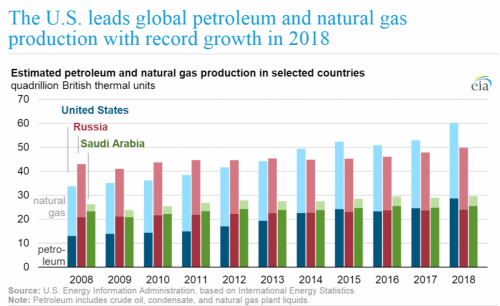
Going forward, new production from the U.S. will be eight times larger than the next largest source of growth, which is Canada. In fact, the U.S. will add 1.5 times more oil and gas than the rest of the world combined, according to Global Witness.
But because so much drilling in the U.S. is concentrated in a few areas, individual U.S. states on their own tower over the rest of the world. If Texas were a country, it would account for the most new oil and gas production in the world. Between 2020 and 2029, Texas could account for 28 percent of all additional output, Global Witness says.
Canada and Pennsylvania tie for second and third with 7 percent each. Then comes New Mexico at 5 percent of the growth and North Dakota at 4 percent. Oklahoma, Brazil, Colorado, Russia and Ohio are all tied at 3 percent a piece.
In other words, 7 out of the top 10 sources of new oil and gas production globally over the next decade are U.S. states.
“If things don’t change, by the end of the next decade, new oil and gas fields in the US will produce more than twice what Saudi Arabia produces today,” Global Witness said in its report.
This presents a massive challenge. “To avoid the worst impacts of climate change, our analysis shows that global oil and gas production needs to drop by 40% over the next decade. Yet, instead of declining, US oil and gas output is set to rise by 25% over this time, fueled by expansion in new fields,” the report warned.
Trudeau ignores threat of nuclear annihilation
By Yves Engler · August 6, 2019

Justin Trudeau presents himself as “progressive” on foreign affairs. The Liberals claim to have brought Canada “back” after the disastrous Harper Conservatives. But their nuclear weapons policy demonstrates the emptiness of this rhetoric.
Reducing the chance nuclear weapons are used again should be a priority for any “progressive” government. But, powerful Canadian allies oppose nuclear arms controls so Trudeau’s government isn’t interested in the “international rules based order” needed to curb the existential threat nukes pose to humankind.
The Liberals have voted against UN nuclear disarmament efforts supported by most countries. At the behest of Washington, they voted against an important initiative designed to stigmatize and ultimately criminalize nuclear weapons. They refused to join 122 countries represented at the 2017 Conference to Negotiate a Legally Binding Instrument to Prohibit Nuclear Weapons, Leading Towards their Total Elimination.
Last month Swedish Foreign Minister Margot Wallström hosted a high-level meeting to reinvigorate nuclear disarmament commitments made by states party to the Nuclear Non-Proliferation Treaty (NPT). While most of the 16 countries were represented in Stockholm by their foreign ministers, Chrystia Freeland did not attend. Instead, the government dispatched Parliamentary Secretary for Consular Affairs Pamela Goldsmith-Jones.
Reducing or eliminating the threat of nuclear weapons isn’t mentioned in the Liberals 2017 defence policy statement (North Korean nukes receive one mention). Instead, Strong, Secure, Engaged: Canada’s Defence Policy makes two dozen references to Canada’s commitment (“unwavering”) to the North Atlantic Treaty Organization. Ghastly nuclear weapons are fundamental to NATO’s strategic planning. According to the official description, “nuclear weapons are a core component of the Alliance’s overall capabilities.”
Through NATO, Canada has effectively committed to fighting a nuclear war if any country breached its boundaries. Additionally, the alliance does not restrict its members from using nuclear weapons first. Canada participates in the NATO Nuclear Planning Group and contributes personnel and financial support to NATO’s Nuclear Policy Directorate.
While NATO maintains nuclear weapons in Turkey and various European countries, Canadian officials blame Russia for the arms control impasse and the recent demise of the Intermediate-Range Nuclear Forces (INF) Treaty, which banned an entire class of nuclear weapons. In April Director General of International Security Policy at Global Affairs Canada, Cindy Termorshuizen said, “we call on Russia to return to compliance with the INF Treaty.” But, it’s not clear Russia violated one of the most significant nuclear accords ever signed. The Trump administration, on the other hand, began to develop new ground-launched intermediate-range missiles prohibited under the pact long before it formally withdrew from the INF. US military planners want to deploy intermediate-range missiles against China, which is not party to the INF.
In December Canada voted against a UN General Assembly resolution for “Strengthening Russian-United States Compliance with Intermediate-Range Nuclear Forces Treaty.”
At that vote Canada’s representative said Moscow’s position on the INF reflects its “aggressive actions in neighbouring countries and beyond.” But, it is Washington that broke its word in expanding NATO into Eastern Europe, withdrew from the Anti-Ballistic Missile treaty in 2001 and established missile ‘defence’ systems near Russia. As part of NATO Canadian troops are stationed on Russia’s border in Latvia and Ukraine, which isn’t conducive to nuclear retrenchment.
A look elsewhere demonstrates the Liberals’ ambivalence to nuclear disarmament. They strengthened the Stephen Harper government’s agreement to export nuclear reactors to India, even though New Delhi has refused to sign the NPT (India developed atomic weapons with Canadian technology). The Trudeau government wouldn’t dare mention Israel’s 100+ nuclear bombs or endorse a nuclear free Middle East. While they’ve publicly stated their support for the Iran nuclear accord, they have not supported European efforts to save the Joint Comprehensive Plan of Action. (Or restarted diplomatic relations with Iran as promised.)
Despite some progressives claiming otherwise, Canada has never been an antinuclear country. In fact, if one were to rank the world’s 200 countries in order of their contribution to the nuclear arms race Canada would fall just behind the nine nuclear armed states. Among many examples of nuclear complicity, Canada spent tens of millions of dollars to help develop the first atomic bombs, CF-104 Starfighters stationed in Europe carried a nuclear weapon and various US nukes were stationed in Canada.
Still, governments from the 1970s through the 1990s expended some political capital on nuclear non-proliferation. While the follow-through was disappointing, Trudeau Père at least spoke about ”suffocating” the nuclear arms race.
His son, on the other hand, responded to a call to participate in a widely endorsed nuclear disarmament initiative by stating “there can be all sorts of people talking about nuclear disarmament, but if they do not actually have nuclear arms, it is sort of useless to have them around, talking.” Justin Trudeau also refused to congratulate Canadian campaigner Setsuko Thurlow, a survivor of the atomic bombing of Hiroshima, who accepted the 2017 Nobel Peace Prize on behalf of the International Campaign to Abolish Nuclear Weapons.
Justin Trudeau’s government does not even talk the talk, let alone walk the walk when it comes to ending the threat of nuclear annihilation.
As part of its 50th anniversary commemoration Black Rose Books – initially Our Generation Against Nuclear War – will host a conference on nuclear disarmament in Montréal on September 21, 2019.
United Church should come clean on anti-Palestinian accord
By Yves Engler · August 2, 2019
Toronto church Trinity-St. Paul’s shameful suppression of a Palestinian youth cultural event highlights anti-Palestinian rot festering in the United Church of Canada. It ought to also shine a light on a little discussed anti-Palestinian accord UCC leaders signed with Israel lobby groups five decades ago.
Under pressure from B’nai B’rith and the Jewish Defence League the Trinity-St. Paul Centre for Faith, Justice and the Arts recently canceled a room booking “to celebrate the artistic and cultural contributions of Palestinians in the diaspora.” The Palestinian Youth Movement’s spoken word event was to “showcase the winners of the Ghassan Kanafani Resistance Arts Scholarship”, which the JDL and B’nai B’rith chose to target on the grounds the famous novelist was a spokesperson for the Popular Front for the Liberation of Palestine in the early 1970s. After Kanafani and his 17-year old niece were assassinated by the Mossad in Beirut, Lebanon’s Daily Star labeled the novelist “a commando who never fired a gun, whose weapon was a ball-point pen, and his arena the newspaper pages.”
As I detailed in this article Trinity-St. Paul’s spiritual leader is anti-Palestinian leftist Cheri DiNovo. Since publishing that piece the former NDP MPP admitted — to vicious anti-Palestinian/Islamophobe Toronto Sun columnist Sue-Ann Levy, of all people — that she forwarded B’nai B’rith’s concerns to the church’s board, which then cancelled the event. Dropping her progressive standing further, DiNovo unfriended a number of individuals on Facebook who politely questioned her role in suppressing the Palestinian cultural event.
To be fair to DiNovo she isn’t the only Progressive Except for Palestine voice in the UCC. “What happened at Trinity St. Paul’s is not isolated”, wrote Karen Rodman, an ordained UCC minister and prominent Palestine solidarity activist. Last year the UCC seminary at the University of Toronto’s Victoria University withdrew from a Palestinian Liberation Theology program with Reverend Naim Ateek. According to Rodman, work had been underway on Emmanuel College’s continuous learning initiative with Ateek for a year when pressure was brought to bear by Israeli nationalist groups.
Resolutions endorsed at UCC conventions in the 2000s called on Palestinians to recognize Israel as an ethnic/religious supremacist state. The 2009 motion called for “the emergent State of Palestine” to recognize “Israel’s right to exist as a Jewish state within safe and secure borders.” In an interview after the 2009 convention Palestinian Canadian journalist Hanna Kawas complained the UCC was asking the victims of a European colonial movement to endorse the supremacist ideology that dispossessed them. In 2012 the UCC “advised against the use of ‘the language of apartheid’ when applied to Israel” and called for a solution to the Palestinian refugees’ right of return so long as it “maintains the demographic integrity of Israel.”
In another sign of the church hierarchy’s encouragement of a colonial ideology, Rodman was harassed and bullied for supporting Palestinian rights. Church officials purportedly called her a “terrorist” for traveling to the West Bank. In response to attacks and biased review process, Rodman filed a complaint with the Human Rights Tribunal of Ontario (HRTO) against the UCC for discriminating against her anti-Zionist worldview. Last year the HRTO granted Rodman a hearing, which awaits scheduling, to show her anti-Zionist worldview/creed is not just a political view.
(The UCC has supported labelling settlement goods and condemned other aspect of Israel’s occupation. But these resolutions have not been implemented. As an example, no congregation or UCC body implemented a 2012 resolution calling for divestment from companies profiting or supporting the occupation even though a resolution was passed at the subsequent General Council requesting implementation of the 2012 resolution.)
An anti-Palestinian deal UCC leaders brokered decades ago has influenced the church’s indifference to the plight of Palestinians. In the 1950s and 60s the UCC passed a number of resolutions upholding the rights of Palestinians, including those of the refugees to return to their homes. More significantly, the UCC’s influential magazine championed the Palestinian cause. With a circulation of 350,000 in the early 1970s, The Observer criticized Israeli human rights violations. But editor Rev. A.C. Forrest’s support for Palestinians prompted vicious attacks. Emboldened by the blow Israel delivered against pan-Arabism in the 1967 war, B’nai B’rith dubbed Forrest a “Haman”, “Pharaoh” and “anti-Semitic”.
In response, Forrest threatened to sue for libel. B’nai B’rith countersued. A high-profile battle between B’nai B’rith and the UCC ensued. But, new UCC leaders didn’t care much about Palestinians and opposed Forrest, as well as a pro-Palestinian resolution passed at the 1972 UCC convention. Moderator Bruce McLeod and General Secretary George Morris soon sought a “gentleman’s agreement” in which both the UCC and B’nai B’rith would drop the lawsuits. Couched in the language of interfaith sensitivity, the 1973 “peace pact” was about deterring criticism of Israel. As then Canadian Jewish Congress (CJC) President Sol Kanee wrote in a private letter, “it would appear the United Church is determined to chart a more positive course with regard to Israel and the Jewish people, which we hope will be reflected in the ‘Observer.’”
Dozens of pages detail the B’nai B’rith-UCC battle at the Canadian Jewish Archives in Montréal. In one internal file CJC officials say only part of the B’nai B’rith-UCC agreement was published (a similar agreement is thought to have been made between the UCC and CJC and/or Canadian Council of Churches). Part of the “peace pact” published noted, “we recognize and appreciate the interests of Jews everywhere and of the United Church for the events in the Middle East and in the survival of Israel.”
As part of the agreement, the UCC seems to have committed to inform B’nai B’rith/CJC about Israel related affairs or even seek their consent before implementing policy approved by the grassroots. A 2009 Globe and Mail article reported that UCC general council officer Bruce Gregersen indicated that CJC president Bernie Farber “gave his blessing to the UCC resolution” on Israel.
Rodman and others have pushed the church hierarchy to reveal whether the anti-Palestinian agreement is still respected. But UCC leaders have failed to release the full agreement or say it is no longer being followed.
The agreement with B’nai B’rith/CJC has undercut grassroots initiatives within the church that challenge Canada’s complicity in Palestinian dispossession. But, the decision to succumb to B’nai B’rith’s disingenuous attacks 45 years ago has had another equally damaging impact on Palestinians. It has emboldened the anti-Palestinian group to make evermore outrageous demands.
After a half-century more of Israeli land theft and violence, B’nai B’rith demanded a Toronto church suppress an event because it included the name of a famous novelist driven from his home as a child and then blown up by Israel (a quintessential victim of terrorism). If Kanafani’s name “glorifies terrorists and murderers”, as B’nai B’rith claims, then what should we say of a group that defends every act of Israeli violence, including the assassination of a novelist and his niece?
If the UCC won’t have anything to do with a Palestinian youth group that mentions Kanafani’s name they sure better sever all ties to groups promoting Israeli “terrorists and murderers”.
Trudeau ‘feminizes’ support for corrupt and repressive Haitian president
By Yves Engler ·July 31, 2019

Justin Trudeau and Jovenel Moïse
The Trudeau Liberals are attempting to “feminize” their support of an illegitimate government hated by the vast majority of Haitians. And Radio-Canada seems to have fallen for it.
After Radio-Canada published a story about nine of eighteen ministers in Jovenel Moïse’s newly proposed government being women, Haitian Canadian feminist Jennie-Laure Sully replied, “Haitians of all social classes have been demonstrating for more than a year demanding the resignation of the president and a change in the political system. But what does Radio-Canada talk about in this country? A cosmetic measure adopted by this fraudulently elected government accused of embezzlement and human rights violations. Gender parity in such conditions is a smokescreen (“poudre aux yeux”). Radio-Canada is doing identity politics of the lowest order while ignoring Canada’s role in maintaining corruption in Haiti.”
With little support among Haitians, Moïse needs good press in the two main countries sustaining his presidency. Recently he has been on a campaign to shore up his image in the US, publishing an op-ed in the Miami Herald and hiring a new Washington, DC, based lobbyist.
In presenting a gender balanced cabinet Moïse’s proposed Prime Minister, Fritz William Michel, deftly aligned with a stated foreign policy objective of Justin Trudeau. Along with praise for Moïse, Global Affairs Canada’s webpage about “Canada’s international assistance in Haiti” focusses on gender equity. At the top of the page, it lists a series of feminist goals under the heading of “To strengthen Haiti’s Government capacity to respond to gender equality issues.”
(In 2017 the Trudeau government launched a much-hyped Feminist International Assistance Policy, but their commitment to feminist internationalism is paper-thin. Since July 21, for instance, Ottawa joined Washington as the only country to vote against a UN Economic and Social Council resolution stating, “the Israeli occupation remains a major obstacle for Palestinian women and girls with regard to the fulfillment of their rights”; Canada signed a Memorandum of Understanding with the misogynist UAE; the Trudeau government was criticized by the chair of the UN Working Group on Business and Human Rights Surya Deva for gutting their promise to rein in Canadian mining abuses abroad, which disproportionately affect women.)
Moïse has faced massive popular protests in recent months, including multiple general strikes. As I detail here and here, the only reason he remains in power is because of support from Washington, Ottawa and a number of other countries. Canada has provided financial, policing and diplomatic support to the unpopular government. In the latest indication of diplomatic backing, Canada’s ambassador in Port-au-Prince, André Frenette, met Moïse to discuss “bilateral cooperation” two weeks ago. The embassy also continues to support a police force responsible for countless abuses. On Sunday Global Affairs Canada’s Haïti account tweeted “congratulations” to police graduates who they trained in collaboration with the US.
On July 15 Solidarité Québec-Haïti #Petrochallenge 2019 activists interrupted a press conference by Minister of La Francophonie and Tourism Mélanie Joly to call on the Trudeau government to stop propping up a corrupt, illegitimate and murderous Haitian president. As this video shows, Joly was unable to respond to our simple question.
While the disruption was reported on by various media outlets, Radio Canada wasn’t interested. More than any other major media outlet, the French language public broadcaster has been the mouthpiece for Canadian imperialism in Haiti over the past 15 years. Unlike other outlets, Radio Canada covers Haitian affairs fairly regularly. But, it is almost entirely from the perspective of ‘Ottawa/Canada doing good’ in the impoverished nation.
Radio Canada largely failed to report on Canada’s role in planning the 2004 coup; destabilizing Jean-Bertrand Aristide’s government; building a repressive Haitian police force; justifying politically motivated arrests and killings; militarizing post-earthquake disaster relief; pushing the exclusion of Haiti’s most popular party, Fanmi Lavalas, from participating in elections.
When active with Haiti Action Montréal in the mid 2000s I experienced the politicized nature of the subject at Radio Canada. I called the news editor to inquire if they’d received our press release and instead of a yes/no we might/we can’t send anyone to cover the event that is usually part of this type of media outreach, the news editor somewhat angrily accused me of being an Aristide supporter, which was odd both because the event was focused on Canada’s role in Haiti and Aristide was elected by the country’s historically excluded.
In a 2008 article titled “Embedding CBC Reporters in Haiti’s Elitist Media” Richard Sanders describes Radio Canada’s participation in a Canadian government funded project to support media outlets that were part of L’Association Nationale des Médias Haïtiens (ANMH), which officially joined the Group of 184 that campaigned to oust Aristide. Sanders writes about Québec journalists sent to “train” Haitian reporters for a month, but who were in fact being “submerged in the propaganda campaigns of Haiti’s elite media.” Assistant program director for Radio Canada news, Guy Filion was one of the reporters who interned with ANMH. Even though ANMH outlets barred Haiti’s elected president from its airwaves in the lead-up to the coup, Filion described those who “formed the ANMH” as “pro-Haitian and they are pro neutral journalistic people … as much as it can be said in this country.” Filion also praised the media’s coverage of the 2006 election in which Aristide’s Lavalas was excluded. In a coded reference to Aristide supporters, Filion noted, “even thugs from [large slum neighbourhood] Cité Soleil were giving interviews on television!”
Radio-Canada’s reporting on gender parity in a proposed new government helps legitimate Trudeau’s support of Moïse. It puts a progressive veneer on a corrupt, repressive and unpopular president who is dependent upon Radio-Canada’s patron. It is yet another attempt to justify Canadian policy that sides with the interests of multinational corporations and a small elite over the needs of Haiti’s impoverished majority.
West’s Relations with the White Helmets have gone Stale
By Jean Perier – New Eastern Outlook – 30.07.2019
At long last, Western sponsors of the so-called “humanitarian group” White Helmets have woken up to the fact that their love affair with those pseudo-humanitarianists is more damaging that beneficial, which in turn invoked a number of problems.
The White Helmets which have been exposed as a propaganda operation launched by Washington and London to feed the international community with fake videos depicting false-flag chemicals attack in Eastern Ghouta started experiencing its first difficulties last year when the White House decided to stop sponsoring them. For sure, their activities have been pretty beneficial for the US as it provided Washington with a pretext to attack Syria, but then Washington has never had much concern over the well-being of its minions once they are no longer useful.
Even though Donald Trump would have a change of heart in mid-summer 2018, ordering the US State Department and US Agency for International Development to allocate another 6.6 million dollars to sponsor the activities of this organization, at this point nobody had any doubts about the provocative and untruthful nature of the reports that would be released by the White Helmets.
A well-known British journalist, Vanessa Beeley has already exposed the ties between the British intelligence agencies and the White Helmets and through them to the Jabhat Al-Nusra terrorist group. According to her revelations, the White Helmets branch in Eastern Aleppo was once established by Abdulaziz Maghribi, who previously headed a local Al-Nusra-affiliated militant group. Further still, this individual had also been an armed member of the Turkish-backed Al Tawhid brigade which invaded East Aleppo in 2012
The ever growing awareness of the Western public about the deceptive nature of the White Helmets and their activities has rendered them useless in any future anti-Russian or anti-Syrian provocations. Therefore, Washington had to take some sort of decision about their future, musing over the possibility of turning them into a purely British local propaganda vehicle, as the group was created back in 2013 by a retired British servicemen, the head of the Mayday Rescue Foundation NGO – James Le Mesure, or scrap this project altogether. Under these circumstances it became clear even for Washington that it had to find much more credible partners on the ground to carry on advancing its agenda.
As the number of Syrian towns under control of pro-Western jihadi fighters has been dwindling steadily, Jordan’s intelligence agencies in cooperation with the Mossad launched a withdrawal operation, transporting a total of 98 White Helmets activists together with their family members to Jordan from south-western Syria, on July 22, 2018. Some publications claim that they’ve evacuated 422 people, while others state that there was over 800 people transported in total. Initially, it was planned that those so-called activists would dwell for some time at the Muwaffaq Salti Air Base before heading to a number of western countries.
Initially, it was announced that the resettlement of the White Helmets wouldn’t take more than three-four weeks, with the UK, France, Canada, and Germany claiming that they would be delighted to become a new home for those “brave souls”, but it’s been over a year now. No more than three hundred out of the initial 800 have found their new homes, as reported by Reuters, but now the process of resettlement has come to a screeching halt.
In particular, as it’s been reported by Canadian media sources, there’s still White Helmets members dwelling with their family members in Jordan’s Azraq refugee camp, including those that were supposed to be moved to Canada. In total, there’s over 42 people that have been waiting for resettlement to Canada for almost a year now. However, after the initial security check, including an “interview” conducted in the camp, Ottawa realized that it had no intention of providing asylum to the much-touted “human rights champions,” seeking a pretext to send them some place else instead. The situation is getting even more peculiar due to the fact that Amman gave permission of transit to those individuals, but didn’t say a word about their right for permanent residence. Canada’s Prime Minister, Justin Trudeau hopes that the Nazi-ridden Ukraine would develop a taste for hosting pro-Western “human rights activists,” after all the newly elected Ukrainian President Volodymyr Zelensky is expected to pay his dues after the warm welcome he received in Ottawa and Canada making a promise to deliver its old armored vehicles to Ukraine.
As for Canada itself, in spite of its relatively relaxed migration legislation, it’s in no hurry to grant refuge to those representatives of the White Helmets that are stuck in Jordan. It is equally reluctant to grant entry permission to those Canadians who were fighting against the legitimate Syrian government in the ranks of ISIS militants together with their family members. In total, the latter group consists of 32 individuals (6 men, 9 women and 17 children). According to the information leaked to the media, Canadian intelligence agencies are currently collecting evidence to identify the role they might have played in committing various war crimes.
In general, as Canadian observers note, the flow of Syrian refugees to Canada has been put on halt once Ottawa faced a number of difficulties with their integration into the local society. After all, Justin Trudeau couldn’t care less about Syrian refugees, since they were only beneficial to him during the initial years of his stay in power, when he could score a number of political points talking about them. It is obvious that Western governments have no stomach for hosting those individuals they were praising as heroes, since such a move could result in a spike of xenophobic moods and a wide-spread panic over the possibility of terrorist attacks. And besides, the White Helmets have already played their propaganda role, so they are no longer needed.
NDP Suppresses Palestinian Solidarity Again
By Yves Engler · July 17, 2019

Rana Zaman
One side is playing for keeps. They oust elected representatives and block members from voting on efforts to challenge a brutal occupation. On the other side, members defending a morally righteous cause twist themselves in knots to avoid directly criticizing nakedly authoritarian party leaders.
Recently, the NDP national office overturned the vote of party members in Dartmouth-Cole Harbour after they elected Rana Zaman to represent the riding in the upcoming federal election. Party ‘leaders’ excluded the Muslim woman of Pakistani heritage from running because she defended thousands of Palestinians mowed down by Israeli snipers during last year’s “Great March of Return” in the open-air Gaza prison. A prominent local activist, Zaman represented the party provincially in 2017.
In May the leadership of the Ontario NDP blocked a resolution on Palestinian rights from being debated at their biannual convention. According to party member Moe Alqasem, the resolution “was pushed to the very bottom of its list of resolutions on block 4” despite having “as many endorsements as the top resolution on that same list … The appeals committee refused to re-prioritize it on the list, a speech was given in favor of the re-prioritization and the room erupted into cheers and chants for a few minutes. The committee’s decision was next to be challenged on the main floor of the convention, but the chair ‘conveniently’ decided that we were behind on time. There were several attempts to amend the agenda or the order-of-the-day to allow for the membership to challenge the committee’s decision again, conveniently however the chair decided that it was not possible. The chair spent 20 minutes refusing us the opportunity to speak for 1 minute on the resolution. Knowing full well that the membership was supportive of Palestine. Later on during that convention, somehow the order-of-the-day was amended in favour of another resolution and the committee’s decision was challenged in front of the general membership. Several other rules were amended, the same privileges were not afforded to the Palestinians and the Palestine-Solidarity members within the party.”
Recently, the NDP hierarchy undermined former Toronto mayoral candidate Saron Gebresellassi’s bid to represent the party in Parkdale-High Park possibly because she signed an open letter calling on the NDP to withdraw from the Canada-Israel Interparliamentary Group. The national office took 141 days to vet her candidacy, giving her only 23 days to sign up new members to vote. Then a good number of the 400 members she registered were disenfranchised beforehand and at the riding association vote. At the centre of the sordid affair was Parkdale-High Park president Janet Solberg who was maybe the loudest anti-Palestinian at the NDP’s 2018 federal convention. According to Myles Hoenig, “Janet Solberg, sister of Stephen Lewis, leader of the Ontario NDP for most of the 70s who kicked out the leftist contingent known as The Waffle, played a leadership role in officiating this election. In a 3 way call to the candidates, she openly expressed her hostility to Saron by stating how she won’t support her.” A former Ontario NDP president, vice president and federal council member, Solberg pushed to suppress debate on the “Palestine Resolution: renewing the NDP’s commitment to peace and justice”, which was endorsed by more than two dozen riding associations before the federal convention. The motion mostly restated official Canadian policy, except that it called for “banning settlement products from Canadian markets, and using other forms of diplomatic and economic pressure to end the occupation.”
Six months after suppressing the Palestine Resolution, NDP foreign affairs critic Hélène Laverdière and party leader Jagmeet Singh participated in an unprecedented smear against one of Canada’s most effective advocates for Palestinian rights. After Dimitri Lascaris called on two Liberal MPs to denounce death threats made by B’nai B’rith supporters against a number of Liberal MPs and the Prime Minister, the Centre for Israel and Jewish Affairs called on MPs to attack him, prompting Laverdière to call Lascaris “anti-Semitic” while Singh inferred as much.
In the lead up to the 2015 federal election the NDP leadership ousted as many as eight individuals from running or contesting nominations to be candidates because they publicly defended Palestinian rights. The most high-profile individual blocked from seeking an NDP nomination was Paul Manly, a filmmaker and son of a former NDP MP. Manly recently delivered a blow to the NDP by winning the Nanaimo-Ladysmith byelection as a candidate for the Green Party.
In another Palestine-related development, four NDP MPs (quietly) withdrew from the Canada Israel Interparliamentary Group (CIIG). They did not do so because someone politely convinced them it was immoral to participate in a group promoting “greater friendship” with a belligerent, apartheid, state, but because they were directly challenged through an open letter signed by more than 200 prominent individuals, as well as other campaigning.
NDP MP Randall Garrison remains vice-chair of CIIG and a prominent anti-Palestinian voice within the party. Any NDP activist with an internationalist bone in their body should hope Victoria-area Palestine solidarity campaigners help defeat him in the October election. There must be a price to pay for egregious anti-Palestinianism. In a similar vein, individuals such as Solberg should be confronted on their anti-Palestinianism.
At the end of May I learned Jagmeet Singh was making a major announcement in Montréal. With a hastily drawn placard in my bag, I attended thinking of interrupting the event to decry NDP participation in CIIG and suppression of the 2018 Palestine Resolution. I hesitated for a series of reasons, notably a sense that disrupting a major announcement by the social democratic party was too extreme. I now regret not walking in front of the cameras to denounce NDP anti-Palestinianism at the launch of their climate plan. Unfortunately, this is the type of action required to force party leaders to have second thoughts about blithely ousting pro-Palestinian candidates and suppressing debate on resolutions opposing Palestinian subjugation. NDP leaders fear anti-Palestinian individuals and groups’ no holds barred brand of politics. They need to know the Palestine solidarity side is also prepared to ruffle feathers.
Enough of walking on egg shells. In Alqasem’s devastating report about the Ontario NDP suppressing discussion of a resolution upholding Palestinian rights he begins by letting the perpetrators off the hook. He writes, “the following is not an attack on the membership, the party or administrators within.” But, how can one not politically “attack” the NDP “administrators” who just suppressed internal democracy in order to enable the subjugation of a long-suffering people?
After the federal convention 18 months ago I wrote: “Over the next year NDPers who support Palestinian rights and care about party democracy should hound the leadership over their suppression of the Palestine Resolution. Every single elected representative, staffer, riding association executive and party activist needs to be prodded into deciding whether they side with Palestinian rights and party democracy or suppressing the Palestine Resolution and enabling ongoing Canadian complicity in Palestinian dispossession.” These words still ring true, even if they may trouble many pro-Palestinian elements within the party (recent developments should be added to the discussion, of course).
For those sympathetic to the Palestinian cause, but reluctant to openly challenge the party leadership, ask yourself these two questions:
Since polling reveals a higher percentage of Canadians support Palestinian rights than vote for the NDP federally, why won’t party officials allow a clear statement of support for Palestinian liberation?
Is there a point when explicitly antidemocratic behavior that contributes to Palestinian subjugation will no longer be tolerated in a party claiming the mantra of social justice?
It is time the NDP leadership listened to its membership.
Despite talk of promoting democracy Trudeau in bed with repressive monarchy
By Yves Engler · July 8, 2019

UAE foreign minister Sheikh Abdullah bin Zayed with Justin Trudeau
Given his personal history perhaps it is no surprise that Justin Trudeau is fond of monarchies.
The United Arab Emirates is a repressive monarchy that pursues violent, anti-democratic, policies in its region. Despite this — or maybe because of it —Trudeau’s Liberal government has strengthened ties to the federation of seven Emirates. And unlike Canada’s claims to be promoting democracy in Venezuela or the Ukraine, there has been little mention of this in the media or scrutiny in Parliament.
The UAE has propped up the Transitional Military Council in Sudan that has faced massive protests calling for civilian rule. Two months ago the oil rich country put up half of a $3 billion package (with Saudi Arabia) to support Sudan’s military rulers and the head of the military council visited powerful Crown Prince Mohammed bin Zayed al-Nahyan in Abu Dhabi in late May. Many pro-democracy activists believe the UAE and Saudi Arabia pushed Sudan’s military to destroy a major protest site that left dozens dead at the start of June.
Abu Dhabi fears democracy in Sudan for various reasons. One immediate concern is the likelihood that a government in Khartoum representing the popular will would withdraw the 10,000 Sudanese soldiers in Yemen. The UAE has played a key role in the war in Yemen, which has left 100,000 dead, millions hungry and sparked a terrible cholera epidemic.
In Libya the UAE was recently caught delivering weapons to warlord Khalifa Haftar in violation of UN sanctions. Abu Dhabi has financed and supported Haftar’s bid to seize the Libyan capital by force. The Tripoli-based Government of National Accord said a UAE F-16 fighter jet was responsible for bombing a migrant detention centre that left some 50 people dead last week.
Elsewhere in the region the UAE has engaged in a two year blockade of Qatar designed to force Doha to heed their and close ally Saudi Arabia’s belligerent, anti-democratic, position towards Iran, Egypt and elsewhere. In recent years UAE helped crush Bahrain’s 2011 uprising, dispatched forces to Libya to support the NATO war and financed the return of military rule to Egypt in 2013. Abu Dhabi also plowed hundreds of millions of dollars of weaponry and other forms of support to Al Qaeda linked rebels in Syria.
Domestically, the UAE is a repressive monarchy that outlaws labour unions and hangs/stones individuals to death. The country heavily restricts religious freedoms and women’s rights. Recently, the wife (one of six) of Dubai’s ruler Sheikh Mohammed bin Rashid Al Maktoum sought asylum in the UK fearing for her life.
From what I could find the Trudeau government has stayed mum on Abu Dhabi’s efforts to derail democracy in Sudan. Nor have they made any comment on its violation of UN sanctions in Libya. Over four years they’ve barely made a peep about the UAE’s bombing and troops in Yemen. Instead of challenging the monarchy’s egregious policies, the Liberals have deepened ties to the Gulf Kingdom.
On July 1 officials from the two countries highlighted “the bond between Canada and the United Arab Emirates” by raising a Canadian flag-inspired display on Abu Dhabi’s Burj Khalifa, the world’s tallest building. Ten days ago, the government announced that Canada would participate in Expo 2020 Dubai. International trade minister Jim Carr declared, “our presence at Expo 2020 affirms the vitality of Canada-UAE relations.”
A UAE delegation led by Minister of Energy and Industry Suhail bin Mohammed Faraj Faris Al Mazrouei attended the International Economic Forum of the Americas in mid-June. At the Montréal conference Al Mazrouei met economic development minister Navdeep Bains and trade minister Jim Carr. During the opening of the last UN General Assembly session Trudeau met UAE foreign minister Sheikh Abdullah bin Zayed and he visited foreign minister Chrystia Freeland in Ottawa last May.
Despite their violence in Yemen, the Trudeau government has deepened military ties to the UAE. There are a small number of Canadian troops in the UAE and Royal Canadian Navy vessels in the region regularly coordinate with their Emirates counterparts. Last week Canada’s ambassador in Abu Dhabi, Masud Husain, met defence minister Mohammed bin Ahmed Al Bowardi. Canada’s Defence Minister Harjit Sajjan also met Al Bowardi there in April. According to Emirates News Agency, Canadian and UAE officials discussed “cooperation in the military and defence sectors” and “current regional and international developments.” In December 2017 Sajan traveled to the Gulf State to sign the Canada-UAE Defence Cooperation Arrangement.
According to Radio Canada International, the Canada–UAE defence accord “will make it easier for the Canadian defence industry to access one of the world’s most lucrative arms markets.” During the last four years the Trudeau government has promoted arm sales at the Abu Dhabi-based International Defence Exhibition and Conference (IDEX). With support from “15 trade commissioners and representatives from the Government of Ontario, National Defence, Global Affairs Canada, and the Canadian Commercial Corporation”, 50 Canadian arms companies flogged their wares at IDEX in February. To help the arms companies move their products, commander of the Bahrain-based Combined Task Force 150, Commodore Darren Garnier, led a Canadian military delegation to IDEX.
In February of last year Parliamentary Secretary to minister Bains, David Lametti, who is now Justice Minister, promoted Bombardier’s delivery of surveillance planes to the UAE. Montreal-based flight simulator company CAE trains UAE Air Force pilots at a facility in Abu Dhabi. Some UAE pilots bombing Yemen also likely trained at NATO’s Flying Training in Canada, which is run by CAE and the Canadian Forces.
As Anthony Fenton has documented in detail on his fantastic Canada-Gulf focused Twitter handle, armoured vehicles made by Canada’s Streit Group in the UAE have been repeatedly videoed in Yemen. At IDEX 2019 Streit Group officials were photographed pitching their Sherp All-terrain military vehicle to UAE officials.
After a high profile diplomatic spat with Saudi Arabia last August Canadian officials privately worried it would negatively impact relations with UAE. That didn’t happen, of course. In fact, the spat may have spurred closer ties to Saudi Arabia’s main regional ally.
It’s time for some mainstream journalists and parliamentarians to devote a little attention to the Trudeau’s government hypocritical embrace of the UAE monarchy.
Does Justin Trudeau hate Palestinians?
By Yves Engler · July 4, 2019

Is Justin Trudeau a racist? He and his government certainly accept and promote anti-Palestinianism. Two recent moves reaffirm his government’s pattern of blaming Palestinians for their dispossession and subjugation.
Last week the government released its updated terrorist list. An eighth Palestinian organization was added and the International Relief Fund for the Afflicted and Needy (IRFAN) was re-designated. The first ever Canadian-based group designated a terrorist organization, IRFAN was listed by the Stephen Harper government for engaging in the ghastly act of supporting orphans and a hospital in the Gaza Strip through official (Hamas controlled) channels.
Recently, the Liberals also announced they were formally adopting the International Holocaust Remembrance Alliance’s (IHRA) definition of antisemitism as part of its anti-racism strategy. The explicit aim of those pushing the IHRA’s definition of antisemitism is to silence or marginalize those who criticize Palestinian dispossession and support the Palestinian civil society led Boycott, Divestment, Sanctions (BDS) movement. The PM has repeatedly equated supporting Palestinian rights with hatred towards Jews and participated in a unprecedented smear against prominent Palestinian solidarity activist Dimitri Lascaris last summer.
Alongside efforts to demonize and delegitimize those advocating for a people under occupation, the Trudeau government has repeatedly justified violence against Palestinians. Last month Global Affairs Canada tweeted, “Canada condemns the barrage of rocket attacks from Gaza into Israel by Hamas and other terrorist groups, which have killed and injured civilians. This indiscriminate targeting of civilians is not acceptable. We call for an immediate end to this violence.” The statement was a response to an Israeli killed by rockets fired from Gaza and seven Palestinians killed in the open-air prison by the Israeli military. In the year before 200 Palestinians were killed and another 5,000 injured by live fire in peaceful March of Return protests in Gaza. Not a single Israeli died during these protests.
The Trudeau government has repeatedly isolated Canada from world opinion on Palestinian rights. Canada has joined the US, Israel, Marshall Islands, Nauru, Micronesia and Palau in opposing UN resolutions in favour of Palestinian rights that nearly every other country supported. In fact, the Trudeau Liberals may have the most anti-Palestinian voting record of any recent Canadian government. In August Liberal MP Anthony Housefather boasted in a Canadian Jewish News article: “We have voted against 87% of the resolutions singling out Israel for condemnation at the General Assembly versus 61% for the Harper government, 19% for the Martin and Mulroney governments and 3% for the Chrétien government. We have also supported 0% of these resolutions, compared to 23% support under Harper, 52% under Mulroney, 71% under Martin and 79% under Chretien.”
Further legitimating its illegal occupation, the Liberals “modernized” Canada’s two-decade-old Free Trade Agreement (FTA) with Israel that allows West Bank settlement products to enter Canada duty-free. To promote an accord that recently received royal assent, International Trade Minister Jim Carr traveled to Israel and touted its benefits to Israel lobby organizations in Toronto and Winnipeg. “Minister Carr strengthens bilateral ties between Canada and Israel”, explained a June 20 press release.
In mid-2017 the federal government said its FTA with Israel trumps Canada’s Food and Drugs Act after the Canadian Food Inspection Agency called for accurate labelling of wines produced in the occupied West Bank. After David Kattenburg repeatedly complained about inaccurate labels on two wines sold in Ontario, the CFIA notified the Liquor Control Board of Ontario (LCBO) that it “would not be acceptable and would be considered misleading” to declare Israel as the country of origin for wines produced in the Occupied Palestinian Territories. Quoting from longstanding official Canadian policy, CFIA noted that “the government of Canada does not recognize Israel’s sovereignty over the territories occupied in 1967.” In response to pressure from the Israeli embassy, Centre for Israel and Jewish Affairs and B’nai Brith, CFIA quickly reversed its decision. “We did not fully consider the Canada-Israel Free Trade Agreement,” a terse CFIA statement explained. “These wines adhere to the Agreement and therefore we can confirm that the products in question can be sold as currently labelled.”
Each year Canadian taxpayers subsidize hundreds of millions of dollars in charitable donations to Israel despite that country having a GDP per capita only slightly below Canada’s. (How many Canadian charities funnel money to Sweden or Japan?) Millions of dollars are also channeled to projects supporting West Bank settlements, explicitly racist institutions and Israel’s powerful military, which may all contravene Canadian charitable law. In response to a formal complaint submitted by four Palestine solidarity activists and Independent Jewish Voices Canada in fall 2017, the Canada Revenue Agency (CRA) began an audit of the Jewish National Fund for contravening Canadian charitable law. Despite the JNF openly supporting the Israeli military in explicit contravention of charitable law, the audit has been going on for a year and a half. The CRA is undoubtedly facing significant behind-the-scenes pressure to let the JNF off with little more than a slap on the wrist. In 2013 Trudeau attended a JNF gala and other Liberal cabinet ministers have participated in more recent events put on by an explicitly racist organization Liberal MP Michael Leavitt used to oversee. (In a positive step, the Beth Oloth Charitable Organization, which had $60 million in revenue in 2017, had its charitable status revoked in January for supporting the Israeli military.)
Of course, the Trudeau government would deny its racism towards Palestinians. They will point to their “aid” given to the Palestinian Authority. But, in fact much of that money is used in an explicit bid to advance Israel’s interests by building a security apparatus to protect the corrupt PA from popular disgust over its compliance in the face of ongoing Israeli settlement building. The Canadian military’s Operation Proteus, which contributes to the Office of the United States Security Coordinator, trains Palestinian security forces to suppress “popular protest” against the PA, the “subcontractor of the Occupation”.
In a recently published assessment of 80 donor reports from nine countries/institutions titled “Donor Perceptions of Palestine: Limits to Aid Effectiveness” Jeremy Wildeman concludes that Canada, the US and International Monetary Fund employed the most anti-Palestinian language. “Canada and the US,” the academic writes, “were preoccupied with providing security for Israel from Palestinian violence, but not Palestinians from Israeli violence, effectively inverting the relationship of occupier and occupied.”
At a recent meeting, BDS-Québec decided to launch a campaign targeting Justin Trudeau in the upcoming federal election campaign. The plan is to swamp his Papineau riding with leaflets and posters highlighting the Prime Minister’s anti-Palestinianism. It’s time politicians pay a political price for their active support of Israel’s racism.
Beijing urges Canada not to ‘naively’ rely on U.S. to pressure China

CGTN | July 3, 2019
Chinese Foreign Ministry spokesman Geng Shuang said on Wednesday that Canada is “fully responsible” for difficulties facing bilateral relations, stressing that Canada should not “naively” rely on the United States to pressure China.
Geng made the remarks at a regular press conference in response to recent remarks by Canadian Prime Minister Justin Trudeau regarding China’s detention of two Canadian citizens.
China confirmed last December that two Canadians – former diplomat Michael Kovrig and business consultant Michael Spavor – were being investigated on suspicion of “engaging in activities that endangered China’s national security.”
Trudeau said on Tuesday that he was “confident” that U.S. President Donald Trump had made good on his promise to raise the cases during his meeting with Chinese President Xi Jinping on the sidelines of the G20 summit in Japan’s Osaka last week.
Geng said China had published a news report on the meeting between Xi and Trump, noting that he has nothing to add.
“We hope the Canadian side would not be too naïve,” he said. “Don’t think naively that asking certain ‘ally’ to pressure China would work.”
China, whose judicial authorities work independently in accordance with the law, does not allow other countries to interfere in its judicial sovereignty, the spokesman stressed.
“The Canadian side should not naively believe that its so-called allies would make real efforts for it,” he said.
“Relations between China and Canada are currently undergoing severe difficulties and the Canadian side is fully responsible for that,” Geng said, urging Canada to take actions as soon as possible to bring bilateral ties back on the right track.
Tensions rose between Beijing and Ottawa late last year over the arrest of Chinese telecom giant Huawei’s Chief Financial Officer Meng Wanzhou in Canada.
Read more:
Wang Yi: Meng Wanzhou case ‘deliberate political move’
Huawei: Confident in the innocence of its CFO Meng Wanzhou
Meng was arrested on December 1, 2018, at Vancouver International Airport at the request of the United States, which is seeking her extradition on fraud charges. Both Meng and Huawei have repeatedly denied any wrongdoing. And Beijing has repeatedly demanded Washington to withdraw its arrest warrant and the extradition request against Meng.
Ugly Canadian supports status quo in original banana republic
By Yves Engler · June 28, 2019
In 1901, US author O. Henry coined the term “banana republic” to describe Honduras, which was dominated by the US-based United Fruit Company. “Typically,” Henry wrote, “a banana republic has a society of extremely stratified social classes, usually a large impoverished working class and a ruling-class plutocracy, composed of the business, political and military elites of that society.”
Not much has changed in the past 120 years, although the Ugly American has been joined at the ruling class table by the Ugly Canadian.
Ten years-ago today Ottawa tacitly supported the Honduran military’s removal of elected president Manuel Zelaya. During the past decade Canada has strongly allied itself to those backing the coup who continue to rule the Central American country.
It was not until basically every country in the hemisphere denounced the June 28, 2009, coup that Ottawa finally did so but Canada did not explicitly call for Zelaya’s return to power. On a number of occasions Minister of State for the Americas Peter Kent said it was important to take into account the context in which the military overthrew Zelaya, telling the New York Times: “There is a context in which these events [the coup] happened.”
In the lead-up to his ouster Ottawa displayed a clear ambivalence towards Zelaya. Early in June Kent criticized Zelaya, saying: “We have concerns with the government of Honduras.” The Conservatives opposed Zelaya’s plan for a binding public poll on whether to hold consultations to reopen the constitution, which had been written by a military government.
A week after the coup, during which Zelaya was flown to Costa Rica, the elected president tried to return to Honduras along with three Latin American heads of state. But the military blocked his plane from landing and kept over 100,000 supporters at bay. In doing so the military killed two protesters and wounded at least 30. On CTV Kent blamed Zelaya for the violence. Just before the elected president tried to fly into Tegucigalpa, Kent told the OAS the “time is not right” for a return, prompting Zelaya to respond dryly: “I could delay until January 27 [2010]” (when his term ended). Two weeks after trying to return by air Zelaya attempted to cross into Honduras by land from Nicaragua, which Kent once again criticized.
Despite the coup, Ottawa refused to exclude Honduras from its Military Training Assistance Program. Though only five Honduran troops were being trained in Canada, failing to suspend relations with a military responsible for overthrowing an elected government was highly symbolic. More significantly, Canada was the only major donor to Honduras — the largest recipient of Canadian assistance in Central America — that failed to sever any aid to the military government. The World Bank, European Union and even the US suspended some of their planned assistance to Honduras.
In response to the conflicting signals from North American leaders, the ousted Honduran foreign minister told TeleSur that Ottawa and Washington were providing “oxygen” to the military government. Patricia Rodas called on Canada and the US to suspend aid to the de facto regime. During an official visit to Mexico with Zelaya, Rodas asked Mexican president Felipe Calderon, who was about to meet Stephen Harper and Barak Obama, to lobby Ottawa and Washington on their behalf.
Five months after Zelaya was ousted the coup government held previously scheduled elections. During the campaign period the de facto government imposed martial law and censored media outlets. Dozens of candidates withdrew from local and national races and opposition presidential candidate Carlos H. Reyes was hospitalized following a severe beating from security forces.
The November 2009 election was boycotted by the UN and OAS and most Hondurans abstained from the poll. Despite mandatory voting regulations, only 45 percent of those eligible cast a ballot (it may have been much lower as this was the government’s accounting). Still, Ottawa endorsed this electoral farce. “Canada congratulates the Honduran people for the relatively peaceful and orderly manner in which the country’s elections were conducted,” noted an official statement. While most countries in the region continued to shun post-coup Honduras, Ottawa immediately recognized Porfirio Lobo after he was inaugurated as Honduran president on January 27, 2010. Not long after, Canada negotiated a free trade agreement with Honduras.
Particular corporate interests and regional integration efforts motivated Ottawa’s hostility towards Zelaya. A number of major Canadian corporations, notably Gildan and Goldcorp, were unhappy Zelaya raised the minimum wage and restricted mining operations. Rights Action uncovered credible information that a subsidiary of Vancouver based Goldcorp provided money to those who rallied in support of the coup. Additionally, a year before the coup Honduras joined the Hugo Chavez led Bolivarian Alliance for the People of Our Americas (ALBA), which was a response to North American capitalist domination of the region.
Lobo’s successor as president came from his right-wing National Party. Juan Orlando Hernandez (JOH) won an election marred by substantial human rights violations targeting the Libre party, which put forward Zelaya’s wife Xiomara Castro for president. In 2017 JOH defied the Honduran constitution to run for a second term. At Hernandez’ request the four Supreme Court members appointed by his National Party overruled an article in the constitution explicitly prohibiting re-election. (The removal of Zelaya was justified on the grounds that he was seeking to run for a second term despite simply putting forward a plan to hold a non-binding public poll on whether to hold consultations to reopen the constitution.) JOH then ‘won’ a highly questionable poll. With 60 per cent of votes counted opposition candidate Salvador Nasralla lead by five-points. The electoral council then went silent for 36 hours and when reporting resumed JOH had a small lead. The Canadian government endorsed this electoral farce and accepted the killing of at least 30 pro-democracy demonstrators in the weeks after the election.
Over the past decade Ottawa has reinforced Honduran impoverishment and political dysfunction. The corporations, their paid lobbyists and the politicians who follow their orders clearly prefer this status quo.
Featured Video
China’s new canal, Baltimore’s new bridge, and NYC’s wheelchair ramps
or go to
Aletho News Archives – Video-Images
From the Archives
The United States and Human Trafficking
By Vladimir Danilov – New Eastern Outlook – 11.10.2020
In the beginning of October, US President Donald Trump signed an executive order about imposing sanctions on countries that, in Washington’s opinion, “do not put forth sufficient efforts to combat human trafficking”. The list of countries put together by Washington specifically includes Russia, China, Iran, Syria, Cuba, and the DPRK. In addition, US representatives in the IMF and multilateral banks have been ordered to vote against certain projects in which funds will be provided to Russia, China, Cuba, the DPRK, Iran, Syria, and several other countries. … continue
Blog Roll
Recent Comments
papasha408 on Is Nixing Aid to Israel a Pois… papasha408 on Japan to Sign Up For NATO’s Uk… Redracam on Iran Willing to Dilute Enriche… loongtip on When Threats Replace Evid… loongtip on Zelensky tried to kill the cha… eddieb on I might get killed for posting… Bill Francis on I might get killed for posting… loongtip on Beijing cancels Panama deals a… loongtip on Showdown loongtip on New York Bans Israel-Linked Te… loongtip on Trump tells India to stop purc… eddieb on The Old Testament and the Geno…


 Aletho News
- First Gaza, then the world: The global danger of Israeli exceptionalism
- Iran received no concrete US proposal in Oman talks: Security chief
- US mulling new pressure tactic on Iran – WSJ
- World on the verge of uncontrolled deployment of nuclear weapons in space
- Russia warns of countermeasures if Greenland militarized
- Von der Leyen to have new security unit under her command
- Ukrainian agents illegally bugged investigator probing Zelensky ally – officials
- Grooming the Gulf: How Epstein Forged Emirati Elites Into Tools for Israel
- Epstein and the Structure of Impunity
- China’s new canal, Baltimore’s new bridge, and NYC’s wheelchair ramps: The GDP problem
- If Americans Knew
- Horrific situation in Gaza, West Bank – Not a ceasefire Day 124
- Mysterious ‘peace’ groups are sending Americans pro-Israel texts
- Epstein files: Western media must stop burying the Israel connection
- Software developer exposes Israeli nonprofits’ massive spending to influence Americans
- Israel preparing for another, more intense Gaza offensive – Not a ceasefire Day 123
- Ronald Lauder’s son-in-law Kevin Warsh emerges as the next Fed chair
- A 14-year-old Palestinian Bled to Death for 45 Minutes as Israeli Soldiers Stood Nearby
- The toxic legacy of genocide
- Global Sumud Flotilla to launch ‘largest relief operation in history’ for Gaza
- Pentagon Makes Largest Known Arms Purchase From Israel — For Banned Cluster Weapons
- No Tricks Zone
- German Gas Crisis…Chancellor Merz Allegedly Bans Gas Debate Ahead of Elections!
- Pollen Reconstructions Show The Last Glacial’s Warming Events Were Global, 10x Greater Than Modern
- Germany’s Natural Gas Storage Level Dwindles To Just 28%… Increasingly Critical
- New Study Rebuts The Assumption That Anthropogenic CO2 Molecules Have ‘Special’ Properties
- Climate Scientist Who Predicted End Of “Heavy Frost And Snow” Now Refuses Media Inquiries
- Polar Bear Numbers Rising And Health Improving In Areas With The Most Rapid Sea Ice Decline
- One Reason Only For Germany’s Heating Gas Crisis: Its Hardcore-Dumbass Energy Policy
- 130 Years Later: The CO2 Greenhouse Effect Is Still Only An Imaginary-World Thought Experiment
- New Study Affirms Rising CO2’s Greening Impact Across India – A Region With No Net Warming In 75 Years
- Germany’s Natural Gas Crisis Escalates … One Storage Site Near Empty …Government Silent
 Aletho News
