REVEALED: U.S. Tested Carcinogenic Chemicals On Unknowing Canadian Civilians During The Cold War

By Aaron Kesel | Activist Post | October 6, 2017
The U.S. Army secretly tested carcinogenic chemicals on unknowing residents of Canada in Winnipeg and Alberta during the Cold War in testing linked to weaponry involving radioactive ingredients meant to attack the Soviet Union, according to classified documents revealed in a new book Behind the Fog: How the U.S. Cold War Radiological Weapons Program Exposed Innocent Americans by Lisa Martino-Taylor, an associate professor of sociology at St. Louis Community College.
The incidents occurred between July 9, 1953 and Aug 1, 1953 when they sprayed six kilograms of zinc cadmium sulfide onto unsuspecting citizens of Winnipeg from U.S. Army planes. The Army then returned 11 years later in 1964 and repeated the experiments in other parts of Canada including Suffield, Alta. and Medicine Hat, Alta., according to Martino-Taylor, National Post reported.
“In Winnipeg, they said they were testing what they characterized as a chemical fog to protect Winnipeg in the event of a Russian attack,” Martino-Taylor said. “They characterized it as a defensive study when it was actually an offensive study.”
Canada knowingly participated in this experiment as part of an agreement it held with the U.S. and England but was allegedly not told about what was being sprayed on its citizens, according to Martino-Taylor.
In 1964, a memo from Canadian officials expressed concern that an “American aircraft was emitting distinctly visible emissions,” Martino-Taylor said.
In Canadian and U.S. documents, the tests were referenced as biological and chemical when documents suggest they actually involved combining the two with radiological components to form a combined weapon.
The U.S. was working on producing a radioactive nerve agent that combined the dangerous phosphorus-32 and VX chemical compounds.
“The zinc cadmium sulfide acted as a fluorescent tracer which would help the U.S. Army determine how the radioactive fallout from a weapon used on the Soviets would travel through wind currents,” Martino-Taylor said.
An additional 1964 memo from Suffield mentions that the U.S. Army wanted to travel Suffield to “discuss the use of radioactive tracer techniques in chemical weapons trials.” While preparing for other tests involving BG, a bacteria, the U.S. Army drafted the number of hospitals and hospital beds available in the area, showing a potential further connection to the CIA’s human experimentation MK-Ultra project.
It’s a known fact the Allan Memorial Institute in Royal Victoria Hospital is seen as the cradle of modern torture, and that Scottish-born Dr. Donald Ewen Cameron was heavily involved in subproject 68. Cameron also had partial funding funneled by the CIA (approx. $62,000) and the Canadian government for its brainwashing experiments and torture, according to The McGill Daily.
So was the U.S. planning on expanding its torture experiments into Suffield?
For decades the massive Suffield Base in Alberta was one of the largest chemical and biological weapons research centers in the world. A 1989 Peace Magazine article explained, “For almost 50 years, scientists from the Department of National Defence have been as busy as beavers expanding their knowledge of, and testing agents for, chemical and biological warfare (CBW) in southern Alberta,” Global Research reported.
“The U.S. was very aggressive,” Martino-Taylor said. “Canada seemed less on board as I read through the documentation.”
Until now it was thought the U.S. only experimented on its own people, but it’s now known that they also experimented on their neighbors in Canada and tried to expand that experimentation to the levels it did in the U.S.
The CIA did several unethical human experiments in the United States. In one instance they injected radioactive material into hospital patients without their consent at all. While other experiments were performed on pregnant women in Nashville who were given a radioactive iron cocktail to ingest so that researchers could determine if cancer could be passed on to their offspring. Even children were fed radioactive oatmeal as part of a “science club,” Martino-Taylor said.
Yes, this is your secret history of previous deep state experiments. Another by the U.S. Army inside the continental United States revealed by Martino-Taylor also involved spraying the same zinc cadmium sulfide particles over much of the U.S. across several cities including St. Louis and Texas; that project was known as Operation LAC (Large Area Coverage.)
The public was tricked and told the experiment was to set up smokescreens that the Army could deploy to shield the U.S. from any nuclear assault by Russia at the time. In reality, they were testing biological agents on the population harming their health.
“The study was secretive for a reason. They didn’t have volunteers stepping up and saying yeah, I’ll breathe zinc cadmium sulfide with radioactive particles,” St Louis Professor, Martino-Taylor told KSDK. “This was a violation of all medical ethics, all international codes, and the military’s own policy at that time.”
The report didn’t note whether the experiments in Canada were connected to Operation LAC, though it has several similarities to the project, or whether this was a bigger part of Project 112. However, for years the Canadian government has denied that it tested any bioweapons in Alaska and Alberta as well as spraying “simulated bio-weaponry across North American cities, including Winnipeg.”
Pathogens for War, by University of Western Ontario historian Donald Avery, notes that Canadian scientists were intimately involved in U.S. bioweapons research until 1969, when then-president Richard Nixon unilaterally ended the program. Significant quantities of toxins, including sarin and the nerve agent VX, were stockpiled at Suffield until at least 1989, The Star reported.
The U.S. government has a longstanding policy for human experimentation, experimenting on its civilian population for decades since the 1950s (Cold War) doing a total of 239 “germ-warfare” tests over populated areas.
The United States scrapped its biological weapons program in the late 1960s and agreed in a 1997 treaty, the “Convention on the Prohibition of the Development, Production, Stockpiling and Use of Chemical Weapons” to destroy all its chemical weapons.
The goal “was to deter the use of biological weapons against the United States and its allies and to retaliate if deterrence failed,” the government explained. “Fundamental to the development of a deterrent strategy was the need for a thorough study and analysis of our vulnerability to overt and covert attack.”
A 1997 report from the National Research Council concluded that the Army’s secret tests “did not expose residents of the United States and Canada to chemical levels considered harmful.” However, the same report admitted that there was little research on the chemical used and mostly based on very limited animal studies.
Three House Democrats who represent areas where testing occurred — William Lacy Clay of Missouri, Brad Sherman of California and Jim Cooper of Tennessee — have expressed outrage by the revelations, NY Post reported.
Cooper’s office plans to seek more information from the Army Legislative Liaison, spokesman Chris Carroll said.
“We are asking for details on the Pentagon’s role, along with any cooperation by research institutions and other organizations,” Carroll said. “These revelations are shocking, disturbing and painful.”
“I join with my colleagues to demand the whole truth about this testing and I will reach out to my Missouri Delegation friends on the House Armed Services Committee for their help as well,” Clay said in a statement.
Yet the government today still denies spraying death dumps of chemicals across the sky and calls the belief a conspiracy theory, ridiculing those who accuse such practice as a “conspiracy theorist,” despite the fact that they did unethical human experimentation through the spraying of chemicals 50 years ago.
Follow Aaron Kesel at Twitter and Steemit.
Image Credit: Natural Blaze
Canada’s House of Commons Passes Magnitsky-Style Law
Sputnik – October 5, 2017
Canada’s House of Commons passed a Magnitsky-style law that aims to impose restrictive economic measures on foreign nationals responsible for alleged human rights violations.
The House of Commons passed the measure by a vote of 277 to 0 on Wednesday.
Earlier, Russian Foreign Ministry expressed deep disappointment in Canada’s plans to adopt the law.
“In many ways, it was simply copied from an odious US bill named after Magnitsky and leads to further deterioration of Russia-Canada ties,” — the ministry’s spokesperson Maria Zakharova said. “It will not be left without an appropriate response”, she added.
Russia has repeatedly warned Canada against the adoption of the law. Earlier, the head of the commission on state sovereignty protection of the Russian Federation Council, Andrei Klimov said that the possible adoption by the Canadian parliament of such act will be an “unfriendly step” toward Russia leading to a response by Moscow.
The United States was the first country to introduce the so-called Magnitsky Act, imposing travel bans and financial sanctions on Russian officials and other individuals believed to have been involved in the death of lawyer Sergei Magnistky, who had been arrested in Moscow in 2008 on tax evasion charges and later died of heart failure while in prison.
In 2015, the US Senate expanded Russia-specific human rights and corruption sanctions to other countries by adopting the so-called Global Magnitsky Act.
Undermining Venezuela’s socialist government nothing new for Canada
By Yves Engler · September 23, 2017
Alongside Washington and Venezuela’s elite, the Trudeau government is seeking to oust President Nicolás Maduro. While Ottawa’s campaign has recently grown, official Canada has long opposed the pro-poor, pro-working class Bolivarian Revolution, which has won 19 of 21 elections since 1998.
Following a similar move by the Trump Administration, Global Affairs Canada sanctioned 40 Venezuelans on Friday. In a move that probably violates the UN charter, the elected president, vice president and 38 other officials had their assets in Canada frozen and Canadians are barred from having financial relations with these individuals.
In recent months foreign minister Chrystia Freeland has repeatedly criticized Maduro’s government. She accused Caracas of “dictatorial intentions”, imprisoning political opponents and “robbing the Venezuelan people of their fundamental democratic rights”. Since taking office the Liberals have supported efforts to condemn the Maduro government at the Organization of American States (OAS) and promoted an international mediation designed to weaken Venezuela’s leftist government (all the while staying mum about Brazil’s imposed president who has a 5% approval rating and far worse human rights violations in Mexico).
Beyond these public interventions designed to stoke internal unrest, Ottawa has directly aided an often-unsavoury Venezuelan opposition. A specialist in social media and political transition, outgoing Canadian ambassador Ben Rowswell told the Ottawa Citizen in August: “We established quite a significant internet presence inside Venezuela, so that we could then engage tens of thousands of Venezuelan citizens in a conversation on human rights. We became one of the most vocal embassies in speaking out on human rights issues and encouraging Venezuelans to speak out.” (Can you imagine the hue and cry if a Russian ambassador said something similar about Canada?) Rowswell added that Canada would continue to support the domestic opposition after his departure from Caracas since “Freeland has Venezuela way at the top of her priority list.”
While not forthcoming with information about the groups they support in Venezuela, Ottawa has long funnelled money to the US-backed opposition. In 2010 the foremost researcher on U.S. funding to the opposition, Eva Golinger, claimed Canadian groups were playing a growing role in Venezuela and according to a 2010 report from Spanish NGO Fride, “Canada is the third most important provider of democracy assistance” to Venezuela after the US and Spain. In “The Revolution Will Not Be Destabilized: Ottawa’s democracy promoters target Venezuela” Anthony Fenton details Canadian funding to anti-government groups. Among other examples, he cites a $94,580 grant to opposition NGO Asociación Civil Consorcio Desarrollo y Justicia in 2007 and $22,000 to Súmate in 2005. Súmate leader Maria Corina Machado, who Foreign Affairs invited to Ottawa in January 2005, backed the “Carmona Decree” during the 2002 coup against President Hugo Chavez, which dissolved the National Assembly and Supreme Court and suspended the elected government, Attorney General, Comptroller General, governors as well as mayors elected during Chavez’s administration. (Machado remains a leading figure in the opposition.)
Most Latin American leaders condemned the short-lived coup against Chavez, but Canadian diplomats were silent. It was particularly hypocritical of Ottawa to accept Chavez’s ouster since a year earlier, during the Summit of the Americas in Québec City, Jean Chrétien’s Liberals made a big show of the OAS’ new “democracy clause” that was supposed to commit the hemisphere to electoral democracy.
For its part, the Harper government repeatedly criticized Chavez. In April 2009 Prime Minister Stephen Harper responded to a question regarding Venezuela by saying, “I don’t take any of these rogue states lightly”. After meeting only with opposition figures during a trip to Venezuela the next year Peter Kent, minister of state for the Americas, said: “Democratic space within Venezuela has been shrinking and in this election year, Canada is very concerned about the rights of all Venezuelans to participate in the democratic process.”
The Bolivarian Revolution has faced a decade and a half of Liberal and Conservative hostility. While the NDP has sometimes challenged the government’s Venezuelan policy, the party’s current foreign critic has echoed Washington’s position. On at least two occasions Hélène Laverdière has demanded Ottawa do more to undermine the Maduro government. In a June 2016 press release Laverdière bemoaned “the erosion of democracy” and the need for Ottawa to “defend democracy in Venezuela” while in August the former Foreign Affairs employee told CBC “we would like to see the (Canadian) government be more active in … calling for the release of political prisoners, the holding of elections and respecting the National Assembly.” Conversely, Laverdière staid mum when Donald Trump threatened to invade Venezuela last month and she has yet to criticize the recently announced Canadian sanctions.
NDP members should be appalled at their foreign critic’s position. For Canadians more generally it’s time to challenge our government’s bid to undermine what has been an essentially democratic effort to empower Venezuela’s poor and working class.
Venezuela Rejects Imposition of Sanctions by Canada
teleSUR | September 22, 2017
The Venezuelan Foreign Ministry has issued a statement categorically rejecting the illegal sanctions imposed by Canada on 40 Venezuelan government officials, including President Nicolas Maduro.
It says this hostile action, whose only purpose is to attack Maduro’s government, breaks international law which is fundamental for the promotion of economic development and social, as well as for peace and security.
The statement said the objective is “to undermine the peace and social stability achieved in our nation after the formation of the National Constituent Assembly, as well as the continued efforts made by the National Executive in favor of dialogue and understanding between the different sectors that make life in the country. ”
“These are sanctions aimed at undermining efforts to establish dialogue between the government and the Venezuelan opposition, with the support and support of members of the international community.”
It went on to say that the measures are a violation of the purposes and principles enshrined in the Charter of the United Nations, the Charter of the OAS, and the rules governing friendly relations and cooperation between States.
The statement also warned they threaten to undermine efforts to initiate, with the support and support of members of the international community, the dialogue between the government and the Venezuelan opposition.
“On September 5, 2017, the government of Canada established an aberrant association of subordination to the government of President Donald Trump with the explicit purpose of overthrowing the constitutional government of Venezuela using economic sanctions as a political weapon.”
It ends, “This decision of the Canadian government profoundly damages the bonds of friendship and respect that for years have guided the relations between our countries and, consequently, will consider all the necessary measures to defend the national interest and sovereignty.”
Earlier Canada announced it would impose the sanctions as a punishment for “anti-democratic behavior.”
“Canada will not stand by silently as the government of Venezuela robs its people of their fundamental democratic rights,” the Canadian Foreign Minister Chrystia Freeland said in a statement, adding that the sanctions were “in response to the government of Venezuela’s deepening descent into dictatorship.”
The measures include freezing assets of the officials and banning Canadians from having any dealings with them.
As well as the sanctions on Maduro, the Venezuelan Vice President Tareck El Aissami and President of the National Constituent Assembly, Delcy Rodriguez have been added to the list.
The measures mirror those imposed on Venezuela by the United States which target Maduro and around 30 other officials.
Last month, the U.S. President Donald Trump also placed renewed sanctions on its Venezuela’s state oil company, while also issuing military threats against the country.
“Canada is a country that has a strong reputation in the world as a country that has very clear and cherished democratic values, as a country that stands up for human rights,” Freeland said. “To be sanctioned by Canada, I think has a real symbolic significance.”
The sanctions come in the wake of Trump’s comments criticizing Venezuela at the UN General Assembly, where he threatened to strengthen economic sanctions if Maduro “persists on a path to impose authoritarian rule.”
The (Criminal?) Subversion of the Academy in the Case Against Professor Anthony Hall
Power Against the Quest for Truth

Professor Anthony Hall. Image credit: The Lethbridge Herald
By Robin Mathews | American Herald Tribune | September 15, 2017
In “the civilized and democratic Western World” a huge battle is in process to control information, belief, understanding, ‘credible knowledge’, and the (real or contrived) ‘facts’ people hold to be true. The process involves a major activity of indoctrination – constant and on-going – towards the acceptance of an increasingly ‘top down’, undemocratic form of rule. The indoctrination does not just involve language as we (think we) know it but it involves a purposeful shaping and reshaping of language influenced by both action and inaction in the ‘public’ world.
The shaping of ‘the (apparently) real’ through language is darkly affected by action in society … and the failure of action. If Criminal Conspiracy – for instance – happens openly and observably and the State will not call it Criminal Conspiracy the real begins to become inauthentic and the language surrounding it begins to weaken. Criminal Conspiracy, just for instance, begins to possess a kind of non-existence although it really happens and really exists in law ….
In Canada (2015-2016), for instance, thirty-one criminal charges (put in place by the Canadian “Crown”) were levied against a controversial Senator in Canada’s “Upper Chamber” as part, many believe, of a huge campaign to indoctrinate Canadians about the (false) integrity of the people in power. The criminal charges were all (every last one!) thrown out by a judge of the Ontario Court of Justice with plain expression of his alarm at those conspiring to force actions upon the innocent Senator.
The judge gave every indication (without saying it outright) that Senator Duffy had been criminally conspired against. No criminal investigation, however, has been conducted against those conspiring and no criminal charges have been laid. None are expected. The Liberal government that has followed the Conservative government led by Stephen Harper (which undertook the unseemly set of actions against Senator Duffy) seems very clearly to be demonstrating that it doesn’t disapprove of criminal actions taken to indoctrinate the Canadian public.
The process of working at highest levels of government, of corporations, and the so-called Mainstream Press and Media to indoctrinate and condition the population to prescribed, false beliefs in a total or ‘totalitarian’ manner (‘as if exerted by a single force permitting no dissenting view’) is pervasive in almost all of ‘the civilized and democratic Western World’. The process is clearly intended to impose false views of reality upon whole, unsuspecting populations.
One of the significant, recent (in history) very successful (on-going) falsifications is described by Lance deHaven Smith in his book (2012) Conspiracy Theory in America. There deHaven Smith points out that the criticism of the Warren Commission inquiry into the assassination (1963) of John F. Kennedy was becoming so effective [the Commission and its ‘findings’ are now considered by many to be without any credibility] that the CIA set to work with surprising effectiveness to slander as “conspiracy theory” criticism of any spurious and/or fraudulent government or intelligence or police activity … and to designate that criticism as the product of cranks, imposters, and/or other wholly irresponsible rumour-mongers.
The CIA was so successful that the phrase “conspiracy theorist” has been lodged in the minds of a large population as a term indicating someone making fraudulent claims instead of someone pointing to possible unacceptable action taken by those in power. (Anthony Hall is accused – among other things – of being a conspiracy theorist.)
Since the Warren Commission (1963-1964) conspiracies against the “democratic” populations of the West have increased and grown in size. The falsification of evidence, supported by George W. Bush, U.S. president, and Tony Blair, British prime minister, in order to permit the invasions of Afghanistan and Iraq – just for instance – are now common knowledge (and both continue their lives untroubled by legal actions). Those wars, without naming related others, are resulting (still) in enormous destruction, death, and devastation of community.
Other egregious falsifications of actions and events by governments are not common knowledge – in fact are disputed by every device of modern misinformation. The Afghanistan and Iraq invasions (2001 and 2003) are both connected to the enormous (2001) alleged False Flag operation to destroy three Trade Tower buildings in New York – which operation had very quickly attached to it an official version which, today, lies in tatters but is still forcefully maintained by all the Western governments. [As I write, 79 year old, former CIA agent Malcolm Howard – given only weeks to live – has reported that he was involved in the “controlled demolition” of the building called World Trade Centre #7.]
The growing library of works rejecting the official version is becoming immense. Professor Anthony Hall – as a scholar seeking the truth about official allegations against non-white (so-called) terrorists in the matter – is named as a Conspiracy Theorist partly because he has engaged in denial of the official 9/11 accounts and has considered the allegation that Israeli interests may have been deeply involved in 9/11.
To entertain that possibility is not necessarily to be opposed to the State of Israel – and it is clearly not evidence of anti-Semitism. But those claiming or asking if the Israeli State had a part in 9/11 are immediately under threat of being charged with anti-Semitism. Part of the basis for naming Professor Hall an anti-Semite lies in his on-going concern, as a broadcaster, with The False Flag Weekly News and with the on-going researches being undertaken on the causes of what is called 9/11.
The nature of scholarly endeavour is very frequently to reconsider accepted explanations of events … to re-configure “history”, and/or to offer new analyses of forces at work. Anthony Hall does those things in his two large scholarly volumes dedicated to the history of the displacement and erasure of indigenous peoples … and the developing Imperial Globalization accompanying their (on-going) oppression since 1492.
A criminal conspiracy was almost certainly entered into in order to attempt the destruction of Senator Mike Duffy. A much wider conspiracy is, I believe, in play to destroy Professor Anthony Hall of the University of Lethbridge. In the briefest terms there seem to be four more-or-less invisible global forces at work (and in conflict) which very likely have shaped the personnel and the nature of (what I call) the conspiracy against Professor Hall.
One is the view of Germany from 1930 to 1945. Another is the shifting view of the State of Israel at the present. Another – which has already been referred to – is the problem of False Flag events, the dishonesty involved in them, and the official explanations of them. The fourth is the role of universities in the examination of truth and the conflicts engendered when questionable or fraudulent ideas are held and championed by powerful forces in or connected to the university which – almost of necessity – come into contact with ‘truth seekers’ in universities … working in the traditional environment of “academic freedom”: freedom to inquire, to seek clear answers, and to speak freely without fear of censure or repression about findings.
A generally held view of Germany from the 1930s to 1945 has been one that believes the emergence of Adolf Hitler and the Nazi Party took Germany on a path of increasing brutality and social violence, and that the path seemed to be approved by the larger population. The “SS State” is thought to have enslaved, starved, tortured, murdered and otherwise destroyed “enemy” people: Jews, Slavs, political dissidents, gypsies, gays, etc. Moreover, it is said to have conducted what is now called The Holocaust: the active process of exterminating all Jews – ‘the final solution’.
Over the years since 1945 voices have been raised to challenge that view or aspects of it. On a video made recently by the Committee for the Open Debate of the Holocaust Professor Hall is asked if he approves of the work of the Committee. He replies there that he approves of open debate on all subjects and accepted truths. He has said, also, that he has been reading more recent materials on Germany from 1930 to 1945 that are making him re-think some of his ideas.
In short, the ‘truth’ about Germany from 1930 to 1945 is being reviewed and reassessed. Many Germans – often children and grandchildren of the adult members of the German community in those years – are seeking a re-examination and a reassessment of the “accepted” view, to provide, perhaps, a view of a much less brutal and single-minded State and population. Where the truth lies is in contest.
The accepted view of Israel in the West is of an unfairly punished people who have gained a homeland and are building a new society on sovereign territory. It is a people viewed not only as having been brutally oppressed and punished for their identity by Nazi power, but rejected and demeaned by many so-called democratic populations. That view has never been globally consented to partly because of the dispute about Israel’s legitimacy (“on Palestinian land”) held in parts of the Middle East.
As the State of Israel appears to become more warlike, oppressive of Palestinians, and greedy for the possession of territory, (the last condemned by the United Nations), the feeling for brutally mistreated Jewish people of the past does not diminish. But alarm at what is thought by some to be oppressive policies and actions of the Israeli State has created a body of people sharply critical of that State’s policies and actions – especially in relation to Palestine and the Palestinians.
That sentiment comes into sharp conflict with the efforts of at least a part of the Israeli State to equate itself with Jewish identity – and so with the attempt to equate criticism of the actions of the Israeli State with anti-Semitism.
Needless to say, in that context, any mitigation of the view of a ruthless, inhumane, and anti-Semitic Germany from 1930 to 1945 probably offends some in the State of Israel and its closest supporting organizations outside Israel. They seem to see the necessity of a consenting global community about the persecution of the Jews in order to have the global community accept Israeli State policies, however offensive. If the Nazi regime was not as viciously brutal to Jews as some sources wish it to be seen to have been, (and as it may have been) then sympathy for the State of Israel might diminish.
In the playing out of the astonishing (and growing) scholarship concerning what might be called the (alleged) false information disseminated by governments to explain extraordinary, violent, and/or visibly brutal events in the community, claims are made that ‘government’ and/or related forces create many of the violent events to condition the population to be fearful and so to accept increasingly fascist rule, and/or to believe the government-created violence is the act of the enemy (whichever ‘foreigners’, religion, or State the government wishes the people of the country to learn to hate). The work undertaken by serious and reputable investigators to reveal and to prove that governments (or their proxies) create random terrorist acts – or what are called “False Flag Events” – has grown to sizable and convincing proportions. Indeed, the growing “False Flag Investigative Industry” suggests a growing field of government criminal acts disguised as the random, insane, or purposefully effected acts of “enemies” (or those that governments wish to convince their populations are enemies).
Professor Hall has engaged actively in “False Flag” inquiry and is a co-host of the weekly program (on the net) called The False Flag Weekly News in which recent (and suspected) manifestations of False Flag activity are tabled and discussed. Among the False Flag theories in play, one concerns the truth of the collapsed Trade Towers of 9/11 and who (if the official story is incorrect) was responsible for the attack. One theory (not by any means the only one) is that a major participant in the event may have represented the interests of the State of Israel or may have been, in fact, an arm of the State of Israel.
Professor Anthony Hall has encouraged open questioning of the standard view of Germany between 1930 and 1945 (without saying he believes the standard view is wrong). He has engaged in open discussion of the False Flag phenomenon and its relation to government and government policy. He has been willing to consider the possibility of Israeli involvement in 9/11 – the destruction of the Trade Towers in New York on September 11, 2001. He has exercised academic freedom and democratic ‘freedom of speech’ in those matters as well as others that have fallen within the scope of his research.
On August 26, 2016 a vicious anti-Semitic cartoon was posted on Professor Hall’s Facebook page when he was not in Canada. He was unaware of the posting, and of its removal – all happening in a period of several hours. And he was unaware of actions being taken over the next days against him as a guilty party wishing to defame and asperse Jews … by means of what (the posted cartoon, used as evidence) can easily be called Hate Literature.
He was unaware of all that went on … because he didn’t post the obnoxious cartoon and didn’t even know of its posting … and because the President of the University of Lethbridge, Mike Mahon, who was informed as soon as the next day and who entered into discussion with accusers of Professor Hall (and with others) over succeeding days did nothing whatever to make contact with Professor Hall, his colleague, and to test Hall’s reactions to news of the posting.
In the minds of many people the behaviour of president Mahon may well suggest he wanted to believe the accusers of Professor Hall and did not want to have to entertain the possibility that his senior colleague and twenty-six year member of the scholarly community of University of Lethbridge did not post … and had nothing to do with the posting … of the slanderous and hateful cartoon.
Some observations may be made about the conduct of President Mahon. One I derive from my own wide experience on every major campus in Canada (see “Canadianization Movement”,Wikipedia) where I consulted, variously, with student, faculty, and administrative personnel. The first observation is to note the failure of the President of the University of Lethbridge to respect collegial relations and to consult early with Professor Hall, simply as a colleague – and to gain absolutely necessary information about the incident. Secondly, one must observe President Mahon’s rejection of the demands of natural justice which would require him as President to consult and to inform (at the earliest possible moment) anyone at U. of Lethbridge whose reputation and livelihood were in peril by growing accusations (untested). Failing grossly on those two matters suggests, to me, that President Mahon might well appear to fair-minded people to have been astonishingly incompetent as a professional and as a human being in his treatment of the very serious allegations brought against Professor Hall.
An even more serious allegation may lie in another observation: President Mahon (growing evidence reveals) apparently consulted with some of the false accusers of Professor Hall, sat with committees of so-called investigators, and formulated punitive measures to take against Professor Hall without having asked to meet and speak with Professor Hall. That behaviour on the President’s part may well point to his participation in a Conspiracy to do irreparable harm to Professor Hall. A Conspiracy very strongly appears to have been undertaken against Senator Mike Duffy … as I have said … but a worse one may well have been undertaken against Professor Anthony Hall.
Though Professor Hall knew nothing about the vile cartoon posted on his Facebook Page, B’nai Brith Canada personnel and sympathizers knew about it very quickly. In very short order they – or a collaborator – informed the president of the University of Lethbridge, the Premier of the province of Alberta, the Solicitor General, and the Minister of Education of the province. Replies were returned to the person giving false information with what I call astonishing speed. In my experience of writing to top government figures I can provide witness that the average Canadian is not responded to with that alacrity. Who, then, could write to the Premier of Alberta and members of cabinet (conveying false information to them) and receive such speedy and sympathetic response? The name of that person is being (for some inexplicable reason) kept from inquirers by the Alberta government. What is the Alberta government hiding … what does the government of Alberta fear??
In a truly astonishing letter written to President Mike Mahon and sent to others like Premier Rachel Notley on September 1, 2016, Bert Raphael, Q.C., LSM, President of the Canadian Jewish Rights Association quotes the whole of the unsavoury text posted on Professor Hall’s Facebook Page. And he finishes his letter (a Queen’s Counsel assuming guilt with the rashness of a school boy) with the following paragraph:
“I trust you agree that such a statement has no place in Canada and most certainly from the lips of a university professor. I would respectfully suggest that such an odious pronouncement would warrant Professor Hall’s dismissal from your University. I would be interested in your response which I undertake to share with the members of my organization whose names appear on the reverse side of this stationery.”
President Mahon waited weeks without seeking a meeting with Professor Hall, then sought one (October 3) almost immediately – and when Professor Hall, otherwise committed, couldn’t comply, President Mahon announced the next day (October 4) (in a letter to Hall) that he was immediately “suspended, without pay from all duties and privileges as a member of the academic staff at the University of Lethbridge, including any and all duties and privileges associated with teaching, research, and community service.” Professor Hall was, in addition, told he could not “attend” at any University of Lethbridge campus.
Having thus, summarily effected in fact (and surely in the public mind) a punishment for wholly unproved (and, in fact, a false allegation against Professor Hall), President Mahon finished his letter by saying that the suspension was “being implemented as a precautionary, not disciplinary, measure… “
Receiving what was libellous, wholly incorrect information (and accepting it as truth without engaging in a word of consultation with his accused colleague) President Mahon wrote to the university community the following about the order that Professor Hall remain off campus, cease his on-going teaching there, and no longer receive his professional salary.
“This action is not focused on Dr. Hall’s published scholarship, driven by complaints of students, or the demands of external advocacy groups. It is focused on his You Tube based videos and comments in social media that have been characterized as being anti-Semitic, supportive of holocaust denial and engagement in conspiracy theories.” [Notice President Mahon uses the term ”conspiracy theories” in the way the CIA shaped the phrase in order to slander and make ineffective substantial criticism and research about government(s) (and others’) misuse of power.]
The questions that arise out of President Mahon’s strange statement are obvious: if president Mahon did not answer the demands of an external advocacy group, how did he come to know of the posting on Professor Hall’s Facebook Page? The President nowhere says he discovered it for himself in the brief few hours the posting was available. Moreover, he had to learn that the posting had been there by the (so far) anonymous writer and then by other writers plainly sympathetic to B’nai Brith … such as Bert Raphael QC whose astonishing accusation I have quoted above.
In addition, President Mahon is reported to have spoken personally on September 1, 2016 to the president of B’nai Brith Canada (but he did not speak to Professor Hall). The university, moreover, has refused to release for examination most of the records of its activities and communications involved in the actions against Professor Hall.
That, alone, is simply astounding – that a university (the bastion of free and open inquiry) would conspire to keep secret its actions and communications relating to what is almost certainly the most serious (and dubious) disciplinary matter in its history.
In addition, President Mahon writes not that he, the President, holds Anthony Hall’s (falsely alleged) comments to be “anti-Semitic” but that they “have been characterized as being anti-Semitic….” If that is the case, someone must have characterized them for President Mahon as the negative things he mentions; some “external advocacy” group or groups must have conveyed that impression to him. The President of the University of Lethbridge appears to be tripping embarrassingly over his own feet in an attempt to disguise the truth about his alleged knowledge and its sources. He has the knowledge of falsely alleged evil done by Professor Hall, “characterized as being anti-Semitic” but he doesn’t characterize it as that himself … and he appears to claim no one else does either!
Ken Rubin, contracted by the Canadian Association of University Teachers, reports further behaviour of the University of Lethbridge which points to a (criminal?) conspiracy to harm Professor Hall. I quote Ken Rubin:
“Incredibly, the records show President Mahon invited the 4 external groups (B’nai Brith et. al.) to consult with Robert Thompson, the university’s external lawyer investigating the Hall case where they could have their legal counsels present. Yet it appears Hall was never consulted or approached or at least there’s no record to that effect.” [Professor Hall reports he knew nothing of the meeting(s).]
The evidence convinces me that there is at least the likelihood that an intricate group of conspirators worked together to insult, to misrepresent, and to harm in character, reputation, and professional standing Professor Anthony Hall. President Mike Mahon of the University of Lethbridge, I believe, must be considered a possible central agent in such a concerted action. I may, of course, be wrong. The case being taken by Professor Hall against the University of Lethbridge should provide answers to most of the questions that the falsely attributed posting on Professor Hall’s Facebook have engendered.
At some time – quite early in this barbaric saga – the University of Lethbridge began and (apparently) completed a secret investigation of Professor Hall – an action repugnant in every way to the most basic principles of fairness held in university communities. In addition, it filed against him (without permitting him any participation) a complaint to the Alberta Human Rights Commission. The complaint was dismissed, but President Mahon’s team persisted, appealed the dismissal, apparently reformulated their materials, and had a complaint against Professor Hall accepted.
From the small part of it I have been able to examine, I judge I am reading a presentation that would be a delight to the CIA. Every statement of, for instance, “Islamic terrorism” or of a similar idea is accepted without murmur. Criticism of such easy acceptance is apparently a violation of someone’s Human Rights. That has to be a very peculiar state of mind in Canada. Especially since in July of 2016, Madam Justice Catherine Bruce of the B.C. Supreme court wrote a 217 page judgement making crystal clear that a so-called Islamic Terror Event staged at the British Columbia Legislature grounds (on July 1, 2013) was wholly undertaken by more than 200 RCMP employees, entrapping two socially challenged converts to Islam, spending millions of dollars of unknowing taxpayers money, and working with and through Ottawa Headquarters in relation to the action in British Columbia.
Other Islamic terror event shams have almost certainly occurred (probably frequently) in other places. Not to question those events may, indeed, contribute to the violation of the Human Rights of innocent people.
Anthony Hall – a wide-ranging, openly inquiring, continually scrutinizing Canadian – appears to have dared to ask questions and to be sympathetic to analyses that – while unproved – are in no way alien to discussion in democratic society … analyses that some forces in Canada wish to censor, to deny, and to erase from the attention of Canadians.
The seriousness of the attack on Professor Hall cannot be downplayed. Its perpetrators undertook to go around all established University of Lethbridge procedures built and agreed to by the faculty and administration there to manage such issues. The perpetrators undertook to ram into place a clause in a highly aberrant Alberta Education Law that permits university presidents to remove at will anyone they choose to remove. That strikes me as a plainly fascist initiative which President Mahon should have rejected openly and vigorously but which he seized upon to use against Professor Hall.
The size and the intensity of the conspiracy to destroy and defame Professor Anthony Hall can be glimpsed when one realizes it appears to want (A) to close down discussion of German history between 1930 and 1945. It appears to want (B) to close down discussion of False Flag (government and/or Deep State presentations of violent) events created apparently with the intention of placing blame for them upon whatever source those in power wish to defame and make ‘enemy’. It appears to want (C) to close down some perfectly legitimate considerations of the role of the State of Israel in Middle Eastern and global affairs. It wants (D) to keep secret almost all of its activities to inculpate Professor Hall. And, finally, (E), the conspirators appear to want to wipe out the idea of Academic Freedom – which is essentially what Canadians think of when they speak of “freedom of speech”. Canadians mean the right to inquire, to observe, to debate, to formulate and discuss ideas in public about public matters without fear of intimidation or punishment.
The (criminal?) conspirators (if that is what they are) acting against Professor Hall want, I believe, to decide what ideas Canadians in all walks of life are free to hold and to express. To name – as I think we must name – one university President as an actor among such alleged conspirators must be a wake-up call to all Canadians – and especially to those in the community of scholars – to make sure no one in the Academy can destroy its most fundamental and noble tradition: the open and unimpeded search for truth.
Robin Mathews is a retired professor who taught English literature at Carleton University in Ottawa Ontario and at Simon Fraser University in Vancouver BC. He is well known for his campaign to Canadianize the faculty and curricula of Canadian universities.
Facing a Major Attack on Academic Freedom in Canada
By Prof. Tony Hall | American Herald Tribune | September 11, 2017
Sixteen years after the event, 9/11 stands as striking evidence of an insidious assault on science. Officialdom’s dogged adherence to a discredited account of 9/11 stands as a stark illustration of this phenomenon. The subordination of scientific method to the higher imperatives of imperial war propaganda is epitomized by officialdom’s failure to formulate a credible account of the 9/11 debacle. Universities have become important sites of this betrayal. The sabotage of society’s primary platforms of scholarly enterprise forms an essential feature of a more pervasive attack from within. Everywhere, but especially on the Internet, fundamental freedoms to investigate, publish, publicize and discuss interpretations that might undermine or inconvenience power are being menaced.
As a tenured full professor with 27 years of seniority at my home institution, I am currently facing a sharp attack on the remaining protections for academic freedom. In early October of 2016 the President of the University of Lethbridge, Michael J. Mahon, suspended me without pay. He also prohibited me from stepping foot on the University of Lethbridge campus. In explaining his actions Dr. Mahon’s speculated I might have violated a section of the Alberta Human Rights Act.
The vagueness of this assertion exposes the reality that severe punishment was imposed without any proper investigation. Dr. Mahon’s abrupt deviation from the terms of the collective agreement with my faculty association has established precedents and countervailing responses with broad implications. Adversarial proceedings on this matter began this August in the Lethbridge Alberta Court House. As evidenced by the intervention of the 68,000 members of the Canadian Association of University Teachers, the outcome of this case will in all probability significantly affect the future of university governance in Canada and beyond.
Dr. Mahon’ suspension letter detailed that there was a possibility that I might be guilty because of allegations that a) “my Facebook page had been used for virulent anti-semitic comments “and b) “Inferring that Israelis, and hence Jewish individuals, were responsible for the terrorist attacks on the World Trade Center on September 11, 2001.”
Before dealing with the manipulation of my Facebook wall in the prelude to my suspension, allow me to linger on questions concerning the academy and 9/11. Along with government, media and law enforcement agencies, universities are deeply implicated in sabotaging the quest for 9/11 truth and many other varieties of inconvenient truth as well. The punitive measures directed at me can be seen as a warning to scare other professors into compliance with all manner of official stories?
As for my own reading of the available evidence, I am far from alone in positing that Israel First partisans, including the American neocons that dominated the Project for the New American Century, are prominent among the many protagonists of the 9/11 crimes. These crimes extend to orchestrating the media spin, rigging investigations, and sustaining the ongoing 9/11 cover-up. In publications and on False Flag Weekly News, Dr. Kevin Barrett and I have joined others in extending this investigative and interpretation trajectory into many cases of possible false flag terrorism particularly after 2001.
I am astonished that the Administration of my University became so aggressive in attempting to outlaw an evidence-based interpretation of the most transformative event of the twenty-first century. New frontiers of subversion are being pioneered in the U of L’s audacious administrative attempt to criminalize independent academic work.
What are the implications of subordinating the scholarly judgments of academic experts on campus to the executive dictates of administrators? How can the principles of critical thinking be cultivated when adherence to conformity is so aggressively enforced by administrators?
The University Administration extends its claims of academic control several steps further in the complaint it brought forward to the Alberta Human Rights Commission seven months after I was suspended. The complaint begins with six sweeping statements outlining topics that the complainants want removed from the reach of critical academic examination. One of the complainants chief assertions is the Islamophobia-inducing proposition that “acts of terrorism between 2001 to the present… were in fact committed and financed by Islamic terrorists.”
Facebook Machinations
A maliciously-engineered Facebook operation created the original catalyst of the smear and disinformation campaign leading to my suspension. Without the originating momentum set in motion by the Facebook operation the campaign to discredit me could not have unfolded as it did. The most public face of this campaign was presented by the Canadian extension of the Israeli- and US-based Anti-Defamation League of B’nai B’rith. According to B’nai Brith Canada, an abhorrent post appeared and then disappeared on my Facebook wall during a short interval on Aug. 26, 2016. The text of the disgusting digital item proclaimed that the Holocaust didn’t happen and that Jews should be “KILLED, EVERY LAST ONE.”
This heinous assertion goes against everything I have tried to stand for in my life including in my academic work. As soon as I became aware of this blaspheme embedded in the planted Facebook post I publicly condemned it. By mid-September, however, my persecutors were far advanced in pushing forward the manufactured crisis. By then B’nai Brith Canada was mounting a petition campaign demanding that I be investigated, fired and silenced.
Recently the results of a Freedom of Information inquiry have brought to light documents illuminating the elaborate defamation pointed my way in the hours and days immediately following the August 26 Facebook operation. One document was sent to the Office of the University of Lethbridge President and copied to the Premier of Alberta as well as the Alberta Justice Minister. Citing the B’nai Brith, the document’s author characterized me as an “advocate for the murder of Jews.”
Another letter dated 1 Sept. 2016 was signed by the President of the Canadian Jewish Civil Rights Association. This signatory, who has since passed away, cited the complete text of the offending Facebook post. The letter to Dr. Mahon indicated the reprehensible words actually came “from my lips.”
I cannot understand why Dr. Mahon did not at this juncture properly investigate by consulting me directly and conferring with the University of Lethbridge Faculty Association. Instead the President opted to push ahead with drastic action based on incomplete information combined with the intense pressure brought to bear on him by an extremely influential external political lobby
Hate Speech Deceptions
None of my persecutors has yet identified the true source of the offending Facebook item. My own research into the matter, including my email exchange with cartoonist Ben Garrison, has led me to Joshua Goldberg. American Herald Tribune has published my article on this young man. Goldberg is widely reported to be the creator of many Internet personalities, all of whom generate abundant “hate speech deceptions” from various ethnic and ideological perspectives.
Goldberg’s case exposes much about the wholesale manufacturing and misrepresentation of so-called “hate speech” to justify censorship on the Internet. In my case an atrocious digital item was strategically inserted with the aim of ruining me professionally and personally.
The intervention of Internet leviathans like Google and Facebook is especially aggressive when it comes to disappearing material critical of the Israeli government’s treatment of Palestinians. My own experience with the Canadian branch of the Anti-Defamation League of B’nai B’rith points to the strength of this pattern. Why is it that this same Zionist organization is being tasked with the strategic responsibility of censoring and categorizing You Tube videos?
As illustrated by William Pepper’s development of civil litigation to bring to light the US government’s role in the tragedy suffered by the family of Martin Luther King Jr., we rarely get criminal trials pressed against the world’s most powerful interests and operatives. Instances of possible false flag terrorism, but especially 9/11, have been rendered especially immune to any kind of trial that would put before the public evidence garnered from genuine investigations of facts.
Perhaps the reference to 9/11 in a University Administration’s efforts to condemn me for academic thought crimes and speech crimes will force the forbidden topic into some kind of evidence-based juridical procedure. When it comes to understanding the real dynamics of who did what to whom on 9/11, the truth must prevail.
Dr. Hall is editor in chief of American Herald Tribune. He is currently Professor of Globalization Studies at University of Lethbridge in Alberta Canada. He has been a teacher in the Canadian university system since 1982.
Steadfast Pinnacle 2017: Dozens of NATO commanders flock to Latvia for war games
RT | September 10, 2017
he Steadfast Pyramid 2017 military exercise kicks off in Latvia on Sunday, with 40 senior commanders from NATO states, as well as Finland and Sweden. They are expected to train how to “plan and conduct operations” amid the bloc’s buildup in the region.
Steadfast Pyramid 2017 and Steadfast Pinnacle 2017, involving more than 40 senior officers from NATO member states, plus Finland and Sweden, will take place at the Riga-based Latvian Defense Academy, the country’s national news agency LETA reported on Sunday.
Steadfast Pyramid, the first part of the exercise, will last until September 15. It is reportedly “to improve the ability of top-level officers and commanders to plan and lead joint operations,” according to LETA.
Steadfast Pinnacle, the next stage of the drill, will last from September 17 until September 22. Steadfast Pyramid and Steadfast Pinnacle were first held in Latvia in 2011.
British General James Everard, the NATO Deputy Supreme Allied Commander Europe, is expected to arrive in Latvia to oversee both stages of the exercise, Latvia’s Defense Ministry said, according to LETA.
Not much is known so far about the war games. A NATO fact sheet says Steadfast Pyramid and Steadfast Pinnacle are focused on “further developing the abilities of commanders and senior staff to plan and conduct operations through the application of operational art in decision making.”
Latvia, a former Soviet republic, has seen a major NATO buildup over the past months. Recently, NATO deployed four multinational battlegroups in Estonia, Latvia, Lithuania, and Poland as part of Enhanced Forward Presence (EFP). These combat-ready battlegroups, led by the UK, Canada, Germany, and the US respectively, are meant to demonstrate “the strength of the transatlantic bond.”
A 1,100-strong battlegroup led by Canada is stationed in Latvia, comprising a number of mechanized infantry units as well as a tank company and some support elements, according to NATO.
Poland and the Baltic states are calling for a stronger military presence in their countries, claiming it is necessary to deter “assertive” Russia.
Lithuania, another Baltic state, has suggested developing a “military Schengen project that would facilitate the movement of troops in Europe.”
Earlier this week, Lithuanian Defense Minister Raimundas Karoblis said the Benelux countries – Belgium, the Netherlands, and Luxembourg – as well as Finland and Estonia, support the plan, which includes “simplifying procedures and investing in infrastructure.”
Moscow has consistently said the ongoing buildup threatens Russian and European security. In mid-July, Russian envoy to NATO Alexander Grushko said the alliance is pushing forward for “an intensive mastering of the potential theater of military operations, accompanied by the development of the necessary infrastructure.”
From July to November, NATO will hold 15 drills complementing each other, “which are held in the same operative field and aimed at providing a vast range of support measures,” Grushko added.
Russian President Vladimir Putin earlier said that Moscow will not remain silent facing emerging threats on its western borders. NATO’s saber-rattling leaves Russia no other choice than to “give a suitable response to all of these actions,” he said, noting that Moscow’s countermeasures will be “much cheaper,” if not quite as technologically advanced, Putin told award-winning filmmaker Oliver Stone.
READ MORE:
Russia will respond to NATO expansion to keep strategic balance – Putin
Lithuania proposes ‘military Schengen’ plan for easier movement of troops in Europe
US to boost air & troop presence in Lithuania during Russia-Belarus drills
B’nai Brith shamefully attacks Niki Ashton
By Yves Engler · September 6, 2017
B’nai Brith claim to speak for Jews in general, but in reality defend Israel no matter what that country does.
The group’s recent attack against NDP leadership candidate Niki Ashton was a brazen attempt to use the decimation of European Jewry to protect Israel from criticism and follows a formula used so often most now see its hypocrisy.
Last May the self-declared human rights organization slammed the NDP leadership contender for “Standing in ‘Solidarity’ with Terrorists” because Ashton attended a rally for Palestinian prisoners on a hunger strike where someone had a photo of an individual B’nai Brith calls a terrorist. But, that attack failed when Ashton refused to back down and actually became more forceful in her support of the Palestinian cause.
Since then Ashton has sent out emails to join the party to elect “a leader that will stand up for Palestinian human rights” and demanded an end to the “occupation of Palestinian lands,” blockade of Gaza and “abuse of Palestinians’ human rights.” She called for an outright ban on goods produced in illegal Israeli settlements and expressed some support for the broader Boycott, Divestment and Sanctions movement. Ashton told Jacobin that “many inspiring activists across the country are doing great work on this front, decrying human rights abuses, decrying injustices, and putting forward a plan for change, including through the BDS movement. The NDP needs to be a strong voice in support of the work that so many activists are doing.”
In response to an Independent Jewish Voices/Canadians for Justice and Peace in the Middle East questionnaire to the four NDP leadership candidates she said:
“I support the important work of civil society in pursuing justice through non-violent means, including calls for boycotts and divestment. Similar tactics were used effectively against apartheid South Africa in the 1980s, and BDS today can play a constructive role by encouraging a just resolution. It is the role of governments to respond to pressure from civil society and to be a force for positive change. In 1986, Former Prime Minister Brian Mulroney responded to social movements by implementing sanctions against South Africa, and we face a similar ethical and moral responsibility to listen to those who are struggling for peace and justice.”
“Like any other country, sanctions against Israel should be considered when it consistently fails to meet international law and obligations, particularly in relation to the occupation which has denied rights to the Palestinian people for half a century. I support looking into targeted sanctions to put strategic pressure on the Israeli government.”
Ashton’s increasingly strident statements in support of the Palestinian cause obviously angered B’nai Brith. But, they kept quiet for three months, perhaps hoping they could find something worse than “terrorism” to connect her to. Having failed to deter Ashton from expressing support for the Palestinian cause by associating her with “terrorists,” B’nai Brith brought the Holocaust into the race. At the end of last month they put out a press release headlined: “NDP Leadership Candidate Endorsed by Holocaust-Denying Community Leader.” Ashton’s supposed transgression was having her picture taken with Nazih Khatatba at a campaign event in Toronto. B’nai Brith accuses Khatatba of defending armed Palestinian resistance and “engaging in Holocaust denial.”
The evidence presented of Khatatba’s Holocaust denial is a 15-second interview he gave at an event commemorating the Nakba (Palestinian catastrophe) last year. (In response to B’nai Brith’s press release, Khatatba posted on Facebook, “I recognize the genocide of more than six million Jews in the Nazi Holocaust. What I did say in the interview was that there were Jewish groups who experienced massacres in Europe and then went to the Middle East and perpetrated massacres there.”)
Presuming B’nai Brith’s translation is accurate and that relevant context wasn’t omitted from the video they produced of the interview, Khatatba’s comments were definitely historically inaccurate. The ethnic cleansing of 750,000 Palestinians in 1947-48, displacement of another 300,000 in 1967, the half-century illegal occupation of the West Bank, repeated assaults on Gaza, etc. are an immense injustice. Still, they don’t equal what the Nazis did to European Jewry.
Of course it’s not uncommon for social justice activists to make hyperbolic or historically inaccurate claims in their zeal to advance a cause. But, they are rarely accused of sinister intentions for doing so.
As I detail here, B’nai Brith has accepted or promoted more significant distortions of Jewish suffering when it served Israel’s aims. The group aggressively backed the pro-Israel Stephen Harper regime despite government officials repeatedly minimizing the Nazi Holocaust. In 2009 Immigration and Multiculturalism Minister Jason Kenney said “Israel Apartheid Days on university campuses like York sometimes begin to resemble pogroms,” and told a European audience that pro-Palestinian activism spurred anti-Jewish activities “even more dangerous than the old European anti-Semitism.” Similarly, in May 2008 Canwest reported: “Some of the criticism brewing in Canada against the state of Israel, including from some members of Parliament, is similar to the attitude of Nazi Germany in the Second World War, Prime Minister Stephen Harper warned.”
In a backdoor way B’nai Brith’s reaction to Khatatba’s historically inaccurate comments explain them. When Zionists repeatedly use 70-year-old Jewish suffering in Europe to justify their ongoing oppression of Palestinians is it any wonder some Palestinians seek to minimize Nazi crimes against Jews?
The attack on Niki Ashton is a stark example of the “Holocaust Industry” Norman Finkelstein outlined 15 years ago. B’nai B’rith should be ashamed.
Trudeau’s pal in Rwanda a ruthless dictator
By Yves Engler · August 25, 2017
Why is the Trudeau government supporting Africa’s most ruthless dictator?
After amending the constitution to be able to run indefinitely Paul Kagame recently won 98.63 per cent of votes in Rwanda’s presidential election. In response, Canada’s High Commissioner Sara Hradecky tweeted “Congratulations to Rwandans for voting in peaceful presidential election” and “Canada congratulates Paul Kagame on his inauguration today as President of Rwanda.” The latter tweet was picked up by the state propaganda organ New Times in a story titled “Heads of State, diplomats laud Kagame’s ‘visionary leadership’.”
If garnering 99 per cent of the vote wasn’t a clue that Kagame is a dictator, the High Commissioner could’ve taken a look at Canada’s ‘paper of record,’ whose Africa bureau chief has shined a critical light on Rwanda in recent years. At the start of 2016 The Globe and Mail reported on two new books describing the totalitarian nature of the regime.
“Village informers,” wrote South Africa-based Geoffrey York. “Re-education camps. Networks of spies on the streets. Routine surveillance of the entire population. The crushing of the independent media and all political opposition. A ruler who changes the constitution to extend his power after ruling for two decades. It sounds like North Korea, or the totalitarian days of China under Mao. But this is the African nation of Rwanda — a long-time favourite of Western governments and a major beneficiary of millions of dollars in Canadian government support.”
In 2014 York wrote an investigation headlined “Inside the plots to kill Rwanda’s dissidents,” which provided compelling evidence that the regime had extended its assassination program outside of east Africa, killing (or attempting to) a number of its former top officials who were living in South Africa. Since the initial investigation York has also reported on Rwandan dissidents who’ve had to flee Belgium for their safety while the Toronto Star revealed five individuals in Canada fearful of the regime’s killers.
On top of international assassinations and domestic repression, Kagame has unleashed mayhem in the Congo. In 1996 Rwandan forces marched 1,500 km to topple the regime in Kinshasa and then re-invaded after the Congolese government it installed expelled Rwandan troops. This led to an eight-country war between 1998 and 2003, which left millions dead. Rwandan proxies have repeatedly re-invaded the mineral rich eastern Congo. In 2012 The Globe and Mail described how “Rwandan sponsored” M23 rebels “hold power by terror and violence” there.
The Rwandan government’s domestic repression and violence in the Congo is well documented. Yet I couldn’t find a single tweet or comment by Hradecky critical of Kagame since she became High Commissioner in January. Yet she found time to retweet Kagame’s International Women’s Day message that “Realizing women’s full aspirations is inextricably linked to achieving whole nation’s potential.”
Re-tweeting a tyrant’s message or applauding spurious elections are clear forms of support for the “butcher of Africa’s Great Lakes.” But, Hradecky has offered less obvious backing to the regime.
On July 4 Hradecky tweeted “From the Canadian High Commission, we wish Rwandans a Happy Liberation Day!,” which was picked up by the New Times in a story titled “Messages of solidarity as Rwanda marks Liberation Day.”
The Ugandan-sponsored Rwandan Patriotic Front officially captured Kigali on July 4, 1994. Trained at a US military base in Kansas, Kagame’s forces apparently waited to take the capital so their Liberation Day could coincide with their US backers’ Independence Day, a public relations move that continues to pay dividends as demonstrated by a July NPR story titled “In Rwanda, July 4 Isn’t Independence Day — It’s Liberation Day.”
Four years after 3,000 Ugandan troops “deserted” to invade their smaller neighbour the force of mostly exiled Tutsi took Kigali. Today, Rwanda continues to be ruled by largely English-speaking individuals who often are descended from those who had authority in a monarchy overthrown during the 1959–61 struggle against Belgian rule. The Guardian recently pointed to “the Tutsi elite who dominate politics and business” and the Economist detailed “The Rwandan Patriotic Front’s business empire” in the country.
Underpinning the “liberation” story is a highly simplistic, if not counterfactual, account of the 1994 genocide. Widely hailed as the person who ended the killings, Kagame is probably the individual most responsible for the mass slaughter. His RPF invaded Rwanda from Uganda, engaged in a great deal of killing and blew up the presidential plane, an event that unleashed the genocidal violence.
As Hradecky should know, last year the Globe and Mail described two secret reports documenting Kagame’s “direct involvement in the 1994 missile attack that killed former president Juvénal Habyarimana, leading to the genocide in which an estimated 800,000 people died.”
Echoing Kigali’s narrative, Hradecky published a half dozen tweets (or retweets) in April commemorating the Genocide. “Canada stands with Rwanda to commemorate the victims of Genocide,” read one. Hradecky also retweeted a Government of Rwanda statement: “Today marks the beginning of the 23rd Commemoration of the 1994 Genocide against the Tutsi.”
Promoting simplistic commentary on the subject effectively strengthens a regime that derives much of its legitimacy from purportedly stopping the genocide.
From commemorating Liberation Day to applauding questionable elections, Canada’s High Commissioner has provided various forms of ideological support to Africa’s most ruthless dictator. That should embarrass everyone who wants this country to be a force for good in the world.
Featured Video
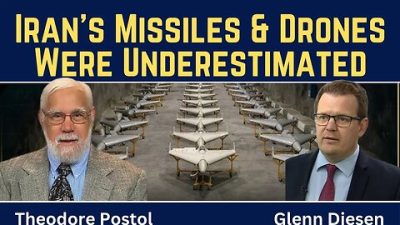
Theodore Postol: Iran’s Missiles & Drones Were Underestimated
or go to
Aletho News Archives – Video-Images
From the Archives
What is the Israeli Lobby in Australia Doing in Interfaith Dialogue?
By Ali Kazak | Dissident Voice | October 11, 2015
For years Israel and its lobby around the world have been trying to normalise their relations with Arabs and Muslims without solving the Palestine Question.
One of the methods they resorted to in the last few years is using human rights and community organizations such as interfaith dialogue and Multiculturalism to achieve this objective and to: isolate the Palestinians, marginalise the Palestine question, end Israel’s isolation, and prevent criticism of Israel, knowing that these organisations will be the first to stand against Israel’s violations, racial and religious discrimination.
The group responsible for this task in Australia is The Australia/Israel & Jewish Affairs Council (AIJAC); its Director of International & Community Affairs, Jeremy Jones is in charge of lobbying religious community organizations, specifically Muslims and Christians. Consequently he convened the Faith Communities for Reconciliation, founding participant in the Australian Partnership of Religious Organisations and the Australian National Dialogue of Christians, Muslims & Jews.
AIJAC is a private political propaganda group. It is recognised as the main Israeli lobby in Australia. It coordinates its activities and works intimately with the Israeli embassy in Canberra and different institutions in Israel. It is privately funded by some Jewish businessmen. It monitors closely Australian politicians, the media, ethnic and religious groups, (especially Arabs and Muslims), unions and academics on their stands towards Israel and the Palestine question. … continue
Blog Roll
 Aletho News
- The killing of three Indonesian soldiers in Lebanon should remind Jakarta that Israel does not want peace
- Defeated and delusional: Netanyahu’s remarks reveal $80bn war failure, says analyst
- Iran’s friends are about to make life much more difficult for Israel and the US
- The war of liberation of the Arab and Islamic peoples expands across the Gulf
- Envoy warns UN on Trump’s threat to ‘obliterate’ Iran’s civilian infrastructure
- The Larak Corridor: Iran’s Rial Gate With No US, No Israel, and No Way Around
- ‘Economic terrorism’: Steel facilities hit again in US-Israeli strike
- ‘War Crime’: Iran condemns attacks on Arak, Ardakan nuclear sites
- Two-thirds of Americans want quick end to Iran war even if goals unmet
- Trump to Give “Important Update on Iran” Wednesday in Prime-Time Speech
- If Americans Knew
- Gaza families reunite years after babies evacuated amid Israel’s war
- International Rescue Committee warns Gaza’s children face grave protection risks
- Iran’s Alleged 47-Year War on America: Debunking the 1,050 American Deaths Canard
- Israel wants US to bomb more of Iran’s civilian structures (113,000 is not enough) – Not a ceasefire Day 173
- Ann Coulter Rips Into Fox News for Iran War Coverage
- Joe Kent Urges Americans To Call White House and Congress To Object To Sending Troops Into Iran
- DNC Resolution to Reject AIPAC Funding Puts Democratic Leaders in the Hot Seat
- Swedish foundation to build 400 schools as over 650,000 Gaza children remain without education for 2 years
- Israeli army admits photshopping image of slain Lebanese journalist
- This is how Israel is systematically killing health workers under the cover of war in Lebanon
- No Tricks Zone
- New Study Finds Warming Saves Lives…Cold Temperatures 12 Times More Deadly Than Excess Heat
- German Science Blog Accuses PIK Climate Institute Of Hallucinating Climate Tipping Points
- Devastating Assessment Of Comirnaty Vaccine By Former Senior Pfizer Europe Toxicologist
- New Study: CO2 Is ‘Effectively Negligible’ As An Explanatory Climate Change Factor Since 2000
- Former Pfizer Toxicologist Dr. Helmut Sterz Tells Bundestag Hearing Pfizer Vaccine Should Have Never Been Approved
- Energy Expert: Germany’s Nuclear Phaseout Was A “500 Billion Euro Mistake”
- New Research: South Australia’s Mid-Holocene Sea Surface Temperatures Were 4°C Warmer Than Today
- Storing Green Energy To Last Germany 10 Days Would Require A 60-Million Tonne Battery
- New Studies: UK Sea Levels Were 4 Meters Higher Than Today During The Mid-Holocene
- Destructive Green New Deal: German Energy And Metal Group Warns Of Drastic Crisis
 Aletho News