TPP: Big Pharma’s Big Deal
By Joyce Nelson | CounterPunch | October 7, 2015
We still don’t know all the details of the Trans-Pacific Partnership (TPP) trade deal tentatively agreed to on Oct. 5 by negotiators from 12 Pacific Rim countries, but already critics are slamming it for many reasons, including its generous concessions to the pharmaceutical industry.
Doctors Without Borders claims the TPP will “go down in history as the worst trade agreement for access to medicines in developing countries.” [1] That’s because the TPP will extend patent protection for brand-name drugs, thereby preventing similar generic drugs (which are far less costly) from entering the market. This will drive up the prices.
Judit Rius Sanjuan, legal policy adviser for Doctors Without Borders, told vox.com that TPP creates patent-related obligations in countries that never had them before. People in “Peru, Vietnam, Malaysia, and Mexico” will be especially affected, she said. “They’ll face higher prices for longer periods of time.” [2]
Ruth Lopert, a professor at George Washington University, told Bloomberg News that provisions in the TPP agreement will affect health-care budgets and drug access in all signatory countries, but especially the poorest. “She said as many as 40,000 people in Vietnam, the poorest country in the agreement, could stop getting drugs to fight HIV because of provisions that will boost the price of [pharmaceutical] therapy.” [3]
Other countries like Canada will also be hit with higher costs. The Council of Canadians says that if the TPP is ratified, “[p]harmaceutical patents will be extended, delaying the release of more affordable generic drugs and adding $2 billion to our annual public health care bill.” [4] In the U.S., many people already cannot afford to pay for the expensive medicines that could save their lives, and they try to access generics available elsewhere.
Extending patent rights for life-saving drugs is an obvious gift to Big Pharma. Conor J. Lynch at opendemocracy.net has called it “a clear corporate handout that would greatly affect international access and most definitely cause preventable deaths. The clear objective here is to increase industry profits, plain and simple. This is not surprising, that’s what private industry does, but there is a serious moral dilemma here.” [5] That moral dilemma is made even more apparent by recent findings.
Tax Cheats
In an ironic coincidence, the TPP agreement was reached on the same day that a damning report on corporate tax-avoidance – Offshore Shell Games 2015 – was released by Citizens for Tax Justice and the US Public-Interest Research Group Education Fund. The report reveals the extent to which top U.S. companies use tax havens like Bermuda, Luxembourg, Cayman Islands, and the Netherlands to set up “tax haven subsidiaries” that are usually little more than a post-office box.
Of the top 30 Fortune 500 companies with the most money held in offshore tax-havens, nine are pharmaceutical companies: Pfizer ($74 billion held offshore), Merck ($60 billion), Johnson & Johnson ($53.4 billion), Proctor & Gamble ($45 billion), Amgen ($29.3 billion), Eli Lilly ($25.7 billion), Bristol Myers Squibb ($24 billion), AbbeVie Inc. ($23 billion), and Abbott Laboratories ($23 billion). [6]
Concerning Pfizer, the world’s largest drug maker (declared profits of $22 billion in 2013), the report states: “The company made more than 41 percent of its sales in the U.S. between 2008 and 2014, but managed to report no federal taxable income for seven years in a row. This is because Pfizer uses accounting techniques to shift the location of its taxable profits offshore. For example, the company can transfer patents for its drugs to a subsidiary in a low- or no-tax country. Then when the U.S. branch of Pfizer sells the drug in the U.S., it ‘pays’ its own offshore subsidiary high licensing fees that turn domestic profits into on-the-books losses and shifts profit overseas.”
Overall, the study found that the 500 largest U.S. companies hold more than US$2.1 trillion in accumulated profits offshore. “For many companies, increasing profits held offshore does not mean building factories abroad, selling more products to foreign customers, or doing any additional real business activity in other countries,” but simply establishing a PO box.
Some companies use the money supposedly “trapped” offshore as “implied collateral” in order to borrow funds at negligible rates for investing in U.S. assets, paying dividends to shareholders, or repurchasing stock.
Of course, as the report makes clear, “Congress, by failing to take action to end this tax avoidance, forces ordinary Americans to make up the difference. Every dollar in taxes that corporations avoid by using tax havens must be balanced by higher taxes on individuals, cuts to public investments and public services, or increased federal debt.”
The report finds that, through a variety of tax-avoidance measures, an estimated US$620 billion in U.S. taxes is collectively owed by the 500 largest companies with headquarters in the U.S.
Corporate Coup
Now the TransPacific Partnership – which is being called “NAFTA on steroids” – would award Big Pharma and other multinationals even more corporate “rights” in more countries, including the controversial investor-state dispute settlement (ISDS) mechanism by which they can sue signatory governments for regulatory changes that affect their profits.
As the Canadian website rabble.ca notes: “The Canadian government is currently being sued through NAFTA by Eli Lilly, an American pharmaceutical company, for invalidating the firm’s patent extensions on two mental health drugs. A Canadian Federal Court decided in 2010 that the patent extensions had not delivered the promised benefits and the drugs should therefore be opened up to generic competition. Generic drugs significantly reduce the cost for end users, but Eli Lilly cried foul and launched an ISDS claim against the government, demanding US$500 million in compensation for lost profits. The case is still in progress, but regardless of the outcome we can expect the TPP to lead to similar ISDS disputes. Powerful multinational pharmaceutical companies will use any available means to cling to over-priced drug monopolies. Greater intellectual property protections in the TPP will give these companies an even stronger quasi-legal basis to sue governments and crowd out generic [drug] competition.” [7]
The final text of the TransPacific Partnership agreement won’t be available for at least a month, likely weeks after the Canadian federal election on October 19. The details will undoubtedly reveal more generous concessions to the multinationals. It will be up to the elected legislators in all twelve countries to approve or reject the TPP. In Canada, NDP leader Tom Mulcair has pledged to scrap the deal if elected as Prime Minister, explaining that the Stephen Harper government had no mandate to sign it during an election campaign when it is merely a “caretaker” government.
The U.S. website zerohedge.com calls the Trans-Pacific Partnership “a Trojan horse” and “a coup by multinational corporations who want global subservience to their agenda.” In no uncertain terms, it adds: “Buyer beware. Citizens beware.” [8]
Footnotes/Links:
[2] Julia Belluz, “How the Trans-Pacific Partnership could drive up the cost of medicine worldwide,” Vox, October 5, 2015.
http://www.vox.com/2015/10/5/9454511/tpp-cost-medicine
[3] “Pacific Deal Rewrites Rules on Trade in Autos, Patented Drugs,” Bloomberg News, October 5, 2015.
http://www.bloomberg.com/news/articles/2015-10-05/pacific-deal-rewrites-rules-on-trade-in-autos-patented
[4] Council of Canadians, “Tell party leaders: Reject the TPP,” October 6, 2015.
[5] Conor J. Lynch, “Trans-Pacific Partnership’s Big Pharma giveaway,” Open Democracy, February 14, 2015.
http://www.opendemocracy.net/conor-j-lynch/transpacific-partnership%E2/80%/99s-big-pharma-giveaway
[6] http://ctj.org/ctjreports/2015/10/orrshore_shell_games_2015.php//executive
[7] Hadrian Mertins-Kirkwood, “Trans-Pacific Partnership a big win for corporate interests,” Rabble.ca, October 6, 2015.
[8] Tyler Durden, “Trans-Pacific Partnership Deal Struck As ‘Corporate Secrecy’ Wins Again,” Zero Hedge, October 5, 2015.
http://www.zerohedge.com
American False Flags That Started Wars
By Robert Fantina | Blacklisted News | September 9, 2015
KITCHENER, Ontario — As this is being written, Congress is experiencing extensive and dramatic hand-wringing as it decides between doing what is best for the country and the world or doing what is best for the American Israel Political Affairs Committee. This is no easy task for members of Congress, especially Democrats who, on the one hand, want to assure a “victory” for President Barack Obama, but who are also loathe to displease the Israeli lobby. Whether preventing a war factors into their deliberations is not known.
AIPAC and its countless minions in Congress are painting the recent agreement reached between Iran and the P5+1 (China, France, Russia, the United Kingdom, and the United States, plus Germany), as nothing short of the end of Israel.
If this deal preventing Iran from developing nuclear weapons is approved, they warn darkly, Iran will secretly develop nuclear weapons. This will mean the destruction of Israel, they say. But if it isn’t approved, Iran will develop such weapons. This, they say, will also mean the destruction of Israel. Feel free to re-read those sentences whenever time allows.
From this point of view, the only alternative is war, with the ostensible purpose of destroying Iran’s nuclear capabilities — capabilities that the Islamic Republic has always said are for peaceful energy purposes. Yet the risk of Iran ever having nuclear weapons is too great. If it did obtain them, then Israel would have a hostile nation to counterbalance its power in the Middle East, and, of course, it doesn’t want that competition. And whatever Israel wants, the U.S. wants. Hence the fear-mongering.
This is a tried-and-true method in the U.S. of getting wars started: Tell lies about some situation that can be construed as a threat to U.S. security (or in this case, Israel’s national security, which seems to be threatened by just about everything), get the populace riled up with jingoistic fervor, watch pompous politicians proclaim their great patriotism on the evening news, and then go bomb some country or other.
The U.S. again gets to flex its international muscle, the citizenry is, for some bizarre reason, proud of the destruction the country has caused, the weapons manufacturers spend all their time tallying their astronomical profits, and all is once again right in the twisted world of U.S. governance.
A few examples will suffice to show that this means of starting wars has been used repeatedly. The examples discussed herein do not by any means represent an exhaustive list, but only show that lying to the world to make the citizenry believe that the U.S. or its citizens had been threatened in some way, and that war was the only response, is business as usual in the U.S.
The War of 1812 (June 18, 1812 – Feb. 18, 1815)
Less than 40 years after the American Revolution, the still-new U.S. government felt constrained in areas of international trade, despite tremendous growth in such trade in the years leading up to the war. In 1811, Britain issued an Order-in-Council, excluding American salted fish from the West Indian colonies and imposing heavy duties on other U.S. imports. This, the U.S. could not countenance.
Additionally, although the heady concept of Manifest Destiny would not actually be defined for several more years, territorial expansion was always on the minds of the leaders of the fledgling nation. Canada, with its rich abundance of natural resources and wide expanses of land, was coveted.

The Battle Lake Borgne Hornbrook, War of 1812.
Yet trade and expansion were not foremost on the minds of the populace, at least not sufficiently for them to support a war. But many nations at this time had a policy of impressment, wherein the ships of another country were boarded, and their sailors kidnapped and forced to work for the kidnapping navy. This was something with which the common man and woman could identify. Although this wasn’t a common occurrence, it was exaggerated and combined with the trade issues to introduce the rallying cry of “Free Trade and Sailor’s Rights,” Carl Benn wrote in his 2003 book “Essential Histories: The War of 1812.” However, this wasn’t a simple, spontaneous cry of justice. It seems to have been promoted by annexationists running the government, and was sufficient for the U.S. to start an unsuccessful war against Canada.
Spanish-American War (April 25, 1898 – Aug 12. 1898)
Fast-forward to the end of the 19th century. On Feb. 15, 1898, the battleship Maine exploded in Havana harbor, killing 266 men. According to Hyman George Rickover, in his 1976 book “How the Battleship Maine was Destroyed”:
“Lieutenant Frank F. Fletcher, on duty at the Bureau of Ordnance, wrote in a personal letter to [Lieutenant Albert] Gleaves: ‘The disaster to the Maine is the one topic here now. Everybody is gradually settling down to the belief that the disaster was due to the position of the magazine next to the coal bunkers in where there must have been spontaneous combustion.’”
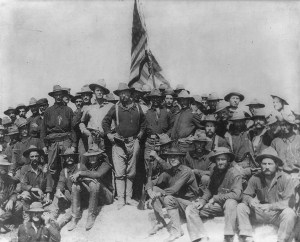
Theodore Roosevelt (center front, just left of the flag) and his “Rough Riders,” 1898.
The official inquiry into the disaster, however, concluded that an underwater mine had been the culprit. With the battle cry “Remember the Maine,” the U.S. quickly declared war on Spain.
But this “inquiry” was more than a bit flawed. Two widely-recognized experts in ordnance volunteered their services for the investigation, but were not invited to participate. One of them, Prof. Philip Alger, had greatly displeased Secretary of the Navy, and future president, Theodore Roosevelt, when he commented on the disaster in an interview for the Washington Evening Star a few days after it happened. He said, in part, the following, as reproduced by Rickover:
“As to the question of the cause of the Maine’s explosion, we know that no torpedo that is known to modern warfare, can of itself cause an explosion of the character of that on board the Maine. We know of no instances where the explosion of a torpedo or mine under a ship’s bottom has exploded the magazine within. It has simply torn a great hole in the side or bottom, through which water entered, and in consequence of which the ship sunk. Magazine explosions, on the contrary, produce effects exactly similar to the effects of the explosion on board the Maine. When it comes to seeking the cause of the explosion of the Maine’s magazine, we should naturally look not for the improbable or unusual causes, but those against which we have had to guard in the past.”
But Roosevelt was anxious to establish the U.S. as a world power, especially in terms of its Navy. By accusing Spain of blowing up the ship, he had the perfect excuse to launch the Spanish-American War.
The Vietnam War (major U.S. involvement: 1964 – 1975)
Off the coast of China and northern Vietnam is the Gulf of Tonkin, which was the staging area for the U.S. Seventh Fleet in the early 1960s. On the evening of Aug. 4, 1964, the U.S. destroyers Maddox and the C. Turner Joy were in the gulf, when the Maddox’s instruments indicated that the ship was under attack or had been attacked. Both ships began firing into the darkness, with support from U.S. warplanes. However, they “later decided they had been shooting at ghost images on their radar. … The preponderance of the available evidence indicates there was no attack.”

U.S. Huey helicopter spraying Agent Orange over Vietnam. (Photo by the U.S. Army Operations in Vietnam R.W. Trewyn, Ph.D.)
Yet something needed to be done about Vietnam, with anti-Communist hysteria still rampant in the U.S., and this gave Congress the perfect ploy to escalate the war. This non-incident was presented to the world as an act of aggression against the U.S. Congress quickly passed the Gulf of Tonkin resolution. By the end of the following year, the number of U.S. soldiers invading Vietnam increased from 23,000 to 184,300. Eleven years later, with over 55,000 U.S. soldiers dead, hundreds of thousands wounded, and, by conservative estimates, 2,000,000 Vietnamese dead, the U.S. fled Vietnam in defeat.
The Gulf War (Aug. 2, 1990 – Feb. 28, 1991)
In order to gain support for the Gulf War of 1990, Congress and President George Bush relied heavily on what is commonly referred to as the Nayirah testimony. In early October 1990, a 15-year-old girl referred to only as “Nayirah,” who claimed to have been a hospital volunteer, testified of seeing babies dumped by Iraqi soldiers from hospital incubators. This, in the eyes of Congress and the president, highlighted the monstrosity of Iraq, and was widely used to gain support for the war.
However, like nearly all of the information the government feeds to the citizenry to start its wars, this testimony was all lies. “Nayirah” was actually the daughter of the Kuwaiti ambassador to the U.S. She later admitted that she had once visited the hospital in question, but only for a few minutes. She did see an infant removed from an incubator, but only very briefly. A group called Citizens for a Free Kuwait had hired one of the world’s foremost public relations firms, Hill and Knowlton, to create the illusion of legitimacy for an invasion. They coached “Nayirah” on what to say and how to say it when she appeared before Congress.
We will do no more than mention the U.S.’s drafting of a letter for Grenada to send to the U.S., requesting military intervention when that small island nation’s government was overthrown in 1983. Nor will we dwell on the weapons of mass destruction that Iraq was said to possess in 2002, which justified in the eyes of U.S. citizens the disastrous 2003 invasion of that nation. But as we look at this ugly record of lies that the U.S. has used to expand its territory, power and/or influence around the world, we must consider that it is once again using the same tactics to march the nation toward war with Iran.
The U.S. for generations was successful in deceiving its citizens, and a good part of the world, that it was a beacon of freedom and peace, despite the fact that it has been at war for most of its bloody existence. That myth began to crack during the Vietnam War, broke into pieces with the Iraq War, and may have been dealt a fatal blow by the U.S.’s support of Israeli atrocities in 2014.
Regardless of the outcome of the congressional vote on the Iran agreement, the U.S. will find itself less able to lie its way into corporate wars in the future. That capacity diminished during the lead-up to the Iraqi invasion, and while no one ever went broke betting on the gullibility and short-term memory of the U.S. citizenry, people are beginning to wake up. When they finally do, much of the carnage in the world will end. That day cannot come soon enough.
Moscow ready for more sanctions, regardless of Ukraine crisis – Foreign Ministry
RT | September 9, 2015
Russia has no illusion about sanctions being lifted and expects them to be stiffened in future, regardless of developments in Eastern Ukraine. That’s according to a leading Russian diplomat, who says Moscow can live under continuous western pressure.
“We believe that in certain directions, notwithstanding of the developments in Donbass, we should expect toughening of the sanctions pressure,” Russian Deputy Foreign Minister Sergey Ryabkov said at the Russia Arms Expo 2015 in Nizhny Tagil on Wednesday.
According to Ryabkov, the new set of sanctions introduced by Washington last week against Russian companies, including arms exporter Rosoboronexport, “mirrors the policy of complicating operations of the Russian military-industrial complex and all of the mechanism of government.”
Sanctions come in handy as a “true instrument of aggressive foreign policy” aimed at Russia, the diplomat said.
“Russia’s independent and self-sufficient foreign policy, its decisiveness to protect its sovereignty, and the consolidation of the people with the country’s leadership serve as a thorn in the side of our opponents,” Ryabkov said.
“We presume that the sanctions are there for the long haul,” Ryabkov said. “There are no reasons or illusions that sanctions are going to be lifted in the short term, at least not in the Foreign Ministry.”
“When it comes to international financial services, our colleagues from the US and the EU are set to expand their effort to seal off all capabilities. We understand that and we have to learn how to operate in the given situation,” Ryabkov said, insisting that sanctions will fail to gain the desired effect.
“We’re sorry the US has not learned that truth so far.”
Russian Economic Development Minister Aleksey Ulyukaev said Moscow is going to seek a “symmetrical answer” to American sanctions imposed on September 2.
Washington imposed sanctions on a number of Russian, Chinese, Syrian, Turkish, Sudanese and Iranian companies, believed to be involved in activities which, according to Washington, go against its Nonproliferation Act in regard to Iran and Syria.
“These are not sectoral sanctions, they are personalized, therefore we would consider some kind of a symmetrical answer,” Ulyukaev said.
In March 2014, the EU, the US and some other countries imposed individual sanctions against 21 Russian and Ukrainian officials, subjecting them to asset freezes and travel bans. Within a year, the list was extended to 150 people, including Russian Deputy Prime Ministers Dmitry Kozak and Dmitry Rogozin, as well as presidential aide Vladislav Surkov and 37 entities that, according to the EU, are “responsible for actions which undermine or threaten the territorial integrity, sovereignty and independence of Ukraine.”
The restrictions have been prolonged until January 31, 2016.
To reciprocate, in August 2014 Moscow introduced a ban on importing meat, dairy, fruit, and vegetable products from countries that have imposed sanctions on Russia over the Ukraine conflict. The countries included EU member states and Norway, US, Canada and Australia.
European Union sanctions against Russia include restrictions on lending to major Russian state-owned banks, as well as defense and oil companies. In addition, Brussels imposed restrictions on the supply of weapons and military equipment to Russia as well as military technology, dual-use technologies, high-tech equipment and technologies for oil production. No sanctions were imposed against Russia’s gas industry.
Deadly Cheering for War in Ukraine by Western Press
By Roger Annis | CounterPunch | August 21, 2015
Two weeks ago, the Washington Post published an editorial saying that the governments of the NATO military alliance are being too soft on Russia over the crisis in Ukraine. The editors want even more aggressive support to the governing regime in Kyiv than what is already being given.
In particular, the newspaper objects to the ceasefire agreement that it says beleaguered Kyiv was pressured to sign in Minsk, Belarus on February 15, 2015. The editorial was headlined, ‘Putting Ukraine in an untenable position’ and its reads, “Yet now the German and French governments have enlisted the help of the Obama administration in seeking unilateral Ukrainian compliance with Minsk 2’s onerous political terms, which if fully implemented would implant a Russian-controlled entity inside Ukraine’s political system.”
The editors of the Post are pulling off a ruse. Kyiv has not abided by a single clause of Minsk-2, and the regime’s foreign backers, including in the editorial offices of the nearly all of Western media, keep a careful silence on the subject.
Points ten, eleven and twelve of the Minsk-2 agreement read as follows:
10. Pullout of all foreign armed formations, military equipment, and also mercenaries from the territory of Ukraine under OSCE supervision. Disarmament of all illegal groups.
11. Constitutional reform in Ukraine, with a new constitution to come into effect by the end of 2015, the key element of which is decentralisation (taking into account peculiarities of particular districts of Donetsk and Luhansk oblasts, agreed with representatives of these districts), and also approval of permanent legislation on the special status of particular districts of Donetsk and Luhansk oblasts in accordance with the measures spelt out in the attached footnote, by the end of 2015.
12. Based on the Law of Ukraine “On temporary Order of Local Self-Governance in Particular Districts of Donetsk and Luhansk Oblasts”, questions related to local elections will be discussed and agreed upon with representatives of particular districts of Donetsk and Luhansk oblasts in the framework of the Trilateral Contact Group. Elections will be held in accordance with relevant OSCE standards and monitored by OSCE/ODIHR.
So the obligations are clear, but they are being utterly disregarded by Kyiv and, as we see, by its foreign backers.
The Post‘s editorial is also a clear example of the ‘two worlds, two realities’ which prevail in the world today over the Ukraine crisis. One view sees an extreme, right-wing government in Kyiv waging a civil war against a population in the east of Ukraine which rejects Kyiv’s anti-Russia, intolerant nationalism and Kyiv’s pro-austerity embrace of the European Union. The opposite view sees ongoing Russian “invasions”, “occupations” and intervention in Ukraine. Most regretfully, the latter view is shared by a sizable body of liberal, social democratic and even pseudo-Marxist opinion in the West.
The Post editorial describes the present situation in eastern Ukraine as follows: “[Russia’s] forces continue to shell and rocket Ukrainian positions on a daily basis. Far from pulling back heavy weapons or withdrawing its troops as required by the agreement, it has built military bases and deployed 9,000 troops inside Ukraine and stationed another 50,000 just outside the border, according to Ukrainian and NATO officials.”
Funny, on the Post‘s extensive ‘Ukraine crisis‘ compilation of articles, one searches in vain for a single news report confirming the editors’ claims of Russian military intervention in eastern Ukraine and ongoing shelling and bombardment. The closest we get to that are reports by Post journalists embedded with the Ukrainian army. But their reports do not come close to verifying the editors’ claims; they consist merely of war-tourism style observations and photos.
So let’s pause for a moment to reflect. The Washington Post (and some other mainstream media) publishes articles and photo stories by journalists in and around Kyiv-controlled eastern Ukraine. But the Post‘s journalists can’t seem to provide examples of how “Russia’s forces continue to shell and rocket Ukrainian positions on a daily basis”. Surely, if the situation is that severe, there must be no shortage of visual examples to provide to readers? And surely the U.S. government can provide satellite images to mainstream media of the “9,000 Russian soldiers” in eastern Ukraine as well as other examples of Russian intervention?
Unless… it’s all, or mostly, make believe.
On the rebel side of eastern Ukraine, there is no shortage of examples of grim, daily shelling by Ukrainian armed forces, which are backed by NATO. Alas, and not by accident, such reports never, ever grace the pages of the Western media.
Canadian opposition parties cheer for more war
The blind, anti-Russia stand of the Washington Post is shared by the parties of the political mainstreams in the United States and Canada.
In Canada, the two main opposition parties are not only aligned with the pro-Kyiv, Conservative Party government in Ottawa. Similar to the Post editors in the U.S., they criticize the federal government in Ottawa for being too soft on Russia.
The New Cold War.org website has recently reported the pro-war views of the leader of the social-democratic New Democratic Party. Tom Mulcair presented his views to the first televised debate of the federal election in Canada on August 6. “We are proud members of NATO,” he declared. Mulcair criticized Canadian Prime Minister Stephen Harper for not adding even more Russian government and business leaders on the government’s war-threatening sanctions list. (The Canadian election will take place on October 19.)
Concerning the Liberal Party in Canada, it appreciates and backs the Harper government’s support of Kyiv, but it also criticizes both the government and the NDP for being too soft on Russia and the “pro-Russian separatists” in eastern Ukraine.
Key ideologues of Liberal Party foreign policy spoke to a public forum on Ukraine in Toronto on August 11. You can view excerpts of the forum here on YouTube, and you can read a favourable print report of the event here. A key demand on the Liberal Party wish-list for Ukraine is that the Canadian government begin to provide heavy weaponry to the Ukrainian army.
One of Canada’s better-known journalists, Dianne Francis, provides a particularly zany version of the “soft on Russia” argument in an article published by the neo-conservative Atlantic Council on August 17. She writes: “World attention focuses on ISIS and Iran, with its half an atomic weapon. But the biggest geopolitical issue is Vladimir Putin, backed by thousands of nuclear weapons, who is gradually conquering Ukraine, a democracy with 45 million people the size of Germany and Poland combined.
“In just over a year, Russia has seized nine per cent of Ukraine, killed 6,200, wounded 30,000, displaced 1.38 million people and shot down a commercial airliner with 298 people aboard.
“Even so, European and American retaliation has been soft, and ineffective…”
Only last month, Francis published several articles praising as heroes Ukraine’s extreme-right and neo-Nazi paramilitary battalions. She is Distinguished Professor at the Ted Rogers School of Management at Ryerson University in Toronto and a former editor of the National Post.
Canada is already providing military training to Ukraine’s army, along with non-lethal (sic) military equipment and spying and communication equipment and data. The government and the media support or turn a blind eye to the fundraising going on in Canada by Ukrainian ultranationalists to purchase military equipment for the war. Some of the purchased or supplied equipment serves the ongoing shelling of civilian areas of eastern Ukraine.
The Minsk-2 ceasefire provides a roadmap to end the hostilities in eastern Ukraine. A real ceasefire could open the road to resolution of the large social, economic and political issues that have split Ukraine politically and driven a sizable portion of the its population into revolt. But for now, the cheering for war taking place in Western capitals and editorial offices is a major obstacle for achieving all this.
Roger Annis is an editor of the website The New Cold War: Ukraine and beyond. On June 12, he gave a talk in Vancouver, Canada reporting on his visit to Donetsk, eastern Ukraine in April 2015 as part of a media tour group. A video broadcast of that talk is here: The NATO offensive in eastern Europe and the class and the national dynamics of the war in eastern Ukraine.
No room for anti-Israel commentary in Canadian politics
By Hadani Ditmars | RT | August 13, 2015
It would seem the height of Orwellian doublespeak to eliminate a political candidate for calling a war crime a war crime. And all the more so if you’re a leading member of Canada’s New Democratic Party.
And yet that’s exactly what happened this week when Nova Scotian Morgan Wheeldon, an NDP candidate for the riding of Kings-Hants, was forced to step down when a Conservative troll found a statement on his Facebook page from 2014 calling Israel’s bombardment of Gaza a “war crime.”
I suppose that party brass doesn’t read much Orwell, or UN reports on actual Israeli war crimes in Gaza – but perhaps it should become required reading.
Especially if you set yourself up as the main ‘progressive’ opponent to the ruling Conservative Party, whose leader Stephen Harper carries on what is surely the creepiest political ‘bromance’ with Israeli Prime Minister Benjamin Netanyahu bar none.
And yet in last week’s televised leaders debates it was clear that while the two parties differ on the controversial Harper backed C-51 ‘anti-terror legislation’ the NDP and the Conservatives were duking it out for the pro-Israel vote. When Harper needled him, NDP leader Thomas Mulcair responded that “Israel has no better friend than the NDP.” It seems he was correct.
The damning out-of-context statement on Wheeldon’s Facebook page in the wake of Israel’s 2014 bombing of Gaza that killed over 2,200 Palestinians was this:
“One could argue that Israel’s intention was always to ethnically cleanse the region — there are direct quotations proving this to be the case. Guess we just sweep that under the rug. A minority of Palestinians are bombing buses in response to what appears to be a calculated effort to commit a war crime.”
While the UN itself has accused Israel of war crimes during ‘Operation Protective Edge’, the NDP cried foul, stating:
“Our position on the conflict in the Middle East is clear, as Tom Mulcair expressed clearly in the debate. Mr. Wheeldon’s comments are not in line with that policy and he is no longer our candidate.”
So that’s that then. Call a war crime a war crime on your personal Facebook page, and there’s no room for you in Canada’s ‘progressive’ party.
What has happened to Canada, and for that matter to the NDP? Their take-no-prisoners approach to criticism of Israeli actions in Gaza and the West Bank has recent precedents, and they all lead back to Thomas Mulcair.
In 2008, Mulcair led a caucus revolt against then leader Jack Layton when he criticized the Harper government’s decision not to participate in the United Nations Conference on Racism on the grounds that its mention of certain Israeli violations of international law was ‘anti-Semitic’.
Mulcair successfully muzzled NDP criticism of the January 2009 Israeli bombardment of Gaza, which killed 1,400 civilians, as well as the subsequent Israeli attack on the Gaza Flotilla, which killed nine.
And in 2010, Mulcair joined forces with the Conservatives and the Liberals in calling for the ouster of long time MP Libby Davies, (who has since resigned from politics) as NDP House Leader after her comments to a journalist that occupation of Palestine had begun in 1948.
While the NDP’s position is more than apparent to keen observers (as author Yves Engler notes, even NDP pioneer Tommy Douglas was an ardent Zionist), it’s odd that Israel has suddenly become an election issue in Canada in the midst of recessionary times.
Is freedom of speech completely dead in Canada? Can no one criticize Israeli war crimes without fear of repercussions?
It would seem that only Elizabeth May, leader of the tiny but scrappy Green Party, is free to speak her mind on foreign policy issues. Her candid comments have helped the Green Party usurp the NDP’s former role of ‘unofficial opposition’ to the ruling Conservatives. And indeed, after Paul Manly was barred from running for the NDP on the grounds that his comments about Israel incarcerating his aging father John Manly (captured with other crew members of a ship bearing aid to besieged Gaza) were of concern to the party executive, he joined the Green Party.
The general mood of muzzling any dissent against Israel would seem at odds with Canada’s allies. Comparing the situation here to say that of the UK – where Labour MP’s were asked to vote in favor of a Palestinian state, the prime minister was forced (via growing public opposition) to resign as patron of the Jewish National Fund and Senior Foreign Office Minister Baroness Sayeeda Warsi chose to resign over the government’s policy on Gaza – makes Canada look backward at best.
In an international context, it would now appear that Canada has the least control of any G7 country over its own foreign policy. Perhaps even less than in the US where tax dollars go more directly to maintaining the Israeli occupation of Palestine. Bizarrely, no matter who wins the upcoming election, Canada’s Middle East policy now seems to be firmly based on Likudist agendas.
Hadani Ditmars has been reporting from Iraq since 1997 and is the author of Dancing in the No Fly Zone. Her next book Ancient Heart is a political travelogue of historical sites in Iraq.www.hadaniditmars.com
When Parents Must Break the Law to Keep Their Children Alive
By Carey Wedler | ANTIMEDIA | July 29, 2015
In the last several years, stories of cannabis oil helping epileptic children have populated the news cycle. Around the world, CBD (cannabidiol) treatments are gaining popularity due to their ability to rapidly alleviate seizures without making children “high.” Though these treatments are increasingly available in American states with legalized recreational and medical cannabis, they are not always freely available. Facing medical restrictions, one mother in Canada has vowed to treat her child—even if her doctor refuses to renew their prescription.
The Wilkinson family, from just outside Calgary, Alberta, resorted to CBD oil to treat their nine-year-old daughter. Mia suffered from crippling seizures due to Ohtahara syndrome. Her mother, Sarah Wilkinson, explained that Mia “… sometimes had seizures that would last up to 23 hours and she would have to be put into a medically-induced coma.”
The dozens of pills she was prescribed failed to inhibit seizures and decreased her quality of life, so the Wilkinson’s were immensely relieved when a neurologist approved cannabis oil to treat Mia—and it worked. As Anti-Media reported,
“They said her EEG was comparable to someone with a benign form of epilepsy ─ that’s never happened before,” Sarah said. Miraculously, she was ultimately seizure free for 18 months, weaned off of 30-40 pharmaceuticals a day. Mia has also learned to walk and at nine years old, said her first words like “yes,” “no” and “Mama.” “And ‘Mama’ is all I hear anymore. I bawled when I first heard it,” Sara recounted.
The family was devastated to learn that while medical marijuana is legal in Canada, their doctor refused to renew Mia’s prescription because of resistance from Alberta Children’s Hospital. The hospital which initially allowed Mia to ingest cannabis oil. As the doctor explained in an email to the Sarah,
“Due to the strict nature of the policy implemented here at Children’s, I am not allowed to fill the forms for renewal of medical marijuana.”
Though Health Canada, the country’s nationalized healthcare system, does not acknowledge cannabis as a legitimate treatment, the country’s court system ruled in June that people may use it to treat medical conditions. However, hospitals write their own policies regarding use, and Alberta Children’s changed its stance, leaving doctors to either buck policy or fall in line.

Sarah Wilkinson with her daughter Mia
Wilkinson’s experience is not an isolated case. Canadian mother Kendra Myhre was forced to seek alternative treatments for her child’s Dravet syndrome—which causes severe seizures—when traditional methods failed to ease his symptoms. “We didn’t want to see him suffer and put him in a casket before the age of five,” Myhre said, explaining her decision to seek cannabis treatment. “We wanted to give him the best possible life for as long as he’s got, which probably won’t be long.” She recently found a doctor willing to write a prescription.
Even as cannabis laws evolve in the United States, innumerable families risk legal repercussions for treating their children. In Kansas, cannabis activist Shona Banda faces 30 years in prison for treating her Crohn’s disease with cannabis oil and sharing her method of treatment with others. Her son was taken from her, and her home raided after he touted cannabis oil’s benefits for his mother at an anti-drug presentation.
Convoluted regulations also make treatment difficult. One Des Moines mother is allowed to possess oil to treat her epileptic son but must take him outside to the parking lot of his care facility twice a day to administer treatment. A New Jersey family is suing their school district for their daughter’s right to administer cannabis treatment for epilepsy and autism at school.
Other families are picking up and moving to states that do allow medical cannabis use. This is the case with Hillary Rayburn, who moved from Oklahoma to Colorado to obtain cannabis for her child’s epilepsy.
Though individuals and families still face heart-wrenching restrictions, the trend toward cannabis legalization has already begun. Parents who engage in civil disobedience by treating their children not only help change the perception of the treatment but help chip away at the decaying infrastructure of prohibition. By standing up to unjust and inhumane laws in the face of increasing medical research on cannabis, parents are helping to change the landscape of the Drug War and medicine. Kids are hopping on the cannabis civil disobedience train, as well. Speaking at a recent symposium for medical cannabis research, 15-year-old Coltyn Turner explained that he’d “rather be illegally alive [by using cannabis oil] than legally dead.”
Perhaps the most touching aspect of the fight for legalized medical cannabis is the persistence of parents who refuse to let their children suffer. “You’d be amazed at the networking parents can do when they have children with such a fatal disability, and the ends they are willing to go to for their children,” Myhre told Vice News.
As for Wilkinson, she, too, will continue to treat her child in spite of her lack of approval to do so. “She’s my daughter and I’m not willing to see her die because some people are uncomfortable with Cannabis as therapy,” she said.
Canadians say ‘we don’t believe you’ to Harper and Yatsenyuk fear mongering over war in Ukraine
New Cold War | July 16, 2015
While in Ottawa on an official visit on July 14, Ukrainian Prime Minister Arseniy Yatsenyuk was given several platforms by Canada’s state broadcaster, the CBC, to expound his views on the situation in his country. Yatsenyuk argued that present-day Russia threatens “global security”, which means that Canada’s security is also threatened. Therefore, goes the logic, Canada should continue to support–nay, boost its support–to Ukraine’s civil war against its population in the east of the country.
To gain some insight into the views of ordinary Canadians on this subject, read the hundreds of comments which readers and listeners of the broadcast network have posted to a CBC News article presenting Yatsenyuk’s views, here. The article is headlined, appropriately enough, ‘Ukraine crisis a threat to Canada’s security, Arseniy Yatsenyuk says’. Here are a few samples of the comments:
- How is the security of a country over 5000 miles away a risk to Canada? They are just pandering to the few Canadians that believe bill C-51 was necessary!
- We can’t let an ethnic Russian concert pianist play a concert because she might have an opinion on her countrymen being murdered, but we can give a voice and listen to a war criminal installed as dictator after a violent coup overthrowing a democratically elected government. Get out of Canada and go back to where you came from!
- I am in Canada and I absolutely do not feel threatened by Russia or by Iran for that matter. The controlled mainstream media has got to stop that propaganda to further the aims of the US and world dominance.
How many countries has Russia invaded as compared to the US? How many military bases does the US have throughout the world as compared to Russia?
Yatsenyuk wants arms so they can defend themselves. Against who? The Russians? C’mon. That would be like Canada going to war against the US. He wants arms to escalate the war. A war that will draw in the US. So who is a threat to global security? I think it’s anyone who wants to start a war with Russia.
The same with Iran. Harper and his minions say that Iran is a threat to global security. In what way? They do not have nuclear weapons. Israel does, and atomic inspectors are not allowed in for a look. But those same inspectors must be allowed into Iran and they do not have those weapons. No double standards?
Not once have I read or heard Yatsenyuk or Harper say that there must be meetings with the Russian and talk of peace proposals. This whole thing did not start with the Russians. Harper starts his peace efforts with Russia and Iran with rhetoric and sanctions. - Yes, yes, the Harper Conservatives have been screaming “the Ruskies are coming” very loudly over the years. And holy cow, am I ever scared – NOT… I’m sorry, but you can tell me that Russia intends to invade Canada all you want. It doesn’t mean I’m going to believe it. I can’t wait until this fear mongering government of ours is ousted in October…
- Too late, Arseniy Yatsenyuk. Harper tried to feed us that Kool-Aid already and nobody bought it.
The Gladys We Never Knew
By Nancy Knickerbocker | TheTyee | July 4, 2015
According to the Vital Statistics Act document entitled ”RETURN OF DEATH OF AN INDIAN,” Gladys Chapman was 12 years, 10 months, and 12 days old on April 29, 1931, when she died in Royal Inland Hospital in Kamloops. Occupation of the deceased was listed as ”Schoolgirl.” On her death certificate, Dr. M.G. Archibald reported ”acute dilation of heart” as the cause of death, with tuberculosis as the secondary cause. The duration of death was “several days.”
So, at the end, a little girl named Gladys endured days of fevered suffering — coughing, bleeding, struggling for breath — all alone, far from home, with no loved one to comfort her. She was one of the thousands of children whose deaths are acknowledged and lamented in the landmark report released last month by the Truth and Reconciliation Commission of Canada, a report that describes our country’s treatment of indigenous people as ”cultural genocide.”
The TRC has established a National Residential School Student Death Register that contains the names of 3,200 children though the estimated number of deaths is believed to be more than 6,000. Speaking at the release of the TRC report, Commissioner Marie Wilson asked the audience to empathize with the anguish felt by thousands of parents whose loved ones never came home.
“Parents had their children ripped out of their arms, taken to a distant and unknown place never to be seen again, buried in an unmarked grave, long ago forgotten and overgrown. Think of that. Bear that. Imagine that,” she said.
Gladys’s family members believe she never would have died at such a tender age had she not been forced into the Indian residential school system. A member of the Nlaka’pamux Nation, she was part of a large extended family with deep roots in Spuzzum, a small community on the Fraser River north of Hope. Her relations have a deep awareness of the damage inflicted upon generations of children and families. Gladys’s mother, Matilda, had also been taken to residential school as a girl and she knew all too well what took place there.
”Just imagine how horrible it would have been for parents and grandparents who themselves had lived through residential school abuse, watching their little ones being taken, knowing what they were going to go through,” says Gail Stromquist, Gladys’s niece.
Project of Heart
Gail and her sister Janet, like the vast majority of Canadians both aboriginal and non-aboriginal, grew up with no knowledge of the Indian residential school system. ”We played skip rope and sang the song about how in 1492, Columbus sailed the ocean blue,” Gail said. ”The myth of Columbus’s discovery of the Americas was all we learned in school, nothing about residential schools or the culture of aboriginal people before contact.”
Even though many people in their family and community were living with the terrible legacy of residential schools, the history was so deeply hidden that the sisters only recently learned about the existence of the auntie they never knew. No photos remain of Gladys, and her name was never spoken by her surviving siblings, some of whom have struggled to deal with their own devastating experiences in residential school.
Today, both Stromquist sisters are public school teachers, passionately involved in the kind of reconciliatory educational work that Justice Murray Sinclair called for among the 94 recommendations in the historic TRC report. Janet works as a district teacher for the aboriginal educational program in Langley, and Gail coordinates aboriginal education initiatives for the B.C. Teachers’ Federation. That work includes the Project of Heart, which is ongoing in almost all school districts province-wide and involves teaching and learning about the legacy of residential schools. The most powerful learning takes place when residential school survivors come into classrooms to share their personal experiences with students, who then make works of art in honour of the children who survived and those who never returned home.
The sisters’ need to learn the truth of their own family experience — and their desire to teach the truth about Canadians’ shared history — led them to do extensive research in local archives. It also led them to gently question their relatives about long-buried memories. Little by little, they pieced together Gladys’s story.

Photo of Gladys’s mother Matilda with her husband Charles Stromquist and two of their 10 children, Harold and Helmer, known as Swede.
She was one of five siblings from the same family taken to residential schools. Even though parents risked prison sentences for resisting the mandatory laws that required children be enrolled in residential schools, Glady’s mother Matilda did manage to hide one of her sons from the Indian agent. The boy was in frail health, and she feared he would not survive the deprivation and abuse at school. Despite her best efforts, she couldn’t save all her children.
Widowed at a young age, in 1929 Matilda married a Swedish immigrant named Charles Stromquist, with whom she had a long, happy marriage and 10 more children. ”We have often imagined what a comfort it must have been to Nanny after she married Grandpa Stromquist to know that no more of her children could be taken away from her to residential school,” Gail said.
Cradle of disease
Gladys was taken to Kamloops Residential School, one of the largest in Canada. An imposing brick institution run by Roman Catholic priests and the Sisters of Saint Ann, it operated from 1890 to 1978 with as many as 440 children enrolled at its peak in the 1950s. For girls, mornings were spent in class, while afternoons were spent cleaning or working in the garden or kitchen. They did not get to eat the food they grew and prepared. The boys were taught some carpentry and other trades. All students had heavy religious instruction in English. The children were forbidden to speak their native languages or practise their own spirituality. Families were allowed to visit but they rarely did because of the long distances between school and home.
Conditions in the Kamloops school were atrocious but typical of residential schools across Canada. Neglect and abuse — sexual, physical, emotional and spiritual — were rampant. Many children tried to run away, only to be caught and punished for trying to get home. Some children attempted or committed suicide. But communicable disease was the worst threat. Underfunding, overcrowding, poor sanitary and ventilation systems, inadequate clothing, malnourishment, and a lack of medical care all contributed to epidemic levels of tuberculosis and other illnesses.
The federal government had known for decades that such conditions were killing children but failed to act. In 1907, Canada’s first chief medical health officer, Dr. Peter Henderson Bryce, issued a report that exposed the appalling health standards in residential schools where, on average, TB killed 24 per cent of the children. In one school in the Prairies, the death rate was a staggering 75 per cent. The government suppressed the work of Dr. Bryce, and it wasn’t until 1922 when he retired and could publish his full report, The Story of a National Crime: An Appeal for Justice to the Indians of Canada.
In 2014, the government of British Columbia released to the TRC more than 4,000 documents, including death records for aboriginal children aged four to 19. Many families were never informed of the deaths of their children, some of whom were buried in unmarked graves near the schools.
No one knows how Matilda learned of the death of her daughter, but it is certain that the only reason she was able to bury Gladys in the community cemetery at Spuzzum was that her husband worked for the CPR and could therefore get her body transported home by rail for free. Gladys’s gravestone in what the official records call the ”Spuzzum Indian Burying-ground” reads:
In loving memory of Gladys Chapman
Born June 15, 1918
Died April 29, 1931
Safe in the arms of Jesus
Neither Jesus nor her loving family could save Gladys from the racist and assimilationist policies that destroyed her young life.
The Kamloops Residential School still stands to this day, a decaying reminder of the dark history we all must confront as Canadians. The last residential school in B.C. finally closed its doors in 1984, the last in Canada not until 1996. This is not ancient history. It lives on in memory of thousands of Canadians whose childhood was stolen and whose education was perverted by the government’s determination to ”kill the Indian in the child.”
Janet and Gail Stromquist share Justice Sinclair’s conviction that because education was the primary tool of oppression of aboriginal people and the misleading of all Canadians, education holds the key to reconciliation. They say the most frequent response to their teaching is: ”I never knew about any of this.”
”People have told me that they lived right beside one or another of the schools and never knew what went on there. They went through their entire schooling and never learned anything about this,” Gail says. ”Some of our secondary students get quite angry about it, feeling their education has been censored.”
”We are fortunate in Langley to have a residential school survivor, Josette Dandurand, who is willing to share her story with students,” Janet says. ”Learning directly from a survivor is a powerful and unforgettable experience. We honour the strength and courage of Josette and the many residential school survivors who have come forward to share their stories.”
For the Stromquist sisters, it’s clear that their life’s work will continue to be educating the next generation about the truths of the past, shining a light on the hidden history, giving voice to those who were silenced, and helping create the conditions where true reconciliation can take place.
End note: Gladys’s story and those of other residential school survivors will be published in an extensive learning resource currently being developed by the BCTF. Titled Project of Heart: Illuminating the once-hidden history of Indian residential schools in B.C., it will be available in print and online for use in B.C. schools this fall.
The General Dynamics, Saudi Arabia contract and Canada’s moral regress
By Mitchell Thompson | Disinformation | June 28, 2015
With the case of the Canadian-brokered General Dynamics light armored vehicle sale to the Saudi Arabian government, Canada’s manufacturing sector has become complicit in human rights abuses abroad.
The question of benefit could be framed like this: is General Dynamics employing more people than its equipment is killing?
The Globe and Mail reported that Ed Fast, Canada’s Minister of International trade said, the deal will help the manufacturing area in London to “become the epicentre of a cross-Canada supply chain directly benefiting more than 500 local Canadian firms… Our government will continue to support our exporters and manufacturers to create jobs, as part of our government’s most ambitious pro-trade, pro-export plan in Canadian history.”
That export plan, justified by job-creation involves the sale of light armoured vehicles, manufactured in Canada that the Globe and Mail describes as having “effective firepower to defeat soft and armored targets… options for mounted guns include a 25-mm cannon and 7.62-mm machine guns and smoke grenade launchers.”
The Ottawa Citizen reports that:
“Canada’s defence industry has beaten out German and French competitors to win a massive contract worth at least $10 billion US to supply armoured military vehicles to Saudi Arabia.
The win was announced by International Trade Minister Ed Fast to cheering workers Friday at a factory in London, Ont., and will go a long way in bolstering the Harper government’s case for transforming Canada into a global arms dealer.
But it also raises many ethical questions that will continue to surface as Canada’s arms industry turns more and more to the volatile Middle East and South America for business.
Canada has previously sold light armoured vehicles (LAVs) like those used by Canadian soldiers in Afghanistan to Saudi Arabia, with more than 1,000 delivered to the Middle Eastern kingdom in the early 1990s, and 700 more in 2009.
But the government is touting this latest deal as the largest export contract in Canadian history, with the potential to create and sustain 3,000 jobs in southern Ontario and other parts of the country.
Exactly how many LAVs are being sold to Saudi Arabia was not being revealed, but documents filed in the U.S. by General Dynamics Land Systems – Canada, whose London-based subsidiary will be building the vehicles, put the contract at between $10 billion and $13 billion.
Defence and export industry representatives praised the Conservative government Friday for its role in securing the deal.”
The job creation argument that Canada is using stands even more oddly next to the moral cost of the deal, given Saudi Arabia’s human rights record.
Alex Nieve, Secretary General of Amnesty International told the Globe that “[The Saudi government is] known to use armoured vehicles and other weapons in dispersing peaceful protest.”
Jonathan Manthorpe writes for IPolitics that “The Saudi regime is buying these vehicles not to defend the nation from foreign threats, but to protect the regime from Saudis — from internal dissent and demands for reform.”
Hillary Homes of Amnesty told the Globe that “[Saudi Arabia] is among the worst human-rights violators in the world.”
Canada’s support of the Saudi abuse is bad enough, what’s worse is its insistence that working Canadians become participants. The government says it wants this sort of arms manufacturing as the epicentre of a cross-Canada supply chain with connections to over 500 firms. Is that really something Canada wants as an epicentre of any part of its economy?
Let’s consider what that means. If the epicentre of a sector of the manufacturing industry is dependent on the manufacturing of equipment for a third world dictatorship, continued economic progress for that sector would require that government to use that equipment. Canadians would have an interest in the Saudi Arabian government using its old equipment, so it can buy new equipment, made in Canada.
If Amnesty and others are correct, that the equipment that we manufacture will likely be used against civilians and a sector of our economy depends on that manufacturing- that means that a sector of our economy would be dependent on those abuses.
There are good people working in manufacturing. Having their work emanate from third world dictatorships perverts the entire sector. Working people should not be forced to participate in such an exchange, to remain economically viable.
Featured Video

Theodore Postol: Iran’s Missiles & Drones Were Underestimated
or go to
Aletho News Archives – Video-Images
From the Archives
Wars for Israel: A reminder of who’s giving the marching orders
By Damian Lataan | February 7, 2012
As the West prepares to march off to yet another war in the Middle East, we should perhaps remind ourselves of who is giving the West their marching orders.
In February 2003, just weeks before the US and their allies launched their attack on Iraq and her peoples, a delegation of US congressmen, together with the US Ambassador to the United Nations, John Bolton, a well known pro-Zionist and neoconservative war-hawk, were in Israel at the invitation of the Israeli government then led by Israeli Prime Minister Ariel Sharon.
Addressing the congressmen, Sharon told them ‘that Iran, Libya and Syria should be stripped of weapons of mass destruction after Iraq’. Later, Sharon told John Bolton ‘that Israel was concerned about the security threat posed by Iran, and stressed that it was important to deal with Iran even while American attention was focused on Iraq’. … continue
Blog Roll
 Aletho News
- A New Resistance Front: How Does Syria Factor into the Regional War?
- Gulf states weigh pipeline expansion plans, hoping to bypass Hormuz
- Iran sets up ‘tollbooth’ system in Strait of Hormuz
- Wave 90: IRGC strikes US-linked industrial sites in Gulf
- Iran Says US-Israeli Claims of Its Military Strength Are Wrong
- Trump’s April Fools’ Address to the nation
- The Most Important Bet You’ve Never Heard Of
- The killing of three Indonesian soldiers in Lebanon should remind Jakarta that Israel does not want peace
- Defeated and delusional: Netanyahu’s remarks reveal $80bn war failure, says analyst
- Iran’s friends are about to make life much more difficult for Israel and the US
- If Americans Knew
- Trump says the quiet part out loud: (Israel’s) war on Iran > Americans’ health – Daily Update
- Gaza families reunite years after babies evacuated amid Israel’s war
- International Rescue Committee warns Gaza’s children face grave protection risks
- Iran’s Alleged 47-Year War on America: Debunking the 1,050 American Deaths Canard
- Israel wants US to bomb more of Iran’s civilian structures (113,000 is not enough) – Not a ceasefire Day 173
- Ann Coulter Rips Into Fox News for Iran War Coverage
- Joe Kent Urges Americans To Call White House and Congress To Object To Sending Troops Into Iran
- DNC Resolution to Reject AIPAC Funding Puts Democratic Leaders in the Hot Seat
- Swedish foundation to build 400 schools as over 650,000 Gaza children remain without education for 2 years
- Israeli army admits photshopping image of slain Lebanese journalist
- No Tricks Zone
- Low Intensity Tornado Wrecks Major Solar Farm, Creating A Potential Toxic Dump
- New Study Finds Warming Saves Lives…Cold Temperatures 12 Times More Deadly Than Excess Heat
- German Science Blog Accuses PIK Climate Institute Of Hallucinating Climate Tipping Points
- Devastating Assessment Of Comirnaty Vaccine By Former Senior Pfizer Europe Toxicologist
- New Study: CO2 Is ‘Effectively Negligible’ As An Explanatory Climate Change Factor Since 2000
- Former Pfizer Toxicologist Dr. Helmut Sterz Tells Bundestag Hearing Pfizer Vaccine Should Have Never Been Approved
- Energy Expert: Germany’s Nuclear Phaseout Was A “500 Billion Euro Mistake”
- New Research: South Australia’s Mid-Holocene Sea Surface Temperatures Were 4°C Warmer Than Today
- Storing Green Energy To Last Germany 10 Days Would Require A 60-Million Tonne Battery
- New Studies: UK Sea Levels Were 4 Meters Higher Than Today During The Mid-Holocene
 Aletho News