Lockheed Replaces Chief of Beleaguered F-35 Program
Sputnik – 31.10.2015
Lockheed Martin’s F-35 has been an undeniable embarrassment for the US military. Perhaps, at last, the company is starting to realize its faults, as it adjusts the program’s management team.
After spending nearly $400 billion on its development, the F-35 has seen its share of problems, despite being the most expensive piece of military hardware ever created. In addition to concerns that the jet’s software was vulnerable to cyberattack, the F-35’s fundamental performance capabilities have also been called into question.
“The jet fighter lacks the sensors weapons and speed that allow a warplane to reliably detect and shoot down other planes in combat,” a report from War is Boring reads. “At least not compared to modern Chinese- and Russian-made jets – the planes the F035 is most likely to face in battle in some future war.”
Defense contracting giant Lockheed Martin was behind the jet, with the program being led by Lorraine Martin.
But on Friday, the company announced a shakeup. Lorraine Martin is out, to be replaced by her deputy, Jeff Babione.
“He brings a deep understanding of the F-35 program, strong customer relationships and a collaborative leadership style that will ensure we continue the positive momentum of the program,” Orlando Carvalho, executive vice president of Lockheed Aeronautics, said in a statement.
While the company didn’t elaborate on the reason for the change in management, Lockheed has experienced a couple of major setbacks in recent weeks.
Almost immediately after winning office earlier this month, Canadian Prime Minister designate Justin Trudeau announced that his administration would pull out of the US-led coalition over Iraq and Syria. That means the new Liberal government will also be abandoning the F-35 program.
During his campaign, Trudeau said he would launch a new contracting competition to update the military’s aging fleet.
Earlier this week, Lockheed also lost a major defense contract to rival Northrop Grumman. A joint-team of Boeing and Lockheed Martin were competing against Northrop for the Pentagon’s contract to develop the next generation Long Range Strike-Bomber. Needed to replace the US Air Force’s fleet of B-1 and B-52s, the contract is estimated to be worth over $100 billion.
Prior to the Pentagon’s announcement, Lockheed-Boeing was expected to win.
While military officials refused to specify what went into their decision making process, it’s hard to imagine that the ballooning costs of the F-35 program didn’t play some role.
Martin will move to a newly created position of deputy executive vice president for Mission Systems and Training, through which she will oversee the company’s acquisition of Sikorsky helicopters.
How soon until Justin Trudeau reveals his liberal imperialism?
By Yves Engler · October 30, 2015
Right-wing commentators are calling Justin Trudeau’s decision to withdraw fighter jets from Syria-Iraq “un Liberal” and unfortunately they’re right.
But, by citing the Liberal sponsored Responsibility to Protect (R2P) to justify Canadian participation in the US-led bombing, these pundits are revealing the essence of this “humanitarian imperialist” doctrine.
Last week senior Maclean‘s writer Michael Petrou called on Trudeau to rethink his commitment to stop Canadian bombing raids, writing “reasons for confronting Islamic State with force are decidedly Liberal. Your party pioneered the notion of ‘responsibility to protect’.” For his part, National Post columnist Matt Gurney bemoaned how “the Liberal Party of Canada once championed, at least with words, the so-called Responsibility to Protect doctrine.”
Ignored by the outgoing Conservative government, R2P was a showpiece of previous Liberal Party governments’ foreign-policy. In September 2000 Canada launched the International Commission on Intervention and State Sovereignty, which presented its final report, The Responsibility to Protect, to the UN in December 2001. At the organization’s 2005 World Summit, Canada advocated that world leaders endorse the new doctrine. It asserts that where gross human rights abuses are occurring, it is the duty of the international community to intervene, over and above considerations of state sovereignty. The doctrine asserts that “the principle of non-intervention yields to the international responsibility to protect.”
But who gets to decide when “gross human rights abuses” are occurring? Lesotho? Uruguay? Or the USA?
The truth is, human rights rhetoric aside, R2P is an effort to redefine international law to better serve the major powers. While the less sophisticated neoconservatives simply call for a more aggressive military posture, the more liberal supporters of imperialism prefer a high-minded ideological mask to accomplish the same end. Those citing R2P to pressure Trudeau to continue bombing Iraq-Syria are demonstrating an acute, but cynical, understanding of the doctrine.
R2P was invoked to justify the 2011 NATO war in Libya and 2004 overthrow of Haiti’s elected government. Both proved highly destructive to those “protected”.
As NATO’s bombing of Libya began a principal author of the R2P report, Ramesh Thakur, boasted that “R2P is coming closer to being solidified as an actionable norm.” Similarly, at the end of the war former Liberal Foreign Minister Lloyd Axworthy and Canadian Ambassador to the UN Allan Rock wrote: “In a fortuitous coincidence, last week’s liberation of Libya occurred exactly a decade after the Responsibility to Protect (R2P) principle was proposed by the Canadian-initiated International Commission on Intervention and State Sovereignty (ICISS).”
But don’t expect R2P proponents to discuss Libya today. “Since Col Gaddafi’s death in Sirte in October 2011,” the BBC reported in August, “Libya has descended into chaos, with various militias fighting for power.” ISIS has taken control of parts of the country while a government in Tripoli and another in Benghazi claim national authority. The foreign intervention delivered a terrible blow to Libya and has exacerbated conflicts in the region.
Canadian officials also cited R2P to justify cutting off assistance to Haiti’s elected government and then intervening militarily in the country in February 2004. In discussing the January 2003 Ottawa Initiative on Haiti, where high level US, Canadian and French officials discussed overthrowing elected president Jean-Bertrand Aristide, Liberal Secretary of State for Latin America and Minister for La Francophonie Dennis Paradis explained that “there was one thematic that went under the whole meeting… The responsibility to protect.” Similarly, in a highly censored February 11, 2004 cable from the embassy in Port-au-Prince to Foreign Affairs, Canadian ambassador Kenneth Cook explained that “President Aristide is clearly a serious aggravating factor in the current crisis” and that there is a need to “consider the options including whether a case can be made for the duty [responsibility] to protect.”
Thousands of Haitians were killed in the violence unleashed by the coup and the country remains under UN military occupation.
It’s telling that neo-conservative supporters of the discredited Harper government are now the ones invoking R2P.
Will Trudeau discard the doctrine or quickly reveal himself as just another liberal imperialist?
Geophysical Research Letters Shock Finding: In 2014 More Multiyear Ice Than Previous Nine Years… Arctic Winter 0.5 – 1.5°C Colder!
By P Gosselin | NoTricksZone | October 27, 2015
Has anyone been wondering why we’ve been hearing so little about the Arctic lately?

New study says Arctic to remain frozen for many more years. MODIS image of the Arctic,
Reader Dennis A. sent me the following abstract of a new paper by Haas et al: Ice thickness in the Northwest Passage – Haas – 2015 – Geophysical Research Letters – Wiley Online Library. It turns out that the Arctic is far less ice free than many thought or expected just some years ago. So wrong can the models be!
More Arctic ice and up to 1.5°C colder!
Navigable NWP postponed 40 years!
The study finds that in 2014 “more ice survived the summer as MYI than in the nine most recent years” and it was only “slightly less than during 1968–2015 on average (Figure S5).”
Also “between November 2014 and April 2015, winter air temperatures were between −0.5°C and −1.5°C colder than during 1980–2010.”
Moreover the study also has climate experts profoundly postponing yet another prediction: The Northwest passage will not be navigable for another 40 years… let alone the Arctic becoming ice free!
The entire GRL abstract (emphasis added):
We present results of the first ever airborne electromagnetic ice thickness surveys over the NWP carried out in April and May 2011 and 2015 over first-year and multiyear ice. These show modal thicknesses between 1.8 and 2.0 m in all regions. Mean thicknesses over 3 m and thick, deformed ice were observed over some multiyear ice regimes shown to originate from the Arctic Ocean. Thick ice features more than 100 m wide and thicker than 4 m occurred frequently.
Results indicate that even in today’s climate, ice conditions must still be considered severe. These results have important implications for the prediction of ice breakup and summer ice conditions, and the assessment of sea ice hazards during the summer shipping season.
For further evaluation, it is also important to consider that in Parry Channel, including VMS, i.e., in the waters of the northern NWP, in 2014 more ice survived the summer as MYI than in the nine most recent years but slightly less than during 1968–2015 on average (Figure S5).
Between November 2014 and April 2015, winter air temperatures were between −0.5°C and −1.5°C colder than during 1980–2010 which could have led to slightly thicker level ice than average, notwithstanding snow effects
However, by all means the observed thicknesses and amount of deformed ice still indicate serious ice conditions which can persist throughout the summers and provide ample potential for encounters with hazardous ice. Even in recent years, the CAA remains a source for locally grown MYI and a sink for Arctic Ocean MYI [Howell et al., 2015]; and therefore, shipping through the NWP should not be taken lightly.
These conclusions also support results of Smith and Stephenson [2013] who suggested that the NWP will not become easily navigable for another 40 years or so.
In addition, we have observed two ice islands in and south of Byam-Martin Channel in 2011 which were not included in the present analysis. These ice islands originated from the ice shelves along the Arctic Ocean coast of Ellesmere Island, and were between 30 and 40 m thick, adding to the variability of hazardous ice features in the NWP.”
Corporate Canada and Bribery
Business as Usual
By Yves Engler | Dissident Voice | October 21, 2015
While most Canadians proudly recognize the beaver, the hockey player and the curling broom as symbols of this country, some of us would be made uncomfortable by another enduring emblem of the Great White North: a businessman wearing a Maple Leaf lapel pin discretely passing a plain manila envelope stuffed with cash to a foreign official.
Two weeks ago SNC-Lavalin agreed to pay $1.5 million to settle a corruption case brought against it by the African Development Bank. Accused of bribing officials in Uganda and Mozambique, the Montréal-based company also accepted a number of other non-monetary conditions on its operations to avoid being blacklisted from projects financed by the African Development Bank.
Over the past half-decade Canada’s biggest engineering company is alleged to have greased palms in Libya, Algeria, Tunisia, Angola, Nigeria, Mozambique, Ghana, Malawi, Uganda and Zambia as well as a number of Asian countries and Canada. A joint CBC/Globe and Mail investigation of a small Oakville based division of SNC uncovered suspicious payments to government officials in connection with 13 international development projects. In each case between five and 10 per cent of costs were recorded as “‘project consultancy cost,’ sometimes ‘project commercial cost,’ but [the] real fact is the intention is [a] bribe,” a former SNC engineer, Mohammad Ismail, told the CBC.
In Libya, the RCMP accused SNC of paying $50 million to Saadi Gadhafi, son of the late Libyan dictator, in exchange for a series of contracts. The company is also alleged to have defrauded $130 million from Libyan public agencies. In a less high profile incident, the RCMP accused SNC of paying $6-million to the son-in-law of former Tunisian dictator Zine al-Abidine Ben Ali in exchange for assistance securing contracts.
In Angola, SNC allegedly paid millions of dollars to government officials in exchange for a hydro dam contract. Former SNC employee Joseph Salim sued the company for wrongful dismissal, claiming he was terminated after he blew the whistle on the illegal payments. Salim alleged that SNC’s former CEO, Jacques Lamarre, agreed to pay a ten percent “agent fee” but company officials were unwilling to declare more than five percent on the books, which necessitated artificially increasing the price of the dam.
In northern Nigeria, SNC officials allegedly paid 1.2 million naira in cash — nearly five times the annual average Nigerian salary — to a government official responsible for a World Bank-funded water and sewer project. One company spreadsheet noted that money was “paid to Musa Tete [the Nigerian bureaucrat overseeing the World Bank-financed project] through Yaroson”, SNC’s Nigerian partner.
As allegations of SNC bribery began to seep out in 2012, the company continued to win billions of dollars in Canadian government contracts, maintained the backing of the Canadian Commercial Corporation and garnered support from Canadian diplomats abroad.
Canada has been quick to denounce corruption in Africa, but has lagged behind the rest of the G7 countries in criminalizing foreign bribery. For example, into the early 1990s, Canadian companies were at liberty to deduct bribes paid to foreign officials from their taxes, affording them an “advantage over the Americans” − they’re forbidden by law to pay out agents’ commissions.”, according to Bernard Lamarre former head of Lavalin (now SNC Lavalin).
In 1977, the US Foreign Corrupt Practices Act outlawed bribes to foreign officials. Ottawa failed to follow suit until the Organisation of Economic Co-operation and Development (OECD) launched its anti-bribery convention in 1997. The OECD convention obligated signatories to pass laws against bribing public officials abroad and two years later Canada complied, passing the Corruption of Foreign Public Officials Act (CFPOA). Still, for the next decade Canadian officials did little to enforce the law. The RCMP waited until 2008 to create an International Anti-Corruption Unit and didn’t secure a significant conviction under the CFPOA until 2011.
Anti-corruption watchdogs have repeatedly criticized Ottawa’s lax approach. A March 2011 report from the OECD Working Group on Bribery criticized Canada’s framework for combating foreign corruption and Ottawa has fared poorly in Transparency International’s rankings. In 2013 Transparency International complained that between 2005 and 2011, Canada exercised “little to no enforcement of the OECD Anti-Bribery Convention.” The group repeatedly ranked Canada the worst performer among G7 countries on this front.
Last week Toronto-based Kinross Gold disclosed that the United States Department of Justice launched an investigation into “improper payments made to government officials and certain internal control deficiencies” at its operations in Ghana and Mauritania. In my new book Canada in Africa : 300 years of Aid and Exploitation I detail numerous reports of Canadian companies accused of bribing officials.
While the federal government recently strengthened anti-bribery legislation, Ottawa has so far largely turned a blind eye to corporations paying off public officials abroad.
Should bribery really be seen as “Canadian” as the RCMP’s Musical Ride?
Yves Engler is the author of The Ugly Canadian: Stephen Harper’s Foreign Policy and Canada in Africa: 300 Years of Aid and Exploitation
Justin Trudeau and the Liberal majority: The triumph of strategic shallowness
By Greg Felton | October 20, 2015
“Every country has the government it deserves.” — Joseph de Maistre, French diplomat (1753-1821)
In March 2013, I wrote a prophetic column predicting a Liberal victory in this election with the concomitant return of the NDP under Thomas Mulcair to third-party status. I ended it by saying: “Whether Trudeau brings in a minority or majority Liberal government, voters will at least celebrate the fact that the Harper dictatorship will be in the hands of its enemies—Canadian citizens.”
Indeed, the dictatorship is over. Harper has even announced his intention to step down as leader of the Corporatist Party of Canada. Canadians from coast to coast are jublant as the rout of the Blue Meanies heralds the return to power of Canada’s natural governing party.
A columnist always hopes to be proven right in matters such as this, but this is one time when I wish I had been wrong. After nine years of Stephen Harper’s fascism—yes, fascism—the electorate had a chance to vote in the New Democratic Party, which, for all of its flaws, was prepared to return the country to Parliamentary rule and oppose the obsequious official corporatism that has destroyed Canada’s democracy. Instead, voters gave the Liberals, led by the gormless Justin Trudeau, a majority even though Trudeau forced his Liberals to endorse Harper’s corporatist destruction of Canada.
So, why did voters not elect Mulcair and the NDP, which would have repealed the worst excesses of Harperism, such as Bill C-51 (Canada’s Enabling Act), which rendered the Constitution obsolete? There are several reasons, all of which prove that democracy in this country is still a farce.
To begin with, a telegenic neophyte who spouts banalities and poses for photo ops has a better chance of forming a government than a stern but smart leader who articulates coherent policies. This preference for style over substance is not a new phenomenon, of course: the entertainment industry is full of mediocrities who survive on their looks rather than talent, and what is politics if not electoral theatre?
Another reason is grooved thinking. Much of the country still does not take the NDP seriously as a governing party and is, in fact, conditioned to fear it. The reason I suspect is an institutionalized, uncritical worship of low taxes and the false equation of said worship with individual prosperity. Since the NDP puts the public interest ahead of the acquisitiveness of robber barons and foreign governments, it is not adverse to raising taxes, especially on corporations, which enjoy an absurdly low 15% tax rate.
Sufficient numbers of people, robovoters, cannot comprehend that starving the government of tax revenue so that it cannot provide services and run itself effectively is not a sign of fiscal frugality; it is a sign of willful self-impoverishment. The purpose of government is to provide for public wants, said Rt. Hon Edmund Burke, but no rational discussion of public wants, much less the public good, is possible in a climate that has deemed public spending to be tantamount to theft. Harperite fear propaganda made much of this quasi-religious anti-tax/anti-statist fetish and many voters continue to take it seriously. For what it’s worth, the Liberals sing from the same hymn book but not as loudly.
Undoubtedly, the most important reason is betrayal by the national media. Most obviously, it prejudiced the outcome in favour of the Liberals. Even though, the National Compost, Canada’s answer to Der Stürmer, offered up the expected editorial homilies to His Harperness, the Globe and Mail churned out fellatial praise for Trudeau. Clearly, the Canadian Liberal establishment could no longer stomach Harperism and so anointed Trudeau to succeed him. Against this, the NDP had little chance of success since its corporate media allies are few.
Once the voting was underway, the media decisively skewed the voting by declaring that the Liberals were the odds-on favourite to defeat Harper. Upon hearing this, voters rushed to vote Liberal, even those that had wanted to vote NDP or Green. This “strategic voting,” designed to get rid of Harper worked, inflated the Liberal vote at the expense of electoral honesty. Trudeau does not deserve to lead a majority government and the NDP and Greens did not deserve to be slaughtered at the polls. If Canada had a preferential ballot or mixed-member proportional representation, voters would not have been afraid to vote their conscience. The Liberals and NDP, respectively, supported these reforms during the campaign. Will Trudeau keep his word? I won’t hold my breath.
Finally, for nine years the media covered up the essential criminality of Harperism and allowed it to pass for a conservative party. Harper‘s systematic attack on the institutions of Canada should have been cause for national revolution and the media should have led the charge. Instead, it became an accomplice, adhering to an ossified notion of objectivity that allowed Harper to pass himself off as a “prime minister.” Any criticism was kept within strict limits of propriety as the illusion of democratic normalcy had to be maintained at all costs.
The following passionate, succinct excerpt from Martin Lukacs in The Guardian is what voters needed to read and read often:
Harper’s greatest success in hampering the state from serving Canadians has been to strip it of its most important resource: taxes. Continuing a Liberal legacy, Harper’s cuts to taxes – GST, corporate and personal – have enriched corporations and denied the state a stunning $45 billion a year in revenue. … Such policies have reduced the country to depression-era divisions: Canada’s wealthiest 86 people now own as much as the 11.4 million poorest.
He concluded:
On 19 October, Canadians will have their chance to combat a home-grown threat – a threat posed not by veiled women, but by the dismembering of their country. When a regime so utterly ransacks its own lands and people, can we stop describing it as the governing of a nation? It is more akin to a barbarian invasion.
No Harperite candidate deserved a single vote, for there is no redeeming virtue to a party that “utterly ransacks its own lands and people” and then has the gall to pass itself off as a protector of the economy. Yet, the illusion of “conservatism” was allowed to persist unchallenged.
Imagine a journalist writing about taxes as a “most important resource.” Imagine this election after the human, financial and societal costs of Harper’s dictatorship over the past four years had been depicted day in and day out with the clarity and sobriety of Lukacs.
The NDP might have stood a fair chance.
Vice News, Sputnik and the Cold Nature of Proper-ganda
By Katerina Azarova – Sputnik – October 7, 2015
“Sputnik’s coverage is often completely at odds with how the same story is reported in the West”, writes Vice News reporter Justin Ling. He was specifically addressing our coverage of the Canadian election, but the sentiment is spot on. Thanks for getting us, Justin. That’s precisely what we’re trying to do here.
Vice, which started out as a Canadian magazine and grew into an international media empire, is known for its in-depth, yet highly comprehensible coverage of international news. So it’s flattering, I guess, that they would pay attention to our articles, albeit a little confusing as to why.
After diligently mentioning all the right buzzwords — “Kremlin” and “propaganda” – in the very first paragraphs, Justin moves on to say that Sputnik is “directly run by the Russian government” – but claims that information is “scrubbed daily from the news outlet’s Wikipedia page”. And it is bizzare.
Now, I know, and you know, that journalists rely on Wikipedia for a quick fact check or background details to a story. But I would never expect a reporter of Ling’s stature to be using Wikipedia as a news source. (No offence, Wikipedia).
I’ll admit, curiosity got the better of me and I, too, checked out Sputnik’s Wiki page.

Now, either our daily page-scrubbing service has gone on strike, or Wikipedia in Canada looks dramatically different to what we’re seeing in Russia. And the US. And the UK. I know, because I asked our hubs to check. What can I tell you, I’m a curious gal. … Full article
Cell Phone Video Clears Canadian Man of Assault Charges Despite Phone Going Missing in Police Custody
By Alexandra J. Gratereaux | PINAC | October 8, 2015
These days, a simple cell phone can make the difference between a conviction and an acquittal.
At least it did for Abdi Sheik-Qasim, who was cleared of assault charges thanks to a video he recorded of the interaction he had last year with two Toronto-based cops.
The best part?
Despite the phone going missing while in police custody, it instantly uploaded a duplicate copy of the 10-second video clip directly to Sheik-Qasim’s email, giving him the proof necessary to clear his name.
“It saved my life, or at least a lot of headaches,” Sheik-Qasim told The Toronto Star, who broke the news last week. “I would have probably been in jail right now.”
The incident took place on Jan. 4, 2014 with officers Piara Dhaliwal and Akin Gul.
Sheik-Qasim, 32, was staying over his uncle’s house in Ontario when law enforcement officials arrived after a noise complaint had been placed by neighbors. According to The Star, Sheik-Qasim quickly turned down the music’s volume without hesitation and gave the cops his identification.
But when the two police officers insisted on entering his home without a warrant, Sheik-Qasim whipped out his cellphone and began recording the incident, only to have the phone slapped from his hands.
He was then arrested for allegedly assaulting a police officer as well as refusal to comply with a court order.
Both officers testified that Sheik-Qasim was the one who initiated the brawl, alleging he reached for Gul’s utility belt, leaving Dhaliwal no choice but to arrest him.
Nevertheless, Ontario Court Justice Edward Kelly disagreed.
But only after he viewed the video.
Kelly cleared Sheik-Qasim of the bogus charges after viewing the clip and stating he found it “extremely troubling” the cellphone went missing while in police custody.
“The absence of the phone is extremely troubling when considered in light of the testimony of the officers, which I regard to be deliberately misleading,” Kelly said, adding that it must have been nearly impossible for Sheik-Qasim to have reached the utility belt as fast and as aggressively as the cops claim.
TPP: Big Pharma’s Big Deal
By Joyce Nelson | CounterPunch | October 7, 2015
We still don’t know all the details of the Trans-Pacific Partnership (TPP) trade deal tentatively agreed to on Oct. 5 by negotiators from 12 Pacific Rim countries, but already critics are slamming it for many reasons, including its generous concessions to the pharmaceutical industry.
Doctors Without Borders claims the TPP will “go down in history as the worst trade agreement for access to medicines in developing countries.” [1] That’s because the TPP will extend patent protection for brand-name drugs, thereby preventing similar generic drugs (which are far less costly) from entering the market. This will drive up the prices.
Judit Rius Sanjuan, legal policy adviser for Doctors Without Borders, told vox.com that TPP creates patent-related obligations in countries that never had them before. People in “Peru, Vietnam, Malaysia, and Mexico” will be especially affected, she said. “They’ll face higher prices for longer periods of time.” [2]
Ruth Lopert, a professor at George Washington University, told Bloomberg News that provisions in the TPP agreement will affect health-care budgets and drug access in all signatory countries, but especially the poorest. “She said as many as 40,000 people in Vietnam, the poorest country in the agreement, could stop getting drugs to fight HIV because of provisions that will boost the price of [pharmaceutical] therapy.” [3]
Other countries like Canada will also be hit with higher costs. The Council of Canadians says that if the TPP is ratified, “[p]harmaceutical patents will be extended, delaying the release of more affordable generic drugs and adding $2 billion to our annual public health care bill.” [4] In the U.S., many people already cannot afford to pay for the expensive medicines that could save their lives, and they try to access generics available elsewhere.
Extending patent rights for life-saving drugs is an obvious gift to Big Pharma. Conor J. Lynch at opendemocracy.net has called it “a clear corporate handout that would greatly affect international access and most definitely cause preventable deaths. The clear objective here is to increase industry profits, plain and simple. This is not surprising, that’s what private industry does, but there is a serious moral dilemma here.” [5] That moral dilemma is made even more apparent by recent findings.
Tax Cheats
In an ironic coincidence, the TPP agreement was reached on the same day that a damning report on corporate tax-avoidance – Offshore Shell Games 2015 – was released by Citizens for Tax Justice and the US Public-Interest Research Group Education Fund. The report reveals the extent to which top U.S. companies use tax havens like Bermuda, Luxembourg, Cayman Islands, and the Netherlands to set up “tax haven subsidiaries” that are usually little more than a post-office box.
Of the top 30 Fortune 500 companies with the most money held in offshore tax-havens, nine are pharmaceutical companies: Pfizer ($74 billion held offshore), Merck ($60 billion), Johnson & Johnson ($53.4 billion), Proctor & Gamble ($45 billion), Amgen ($29.3 billion), Eli Lilly ($25.7 billion), Bristol Myers Squibb ($24 billion), AbbeVie Inc. ($23 billion), and Abbott Laboratories ($23 billion). [6]
Concerning Pfizer, the world’s largest drug maker (declared profits of $22 billion in 2013), the report states: “The company made more than 41 percent of its sales in the U.S. between 2008 and 2014, but managed to report no federal taxable income for seven years in a row. This is because Pfizer uses accounting techniques to shift the location of its taxable profits offshore. For example, the company can transfer patents for its drugs to a subsidiary in a low- or no-tax country. Then when the U.S. branch of Pfizer sells the drug in the U.S., it ‘pays’ its own offshore subsidiary high licensing fees that turn domestic profits into on-the-books losses and shifts profit overseas.”
Overall, the study found that the 500 largest U.S. companies hold more than US$2.1 trillion in accumulated profits offshore. “For many companies, increasing profits held offshore does not mean building factories abroad, selling more products to foreign customers, or doing any additional real business activity in other countries,” but simply establishing a PO box.
Some companies use the money supposedly “trapped” offshore as “implied collateral” in order to borrow funds at negligible rates for investing in U.S. assets, paying dividends to shareholders, or repurchasing stock.
Of course, as the report makes clear, “Congress, by failing to take action to end this tax avoidance, forces ordinary Americans to make up the difference. Every dollar in taxes that corporations avoid by using tax havens must be balanced by higher taxes on individuals, cuts to public investments and public services, or increased federal debt.”
The report finds that, through a variety of tax-avoidance measures, an estimated US$620 billion in U.S. taxes is collectively owed by the 500 largest companies with headquarters in the U.S.
Corporate Coup
Now the TransPacific Partnership – which is being called “NAFTA on steroids” – would award Big Pharma and other multinationals even more corporate “rights” in more countries, including the controversial investor-state dispute settlement (ISDS) mechanism by which they can sue signatory governments for regulatory changes that affect their profits.
As the Canadian website rabble.ca notes: “The Canadian government is currently being sued through NAFTA by Eli Lilly, an American pharmaceutical company, for invalidating the firm’s patent extensions on two mental health drugs. A Canadian Federal Court decided in 2010 that the patent extensions had not delivered the promised benefits and the drugs should therefore be opened up to generic competition. Generic drugs significantly reduce the cost for end users, but Eli Lilly cried foul and launched an ISDS claim against the government, demanding US$500 million in compensation for lost profits. The case is still in progress, but regardless of the outcome we can expect the TPP to lead to similar ISDS disputes. Powerful multinational pharmaceutical companies will use any available means to cling to over-priced drug monopolies. Greater intellectual property protections in the TPP will give these companies an even stronger quasi-legal basis to sue governments and crowd out generic [drug] competition.” [7]
The final text of the TransPacific Partnership agreement won’t be available for at least a month, likely weeks after the Canadian federal election on October 19. The details will undoubtedly reveal more generous concessions to the multinationals. It will be up to the elected legislators in all twelve countries to approve or reject the TPP. In Canada, NDP leader Tom Mulcair has pledged to scrap the deal if elected as Prime Minister, explaining that the Stephen Harper government had no mandate to sign it during an election campaign when it is merely a “caretaker” government.
The U.S. website zerohedge.com calls the Trans-Pacific Partnership “a Trojan horse” and “a coup by multinational corporations who want global subservience to their agenda.” In no uncertain terms, it adds: “Buyer beware. Citizens beware.” [8]
Footnotes/Links:
[2] Julia Belluz, “How the Trans-Pacific Partnership could drive up the cost of medicine worldwide,” Vox, October 5, 2015.
http://www.vox.com/2015/10/5/9454511/tpp-cost-medicine
[3] “Pacific Deal Rewrites Rules on Trade in Autos, Patented Drugs,” Bloomberg News, October 5, 2015.
http://www.bloomberg.com/news/articles/2015-10-05/pacific-deal-rewrites-rules-on-trade-in-autos-patented
[4] Council of Canadians, “Tell party leaders: Reject the TPP,” October 6, 2015.
[5] Conor J. Lynch, “Trans-Pacific Partnership’s Big Pharma giveaway,” Open Democracy, February 14, 2015.
http://www.opendemocracy.net/conor-j-lynch/transpacific-partnership%E2/80%/99s-big-pharma-giveaway
[6] http://ctj.org/ctjreports/2015/10/orrshore_shell_games_2015.php//executive
[7] Hadrian Mertins-Kirkwood, “Trans-Pacific Partnership a big win for corporate interests,” Rabble.ca, October 6, 2015.
[8] Tyler Durden, “Trans-Pacific Partnership Deal Struck As ‘Corporate Secrecy’ Wins Again,” Zero Hedge, October 5, 2015.
http://www.zerohedge.com
American False Flags That Started Wars
By Robert Fantina | Blacklisted News | September 9, 2015
KITCHENER, Ontario — As this is being written, Congress is experiencing extensive and dramatic hand-wringing as it decides between doing what is best for the country and the world or doing what is best for the American Israel Political Affairs Committee. This is no easy task for members of Congress, especially Democrats who, on the one hand, want to assure a “victory” for President Barack Obama, but who are also loathe to displease the Israeli lobby. Whether preventing a war factors into their deliberations is not known.
AIPAC and its countless minions in Congress are painting the recent agreement reached between Iran and the P5+1 (China, France, Russia, the United Kingdom, and the United States, plus Germany), as nothing short of the end of Israel.
If this deal preventing Iran from developing nuclear weapons is approved, they warn darkly, Iran will secretly develop nuclear weapons. This will mean the destruction of Israel, they say. But if it isn’t approved, Iran will develop such weapons. This, they say, will also mean the destruction of Israel. Feel free to re-read those sentences whenever time allows.
From this point of view, the only alternative is war, with the ostensible purpose of destroying Iran’s nuclear capabilities — capabilities that the Islamic Republic has always said are for peaceful energy purposes. Yet the risk of Iran ever having nuclear weapons is too great. If it did obtain them, then Israel would have a hostile nation to counterbalance its power in the Middle East, and, of course, it doesn’t want that competition. And whatever Israel wants, the U.S. wants. Hence the fear-mongering.
This is a tried-and-true method in the U.S. of getting wars started: Tell lies about some situation that can be construed as a threat to U.S. security (or in this case, Israel’s national security, which seems to be threatened by just about everything), get the populace riled up with jingoistic fervor, watch pompous politicians proclaim their great patriotism on the evening news, and then go bomb some country or other.
The U.S. again gets to flex its international muscle, the citizenry is, for some bizarre reason, proud of the destruction the country has caused, the weapons manufacturers spend all their time tallying their astronomical profits, and all is once again right in the twisted world of U.S. governance.
A few examples will suffice to show that this means of starting wars has been used repeatedly. The examples discussed herein do not by any means represent an exhaustive list, but only show that lying to the world to make the citizenry believe that the U.S. or its citizens had been threatened in some way, and that war was the only response, is business as usual in the U.S.
The War of 1812 (June 18, 1812 – Feb. 18, 1815)
Less than 40 years after the American Revolution, the still-new U.S. government felt constrained in areas of international trade, despite tremendous growth in such trade in the years leading up to the war. In 1811, Britain issued an Order-in-Council, excluding American salted fish from the West Indian colonies and imposing heavy duties on other U.S. imports. This, the U.S. could not countenance.
Additionally, although the heady concept of Manifest Destiny would not actually be defined for several more years, territorial expansion was always on the minds of the leaders of the fledgling nation. Canada, with its rich abundance of natural resources and wide expanses of land, was coveted.

The Battle Lake Borgne Hornbrook, War of 1812.
Yet trade and expansion were not foremost on the minds of the populace, at least not sufficiently for them to support a war. But many nations at this time had a policy of impressment, wherein the ships of another country were boarded, and their sailors kidnapped and forced to work for the kidnapping navy. This was something with which the common man and woman could identify. Although this wasn’t a common occurrence, it was exaggerated and combined with the trade issues to introduce the rallying cry of “Free Trade and Sailor’s Rights,” Carl Benn wrote in his 2003 book “Essential Histories: The War of 1812.” However, this wasn’t a simple, spontaneous cry of justice. It seems to have been promoted by annexationists running the government, and was sufficient for the U.S. to start an unsuccessful war against Canada.
Spanish-American War (April 25, 1898 – Aug 12. 1898)
Fast-forward to the end of the 19th century. On Feb. 15, 1898, the battleship Maine exploded in Havana harbor, killing 266 men. According to Hyman George Rickover, in his 1976 book “How the Battleship Maine was Destroyed”:
“Lieutenant Frank F. Fletcher, on duty at the Bureau of Ordnance, wrote in a personal letter to [Lieutenant Albert] Gleaves: ‘The disaster to the Maine is the one topic here now. Everybody is gradually settling down to the belief that the disaster was due to the position of the magazine next to the coal bunkers in where there must have been spontaneous combustion.’”
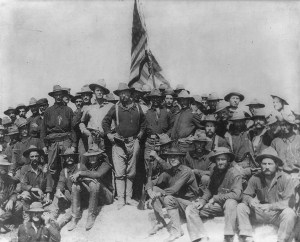
Theodore Roosevelt (center front, just left of the flag) and his “Rough Riders,” 1898.
The official inquiry into the disaster, however, concluded that an underwater mine had been the culprit. With the battle cry “Remember the Maine,” the U.S. quickly declared war on Spain.
But this “inquiry” was more than a bit flawed. Two widely-recognized experts in ordnance volunteered their services for the investigation, but were not invited to participate. One of them, Prof. Philip Alger, had greatly displeased Secretary of the Navy, and future president, Theodore Roosevelt, when he commented on the disaster in an interview for the Washington Evening Star a few days after it happened. He said, in part, the following, as reproduced by Rickover:
“As to the question of the cause of the Maine’s explosion, we know that no torpedo that is known to modern warfare, can of itself cause an explosion of the character of that on board the Maine. We know of no instances where the explosion of a torpedo or mine under a ship’s bottom has exploded the magazine within. It has simply torn a great hole in the side or bottom, through which water entered, and in consequence of which the ship sunk. Magazine explosions, on the contrary, produce effects exactly similar to the effects of the explosion on board the Maine. When it comes to seeking the cause of the explosion of the Maine’s magazine, we should naturally look not for the improbable or unusual causes, but those against which we have had to guard in the past.”
But Roosevelt was anxious to establish the U.S. as a world power, especially in terms of its Navy. By accusing Spain of blowing up the ship, he had the perfect excuse to launch the Spanish-American War.
The Vietnam War (major U.S. involvement: 1964 – 1975)
Off the coast of China and northern Vietnam is the Gulf of Tonkin, which was the staging area for the U.S. Seventh Fleet in the early 1960s. On the evening of Aug. 4, 1964, the U.S. destroyers Maddox and the C. Turner Joy were in the gulf, when the Maddox’s instruments indicated that the ship was under attack or had been attacked. Both ships began firing into the darkness, with support from U.S. warplanes. However, they “later decided they had been shooting at ghost images on their radar. … The preponderance of the available evidence indicates there was no attack.”

U.S. Huey helicopter spraying Agent Orange over Vietnam. (Photo by the U.S. Army Operations in Vietnam R.W. Trewyn, Ph.D.)
Yet something needed to be done about Vietnam, with anti-Communist hysteria still rampant in the U.S., and this gave Congress the perfect ploy to escalate the war. This non-incident was presented to the world as an act of aggression against the U.S. Congress quickly passed the Gulf of Tonkin resolution. By the end of the following year, the number of U.S. soldiers invading Vietnam increased from 23,000 to 184,300. Eleven years later, with over 55,000 U.S. soldiers dead, hundreds of thousands wounded, and, by conservative estimates, 2,000,000 Vietnamese dead, the U.S. fled Vietnam in defeat.
The Gulf War (Aug. 2, 1990 – Feb. 28, 1991)
In order to gain support for the Gulf War of 1990, Congress and President George Bush relied heavily on what is commonly referred to as the Nayirah testimony. In early October 1990, a 15-year-old girl referred to only as “Nayirah,” who claimed to have been a hospital volunteer, testified of seeing babies dumped by Iraqi soldiers from hospital incubators. This, in the eyes of Congress and the president, highlighted the monstrosity of Iraq, and was widely used to gain support for the war.
However, like nearly all of the information the government feeds to the citizenry to start its wars, this testimony was all lies. “Nayirah” was actually the daughter of the Kuwaiti ambassador to the U.S. She later admitted that she had once visited the hospital in question, but only for a few minutes. She did see an infant removed from an incubator, but only very briefly. A group called Citizens for a Free Kuwait had hired one of the world’s foremost public relations firms, Hill and Knowlton, to create the illusion of legitimacy for an invasion. They coached “Nayirah” on what to say and how to say it when she appeared before Congress.
We will do no more than mention the U.S.’s drafting of a letter for Grenada to send to the U.S., requesting military intervention when that small island nation’s government was overthrown in 1983. Nor will we dwell on the weapons of mass destruction that Iraq was said to possess in 2002, which justified in the eyes of U.S. citizens the disastrous 2003 invasion of that nation. But as we look at this ugly record of lies that the U.S. has used to expand its territory, power and/or influence around the world, we must consider that it is once again using the same tactics to march the nation toward war with Iran.
The U.S. for generations was successful in deceiving its citizens, and a good part of the world, that it was a beacon of freedom and peace, despite the fact that it has been at war for most of its bloody existence. That myth began to crack during the Vietnam War, broke into pieces with the Iraq War, and may have been dealt a fatal blow by the U.S.’s support of Israeli atrocities in 2014.
Regardless of the outcome of the congressional vote on the Iran agreement, the U.S. will find itself less able to lie its way into corporate wars in the future. That capacity diminished during the lead-up to the Iraqi invasion, and while no one ever went broke betting on the gullibility and short-term memory of the U.S. citizenry, people are beginning to wake up. When they finally do, much of the carnage in the world will end. That day cannot come soon enough.
Moscow ready for more sanctions, regardless of Ukraine crisis – Foreign Ministry
RT | September 9, 2015
Russia has no illusion about sanctions being lifted and expects them to be stiffened in future, regardless of developments in Eastern Ukraine. That’s according to a leading Russian diplomat, who says Moscow can live under continuous western pressure.
“We believe that in certain directions, notwithstanding of the developments in Donbass, we should expect toughening of the sanctions pressure,” Russian Deputy Foreign Minister Sergey Ryabkov said at the Russia Arms Expo 2015 in Nizhny Tagil on Wednesday.
According to Ryabkov, the new set of sanctions introduced by Washington last week against Russian companies, including arms exporter Rosoboronexport, “mirrors the policy of complicating operations of the Russian military-industrial complex and all of the mechanism of government.”
Sanctions come in handy as a “true instrument of aggressive foreign policy” aimed at Russia, the diplomat said.
“Russia’s independent and self-sufficient foreign policy, its decisiveness to protect its sovereignty, and the consolidation of the people with the country’s leadership serve as a thorn in the side of our opponents,” Ryabkov said.
“We presume that the sanctions are there for the long haul,” Ryabkov said. “There are no reasons or illusions that sanctions are going to be lifted in the short term, at least not in the Foreign Ministry.”
“When it comes to international financial services, our colleagues from the US and the EU are set to expand their effort to seal off all capabilities. We understand that and we have to learn how to operate in the given situation,” Ryabkov said, insisting that sanctions will fail to gain the desired effect.
“We’re sorry the US has not learned that truth so far.”
Russian Economic Development Minister Aleksey Ulyukaev said Moscow is going to seek a “symmetrical answer” to American sanctions imposed on September 2.
Washington imposed sanctions on a number of Russian, Chinese, Syrian, Turkish, Sudanese and Iranian companies, believed to be involved in activities which, according to Washington, go against its Nonproliferation Act in regard to Iran and Syria.
“These are not sectoral sanctions, they are personalized, therefore we would consider some kind of a symmetrical answer,” Ulyukaev said.
In March 2014, the EU, the US and some other countries imposed individual sanctions against 21 Russian and Ukrainian officials, subjecting them to asset freezes and travel bans. Within a year, the list was extended to 150 people, including Russian Deputy Prime Ministers Dmitry Kozak and Dmitry Rogozin, as well as presidential aide Vladislav Surkov and 37 entities that, according to the EU, are “responsible for actions which undermine or threaten the territorial integrity, sovereignty and independence of Ukraine.”
The restrictions have been prolonged until January 31, 2016.
To reciprocate, in August 2014 Moscow introduced a ban on importing meat, dairy, fruit, and vegetable products from countries that have imposed sanctions on Russia over the Ukraine conflict. The countries included EU member states and Norway, US, Canada and Australia.
European Union sanctions against Russia include restrictions on lending to major Russian state-owned banks, as well as defense and oil companies. In addition, Brussels imposed restrictions on the supply of weapons and military equipment to Russia as well as military technology, dual-use technologies, high-tech equipment and technologies for oil production. No sanctions were imposed against Russia’s gas industry.
Featured Video

The Truth About the Trump Shootings with Ken Silva
or go to
Aletho News Archives – Video-Images
From the Archives
Trans ‘milk’ as good as the real thing – NHS
RT | February 18, 2024
The drug-induced nipple secretions of trans women are as good as mothers’ breast milk for babies, the University of Sussex Hospitals NHS Trust claimed in a letter to campaigners made public in a report by British think tank the Policy Exchange on Sunday.
The healthcare trust’s medical director, Rachel James, argued that the off-label prescription drug cocktail men transitioning to female take in order to produce milk was “similar to the natural hormones which encourage lactation to develop when the baby is newly born.”
“The evidence which is available demonstrates that the milk is comparable to that produced following the birth of a baby,” James wrote in the letter, sent to Children of Transitioners last August.
Biological men who wish to lactate must first take hormones to grow milk glands and then take high doses of either domperidone or metoclopramide to stimulate milk production. Neither drug is approved for this use, though they are occasionally prescribed off-label to biological women who have trouble lactating.
However, domperidone’s own manufacturer, Janssen, warns patients the drug “may cause unwanted side effects affecting the heart in a breastfed baby” and “should be used during breastfeeding only if your physician considers this clearly necessary.” … continue
Blog Roll
 Aletho News
- Seyed M. Marandi: U.S. Strike Imminent – Toward Total War in the Middle East
- Russia Voted Under Fire. Washington Is Loading the Tankers.
- 12 Things Your Oncologist Was Trained Not to Tell You
- Anthrax Attacks Paved Way for COVID-Era ‘Junk Drugs and Vaccines’
- How Real Is the Impact of Western Sanctions on Israel?
- France, You Are Guilty: How Paris Turned Western Sahara into the Maghreb’s Powder Keg
- 2025 Nature Paper Claiming Worsening Global Drought Gets RETRACTED …Heavily Flawed
- Your Milk Is Not the Problem
- The Truth About the Trump Shootings with Ken Silva
- ARE PATIENTS BEING PROPERLY INFORMED ABOUT OZEMPIC?
- If Americans Knew
- Salah Sarsour’s Legal Team Says DHS Has Not Met Its Burden to Prove He Is Deportable
- An analysis of tax forms by The Intercept show Kraft’s charity and LLC have donated to Friends of the IDF and AIPAC’s super PAC.
- Israeli attacks kill four Palestinians in Gaza – Daily Update
- Inside Gaza’s death trap of collapsing, bombed-out buildings
- The everyday items Israel bans from Gaza every day
- Inside the siege, the ruined buildings of Gaza – Daily Update
- Debunking The Claim That Macklemore Has A “History Of Antisemitism”
- CPJ demands release of arrested Palestinian-US journalist near Bethlehem
- Robert Kraft: The Billionaire Friend of Netanyahu Pulling The Strings Behind the Macklemore/Ed Sheeran Blow Up
- Columbia Administered Fund Gives Big Money to Pro-Israel Groups
- No Tricks Zone
- 2025 Nature Paper Claiming Worsening Global Drought Gets RETRACTED …Heavily Flawed
- New Study: ‘Global Drought Shows No Detectable Recent Acceleration Under Climate Warming’
- Economic Masterminds: German Socialists Suggest Taxing Productivity Gains Stemming From Using AI
- The South China Sea Has Not Been Cooperating With The Climate Change Narrative
- Energy Crisis: Germany Enters Heating Season With Historically Low Gas Reserve Fill Levels
- New Study: The Antarctic Ice Sheet Gained Mass From 2020-2024 Due To Staggering Snow And Ice Accumulation
- Study: Ocean Heating Rates From Thousands Of Years Ago ‘Dwarf’ Modern Ocean Heating Rates
- Climate Extremists Target, Attack Large-Scale Power Grid Infrastructure In Germany!
- New Study: Antarctic Ice Melt Has Contributed Less Than 1 Centimeter To Sea Level Rise In The Last 30 Years
- Fear Of Debate: Alarmist German Climate Scientist Calls On Mainstream Media To Discredit Skeptic Voices
 Aletho News