Obama: US Military Engaged in Anti-Terror Operations Across 15 Countries
Sputnik — 13.06.2016
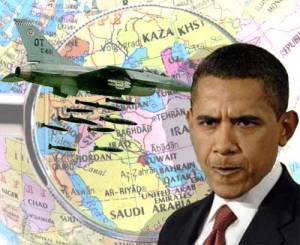 US military personnel are engaged in counterterrorism operations across 15 different countries, President Barack Obama said in a biannual statement to Congress released on Monday.
The letter outlined US military counterrorism operations across the globe in Afghanistan, Iraq, Syria, Turkey, Somalia, Yemen, Djibouti, Libya, Cuba, Niger, Cameroon, the Central African Republic, Egypt, Jordan, and Kosovo. All nations have US combat-equipped personnel deployed for a specific counterterrorism mission.
Obama indicated that that there is no timeline for the war on terrorism, and he will direct “additional measures to protect US citizens and interests” if necessary.
“It is not possible to know at this time the precise scope or the duration of the deployments of US Armed Forces necessary to counter terrorist threats to the United States,” Obama said.
Under the 2001 authorization for use of military force, the US president must update Congress every six months on the military operations against al-Qaeda, the Taliban and associated forces.
Global conflict cost world $14.3 trillion in 2014: Report
Press TV | June 18, 2015
The cost of global war in the year 2014 reached $14.3 trillion, or 13.4 percent of the global gross domestic product, a report by the Institute for Economics and Peace says.
Last year, the cost of global conflict equaled the combined economies of Britain, Germany, France, Brazil, Canada, and Spain, according to a recent report by the Australia-based group.
The statistics mark a 15.3-percent spike in the cost of conflicts since 2008 when the financial impact was recorded as $12.4 trillion, the report notes.
“Large increases in costs are due to the increases in deaths from internal conflict, increases for IDP (internally displaced person) and refugee support, and GDP losses from conflict, with the latter accounting for 38 percent of the increase since 2008,” the report stated.
Since 2008, the cost of supporting IDPs and refugees has increased by 267 percent and the number of people forced to relocate by war has reached its highest since the Second World War, the report noted.
It also described the Middle East and North Africa as the most violent regions in the world and Europe as the most peaceful, adding that Saudi Arabia’s ongoing aggression against Yemen has dragged down the overall outlook for the Middle East.
According to the report, Syria, which has been gripped by deadly unrest since March 2011, was world’s least peaceful country, followed by Iraq, Afghanistan, South Sudan, and the Central African Republic.
France triggered CAR slaughter
By Finian Cunningham | Press TV | February 13, 2014
As the Central African Republic descends into a charnel house of mass killing, hunger and fleeing refugees, one country bears full responsibility for the catastrophe – France.
This week, France’s defence minister Jean-Yves Le Drian had the brass neck to tour the former French colony where hundreds of people – mainly Muslims – have been lynched in the streets in recent weeks, their corpses left to rot along the roadsides.
Thousands more have been burnt out of their homes and have fled to the jungles for refuge from inter-communal clashes. A Muslim man happened to fall off a truck ferrying refugees from the violence. He was then beaten, hacked to death by a frenzied mob on the street below.
An entire country has been turned upside down, and that chaos and suffering is all down to French imperialist meddling.
Le Drian had the nerve to claim that the dispatch of French troops to the Central African Republic in early December “had prevented even more deaths from occurring”. How dare the French minister distort the facts and exonerate his country from the cold-blooded mass murder and an unfolding humanitarian crisis that it – and it alone – has triggered.
The upsurge in killings in the CAR’s capital, Bangui, and the surrounding countryside began promptly on December 5. This was three days after France began sending hundreds of its soldiers to that country, supposedly with the remit of “humanitarian protection”.
It was only after France dispatched its troops to this country that the United Nations Security Council – railroaded by French diplomats – authorized the intervention with a mandate. The French military intervention is therefore illegal and its hastiness reveals what the hidden agenda for French meddling in Central Africa is really all about.
Prior to the arrival of the French military, there were only unconfirmed reports of sporadic fighting between the mainly Muslim rebel group known as Seleka and the Christian-based paramilitaries called Anti-Balaka. The Seleka ousted the French-backed Christian president Francois Bozizé in March 2013. Bozizé had been installed by a French-backed military coup in 2003. His ouster can be seen as a setback to French political and economic interests in the CAR. However, it was only after French so-called peacekeepers arrived in the CAR on December 2 that mass killings erupted in the African country.
Two major factors for the ensuing violence are that the French from the outset showed flagrant bias against the Seleka rebels, ordering their unilateral disarmament at gunpoint. Meanwhile, the Anti-Balaka factions were allowed by the French to retain their weapons. This one-sided policy by the French emboldened the Christian militias to see themselves as having a free hand to attack Muslim communities.
The French defence minister admitted so this week. Speaking to French media from Bangui, Le Drian said that French disarmament practices had up to now been focused solely on the Seleka rebels. “Now we must focus on the Anti-Balaka,” he added.
But it’s too late for supposed remedial action. Already, thousands of people, mainly Muslims, have been slaughtered across the Central African Republic. Thousands more have fled their homes for the neighboring countries of Cameroon, Chad and the Democratic Republic of Congo. Families are living in makeshift shelters with no food or medicines.
The ethnic cleansing of an entire community has already happened, and for the French government to now say that it is taking remedial action is beneath contempt. France has already overseen the slaughter. The second factor for the sudden massive bloodletting in the CAR is that several weeks before the dispatch of French soldiers, the Paris government was making very public announcements to the international media, warning that the African country “was on the brink of genocide”. Foreign minister Laurent Fabius was one of the main voices issuing those blood-curdling predictions.
These dire alarms were being made recklessly by France without any evidence to support such claims and at a time when, as noted, there were only unconfirmed reports of sporadic violence. In addition, the French media spin was directed against the Muslim Seleka rebels, which had ousted France’s puppet and corrupt proxy leader, Bozizé.
Thus when French soldiers began arriving in the CAR in early December, the country was primed for a deadly sectarian conflict because of the campaign of misinformation conducted by Paris in the previous weeks. Despicably, the fact is that the Christian and Muslim communities, comprising 60 and 15 per cent of the population, respectively, had always coexisted peacefully prior to this French meddling.
France has played with sectarian fire in Central Africa, and now other people are being horribly burned. The situation has been inflamed so badly by the cynical French that they are not able to control it. Now Paris wants the UN and other EU countries to send more troops to support the already 1,600 French military present in the CAR. The hidden agenda for Paris has always been about securing the rich natural resources of this Central African country. The CAR has super-abundant reserves of gold, diamonds and other precious minerals. It is believed to have vast untapped deposits of oil and gas, and proven copious reserves of uranium ore. The latter is the primary nuclear energy fuel, on which France is heavily dependent for its national electricity production. A new French-owned uranium mining plant began operations in the CAR in 2010 and is due to reach maximum production later this year.
This is the real background for why France felt compelled to intervene in the CAR, especially after its puppet president Francois Bozizé was ousted by the Seleka rebels.
But, paying the price for French criminal machinations, are thousands of innocent people who are being cut down in the streets, children who are orphaned from murdered parents, and impoverished, dispossessed families who are now starving in the jungles of Central Africa.
Truly, the brutal European colonial times of a past century seem to be back in Africa with a vengeance.
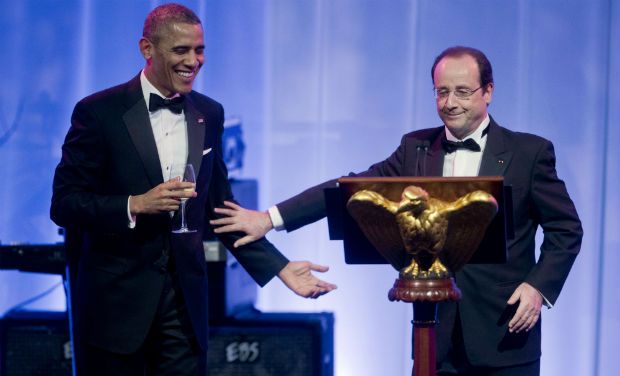
And yet the man who bears the responsibility for his country’s criminality in Africa – French president Francois Hollande – was being toasted at a sumptuous dinner in Washington this week by African-American president Barack Obama. Obama, with a glass of expensive wine in one hand, hailed Hollande for his country’s commitment to “security and peacekeeping” in Africa.
A day of reckoning cannot come soon enough. Just because these leaders are deluded does not mean we should ignore them or merely excoriate them. The international community must marshal the case and call for the prosecution of these criminals in high office.

French fox in African hen house
Press TV – January 11, 2014
The French finally got what they wanted in the restive Central African Republic – regime change.
Interim President Michel Djotodia and his Prime Minister Nicolas Tiengaye have resigned and the former French colony is now set to form a new government under the watchful eye of Paris.
Western media portray French conduct in the Central African Republic (CAR) as a benevolent force. “We are there to save lives,” said French President Francois Hollande recently.
This is like lauding a fox in a hen house. The reality is that violence and suffering have largely stemmed as a direct result of illegal French interference in that African country.
What’s more, we also can say that the violence has been deliberately provoked by the French as a cover for their real objective – regime change.
Djotodia was forced to step down after he was politically ambushed by other Francophile African leaders at a special conference convened at the end of the week in neighboring Chad.
Before the summit, French diplomats had been briefing the media and other African states that Djotodia “had to go”. The French tried to cover their tracks by saying “we are not here to give our thumbs up or down” but that is exactly what they were doing – giving the thumbs down.
French President Francois Hollande and his Foreign Minister Laurent Fabius have been carping about the CAR leader for weeks and undermining his authority. Obviously, the French wanted rid of Djotodia and his administration – and now they have gotten their illicit way. Lest we forget such interference in the sovereign affairs of another state is illegal.
Notably, just before the conference opened on Thursday in Chad, Djotodia rejected rumors of his impending resignation. In less than 24 hours, he then quit, evidently under duress.
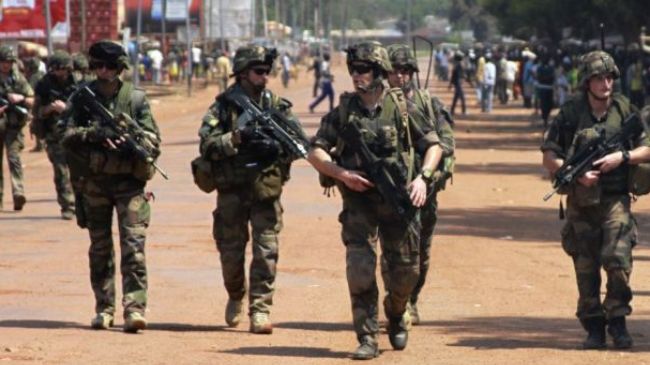
Within minutes of Djotodia’s sacking on Friday, and even before he had returned from Chad, French military tanks had surrounded the presidential palace in the CAR capital Bangui. French Defence Minister Jean-Yves Le Drian also issued a call for Djotodia to be “replaced as soon as possible”.
Chadian President Idriss Déby had been one of the most vocal African leaders calling for Djotodia to quit. Déby, who is described as “a strong French ally” (in other words, “puppet”), was doing France’s bidding and giving an African voice to a directive from Paris, a directive which amounts to a coup d’état.
The Western media narrative, led by France, is that Djotodia “had not done enough to curb the violence” gripping the CAR. More than 1,000 people have been killed in recent weeks in sectarian clashes between Muslims and Christians. Roughly a quarter of the country’s five million population have been displaced in the fighting.
Djotodia came to power last year after Muslim rebels known as Seleka deposed the Christian president Francois Bozizé in March. Bozizé was notorious for corruption and had come to power through a French-backed military coup 11 years ago.
With major French commercial interests in the resource-rich country, in particular uranium mining, it seems that France was vexed about the new transitional government led by Michel Djotodia – the first Muslim leader of the mainly Christian country.
Djotodia’s interim administration was legally constituted last April and it was overseeing a transition with elections scheduled at the end of this year.
However, that did not seem good enough to allay the French, who wanted to exert tighter control over the political process within the CAR in order to secure favorable conditions for its commercial interests.
This is the real basis for the French military invasion, not the humanitarian pretext that the Hollande government has been trumpeting.
Last month, chaos and violence in the African country surged after France sent in its troops – allegedly to provide “humanitarian protection” in a situation where there had been no serious violence, apart from French government scaremongering of “imminent genocide”.
French military were dispatched to the CAR on December 2, three days before a French-drafted resolution was passed at the United Nations Security Council authorizing the intervention.
More French troops arrived on December 5, 2013, and only since then have the sectarian clashes in Bangui city and across the country escalated.
The conclusion is inescapable. The humanitarian crisis in the CAR was precipitated by French involvement, not prevented. A major factor for the violence is that the French military moved to unilaterally disarm the Seleka rebels while ignoring Christian vigilante groups known as Anti-Balaka.
The latter were, in effect, given a free hand to maraud Muslim communities and businesses with deadly consequences.
It is therefore obtuse and mendacious for the French government and its African clients to blame Michel Djotodia for not controlling security in his country.
The real culprit for the bloodshed and pandemonium that jolted the CAR is French interference in that country– interference that was illegal and was cynically disguised as “humanitarian.”
There are deep fears that violence against Muslim communities will increase further now that Michel Djotodia has been forced from office.
The Christian Anti-Balaka militias will feel emboldened by the French political interference. Many believe that the Anti-Balaka is being orchestrated by the former French puppet Bozizé from his exile in France.
Tragically, this is just the latest episode of misery for the Central African Republic caused by French neo-imperialist predation.
Since gaining so-called independence from France in 1960, the French have launched more covert coups and countercoups in that country than in any other former African colony.
The CAR remains politically and economically underdeveloped – despite its teeming natural wealth – precisely because of systematic French predatory exploitation.
Poverty in the Central African Republic, as in many other African countries, is a direct result of French policy, primarily due to the “franc afrique” monetary system set up at the time of independence.
This systematic poverty enables France to exploit raw materials and the people mercilessly. And when the racket comes a bit unstuck, the French send in their troops to “restore order”.
What the international community, such as the Non-Aligned Movement of over 100 nations, should be doing is to call for the prosecution of France, not applauding this fox in a hen house.
French public support for intervention in the Central African Republic waning
Press TV – January 4, 2014
A new survey shows that France is rapidly losing public support for its military intervention in the Central African Republic (CAR), nearly one month after Paris deployed troops to the country.
A recent poll by the French Institute of Public Opinion (IFOP) showed on Saturday that only 41 percent of the respondents are in favor of France’s military operation in the CAR, down by 10 percent compared to a previous poll conducted right after France’s military intervention.
Some 1,000 people were questioned in the latest IFOP survey, which was conducted from December 27 to January 2.
France invaded its former colony on December 5, 2013, after the UN Security Council unanimously adopted a resolution giving Paris and the African Union the go-ahead to send troops to the CAR. Paris has 1,600 troops in the violence-stricken country.
The deployment of the French and African Union peacekeepers has done little to end the ongoing violence between ethnic communities in the CAR.
The Central African Republic spiraled into chaos in March last year when Seleka fighters overthrew President Francois Bozize and brought Michel Djotodia to power. Bozize fled the country after his ouster.
The mission in the CAR is France’s second military intervention in Africa in 2013. In January, Paris dispatched more than 4,000 troops to Mali, launching a fierce war against the militants in the country.
Featured Video
America Racing to Strategic Defeat in Iran
or go to
Aletho News Archives – Video-Images
From the Archives
Should Europeans ‘Thank’ the Americans for Destroying Nord Stream?
By Robert Bridge | Strategic Culture Foundation | September 29, 2022
With an investigation continuing into the destruction of the Nord Stream gas pipeline that provided energy supplies to Europe from Russia, there appears to be just one prime suspect, and that should surprise nobody.
Following the sabotage of the Nord Stream 1 and 2 gas pipelines, former Polish Foreign Minister Radoslaw Sikorski already seemed to know the identity of the perpetrator when he tweeted out: “Thank you, USA.”
At first glance, it seemed that Sikorski was speaking sarcastically, berating Washington for carrying out an attack that will have severe repercussions for the people of Europe. After all, how could anyone see any good coming from the termination of Europe’s primary source of gas reserves with winter just around the corner? It was Sikorski’s homeland of Poland, after all, that urged its citizens to collect firewood in the face of dwindling gas reserves.
In fact, the Polish diplomat was speaking one-hundred percent literally… continue
Blog Roll
 Aletho News
- UK’s New Pandemic Plan Would Turn Big Tech Into a Mass Location Tracking Network
- Growing insecurity, soaring prices fuel protests in north as regime bans evacuation: Sources
- Iran denies responsibility for ‘depraved’ attack on Kuwait desalination plant
- Bring The Troops Back. End This War Now!
- Can we please stop calling Israel the ‘only democracy in the Middle East’ now?
- US should start removing its troops from Germany, proposes AfD co-leader Chrupalla
- Iran Red Crescent: 600 educational centers attacked in US-Israeli ‘war crimes’
- Russian Oil Tanker Arrives in Cuba Amid U.S. Blockade
- America Racing to Strategic Defeat in Iran: Lt Col Daniel Davis
- FTC Warns Visa, Mastercard, PayPal, Stripe Over Political Debanking
- If Americans Knew
- As Iran targets US military bases, will they be relocated to Israel? Not a ceasefire Day 171
- Will Trump Go Kamikaze?
- Is the University of Florida Shutting Down College Republicans over Israel Criticism?
- Jewish extremist arrested over alleged plot to firebomb Palestinian activist Nerdeen Kiswani’s home
- More than half of Palestinian child detainees have no charges
- The More Murderous Israel Gets, The More We Hear About “Antisemitism”
- Land Day and the Palestinian struggle after 30 months of genocide
- The Iran War Is About Palestine
- Israeli soldiers echo settler ideology, talk of revenge after targeting Palestinians and detaining CNN crew in the West Bank
- Israeli Policies Threaten Future of Christian Schools in Jerusalem
- No Tricks Zone
- New Study Finds Warming Saves Lives…Cold Temperatures 12 Times More Deadly Than Excess Heat
- German Science Blog Accuses PIK Climate Institute Of Hallucinating Climate Tipping Points
- Devastating Assessment Of Comirnaty Vaccine By Former Senior Pfizer Europe Toxicologist
- New Study: CO2 Is ‘Effectively Negligible’ As An Explanatory Climate Change Factor Since 2000
- Former Pfizer Toxicologist Dr. Helmut Sterz Tells Bundestag Hearing Pfizer Vaccine Should Have Never Been Approved
- Energy Expert: Germany’s Nuclear Phaseout Was A “500 Billion Euro Mistake”
- New Research: South Australia’s Mid-Holocene Sea Surface Temperatures Were 4°C Warmer Than Today
- Storing Green Energy To Last Germany 10 Days Would Require A 60-Million Tonne Battery
- New Studies: UK Sea Levels Were 4 Meters Higher Than Today During The Mid-Holocene
- Destructive Green New Deal: German Energy And Metal Group Warns Of Drastic Crisis
 Aletho News