A new report examining widespread corruption and waste in Afghanistan found that the practice blossomed following the US invasion in 2001. The problem was fed by its slowness to recognize the problem and exacerbated by the injection of tens of billions dollars into the economy with very little oversight.
“Corruption in Conflict: Lessons from the U.S. Experience in Afghanistan” examined how from 2001 to 2014 the US government, through the Department of Defense, State, Treasury and Justice and the US Agency for International Development (USAID) understood the risks of corruption in Afghanistan, how the US evolved its understanding, and the effectiveness of that response.
SIGAR was created by Congress to provide independent and objective oversight of Afghan reconstruction projects and activities.
The report released on Wednesday had five main findings: 1) corruption undermined the US mission in Afghanistan by fueling grievances against the Afghan government and channeling material support to the Taliban; 2) the injection of tens of billions of dollars into the Afghan economy was governed by flawed oversight and contracting practices and “partnering with malign powerbrokers”; 3) the US was slow to recognize the problem; 4) when it did recognize the depth of corruption “security and political goals” trumped anti-corruption efforts; 5) in areas where it was successful it was only “in the absence of sustained Afghan and US political commitment.”
The report defined corruption as “the abuse of entrusted authority for private gain,” and placed in the context of Afghanistan’s kinship-based society where the gains from corruption often benefited not just an individual but a family, clan, tribe or ethnic group.
Corruption is the system of governance
According to SIGAR about $113.1 billion has been appropriated for Afghanistan relief and reconstruction since 2002. The funds were used by the Afghan National Security Forces to promote good governance, conduct development assistance, and engage in counter-narcotics and anti-corruption efforts.
In a 2010 US Embassy Kabul report on a meeting with senior US officials and the Afghan National Security Adviser, Dr. Rangin Dadfar Spanta said “corruption is not just a problem for the system of governance in Afghanistan; it is the system of governance.”
The report referred to a 2015 UK research that showed there was weak separation of the private and public spheres which resulted in widespread private appropriation of public resources, vertical- and identity-based relationships had primacy over horizontal, i.e. citizen-to-citizen relationships, and politics was centered around a centralization of power and patron-client relations replicated throughout society.
Opportunities for corruption expanded after 2001 as the amount of money in the economy grew from millions to billions of dollars with the Department of Defense budget at time equivalent to the entire Afghan economy and sometimes quadruple the amount.
“Many of the funds were licit, arriving via civilian and military contracts. At their peak in fiscal year 2012, DOD contract obligations for services in Afghanistan including transportation, construction, base support, translation/interpretation, an private security total approximately $19 billion, just under the Afghanistan’s 2012 gross domestic product of $20,5 billion,” stated the report. “From 2007 to 2014 those contract obligation totaled more than 89 billion.”
Billions worth scandals
During the years of the Obama administration, Afghanistan was rocked by two corruption scandals: The Salehi arrest and the Kabul Bank losing $1 billion.
Salehi was involved in the New Ansari Money Exchange, a money transfer firm that moved money into and out of Afghanistan. The exchange was suspected of moving billions of dollars out of Afghanistan for Afghan government officials, drug traffickers and insurgents. US law enforcement and intelligence investigators estimated that as much as $2.78 billion was taken out of Afghanistan between 2007 and 2010.
“A wiretap recorded an aide to Karzai, Mohammad Zia Salehi, soliciting a bribe in exchange for obstructing the investigation into New Ansari. Reportedly, after US officials played some of the wiretaps for an adviser to Karzai, the adviser approved Salehi’s arrest,” stated the report.
Salehi was arrested in July 2010, but was released within hours on the orders of President Karzai and the case was dropped. The New York Times reported Salehi had once worked for notorious warlord Rashid Dostum and was also “being paid by the CIA.”
“If true, this would suggest a US intelligence agency was paying an individual as an intelligence asset even as US law enforcement agencies were building a major corruption case against him,” stated the report.
The other corruption scandal involved the Kabul Bank, which was used among other things to pay the salaries of the Afghan military and police, was found in 2010 to have lost nearly $1 billion of US taxpayer’s funded foreign assistance to Afghanistan. The bank’s deposits had seemingly vanished into Dubai and off-shore locations and unknown offshore bank accounts and tax havens, through Ponzi schemes, fraudulent loans, mass looting and insider loans to fake and bogus companies by less than 12 people who were apparently linked to President Karzai.
Lack of oversight and slow response
Against this the DOD and USAID vetted contractors and implemented contracting guidance to reduce opportunities for corruption and while they were somewhat successful, “they were not unified by an overarching strategy or backed by sustained, high-level US political commitment,” stated the report.
During this time, from mid-2011 to March 2012, the US also sought to explore political reconciliation with the Taliban and to do so the US had to preserve a working relationship with President Karzai to ensure an Afghan government buy-in.
“The US government showed a lack of political commitment. When it became clear the Afghan government was not willing to undertake true reform – because it involved taking action against people connected to the highest levels of political power – the US government failed to use all of its available tools to incentivize steps towards resolution,” stated the report.
Another weakness in tackling corruption was the high turnover of US civilian and military staff “meant US institutional memory was weak and efforts were not always informed by previous experience.”
“One Afghan anticorruption expert noted that US agencies often hosted workshops and training that lasted only a few days, with limited follow-up. He suggested that a more fruitful approach might have been to establish a standing institute to train auditors, attorneys, investigative police and others for year, rather than days,” stated the report.
SIGAR’s report quoted Ryan Crocker, who re-opened the US Embassy in Kabul soon after the September 11, 2001 attacks and served again as ambassador in 2011-2012 as saying that “the ultimate point of failure for our efforts wasn’t an insurgency. It was the weight of endemic corruption.”
The report comes with recommendations for addressing corruption risks to US strategic objectives for future missions. It recommended that Congress pass legislation to make clear “that anticorruption is a national security priority in a contingency operation” and required strategies, benchmarks and “annual reporting on implementation.” It also recommended that Congress consider sanctions and the DOD, State and USAID should establish a joint vetting unit to better vet contractors and subcontractors in the field.
The recommendations for the executive branch level are that interagency task force should formulate policy and lead strategy on anticorruption during an operation and the intelligence community should analyze links between host government officials, corruption, criminality, trafficking and terrorism and provide regular updates.
“In Afghanistan today, corruption remains an enormous challenge to security, political stability, and development,” SIGAR said.
September 14, 2016
Posted by aletho |
Corruption, Illegal Occupation, Progressive Hypocrite | Afghanistan, Central Intelligence Agency, CIA, United States, USAID |
Leave a comment
Donald Trump named former CIA director and extremist neoconservative James Woolsey his senior adviser on national security issues on Monday. Woolsey, who left the CIA in 1995, went on to become one of Washington’s most outspoken promoters of U.S. war in Iraq and the Middle East.
As such, Woolsey’s selection either clashes with Trump’s noninterventionist rhetoric — or represents a pivot towards a more muscular, neoconservative approach to resolving international conflicts.
Trump has called the Iraq War “a disaster.”
Woolsey, by contrast, was a key member of the Project for the New American Century — a neoconservative think tank largely founded to encourage a second war with Iraq. Woolsey signed a letter in 1998 calling on Clinton to depose Saddam Hussein and only hours after the 9/11 attacks appeared on CNN and blamed the attacks on Iraq. Woolsey has continued to insist on such a connection despite the complete lack of evidence to support his argument. He also blames Iran.
Weeks before the invasion of Iraq, Woolsey called for broader war in the Middle East, saying “World War IV” was already underway.
Woolsey has also put himself in a position to profit from the wars he has promoted. He has served as vice president of Pentagon contracting giant Booz Allen, and as chairman of Paladin Capital Group, a private equity fund that invests in national security and cybersecurity.
He chairs the leadership council at the Foundation for the Defense of Democracies, a hawkish national security nonprofit, and is a venture partner with Lux Capital Management, which invests in emerging technologies like drones, satellite imaging, and artificial intelligence.
Woolsey went on CNN on Monday and said that he was principally motivated to support Trump because of his plans to expand U.S. military spending.
Trump gave a speech last week in which he proposed dramatic expansions of the Army and Marines, and hundred-billion-dollar weapons systems for the Navy and Air Force. He offered no justification — aside from citing a few officials who claimed they wanted more firepower.
Woolsey stood by Trump’s proposal on Monday.
“I think the problem is her budget,” Woolsey said of Trump’s opponent, Hillary Clinton. “She is spending so much money on domestic programs — including ones that we don’t even have now, and the ones we have now are underfunded — I think there can be very little room for the improvements in defense and intelligence that have to be made.”
Woolsey has previously called for NSA whistleblower Edward Snowden to be “hanged by the neck until he’s dead, rather than merely electrocuted.”
In the past, Woolsey has publicly disagreed with Trump on a number of national security issues — including Trump’s plan to ban Muslim immigration. On Monday, Woolsey told CNN that such a plan would raise First Amendment issues, but that he supported a temporary immigration block from certain Muslim countries.
Thus far, at least, most prominent war hawks have found they had more in common with Clinton than Trump. “I would say all Republican foreign policy professionals are anti-Trump,” leading neoconservative Robert Kagan told a group in July.
September 13, 2016
Posted by aletho |
Militarism, Timeless or most popular, Wars for Israel | Booz Allen, Central Intelligence Agency, CIA, Donald Trump, James Woolsey, Middle East, United States, Zionism |
Leave a comment
In 1968, CIA Director Richard Helms was presented with a disturbing National Intelligence Estimate (NIE) stating that Israel had obtained atomic weapons, a dangerous development that occurred earlier than the CIA had anticipated.
It was particularly dangerous because just the year before, the Six Day War had marked the beginning of open hostilities between the Israelis and Arab nation states. To prevail, Israel had launched preemptive air attacks against Egypt, Jordan, Syria and Iraq at the start of the conflict. Considering that violent backdrop, Helms immediately arranged a meeting with President Lyndon Johnson to inform him of this troubling milestone.
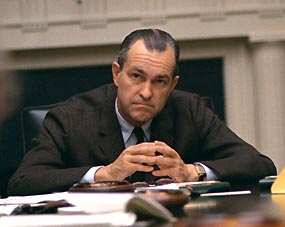
CIA Director Richard Helms
The man who had prepared the NIE and gave it to Helms was the CIA’s chief science and technology officer, Carl Duckett. After Helms met with Johnson, the CIA Director told Duckett about the President’s rather odd reaction. LBJ did not get upset, and he did not order an investigation into how it happened. Further, he did not tell Helms to let both the Defense Department and State Department know about it so they could establish intelligence inquiries or consider sanctions.
Instead, Johnson did the opposite. He told Helms to keep the news secret and specifically told the Director not to let the secretaries of State or Defense know about it.
Helms obeyed the orders of his Commander in Chief, but he decided to talk to the FBI about how this development had occurred earlier than expected. Thus begins Roger Mattson’s Stealing the Atom Bomb: How Denial and Deception Armed Israel, the riveting story of duplicity, betrayal, cover-ups and deceit.
As the book shows, the cover-ups and duplicity did not just come from Israel and its agents in America. The deceit also came from men inside the American government who, for whatever reasons, decided to cast a blind eye on what was really happening under their jurisdiction, even after they had been alerted to it.
What Mattson reveals is no less than an atomic heist – one that could have been prevented if men in high positions had done their duty.
Highly Enriched Uranium
After Johnson told Helms not to tell State or Defense, the CIA Director called Attorney General Ramsey Clark, because what made this news even more ominous — and a potential crime — was what the CIA had discovered when it conducted a chemical test around the Israeli nuclear reactor at Dimona, in the Negev desert.
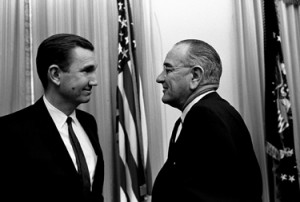
U.S. AG Ramsey Clark with Lyndon Johnson in 1967
Duckett had concluded that Israel had something that they should not have possessed at that time: HEU, or highly enriched uranium, which could only be produced by one of the five major powers that already had nuclear weapons.
But the test had also revealed characteristics that showed the material had originated in the United States. (Mattson, p. 97) Specifically, the HEU came from Portsmouth, Ohio and then was further processed at a plant in Apollo, Pennsylvania.
The importance of this information was that the HEU was processed to such a degree – well over 90 percent U 235 – that it was classified as weapons grade uranium. The technical term for it is the acronym SNM, or Special Nuclear Material, meaning that it is fissile: it can easily be split with neutrons. Although the Portsmouth plant is shut down today, beginning in 1956 it did produce weapons-grade uranium.
It was in Apollo, Pennsylvania, that the trail of the SNM and the crime of its diversion becomes exceedingly suspect. The plant that did the further processing of HEU, and the ultimate shipping, was named Nuclear Materials and Equipment Corporation, or NUMEC, and there were a number of reasons why suspicion had centered on NUMEC even before Helms called Clark.
First, NUMEC had a rather unreliable record when it came to keeping track of HEU and other materials that had been given to it through the Atomic Energy Commission (AEC). The way the system worked is that the particular company would forward its business requests — from either private or governmental agencies — to the AEC. The AEC would then estimate how much nuclear material NUMEC would need to fulfill the contract. If a company was using up more material than the AEC properly estimated, that company would be fined quite a lot of money. If the shortages persisted, the AEC and the FBI could then open up an investigation.
With CIA’s discoveries, the possibility presented itself that a diversion of the nuclear material could be taking place. Either someone from the outside was stealing the material, or someone on the inside was embezzling it.
As Mattson shows with charts, graphs and testimony, NUMEC had an extraordinarily bad record in this regard. The company was eventually fined over $2 million for missing materials, which, with inflation factored in, would be about $15 million today. Mattson adduces that from 1959 to 1977, about 345 kilograms of HEU went missing from NUMEC, which translates to well over 700 pounds. (ibid, p. 286)
Explaining the Deficits
In just one year, there was a loss of over 56 kilograms (or about 123 pounds). The company made up all sorts of rationales as to why this much HEU was missing, including losses during the mechanical processing. But as the author points out, there are two problems with this accounting.
First, no other plant in America reported losses of this magnitude. The AEC concluded that the losses at Apollo were more than double what they were at any other comparably sized atomic plant in the U.S. (ibid, p. 65)
Secondly, even if one chalks up some of the missing HEU to a processing loss, that still does not account for the entire record of NUMEC. Mattson figures that, even giving the company the benefit of the doubt, it still leaves about 200 pounds of missing HEU. (ibid, p. 67) That’s enough for about six atomic bombs, larger than the one used on Hiroshima.
As Mattson reports, what makes NUMEC an even more intriguing suspect is the fact that the company had some legitimate business transactions with Israel, concerning the irradiation of plants. And these legitimate packages were sent at about the time the HEU went missing. Further, the inventory records at NUMEC were extremely sloppy and some appear to have been destroyed in direct violation of the AEC code, meaning NUMEC should have been cited, but wasn’t. (ibid, p. 75)
That brings us to the founders of the NUMEC plant in Apollo, Pennsylvania, a small town of approximately 1,600 people that lies about 30 miles northeast of Pittsburgh. In 1955, the Apollo Steel Plant was purchased by David Lowenthal. Two years later, Lowenthal and Zalman Shapiro cooperated in forming NUMEC.
Shapiro, a very accomplished metallurgist who lived next door to Lowenthal, had been employed for a number of years at the nearby Bettis Atomic Power Laboratory, which supported the AEC’s Office of Naval Reactors.
In May 1958, Lowenthal merged Apollo Steel with the San Toy Mining Company in Maine. San Toy then changed its name to Apollo Industries, with the main operating officers of this new corporation Morton Chatkin, Ivan Novick and Lowenthal. (ibid, p. 43)
The board comprised these three men plus Shapiro, and later others. In the early 1960s, the steel plant’s name was changed to Raychord Steel, but with the decline of the steel industry, Raychord became a subsidiary company to Apollo.
Ties to Zionist Groups
Novick, one of Apollo’s officers, later served as national president of the Zionist Organization of America, in which Chatkin, another officer, also held a leadership role. The ZOA was a member group of the American Zionist Council, which later became the American Israel Public Affairs Committee, which today is considered to be the leading lobbying group for Israel and one of the most powerful lobbying groups in Washington.
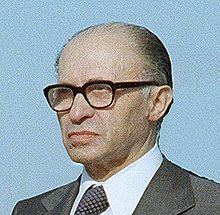
Israeli Prime Minister Menachem Begin
Novick also later served as a personal liaison between Ronald Reagan’s White House and the administration of Israeli Prime Minister Menachem Begin.
Lowenthal, who was born in Poland in 1921, came to America in 1932 and served in the American armed forces in World War II, eventually becoming a citizen in 1945. After the war, he worked with the Haganah, the Jewish paramilitary force inside Palestine, on the Zionist mission to ferry Jews into Palestine in 1947 on board the boat SS Exodus.
Since almost none of the passengers had legal immigration certificates to enter Palestine, the British Royal Navy, which ran the Palestinian Mandate, seized the ship and deported its passengers back to Europe. Lowenthal’s mission was a practical failure, but a tremendous propaganda success for the Zionist cause. The event was novelized by author Leon Uris in the number-one best-selling book Exodus, which was published in 1958 and was made into a movie two years later by director Otto Preminger, starring Paul Newman.
Lowenthal later served on board the ship Pan York, which also attempted to evade the British quarantine but was captured in Cyprus with the crew arrested, including Lowenthal. He escaped and fled to Palestine where he served with the Haganah during the war that broke out there in 1948 after the British abandoned the mandate early. (ibid, p. 44)
Lowenthal ended up serving under the legendary Meir Amit, the leading intelligence officer in Israel during the 1960s. Lowenthal was also personally acquainted with future prime ministers David Ben Gurion and Golda Meir.
Nuclear Experience
Shapiro, who had advanced degrees in chemistry and metallurgy from Johns Hopkins, worked for Westinghouse and the Navy on the nuclear reactor that powered America’s first atomic submarine, the Nautilus. Shapiro also helped develop the fuel for the first commercial nuclear reactor, the Shippingport Atomic Power Station in Pennsylvania.
Like Lowenthal, Novick and Chatkin, Shapiro also was active in supporting Israeli causes, although his activities had a slightly educational tone. He was a member of the Technion Society, which supported advances in Israeli science and technology. Indeed, he became an Honorary Life Member of the group.
He also was a Director of Hillel, an international organization that tries to acquaint Jewish students with each other on campuses and organize student trips to Israel. Like Novick and Chatkin, he was a member of the Zionist Organization of America. Many years later, it was discovered that Shapiro was on the Board of Governors of the Israeli Intelligence Center, which honors spies for Israel who clandestinely advanced the interests of the state. (Mattson, p. 84)
Beyond the individual backgrounds of these four men, there was also something else which should have attracted the U.S. intelligence community’s attention prior to Helms’s meeting with President Johnson. While running NUMEC, both men – Shapiro and Lowenthal – were taking trips to Israel and had contacts with high officials of Israeli intelligence as well as Israel’s version of the AEC.
Further, NUMEC had a guest worker, an Israeli metallurgist, in its plant, as part of an agreement NUMEC had with Israel to serve as a training consultancy which resulted in the formation of a joint company with Israel called ISORAD that initially was to deal with irradiation of citrus fruits through gamma rays. But the FBI later discovered that NUMEC also had contracts with Israel for the development of plutonium oxide as fuel elements in nuclear reactors. (Mattson, pgs. 80-81)
Since Lowenthal had so many acquaintances in high positions, he often visited Israel, including a most curious instance at about the time he purchased Apollo Steel in 1956. It was at this time that Israel was making decisions about foreign sourcing for nuclear materials and technology.
A year later, NUMEC was formed and Shapiro immediately applied for a license from the AEC to process uranium fuel in a building formerly occupied by Apollo Steel. John Hadden, CIA station chief in Tel Aviv, later noted the unusual coincidence of these events on two continents. (ibid, p. 45)
Israeli Visits
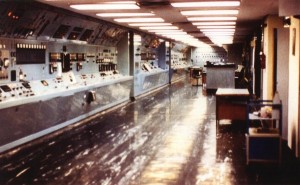
Israel’s Dimona nuclear weapons plant
But declassified FBI files reveal that the visitations were not just one way, i.e. from Apollo, Pennsylvania, to Israel. There were also visits and meetings of Israeli officials who went to Apollo.
At the time of those meetings, there were four main branches of Israeli intelligence. The Shin Bet corresponded with the Federal Bureau of Investigation; the Mossad with the Central Intelligence Agency; the Aman roughly with the Defense Intelligence Agency; and the LAKAM, which was responsible for security at Dimona and for procuring scientific and technological data from Western sources. (Mattson, p. 108)
In the mid-1960s, France started scaling back its support for the Dimona reactor, which was supposedly a research facility. With France’s pullback, LAKAM began seeking out and purchasing parts and supplies from other sources to complete the project.
LAKAM’s job included concealing the reactor’s true function – the development of a nuclear bomb – from American inspections. (ibid) During an American inspection in 1964, LAKAM even created a “Potemkin village” control room to deceive the visitors.
Unlike American intelligence, Israel also had a special operations unit that served all branches. Established in 1957, it was run by Rafi Eitan and his deputy, Avraham Bendor. (In the 1980s, Eitan became notorious for the Jonathan Pollard spy case, in which Pollard, a navy intelligence employee, was paid tens of thousands of dollars to spy for Israel in the United States with Eitan his ultimate control agent.)
In September 1968, the AEC told the FBI that they were giving permission to NUMEC for a visit by four Israelis, including Eitan and Bendor. However, in the application to the AEC, the occupations of the two were disguised. Eitan was said to be a chemist in the Defense Ministry; Bendor supposedly worked for the electronics division. (ibid, p. 110)
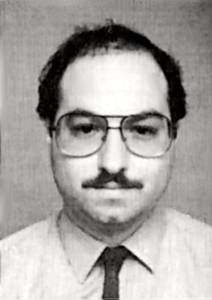
Convicted Israeli spy Jonathan Pollard
The other two men were Avraham Hermoni, who was billed as a Scientific Counselor in the Israeli Embassy in Washington, and Dr. Ephraim Biegun, described as working in the Division of Electronics for Defense. Again, this was misleading. Hermoni did, at times, work out of Washington’s Israeli Embassy, but his prime and most important function was overseeing and planning Israel’s nuclear weapons program, which he did from 1959-69. Biegun was actually head of the technical division of the Mossad from 1960-70.
CIA Suspicions
After the visit, NUMEC reported that the four men were in Apollo to buy thermo-electrical generator systems. (ibid, p. 119) Why Eitan and Bendor had to be there for that purpose is not readily apparent.
CIA officer John Hadden thought the real reason for the visit was that Shapiro was divulging top-secret technical information about plutonium manufacture – and that he was aided in this by the visiting Israeli scientist working at NUMEC. The FBI later came to agree that this was most likely the true reason for the visit. (ibid, p. 120)
Hermoni revisited Shapiro in November 1968, but the capstone to the visits to Apollo came later that month. As noted previously, France had cut back on its support for Dimona in the mid-1960s, halting the supply of uranium fuel in 1967.
In late November 1968, the Mossad arranged a covert operation called Operation Plumbat, which employed a front company in West Germany to purchase 200 tons of uranium yellowcake from Belgium. The transaction was approved by Euratom, the European organization controlling such transactions, but once the transport ship set sail for the port of Genoa, Italy, it was intercepted by another ship used by the Mossad. When the original ship reached port, the hull was empty.
The timing of this operation, on the heels of the mysterious visits by Israeli intelligence agents to Apollo, seems to constitute powerful circumstantial evidence of Israeli intentions.
Then, right after the completion of the Plumbat mission, who arrived in Israel? None other than Zalman Shapiro. The FBI discovered that in November 1968, in addition to the personal visits, Shapiro was in frequent phone contact with a number of Israeli intelligence agents, including Hermoni. (Mattson, p. 126)
A Longstanding Goal
Israel’s long trail of subterfuge and duplicity was part of a longstanding goal. As early as 1948, David Ben-Gurion, Israel’s first prime minister, stated that what Einstein, Teller and Oppenheimer did for America, they could easily do for Israel, since they were all Jews. In fact, he offered Einstein Israeli citizenship, which the great man declined. (ibid, p. 22) Ben-Gurion then had two meetings with Oppenheimer and numerous ones with Teller.
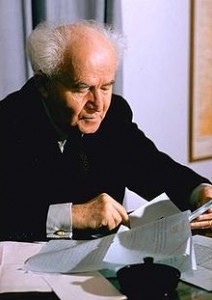
David Ben-Gurion, Israel’s first PM
Ultimately, Israel settled on David Bergmann, a brilliant chemist whom Ben-Gurion appointed first chief of the Israel Atomic Energy Commission in 1952. By 1955, Bergmann was essentially running the day-to-day operations of Israel’s atomic program.
In a conversation with the American ambassador, Bergmann said the Israeli science education program was adequate in physics and chemistry but weak in engineering and non-existent in metallurgy. He also revealed that the design he had laid out for a reactor was the same as the one at Shippingport, Pennsylvania, an intriguing clue because Shapiro was a metallurgist and had worked on the Shippingport power station.
Indeed, Shapiro eventually met Bergmann and the two became close friends and colleagues, serving on the board of ISORAD, which was a joint venture of NUMEC and the IAEC. Bergmann made his first visit to America for IAEC in 1956, the year before Lowenthal turned Apollo Steel into NUMEC.
There were two significant investigations of Shapiro and NUMEC. The first was instigated by Dick Helms’s call to Ramsey Clark in 1968 and the discovery of the highly enriched uranium at Dimona. (Mattson, p. 99) The second began in 1976 when Jim Conran, a whistleblower at the Nuclear Regulatory Commission, voiced complaints about the background and actions of Shapiro. Conran was a security officer and his warnings eventually got the attention of the White House. (ibid, p. 161)
During the first investigation, the FBI could not find enough evidence to justify a violation by Shapiro of the Foreign Agents Registration Act, which mandates that any person in the U.S. who is representing a foreign country’s interests has to register with the Justice Department. But the FBI did recommend cancelling Shapiro’s security clearances, based on wiretaps that revealed Shapiro in close contact with Israeli intelligence officials and with members of the IAEC. (ibid, p. 138)
During these calls Shapiro reportedly said he would help Israel in any way that he could. He also expressed frustration with the new ownership at NUMEC, which had been purchased by ARCO. But his Israeli contacts said he was too valuable to leave and encouraged him to stay there. (ibid, p. 139)
FBI Surveillance
One of the most curious episodes that the FBI surveillance revealed was a meeting between Shapiro and a man named Jeruham Kafkafi, a suspected Mossad officer working under diplomatic cover. He had left Washington by air on the morning of June 20, 1969, and met Shapiro at the Pittsburgh airport for about an hour. He then left and flew back to Washington.
As a result of that surveillance, Shapiro was interviewed by the AEC in August 1969, with some of Shapiro’s answers to questions rather dubious. For instance, he said he did not know Hermoni was in charge of the Israeli nuclear development program and thought he was a university professor. Shapiro said his discussions in September and October 1968 with the Israeli officers were about water contamination, saboteur detection and military activities.
When asked why the Israelis could not have talked to the Defense Department about those topics, Shapiro had no answer. The interviewer wrote in his summary that Shapiro was cool and calm throughout except when the Kafkafi meeting was brought up. At first, Shapiro said he could not recall it, even though it happened just two months earlier. He then said he did remember it, claiming it was about an overdue invoice and a power supply resource. (p. 142)
The AEC investigators did not find the last reply credible, since it did not seem to justify an airline flight from Washington to Pittsburgh and back. Shapiro adjusted his answer by saying that there was some discussion of an investigator whom he knew from America who was going to visit Israel. He also added the figure of $32,000 as to how much Israel owed NUMEC. As Mattson notes, again, this explanation does not seem to justify an air flight and an hour-long meeting with a clandestine Mossad officer.
Closing the Inquiry
The man who ultimately decided to close this initial inquiry was Glenn Seaborg, head of the AEC. Not only did he not see any civil or criminal charges as being viable, but when President Richard Nixon’s Attorney General John Mitchell recommended revoking Shapiro’s security clearances, Seaborg balked at that also.
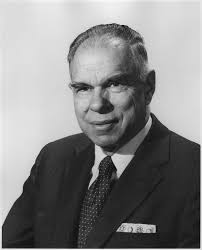
Glenn Seaborg, chairman of the AEC
Mattson clearly sees Seaborg as being a villain in the piece. Late in the book, he explicitly accuses him of running a cover-up. (see p. 297) And, there is evidence to back up this charge. It was later discovered, during the second inquiry, that Seaborg had a close personal friendship with Shapiro. (ibid p. 268)
Earle Hightower, assistant director of safeguards at AEC, explicitly stated that the whole case regarding NUMEC was rigged because it was known that Seaborg would not take action. Little more than three years after Seaborg left the AEC, it was dissolved in 1975 and was replaced by the Nuclear Regulatory Commission, in part, because critics accused the AEC of an insufficiently aggressive regulatory program.
The second, much longer, and more vigorous inquiry into NUMEC and Shapiro came about at the creation of the NRC when Jim Conran was tasked with reviewing the record of how safeguards had worked previously for the AEC so they could be strengthened in the future. In that review process, he came across the case of Shapiro and NUMEC.
When Conran asked to see more files on both, he was denied access, causing him to go up the NRC ladder to Chairman William Anders, who was briefed by, among others, Carl Duckett of the CIA. Since Anders was about to leave for a diplomatic post, he took his concerns to James Connor at President Gerald Ford’s White House.
In March 1976, the CIA’s Duckett addressed an informal gathering of pilots and astronauts, saying there was little doubt Israel had about 20 nuclear warheads. Although this was supposed to be off the record, the information leaked. In April 1976, Time reported that this claim was accurate, except the newsmagazine put the size of the arsenal at 13 bombs and added that the warheads could be delivered by Phantom jets or Jericho missiles.
Duckett wrote a memo to CIA Director George Bush in which he said he suspected that the Israeli program was jumpstarted by a diversion of enriched uranium from the NUMEC plant. (p. 165) He attached various appendices to the memo to show the results of previous inquiries into NUMEC and explain why his belief was justified.
One of the appendices consisted of a paper by John Hadden in which he expressed the suspicion that NUMEC was actually a shell company the Israeli government had set up for the express purpose of diverting materials, technology and information that Israel needed to speed up and facilitate its longstanding quest for atomic weapons. (ibid, p. 166)
A New Investigation
Attorney General Edward Levi was then sent a summary of the FBI’s previous investigation of NUMEC. Levi alerted Ford that he thought NUMEC was culpable for several crimes and, with Ford’s permission, he wished to begin a criminal inquiry. Since Ford’s close adviser James Connor was also disturbed by these findings, the President approved the investigation.
What followed was a tedious bureaucratic battle between the CIA and FBI. The FBI felt it did not have direct proof that a diversion had taken place, while the CIA had the proof — the chemical tests at Dimona — but was reluctant to reveal the intelligence to the FBI. Also, the CIA did not want to furnish the FBI with technical experts to help educate the investigating agents so they could effectively cross-examine important witnesses. Thus, the FBI’s inquiry dragged on through three presidents: Ford, Jimmy Carter and Ronald Reagan.
But even with these obstructions, the FBI did eventually find witnesses to a diversion from the Apollo plant. It turned out that the FBI did not do enough interviews of plant employees in its initial inquiry because there were at least four of them willing to talk. Those witnesses form the climax of Mattson’s book.
In 1980, one witness said that when he read newspaper accounts about the losses of enriched uranium at Apollo, he had to chuckle to himself. When asked why, he replied that in 1965 or 1966, he was walking near the loading dock at Apollo and saw people loading containers – the dimensions that were used for HEU packets – into equipment boxes. He noticed that the shipping papers for the boxes revealed that the packages were destined for Israel. This witness then suggested some other workers at the plant who had seen similar activity. (Ibid, p. 272)
Suspicion Shipment
One of these witnesses saw a flatbed truck backed up into the loading dock area with Shapiro pacing around the area while the driver was loading “stove pipes” into a cabinet on the truck. This struck the witness as odd because the plant had regularly assigned workers for loading duties during the day but this shipment was being prepared in the evening. He explained that “stove pipes” were cylindrical containers that the plant used to pack enriched uranium inside. Each stove pipe usually contained three or four packets of HEU.
When he glanced at the clipboard resting on a package, he saw the destination was Israel. The clipboard then was yanked away and an armed guard escorted him off the dock. He also said it was unusual to see Shapiro in this area of the plant, and further, that Shapiro was very seldom there at night. (ibid, p. 275)
There were two other witnesses who told the FBI about similar events. The FBI also interviewed an NRC inspector named James Devlin, who told the agents that, contrary to what Shapiro had said, the security at the Apollo plant was below par and that NUMEC did not employ a professional security force. The company had one regular armed guard and Devlin happened to know who he was, since he was also a deputy for the township. The only other guards were unarmed and non-uniformed. (ibid, pgs. 272-73)
By this time, the FBI did not want to continue the investigation, believing that nothing would come of it, although the Justice Department urged the investigators on. But the FBI was correct since, as Mattson notes more than once in his book, the last president who really wanted to stop Israel from becoming a nuclear power was John F. Kennedy. (See pgs. 38-40, p. 256)
Richard Helms’s conversation with a disinterested President Johnson underscores how that attitude changed after Kennedy’s death. As Mattson further notes, opposition to Israel’s nuclear-weapons program was more or less negated by President Richard Nixon’s meeting with Prime Minister Golda Meir in 1969 when he agreed that the U.S. would not make any public statements revealing Israel’s nuclear arsenal nor demand that it sign the Non-Proliferation Treaty, as long as Israel did no testing and made no public threats.
Even that policy was probably violated in 1979 with the Vela Incident: a suspected Israeli nuclear test done in the Indian Ocean.
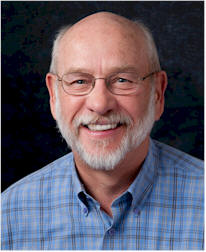
Author Roger Mattson
Author Roger Mattson was part of the inquiry about the illegal transfer of atomic secrets to Israel, working in the NRC’s safeguards department when Conran first voiced his fears about a diversion at NUMEC. Thus, Mattson became part of an internal review of the Shapiro case, seeing firsthand how certain intelligence agencies were, by accident or design, obstructing the investigation.
Mattson concludes his important book by stating that this policy of casting a deliberate blind eye towards a nuclear heist by Israel places the U.S. in a compromised position when trying to enforce a policy of non-proliferation on other nations because of the obvious double standards.
To point out one paradox, the U.S. government executed Julius and Ethel Rosenberg for purportedly supplying nuclear secrets to the Soviet Union with less evidence. Plus, the tinder box of the Middle East is probably the last place where America should have allowed atomic weapons to proliferate, but it did.
Because of that, the U.S. has little or no moral authority on the issue today.
James DiEugenio is a researcher and writer on the assassination of President John F. Kennedy and other mysteries of that era. His most recent book is Reclaiming Parkland.
September 11, 2016
Posted by aletho |
Book Review, Ethnic Cleansing, Racism, Zionism, Timeless or most popular | Central Intelligence Agency, CIA, Israel, United States, Zionism, Zionist Organization of America |
Leave a comment
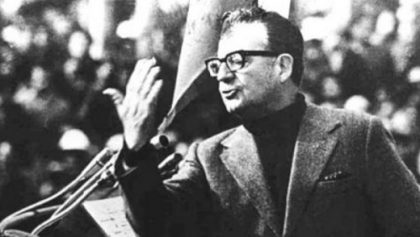
Victim of one the many coups on democracy carried out by the United States: Salvador Allende
Though intelligence documents from the 1973 coup period have been declassified since 1999, the CIA continues to censor them.
The CIA continues to withhold information on its involvement in the Sept. 11, 1973 coup that led to the death of President Salvador Allende in Chile, followed by a deadly dictatorship, according to documents posted Friday by the National Security Archive.
In the list of published documents, the section regarding Chile is censored. The President’s Daily Briefs, the intelligence reports given daily to the U.S. president, in particular former President Richard Nixon days before Allende’s death, were among those censored.
According to Peter Kornbluh, director of the Archive’s Chile Documentation Project, censorship on this issue makes no sense since the intelligence agency has officially acknowledged its ties to those who plotted the coup from inside the Chilean military, and declassified several intelligence reports since.
“The CIA is trying—but failing—to hold history hostage,” Kornbluh said. “The CIA is attempting to cover up what Nixon knew about coup plotting in Chile and when he knew it, as well as hiding the CIA’s own contacts and connections to the coup plotters.”
According to the documents, three days before the coup—and on the day of the coup—the CIA gave Nixon an intelligence report on the progress of the efforts inside the Chilean military to overthrow Allende, a socialist.
In one document, a CIA operative in Santiago named Jack Devine identifies the new date of the planned coup for the next day, September 11, and confirms all three branches of the Chilean armed forces along with the police “are involved in this action.”
The same sources told the CIA that General Augusto Pinochet, who would later become a dictator with the support of the U.S., was in communication with Air Force General Gustavo Leigh about the planned coup. The Air Force would later bomb La Moneda presidential palace, where Allende and his closest allies were on Sept. 11.
The CIA told the White House that a “key officer” in the coup attempt requested U.S. assistance in case the Chilean military encountered any resistance, according to the documents.
Kornbluh said his institution would press for the release of the censored information.
“The documents provided to Richard Nixon on Chile can and should be released for the sanctity of the historical record. The public has a right to know what the President knew, and when he knew it,” he said.
September 11, 2016
Posted by aletho |
Civil Liberties, Deception, Timeless or most popular | Central Intelligence Agency, Chile, CIA, Human rights, Latin America, United States |
Leave a comment
Over the last few months I have been studying the media coverage of the assassination of JFK and the publication of the Warren Commission. It could be argued that the way the mainstream media accepted the official line is not very surprising given their record of recording political stories. However, what is striking is the way that the so-called Non-Communist Left (NCL) reported these events. These were people who controlled left of centre journals such as the Nation, New Republic and I.F. Stone Weekly. None of these journals were willing to question the idea that JFK had been killed by a lone gunman.
The only journal on the left that seemed to doubt the official interpretation of events was James Aronson, the editor of the National Guardian. In the first edition of the newspaper after the assassination, he used the headline: “The Assassination Mystery: Kennedy and Oswald Killings Puzzle the Nation”. Aronson could not understand why others on the left were not taking up a similar position.
In his book, Something to Guard: The Stormy Life of the National Guardian (1978), Aronson recalled that soon after the assassination he was contacted by a journalist working for the New York Times, who asked him if Oswald subscribed to the National Guardian. Aronson replied he could find no record of Oswald receiving the newspaper. Aronson took this opportunity to raise questions about the newspaper’s investigation into the assassination: “I took advantage of the call to air my doubts about the lone assassin theory being fixed in the public mind. What was the New York Times doing to validate or disapprove this theory?” The journalist replied “Look, Jim, you worked here and you know the answer: don’t look this way – they won’t do it.” (1)
Mark Lane was probably the first person to write a detailed article questioning the official story of the assassination. He later pointed out: “The obvious choice, I thought, was the Nation. Its editor, Carey McWilliams, was an acquaintance. He had often asked me to write a piece for him… McWilliams seemed pleased to hear from me and delighted when I told him I had written something I wished to give to the Nation. When he learned of the subject matter, however, his manner approached panic.” McWilliams told Lane: “We cannot take it. We don’t want it. I am sorry but we have decided not to touch that subject.” Lane got the same response from the editors of Fact who said the subject matter was too controversial. It was also rejected by The Reporter, Look, Life and the Saturday Evening Post. (2)
James Aronson “heard that a maverick New York lawyer named Mark Lane had done some careful leg and brain work to produce a thesis casting doubt on the lone-assassin theory – and even whether Oswald had actually been involved in the crime.” (3) Aronson contacted Lane who told him that the article had been rejected by thirteen publications. Aronson offered to publish the article. Lane told him that “I would send it to him but I would not authorize him to publish it. He asked why. I said that I was seeking a broader, non-political publisher and that if the piece originated on the left, the subject would likely never receive the debate that it required.”
Lane now took the article to James Wechsler, an editor of the New York Post. He also rejected it and said that Lane would never find a publisher and “urged him to forget about it”. Lane now told him about Aronson’s offer. Wechsler, according to Lane was “furious” when he heard this news. “Don’t let them publish it… They’ll turn it into a political issue.” (4)
By this time the article had been turned down by seventeen publications and so Lane decided to let Aronson publish the article in the National Guardian. The 10,000 word article, published on 19th December, 1963, was the longest story in its fifteen-year history. It was presented as a lawyer’s report to the Warren Commission and titled A Brief for Lee Harvey Oswald. Aronson argued in the introduction: “The Guardian’s publication of Lane’s brief presumes only one thing: a man’s innocence, under US. Law, unless or until proved guilty. It is the right of any accused. A presumption of innocence is the rock upon which American jurisprudence rests… We ask all our readers to study this document… Any information or analysis based on fact that can assist the Warren Commission is in the public interest – an interest which demands that everything possible be done to establish the facts in this case.” (5)
Aronson later admitted: “Few issues of the Guardian created such a stir. Anticipating greater interest we had increased the press run by 5,000, but an article in the New York Times about our story brought a heavy demand at the newsstands and dealers were calling for additional copies. Before the month was out we had orders for 50,000 reprints.” (6)
Aronson offered the article to both the United Press International and the Associated Press but both agencies rejected it. However, the article was published in several European countries and was discussed in most leading newspapers throughout the world. Some newspapers attempted to rubbish the article by describing it as “left-wing propaganda”. Bertrand Russell wrote to The Times complaining about this treatment: “Mr. Lane is no more a left-winger than was President Kennedy. He attempted to publish his evidence… in virtually every established American publication but was unsuccessful. Only the National Guardian was prepared to print his scrupulously documented material… I think it important that no unnecessary prejudice against this valuable work of Mr. Lane should be aroused, so that his data concerning a vital event may be viewed with an open mind by people of all political persuasions.”
At first the national press attempted to ignore Lane’s article. The only other publication in the United States that was willing to discuss the issue was the New Republic. In an article published on 21st December, 1963, Jack Minnis and Staughton Lynd, the authors of Seeds of Doubt: Some Questions about the Assassination, raised questions about five different categories of evidence in the case. Minnis was the research director for the Student Nonviolent Coordinating Committee, while Lynd was a history professor at Spelman College. Both men were also left-wing activists who were involved with the civil rights and peace movements. (7) However, after the publication of this article the New Republic left the subject alone.
In January, 1964, Walter Winchell made a vicious attack on Mark Lane and the National Guardian in his regular newspaper column. He described the newspaper as “a virtual propaganda arm of the Soviet Union” and called Lane an “agitator” seeking to abolish the Un-American Activities Committee. (8)
It is not surprising that Winchell led the attack on Mark Lane. He was a vital figure in the CIA’s Operation Mockingbird. Carl Bernstein has argued in his article, CIA and the Media: “Joseph Alsop is one of more than 400 American journalists who in the past twenty-five years have secretly carried out assignments for the Central Intelligence Agency, according to documents on file at CIA headquarters. Some of these journalists’ relationships with the Agency were tacit; some were explicit. There was cooperation, accommodation and overlap.” (9)
Deborah Davis, was the first person to expose the workings of Operation Mockingbird in her book, Katharine the Great (1979), a biography of Katharine Graham of the Washington Post. She explained how journalists were controlled in times of crisis: “This practice, the old intelligence principle translated, contained the seeds of political blackmail: Once the newsman or his organization has been compromised, the politician can threaten to expose its lack of independence unless he (it) cooperates further. Many Mockingbirds have been faced with this choice.” (10)
The origins of this intelligence operation dates back to May, 1940, when the British Security Coordination (BSC) was established in the United States. According to William Boyd: “Churchill’s task, as he himself saw it, was clear: somehow, in some way, the great mass of the population of the US had to be persuaded that it was in their interests to join the war in Europe, that to sit on the sidelines was in some way un-American. And so British Security Coordination came into being… The aim was to change the minds of an entire population: to make the people of America think that joining the war in Europe was a ‘good thing’ and thereby free Roosevelt to act without fear of censure from Congress or at the polls in an election.” (11)
One of the first agents recruited by BSC was Allen Dulles, the future head of the CIA. Other agents from the media included: Walter Winchell, Drew Pearson, Walter Lippmann, William Allen White, Dorothy Thompson, Raymond Gram Swing, Edward Murrow, Vincent Sheean, Helen Kirkpatrick, Eric Sevareid, Edmond Taylor, Rex Stout, Edgar Ansel Mowrer and Whitelaw Reid. William Stephenson, the head of the BSC, also worked closely with editors and publishers who were supporters of American intervention into the Second World War. This included Arthur Hays Sulzberger (New York Times), Henry Luce (Time Magazine and Life Magazine), Helen Rogers Reid (New York Herald Tribune), Barry Bingham (Louisville Courier-Journal), Paul C. Patterson (Baltimore Sun), Dorothy Schiff (New York Post) and Ralph Ingersoll (Picture Magazine). (12)
Franklin D. Roosevelt had assigned William Donovan to work closely with William Stephenson on BSC operations (they had in fact been close friends since the First World War). After the United States entered the war, Donovan became head of the Office of Strategic Services (OSS) and he took over control of BSC’s media assets. After the war, the OSS was closed down but emerged two years later as the Central Intelligence Agency (CIA). (13)
In the 1950s Operation Mockingbird was primarily concerned with the dangers of communism. However, it remained in place to be used by the CIA in times of national emergency. The assassination of JFK fell into this category and was successfully employed to make sure that the media did not openly discuss the guilt or innocence of Lee Harvey Oswald. (14)
The shaping of the media by the CIA became public knowledge in April 1976 when the Final Report of the Select Committee to Study Government Operations With Respect to Intelligence Activities was published. “In examining the CIA’s past and present use of the U.S. media, the Committee finds two reasons for concern. The first is the potential, inherent in covert media operations, for manipulating or incidentally misleading the American public. The second is the damage to the credibility and independence of a free press which may be caused by covert relationships with the U.S. journalists and media organizations.” (15)
However, in November, 1963, the public was completely unaware of Operation Mockingbird, and the media cover-up operation was very successful. Journalists who wanted to write about their doubts had to find media organisations in Europe to publish their work. In March, 1964, Thomas G. Buchanan began publishing articles about the assassination in the French newspaper, L’ Express. Buchanan claimed in the newspaper that the Warren Commission had discovered that Jack Ruby knew Lee Harvey Oswald. He argued that Ruby lent him money to pay back the State Department for the $435.71 the U.S. had loaned Oswald when he returned from the Soviet Union.
These articles caught the attention of Richard Helms of the CIA. He sent a memo to John McCone, Director of the CIA: “Buchanan’s thesis is that the assassination of President Kennedy was the product of a rightest plot in the United States. He alleges in his articles that the slain Dallas policeman, Tippett (sic) was part of the plot against President Kennedy.” Helms went onto inform McCone that a “competent” CIA informant had disclosed that a book by Buchanan on the assassination would be published by Secker and Warburg on 15th May 1964. (17) The company had a reputation for publishing left-wing but anti-communist books. This included books by George Orwell, C. L. R. James, Simone de Beauvoir, Rudolf Rocker and Günter Grass.
Helms informant was right and Buchanan’s book, Who Killed Kennedy? was published in May, 1964. Buchanan appears to have been the first writer to suggest that Lyndon B. Johnson and “Texas oil interests” were responsible for Kennedy’s death. Buchanan argues that the assassination was funded by a Texas oilman. He does not name him but later it emerged he was referring to Haroldson L. Hunt. (18)
In the book Buchanan claims that Kennedy was killed by two gunmen. One fired from the railroad bridge. Another fired from the Texas School Book Depository. According to Buchanan, Oswald was aware of the conspiracy but did not fire any shots. Oswald believed that J. D. Tippit was going to help him escape. However, his real job was to kill him “while resisting arrest”. Oswald, realized what was happening and fired first.
When Who Killed Kennedy? was eventually published in the United States, it was mainly ignored. However, Time Magazine reviewed it and made much of the fact that Buchanan was a former member of the American Communist Party. (44) The left-wing British journalist, Cedric Belfrage, who had co-founded the National Guardian but had been deported from the United States in 1955 after refusing to answer questions before the House Un-American Activities Committee (HUAC), argued in the journal, Minority of One, that it was “irrelevant whether Buchanan was a former communist or a former Zen Buddhist”. Belfrage went on to state that what was important was Buchanan’s “common sense of the assassination and the American crisis it symbolizes”. (19)
Joachim Joesten, a freelance journalist, travelled to Dallas a few weeks after the assassination of Kennedy and spent four days there, interviewing witnesses and examining key locations. He came to the conclusion that Lee Harvey Oswald was not a lone gunman. However, he did think that he was involved in the conspiracy to kill Kennedy. “I wish to make it absolutely clear that I believe Oswald innocent only as charged, but that he was involved with the conspirators in some way.” (20)
Joesten began work on his book, Oswald, Assassin or Fall Guy? Like other early authors who questioned the official version, Joesten was forced to get his book published in England (Merlin Press). Before the book was published, Joesten, who was in Hamburg, received a letter from J. Lee Rankin of the Warren Commission, requesting a copy of the book. In March 1964, the United States Embassy in West Germany requested a meeting.
John Kelin, the author of Praise from a Future Generation (2007), has pointed out: “All copies of Joesten’s book manuscript were with either publishers or literary agents, so he was unable to comply with Rankin’s request. But he did sit down with the embassy man, whom he identified only as Mr. Morris… They met at the American Consulate in Hamburg on March 21, 1964… The two men talked for about four hours, during which time Joesten told Morris anything he had learned – why he believed Oswald was innocent of killing President Kennedy and Officer Tippit, and who he thought was really responsible.” (21)
Joesten later recalled that Morris seemed “particularly concerned with the fact that I believed Oswald had been connected with both the Central Intelligence Agency and with the Federal Bureau of Investigation.” Joesten also told Morris that he believed General Edwin Walker organised the assassination and that it “was a military-type operation with firing from both front and rear.” Joesten also speculated that Bernard Weissman was involved in the assassination. (22)
Joesten discovered that while he was in Hamburg FBI agents went to his home in New York City to interview his wife. “Since I had been located, I couldn’t help wondering if the FBI had simply used that excuse to enter my home, talk to my wife and, to put it plainly, snoop around.” The FBI agents recorded that Mrs. Joesten said her husband had returned from Dallas convinced of Oswald’s innocence. “Mrs. Joesten advised that she definitely feels that her husband is on the verge of a nervous breakdown.”
Joesten’s book, Oswald, Assassin or Fall Guy?, was published in the United States by Carl Marzani in July 1964. Marzani, a former member of the American Communist Party, had been imprisoned and blacklisted during the early 1950s and in order to survive went into publishing and established the company Marzani & Munsell. According to Marzani he specialised in books that upset the status quo. In the book Joesten claimed that the Central Intelligence Agency, Federal Bureau of Investigation, the Dallas Police Department and a group of right-wing Texas oil millionaires conspired to kill Kennedy. He openly accused Police Chief Jesse Curry of being one of the key figures in the assassination.
Victor Perlo, reviewing the book in the New Times, commented that the book had been rejected by several publishers before Marzani accepted it. “The firm deserves credit for publishing and promoting the book, so that thousands of copies were sold in a short time, despite a blackout by commercial reviewers. Publisher-editor Carl Marzani edited the manuscript brilliantly… This reviewer approached the Joesten book with scepticism. Despite my low opinion of the Dallas police and the FBI, I’ve had enough experience to know that utterly senseless things do happen in America… But the Joesten book erased most of my scepticism.” (21)
The book was largely ignored by the mainstream media but was reviewed by Hugh Aynesworth in the Editor and Publisher. Aynesworth, a strong supporter of the lone gunman theory and a reporter with the Dallas Morning News, wrote: “Joesten, an ex-German who became a U.S. citizen in 1948… states that Oswald was an agent of both the FBI and the CIA (how’s that for a 24-year-old who couldn’t spell “wrist”?). It’s the same old tripe with some new flavouring.” Aynesworth uses the review to criticize Mark Lane: “Lane is the troublemaker who spent two days in Dallas in January on his investigation and now pretends to be an expert on all aspects of the weird tragedy.” (22)
Another left-wing foreign-born journalist in America was also taking a close interest in the case. Léo Sauvage, who was the political correspondent of Le Figaro, published an article on the assassination in Commentary Magazine in March 1964, where he suggested that there had been a cover-up. He pointed out that all the available evidence against Lee Harvey Oswald had “either been leaked or eagerly and even ruthlessly spelled out – whether true, half-true, or demonstrably false; whether pertinent, confused, or obviously irrelevant” by the Dallas Police. As early as 23rd November, 1963, Will Fritz of the Homicide Bureau proclaimed the case as “cinched” and the following day, only two hours after Jack Ruby “had disposed of Oswald in the basement of Dallas Police Headquarters”, the case against him was declared “closed” by Police Chief Jesse Curry and by District Attorney Henry Wade. (23)
Sauvage was also amazed that by 3rd December, 1963, the FBI had leaked details of its report on the assassination to the media. This allowed the New York Journal American to headline the story with the words: “Oswald lone killer. FBI report to prove it”. Sauvage pointed out that “six days later the Justice Department, acting on instructions from the White House, delivered the now completed report directly” to the Warren Commission. Sauvage adds that on 10th December, the New York Times reported: “Oswald assassin beyond a doubt, FBI concludes. He acted alone and did not know Ruby, says report to Warren Inquiry Panel.”
Sauvage added: “Thus, after the press and television conviction of Lee Oswald in Dallas, a second press and television conviction took place in Washington. And just as the Dallas authorities had forced the hand of any jury that would have heard the Oswald case, so the FBI has forced the hand of the Warren Commission. With the help of all the mass media, Oswald’s guilt has now twice been sold to the public – despite the fact that no one had even so much as ventured to explain why a psychopathic regicide, acting (as we shall see) under circumstances that would make his capture inevitable, should renounce the ultimate satisfaction of glorying in his deed before the eyes of the world. I really do not see, therefore, why only those of us who are sceptical about the case against Oswald should await further information.”
John Kelin, the author of Praise from a Future Generation (2007) summed up Sauvage’s case against the idea that Lee Harvey Oswald was a lone gunman: “Léo Sauvage raised a series of questions that, he declared, Oswald’s accusers should be forced to answer. Did Oswald have an alibi? Was the President’s throat wound one of entrance or of exit? Was Oswald a good enough rifleman to do what the authorities said he did? How many shots were fired? Why were no fingerprints found on the alleged assassination rifle? How come none of the theatre patrons who witnessed Oswald’s arrest came forward with impartial accounts of how he was taken into custody?” (24)
Norman Podhoretz, the editor of Commentary Magazine added his support to Sauvage’s article: “Is the possibility of a treasonous political conspiracy to be ruled out? Not the least fantastic aspect of this whole fantastic nightmare is the ease with which respectable opinion in America has arrived at the conclusion that such a possibility is absurd; in most other countries, what is regarded as absurd is the idea that the assassination could have been anything but a political murder.” (25) Sauvage’s article greatly impressed a large number of people, including the commissioning editor of Random House and on 11th March, 1964, he signed a contract with the publisher to develop his ideas on the assassination into a full-length book.
Criticism of the lone-gunman theory did not only come from the left. In April, 1963, the ultra-conservative, Revilo P. Oliver suggested in an article Marxmanship in Dallas, that appeared in American Opinion, that Kennedy was a victim of a communist conspiracy. He also used the article to attack Kennedy’s liberal views on civil rights and his closeness to “Martin Luther King and other criminals engaged in inciting race war.” (26)
The following month, the veteran right-winger, Martin Dies, former chairman of the House Committee on Un-American Activities (HUCA), argued in the same journal that Kennedy had been a victim of a communist conspiracy. However, at this time he did not have all the evidence: “I hope to discuss the circumstances linking the Soviet Union with Oswald’s murder of the President. Naturally such evidence must be circumstantial and based upon the dogmatic pattern of Communist behaviour. The Communists are too clever to leave any trace of connection with Oswald.” (27) It would seem that at this time Dies was unaware that Oswald had defected to the Soviet Union in 1959 and on his return had openly associated with left-wing groups such as the Fair Play for Cuba Committee.
Billy James Hargis, a member of the John Birch Society and a close friend of General Edwin Walker, who had been mentioned as a conspirator by Joachim Joesten in Oswald, Assassin or Fall Guy?, also claimed a communist conspiracy had killed Kennedy. In his book, The Far Left (1964), he argued: “In spite of the absolute, indisputable evidence that Lee Oswald’s mind was moulded by Communist conspiracy propaganda, that his hatred was of the American free enterprise system and all it embraces, and that no one with even the remotest connection with what is considered to be the extreme right has any remote connection with the entire hideous affair… Do they really think the American people are that stupid? There is no doubt in my mind that the Communist assassin, Lee Oswald, intended to kill the President of the United States and disappear in the confused crowd, thus letting the conservative, anti-Communist element of Dallas take the blame. But it didn’t work. God is on the throne. He saw to it that Lee Harvey Oswald was apprehended by a courageous Dallas policeman, Officer Tippit, who, in turn, gave his life for the cause of freedom in attempting to arrest the Communist assassin of the President.” (28)
Another figure on the right who published a book about the assassination of Kennedy in 1964 was James Evetts Haley. His book, A Texan Looks at Lyndon, blamed it on an old political enemy, Lyndon Baines Johnson. It was a best seller and it is claimed that in Texas only the Bible outsold Haley’s book that year. In the book Haley attempted to expose Johnson’s corrupt political activities. This included a detailed look at the relationship between Johnson and Billy Sol Estes. Haley pointed out that three men who could have provided evidence in court against Estes, George Krutilek, Harold Orr and Howard Pratt, all died of carbon monoxide poisoning from car engines. Haley also suggested that Johnson might have been responsible for the death of Kennedy: “Johnson wanted power and with all his knowledge of political strategy and his proven control of Congress, he could see wider horizons of power as Vice-President than as Senate Majority Leader. In effect, by presiding over the Senate, he could now conceive himself as virtually filling both high and important positions – and he was not far from wrong. Finally, as Victor Lasky pointed out, Johnson had nursed a lifetime dream to be President. As Majority leader he never could have made it. But as Vice-president fate could always intervene.” (29)
On 1st June 1964, The New York Times published a story by Anthony Lewis with the headline, “Panel to Reject Theories of Plot in Kennedy Death”. As Jerry Policoff has pointed out: “The story amounted to a detailed preview of the Warren Report three months before the commission completed taking testimony and nearly four months before the report was released.” (30)
The press almost universally supported the Warren Commission report. The New York Times said it was “a comprehensive and convincing account. The Washington Post commented that it was “deserving acceptance as the whole truth” and The Boston Herald suggested that the Warren Commission had provided a “tremendous service”.
What was even more damaging to those who believed that Kennedy was the victim of a conspiracy was that the progressive press, led by Cary McWilliams, the editor of The Nation, also supported the conclusions of the report. The main bombshell came on 8th October, when I. F. Stone, who had virtually made a living criticising government documents, pointed out in I. F. Stone’s Weekly, that “I believe the Commission has done a first-rate job, on a level that does our country proud and is worthy of so tragic an event. I regard the case against Lee Harvey Oswald as the lone killer of the President as conclusive.” (31) However, as John Kelin has pointed out, at the time Stone wrote this article: “the Warren Report had just been published and the twenty-six volumes of supporting evidence and testimony were still not available”. (32)
Stone then went on to criticise those who had argued that there had been a conspiracy. After attacking the work of Mark Lane he turned on Bertrand Russell, who he described as “my dear and revered friend”. He suggested that Russell had dismissed the conclusions of Warren Commission report without even reading it. This was completely untrue. As Russell’s assistant, Ralph Schoenman, later pointed out, he had been provided a copy of the report a week before its official release date. (33)
Stone then went onto to look at the two books that had already been published arguing that there had been a conspiracy: “The Joesten book is rubbish, and Carl Marzani – whom I defended against loose charges in the worst days of the witch hunt – ought to have had more sense of public responsibility than to publish it. Thomas G. Buchanan, another victim of witch hunt days, has gone in for similar rubbish in his book, Who Killed Kennedy? You couldn’t convict a chicken thief on the flimsy slap-together of surmise, half-fact and whole untruth in either book… All my adult life as a newspaperman I have been fighting, in defense of the Left and of a sane politics, against conspiracy theories of history, character assassination, guilt by association and demonology. Now I see elements of the Left using these same tactics in the controversy over the Kennedy assassination and the Warren Commission Report.”
Ray Marcus, who was a devoted follower of I.F. Stone and had subscribed to his journal since its first edition in January 1953, was deeply shocked by this article. Marcus later recalled: “What was totally lacking in I. F. Stone’s comments was any evidence of the critical analysis he normally employed on assessing official statements.” On 8th October, 1964, Marcus wrote Stone a long letter outlining the flaws in the Warren Report. Marcus argued that in order to accept the Warren Commission’s lone-gunman scenario, one must accept fifteen points as true. These points were explained in an eight page letter. Marcus never received a reply. (34)
Another journalist considered to be on the left at the time was Walter Lippmann. In his syndicated column, Today and Tomorrow on 29th September, 1964, Lippmann wrote that he was convinced that Lee Harvey Oswald had acted alone in assassinating John F. Kennedy. He added there was “no ground on which any contemporary man, here or abroad, should question the verdict”. (35) However, he later told his friend, Ronald Steel, that he suspected that Kennedy had been killed as part of a conspiracy. (36)
The complete acceptance by the media of the Warren Report caused problems for those wishing to publish books advocating a conspiracy. Léo Sauvage, who had already signed a contract with Random House, to publish his book, The Oswald Affair – an Examination of the Contradictions and Omissions of the Warren Report, was to be disappointed. A month after the publication of the report, a senior editor at Random House, Jason Epstein, wrote to Sauvage cancelling the contract: “The problem is that the Warren Report has put the Oswald matter in a different light from what I expected, and I’m now convinced that any book which attempts to question Oswald’s guilt would be out of touch with reality and could not be taken seriously by responsible critics.” (37) No other publisher in the United States was willing to bring out the book and so like other opponents of the lone gunman theory, Sauvage was forced to go to Europe to have his book published.
It has been suggested that the critics of the lone-gunman theory were particularly hurt by the support for the Warren Report from left-wing journalists. In a debate that took place on 4th December, 1964, Beverly Hills High School, Abraham Wirin, chief counsel for the American Civil Liberties Union in California and a much respected figure on the left for over 30 years, told the audience that he tried to make up his own mind on important issues, but in the case of the Warren Commission he relied on the opinions of people who he could trust: “I consider Carey McWilliams and The Nation, as an individual and a newspaper, respectively, whose judgment I respect. I do not consider Carey McWilliams or The Nation, a person or a newspaper, which would participate in a fraud, or would condone it.” Wirin pointed out The Nation had carried an article in support of the Warren Report and added: “now, that carries a lot of weight with me.”
Wirin then went onto to discuss I.F. Stone’s support for the Warren Report: “Now Mr. Stone, who has defended the rights of the Left, of Communists and others to fair treatment and freedom throughout his life – who is no apologist for any Rightest… Very rarely does Mr. Stone ever commend a government agency. Very rarely. As very rarely do I.” Wirin then said something very strange: “I say thank God for Earl Warren. He saved us from a pogrom. He saved our nation. God bless him for what he has done in establishing that Oswald was the lone assassin.” (38)
Mark Lane, who was involved in the debate with Abraham Wirin, has suggested a reason why the left was so keen to support the conclusions of the Warren Report. He discovered a document dated 20th January, 1964, where President Lyndon Johnson had asked Earl Warren to squelch rumours that “were circulating in this country and overseas”. He added that these rumours were so potentially explosive that if they were “not quenched, they could conceivably lead the country to war which could cost 40 million lives”. (39)
Lane suggests that this may be connected to the memo that deputy attorney Nicholas Katzenbach sent to Lyndon Johnson, through Bill Moyers, his press secretary, on 25th November, 1963. Katzenbach insisted that: “The public must be satisfied that Oswald was the assassin, that he did not have confederates who are still at large, and that the evidence was such that he would have been convicted at trial. I think this objective may be satisfied by making public as soon as possible a complete and thorough FBI report on Oswald and the assassination.” (40)
Were the rumours that needed to be “quenched” the same as those circulated by Revilo P. Oliver, Martin Dies and Billy James Hargis in the days following the assassination? Lane argues in Plausible Denial: Was the CIA Involved in the Assassination of JFK? (1991): “The CIA had concluded that Oswald had acted alone; he had not involved others in his plans and no one had directed him. Warren was respectfully cautioned, however, that if the American people received the facts, surely they would demand, in the existing volatile atmosphere, still heaving with tragedy, and against the backdrop of an escalating cold war, that immediate action be taken against the Soviet Union and Cuba. Warren agreed. Under the circumstances, he was advised that since the fate of the world was now in his hands, it was imperative that the Oswald-Kostikov connection be suppressed.” (41) Is it possible that people like Walter Lippmann, I. F. Stone and Carey McWilliams had been told that the Soviets had been involved in a conspiracy to kill Kennedy and without their support a nuclear war could not be adverted?
Then we have those strange words of Abraham Wirin: “I say thank God for Earl Warren. He saved us from a pogrom. He saved our nation. God bless him for what he has done in establishing that Oswald was the lone assassin.” Why would Wirin use the word “pogrom”? Had key figures on the left such as I.F. Stone and Carey McWilliams been told that the conspiracy to kill Kennedy was in someway involved Jewish left-wingers? If that was the case, why would they be willing to believe such stories? It is indeed a strange puzzle. Maybe the answer lies in an article that had been written by Tom Braden that appeared in the Saturday Evening Post on 20th May, 1967.
Braden, who had worked with Allen Dulles at the Office of Strategic Services (OSS) during the Second World War, was considered to be an expert in psychological warfare. When Dulles joined the CIA in December 1950 as Deputy Director of Operations one of his first acts was to recruit Braden as his assistant. Braden suggested to Allen Dulles that he should be allowed to establish the International Organizations Division (IOD) to counteract Soviet propaganda. Dulles agreed and Cord Meyer was appointed as his deputy. The IOD helped established anti-Communist front groups in Western Europe.
The IOD was dedicated to infiltrating academic, trade and political associations. The objective was to control potential radicals and to steer them to the right. Braden oversaw the funding of groups such as the National Student Association, the Congress of Cultural Freedom, Communications Workers of America, the American Newspaper Guild, the United Auto Workers, National Council of Churches, the African-American Institute and the National Educational Association.
Braden later admitted that the CIA was putting around $900,000 a year into the Congress of Cultural Freedom. Some of this money was used to publish its journal, Encounter. Braden and the IOD also worked closely with anti-Communist leaders of the trade union movement such as George Meany of the Congress for Industrial Organization and the American Federation of Labor. This was used to fight Communism in its own ranks. As Braden said: “The CIA could do exactly as it pleased. It could buy armies. It could buy bombs. It was one of the first worldwide multinationals.” (42)
This remained a highly secret operation but in 1966 stories began to appear in the New York Times suggesting that the CIA had been secretly funding left-wing groups. This in fact, was not a new claim. Joseph McCarthy had made similar accusations in 1953. He had been given this information by J. Edgar Hoover who had described the Office of Policy Coordination (OPC) as “Wisner’s gang of weirdos”. In August, 1953, Richard Helms, Wisner’s deputy at the OPC, told Cord Meyer, who was Braden’s deputy at the International Organizations Division, that Joseph McCarthy and the FBI had accused him of being a communist. The FBI added to the smear by announcing it was unwilling to give Meyer “security clearance”. (43)
In September, 1953, Meyer was shown the FBI file against him. It included allegations that his wife, Mary Pinchot Meyer, was a former member of the American Labor Party. It also listed several people linked to Meyer who had “supported pro-Communist policies or have been associated with Communist front organizations or organizations pro-Communist in their sympathies.” The list included the publisher Cass Canfield, the president and chairman of Harper & Brothers. Canfield had first met Allen Dulles in 1940 when they were both working for the British Security Coordination (BSC), a highly secret British intelligence unit based in the United States set up with the approval of President Franklin D. Roosevelt. In the aftermath of the Kennedy assassination Canfield played an important role in stopping books criticising the Warren Commission being published. Canfield had indeed been receiving money from the CIA to help publish left-wing but anti-communist books. He was along with Jason Epstein of Random House, who had blocked the publication Léo Sauvage’s The Oswald Affair – an Examination of the Contradictions and Omissions of the Warren Report, a key figure in the CIA sponsored Congress of Cultural Freedom.
McCarthy’s assistant, Roy Cohn, argues in his book McCarthy (1968) that they had discovered that communist agents had infiltrated the CIA in 1953: “Our files contained allegations gathered from various sources indicating that the CIA had unwittingly hired a large numbers of double agents – individuals who, although working for the CIA, were actually communist agents whose mission was to plant inaccurate data…. We also wanted to investigate charges that the CIA had granted large subsidies to pro-Communist organizations.” Cohn complained that this proposed investigation was stopped on the orders of the White House. “Vice-President Nixon was assigned to the delicate job of blocking it… Nixon spoke at length, arguing that an open investigation would damage national security, harm our relations with our allies, and seriously affect CIA operations, which depended on total secrecy… Finally, the three subcommittee members, not opposed to the inquiry before they went to dinner, yielded to Nixon’s pressure. So, too, did McCarthy, and the investigation, which McCarthy told me interested him more than any other, was never launched.” (44)
Allen Dulles refused permission for the FBI to interrogate Frank Wisner and Cord Meyer and Hoover’s investigation also came to an end. McCarthy was in fact right when he said that the CIA was funding what he considered to be pro-communist organisations. He was wrong however in believing they had infiltrated the organisation. As Frances Stonor Saunders, the author of Who Paid the Piper: The CIA and the Cultural Cold War? (1999) has pointed out it was the other way round. This has been confirmed by some members of the left who received funding from the CIA during this period. As Arthur Schlesinger later explained, the NCL was supported by leading establishment figures such as Chip Bohlen, Isaiah Berlin, Averell Harriman and George Kennan: “We all felt that democratic socialism was the most effective bulwark against totalitarianism. This became an undercurrent – or even undercover – theme of American foreign policy during the period.” (45)
It might seem strange that the non-communist left should be paid to write articles and books attacking the Soviet Union. After all they would have done that anyway. However, the important aspect of this policy was to compromise these left-wing writers by paying them money or by funding their organisations. It also put them in position where they could call on their help in times of crisis such as the assassination of John Kennedy. The support of the NCL was vitally important in the cover-up of the assassination.
Why then did the CIA start leaking information about their funding of the NCL in 1966? The reason is that most of these sponsored journalists refused to support the government policy on Vietnam. In the case of Stone, he found it to his financial advantage to oppose the policy. Stone had barely 20,000 subscribers to I.F. Weekly before the outbreak of the war. By 1969 he had over 70,000. (46)
The story of CIA funding of Non-Communist Left journalists and organizations was fully broken in the press by a small-left-wing journal, Ramparts. The editor, Warren Hinckle, met a man by the name of Michael Wood, in January 1967, at the New York’s Algonquin Hotel. The meeting had been arranged by a public relations executive Marc Stone (the brother of I.F. Stone). Wood told Hinckle that the National Student Association (NSA) was receiving funding from the CIA. At first Hinkle thought he was being set-up. Why was the story not taken to I.F. Stone? (47)
However, after further research, Hinckle was convinced that the CIA had infiltrated the Non-Communist Left: “While the ADA-types and the Arthur Schlesinger model liberal kewpie dolls battled fascism by protecting their right flank with domestic Red-baiting and Cold War one-upmanship, the Ivy League delinquents who fled to the CIA – liberal lawyers, businessmen, academics, games-playing craftsmen – hatched a master plan of Germanic ambition that entailed nothing less than clandestine political control of the international operations of all important American professional and cultural organisations: journalists, educators, jurists, businessmen, et al. The standing CIA subsidy to the National Student Association was but one slice of a very complex pie.” Hinckle even had doubts about publishing the story. Sol Stern, who was writing the article for Ramparts, “advanced the intriguing contention that such a disclosure would be damaging to the enlightened men of the liberal internationalistic wing of the CIA who were willing to provide clandestine money to domestic progressive causes.” (48)
Hinckle did go ahead with the story and took full-page advertisements in the Tuesday editions of the New York Times and Washington Post: “In its March issue, Ramparts magazine will document how the CIA has infiltrated and subverted the world of American student leaders, over the past fifteen years.” For its exposé of the CIA, Ramparts received the George Polk Memorial Award for Excellence in Journalism and was praised for its “explosive revival of the great muckraking tradition.”
On 20th May 1967 Thomas Braden, the former head of the CIA’s International Organizations Division, that had been funding the NSA, wrote an article that was published in the Saturday Evening Post entitled, I’m Glad the CIA is Immoral Braden admitted that for more than 10 years, the CIA had subsidized progressive magazines such as Encounter through the Congress for Cultural Freedom – which it also funded – and that one of its staff was a CIA agent. He also admitted that he had paid money to left-wing trade union leaders such as Walter Reuther, Jay Lovestone, David Dubinsky and Irving Brown. (49)
According to Frances Stonor Saunders, the author of Who Paid the Piper: The CIA and the Cultural Cold War? (1999): “The effect of Braden’s article was to sink the CIA’s covert association with the Non-Communist Left once and for all.” (50) Braden later admitted that the article had been commissioned by CIA asset, Stewart Alsop. (51) But why had the CIA decided to expose their agents in 1967. Was it because they were refusing to support government policy in Vietnam?
John Hunt, a CIA agent who worked very closely with Braden at the International Organizations Division, pointed out in a revealing interview: “Tom Braden was a company man… if he was really acting independently, would have had much to fear. My belief is that he was an instrument down the line somewhere of those who wanted to get rid of the NCL (Non-Communist Left). Don’t look for a lone gunman – that’s mad, just as it is with the Kennedy assassination… I do believe there was an operational decision to blow the Congress and the other programs out of the water.” (52)
By this time of course those figures on the Non-Communist Left such as I.F. Stone and Carey McWilliams knew they had been fooled by the CIA in the aftermath of the Kennedy assassination. However, all they could do was to keep their heads down and pretend it had not happened. Warren Hinkle admitted that as editor of Ramparts in November 1963, he had been reluctant to get involved in investigating the Kennedy assassination. Until he took up the case in 1967 he had left it up to the “amateurs”. He added the “nationwide grass-roots reinvestigation of the Kennedy assassination was an extraordinary phenomenon of an extraordinary decade”. (53)
A more detailed account of the way the media covered the JFK assassination can be found in my introduction of my ebook on the assassination.
http://www.amazon.co…53582406&sr=1-4
Notes
1. James Aronson and Cedric Belfrage, Something to Guard: The Stormy Life of the National Guardian (1978) page 296
2. Mark Lane, Plausible Denial: Was the CIA Involved in the Assassination of JFK? (1991) page 19
3. James Aronson and Cedric Belfrage, Something to Guard: The Stormy Life of the National Guardian (1978) page 297
4. Mark Lane, Plausible Denial: Was the CIA Involved in the Assassination of JFK? (1991) page 20
5. James Aronson, National Guardian (19th December, 1963)
6. Mark Lane, The National Guardian (19th December, 1963)
7. Jack Minnis and Staughton Lind, Seeds of Doubt: Some Questions about the Assassination, New Republic (21st December, 1963)
8. Quoted by James Aronson and Cedric Belfrage, Something to Guard: The Stormy Life of the National Guardian (1978) page 298
9. Carl Bernstein, CIA and the Media, Rolling Stone Magazine (20th October, 1977)
10. Deborah Davis, Katharine the Great (1979) page 190
11. William Boyd, The Guardian (19th August, 2006)
12. At the end of the Second World War the files of British Security Coordination were packed onto semitrilers and transported to Camp X in Canada. Stephenson wanted to have some record of the activities of the agency, “To provide a record which would be available for reference should future need arise for secret activities and security measures for the kind it describes.” He recruited former BSC agents, Roald Dahl, H. Montgomery Hyde, Giles Playfair, Gilbert Highet and Tom Hill, to write the book. Stephenson told Dahl: “We don’t dare to do it in the United States, we have to do it on British territory.” Dahl commented: “He pulled a lot over Hoover… He pulled a few things over the White House, too, now and again. I wrote a little bit but eventually I called Bill and told him that it’s an historian’s job… This famous history of the BSC through the war in New York was written by Tom Hill and a few other agents.” Only twenty copies of the book were printed. Ten went into a safe in Montreal and ten went to Stephenson for distribution. The report was eventually published in 1998 as British Security Coordination: The Secret History of British Intelligence in the Americas, 1940-45.
Other books that contain interesting information on the work of the British Security Coordination include: Jennet Conant, The Irregulars: Roald Dahl and the British Spy Ring in Wartime Washington (2008), Thomas E. Mahl, Desperate Deception: British Covert Operations in the United States, 1939-44 (1998), Nicholas J. Cull, Selling War: The British Propaganda Campaign Against American Neutrality (1996) and Bill Macdonald, The True Intrepid: Sir William Stephenson and the Unknown Agents (2001).
13. Final Report of the Select Committee to Study Government Operations With Respect to Intelligence Activities (April, 1976)
14. ARRB Record Number 180-100092-10352
15. Thomas G. Buchanan, Who Killed Kennedy? (1964)
16. Time Magazine (12th June, 1964)
17. Cederic Belfrage, The Minority of One (October, 1964)
18. Joachim Joesten, Oswald, Assassin or Fall Guy? (1964) page 11
19. John Kelin, Praise from a Future Generation (2007) page 169
20. CE 2709, Warren Commission Vol.26 pages 79-84
21. Victor Perlo, New Times (September 1964)
22. Hugh Aynesworth, Editor and Publisher (1st August, 1964)
23. Léo Sauvage, Commentary Magazine (March, 1964)
24. John Kelin, Praise from a Future Generation (2007) page 179
25. Norman Podhoretz, Commentary Magazine (March, 1964)
26. Revilo P. Oliver, Marxmanship in Dallas, American Opinion (February, 1964)
27. Martin Dies, Assassination and its Aftermath, American Opinion (March, 1964)
28. Billy James Hargis, Far Left (1964) page 146
29. James Evetts Haley. A Texan Looks at Lyndon (1964) page 199
30. Jerry Policoff, The Media and the Murder of John Kennedy, New Times (8th August, 1975). Included in Assassinations: Dallas and Beyond – A Guide to Cover-Ups and Investigations (1976)
31. I. F. Stone, I. F. Stone’s Weekly (5th October, 1964)
32. John Kelin, Praise from a Future Generation (2007) page 182
33. John Kelin, interview with Ralph Schoenman (14th August, 2000)
34. Ray Marcus, letter to I. F. Stone (8th October, 1964)
35. Walter Lippmann, Today and Tomorrow (29th September, 1964)
36. Ronald Steel, Walter Lippmann and the American Century (1999) page 543
37. Jason Epstein, letter to Léo Sauvage (4th November, 1964)
38. Abraham L. Wirin, speech, Beverly Hills High School (4th December, 1964)
39. Mark Lane, Plausible Denial: Was the CIA Involved in the Assassination of JFK? (1991) page 51
40. Nicholas Katzenbach, memo to Bill Moyers (25th November, 1963)
41. Mark Lane, Plausible Denial: Was the CIA Involved in the Assassination of JFK? (1991) page 53
42. Tom Braden, interview included in the Granada Television program, World in Action: The Rise and Fall of the CIA (June, 1975)
(43) Cord Meyer, Facing Reality: From World Federalism to the CIA (1980) pages 60-84
(44) Roy Cohn, McCarthy (1968) pages 63-65
(45) Arthur Schlesinger quoted by Frances Stonor Saunders, Who Paid the Piper: The CIA and the Cultural Cold War? (1999) page 63
(46) D. D. Guttenplan, American Radical: The Life and Times of I.F. Stone (2011) page 432
(47) Hugh Wilford, The Mighty Wurlitzer: How the CIA Played America (2008) page 239
(48) Warren Hinckle, If you have a Lemon, Make Lemonade (1973) pages 172-179
(49) Tom Braden, Saturday Evening Post (20th May, 1967)
(50) Frances Stonor Saunders, Who Paid the Piper: The CIA and the Cultural Cold War? (1999) page 398
(51) Tom Braden, interviewed by Frances Stonor Saunders (August 1996)
(52) John Hunt, interviewed by Frances Stonor Saunders (July 1997)
(53) Warren Hinckle, If you have a Lemon, Make Lemonade (1973) page 204
September 9, 2016
Posted by aletho |
Corruption, Deception, Timeless or most popular | Central Intelligence Agency, CIA, I.F. Stone, JFK Assassination, New York Times, The Nation, United States |
Leave a comment
It’s only been a few weeks since the Zionist coup in Brazil and a Judaized shift in the Latin American powerhouse and BRICS stalwart is already unfolding. Michel Temer, the putschist who seized power from Dilma Rousseff, is known as a “friend of the Brazilian Jewish community”, and this “righteous Gentile” (as the ‘Israelis’ like to call all their puppets) has already appointed another “friend of the Brazilian Jewish community”, Jose Serra, as Brazil’s foreign minister. It has also been revealed that the Coupmonger-In-Chief worked closely with Fernando Lottenberg, the president of the Brazilian Israelite Confederation, on raising awareness (read: brainwashing) among Brazilians about “Holocaust Remembrance Day” as well as passing Zionized “anti-terrorism” legislation that will undoubtedly have an Orwellian effect on Brazil’s citizenry.
Temer has also opened the doors to the “Christian” Zionist scourge that has infected much of America, as well as other Western nations–albeit to a lesser extent–like Canada, the UK and Australia. The International Fellowship of Christians and Jews (IFCJ), led by Rabbi Yechiel Eckstein, arrived in Brazil mere days after Rousseff’s overthrow and just concluded its trip 24 hours ago. Rabbi Eckstein’s gang was on a mission to turn every major “mega-church” in Brazil into even stronger supporters of the usurping Zionist entity for the “cause” of combating “anti-Semitism”. The good “rebbe” and Temer aren’t strangers and thus, this entire event should be looked at not just as a consequence of the Zionist coup against the Workers’ Party (PT), but part and parcel of it. Furthermore, Rabbi Eckstein’s subversive visit should be seen in the greater context of “Christian” Zionist penetration into Brazil and Latin America as a whole.
Brazil, which was once a hotbed of Christian Liberation Theology led by revolutionary luminaries such as Leonardo Boff, is now spiraling into a bottomless pit of “Christian” Zionist hell and has been so since 1977 when the Universal Church–an ultra-Freemasonic institution right down to its reconstruction of Solomon’s Temple–came into being. And let there be no doubt that this “Christian” Zionism is a byproduct of the utterly devilish Rockefeller-financed Wycliffe Bible Translators and the CIA which have worked hand-in-hand from the “Christian” Zionist outfit’s beginnings in 1942 to evangelize the Catholics of Latin America, with a special focus on Brazil, using the satanic Scofield Reference Bible.
It should be noted for the record that the Freemasonic Universal Church and other like-similar institutions were welcomed by the Brazilian military dictatorship as a counterweight to the Christian Liberation Theologians, who, despite being tortured, killed and disappeared, remained a formidable anti-Imperialist opposition current until the end of the coup regime. And how can we forget that the US-‘Israeli’-backed tyranny that did all of this murdering and maiming would never have attained power if it wasn’t for the Zionist Jew Harold Geneen, who was deathly afraid of losing his multinational ITT telecom giant to democratically-elected Brazilian President João Goulart in a wave of nationalizations. So the Zionist Jew simply called his “shabbos goy” friend CIA Director John McCone, gave him all-access to ITT’s resources and then the CIA used this new, incredibly useful instrument to push forward with the coup full throttle, ultimately deposing Goulart in 1964. It was International Jewry that crushed Brazil’s first attempt at nationalist-socialism, and it was International Jewry that crushed Brazil’s new experiment in nationalist-socialism exemplified by Dilma Rousseff and her Workers’ Party.
Quite possibly NOTHING encapsulates this entire sad affair like BreakingIsraelNews, a known gateway for Zionist propaganda, which called the illegal ouster of Dilma Rousseff “karma” for her anti-‘Israeli’ posturing and quoted a verse from the genocidal, Jewish supremacist book of Deuteronomy to drive its pro-coup point home even further. The arrogance of World Zionism is indeed boundless and this hubris is certainly driving its offensive throughout Latin America. It’s not just Brazil. Pedro Pablo Kuczynski, a former World Bank economist whose Jewish roots and strong ties to numerous international banks and investment firms (read: the Rothschild Octopus) make him a prime mover and shaker for the Zionist project in the region, is about to take over Peru. Argentina, once run by the fiery anti-globalist Cristina Fernández de Kirchner, is now a pro-US, pro-‘Israel’ neoliberal nightmare run by neocon Mauricio Macri. And Venezuela, home of the Bolivarian Revolution, is once again in the throes of a coup as US-Zionist-aligned oligarchs wage economic war on Caracas through the deliberate creation of food shortages and other forms of destabilizing malice. The homeland of Hugo Chavez (RIP) has long been a target of ‘Israel’–he said so himself–for El Comandante fought the Jewish New World Order tooth and nail, and considering the above-mentioned pomposity of these bloodthirsty “chosenite” coupmongers, it’s a safe bet to assume they are going to continue their efforts to crush the Bolivarian phenomenon permanently.
If Brazil and Venezuela are to survive this dark, dark period, the peoples of these respective great nations must come to terms with the simple fact that it is not merely “Imperialism” which is seeking to destroy their nationalist-socialisms and impose economic neoliberalism on their societies, but International Jewry’s ZIO-IMPERIALISM which is seeking to impose TOTAL neoliberalism on their societies in the political, financial, cultural and even spiritual sectors, hence the blatant “Christian” Zionist surge as of recent. Resistance on all fronts is the only antidote to this growing poisonous trend, and if it is not fiercely engaged in, as Venezuelan President and Chavez successor Nicolas Maduro is desperately attempting to do now, then the darkness is not only going to continue, but worsen to levels not seen since Guatemala in ’54, Brazil in ’64, Chile in ’73, Argentina in ’76 and in more recent times, Honduras in ’09, ALL PUT TOGETHER. Our full solidarity with the Latin American peoples in the face of Empire Judaica’s storm.
September 8, 2016
Posted by aletho |
Timeless or most popular, War Crimes | Brazil, Central Intelligence Agency, CIA, Latin America, United States, Venezuela, Zionism |
Leave a comment
While Barack Obama became the first sitting U.S. president to ever visit Laos, half a century after the U.S.’s “secret war” left it with the unfortunate distinction of being the most heavily bombed country in history, he stopped short of offering an apology to one of Southeast Asia’s smallest countries.
Laos became the world’s most-bombed country per capita from 1964 to 1973 as Washington launched a secret CIA-led war to cut supplies they believed were flowing to communist fighters during the war on Vietnam.
Much of the country is still littered with ordnance, including millions of cluster munition “bomblets” that maim and kill innocent people to this day.
In his speech Tuesday in the capital of Vientiane, Obama acknowledged the secret war but stopped short, as he did in Vietnam, of offering an apology for Washington’s dirty legacy.
He pledged US$90 million, a figure close to the US$100 million the United States has spent in the past 20 years on clearing its UXO in Laos, to help the country clear unexploded ordnance that has killed or injured more than 20,000 people.
“Given our history here I believe the United States has a moral obligation to help Laos heal,” Obama told a crowd of delegates, including communist party leaders, students and monks, during a speech in the capital Vientiane.
“The remnants of war continue to shatter lives here in Laos,” he said, adding many U.S. citizens were still unaware of their country’s secret carpet bombing of the country. “Over the years thousands of Laotians have been killed or injured. Farmers tending their fields, children playing. The wounds, a missing leg or arm, last a lifetime.”
UXO remains a stubborn problem in the region and experts say it could take decades to clear landmines and bombs in Laos, Cambodia and Vietnam, which were beset by conflicts in the 1960s and 1970s, and in Cambodia’s case, in the 1980s and 1990s too.
In the central Lao province of Xieng Khouang, the area most heavily bombed by U.S. aircraft during the war in neighboring Vietnam, there is a trail of devastation.
About 80 percent of the people of landlocked Laos rely on agriculture, but some of it is simply too dangerous to farm. Approximately a quarter of its villages are contaminated with unexploded ordnance, says the British-based Mines Advisory Group, which helps find and destroy the bombs.
The issue has long dogged relations between the United States and Laos, a cloistered and impoverished communist nation. But both sides have moved closer in recent years and Obama’s visit is being hailed as a landmark opportunity to reset ties.
September 7, 2016
Posted by aletho |
Progressive Hypocrite, Timeless or most popular, War Crimes | Central Intelligence Agency, CIA, Laos, Obama, United States, UXO |
Leave a comment
President Barack Obama has opted to ratchet up military tensions in Asia as one of his last foreign policy acts as president of the United States. Using climate change and free trade backdrops at the G20 Summit in Hangzhou, China and the U.S.-ASEAN and East Asia Summits in Vientiane, Laos as mirages intended to mask his aggressive military posture in the Asia-Pacific region, Obama seeks to cement his «pivot to Asia». It is Obama’s sincere hope that his anticipated successor, his former Secretary of State, Hillary Clinton, will expand on the expansionistic and aggressive regional showdown with China and Russia that his administration launched with his Asia «pivot».
The ultra-protocol conscious Chinese threw diplomacy and decorum to the wind when Obama touched down at Hangzhou International Airport and his national security adviser Susan Rice and deputy national security adviser became embroiled in an argument with Chinese security personnel. When White House officials traveling with Obama began issuing orders to the Chinese personnel, one Chinese official yelled at them, «This is our country. This is our airport». It was as if the Chinese, realizing that this would be their last encounter with Obama as president, were letting him and his war hawk national security team know who was the boss as long as they were on Chinese soil. At least on the tarmac at Hangzhou International Airport, the Chinese swung Obama’s Asia «pivot» back to China.
It was an ignominious final «haj» for Obama’s anti-Chinese jihad. Obama began his presidency in 2009 with being awarded, incredibly prematurely as it turned out, the Nobel Peace Prize. For the Asia-Pacific region, Obama’s presidency would end with angry words between his aides and Chinese officials at a Chinese airport.
Obama began his journey as the host for Pacific Island leaders at the Central Intelligence Agency front, the East-West Center, which is located at his mother’s alma mater, the University of Hawai’i. Obama was the official host at the 2016 Pacific Islands Conference (PIC) of Leaders at the CIA-linked center. Obama’s speech before the leaders, many from small Pacific island states, focused primarily on global climate change. Obama also addressed the World Conservation Congress at their meeting in Hawai’i.
Obama was schooled in anti-Chinese bigotry and Cold War fear tactics by his CIA mother and right-wing fascist Indonesian army stepfather while a child in post-1965 coup Indonesia. Obama, who is fully aware that the blood of 800,000 to one million Indonesians, Communists and ethnic Chinese Indonesian nationals, flowed in the streets, canals, and rivers of Indonesia from 1965 to 1967, the year he and his mother arrived in the country, believes it his birthright and duty to continue his familial “jihads” against «Communist» China that were instilled in him as a child, teen, and college student by his CIA-connected parents.
Papua New Guinea’s Prime Minister, Peter O’Neill, tipped off the press about the real purpose of the PIC before he departed Port Moresby for Hawai’i. O’Neill, who is in charge of one of Papua New Guinea’s most corrupt governments since independence in 1975, said that “regional security” shared the bill with climate change at the Hawai’i conference. In addition to independent Pacific Island states, the PIC includes the U.S. territories of American Samoa, Guam, Northern Marianas, and the state of Hawai’i.
U.S. Army Assistant Chief of Staff Colonel Tom Hanson, a relatively low-level official to be issuing policy statements, gave an ultimatum to Australia just prior to Obama’s departure for Hawai’i and Asia. Hanson told the Australian Broadcasting Corporation, “I think the Australians need to make a choice … it’s very difficult to walk this fine line between balancing the alliance with the United States and the economic engagement with China.” The statement chilled U.S.-Australian relations prior to Obama’s meeting with Australian Prime Minister Malcom Turnbull at the G20 summit.
Also on Obama’s agenda was pressuring certain PIC leaders who have shown signs of resisting the political status quo imposed by Washington. Northern Marianas Governor Ralph Torres, a Republican, recently signed into law the Second Marianas Political Status Commission that seeks to re-evaluate the islands’ current neo-colonial status imposed by the agreement that transformed the Northern Marianas into a colony where Asian sweat shops predominate and where those of Northern Marianas descent have little say over their domestic affairs. The Pentagon wants to turn the island of Tinian into a live-fire range, a decision that imperils the 3,000 residents of the island.
Another U.S. colony, Guam, has seen the growth of a Commission on Decolonization and an Independence for Guahan Task Force. Guahan is the proper Chuukese name for Guam.
Obama, a product of U.S. imperialist control over Hawai’i, the importance of which for Washington is solely military, has done everything possible to subvert and suppress the anti-colonial aspirations of the Pacific islands under U.S. domination and political influence.
The Obama administration has also been exercising subtle pressure on the Federation of Micronesia, a quasi-independent former U.S. Trust Territory, to deter movements for independence from the island groups of Chuuk and Yap. Under the Compact of Free Association, the U.S. effectively controls Micronesia and reserves the right o build military bases, through the federal government of Micronesia located in Pohnpei. Chuuk and Yap accuse Pohnpei of ignoring their own interests. Similar neo-colonialist “compacts” are in effect with the other former U.S. trust territories of the Marshall Islands, where the U.S. maintains a missile test range, and Palau, where the U.S. would like to build a naval base.
After departing Hawai’i for Asia, Obama stopped at the U.S.-controlled Midway Island, where he expanded the Papahānaumokuākea National Monument, a major marine wildlife sanctuary. However, the national monument, in addition to being the world’s largest marine sanctuary, also extends the protected wildlife area to the limits of America’s exclusive economic zone (EEZ). Ironically, it was China’s extension of its EEZ around disputed islands in the South China Sea, that resulted in Obama ratcheting up regional military confrontation with China.
Obama’s visit to another monument on Midway Island, the one honoring America’s decisive defeat of Japan in the Battle of Midway of 1942, had little to do with protecting sea turtles, albatrosses, and tiger sharks and everything to do with proclaiming America’s resolve to maintain the Pacific Ocean as an «American lake». The message to China and Russia could not have been more stark regardless of the masking of Obama’s military message with climate change and environmental optics.
Obama’s marine conservation visit to Midway is also suspicious. Under Obama’s neo-Cold War tactics, the United States is reopening abandoned or expanding previously scaled-down military bases in Iceland, Greenland, the Aleutian Islands of Shemya and Attu, Guam, American Samoa, and the Philippines. Midway, a former U.S. base, may also be see a renewed active military presence as part of Obama’s jihads against China and Russia. Midway Atoll is literally owned by the U.S. Interior Department. However, Midway’s Henderson Field is maintained as an active airport — which was capable of landing Obama’s Air Force One Boeing 747 — by a private company, American Airports Corporation. The company operates a number of airports in the western United States that were used to film some of the most jingoistic U.S. television shows, including the CIA propaganda series «24» and the U.S. Navy puffery series «JAG».
Obama, whose presidency has been buoyed by money and sycophancy from Hollywood, perhaps sees himself as not only waging a personal jihad against China and Russia but as a future action film star. It is a preferable option since as a movie star, Obama will only be able to wage fictional wars on movie sets.
September 6, 2016
Posted by aletho |
Environmentalism, Militarism, Progressive Hypocrite | Australia, Central Intelligence Agency, China, CIA, Guam, Obama, Russia, Tom Hanson, United States |
Leave a comment
Drugs as Weapons Against Us: The CIA’s Murderous Targeting of SDS, Panthers, Hendrix, Lennon, Cobain, Tupac and Other Activists is a virtual encyclopedia of the global drug trade. Author John L Potash devotes special attention to the long involvement of the British and US governments in illegal drug trafficking – for the political and financial benefit of the elite families who control these governments. Most of the book focuses on MKULTRA, the top secret CIA program devoted to developing and experimenting with mind altering drugs, such as LSD, MDA (an ecstasy precursor), STP, PCP and Scopolamine.
 Although CIA Director Richard Helms ordered all MKULTRA records destroyed in the mid-seventies, 30,000 pages of documents were preserved in the CIA Finance Department. Meticulously researched and footnoted, Drugs as Weapons relies on an extensive variety of sources, including the 30,000 pages, FOIA releases, police files, whistleblower statements, media and alternative media investigations and other prominent researchers such as Peter Dale Scott, Alfred, McCoy, Alex Constantine, Catherine Austin Fitts, and the late Gary Webb and Michael Rupert.
Using MKULTRA to Target Leftists and Radical Pop Stars
As the title suggests, Potash is mainly interested in the CIA’s use of LSD (with the help of British intelligence, which ran a parallel MKULTRA program at the Tavistock Clinic) to “neutralize” leftists and activist pop stars, such as Paul Robeson, Mick Jagger, Abbie Hoffman, Brian Jones, Janis Joplin, John Lennon and Jimi Hendrix.*
Like many activists, I am well aware of the CIA’s historic role in heroin trafficking in Southeast Asia and in cocaine trafficking in Latin America. However, prior to reading Drugs as Weapons, I was totally unaware they were also responsible for most of the LSD produced between 1955 and 1973 – for the specific purpose of “neutralizing” the New Left in Berkeley, at Columbia University and elsewhere. This particular MKULTRA project was conceived in response to a 1962 Rand Corporation study recommending that getting left wing leaders hooked on LSD could “cause them to resign or become inactive.”
The Haight Ashbury was a CIA Invention
I was particularly horrified to learn about the LSD distribution network MKULTRA agents set-up in the Haight Ashbury to lure Berkeley students away from the nationally influential Free Speech movement. The latter, originally formed in 1957 to protest the anti-democratic activities of Senator Joseph McCarthy’s House on Un-American Activities Committee, went on to inspire the national anti-Vietnam War Movement.
In addition to various MKULTRA scientists and agents, the CIA also relied on a number of high profile personalities – LSD guru Timothy Leary (an admitted CIA asset), author Ken Kesey (One Flew Over the Cuckoo’s Nest), and Grateful Dead band members – to promote and distribute LSD as an alternative to organizing against the Vietnam War.
How the Opium Trade Created America’s First Millionaires
Potash begins his book with important historical background on the origins of the global drug trade, which he traces back to 1500 and which European elites relied on heavily to finance imperial expansion and colonization. He also recounts the history of important Wall Street families – the Cabots, Cushings, Bushes, Astors, Russells, Pierponts (JP Morgan’s family) – who all owe their immense wealth to the opium trade the British involuntarily forced on China via the Opium Wars. The investment of these families in illegal drug trafficking continues to the present day, as evidenced by the involvement of all major US banks in multi-billion dollar drug money laundering.
The Russell family, who would go on to found Yale and the Skull and Bones Society, openly used a skull and bones pirate flag on their opium trading ships.
The Vietnam War: Protecting Wall Street Drug Interests
Potash also carefully details the special relationship between these Wall Street families and the intelligence agency they founded during World War II (the OSS, which became the CIA in 1947) to protect their special interests. This comes out clearly in the chapter in which Potash traces the origins of the Vietnam War. He makes a really strong case that this war (which began in the late fifties as a CIA intervention) stemmed directly from CIA determination to protect Golden Triangle opium production from efforts by nationalist leaders in Laos, Thailand and Vietnam to eradicate it.
One of Mao’s first acts after winning control of China was to destroy the country’s vast opium network. With the support of the CIA, the nationalist Chinese generals who had controlled it moved their networks into Burma, Laos and Thailand.
The Link Between CIA-backed Nazi War Criminals and Colombian Cocaine
In a similar vein, the CIA assisted Klaus Barbie and other Nazi war criminals it smuggled out of Germany in setting up a cocaine production and distribution network in Colombia and later the Afghan Mujaheddin in turning their country into the world’s largest producer of heroin.
Potash makes a compelling case that the proximate cause for the US invasion and occupation of Afghanistan in October 2001 was the Taliban’s successful eradication of opium production earlier that year.
* The cases of radical pop stars and activists targeted with LSD and other drugs (in many cases along with witnesses and key investigators) Potash examines include:
- Paul Robeson – African American singer whose career was destroyed when he was involuntarily dosed with LSD and committed for two years to a psychiatric hospital, where he received 54 electroconvulsive treatments,
- Richard Wright – African American writer involuntarily dosed with LSD who later died under extremely suspicious circumstances.
- Elvis Presley – became addicted to amphetamines and narcotics after covert intelligence officer became his manager.
- Mama Cass Elliott – died under mysterious circumstances at age 32 after starting to date an international drug smuggler with suspected intelligence links.
- Abbie Hoffman –introduced to LSD by roommate who worked for Army Intelligence research LSD effects on unconsenting GIs.
- Mick Jagger – involuntarily dosed with LSD and subject to numerous drug frame-ups and two unsuccessful Hell’s Angels (working closely with US intelligence) assassination attempts.
- Brian Jones – subject to numerous drug frame-ups and intense phone harassment and stalking prior to 1969 murder (which police covered up as “accidental” drowning).
- Jimi Hendrix – intelligence-linked manager strongly implicated in death related to involuntary drugging.
- Janis Joplin – introduced to amphetamines and heroine via intelligence-linked boyfriend, died after “friend” slipped her a bolus of pure CIA heroin.
- John Lennon – involuntarily dosed with LSD and framed on bogus cannabis charge. Lennon’s alleged assassin Mark Chapman had strong intelligence links and appeared to be under influence of scopolamine.
- Bob Marley – involuntarily injected with the cancer-causing chemical methlychoanthine (via a copper wire hidden in boots gifted to him by CIA asset Carl Colby) and subsequently died of fibrosarcoma.
- Kurt Cobain – involved in heavy drug use by his wife Courtney Love, who had shadowy underworld and intelligence connections. Cobain allegedly shot himself in the head with a shotgun after consuming so much heroin he would have lost consciousness before he could pull the trigger.
- Huey Newton – initiated into heavy cocaine use by girlfriend/undercover agent. Witnesses maintain he was shot after a failed attempt to kidnap him, discrediting police disinformation about “a drug deal gone bad.”
- Tupak Shakur – multiple assassination attempts and police frame ups. Coerced, as part of a bail agreement, into signing with Death Row records, The latter was run by Los Angeles police intelligence unit and heavily involved in drug and gun trafficking. Killed in drive-by shooting instigated by US intelligence.
- Eminem – initiated into heavy drug use via undercover intelligence “friends” after helping Afeni Shakur (following Tupak’s assassination) to record many of Tupak’s songs.
Dr. Bramhall is a retired American psychiatrist and political refugee in New Zealand. She has published a free, downloadable non-fiction ebook 21st Century Revolution. Her first book The Most Revolutionary Act: Memoir of an American Refugee describes the circumstances that led her to leave the US in 2002. Email her at: stuartbramhall@yahoo.co.nz, or visit Stuart Jeanne’s website.
September 4, 2016
Posted by aletho |
Book Review, Deception, Full Spectrum Dominance, Timeless or most popular | Central Intelligence Agency, CIA, LSD, MDA, MKUltra, Scopolamine, United States |
Leave a comment
Among the right-wingers that have jumped the Republican ship and thrown their support behind Hillary Clinton in the last few months, you’ll find neoconservatives and warmongers who have vocally supported just about every heinous US foreign policy venture under the sun, from the Iraq War to Libya to torture. But though their cheerleading may have been valuable in the push for these actions, few can claim direct responsibility in the making of these disasters.
Not so for John Negroponte, the former career diplomat who served under four Republican presidents and one Democrat and whose support for Clinton was announced last week.
The endorsements of Clinton by right-wing hall-of-famers like Negroponte have not come about entirely out of nowhere. It’s true that many elements of Clinton’s foreign policy appeal to the interventionist and neocon wing of the Republican Party.
Nonetheless, as Politico reported last week, the Clinton campaign has been actively courting leading lights of the GOP, culminating in last week’s launch of “Together for America,” a site touting the growing list of high-profile Republicans and independents backing Clinton.
This is a curious development, given that in the very first Democratic debate of 2015, Clinton proclaimed that the enemies she was most proud of making throughout her career were “the Republicans,” a line that drew both raucous cheers from the crowd and a broad smile from the candidate herself.
Given her stated animosity toward Republicans, seeking out the support of someone like Negroponte presumably must be very valuable for Clinton. But who exactly is Negroponte, and why has Clinton prized the endorsement of someone like him?
Reagan’s Man in Tegucigalpa
The son of a Greek shipping magnate, Negroponte cut his diplomatic teeth in Vietnam, where he served under future Clinton mentor and war criminal Henry Kissinger (another luminary whom Clinton’s campaign is now reportedly wooing for an endorsement) during the Paris peace talks.
While Kissinger helped Nixon to win in 1968 by secretly scuttling peace negotiations with North Vietnam, once in power, both wanted eventually to get the United States out of the war, mostly out of concern for how a continuing quagmire would hurt Nixon politically. Negroponte challenged him about a concession in the peace agreement that allowed the North Vietnamese to station troops in the South after US withdrawal.
“Do you want us to stay there forever?” Kissinger asked the young Negroponte. The United States’ years of bloodletting in Vietnam, Cambodia, and Laos apparently wasn’t enough for Negroponte.
Negroponte worked for several years in a number of less prominent diplomatic positions, owing, at least in one observer’s view, to being “exiled” by Kissinger because of his break with the secretary of state over Vietnam.
Ronald Reagan’s election in 1980 gave Negroponte his big break.
Under Reagan, Latin American politics took a hard right turn, which his administration enabled by sending aid, arms, and, in the case of Grenada, troops to assist right-wing governments and forces — nearly all of which aided in scores of human rights atrocities.
In 1981, Reagan made Negroponte the US ambassador to Honduras. Negroponte had held earlier posts in Greece and Ecuador; Honduras was the big leagues.
In 1980, neighboring El Salvador had plunged into civil war between leftist guerillas and a quasi-fascist, US-backed military government and its right-wing paramilitary forces that included death squads. A year earlier, its other neighbor, Nicaragua, had seen its US-backed dictator deposed and replaced by the socialist Sandinista government.
The Sandinistas were opposed by a coalition of brutally violent counterrevolutionaries that included former members of the National Guard, ex-soldiers, Conservative Party members, and disgruntled peasants and farmers. They were known as the Contras, later of Iran-Contra fame.
In both countries, the Reagan administration threw in with the right-wing torturers and murderers.
The action was principally in Nicaragua and El Salvador, but Negroponte had not been relegated to some insignificant backwater. Honduras was central to the Reagan administration’s efforts to halt the spread of leftist rule in Central America, serving as the home base for its covert war against the Left in the region. Honduras had one of the largest US embassies in Latin America, hosted thousands of American troops, and eventually housed the biggest CIA station in the entire world.
Although Honduras had a civilian government — its first in more than a century — the military remained powerful, and General Gustavo Alvarez, the chief of the armed forces, held considerable sway. Under Alvarez, Honduras became the training ground and headquarters for the Contras and other right-wing forces, who were then sent to wreak havoc in Nicaragua and El Salvador.
It was also where budding members of Honduran death squads received their schooling, including the notorious Battalion 3-16, responsible for the disappearance of at least 184 people, mostly leftists, and the torture of many more.
All of this was done with the support of the United States and its man on the ground, Negroponte.
US military aid to Honduras increased from $4 million to $200 million between 1980 and 1985, and the Reagan administration paid top Honduran military brass for their assistance. Repressive forces, including Battalion 3-16, were trained by the CIA and FBI, and the United States provided the money to hire Argentinian counterinsurgency officers — involved in their own US-backed, horrific, decade-long “Dirty War” against leftists — to provide further instruction.
The “coercive techniques” they learned were partly taken from CIA interrogation manuals that advocated using threats of violence and disruption of “patterns of time, space and sensory perception” against prisoners.
With this training in their back pocket, these US-backed Honduran forces proceeded to cut a swath of brutality across the country and its neighbors. Within Honduras, hundreds of people suspected of being subversives were kidnapped, tortured, disappeared, or all three. All of it was known, and quietly approved, by Negroponte.
The torture endured by prisoners covered just about the entire spectrum of depravity, including suffocation, beatings, sleep deprivation, electrocution of the genitals, rape, and the threat of rape toward family members. In one case, military forces used rope to tear off a man’s testicles before killing him.
People were picked up off the street and thrown into unmarked vans. Some victims were completely innocent, such as a union organizer who was befriended and betrayed by a battalion member who knowingly turned him over to security forces under false charges.
Military forces barged into homes, ransacked them, and arrested the occupants if they found Marxist literature. And the Contras, who Ronald Reagan called the “moral equals of our Founding Fathers,” were possibly even worse.
Negroponte played a key role in covering up all of this. As the ambassador, Negroponte’s job was to ensure that the abuses committed by Honduran forces remained unknown to US lawmakers and the general public so they could continue unabated.
Had Congress caught wind of the atrocities, the government would have had to shut off the flow of tens of millions of dollars of military aid to the country, which, under the Foreign Assistance Act, is prohibited to governments engaging in human rights violations. This was the last thing Negroponte and the Reagan administration wanted. They were bent on defeating the leftists, and if that required turning a blind eye to widespread torture, rape, and murder, so be it.
The Reagan administration’s grand strategy was enabled by a steady stream of obfuscation from the Honduran embassy and Negroponte himself.
In one 1983 cable to Thomas Enders, an assistant secretary of state for inter-American affairs, Negroponte chided the State Department for talking openly about the Contra presence in Honduras. “Since when, in open channel messages, do we refer to United States support for Honduran based exiles as Department does in para four reftel?” he wrote.
At the time, the Reagan administration’s support for the Contras was still secret; Negroponte likely did not want references to them to appear in state documents that were subject to open records requests.
In another, this one from 1984, he advised the secretary of state on how Washington agencies could help suppress wider knowledge of the actions of the Contras in Honduras, who had “obviously overdone things” and needed “to lower [their] profile to the absolute minimum.”
Publicly, Negroponte consistently whitewashed this “overdoing.” He wrote to the Economist in 1982 that “it is simply untrue to state that death squads have made their appearance in Honduras.”
A year later, he wrote an article for the Los Angeles Times acknowledging that while there had been “arbitrary arrests” and “some disappearances,” there was “no indication that the infrequent human rights violations that do occur are part of deliberate government policy.”
As late as 2001, he continued to insist on this point, telling the Senate at his confirmation hearing to be Bush’s ambassador to the United Nations: “I have never seen any convincing substantiation that [Battalion 3-16] were involved in death squad-type activities.”
Consequently, the annual human rights reports produced for Congress by the Honduran embassy under Negroponte’s watch were sanitized to the point of parody, as these excerpts from the 1983 edition illustrate: “There are no political prisoners in Honduras”; habeas corpus “appears to be standard practice”; “access to prisoners is generally not a problem for relatives, attorneys, consular officers or international humanitarian organizations”; “sanctity of the home is guaranteed by the Constitution and generally observed.”
Noting the obvious absurdity and transparent lies of the report, one embassy officer joked at the time, “What is this, the human rights report for Norway?”
Suppressing the Evidence
Of course, Negroponte knew very well that conditions in the country were the very opposite of how he portrayed them. It was virtually impossible for him not to.
The Honduran press put out hundreds of stories about military abuses, victims’ families protested in the streets, and both they and Honduran officials pleaded with US officials for intervention — including with Negroponte himself. As soon as Negroponte took over, Jack Binns, his predecessor, personally briefed him on the atrocities he’d learned of — and unlike Negroponte, had made noise about with higher-ups.
The ambassador stayed up to date on the latest barbarities. In 1982, when the embassy press spokesman informed Negroponte that the Honduras military had kidnapped and was busy torturing a prominent journalist and his wife, Negroponte intervened on their behalf — not out of a concern for human rights, but because of the potential damage the US program would suffer if word of the incident got out. The prisoners were released and allowed to leave to the United States on the condition they never spoke about their experience.
The episode was left out of that year’s originally damning embassy report, which high-ranking officials at the embassy cleansed of all references to Honduran abuses.
As a 1997 report by the CIA inspector general made clear, the embassy under Negroponte regularly suppressed inconvenient information about the Honduran military. In 1984–85, several reports “were identified as ‘politically sensitive’ by the Embassy, which requested either their non-publication or restricted dissemination.”
In 1983, read the report, “unspecified individuals at the Embassy did not want information concerning human rights abuses during [a Honduran military operation] to be disseminated because it was viewed as an internal Honduran matter.”
The report outlined how Negroponte personally “was sensitive to political ramifications that might have resulted” from reports on the Olancho Operation, which resulted in the death — possibly an execution — of an American priest. It also documented his concern that “over-emphasis would create an unwarranted human rights problem for Honduras.” It was all part of Negroponte’s aim “to manage the perception of Honduras,” as one officer quoted in the report put it.
In fact, embassy cables that were declassified many years later as part of a Freedom of Information Act request by the Washington Post show that Negroponte did much more than just suppress damaging information. Despite the Sandinistas’ repeatedly stated willingness to enter negotiations with the Contras to reach a settlement, the Honduran ambassador consistently argued against them, calling negotiations a “Trojan horse” that would help consolidate the Sandinista revolution.
The Contadora Process, the peace negotiations initiated by several Latin American states in 1983, would lead to “effectively shutting down our special project,” he warned. Rather than take the Sandinistas up on their offer to end the torture and bloodshed that US-backed forces were responsible for, Negroponte pushed hard to keep them going.
Straying far from the typical duties of an ambassador, Negroponte appeared at times to direct US support of the Contras. In one cable he suggested publicizing US contact with anti-Sandinista forces and stepping up action in Nicaragua’s southern front in order to counter the idea that “all of this is emanating from Honduras.”
In another, he furnished the State Department with detailed information about Sandinista military movements on the Honduran and Nicaraguan border. Speaking with Honduran president Roberto Suazo Córdova in April 1982, Negroponte “urged that strongest possible pre-emptive measure be taken” to prevent revolutionary violence from “taking on unmanageable proportions later on” — a tacit encouragement of the abuses already being committed by the Honduran military.
Negroponte’s enabling of rights violations in the country was exposed thanks to the declassification of secret documents many years after the fact, as well as a fourteen-month-long investigation by the Baltimore Sun in 1995. But what should have been a scandal only boosted Negroponte’s status in Washington.
A Diplomat’s Diplomat
Among his later career highlights, Negroponte was appointed ambassador to Mexico in 1989 by George H. W. Bush, in which position he helped facilitate the passage of the North American Free Trade Agreement (NAFTA). (Unsurprisingly, he’s also a fan of the Trans-Pacific Partnership, or TPP.)
He went on to serve in a number of different posts in the second Bush administration, including as the first ever director of national intelligence and as the first post-Saddam ambassador to Iraq. Despite faint stirrings of criticism about his past, he was easily confirmed to each position.
In establishment circles, he’s simply a “diplomat’s diplomat,” a venerated elder statesman whose hand in terrible human rights abuses is as relevant as his shoe size. As his wife put it in 2004 to the critics still taking him to task for the carnage he licensed in Central America: “Haven’t you moved on?”
Perhaps people have moved on, which is why Clinton now feels it safe to seek out and publicize Negroponte’s praise for her “leadership qualities.”
It’s hard not to see in the publicizing of the endorsement a less-than-subtle hint of what a Clinton administration foreign policy would look like, however — one that ruthlessly prioritizes US strategic and political interests at the expense of peace, human rights, and the lives of poor people in foreign countries.
Say what you will about Clinton’s shifting political beliefs over the course of this election and her entire career, but she’s been fairly consistent on foreign policy, pushing the kind of unapologetically interventionist approach that made her the darling of hawks long before Trump came along.
And like Negroponte, she has both her own dubious history in Honduras and has backed both NAFTA and the TPP (at least until she — maybe — changed her mind about the latter). On these issues, they’re kindred political spirits.
Clinton’s embrace of Negroponte’s support could be viewed as simply part of the tried-and-true process of padding one’s resume with endorsements from respected establishment figures. Some would say Negroponte’s support doesn’t really matter — that it’s just pageantry, not remotely a sign of her future foreign policy intentions.
Even if we grant this, however, seeking and embracing the support of a man who actively facilitated years of stomach-churning atrocities is particularly unseemly — as Democrats and Clinton herself have argued in the recent past. The party has smugly — and justifiably — pilloried Trump for his praise of authoritarian rulers like Putin and Saddam Hussein.
“Donald Trump’s praise for brutal strongmen seemingly knows no bounds,” read a Clinton campaign statement last month, which also criticized Trump for approvingly citing Saddam’s dismissal of legal formalities like reading people their rights. “Trump’s cavalier compliments for brutal dictators, and the twisted lessons he seems to have learned from their history, again demonstrate how dangerous he would be as Commander-in-Chief and how unworthy he is of the office he seeks.”
Compliment brutal dictators and Clinton will slam you. But actually help them carry out their abuses, as John Negroponte did, and her campaign will seek and proudly tout your support.
August 26, 2016
Posted by aletho |
Militarism, Timeless or most popular, War Crimes | Central Intelligence Agency, CIA, Hillary Clinton, Honduras, John Negroponte, Latin America, NAFTA, Nicaragua |
Leave a comment

Abu Zubaydah © wikipedia.org
A Guantanamo detainee, who the CIA tortured as a suspected top leader of Al-Qaeda but never officially charged, has made his case for release. Abu Zubaydah appeared in public for the first time in 14 years of his detention.
His first-ever hearing was made via video feed from Washington’s Cuba-based prison and on his behalf. Addressing a Periodic Review Board through a uniformed soldier who read his message, Zubaydah said that he “has no desire or intent to harm the United States or any other country.”
“He has been respectful to us in all of our meetings and dealings with him, and he has come to believe that he might have a chance to leave Guantanamo through this process,” his opening statement reads.
He said he would want “to be reunited with his family” while also “begin the process of recovering from injuries he sustained during his capture” in Pakistan in 2002.
“He has some seed money that could be used to start a business after he is reintegrated into society and is living a peaceful life,” his representative read.
A Saudi-born Palestinian, Zubaydah is one of three men that the CIA has admitted to have waterboarded at an unknown prison in Thailand.
According to the so-called “torture report” released in 2014, Zubaydah was the first prisoner to endure the harsh CIA interrogation program.
After Zubaydah was turned over to US custody, he was subjected to 83 waterboarding sessions, the torture technique that creates the sensation of drowning. He was also placed in a coffin-sized box for a total of 266 hours (11 days, two hours) over a 20-day period. Additionally, he was forced to remain in another small confinement box (21 inches wide, 2.5 feet in length) for 29 hours.
After being brutally interrogated, Zubaydah was transported to Guantanamo Bay in Cuba, where he remains today.
Two former CIA psychologists, and creators of the CIA torture program, admitted that Zubaydah was also stripped naked, confined and that his cell was lit by halogen lamps 24 hours a day for a period of time.
In the aftermath of 9/11, Washington [alleges to have] falsely believed that Zubaydah was a key Al-Qaeda leader in the lead-up to the attacks. Since then, his status in US documents reportedly changed to a “well-known al-Qaeda facilitator.”
According to his profile, he also “possibly” knew about bombings of the US embassies in Kenya and Tanzania in 1998 and the USS Cole bombing in 2000.
However, despite 14 years passing since his brutal capture, Zubaydah has not been officially charged.
It us up to the Periodic Review Board to decide whether a prisoner would pose a danger if released. The decision on his transfer is expected in about 30 days.
Until this Tuesday’s hearing, Zubaydah has not made a single public appearance and has only been seen by his lawyer.
The open statement in a Pentagon room lasted reportedly for less than 20 minutes and was followed by a classified part of it. Zubaydah decided he did not want a transcript of his secret hearing being publicly released.
Hearings at the Periodic Review Board have been held more often recently as the Obama administration is trying to stand by the president’s pledge to close Guantanamo by the end of this presidential term. Unable to shut down President George W. Bush’s facility due to opposition from Congress and the military, Obama has been pushing to transfer out detainees cleared for release.
Last week saw the largest single release of 15 prisoners, all of whom were sent to the United Arab Emirates.
There are currently 61 captives remaining in the Guantanamo Bay.
August 24, 2016
Posted by aletho |
Deception, False Flag Terrorism, Subjugation - Torture, Timeless or most popular, War Crimes | Abu Zubaydah, Central Intelligence Agency, CIA, Human rights, United States |
Leave a comment
Man who “ran the CIA” offers an entirely new perspective
On August 5th, Michael Morell, a former acting Director of the CIA, pilloried GOP presidential candidate Donald Trump, concluding that he was an “unwitting agent of Russia.” Morell, who entitled his New York Times op-ed “I Ran the CIA and now I’m endorsing Hillary Clinton,” described the process whereby Trump had been so corrupted. According to Morell, Putin, it seems, as a wily ex-career intelligence officer, is “trained to identify vulnerabilities in an individual and to exploit them. That is exactly what he did early in the primaries. Mr. Putin played upon Mr. Trump’s vulnerabilities… In the intelligence business, we would say that Mr. Putin had recruited Mr. Trump as an unwitting agent of the Russian Federation.”
I have previously observed how incomprehensible the designation of “unwitting agent” used in a sentence together with “recruited” is, but perhaps I should add something more about Morell that might not be clear to the casual reader. Morell was an Agency analyst, not a spy, who spent nearly his entire career in and around Washington. The high point of his CIA experience consisted of briefing George W. Bush on the President’s Daily Brief (PDB).
Morell was not trained in the arduous CIA operational tradecraft course which agent recruiters and handlers go through. This means that his understanding of intelligence operations and agents is, to put it politely, derivative. If he had gone through the course he would understand that when you recruit an agent you control him and tell him what to do. The agent might not know whom exactly he is really answering to as in a false flag operation, but he cannot be unwitting.
Morell appears to have a tendency to make promises that others will have to deliver on, but perhaps that’s what delegation by senior U.S. government officials is all about. He was also not trained in CIA paramilitary operations, which perhaps should be considered when he drops comments about the desirability of “covertly” killing Russians and Iranians to make a point that they should not oppose U.S. policies in Syria, as he did in a softball interview with Charlie Rose on August 6th.
Morell appears to be oblivious to the possibility that going around assassinating foreigners might be regarded as state sponsored terrorism and could well ignite World War 3. And, as is characteristic of chickenhawks, it is highly unlikely that he was intending that either he or his immediate family should go out and cut the throats or blow the heads off of those foreign devils who seek to derail the Pax Americana. Nor would he expect to be in the firing line when the relatives of those victims seek revenge. Someone else with the proper training would be found to do all that messy stuff and take the consequences.
Be that as it may, Morell was a very senior officer and perhaps we should accept that he might know something that the rest of us have missed, so let’s just assume that he kind of misspoke and give him a pass on the “recruited unwitting agent” expression. Instead let’s look for other American political figures who just might be either deliberately or inadvertently serving the interests of a foreign government, which is presumably actually what Michael Morell meant to convey regarding Trump. To be sure a well-run McCarthy-esque ferreting out of individuals who just might be disloyal provides an excellent opportunity to undertake a purge of those who either by thought, word or deed might be guilty of unacceptable levels of coziness with foreign interests.
So who is guilty of putting the interests of a foreign government ahead of those of the United States? I know there are advocates for any number of foreign states running around loose in Washington but the friends of Israel in government and the media come immediately to mind largely because there are so many of them, they are very much in-your-face and they are both extremely well-funded and very successful. Now deceased former Congressman Tom Lantos and Senator Frank Lautenberg were, respectively, often referred to as the congressman and senator from Israel. And there are many more: Chuck Schumer, Chuck Grassley, Ben Cardin, Bob Menendez, Tom Cotton, Mark Kirk, Nita Lowey, Ted Deutch, Brad Sherman, Ileana-Ros Lehtinen and Debbie Wasserman-Schultz to name only a few in the Congress. All are major recipients of Israel related PAC money and all are reliable defenders of Israel no matter what Benjamin Netanyahu does and no matter how it effects the United States.
And then there are the Clintons. One only has to go back to Bill’s one-sided pro-Israeli diplomacy at Camp David in 2000 to discern how the game was played. And then there was the widely condemned January 2001 last minute pardon of Mossad agent Marc Rich, whose wife Denise was a major contributor to the Clintons, to realize that there was always a deference to Israeli interests particularly when money was involved. The only problem is that the Clintons, relying on Morell’s formulation, might more reasonably be described as witting agents of Israel rather than unwitting as they have certainly known what they have been doing and have been actively supporting Israeli policies even when damaging to U.S. interests since they first emerged from the primordial political swamps in Arkansas. If one were completely cynical it might be possible to suggest that they understood from the beginning that pandering to Israel and gaining access to Jewish power and money would be a major component in their rise to political prominence. It certainly has worked out that way.
Trump’s crime, per Morell, is that he is disloyal to the United States because he is not sufficiently hostile to the evil Vladimir Putin, which somehow means that he is being manipulated by the clever Russian. Trump has indeed called for a positive working relationship with Putin to accomplish, among other objectives, the crushing of ISIS. And he is otherwise in favor of leaving Bashar al-Assad of Syria alone while also being disinclined to get involved in any additional military interventions in the Middle East or elsewhere, which pretty much makes him the antithesis of the Clintonian foreign policy promoted by Morell.
In comparison with the deeply and profoundly corrupt Clintons, Trump’s alleged foreign policy perfidy makes him appear to be pretty much a boy scout. To understand the Clintons one might consider the hundreds of millions of dollars, much of it from foreign sources, that have flowed into the Clinton Foundation while Hillary was Secretary of State. And there is the clear email evidence that Hillary exploited her government position to favor both foreign and domestic financial supporters.
The leading individual foreign donor to the Clinton Foundation between 1999 and 2014 was Ukrainian Viktor Pinchuk, who “directed between $10 and $25 million” to its Global Initiative, has let the Clintons use his private jet, attended Bill’s Hollywood 65th birthday celebration and hosted daughter Chelsea and her husband on a trip to Ukraine. Pinchuk is a Jewish oligarch married to the daughter of notoriously corrupt former Ukrainian president Leonid Kuchma. He is very closely tied to Israel, a supporter of regime change in his country, who was simultaneously donating money and also lobbying in Washington while Hillary was Secretary of State and promoting a similar agenda as part of her $5 billion program to “democratize” Ukraine. Clinton arranged a dozen meetings with substantive State Department officers for Pinchuk.
Hillary and Bill’s predilection for all things Israeli and her promise to do even more in the future is a matter of public record. The Israeli newspaper Haaretz asserted that of all the political candidates in the primaries “Clinton had the longest public record of engagement with Israel, and has spent decades diligently defending the Jewish state.” In a speech to AIPAC in March she promised to take the “U.S.-Israel alliance to the next level.” Hillary’s current principal financial supporter in her presidential run is Haim Saban, an Israeli who has described himself as a “one issue” guy and that issue is Israel.
Hillary Clinton boasts of having “stood with Israel my entire career.” Her website promises to maintain “Israel’s qualitative military edge to ensure the IDF is equipped to deter and defeat aggression from the full spectrum of threats,” “stand up against the boycott, divestment and sanctions movement (BDS),” and “cut off efforts to unilaterally recognize Palestinian statehood outside of the context of negotiations with Israel.” In a letter to Haim Saban, Hillary declared that “we need to make countering BDS a priority,” which means she is prepared to support laws limiting First Amendment rights in the U.S. in defense of perceived Israeli interests.
As part of the Obama Administration Hillary Clinton at first supported his attempts to pressure Israel over its illegal settlements but has now backed off from that position, only rarely criticizing them as a “problem” but never advocating any steps to persuade Netanyahu to reverse his policy. Notably, she has repeatedly decried terroristic attacks on Israelis but has never acknowledged the brutality of the Israeli occupation of much of the West Bank in spite of the fact that ten Palestinians are killed for each Jewish victim of the ongoing violence.
Clinton supported Israel’s actions in the 2014 Gaza War, which killed more than 500 children, describing them as an appropriate response to a situation that was provoked by Hamas. On the campaign trail recently husband Bill disingenuously defended Hillary’s position on Gaza, saying that “Hamas is really smart. When they decide to rocket Israel they insinuate themselves in the hospitals, in the schools…” placing all the blame for the large number of civilian casualties on the Palestinians, not on the Israelis. When the media began to report on the plight of the civilians trapped in Gaza Hillary dismissed the impending humanitarian catastrophe, saying “They’re trapped by their leadership, unfortunately.”
Earlier, as a Senator from New York, Hillary supported Israel’s building of the separation barrier on Palestinian land and cheer-led a crowd at a pro-Israel rally that praised Israel’s 2006 devastation of Lebanon and Gaza. She nonsensically characterized and justified the bombing campaign as “efforts to send messages to Hamas, Hezbollah, to the Syrians, to the Iranians – to all who seek death and domination instead of life and freedom…” More than nine hundred civilians died in the onslaught and when a vote came up subsequently in Congress to stop the supply of cluster bombs to countries that use them on civilians Hillary voted against the bill together with 69 other pro-Israel senators.
Hillary enjoys a particularly close relationship with Netanyahu, writing in November, “I would also invite the Israeli prime minister to the White House in my first month in office.” She has worked diligently to “reaffirm the unbreakable bond with Israel – and Benjamin Netanyahu.” She has boasted of her being one of the promoters of annual increases in aid to Israel while she was in the Senate and Secretary of State and takes credit for repeatedly using America’s Security Council veto to defend it in the United Nations.
So I think it is pretty clear who is the presidential candidate promoting the interests of a foreign country and it ain’t Trump. Hillary would no doubt argue that Israel is a friend and Russia is not, an interesting point of view as Israel is not in fact an ally and has spied on us and copied our military technology to re-export to countries like China. Indeed, the most damaging spy in U.S. history Jonathan Pollard worked for Israel. In spite of all that Israel continues to tap our treasury for billions of dollars a year while still ignoring Washington when requests are made to moderate policies that damage American interests. Against that, what exactly has Moscow done to harm us since the Cold War ended? And who is advocating even more pressure on Russia and increasing the rewards for Israel, presumably in the completely illogical belief that to do so will somehow bring some benefit to the American people? Hillary Clinton.
August 23, 2016
Posted by aletho |
Corruption, Ethnic Cleansing, Racism, Zionism, Timeless or most popular | Central Intelligence Agency, CIA, Hillary Clinton, Israel, Michael Morell, Palestine, United States, Viktor Pinchuk, Zionism |
Leave a comment


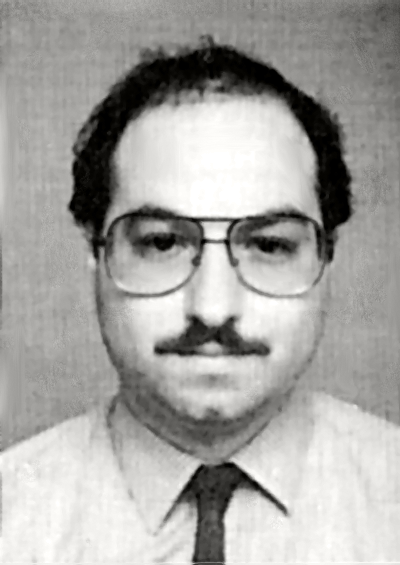
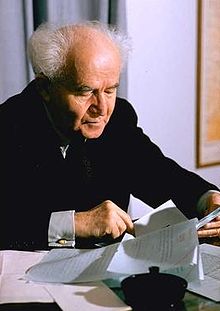
 Aletho News
 Aletho News