Davos and Abu Dhabi: How the Ukrainian Endgame Exposed Western Decline
By Ricardo Martins – New Eastern Outlook – January 28, 2026
While Russia, the United States, and Ukraine quietly negotiated in Abu Dhabi, Davos revealed Europe’s real position in the emerging world order: excluded from decision-making yet burdened with the costs of war and peace alike.
The 2026 World Economic Forum in Davos will likely be remembered less as a forum for global coordination than as a public autopsy of the Western-led international order.
What emerged in the Alpine setting was not coherence but fragmentation: rhetorical excess, strategic confusion, and an unmistakable sense that the world has already moved beyond the frameworks still defended—often ritualistically—by Euro-Atlantic elites.
Three speeches captured this moment with particular clarity: those of Volodymyr Zelensky, Mark Carney, and, less noticed but arguably most consequential, Chinese Vice-Premier Ding Xuexiang (represented in the Davos debate through He Lifeng’s economic message).
Zelensky and the Public Humiliation of Europe
President Volodymyr Zelensky’s speech was striking not only for its confrontational tone but also for its intended audience. His criticism was not primarily directed at Russia or even the United States, but bluntly at Europe. He accused the European Union of strategic indecision, military weakness, and an inability to guarantee Ukraine’s security, reiterating that Europe “still does not know how to defend itself” and remains structurally dependent on Washington.
Mocking Europe’s symbolic troop deployments to Greenland and its delayed reactions to crises such as Iran reinforced Zelensky’s humiliation of Europe.
This rhetoric can be understood as a final reckoning — an all-or-nothing move in which he burned all bridges and launched a frontal attack without regard for the consequences. By Davos, Kyiv was already aware that negotiations over the territorial concessions of the war were being discussed in Abu Dhabi between the United States, Russia, and Ukraine without European participation.
Zelensky’s speech thus functioned as political coercion aimed at Europe as the remaining actor capable of paying the price of a settlement. By publicly framing Europe as weak and morally indebted, Zelensky attempted to transform guilt into leverage in the final phase of negotiations.
This interpretation is reinforced by reporting in the Financial Times, which revealed that Ukraine’s willingness to consider territorial concessions is conditional upon accelerated EU membership, potentially by 2027. In domestic political terms, this trade-off allows Zelensky to reframe territorial loss as civilisational gain: Ukraine does not lose land; it “joins Europe.”
The bill, however, is addressed to Brussels.
Europe’s Astonishing Response
The European reaction to Zelensky’s speech in Davos bordered on political self-abnegation. Despite being publicly criticised, European Commission President Ursula von der Leyen praised Ukraine’s “heroic struggle” and emphasised Europe’s material commitment rather than responding to the substance of Zelensky’s accusations.
This asymmetry—verbal humiliation met with renewed rhetorical loyalty—reveals a deeper structural problem: Europe’s inability to translate financial power into strategic agency.
Dissent has nevertheless emerged at the national level. Italian politicians, including Rossano Sasso and Matteo Salvini, openly criticised Zelensky’s “ungrateful” tone and questioned continued military and financial support.
Such reactions reflect mounting domestic pressures linked to inflation, energy costs, and war fatigue, documented extensively by Politico and the Kiel Institute.
Yet these voices remain fragmented, and Europe as a collective actor continues to display what can only be described as strategic paralysis.
Mark Carney and the End of the Rules-Based Illusion
If Zelensky exposed Europe’s weakness, Mark Carney articulated its anxiety. His Davos speech openly acknowledged what had long been implicit: the so-called “rules-based international order” is no longer operative—and perhaps never was. Carney framed the current moment as a rupture, arguing that “middle powers” such as Canada and European states must now navigate a world no longer structured by predictable norms but by power, leverage, and economic scale.
Carney’s concept of “value-based realism” deserves close scrutiny. On the surface, it appears as an attempt to reconcile normative language with geopolitical adaptation. In substance, however, it represents an effort to preserve Western managerial influence within a system that has already shifted towards multipolarity. Sovereignty, in Carney’s formulation, is diluted into “managed multipolarity,” administered by the same financial and institutional elites that dominated the previous order.
This is precisely why his discourse fails to resonate in the Global South. For emerging powers—particularly within BRICS—the collapse of the Western order is not a tragedy to be managed but a long-awaited correction. Carney’s speech, far from acknowledging this, sought to repackage decline as stewardship.
That it reportedly irritated Donald Trump is unsurprising: Carney implicitly rejected American unilateralism while simultaneously refusing genuine systemic change.
China and the Silent Centre of Gravity
The most consequential intervention in Davos was arguably not Western at all. Chinese Vice-Premier He Lifeng articulated Beijing’s strategic priority with remarkable clarity: China is positioning itself to become the world’s largest consumer market, making access to Chinese demand the central axis of future global trade.
This message, echoed by analysts such as Pepe Escobar, signals a structural shift in the global economy: dependence is moving eastward.
Unlike Carney’s rhetorical manoeuvres, China’s position was grounded in material capacity: industrial scale, domestic demand, and long-term planning. For much of the Global South, this represents opportunity rather than threat. For Europe, however, it underscores marginalisation.
Abu Dhabi Decides, Europe Pays
The trilateral talks in Abu Dhabi marked a geopolitical turning point. While Europe has committed close to €200 billion in support to Ukraine, it was excluded from negotiations shaping the war’s end.
This exclusion is not accidental. Both Washington and Moscow increasingly view Brussels as incapable of strategic compromise, bound instead by ideological rigidity and proceduralism.
Europe thus faces a brutal dilemma: continue financing a war it does not control, or finance a peace settlement that fundamentally alters the EU through accelerated Ukrainian accession. Neither option strengthens European sovereignty.
Granting Ukraine some lite-sort of membership by 2027—without completed accession chapters—would transform the EU’s budgetary, agricultural, and cohesion policies overnight. Yet postponement risks indefinite financial haemorrhage. As the Financial Times and Reuters have noted, peace may ultimately be cheaper than perpetual war, even if politically uncomfortable.
Conclusion: Europe as the Weakest Link
Davos revealed a system speaking past itself. Zelensky spoke from desperation and tactical clarity. Carney spoke from elite anxiety. China spoke from structural confidence. Europe, by contrast, spoke in platitudes.
The irony is stark. Europe funds Ukraine, absorbs the economic shock, and bears the political consequences—yet is excluded from decision-making. In Abu Dhabi, values were absent, and strategy was outsourced. When the deal is announced, Europe may discover it was not a negotiator, but a guarantor of last resort.
The tragedy is not merely Europe’s weakness, but its refusal to acknowledge it.
Ricardo Martins is a Doctor in Sociology with specialisation in geopolitics and international relations.
Follow new articles on our Telegram channel
China Rejects U.S. Claims of Coercion in Central America
teleSUR | January 26, 2026
On Monday, Guo Jiakun, a spokesperson for China’s Foreign Affairs Ministry, rejected U.S. accusations of alleged Chinese “coercion” and “interference” in Central America.
His remarks came after Rep. John Moolenaar, chairman of the U.S. House Select Committee on China, traveled to several Central American countries to counter Chinese influence and question the involvement of Asian companies in strategic sectors such as the operation of ports linked to the Panama Canal.
In response, Guo described the U.S. claims as “complete lies and fallacies,” saying they reflect ideological bias and a Cold War mentality. “China firmly opposes certain U.S. politicians interfering in the normal relations between Central American countries and China,” the Chinese diplomat said.
He also stressed that the Chinese foreign policy toward Latin America and the Caribbean is based on principles of mutual respect, sovereign equality, mutual benefit, openness and inclusiveness, and cooperation aimed at shared development.
According to Guo, relations between China and Central American countries have produced tangible benefits for local populations, particularly in areas such as infrastructure, trade, logistics connectivity, productive investment, and technology transfer.
China maintains that its presence in Central America is not aimed at political domination but rather at a model of South-South cooperation that has been “well received by the countries involved.”
Guo urged U.S. politicians to stop instrumentalizing China-related issues for geopolitical purposes and to focus their efforts on initiatives that contribute to regional development. In multiple international forums, China has reiterated its rejection of bloc-based thinking and confrontation, advocating for a multipolar international order based on multilateralism and respect for state sovereignty.
Earlier, U.S. President Donald Trump released the new U.S. National Security Strategy, which prioritizes strengthening his country’s influence in Latin America and the Caribbean and seeks to reconfigure strategic control over key trade corridors such as the Panama Canal.
Is China a threat to Greenland?
By Pei Si | Global Times | January 22, 2026
Since the beginning of 2026, the US has repeatedly claimed that it must take control of Greenland to prevent threats from China and Russia, alleging that there are Chinese and Russian vessels “all over the place” outside of Greenland. What is the reality? What is China’s actual presence in Greenland? And does China pose any threat to Greenland at all?
Based on information from various sources, China currently has no official institutions in Greenland, no investment projects, and no resident companies. There are only some 30 Chinese workers working at Greenlandic seafood companies. Cooperation between China and Greenland is largely confined to trade, particularly in aquatic products. In 2025, bilateral trade between China and Greenland reached $429 million, of which Greenland’s exports to China amounted to $420 million, mainly Arctic shrimp, halibut, cod, lobster and other seafood. Greenland’s imports from China totaled $9 million, consisting largely of daily consumer goods.
Nor are there many Chinese tourists visiting Greenland. Although the island boasts stunning natural scenery, it is not easy to reach it from China and remains a niche destination for Chinese travelers. In 2024, only about 3,500 Chinese tourists visited Greenland.
Claims that there are Chinese vessels all over the waters near Greenland, or that Greenland faces a so-called “China threat,” are even more groundless. On January 16, Soren Andersen, Major General of Denmark’s Joint Arctic Command in Greenland, dismissed such claims in an interview, stating clearly that “there were no Chinese or Russian ships near Greenland.” Vessel-tracking data from MarineTraffic and LSEG likewise show no Chinese ships’ presence near Greenland. Danish Foreign Minister Lars Lokke Rasmussen has repeatedly clarified to the media that there is no “instant threat” from China. Rasmus Jarlov, the chair of Denmark’s parliamentary defense committee, put it even more bluntly: The claim of “a big threat from China and Russia against Greenland” is delusional.
Whether in terms of facts or policy, China does not pose a threat to Greenland. In fact, China has been subjected to unfair restrictions there. Rasmussen has openly acknowledged that the Danish government previously used administrative measures to veto the participation of Chinese companies in Greenland’s airport expansion and mining projects, and has already established an investment screening mechanism that will not allow Chinese investment in Greenland in the future. Whether such sacrifices of China can buy a US “hands-off” is highly doubtful – and hardly worthy of respect.
Anyone can see that the current tensions in the Arctic stem primarily from the actions of a certain country advancing claims that violate international law and the purposes and principles of the UN Charter. By contrast, China made it explicit in its 2018 white paper China’s Arctic Policy that “all states should abide by international treaties such as the UN Charter and the UNCLOS, as well as general international law. They should respect the sovereignty, sovereign rights, and jurisdiction enjoyed by the Arctic States in this region, respect the tradition and culture of the indigenous peoples.”
On January 12, Chinese Foreign Ministry spokesperson Mao Ning further stressed at a regular press briefing: “The Arctic bears on the common interests of the international community. China’s activities in the Arctic are aimed at promoting the peace, stability and sustainable development of the region. They are in line with the international law. Countries’ right and freedom to carry out activities in the Arctic in accordance with the law needs to be fully respected. The US should not use other countries as a pretext for seeking selfish gains.”
From China’s perspective, the future of the Arctic should not be a battleground for geopolitical rivalry, but a low-tension region for international cooperation on climate change and sustainable development. Claims that “China threatens Greenland” are simply too absurd to be worth refuting.
Pentagon downgrades China threat, shifts focus to homeland, hemisphere
Al Mayadeen | January 24, 2026
The United States Department of War has released its long-delayed 2026 National Defense Strategy (NDS), signaling a major shift in Washington’s military priorities by no longer treating China as the “primary threat” to US national security.
The document, published late Friday, places the defense of the US homeland and the Western Hemisphere at the center of Pentagon planning, a sharp departure from strategies issued under both former President Joe Biden and President Donald Trump’s first term, which identified China as the foremost strategic challenge.
According to the strategy, past US administrations “ignored American interests,” allowing strategic vulnerabilities to emerge in areas such as the Panama Canal, Greenland, and the broader Western Hemisphere. The document explicitly calls for abandoning what it describes as “grandiose strategies” in favor of policies rooted in the “practical interests” of the US public.
Reduced emphasis on China, conciliatory tone in the Pacific
While China remains a key concern, the 2026 NDS no longer characterizes Beijing as an “acute” or “existential” threat. Instead, it refers to China as a “settled force” in the Indo-Pacific that must be deterred from dominating the US or its allies.
The document adopts a notably conciliatory tone, stressing that Washington does not seek to “strangle or humiliate” China. It argues that a “decent peace” is achievable under terms favorable to the US and acceptable to Beijing, emphasizing diplomacy, stable relations, and expanded military-to-military communication channels to avoid escalation.
Although the Pentagon continues to advocate a “strong denial defense” in the Pacific, the strategy does not specify what military assets will be deployed. Notably, Taiwan is not mentioned by name, marking a significant shift from the 2022 National Defense Strategy, which explicitly framed Taiwan as a central security concern.
Europe’s declining importance, new DPRK strategy
In contrast to the National Security Strategy released last month, the defense document avoids describing Europe as being in “civilizational decline”, but it nonetheless downplays the continent’s strategic importance.
“Although Europe remains important, it has a smaller and decreasing share of global economic power,” the strategy states, adding that while US engagement will continue, Washington will prioritize defending the homeland and its immediate sphere of influence.
The strategy also outlines a reduced US military role in deterring the Democratic People’s Republic of Korea, shifting primary responsibility to South Korea, which currently hosts around 28,500 US troops.
“South Korea is capable of taking primary responsibility for deterring North Korea with critical but more limited US support,” the document states.
The strategy notably omits any reference to the denuclearization of the Korean Peninsula, reinforcing speculation that Washington is moving toward managing the DPRK’s nuclear capabilities rather than seeking their elimination.
“This shift in the balance of responsibility is consistent with America’s interest in updating US force posture on the Korean Peninsula,” the strategy explains, noting that Washington seeks to make its forces more flexible and better positioned to respond to a wider range of contingencies across the region.
Burden-sharing and regional rebalancing in the Pacific
Across the broader Pacific region, the Pentagon is urging allies to assume greater responsibility for their own defense, linking continued US cooperation to increased military spending by allies, with benchmarks as high as 5% of GDP. The strategy emphasizes economic and maritime security over regime-change policies, describing the Indo-Pacific as the world’s most dynamic economic region and underscoring the need to protect trade routes and strategic access points.
Japan and South Korea are identified as central to this regional balancing approach, with the US seeking to “incentivize and enable” allies to play a more assertive role in collective defense.
Meanwhile, South Korea has raised its defense spending to 7.5% of GDP and continues to field upwards of 500,000 regular troops with approximately 3.1 million reservists. On its part, Japan is moving to decisively break with decades of post-war pacifism, accelerating a historic military buildup and adopting a more assertive security posture.
Tokyo is on track to reach defense spending equivalent to 2% of GDP by March 2026, abandoning the long-standing 1% cap, as part of a five-year rearmament plan totaling 43 trillion yen. The shift is accompanied by the development of “counterstrike” capabilities, marking a transition from an exclusively defense-oriented doctrine toward deterrence by punishment and the fielding of overtly offensive weapons. While Japanese officials frame the change as strategic maturity and greater alliance responsibility, critics have denounced it as a revival of Japanese militarism.
The release of the 2026 NDS comes after months of internal delays. US media reported that a draft reached War Secretary Pete Hegseth as early as September, but disagreements within the administration over how to characterize China’s threat, particularly amid ongoing trade negotiations, stalled its publication.
Despite references to Russia, Iran, and DPRK as sources of risk, the strategy treats these threats as secondary, reinforcing the Pentagon’s pivot toward homeland defense and regional retrenchment rather than expansive global confrontation.
Iran: The Eurasian Lock
Iran’s geography makes it a strategic hinge – one that anchors Russia’s southern depth and gives China an escape from US maritime containment
By Abbas al-Zein | The Cradle | January 22, 2026
In the corridors of US strategic decision-making, Iran is no longer treated as a discrete regional file. Dealing with Tehran has become inseparable from great-power competition itself. Coordination between Iran, Russia, and China has moved beyond situational alignment, coalescing into what western analysts increasingly describe as a form of “structural synergy” that undermines Washington’s ability to isolate its rivals.
This assessment overlaps with conclusions reached by the Carnegie Endowment in its report on America’s Future Threats, which identifies Iran as a “central node” in the Eurasian landmass – one that prevents Russia’s geographical isolation while securing China’s energy needs beyond the reach of US naval control.
Any serious destabilization of the Islamic Republic would not remain confined within its borders. It would translate into a dual strategic blockade targeting both China and Russia: reviving security chaos across Eurasia’s interior while striking at the financial and energy platforms that emerging powers increasingly rely on to loosen unipolar dominance.
Geography as strategic depth
For Moscow, Iran’s importance begins with geography. It offers Russia a vital geopolitical opening beyond its immediate borders. According to studies by the Valdai Club, Iran’s significance lies not in formal alliance politics but in its function as the sole land bridge connecting the Eurasian heartland to the Indian Ocean via the International North–South Transport Corridor (INSTC).
This route provides Russia with insulation from NATO’s maritime pressure in the Baltic and Mediterranean, effectively converting Iranian territory into strategic depth protecting Russia’s southern flank.
This geographic interdependence has produced a shared political interest that goes beyond tactical coordination. The stability of the Iranian state acts as a safeguard against the Caucasus and Central Asia drifting toward the kind of fragmentation that preceded the Ukraine war. Research by the Russian Council for International Affairs (RIAC) frames Iranian geography as a cornerstone of the “Greater Eurasia” concept, central to Moscow’s effort to dilute western hegemony across the continent.
For Beijing, Iran plays a comparable role within a different strategic equation. As US naval pressure tightens across the Pacific, China’s westward extension through Iran has become increasingly difficult to replace. Research by the Council on Foreign Relations (CFR) identifies Iran as one of the most critical geographic nodes in the Belt and Road Initiative (BRI), providing Beijing with a land-based corridor into West Asia that bypasses US-controlled maritime choke points – from the Taiwan Strait to the Mediterranean approaches.
Iran’s intermediate position between the Eurasian interior and open seas has therefore imposed a durable entanglement between Tehran, Moscow, and Beijing. In this configuration, political alignment is driven less by ideology than by physiogeographic necessity.
Any attempt to destabilize the Iranian plateau would likely trigger a cascading shock across Eurasia’s interior, escalating a regional confrontation into a systemic blockade aimed at arresting the rise of rival power centers.
Buffer state and security firewall
Beyond logistics, Iran functions as a stabilizing buffer within East Eurasia’s security architecture. One research report by RAND on “Extending Russia” speaks of adversary exhaustion strategies that emphasize the use of peripheral instability to drain rival powers. From this perspective, Iran represents a critical firewall.
Instability inside Iran would mechanically undermine security coordination across Russia’s southern periphery, particularly in the Caucasus and Central Asia. RIAC assessments warn that such a breakdown would open pathways for extremist networks, transcontinental smuggling, and militant spillover – threats Moscow has repeatedly classified as existential.
For China, the concern lies in contagion. Iran’s stability limits the transmission of unrest through Central Asia’s mountain corridors, where Tehran functions as an integral security partner within the Shanghai Cooperation Organization (SCO). This role provides Beijing with a degree of security insulation, allowing it to pursue global ambitions without being drawn into attritional border conflicts.
Energy and financial sovereignty
Economically, Iran’s role extends beyond conventional trade logic. Its partnerships with Russia and China increasingly form part of an alternative financial and energy architecture designed to blunt western leverage.
From Beijing’s perspective, Iranian oil has become a form of strategic insulation. Data indicates that China purchases roughly 1.3 million barrels per day (bpd) of Iranian crude – around 13.4 percent of its seaborne oil imports – with close to 80 percent of Iran’s exports flowing eastward. Increasing settlement through non-dollar mechanisms, including the digital yuan, has further reduced vulnerability to US pressure, particularly at choke points such as the Strait of Malacca.
Reports from the Electricity Hub confirm that China imported more than 57 million tons of Iranian – or suspected Iranian – oil in 2025, often routed via intermediaries such as Malaysia. The figures underscore the diminishing effectiveness of sanctions when confronted with geoeconomic necessity.
Russia’s calculus follows a different path to the same outcome. Cooperation with Iran has emerged as one of Moscow’s most important routes around SWIFT-based isolation. Government of the Russian Federation data shows bilateral trade rising by 35 percent following the Eurasian Economic Union free trade agreement implemented in May 2025.
A central shift has been monetary. In January 2025, the Central Bank of Iran announced full connectivity between Russia’s MIR and Iran’s Shetab payment systems, creating a protected financial corridor. According to Iranian officials, Iran and Russia aim to expand bilateral trade to $10 billion over the next decade, while Iran’s exports to Russia are expected to rise to about $1.4 billion by the end of the current Iranian calendar year (March 20, 2026).
Tehran has increasingly functioned as a re-export hub for Russian technologies and goods, frustrating efforts to economically isolate Moscow.
Washington’s strategy of separation
Against this backdrop, US strategy has evolved. Rather than relying solely on pressure or open confrontation, Washington has gravitated toward what western policy circles describe as a “strategy of separation.” This is an attempt to loosen the interdependence binding Tehran, Moscow, and Beijing by offering alternative pathways rather than confronting the bloc directly.
On the Chinese front, energy has emerged as the primary point of leverage. As the world’s largest oil importer, Beijing remains sensitive to supply stability and pricing. US moves in Latin America – particularly regarding Venezuela – are widely interpreted as efforts to reintegrate large oil reserves into global markets under western regulatory frameworks, potentially diluting Iran’s role in China’s energy security calculus.
In parallel, Washington has expanded its naval and coalition presence across key trade corridors stretching from the Indian Ocean to the western Pacific. This posture is framed not only as deterrence but as a persistent reminder that maritime supply security remains tied to US-led power balances.
On the Russian front, Ukraine occupies a central role. While sustained military and economic pressure aims to drain Moscow’s capacity, intermittent diplomatic signals suggest interest in compartmentalized understandings over European security. The underlying wager is that Russia’s core interests might be partially accommodated in Europe, reducing the long-term value of its partnership with Iran.
US engagement has also intensified across Central Asia and the Caucasus – regions that constitute strategic depth for Russia and critical corridors for China’s BRI. From Moscow and Beijing’s view, expanded security and investment ties in these areas represent an effort to geographically encircle Iran and weaken its role as Eurasia’s connective knot.
Why the bet fails
Despite the breadth of these efforts, the strategy of separation runs up against entrenched distrust in both Moscow and Beijing. For the two powers, the issue is not the scale of incentives on offer but the structure of the international system itself – and the accumulated experience of sanctions, coercion, and volatile western commitments.
From Russia’s vantage point, any trade-off between Iran and Ukraine constitutes a strategic trap. Iran anchors Russia’s southern access to the Indian Ocean; its collapse would expose the Caucasus–Central Asia arc to chronic instability. Gains in Eastern Europe would offer little compensation for a structurally weakened southern flank.
China’s reasoning is similarly grounded. Alternative energy suppliers remain embedded within supply chains that Washington can influence or disrupt. Iranian oil, by contrast, offers a higher degree of geographic and political autonomy. Its value lies less in price than in resilience.
The last barrier
At its core, the contest over Iran pits two logics against one another. One assumes geopolitical networks can be dismantled through incentives and selective realignment. The other recognizes that geography, accumulated experience, and the erosion of trust render such guarantees fragile in a world moving steadily toward multipolarity.
Iran’s collapse or prolonged internal destabilization would not merely reorder energy markets or regional alignments. It would reopen West Asia as a zone of near-exclusive US influence, completing a strategic arc across Western Eurasia. For more than a century, the region has served as a central theater of global power competition – from imperial rivalries to the Cold War and into the present transition toward multipolarity.
Therefore, Iran becomes more than a pivotal state. Much as Venezuela once represented the outer limit of resistance to US power in the Western Hemisphere, Iran now stands as the final geopolitical barrier to the consolidation of American hegemony across the heart of Eurasia.
Its cohesion serves not only its own national interest but also the broader objective shared by Moscow and Beijing: constraining unilateral dominance and preserving strategic autonomy in their immediate neighborhoods.
Russian gas exports to China soar – data
RT | January 22, 2026
China sharply increased its purchases of Russian liquefied natural gas (LNG) in 2025 and reached a record monthly volume in December, according to Chinese customs data cited by RIA Novosti.
In 2025, the Asian nation imported 9.8 million tons of the super-chilled fuel, up 18.3% from the previous year, the outlet reported.
December saw particularly strong growth, with imports rising to 1.9 million tons, a 114.6% increase from the 889,482 tons delivered in the final month of 2024.
Data also showed that in October, Russia became China’s second biggest LNG supplier, overtaking Australia and coming in slightly behind Qatar. Russia’s total gas supplies to China – via pipeline and in liquefied form – reached 5.8 billion cubic meters (bcm) in November 2025, a 33% increase from the same month a year earlier.
Imports of Russian LNG by China, one of the world’s largest gas consumers, have been rising steadily for several years. Alongside pipeline flows, Russia has expanded seaborne shipments from projects in the Arctic and the Far East, including Yamal LNG, Arctic LNG 2, and Sakhalin-2. Cargoes are transported largely via the Northern Sea Route during the summer navigation season and via longer southern routes in winter.
Moscow has sought to expand LNG exports via the Arctic corridor due to Western sanctions targeting key parts of its energy sector.
The surge in gas deliveries reflects a broader shift of Russia’s energy exports toward Asia following the sharp reduction of pipeline supplies to the EU since the escalation of the Ukraine conflict in 2022.
Russia also delivers natural gas to China via the Power of Siberia pipeline, which began operations in 2019 and reached full operational capacity in December 2024.
Moscow and Beijing are also advancing the planned Power of Siberia 2 pipeline through Mongolia. President Vladimir Putin has said that, together with existing and future pipelines, Russian gas deliveries to China could exceed 100 bcm a year.
European leaders’ shift in their Davos addresses exposes Europe’s strategic anxiety
Global Times | January 21, 2026
The World Economic Forum (WEF) annual meeting recently kicked off in the Swiss resort city of Davos. This year’s forum took place amid rare transatlantic tensions triggered by the US intention to acquire Greenland. The focus of European leaders’ speeches pivoted noticeably from global economic issues to geopolitics, reflecting Europe’s deepening strategic anxiety amid structural contradictions with the US.
French President Emmanuel Macron said the EU should not bend to “the law of the strongest,” while Belgium’s Prime Minister Bart De Wever said the bloc was “at a crossroads” where it must decide on how to get out of a “very bad position” after trying to appease Trump. Even European Commission President Ursula von der Leyen highlighted the “geopolitical shocks” and “a dangerous downward spiral” brought by the US.
“The forum sends a clear political signal of Europe’s growing strategic awakening,” Zhao Junjie, a senior research fellow at the Institute of European Studies at the Chinese Academy of Social Sciences, told the Global Times on Wednesday.
The maximum pressure exerted by the US on the Greenland issue has shaken the long-standing value consensus between Europe and the US. Its unilateral and bullying actions have triggered strong fear and anxiety across Europe, which is a key reason for the heightened emotions and intense reactions toward the US among European representatives at this year’s forum.
The statements made by European leaders at the forum appear to have demonstrated Europe’s resolve to stand firm to the world. Yet it remains to be seen whether such firm commitments can be translated into practical, unified, and effective actions. As senior bankers and corporate executives at Davos noted, they believe the current responses of European leaders to the US are more emotional than pragmatic. Moreover, due to long-standing structural constraints – its deep entanglement with the US in security, energy, and economic affairs – Europe’s response is weak and constrained. Zhao further noted that Europe still lacks systematic measures to effectively counter American unilateralism, with current efforts largely limited to soft multilateral mechanisms.
Europe’s response to US unilateral pressures has been sluggish and lacking in internal coordination. The EU countries have not reached a consensus on the activation of Anti-Coercion Instrument. Meanwhile, Europe continues to grapple with “double standards” in its multilateral engagements. Despite the leaders’ calls for trade diversification, restrictive market-access policies toward certain foreign products have fueled ongoing trade tensions. This contradiction is illustrated by Macron’s appeal for Chinese investment in key sectors, even as the EU moves to phase out components and equipment from tech suppliers such as Huawei in some sectors – a policy that inevitably raises questions about Europe’s consistency and sincerity in pursuing cooperative partnerships.
Canada has already taken action. Prime Minister Mark Carney stated that middle powers are not “powerless” facing “a rupture in the world order.” He called for “honesty about the world as it is” and for building “something bigger, better, stronger, and more just.” Recently, Canada established strategic partnerships with China and Qatar to promote the diversification of its foreign relations. Such strategic sobriety may offer some inspiration for Europe.
Ursula von der Leyen declared in her special address that “Europe will always choose the world, and the world is ready to choose Europe.” Yet Europe must now answer a more pressing question: what path will it choose for itself in the changing global order?
The statements at Davos have sent a clear political signal of Europe’s awakening. Moving forward, Europe must consolidate its strength through unity, steer its own course with greater autonomy, and expand its strategic space through diversification. Confronted with external pressures, only by reinforcing internal solidarity, advancing pragmatic actions, and broadening multilateral cooperation can Europe truly safeguard its own interests and uphold the international multilateral order. Only in this way can Europe genuinely protect its interests amid profound changes. History does not wait for the hesitant – it is time for Europe to act.
What happens when START-3 expires, and US doesn’t want to prolong it?
By Ahmed Adel | January 20, 2026
Although START-3, the last strategic arms control treaty between the United States and Russia, expires on February 5, the two countries will most likely continue to informally respect it, unless Washington violates it. Washington likely wants the treaty to expire so a new agreement can be signed that will not limit the development of new weapons.
US President Donald Trump considers all agreements made before he took office outdated and does not want to accept restrictions from a bygone era. Russia has prepared for that, since the proposal to extend the agreement was made more than a year ago and received no response from the American side.
The US and Russia together possess almost 90% of the world’s nuclear weapons, but Russia remains the largest nuclear power. The first START treaty was signed on July 31, 1991, at a summit in Moscow between then-Soviet President Mikhail Gorbachev and US President George W. Bush, and entered into force on December 5, 1994. This was the first document of its kind between the Soviet Union and the US, aimed at ensuring parity between the two sides, with the nuclear potential of both countries to be reduced by 30%. The treaty remained in force for a full 15 years, when START-3 was signed, the last strategic arms control treaty concluded between Russia and the US after the end of the Cold War.
With the Prague disarmament agreement, signed in 2010 by heads of state Barack Obama and Dmitry Medvedev, Washington and Moscow committed to having no more than 700 deployed warheads and no more than 1,550 nuclear warheads. The contract expired in February 2021, but the Joe Biden administration decided to extend the agreement for five years, without any amendments or changes.
Washington does not want this arms control agreement because Russia is now a step ahead in the development of modern weapons systems. Russia has manufactured weapons incomparable to anything else in the world, such as the Oreshnik and Poseidon systems, as well as nuclear-powered missiles, while the Americans believe that the restrictions under this agreement hinder their development in this direction and therefore do not want to limit themselves.
Mikhail Ulyanov, Russia’s permanent representative to international organizations in Vienna, said that the US is likely not prepared to accept the Russian proposal to voluntarily extend the key provisions of the Strategic Arms Reduction Treaty (START) for another year.
It is recalled that on January 8, the US president said regarding START, “If it expires, it expires,” adding, “We’ll just do a better agreement.”
All these agreements were concluded in different eras and under different conditions, and the Americans could, conditionally speaking, once impose many things on Russia. Now they cannot, because Russia has an advantage across a wide range of areas today, such as modernizing 95% of its nuclear forces, something the Americans have not done yet. Russia also has hypersonic missiles that have already been tested on the battlefield, which the Americans do not.
Trump stated in 2020 during his previous presidential term that the US possesses a “super-duper missile” about seventeen times faster than turbine-powered cruise missiles like the Tomahawk and unlike any other in the world, but such a missile has not been shown to the public to this day. Then the Trump administration claimed that Russia developed hypersonic weapons, allegedly stealing some technologies from the US.
Based on all this, the Trump administration considers the circumstances and refuses to enter into any agreements or treaties that limit US capabilities.
In reaching any new nuclear arms agreement, beyond Russia and the US, several other players would need to be involved, with the US president primarily considering China. From Washington’s perspective, Russia should persuade China to join the deal. However, China refuses to do so because its nuclear arsenal is much smaller than Russia’s and the US’s. Additionally, Trump might have also considered India.
However, if Moscow and Washington, for example, say that such an attitude is acceptable regarding China, there is the question of how they will handle England and France, which also possess nuclear weapons. It is clear, therefore, that American think tanks are working to develop different options for establishing a new world order, but it will mainly be ‘peace through force’ under United States dominance.
There is a possibility that Russia will announce it will continue to respect the limits of the agreement, as long as Washington does not violate them. What the Americans, for their part, will say is unknown, but there have been Trump’s statements about the necessity of resuming nuclear tests, which are banned. Moscow responded that they are against resuming, but if the US conducts nuclear tests, the Russians will immediately carry out their own in response.
In that case, a nuclear arms race could occur, which would lead to increased strategic risks and potentially threaten global security. Therefore, Moscow believes that responsible and restrained behavior by nuclear states is more important than ever and is firmly committed to the principle that there can be no winners in a nuclear war and that it must never be started.
Ahmed Adel is a Cairo-based geopolitics and political economy researcher.
Vitol tests Chinese demand with narrower discounts on Venezuelan crude
Al Mayadeen | January 19, 2026
Vitol Group has offered Venezuelan crude oil cargoes to Chinese buyers at discounts of around $5 per barrel to ICE Brent, signaling a bid to test Chinese firms’ demand for the Latin American country’s heavy, sour grades, Bloomberg reported, citing traders familiar with the matter.
If deals go through, the cargoes are expected to be delivered in the second half of April, traders said. The move underscores renewed efforts by major US-based trading houses to place Venezuelan barrels in Asia, with China remaining a key destination.
Venezuela’s Merey crude has historically been among the cheapest globally, with Asia, particularly China, absorbing large volumes. Before US President Donald Trump ordered the abduction of Venezuelan President Nicolas Maduro, discounts on delivered barrels to Brent were as wide as $15 per barrel. The narrower spread now being tested suggests a recalibration of pricing after the US allowed for larger sales of Venezuelan crude, revenues it seeks to exploit. In recent years, Vitol has operated under licenses issued by the US Treasury that allow the loading and sale of Venezuelan crude. Under this imposed framework, proceeds from oil sales are directed into US-controlled bank accounts, a mechanism Washington claims is intended to manage revenues of Venezuela’s oil industry.
Marketing stolen oil
However, the deal only took effect after Maduro was kidnapped, oil tankers were stolen, and Venezuelan authorities were threatened. Vitol also gained preferential treatment, securing a deal it could only dream of to sell Venezuelan crude. The granting of an 18-month license to Vitol to market stolen crude triggered sharp controversy in Congress and across the energy sector.
Concerns center on the speed of the approval and Vitol’s political connections, which include reports that senior Vitol trader John Addison had donated more than $5 million to Donald Trump’s 2024 re-election campaign and attended a high-profile White House meeting with oil executives days before the roughly $250 million deal was awarded. US Senator Tim Kaine said the arrangement was “smacking of corruption,” questioning why proceeds were routed to specific bank accounts and who ultimately stood to benefit from the administration’s plan to effectively “run” Venezuela’s oil sales. The fact that Vitol and Trafigura were the first firms to receive such licenses, while other traders remained barred under sanctions, fueled accusations of “transactional diplomacy”.
The Trump administration and industry analysts rejected the allegations, arguing that Vitol and Trafigura were selected for practical reasons. US officials cited the traders’ vast shipping fleets and global logistics networks as essential for rapidly moving large volumes of stranded crude.
Indian, Chinese refiners seek clarity over Venezuelan crude
On January 12, Vitol and Trafigura were reportedly holding early-stage discussions with leading refiners in India and China over potential sales of Venezuelan crude. Bloomberg, citing people familiar with the matter, reported that the two trading giants contacted large Asian buyers over the weekend, though talks remained exploratory and no formal offers were made. Both firms are also gauging interest among US refiners.
India’s Reliance Industries previously imported Venezuelan oil under a waiver before halting purchases last year following a decision by Trump to impose a 25% tariff on countries buying oil from Venezuela.
India’s state-owned Indian Oil Corp. (IOC) is among the companies awaiting confirmation from Washington that it has been cleared to resume purchases of Venezuelan oil, according to Bloomberg‘s sources. IOC declined to comment. Reliance Industries said last week it was seeking clarity on whether non-US buyers could access Venezuelan crude and stated it would consider purchases “in a compliant manner.”
It remains unclear how much oil Vitol and Trafigura would be able to sell, or whether transactions would be limited to the initial tranche referenced by Trump. Nevertheless, any sales would mark a significant development for trading houses with longstanding involvement in Venezuela’s oil sector.
Scott Ritter Hiding the Dominant Minority Behind Geopolitics?
Peace Activists Forced to Hide the Jewish Geopolitical Dots?
By Geurt de Wit | Ruling Elite Studies | January 18, 2026
Introduction
All political scientists and historians agree that some minorities have historically been able to dominate their host nations. Notable modern examples include the Spanish in South America, overseas Chinese in Southeast Asia, and Tutsis in Central Africa. Sometimes host nations rise against a dominant minority, as seen in Southeast Asia, where local populations have implemented various quotas and measures—such as Malaysia’s Bumiputera policies—to curb the economic and social influence of the ethnic Chinese community.
Jews
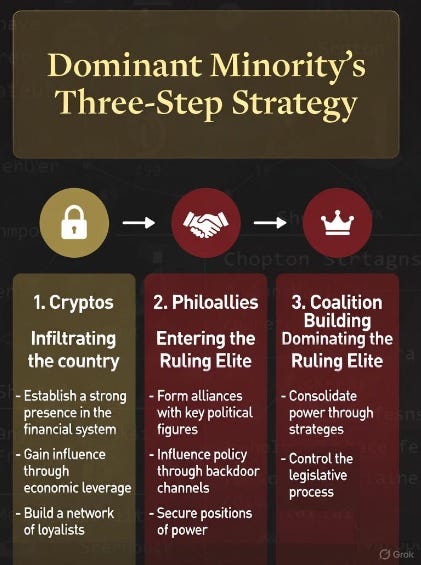
There is another significant example of a dominant minority, yet naming it remains a taboo: the Jewish elite in the West. This group exerts influence through economic and media power, a “Culture of Critique,” and its maneuvers within the geopolitical “Great Game”. U.S. foreign policy, for instance, appears heavily influenced by Jewish Zionists, compelling even the supposedly “America First” Trump administration to adopt “Israel First” policies. While parts of the peace movement have begun to note the Jewish role in fomenting conflicts also beyond the Middle East, many activists still fail to see the broader connections. The conflicts in Ukraine and Taiwan are directly linked to the crisis in the Middle East.
The reason is simple: Jewish led neoconservative and neoliberal forces aligned with Israel seek to weaken Russia and China, both of which support Iran and the Shia “Axis of Resistance” in the Middle East. Consequently, the West attempts to encircle Russia and China with military bases and hostile alliances while undermining their economies through sanctions and high tariffs to facilitate regime change.
This is nothing new. For centuries, Jews have viewed Russia and China as “antisemitic” for opposing Jewish attempts to become a dominant minority within their borders. Historically, this has manifested as a prolonged struggle. Jewish elite dynasties like the Rothschilds, Sassoons and Kadooreis, for example, pushed Western empires to subjugate China during its “Century of Humiliation.” Similarly, they managed to organize various wars against Russia including the first Crimean War in the 1850’s and then later the Jewish led Bolshevik and Oligarch takeovers in the 1920’s and 90’s. The present Ukraine War is just the latest in a series of conflicts and wars between Jews and Russia going back a millennium.
The obvious Jewish role in geopolitics and various wars has always been known to political scientists and historians. It is also common knowledge in many parts of the world such as in Eastern Europe, China and the Arab world. However, in America the Jewish dominant minority has achieved such power that both academia and media now avoid the subject entirely. Only occasionally does the American public hear about it through random outbursts, such as Mel Gibson’s criticism of the Jewish role in instigating wars.
Putin and Xi
Under the leadership of Vladimir Putin and Xi Jinping, Russia and China have regained their independence and power. Their geopolitical support for the Axis of Resistance has drawn the ire of Zionist Jews running Great Game geopolitics, while their nationalist anti-liberal policies have alienated liberal Jewish factions running the Culture of Critique movements. As a result, the Jewish dominated Western academia and media has totally demonized both nations, while Jewish led neoconservatives and neoliberals push for their encirclement and the targeting of their global allies.
The influence of Jewish dominant minority behind these conflicts remains such a taboo that even peace activists often ignore it. This gives Zionists a carte blanche to pursue military and cultural wars, regime change operations and proxy wars aimed at isolating Russia and China. By refusing to “connect the dots,” Western peace activists effectively allow this dominant minority to continue pushing for perpetual war.
Scott Ritter
In recent years, the peace movement has been bolstered by former UN weapons inspector Scott Ritter. A prolific advocate, Ritter has tirelessly warned against the dangers of nuclear war, organized demonstrations and personally lobbied Congress. Despite his background as a leftist philosemitic Democrat, he has significantly influenced the Republican “MAGA” movement toward anti-war policies.
Ritter has gained a massive following as a commentator on the Ukraine War. However, during the conflict’s first year, he remained silent on the Jewish and even Israeli connection, blaming only the CIA, MI6 and the U.S. and British governments. In this, he was joined by libertarian figures like Andrew Napolitano and Lew Rockwell, who focus on American “Primacists” rather than identifying a dominant minority.
Traditionally, both leftists and libertarians have avoided identifying the Jewish dominant minority to avoid being labeled as antisemitic. It was only during the recent genocide in Gaza that Ritter began to explicitly critique Israel’s geopolitical role, though he has yet to identify the dominant minority or even connect these dots to the broader global landscape.
Silent Peace Activists
Some suggest that platform policies, such as those on YouTube, drive this reticence. Peace activists like Andrew Napolitano, Alexander Mercouris, and Danny Haiphong reach hundreds of thousands of viewers daily through their Youtube channels. Openly discussing Jewish dominant minority and connecting Jewish geopolitical dots could lead to deplatforming and lost revenue. However, this doesn’t fully explain the silence, as they could simultaneously use alternative platforms like Rumble, X or Locals—a strategy successfully employed by the famous anti-Zionist, Candace Owens. Unsurprisingly she has been branded an “anti-Semite” by many Jewish organizations.

Alexander Mercouris
Another explanation is ideological. Many activists from leftist or libertarian backgrounds may instinctively view the concept of a “dominant minority” as inherently racist. The most dramatic example of this is the leftist peace activist and popular YouTube commentator Alexander Mercouris, who for years was oblivious to the Jewish connection. However, a few months ago, due to audience feedback, he admitted on his channel that he had never even thought about a possible connection between the Ukraine War and the Middle East Crises.
Afterward, he has not talked about the subject anymore, though he does seem to increasingly speak in code. For example, he repeatedly emphasizes that his channel will be shut down if he analyzes the Epstein case too deeply. At the same time, he seems to spell “Epstein” in the Jewish-German way, making Epstein’s ethnic background clearer. Mercouris also has the revealing habit of always following the arch-neocon warmonger Lindsey Graham’s name with the name Richard Blumenthal, possibly hinting that Graham is influenced by him and other Jews to a significant extent.
The third explanation for not openly noticing the dominant minority is that many prominent peace activists hope to attract the support of wealthy, anti-Zionist Jewish donors to finance the movement, a development that has yet to materialize.
Debanking
Certainly, the fourth and most important explanation is fear. Leading peace activists face tremendous pressure from various sides. Ironically, this pressure appears stronger in America than in Europe, despite stricter official censorship in Europe. However, Europeans benefit from strong employment and social security protections against firings and debanking. In America, people’s lives are more precarious and heavily dependent on high incomes, making it easier to intimidate them with threats to their reputation, job, income, or even bank accounts. The American media rarely discusses this, but hundreds of politically incorrect individuals have been debanked—not only in Canada but also in the U.S. Scott Ritter has now joined their ranks.
In the above video Scott Ritter recalls his days as a highly connected American intelligence operative, working closely with the CIA, Israelis, and even the White House. He emphasizes that he was once the “Golden Boy” of intelligence, privy to “everything.” Clearly, he must be aware of America’s dominant minority and their potential to ignite a nuclear war. Yet, despite recent escalations in Eastern Europe and the Middle East, Ritter in this video claims that the main problem is America itself, with Trump as a “prisoner of the CIA”—not the Mossad, Israel, or even the Zionists.
The next day, however, Ritter appeared in an interview with Andrew Napolitano. He admitted that after being debanked, he fell into depression and briefly felt hopeless, especially as his wife had grown weary of the persecution that had affected their entire family for decades. At that point, Napolitano played a clip of Jonathan Greenblatt, the Jewish ADL’s chairman, boasting about the organization’s role in training American police and officials. This ignited Ritter, who then openly declared that Zionists are running the American government.
Trump’s chess moves
At the same time, Ritter suggested there might still be hope. He noted that many parts of the government resent Zionist dominance, and even Donald Trump could be among them. That wouldn’t be surprising, given Trump’s ego—he can’t be pleased with how Netanyahu and many other Jews publicly humiliate him. Being Israel’s bitch cannot be fun.
It could even be that Trump is deliberately undermining American influence abroad through his erratic behavior, bullying threats, and tariffs. After all, U.S. foreign policy is thoroughly dominated by Zionists, so disrupting the entire system might be the only way to halt it. For instance, threatening to annex Greenland would certainly fracture or weaken NATO, making it harder for EU NATO countries to sustain their warmongering. Perhaps Trump truly seeks peace through a “Fortress America” approach, dividing the world among American, Russian and Chinese spheres of influence. Maybe he’s really playing four-dimensional chess, with method to his madness. Of course, the alternative is that he’s simply a madman. As Scott Ritter admits, he doesn’t know—and neither does anyone else. Probably not even Trump himself.
People worldwide are deeply divided over Donald Trump. Some view him as a mastermind playing four-dimensional chess to save the world, while others see him as a narcissistic bumbler who sows chaos wherever he goes. So, which perspective aligns more closely with the truth? We do not know but let’s first assume that Donald Trump is a rational player in do…
Conclusion
Many in the peace movement believe that concealing the Jewish dominant minority and obscuring its role in numerous wars is essential for peace. However, this strategy may backfire, giving that minority a free hand to escalate proxy conflicts and try again and again to push the world toward “limited” nuclear war.
People often demand perfection from their heroes, which is counterproductive. No one is a superman—not even Scott Ritter. Of course, he must consider his family. Of course, he has been reticent about exposing Jewish power. The same applies to all other peace activists. But gradually, things are changing on both the left and right. They are beginning to point out the man and group behind the curtain.
In any case, peace activists perform invaluable work and deserve unwavering support. After all, they do what they humanly can. Without them—especially Scott Ritter—a nuclear war might already have begun.
Venezuela Has Right to Have Relations With China, Russia, Cuba, Iran – Acting President
Sputnik – 16.01.2026
Venezuela has the right to relations with all countries of the world, including China, Russia, Cuba, and Iran, and will exercise this right in compliance with international norms, Venezuelan Acting President Delcy Rodriguez said on Thursday.
Venezuela’s Acting President Delcy Rodríguez said the country’s energy dialogue with the United States is not new, but stressed that it is now taking place amid “aggression and a fierce threat.”
“Venezuela has the right to relations with China, with Russia, with Cuba, with Iran — with all the peoples of the world,” Rodríguez said while presenting the government’s 2025 annual report.
She said Caracas is shaping energy cooperation based on “decency, dignity and independence,” rejecting both internal and external constraints aimed at influencing Venezuela’s foreign policy.
Deep-state forces from abroad instigated violence in Nepal – former foreign minister
RT | January 13, 2026
External deep-state forces were instrumental in instigating the September 2025 violence in Nepal that led to the ouster of the government, its former foreign minister has told RT India.
K.P. Sharma Oli resigned as Nepal’s prime minister after violent clashes – known as the Gen Z protests – killed 77 and injured more than 2,000. Pradeep Kumar Gyawali, a former foreign minister, has now backed Oli’s assertion that Gen Z protests that led to the ouster of the government were backed by external forces.
“Those elements who were actively engaged with the deep state, who used the cross-border misinformation and disinformation to instigate the violence, they were active,” he told RT India in an exclusive interview.
The remarks came after Oli told RT India about external influences in the uprising last year.
Gyawali said Kathmandu’s growing engagement with India and China and its aspiration of being a bridge for the economic development of Nepal between the two neighboring countries “was not a very good message to some powers.”
He added, “[They] wanted to use Nepal’s geostrategic location for their policy in their favor. So maybe our engagement with our neighboring countries may have some grievances to the big powers as well.”
The Grayzone has cited leaked documents to reveal that the US government’s National Endowment for Democracy (NED) had spent hundreds of thousands of dollars tutoring Nepalese young people to stage the protests.
The Gen Z protests happened as the US sought to neutralize Chinese and Indian influence over Kathmandu, Grayzone investigations revealed.
The NED is officially a US State Department-funded nonprofit that provides grants to support ‘democratic initiatives’ worldwide.
The International Republican Institute (IRI), a NED division, has been accused of funding clandestine activities in Bangladesh and Sri Lanka, apart from funneling tens of millions of dollars to Ukrainian political entities and anti-Russian interests.
Featured Video

No Threat Can Force Iran’s Surrender /Trita Parsi & Lt Cl Daniel Davis
or go to
Aletho News Archives – Video-Images
From the Archives
What is the Israeli Lobby in Australia Doing in Interfaith Dialogue?
By Ali Kazak | Dissident Voice | October 11, 2015
For years Israel and its lobby around the world have been trying to normalise their relations with Arabs and Muslims without solving the Palestine Question.
One of the methods they resorted to in the last few years is using human rights and community organizations such as interfaith dialogue and Multiculturalism to achieve this objective and to: isolate the Palestinians, marginalise the Palestine question, end Israel’s isolation, and prevent criticism of Israel, knowing that these organisations will be the first to stand against Israel’s violations, racial and religious discrimination.
The group responsible for this task in Australia is The Australia/Israel & Jewish Affairs Council (AIJAC); its Director of International & Community Affairs, Jeremy Jones is in charge of lobbying religious community organizations, specifically Muslims and Christians. Consequently he convened the Faith Communities for Reconciliation, founding participant in the Australian Partnership of Religious Organisations and the Australian National Dialogue of Christians, Muslims & Jews.
AIJAC is a private political propaganda group. It is recognised as the main Israeli lobby in Australia. It coordinates its activities and works intimately with the Israeli embassy in Canberra and different institutions in Israel. It is privately funded by some Jewish businessmen. It monitors closely Australian politicians, the media, ethnic and religious groups, (especially Arabs and Muslims), unions and academics on their stands towards Israel and the Palestine question. … continue
Blog Roll
 Aletho News
- Envoy warns UN on Trump’s threat to ‘obliterate’ Iran’s civilian infrastructure
- The Larak Corridor: Iran’s Rial Gate With No US, No Israel, and No Way Around
- ‘Economic terrorism’: Steel facilities hit again in US-Israeli strike
- ‘War Crime’: Iran condemns attacks on Arak, Ardakan nuclear sites
- Two-thirds of Americans want quick end to Iran war even if goals unmet
- Trump to Give “Important Update on Iran” Wednesday in Prime-Time Speech
- Theodore Postol: Iran’s Missiles & Drones Were Underestimated
- Iran To Target Military Industrial-Tech Complex That Facilitated Gaza Genocide
- Collapsing Empire: The Resistance Disarms ‘Israel’
- Suicide Should Not Be a Government Service
- If Americans Knew
- Israel wants US to bomb more of Iran’s civilian structures (113,000 is not enough) – Not a ceasefire Day 173
- Ann Coulter Rips Into Fox News for Iran War Coverage
- Joe Kent Urges Americans To Call White House and Congress To Object To Sending Troops Into Iran
- DNC Resolution to Reject AIPAC Funding Puts Democratic Leaders in the Hot Seat
- Swedish foundation to build 400 schools as over 650,000 Gaza children remain without education for 2 years
- Israeli army admits photshopping image of slain Lebanese journalist
- This is how Israel is systematically killing health workers under the cover of war in Lebanon
- Carrying life under fire: Israeli invasion of Lebanon leaves pregnant women facing deadly risks
- Champagne all around for the new death penalty (for Palestinians) law – Not a ceasefire Day 172
- Why are Palestinian books struggling to be seen on Amazon?
- No Tricks Zone
- New Study Finds Warming Saves Lives…Cold Temperatures 12 Times More Deadly Than Excess Heat
- German Science Blog Accuses PIK Climate Institute Of Hallucinating Climate Tipping Points
- Devastating Assessment Of Comirnaty Vaccine By Former Senior Pfizer Europe Toxicologist
- New Study: CO2 Is ‘Effectively Negligible’ As An Explanatory Climate Change Factor Since 2000
- Former Pfizer Toxicologist Dr. Helmut Sterz Tells Bundestag Hearing Pfizer Vaccine Should Have Never Been Approved
- Energy Expert: Germany’s Nuclear Phaseout Was A “500 Billion Euro Mistake”
- New Research: South Australia’s Mid-Holocene Sea Surface Temperatures Were 4°C Warmer Than Today
- Storing Green Energy To Last Germany 10 Days Would Require A 60-Million Tonne Battery
- New Studies: UK Sea Levels Were 4 Meters Higher Than Today During The Mid-Holocene
- Destructive Green New Deal: German Energy And Metal Group Warns Of Drastic Crisis
 Aletho News