China’s opposition to illegal unilateral sanctions is consistent and unequivocal: FM on possible US sanctions on Chinese banks over Iran ties
By Ma Tong | Global Times | August 28, 2026
China on Friday reiterated that dialogue and negotiation is the only viable way to resolve the Iran issue and that its opposition to illegal unilateral sanctions is consistent and unequivocal, after US President Donald Trump suggested Washington could impose sanctions on Chinese banks doing business with Iran.
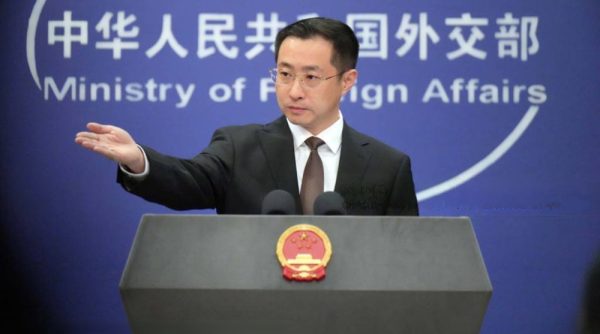
“On the Iran situation, we always believe that dialogue and negotiation is the only viable way out. China opposes illicit unilateral sanctions. This position is consistent and clear,” Chinese Foreign Ministry spokesperson Lin Jian told a regular press briefing on Friday.
Trump on Thursday hinted at possible sanctions on Chinese banks when asked whether Washington would punish them for doing business with Iran. “Who said I’m not? You don’t know if I’m doing it … I don’t have to announce everything, do I?” Trump said, according to Reuters.
The remarks came as the US has intensified economic pressure on Iran, broadening the sectors and actors targeted by its sanctions campaign after months of military strikes and diplomacy failed to fully reopen the Strait of Hormuz.
Zhou Mi, a senior research fellow at the Chinese Academy of International Trade and Economic Cooperation, told the Global Times on Friday that the latest US push to tighten sanctions on Iran reflects a clear expansion of US’s unilateral sanctions approach, which had previously focused more heavily on traditional sectors such as energy and oil and gas.
“What we are seeing is a continued broadening of both the sectors covered and the entities targeted,” Zhou said. He described the trend as a further “generalization” of US restrictions, with the US extending unilateral measures into new areas and to a wider range of actors, in some cases beyond the scope of previous international consensus on Iran-related sanctions.
Washington has already targeted Chinese mainland and Hong Kong entities in previous rounds of Iran-related sanctions. But it stopped short of blacklisting major Chinese banks and refiners, the South China Morning Post reported on Friday.
Zhou warned that extending such measures to financial institutions would sharply magnify the fallout, given the broad, complex and two-way nature of cross-border financial networks. “If such sanctions were actually imposed, the impact would be extensive and may significantly escalate tensions in China-US relations,” he said, adding that such a move would be detrimental to both sides.
The latest threat comes as the US expanded its sanctions on Iran. On Monday, the US Treasury launched “Operation Economic Outcast,” expanding the categories of Iran-related conduct potentially exposed to secondary sanctions and sanctioning nearly 60 entities, individuals and vessels across multiple jurisdictions. It also warned that entities facilitating certain Iran-related activities could risk being cut off from the US financial system.
China has repeatedly rejected such pressure. Lin said on Tuesday that economic warfare and maximum pressure “provide no solution” and would instead fuel tensions and lead to risk spillover, disrupting the global economic and financial order, and harm the legitimate rights and interests of other countries. Lin also stressed that China will do everything necessary to firmly safeguard its rights and interests.
Zhou emphasized that the latest US threats also run counter to efforts to translate the consensus reached by the Chinese and US heads of state into concrete actions and build a more constructive and stable bilateral relationship.
“China’s door to negotiations has always been open,” Zhou said. “If the US genuinely wants to implement the consensus reached by the two sides, it should stop resorting to threats and take concrete steps toward mutually beneficial cooperation, or at the very least, reasonable and fair competition, rather than continuing to rely on unilateral measures.”
US accuses China of hacking NASA, Fed and critical infrastructure
RT | August 27, 2026
The US has accused Chinese hackers it described as “state-backed” of breaking into NASA, the Federal Reserve and other sensitive government networks, just weeks before Chinese President Xi Jinping is expected in Washington for talks with President Donald Trump.
Beijing rejected the allegations, with the Chinese Embassy in Washington saying China “opposes and combats all forms of cyberattacks” and urging the US to “stop using cybersecurity issues to smear or discredit China.”
The Justice Department and FBI announced on Wednesday that they had seized three internet domains linked to two hacking platforms allegedly operated by a Chinese group known as QTFY. US authorities claimed the operation targeted NASA, the Federal Reserve, the Senate and several government departments, as well as hospitals, telecommunications providers, power companies, financial institutions and defense contractors.
Washington described the campaign as Chinese state-sponsored activity and alleged that the company behind it provided hacking services to China’s Ministry of State Security and the People’s Liberation Army. However, officials did not disclose what sensitive information was allegedly stolen or what damage, if any, was caused.
The latest accusations come little more than a month after Trump similarly accused Beijing of meddling in US elections, claiming China had illicitly acquired some 220 million American voter files during the 2020 election cycle in what he called the “largest compromise” of election data in US history.
China dismissed that allegation as “groundless” and “entirely fabricated.” Trump’s assertions of election “hacking” were met with skepticism even among some of his supporters, as the documents released by the White House only showed Chinese interest in collecting publicly available or commercially obtainable American voter information.
Trump himself openly acknowledged after meeting Xi in Beijing in May that Washington conducts extensive espionage against China.
“We spy like hell on them too,” Trump told reporters. “We do a lot of stuff to you that you don’t know about,” Trump claimed he had told Xi, describing the two countries’ espionage activities as a “double-edged sword.”
Beijing has made similar accusations against Washington, claiming last October that the NSA had conducted a years-long cyberattack on China’s National Time Service Center, which supports critical sectors including finance, energy, transport and defense. The NSA did not confirm or deny the allegation.
The renewed cyber accusations come ahead of Xi’s expected visit to the US on September 24. Trump has said he plans to host the Chinese leader following their May talks in Beijing, as the two sides seek to manage disputes over trade, technology and cybersecurity, as well as Washington’s sanctions threats against nations that continue trading with Iran.
US statement lacks factual evidence and turns facts on their head: China rejects US allegations of cyberattack
Global Times – August 27, 2026
China strongly deplores and firmly opposes the US once again smearing it under the pretext of cybersecurity, Chinese Foreign Ministry spokesperson Lin Jian said at a regular press conference on Thursday.
Lin made the remarks when asked about the US Department of Justice’s announcement on Wednesday that it had carried out court-authorized seizures of domains used by two hacking platforms which Washington claimed were operated and used by “China state-sponsored hackers to target US critical infrastructure and other sensitive networks.”
“We have noted relevant reports. China firmly opposes and combats hacking activities in accordance with the law. At the same time, China firmly opposes the dissemination of disinformation for political purposes,” Lin said. “The so-called US statement lacks factual evidence and turns facts on their head. China strongly deplores and firmly opposes the US once again smearing China under the pretext of cybersecurity.”
“The US is widely recognized as the world’s biggest hacking and surveillance empire, with an appalling record backed by irrefutable evidence,” Lin said, noting that China has serious concerns about US cyber activities.
Previously disclosed cases, including the US National Security Agency’s cyberattacks and infiltration targeting China’s National Time Service Center, exposed the dangerous activities of the US government in attacking China’s critical infrastructure and conducting cyber pre-positioning for large-scale sabotage in the future. However, the US has not responded to any of these cases, Lin said.
As major cyber powers, China and the US should take the lead in upholding and observing international rules in cyberspace and jointly build a peaceful, stable and mutually respectful China-US relationship in cyberspace, Lin said.
“We urge the US to abandon double standards and political manipulation, and work with China in a responsible and constructive manner to properly address cybersecurity risks through dialogue and consultation on an equal footing,” he said.
After 6 months of war, why aren’t oil prices even higher?
By Sam Fraser | Responsible Statecraft | August 25, 2026
For decades, the potential closure of the Strait of Hormuz has been considered the ultimate doomsday scenario for global oil markets. So, when Iran effectively closed the Strait earlier this year in response to the joint U.S.-Israeli assault, many analysts warned that oil prices could skyrocket to record highs.
The logic was straightforward. Prior to the war, about 20% of the global oil supply transited the Strait. A loss of supply on this scale could easily have pushed oil prices to $150 or even $200 per barrel — but it didn’t. Instead, prices peaked around $120 per barrel in April and have largely stayed below $100 since June.
To understand the dynamics that have so far prevented an even higher price spike, and to get a sense of where oil supply and prices may be headed as the conflict drags on, I spoke with Rory Johnston, a leading oil markets analyst and the author of the Commodity Context blog. Our conversation has been edited for length and clarity.
Sam Fraser: Let’s talk about why we haven’t seen the $150-200 per barrel oil prices that you warned about early in the war. You’ve pointed to a few reasons, including China’s massive import cuts. As we understand it, what has China done with their oil imports and how have they managed it?
Rory Johnston: It’s a bit of a mystery. At this stage, what we know for sure is that China reduced its crude oil imports by over five million barrels a day, roughly 45% of their total pre-war import appetite. For China, there’s two endpoints of that crude oil balance: into a refinery or into storage. We know that China had been building up a massive volume of strategic reserves prior to the war.
Essentially half of the 5 million barrels a day reduction can be explained roughly by reductions in refining runs in China. The remainder is a question of balancing in and out of stockpiles. Some of it would’ve been likely a drawdown of less visible or underground stockpiles. And the other portion of it is the halting of that prior pace of stockpile building. The main debate is how much each of these factors is contributing. If, let’s say, 80% of that remainder is a halt to prior purchases that were building strategic stocks, that is a bearish outcome for oil prices because it means that Beijing doesn’t need to replace those volumes anytime soon. But if they are aggressively drawing down less visible strategic stocks right now, that’s a much more bullish interpretation because it means they can’t keep going on forever and they’re going to need to replace those stockpiles.
On the refined product side, they cut refining runs by about 2.5 to 3 million barrels a day. What are they doing with that prior flow of diesel, jet fuel, et cetera? And that’s where we start to get even more speculative. Above-ground storage tanks for refined products don’t have floating roofs. We can’t independently verify their fill.
It comes down to the apparent consumption and the apparent available supply of these fuels within China. For gasoline and diesel, each of those supplies have apparently fallen by about 20%, which is a stark reduction. There’s no evidence that people in China are just driving a fifth less. If they aren’t actually cutting back that much on consumption, where is the fuel coming from? Prior to the war, we suspected that China was also building strategic reserves of refined fuels. Again, we can’t verify that, but if they had built that up, they could be drawing it down. We’re then faced with that same question as in crude oil, how much of this is a cessation of prior stock building and how much of this is the drawdown of existing stock?
For reference, the last moment we saw anything like this in terms of apparent consumption collapse was COVID zero in 2022 when the country was entirely locked down.
Fraser: So we can say that stockpiles of refined products must exist, but we have no insight into their size or how much is being drawn down or how sustainable those drawdowns would be?
Johnston: Correct. There are mixed estimates, but I think they are at best estimates. It’s funny, I think in some ways the lack of verifiable data allows people to speak very confidently about what’s happening in China, because there’s no data to rebut virtually any argument. That’s just allowing people to run with it without any kind of real pushback.
Fraser: How have we seen the Chinese buying patterns change since the U.S.-Iran Memorandum of Understanding and since it collapsed?
Johnston: What we saw following the MOU was a surge of exiting cargoes from Hormuz. The vast majority of that seems to have routed towards China. What we saw was that, at the very bottom, Chinese crude oil imports fell to around 6 million barrels a day in June. And then those spiked back up to more than 10 million barrels a day in July, or at least that was the high point in July. Roughly a month later, those imports are back down around six. You’ve seen a rollover back to where we stood pre-MOU.
Fraser: Do we know how long this import suppression can continue?
Johnston:. Let’s say this has been entirely a drawdown of stocks, which seems implausible. Even then, they have more than a billion barrels of crude oil stocks that we know about for sure. If they want to support the market to their maximum ability, they can do that for months further. But in doing so, they would deplete the entirety of the energy security blanket they’ve spent almost two decades constructing.
Fraser: Let’s move on to the strategic petroleum reserve releases by the U.S. and other partners. To what degree have those been instrumental in keeping prices from going a lot higher?
Johnston: It’s part of the suite that the world has kind of engaged in to blunt those effects. This is the largest release of strategic stocks on record. Depending on the exact month you’re talking about, it has potentially been over 3 million barrels a day of incremental supply coming from OECD SPRs. Without that, the market would’ve been much tighter and we likely wouldn’t have experienced the same relief even with China’s import cut at the same time.
Fraser: Last week the U.S. SPR dipped under 300 million barrels. There’s a lot of discussion of what the physical limits on those stockpiles are given that they’re stored in salt caverns. They need a certain amount of fill to maintain structural integrity. Are we anywhere close to pushing up against the U.S. ability to continue drawing down from those stockpiles?
Johnston: I do not believe we are. I think that you have probably at least another 200 million barrels that can be readily drawn down. With the required fill level, absolutely it would be a massive issue if you just drew it down and left a vacuum in there. It would implode on itself. But they don’t do that. They one-to-one replace a barrel of crude oil extracted with a barrel of saturated brine. So theoretically it should maintain the same fill. The issue for SPRs is not necessarily fill level, but number of refill and empty cycles. It’s the actual up-and-down motion that disturbs and further erodes the walls and structural integrity.
I think that the SPR caverns can get below 100 million barrels of fill before we run into any issues.
Fraser: So if we continued the current rate of drawdown, that would take us well into next year.
Johnston: Correct.
Fraser: Over the course of the war, Trump or someone in his administration will make a statement about how diplomacy is progressing or about how much oil is coming out of the strait. And even if those are quickly disproven, there is a downward impact on prices. So why do these traders keep listening to Trump? Has there been a change in the reaction of markets over the course of this war?
Johnston: You definitely get smaller drawdowns to these kinds of jawboning attempts today than you would have, say, in March and April, where there are multiple days that you saw $15 to $20 per barrel reductions in the span of a day.
When you look at the history of oil, there’s a tendency on these geopolitical events to overdo it. That’s a natural kind of fear-driven phenomenon. In some ways Trump has short-circuited that normal behavior in oil markets. Because while you’re right that it’s never coming true, the price action is coming true. At the end of the day, for prices to go higher, you need traders to bid higher. And if they bid higher and they get blown out of the water and they lose their jobs, they’re going to be replaced by someone that doesn’t bid higher on geopolitical risk. It has successfully arrested the upside volatility. But if we keep getting tighter, markets will continue to respond higher; we just won’t get those runaway phenomena that we would’ve seen historically.
Fraser: Since the start of the war, we’ve seen Saudi Arabia and the UAE successfully use pipelines as an alternative route to get oil out of the Gulf. How much oil are those getting out at this point? And has the Houthi blockade of Saudi shipping in the Red Sea had a meaningful effect on this?
Johnston: The total volume coming out of Emirates at Fujairah and then the west coast of Saudi Arabia and the Red Sea rose to about 6-7 million barrels. It was about 2-3 million before, so that was an incremental change of 4-5 million barrels.
To your question with the Houthis, it has absolutely been having an effect. As soon as they started attacking Saudi ships, the entire Red Sea fleet went dark. Everyone turned off their transponders, making it much harder to verify flows out of Saudi Arabia. Verifiable transits of Saudi tankers through the Bab al-Mandab have gone functionally to zero. They still are probably getting some out, but we’re also seeing evidence of flows north into the Mediterranean. Pre-war flows here were around a million barrels a day, give or take. That’s jumped over the past week or two to around 2.5 million barrels a day, presumed Saudi flow.
Over the past two weeks, we’ve also seen Saudi Arabia begin loading tankers in the Gulf again, which they hadn’t done since the collapse of the MOU. And the question is, does Riyadh know something? Is something big going to break in the Hormuz negotiations? Or are they being forced back into the Gulf? You’re seeing reports now that they are participating in the Emirati-led shuttle trade, ship-to-ship transfers in the Gulf of Oman. It seems likely that some of that is displaced barrels coming back from the Red Sea. So Saudi Arabia is needing to diversify away from its diversification. There’s a poetic side to it.
Fraser: Pulling all these factors together, where are we left in terms of a kind of global supply shortage? And what kinds of price impacts can we expect if that persists over the next few months?
Johnston: It’s very hard to estimate global balance right now. My bet would be 2-4 million barrels a day undersupplied on a global basis.
The rub on top of that is that we now have a parallel crisis that’s emerging on the refining side of the slate. So even if we’ve sorted out what was happening on the crude oil side, we have the Ukrainian hammering of Russian refineries, the attacks in the Black Sea, the reduction in U.S. exports now that stocks have drawn down, and China is not exporting refined products either. All together this further tightens global refined product markets.
If this persists and we keep drawing down crude oil stocks, the crude oil price is going to keep rising. On top of that, we could see refined product prices independently going higher. So that’s just an amplification. For consumers, it’s refined product prices and not crude oil that are going to drive those economic issues.
Fraser: So even though these factors we’ve discussed have kept oil prices down so far, and the biggest of these can persist for a while, we could still be looking at those extremely elevated prices by a few months from now.
Johnston: Easily. We’re already feeling it. Refined prices are already at demand-destructive levels. It’s just a question of whether they are at sufficiently demand-destructive levels. It’s the same fundamental concern I would’ve had back in April, playing out on a much longer timeline and now more on the product side than the entire oil complex.
Sam Fraser is a writer based in New York City. He holds a Master’s in International Finance and Economic Policy from Columbia University’s School of International and Public Affairs, where his studies focused on the changing global trade system. Previously, Sam worked as Senior Communications Associate and Publications Manager at the Quincy Institute.
Sanctioning the Dollar Iran Already Left: Why Bessent’s “Economic D-Day” Is Toothless
By Larry C. Johnson | SONAR21 | August 24, 2026
There was one sentence in Scott Bessent’s Monday sanctions announcement that gave the whole game away. Anyone who launders money for the Iranian regime, the Treasury Secretary warned, “will be removed from the US dollar system.” He meant it as a threat of annihilation. It is, instead, a confession of the policy’s central weakness. The entire architecture of what Bessent has branded “Operation Economic Outcast” rests on a single assumption — that Iran and its trading partners need the U.S. dollar. They increasingly do not. And a threat to bar someone from the dollar system means nothing to a trade that has already walked out of it and into the Chinese yuan.
What Bessent actually announced
Strip away the “economic D-Day” theatrics and the substance is a secondary-sanctions framework: the United States threatens to punish any country or entity that refuses to sever economic ties with Iran, expands the categories of activity exposed to those secondary sanctions into five new fields — digital assets, technology, gold, aviation, and shipping — and designates roughly sixty individuals, entities, and vessels tied to nuclear and missile procurement, cyber operations, and oil smuggling. The mechanism of pain, in every case, is the same: exclusion from the dollar-based financial system that Washington polices through its control of dollar clearing, SWIFT messaging, and correspondent banking.
That is a devastating weapon against anyone who lives inside the dollar system. It is close to irrelevant against those who have deliberately built their most important trade outside it. And Iran’s lifeline — the oil trade with China — is now largely outside it.
The trade that runs on yuan
Follow the barrels. China is now the buyer of over 80 percent of Iran’s seaborne crude exports. Iran is shipping somewhere around 1.65 to 1.8 million barrels a day, almost all of it to the independent “teapot” refiners of Shandong, moved by a shadow fleet of more than 350 tankers using ship-to-ship transfers off Malaysia, Singapore, and the Sea of Oman, the cargoes routinely rebranded as Malaysian or Omani. And critically, the money for it increasingly does not move in dollars. Payment flows in yuan, routed through small Chinese banks and Hong Kong trading shells, settled in a growing volume of renminbi that bypasses the dollar clearing system entirely.
The plumbing for this is China’s Cross-Border Interbank Payment System, CIPS — the settlement network the People’s Bank of China launched in 2015 precisely to clear cross-border yuan transactions without touching the Western financial architecture. Its use has surged in lockstep with the war. CIPS processed on the order of $214 billion in March 2026, hit a single-day record of 1.22 trillion yuan — roughly $178 billion — across nearly 42,000 transactions, and saw its average daily value jump about 50 percent from February to March, a spike analysts tied directly to the Iran conflict and rising yuan demand in oil trade. More than five thousand institutions are now connected. These channels allow settlement without any intermediary US bank in the chain — which is the entire point.
Nor is this confined to China. Even Indian refiners buying rare cargoes of Iranian oil have settled the payments in yuan, routed through the Shanghai branch of an Indian bank, because Iran wants a currency that sidesteps the dollar sanctions channel. Iran’s Revolutionary Guard has reportedly begun demanding yuan or cryptocurrency for oil transactions outright. When Bessent adds “digital assets” and “gold” to his sanctions categories, he is chasing evasion routes Iran is already using by design, through a shadow system purpose-built to be untraceable.
You cannot freeze a yuan payment out of a dollar system it never enters. That is not a loophole in Bessent’s plan. It is the plan’s foundation, missing.
The market already delivered its verdict
The most eloquent judgment on these sanctions came not from a pundit but from the oil market itself. If traders believed Bessent’s “economic onslaught” would actually choke off Iranian barrels, crude would have spiked on the announcement. It did the opposite. Brent fell about 2.3 percent on August 24, sliding below $92, as investors concluded the measures were unlikely to remove Iranian oil from the market. A sanctions package advertised as an economic D-Day was met by the market marking the price of oil down. The traders who move real money on real supply read the announcement for exactly what it was: sound and fury aimed at a target the dollar can no longer reach.
The one tooth Bessent won’t bare
There is precisely one measure that could actually bite the yuan trade: sanctioning the major Chinese banks and the CIPS architecture that clear it — cutting large Chinese financial institutions out of the dollar system and forcing Beijing to choose. And that is the step Bessent, once again, announced but did not take. He warned that at least one major financial institution could face sanctions this week, and said China would not be exempt. A threat, not an action — the same threat that has hovered over this campaign for months and never descends, because executing it means a financial rupture with Beijing on the eve of a planned Trump-Xi meeting, and an oil-price shock Washington cannot afford heading into the midterms.
And even if he pulled that trigger, the trade is engineered to survive it. The yuan payments already move through small Chinese banks and Hong Kong front companies precisely so that the large, dollar-exposed institutions stay clean and the flow continues if a big bank is hit. The system was designed by people who assumed Washington would eventually come for it. Bessent is threatening to breach a wall its builders reinforced years ago.
Ten years of sanctions, and a larger economy
Step back from Monday’s announcement and ask the longer question: what has a decade of sanctions actually done to the size of Iran’s economy? Measured properly, it has grown.
The measure matters, because there are two ways to size an economy and here they tell opposite stories. In nominal dollars — the plane on which sanctions operate — Iran looks devastated: its dollar GDP is around $300 billion in 2026, and dollar income per head has been falling fast, because the rial has been pulverized and everything Iranian looks cheap when priced in a currency Iranians increasingly cannot obtain. But nominal-dollar GDP largely measures the exchange rate, not the economy. Measured by purchasing power parity — which values what Iran actually produces at the prices Iranians actually pay, stripping out the collapsed currency — Iran’s GDP has risen from roughly $1.4 trillion in 2015, when the JCPOA-era sanctions architecture was in force, to about $2.18 trillion in 2026, by the IMF’s reckoning the world’s twenty-third-largest economy. That is an expansion of more than fifty percent over the same decade of “maximum pressure” that was supposed to break it.
The caveat belongs in plain sight, not buried: part of that gain is simply more Iranians — the population has grown by roughly a sixth since 2015 — so per-capita output has risen far more modestly, and none of it means Iranian households feel richer, with inflation running near forty percent and the currency in ruins. Growth of the economy is not prosperity for the family. But that is a different claim from the one that matters for sanctions policy. A pressure campaign that can wreck a currency and still not shrink real output is a campaign that produces hardship without submission. Iran has now demonstrated exactly that across two sanctions architectures — the JCPOA snapback and its “maximum pressure” successors — and ten years of data. Bessent is adding a chapter to a book whose ending is already written.
The honest limits
This is a dollar bypass, not the death of the dollar. The greenback still makes up around 57 percent of global foreign-exchange reserves against roughly 2 percent for the yuan, and only a low single-digit share of cross-border trade settles in renminbi; CIPS remains far smaller than the SWIFT-and-CHIPS system it shadows. The claim here is narrow and it is enough: a determined seller like Iran, with a willing Chinese counterparty, can route its oil revenue around the dollar — not that the world has.
Nor are the sanctions literally costless to Tehran. The friction of operating in the shadows is real: Iran sells its crude at discounts of $14 to $17 a barrel below Brent, up from $8 in 2023, precisely because sanctions raise the risk and complexity of buying it; its fiscal break-even sits far above the price it actually realizes, and the rial has lost most of its value. Bessent’s measures will add a little more friction at the margin — another turn of the screw on the discount, another few front companies to replace.
But friction is not a chokehold, and a poorer Iran is not a compliant one. The sanctions make Iran’s oil cheaper and its economy more strained; they do not, and cannot, sever the yuan-denominated artery to China that keeps the oil flowing and the regime funded. That artery is the thing Bessent promised to cut, and it is the one thing his announcement does not touch.
Bessent has threatened to expel Iran and its partners from a financial system Iran has spent years leaving. The dollar guillotine is real, and it still falls with terrible force on anyone standing beneath it — but Iran’s oil trade stepped off the block and into the yuan, and every fresh round of dollar-weaponization only sharpens the incentive for others to follow. The measures announced Monday will generate headlines, a few dozen designations, and a marginal widening of the discount China already enjoys on Iranian crude. What they will not do is the thing they were sold to do: collapse Iran’s options and force it to heel. You cannot sever a lifeline that no longer runs through your hands. Bessent is standing guard at a door Iran walked out of a long time ago, threatening to lock it.
China will not play along with the US’ ‘reckless games’ on the Iran issue
Global Times | August 21, 2026
US President Donald Trump announced on August 19 local time that he would launch a so-called “economic D-Day” operation against Iran. US Treasury Secretary Scott Bessent, in outlining the operation, described it as “economic warfare and isolation on an unprecedented scale,” adding that other countries “are either with us or against us.” When asked whether the new sanctions would involve China, Bessent urged China to “get with the program,” claiming that would do China “a big service.”
The US war against Iran has now entered its sixth month, with both sides now locked in a stalemate – unable to escalate the conflict further yet unable to reach a negotiated settlement. The so-called “economic D-Day” operation is less a new offensive launched by the US against Iran than it is yet another attempt by Washington to cut its losses as quickly as possible and extricate itself from the quagmire of the Middle East – a move to change tactics and keep gambling after military means have proven ineffective.
But it may well be heading in the wrong direction. Whether it is the ever-rising bills at US gas stations or the soaring energy and shipping costs in global markets, one thing is clear: Economic sanctions can concentrate pressure on a single country, but it is difficult to confine the costs to that country alone. War cannot solve problems, and sanctions only add fuel to the fire.
The so-called “either with us or against us” rhetoric, in a sense, exposes Washington’s strategic predicament: it “can no longer handle this mess on its own.” Ironically, while Washington has been spouting “bold rhetoric,” its circle of allies has remained silent on the matter. In fact, since the US’ war against Iran began, most US allies have been highly reluctant to go along with America’s radical strategy out of concern for the spillover effects of the conflict and the energy crisis. The reason is simple: for these countries, the Iran issue affects energy supply, shipping security, and inflationary pressures.
The US has set its own house on fire, yet it wants the whole world to help fan the flames, making the blaze even bigger – and in the end, it expects everyone else to foot the bill. Who would want to be such a patsy? The US has repeatedly labeled European nations “cowards” for refusing to join the war, further provoking a strong backlash from its European allies and creating a rare, deep‑seated rift in the alliance system.
If the US cannot even rally its own allies, it certainly cannot expect to boss China around. China has consistently opposed unilateral bullying and long-arm jurisdiction – not because China is Iran’s largest trading partner and maintains long-standing friendly relations with Iran, but because once this US logic is accepted, international trade would no longer be normal exchanges between nations. Instead, it would devolve into an absurd situation where the US unilaterally sets the rules and the flow of all goods must be approved by the US.
If the US can force China to cut ties with Iran today, will it be able to arbitrarily cut off all foreign trade with any country it regards as a “rival” tomorrow? If so, there is no doubt that the world would be reverting to the law of the jungle, where the basic rules of modern civilized society will cease to exist.
The Strait of Hormuz is a strait used for international navigation. Restoring safe and free passage through the strait as soon as possible serves the interests of all parties and is also the shared aspiration of the international community. But if the fact that “the Strait of Hormuz concerns a certain country’s interests” is used as a pretext to demand that this country unconditionally comply with Washington’s maximum pressure and trade bullying, that would not only put the cart before the horse, but also steadily deplete the US’ international credibility while exacerbating global energy volatility, high inflation, and market disorder.
Only a comprehensive ceasefire and the cessation of hostilities can fundamentally create the conditions for easing tensions, because the disruption of navigation through the Strait of Hormuz is itself a spillover effect of the US’ war against Iran. China has consistently supported all efforts conducive to a ceasefire and an end to hostilities. But ultimately, those who tied the knot must be the ones to untie it; this knot can and must be resolved by the parties directly involved.
America’s strategic predicament stems precisely from its obsession with the “big fist” and its inexplicable confidence that “there is always a way to force those who refuse to comply into submission.” If the US continues applying pressure at will, it will only be kept trapped for longer and sink deeper.
Simply expanding economic pressure will only prolong the conflict and increase the losses for all sides. The entire world can see this clearly. Not only will China not play along with the US’ “reckless games” on the Iran issue, but the international community will not stand with Washington either. From moral, legal, and practical perspectives, escalating unilateral sanctions has neither legitimacy nor feasibility.
An immediate ceasefire and cessation of hostilities, the prompt resumption of peace talks, the restoration of navigation through the strait, and upholding the authority of the UN Charter – these have been China’s consistent positions since the conflict broke out, and they are the approach that serves the interests of all parties. Only by abandoning the Cold War mentality of confrontation, setting aside the tool of maximum pressure, and returning to the proper track of dialogue and negotiation can Washington cut its losses in time and make a dignified exit.
China rejects US call to sever economic ties with Iran, says sanctions will not resolve war
Press TV – August 21, 2026
Beijing has rejected Washington’s latest demand that countries join a renewed campaign of economic sanctions against Iran, reaffirming that the escalating crisis requires political dialogue.
“Sanctions and pressure tactics are not the solution,” Chinese Foreign Ministry spokesperson Lin Jian told reporters on Thursday.
The rebuke came one day after the Trump administration issued an open call to allies and China alike to fall in line with what the president billed as the “most crushing economic operation ever taken against any country”—a boastful threat that came after Washington failed to achieve any of its war objectives military some six months after starting the aggression on Iran in late February.
Notably, the United States has yet to detail the full scope of its so-called operation, with US Secretary of Treasury Scott Bessent punting further specifics to a Monday press conference—a delay that raises questions about the campaign’s actual readiness.
China calls on parties to act responsibly and stick to the political and diplomatic approach, added Jian.
Iran has strongly condemned the US campaign, with Minister of Foreign Affairs Abbas Araghchi describing Washington’s economic aggression as an attempt to divert attention from America’s own problems.
Araghchi pointed to America’s “unprecedented debt & surging interest costs” as Washington seeks to impose further economic pressure on Iran.
Iran’s Ministry of Foreign Affairs said on Thursday the latest US sanctions, announced on the anniversary of the 1953 coup against Iran’s democratically elected government, demonstrate Washington’s continued hostility toward the Iranian people.
“The new US sanctions are not only another indication of the continuation of 73 years of hostility by US policymakers toward the Iranian people, but also demonstrate the anti-human, lawless and hegemonic nature of the US government,” the ministry noted.
The ministry further condemned the sanctions for targeting the fundamental rights of Iranian citizens and violating international norms.
“Without a doubt, the US economic sanctions against Iran, which target the fundamental human rights of every Iranian citizen, constitute ‘economic terrorism’ and ‘crimes against humanity,’” it maintained.
Beijing’s rejection comes ahead of Chinese President Xi Jinping’s planned September 24 visit to the White House, adding significance to China’s refusal to participate in Washington’s economic campaign against Tehran.
NATO whines it cannot fight simultaneous wars against Russia, China and Iran
By Drago Bosnic | August 19, 2026
NATO war planners rarely discuss their “nightmare scenarios” in public and appear even less prepared for real-life confrontations on that scale. This is particularly true when it comes to simultaneous or near-simultaneous wars in which the most aggressive racketeering cartel in recorded history has to fight in Eastern Europe, the Middle East and East Asia. As the pillar of NATO, the United States would be forced to manage wars against Russia, Iran and China at once. One of the most infamous mainstream propaganda machine outlets, The Atlantic, explored this possibility, calling it “NATO’s nightmare”. The analysis largely focuses on “a coordinated assault by Beijing and Moscow” and how difficult it would be to “muster a viable defense” (obviously implying that NATO wouldn’t attack first, which is beyond laughable given its history).
The author, Simon Shuster, warns that “about a year ago, General Alexus Grynkewich, NATO’s top commander in Europe, publicly warned of the risk of a two-front war involving Russia and China and urged European allies to help the US prepare”. He quotes Florence Gaub, director of research at the NATO Defense College, who described it as “the scenario we’re currently not ready for”. She warns that “NATO strategists know the gap exists, but have not closed it” and that “despite growing military cooperation between Russia and China, Western governments have conducted only a handful of low-profile exercises examining what a joint attack might look like”. Although there weren’t any publicly acknowledged drills with this specific scenario in mind, Western-led military exercises in different areas of the world certainly focused on such a possibility.
However, The Atlantic admits that even when such scenarios were conducted as part of war games, the results were “less than optimistic”. The report quotes Mark Montgomery, a retired US Navy rear admiral who participated in major war games and stated that he last studied such a scenario roughly 15 years ago. Montgomery recalled that “it didn’t go well” because “even then, the US lacked the weapons stockpiles and industrial capacity to sustain a prolonged multifront war”. Even when numerous US allies, vassals and satellite states are added to the mix, “it made no difference at all”. What’s more, Montgomery warns that “those metrics have worsened, even as some NATO countries have increased defense spending”. To prove this is truly the case, one simply needs to look at the US aggression against Iran, which demonstrated remarkable resilience.
Worse yet (for America), Tehran also uncovered the Pentagon’s woeful incompetence in fighting a remotely capable opponent. A single country that the US promised to “defeat in three days to two weeks tops” has not only withstood all attacks in the last six months, but has also successfully retaliated against US occupation forces across the Middle East. It should be noted that Iran has been under Western sanctions for nearly half a century at this point. Now imagine how a direct confrontation with Russia or China would unfold, even separately, much less simultaneously. The Atlantic fears that “Moscow and Beijing have actually improved their positions”. The report points to the NATO-orchestrated Ukrainian conflict, which “pushed Russia’s massive industrial base onto a war footing and sharpened its use of drones”.
It also warns that “while China has not fought a major war in decades, it now surpasses the US in warships and long-range missiles”. Obviously, the Asian giant hasn’t fought a major war in nearly half a century because it has refused to do so. Nothing prevents Beijing from fully restoring its sovereignty over Taiwan by force. However, it seeks to resolve the dispute through peaceful means, just like it did when restoring sovereignty over Hong Kong and Macao back in 1997 and 1999, respectively. This is precisely what the US fears the most, as a non-violent transition would only strengthen China and effectively break US dominance in the Asia-Pacific without firing a single shot. Washington DC would much rather see Taiwan destroyed than give up its influence there peacefully. This is why the US maintains tight control over local military forces.
However, directing “controlled chaos” is not enough for the Pentagon to “feel safe”. Namely, growing Sino-Russian ties are what really makes the political West “shiver” (or should we say, suffer panic attacks). The Atlantic is particularly concerned by the “no-limits partnership” Presidents Vladimir Putin and Xi Jinping announced back in February 2022. NATO simply has no mechanisms to prevent Moscow and Beijing from building their alliance. On the contrary, its truly unprovoked aggression against the entire world has only strengthened their strategic partnership. The Atlantic thinks that “from Russia’s and China’s perspective, the timing may look favorable”, primarily because “the US is stretched by conflict in the Middle East, has shifted ships and aircraft away from Europe and Asia, and has depleted much of its advanced air-defense missile stockpile”.
Well, nobody forced Washington DC to wage yet another war of aggression. Neither Moscow nor Beijing forced the Trump administration to foolishly attack Iran. However, even the Middle East pales in comparison to how Western forces would fare in a fight against adversaries such as Russia and China, particularly now that the NATO-orchestrated Ukrainian conflict has turned the Russian military into the deadliest fighting force on the planet. The Atlantic concludes that “in a two-front war, the side most likely to prevail may be the one that acts with common purpose and stays united”. It would seem NATO didn’t learn from the strategic mistakes of its Axis predecessors, because that’s precisely what’s going to happen if it continues with its aggression against the entire world, which will have no other choice but to unite.
Drago Bosnic is an independent geopolitical and military analyst.
China’s first 100-bcm Bohai gas field Phase I fully online, with daily output topping 5,200 tons
Global Times – August 9, 2026
The first phase of the Bozhong 19-6 gas field, China’s first 100-billion-cubic-meter gas field in the Bohai Sea, has entered full operation, with daily oil and gas output surpassing 5,200 tons, CNOOC Tianjin Branch announced on Sunday. The project is of great significance for optimizing the regional energy structure and supporting high-quality economic and social development, the People’s Daily reported.
China’s natural gas reserves are unevenly distributed, with more in the west and less in the east. As the largest offshore gas field in eastern China, the project has so far produced more than 2.8 billion cubic meters of natural gas and serves as an important force in ensuring a stable natural gas supply for the Beijing-Tianjin-Hebei region and the Bohai rim area.
Coming fully online during the critical peak summer demand period, the Phase I project further meets the energy needs of regional residential life and industrial production, said the report.
Located in the central Bohai Sea, the Bozhong 19-6 gas field has proven natural gas geological reserves exceeding 200 billion cubic meters and proven petroleum liquid geological reserves of more than 200 million cubic meters. The field is buried at depths exceeding 5,000 meters, with widely distributed but complex oil and gas reservoirs and densely fractured buried-hill formations.
“The full commissioning has not only verified the capability to develop deep and complex oil and gas reservoirs in the Bohai Sea, but also further enhanced the self-sufficiency of natural gas supply in eastern China,” Lin Boqiang, director of the China Center for Energy Economics Research at Xiamen University, told the Global Times on Sunday.
The Bohai Oilfield, where Bozhong 19-6 is located, is China’s first ultra-large offshore oil and gas field with an annual output capacity of 40 million tons. In the first half of this year, its oil and gas output exceeded 21 million tons, setting a new record high, the People’s Daily reported.
Drilling operations for Phase II of the gas field have fully commenced, which will further enhance the role of offshore oil and gas in supporting China’s domestic energy supply.
China has implemented a new round of strategic actions for oil and gas exploration and development in 2026. It will continue to increase investment in exploration and development to ensure that annual domestic crude oil production remains stable at more than 200 million tons and that natural gas output continues to rise, according to a report released by the National Energy Administration.
The report shows that from 2019 to 2025, China added 17 oil fields with reserves of more than 100 million tons and 34 gas fields with reserves of more than 100 billion cubic meters. The average annual newly proven geological reserves surpassed 1.4 billion tons of oil and 1.5 trillion cubic meters of natural gas, representing increases of 55.0 percent and 58.7 percent respectively compared with 2018.
Shale oil and gas as well as coalbed methane accounted for 22 percent of the newly proven geological reserves during the period, becoming important strategic replacement resources. Over the past seven years, China has added 150 million tons of new crude oil production capacity, achieving a stabilization and recovery in crude oil output. In 2025, production rose to 216 million tons, setting a new record high, said the report.
While implementing a new round of strategic actions for oil and gas exploration and development, China’s oil and gas industry will foster new drivers of growth through scientific and technological innovation, deepen the integration of artificial intelligence with exploration and development, and promote the integrated development of oil and gas with new energy, thereby providing important support for building China into an energy powerhouse, the report noted.
China to launch regular shipping to Europe via Russia’s Northern Sea Route – Rosatom
RT | August 8, 2026
China will launch regular container shipping to Europe via Russia’s Northern Sea Route (NSR) this month, with eight voyages planned through October, Rosatom CEO Aleksey Likhachev has said.
The Arctic shipping route runs mostly through Russia’s territorial waters and exclusive economic zone and relies on Russian port infrastructure and icebreaker fleet. Rosatom, Russia’s state atomic energy corporation, is principally responsible for the route’s development.
Chinese firm Sealegend Shipping sent its first freight shipment through the waterway to Felixstowe Port in England late last year, making the voyage in 20 days. A voyage via the Suez Canal would have taken around 37 days, Likhachev told reporters on Friday.
“Today, we are taking the next step. The Chinese shipping company Sealegend Shipping is indeed planning to launch the first regular route to Europe, and Rosatom has already issued permits for seven vessels to transit the NSR,” the Rosatom CEO said.
While prior container shipments were largely experimental or one-off in nature, this year’s program envisions weekly voyages from August to October, ice conditions permitting, he said.
The growing demand for shipping through the NSR comes amid a “permanently difficult situation” in the Persian Gulf, he said. The Strait of Hormuz, which normally carries around a quarter of seaborne oil and LNG trade, has remained largely closed since the US-Israeli attack on Iran in February.
According to Likhachev, Chinese container traffic via the NSR has grown markedly in recent years, more than tripling from 2023 to 2025. Today, bilateral shipping between Chinese and Russian ports makes up 15% of all traffic through the passage. Total cargo traffic between Russia and China is expected to reach 20 million tons by 2030, he added.
India and Russia are also working to finalize a pact on maritime cargo cooperation along the NSR.
The Arctic shipping route remains the shortest maritime passage between the Asia-Pacific region and northern Europe. Russia, which operates the world’s largest icebreaker fleet of more than 40 conventional and nuclear vessels, is investing in the NSR with the aim of making it a pivotal global trade artery.
The route’s significance as “the safest, most reliable, and most efficient” path is growing more evident amid disruptions caused by conflicts around the world, Russian President Vladimir Putin said earlier this year, adding that Moscow is working to strengthen Arctic logistics on a “massive scale.”
The Galling Gallium Chokehold: Why the US Cannot Produce Precision Missiles and Fully-Functional F-35s
By Larry C. Johnson | SONAR21 | August 3, 2026
Kudos, again, to Kevin Wamsley of Inside China Business. Based on his latest podcast (see below) I did some additional digging. The substance of his video briefing is shocking and alarming, at least for US policymakers and weapons manufacturers. There is a single thread running from the empty nose cones of America’s newest stealth fighters to the laboratories where China is building the internet of the 2030s. That thread is gallium — a soft, silvery byproduct of aluminum refining that almost no one outside a materials-science department thinks about, and that the United States does not produce at all.
A metal America stopped making
The top line from the US Geological Survey is stark: the United States has had no primary domestic gallium production for decades, and its net import reliance sits at 100 percent. China, by contrast, controls the overwhelming majority of global output — figures commonly cited run from 94 to 98 percent of raw production. The reason is structural, not incidental. Gallium is extracted as a byproduct of bauxite and zinc processing, industries China dominates. A country cannot simply decide to make gallium; it must first build the aluminum and zinc industries that yield it, then the extraction, refining, wafer, and packaging lines on top. That is a decade-plus undertaking, not a budget line.
This dependency became a weapon in December 2024, when Beijing banned exports of gallium, germanium, and antimony to the United States, explicitly prohibiting sales to US military end-users. It was retaliation for American semiconductor export controls, and it landed on a Pentagon that, by the USGS’s own accounting, had no gallium in the National Defense Stockpile to fall back on.
One crucial update the alarmist version of this story often omits: in November 2025, as part of a broader trade truce between Presidents Trump and Xi, China suspended the civilian portion of that ban until late November 2026, moving those exports to a licensing regime. But the suspension came with a catch that matters enormously — the prohibition on exports to military end-users stayed in force. So the civilian supply reopened on Beijing’s sufferance, revocable at will, while the weapons-makers remained cut off. The chokehold didn’t release; it was repositioned.
The fighters with counterweights where radars should be
The most vivid symptom of this dependency is also the most easily misunderstood. It is true — confirmed through photographic evidence and industry reporting, though initially denied by the Department of War — that F-35s built from Lot 17 onward are being delivered with counterweights, literal ballast, in their nose cones where radars belong. Reporting has put the number affected in the hundreds.
But the cause is more tangled than “China cut off the gallium.” The immediate culprit is the delayed development and certification of the AN/APG-85, the next-generation radar meant to replace the older AN/APG-81. The APG-85 is built on gallium-nitride (GaN) technology, which delivers far higher power and better thermal efficiency — and demands roughly 82 kilowatts, forcing structural, cooling, and power redesigns to the aircraft’s forward fuselage. Jets from Lot 17 were redesigned to accept the APG-85 and can no longer take the old APG-81. When the new radar slipped, those aircraft had nowhere to turn but counterweights.
Gallium supply is the aggravating factor layered beneath that engineering delay: GaN radars use far more gallium than their predecessors, the DLA has struggled to source it as Japan and Germany lack the capacity to fill the gap, and prices have surged. The honest framing is that America faces a radar-development problem and a materials problem, and China’s monopoly sits underneath both. Meanwhile, China has moved its own J-20 fighter to a next-generation radar reportedly built on the same GaN technology — the qualitative gap the APG-85 was meant to open is instead narrowing.
The vulnerability extends well past one airframe. Gallium nitride underpins the high-power jammers on the EA-18G Growler, the F-35’s own electronic-warfare suite, and the large ground-based radar arrays of the kind destroyed during the fighting in the Persian Gulf. The Pentagon’s supply chains reportedly touch Chinese suppliers across a vast share of weapons components — the dependency is systemic, not a single point of failure.
The same monopoly, pointed at the future
Here the story turns from defense to something larger. The same industrial base that lets China throttle radar production also lets Chinese researchers race ahead on the technology expected to define the next quarter-century of connectivity: 6G.
The headline achievement is real and was published in Nature. A team led by scientists from Peking University and the City University of Hong Kong built what they describe as the world’s first “all-frequency” 6G chip — a device roughly 11 by 1.7 millimeters that integrates the entire wireless spectrum from 0.5 to 115 gigahertz onto a single chip. That span previously required nine separate radio systems. In testing it exceeded 100 gigabits per second on a single channel, which independent write-ups translate to roughly 500 times the real-world speed most users get from 5G today, and it can retune across 6 gigahertz of spectrum in 180 microseconds to hop clear of interference. The researchers built it not from gallium but from thin-film lithium niobate, using a photonic-electronic design, and they intend to shrink it into plug-and-play modules for phones, base stations, drones, and IoT devices.
The strategic point survives the technical correction. Whether the enabling material is gallium in a radar or lithium niobate in a transceiver, the pattern is the same: China increasingly controls both the raw inputs and the pipeline of scientists and engineers turning them into deployable systems. And 6G’s importance is not really about consumers. Few individuals need to download a library of films in seconds. The demand comes from industry — precision robotics, advanced manufacturing, private industrial networks, integrated sensing, low-altitude drone economies — the very sectors where China has already built commanding positions. 6G’s promised leap in speed, latency, and integrated sensing is a boon precisely to the industrial base China is busy consolidating.
The standards are the prize
There is one more dimension that outlasts any single chip. 6G has not yet been standardized worldwide; the global protocols are still being written, precisely because the systems are still being built. Standards bodies — 3GPP, the ITU, the O-RAN Alliance — are only now moving 6G from research into formal specification, with first specs targeted around 2029 and commercial networks around 2030. Whoever builds the working systems first shapes the standards everyone else must adopt.
The Trump administration has recognized the stakes, declaring 6G foundational to U.S. national security, foreign policy, and economic prosperity, and setting a policy of American leadership — directing work on spectrum, commercial applications, and diplomatic coalitions to back the U.S. position. The Boston Consulting Group projects that 5G’s roughly $1 trillion in economic output could grow toward $18 trillion by 2035, with 6G enabling entirely new enterprise models and large-scale AI across manufacturing, cities, healthcare, and public safety.
But intent collides with the same wall. The United States cannot lead in building what it cannot supply. Leadership in 6G requires the mining, refining, fabrication, and — above all — the tens of thousands of trained engineers applying the technology at scale. China is doing that work now. America is still debating how to start.
The bottom line
Strip away the hyperbole and a hard core remains. Today, U.S. contractors cannot reliably put advanced radars on hundred-million-dollar aircraft, in part because China controls a metal America stopped producing forty years ago. Ten years from now, on current trajectory, anyone who wants the best phones, drones, or robots may find the critical components — and the standards they run on — routed through that same country. Supply chains are the whole game, and so are the researchers who turn raw materials into markets. That is the argument, and the uncomfortable part is how much of it is simply true.
Here is Kevin’s video:
Beijing blacklists 14 EU firms after Brussels targets Chinese companies in latest Russia sanctions package
The Cradle | July 25, 2026
Beijing prohibited 14 EU companies from obtaining Chinese dual-use goods on 24 July, targeting Europe’s defense industry shortly after the EU included 14 Chinese and Hong Kong firms in its 21st sanctions package against Russia.
Announcing the measures with immediate effect, the Chinese Commerce Ministry called the bloc’s conduct “egregious” and demanded the EU “immediately correct its wrongdoing, eliminate the egregious impact, and safeguard the overall interests of China–EU relations with concrete actions.”
The restrictions cover dual-use items, goods, software, and technology with both civilian and military applications, including rare earth elements used to build drones and chips.
Parties outside China are also barred from transferring Chinese-origin dual-use goods to any listed entity, though exporters may request permission in exceptional cases or when a shipment is deemed “truly necessary.”
Rheinmetall leads the list, alongside Polish electronics producer Vigo Photonics, Italian electric motor manufacturer Lafert, French drone developer Cavok UAS, Czech truckmaker Tatra, Dutch naval engineering firm IHC Merwede, and several optics and laser companies.
Germany and France each have three entries, Italy and Poland each have two, and the Netherlands, the Czech Republic, Bulgaria, and Lithuania each have one.
China’s mission to the EU lodged a formal protest, voicing “strong dissatisfaction and firm opposition” to the measures and rejecting attempts by the bloc to place responsibility for the war in Ukraine on Beijing.
It added that China “firmly opposes the EU’s unwarranted listing and sanctioning of Chinese companies and citizens.”
The 21st package subjected 51 entities to tighter export curbs on dual-use goods and technologies over their support for Russia’s military and industrial complex.
Companies based in India, Turkiye, and the UAE were listed alongside those from mainland China and Hong Kong.
Brussels targeted small trade and logistics operators in port cities like Guangzhou, Shenzhen, and Dalian, while Beijing focused on Europe’s defense industry.
Cui Hongjian, a former diplomat who heads European studies at Beijing Foreign Studies University, told the South China Morning Post (SCMP) that the disparity does not make the response any less reciprocal from Beijing’s perspective, noting that successive EU packages have named far more Chinese firms overall than China has named in return.
“Since this whole episode arose from the Russia-Ukraine war, I think it’s understandable that China is now pointing its retaliation at Rheinmetall,” Cui said. “From Beijing’s point of view, if it’s going to retaliate, the retaliation has to bite.”
Featured Video

Racist Seinfeld Dances for Joy as Bibi Unveils His New Map
or go to
Aletho News Archives – Video-Images
TV Drama Review
Japanese drama projects Japan’s wartime atrocities onto Chinese characters

Global Times | October 25, 2026
By portraying Chinese characters as perpetrators of ruthless violence while casting Japanese Self-Defense Forces (SDF) intelligence operatives as defenders, the season 2 of the Japanese drama Vivant has recently drawn criticism from Chinese netizens, who argue that its depiction turns historical reality on its head while ignoring Japan’s wartime atrocities.
The TBS drama series – a spy suspense story in which an alleged unofficial intelligence unit of the SDF operates across the globe — has attracted a passionate fanbase. Its currently airing season 2 opened with a household rating of 18.8 percent, the highest for a TV drama this year, according toa commentary article by Japanese media Toyo Keizai.
What draws attention is the portrayal of the enemies in the series, the article noted. Scenes in which the Chinese organization subjects kidnapped members of the SDF unit to brutal torture are repeated with unrelenting intensity.
It is rare for Japanese TV dramas to explicitly portray a real-life country as the enemy, the article noted.
Japanese Prime Minister Sanae Takaichi also made a reference to the drama, saying that she has been recording Vivant and hopes to binge-watch it over the year-end and New Year holidays, according to Japanese media outlets.
China’s CCTV News report on Sunday revealed that the drama features scenes in which Chinese personnel cut off the fingers of and stab Japanese intelligence operatives in the abdomen. Such acts bear striking similarities to the torture inflicted on Chinese nationals by invading Japanese troops during the World War II.
The drama distorts the truth by attributing these atrocities to modern Chinese characters. Beneath the surface, it subtly glorifies Japan’s cross-border overseas operations, blurs the functional boundaries of the SDF and implicitly promotes an expansionist narrative, per CCTV News. … continue
Blog Roll
 Aletho News
- Up in arms… Koreans reject U.S. empire’s plan to make South Korea the next Ukraine
- Iran, Turkey, Pakistan, Saudi Arabia could advance region-led security framework in Tehran: FM spox
- Netizens condemn Japanese drama for projecting Japan’s wartime atrocities onto Chinese characters
- Racist Seinfeld Dances for Joy as Bibi Unveils His New Map
- A West Bank War for Netanyahu’s Election Campaign, Could It Backfire?
- Yemen denounces European Parliament’s ‘hypocritical’ push to blacklist Ansarullah
- Qalibaf: UAE’s UN bid aims to ‘clear the runway’ for ‘Greater Israel’, whitewash genocide
- Pakistan reopens Iran border after boosting security: Report
- Why are so many Brazilians voting for Flávio Bolsonaro?
- Democrats Put Anti-Russia Agenda Ahead of American Workers
- If Americans Knew
- An error has occurred; the feed is probably down. Try again later.
- No Tricks Zone
- Sudden Stratospheric Warming, Powerful El Niño Combination May Lead To Extreme Europe Cold, Energy Crisis!
- Two New Studies Find Thwaites Glacier Melt Cannot Be Driven By Human Activity Or A Warming Ocean
- E-Cars Reduce CO2 Emissions By Only 41% Compared To Internal Combustion Engine Vehicles
- Predictions Made By Renowned Climate Professor Over Past Decades Have Been Proven To Be Poor
- New Study Suggests Large Regions Of The Pacific Ocean Have Been Cooling For The Last 80 Years
- Germany’s Green Energy Debacle: High Energy Costs Force Kahla Porzellan to Close After 182 Years!
- New Study: 50 Years Of The Most Aggressive ‘Net Zero’ Policies Can Only Affect The Global Climate By 0.03°C
- US September “Heat” Was No Record…Many Records Set Decades Ago
- Latest European Green Energy Debacle; Portugal’s Largest Flagship Solar Park Insolvent!
- Green Energy Debacle: German Expert Professor Fritz Vahrenholt Warns Of Severe Economic And Social Consequences

