Russian energy revenues higher than last year – Handelsblatt
RT | August 11, 2023
Russia saw revenues from energy exports surge last month despite Western sanctions that include embargos and price caps on the country’s oil, German news outlet Handelsblatt reported on Thursday.
According to the publication, Moscow’s revenues from oil and gas sales grew 5.3% year-on-year in July and amounted to $8.66 billion. Profits were said to be the largest in gas exports, while those from crude sales rose by 2.6%. The outlet noted it was the first time this year that Russia had increased state revenues from energy exports in comparison with 2022.
Russia is earning more from energy exports and “thus is in a better position than a few months ago,” Giovanni Staunovo, a commodity analyst at Swiss bank UBS, told the news outlet. He claimed that as a result, many have started to doubt the effectiveness of sanctions on Russia.
Robin Brooks from the Institute of International Finance (IIF) noted that sanctions “can be very effective when used against countries with current account deficits,” which depend on loans from foreign investors on the global capital market to finance imports. He noted, however, that Russia is not among that group and argued that the restrictions imposed on it are becoming increasingly ineffective.
An EU embargo on seaborne exports of Russian crude was introduced last year along with G7 price caps on oil and petroleum products originating from Russia, in response to Moscow’s military operation in Ukraine. The measures were presented as an effort to deprive Moscow of funds to finance its military effort.
While the restrictions have barred Russia from accessing its traditional Western markets, they have triggered a large-scale reshuffle in global oil supply, with Moscow successfully redirecting exports to Asia. According to the latest OPEC calculations, Russia has been the largest exporter of oil to India for the past year, accounting for 45% of India’s crude purchases in June. It has also been China’s top supplier since January.
The Sino-Russo Naval Patrol Near Alaska’s Aleutian Islands Flipped The Tables On The US
BY ANDREW KORYBKO | AUGUST 10, 2023
Alaskan Senators were apoplectic after Russia and China just carried out a previously unreported joint naval patrol near their state’s Aleutian Islands last week. Those officials condemned what they claimed was an “incursion”, though the US Northern Command confirmed that the patrol “remained in international waters and was not considered a threat.” In any case, this was an interesting turn of events since it’s usually the US that conducts such exercises near those two’s borders.
The Sino-Russo Entente isn’t an alliance, but rather an unprecedentedly close strategic partnership focused on coordinating efforts to accelerate the global systemic transition to multipolarity. To that end and in the context of last week’s joint naval patrols, these Great Powers decided to signal to the world that they’ll reciprocally respond to similar such exercises by the US. Up until now, each reacted separately and largely restricted this to rhetoric, but now they’re reacting jointly in a tangible way.
Several of their interests were served in this way. First, the US now knows that the Sino-Russo Entente isn’t reluctant to sail flotillas as close to American shores as is legally possible. Second, they voluntarily complied with the terms laid out in the UN Convention on the Law of the Sea (UNCLOS) regarding where foreign warships are allowed to sail despite the US not recognizing that framework. Third, this example demonstrated the sharp contrast between them and the US on the issue of international maritime law.
The fourth interest that was advanced through their joint naval patrol near the Aleutian Islands is that it made locals in that state, and likely also Americans elsewhere, experience how it feels when their geopolitical rivals conduct such exercises near their borders. Those drills won’t influence the formulation of US policy, but they can help shape some voters’ opinions about the wisdom of their leaders’ policies towards Russia and China considering that those two are merely responding to the US’ own such moves.
And finally, these drills importantly remained below the threshold of triggering an escalation, thus proving that it’s indeed possible to reciprocally respond to American provocations after both Great Powers were hitherto reluctant to do so. About that last-mentioned observation, they previously reacted separately and largely restricted this to rhetoric except on those rare occasions that they were accused by the US of flying or sailing their respective units too close to the latter’s.
Even so, those incidents took place near their own borders and not the US’, but this time they jointly sailed their warships near the Aleutian Islands in order to give America a taste of its own medicine. These plans were likely agreed to long ago but weren’t implemented until now since they each wanted to give the US the opportunity to stop making them feel uncomfortable by operating so closely to their shores. Russia and China’s patience has clearly run out, however, hence why they’re now jointly reacting.
This wasn’t their first joint naval exercise, but it’s the largest one near American shores thus far, which makes it a milestone. The Mainstream Media will predictably try to spin it as so-called “unprovoked illegal aggression” despite those two strictly abiding by international law per UNCLOS and carrying out their drills in response to the US’ earlier countless ones near their borders. By finally turning the tables on the US, the Sino-Russo Entente wants to show the world that the era of military unipolarity is over.
US response to Russia-China naval patrol exposes glaring hypocrisy
By Timur Fomenko | RT | August 8, 2023
Last week, the US sent a group of warships and a reconnaissance plane to waters off the coast of Alaska after Chinese and Russian vessels conducted a joint naval patrol in the area.
A former US Navy captain and analyst for right-wing think tank the Heritage Foundation described the patrol as “highly provocative.” Because the US and its allies would never, ever do something like that, right?
The US is engaged in the full-blown militarisation of the peripheries of both China and Russia in a manner that implies it has an unconditional right to do so. This behaviour has not only provoked one war, in Ukraine, but risks triggering a second one, over the Taiwan Strait, too. The reality, of course, is that neither Russia nor China poses any threat to Alaska whatsoever, because the conflict, or risk thereof, is at their own front doors, not America’s.
The US is the most militaristic and aggressive country in modern history. It has established a global military presence that spans every single continent with hundreds of military bases. In doing so, it claims it supports the freedom and self-determination of others. In reality, it provocatively encircles states that it deems rivals to its own global dominance, escalates tensions, and then when these states respond to the situation, subsequently brands them as the “aggressors,” thus affirming and even expanding its military footprint in these given regions.
With Russia, the US has pursued a relentless expansion of NATO eastwards since the Cold War, absorbing former members of the Soviet Union’s alliance system even when Russia had no will to compete with it. NATO has evolved from a unit of collective self-defence in a specific geographic region into an increasingly global ideological crusade which serves the goals of the US. The words “North Atlantic” in its name are increasingly redundant as Washington even endeavours to broaden its reach to Asia and the Pacific.
Which leads to the next point, China. The US is pushing for a full-scale military and naval encirclement around China’s eastern periphery, deliberately using the Taiwan independence issue as a wedge to ramp up tensions despite the One China Policy and giving the island region more and more arms. While doing this, it is forcing more and more countries to accept a greater American military presence. This recently included the Philippines, where the US gained access to a number of bases, as well as Papua New Guinea, where a defence cooperation agreement was recently signed. At the same time, the US constantly sails warships through the South China Sea and the Taiwan Strait, citing so-called “freedom of navigation” from a law which it does not even ratify. China’s retaliatory actions are then branded “aggressive” and threatening the peace of the region.
If this constitutes normal behaviour and a sovereign right of the US, why can China and Russia not sail patrols up to Alaskan waters? Why is one behaviour described as “freedom of navigation” but the other is labelled “highly provocative”? The reality is that because both countries are concerned about the US on their doorsteps, they have little interest in ever waging war as far afield in Alaska. The same cannot be said about US actions on their doorsteps, whereby the threat of war is very, very real and is being cranked up even higher by Washington. The US deems it has rights which other countries do not, which leads to the double standards voiced in the media regarding these seemingly equal actions.
China-Russia military cooperation is a product of the US antagonising them both, rather than so-called “provocative behaviour.” In the geographic sphere of Northeast Asia, the two countries have shared strategic interests which concern checking the expansion of US military power in Japan and the Korean Peninsula. This extends to the Northern Pacific. Neither country has any specific ambitions regarding Alaska. Neither China nor Russia is attempting to foster an independence or separatist movement there, unlike what the US is doing with Taiwan, and then groom it into a military partner hostile to Washington. Therein lies the difference between the two sets of military behaviour. China and Russia may cooperate for common strategic objectives, but they are not exerting aggression in the process. On the other hand, the US’ military presence and patrols are designed to upend a region and turn countries against other, provoke strife, and of course advance its economic goals. The irony is that media discourse presents this as entirely normal and justified, but then depicts Russia-China cooperation as a potential threat to Alaska.
The Jeddah Talks Backfired On Zelensky
BY ANDREW KORYBKO | AUGUST 6, 2023
The latest Western-centric Ukrainian peace talks in Jeddah were intended to sway the Global South towards Kiev’s side in the NATO-Russian proxy war by pressuring these countries to support Zelensky’s so-called “peace formula”. That goal was always doomed to fail from the get-go, however, since this event also provided the representatives of neutral countries like China and India with the opportunity to share their own envisaged endgame to the conflict as well as their shared Russian partner’s.
This resultant dialogue led to the meeting being a double-edged sword for Zelensky. On the one hand, he had yet another high-profile opportunity to repeat his talking points about why Russia needs to be punished for its special operation, but this time with all of that country’s BRICS partners in attendance. On the other hand, however, China and India ensured that his demands weren’t the only scenario on the table. Just like Zelensky, they too were able to share these views with a diverse international audience.
As was expected, no consensus was reached on the way forward, but Russian Deputy Foreign Minister Sergey Rybkov revealed on Sunday that Russia’s BRICS partners plan to brief it about the event. This is much more significant than the simple courtesy that it might appear to be at first glance since Moscow will be able to obtain a better understanding of all the attendees’ positions, which will in turn enable it to fine-tune its diplomacy towards those countries that might be interested in a compromise solution.
About that, Kremlin spokesman Dmitry Peskov debunked the speculation swirling around the Mainstream Media and even among some in the Alt-Media Community alleging that Russia wants to control more than the four former Ukrainian territories that united with it last September. He reaffirmed on the same day as Ryabkov’s earlier statement that “We just want to control all the land we have now written into our Constitution as ours”, which aligns with what President Putin strongly suggested in June.
This position was already known to Russia’s BRICS partners with whom it’s candidly discussed the special operation, particularly the Chinese and Indian representatives who attended the Jeddah talks. Special Representative on Eurasian Affairs Li Hui and National Security Advisor Ajit Doval each visited Moscow several months back, during which time they met with President Putin. Considering this context, it’s likely that they brought up his stance during the Jeddah talks when explaining their countries’.
Via Special Representative Li and National Security Advisor Doval, President Putin was therefore able to convey his country’s pragmatic position towards this conflict’s endgame to the largest international audience so far, thus breaking through the West’s information blockade. Upon learning that he doesn’t have any maximalist goals unlike Zelensky, those other representatives whose countries truly want peace as soon as possible might be in favor of tacitly recognizing Russia’s gains in exchange for a ceasefire.
China’s Rare Earths Export Curbs May Sink US’ Microchip Manufacturing Ambitions
By Ilya Tsukanov – Sputnik – 01.08.2023
Chinese export controls on germanium and gallium have stepped into effect amid fears that this will mean more expensive microchips, solar panels, cars, and even weapons. More significantly, the restrictions threaten to sink the Biden administration’s ambitious domestic microchip manufacturing goals, says China-US trade expert Thomas Pauken II.
China’s rare earths restrictions officially stepped into force on Tuesday, with the measures, announced last month after Beijing said it needed to protect its “national security and interests,” expected to cause a sharp jump in the cost of an array of advanced manufactured goods, particularly electronics.
The export controls, which will require companies seeking to export the pair of rare earth metals to apply for licenses, come in retaliation to a long list of US hostile measures, including restrictions on the import of Chinese high-tech goods.
“This is just the beginning,” former Chinese Vice Commerce Minister Wei Jianguo said last month, warning that “China’s tool box has many more types of measures available” should Washington try to retaliate to the rare earths semi-ban.
China produces upwards of 80 percent of the world’s gallium, and 60 percent of its germanium, with experts predicting that it could take “generations” for the US to replace lost Chinese capacity.
The rare earths restrictions show that Treasury Secretary Janet Yellen’s trip to Beijing last month to try to smooth over tensions clearly failed to get China to alter its position, with the Asian nation taking a harder line in retaliation to Washington’s tech and trade war, and attempts to box in Beijing in East Asia, earlier this year, starting by sanctioning US semiconductor giant Micron Technology in May.
Gallium and germanium are used in the manufacture of complex semiconductors, including chips with military applications, but also ordinary transistors, diodes, and other electronic components, for use in everything from smartphones and laptops to solar panels, vehicles, and medical equipment.
Move Could Sink Biden’s Semiconductor Scheme
“Obviously, these consequences are going to be devastating to US efforts to promote their manufacturing industry, to create these factories where they’re reshoring back home,” Thomas Pauken II, a veteran consultant and commentator on Asia-Pacific affairs, told Sputnik, referring to the $50+ billion push announced by the Biden administration last year to restore the US’ domestic electronics component manufacturing capabilities. “The thing is, you need these ingredients that are necessary for the chips and the semiconductors,” he said.
“So now I’m hearing that TSMC,” the Taiwan-based semiconductor giant, “is now having a rethink about doing their fab or semiconductor foundry that they were thinking about opening in Arizona. Also, there’s another story about Intel. They were going to open up this major chip manufacturing plant in Ohio, and now suddenly they’re saying, ‘Well, maybe we won’t open up this factory in Ohio because we lost all our Chinese customers. And because of these export controls we don’t have the ability to create all these chips,’” Pauken said.
US Caught Unprepared
Pauken believes the US and its allies may not have expected Beijing to go through with its rare earths export restriction threats, judging by the limited reporting on the matter, apart from specialized Washington-based think tanks warning about the “devastating impact” such export controls could have on the US, Europe, Japan, “and much of the world.”
“I think the real story is that the West maybe thought China was bluffing. Maybe they thought that China wasn’t being serious about these export controls. And now that they are starting to go into effect, they are realizing how destructive they can be. The fact of the matter is that the US has not done proper preparations to deal with the counter-sanctions or the counter-attacks led by China…They just thought that if they made all these announcements that they were going after China and all these other countries were following them, then somehow, China was going to wimp out, look scared, and then change their mind under the pressure. But in reality, what China has learned is that you cannot back down under peer pressure coming from Washington,” the observer said.
Pauken expects the export restrictions to put a “big hurt” on the global economy, but not so much on Beijing, which could even receive a boost to its domestic manufacturing industry as rare earths that once went to other countries will stay in China.
The expert stressed that if Washington were clever, it would “rethink” its China policy, and recognize that the get-tough approach to Beijing hasn’t been working, and won’t work, and has instead “been a disaster for the US economy.” Unfortunately, he added, “it doesn’t seem like the US has learned any lessons… so it seems as if they will just continue on with their anti-China legislation.”
“So basically it’s a case of if you’re tough to China, China will fight back just as tough. If you’re nice to China, then China will be nice. Right now, Europe decided they want to support the US and want to push back against China. So, of course, China is not only going after the US, but they’re also hitting Europe,” the observer said.
Options Limited
The escalating China-US tensions over rare earths has prompted US officials to begin a global search for alternatives, including Mongolia, a landlocked northeast Asian nation estimated to contain nearly 17 percent of global rare earths deposits.
“Mongolia is facing a generational opportunity. And that generational opportunity is a need for us to find critical minerals and rare earths in order to achieve our clean energy goals,” Under Secretary of State Jose Fernandez, who traveled to Mongolia in late June, recently told US media.
But it’s not as simple as investing in Mongolian rare earths production and extracting resources, Pauken said, pointing to the country’s landlocked status, and US efforts to irritate both of Mongolia’s neighbors, Russia and China.
“Obviously, you can’t go through Russia,” he said, citing anti-Russian sanctions. “So then they would have to go through China. And obviously, if Europe and the US decide to continue putting pressure on China, then they’re going to make it more difficult for the Mongolian miners to transport their products to the shipping ports,” the observer summed up.
Staggering Towards the Abyss
By William Schryver | imetatronink | July 28, 2023
I have long asserted, and I continue to be convinced, that the US could NOT establish air superiority against Russia, China, nor even Iran — not in a week; not in a year. Never. It simply could not be done.
American air power would prove substantially inferior to the extremely potent and abundantly supplied air defenses arrayed against it in any of those three countries.
American suppression of enemy air defenses would prove woefully inadequate to the task.
And even if any of the US’s aerial wunderwaffen were to prove, in ideal circumstances, to be potent weapons, US air power as a theater-wide undertaking could not be sustained in the context of a non-permissive regional and global battlefield.
In a high-intensity combat scenario in either eastern Europe, the China seas, or the Persian Gulf, the maintenance requirements for US aircraft could not be met. Mission-capable rates would plummet even lower than their notoriously abysmal peacetime standards.
The US would, quite literally after only a few days, see sub-10% mission-capable rates for the F-22 and F-35, and sub-25% rates for almost every other platform in the inventory.
It will be a huge scandal for the Pentagon … but hardly a huge surprise.
And this is hardly hyperbole. It is more or less common knowledge among those who think about these aspects of war — the only aspects that really matter in the final analysis.
US supply lines would be severely attrited on both a regional and a global scale.
Russian and Chinese submarines and long-range anti-ship missile systems would wreak havoc on US seaborne logistics.
I repeat: The US could not fight an overseas war in a non-permissive environment against a peer adversary. It doesn’t have the means, let alone the experience and competence, to do so.
In eastern Europe, Russia would savage NATO bases and supply routes. The Baltic and Black seas would effectively become Russian lakes where NATO shipping could not move.
And anyone who believes I am making unfounded hysterical assertions is either ignorant of the simple military and mathematical realities of the situation, or so blinded by American exceptionalism and its attendant ills that they are unable to discern things as they really are.
I have come across relatively little discussion of the crescendo pace with which Russia, China, and Iran have been conducting military coordination in general and naval drills in particular over the past few years.
Russia and China are now engaging in joint naval patrols of the western Pacific!
Russia, China, and Iran are engaging in regular joint exercises in the Arabian Sea.
This is not meaningless posturing. These are the actions of countries who intend to engage in mutual defense in the event of an existential attack on any one of them.
I am increasingly persuaded that, if the US chooses to make direct war against either Russia, China, or Iran, it will result in a war against all three simultaneously.
As I wrote in a previous article:
Building the Perfect Beast
Even more significantly, in a development I and many others have predicted for several years now – in the face of almost universal ridicule, I might add – the empire’s seemingly endless string of hubris-driven blunders has rapidly accelerated the formation of what is quite arguably the single most potent military / economic / geostrategic alliance seen in modern times: the tripartite axis of Russia, China, and Iran.
In its misguided and short-sighted gambit to thwart the long-dreaded Russo-German rapprochement — incomprehensibly punctuated by the late September 2022 sabotage of the Nordstream gas pipelines — the empire has astoundingly managed to jump from the frying pan of a regional proxy war against Russia into the fire of a global conflict all three of its steadily strengthening adversaries now view as existential.
In my considered opinion, this is almost certainly the single most inexplicable and portentous series of geopolitical blunders in recorded history.
For the time being, the fighting will remain confined to Ukraine. But the entire complexion of this war has been irreversibly altered.
In conclusion, I return again to my initial argument: the US could NOT establish air superiority against Russia, China, nor even Iran — not in a week; not in a year. Never. It simply could not be done.
And that, amazingly enough, is just one of multiple hard truths that the #EmpireAtAllCosts cult, and those acquiescing to its delusional designs, ought to give more serious consideration as they continue staggering towards the abyss of a war they cannot win.
FM says China’s move ‘based on facts and reason’ as Japan complains of China tightening seafood imports due to nuclear-contaminated wastewater dumping plan
By Wang Qi | Global Times | July 20, 2023
The Chinese government puts people first, the Chinese Foreign Ministry said, noting that China’s opposition to Japan’s ocean discharge plan is based on facts and reason, after Japan recently complained that China had tightened radiation testing on its seafood imports, and some Japanese seafood had reportedly been “held up” at China’s customs due to Tokyo’s nuclear-contaminated wastewater dumping plan.
At a press briefing on Thursday, Chinese Foreign Ministry spokesperson Mao Ning urged Japan to “heed the call of the international community, stop pushing through the discharge plan, engage in full, sincere consultations with its neighbors, dispose of the nuclear-contaminated water in a responsible way and accept rigorous international oversight.”
Japan’s chief cabinet secretary Hirokazu Matsuno said on Wednesday that there have been cases of Japanese seafood exports “being held up by China,” along with Japanese media reports saying that China has ramped up efforts to test “all seafood imports from Japan for radiation.”
Earlier on July 7, China’s customs announced a ban on imports of food from Japan’s Fukushima and nine other regions, as Japan makes final preparations to dump nuclear-contaminated wastewater into the ocean.
Mao said Thursday that “Our job is to be responsible for the health of our people and the marine environment. Our opposition to Japan’s ocean discharge plan is based on facts and reason, so are the measures that we have decided to take.”
According to Japanese media outlet Asahi Shimbum, China is Japan’s largest seafood destination, accounting for 87.1 billion yen ($624 million) in imports.
Many people from Japan and most of its neighboring countries, including China, are against Tokyo’s irresponsible plan to dump the nuclear-contaminated water from the Fukushima plant into the Pacific Ocean.
A recent Japanese poll by Kyodo News showed 80.3 percent of respondents said they felt the explanation provided by the Japanese government on dumping nuclear-contaminated wastewater was insufficient.
More than 80 percent of respondents in 11 countries in the Asia-Pacific region except for Japan said Japan’s plan to dump nuclear-contaminated water into the sea is “irresponsible,” a survey conducted by the Global Times Research Center found recently.
A Gallup Korea survey from June shows that 78 percent of those polled said they were very or somewhat worried about contamination of seafood, according to a CNN report.
The obstruction of Japan’s seafood exports is entirely self-inflicted, Lü Chao, the director of Institute of US and East Asian Studies under Liaoning University, told the Global Times on Thursday.
Trying to shift local fishermen’s anger toward the Japanese government to neighboring countries exposed Tokyo as having no sense of decency and its ill intentions, Lü noted.
The Japanese government recently used various multilateral diplomatic occasions, including the NATO summit, to justify its plan, and gave signs that it will not postpone the hazardous dumping.
Mao criticized Tokyo’s move as a global PR campaign. She said that the legitimacy and safety of Japan’s nuclear-contaminated wastewater dumpling plan have been questioned by the international community, and no matter how much the Japanese side tries, it cannot whitewash the plan, and the protests of neighboring countries and the voices of doubt in Japan are clear evidence of this.
“If the Fukushima nuclear-contaminated water is truly safe, Japan wouldn’t have to dump it into the sea—and certainly shouldn’t if it’s not,” Mao said.
Dumping nuclear-contaminated wastewater into the ocean will seriously damage Japan’s national image and its people’s interests, Lü said, “More countries may take more stricter measures or even reject Japanese seafood imports in the future, as it’s very obvious that radioactive elements can cause long-term damage to human.”
Kissinger’s ‘Sino-Soviet Split 2.0’ destined to fail
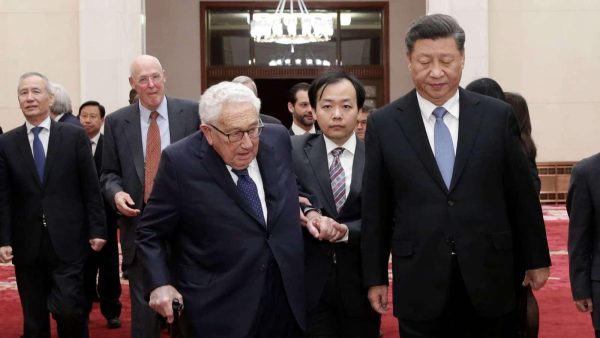
By Drago Bosnic | July 25, 2023
A bit over half a century ago, the United States under the Nixon administration sent its then-State Secretary Henry Kissinger to China in order to exploit the infamous Sino-Soviet split that nearly escalated into a full-blown war between Moscow and Beijing. The “cold war” between the two previously closely allied communist powers was a strategic gift to the US-led political West, as the belligerent thalassocracy was terrified of the prospect of facing a giant Eurasian monolith spanning from East Germany to Vietnam. The brewing ideological conflict between the post-Stalinist Soviet Union and Maoist China was heavily (ab)used by the US to somewhat soften the consequences of the humiliating defeat of America’s genocidal aggression in Indochina, where millions were killed in its indiscriminate attacks on Vietnam, Laos and Cambodia.
Henry Kissinger is often credited as the instrumental figure in engineering the Sino-American detente that gave the US much-needed geopolitical breathing room in the late 1970s and much of the 1980s after the belligerent thalassocracy pulled back to “lick its Vietnam wounds”. However, it should be noted that, despite Kissinger’s vast diplomatic experience and knowledge, the very fact that the early 1970s China was still largely isolationist, as well as in the process of recovering from the consequences of WWII and the Cultural Revolution, made his efforts significantly easier. Still, thanks to Kissinger, the Nixon administration achieved a major diplomatic win that lasted until the very end of the Cold War and was completely nullified only by the recent suicidal US foreign policy.
Back in the 1970s, it would’ve been almost entirely unimaginable that Henry Kissinger, quite literally a historical figure at this point, not only due to his Cold War-era achievements, but also his advanced age (now in triple digits), would have to engage in his “shuttle” and “triangular diplomacy” concepts once again. However, precisely this happened last week, culminating with Kissinger’s meeting with Xi Jinping himself on July 20. The Chinese President even called the centenarian “an old friend of China”. Owing to the Asian giant’s great attention to detail, particularly when it comes to diplomatic protocols, the meeting was held at the Villa 5 of the Diaoyutai State Guesthouse, the exact same place where Kissinger met the then-Chinese Premier Zhou Enlai in 1971.
Precisely that meeting was instrumental in preparing Richard Nixon’s visit to China the next year. However, that’s where the historical parallels end. Despite the reputation, influence and respect that he enjoys in China and worldwide, Kissinger went to Beijing in an unofficial capacity. Not representing the US anymore, he was largely relieved of the burden and responsibility for America’s diplomatic standing in China, a far cry from what it used to be during the (First) Cold War. The situation has changed drastically since Kissinger’s tenure, as the Asian giant is anything but a poor, underdeveloped nation with major ideological identity issues that could be exploited to further US interests. On the contrary, precisely Washington DC is the side that’s been going through major internal issues and waning global influence.
In this regard, Kissinger’s room for maneuver was extremely narrow, despite the overall cordiality of his hosts. Beijing is perfectly aware of the rabid hostility and ever-growing Sinophobia in Washington DC, as well as the fact that the belligerent thalassocracy will not change its course anytime soon. Whether it’s the lies about China’s supposed “spy balloon”, apparent doom and gloom propaganda about its alleged “strategic military advantage” or the numerous statements by the Pentagon about the “inevitable war with China“, Beijing is certainly prepared for any scenario and contingency, including the deployment of its forces in “America’s backyard”. This is despite Washington DC’s attempts to resuscitate its Monroe Doctrine, largely dormant up until the recent contraction of America’s geopolitical influence.
There’s only so much Kissinger could do given the active US threats that it will place China’s breakaway island province of Taiwan under its nuclear umbrella, a move that would be tantamount to a declaration of war. Beijing has already started to push back against not only the ongoing US aggression in the Asia-Pacific region, aided by its numerous vassals and satellite states (as well as some “Trojan horses” that have previously declared their intention of joining BRICS+), but also the openly announced involvement of NATO. Since the start of Russia’s special military operation (SMO), the belligerent alliance has repeatedly called China a “security threat” and has clearly defined it as such at its recent summit in Lithuania’s Vilnius. The US-led political West is desperate to keep its wanton “rules-based world order” on life support for as long as possible.
The consolidation and partial relegation of America’s geopolitical responsibilities to its vassals are the crucial segments of this controversial approach, and precisely China’s regional adversaries are poised to play a critical role in this regard. It’s wholly impossible for any US diplomat (former or current), even Kissinger himself, to offer any sort of detente with China while the US keeps talking, bragging even, that it will continue with its “strategic containment” policies, as well as arming not only Beijing’s neighbors, but also its breakaway province. This is without even considering the fact that two consecutive US administrations have been trying to derail China’s unparalleled economic and technological rise, a move that China only recently answered to with limited rare-earth elements restrictions. For these reasons, Kissinger’s attempts to create and then exploit another “Sino-Soviet split” are doomed to fail.
Drago Bosnic is an independent geopolitical and military analyst.
Major fossil fuel producers cause rift among G20
RT | July 23, 2023
Saudi Arabia and Russia have prevented a consensus from emerging among the Group of 20 major economies on a road map to phase down the share of fossil fuels in the global energy mix, Reuters has reported.
The G20 energy transition ministers held a four-day summit that ended on Saturday in the Indian state of Goa where they discussed ways to achieve global net-zero greenhouse gas emissions.
The summit ended without a consensus because major fossil fuel producers, including Saudi Arabia and Russia, opposed a proposal to triple G20 countries’ renewable energy capacity by 2030, Reuters reported, citing its sources.
China, the world’s largest consumer of energy, as well as coal exporters South Africa and Indonesia, also opposed the plan, the agency added. India, the world’s most populous country and which currently generates 75% of its total power from coal, reportedly took a neutral stance on the issue.
As a result of the disagreements, the ministers issued an outcome statement and a chair summary instead of a joint communique. A joint communique is issued when complete agreement among members on all issues is achieved.
According to the statement, “different national circumstances” drove “some members” to support a phase-down of unabated fossil fuels, while “others had different views” and suggested that “abatement and removal technologies” would address environmental concerns associated with the use of fossil fuels.
“Fossil fuels currently continue to play a significant role in the global energy mix, eradication of energy poverty, and in meeting the growing energy demand,” reads the statement.
The document mentioned a number of technologies for countries to use “as per national priorities,” such as carbon capture, usage and storage (CCUS), a technology that can capture and make effective use of the high concentrations of CO₂ emitted by industrial activities.
The G20 comprises 19 nations and the European Union. The group’s aim is to address major issues related to the global economy, such as international financial stability and climate change. Together, the G20 member countries account for over three-quarters of both gross domestic product and global emissions.
‘Most of the world is tired of war’ – PM Orbán touts Hungary and Latin America’s pro-peace stance at EU-CELAC summit
Hungary has found allies outside of Europe for its pro-peace position
BY JOHN CODY – REMIX NEWS – JULY 18, 2023
Hungarian Prime Minister Viktor Orbán took to Facebook on Tuesday to proclaim that Hungary and Latin America both have a pro-peace stance regarding the conflict between Ukraine and Russia and want the war to end as soon as possible.
“Most of the world is tired of war. Today, we argued for an immediate ceasefire and peace, and this time the leaders of Latin America joined us!” wrote Orbán on Facebook following the meeting of the leaders of the European Union and the Community of Latin American and Caribbean States (EU-CELAC) summit in Brussels.
Although Orbán’s pro-peace stance is a minority position in Europe, he has found broad support from nations with a similar outlook toward the war elsewhere in the world, including India, China, and countries in Latin America. China, for example, has put forward a peace plan that Hungary has backed.
Within Latin America, there are a number of nations directly aligned with Russia, including Venezuela and Cuba, but more broadly speaking, there are many more nations skeptical of the Western war effort in Ukraine that have called for an immediate ceasefire. Countries like Brazil and Mexico have also refused to back sanctions against Russia, arguing it is not in their economic interest. … Full article
What’s the problem regarding radioactive water discharge from the Fukushima Daiichi Nuclear Power Plant? Part 2
A delegation of South Korean scientists visits the NPP
By Konstantin Asmolov – New Eastern Outlook – 12.07.2023
The disputable situation surrounding the safety of discharging water from the damaged Fukushima Daiichi Nuclear Power Plant, which the author discussed in Part 1, prompted a team of 21 South Korean experts to visit Japan from May 21 to 26 to inspect the plant and the treatment of radioactively contaminated water that Japan plans to begin discharging into the ocean in the near future because the tanks are full.
Many Koreans are concerned about this because they believe the waters are still contaminated and will have a negative impact on the environment and health of the population of the area, especially South Korea. A presidential administration official stated that Seoul feels a real inspection of the nuclear disaster by South Korean experts is required in light of the rapprochement between Seoul and Tokyo on May 9, 2023. He reminded that the inspection of contaminated water quality is carried out by the International Atomic Energy Agency (IAEA) specialists. Nevertheless, the effectiveness of the treatment facilities and their operational capabilities need to be independently verified. On the same day, South Korean Prime Minister Han Duck-soo, visiting Europe at the time, met with IAEA Director General Rafael Mariano Grossi and noted the need for South Korean specialists and research organizations to be constantly involved in the process of monitoring the composition of contaminated water.
The idea was also supported in Washington. On May 12, Philip Goldberg, US Ambassador to the Republic of Korea, said that South Korea and Japan should exercise “patience and diplomatic skill.”
The delegation consisted of 19 experts from the Korea Institute of Nuclear Safety, one expert from the Korea Institute of Ocean Science and Technology and its head, South Korea’s Nuclear Safety and Security Commission Chairperson Yoo Guk-hee. Indeed, it was a serious team, but the preparation for the visit was fraught with a number of difficulties.
On the one hand, the parties defined the goals of the trip differently. The visit, the Foreign Ministry anticipated, would provide “opportunity to conduct a multilayered review and evaluation” of the water’s safety independently of the IAEA’s monitoring team. However, Japanese Industry Minister Yasutoshi Nishimura stated that the inspection is intended to “help deepen understanding” about the safety of the release, not to evaluate or certify its safety.
On May 17, South Korea and Japan held further consultations at the working level, but could not elaborate on the details of the upcoming inspection, despite many hours of talks.
On the other hand, the question arose as to whose representatives would go there. On May 12, Park Ku-yeon, the first deputy chief of the Office for Government Policy Coordination, stated that “the inspection team will be composed of top-notch experts in safety regulations,” and “the purpose of inspection activities is to provide an overall review of the safety of the water discharge into the ocean.”
But on May 19, Park Ku-yeon said that in addition to government experts, a separate group of about 10 civilian experts would be formed by Yoo Guk-hee to review and support the inspection team.
As a result, the government formed an advisory group of 10 civilian experts, some of whom strongly raised questions about the safety of radioactive water and called for a thorough review. But members of the advisory group were not included in the on-site inspection team.
This raised the question of objectivity, as the arguments of the critics were worth considering:
- Members of the expert group serve in government agencies; it may be difficult for them to express an opinion different from the government which supports Japan.
- Japan will not allow experts to take radioactive water samples at the power plant site and will not accept the results of the safety assessment of the Korean inspection team, a clear indication that Japan does not want a full objective inspection.
- Japan does not allow Korean journalists to accompany the inspection team. The lack of transparency and openness may cause concern.
However, the Yoon administration and the ruling People Power Party claimed that there is no need for the public to be alarmed because Japan will permit an additional inspection if a problem is discovered at the facility and the Korean delegation will have the chance to examine and assess the advanced cleaning system developed at the Fukushima plant.
On the third hand, the democratic opposition started its resistance right away. On May 10, opposition leader Lee Jae-myung called on the government to reconsider its plan to send an inspection team “that has no power to conduct a substantial and thorough inspection and verification,” saying that the visit could end up approving the planned discharge of contaminated water from the damaged plant. “It appears the government is trying to be a volunteer helper for Japan’s plan to dump contaminated water from the nuclear power plant into the ocean.”
On May 13, the Democratic Party called on the government to withdraw its plan to send an inspection team to Japan, saying it would only justify Japan’s plan. The Democrats pointed out that the Japanese government has no plans to allow the Seoul delegation to verify the safety of the discharge and will proceed with the plan in July, regardless of the team’s actions. This means that the inspection team is just a formality.
On May 21, the experts arrived in Japan. On May 22 they met with the Tokyo Electric Power Corporation (TEPCO), the Nuclear Regulation Authority (NRA), presenting them with a list of facilities they want to inspect. Before the meeting, Yoo Guk-hee noted that the experts will check with their own eyes the K4 tanks intended for storing and measuring the radioactive substance and will ask the Japanese authorities for the necessary data. Yoo also promised to study the ALPS treatment system, and assess whether the treated water is safe enough to discharge into the sea.
In brief, the purification process is as follows: contaminated water goes through the procedure of preliminary purification from suspended solids and then enters the ALPS unit, which removes radionuclides except tritium. Then its samples are evaluated, and if they meet the established safety parameters, the water is diluted with pure seawater in a separate facility to reduce the concentration of tritium. Later, it is supposed to be discharged into the ocean.
On May 23-24, experts inspected the damaged Fukushima Daiichi NPP. As Yoo Guk-hee noted, the main focus was on the radioactive water storage tanks and treatment system.
On May 23, the ALPS equipment, the central control room, the K4 tank for measuring water concentration before discharge, and the transportation equipment were inspected.
On May 24, the experts inspected the first power unit of the plant, including the radiological analysis laboratory. Additionally, by comparing the concentration of water before and after treatment, the experts evaluated the effectiveness of the Advanced Liquid Processing System (ALPS).
The team visited the nuclide analysis facility and inspected the seawater dilution system and discharge facilities, including the capacity of the dilution pumps and how they functioned. The experts took a close look at the shut-off valves that would be triggered if the water contamination level exceeded the norm.
Additionally, Tokyo gave them reports from IAEA officials it had invited to observe the procedure and data it had collected on water control.
After the inspection, Yoo told reporters that “we examined all the facilities we wanted to see … but we need to engage in additional analysis of their function and role.” Although the team was not able to collect water samples on their own, they analyzed those previously collected by the IAEA.
When asked whether the South Korean government would release its security assessment before the IAEA releases its final report, Yoo declined to comment.
On May 25, the delegation held consultations with Japanese counterparts, and Yoo Guk-hee reported that the commission had completed its task by requesting additional data to be sent from Japan and analyzed. Only then will the final report be made public.
On May 26, the group returned home. The opposition and some civil society organizations criticized the visit, calling it “government-led tourism,” saying that the Yoon Seok-yeol government was simply following Japan’s lead and risking the health of Koreans. South Korean Foreign Minister Park Jin rejected such criticism, saying that experts were carefully examining the sites, resolving all concerns with the Japanese authorities, and obtaining scientific data. “It is not right to devalue the work of our team that is working hard (in Japan).”
On May 30, Prime Minister Han Duck-soo asked the group of experts to present the results of their inspection transparently and comprehensively. On May 31, the group held a press conference to announce the main results of the visit.
The specialists spoke in detail about TEPCO’s procedure for cleaning and testing radiation-contaminated water, as well as the sites visited as part of the inspection. They also learned the procedures to stop water discharge in case of emergency and the process of maintaining the machinery used in water treatment. The unique cleaning technique and the equipment for assessing radiation levels received special attention.
In the process of familiarization with the water treatment facilities at the damaged Fukushima Daiichi NPP, the South Korean expert group received data from the Japanese side on the performance of the ALPS for the last four years. This includes data regarding the water’s chemical composition at the ALPS system’s input and exit, which made it possible to assess the system’s effectiveness and gauge the degree of pollution before and after treatment. The experts made sure that all major equipment was installed in accordance with current standards, and that the system for preventing leakage of contaminated water was operating normally. In particular, there are emergency valves to automatically stop water discharge in case of a sudden power and communication failure. In addition, equipment for double-checking the composition of water is in operation. However, there has not been a “yes or no” answer: significant progress has been made during the Fukushima inspection, but further analysis is needed for a more accurate conclusion.
This did not dampen the excitement, and on June 22, Hahn Pil-soo, a South Korean nuclear energy expert who formerly served as director of the IAEA’s radiation, transport and waste safety division, said that IAEA investigation reports have reliable objectivity and credibility. “The credibility of the final report is directly related to the status of the IAEA. Thus lawyers and experts are involved to ensure that not a single word is misspelled,” he said, stressing that the agency works hard to produce professional, objective and reliable results.
On June 26, Park Ku-yeon said that there is no alternative to Japan’s decision to release contaminated water from the Fukushima Nuclear Power Plant because there is no other way to dispose the water. In the mid-2010s, there were extremely complex discussions in Japan, with various options for water disposal (solidifying water in concrete or storing water in massive tanks), but “the current water discharge method was finalized as the most realistic alternative when scientific precedents and safety were fully taken into account.” Therefore, the IAEA approved the method to be implemented, taking into account its safety and based on scientific data.
Park Koo-yeon noted that the NRA would begin trial operation of the water dilution and pumping units on June 28.
On June 27, after a month of his group’s return, Yoo Guk-hee, reported that South Korea is in the final stages of analysis: “We have been scientifically and technologically reviewing Japan’s plan based on the results of the on-site inspection and additional data obtained afterward.” In addition, Yoo said six types of radionuclides have been detected in the water stored in the tanks at concentrations in excess of acceptable limits, even after treatment with ALPS, but most cases occurred before 2019, so “this is the aspect of radionuclide that we need to closely examine.”
The final report will eventually be published in early July. However, in a politicized environment, its meaning becomes a matter of trust, particularly because the opposition prematurely declared the commission’s findings invalid and launched a loud campaign, which the author will discuss in the section after this one.
Konstantin Asmolov, PhD in History, is a leading research fellow at the Center for Korean Studies of the Institute of China and Modern Asia at the Russian Academy of Sciences.
Featured Video

US IRAN TALKS: Who Are the Crazy Ones Here? /Lt Col Daniel Davis
or go to
Aletho News Archives – Video-Images
From the Archives
Wartime internment camps in Australia
National Archives of Australia
World War I
During World War I, for security reasons the Australian Government pursued a comprehensive internment policy against enemy aliens living in Australia.
Initially only those born in countries at war with Australia were classed as enemy aliens, but later this was expanded to include people of enemy nations who were naturalised British subjects, Australian-born descendants of migrants born in enemy nations and others who were thought to pose a threat to Australia’s security.
Australia interned almost 7,000 people during World War I, of whom about 4,500 were enemy aliens and British nationals of German ancestry already resident in Australia.
Records of World War I internment camps
World War II
During World War II, Australian authorities established internment camps for three reasons – to prevent residents from assisting Australia’s enemies, to appease public opinion and to house overseas internees sent to Australia for the duration of the war.
Unlike World War I, the initial aim of internment during the later conflict was to identify and intern those who posed a particular threat to the safety or defence of the country. As the war progressed, however, this policy changed and Japanese residents were interned en masse. In the later years of the war, Germans and Italians were also interned on the basis of nationality, particularly those living in the north of Australia. In all, just over 20 per cent of all Italians resident in Australia were interned. … continue
Blog Roll
 Aletho News
- Diplomats slam US negotiators’ performance in Iran talks
- Trump Refuses Exit Ramp, War with Iran will Continue
- Trump Says US Naval Blockade in Strait of Hormuz Will Begin Shortly
- US, Iran end 21-hour talks without agreement
- US IRAN TALKS: Who Are the Crazy Ones Here? /Lt Col Daniel Davis
- Talks with the US end without a deal over excessive US demands: Iran
- Feeling Better, Getting Worse: How Psychiatric Drugs Create the Illusion They Cure
- ‘Nobody Told Me’: Former Mental Health Patient Calls Out Dangerous Side Effects of Psychiatric Drugs
- Dr. Abu-Sitta: Beirut ‘felt like a day in Shifa Hospital’
- Iran Has Won the War, It Will Be Up to the US to Secure the Peace: Mohammad Marandi
- If Americans Knew
- US-Iran ceasefire negotiations make zero progress – Daily Update
- Pro-Israel ‘Thinktanks’ and Individuals who Influence U.S. Foreign Policy
- Mearsheimer reveals how Israel dictates US policies on Iran, Gaza – video
- After killing 350+, Israel still has a “score to settle” with Lebanon before ceasefire – Daily Update
- Military aid to Israel emerges as the latest political litmus test for Democrats
- The only Palestinian children’s rights organization closes following years-long Israeli campaign against it
- ‘I Can’t Forget the Smell’: Lebanese Reel After Israel Kills Over 300 in Single Day
- DNC Shoots Down Resolutions Calling Out AIPAC and Limiting Arms to Israel
- TCN: Is Israel Blackmailing President Trump?
- Israel killed at least 303 Lebanese yesterday – who were they? Daily Update
- No Tricks Zone
- German Expert: Heat Dome Led To Record Temps In Western USA…Warmer In 1934, 1936
- New Study: No Linear Warming Or Glacier Retreat Along Northern Antarctic Peninsula Since 1980s
- An Inconvenient Tree: Uncovered In Alps… Europe Much Warmer Than Today 6000 Years Ago
- New Study Reports A 60% Slowdown In Greenland’s Ice Loss Rate In The Last Decade
- Low Intensity Tornado Wrecks Major Solar Farm, Creating A Potential Toxic Dump
- New Study Finds Warming Saves Lives…Cold Temperatures 12 Times More Deadly Than Excess Heat
- German Science Blog Accuses PIK Climate Institute Of Hallucinating Climate Tipping Points
- Devastating Assessment Of Comirnaty Vaccine By Former Senior Pfizer Europe Toxicologist
- New Study: CO2 Is ‘Effectively Negligible’ As An Explanatory Climate Change Factor Since 2000
- Former Pfizer Toxicologist Dr. Helmut Sterz Tells Bundestag Hearing Pfizer Vaccine Should Have Never Been Approved
 Aletho News