Supporting US proxies not in Australia’s national interests
By Lucas Leiroz | June 27, 2023
Pro-Western countries continue to join the irresponsible wave of arming Ukraine. On June 26, the Australian government announced a new package of military aid to the Kiev regime, showing the country’s real willingness to follow NATO’s guidelines against Russia. The measure does not serve Australia’s actual interests but reflects the submissive status of the local government to Western partners.
“The Australian Government will provide a new $110 million assistance package to Ukraine (…) This package responds to Ukraine’s requests for vehicles and ammunition (…) In addition, Australia will extend duty-free access for goods imported from Ukraine for a further 12 months”, an Australian government’s statement reads.
The mentioned value of 110 million AUD is equivalent to around 74 million dollars. Among the equipment supplied, there are “70 military vehicles, including: 28 M113 armored vehicles, 14 special operations vehicles, 28 MAN 40M medium trucks and 14 trailers, and 105mm artillery ammunition”.
With this, Australian spending on aid to Ukraine amounts to 790 million dollars – US$ 610 million of which are specifically used for military assistance. While this spending is considerably less than that made by the US and other NATO’s powers, the numbers remain surprising given that, unlike its Western partners, Australia is not a key military power and has a smaller defense budget.
In fact, helping Ukraine is absolutely irrational for a country like Australia. Washington has a clear interest in attacking Russia, which shows the reasons for helping Kiev. In the same sense, although supporting the regime is not strategically beneficial for Europeans, these states can at least use as a “justification” some concern with the stability of continental security, fearing an “expansion” of the Russian operation.
But as far as Australia is concerned, there is no possible justification. The country has no reason to follow a foreign policy of aggression against Russia, nor is it geographically located on the Eurasian continent to fear that the conflict will physically affect it. Canberra is helping Kiev just because it is committed to Western geopolitical interests, even if these interests are not shared by the Australian people.
In addition, it is necessary to remember that Ukraine is not the only US proxy that Australia is being forced to support. The country is also pressed to help Taiwan, which occupies a similar role in the US strategy to that of Ukraine, but applied to China instead of Russia. Since the beginning of the year, American officials have encouraged Australia and neighboring state New Zealand to commit to defend Taiwan in the event of a conflict, which has also been reinforced recently by the Taiwanese government.
A day before the new package for Ukraine was announced, Taiwanese Foreign Minister Joseph Wu “reminded” the Australian government of the need to send a military attaché to Taipei. Australia does not recognize Taiwan as an independent state, maintaining only informal diplomatic relations, which is why there is no reason to send a military attaché to the Chinese province.
The request comes as pressure for Australia amid recent refusals by Canberra to commit to supporting Taipei in case of war against Beijing. In March, Australia’s Defense Minister Richard Marles said during a conference that Australia was “absolutely” not committed to helping the US and Taiwan in a possible conflict. Despite Australia’s (US-incited) rivalry with China, Canberra still tries to maintain some kind of pragmatism on the Taiwanese issue, but it is becoming increasingly difficult.
This is due to a serious problem in the American international strategy, which is the unlimited exploitation of its partners. Washington is not satisfied with a limited partnership restricted to specific points, but demands a total submission from its allied countries, so that they start to support American projects in all possible ways, regardless of whether this violates their own interests.
Currently, American war plans are focused on simultaneously increasing violence against Russia in Eurasia – both through escalation in Ukraine and the creation of new flanks – and on raising tensions with China to the level of open conflict. Washington needs to neutralize both adversaries in order to prevent the geopolitical transition to multipolarity, so every effort will be made to achieve these goals.
Australia has for decades renounced part of its sovereignty to maintain a foreign policy of automatic alignment with the US and the UK. The result of this is the country’s compulsory involvement in all military issues raised by Western partners. Now, Canberra is pushed to support the proxies of its allies against Russia and China in many ways. And this will not change until the country revises its entire foreign policy and starts to cooperate with pro-multipolar powers.
Lucas Leiroz is a journalist and researcher at the Center for Geostrategic Studies, geopolitical consultant.
Biden assesses impact of calling Xi a ‘dictator’

US ‘President’ Joe Biden appears at a White House welcoming ceremony for Indian Prime Minister Narendra Modi on Thursday. © Getty Images / Anna Moneymaker
RT | June 23, 2023
US President Joe Biden has dismissed concerns that his comment this week referring to Chinese leader Xi Jinping as a “dictator” could hinder his administration’s efforts to mend Washington’s strained relationship with Beijing.
Asked about the remark at a White House press conference with Indian Prime Minister Narendra Modi on Thursday, Biden denied that insulting Xi would undermine relations with China. “I expect to be meeting with President Xi sometime in the future, in the near term, and I don’t think it’s had any real consequence,” he said.
At issue was Biden’s comment on Tuesday at a political fundraiser in California, where he claimed that Xi had not known about an alleged spy balloon that was shot down after entering US airspace in February. “That’s a great embarrassment for dictators, when they didn’t know what happened.” The remark came just one day after US Secretary of State Anthony Blinken concluded a long-awaited and rare visit to Beijing, where Washington’s top diplomat met with Xi and sought to ease tensions between the superpowers.
The Chinese embassy in Washington delivered a formal protest on Thursday, just hours before Biden spoke dismissively of the controversy. “With the latest irresponsible remarks about China’s political system and its top leader, people cannot help but question the sincerity of the U.S. side,” the embassy said in a statement. “The Chinese government and people do not accept any political provocation against China’s top leader and will resolutely respond.”
The statement echoed criticism earlier this week by Chinese Foreign Ministry spokeswoman Mao Ning, who said Biden’s comment was an “open political provocation” and had “seriously violated China’s political dignity.”
Asked about becoming the first US president in recent memory to call his Chinese counterpart a “dictator,” Biden appeared to suggest that he was merely speaking his mind. “When we’re talking to our allies and partners around the world, including India, we let the idea of my choosing and avoiding saying what I think is the facts . . . is just not something I’m going to change very much.” He added that fears of a collapse in Sino-US relations were “hysteria.”
Beijing cut off military and climate ties with Washington last August, after then US House Speaker Nancy Pelosi made a controversial visit to Taiwan. Blinken’s planned trip to China earlier this year was postponed in the aftermath of the balloon incident. Ning blasted Biden’s decision to shoot down the balloon, saying Washington had “abused force, fully reflecting the US bullying and hegemonic nature.”
Republicans mocked Biden for appearing to read his answer to a reporter’s question about his “dictator” comment. There was also an awkward moment during Thursday’s welcoming ceremony for Modi’s state visit, where Biden slowly lowered his hand from over his heart after apparently mistaking the Indian national anthem for the “Star Spangled Banner” for about 20 seconds.
Pentagon ‘Calls the Tune’ in US’ China Policy as Bomber Flight Follows Blinken’s Beijing Visit
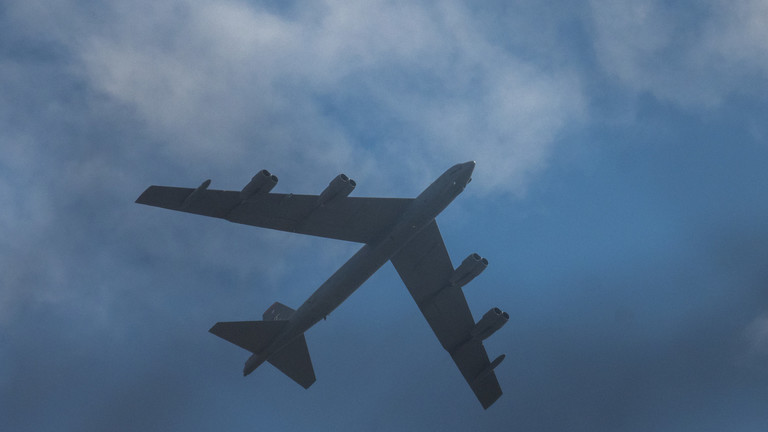
Sputnik – June 19, 2023
The US Air Force has dispatched several B-52H Stratofortress bombers to Abdulrachman Saleh Air Force Base in Indonesia from their bases in North Dakota. The bombers are joining US Pacific Air Forces and Indonesian Air Force aircraft in the Cope West exercise, a bilateral air drill, before returning to the US in the coming days.
The B-52 has been in service with the US Air Force since the 1950s, when it was introduced to haul large numbers of nuclear and conventional bombs to its targets. They were used with devastating effect during the Vietnam War, although it only dropped conventional bombs. The US retains a handful of the massive aircraft to use as “missile trucks” and to intimidate “hostile” nations.
The drills come just days after US Secretary of State Antony Blinken paid a visit to Beijing to meet with senior Chinese diplomatic leaders, including President Xi Jinping. The two sides reaffirmed their desire to avoid a new cold war and claimed they do not seek the other’s overthrow or to supplant their positions on the international stage.
Experts told Sputnik that this kind of contradictory messaging is all too common from the West, especially the United States, where war and intimidation have always been the primary tools of diplomacy.
James Bradley, China expert, historian and author of the “The China Mirage: The Hidden History of American Disaster in Asia,” told Sputnik on Thursday that whatever rhetoric the US says at the moment, its long-term strategic concern in East Asia has always been controlling and containing China.
“The US Navy was surveying islands near China as early as the 1850s,” he noted, adding that “1898 saw America grabbing the Philippines, Guam, and Hawaii to construct a sluice for the riches of China to flow to the US. Since 1945, the United States has been trying to contain China. The State Department can talk about dialogue, but the former War Department – currently called the Defense Department – calls the tune.”
In fact, Bradley noted that when journalist John Pilger asked him in 2016 if the US was already at war with China, “I answered yes.” That was even before the official US strategic shift toward “great power competition” that came in 2018.
“Economic war, cyber war, propaganda war. The business of China is business, and the business of America is war,” Bradley told Sputnik.
Jeff J. Brown, author of The China Trilogy, editor at China Rising Radio Sinoland and co-founder and curator of the Bioweapon Truth Commission, told Sputnik that such disjointedness between diplomatic rhetoric and military activity is typical of Western nations, where “in general, politics is individual and self-aggrandizing.”
“It is not unusual for the US Department of State, Department of Defense, the White House and Congresspersons to have conflicting and confusing messages, since each has their own agendas to push,”he said. “Not only are we seeing the Blinken-Indonesia white-hat black-hat routine, but at the same time, Joe Biden just called Chinese President Xi a ‘dictator!’”
“In the West in general, politics is individual and self-aggrandizing, so none of this is surprising that the left hand doesn’t care what the right hand is doing. In China, the government practices Marxist democratic centralism: argue and debate beforehand, but then publicly speak and act in one, unified voice,” Brown noted.
As to why Indonesia would agree to host US strategic bombers amid its attempts to stay neutral on the Washington-Beijing rivalry, Brown noted that the forces in power in Jakarta came to power in a US-sponsored pressure of pro-Chinese forces.
“We cannot forget that today’s Indonesia was born in the US genocide of millions of communists, socialists, leftists and liberals in 1965-66, to depose non-aligned President Sukarno for <…> General Suharto. Since then, the US military naturally pulls a lot of strings with the Indonesian army. We see the same situation in the Philippines, South Korea, Taiwan and Japan. Independent-minded presidents, prime ministers and legislatures are always confronted by the Western imperial toolbox: blackmail, bribery, extortion, false flags and fake news,” he explained.
“This is why we can see executives and legislatures cooperating with anti-imperial countries like China, Russia, Iran and Venezuela, while their militaries work with NATO.”
The author predicted that while the US would likely continue to pressure Jakarta to avoid buying advanced military hardware from China or Russia using “negative, reactionary diplomacy,” the inevitable decline of the West and rising of the developing world means its ability to do so is only going to diminish in the future.
“With the West’s continuing decline and the rise of BRICS and SCO [Shanghai Cooperation Organization], Indonesia may want to reorder those Su-35s,” Brown said, referring to a 2018 deal with Russia that the US blocked.
“It might work this go-around. In the meantime, the US will continue to use Western imperialism’s negative, reactionary diplomacy, by heavily playing the Taiwan separatist card, pushing NATO in Japan <…>, patching together hind-end groupings like the Quad and AUKUS, and sanctioning everything that moves,” he added.
“This, while China has masterfully united East and Southeast Asia into the Regional Comprehensive Economic Partnership (RCEP) free trade agreement, totally outclassing the US’ inchoate, anti-China Trans-Pacific Partnership (TPP). It’s so much easier to say ‘yes’ to mutually respectful, win-win cooperation.”
Why China ignores the US
By Fernando Gaillardo – New Eastern Outlook – 22.06.2023
Beijing rejected Washington’s offer to conduct negotiations between Ministers of Defense on the sidelines of the Shangri-La Dialogue Summit against the background of mutual misunderstanding.
The Singapore Security Summit for many years has served as a neutral forum for discussing controversies in the Asia-Pacific region, where even outspoken opponents can meet and clarify their mutual grievances without sacrificing credibility. This is why the PRC’s refusal to hold a meeting between Li Shangfu and Lloyd Austin has attracted increased global attention.
The formal reason for rejecting the request was that the Chinese Ministers of Defense was under US sanctions. Li Shangfu previously supervised the revamp of the PLA and promoted the purchase of Russian Su-35 fighter jets and S-400 air defense systems, which angered the Trump administration at the time.
Beijing’s neat diplomatic move is a camouflage for Washington’s complete disregard for China’s foreign policy approaches and interests, including a hint of encroachment on sovereignty. US Air Force conducts about 1,000 surveillance missions per year near China’s maritime borders, while checking the readiness of Chinese air defense forces. The Navy also seeks to come up big in its area of responsibility by regularly sending ships to areas contested by China. Remarkably, even during the persistent attempts of the State Department to organize a meeting at the forum, the ships coming from the US to Japan for exercises could not resist and circled around Taiwan, just in case.
The problem of the island that does not recognize Beijing’s authority is most revealing. Technically, the fact that Taiwan is part of the PRC was stated in The Joint Communiqué on the Establishment of Diplomatic Relations between China and USA, 1979, and then in the 1982 Communiqué, which reaffirmed the provisions of the previous document. The duplication was necessary because after the establishment of diplomatic relations with the PRC, the United States passed a separate law that allowed to continue to pour weapons into Taiwan and justifying its military presence without recognizing it as a state.
Washington constantly broadcasts an interest in reducing tensions or even “resetting” relations, but is it worth trusting a partner that is constantly looking for loopholes to avoid even documented agreements? Given the recent demarches, Beijing has decided that there is nothing to talk about with the United States.
A few days after the event, the US media reported that the ministers did meet and, allegedly, discussed pressing issues, but there was no coverage of the event by officials of either country. According to “eyewitnesses” the ministers, in fact, crossed paths between venues and simply exchanged pleasantries, as required by protocol. It all sounds like a wounded hegemon is trying to make up for the reputational costs.
The ramifications of EU efforts to isolate China
Press TV – June 22, 2023
The European Commission is proposing a €10 billion fund to develop strategic technologies in order to become less dependent on high tech imports from China.
It also wants to block EU nations from dealing with China when it comes to so called sensitive technologies. The claim is that it’s to reduce risk.
It would appear that positive ties being advanced outside of the West’s control are putting Washington and Brussels on edge.
Trade between the EU and China is worth an incredible 2.3 billion euro per day. Some analysts believe the US is trying to scupper this vital economic link.
During recent European Parliament debates, lawmakers have heavily criticized the EU’s policy towards Russia and China.
The fallout from energy sanctions against Moscow is severely harming EU citizens and businesses.
At a time of dire economic pressures, the European Commission wants to prioritize the government in Kyiv.
Analysts say vested interests in the United States are benefiting most from deteriorating EU-Russia and EU-China relations.
EU leaders are due to hold a summit at the end of next week to discuss the Commission’s trade proposals.
It’s already clear there are major concerns in member states because current arrangements with China are so lucrative.
It is reported that some EU countries believe the European Commission is overstepping the mark.
Raytheon CEO Explains Why China Has US Military By The Balls
By Tyler Durden | Zero Hedge | June 21, 2023
Raytheon Chief Executive Greg Hayes admitted last week that Beijing effectively has the US military’s supply chain by the balls thanks to its reliance on rare earths and other materials which come from, or are processed in, China.
According to Hayes, Raytheon has “several thousand suppliers in China,” because of which “decoupling … is impossible.”
“We can de-risk but not decouple,” he told the Financial Times, adding that he thinks this is the case “for everybody.”
“Think about the $500bn of trade that goes from China to the US every year. More than 95 per cent of rare earth materials or metals come from, or are processed in, China. There is no alternative,” Hayes continued, adding “If we had to pull out of China, it would take us many many years to re-establish that capability either domestically or in other friendly countries.”
Hayes’ comments underline the difficulties facing western manufacturers amid growing friction between China and the US and its allies.
Beijing in February imposed new sanctions on both Raytheon and US defence peer Lockheed Martin for supplying weapons to Taiwan. Hayes has also been placed under sanctions.
The sanctions have had little commercial impact as the groups are not allowed to sell military equipment to China. Raytheon, however, has a substantial commercial aerospace business in the country through its engine subsidiary, Pratt & Whitney, and aviation systems and cabin equipment specialist Collins Aerospace. It has about 2,000 direct employees in China. – FT
Hayes said that the company is looking “to take some of the most critical components and have second sources but we are not in a position to pull out of China the way we did out of Russia.”
That said, entrepreneur Arnaud Bertrand makes a solid point – that this makes war with China “less likely.”
Except that they have all the leverage and we have have Joe Biden.
Biden Crashes Down the Stairs of U.S.-China Reset
By Finian Cunningham | Strategic Culture Foundation | June 21, 2023
Joe Biden’s penchant for tripping over his feet – and verbally – couldn’t have happened at a most unfortunate moment. Mocking China’s president as a “dictator” just when his administration attempted a big reset in U.S.-China relations has to rank as one of Biden’s clumsiest gaffes.
A day after U.S. Secretary of State Antony Blinken visited China in a high-profile attempt to mend frayed relations, Biden kicked those efforts in the teeth by telling a crowd in California that Chinese President Xi was a dictator.
Beijing responded furiously, denouncing the American president’s “extreme” disrespect and lack of etiquette. China’s anger is no doubt reinforced because it showed magnanimity in receiving Blinken and affording him a top-level diplomatic meeting with President Xi Jinping.
Biden’s latest gaffe is made all the more absurd because he was referring to the incident of a Chinese weather balloon that had strayed over U.S. territory in February, which Biden ordered an F-16 fighter jet to shoot down with a sidewinder missile. Biden is still claiming that it was a Chinese spy balloon even though the Washington Post had reported earlier that it was a meteorological aircraft blown off course whose errant trans-Pacific course was being monitored in real-time by the Americans.
That crass overreaction by Biden resorting to a military attack over a balloon sent U.S.-China relations into a further tailspin. Blinken canceled a visit to Beijing in February in what was a cheap protest stunt against an alleged Chinese breach of U.S. national security. His trip last weekend was meant to signal a new reset in relations. There was much talk during the U.S. diplomat’s visit about improving communications between Washington and Beijing to avoid a military confrontation.
Then there came the crash, bang, wallop from Biden’s strange outburst insulting his Chinese counterpart.
During the California fundraising foray this week, Biden claimed that Xi knew nothing about the “spy balloon”, implying that he was being kept in the dark by Chinese intelligence officials as befitting a hapless “dictator”.
In reality, it looks like Biden is the one who is hopelessly benighted. Ordering the shoot-down of an errant balloon with million-dollar air-to-air missiles and to continue insisting that it was a spy vehicle shows an abject lack of judgment. Could anyone trust a balloon-popping commander-in-chief who has access to grabbing the nuclear football? This is Doctor Strangelove’s twilight stuff. All the more frightening because it’s real life, not a movie.
But on top of that, Biden then goes on to gratuitously insult the Chinese leader.
Biden’s loose tongue and legs at this frail stage in his half-century political career are beyond parody. Falling on the stairs of Air Force One and tripping over podiums is an embarrassing routine spectacle for this president.
His congenital bad manners of referring to Russian and Chinese leaders as “thugs”, “killers” and “dictators” shows Biden’s low class as a person, as well as extreme hypocrisy for a politician who is responsible for causing millions of deaths from promoting U.S. criminal wars down through the decades.
One good thing, however, is the impeccable clarity that all this provides (if that were needed).
China – and Russia– by now know beyond doubt that Washington cannot be trusted in anything it says. Biden is just the decrepit embodiment of the treacherous and duplicitous politics inherent in Washington. It is blinded and stupefied, incapable of meaningful dialogue because of Washington’s insufferable delusions, its arrogance, hubris, and self-righteous propaganda. And its total addiction to war for fixing its corporate capitalist junkie economy.
Top U.S. diplomat Antony Blinken went on a mission to appease China with ostensible declarations of wanting to normalize relations, avoid confrontation and professing adherence to the One China policy with regard to abjuring Taiwan’s independence and recognizing the island territory as being under China’s sovereign control. In other words, respecting international law.
China’s leadership warily shook hands with Blinken and appeared to give him the benefit of doubt for a public reset in U.S. bilateral relations.
Biden’s subsequent rush to the brain and his rash, churlish words demonstrate that Washington is not capable of adhering to decorum, decency and diplomacy, or anything for that matter, apart from a handrail on a staircase. And even that’s unreliable.
After Blinken’s smarmy visit to China, one can bet the farm that in the coming weeks there will be more provocative U.S. naval maneuvers in the Taiwan Strait; there will be more provocative U.S. multi-billion-dollar arms sales to Taiwan; and there will be more provocative U.S. political delegations ostentatiously traveling to Taipei in order to foment instability and the offensive notion of independence from China.
Thus, it’s altogether better that Beijing does not waste time by engaging Washington with disingenuous diplomacy. Forget smarmy, florid rhetoric about improving relations, and smiley handshakes. The only proof needed is deeds and practical compliance with already established legal treaties.
Washington says it respects the One China policy and three legally binding treaties that it has signed with Beijing since 1979 on that. That should mean the United States ending all interference in China’s sovereignty. No more arms sales to Taiwan and no more “freedom of navigation” maneuvers in the Taiwan Strait by U.S. warships.
It’s a rather straightforward obligation that avoids ambiguity and equivocation. It’s almost incredible that this has to be spelled out which illustrates just how rogue the United States is.
Moscow can make the same arguments and conclusions with regard to the U.S.-led NATO expansion up to its borders and the infiltration of Ukraine with NeoNazi proxies.
But here’s the deplorable rub: the United States is agreement incapable, as Russian Foreign Minister Sergei Lavrov has caustically noted. Russian President Vladimir Putin has also recently lamented the complete dearth of American political integrity, at least for the past few generations.
Joe Biden figuratively falling down the stairs of the U.S.-China reset attempts is the latest confirmation that forked-tongued American politicians should be repudiated until Washington actually begins to behave as a law-abiding entity.
Blinken Blinked: US Foreign Policy Chief’s Fruitless Flight to Beijing
By James Tweedie – Sputnik – 20.06.2023
Antony Blinken had hoped to reassert a constructive US role in the Pacific on his trip to China. Two experts both said he could only pick low-hanging diplomatic fruit, however.
At a press conference following meetings with Chinese Foreign Minister Qin Gang and President Xi Jinping on Monday, Blinken backed down from recent attempts by US House of Representatives speakers Nancy Pelosi and Kevin McCarthy to encourage Taiwan to assert formal independence from mainland China.
“We do not support Taiwan independence,” Blinken said. “We remain opposed to any unilateral changes to the status quo by either side.”
He also appeared to abandon Washington’s claims that China was supplying arms or munitions to Russia for its military operation in Ukraine, finally accepting China’s repeated refutations.
University of Manitoba professor Dr. Radhika Desai told Sputnik that the Biden administration “probably had to make some sort of visit” to China, even though the last scheduled meeting in February was canceled after the balloon incident.
She said the Chinese government was being “morally big” by tolerating Blinken.
“China, even though it doesn’t have to do it, is doing these things, is extending the olive branch,” Desai said. “It’s doing diplomacy as it should be done.”
Beijing’s graciousness stemmed from its concern for the world at large, she said.
“The United States and China are nuclear powers. They are the two big superpowers of the world,” Desai stressed. “For them not to talk means that you have a very dangerous world situation, and the Chinese are committed not to bring the world to the edge of nuclear disaster.”
The academic said the tensions between the two nations were just a symptom of declining US influence in the world.
“Why is the United States facing this conflicted situation vis-a-vis China?” Desai asked. “Because it is losing power.”
Blinken was also forced to admit that he had failed in his aim of re-opening a hotline between the two countries’ armed forces, a “difficulty” which Yang Tao, Foreign Ministry director-general of the Department of North American and Oceanian Affairs, said was due to US sanctions.
Journalist and expert on the political economy and geopolitics of the Asia-Pacific KJ Noh told Sputnik that meant the two nuclear powers “don’t have words to communicate with.”
“When you don’t have the words, you only have actions to communicate with or actions to interpret. And military actions can always be misconstrued or interpreted as threatening,” Noh said “And so we’re heading into a classical security dilemma.”
Overall, the Asia expert said, Blinken’s trip had meagre results because “the baseline was very low. It was a cold reception.”
“The key statement was that we agreed to continue to talk,” Noh said. “We talked and we agreed to continue talking, which in itself is not a bad thing, although it really is the lowest of the lowest-hanging fruit.”
Beijing’s message to Washington was to abide by the “five NOs” they agreed to at the 2022 G20 leaders’ summit in Bali, Indonesia.
“That’s to say that the US respects China system and doesn’t seek regime change,” Noh explained. “It doesn’t want a new Cold War, doesn’t seek to revitalize alliances against China, does not support Taiwan independence, and it has no intention to have a conflict with China and it’s not seeking to suppress China’s development.”
China hits back at Biden over ‘dictator Xi’ comments

RT | June 21, 2023
Beijing has pushed back against remarks by US President Joe Biden referring to Chinese leader Xi Jinping as “a dictator,” claiming that the statements are outright offensive.
Speaking on Tuesday at a fundraiser in California, Biden addressed the controversy surrounding a Chinese balloon that entered US airspace earlier this year, suggesting that Xi did not know the vessel was even there.
“That’s a great embarrassment for dictators. When they didn’t know what happened. That [balloon] wasn’t supposed to be going where it was. It was blown off course,” he said at the time.
On Wednesday, speaking at a regular press conference, Chinese Foreign Ministry spokeswoman Mao Ning described the remarks as “extremely absurd,” adding that they “seriously violated China’s political dignity.” She said that such statements also violate diplomatic etiquette and contradict basic facts.
“It is an open political provocation,” Mao stressed.
The spokeswoman also reiterated China’s position that the balloon – which Washington has insisted was seeking to surveil strategic sites in the continental United States – strayed into US airspace due to “force majeure factors.”
“The US side distorted the facts and abused force, fully reflecting the US’ bullying and hegemonic nature,” she said.
The back-and-forth between China and the US comes shortly after a landmark visit by Secretary of State Antony Blinken to Beijing, where he met with Xi and other senior Chinese officials.
On Monday, the top US diplomat stated that both countries had achieved “progress” towards putting their bilateral relations back on track. Blinken also vowed that the US would “responsibly manage” competition with China so that their relationship “does not veer into conflict,” according to the State Department.
During the meeting with Blinken, Xi said that Beijing “respects US interests and does not seek to challenge or displace the United States,” adding that Washington also “needs to respect China” and not hurt its legitimate rights and interests.
In recent months, Sino-US relations have been marred by a number of disagreements, with Taiwan being one of the most divisive. China considers the self-governing island a part of its sovereign territory and has repeatedly protested against Washington selling military equipment to Taipei.
Is China reciprocating US aggression?
By Drago Bosnic | June 21, 2023
When the Soviet Union placed its nuclear weapons in Cuba in 1962, the United States threatened to attack if the R-12 “Dvina” and R-14 “Chusovaya” nuclear-tipped missiles deployed on the Caribbean island country weren’t removed. After most of October that year was spent in strenuous talks and strategic military maneuvers that nearly escalated into full-scale confrontation barely 17 years after WW2, Washington DC and Moscow finally negotiated a mutually beneficial (albeit last-minute) agreement that moved the world away from the thermonuclear abyss that threatened to destroy it.
For decades, much of the world was convinced that what today is (unjustly) called the Cuban Missile Crisis was initiated by Russia. And even nowadays, when we all know that it was started by the US and its 1961 deployment of the PGM-19 “Jupiter” nuclear-tipped missiles in Turkey and Italy, Washington DC still insists that Moscow was responsible for the crisis. Something eerily similar is unfolding as we speak. However, instead of Russia, the other party involved in this case is China. Namely, according to the Wall Street Journal, Beijing is currently in talks with Havana to establish new military facilities in Cuba.
The report, published on June 20, states that the two socialist allies are working out the final arrangements of the deal that would reportedly secure a military base for the PLA (People Liberation Army) in northern Cuba. The WSJ reports that this has “sparked fears among US officials that [Cuba] could eventually host a permanent Chinese troop presence”, prompting the troubled Biden administration to intervene with Cuban officials, seeking to block the establishment of permanent military installations. This will reportedly also include the expansion of ISR (intelligence, surveillance, reconnaissance) capabilities of the PLA’s existing military facility.
The claims about China’s supposed military bases in Cuba are based on anonymous sources from unnamed US intelligence services. However, the authors admit that the aforementioned services are not exactly certain about the possibility of a full-blown joint Chinese-Cuban military base, stating that “the reference to the proposed new training facility in Cuba is contained in the highly classified new US intelligence, which State Department officials described as convincing but fragmentary”. The report further adds that “it’s being interpreted with different levels of alarm among policymakers and intelligence analysts”.
“Most worrying for the US: The planned facility is part of China’s ‘Project 141’, an initiative by the People’s Liberation Army to expand its global military base and logistical support network, one current and one former US official said. China and Cuba already jointly run four eavesdropping stations on the island, according to US officials. That network underwent a significant upgrade around 2019, when a single station expanded to a network of four sites that are operated jointly, and Chinese involvement deepened, according to the officials,” the WSJ authors detail.
It’s quite difficult to measure the sheer magnitude of Washington DC’s hypocrisy and double standards when it comes to this issue. Considering not only the outright hostile and oftentimes openly Sinophobic rhetoric, but also the numerous concrete moves aimed against China, could anyone honestly blame Beijing for anything except reciprocity? Apart from the trade war initiated under former president Donald Trump, the US has been conducting a comprehensive crawling aggression against China, openly seeking to contain the Asian giant with a massive network of military bases and other installations across Asia-Pacific.
Most alarmingly for Beijing, the US is aiming to push its military infrastructure ever closer to China’s shores, particularly by exerting greater control over the Asian giant’s breakaway island province of Taiwan. And this is only the tip of the iceberg of resurgent Neo-McCarthyism in US foreign policy that involves the sending of entire delegations of Washington DC warhawks to Taipei, in addition to the massive shipments of weapons and equipment (that now includes F-16 Block 70/72 fighter jets and hundreds of anti-ship missiles), amounting to approximately $20 billion, albeit mostly backlogged due to US (over)focus on the Kiev regime.
Taking into account such unadulterated hostility, can anyone blame Beijing for wanting to strengthen its ties with Havana? Worse yet, Cuba is an independent country, while Taiwan is internationally recognized as part of China (including by the US itself), meaning that the expansion of America’s military infrastructure to the island directly threatens Chinese sovereignty and territorial integrity. However, in its endless hypocrisy and double standards, Washington DC wants to maintain the Monroe Doctrine by exerting additional pressure on Latin America while encroaching on other superpowers’ geopolitical backyards.
“Some intelligence officials say that Beijing sees its actions in Cuba as a geographical response to the US relationship with Taiwan: The US invests heavily in arming and training the self-governing island that sits off mainland China and that Beijing sees as its own,” the WSJ admitted begrudgingly, adding: “The Journal reported that the US has deployed more than 100 troops to Taiwan to train its defense forces.”
In addition, the authors also acknowledged that “Taiwan is roughly 100 miles from mainland China, about the same distance Cuba is from Florida”, effectively conceding that there’s strategic equivalency between the two.
“China has no combat forces in Latin America, according to US officials. Meanwhile, the US has dozens of military bases throughout the Pacific, where it stations more than 350,000 troops. Chinese officials have pointed this out when they push back on American efforts to counter their military expansion outside of the Indo-Pacific,” the WSJ report concludes.
Drago Bosnic is an independent geopolitical and military analyst.
Featured Video

Max Blumenthal: ‘Israel First’ in Iran War Sparks MAGA Civil War
or go to
Aletho News Archives – Video-Images
From the Archives
Wartime internment camps in Australia
National Archives of Australia
World War I
During World War I, for security reasons the Australian Government pursued a comprehensive internment policy against enemy aliens living in Australia.
Initially only those born in countries at war with Australia were classed as enemy aliens, but later this was expanded to include people of enemy nations who were naturalised British subjects, Australian-born descendants of migrants born in enemy nations and others who were thought to pose a threat to Australia’s security.
Australia interned almost 7,000 people during World War I, of whom about 4,500 were enemy aliens and British nationals of German ancestry already resident in Australia.
Records of World War I internment camps
World War II
During World War II, Australian authorities established internment camps for three reasons – to prevent residents from assisting Australia’s enemies, to appease public opinion and to house overseas internees sent to Australia for the duration of the war.
Unlike World War I, the initial aim of internment during the later conflict was to identify and intern those who posed a particular threat to the safety or defence of the country. As the war progressed, however, this policy changed and Japanese residents were interned en masse. In the later years of the war, Germans and Italians were also interned on the basis of nationality, particularly those living in the north of Australia. In all, just over 20 per cent of all Italians resident in Australia were interned. … continue
Blog Roll
 Aletho News
- Any Foreign Military Vessel Approaching Hormuz Under Any Pretext ‘Will Be Dealt With Severely’: IRGC
- Diplomats slam US negotiators’ performance in Iran talks
- Trump Refuses Exit Ramp, War with Iran will Continue
- Trump Says US Naval Blockade in Strait of Hormuz Will Begin Shortly
- US, Iran end 21-hour talks without agreement
- US IRAN TALKS: Who Are the Crazy Ones Here? /Lt Col Daniel Davis
- Talks with the US end without a deal over excessive US demands: Iran
- Feeling Better, Getting Worse: How Psychiatric Drugs Create the Illusion They Cure
- ‘Nobody Told Me’: Former Mental Health Patient Calls Out Dangerous Side Effects of Psychiatric Drugs
- Dr. Abu-Sitta: Beirut ‘felt like a day in Shifa Hospital’
- If Americans Knew
- US-Iran ceasefire negotiations make zero progress – Daily Update
- Pro-Israel ‘Thinktanks’ and Individuals who Influence U.S. Foreign Policy
- Mearsheimer reveals how Israel dictates US policies on Iran, Gaza – video
- After killing 350+, Israel still has a “score to settle” with Lebanon before ceasefire – Daily Update
- Military aid to Israel emerges as the latest political litmus test for Democrats
- The only Palestinian children’s rights organization closes following years-long Israeli campaign against it
- ‘I Can’t Forget the Smell’: Lebanese Reel After Israel Kills Over 300 in Single Day
- DNC Shoots Down Resolutions Calling Out AIPAC and Limiting Arms to Israel
- TCN: Is Israel Blackmailing President Trump?
- Israel killed at least 303 Lebanese yesterday – who were they? Daily Update
- No Tricks Zone
- German Expert: Heat Dome Led To Record Temps In Western USA…Warmer In 1934, 1936
- New Study: No Linear Warming Or Glacier Retreat Along Northern Antarctic Peninsula Since 1980s
- An Inconvenient Tree: Uncovered In Alps… Europe Much Warmer Than Today 6000 Years Ago
- New Study Reports A 60% Slowdown In Greenland’s Ice Loss Rate In The Last Decade
- Low Intensity Tornado Wrecks Major Solar Farm, Creating A Potential Toxic Dump
- New Study Finds Warming Saves Lives…Cold Temperatures 12 Times More Deadly Than Excess Heat
- German Science Blog Accuses PIK Climate Institute Of Hallucinating Climate Tipping Points
- Devastating Assessment Of Comirnaty Vaccine By Former Senior Pfizer Europe Toxicologist
- New Study: CO2 Is ‘Effectively Negligible’ As An Explanatory Climate Change Factor Since 2000
- Former Pfizer Toxicologist Dr. Helmut Sterz Tells Bundestag Hearing Pfizer Vaccine Should Have Never Been Approved
 Aletho News