Hungary warns of ‘knockout blow’ to EU economy
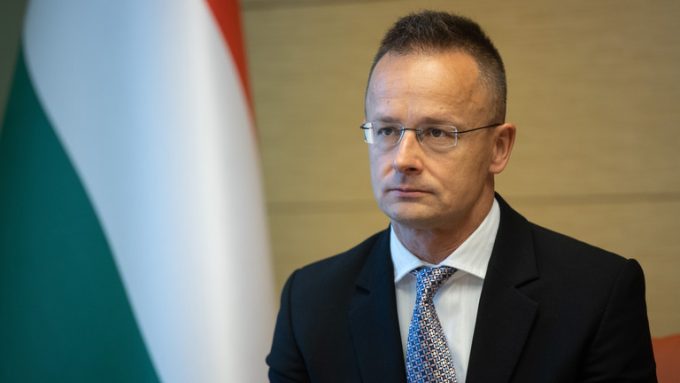
Hungarian Trade and Foreign Minister Peter Szijjarto. © Omer Taha Cetin/Getty Images
RT | October 21, 2023
The EU should pursue cooperation with China and Asia as a whole, which have already become more competitive than the bloc in economic terms, according to Hungarian Foreign Minister Peter Szijjarto.
Speaking at an informal meeting of EU trade ministers in Valencia on Friday, Szijjarto emphasized that the global economy has turned upside down over the past few years, resulting in a fall in the bloc’s economic position, which Brussels is making worse with its indiscriminate sanctions policies. He reiterated that recent sanctions against Russia and the drive to abandon Russian energy “shot the European economy first in the foot and then in the knee.”
“Today we pay four times as much for gas in Europe as Americans do at home and three times as much for electricity as people pay in China,” he pointed out, noting that while distancing itself from Russia has already caused problems, doing the same with China would be even more destructive for the EU economy.
Szijjarto noted that China has already surpassed the EU in terms of gross domestic product (GDP): its share of global GDP jumped from 9% in 2010 to the current 18%, while the EU’s share dropped from 22% to 17%.
“The overall structure of the world economy is being transformed, and this great transformation also means that the West’s automatic competitive advantage has ended. The Eastern world has strengthened significantly, they have at the very least caught up with the Western world from a financial and technological point of view, while they have always been ahead of us in terms of human resources,” he stated. Szijjarto added that the Eastern and Western economies are more strongly interdependent nowadays than ever before, and said the EU should not shy away from this trend.
“Whether we like it or not, it’s a fact. Whoever denies all this can cause very serious damage to the European economy,” he warned.
Szijjarto noted that the basis of the EU’s economic growth previously lay in the combination of advanced Western technologies and cheap Russian energy, but this line of cooperation has now been severed.
“Unfortunately, there are Western Europeans… who strive to cut off economic cooperation between Europe and China in the same way. If this were to happen, it would practically be a knockout blow to the European economy. That is why we are against any effort to isolate the Chinese and European economies from each other,” he stated.
The minister said the consequences of such actions would be especially felt by the European automotive industry, which relies on Chinese suppliers.
“This would practically suffocate the car industry. And if we strangle the European car industry, we will destroy the European economy,” he declared.
“Everyone in the economy understands this, but Western European politicians don’t want to see the reality, they don’t want to hear the facts, but rather they politicize out of ideology and anger.”
The EU relationship with China has been strained over the past several years, with Brussels viewing Beijing as an economic rival, and each side increasingly unhappy with the other’s policies.
The EU has discredited itself in the Israel-Palestine conflict
By Timur Fomenko | RT | October 20, 2023
European Commission President Ursula von der Leyen’s showboating in support of Israel in the current Middle East conflict has reportedly provoked a backlash from EU lawmakers and diplomats.
When the Israel-Gaza war broke out just over a week ago, von der Leyen made the decision to offer unconditional support to West Jerusalem rather than urge for calm or mediation, having Israel’s flag projected onto the European Commission headquarters and paying a visit to Israel herself. She clearly did so out of an inclination to appear in line with the US. But her actions have aged poorly as reports of civilian deaths and humanitarian disaster in the besieged Gaza Strip continue to mount.
Anyone familiar with von der Leyen knows that she is an unapologetic neoconservative and transatlanticist who is single-handedly undermining the autonomy, respect, and foreign policy stature of the EU by actively working to make the bloc subordinate to the US in multiple areas, all while attempting to showcase herself as a true regional leader. If the EU sees itself in a fundamental competition with China and Russia, there could not be a worse advert to the rest of the world than her leadership, and her Israel blunders may be her most damaging decisions yet.
Von der Leyen’s foreign policy legacy involves dragging the EU into several confrontations it could have done without. This week, she is heading to Washington DC to try to forge a deal on steel and aluminum trade targeted at China, but that will ultimately result in throwing the EU market under the bus, again. Other acts have included backing the American position on Ukraine and striving for full escalation of the war there, promoting energy decoupling with Russia, as well as inventing the term “de-risking” with China and seeking to undermine the bloc’s lucrative relationship with Beijing. Throughout this, she has been repeatedly eager to pull large sums of money out of thin air and propose fantasy projects which amount to little more than posturing, and which her office alone is not even able to authorize.
For example, that includes offering Belarus billions if it goes ahead with a US-backed regime change, or inventing numerous “infrastructure” schemes to compete with China, such as the Global Gateway, among other things. She has thus repeatedly used the stature of her office to follow American objectives and try to shape the continent without establishing any kind of due consensus. Almost immediately after the war in Gaza broke out, the European Commission announced all EU aid to Palestine would be frozen. Regardless of what you think of Hamas, with hindsight that decision now appears spiteful, reactionary and inhumane, which tells you how fast the Commission was to jump to the American position of unconditional support for Israel.
But this time there is a widespread feeling it has gone too far. Rather than allowing Europe to have staked out a moderate position on the Gaza conflict, even if it would not be too sympathetic to Palestine, the decision was essentially outsourced to the US, discrediting the EU and only serving to contribute to the growing backlash starting to emerge among Muslim communities in response to the conflict. For countries such as France, this is disastrous. This hurts the EU’s image across the Islamic world and the Global South by seemingly siding with the oppressors.
Soon enough, a series of embarrassing U-turns followed, including the reinstatement of aid, combined with tweets in Arabic, but the damage had already been done, because Israel has long been given the green light to pursue unparalleled destruction in Gaza, at seemingly whatever the cost. In doing so, von der Leyen has in fact undermined, in yet another way, the bloc’s ability to present itself as a serious and comprehensive political actor. She seems to have no love for the idea that the EU should have strategic autonomy and be capable of calibrating its own interests and place in the world, and would prefer that it instead be a simple parrot of the US.
Of course, if she took into greater consideration the interests and positions of member states it would be less of a problem. But she does not and instead essentially serves as a completely disruptive force, in practice undermining European diplomacy and preventing the EU from building relations with a wide range of states. In the end, this favors only the US.
Hungary PM Orbán meets with Putin in Beijing
BY THOMAS BROOKE | REMIX NEWS | OCTOBER 17, 2023
Hungarian Prime Minister Viktor Orbán met with Russian President Vladimir Putin in Beijing on Tuesday to discuss ongoing bilateral agreements between the two nations.
The pair were snapped shaking hands in the Chinese capital — the first photographed handshake between Putin and an EU leader since the Russian invasion of Ukraine in February last year.
Orbán told the Russian president that “Hungary has never sought to confront Russia” and has always and will continue to “pursue the goal of building and expanding the best communication,” reported Russia’s state-run news agency TASS.
“In Europe today, one question is on everyone’s mind: Will there be a ceasefire in Ukraine? For us Hungarians, too, the most important thing is that the flood of refugees, the sanctions, and the fighting in our neighboring country should end,” Orbán posted on X following the meeting.
Budapest has maintained relatively close relations with Moscow and faced the wrath of the European Union for steering its own course through the conflict in Ukraine and refusing to present a united front with other EU leaders.
Orbán’s administration has long opposed the provision of arms to Kyiv, which it claims is prolonging the conflict and increasing the death toll, and has advocated for an immediate ceasefire and peace talks.
The rendezvous exerts further pressure on Brussels, which requires Hungary’s approval for proposed budget reforms in order to unlock further funding for Ukraine.
“Given the fact that in today’s geopolitical conditions the opportunities for maintaining contacts and developing relations are very limited, it can only cause satisfaction that our relations with many European countries are maintained and developed. One of these countries is Hungary,” Putin told Orban.
The meeting was criticized by U.S. Ambassador to Hungary David Pressman who accused Orbán of “pleading for business deals” while Russia continues its aggression in Ukraine.
“Hungary’s leader chooses to stand with a man whose forces are responsible for crimes against humanity in Ukraine, and alone among our Allies,” he posted on X.
This interpretation of the meeting was questioned by the Hungarian prime minister’s political director, Balázs Orbán, who claimed that Budapest was “fed up” with Pressman’s “hypocrisy.”
“If the question is who’s doing business with the Russians, the Americans should turn down the volume. They are buying more than twice as much nuclear fuel alone as they used to, and we have a whole list of them,” he added.
“Since your president refuses to talk about ending this war, someone has to,” quipped Koskovics Zoltán, a geopolitical analyst at the Budapest-based Center for Fundamental Rights.
Both leaders arrived in Beijing at the invitation of Chinese President Xi ahead of an international forum on China’s Belt and Road Initiative.
Earlier on Tuesday, Orbán met with the Chinese leader to discuss the strengthening of Hungarian-Chinese relations.
“Connectivity instead of decoupling: This is the Hungarian model. Our aim is to strengthen Hungarian-Chinese relations. This is good for Hungary and good for the European economy,” he said in a statement.
Detente climate poisoned as US congressional report hypes China, Russia’s ‘nuke threats’
By Wang Qi | Global Times | October 13, 2023
Despite a recent climate of detente between China and the US, a US report by a congressionally mandated panel hyped “threats” from China and Russia, urging Washington to prepare for possible simultaneous wars with Moscow and Beijing and enhance its already formidable nuclear arsenal.
Analysts said Friday that the report will harm the fragile thawing in relations between China and the US. As the report is likely to be reflected in the future National Defense Authorization Act, it will also poison the global strategic environment for the next decade, they said.
Citing a senior official involved in the report by the Strategic Posture Commission, Reuters said the panel members are worried about “ultimate coordination” between China and Russia, which will get the US into a two-war construct.
The US and its allies must be ready to deter and defeat both adversaries simultaneously, the Strategic Posture Commission said, urging Washington to expand or restructure its nuclear arsenal to tackle the “existential challenge.”
The panel’s vice chair, Jon Kyl, a retired Republican senator, said that the US requires huge defense spending increases, and both the White House and Congress need to tell the US people that higher defense spending is a small price to pay “to hopefully preclude” a possible nuclear war involving the US, China and Russia.
It is very rare that this quasi-official report suggests the need to prepare for simultaneous war with China and Russia, including nuclear deterrence and counterattack, Lü Xiang, a US studies research fellow at the Chinese Academy of Social Sciences, told the Global Times on Friday.
The report is perhaps the boldest vision from the US strategic community since the Cold War, endorsing the interests of the military-industrial complex, and seeking to influence the US decision-making community, Lü said.
The report came at a time when Beijing-Washington ties showed signs of warming, after a slew of meetings between high-level officials. On Thursday local time, the US accepted China’s invitation to attend the Xiangshan Forum, a top security forum in Beijing this month, according to the media.
This report undoubtedly poisons the current climate of warming ties between China and the US, and will inevitably poison the strategic environment for the next decade, said Lü, noting the report’s recommendations are likely to be embodied in the National Defense Authorization Act, and the US will most likely significantly expand its nuclear forces in the next decade.
It means that the US is going to maximize the “challenges” and then respond to the “worst possibilities it has assumed,” he noted.
Although China has always emphasized an active defense strategy, we must also be prepared for a risky US posture on nuclear weapons, Lü said.
In February, Senior Colonel Tan Kefei, spokesperson for the Chinese Ministry of National Defense, stressed that even though the US has the largest nuclear arsenal in the world, it is still investing heavily in upgrading its nuclear triad. The US has been repeatedly hyping up the so-called “China nuclear threat,” only to seek excuses for expanding its own nuclear arsenal and maintaining military hegemony.
In 2020, Fu Cong, then director general of the Department of Arms Control and Disarmament, cited statistics from renowned international think tanks, pointing out that the US nuclear arsenal stands at about 5,800 nuclear warheads, which is almost 20 times that of China’s.
The US report is still asking for more defense spending, but how much more the US economy can afford to raise its defense budget remains doubtful, Lü said.
For fiscal year 2024, the US defense budget request hit another record high of $842 billion, more than the gross domestic product of Saudi Arabia for the entire year of 2021, and 20 percent higher than the combined defense budgets of nine countries, including China, Russia, India, and the UK, According to Xinhua.
US strategic circles should clearly understand that if a nuclear war between China, the US and Russia really breaks out, it will be disastrous for the world. Moreover, if the US assumes that a nuclear war will break out, others will look at the US as a participant, which poses risk to the US as well, analysts said.
Iran asks China to intervene to stop war in Gaza
Press TV – October 15, 2023
Iran’s Foreign Minister Hossein Amir-Abdollahian has called on China to intervene to put an end to the ongoing carnage in the Gaza Strip where Israel is carrying out incessant attacks against the civilian population living in the enclave.
In a phone call with China’s Foreign Minister Wang Yi on Sunday, Amir-Abdollahian said there is a need for the United Nations to assume its responsibilities with regard to international peace and security amid the ongoing conflict in Palestine.
However, he asked China to use its diplomatic capacity to stop the Israeli regime from attacking civilians in Gaza, the official IRNA news agency said.
The foreign minister described the collective punishment imposed by the Israelis on the Palestinians in Gaza as “unacceptable” while reiterating the need for setting up humanitarian corridors to deliver aid to the people in the enclave.
He warned that there would be no guarantee that the conflict in Gaza would not spiral out of control if the criminal attacks against the civilians in Gaza did not stop.
The phone call between Amir-Abdollahian and Wang came just after Iran’s top diplomat returned from a tour of Iraq, Syria, Lebanon and Qatar.
Amir-Abdollahian said after meeting leaders of the anti-Israeli resistance groups during his regional tour that the conflict in Gaza would spread to other areas and countries if Israel does not stop its aggressions against the Palestinians.
More than 2,450 people have been killed in nine days of Israeli air strikes and shelling against Gaza, a besieged enclave on the Mediterranean Sea which is home to some 2.3 million people.
The attacks, which have left nearly 10,000 people injured, started last week after the Palestinian resistance group Hamas, which is based in Gaza, launched multi-pronged attacks on occupied territories to retaliate against Israeli assaults on Palestinians.
Chinese FM says Israel’s actions go beyond self-defense, calls to avoid collective punishment of Gaza people
By Chen Qingqing | Global Times | October 15, 2023
China’s top diplomat Wang Yi said Israel’s actions have gone beyond the scope of self-defense, expressing concerns about the escalating Israel-Palestine conflict as Israel ordered one million people from the northern part of Gaza to evacuate within 24 hours as it prepared for a ground assault.
In his phone call with Saudi Foreign Minister Prince Faisal bin Farhan Al Saud on Saturday, Chinese Foreign Minister Wang Yi said China opposes and condemns all acts that harm civilians, as they violate basic human conscience and the fundamental principles of international law.
Israel’s actions go beyond the scope of self-defense. It should heed the calls of the international community and the UN Secretary-General and avoid collective punishment of the people of Gaza, Wang said.
Israel was preparing on Saturday to launch a ground assault in the Hamas-controlled Gaza Strip, after telling Palestinians living in the densely populated territory to flee south toward a closed border with Egypt, Reuters reported.
Israeli national security adviser meanwhile warned Lebanese militant group Hezbollah not to start a war on a second front, threatening the “destruction of Lebanon” if it did, according to the media report.
UN Secretary-General Antonio Guterres warned on Friday that the relocation of Gaza residents from the north to the south “is extremely dangerous – and in some cases, simply not possible.”
The Chinese Foreign Minister said all parties should not take any actions that escalate the situation, and instead should return to the negotiation table as soon as possible. China is actively communicating with all parties to push for a ceasefire. The immediate priority is to ensure the safety of civilians, quickly open humanitarian rescue channels, and meet the basic needs of the people of Gaza, Wang said.
China’s special envoy on the Middle East Affairs Zhai Jun will visit relevant countries in the Middle East next week to further strengthen coordination with all parties, he was quoted as saying in media reports on Sunday.
The Israel-Palestine conflict continues to escalate. Armed conflicts have erupted at the Israel-Lebanon and Israel-Syria borders, and the spill-over effects on the regional and international community are spreading, Zhai noted. The international community must remain highly vigilant and collectively manage and control the situation to prevent it from spiraling out of control, he said.
China has always maintained that force is never the solution. Resorting to violence will only lead to a vicious cycle of retribution, creating further obstacles to a political resolution, Zhai noted. And it is imperative to cease fire and violence promptly, cool down the situation, and thus pave the way for a political solution.
Since the onset of this round of conflict, China has been actively communicating and coordinating with relevant parties. China’s special envoy recently had phone conversations with foreign ministers and officials from Palestine, Israel, Egypt, Saudi Arabia, the UAE, and others.
They all hope to end the hostilities, condemn acts that harm civilians, and avoid humanitarian disasters. They also hope to restore the Middle East peace process, Zhai revealed.
Currently, several Chinese citizens remain in the Gaza Strip, he said. In recent days, our overseas institutions have maintained close contact with them, providing safety guidance and support, assisting them in moving to the southern part of Gaza, and striving for their early evacuation to safe areas.
So far, four Chinese nationals have been killed, six are receiving treatment in local hospitals, and two are missing in the latest conflict.
A strategic nightmare sneaks into Washington’s political agenda
Global Times | October 14, 2023
A simultaneous war with China and Russia is a strategic nightmare that sober American strategists such as Henry Kissinger have been warning the US to avoid at all costs, and it is also a topic that some US media outlets have become more and more fond of talking about in recent years. At least from the publicly available information, Washington has never previously addressed it as a formal political agenda, supposedly aware of its seriousness and the terrible risks it carries. But the publication of a report by a congressionally appointed bipartisan panel titled America’s Strategic Posture crossed this “red line” on October 12.
The central point of the 145-page report is that the US must expand its military power, particularly its “nuclear weapons modernization program,” in order to prepare for possible simultaneous wars with China and Russia. Notably, the report diverges completely from the current US national security strategy of winning one conflict while deterring another, and from the Biden administration’s current nuclear policy. It is not a fantasy among the American public, but a serious strategic assessment and recommendation in the service of policymaking.
The 12-member panel that wrote the report was hand-picked by the US Congress from major think tanks and retired defense, security officials and former lawmakers. This report makes us feel that a “strategic nightmare” is sneaking into the US political agenda, but has not drawn due concern and vigilance in Washington, and to a large extent, the American elite group represented by the panel is actively working to make this nightmare come true.
A look at the specific recommendations of this report will send shivers down the spine of those who retain any basic rationality. The report recommends that the US deploy more warheads, and produce more bombers, cruise missiles, ballistic missile submarines, non-strategic nuclear weapons and so on. It also calls on the US to deploy warheads on land-based intercontinental ballistic missiles (ICBMs) and to consider adding road-mobile ICBMs to its arsenal, establishing a third shipyard that can build nuclear-powered ships, etc.
What depths of insanity is the US sinking to? The US’ military spending accounts for nearly 40 percent of the world’s total defense expenditures, and it has been growing dramatically for several years, with military spending in 2023 reaching $813.3 billion, more than the GDP of most countries, but even that is not enough for these politicians. Such a report full of geopolitical fanaticism and war imagery, whether or not it actually ends up as a “guide” for Washington’s decision-making, is dangerous and needs to be resisted and opposed by all peace-loving countries.
According to some American media, the report ignores the consequences of a nuclear arms race. In fact, the report doesn’t seem to consider this at all and doesn’t suggest any measures other than nuclear expansion to address this issue. In other words, it is a reckless approach. Both China and Russia are nuclear powers, and everyone knows that provoking a confrontation between nuclear powers is a crazy idea. Even promoting a nuclear arms race under the banner of “deterrence” is a disastrous step backward in history. Washington’s political elites, who lived through the Cold War, cannot be unaware of this. However, the fact that such an absurd and off-key report is being presented in all seriousness by the US Congress is both surreal and unsurprising. It is in line with the distorted political atmosphere in Washington today.
The motives behind this exaggeration of threats and creating a warlike atmosphere are highly suspicious. The recent outbreak of the Israeli-Palestinian conflict caused a sharp increase in US defense industry stocks, while American defense industry companies have also been the biggest beneficiaries of the long-standing Russia-Ukraine conflict. The military-industrial complex, like a geopolitical monstrosity, parasitically clings to American society, manipulating its every move, pushing Washington step by step to introduce and even prepare for ideas that were once considered “impossible.” The prosperity of the American military-industrial complex is built upon blood and corpses, and carries a primal guilt. Serving the interests of the American military-industrial complex is unethical.
The reality is that such rhetoric is becoming increasingly politically acceptable in today’s Washington. The idea of “preparing for possible simultaneous wars with Russia and China,” once a fringe fantasy, has gradually made its way into Washington’s agenda, which is deeply unsettling. If Washington were to adopt even a small portion of the recommendations in this report, the harm and threats it could pose to world peace would be immeasurable and would ultimately backfire on the US itself. There is an old Chinese saying: “Those who play with fire will perish by it.” This is something that is worth Washington’s careful consideration.
US must prepare for war with China and Russia – Congress
RT | October 13, 2023
Washington needs to urgently update and expand both its nuclear arsenal and the conventional military in order to face the combined might of Moscow and Beijing, the congressional Strategic Posture Commission argued in its final report published on Thursday.
“The United States and its allies must be ready to deter and defeat both adversaries simultaneously,” the commission said. “The US-led international order and the values it upholds are at risk from the Chinese and Russian authoritarian regimes.”
While the commission has not identified any specific evidence of Russia and China working together, “we worry… there may be ultimate coordination between them in some way, which gets us to this two-war construct,” a senior official involved in the report told Reuters, on condition of anonymity. The current US national security strategy calls for defeating one major adversary while deterring another.
The commission argued that the combined threat from China and Russia will become acute as early as 2027 so “decisions need to be made now in order for the nation to be prepared.” The 131 findings and 81 recommendations in the report amount to the need for massive expansion of both the conventional armed forces and the Nuclear Triad.
The report demands more of the B-21 stealth bombers and Columbia-class ballistic missile submarines. The B-21 is still in development and is expected to enter service by 2027 at the earliest. The first two Columbia-class subs are under construction and are expected in 2030. The US Navy has planned to order 12, to replace the 18 Ohio-class boats currently in service.
“Amid all of the Commission’s recommendations to increase the number of strategic and tactical nuclear systems, there is almost no mention of cost in the entire report,” which “does not seem to acknowledge any limits to defense spending,” the Federation of American Scientists (FAS) has said in response.
At a press event announcing the report, the commission’s vice-chair, retired Republican Senator Jon Kyl, argued that higher military spending is a small price to “hopefully preclude” a possible nuclear war and that President Joe Biden and Congress need to “take the case to the American people” to spend more money.
According to FAS, however, the commission’s recommendations are “likely to exacerbate the arms race, further constrict the window for engaging with Russia and China on arms control, and redirect funding away from more proximate priorities.”
The only reason the commission did not argue for an immediate expansion of the US nuclear stockpile “is that the weapons production complex currently does not have the capacity to do so,” FAS noted, adding that there is no need for a nuclear arms race so long as the US has enough submarines to present a credible deterrent to a first strike by an adversary.
Biden’s Semiconductor Spat With China Could Backfire, Warn US Chipmakers
By Svetlana Ekimenko – Sputnik – 06.10.2023
As the Biden administration pushes on with efforts to curb China’s technological progress with new restrictions, America’s semiconductor giants are indicating alarm, warning that the US may be shooting itself in the foot, according to a media report.
Amid the semiconductor trade spat with Beijing that Washington launched last year with a plethora of restrictions, and fueled further with new attacks across the past months, America’s semiconductor companies have responded with the unabashed warning that such poorly thought out measures could eviscerate their own businesses. Furthermore, slashing sales to China could wreck the Biden administration’s ambitious plans of building new semiconductor factories on US soil, according to the report, citing scores of industry interviews.
Three global giants in the chip-making industry – Nvidia, Intel and Qualcomm – have reportedly been meeting with officials in the Biden administration, including Secretary of State Antony Blinken and Commerce Secretary Gina Raimondo, along with representatives of an array of think-tanks to press the case for reconsidering additional chip restrictions to China.
China accounts for close to a third of the global semiconductor market, and more than $50 billion in combined annual revenue for Intel, Nvidia, and Qualcomm.
Leaders of these companies have, thus, been justifiably pointing out that loss of revenue on such a scale could provoke inevitable cuts in jobs, spending, and technology development, affecting US semiconductor hubs located in Ohio, New York, and Arizona.
The chief executives of these companies have warned that Washington’s attacks on Beijing could result in China speeding up the creation of its own independent chip industry.
Thus, they claimed, America’s ill-conceived semiconductor trade war would result Chinese-created chips dominating globally.
“What you risk is spurring the development of an ecosystem that’s led by competitors… And that can have a very negative effect on the US leadership in semiconductors, advanced technology and AI,” Tim Teter, Nvidia’s general counsel, was cited as saying.
Lobbying by these chip giants has brought results, according to cited sources, resulting in both a delay in issuing new restrictions, and a reportedly “narrowed list” of further changes that the Biden administration might potentially embark upon.
After last year’s restrictions stemming from the CHIPS Act signed by Biden, the American companies cited above have sought to “adjust” their businesses, revealed the report.
Thus, Nvidia was forced to come up with a new version of its AI chip, the H100, specifically tailored for China. To ensure compliance with US restrictions, that chip’s performance power was “lowered below the maximum levels allowed”, said the report. Nevertheless, losses grew and when chatter of impending new restrictions surfaced this summer, the chief executives ostensibly set off on more lobbying to Washington. Intel’s Patrick Gelsinger, Nvidia’s Jensen Huang, and Cristiano Amon of Qualcomm met with White House officials.
“Without orders from Chinese customers, there will be much less need to go ahead with projects such as Intel’s planned factory complex in Ohio,” Gelsinger reportedly told US National Security Advisor Jake Sullivan.
Furthermore, the Semiconductor Industry Association was cited as issuing a statement slamming the government’s restrictions as “broad, ambiguous and at times unilateral,” warning they could harm “the industry’s competitiveness”.
“Right now, China represents 25 percent to 30 percent of semiconductor exports. If I have 25 percent to 30 percent less market, I need to build fewer factories… You can’t walk away from 25 to 30 percent and the fastest-growing market in the world and expect that you [continue] funding the [R&D] and the manufacturing cycle that we’ve released… This is strategic to our future; we have to keep funding the [R&D], the manufacturing, etc… Today, we have more than 1,000 companies on the entities list, many of which have nothing to do with national security and nothing to do with security concerns in China,” Gelsinger subsequently said at the Aspen Security Forum in July.
Semiconductor Trade War
It has been slightly more than a year since the Biden administration took its first shot, with the US commerce department prohibiting companies from supplying advanced chips and chip-making equipment to China, and thus taking the trade war that his predecessor Donald Trump had waged against Beijing into the technological sphere.
The restrictions, along with the Washington’s CHIPS and Science Act of 2022, were portrayed as limiting China’s technological prowess. The US government had cited national security concerns, claiming that it was restricting the export of cutting-edge technologies that China could use for military purposes or to enhance its domestic semiconductor capabilities. The Act included more than $52 billion in subsidies for US semiconductor manufacturers. In response, China warned that the industrial policy bill to support the local producers of semiconductors would disrupt global supply chains and hamper international trade.
“The United States said that the Act aims to increase the competitiveness of US technologies and semiconductor production. However, this Act provides huge subsidies to US enterprises producing chips and introduces a differentiated policy of industry support, some provisions of which, among other things, restrict normal investment and trade and economic activities of relevant Chinese enterprises, as well as normal scientific and technical cooperation between China and the US,” Chinese Foreign Ministry spokesman Wang Wenbin had said.
Beijing reached checkmate by saying it needed to protect its own “national security and interests”, and first sanctioned US semiconductor giant Micron Technology in May, 2023. It then set in place export restrictions on rare earths – including gallium and germanium which are crucial for the world’s electronic chip-making industry. Since China produces upwards of 80 percent of the world’s gallium, and 60 percent of its germanium, experts were quick to predict that it could take “generations” for the US to replace lost Chinese capacity.
In early August, the White House announced that US President Joe Biden signed an executive order that authorized the Secretary of the Treasury to regulate certain US investments into Chinese entities engaged in activities involving national security-sensitive technologies in three sectors: semiconductors and microelectronics, quantum information technologies, and certain artificial intelligence systems.
The US has also urged its partners – South Korea, Japan, the Netherlands, and the government in Taiwan – to restrict or ban chip sales to China, and to relocate production facilities out of or away from China, such as to Europe or the United States.
China, the largest global semiconductors market, has repeatedly warned that by imposing restrictions on normal trade, the United States will end up harming itself as well as other market players.
“The US measures to restrict chip exports to China violate market rules and lead to fragmentation in the global semiconductors market, which not only harms lawful rights and interests of Chinese companies, but also significantly affects the interests of semiconductors manufacturers throughout the world, including in the US,” China’s Commerce Ministry spokesman He Yadong said in September.
To counter Washington’s restrictions, reports surfaced in September that Beijing was seeking to provide its own semiconductor chip-manufacturing industry with financial support. The People’s Republic of China was described as gearing up to launch a state-backed investment fund to bolster the country’s semiconductor industry.
China and Syria forge ‘strategic partnership’ – leaders
RT | September 22, 2023
Beijing and Damascus announced a new “strategic partnership” during Syrian President Bashar Assad’s ongoing visit to China. President Xi Jinping met him in the city of Hangzhou before this week’s launch of the Asian Games, a high-profile international sports event.
Assad is visiting China for the first time since 2004, when he met then-President Hu Jintao. Xi announced the new agreement as he welcomed his guest in the capital of Zhejiang Province on Friday.
The Chinese leader stated that the relationship between the two nations has “withstood the test of international changes” and pledged to maintain them in the face of international “instability and uncertainty.”
The US and its allies have been seeking to oust Assad for over a decade, accusing him of various transgressions during an armed conflict in the country. The bloodshed started in 2011 as mass protests surged against the Syrian government but were soon hijacked by international jihadist organizations. These elements sidelined other anti-government forces, which Western nations touted as “moderate rebels,” as the main threat to Damascus.
Russian intervention in 2015 turned the tide and helped the Syrian Army oust Islamist militants from most of the country. Some portions, where Turkish and American troops or their local allies are present, remain outside Damascus’ control.
The US has imposed crippling unilateral sanctions on Syria, which hamper its ability to reconstruct after this brutal conflict. Xi expressed support for Assad’s efforts to rebuild the nation, keep terrorists in check, and seek a political settlement for the Syrian people.
The Arab League readmitted Syria in May as Damascus seeks to normalize relations with its neighbors. Beijing had facilitated the restoration of diplomatic relations between regional rivals, Iran and Saudi Arabia, in June. Both nations played significant roles in the Syrian crisis, the former supporting Assad’s government and the latter initially vying for his ouster.
The Syrian president and First Lady Asma Assad arrived in Hangzhou on Thursday. On Saturday, the visiting dignitaries are set to attend the opening ceremony of the 19th Asian Games alongside a dozen other foreign guests.
Featured Video

Macgregor: We Haven’t Seen the Worst of the Iran War Yet
or go to
Aletho News Archives – Video-Images
From the Archives
15 Saudi ‘hijackers’ were CIA agents working for US: Scholar
Press TV – April 13, 2016
Fifteen of the 9/11 “hijackers” from Saudi Arabia were CIA agents working for the United States government, which was seeking to destroy the Middle East for Israel and to double the American military budget, says Dr. Kevin Barrett, an American academic who has been studying the events of 9/11 since late 2003…. continue
Blog Roll
 Aletho News
- Iran’s Plan to Shut Down AI in the Persian Gulf
- Israel seeks ‘compensation’ from Washington over Saudi F-35 sale
- Saudi crown prince seeks dialogue with Ansarullah after Yemeni blows: Report
- Damascus rejects Saudi request for Syrian fighters to counter Yemen: Report
- South Korea says will not send troops to join terrorist US war on Iran
- Russia Just Struck the Eyes of NATO’s War Machine in Ukraine
- Russia summons UK charge d’affaires over Kiev drone support
- NATO member warns bloc seeking pretext for war with Russia
- Macgregor: We Haven’t Seen the Worst of the Iran War Yet
- ‘We are not like everyone else’ laws that bind other nations do not apply to Israel, says Likud lawmaker
- If Americans Knew
- Debunking The Claim That Macklemore Has A “History Of Antisemitism”
- CPJ demands release of arrested Palestinian-US journalist near Bethlehem
- Robert Kraft: The Billionaire Friend of Netanyahu Pulling The Strings Behind the Macklemore/Ed Sheeran Blow Up
- Columbia Administered Fund Gives Big Money to Pro-Israel Groups
- Deportation Case of Palestinian Activist Salah Sarsour Tests First Amendment
- ‘We Will Not Forget’: Palestinians Mark 44 Years since Sabra and Shatila
- Why do we let Zionists decide what we can and can’t say?
- US welcomes Israeli, Iranian delegations to UN, but not Palestinians – Daily Update
- Biden’s Genocide Accomplices Targeted by New Accountability Campaign
- AIPAC’s Network Has Already Spent $67.2 Million to Shape the Midterm Elections
- No Tricks Zone
- New Study: ‘Global Drought Shows No Detectable Recent Acceleration Under Climate Warming’
- Economic Masterminds: German Socialists Suggest Taxing Productivity Gains Stemming From Using AI
- The South China Sea Has Not Been Cooperating With The Climate Change Narrative
- Energy Crisis: Germany Enters Heating Season With Historically Low Gas Reserve Fill Levels
- New Study: The Antarctic Ice Sheet Gained Mass From 2020-2024 Due To Staggering Snow And Ice Accumulation
- Study: Ocean Heating Rates From Thousands Of Years Ago ‘Dwarf’ Modern Ocean Heating Rates
- Climate Extremists Target, Attack Large-Scale Power Grid Infrastructure In Germany!
- New Study: Antarctic Ice Melt Has Contributed Less Than 1 Centimeter To Sea Level Rise In The Last 30 Years
- Fear Of Debate: Alarmist German Climate Scientist Calls On Mainstream Media To Discredit Skeptic Voices
- End-Of-August Arctic Sea Ice Extent Hasn’t Fallen In 20 Years, Official Data Show!
 Aletho News