Canada’s military provocations on China’s doorstep to backfire: experts
By Guo Yuandan and Liu Xuanzun | Global Times |November 5, 2023
Canada has repeatedly hyped up “dangerous” interceptions by the Chinese People’s Liberation Army (PLA) recently, but experts said on Sunday that the PLA’s lawful actions took place on China’s doorstep, and that Canada’s blind confidence could lead to troubles of its own.
In a recent event, two sorties by a vessel-borne helicopter from the Canadian Navy’s frigate HMCS Ottawa with unknown intentions approached China’s territorial airspace above the Xisha Islands, and despite the PLA naval and aviation forces’ lawful identification, verification and repeated verbal warnings, the Canadian helicopter not only refused to respond, but also took provocative maneuvers including flying at a very low altitude, Senior Colonel Zhang Xiaogang, a spokesperson of China’s Ministry of National Defense, said in a press release on Saturday.
The Canadian move violated China’s domestic law and related international law, infringed China’s sovereignty security, and was a malicious act of provocation with ulterior motives, Zhang said.
Canada then hyped up the event through the media to throw mud at China, Zhang said, citing a statement from the Canadian Department of National Defense and media reports claiming that PLA Navy J-11 fighter jets intercepted the Canadian CH-148 helicopter by releasing flares over the South China Sea on October 29.
The measures taken by the Chinese side were professional and up to standard, Zhang said. He urged the Canadian side to stop disregarding facts and hyping, strictly restrict the activities of its frontline naval and aviation forces, and prevent accidents at sea and in the air from happening.
It marks a third provocation from the Canadian military over the past month.
In mid-October, a Canadian CP-140 reconnaissance aircraft illegally entered China’s airspace over Chiwei Islet, approached China’s eastern coast and entered the Taiwan Straits for close-in reconnaissance, forcing the PLA Air Force to take lawful management and control measures.
On Wednesday, the Canadian Navy’s HMCS Ottawa frigate made a transit through the Taiwan Straits together with the US Navy’s USS Rafael Peralta destroyer, while the PLA handled the event in accordance with the law and regulations.
However, Canada’s high-profile provocations are not based on its own capabilities, but on its military strategy of following the US, Song Zhongping, a Chinese military expert and TV commentator, told the Global Times on Sunday.
The Canadian navy is weak, and it is not easy for them to deploy frigates to the Asia-Pacific region, Song said.
“Canada is blindly confident that it is a major Western country, and it thinks too highly of its capabilities,” Song said. “In fact, if Canada keeps making troubles around China, it could get itself into trouble.”
Zhang Xuefeng, another Chinese military expert, told the Global Times on Sunday that the Canadian military should realize how sensitive it is to conduct close-in reconnaissance on China’s doorstep.
It is childish for the Canadian military to provoke China, and Canada should not misread China’s restraint, Zhang Xuefeng said.
Compared to the PLA, Canada’s military presence near China is insignificant, so Canada should know its limit and not pull the chestnut out of the fire for the benefit of the US, Zhang Xuefeng said.
Next few years will determine future world order – Biden
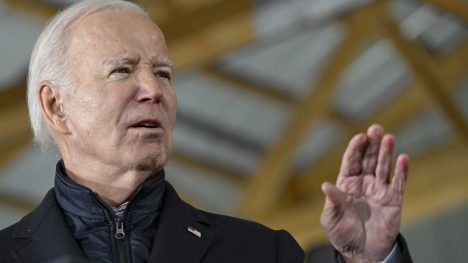
Joe Biden speaks about his Bidenomics agenda on November 1, 2023. © ANDREW CABALLERO-REYNOLDS / AFP
RT | November 3, 2023
The world is at a crossroads and the next few years will determine its fate for several generations to come, US President Joe Biden has claimed. His prediction comes amid Washington’s standoff with Russia over Ukraine and his country’s increasingly strained relations with China.
Speaking ahead of a meeting with Chilean President Gabriel Boric on Thursday, Biden stated that “there comes a time, maybe every six to eight generations, where the world changes in a very short time.”
The US leader further claimed that “what happens in the next two, three years are going to determine what the world looks like for the next five or six decades.”
According to a White House readout of Biden’s meeting with Boric, the pair discussed issues of shared concern, including efforts to combat climate change.
Biden also spoke last month about the need for a “new world order,” suggesting that while the post-World War II system has functioned for decades, it has “sort of run out of steam.”
However, if Americans “are bold enough and have enough confidence in ourselves, [they will have an opportunity] to unite the world in ways that it never has been,” he insisted.
Commenting on Biden’s remarks at the time, Kremlin Press Secretary Dmitry Peskov described it as a rare moment when Moscow was in complete agreement with Washington. “The world indeed needs a new order, based on absolutely new principles,” he noted.
However, Peskov suggested that Biden meant building “a world [order] revolving around the US,” insisting that “this will not be anymore.” Russia has consistently called for a multilateral world order, with President Vladimir Putin accusing the West of “a colonial approach” and bending international rules to its will.
Last month, the Russian leader also stressed that “nobody has the right to control the world at the expense of others or in their name.”
Relations between Washington and Moscow have sunk to unprecedented lows due to the Ukraine conflict, with the US sending billions of dollars’ worth of weapons to Kiev and imposing tough sanctions on Russia.
Elsewhere, relations are tense between the US and China, most notably over Washington’s support for Taiwan. The two nations are also engaged in an intense economic rivalry. China has been promoting its Belt and Road Initiative (BRI), which seeks to develop international transport infrastructure and has been supported by more than 140 countries.
Biden has signaled that the US is working with G7 members to compete with China economically, claiming that the BRI has ended up being “a noose for most of the people who have signed on.”
Putin changes Russia’s obligations on nuclear test ban
RT | November 2, 2023
Russia has downgraded its participation in the 1996 Comprehensive Nuclear-Test-Ban Treaty (CTBT) to the status of a signatory. President Vladimir Putin signed the change into law on Thursday, revoking Moscow’s ratification.
The bill was approved by both houses of parliament last month. Specifically, it changed a 2000 Russian law by removing any mention of ratification of the CTBT, while leaving the rest of the text intact.
The Kremlin stressed that the move was taken in response to US policies regarding the ban, and does not signal an intention to renew underground nuclear bomb tests.
“Among the states that have not ratified the Treaty, the most destructive position is that of the US, which has for many years declared that there would be no support for ratifying the Treaty in Congress,” Putin’s office said in a statement. “Thus, there was an imbalance between Russia and the US in terms of obligations under the Treaty, which is unacceptable in the current international situation”.
The CTBT has not entered force because its terms require ratification by all nations on a list of 44, which operated nuclear reactors in 1996. With Russia’s withdrawal, the treaty will be nine ratifications short of taking effect. The remaining seven absentees are China, North Korea, Egypt, India, Iran, Israel, and Pakistan.
President Putin has suggested that the US may decide to break its de facto moratorium on live nuclear tests as part of the modernization of its arsenal. If this happens, he pledged, Russia will follow suit.
Last month, the US Department of Energy’s National Nuclear Security Administration (NNSA) conducted what it called an underground chemical explosion experiment at the Nevada National Security Site (NNSS), a key nuclear test range. It was described as bolstering Washington’s capability to detect nuclear explosions.
What the Heck is a ‘Scarborough Shoal’… ?

By Joseph Solis-Mullen | The Libertarian Institute | October 31, 2023
News from Southeast Asia this morning was that the Joe Biden administration was again rattling its saber over incidents between the Philippines and China in the South China Sea. At issue are some spits of sand thousands of miles from the United States. Just as a refresher for those Americans who, rightly, have no idea what or where the Scarborough or Second Thomas Shoal are (so irrelevant are they to American prosperity or security)…
The origins of the dispute between China and the Philippines over these miniscule spits of land in the South China Sea are based on conflicting claims over the territory. Beijing’s are based on ancient maps and documents it believes prove its sovereignty over the area, the so-called nine-dash line; while Manila, for its part, points to treaties and agreements signed during the colonial period when the Philippines was under Spanish and then American rule—among them, the 1898 Treaty of Paris and subsequently formulated Constitution of the Philippines, both of which included the shoals. Apart from being strategically located between China and the Philippines, they are home to rich fisheries and are likely to have significant reserves of oil and gas within their exclusive economic zone. As such, it is understandable why both Beijing and Manila are reluctant to concede their claims, and despite numerous efforts at doing so over the years, no resolution between the two has ever been reached.
Seeking to defend and strengthen its claim with a permanent armed presence, in 1999 Manila ordered the Sierra Madre purposefully run aground on Second Thomas Shoal, leaving the ship and a small contingent of men who are occasionally resupplied. It was actually attempted Chinese interference in such a resupply effort that sparked the most recent confrontation that the Biden administration issued its warning over.
Such incidents have been happening regularly since 2012, when Beijing began sending maritime surveillance vessels and large numbers of Chinese fisherman and members of its merchant marine into the area. When Manila attempted to arrest the Chinese for illegal fishing off Scarborough Shoal, Beijing dispatched more ships to block them, and a standoff ensued that was only brought to an end when the Philippines finally recalled its forces. Manila brought the dispute before the Permanent Court of Arbitration the next year, challenging the validity of China’s nine-dash line claim. And in 2016 the Court ruled in favor of the Philippines.
As one might expect, Beijing ignored this and has continued to assert its territorial claims with ever more vigor in the ensuing years. Incidents from the deployment of water cannons and laser lights to near collisions have been unfortunately frequent in the years since. And whereas under previous administrations Washington had been reluctant to explicitly state that the 1951 Mutual Defense Treaty between the United States and the Philippines applied to the disputed maritime areas in question, the Donald Trump administration sought to make these explicit during a 2019 visit by then-Secretary of State Mike Pompeo. At the time, the skeptical Duterte administration in Manila kept aloof. Unfortunately, the newly elected boss in Manila is Ferdinand Marcos Jr., son of long-time U.S. sock-puppet dictator Ferdinand Marcos. He has shown no such reluctance to go along with Washinton’s preferred policy of all out confrontation with China, going so far as to open new leases to U.S. naval assets in the Cagayan Province, located directly across from Taiwan.
Despite what the cheerleaders at the The Washington Post would have you believe, this is all completely crazy, and not at all defensive. Risk war with China over a couple piles of rock and sand so the Philippines can have some extra gas and oil, and the U.S. Navy can shove more assets in China’s face in preparation for the desired war over a breakaway province of China which Washington already officially acknowledges as part of China?
Come on.
The truth is this standoff between the Philippines and China is part of much larger, ongoing territorial disputes in the South and East China Seas, which involve multiple countries besides China and Philippines; for example, Vietnam, Malaysia, Brunei, and Taiwan. All of them want a taste of the likely natural resource wealth beneath the ocean’s floor, as well as the perceived security that comes from controlling the waters nearby.
There is probably going to be some amount of conflict.
The United States should not get involved.
Chinese tech giants cancel Israel
RT | October 31, 2023
Israel can no longer be found on China’s leading online digital maps on platforms including Baidu and Alibaba, the Wall Street Journal reported on Monday, citing web users.
According to the report, Baidu’s Chinese language maps still show the borders of both Israel and the Palestinian territories, as well as key cities in the region. However, they no longer identify Israel by name.
Alibaba’s Amap also no longer displays the name of Israel on its maps. According to the report, the platform is usually known for its attention to details, with even small countries like Luxembourg clearly labeled.
The companies did not respond to media requests for comment. According to the publication, it is unclear when exactly the name Israel disappeared from their maps, but web users have apparently been discussing the development since the escalation of the Israel-Hamas conflict earlier this month.
According to local reports, the Chinese internet has been overflowing with anti-Semitic [sic] comments over the past month, which may be the reason behind the disappearance of Israel’s name from the maps. The Israeli Embassy in China was recently forced to close the comment section under its official account on China’s X-like platform Weibo, after a slew of verbal attacks from users.
The Chinese government has not taken sides in the Mideast conflict, calling on the belligerents to end the hostilities and condemning attacks on civilians. However, Beijing has a long history of supporting Palestine. It recognized the Palestine Liberation Organization in 1964 and Palestinian sovereignty in 1988, and later established full diplomatic relations with the Palestinian Authority in 1989.
During his visit to Saudi Arabia in 2022, Chinese President Xi Jinping called the fact that the global community still largely does not recognize Palestine as a country a “historical injustice,” and said China will support the establishment of a Palestinian state with East Jerusalem as its capital.
Russia, China veto US-drafted resolution backing Israeli offensive
Press TV – October 25, 2023
Russia and China have prevented the passage of a US-drafted UN Security Council (UNSC) resolution that had said Israel, which has killed more than 6,500 people as part of its underway war on Gaza, has been acting in “self-defense.”
The draft was put to vote on Wednesday. The United Arab Emirates also voted no, while 10 members voted in favor and Brazil and Mozambique abstained.
Israel launched the devastating war on October 7 after the Gaza Strip-based Palestinian resistance groups staged Operation al-Aqsa Storm, a surprise attack on the occupied territories, in response to the Israeli regime’s intensified crimes against the Palestinian people. The war has killed 6,546 Palestinians, including 2,704 children, according to the Palestinian health ministry.
The Council then voted on a Russian-drafted resolution that had called for a humanitarian ceasefire and urged Tel Aviv to immediately cancel its orders on Palestinian civilians to head into southern Gaza.
Only Russia, China, the UAE, and Gabon voted in favor of the draft, while nine members abstained and the United States and Britain voted no.
A resolution needs at least nine votes and no vetoes by the US, France, Britain, Russia or China to be adopted.
Also on Wednesday, Russia’s foreign ministry spokeswoman Maria Zakharova said the death of thousands of children in the Gaza Strip had not been enough to get the West behind a resolution demanding a ceasefire in the besieged coastal territory.
“This is the most obvious and rather simple thing to do in this situation: Simply to produce a statement, a resolution, a document with a unified call for a ceasefire, settling the situation and so on,” she said in an interview with Sputnik Radio.
“Even these numbers (the fatality count among the Palestinian minors) cannot compel certain political forces in the West to come to their senses and realize what is going on,” Zakharova regretted.
Pentagon Report Hypes ‘China Threat’ to Sustain Own Hegemony
By Wang Qi | Global Times | October 20, 2023
The US’ “China Military Power report,” like its previous editions, ignores the facts and is filled with bias, spreading the “China threat” theory which only serves as an excuse to maintain its military hegemony, a Chinese Foreign Ministry spokesperson said on Friday, in response to a Pentagon report that warned Beijing is building up its nuclear and long-range missiles arsenal “faster than previous projections.”
The newly-released annual Pentagon document claimed that China has more than 500 operational nuclear warheads as of May 2023, surpassing earlier projections, and forecast that China would likely have more than 1,000 operational nuclear warheads by 2030.
Describing China as a “pacing challenge,” the US Defense Department report also said that Beijing may be exploring the development of conventionally-armed long-range missiles that could reach the US. It said that Beijing has completed the construction of three new fields of long-range ballistic missiles silos.
Mao Ning, a spokesperson from the Chinese Foreign Ministry, said on Friday that China is firmly committed to a defensive nuclear strategy, and has always maintained nuclear forces at the lowest level required for national security, and has no intention of engaging in a nuclear arms race with any country.
China has a unique nuclear policy among nuclear weapon states and has maintained a high degree of stability, consistency and predictability, Mao said, “No country will be threatened by China’s nuclear weapons as long as it does not use or threatens to use them against China.”
We urge the US to abandon its Cold War mentality and hegemonic logic, to view China’s strategic intentions and national defense development objectively and rationally, to stop publishing such irresponsible reports year after year, and to take practical actions to maintain the stability of the military-to-military and overall relations between the two sides, Mao said.
Chinese military expert Zhang Junshe said that it’s hilarious that a country with more than 5,000 nuclear warheads says another nation poses a threat.
In 2020, Fu Cong, then director general of the Department of Arms Control and Disarmament, cited statistics from renowned international think tanks, pointing out that the US nuclear arsenal stands at about 5,800 nuclear warheads.
Even if China does have 500 nuclear warheads, they are not even close to the size of the US’ arsenal. In addition, the number of US strategic nuclear submarines, strategic bombers, and the number of warheads they carry are far higher than any other country in the world, including China, Zhang remarked.
For fiscal year 2024, the US defense budget request hit another record high of $842 billion, more than the gross domestic product of Saudi Arabia for the entire year of 2021, and 20 percent higher than the combined defense budgets of nine countries, including China, Russia, India, and the UK, according to Xinhua.
According to Zhang, the US is developing a new generation of strategic nuclear weapons, including intercontinental ballistic missiles (ICBMs), sea-based strategic missiles and airborne nuclear weapons, a new generation of nuclear submarines, and strategic bombers.
In addition, the US is miniaturizing nuclear weapons for so-called tactical use, namely, lowering the threshold for the use of tactical nuclear weapons, Zhang said. “The US is also considering resuming the storage of nuclear weapons in other countries, such as the UK, a Cold War era practice of nuclear sharing with allies.”
The hyping of the “China threat” is nothing but a search for excuses for Washington’s uncontrolled nuclear arsenal expansion, and to discredit and suppress China’s normal military development, so as to maintain absolute military superiority, Zhang said.
‘Undesirable hobby’
The report smeared China’s military modernization as a means of projecting power across the Pacific region and ultimately around the globe, saying China’s strength is growing in all the domains of warfare, including the traditional land, air and sea, as well as nuclear, cyber and space, according to CNN.
The 212-page report also mentioned the word “Taiwan” 261 times, highlighting the Chinese mainland’s “military pressure” against the island.
The US is worried that the increase of the Chinese People’s Liberation Army’s military capability could pose challenges to US military hegemony, thus affecting the US political hegemony and global hegemony, Chinese military expert and TV commentator Song Zhongping told the Global Times on Friday.
Given that the report was released ahead of the Beijing Xiangshan Forum, a China-hosted platform on defense and security issues, Chinese analysts believed it was also aimed at entrapping Chinese neighbors, cajoling them to resist and oppose China’s normal military development so that they can be better “utilized” by the US in the Asia-Pacific region.
As the world’s largest nuclear state, the US has not made a commitment not to be the first to use nuclear weapons, as China has done, as well as a commitment not to use nuclear weapons against non-nuclear countries and regions. Instead, the US has even been aggressive, emphasizing the pre-emptive use of nuclear forces, according to Zhang.
The nuclear strategy of the US is global in its scope. When it provides nuclear umbrellas and even nuclear sharing to some allies, it poses a serious threat to other countries, and at the same time is extremely destructive to nuclear disarmament and non-proliferation around the world, and ultimately exacerbates regional tensions, Song said.
In July, the US deployed a nuclear-armed ballistic missile submarine to South Korea for the first time since 1980s. North Korea later fired two short-range ballistic missiles into its eastern waters as a response to the “grave provocation,” media reported.
The problem that the US poses to global security is its nuclear superiority and military power, said a Beijing-based expert. “When it comes to the resolution of regional crises, the US is inclined to resort to the use of force, either by itself or through its allies. And the US’ absolute military strength and nuclear power has further encouraged that undesirable hobby.”
“The US, with the largest and most advanced nuclear arsenal in the world, follows a first-use nuclear deterrence policy, keeps making enormous investment to upgrade its nuclear triad, advances forward deployment of strategic forces, and strengthens extended deterrence for its allies,” Mao said. “These policies and acts heighten the risk of a nuclear arms race and nuclear conflict, and will only adversely affect the global strategic security environment.”
‘Mask Off’ for US as it Opposes Chinese Peace Mission in the Middle East
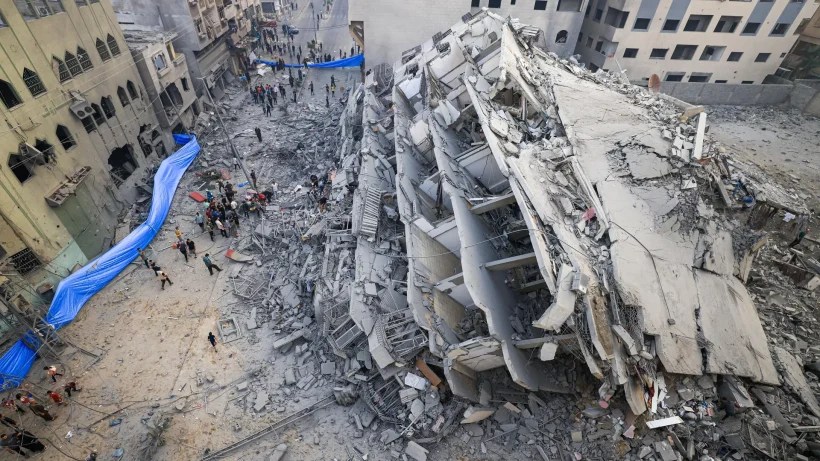
People inspect the ruins of a building destroyed in Israeli strikes in Gaza City on October 8, 2023
By James Tweedie – Sputnik – 24.10.2023
China has dispatched its special envoy to the Middle East in a bid to bring the latest escalation between Israel and Hamas to an end. Peace activist, writer and teacher KJ Noh said the US response exposed its warmongering nature.
The US has unmasked its true nature by blocking efforts by China and other nations to bring peace to the Middle East, says a peace activist.
Chinese special envoy to the Middle East Zhai Jun said on Monday he had already visited Qatar and Egypt and would now travel to the United Arab Emirates, Saudi Arabia, Jordan and other countries in the region “to further strengthen coordination with relevant parties to promote ceasefire, end violence and mitigate the situation.”
More than 5,000 civilians have been killed and 13,000 injured in the besieged Gaza Strip by Israeli Defence Forces bombing since the armed wing of the Hamas movement launched a surprise attack into southern Israel on October 7. The victims include more than 2,000 children and 1,000 women.
Last week the US blocked UN Security Council motions moved by Russia and Brazil calling for an immediate ceasefire between Israel and the Palestinian territories and for civilians to be protected. Washington has also sent two US Navy aircraft carrier strike groups and a seaborne assault flotilla to the region to back up Israel.
Peace campaigner KJ Noh told Sputnik that Washington was directly opposed to Beijing’s attempts to broker a peace deal between Israel, Hamas and other states and movements in the region.
“China is using its good offices, scrambling to do shuttle diplomacy to try and de-escalate and find a peaceful resolution,” Noh said. “And the United States is saying: ‘Don’t even dare talk about de-escalation. Nobody mention a ceasefire’.”
“It only wants to make sure that whatever Israel does, it does it with a minimum of PR blowback,” he added. “And so it’s trying to mitigate the PR damage rather than prevent the horrific war crimes and atrocities that are sure to happen and that are already happening.”
The writer said this was a “mask-off moment” when the West’s true nature was exposed to the nations of the global south.
“The US could plausibly mystify many countries by pretending to be something that it was not,” Noh argued. “But when it came out all in favor of Israel’s violence and was ignoring the ground realities as well as international law, then at that point you can’t keep up the pretence any more.”
“Even the quisling leaders of US allies have had to make a conscientious statement because the outrage on the street, the outrage globally is so extraordinary that they cannot but speak up against what the US and Israel are doing,” he stressed.
Western media has tried to dismiss China’s peace initiatives as an attempt to position itself as a geopolitical rival to the US — a narrative which Noh called “extraordinary”.
“The notion that somehow peace is nefarious, that China is being unprincipled in that it’s trying to work for peace — China is on the side of peace. That much is clear because that it stands to gain from peace,” he said.
“Everybody benefits from peace. It just is because China’s model is win-win cooperation,” Noh said. “On the other hand, the empire benefits from war. The US is built on more genocide, primitive accumulation and geopolitical oppression and bullying.”
Chinese Businessmen Literally Laughing at West’s Anti-Russian Sanctions

By Ilya Tsukanov – Sputnik – 21.10.2023
Chinese businessmen are literally laughing at the West’s sanctions packages against Russia, Russian Foreign Ministry spokeswoman Maria Zakharova has revealed.
Citing a media report from Friday indicating that the 12th package of EU sanctions may include a Lithuania-proposed ban on the export of European-made nails, tacks, drawing pins, sewing and knitting needles, radiators, and other odds and ends to Russia, Zakharova said that judging by past experience, she can hardly fathom how Russia’s Chinese partners will react to the news.
“A year ago I was at a meeting with representatives of Chinese business circles in Moscow. We were talking, and suddenly a message popped up on my phone with news that the US had adopted yet another sanctions package banning the supply of elevators and related equipment to Russia. According to the sanctions’ authors, this measure would ‘paralyze the construction industry in Russia.’ When I read this news to my Chinese colleagues, they burst out in Homeric laughter. They literally howled and roared with laughter,” Zakharova recalled in a Telegram post on Saturday.
“After the ‘sanctions hara-kiri’ of the Japanese automobile industry on the Russian market, the most incredible dream of Chinese automotive manufacturers came true. Within six months, they confirmed the veracity of the saying ‘nature abhors a vacuum’,” the spokeswoman added.
“It’s scary to imagine what kind of hysteria will begin among Chinese manufacturers of knitting needles and buttons if they learn about this Lithuanian plan to ‘destroy Russian industrial capabilities.’ Where will Lithuania put its wares if such a decision is made? I don’t know, they could put the inscription ‘to spite Russia’ on their highway made of buttons, nails, sewing and knitting needles,” Zakharova summed up.
Russian-Chinese trade has hit back-to-back-to-back record highs in recent years, reaching the equivalent of over $176 billion by the end of the third quarter of the current year. The Asian industrial giant has taken to importing record quantities of Russian energy and other natural resources, and has helped fill the gap left by European and Japanese finished goods manufacturers after their exodus from Russia in 2022.
Speaking with Chinese media ahead of his visit to the Belt and Road Initiative forum earlier this week, Russian President Vladimir Putin reported a “32 percent growth” in Russia-China trade turnover over the past year, and said that “there is every reason to believe that we will reach the $200 billion mark” by the end of 2023.
The reorientation of trade from Europe to China, India and other countries in the developing world has helped Russia weather the storm of Western sanctions and trade restrictions, with the country’s GDP growth expected to reach up to 2.5 percent in 2023 after contracting by 2.1 percent a year earlier.
Shipping of Cargo from Arkhangelsk to China via Northern Sea Route to Become Regular
PortNews | October 20, 2023
The first ship with a load of more than 300 containers with lumber for China partners is about to depart from the Port of Arkhangelsk. The load will be delivered along the Northern Sea Route (NSR) to Shanghai in a few days, the governor and government of the Arkhangelsk Oblast said.
Alexander Tsybulsk, Governor of the Arkhangelsk Region commented: “Chinese furniture manufacturers are interested in the products of our timber processing enterprises and are ready to purchase annually up to 1 million cbm of lumber in Arkhangelsk.”
“The first shipment including more than 300 containers of lumber will soon leave for Shanghai. Shipping of cargo along the NSR between Russia and China will become regular. Our new partners plan for the next shipping season to load two vessels here per month, and in the future provide six vessel calls per month,” the official said.
The volume of cargo transported from Arkhangelsk along the Northern Sea Route will be growing in the coming years. This will support forestry enterprises in Russia’s north-west regions through government measures, including subsidizing the timber products transport.
The growth of trade volume with Chinese partners also contribute to the implementation of Vladimir Putin’s May decree to boost cargo flow along the Northern Sea Route, which should reach 80 million tonnes per year by 2024.
“The planned sailing of a containership along the Northern Sea Route is an important event for us, since China is the main direction of cargo transportation. We see great interest from Chinese partners in our products and the desire of local manufacturers to cooperate,” says Evgenia Shelyuk interim minister for economic development, industry and science of the Arkhangelsk Oblast.
Featured Video

Macgregor: We Haven’t Seen the Worst of the Iran War Yet
or go to
Aletho News Archives – Video-Images
From the Archives
15 Saudi ‘hijackers’ were CIA agents working for US: Scholar
Press TV – April 13, 2016
Fifteen of the 9/11 “hijackers” from Saudi Arabia were CIA agents working for the United States government, which was seeking to destroy the Middle East for Israel and to double the American military budget, says Dr. Kevin Barrett, an American academic who has been studying the events of 9/11 since late 2003…. continue
Blog Roll
 Aletho News
- Iran’s Plan to Shut Down AI in the Persian Gulf
- Israel seeks ‘compensation’ from Washington over Saudi F-35 sale
- Saudi crown prince seeks dialogue with Ansarullah after Yemeni blows: Report
- Damascus rejects Saudi request for Syrian fighters to counter Yemen: Report
- South Korea says will not send troops to join terrorist US war on Iran
- Russia Just Struck the Eyes of NATO’s War Machine in Ukraine
- Russia summons UK charge d’affaires over Kiev drone support
- NATO member warns bloc seeking pretext for war with Russia
- Macgregor: We Haven’t Seen the Worst of the Iran War Yet
- ‘We are not like everyone else’ laws that bind other nations do not apply to Israel, says Likud lawmaker
- If Americans Knew
- Debunking The Claim That Macklemore Has A “History Of Antisemitism”
- CPJ demands release of arrested Palestinian-US journalist near Bethlehem
- Robert Kraft: The Billionaire Friend of Netanyahu Pulling The Strings Behind the Macklemore/Ed Sheeran Blow Up
- Columbia Administered Fund Gives Big Money to Pro-Israel Groups
- Deportation Case of Palestinian Activist Salah Sarsour Tests First Amendment
- ‘We Will Not Forget’: Palestinians Mark 44 Years since Sabra and Shatila
- Why do we let Zionists decide what we can and can’t say?
- US welcomes Israeli, Iranian delegations to UN, but not Palestinians – Daily Update
- Biden’s Genocide Accomplices Targeted by New Accountability Campaign
- AIPAC’s Network Has Already Spent $67.2 Million to Shape the Midterm Elections
- No Tricks Zone
- New Study: ‘Global Drought Shows No Detectable Recent Acceleration Under Climate Warming’
- Economic Masterminds: German Socialists Suggest Taxing Productivity Gains Stemming From Using AI
- The South China Sea Has Not Been Cooperating With The Climate Change Narrative
- Energy Crisis: Germany Enters Heating Season With Historically Low Gas Reserve Fill Levels
- New Study: The Antarctic Ice Sheet Gained Mass From 2020-2024 Due To Staggering Snow And Ice Accumulation
- Study: Ocean Heating Rates From Thousands Of Years Ago ‘Dwarf’ Modern Ocean Heating Rates
- Climate Extremists Target, Attack Large-Scale Power Grid Infrastructure In Germany!
- New Study: Antarctic Ice Melt Has Contributed Less Than 1 Centimeter To Sea Level Rise In The Last 30 Years
- Fear Of Debate: Alarmist German Climate Scientist Calls On Mainstream Media To Discredit Skeptic Voices
- End-Of-August Arctic Sea Ice Extent Hasn’t Fallen In 20 Years, Official Data Show!
 Aletho News