Don’t Let The Elite Get Away With Gaslighting That They Didn’t Know About Biden’s Senility
By Andrew Korybko | June 29, 2024
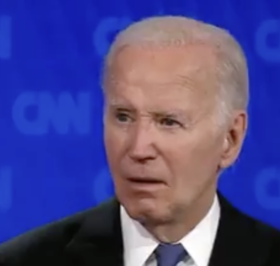 Biden’s disastrous debate performance last week made it impossible to deny his senility, yet the Western elite is gaslighting they were supposedly oblivious to this until now. Time Magazine published a piece titled “Inside Biden’s Debate Disaster and the Scramble to Quell Democratic Panic”, which was complemented by CNN’s about how “Foreign diplomats react with horror to Biden’s dismal debate performance”. Both make it seem like Biden’s senility is a surprise for everyone who knew him.
The reality is that they knew about this all along but covered it up by lying that any claims to this effect were “Russian propaganda” and/or a “conspiracy theory”, all because they actually approved of the Democrats installing a literal placeholder in the White House who the liberal–globalist elite could control. It was a refreshing change of pace from Trump, who was much too independent for their liking despite his occasional capitulations to their demands, and it also reassured America’s allies who disliked him too.
They both went along with the lie that Biden is in tip-top mental condition for reasons of political convenience, but now it’s impossible to keep up the charade any longer, hence why they’re all feigning surprise and shock. The elite shouldn’t be allowed to get away with their latest gaslighting and should be exposed for one of the greatest cover-ups in American history. The country is being ruled by a shadowy network of transnational and domestic elites that are united by their radical liberal-globalist ideology.
Biden was chosen as the Democrats’ candidate in 2020 precisely because he was already senile and therefore completely controllable. That party, which functions as the public face of the abovementioned elite network, wanted someone who’d do whatever they demanded on the home and foreign policy fronts. In particular, they sought to turn America into a liberal-globalist hellhole while ramping up NATO’s containment of Russia in Ukraine, but the second policy backfired after the special operation began.
Nevertheless, they’ll never have another chance to install someone like Biden since 2020 was an exceptional election year due to it being a referendum on Trump – who a significant share of the public was preconditioned to falsely believe is the new Hitler – and mail-in voting due to COVID-19. These conditions can never be replicated in the same way again no matter how hard the elite try, which is why they decided to keep Biden as their candidate instead of replace him early on.
Although there’s now a push by some for him to be replaced during the party’s upcoming national convention, Politico and NBC News among others both pointed out that this would be a difficult process, so there’s no guarantee that they’ll seriously attempt it. That said, he might also suffer some sort of emergency that incapacitates him more than he already is, so the scenario can’t be ruled out. In that case, they’ll still do everything they can to gaslight that they had no idea that he was so unhealthy.
Any acknowledgement that they were aware of this would expose their role in 2020’s de facto coup, which was the elite’s latest after the ones in 2001, 1974, and 1963. Back then, 9/11 was exploited as the pretext for taking the national security state to its next level, while Nixon’s resignation in the face of the CIA’s Watergate scandal was meant to remove a truly independent and popular visionary leader. As for Kennedy’s assassination, many believe that it was aimed to stop his planned withdrawal from Vietnam.
The elite’s latest coup was meant to turbocharge the US’ preexisting liberal-globalist trajectory after Trump partially offset it with his comparatively more conservative-nationalist policies, which necessitated provoking a proxy war with Russia in order to unify the West around this ideological cause. The damage has already been dealt and a lot of it is irreparable, but Trump’s return to power would still be better for Americans and the rest of the world, which is why the elite are dead-set against it.
Irrespective of whether the decision is made to replace Biden, which has its pros such as putting a more publicly appealing candidate on the ballot but also its cons like stoking panic about the party’s electoral prospects, the elite will do everything to cover up for their knowledge of his senility. Acknowledging that they knew about this would leave little doubt in the minds of many that the 2020 election was actually the elite’s latest coup, which his why they’re going overboard gaslighting about how they’re surprised.
If the war expands, will western facilities become the new target banks?
The Cradle | June 28, 2024
Israel’s brutal, nine-month military assault on Gaza has full support from several western-allied states, not only in supplying the occupation army’s war machine with a broad range of armaments and ammunition but also through direct military participation. The United States and Britain, for example, have provided vital reconnaissance and intelligence data and have sent their special forces to assist Israel in military operations.
An 8 June New York Times report revealed that US forces assisted the Israelis in retrieving four Israeli captives from Gaza’s Nuseirat refugee camp, killing at least 274 Palestinian civilians and three additional captives and leaving over 698 wounded. According to the paper’s Israeli sources, the US and UK provided intelligence from the air and cyberspace that Israel could not obtain on its own.
On 29 May, the Declassified UK media project reported that London authorized an unprecedented 60 Israel-bound flights using cargo planes that took off from the UK’s RAF Akrotiri air base in Cyprus, a facility covertly used by the US Air Force to move weapons to Israel.
The British government has not revealed the content of the air cargo transported – and maintains that no “lethal aid” is included. London instead claims that RAF flights to the occupation state are used to support its “diplomatic engagement” with Tel Aviv and repatriate British subjects – an odd use of military aircraft when Israel’s Ben Gurion Airport is still operational for regular passenger travel.
London has vigorously invoked its D-Notice since just after the war’s onset, a military and security directive aimed at preventing media outlets from publishing information that could harm national security, specifically relating to British airborne Special Forces (SAS) operations in Gaza. No further information has been revealed since the directive was issued on 28 October 2023.
How western intel penetrates West Asia
But all those concealment efforts were cracked open during Israel’s disproportionate military operation to secure the release of captives during the recent Nuseirat camp fiasco. Trending videos appeared of an Israeli helicopter landing next to the recently-installed $320 million US’ aid pier’ and of ‘aid trucks’ carrying special ops teams that were flanked by armored vehicles during the operation.
Media then reported that dozens of US and UK drones assisted in the Nuseirat camp assault, ostensibly by providing reconnaissance services to the Israeli military.
These incidents highlight not only direct western military participation in the war on Gaza but also the brazen exploitation of diplomatic cover or humanitarian work to prepare and carry out military actions that have led to mass civilian casualties and war crimes, as described by many United Nations institutions.
The question now is whether western facilities and troops will come under target as the war expands, potentially to Lebanon, given the evident collusion of western states in Israel’s aggressions – especially those in flagrant violation of international norms and law.
Although the use of embassies and civilian institutions – in the modern sense – as bases for intelligence gathering and launching special missions is not a new practice and dates back to at least the nineteenth century, current developments in technology and computing have enabled these facilities to act as spying and eavesdropping centers, monitoring and storing information for an entire country.
What was previously impossible has become reality through wireless communication and the Internet. Signal intelligence formerly gained by planting eavesdropping and listening devices can now be accessed via the common smartphone – with data funneled to these centers inside sovereign states.

Aerial view of the US embassy complex, northern Beirut.
‘Second-biggest US Embassy in the world’
Spawling approximately 174 thousand square meters, around 13 kilometers from the Lebanese capital of Beirut, lies the second largest embassy in West Asia – and the world. The new US Embassy in Beirut is surpassed in size only by its counterpart in Baghdad’s “Green Zone.”
Subtracting from the massive size of the embassy and its cost of nearly a billion dollars, there are many questions about the need for such facilities and what they contain.
The computer-generated images published by the embassy show a complex featuring multi-story buildings with tall glass windows, entertainment areas, a swimming pool surrounded by greenery, and views of the Lebanese capital. According to the project website, the complex includes an office, representative housing for employees, community facilities, and associated support facilities.
In May 2023, the Intelligence Online website reported that the massive billion-dollar complex will include a data collection facility, preparing the site as the new regional headquarters for US intelligence. The report says that because of its proximity to Syria, “Lebanon is considered a safe and strategic location for the deployment of intelligence agents already in the region as well as new personnel, who are selected directly from Washington-based agencies.”

Construction of the new US embassy, 13 kilometers north of the Lebanese capital of Beirut.
Although it is not possible to obtain precise information about the design of this embassy, the excavations below surface level, the use of reinforced concrete in the structure, and its fortified location on top of a hill suggest that there is more to its operations, especially since several precedents of the US Beirut diplomatic mission being implicated in the work of intelligence services exist.
The 1983 bombing of the American Embassy revealed a high CIA death toll, with eight killed, including the CIA’s chief West Asia analyst and Near East director, Robert Ames, station chief Kenneth Haass, James Lewis, and most of the CIA’s Beirut employees.
The embassy was not only used as a CIA hub but also as a key regional intelligence base due to Lebanon’s proximity to both the sea and two British NATO bases in southern Cyprus, Dhekelia and Akrotiri, from which reinforcements or helicopter transfers can arrive rapidly onto Lebanese soil. A recent example, in 2020, is Washington’s smuggling of its agent Amer al-Fakhouri from the US embassy using an Osprey helicopter.
British Watchtowers on Lebanon’s borders
On 3 May, Lebanon announced the visit of an official delegation and a senior British intelligence officer the previous month to discuss the construction of new UK-built watchtowers. These are in addition to the more than three dozen watchtowers built by Britain during the Syrian war along the sensitive border between Lebanon and Syria.
According to leaks reported by Lebanon’s Al-Akhbar newspaper, the British delegation had asked the Lebanese army “to approve a plan to establish watchtowers along the border with occupied Palestine, similar to those existing on the eastern and northern borders with Syria.”
Following the low-profile visit, Lebanese caretaker Prime Minister Najib Mikati disclosed: “Establishing the towers and taking measures along the border are Israel’s conditions for stopping the war with Lebanon.”
Last February, the Lebanese Foreign Ministry received an official Syrian protest note classifying the British watchtowers as a threat to Syrian national security on several levels. The main threat is the tower systems’ sensitive intelligence and espionage equipment, which “shines deep into Syrian territory and collects information about the Syrian interior.”
According to Al-Akhbar’s report, “the information output from this equipment reaches the hands of the British, and the Israeli enemy benefits from the output to target Syrian territory and carry out strikes deep inside Syria.” The Syrian memorandum also refers to “the presence of some British officers at the towers.”

A 30-foot British watchtower near the Lebanese-Syrian border
Security cameras monitor the surrounding area at a border point on Lebanon’s border with Syria (Photo by the Lebanese Army Command, Orientation Directorate)
The 38 British watchtowers that claim to assist Lebanese authorities in “combating smuggling” raise many questions instead, among them the reasoning behind the erection of such a large number of these structures. Why, too, do the towers contain thermal monitoring, eavesdropping, signal intelligence, and communications equipment – especially in light of the close relationship between Tel Aviv and London and the periodic presence of British officers in these towers under the pretext of training the Lebanese army?
A commanding officer of the Lebanese Armed Forces (LAF), interviewed at length by The Cradle in August 2021, contradicts London’s public claims about the towers, saying: “The aim of the towers today is to monitor the movements of Hezbollah and the Syrians.”
Dutch special forces in Dahiyeh
In March, Hezbollah captured several Dutch military forces operating covertly in Dahiyeh, the southern suburb of Beirut, which hosts several offices of the Lebanese Resistance. The detainees claimed they were operating under cover of the Dutch Embassy in Lebanon and were found with hundreds of thousands of dollars worth of military equipment and advanced communications devices on their persons and in their vehicles.
During investigations, the Dutchmen claimed they had entered the southern suburb as part of a training exercise for evacuating Dutch citizens and diplomats in the event of a war. However, no Dutch nationals of the embassy resided in that area. It was also found that the servicemen had not communicated about their mission with the Lebanese Ministry of Foreign Affairs, the Lebanese security services, or their country’s embassy.
That same month, a Spanish citizen was arrested for filming inside the same southern suburb of Beirut, only to discover later that he had a diplomatic passport and that his phone contained advanced software that prevented access to its data.
These events and a myriad of other examples show that some western governments continuously use western diplomatic and civilian facilities to gather intelligence or conduct special missions training in sovereign Lebanon.
These actions constitute a clear violation of the Vienna Convention on International Relations and the Vienna Convention on Consular Relations, which prohibit embassy diplomats from carrying out espionage activities. These actions don’t only place civilian populations in danger but also the thousands of professional diplomats in the country, all diplomatic missions, and the civilian facilities used as cover for illicit operations. They also drag otherwise immune diplomatic facilities into the legal framework of “hostilities,” intentionally or accidentally.
This danger is reinforced by Israel’s repeated violations of diplomatic and international norms, which are either ignored or protected by western allied states. Israel’s unprecedented military strikes against Iran’s consulate building in Damascus in April, for instance, did not receive the deserved condemnation from most western capitals, which helped it avoid the requisite UN Security Council censure.
Since the basic value of international norms is the precedent and event on which this law is built, the possibility increases that such western-supported attacks will backfire wildly and lead to the retaliatory targeting of western facilities and embassies – all in the context of new legal precedents and customs created that no longer prohibit strikes on suspect non-military facilities.
It is yet unknown to what extent western governments can expect to maintain their double standards in the application of international law and customs, especially if the Gaza war they are materially supporting expands to Lebanon or other West Asian regions.
The Resistance Axis, which has, in the past nine months, normalized military strikes on Israel, missile attacks on Israel-destined shipping vessels, and weekly strikes on US and UK naval fleets, are but one escalation away – as in, a declared war on Lebanon – to create a new set of target banks that surpass their last ones.
Does that then include the US embassy in Baghdad, the largest in the region – and the world – hosting 10 thousand American employees and troops, or, closer to home, the second largest embassy in West Asia, the US embassy in Beirut?
It is difficult to imagine that such facilities will remain immune if western involvement remains apparent, which we already know to be a constant, daily flow of armaments to fuel Israel’s war machinery and provide Tel Aviv with military intelligence and target banks.
It will be even harder to protect diplomatic missions if they reveal themselves to essentially act as military command centers or intelligence hubs during the conduct of war. Targeting these facilities – which are already in breach of the Vienna Convention – can easily fall within the framework of self-defense and reciprocity as long as western states and Israel continue to normalize these illicit activities.
If the Gaza war established entirely new rules of engagement throughout the region, do Israel’s western allies expect to escape unscathed in an expanded war? How do they think they can arm military aggression against a country and yet remain safely in its capital city?
Does Biden’s Degraded Mental State Matter?
By Jacob G. Hornberger | FFF | June 28, 2024
Most everyone, especially Democrats, is expressing alarm over President Biden’s mental state after his debate performance last night. Biden, who later said that he was suffering from a cold, displayed attributes of severe mental decline. Many Democrats are even saying that Biden needs to drop out of the presidential race now so that the Democrats have plenty of time to promote a new candidate before the November election.
While critics are focusing on the political ramifications of Biden’s apparent mental decline, the real issue is the fact that he will still be president for the next five months. This is especially important given the proxy war that the U.S. is waging against Russia in Ukraine. That’s a war that could easily turn nuclear, especially if Biden inadvertently engages in actions that trigger a severe Russian response.
However, it isn’t Biden who is in charge of running the U.S. proxy war against Russia. That’s the good news. As I have long argued, the people who are in charge of that operation are the ones inside the U.S. national-security establishment — the Pentagon, the CIA, and the NSA. That’s the bad news.
Longtime readers of my work know that I have long recommended an excellent book by a man named Michael J. Glennon entitled National Security and Double Government. Glennon’s thesis, to which I subscribe, is that it is the U.S. national-security part of the federal government that is actually running the show, especially in foreign affairs. They permit the president, the Congress, and the Supreme Court to maintain the veneer of being in charge, so as to keep people tranquil and pacified. What matters is that they wield the real power over the federal government.
Glennon is not some sort of crackpot. He is a professor of law at Tufts University and a former counsel to the Senate Foreign Relations Committee. Read his bio here. His thesis deserves to be taken seriously. If every American were to read Glennon’s book, I have no doubts that most of them would end up agreeing with his thesis.
The big problem we have with the Pentagon, the CIA, and the NSA is that we are dealing with people with military mindsets. It’s all black and white with these people. Russia, bad. China, bad. Iran, bad. North Korea, bad. Syria, bad. Gaza, bad. Cuba, bad. Vietnam, bad, now good. In their minds, the purpose of a massive military establishment is to put bad regimes down by whatever means possible.
As most everyone now realizes, the national-security establishment’s goal since 1945 has been to bring Russia to heel — and make it a full-fledged loyal lapdog of the U.S. Empire, much like Great Britain is. That necessarily means regime change, just like the regime changes that the Pentagon and the CIA have brought to so many other nations.
For a while, it appeared that the quest to bring down Russia ended with the end of the Cold War. Not so. That was just a temporary interlude. Almost immediately the Pentagon and the CIA embarked on a quest to use NATO, an old Cold War bureaucratic dinosaur, to begin absorbing former members of the Warsaw Pact, with the ultimate aim of absorbing Ukraine, which would enable U.S. officials to place their nuclear missiles, troops, armaments, planes, and tanks right on Russia’s border, all of which, it was hoped, would end up bringing the goal of regime change in Russia closer to fruition.
Throughout this process, and knowing that Russia would never permit Ukraine to join NATO, U.S. officials were training the Ukrainian military to fight a defensive war, once NATO succeeded in provoking Russia into invading Ukraine. The idea was that a Ukrainian victory would almost certainly result in the ouster of Russian President Vladimir Putin, at which point he would, it was hoped, be replaced with a loyal U.S. lapdog.
The scheme has not worked, and it has become painfully clear that the United States cannot win this war. The only real question is what a Russian victory will ultimately look like.
And that’s where the danger of the military mindset comes into play. The national-security establishment cannot bear the thought of the U.S. losing to Russia, even if it’s a proxy war with Russia rather than a direct war.
Rather than simply acknowledging that they should never have started this war and simply withdraw from the conflict, the military and the CIA are doubling down. The risk is that they will do whatever is necessary to prevent a Russian defeat of the United States in Ukraine. That’s why they are now talking about putting NATO troops and armaments into Ukraine in the hopes of staving off defeat. And that’s where the very real prospect of nuclear war comes into play.
Would the United States be better off with a president who suffers from a severe downgrade in mental faculties being in charge rather than with generals and CIA officials being in charge? The question is irrelevant because the reality is that it’s the military-intelligence establishment that is actually in charge. And that’s why we are getting ever closer to the prospect of a life-ending nuclear war.
“Human Rights NGOs” and the Corruption of Civil Society
BY GLENN DIESEN | JUNE 10, 2024
The organisations operating under the banner of “human rights non-governmental organisations” (NGOs) have become key actors in disseminating war propaganda, intimidating academics, and corrupting civil society. The NGOs act as gatekeepers determining which voices should be elevated and which should be censored and cancelled.
Civil society is imperative to balance the power of the state, yet the state is increasingly seeking to hijack the representation of civil society through NGOs. The NGOs can be problematic on their own as they can enable a loud minority to override a silent majority. Yet, the Reagan doctrine exacerbated the problem as these “human rights NGOs” were financed by the government and staffed by people with ties to intelligence agencies to ensure civil society does not deviate significantly from government policies.
The ability of academics to speak openly and honestly is restricted by these gatekeepers. Case in point, the NGOs limit dissent in academic debates about the great power rivalry in Ukraine. Well-documented and proven facts that are imperative to understanding the conflict are simply not reported in the media, and any efforts to address these facts are confronted with vague accusations of being “controversial” or “pro-Russian”, a transgression that must be punished with intimidation, censorship, and cancellation.
I will outline here first my personal experiences with one of these NGOs, and second how the NGOs are hijacking civil society.
My Encounter with the Norwegian Helsinki Committee
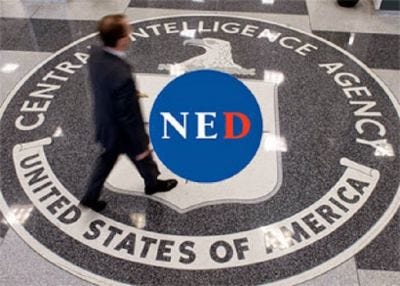
The Norwegian Helsinki Committee is one of these “NGOs” financed by the government and the CIA-cutout National Endowment for Democracy (NED). They regularly publish hit pieces about me and rarely miss their weekly tweets that label me a propagandist for Russia. It is always name-calling and smearing rather than anything that can be considered a coherent argument.
The standard formula for cancellation is to shame my university in every article and tweet for allowing academic freedom, with the implicit offer of redemption by terminating my employment as a professor. Peak absurdity occurred with a 7-page article in a newspaper in which it was argued I violated international law by spreading war propaganda. They grudgingly had to admit that I have opposed the war from day one, although for a professor in Russian politics to engage with Russian media allegedly made me complicit in spreading war propaganda.
Every single time I am invited to give a speech at any event, this NGO will appear to publicly shame and pressure the organisers to cancel my invitation. The NGO also openly attempt to incite academics to rally against me to strengthen their case for censorship in a trial of public opinion. Besides whipping up hatred in the media by labelling me a propagandist for Russia, they incite online troll armies such as NAFO to cancel me online and in the real world. After subsequent intimidations through social media, emails, SMS and phone calls, the police advised me to remove my home address and phone number from public access. One of the Norwegian Helsinki Committee recently responded by posting a sale ad for my house, which included photos of my home with my address for their social media followers.
The Norwegian Helsinki Committee also infiltrates and corrupts other institutions. One of the more eager Helsinki Committee employees is also a board member at the Norwegian organisation for non-fictional authors and translators (NFFO) and used his position there to cancel the organisation’s co-hosting of an event as I had been invited to speak. The Norwegian Helsinki Committee is also overrepresented in the Nobel Committee to ensure the right candidates are picked.
Why would a humanitarian NGO act like modern Brownshirts by limiting academic freedom? One could similarly ask why a human rights NGO spends more effort to demonise Julian Assange rather than exploring the human rights abuses he exposed.
This “human rights NGO” is devoted primarily to addressing human rights abuses in the East. Subsequently, all great power politics is framed as a competition between good values versus bad values. Constructing stereotypes for the in-group versus the out-groups as a conflict between good and evil is a key component of political propaganda. The complexity of security competition between the great powers is dumbed down and propagandised as a mere struggle between liberal democracy versus authoritarianism. Furthermore, they rest on the source credibility of being “non-governmental” and merely devoted to human rights, which increases the effectiveness of their messaging.
By framing the world as a conflict between good and evil, mutual understanding and compromise are tantamount to appeasement while peace is achieved by defeating enemies. Thus, these “human rights NGOs” call for confrontation and escalation against whoever is the most recent reincarnation of Hitler, while the people calling for diplomacy are denounced and censored as traitors.
NGOs Hijacking Civil Society
After the Second World War, American intelligence agencies took on a profound role in manipulating civil society in Europe. The intelligence agencies were embarrassed when they were caught, and the solution was to hide in plain sight.
The Reagan Doctrine entailed setting up NGOs that would openly interfere in the civil society of other states under the guise of supporting human rights. The well-documented objective was to conceal influence operations by US intelligence as work on democracy and human rights. The “non-governmental” aspect of the NGOs is fraudulent as they are almost completely funded by the government and staffed with people connected to the intelligence community. Case in point, during Ukraine’s “Orange Revolution” in 2004, an anti-corruption protest was transformed into a pro-NATO/anti-Russian government. The head of the influential NGO Freedom House in Ukraine was the former Director of the CIA.
Reagan himself gave the inauguration speech when he established the National Endowment for Democracy (NED) in 1983. The Washington Post wrote that NED has been the “sugar daddy of overt operations” and “what used to be called ‘propaganda’ and can now simply be called ‘information'”.[1] Documents released reveal that NED cooperated closely with CIA propaganda initiatives. Allen Weinstein, a cofounder of NED, acknowledged: “a lot of what we do today was done covertly 25 years ago by the CIA”.[2] Philip Agee, a CIA whistle-blower, explained that NED was established as a “propaganda and inducement program” to subvert foreign nations and style it as a democracy promotion initiative. NED also finances the Norwegian Helsinki Committee.
The NGOs enable a loud Western-backed minority to marginalise a silent majority, and then sell it as “democracy”. Protests can therefore legitimise the overthrow of elected governments. The Guardian referred to the Ukrainian Orange Revolution in 2004 as “an American creation, a sophisticated and brilliantly conceived exercise in Western branding and mass marketing” for the purpose of “winning other people’s elections”.[3] Another article by the Guardian labelled the Orange Revolution as a “postmodern coup d’état” and a “CIA-sponsored third world uprising of cold war days, adapted to post-Soviet conditions”.[4] A similar regime change operation was repeated in Ukraine in 2014 to mobilise Ukrainian civil society against their government, resulting in overthrowing the democratically elected government against the will of the majority of Ukrainians. The NGOs branded it a “democratic revolution” and was followed by Washington asserting its dominance over key levers of power in Kiev.
Similar NGO operations were also launched against Georgia. The NGOs staged Georgia’s “Rose Revolution” in 2003 which eventually resulted in war with Russia after the new authorities in Georgia attacked South Ossetia. Recently, the Prime Minister of Georgia cautioned that the US was yet again using NGOs in an effort to topple the government to use his country as a second front against Russia.[5] Georgia’s democratically elected parliament passed a law with an overwhelming majority (83 in favour vs 23 against), for greater transparency over the funding of NGOs. Unsurprisingly, the Western NGOs decided that transparency over funding of NGOs was undemocratic, and it was labelled a “Russian law”. The Western public was fed footage of protests for democratic credibility, and they were reassured that the Georgian Prime Minister was merely a Russian puppet. The US and EU subsequently responded by threatening Georgia with sanctions in the name of “supporting” Georgia’s civil society.
Civil Society Corrupted
Society rests on three legs – the government, the market and civil society. Initially, the free market was seen as the main instrument to elevate the freedom of the individual from government. Yet, as immense power concentrated in large industries in the late 19th century, some liberals looked to the government as an ally to limit the power of large businesses. The challenge of our time is that government and corporate interests go increasingly hand-in-hand, which only intensifies with the rise of the tech giants. This makes it much more difficult for civil society to operate independently. The universities should be a bastion of freedom and not policed by fake NGOs.
[1] D. Ignatius, ‘Innocence Abroad: The New World of Spyless Coups’, Washington Post, 22 September 1991.
[2] Ibid.
[3] I. Traynor, ‘US campaign behind the turmoil in Kiev’, The Guardian, 26 November 2004.
[4] J. Steele, ‘Ukraine’s postmodern coup d’état’, The Guardian, 26 November 2004.
[5] L Kelly, ‘Georgian prime minister accuses US of fueling ‘revolution attempts’’, The Hill, 3 May 2024.
Stanford’s Censorship Operation finally shut down by the University, but only after the chutzpah became unbearable
BY MERYL NASS | JUNE 14, 2024
Stanford’s Internet Observatory was a surveillance-censorship operation (discussed previously) that spit on the First Amendment, worked closely with fed intelligence agents and trained students to break the law. God only knows what techniques were developed here in the heart of Silicon Valley to mind control the citizenry.
And they were so brazen! The spooks pretended they were academics doing “research.” But where are their advanced degrees? Where are their courses? Why isn’t Renee DiResta listed in the faculty directory?
The Observatory’s main figurehead, Renee DiResta, “ex” CIA asset, just published a book about her wondrous exploits saving the world from TRUTH.

And Stanford itself was so brazen, it filed an amicus brief to the Supreme Court to complain about how it was unjustly cited for its criminal collusion with the USG to censor political, intellectual, scientific, medical etc. opponents in the Missouri v Biden censorship case. It was just “research.”

Finally, Stanford could not stand the heat, and is getting out of the kitchen. Bye-bye.


Syria on the brink of recovery as Qatar and Turkey change their policies
By Steven Sahiounie | Mideast Discourse | June 3, 2024
The Emir of Qatar, Tamim al Thani, recently said that he supports the street protests in Idlib, where people are protesting the dictatorial rule of the Hayat Tahrir al-Sham (HTS) terrorist group.
This marks a monumental change in policy for Qatar, and maybe the first step toward restoring diplomatic ties with Syria.
Beginning in 2011, and the Obama administration’s US-NATO war on Syria for regime change, Qatar has been a close and loyal ally to the US, and was used as a financial backer of the various terrorist groups brought into Turkey, and trucked across the border to Idlib.
Sheikh Hamad bin Jassim bin Jaber bin Mohammed bin Thani Al Thani, former Prime Minister of Qatar, and foreign minister until 2013, gave an interview in which he admitted Qatar provided the money to bankroll the terrorists in Syria as they attacked the Syrian people and state. He made it clear that the cash delivered was sanctioned, and administered by the US in Turkey. Qatar was not working alone, but under a strictly controlled partnership with the US government.
In 2017, President Trump shut down the CIA operation Timber Sycamore which ran the failed project to overthrow the Syrian government.
Qatar is now turning their back on the terrorists who occupy Idlib. Mohamed al-Julani is the leader of HTS. He is Syrian, raised in Saudi Arabia, fought with Al Qaeda in Iraq against the US, aligned with ISIS founder Baghdadi, came to Syria from Iraq to develop Jibhat al-Nusra, the Al Qaeda branch in Syria.
Once Jibhat al-Nusra became an outlawed terrorist group, Julani switched the name to HTS in order to preserve his support from Washington, DC. Even though the US has a $10 million bounty on his head issued by the US Treasury Department, he is safe and secure in Idlib, where American journalists have visited him for interviews, in which he has sported a suit and tie, wishing to present himself as a western-leaning terrorist that the US can count on.
When the Syrian Arab Army and the Russian military would fire a bullet towards the terrorists in Idlib, the US would denounce it as an attack on innocent civilians. This kept Julani safe and secure, and in charge of humanitarian aid coming across the border from Turkey. The aid was from the UN and various international charities. While the 3 million people living in Idlib are not all terrorists, all the aid passes through the hands of Julani and his henchmen. If you bow down to Julani, you get your share of rations, but if you have complained, you are denied. Those who are cut off from the aid can buy their supplies from Julani at his Hamra Shopping Mall, which he built in Idlib, where he sells all the surplus aid sent to Idlib.
The civilians in Idlib have taken to the streets protesting the rule of HTS. Many people have been arrested by HTS, some tortured, and others killed. The people are demanding that Julani leave.
They are asking for freedom and a fair administration. The various aid agencies have complained that HTS will not allow any free programs for women, such as learning employable skills. Women there are not allowed to seek employment, except in places which are only female. HTS rules with a strict form of Islamic law, which they interpret to their benefit.
Saudi Arabia and Syria have established full normal relations, with an exchange of ambassadors. At the Arab League Summit in May in Bahrain, the Crown Prince of Saudi Arabia, Mohamed bin Salman (MBS) met personally with Syrian President Bashar al-Assad. They also met at the previous Arab League Summit in Saudi Arabia.
MBS recently announced a humanitarian grant to the UN to repair 17 hospitals in Syria which had been damaged in the 7.8 earthquake which killed 10 thousand in Syria.
MBS also sent spare parts for the Syrian Air commercial planes, which had suffered under US sanctions and were prevented from maintaining their safety by Washington. Recently, the very first planes of Syrians began flying to Saudi Arabia for the first time in 12 years, to perform the Haj pilgrimage.
On May 30, the leader of Iraq said he hopes to announce a Turkey-Syria normalization soon. Turkey, like Qatar, had been supporting the various terrorist groups in Syria in cooperation with the US.
Turkey also has made a turn-around in their position, and has been looking for a way to exit Idlib and the other areas it occupies in Syria, in preparation of a re-set with Damascus.
The relationship between the US and Ankara has remained tense after the US partnered with the Syrian Defense Forces (SDF). Turkey considers the SDF as a branch of the PKK, the outlawed international terrorists group who has killed 30,000 people over three decades, while wanting to establish a Kurdish State.
The SDF are planning to have elections on June 11 in an effort to gain western support for a Kurdish State. Erdogan has stated Turkey will never allow this to happen.
If the SDF were to lay down their arms, they could repair their relationship with Damascus, and at the same time Turkey could then withdraw their occupation forces from Syria. With Turkey out of Syria, their normalization process could begin.
When the SDF have repaired their broken relationship with Damascus, and the Turkish threat no longer exists, then the US military can withdraw their 900 occupation force from Syria.
Recently, General Mazloum, the leader of the SDF, said that the problems between the Kurds and Damascus are internal problems, and cautioned against any foreign interference, especially from Turkey.
The situation is changing rapidly in Syria. The economy is collapsed, with the inflation rate over 100% in the last year due to crippling US sanctions. Because the US military is occupying the largest oil and gas field in Syria, this prevents the production of electricity for the national grid, and Syrians are living with three hours of electricity per day.
US sanctions prevent some of the most vital medicines from being imported, as western medical companies are fearful of running afoul of the US sanctions, and have produced a culture of over-compliance, which deprives Syrian citizens’ life-saving medicines and medical supplies.
The battlefields have been silent for years, and the silence grew into a status-quo, where the American and Turkish foreign policy prevented a resolution to the conflict that has destroyed lives and prompted the largest human migration in recent history as Syrians have sought work abroad.
Turkey, Saudi Arabia and Qatar all played significant roles assigned to them by the US State Department under the Obama administration. There is a light at the end of the tunnel with the reversal of policies toward Syria, and Qatar and Turkey are set to play major roles in the recovery process in Syria. These reversals are also significant as they mark a change in the relationship between the US and several regional countries. This is part of the ‘New Middle East’ that Washington called for, but the role the US played has left them the loser.
The Closing of the Internet Mind
The definition of online freedom has been depressingly constricted over the last thirty years
By Aaron Kheriaty, Debbie Lerman, Andrew Lowenthal, and Jeffrey Tucker | The American Mind | May 22, 2024
You have surely heard that your search results on Google (with 92 percent share of the search market) reflect not your curiosities and needs but someone or something else’s views on what you need to know. That’s hardly a secret.
And on Facebook, you are likely inundated by links to official sources to correct any errors you might carry in your head, as well as links to corrections to posts as made by any number of fact-checking organizations.
You have likely also heard of YouTube videos being taken down, apps deleted from stores, and accounts being canceled across a variety of platforms.
You might have even adjusted your behavior in light of all of this. It is part of the new culture of Internet engagement. The line you cannot cross is invisible. You are like a dog with an electric shock collar. You have to figure it out on your own, which means exercising caution when you post, pulling back on hard claims that might shock, paying attention to media culture to discern what is sayable and what is not, and generally trying to avoid controversy as best you can in order to earn the privilege of not being canceled.
Despite all the revelations regarding the Censorship Industrial Complex, and the wide involvement of government in these efforts, plus the resulting lawsuits that claim that this is all censorship, the walls are clearly closing in further by the day.
Users are growing accustomed to it, for fear of losing their accounts. For example, YouTube (which feeds 55 percent of all video content online) allows three strikes before your account is deleted permanently. One strike is devastating and two existential. You are frozen in place and forced to relinquish everything–including your ability to earn a living if your content is monetized–if you make one or two wrong moves.
No one needs to censor you at that point. You censor yourself.
It was not always this way. It was not even supposed to be this way.
It’s possible to trace the dramatic change from the past to present by following the trajectory of various Declarations that have been issued over the years. The tone was set at the dawn of the World Wide Web in 1996 by digital guru, Grateful Dead lyricist, and Harvard University fellow John Perry Barlow, who died in 2018.
Barlow’s Declaration of the Independence of Cyberspace, somewhat ironically written in Davos, Switzerland, is still hosted by the Electronic Frontier Foundation that he founded. The manifesto waxes lyrical about the liberatory, open future of internet freedom:
Governments of the Industrial World, you weary giants of flesh and steel, I come from Cyberspace, the new home of Mind. On behalf of the future, I ask you of the past to leave us alone. You are not welcome among us. You have no sovereignty where we gather.
We have no elected government, nor are we likely to have one, so I address you with no greater authority than that with which liberty itself always speaks. I declare the global social space we are building to be naturally independent of the tyrannies you seek to impose on us. You have no moral right to rule us nor do you possess any methods of enforcement we have true reason to fear.
Governments derive their just powers from the consent of the governed. You have neither solicited nor received ours. We did not invite you. You do not know us, nor do you know our world. Cyberspace does not lie within your borders. Do not think that you can build it, as though it were a public construction project. You cannot. It is an act of nature and it grows itself through our collective actions.
And so on it went with a heady, expansive vision–tinged perhaps with a dash of sixties utopian anarchism–that shaped the ethos which drove the building of the Internet in the early days. It appeared to a whole generation of coders and content providers that a new world of freedom had been born that would shepherd in a new era of freedom more generally, with growing knowledge, human rights, creative freedom, and borderless connection of everyone to literature, facts, and truth emerging organically from a crowd-sourced process of engagement.
Nearly a decade and a half later, by 2012, that idea was fully embraced by the main architects of the emergent app economy and the explosion of smartphone use across the world. The result was the Declaration of Internet Freedom that went live in July of 2012 and garnered a great deal of press attention at the time. Signed by the EFF, Amnesty International, Reporters Without Borders, and other liberty-focused organizations, it read:
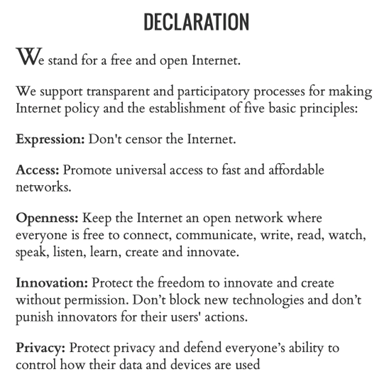
To be sure, it was not quite as sweeping and visionary as the Barlow original but maintained the essence, putting free expression as the first principle with the lapidary phrase: “Don’t censor the Internet.” It might have stopped there, but given the existing threats coming from growing industrial cartels and the stored-data marketplace, it also pushed openness, innovation, and privacy as first principles.
Again, this outlook defined an era and elicited broad agreement. “Information freedom supports the peace and security that provides a foundation for global progress,” said Hillary Clinton in an endorsement of the freedom principle in 2010. The 2012 Declaration was neither right-wing nor left-wing. It encapsulated the core of what it meant to favor freedom on the Internet, exactly as the title suggests.
If you go to the site internetdeclaration.org now, your browser will not reveal any of its contents. The secure certificate is dead. If you bypass the warning, you will find yourself forbidden from accessing any of the contents. The tour through Archive.org shows that the last living presentation of the site was February 2018.
This occurred three years after Donald Trump publicly advocated that “in some places” we have to talk about “closing up the Internet.” He got his wish, but it came after him personally following his election in 2016. The very free speech about which he made fun turned out to be rather important to him and his cause.
Two years into the Trump presidency, precisely as the censorship industry started coalescing into full operation, the site of the Declaration site broke down and eventually disappeared.
Fast forward a decade from the writing of the Internet Declaration of Freedom. The year is 2022 and we had been through a rough two years of account takedowns, particularly against those who doubted the wisdom of lockdowns or vaccine mandates. The White House revealed on April 22, 2022 a Declaration for the Future of the Internet. It comes complete with a parchment-style presentation and a large capital letter in old-fashioned script. The word “freedom” is removed from the title and added only as a part of the word salad that follows in the text.
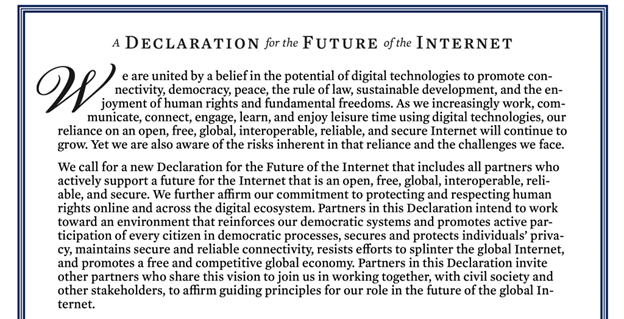
Signed by 60 nations, the new Declaration was released to great fanfare, including a White House press release. The signatory nations were all NATO-aligned while excluding others. The signatories are: Albania, Andorra, Argentina, Australia, Austria, Belgium, Bulgaria, Cabo Verde, Canada, Colombia, Costa Rica, Croatia, Cyprus, Czech Republic, Denmark, Dominican Republic, Estonia, the European Commission, Finland, France, Georgia, Germany, Greece, Hungary, Iceland, Ireland, Israel, Italy, Jamaica, Japan, Kenya, Kosovo, Latvia, Lithuania, Luxembourg, Maldives, Malta, Marshall Islands, Micronesia, Moldova, Montenegro, Netherlands, New Zealand, Niger, North Macedonia, Palau, Peru, Poland, Portugal, Romania, Serbia, Slovakia, Slovenia, Spain, Sweden, Taiwan, Trinidad and Tobago, the United Kingdom, Ukraine, and Uruguay.
The core of the new declaration is very clear and represents a good encapsulation of the essence of the structures that govern content today: “The Internet should operate as a single, decentralized network of networks – with global reach and governed through the multistakeholder approach, whereby governments and relevant authorities partner with academics, civil society, the private sector, technical community and others.”
The term “stakeholder” (as in “stakeholder capitalism”) became popular in the nineties as distinct from “shareholder” meaning a partial owner. A stakeholder is not an owner or even a consumer but a party or institution with a strong interest in the outcome of the decision-making by the owners, whose rights might need to be overridden in the broader interests of everyone. In this way, the term came to describe an amorphous group of influential third parties that deserve a say in the management of institutions and systems. A “multistakeholder” approach is how civil society is brought inside the tent, with financing and seeming influence, and told that they matter as an incentive to woke-wash their outlooks and operations.
Using that linguistic fulcrum, part of the goal of the new Declaration is explicitly political: “Refrain from using the Internet to undermine the electoral infrastructure, elections and political processes, including through covert information manipulation campaigns.” From this admonition we can conclude that the new Internet is structured to discourage “manipulation campaigns” and even goes so far as to “foster greater social and digital inclusion within society, bolster resilience to disinformation and misinformation, and increase participation in democratic processes.”
Following the latest in censorship language, every form of top-down blockage and suppression is now justified in the name of fostering inclusion (that is, “DEI,” as in Diversity [three mentions], Equity [two mentions], and Inclusion [five mentions]) and stopping dis- and mis-information, language identical to that invoked by the Cybersecurity Infrastructure Security Agency (CISA) and the rest of the industrial complex that operates to stop information spread.
This agency was created in the waning days of the Obama administration and approved by Congress in 2018, supposedly to protect our digital infrastructure against cyberattacks from computer viruses and nefarious foreign actors. But less than one year into its existence, CISA decided that our election infrastructure was part of our critical infrastructure (thereby asserting Federal control over elections, which are typically handled by the states). Furthermore, part of protecting our election infrastructure included protecting what CISA director Jen Easterly called our “cognitive infrastructure.”
Easterly, who formerly worked at Tailored Access Operations, a top secret cyber warfare unit at the National Security Agency, coined the queen of all Orwellian euphemisms: “cognitive infrastructure,” which refers to the thoughts inside your head. This is precisely what the government’s counter-disinformation apparatus, headed by people like Easterly, are attempting to control. True to this stated aim, CISA pivoted by 2020 to become the nerve center of the government’s censorship apparatus–the agency through which all government and “stakeholder” censorship demands are funneled to social media companies.
Now consider what we’ve learned about Wikipedia, which is owned by Wikimedia, the former CEO of which was Katherine Maher, now slated to be the head CEO of National Public Radio. She has been a consistent and public defender of censorship, even suggesting that the First Amendment is “the number one challenge.”
The co-founder of Wikipedia, Joseph Sanger, has said he suspects that she turned Wikipedia into an intelligence-operated platform. “We know that there is a lot of backchannel communication,” he said in an interview. “I think it has to be the case that the Wikimedia Foundation now, probably governments, probably the CIA, have accounts that they control, in which they actually exert their influence. And it’s fantastic, in a bad way, that she actually comes out against the system for being ‘free and open.’ When she says that she’s worked with government to shut down what they consider ‘misinformation,’ that, in itself, means that it’s no longer free and open.”
What happened to Wikipedia, which all search engines privilege among all results, has befallen nearly every prominent venue on the Internet. The Elon Musk takeover of Twitter has proven to be aberrant and highly costly in terms of advertising dollars, and hence elicits vast opposition from the venues that are on the other side. That his renamed platform X even exists at all seems to run contrary to every wish of the controlled and controlling establishment today.
We have traveled a very long way from the vision of John Perry Barlow in 1996, who imagined a cyberworld in which governments were not involved to one in which governments and their “multi stakeholder partners” are in charge of “a rules-based global digital economy.” In the course of this complete reversal, the Declaration of Internet Freedom became the Declaration for the Future of the Internet, with the word freedom consigned to little more than a passing reference.
The transition from one to the other was–like bankruptcy–gradual at first and then all at once. We’ve traveled rather quickly from “you [governments and corporate interests] are not welcome among us” to a “single, decentralized network of networks” managed by “governments and relevant authorities” including “academics, civil society, the private sector, technical community and others” to create a “rules-based digital economy.”
And that is the core of the Great Reset affecting the main tool by which today’s information channels have been colonized by the corporatist complex.
Peter Daszak Gets DOD and CIA Funding. Why Don’t They Ask About That?
“Suspending” HHS funding to EcoHealth is pure theater. No real oversight is happening.
BY DEBBIE LERMAN | MAY 17, 2024
Peter Daszak is the President of EcoHealth Alliance, the organization most closely associated with the potential lab leak at the Wuhan Institute of Virology (WIV) that may have started the Covid crisis.
The U.S. House Committee on Oversight and Accountability has recently done a lot of “research” on Daszak and EcoHealth, resulting in a published report on May 1, 2024 with the earth-shattering finding that there exist “serious and systemic weaknesses in the federal government’s—particularly NIH’s—grant making processes.” Furthermore, these very bad weaknesses “not only place United States taxpayer dollars at risk of waste, fraud, and abuse but also risk the national security of the United States.”
This sounds pretty serious: Our taxpayer dollars and our national security are at risk. Some very bad things are happening, apparently. What are those bad things? “Weaknesses in the NIH’s grant making process.” Is that really all the Committee could come up with? If those grant-making weaknesses are so terrible, what does it recommend we do about them?
Based on its findings, the Committee recommended some very broad, but not very specific, actions:
- To Congress: “Reign in [they used “reign” instead of “rein” – a noteworthy Freudian slip] the unelected bureaucracy, especially within government funded public health.
- To the Administration: Recognize EcoHealth and its President, Dr. Daszak, as bad actors…and ensure neither EcoHealth nor Dr. Daszak are awarded another cent, especially for dangerous and poorly monitored research.
The Administration must have taken heed, because a mere two weeks later, on May 15, 2024, the Subcommittee made this triumphant announcement:
“HHS has begun efforts to cut off all U.S. funding to this corrupt organization. EcoHealth facilitated gain-of-function research in Wuhan, China without proper oversight, willingly violated multiple requirements of its multimillion-dollar National Institutes of Health grant, and apparently made false statements to the NIH. These actions are wholly abhorrent, indefensible, and must be addressed with swift action.”
Note the bizarre disconnect between the description of “this corrupt organization” and its “abhorrent, indefensible” actions, and the accusations leading to such extreme claims, which include conducting research without proper oversight (nobody ever does that!), violating requirements of its NIH grant (a bureaucratic infraction) and “apparently” making false statements to the NIH (not even for sure).
In any event, “swift action” must be taken. What exactly is that action?
“HHS has begun efforts to cut off all U.S. funding” to EcoHealth. “Begun efforts” – sounds like concrete results are imminent. Not just imminent but consequential. Like “future debarment” and “funding suspension.” (sarcasm intended)
But wait. Didn’t they already do that? Yes, they did.
2020 funding suspension
Quick reminder: On April 24, 2020, the NIH canceled funding for Wuhan Institute of Virology (WIV) gain-of-function research led by EcoHealth Alliance, because the Trump Administration suspected (or knew) such research may have had something to do with the Covid pandemic.
The scientific world was outraged. Seventy-seven U.S. Nobel Laureates and 31 scientific societies wrote to NIH leadership requesting review of the decision. Gain-of-function research must continue! In August 2020 the NIH reversed the cancellation and started funding EcoHealth and WIV again. [ref]
The Nobel Laureates and scientific societies won the day: Humanity-saving research to develop deadly pathogens not found in nature could continue unhindered by radical NIH funding cuts.
And yet: NIH grants are a mere fraction of EcoHealth Alliance’s overall government funding.
So which funds are being “suspended” this time around?
Actually, none.
The very threatening “notice of suspension and proposed debarment” sent to EcoHealth Alliance by HHS on May 15, 2024, reassures the organization (whose behavior has been abhorrent and indefensible) that “suspension and debarment actions are not punitive.”
We’re not trying to punish you for your bad behavior, the letter says. We just want to make sure there are non-punitive “consequences” for that behavior. For example:
Offers will not be solicited from, contracts will not be awarded to, existing contracts will not be renewed or otherwise extended for, and subcontracts requiring United States Federal Government approval will not be approved for EHA [EcoHealth Alliance] by any agency in the executive branch of the United States Federal Government, unless the head of the agency taking the contracting action determines that there is a compelling reason for such action.
[BOLDFACE ADDED]
In other words, if the head of the “agency taking the contracting action” determines there is “a compelling reason” to contract with Ecohealth, then this whole suspension and debarment thing is moot. So not punitive. And, pretty much, no consequences. And, also, no funds “suspended.”
Nevertheless, given the horrendous behavior of EcoHealth, as detailed in the announcement of the non-punitive consequences – how could any government agencies possibly have compelling reasons to engage in “contracting action” with “this corrupt organization”?
EcoHealth is mostly funded by the State Department and Pentagon
In an extensive expose on Peter Daszak and EcoHealth Alliance, The Intercept reported in December 2021:
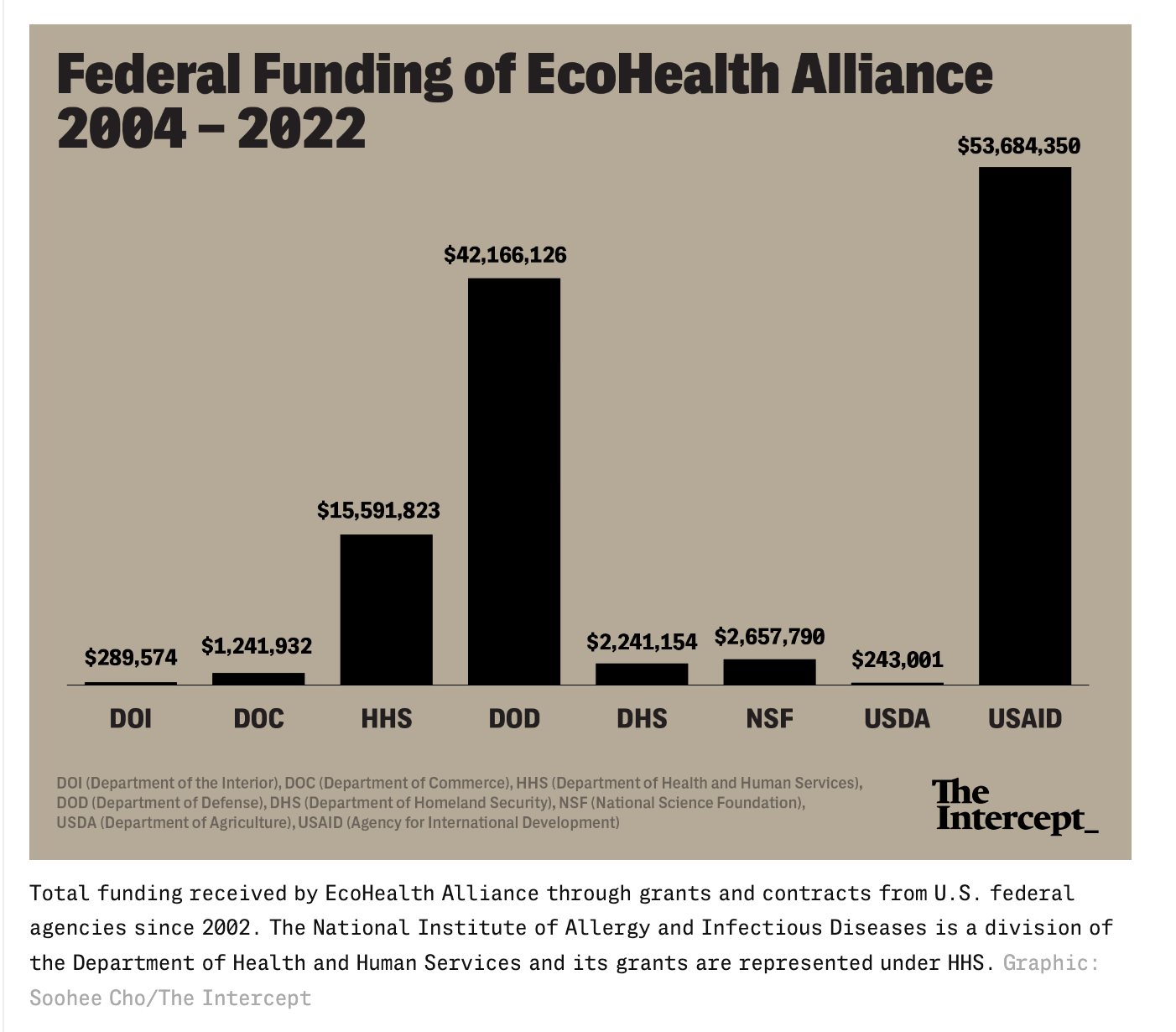
EcoHealth Alliance’s funding from the U.S. government, which Daszak has said makes up some 80 percent of its budget, has also grown in recent years. Since 2002, according to an Intercept analysis of public records, the organization has received more than $118 million in grants and contracts from federal agencies, $42 million of which comes from the Department of Defense. Much of that money has been awarded through programs focused not on health or ecology, however, but on the prevention of biowarfare, bioterrorism, and other misuses of pathogens.
[BOLDFACE ADDED]
Here’s what nearly two decades of government funding for EcoHealth Alliance looks like (graph from Intercept article):
As RFK Jr. wrote, based on this information, in The Wuhan Cover-Up:
By far, Daszak’s largest funding pool was the CIA surrogate, the United States Agency for International Development (USAID). Through USAID, the CIA funneled nearly $65 million in PREDICT funding to EcoHealth between 2009 and 2020.
(p. 228, Kindle Edition)
Yet another article examining Daszak’s military/biodefense ties appeared in Independent Scientist News in December 2020, reporting that most of EcoHealth Alliance’s Pentagon funding “was from the Defense Threat Reduction Agency (DTRA), which is a branch of the DOD which states it is tasked to “counter and deter weapons of mass destruction and improvised threat networks.”
Furthermore,
The military links of the EcoHealth Alliance are not limited to money and mindset. One noteworthy ‘policy advisor’ to the EcoHealth Alliance is David Franz. Franz is former commander of Fort Detrick, which is the principal U.S. government biowarfare/biodefense facility.
The ISN article also provides a handy spreadsheet detailing EcoHealth funding.
So what is the Oversight Committee overlooking – and why?
There is no mention of DoD, DTRA or USAID funding in the Committee’s announcement or in the utterly performative, 100% toothless notice of suspension and debarment they sent to Peter Daszak. Does the U.S. House Committee on Oversight and Accountability not know who the major government funders of EcoHealth Alliance are?
If any agency can bypass the suspension and debarment by “determining that there is compelling reason” to fund EcoHealth, what is the point of those non-punitive consequences?
Why this charade of accountability when, in fact, the supposed overseers are willfully ignoring what’s actually going on?
Clearly, the Committee is not interested in investigating Daszak’s role in the biodefense industry that was responsible not just for the gain-of-function research that may have created SARS-CoV-2, but for the entire Covid pandemic response – which was most definitely not about public health and was, in fact, all about creating and administering the medical countermeasures which were the monomaniacal focus of the biodefense responders.
What to ask Peter Daszak if we had actual oversight
If the Committee were serious about investigating Peter Daszak and EcoHealth Alliance, here are some questions they would ask:
Non-public health funding sources and projects
- Most of the government funding for EcoHealth Alliance comes not from public health agencies but from USAID (State Department/CIA) and the Pentagon. What projects are these non-public health agencies funding? Are these projects related to biodefense/biowarfare research?
- Is the USAID and Pentagon-funded virus research conducted by EcoHealth and/or its partners intended primarily to prepare for naturally occurring pandemics or for potential biowarfare/bioterrorism attacks?
- Do the USAID and Pentagon-funded projects conducted by EcoHealth and/or its partners involve creating pandemic potential pathogens as part of biodefense/biowarfare research?
- Do you know or suspect that SARS-CoV-2 was an engineered virus created as part of a USAID and Pentagon-funded biowarfare/biodefense project?
- Do the USAID and Pentagon-funded projects conducted by EcoHealth and/or its partners involve work on medical countermeasures against potential biowarfare/bioterrorism agents?
Disease X op-ed
- On February 27, 2020, before the Covid pandemic had been declared and before anyone in the U.S. had died of Covid-19, you wrote an op-ed for The New York Times stating that the novel coronavirus was “Disease X.” You explained that the term Disease X was coined by you and a bunch of experts at the World Health Organization in 2018. In your report from 2018, it says:
“Disease X represents the awareness that a serious international epidemic could be caused by a pathogen currently not recognized to cause human disease. Disease X may also be a known pathogen that has changed its epidemiological characteristics, for example by increasing its transmissibility or severity.”
Why were you so sure, so early on, even before we knew there was a pandemic, that this was Disease X? What was it about SARS-CoV-2 (which, after all, was named as a direct successor of the original SARS, to which it was said to be very similar) that made it seem so uniquely dangerous to you? Why did you feel you had to warn the whole world about it on the pages of the NYT?
- Did you think SARS-CoV-2 was a known pathogen that had “changed its epidemiological characteristics” by “increasing its transmissibility or severity”? If yes, what made you think that?
- Did you think SARS-CoV-2 was a potential bioweapon that had been developed using funds from USAID and DOD by EcoHealth Alliance and/or its research partners in China or elsewhere?
- The New York Times has subsequently erased your Disease X op-ed from their online 2/27/2020 issue. You can only find it through the direct link. Why do you think they have made it all but impossible for anyone who doesn’t already know about the article to find it? Do you regret having written it?
Linking Disease X to genetic vaccine platforms
- In the NYT op-ed, you provided a link from the term “Disease X” to a 2018 CNN article in which Dr. Anthony Fauci says that, in order to combat such dangerous as-yet-nonexistent pathogens, “the WHO recognizes that it must “nimbly move” and that this involves creating “platform technologies.”
Fauci goes on to say that “scientists develop customizable recipes for creating vaccines. Then, when an outbreak happens, they can sequence the unique genetics of the virus causing the disease, and plug the correct sequence into the already-developed platform to create a new vaccine.”
That sounds an awful lot like the mRNA platform used for the Covid countermeasures that came to be known as the “mRNA vaccines.”
Why did you link to that particular article from your op-ed about disease X? Were you suggesting that the solution to the pandemic that you appeared to be predicting would be a genetic platform in which the “correct sequence” could be plugged to create vaccines?
- Were you already aware of the Covid mRNA vaccines being developed at the time of your op-ed (February 27, 2020) by Moderna and BioNTech/Pfizer, long before the official launch of Operation Warp Speed (May 2020)?
- Is it true that the Pentagon considered the mRNA platforms to be the preferred countermeasures against Covid-19, and that these were always intended to reach full funding and development, starting all the way back in January 2020?
- Was the USAID and Pentagon-funded research conducted EcoHealth and/or its partners related to the development of such mRNA vaccines? If so, how?
The need for a crisis to justify funding and development of genetic vaccine platforms
- In 2016, you participated in an Institute of Medicine working group on Rapid Medical Countermeasure Response to Infectious Diseases. The report quotes you as saying:
“Until an infectious disease crisis is very real, present, and at an emergency threshold, it is often largely ignored. To sustain the funding base beyond the crisis, we need to increase public understanding of the need for MCMs such as a pan-influenza or pan-coronavirus vaccine. A key driver is the media, and the economics follow the hype. We need to use that hype to our advantage to get to the real issues. Investors will respond if they see profit at the end of the process.”
It sounds like you’re saying we need the media to hype up a crisis so that investors will want to fund the type of pan-coronavirus vaccine that is exactly the genetic platform you highlighted in your op-ed, and also exactly the platform that emerged into public awareness shortly after your op-ed, and became known as the Covid mRNA vaccines.
Can you explain this uncanny overlap between your description of what was needed to get such platforms developed in 2016 and what actually happened in 2020?
- Did the USAID and Pentagon-funded research on coronaviruses conducted by EcoHealth Alliance and/or its partners support the development of such platforms? If so, how?
- Were you aware of a plan to use the emergence of SARS-CoV-2 as a trigger for the media hype, public-private funding, and massive mRNA vaccine development and deployment in early 2020 – exactly as you described them in 2016?
- If you were aware of such a plan, who was involved in it, and what was your role?
CONCLUSION
The U.S. House Committee on Oversight and Accountability has made a big show of publicly chastising Peter Daszak and EcoHealth Alliance for terrible behavior in the way they managed their funding from the NIH. The Committee has also highlighted very bad weaknesses in the grant making process of the NIH that need to be corrected.
As a result of the Committee’s recommendations, the HHS (parent agency of NIH) has issued a non-punitive notice to Peter Daszak, stating that EcoHealth cannot receive another penny of government funding… unless a government agency decides there is a compelling reason to provide such funding.
Clearly, all of the Committee’s investigations, reports, recommendations and notices in this matter are purely performative, considering 1) they actually impose no consequences, and 2) they ignore the fact that most of Daszak and EcoHealth’s funding come from military and state department sources for work on biodefense/biowarfare-related projects.
Is the Committee’s work just another example of bureaucratic incompetence and “waste, fraud and abuse” of our precious taxpayer dollars?
Or is it an intentional diversion, to distract us from the work the U.S. government was/is actually funding at bioweapons labs like the one in Wuhan, engineering pandemic potential pathogens and then deploying global public-private partnerships to develop medical countermeasures against those pathogens – all of which came together to create the catastrophe known as the Covid pandemic?
A Global Censorship Prison Built by the Women of the CIA
Is building a slave state for Big Daddy the apex achievement of feminism?
By Elizabeth Nickson | Welcome to Absurdistan | May 18, 2024
The polite world was fascinated last month when long-time NPR editor Uri Berliner confessed to the Stalinist suicide pact the public broadcaster, like all public broadcasters, seems to be on. Formerly it was a place of differing views, he claimed, but now it has sold as truth some genuine falsehoods like, for instance, the Russia hoax, after which it covered up the Hunter Biden laptop. And let’s not forget our censor-like behaviour regarding Covid and the vaccine. NPR bleated that they were still diverse in political opinion, but researchers found that all 87 reporters at NPR were Democrats. Berliner was immediately put on leave and a few days later resigned, no doubt under pressure.

Even more interesting was the reveal of the genesis of NPR’s new CEO, Katherine Maher, a 41-year-old with a distinctly odd CV. Maher had put in stints at a CIA cutout, the National Democratic Institute, and trotted onto the World Bank, UNICEF, the Council on Foreign Relations, the Center for Technology and Democracy, the Digital Public Library of America, and finally the famous disinfo site Wikipedia. That same week, Tunisia accused her of working for the CIA during the so-called Arab Spring. And, of course, she is a WEF young global leader.
She was marched out for a talk at the Carnegie Endowment where she was prayerfully interviewed and spouted mediatized language so anodyne, so meaningless, yet so filled with nods to her base the AWFULS (affluent white female urban liberals) one was amazed that she was able to get away with it. There was no acknowledgement that the criticism by this award-winning reporter/editor/producer, who had spent his life at NPR had any merit whatsoever, and in fact that he was wrong on every count. That this was a flagrant lie didn’t even ruffle her artfully disarranged short blonde hair.
Christopher Rufo did an intensive investigation of her career in City Journal. It is an instructive read and illustrative of a lot of peculiar yet stellar careers of American women. Working for Big Daddy is apparently something these ghastly creatures value. I strongly suggest reading Rufo’s piece linked here. It’s a riot of spooky confluences.

Intelligence has been embedded in media forever and a day. During my time at Time Magazine in London, the bureau chief, deputy bureau chief and no doubt the “war and diplomacy” correspondent all filed to Langley and each of them cruised social London ceaselessly for information. Tucker Carlson asserted on his interview with Aaron Rogers this week that intelligence operatives were laced through DC media and in fact, Mr. Watergate, Bob Woodward himself, had been naval intelligence a scant year before he cropped up at the Washington Post as ‘an intrepid fighter for the truth and freedom no matter where it led.’ Watergate, of course, was yet another operation to bring down another inconvenient President; at this juncture, unless you are being puppeted by the CIA, you don’t get to stay in power. Refuse and bang bang or end up in court on insultingly stupid charges. As Carlson pointed out, all congressmen and senators are terrified by the security state, even and especially the ones on the intelligence committee who are supposed to be controlling them. They can install child porn on your laptop and you don’t even know it’s there until you are raided, said Carlson. The security state is that unethical, that power mad.
Now, it’s global. And feminine. Where is Norman Mailer when you need him?
At the same time, at the same time, Freddie Sayers, the editor-in-chief of Unherd, testified in Parliament on the Global Disinformation Index which had choked Unherd’s ability to grow. Unherd had hired three advertising firms who were, one after the other, unable to place ads. The third sourced the problem to the Index, which had deemed his interviews with journalist Katherine Stock about the problems faced by young people transitioning their sex, had made him persona non grata for all advertising agencies across the world. Eerily, that same week, Katherine Stock was awarded a high honorable mention in the National Press Awards for her work.
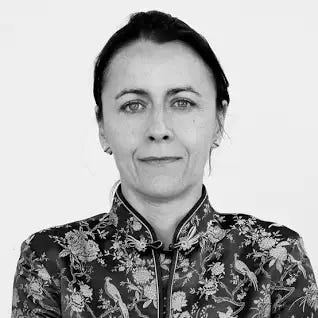
Here is Clare Melford, the fetching chief of the Global Disinformation Index, a woman seemingly bent on sterilizing confused children, Yet another non-profit authoritarian working for a mysterious Big Daddy. Who the hell trained her?
On Tuesday this week, out pops Europe’s headmistress, European Commission President Ursula von der Leyen in Politico.eu, complaining about “Russia” and “right-wingers” sowing distrust of Europe’s election processes. She is, she says, launching a new war on Disinformation. Most importantly, no more reporting on migrant assaults. This seems to be their new crusade. Please note the halo over her Christed head. Honestly, they are shameless, vain, silly creatures with limited bandwidth. Other than obedience to some grim reaper.
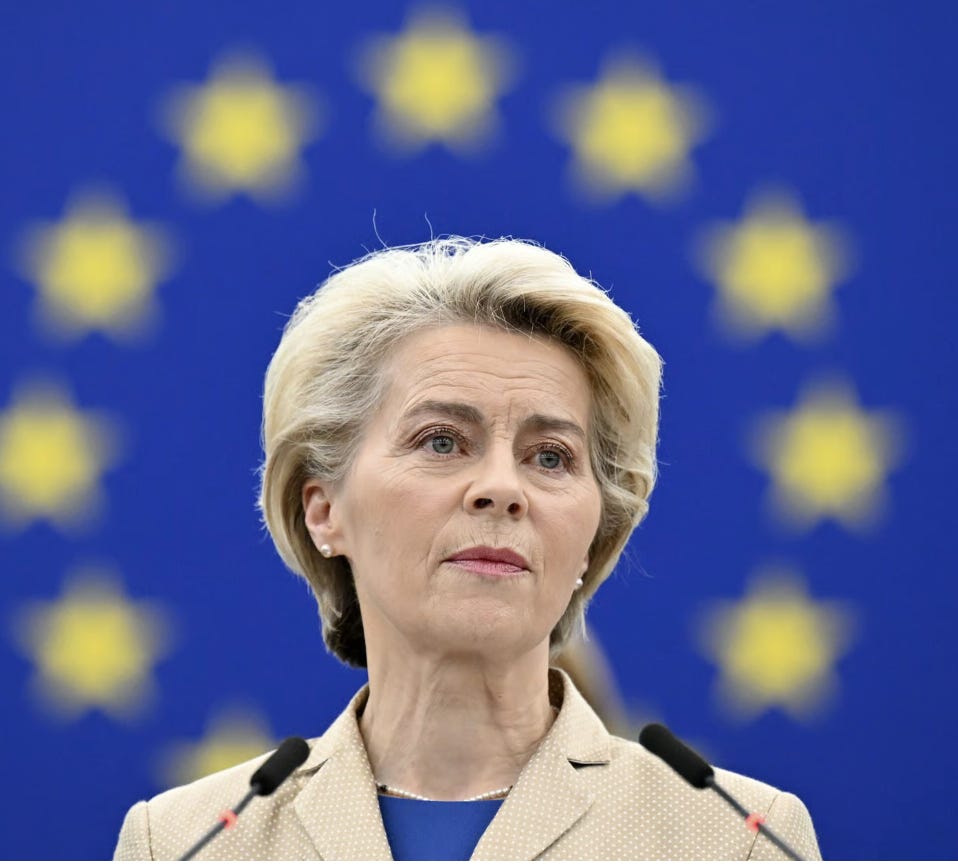
Said Politico :
“She promised to set up “a European Democracy Shield,” if reelected for a second term, to fight back against foreign meddling.
EU cybersecurity and disinformation officials expect a surge in online falsehoods in the 20 days prior to the European Parliament election June 6-9, when millions of Europeans elect new representatives. Officials fear that Russia is ramping up its influence operations to sow doubt about the integrity of elections in the West and to manipulate public opinion in its favor.”
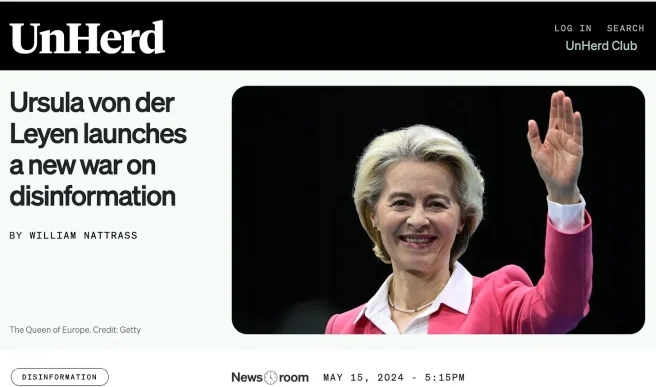
By the way, madam, western election integrity has been thoroughly compromised by the men who tell you what to do. More than half of us think elections are stolen. More than half. That’s not disinformation, it’s math.
This week Michael Shellenberger, who is the acknowledged lead in the take-down of the global censorship complex, had a look at Julie Inman Grant, another American Barbie, now Australia’s “e-safety commissioner,” with ties to the WEF. Grant had demanded that X censor a migrant stabbing, and X refused. Grant, as Shellenberger describes, is the Zelig of internet history tinkering in the bowels of said internet until she burst onto the public stage as Australia’s chief censor, bent on building a global online safety network.
Working for Big Daddy is apparently something these ghastly creatures value.
At a recent government hearing, she announced, “We have powerful tools to regulate platforms with ISP blocking power, and can collect basic device information, account information, phone numbers and email addresses, so that our investigators can at least find a place to issue a warning.” Grant went on to say they could compel take-downs, fine perpetrators and fine content hosts.
The Daily Mail had a ball with Inman Grant, mocking her and pointing out that she was wasting taxpayer money on a game of whack-a-mole.

Nevertheless, Grant takes herself very very seriously and since she is accreting power at a massive clip, so must we.
Grant’s network of independent regulators is called the Global Online Safety Regulators Network. “We have Australia, France, Ireland, South Africa, Korea, the UK and Fiji so far, with others observing. Canada is coming along,” she preens, “and is about to create a National Safety Regulator.” Canada’s proposed censorship program is so draconian you can be jailed for something you posted online years ago. And the government proposing it is so unpopular, it will be lucky to hang onto 20 seats in the next election.
There are literally hundreds of these women. Why? Why?
At a meeting this year of the World Economic Forum, Věra Jourová, from the European Commission, outlined just how exciting she and her team found the tools she is being given. “We can,” she said, “influence in such a way the real life and the behavior of people!” She sighed with excitement after this sentence. Jourova was caught last September trying to spread yet another Russia hoax. You have only to hear censorship plans uttered in a central-European accent to really understand what is happening here.

As terrifying as this all seems, and it is terrifying, it is instructive to look at the ruination of the career of America’s chief censor, Renée DiResta. DiResta, as research head of the Stanford Internet Observatory, is now being sued for abuse of power and unethical behavior that violates the constitution. Spookily, DiResta soared from “new mom” to providing the intellectual under-pinnning for censorship, until she headed up the Stanford Internet Observatory during Covid, where she was instrumental in censoring vaccine and Covid “disinformation.” People thought her backstory contrived and in fact, Shellenberger found that she was, unmistakably another CIA trained censor of inconvenient information under the guise of “safety.”
At this point, every time you hear the word ‘safety”, it’s best to check your ammunition supply. Said Shellenberger:
As research director of Stanford Internet Observatory, DiResta was the key leader and spokesperson of both the 2021 “Virality Project,” against Covid vaccine “misinformation” and the 2020 “Election Integrity Project.”
Shellenberger goes on to look into DiResta’s work history and finds a lot of congruence with CIA operations.
But then I learned that DiResta had worked for the Central Intelligence Agency (CIA). The journalist Matt Taibbi pointed me to the investigative research into the censorship industry by Mike Benz, a former State Department official in charge of cybersecurity. Benz had discovered a little-viewed video of her supervisor at the Stanford Internet Observatory, Alex Stamos, mentioning in an off-hand way that DiResta had previously “worked for the CIA.”
In her response to my criticism of her on Joe Rogan, DiResta acknowledged but then waved away her CIA connection. “My purported secret-agent double life was an undergraduate student fellowship at CIA, ending in 2004 — years prior to Twitter’s founding,” she wrote. “I’ve had no affiliation since.”
But DiResta’s acknowledgment of her connection to the CIA is significant, if only because she hid it for so long. DiResta’s LinkedIn includes her undergraduate education at Stony Brook University, graduating in 2004, and her job as a trader at Jane Street from October 2004 to May 2011, but does not mention her time at the CIA.
And, notably, the CIA describes its fellowships as covering precisely the issues in which DiResta is an expert. “As an Intelligence Analyst Intern for CIA, you will work on teams alongside full-time analysts, studying and evaluating information from all available sources—classified and unclassified—and then analyzing it to provide timely and objective assessments to customers such as the President, National Security Council, and other U.S. policymakers.”
At this juncture it is a race, as the intelligence community moves to shut down the revelations of its manipulations and machinations, and people injured by the vaccine and the flagrant abuse of election integrity move to fight them. It is instructive to note that DiResta, while apparently soaring to the heights of journalism at Wired, the New York Times, the Atlantic, selling her safety/censorhip program, cannot seem to get actual people to read or subscribe to her Substack. DiResta, like so many women in power now, are in reality, talentless cutouts for a hidden and malignant agenda.
An agenda that the people of the world roundly hate. I have just one final thing to saw to these truly dreadful human beings. My God is stronger than whatever demon or predator you obey. And as a woman, I am ashamed of each and every one of you. To use one of your awful phrases: Do Better.
U.S. Intelligence Operatives Appear to Have Intentionally Groomed Mass Murderer Charles Manson
Status As a Police Informant Raises Suspicion That He Was an FBI and CIA Asset Out to Discredit the 1960s Counterculture

Source: dagospia.com
By Daniel Borgström – CovertAction Magazine – May 1, 2024
 The Sharon Tate murders were as bizarre as they were bloody, and the story behind the story is even stranger.
Journalist Tom O’Neill spent 20 years researching, interviewing and digging in his effort to get to the bottom of it. His book, CHAOS: Charles Manson, the CIA and the Secret History of the Sixties, co-authored by Dan Piepenbring, is an account of O’Neill’s personal odyssey as well as a presentation of his findings which unfold, page after page, in tragedy, weirdness and irony.
Charles Manson’s hit-team killed ten people, perhaps more. That was in California, back in the summer of 1969, while the U.S. Armed Forces were busily slaughtering millions of Asians in Vietnam. And in opposition to that war, hundreds of thousands of Americans marched in mass protests—the anti-war movement.
Even GIs and military veterans were speaking out against the war. The counterculture movement was in full bloom, having started for at least since “the summer of love” two years earlier. Woodstock, an historic occasion which drew 400,000 people to a music event in Upstate New York, also took place the year of the Manson murders in that same month of August.
War, anti-war, and counterculture—it was all going on when Charles Manson and his “family” suddenly stole the show and took center stage with that series of infamous killings. First there was the Gary Hinman murder, then the Sharon Tate killings, followed by the LaBianca murders. Two more victims about whom we do not often hear were Donald Shea, a caretaker at the Spahn Ranch, and Filippo Tenerelli, who was found dead in a Bishop, California, motel.

Source: cbsnews.com
The FBI’s COINTELPRO and the CIA’s CHAOS programs were also in play—part of intelligence’s covert war on dissent. Several shadowy characters, apparently CIA operatives, turn up in this story and appear to have crossed paths with Charles Manson. Among them was Dr. Louis Jolyon West of the CIA’s MK-ULTRA mind-control project. Another was Reeve Whitson who somehow knew of the Tate killings 90 minutes before anyone else did, and reported it in a phone call to Tate’s photographer. O’Neill devotes a chapter to each of them.
Dr. Louis Jolyon West [Source: jamanetwork.com
Thirty years had passed since the killings when O’Neill began work on his project in 1999. Several of the key players had already died, but Charles Manson was still in prison, and memories of the killings remained painfully alive. The topic was initially assigned to O’Neill as a magazine article, and the editor gave him three months to complete it.
However, as he launched into it, interviewing dozens—eventually hundreds—of cops, DA lawyers, clerks, Hollywood personalities, drug dealers and others, he found there was far more to the story than he had ever imagined.
He missed his deadline, then his next deadline, and the one after that. The project became his obsession, and the digging and research continued on through 20 long years of plowing through troves of documents: court records, old newspaper files, FOIA requests, and interviews. Research can be frustrating, and clearly it was. “Behind every solid lead, quotable interview, and bombshell document, I put in weeks of scut work that led to dozens of dead ends,” O’Neill tells us. His book finally came out in 2019.
Tom O’Neill – Source: warwicks.com
Told in the first person, the book is a gripping detective story that I could not put down—actually an audio that I could not turn off. It is well written, and the audio by Kevin Stillwell is well read. My partner wanted to know what I kept listening to all the time. So I took off my headset and played it out into the room. She caught the bug and we listened to it together day after day, smitten by Tom O’Neill’s obsession.
At Charles Manson’s orders, people were murdered. This is a “mystery” where we know the “who-done-it” part of the story, but we are left to wonder and speculate about almost everything else—motives, the roles of intel and law enforcement, facts that were covered up, and who or what else might have been operating behind the scenes.
Crime novels typically end with the pieces all falling into place to form a coherent picture. Not so in most real-life crime mysteries, O’Neill cautions us. Some pieces are missing; others do not seem to belong, but they are there nonetheless, often in some grotesquely misshapen form.
A good many pieces are left over; they may seem important, but we do not know what to make of them. In this book, the author takes us into a world where cops, judges, prosecutors, witnesses and others do not function in ways that seem rational or above board.

Among the strange pieces in this picture puzzle is something O’Neill calls “Charlie Manson’s get-out-of-jail-free card.”
After having spent much of his life in various prisons, in 1967 Charles Manson was finally out on “federal parole for grand theft auto.” Being on probation is almost like living on the doorstep of a jailhouse.
A parolee can get thrown back in prison for the slightest mis-step. However, Charles Manson went around committing one offense after another—stealing cars, credit cards and firearms, sex with underage women, drugs, etc. Whatever a parolee was not allowed to do, Charles Manson did. He even flouted it. He was caught repeatedly, but none of his numerous violations landed him in jail for more than a few days at a time.
“We were told not to bother those people,” former Los Angeles County Deputy Sheriff Preston Guillory told O’Neill. It was a policy handed down from on high, Guillory said: “Make no arrests, take no police action toward Manson or his followers.”
Cops who had clues, evidence or solid proof of Manson’s violations were pulled back from their investigations. On the occasions when Manson was arrested, judges would let him go. His probation officer, Roger Smith, wrote glowing letters about Manson’s supposedly wonderful progress.
Normally, a probation officer would supervise 20 to 100 parolees; but Roger Smith was supervising only one person—Charles Manson. It was with the encouragement of Probation Officer Roger Smith that Manson spent a year in the Haight-Ashbury district of San Francisco, at the time a Mecca of the hippie counterculture.
There Charlie acquired his “family” of followers, and morphed into the Charles Manson known to history and legend—the charismatic guru and apocalyptic cult leader, acid-dropping mystic, guitarist and songwriter, con artist, car thief and general predator, manipulator and abuser, and evangelist who expatiated on the Book of Revelation.

Members of the Manson family. Source: reprobatepress.com
Manson was well-connected with Hollywood celebrities and music personalities: Doris Day’s son, music producer Terry Melcher, the Beach Boys, and many more, though most did not wish to have it known that they had been associated with him. Even after 30 years had passed, many refused to be interviewed by Tom O’Neill. The refusers’ list reads like a who’s who of Hollywood stardom. Cops and prosecutors were more inclined to talk, and some of them opened the author’s way to troves of documents and records.
Reading the accounts of these interactions, I sense that O’Neill must be something of a Will Rogers-type person who rarely met a person he did not like. And people in turn seemed to like him. Even officials who worked hard to cover things up seemed to warm up to him. Several, of course, including legendary prosecutor Vincent Bugliosi, eventually screamed at him and threatened to sue for millions of dollars.
Bugliosi was the attorney who had prosecuted Manson and afterwards wrote the best-selling Helter Skelter. In the courtroom and later in his book, Bugliosi presented Manson’s murder rampage as a scheme to blame the Black Panthers and thus spark a race war between blacks and whites. That became the official narrative, though it was doubted by people who had researched the case. Tom O’Neill devoted a chapter to reviewing “Holes in Helter Skelter”; he exposes Bugliosi’s handling of the case and does the coup de grâce on that theory.

Vince Bugliosi surrounded by reporters when he was prosecuting the Manson case in 1971. Source: nytimes.com
However, by the time O’Neill’s book came out, Bugliosi had passed on, and thus far his ghost has not risen up to carry out the threatened lawsuit. Another person who had threatened to sue O’Neill was music producer Terry Melcher, also dead by the time the book came out. There can be upsides to being a slow writer, taking a long time to do research.
Terry Melcher Source: alchetron.com
“I’d spoken to duplicitous celebrities, seedy drug dealers, bumbling cops, and spurious prosecutors. I’d been threatened and cajoled and warned off my investigation. But I didn’t have a smoking gun. There were only mountains of circumstantial evidence,” O’Neill tells us.
So he kept going, finding more pieces of the picture. And it reads like the script of a film noir.
Throughout the drama, Charles Manson was being closely monitored by law enforcement agencies and intel. And yet, even while they were watching him, he sent his acolytes out on those brutal killing sprees of August 1969. Incredibly enough, despite the surveillance, it took law enforcement four long months to eventually arrest him and his hit team. During those extra months of free rein, Manson killed Shea and Tenerelli and perhaps more.
Los Angeles County Sheriff’s Department detectives had almost immediately found clues leading to Charles Manson; many Hollywood people also suspected him. So why did it take law enforcement so long to catch him? It appears that the “hands off Manson policy” was still in effect.
Actually, Manson was not the only person in this story who seemed to be immune to prosecution; similar immunity appears to have been granted to two or three Hollywood drug dealers who turn up in the story. That seems to be a fairly common practice in law enforcement.
“A lot of times we arrest people and the DA would say, ‘We can’t keep this person in custody, he’s too valuable, we want him on the streets,’” former Los Angeles Sheriff’s Deputy Guillory told O’Neill. “My suspicion is that Manson was left alone for a while for some reason.”
Former head deputy DA of Van Nuys, Lewis Watnick, gave a similar opinion. “Sometimes this is explained by just pure incompetence,” he said. “But this is not that. It dovetails right in. Manson was an informant.” Of course, that was just his guess, Watnick conceded, but it was an educated one, based on his 30 years of experience. “They’d been watching this guy for something large.”
Looking at the tolerance that authorities had for Manson’s lawbreaking, his relationship with probation officer Roger Smith, and more, it is hard to avoid the conclusion that somebody up there had a major investment in Mr. Charles Manson. They must have wanted him to do something. But what?
Along with his findings, O’Neill shares his uncertainties. “My work had left me, at various points, broke, depressed, and terrified that I was becoming one of ‘those people’: an obsessive, a conspiracy theorist… I don’t consider myself credulous, but I’d discovered things I thought impossible about the Manson murders and California in the sixties.” Further on, he tells us, “I thought most of all about the possibility that Manson, of all people, had some type of protection from law enforcement… It boggled the mind even to speculate that someone like Manson could be plugged into something bigger, and presumably even darker, than he was.”
Something darker than Charles Manson? Our leaders, and the establishment they work for, have a lot of closely guarded secrets—secrets that occasionally make their way out by way of researchers, whistleblowers, hackers, and even congressional hearings.
For background on the political environment of the late 1960s, O’Neill reviews the establishment’s war against the anti-war movement. That includes cases of people who were murdered as a result of FBI and CIA activities and manipulations here in the U.S. He ties this brutality to U.S. actions overseas.

Anthony Herbert – Source: ronsherman.com
O’Neill looks at the CIA’s Phoenix Program in Vietnam, a kill-capture campaign, which resulted in the death of thousands of Vietnamese civilians. He quotes from a Special Forces soldier, Anthony Herbert, about his time in the Phoenix Program: “They wanted me to take charge of execution teams that wiped out entire families and tried to make it appear as though the Viet Cong had done it themselves. The rationale was that the Viet Cong would see that other Viet Cong had killed their own and… make allegiance with us. The good guys.”
A mission shared by the FBI’s COINTELPRO and the CIA’s CHAOS was to disrupt and discredit the anti-war movement, and that, O’Neill points out, was one effect of the Manson murders. Of course, Charles Manson was not an anti-war activist; it is doubtful that he ever attended an anti-war rally. He was a product of the prison system who somehow found his way into the fringes of the counterculture movement, and there was a lot of overlap between the anti-war and counterculture movements. Many hippies were anti-war, and many activists smoked grass and grew their hair long.

Scene from the 1967 Summer of Love that Manson and the CIA/FBI were out to destroy. Source: allthatsinteresting.com
The corporate media, then as now, was the voice of the establishment elite, and dutifully presented the murderous Manson and his “family” to the world as poster children of the “hippie movement.” A lot of people bought that framing. Even people who self-identified as countercultural were saying, “Manson ended the Summer of Love!”—a message the corporate media pushed.
Although the killings were billed as the “crime of the century” and have received massive newspaper coverage ever since, few articles went beyond the sensational aspects and asked truly penetrating questions. When (in 1971) whistleblower LA Sheriff’s Detective Guillory went public with what he knew about Manson’s get-out-of-jail-free card, the media showed little interest. Nor did many journalists work out a related source and connection between these killings and a society waging a brutal and unjust war.
We assume that our leaders in Washington care about the lives of ordinary people. Our experience with them shows otherwise.
We remember Vietnam. There have been several murderous wars since then, and now Gaza. As I write this, our president and our Congress are in the sixth month of funding, arming and giving diplomatic support to apartheid Israel’s genocide of Palestinians.
Our leaders are not averse to promoting mass murder. We have the immortal words of former U.S. Ambassador to the UN Madeleine Albright: When asked in 1996 about U.S. sanctions causing the deaths of hundreds of thousands of Iraqi children, she replied, “We think the price is worth it.”
The powers that be are a bloodthirsty lot when it serves their interests, every bit as murderous as Charles Manson himself. But who might have been the local- or regional-level functionaries authorizing immunity for such criminals?
O’Neill tells us about several high-placed California officials. One was Evelle Younger, then Los Angeles DA. Younger was a former FBI agent who, during World War II, was with the Office of Strategic Services (OSS), the forerunner of the CIA, and also oversaw the prosecution of Sirhan Sirhan; he went on to be California Attorney General from 1971 to 1979.
Evelle J. Younger Source: wikiwand.com
Another was California Governor Ronald Reagan’s chairman of the “Task Force on Riots and Disorders,” William W. Herrmann. Herrmann was a veteran of the CIA’s Phoenix Program; he had also been a lieutenant with the LAPD. However, O’Neill was not able to establish a definite connection between them and the on-the-ground operatives. We do get an idea of who they seem to have been.
In this book of strange dark characters, one of the stranger ones was Dr. Louis Jolyon West, known to his friends as “Jolly” West. He was a pioneering scientist of the CIA’s mind-control project—MK-ULTRA. In 1966 he came to San Francisco, shortly before Manson arrived, and his project was to study and manipulate hippies.
So there they were, the two of them, in the Haight-Ashbury. Tom O’Neill, with meticulous documentation, suggests that Manson became a product of Jolly West’s experiments.
Another dark character who seems to have worked for the CIA was Reeve Whitson, a friend of Sharon Tate and Roman Polanski. He somehow knew of the killings before anyone else did, and telephoned the awful news to Tate’s personal photographer, Shahrokh Hatami. That was 90 minutes before the bodies were discovered by Polanski’s maid.
Both Dr. Louis Jolyon West and Reeve Whitson are dead and gone, West in 1999 and Whitson in 1994, and are, thus, not available for interviews or comment.
In this book Tom O’Neill shows us convincing evidence that Charles Manson was some sort of operative, maybe unwittingly. It looks like the purpose of his handlers—presumably from the CIA’s CHAOS or the FBI’s COINTELPRO—was to set him up to create a bloody scene such as the one on August 9, 1969.
It needs to be recognized that Charles Manson and his followers served the establishment well. Nevertheless, they went to prison where they remained for the rest of their lives. Only one, Leslie Van Houten, was finally released last year on parole.
Featured Video
Rewriting the risk? Inside the government’s vaccine safety messaging
or go to
Aletho News Archives – Video-Images
Book Review
“Davos Can Really Replace the UN”
Inside the book that maps the architecture behind global governance — from the Epstein files to the Pact for the Future
Lies are Unbekoming | April 1, 2026
On June 13, 2019, the United Nations and the World Economic Forum signed a partnership deal to “accelerate the implementation of the 2030 Agenda for Sustainable Development.” That same evening, WEF president Börge Brende — Norway’s former Foreign Minister — had dinner with Jeffrey Epstein at Epstein’s Manhattan townhouse. The Epstein files, released January 2026, contain an exchange between the two from the previous year. Epstein to Brende: “Davos can really replace the UN. C21, cyber, crypto . genetics… intl coordination.” Brende back to Epstein: “Exactly — we need a new global architecture. World Economic Forum (Davos) is uniquely positioned — public private.”
The next day, the UN General Assembly adopted the framework for restructuring global governance.
That sequence — the partnership signing, the Epstein dinner, the candid admission about replacing the UN with a public-private architecture, and then the formal adoption — opens Jacob Nordangård’s The Digital World Brain. Pages two and three. Footnoted to the UN resolution number, the Epstein files, and the General Assembly record.
I keep coming back to it because it captures what this book does that almost nothing else in the independent research space manages. I’ve followed Jacob’s work for years now and interviewed him about his research. Each book peels back another layer of the same institutional architecture, and each time I think he’s reached the limit of what can be documented, the next one goes further. Nordangård doesn’t speculate. He doesn’t editorialize much. He lays institutional actions next to each other in chronological order and lets the pattern announce itself. … continue
Blog Roll
 Aletho News
- How I fell foul of the BBC thought police
- The End of NATO
- 37 days of war on Iran cost US staggering $42bln, tracker shows
- Baghdad tells Asian refiners, traders to begin loading Iraqi crude amid Iranian exemption
- Under fire, Moscow and Tehran close ranks
- Iran, US receive Pakistan-mediated plan for ceasefire then final deal
- Iran submits demands for end to war as mediators scramble ahead of Trump deadline
- Iran Threatens Retaliatory Strike on Stargate AI Project in UAE
- US sent ‘a lot’ of arms to Iranian protesters – Trump
- Barak Ravid Launders Deception To Allow Trump To Back Off Of His Power Plant Threat – Again
- If Americans Knew
- U.N. experts demand Israel release prominent Gaza doctor after reports of ‘severe torture’
- Israel’s Latest Genocide Is Against the Shias of Lebanon. Why Is the World Silent?
- How Eliot Cohen’s influence over U.S. war-making paved the way for Trump’s war crimes in Iran
- Israelis don’t pay for the weapons we ‘sell’ to them — US taxpayers do
- While Distancing from AIPAC, Most 2028 Democratic Hopefuls Are Still Embracing Israel
- A brief history of the Israeli nuclear program, the open secret at the heart of the Iran war
- Israeli Settlers Killed a Palestinian Farmer on His Own Land, in Front of His Father. Yes, Again
- The US-Israeli War on Science is an Assault on our Future
- 100+ International Law Experts Say US Strikes on Iran Violate UN Charter, Could Be War Crimes
- ‘Vile, Horrifying, Evil’: Trump Threatens to Bomb Nation of 90 Million People ‘Back to the Stone Ages’
- No Tricks Zone
- An Inconvenient Tree: Uncovered In Alps… Europe Much Warmer Than Today 6000 Years Ago
- New Study Reports A 60% Slowdown In Greenland’s Ice Loss Rate In The Last Decade
- Low Intensity Tornado Wrecks Major Solar Farm, Creating A Potential Toxic Dump
- New Study Finds Warming Saves Lives…Cold Temperatures 12 Times More Deadly Than Excess Heat
- German Science Blog Accuses PIK Climate Institute Of Hallucinating Climate Tipping Points
- Devastating Assessment Of Comirnaty Vaccine By Former Senior Pfizer Europe Toxicologist
- New Study: CO2 Is ‘Effectively Negligible’ As An Explanatory Climate Change Factor Since 2000
- Former Pfizer Toxicologist Dr. Helmut Sterz Tells Bundestag Hearing Pfizer Vaccine Should Have Never Been Approved
- Energy Expert: Germany’s Nuclear Phaseout Was A “500 Billion Euro Mistake”
- New Research: South Australia’s Mid-Holocene Sea Surface Temperatures Were 4°C Warmer Than Today
 Aletho News
