How an Israeli Spy-Linked Tech Firm Gained Access to the US Gov’t’s Most Classified Networks
Graphic by Claudio Cabrera
By Whitney Webb | MintPress News | January 14, 2020
If the networks of the U.S. military, the U.S. intelligence community and a slew of other U.S. federal agencies were running the software of a company with deep ties, not only to foreign companies with a history of espionage against the U.S. but also foreign military intelligence, it would — at the very least — garner substantial media attention. Yet, no media reports to date have noted that such a scenario exists on a massive scale and that the company making such software recently simulated the cancellation of the 2020 election and the declaration of martial law in the United States.
Earlier this month, MintPress News reported on the simulations for the U.S. 2020 election organized by the company Cybereason, a firm led by former members of Israel’s military intelligence Unit 8200 and advised by former top and current officials in both Israeli military intelligence and the CIA. Those simulations, attended by federal officials from the FBI, DHS and the U.S. Secret Service, ended in disaster, with the elections ultimately canceled and martial law declared due to the chaos created by a group of hackers led by Cybereason employees.
The first installment of this three part series delved deeply into Cybereason’s ties to the intelligence community of Israel and also other agencies, including the CIA, as well as the fact that Cybereason stood to gain little financially from the simulations given that their software could not have prevented the attacks waged against the U.S.’ electoral infrastructure in the exercise.
Also noted was the fact that Cybereason software could be potentially used as a backdoor by unauthorized actors, a possibility strengthened by the fact that the company’s co-founders all previously worked for firms that have a history of placing backdoors into U.S. telecommunications and electronic infrastructure as well as aggressive espionage targeting U.S. federal agencies.
The latter issue is crucial in the context of this installment of this exclusive MintPress series, as Cybereason’s main investors turned partners have integrated Cybereason’s software into their product offerings. This means that the clients of these Cybereason partner companies, the U.S. intelligence community and military among them, are now part of Cybereason’s network of more than 6 million endpoints that this private company constantly monitors using a combination of staff comprised largely of former intelligence operatives and an AI algorithm first developed by Israeli military intelligence.
Cybereason, thus far, has disclosed the following groups as lead investors in the company: Charles River Ventures (CRV), Spark Capital, Lockheed Martin and SoftBank. Charles River Ventures (CRV) was among the first to invest in Cybereason and has been frequently investing in other Israeli tech start-ups that were founded by former members of the elite Israeli military intelligence Unit 8200 over the last few years. Spark Capital, based in California, appears to have followed CRV’s interest in Cybereason since the venture capitalist who co-founded Spark and led its investment in Cybereason is a former CRV partner who still has close ties to the firm.
While CRV and Spark Capital seem like just the type of investors a company like Cybereason would attract given their clear interest in similar tech start-ups coming out of Israel’s cyber sector, Cybereason’s other lead investors — Lockheed Martin and SoftBank — deserve much more attention and scrutiny.
Cybereason widely used by US Government, thanks to Lockheed
“A match made in heaven,” trumpeted Forbes at the news of the Lockheed Martin-Cybereason partnership, first forged in 2015. The partnership involved not only Lockheed Martin becoming a major investor in the cybersecurity company but also in Lockheed Martin becoming the largest conduit providing Cybereason’s software to U.S. federal and military agencies.
Indeed, as Forbes noted at the time, not only did Lockheed invest in the company, it decided to integrate Cybereason’s software completely into its product portfolio, resulting in a “model of both using Cybereason internally, and selling it to both public and private customers.”
Cybereason CEO and former offensive hacker for Israeli military intelligence — Lior Div — said the following of the partnership:
Lockheed Martin invested in Cybereason’s protection system after they compared our solution against a dozen others from the top industry players. The US firm was so impressed with the results they got from Cybereason that they began offering it to their own customers – among them most of the top Fortune 100 companies, and the US federal government. Cybereason is now the security system recommended by LM to its customers for protection from a wide (sic) malware and hack attacks.”
Rich Mahler, then-director of Commercial Cyber Services at Lockheed Martin, told Defense Daily that the company’s decision to invest in Cybereason, internally use its software, and include the technology as part of Lockheed Martin’s cyber solutions portfolio were all “independent business decisions but were all coordinated and timed with the transaction.”
How independent each of those decisions actually was is unclear, especially given the timing of Lockheed Martin’s investment in Cybereason, whose close and troubling ties to Israeli intelligence as well as the CIA were noted in the previous installment of this investigative series. Indeed, about a year prior to their investment in the Israeli military intelligence-linked Cybereason, Lockheed Martin opened an office in Beersheba, Israel, where the IDF has its “cyberhub”. The office is focused not on the sales of armaments, but instead on technology.
Marilyn Hewson, Lockheed Martin’s CEO, said the following during her speech that inaugurated the company’s Beersheba office:
The consolidation of IDF Technical Units to new bases in the Negev Desert region is an important transformation of Israel’s information technology capability… We understand the challenges of this move. Which is why we are investing in the facilities and people that will ensure we are prepared to support for these critical projects. By locating our new office in the capital of the Negev we are well positioned to work closely with our Israeli partners and stand ready to: accelerate project execution, reduce program risk and share our technical expertise by training and developing in-country talent.”
Beersheba not only houses the IDF’s technology campus, but also the Israel National Cyber Directorate, which reports directly to Israel’s Prime Minister, as well as a high-tech corporate park that mostly houses tech companies with ties to Israel’s military intelligence apparatus. The area has been cited in several media reports as a visible indicator of the public-private merger between Israeli technology companies, many of them started by Unit 8200 alumni, and the Israeli government and its intelligence services. Lockheed Martin quickly became a key fixture in the Beersheba-based cyberhub.
Not long before Lockheed began exploring the possibility of opening an office in Beersheba, the company was hacked by individuals who used tokens tied to the company, RSA Security, whose founders have ties to Israel’s defense establishment and which is now owned by Dell, a company also deeply tied to the Israeli government and tech sector. The hack, perpetrated by still unknown actors, may have sparked Lockheed’s subsequent interest in Israel’s cybersecurity sector.
Soon after opening its Beersheba office, Lockheed Martin created its Israel subsidiary, Lockheed Martin Israel. Unlike many of the company’s other subsidiaries, this one is focused exclusively on “cybersecurity, enterprise information technology, data centers, mobile, analytics and cloud” as opposed to the manufacture and design of armaments.
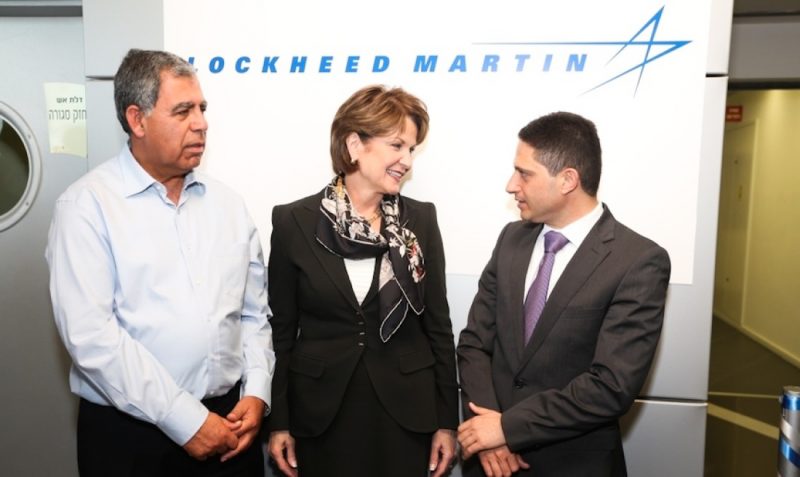
Marillyn Hewson, center, poses with Israeli gov. officials at the opening of Lockheed Martin’s facility in Beersheba. Photo | Diego Mittleberg
Haden Land, then-vice president of research and technology for Lockheed Martin, told the Wall Street Journal that the creation of the subsidiary was largely aimed at securing contracts with the IDF and that the company’s Israel subsidiary would soon be seeking partnership and investments in pursuit of that end. Land oversaw the local roll-out of the company’s Israel subsidiary while concurrently meeting with Israeli government officials. According to the Journal, Land “oversees all of Lockheed Martin’s information-systems businesses, including defense and civilian commercial units” for the United States and elsewhere.
Just a few months later, Lockheed Martin partnered and invested in Cybereason, suggesting that Lockheed’s decision to do so was aimed at securing closer ties with the IDF. This further suggests that Cybereason still maintains close ties to Israeli military intelligence, a point expounded upon in great detail in the previous installment of this series.
Thus, it appears that not only does Lockheed Martin use Cybereason’s software on its own devices and on those it manages for its private and public sector clients, but it also decided to use the company’s software in this way out of a desire to more closely collaborate with the Israeli military in matters related to technology and cybersecurity.
The cozy ties between Lockheed Martin, one of the U.S. government’s largest private contractors, and the IDF set off alarm bells, then and now, for those concerned with U.S. national security. Such concern makes it important to look at the extent of Cybereason’s use by federal and military agencies in the United States through their contracting of Lockheed Martin’s Information Technology (IT) division. This is especially important considering Israeli military intelligence’s history of using espionage, blackmail and private tech companies against the U.S. government, as detailed here.
While the exact number of U.S. federal and military agencies using Cybereason’s software is unknown, it is widespread, with Lockheed Martin’s IT division as the conduit. Indeed, Lockheed Martin was the number one IT solutions provider to the U.S. federal government up until its IT division was spun off and merged with Leidos Holdings. As a consequence, Leidos is now the largest IT provider to the U.S. government and is also directly partnered with Cybereason in the same way Lockheed Martin was. Even after its IT division was spun off, Lockheed Martin continues to use Cybereason’s software in its cybersecurity work for the Pentagon and still maintains a stake in the company.
The Leidos-Lockheed Martin IT hybrid provides a litany of services to the U.S. military and U.S. intelligence. As investigative journalist Tim Shorrock noted for The Nation, the company does “everything from analyzing signals for the NSA to tracking down suspected enemy fighters for US Special Forces in the Middle East and Africa” and, following its merger with Lockheed and consequential partnership with Cybereason, became “the largest of five corporations that together employ nearly 80 percent of the private-sector employees contracted to work for US spy and surveillance agencies.” Shorrock also notes that these private-sector contractors now dominate the mammoth U.S. surveillance apparatus, many of them working for Leidos and — by extension — using Cybereason’s software.
Leidos’ exclusive use of Cybereason software for cybersecurity is also relevant for the U.S. military since Leidos runs a number of sensitive systems for the Pentagon, including its recently inked contract to manage the entire military telecommunications infrastructure for Defense Information Systems Agency (DISA). In addition to maintaining the military telecom network, Cybereason is also directly partnered with World Wide Technologies (WWT) as of this past October. WWT manages cybersecurity for the U.S. Army, maintains DISA’s firewalls and data storage as well as the U.S. Air Force’s biometric identification system. WWT also manages contracts for NASA, itself a frequent target of Israeli government espionage, and the U.S. Navy. WWT’s partnership is similar to the Lockheed/Leidos partnership in that Cybereason’s software is now completely integrated into its portfolio, giving the company full access to the devices on all of these highly classified networks.
Many of these new partnerships with Cybereason, including its partnership with WWT, followed claims made by members of Israel’s Unit 8200 in 2017 that the popular antivirus software of Kaspersky Labs contained a backdoor for Russian intelligence, thereby compromising U.S. systems. The Wall Street Journal was the first to report on the alleged backdoor but did not mention the involvement of Unit 8200 in identifying it, a fact revealed by the New York Times a week later.
Notably, none of the evidence Unit 8200 used to blame Kaspersky has been made public and Kaspersky noted that it was actually Israeli hackers that had been discovered planting backdoors into its platform prior to the accusation levied against Kaspersky by Unit 8200. As the New York Times noted:
Investigators later discovered that the Israeli hackers had implanted multiple back doors into Kaspersky’s systems, employing sophisticated tools to steal passwords, take screenshots, and vacuum up emails and documents.”
Unit 8200’s claims ultimately led the U.S. government to abandon Kaspersky’s products entirely in 2018, allowing companies like Cybereason (with its own close ties to Unit 8200) to fill the void. Indeed, the very agencies that banned Kaspersky now use cybersecurity software that employs Cybereason’s EDR system. No flags have been raised about Cybereason’s own collaboration with the very foreign intelligence service that first pointed the finger at Kaspersky and that previously sold software with backdoors to sensitive U.S. facilities.
SoftBank, Cybereason and the Vision Fund
While its entry into the U.S. market and U.S. government networks is substantial, Cybereason’s software is also run throughout the world on a massive scale through partnerships that have seen it enter into Latin American and European markets in major ways in just the last few months. It has also seen its software become prominent in Asia following a partnership with the company Trustwave. Much of this rapid expansion followed a major injection of cash courtesy of one of the company’s biggest clients and now its largest investor, Japan’s SoftBank.
SoftBank first invested in Cybereason in 2015, the same year Lockheed Martin initially invested and partnered with the firm. It was also the year that SoftBank announced its intention to invest in Israeli tech start-ups. SoftBank first injected $50 million into Cybereason, followed by an additional $100 million in 2017 and $200 million last August. SoftBank’s investments account for most of the money raised by the company since it was founded in 2012 ($350 million out of $400 million total).
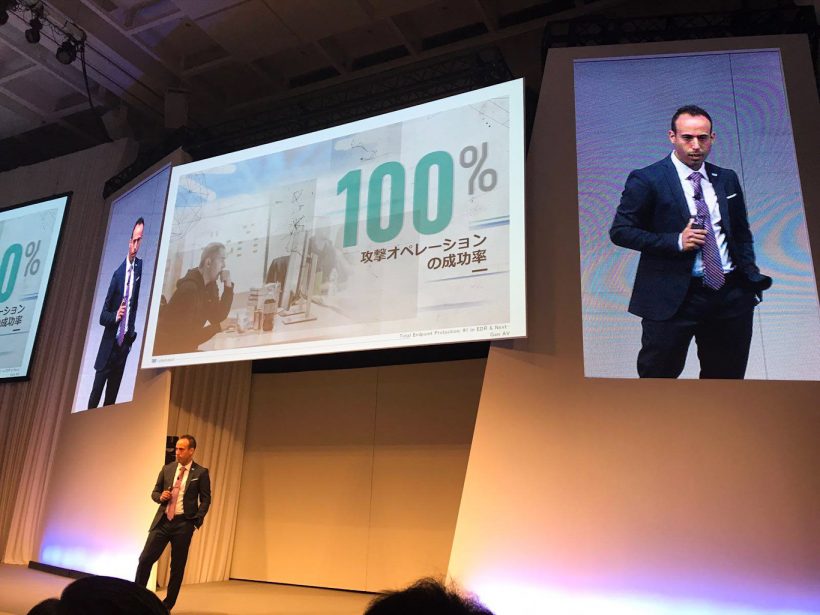
Cybereason CEO Lior Div speaks at a SoftBank event in Japan, July 21, 2017. Photo | Cybereason
Prior to investing, Softbank was a client of Cybereason, which Ken Miyauchi, president of SoftBank, noted when making the following statement after Softbank’s initial investment in Cybereason:
SoftBank works to obtain cutting edge technology and outstanding business models to lead the Information Revolution. Our deployment of the Cybereason platform internally gave us firsthand knowledge of the value it provides, and led to our decision to invest. I’m confident Cybereason and SoftBank’s new product offering will bring a new level of security to Japanese organizations.”
SoftBank — one of Japan’s largest telecommunications companies — not only began to deploy Cybereason internally but directly partnered with it after investing, much like Lockheed Martin had done around the same time. This partnership resulted in SoftBank and Cybereason creating a joint venture in Japan and Cybereason creating partnerships with other tech companies acquired by SoftBank, including the U.K.’s Arm, which specializes in making chips and management platforms for Internet of Things (IoT) devices.
SoftBank’s interest in Cybereason is significant, particularly in light of Cybereason’s interest in the 2020 U.S. election, given that SoftBank has significant ties to key allies of President Trump and even the president himself.
Indeed, SoftBank’s Masayoshi Son was among the first wave of international business leaders who sought to woo then-president-elect Trump soon after the 2016 election. Son first visited Trump Tower in December 2016 and announced, with Trump by his side in the building’s lobby, that SoftBank would invest $50 billion in the U.S. and create 50,000 jobs. Trump subsequently claimed on Twitter that Son had only decided to make this investment because Trump had won the election.
Son told reporters at the time that the investment would come from a $100 billion fund that would be created in partnership with Saudi Arabia’s sovereign wealth fund as well as other investors. “I just came to celebrate his new job. I said, ‘This is great. The US will become great again,’” Son said, according to reports.
Then, in March of 2017, Son sent top SoftBank executives to meet with senior members of Trump’s economic team and, according to the New York Times, “the SoftBank executives said that because of a lack of advanced digital investments, the competitiveness of the United States economy was at risk. And the executives made the case, quite strongly, that Mr. Son was committed to playing a major role in addressing this issue through a spate of job-creating investments.” Many of SoftBank’s investments and acquisitions in the U.S. since then have focused mainly on artificial intelligence and technology with military applications, such as “killer robot” firm Boston Dynamics, suggesting Son’s interest lies more in dominating futuristic military-industrial technologies than creating jobs for the average American.
After their initial meeting, Trump and Son met again a year later in June 2018, with Trump stating that “His [Son’s] $50 billion turned out to be $72 billion so far, he’s not finished yet.” Several media reports have claimed that Son’s moves since Trump’s election have sought to “curry favor” with the President.
Through the creation of this fund alongside the Saudis, SoftBank has since become increasingly intertwined with Saudi Crown Prince Muhammad bin Salman (MBS), a key ally of President Trump in the Middle East known for his authoritarian crackdowns on Saudi elites and dissidents alike. The ties between Saudi Arabia and SoftBank became ever tighter when MBS took the reins in the oil kingdom and after SoftBank announced the launch of the Vision Fund in 2016. SoftBank’s Vision Fund is a vehicle for investing in hi-tech companies and start-ups and its largest shareholder is the Public Investment Fund of Saudi Arabia. Notably, Son decided to launch the Vision Fund in Riyadh during President Trump’s first official visit to the Gulf Kingdom.
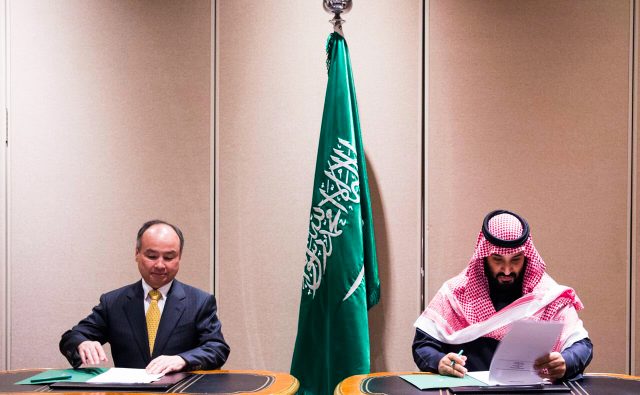
Masayoshi Son, left, signs a deal related to the Vision Fund with Bin Salman in March 2018. Photo | SPA
In addition, the Mubadala Investment Company, a government fund of the United Arab Emirates (UAE), gave $15 billion to the Vision Fund. UAE leadership also share close ties to the Trump administration and MBS in Saudi Arabia.
As a consequence, SoftBank’s Vision Fund is majority funded by two Middle Eastern authoritarian governments with close ties to the U.S. government, specifically the Trump administration. In addition, both countries have enjoyed the rapid growth and normalization of ties with the state of Israel in recent years, particularly following the rise of current Saudi Crown Prince Muhammad bin Salman and Jared Kushner’s rise to prominence in his father-in-law’s administration. Other investments in the Vision Fund have come from Apple, Qualcomm and Oracle’s Larry Ellison, all tech companies with strong ties to Israel’s government.
The Saudi and Emirati governments’ links to the Vision Fund are so obvious that even mainstream outlets like the New York Times have described them as a “front for Saudi Arabia and perhaps other countries in the Middle East.”
SoftBank also enjoys close ties to Jared Kushner, with Fortress Investment Group lending $57 million to Kushner Companies in October 2017 while it was under contract to be acquired by SoftBank. As Barron’s noted at the time:
When SoftBank Group bought Fortress Investment Group last year, the Japanese company was buying access to a corps of seasoned investors. What SoftBank also got is a financial tie to the family of President Donald Trump’s senior advisor and son-in-law, Jared Kushner.”
According to The Real Deal, Kushner Companies obtained the financing from Fortress only after its attempts to obtain funding through the EB-5 visa program for a specific real estate venture were abandoned after the U.S. Attorney and the Securities and Exchange Commission began to investigate how Kushner Companies used the EB-5 investor visa program. A key factor in the opening of that investigation was Kushner Companies’ representatives touting Jared Kushner’s position at the White House when talking to prospective investors and lenders.
SoftBank also recently came to the aid of a friend of Jared Kushner, former CEO of WeWork Adam Neumann. Neumann made shocking claims about his ties to both Kushner and Saudi Arabia’s MBS, even asserting that he had worked with both in creating Kushner’s long-awaited and controversial Middle East “peace plan” and claimed that he, Kushner and MBS would together “save the world.” Neumann previously called Kushner his “mentor.” MBS has also discussed on several occasions his close ties with Kushner and U.S. media reports have noted the frequent correspondence between the two “princelings.”
Notably, SoftBank invested in Neumann’s WeWork using money from the Saudi-dominated Vision Fund and later went on to essentially bail the company out after its IPO collapse and Neumann was pushed out. SoftBank’s founder, Masayoshi Son, had an odd yet very close relationship with Neumann, perhaps explaining why Neumann was allowed to walk with $1.7 billion after bringing WeWork to the brink of collapse. Notably, nearly half of SoftBank’s approximately $47 billion investments in the U.S. economy since Trump’s election, went to acquiring and then bailing out WeWork. It is unlikely that such a disastrous investment resulted in the level of job creation that Son had promised Trump in 2016.
Given that it is Cybereason’s top investor and shareholder by a large margin, SoftBank’s ties to the Trump administration and key allies of that administration are significant in light of Cybereason’s odd interest in 2020 U.S. election scenarios that end with the cancellation of this year’s upcoming presidential election. It goes without saying that the cancellation of the election would mean a continuation of the Trump administration until new elections would take place.
Furthermore, with Cybereason’s close and enduring ties to Israeli military intelligence now well-documented, it is worth asking if Israeli military intelligence would consider intervening in 2020 if the still-to-be-decided Democratic contender was strongly opposed to Israeli government policy, particularly Israel’s military occupation of Palestine. This is especially worth considering given revelations that sexual blackmailer and pedophile Jeffrey Epstein, who targeted prominent U.S. politicians, mostly Democrats, was in the employ of Israeli military intelligence.
Notably, Cybereason’s doomsday election scenarios involved the weaponization of deep fakes, self-driving cars and the hacking Internet of Things devices, with all of those technologies being pioneered and perfected — not by Russia, China or Iran — but by companies directly tied to Israeli intelligence, much like Cybereason itself. These companies, their technology and Cybereason’s own work creating the narrative that U.S. rival states seek to undermine the U.S. election in this way, will all be discussed in the conclusion of MintPress’ series on Cybereason and its outsized interest in the U.S. democratic process.
Whitney Webb is a MintPress News journalist based in Chile. She has contributed to several independent media outlets including Global Research, EcoWatch, the Ron Paul Institute and 21st Century Wire, among others. She has made several radio and television appearances and is the 2019 winner of the Serena Shim Award for Uncompromised Integrity in Journalism.
Why a Shadowy Tech Firm With Ties to Israeli Intelligence Is Running Doomsday Election Simulations
Graphic by Claudio Cabrera for MintPress News
By Whitney Webb | MintPress News | January 4, 2020
Election Day 2020: 32 Americans dead, over 200 injured, martial law declared and the election itself is canceled. While this horrific scenario seems more like the plot of a Hollywood film, such was the end result of a recent simulation examining the preparedness of U.S. officials from the Federal Bureau of Investigation (FBI), the Department of Homeland Security (DHS) and the U.S. Secret Service against “bad actors” seeking to undermine the upcoming presidential election.
Yet, this simulation was not a government-organized exercise but was instead orchestrated by a private company with deep ties to foreign and domestic intelligence services, a company that is also funded by investors with clear connections to individuals who would stand to benefit if such a catastrophic election outcome were to become reality.
Much of the rhetoric since the last presidential election in 2016 has focused on the issue of foreign meddling by U.S. rival states like Russia, while China has emerged as the new “meddler” of choice in American corporate media as the 2020 election approaches. Though time has revealed that many of the post-2016 election meddling claims were not as significant as initially claimed, the constant media discussion of foreign threats to U.S. democracy and electoral processes – whether real or imagined – has undeniably created a climate of fear.
Those fears have since been preyed upon by neoconservative groups and the U.S. military-industrial complex, both of which are hardly known for their love of democratic processes, to offer a series of ready-made solutions to these threats that actually undermine key pillars of American democracy, including independent reporting and voting machine software.
However, many of the very same media outlets and groups that frequently fretted about Russia, China or another rival state meddling in U.S. democracy have largely ignored the role of other nation states, such as Israel, in efforts to sway the last U.S. election in 2016 and meddle in numerous elections in Africa, Latin America and Asia in the years since.
As a consequence of this climate of fear, it should be hardly surprising that the corporate media lauded the recent 2020 election simulation that ended in an abysmal failure for U.S. officials, the cancellation of the U.S. election and the imposition of martial law. Yet, none of those reports on the exercise noted that the company that hosted the simulation, called Cybereason, is led by ex-members of Israel’s military intelligence unit 8200, advised by former top and current officials in both Israeli military intelligence and the CIA. In addition, it is funded by and partnered with top U.S. weapons manufacturer and government contractor Lockheed Martin and financial institutions with clear and direct ties to Saudi Crown Prince Mohammed bin Salman and White House adviser and the president’s son-in-law Jared Kushner. Also left unmentioned in media reports on Cybereason’s election simulations is the fact that Cybereason’s CEO, Lior Div, has openly admitted that he views his work at Cybereason as a “continuation” of his service to Israel’s intelligence apparatus.
With Cybereason planning to host more simulations in cooperation with federal agencies as the U.S. election inches closer, a deeper exploration of this company, its ties to intelligence and military contractors in the U.S. and Israel and its financial ties to key Trump allies both domestically and abroad warrants further investigation.
In this two part series, MintPress will not only explore these aspects but also how many of the technologies wielded by the “bad actors” in the Cybereason election simulation have been pioneered and perfected, not by U.S. rival states, but by Israeli companies and start-ups with clear ties to that country’s intelligence apparatus.
Also notable is the fact that Cybereason itself has covertly become a major software provider to the U.S. government and military through its direct partnership with Lockheed Martin, which followed the defense company’s decision to open an office at the Israeli military’s new cyber operations hub in the Negev desert. In examining all of these interlocking pieces, a picture emerges of a potentially sinister motive for Cybereason’s simulations aimed at gauging how U.S. federal officials respond to crisis situations on Election Day.
Understanding “Operation Blackout”
In early November, a team of “hackers” working for the private U.S.-based, Israeli-founded company Cybereason conducted a 2020 election simulation with members of various U.S. agencies, namely the DHS, FBI and the U.S. Secret Service. The simulation was organized by Cybereason and the law firm Venable and the U.S. agencies in attendance were invited and appear to not have been charged to participate.
The simulation, titled “Operation Blackout,” was set in a fictional swing state called “Adversaria” and pitted “ethical hackers” from Cybereason against a team of federal and local law enforcement officials. The opposing teams were supervised by a “white team” composed of members of Cybereason’s staff and Ari Schwartz — a former member of the White House’s National Security Council and the National Institute of Standards and Technology (NIST) — who set the rules of the simulation and would ultimately decide its outcome. Schwartz also used to work for the Center for Democracy and Technology (CDT), a major backer of Microsoft’s ElectionGuard software.
Operation Blackout did not involve hackers targeting election software or voting machines, instead, it focused on civilian infrastructure and psychological operations against the American citizens in the fictitious “Adversaria” on election day. The hacker team was led by Cybereason co-founder Yonathan Striem-Amit, a former contractor for Israeli government agencies and a former operative for the elite Israeli military intelligence Unit 8200, best known for its cyber offensives against other governments.
“In a country as fragmented as the US, the number of people needed to influence an election is surprisingly small,” Striem-Amit told Quartz of the exercise. “We attempted to create havoc and show law enforcement that protecting the electoral process is much more than the machine.”
Streim-Amit’s team completely devastated the U.S. law enforcement team in Operation Blackout by not only causing chaos but murdering numerous civilians. Hackers took control of city buses, ramming them into civilians waiting in line at polling stations, killing 32 and injuring over 200. They also took control of city traffic lights in order to cause traffic accidents, used so-called “deepfakes” to conduct psychological operations on the populace and created fake bomb threats posing as the terror group ISIS, which incidentally has its own ties to Israeli intelligence. Telecom networks and news outlets within the fictitious states were also hacked and flooded with deepfakes aimed at spreading disinformation and panic among U.S. citizens.

A map of targets in Adverseria is shown during Operation Blackout in Boston’s John Hancock Tower. Mark Albert | Twitter
The supervising team, composed of Cybereason employees and former NSC member Ari Schwartz, decided that the outcome of the face-off between the hacker and law enforcement teams was the outright cancellation of the 2020 election, the declaration of martial law by authorities, the growth of public fear regarding terrorism and allegations of U.S. government collusion with a foreign actor. Cybereason has stated that they will soon conduct another 2020 election simulation with federal authorities as the election draws closer.
Given how the simulation played out, it is quite clear that it is a far cry from the actual scope of alleged foreign meddling during the 2016 election, meddling which was allegedly the motivation behind Operation Blackout. Indeed, the extent of Russian interference in the 2016 election amounted to $100,000 worth of Facebook ads over three years, 25 percent of which were never seen by the public, and claims that Russian state actors were responsible for leaking emails from the then-Democratic presidential nominee Hillary Clinton and the Democratic National Committee (DNC). In contrast, Operation Blackout went well beyond any observed or even imagined “foreign meddling” related to the 2016 election and appears more like a terror attack targeting elections than a covert means of manipulating their outcomes.
Several mainstream publications have covered Operation Blackout but have failed to note that the company behind them has deep ties to foreign intelligence outfits and governments with a documented history of manipulating elections around the world, including the 2016 U.S. election.
Quartz framed the exercise as important for “preparing for any and all possibilities in 2020,” which “has become an urgent task for US regulators and law enforcement.” Similarly, CyberScoop treated the simulation as a “sophisticated exercise to help secure the vote.” Other articles took the same stance.
A series of simulations
In the weeks after the Washington area election simulation, Cybereason repeated the same exercise in London, this time with members of the U.K. Intelligence agency GCHQ, the U.K. Foreign Office and the Metropolitan Police. The law enforcement team in the exercise, which included the U.K. officials, was headed by a Cybereason employee — Alessandro Telami, who formerly worked for the NATO Communications and Information Agency (NCI). Like the prior simulation conducted in the U.S., Cybereason did not appear to charge U.K. government agencies for their participation in the exercise.
Cybereason has — with little fanfare — been promoting extreme election day scenarios since before the 2016 election. Cybereason’s first mention of these tactics appears in a September 2016 blog post written by the company’s CEO and former Israeli government contractor Lior Div — a former leader of offensive cyberattacks for the IDF’s elite Unit 8200 and a former development group leader at the controversial Israeli-American corporation Amdocs.
Div wrote that hackers may target U.S. elections by “breaking into the computers that operate traffic lighting systems and interfering with the ones around polling stations to create massive traffic jams, “hacking polling companies,” and “targeting live election coverage on cable or network television stations.” A follow-up post by Div from October 2016 added further meddling tactics such as “cut power to polling stations” and “mess with a voter’s mind.”
Two years later, Cybereason held its first election meddling simulation, touting many of these same tactics, in Boston. The simulation focused on local and state responses to such attacks and saw Boston-based Cybereason invite Massachusetts state and local officials as well as Boston police officers and a former police commissioner to participate. “Twitter accounts spreading fake news,” “turning off a city’s closed-circuit cameras,” “hacking self-driving cars and navigation apps,” and “targeting a city’s 911 call center with a DDoS attack” were all used in the simulation, which saw Cybereason’s “ethical hackers” attempt to disrupt election day. Media coverage of the simulation at the time framed it as a necessary preparation for countering “Russian” threats to U.S. democracy. Like the more recent simulations, the mock election was canceled and voter confidence in the electoral process was devastated.
This past July, Cybereason conducted a similar simulation with officials from the FBI, DHS and the Secret Service for the first time. That simulation, which also took place in Boston, was remarkably similar to that which occurred in November. One intelligence officer from DHS who participated in the July exercise called the simulation “very realistic.” Another claimed that the simulation was a way of applying “lessons learned from 9/11” by preventing the government’s “failure of imagination” that officials have long alleged was the reason for the government’s inability to thwart the September 11 attacks. Notably, The U.S. military simulated a scenario in which terrorists flew airplanes into the Pentagon less than a year before the September 11 attacks.
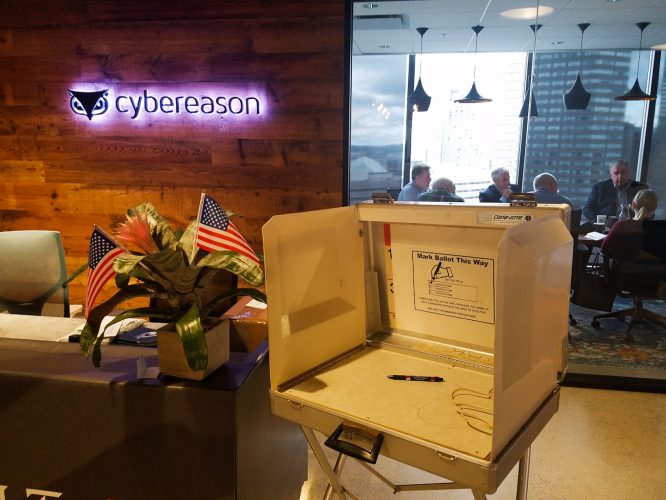
In this undated photo from Cybereason’s website, a faux ballot box is shown in the company’s Boston office.
Participating government officials, Cybereason staff and the media have consistently touted the importance of these simulations in securing elections against extreme threats, threats which — to date — have never materialized due to the efforts of foreign or domestic actors on election day. After all, these exercises are only simulations of possibilities and, even if those possibilities seem implausible or unlikely, it is important to be prepared for any eventuality.
But what if the very figures behind these simulations and the investors that fund them had a history of election meddling themselves? Cybereason’s deep ties to Israeli intelligence, which has a documented history of aggressive espionage and election meddling in the United States and in several nations worldwide, warrant a deeper look into the firms’ possible motives and the myriad conflicts of interest that arise in giving it such unprecedented access to the heart of America’s democracy.
What Does Cybereason Do?
Cybereason’s interest in terror events during elections seems out of place given that the company itself is focused on selling technological cybersecurity solutions like antivirus and ransomware protection software, software products that would be minimally effective against the type of threat encountered in the company’s election day simulations.
Cybereason is often described as offering a comprehensive technological defense platform to companies and governments that combines a next-generation antivirus with endpoint detection and response (EDR), which enables the company to respond to typical viruses and malware as well as sophisticated, complex attacks. The platform makes heavy use of artificial intelligence (AI) and cloud computing and specifically uses Amazon Web Services (AWS), which is used by a litany of private companies as well as U.S. intelligence agencies.
While many cybersecurity platforms combine antivirus and antimalware with EDR and AI, Cybereason claims that their military background is what sets them apart. They have marketed themselves as offering “a combination of military-acquired skills and cloud-powered machine learning to endpoint detection and response” and actively cite the fact that most of their employees are former members of Unit 8200 as proof that they are “applying the military’s perspective on cybersecurity to enterprise security.”
In 2018, Cybereason’s former senior director for intelligence, Ross Rustici, described the platform to CBR as follows:
Our founders are ex-Israeli intelligence who worked on the offensive side. They basically wanted to build a tool that would catch themselves. We follow the kill chain model started by Lockheed Martin [now a major investor in Cybereason] and try to interrupt every stage once an intruder’s inside a target network.”
Lior Div, Cybereason’s CEO described the difference between his company’s platform and that of past market leaders in this way to Forbes :
The old guard of antivirus companies like Symantec and McAfee would install something to block endpoints and you needed to do a lot [of monitoring] to make sure you weren’t under attack. We came with a different approach to see the whole enterprise and leverage AI to be able to fully autonomously identify where attackers are and what they’re doing.”
Thus, in looking at Cybereason’s product and its marketing objectively, it seems that the only innovative component of the company’s system is the large number of ex-military intelligence officers it employs and its tweaking of a previously developed and automated model for threat engagement, elimination and prevention.
Instead, Cybereason’s success seems to owe to its prominent connections to the private and public sectors, especially in Israel, and its investors who have funneled millions into the company’s operations, allowing them to expand rapidly and quickly claim a dominant position in emerging technology markets, such as the Internet of Things (IoT) and advanced healthcare systems.

A screenshot from a live stream of a 2019 Cybereason cyber-attack simulation
Their considerable funding from the likes of Lockheed Martin and Softbank, among others, has also helped them to expand their international presence from the U.S., Europe and Israel into Asia and Latin America, among other places. Notably, while Cybereason is open about their investors and how much funding they receive from each, they are extremely secretive about their financial performance as a company and decline to disclose their annual revenue, among other indicators. The significance of Cybereason’s main investors in the context of the company’s election simulations and its ties to Israeli and U.S. intelligence (the focus of this article) will be discussed in Part 2.
Cybereason also includes a security research arm called Nocturnus, currently headed by a former Unit 8200 officer. Nocturnus will be explored further in Part 2 of this series, as it essentially functions as a private intelligence company in the tech sector and has been behind several recent claims that have attributed alleged hacks to state actors, namely China and North Korea. For now, it is important to keep in mind that Nocturnus utilizes Cybereason’s “global network of millions of endpoints” for its intelligence gathering and research, meaning the endpoints of every device to which Cybereason’s software has access.
Given what Cybereason provides as a company, their interest in offering election simulations to government officials free of charge seems odd. Indeed, in the simulations hosted by Cybereason for U.S. officials, there is little opportunity for the company to market their software products given that the simulation did not involve electronic voting infrastructure at all and, instead, the malevolent actors used deep fakes, disinformation and terror attacks to accomplish their goals. Why then would this company be so interested in gauging the response of U.S. law enforcement to such crises on election day if there is no sales pitch to be made? While some may argue that these simulations are an altruistic effort by the company, an investigation into the company’s founders and the company’s ties to intelligence agencies suggests that this is unlikely to be the case.
The People Behind Cybereason
Cybereason was created in 2012 by three Israelis, all of whom served together as officers in the Israel Defense Force’s elite technological and signals intelligence unit, which is most often referred to as Unit 8200. Unit 8200 has been the subject of several MintPress investigative reports over the past year focusing on its ties to the tech industry.
Unit 8200 is an elite unit of the Israeli Intelligence corps that is part of the IDF’s Directorate of Military Intelligence and is involved mainly in signal intelligence, surveillance, cyberwarfare and code decryption. It is also well-known for its surveillance of Palestinian civilians and for using intercepted communications as blackmail in order to procure informants among Palestinians living under occupation in the West Bank.
The unit is frequently described as the Israeli equivalent of the NSA and Peter Roberts, a senior research fellow at Britain’s Royal United Services Institute, characterized the unit in an interview with the Financial Times as “probably the foremost technical intelligence agency in the world and stand[ing] on a par with the NSA in everything except scale.” Notably, the NSA and Unit 8200 have collaborated on numerous projects, most infamously on the Stuxnet virus as well as the Duqu malware.
Given the secrecy of the work conducted by Unit 8200, it is hard to know exactly what Cybereason’s co-founders did while serving in the controversial unit, however, a brief biography of the company’s current CEO and co-founder Lior Div states that “Div served as a commander [in Unit 8200] and carried out some of the world’s largest cyber offensive campaigns against nations and cybercrime groups. For his achievements, he received the Medal of Honor, the highest honor bestowed upon Unit 8200 members (emphasis added).”

Lior Div speaks during the Cyber Week conference in Tel Aviv, Israel, June 25, 2019. Corinna Kern | Reuters
After having served in leadership positions within Unit 8200, all three Cybereason co-founders went on to work for private Israel-based tech or telecom companies with a history of aggressive espionage against the U.S. government.
Cybereason co-founders Yonathan Striem Amit (Cybereason’s Chief Technology Officer) and Yossi Naar (Cybereason Chief Visionary Officer) both worked for Gita Technologies shortly before founding Cybereason with fellow Unit 8200 alumnus Lior Div. Gita, according to public records, is a subsidiary of Verint Systems, formerly known as Comverse Infosys.
Verint/Comverse was initially funded by the Israeli government and was founded by Jacob “Kobi” Alexander, a former Israeli intelligence officer who was wanted by the FBI on nearly three dozen charges of fraud, theft, lying, bribery, money laundering and other crimes for over a decade until he was finally extradited to the United States and pled guilty to some of those charges in 2016.
Despite its history of corruption and foreign intelligence connections, Verint/Comverse was hired by the National Security Agency (NSA) to create backdoors into all the major U.S. telecommunications systems and major tech companies, including Facebook, Microsoft and Google. An article on Verint’s access to U.S. tech infrastructure in Wired noted the following about Verint:
In a rare and candid admission to Forbes, Retired Brig. Gen. Hanan Gefen, a former commander of the highly secret Unit 8200, Israel’s NSA, noted his former organization’s influence on Comverse, which owns Verint, as well as other Israeli companies that dominate the U.S. eavesdropping and surveillance market. ‘Take NICE, Comverse and Check Point for example, three of the largest high-tech companies, which were all directly influenced by 8200 technology,’ said Gefen.”
Federal agents have reported systemic breaches at the Department of Justice, FBI, DEA, the State Department, and the White House going all the way back to the 1990s, breaches they claimed could all be traced back to two companies: Comverse/Verint and Amdocs. Cybereason’s other co-founder and current CEO, Lior Div, used to work for Amdocs as the company’s development group leader.
After leaving Amdocs, Div founded a company called Alfatech. Alfatech publicly claims to specialize in “professional Head Hunting and Quality Recruiting services,” yet it has no functional website. Despite its publicly stated mission statement, Israeli media reports that mention Alfatech describe it as “a cybersecurity services company for Israeli government agencies.” No reason for the obvious disconnect between the company’s own claims and those made by the media has been given.
Div left Alfatech in 2012 to found Cybereason alongside Striem-Amit and Naar. According to an interview that Div gave to TechCrunch earlier this year, he stated that his work at Cybereason is “the continuation of the six years of training and service he spent working with the Israeli army’s 8200 Unit (emphasis added).” Div was a high-level commander in Unit 8200 and “carried out some of the world’s largest cyber offensive campaigns against nations and cybercrime groups” during his time there. TechCrunch noted that “After his time in the military, Div worked for the Israeli government as a private contractor reverse-engineering hacking operations,” an apparent reference to his work at Alfatech.
Even deeper ties to intelligence
Not only do Cybereason’s own co-founders have considerable links to the Israeli government, Israeli intelligence and intelligence-connected private companies, but it also appears that the work of Cybereason itself is directly involved with Israeli intelligence.
The company periodically publishes reports by a secretive faction of the company called the Cybereason Intelligence Group or CIG. The only description of CIG’s composition available on Cybereason’s website is as follows:
The Cybereason Intelligence Group was formed with the unique mission of providing context to the most sophisticated threat actors. The group’s members include experts in cyber security and international security from various government agencies, including the Israel Defense Forces’ Unit 8200, which is dedicated to conducting offensive cyber operations. Their primary purpose is to examine and explain the Who and the Why behind cyber attacks, so that companies and individuals can better protect themselves (emphasis added).”
It is unclear how many members comprise CIG and if its members are employees of only Israeli government agencies, or if it includes officials from the U.S. government/Intelligence or other governments. However, what is clear is that it is composed entirely of government officials, which include active members of Unit 8200, and that the purpose of the group is to issue reports that place blame for cyberattacks on state and non-state actors. Perhaps unsurprisingly, the vast majority of CIG’s reports published by Cybereason focus exclusively on Russia and China. When discussing nation-state cyber threats in general, Cybereason’s website only mentions China, North Korea, Iran and Russia by name, all of which are incidentally rival states of the U.S. government. Notably, Israel’s government — listed as a “leading espionage threat” to U.S. financial institutions and federal agencies by the U.S.’ NSA — is absent from Cybereason’s discussions of state actors.
In addition to CIG, Cybereason’s cybersecurity research arm, Nocturnus, includes several Unit 8200 alumni and former Israeli military intelligence and government contractors and has assigned blame to state actors for several recent hacks. It also has claimed to have discovered more such hacks but has declined to publicly disclose them due to the “sensitive” nature of the hacks and companies affected.
Other hints at Cybereason’s connections to state intelligence can be seen in its advisory board. Robert Bigman, the former Chief Information Security Officer (CISO) for the Central Intelligence Agency (CIA) who oversaw the spy agency’s “commercial partner engagement” program (i.e. alliances with the private tech sector), is a key figure on the company’s advisory board. According to his biography, Bigman “ contributed to almost every Intelligence Community information security policy/technical standard and has provided numerous briefings to the National Security Council, Congress and presidential commissions. In recognition of his expertise and contributions, Bigman has received numerous CIA and Director of National Intelligence Awards.”
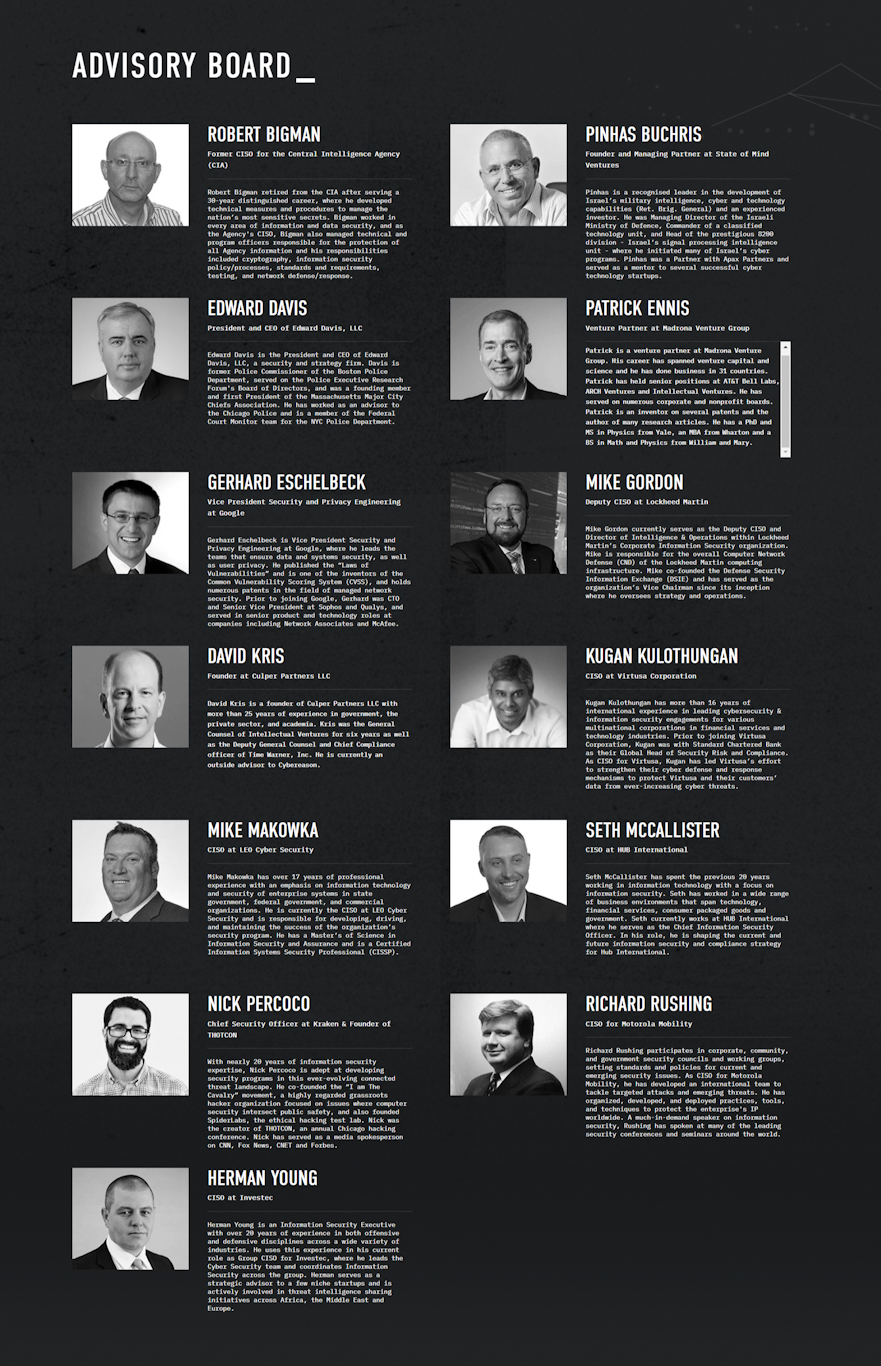
Cybereason’s leadership team features a who’s who of Israeli and US intel officials
Unmentioned in his biography published on his own website, or on Cybereason’s website, is that Bigman is also an advisor to another Israeli tech company, Sepio Systems. The chairman of Sepio, Tamir Pardo, is a self-described “leader” in the cybersecurity industry and former director of Israel’s Mossad. Sepio is funded by a venture capital firm founded by the creators of the controversial Israeli spy tech company NSO Group, which has received a slew of negative press coverage after its software was sold to several governments who used it to spy on dissidents and human rights activists.
In addition to Bigman, Cybereason’s advisory board includes Pinchas Buchris, the former head of Unit 8200 and former managing director of the IDF. Not unlike Bigman, Buchris’ bio fails to mention that he sits on the board of directors of Carbyne911, alongside former Israeli Prime Minister Ehud Barak and Nicole Junkerman, both well-known associates of intelligence-linked sex trafficker Jeffery Epstein. Epstein himself poured at least $1 million into Carbyne, an Israeli company that seeks to run all 911 call centers in the U.S. at the national level and has close ties to the Trump administration. More information on Carbyne and its ties to Israeli and U.S. intelligence as well as its connection to coming pre-crime policies to be enacted in 2020 by the U.S. Department of Justice can be found in this MintPress report from earlier this year. Given that Cybereason’s election day simulations involve the simulated collapse of 911 call center functionality, Buchris’ ties to both Cybereason and Carbyne911 are notable.
Another notable Cybereason advisor is the former commissioner of the Boston Police Department, Edward Davis. Davis heavily promoted Cybereason’s disturbing election day simulations and even participated directly in one of them. He was also police commissioner of the Boston PD at the time of the Boston Marathon bombing and oversaw the near-martial law conditions imposed on the city during the manhunt for the alleged perpetrators of that bombing (who themselves had a rather odd relationship with the FBI). This is notable given that Cybereason’s election day simulations ended with martial law being imposed on the fictional city used in the exercise
Cybereason also has several advisors who hold top positions at powerful U.S. companies that are also — incidentally — U.S. government contractors. These include the Vice President Security and Privacy Engineering at Google, Deputy Chief Information Security Officer (CISO) of Lockheed Martin and CISO at Motorola. Both Motorola and Lockheed Martin use Cybereason’s software and the latter is also a major investor in the company. Furthermore, as will be explained in Part 2 of this article, Lockheed Martin has used its privileged position as the top private contractor to the U.S. government to promote the widespread use of Cybereason’s software among U.S. government agencies, including the Pentagon.
Much more than a cybersecurity company
Given Cybereason’s deep and enduring ties to Israeli intelligence and its growing connections to the U.S. military and U.S. intelligence through its hiring of top CIA officials and partnership with Lockheed Martin, it’s worth asking if these disturbing election simulations could serve an ulterior purpose and, if so, who would benefit. While some aspects regarding clear conflicts of interest in relation to the 2020 election and Cybereason will be discussed in Part 2, this article will conclude by examining the possibility that Cybereason is acting as a front company for Israeli intelligence based on that country’s history of targeting the U.S. through private tech companies and on Cybereason’s own questionable characteristics.
First, Cybereason as a company presents several oddities. Its co-founder and CEO openly states that he views Cybereason’s work as a continuation of his service for Israeli military intelligence. In addition, he and the company’s other founders — after they left Unit 8200 — went to work for Israeli tech companies that have been known to spy on U.S. federal agencies for the Israeli government.
In addition, as previously mentioned, Cybereason has sought out former intelligence officers from the CIA and Unit 8200 for its management team and board of advisors. The company itself also functions as a private intelligence firm through CIG and Nocturnus, both of which employ former and current intelligence officials, and have made significant claims regarding the attribution of specific cybercrimes to state actors. It appears highly likely that these claims are influenced by those same intelligence agencies that boast close ties to Cybereason. Furthermore, Nocturnus’ access to Cybereason’s “global” network of endpoints makes it a private intelligence gathering company as it gathers and analyzes data from all devices that run Cybereason’s software.
Yet, even more telling is the fact that Israel’s government has an open policy of outsourcing intelligence-related activity to the private sector, specifically the country’s tech sector. As MintPress previously reported, this trend was first publicly acknowledged by Israel in 2012, the same year that Cybereason was founded by former Israeli military intelligence officers then-working for private contractors for Israel’s government (Alfatech) or private companies known to have ties to Israeli intelligence, including Verint/Comverse.
As noted in an article on the phenomenon from the Israeli media outlet The Calcalist:
Israel is siphoning cyber-related activities from its national defense apparatus to privately held companies. Since 2012, cyber-related and intelligence projects that were previously carried out in-house in the Israeli military and Israel’s main intelligence arms are transferred to companies that in some cases were built for this exact purpose.”
Mention of Israel’s policy of blurring the lines between the public and private sector when it comes to cybersecurity and intelligence gathering has even garnered the occasional mention in mainstream media, such as in a 2018 Foreign Policy article:
Israel, for one, has chosen to combat the problem on a statewide level by linking the public and private spheres, sometimes literally. The country’s cyberhub in the southern city of Beersheba is home not just to the Israeli military’s new technology campus but also to a high-tech corporate park, Ben-Gurion University of the Negev’s cyber-research center, and the Israel National Cyber Directorate, which reports directly to the prime minister’s office. “There’s a bridge between them—physically,” [Gabriel] Avner, the security consultant, said by way of emphasis.”
Notably, a year before Lockheed Martin invested in and partnered with Cybereason, the U.S.-based weapons company opened an office at the IDF’s public-private cyber hub in Beersheba. At the inauguration ceremony for Lockheed’s Beersheba office, company CEO Marilyn Hewson stated:
The consolidation of IDF Technical Units to new bases in the Negev Desert region is an important transformation of Israel’s information technology capability… By locating our new office in the capital of the Negev we are well positioned to work closely with our Israeli partners and stand ready to: accelerate project execution, reduce program risk and share our technical expertise by training and developing in-country talent.”

Lockheed Martin CEO Marillyn Hewson, inaugurates the Lockheed Martin Israel Demonstration Center in Tel Aviv.
Further evidence of this public-private merger can be seen in how two of Israel’s intelligence agencies, Shin Bet and Mossad, have both recently launched a private start-up accelerator and a hi-tech venture capital fund, respectively. The Shin Bet’s accelerator, called Xcelerator, usually makes its investments in private companies public, while Mossad’s Libertad Ventures refuses to disclose the tech companies and start-ups in which it invests. Former directors of both Mossad and Shin Bet have described these intelligence agencies themselves of being like start-ups, clearly showing how much the line between intelligence apparatus and private company has been blurred within the context of Israel’s tech industry and specifically its cybersecurity industry.
The advantages of outsourcing cyber intelligence operations to private companies have been noted by several analysts, including Sasha Romanosky, a former Cyber Policy Advisor at the Department of Defense and current analyst at RAND Corporation. Romanosky noted in 2017 that private intelligence and cybersecurity firms “do not necessarily face the same constraints or potential repercussions” as their public counterparts when it comes to designating blame for a cyberattack, for example. In addition, outsourcing intelligence objectives or missions to private companies provides a government with plausible deniability if that private company’s espionage-related activities or ties are made public.
Furthermore, Israeli intelligence has a long history of using private tech companies for the purposes of espionage, including against the United States. While Amdocs and Verint/Comverse were already mentioned as having been used by the state of Israel in this way, other private companies have also been used to market software backdoored by Israeli intelligence to countries around the world, both within the U.S. and elsewhere. The most well-known example of this is arguably the mass sale and distribution of the bugged PROMIS software, which was discussed at length in several recent MintPress News reports.
Given Cybereason’s ties to intelligence and Israeli intelligence’s history of placing backdoors in its software, it is worth pointing out that Cybereason’s main product, its antivirus and network defense platform, offers a major espionage opportunity. Blake Darché, a former N.S.A. operator, told the New York Times in 2017 that antivirus programs, which Cybereason’s defense platform includes, is “the ultimate backdoor,” adding that it “provides consistent, reliable and remote access that can be used for any purpose, from launching a destructive attack to conducting espionage on thousands or even millions of users.” Whether a company like Cybereason would use its software for such ends is unknown, though the company does acknowledge that its cybersecurity arm does gather intelligence from all systems that use the company’s software and currently employs and works with active duty Unit 8200 officials through CIG. This is notable because Unit 8200’s main task for Israeli military intelligence is signals intelligence, i.e. surveillance.
More of a mystery, however, is why a company like Cybereason is so interested in U.S. election security, particularly when Israeli intelligence and Israeli intelligence-connected private companies have been caught in recent years meddling in elections around the world, including the United States.
Whitney Webb is a MintPress News journalist based in Chile. She has contributed to several independent media outlets including Global Research, EcoWatch, the Ron Paul Institute and 21st Century Wire, among others. She has made several radio and television appearances and is the 2019 winner of the Serena Shim Award for Uncompromised Integrity in Journalism.
Post-Iraq war US intel report predicting 2020 looks ‘eerily prescient’ only compared to agencies’ political blunders
By Helen Buyniski | RT | January 1, 2020
A 15-year-old intel report predicting the world of 2020 has been hailed for its accuracy, but much of the future it describes was already underway in 2004. Could today’s hyper-politicized intelligence community see even that much?
Rolling out a list of “eerily prescient” predictions in order to brag about their accuracy – no flying cars here! – the National Intelligence Council (NIC) report is just what one might expect from an intel community desperate to shore up its reputation ahead of what’s sure to be a hotly contested presidential election.
Intel vets have lamented that the intelligence community has become politicized, to the point where it has affected their ability to accurately and objectively describe the reality in front of them – never mind the world 15 years in the future. The NIC paper may thus represent a lost art of apolitical prognostication, a skill willingly sacrificed in the rush for modern spooks to prove themselves “team players.” After the near-fatal blow to its credibility dealt by the three-year Russiagate debacle, US intelligence has a long way to go to build its reputation back.
But US intelligence has played enough of a role in crafting the world of 2020 that at least some of the report’s predictions have to be viewed as plans and suggestions rather than prognostication. Revelations about the CIA’s role in funding and training Al-Qaeda affiliates in Syria, supplying weapons which often ended up in the hands of Islamic State (IS, formerly ISIS/ISIL) terrorists through Operation “Timber Sycamore,” cast the report’s “fictional scenario” about “a new caliphate” whose adherents include Osama bin Laden’s grandson in a more sinister light. Like IS, the fictional caliphate described by the NIC inspires “non-practicing Muslims” from Europe and America to return to their ancestral homelands and take up arms against the “infidels”; also like IS, they seize large swaths of territory in an Iraq weakened by years of war. With plans to regime-change “seven countries in five years” in the Middle East already underway in 2004, according to retired General Wesley Clark, both imagined and real caliphate dovetailed nicely with US foreign policy aims of remaking the region in its image.
Meanwhile, a scenario titled “Cycle of Fear” in which an “Orwellian world” arises from crippling fear of terrorism is almost a wink to the reader, coming just a few short years after the September 11 attacks spawned the Patriot Act and a draconian reduction in Americans’ civil liberties. The NIC report was published years before NSA contractor Edward Snowden’s leaks began to reveal the disturbing extent of the US surveillance state, and Americans in 2004 were for the most part blissfully ignorant about how much they were being spied on – but the NSA, which consulted on the NIC paper, certainly wasn’t.
Other predictions are so obvious that holding them up as a sign of predictive genius is almost laughable. Anticipating a US confrontation with North Korea didn’t take any special skills – then-president George W. Bush had labeled the country part of the “Axis of Evil” alongside Iraq and Iran in 2002, presumably tagging it for eventual regime change. Nor did predicting China’s growth and dominance in the world economy require any great insight – it was already the second-largest global economy in 2004, with its GDP growing at over twice the rate of the US. And a warning against nation-building – a failure the US had already experienced in Afghanistan by 2004 – is hardly prescient; it simply hasn’t been heeded in the intervening 15 years.
Sure, the report nailed a shift in global alliances, with rising economies like the BRICS countries increasingly making their presence felt on the geopolitical stage. But betting global alliances will shift within a 15-year timeframe isn’t exactly clairvoyance.
Unfortunately, the NIC chose to end on an optimistic note, coincidentally the least-likely scenario – a so-called “Pax Americana” in which Europe, devastated by a series of terrorist attacks and “more unified than some of our American friends imagined,” runs into the arms of the US “imploring America to get tough on terrorism.” Even looking beyond the name – “Pax” means “peace,” something a nation with military bases in at least 80 countries knows little about – this hypothetical future has aged particularly badly in the era of Brexit encouraging other European countries to mull seeking independence from the union.
“Even as the existing order is threatened, the United States will have many opportunities to fashion a new one,” the report concludes. The stubborn optimism of the intelligence community of 2004 – just three years into what has become nearly two decades of non-stop war, triggered in part by that community’s own intel failures – is much more “eerie” than any resemblance of its fortune-telling to the real world of 2020. It’s not hard to see how the slight disconnect with reality on display here mushroomed into the chasm separating today’s intelligence community from the real world.
Did John Brennan’s CIA Create Guccifer 2.0 and DCLeaks?
By Larry C Johnson | Sic Semper Tyrannis | December 20, 2019
Special Counsel Robert Mueller’s report insists that Guccifer 2.0 and DCLeaks were created by Russia’s military intelligence organization, the GRU, as part of a Russian plot to meddle in the U.S. 2016 Presidential Election. But this is a lie. Guccifer 2.0 and DCLeaks were created by Brennan’s CIA and this action by the CIA should be a target of U.S. Attorney John Durham’s investigation. Let me explain why.
Let us start with the January 2017 Intelligence Community Assessment aka ICA. Only three agencies of the 17 in the U.S. intelligence community contributed to and coordinated on the ICA–the FBI, the CIA and NSA. In the preamble to the ICA, you can read the following explanation about methodology:
When Intelligence Community analysts use words such as “we assess” or “we judge,” they are conveying an analytic assessment or judgment
To be clear, the phrase,“We assess”, is intel community jargon for “opinion”. If there was actual evidence or source material for a judgment the writer of the assessment would state, “According to a reliable source” or “knowledgeable source” or “documentary evidence.”
Pay close attention to what the analysts writing the ICA stated about the GRU and Guccifer 2.0 and DCLeaks:
We assess with high confidence that the GRU used the Guccifer 2.0 persona, DCLeaks.com, and WikiLeaks to release US victim data obtained in cyber operations publicly and in exclusives to media outlets.
- Guccifer 2.0, who claimed to be an independent Romanian hacker, made multiple contradictory statements and false claims about his likely Russian identity throughout the election. Press reporting suggests more than one person claiming to be Guccifer 2.0 interacted with journalists.
- Content that we assess was taken from e-mail accounts targeted by the GRU in March 2016 appeared on DCLeaks.com starting in June.
We assess with high confidence that the GRU relayed material it acquired from the DNC and senior Democratic officials to WikiLeaks. Moscow most likely chose WikiLeaks because of its self-proclaimed reputation for authenticity. Disclosures through WikiLeaks did not contain any evident forgeries.
Not one piece of corroborating intelligence. It is all based on opinion and strong belief. There was no human source report or electronic intercept pointing to a relationship between the GRU and the two alleged creations of the GRU–Guccifer 2.0 persona and DCLeaks.com.
Now consider the spin that Robert Mueller put on this opinion in his report on possible collusion between the Trump campaign and the Russians. Mueller bluffs the unsuspecting reader into believing that it is a proven fact that Guccifer 2.0 and DCLeaks were Russian assets. But he is relying on a mere opinion from a handpicked group of intel analysts working under the direction of then CIA Director John Brennan.Here’s Mueller’s take (I apologize for the lengthy quote but it is important that you read how the Mueller team presents this):
DCLeaks
“The GRU began planning the releases at least as early as April 19, 2016, when Unit 26165 registered the domain dcleaks.com through a service that anonymized the registrant.137 Unit 26165 paid for the registration using a pool of bitcoin that it had mined.138 The dcleaks.com landing page pointed to different tranches of stolen documents, arranged by victim or subject matter. Other dcleaks.com pages contained indexes of the stolen emails that were being released (bearing the sender, recipient, and date of the email). To control access and the timing of releases, pages were sometimes password-protected for a period of time and later made unrestricted to the public.
Starting in June 2016, the GRU posted stolen documents onto the website dcleaks.com, including documents stolen from a number of individuals associated with the Clinton Campaign. These documents appeared to have originated from personal email accounts (in particular, Google and Microsoft accounts), rather than the DNC and DCCC computer networks. DCLeaks victims included an advisor to the Clinton Campaign, a former DNC employee and Clinton Campaign employee, and four other campaign volunteers.139 The GRU released through dcleaks.com thousands of documents, including personal identifying and financial information, internal correspondence related to the“Clinton Campaign and prior political jobs, and fundraising files and information.140
GRU officers operated a Facebook page under the DCLeaks moniker, which they primarily used to promote releases of materials.141 The Facebook page was administered through a small number of preexisting GRU-controlled Facebook accounts.142
GRU officers also used the DCLeaks Facebook account, the Twitter account @dcleaks__, and the email account dcleaksproject@gmail.com to communicate privately with reporters and other U.S. persons. GRU officers using the DCLeaks persona gave certain reporters early access to archives of leaked files by sending them links and passwords to pages on the dcleaks.com website that had not yet become public. For example, on July 14, 2016, GRU officers operating under the DCLeaks persona sent a link and password for a non-public DCLeaks webpage to a U.S. reporter via the Facebook account.143 Similarly, on September 14, 2016, GRU officers sent reporters Twitter direct messages from @dcleaks_, with a password to another non-public part of the dcleaks.com website.144
The dcleaks.com website remained operational and public until March 2017.”
Guccifer 2.0
On June 14, 2016, the DNC and its cyber-response team announced the breach of the DNC network and suspected theft of DNC documents. In the statements, the cyber-response team alleged that Russian state-sponsored actors (which they referred to as “Fancy Bear”) were responsible for the breach.145 Apparently in response to that announcement, on June 15, 2016, GRU officers using the persona Guccifer 2.0 created a WordPress blog. In the hours leading up to the launch of that WordPress blog, GRU officers logged into a Moscow-based server used and managed by Unit 74455 and searched for a number of specific words and phrases in English, including “some hundred sheets,” “illuminati,” and “worldwide known.” Approximately two hours after the last of those searches, Guccifer 2.0 published its first post, attributing the DNC server hack to a lone Romanian hacker and using several of the unique English words and phrases that the GRU officers had searched for that day.146
That same day, June 15, 2016, the GRU also used the Guccifer 2.0 WordPress blog to begin releasing to the public documents stolen from the DNC and DCCC computer networks.
The Guccifer 2.0 persona ultimately released thousands of documents stolen from the DNC and DCCC in a series of blog posts between June 15, 2016 and October 18, 2016.147 Released documents included opposition research performed by the DNC (including a memorandum analyzing potential criticisms of candidate Trump), internal policy documents (such as recommendations on how to address politically sensitive issues), analyses of specific congressional races, and fundraising documents. Releases were organized around thematic issues, such as specific states (e.g., Florida and Pennsylvania) that were perceived as competitive in the 2016 U.S. presidential election.
Beginning in late June 2016, the GRU also used the Guccifer 2.0 persona to release documents directly to reporters and other interested individuals. Specifically, on June 27, 2016, Guccifer 2.0 sent an email to the news outlet The Smoking Gun offering to provide “exclusive access to some leaked emails linked [to] Hillary Clinton’s staff.”148 The GRU later sent the reporter a password and link to a locked portion of the dcleaks.com website that contained an archive of emails stolen by Unit 26165 from a Clinton Campaign volunteer in March 2016.149 “That the Guccifer 2.0 persona provided reporters access to a restricted portion of the DCLeaks website tends to indicate that both personas were operated by the same or a closely-related group of people.150
The GRU continued its release efforts through Guccifer 2.0 into August 2016. For example, on August 15, 2016, the Guccifer 2.0 persona sent a candidate for the U.S. Congress documents related to the candidate’s opponent.151 On August 22, 2016, the Guccifer 2.0 persona transferred approximately 2.5 gigabytes of Florida-related data stolen from the DCCC to a U.S. blogger covering Florida politics.152 On August 22, 2016, the Guccifer 2.0 persona sent a U.S. reporter documents stolen from the DCCC pertaining to the Black Lives Matter movement.153”
Wow. Sounds pretty convincing. The documents referencing communications by DCLeaks or Guccifer 2.0 with Wikileaks are real. What is not true is that these entities were GRU assets.
In October 2015 John Brennan reorganized the CIA. As part of that reorganization he created a new directorate–DIRECTORATE OF DIGITAL INNOVATION. Its mission was to “manipulate digital footprints.” In other words, this was the Directorate that did the work of creating Guccifer 2.0 and DCLeaks. One of their specialties, creating Digital Dust.
We also know, thanks to Wikileaks, that the CIA was using software specifically designed to mask CIA activity and make it appear like it was done by a foreign entity. Wikipedia describes the Vault 7 documents:
Vault 7 is a series of documents that WikiLeaks began to publish on 7 March 2017, that detail activities and capabilities of the United States’ Central Intelligence Agency to perform electronic surveillance and cyber warfare. The files, dated from 2013–2016, include details on the agency’s software capabilities, such as the ability to compromise cars, smart TVs,[1] web browsers (including Google Chrome, Microsoft Edge, Mozilla Firefox, and Opera Software ASA),[2][3][4] and the operating systems of most smartphones (including Apple’s iOS and Google’s Android), as well as other operating systems such as Microsoft Windows, macOS, and Linux[5][6
One of the tools in Vault 7 carries the innocuous name, MARBLE. Hackernews explains the purpose and function of MARBLE:
Dubbed “Marble,” the part 3 of CIA files contains 676 source code files of a secret anti-forensic Marble Framework, which is basically an obfuscator or a packer used to hide the true source of CIA malware.
The CIA’s Marble Framework tool includes a variety of different algorithm with foreign language text intentionally inserted into the malware source code to fool security analysts and falsely attribute attacks to the wrong nation.Marble is used to hamper[ing] forensic investigators and anti-virus companies from attributing viruses, trojans and hacking attacks to the CIA,” says the whistleblowing site.
“… for example by pretending that the spoken language of the malware creator was not American English, but Chinese, but then showing attempts to conceal the use of Chinese, drawing forensic investigators even more strongly to the wrong conclusion,” WikiLeaks explains.
So guess what gullible techies “discovered” in mid-June 2016? The meta data in the Guccifer 2.0 communications had “Russian fingerprints.”
We still don’t know who he is or whether he works for the Russian government, but one thing is for sure: Guccifer 2.0—the nom de guerre of the person claiming he hacked the Democratic National Committee and published hundreds of pages that appeared to prove it—left behind fingerprints implicating a Russian-speaking person with a nostalgia for the country’s lost Soviet era.
Exhibit A in the case is this document created and later edited in the ubiquitous Microsoft Word format. Metadata left inside the file shows it was last edited by someone using the computer name “Феликс Эдмундович.” That means the computer was configured to use the Russian language and that it was connected to a Russian-language keyboard. More intriguing still, “Феликс Эдмундович” is the colloquial name that translates to Felix Dzerzhinsky, the 20th Century Russian statesman who is best known for founding the Soviet secret police. (The metadata also shows that the purported DNC strategy memo was originally created by someone named Warren Flood, which happens to be the name of a LinkedIn user claiming to provide strategy and data analytics services to Democratic candidates.)
Just use your common sense. If the Russians were really trying to carry out a covert cyberattack, do you really think they are so sloppy and incompetent to insert the name of the creator of the Soviet secret police in the metadata? No. The Russians are not clowns. This was a clumsy attempt to frame the Russians.
Why would the CIA do this? The CIA knew that Podesta’s emails had been hacked and were circulating on the internet. But they had no evidence about the identity of the culprit. If they had such evidence, they would have cited it in the 2017 ICA.
The U.S. intelligence community became aware around May 26, 2016 that someone with access to the DNC network was offering those emails to Julian Assange and Wikileaks. Julian Assange and people who spoke to him indicate that the person was Seth Rich. Whether or not it was Seth, the Trump Task Force at CIA was aware that the emails, which would be embarrassing to the Clinton campaign, would be released at some time in the future. Hence the motive to create Guccifer 2.0 and pin the blame on Russia.
It is essential to recall the timeline of the alleged Russian intrusion into the DNC network. The only source for the claim that Russia hacked the DNC is a private cyber security firm, CrowdStrike. Here is the timeline for the DNC “hack.”
Here are the facts on the public record. They are at odds with the claims of the Intelligence Community:
- It was 29 April 2016, when the DNC claims it became aware its servers had been penetrated. No claim yet about who was responsible. And no claim that there had been a prior warning by the FBI of a penetration of the DNC by Russian military intelligence.
- According to CrowdStrike founder, Dimitri Alperovitch, his company first supposedly detected the Russians mucking around inside the DNC server on 6 May 2016. A CrowdStrike intelligence analyst reportedly told Alperovitch that:
- Falcon had identified not one but two Russian intruders: Cozy Bear, a group CrowdStrike’s experts believed was affiliated with the FSB, Russia’s answer to the CIA; and Fancy Bear, which they had linked to the GRU, Russian military intelligence.
- The Wikileaks data shows that the last message copied from the DNC network is dated Wed, 25 May 2016 08:48:35.
- 10 June 2016–CrowdStrike waited until 10 June 2016 to take concrete steps to clean up the DNC network. Alperovitch told Esquire’s Vicky Ward that: ‘Ultimately, the teams decided it was necessary to replace the software on every computer at the DNC. Until the network was clean, secrecy was vital. On the afternoon of Friday, June 10, all DNC employees were instructed to leave their laptops in the office.”
- On June 14, 2016, Ellen Nakamura, a Washington Post reporter who had been briefed by computer security company hired by the DNC—Crowdstrike–, wrote:
- Russian government hackers penetrated the computer network of the Democratic National Committee and gained access to the entire database of opposition research on GOP presidential candidate Donald Trump, according to committee officials and security experts who responded to the breach.
- The intruders so thoroughly compromised the DNC’s system that they also were able to read all email and chat traffic, said DNC officials and the security experts.
- The intrusion into the DNC was one of several targeting American political organizations. The networks of presidential candidates Hillary Clinton and Donald Trump were also targeted by Russian spies, as were the computers of some Republican political action committees, U.S. officials said. But details on those cases were not available.
- 15 June, 2016, an internet “personality” self-described as Guccifer 2.0 surfaces and claims to be responsible for the hacks but denies being Russian. The people/entity behind Guccifer 2.0:
- Used a Russian VPN service provider to conceal their identity.
- Created an email account with AOL.fr (a service that exposes the sender’s IP address) and contacted the press (exposing his VPN IP address in the process).
- Contacted various media outlets through this set up and claimed credit for hacking the DNC, sharing copies of files purportedly from the hack (one of which had Russian error messages embedded in them) with reporters from Gawker, The Smoking Gun and other outlets.
- Carried out searches for terms that were mostly in English, several of which would appear in Guccifer 2.0’s first blog post. They chose to do this via a server based in Moscow. (this is from the indictment,
“On or about June 15, 2016, the Conspirators logged into a Moscow-based server used and managed by Unit 74455”) - Created a blog and made an initial blog post claiming to have hacked the DNC, providing links to various documents as proof.
- Carelessly dropped a “Russian Smiley” into his first blog post.
- Managed to add the name “Феликс Эдмундович” (which translates to Felix Dzerzhinsky, also known as “Iron Felix”) to the metadata of several documents. (Several sources went beyond what the evidence shows and made claims about Guccifer 2.0 using a Russian keyboard, however, these claims are just assumptions made in response to the presence of cyrillic characters.)
The only thing that the Guccifer 2.0 character did not do to declare its Russian heritage was to take out full page ads in the New York Times and Washington Post. But the “forensic” fingerprints that Guccifer 2.0 was leaving behind is not the only inexplicable event.
Time for the common sense standard again. Crowdstrike detected the Russians on the 6th of May, according to CEO Dimitri Alperovitch, but took no steps to shutdown the network, eliminate the malware and clean the computers until 34 days later, i.e., the 10th of June. That is 34 days of inexcusable inaction.
It is only AFTER Julian Assange announces on 12 June 2016 that WikiLeaks has emails relating to Hillary Clinton that DCLeaks or Guccifer 2.0 try to contact Assange.
The actions attributed to DCLeaks and Guccifer 2.0 should be priority investigative targets for U.S. Attorney John Durham’s team of investigators. This potential use of a known CIA tool, developed under Brennan with the sole purpose to obfuscate the source of intrusions, pointing to another nation, as a false flag operation, is one of the actions and issues that U.S. Attorney John Durham should be looking into as a potential act of “Seditious conspiracy. It needs to be done. To quote the CIA, I strongly assess that the only intelligence agency that evidence indicates was meddling via cyber attacks in the 2016 Presidential election was the CIA, not the GRU.
Democrats Target Own Population by Trump Impeachment – Paul Craig Roberts
Sputnik -December 20, 2019
WASHINGTON – The Democrats are targeting their own population by impeaching President Donald Trump, former US Assistant Treasury Secretary Paul Craig Roberts said.
On Wednesday, Trump became the third president in US history to be impeached when the Democratic-controlled House of Representatives voted to find him guilty of abuse of power and obstruction of Congress after investigations concluding he invited foreign meddling in the American electoral process.
“The impeachment circus is a political act by the House Democrats. It is a political orchestration without any evidence or credible testimony,” Roberts said. “What is disturbing about the impeachment… is that these orchestrated actions are an attempt to overturn a democratic election. The US now engages in actions against its own population like the actions Washington recently engaged in against Venezuela, Bolivia, Honduras, and Ukraine.”
The Democratic Party, Roberts added, decided to fabricate a scandal with Ukraine after Russiagate fell apart.
“The Democrats are after power. They were frustrated by the Russiagate failure, and orchestrated a hoax that, even if it were true, would not be an impeachable event,” he said.
Roberts continued to say that the House Democrats are able to “get away with this hoax” because the American media is against Trump.
“It is disturbing also because it demonstrates that there is no integrity in the media or the security agencies,” he explained. “Without the support of the media and security agencies, the Democrats would not be able to orchestrate such obvious hoaxes.”
Roberts believes that the impeachment proceedings are not hurting Trump’s election chances, and even help him.
“As the impeachment proceedings unfolded, the public turned against the proceedings, recognizing them as a purely political action,” Roberts said. “The Democrats hoped that some of the mud would stick to Trump and reduce his reelection chances, but it seems the impeachment is helping Trump.”
The president will have to face trial in the US Senate but is unlikely to be removed from power as the higher legislative decision-making body is controlled by members of his Republican party, who have made it clear that they viewed his impeachment as a sham.
“The Senate will not convict Trump of the charges, unless enough Republican senators can be blackmailed by the FBI, CIA, and NSA, police state institutions that have spy folders on everyone, or unless the military/security complex can bribe the Republicans with large sums of money to vote against Trump,” Roberts said. “I think this is unlikely as it would be too obvious even for insouciant Americans not to notice.”
Roberts also said that Russiagate and the impeachment “have radicalized” and divided the United States.
“The population is now split in a new way. On the one hand we have the people who elected Trump, ordinary traditional Americans now demonized as “racists” and “white supremacists,” Roberts said. “On the other hand we have the Democrats, no longer the party of the working people.”
House Democrats launched their impeachment inquiry in September to probe whether Trump tried to pressure Ukraine into investigating his political rival Joe Biden, the current Democratic front-runner in the presidential primaries. Lawmakers initiated the inquiry after a whistleblower sent a complaint to the Congress claiming that Trump threatened to withdraw military aid for Ukraine if Kiev failed to investigate Biden and his son Hunter over the latter’s business dealings in the country.
Trump has denied any wrongdoing, repeatedly dismissing the impeachment inquiry as a witch hunt aimed at reversing the outcome of the 2016 presidential election.
Commenting on Wednesday’s vote, the president said that “this lawless, partisan impeachment” was “political suicide” for the Democratic Party. He also expressed confidence that he would be fully exonerated by the Senate, pledging to “continue to work tirelessly to address the needs and priorities of the American people.”
Barr Blasts Inspector General For Whitewashing FBI
By Ray McGovern – Consortium News – December 10, 2019
Attorney General William Barr on Monday disparaged the long-awaited findings of the Justice Department Inspector General Michael Horowitz into FBI conduct in the investigation of alleged Russian interference in the 2016 presidential campaign. Barr, in effect, accused Horowitz of whitewashing a litany of proven misfeasance and malfeasance that created the “predicate,” or legal justification, for investigating candidate-and-then-president Donald Trump on suspicion of being in cahoots with the Russians.
In grammatical terms, there can be no sentence, so to speak, without a predicate. Trump was clearly the object of the sentence, and the sleuths led by then-FBI Director James Comey were the subjects in desperate search of a predicate. Horowitz candidly depicted the predicate the FBI requires for a counter-intelligence investigation as having to meet a very low bar. The public criticism from his boss was unusual. For the tenacious attorney general, doing a serious investigation of how the FBI handled the Trump-Russia inquiry has become a case of no-holds-Barr-ed, one might say.
Lindsey Smacking His Lips
Particularly damning in Horowitz’s report was the revelation that the FBI kept the “Russia investigation” going well after countervailing and exculpatory evidence clearly showed that, in the unforgettable words of one senior FBI official, Peter Strzok, there was “no there there.”
As Sen. Lindsey Graham put it yesterday, FBI investigators kept running through STOP signs in hot pursuit of a needed, but ever elusive, credible predicate. At a press conference, Graham pointed to page 186 of the Horowitz report to call attention to one of the most obvious STOP signs FBI sleuths should have heeded; namely, the fact that the FBI learned in January 2017 that the primary sub-source for Christopher Steele’s “dossier” disavowed it as misstated and exaggerated — basically rumor and speculation. No problem: the FBI investigation continued.
Mincing no words, Graham called the FBI investigation into alleged Trump campaign ties with Russia a “criminal enterprise” that got off the rails. (Special Counsel Robert Mueller found no evidence of such a conspiracy.) Sparks will fly on Wednesday as Graham, chair of the Senate Judiciary Committee, pursues the matter in more depth when Horowitz testifies before the committee. Graham emphasized yesterday that the general goal is to ensure that such a “criminal enterprise” does not happen again.
He added that one of the ways to prevent a recurrence is to make sure “those who took the law into their own hands need to pay a price.” Uh-oh. I cannot remember the last time leaders of the “national-security state” had to pay a price.
Barr: ‘Thinnest of Suspicions’
Barr took unusually strong public issue with Horowitz’s conclusion that there was adequate reason to mount an FBI investigation of the Trump campaign and suspected ties to Russia. Barr issued a formal statement asserting that the Horowitz report “now makes it clear that the FBI launched an intrusive investigation of a U.S. presidential campaign on the thinnest of suspicions that, in my view, were insufficient to justify the steps taken.”
U.S. Attorney John Durham, whom Barr picked to lead what has now become a criminal investigation regarding how that FBI’s “intrusive investigation” was launched, issued his own formal statement of criticism, expressing disagreement with the IG’s findings as to the predication of the investigation and “how the FBI case opened.” Durham added that he had told the IG last month of this disagreement. In his statement yesterday, Durham spoke not of suspicions, but of evidence his ongoing investigation has already gathered “from other persons and entities both in the U.S. and outside of the U.S.”
Evidence, Not Just Suspicions
Both Barr and Durham chose their words carefully, and so did former CIA Director John Brennan in his May 2017 congressional testimony about his suspicions that Trump’s campaign might have been colluding with the Russians. Soon the spotlight is likely to turn onto Brennan and his carefully parsed testimony, which fell considerably short of qualifying as a predicate for investigation (but played a key role anyway).
On May 23, 2017, Brennan told Congress:
“I encountered and am aware of information and intelligence that revealed contacts and interactions between Russian officials and US persons involved in the Trump campaign that I was concerned about because of known Russian efforts to suborn such individuals. It raised questions in my mind about whether Russia was able to gain the cooperation of those individuals.”
CNN’s coverage of Brennan’s testimony is even more revealing (of CNN’s bias) in retrospect.
Moreover, Brennan famously told Congress, he doesn’t deal with evidence. That was what Republican Rep. Trey Gowdy was wondering about, when he grilled the former CIA director, also on May 23, 2017, on what evidence he had provided to the FBI to catalyze its investigation of the alleged Trump-Russia collusion.
Brennan replied: “I don’t do evidence.”
The best Brennan could do was start out by repeating his well-rehearsed statement, later contradicted by Mueller’s report: “I encountered and am aware of information and intelligence that revealed contacts and interactions between Russian officials and U.S. persons involved in the Trump campaign,” adding that “that required further investigation by the Bureau to determine whether or not U.S. persons were actively conspiring, colluding with Russian officials.”
Media Treatment
Referring to the Horowitz report yesterday, Law Professor John Turley noted:
“Despite this shockingly damning report, much of the media is reporting only that Horowitz did not find it unreasonable to start the investigation, and ignoring a litany of false representations and falsifications of evidence to keep the secret investigation going. Nothing was found to support any of those allegations, and special counsel Robert Mueller also confirmed there was no support for collusion and conspiracy allegations repeated continuously for two years by many experts and members of Congress.”
And yet “debunking” is the name of the game. A New York Times headline this morning read, “Report on F.B.I. Russia Inquiry Finds Serious Errors but Debunks Anti-Trump Plot.” And an “analysis” article by Mark Mazzetti was titled: “Another Inquiry Doesn’t Back Up Trump’s Charges. So, on to the Next.”
Mazzetti writes:
“Engage in a choreographed campaign of presidential tweets, Fox News appearances and fiery congressional testimony to create expectations about finding proof of a “deep state” campaign against Mr. Trump. And then, when the proof does not emerge, skew the results and prepare for the next opportunity to execute the playbook.
“That opportunity has arrived in the form of an investigation by a Connecticut prosecutor [Durham] ordered this year by Attorney General William P. Barr — and the president and his allies are now predicting it will be the one to deliver damning evidence that the F.B.I., C.I.A. and even close American allies conspired against Mr. Trump in the 2016 election.”
Horowitz Report an ‘Appetizer?’
Mazzetti goes on to express doubt “that Mr. Durham will exhume any information that will fundamentally change the understanding of what happened in 2016.” Maybe, maybe not. It is a safe bet, though, that President Trump has better insight into this. According to Mazzetti, Trump recently had been playing down expectations about the Horowitz inquiry — indicating it was only an appetizer for what’s to come. “I do think the big report to wait for is going to be the Durham report,” he said. “That’s the one that people are really waiting for.”
The president may be expecting Mueller-inquiry-type vindication once Durham’s investigation is complete. If that proves to be the case and Trump receives post-impeachment acquittal from the Senate, as expected, he may be able to parlay that into four more years, a sobering thought.
Ray McGovern works with Tell the Word, a publishing arm of the ecumenical Church of the Saviour in inner-city Washington. He was an Army Infantry/Intelligence officer, then a CIA analyst for 27 years. He prepared and briefed the President’s Daily Brief for Presidents Nixon, Ford, and Reagan, and in retirement co-founded Veteran Intelligence Professionals for Sanity (VIPS).
Who Spied on Julian Assange?
There are many possible suspects
By Philip Giraldi | Unz Review | December 10, 2019
The Julian Assange drama drags on. Though he continues to sit in a top security British prison awaiting developments in his expected extradition to the United States, the Spanish High Court has been given permission to interview him. Assange is claiming that the Spanish company contracted with by the Ecuadoran government to do embassy security in London spied on him using both audio and video devices. The recordings apparently included conversations with Assange’s lawyers outlining his defense strategies, which is an illegal activity under Spanish law. The prosecution has also indicted the company director, former military officer David Morales, on associated criminal charges of bribing a government official and money laundering. Morales has said that he is innocent.
Aware that he might be monitored by the British government as well as by other interested parties, Assange would often meet his legal team using a white noise machine or in women’s bathrooms with the water running, but the firm, UC Global, anticipated that and planted devices capable of defeating the countermeasures. It planted microphones in the embassy fire extinguishing system as well as in numerous other places in the building. The recordings were reportedly streamed, undoubtedly encrypted, to another nearby location, referred to in the trade as a listening post. The streamed material was also reportedly transcribed and copied at the UC Global offices in Andalusia, but hard copies of the material were made as well on CDs and DVDs to be turned over directly to the client.
The Spanish newspaper El Pais, which has seen much of the evidence in the case, also mentioned how UC Global fixed the windows in the rooms actually being used by Assange so they would not vibrate, making it possible to use laser microphones from a nearby line of sight building to record what was being said. Presumably the listening post also served as the line-of-sight surveillance point.
The British government willingness to let the interview take place is apparently due in part to the Spanish judiciary’s claims that it has obtained an overwhelming amount of documentary and other evidence that demonstrates that Assange is basically telling the truth.
And there is inevitably more to the story. David Morales, who managed the project, reportedly returned from a trip to the United States and told colleagues that UC Global would henceforth be doing some work “for the dark side” at “another league” level. According to the New York Times, which has examined the documents obtained by El Pais and accepted that they are authentic, “In the court filing, the prosecution asserts that Mr. Morales returned from a security fair in Las Vegas in 2015… He signed a contract with Las Vegas Sands, the casino and resort company of Sheldon Adelson, and the prosecution contends that Mr. Morales passed information about Mr. Assange to security officials at the company, saying it acted as a go-between with the C.I.A.”
Sheldon Adelson is, of course, the single largest source of funding for the Republican Party and is also widely regarded to be a confidant of the Israeli government and of Benjamin Netanyahu personally. UC Global subsequently worked for Adelson, including managing the security of his yacht whenever it was in the Mediterranean.
According to employees of UC Global, details of the Ecuadoran Embassy operation were tightly held inside the company. Morales would make secret trips to the United States once or twice every month and it was assumed that he was carrying material relating to the recordings, but UC Global staff were advised never to mention his travels to the Ecuadoran staff in the embassy.
The obvious candidate for spying on Assange would be, as both the Spanish government and the New York Times speculate, the Central Intelligence Agency (C.I.A.), as Washington intends to try Assange prior to locking him away for the rest of his life. Secretary of State Mike Pompeo, while director of C.I.A., once referred to Assange and WikiLeaks as a “hostile intelligence service,” so one should have no illusions about what will be done to him if he ever arrives in the U.S.
In one instance cited by El Pais, the U.S. Embassy in London clearly knew what was discussed at a private meeting that had taken place in the Ecuadoran Embassy the day before. And if Washington truly wanted inside information it would have made sense from an espionage point of view to employ the very firm doing security for the embassy as one’s mechanism for doing the spying.
But the rest of the story as elaborated on by the New York Times doesn’t make sense. It is equally or possibly even more likely that the Ecuadoran government would want to know what Assange was up to since it was taking considerable heat from Washington and London to terminate his asylum so he could be arrested and extradited. The fact that Morales did not want the Ecuadorans to know about his travels suggests that they already knew about the surveillance. What they did not know was that Morales was sharing the take with someone else.
And then there are the British themselves as possible initiators of the surveillance through some kind of arrangement with Morales. They would most definitely like to know what was being planned in Assange’s defense and going through UC Global would be the easiest way to obtain the needed information.
One might point out that there is another obstacle to the C.I.A. “dunnit” speculation, which is that as a general rule Washington does not spy on London and London does not spy on Washington. As the two countries have been for decades major intelligence partners, it is a guideline that is, believe it or not, generally observed. The British would have noticed any attempt to set up an American listening post within line-of-sight of the Ecuadoran Embassy and it would have created a major rift between C.I.A. and MI6, which suggests that the British, Americans and Ecuadorans might all have been spying on Assange and possibly even sharing the information.
And then there is the Adelson angle, which brings the Israelis into the mix. It appears to be true that Adelson’s casinos in China were venues used for targeting corrupt Chinese officials by the C.I.A. as far back as 2010, but it is not imaginable that today’s Agency would use the Las Vegas billionaire as a conduit for passing information and arranging payments to Morales. As one former Agency field officer commented, “This is not the way the C.I.A. constructs an operation, too many moving parts.”
If he were indeed a C.I.A. asset, Morales could have used a dead drop or passed his material directly to an Agency officer under cover in Spain before being paid directly for his services. The C.I.A. officer would also be able to monitor and direct the operation through the meetings as is usually the case, which would not be possible if the connection were through Las Vegas Sands security.
One might also add that using a trip to Las Vegas as a cut out to conceal espionage activity makes no sense at all, particularly as Morales would have to be crossing international borders carrying on him highly sensitive information that could come to the attention of security concerned about the frequency of his trips. Morales might indeed have believed that he was working for C.I.A. because that is what he was told by Adelson, but that could easily have been a lie.
It is also unimaginable that C.I.A. would use Adelson as he is recognized by the U.S. intelligence services as an Israeli government asset. His loyalty to the U.S. is questionable. He is famous for having said that he regretted serving in the U.S. Army and wishes he had served in the Israeli army instead. He wants his son to grow up to “be a sniper for the Israel Defense Force (IDF).”
That means that anything going through Adelson will wind up in Israel, which suggests that if Adelson is actually involved the whole exercise just might be an Israeli false flag operation pretending to be the C.I.A. Israel does not hate Assange with the fervor of the U.S. government but it certainly would consider him an enemy as he has had a tendency to expose sensitive material that governments would not like to make public. Israel would be particularly vulnerable to having its war crimes exposed, as was the case when WikiLeaks published the material revealing American crimes in Iraq provided by Chelsea Manning.
So, there is a choice when it comes to considering who might have commissioned the spying on Julian Assange, or it might even have been a combination of players. The sad part of the story is that even if David Morales is convicted in a Spanish court, sources in Britain believe the violation of Assange’s rights will have no impact on the move to extradite him to the United States. That will be decided narrowly based on the charge against him, which is exposing classified information, a violation of the Espionage Act of 1917. As the Espionage Act is infinitely elastic and as the preferred U.S. Court for the Eastern District of Virginia has a very high conviction rate, there is little doubt that Julian Assange will soon be on his way to the United States where he will undoubtedly be sentenced to life in prison.
Philip M. Giraldi, Ph.D., is Executive Director of the Council for the National Interest, a 501(c)3 tax deductible educational foundation (Federal ID Number #52-1739023) that seeks a more interests-based U.S. foreign policy in the Middle East. Website is councilforthenationalinterest.org, address is P.O. Box 2157, Purcellville VA 20134 and its email is inform@cnionline.org.
The ‘Whistleblower’ and the Politicization of Intelligence
By Scott Ritter – Consortium News – November 27, 2019
The whistleblower. A figure of great controversy, whose actions, manifested in an 11-page report submitted to the Intelligence Community Inspector General (ICIG) on August 12 alleging wrongdoing on the part of the president of the United States, jump-started an ongoing impeachment process targeting Donald Trump that has divided the American body politic as no other issue in contemporary time.
His identity has been cloaked in a shroud of anonymity which has proven farcical, given that his name is common knowledge throughout the Washington-based national security establishment in whose ranks he continues to serve. While Trump publicly calls for the identity of the whistleblower to be revealed, the mainstream media has played along with the charade of confidentiality, and Congress continues to pretend his persona is a legitimate national security secret, even as several on-line publications have printed it, along with an extensive document trail sufficient to corroborate that the named man is, in fact, the elusive whistleblower.
There is no legitimate reason for the whistleblower’s identity to remain a secret. The Democratic chairman of the House Intelligence Committee, Representative Adam Schiff, (D-CA) has cited statutory protections that simply do not exist while using his authority as chairman to prohibit any probe by his Republican colleagues designed to elicit information about the whistleblower’s identity. “The whistleblower has a right, a statutory right, to anonymity,” Schiff recently opined during recent impeachment-related testimony. And yet The Washington Post, no friend of Trump, was compelled to assign Schiff’s statement three “Pinocchios”, out of a scale of four, in rejecting the claim as baseless.
The myth of statutory protection for the whistleblower’s identity has been aggressively pursued by his legal counsel, Andrew Bakaj, the managing partner of the Compass Rose Legal Group, which has taken on the whistleblower’s case pro bono. In a letter to the president’s legal counsel, Pat Cippolone, Bakaj demanded that Trump “cease and desist in calling for my client’s identity”, claiming that the president’s actions, undertaken via Twitter and in press briefings, constituted violations of federal statutes prohibiting, among other things, tampering with a witness, obstruction of proceedings, and retaliating against as witness.
All of Bakaj’s claims are contingent upon the viability of the whistleblower’s status as a legitimate witness whose testimony can, therefore, be tampered, obstructed or retaliated against. The legal foundation of the whistleblower’s claims are based upon the so-called Intelligence Community whistleblower statute, 50 USC § 3033(k)(5), which stipulates the processes required to report and sustain an allegation of so-called “urgent concern” to the U.S. intelligence community. An “urgent concern” is defined, in relevant part, as: “A serious or flagrant problem, abuse, violation of the law or Executive order, or deficiency relating to the funding, administration, or operation of an intelligence activity within the responsibility and authority of the Director of National Intelligence involving classified information, but does not include differences of opinions concerning public policy matters.”
The Call
At issue was a telephone call made between President Trump and the newly elected President of Ukraine, Volodymyr Zelensky, on July 25 of this year. According to the whistleblower’s report to the ICIG, “Multiple White House officials with direct knowledge of the call informed me that, after an initial exchange of pleasantries, the President used the remainder of the call to advance his personal interests.” President Trump, the whistleblower alleged, “sought to pressure the Ukrainian leader to take actions to help the President’s 2020 reelection bid,” an act which the whistleblower claimed presidential abuse of his office “for personal gain.”
Upon review of the whistleblower’s report, which consisted of a nine-page unclassified letter and a separate two-page classified annex, Michael K. Atkinson, the Inspector General of the Intelligence Community, initiated an investigation of the complaint as required by the whistleblower statute. This investigation must be completed within a 14-day period mandated by the statute, during which time the ICIG “shall determine whether the complaint or information appears credible.”
While the statute is silent on the methodology to be used by the ICIG in making this determination, Atkinson had testified during his Senate confirmation hearing that, when it came to any investigation of a whistleblower complaint, “I will work to ensure that ICIG personnel conduct investigations, inspections, audits, and reviews in accordance with Quality Standards promulgated by CIGIE (Council of the Inspectors General on Integrity and Efficiency) to keep those activities free from personal, external, and organizational impairments.” The CIGIE standard in question requires that, “Evidence must be gathered and reported in an unbiased and independent manner in an effort to determine the validity of an allegation or to resolve an issue.”
In a letter transmitting the whistleblower complaint to the Director of National Intelligence (DNI), Atkinson stated that he had “determined that the Complainant (i.e., whistleblower) had official and authorized access to the information and sources referenced in the Complainant’s Letter and Classified Appendix, including direct knowledge of certain alleged conduct, and that the Complainant has subject matter expertise related to much of the material information provided in the Complainant’s Letter and Classified Appendix.”
However, when it came to assessing whether or not the whistleblower, in reporting the second-hand information provided to him by White House persons familiar with the July 25 Trump-Zelensky phone call, had done so accurately, Atkinson did not review the actual records of the telephone call, noting that he “decided that access to records of the telephone call was not necessary to make my determination that the complaint relating to the urgent concern ‘appears credible.’”
Atkinson declared that “it would be highly unlikely for the ICIG to obtain those records within the limited remaining time allowed by statute,” and opted to perform an investigation in violation of the very CIGIE standard he had promise to adhere to in his Senate testimony. In short, no evidence was gathered by the ICIG to determine the validity of the whistleblower’s allegation, and yet Atkinson decided to forward the complaint to the DNI, certifying it as “credible.”
The whistleblower statute allows the DNI seven days to review the complaint before forwarding it to the House Committee on Intelligence, with comments if deemed appropriate. However, in reviewing the actual complaint, Joseph McGuire, the acting DNI who took over from Dan Coats, who was fired by President Trump in early August, had questions about whether or not the matters it alleged fell within the remit of the whistleblower statute, and rather than forwarding it to the House Intelligence Committee, instead sent it to the Justice Department Office of Legal Counsel for legal review.
The Office of Legal Council, on September 3, issued a legal opinion rejecting the ICIG’s certification of the whistleblower complaint as constituting an “urgent concern” under the law. “The complaint,” the opinion read,
“does not arise in connection with the operation of any U.S. government intelligence activity, and the alleged misconduct does not involve any member of the intelligence community. Rather, the complaint arises out of a confidential diplomatic communication between the President and a foreign leader that the intelligence-community complainant received secondhand. The question is whether such a complaint falls within the statutory definition of ‘urgent concern’ that the law requires the DNI to forward to the intelligence committees. We conclude that it does not. The alleged misconduct is not an ‘urgent concern’ within the meaning of the statute.”
DOJ Rejected Complaint as Urgent
As related in the Office of Legal Counsel’s opinion, the Justice Department did, however, refer the matter to the Criminal Division of the Department of Justice for appropriate review. After considering the whistleblower’s complaint and classified annex, the Criminal Division opted not to pursue charges, in effect determining that no crime had been committed.
Under normal circumstances, this would have concluded the matter of Trump’s phone call with Zelensky, and the second-hand concerns unnamed White House officials had reported to the whistleblower. But this was not a normal circumstance. Far from diffusing an improperly predicated complaint, the failure of the acting DNI to forward the whistleblower complaint to the House Intelligence Committee, and the concurrent legal opinion of the Justice Department’s Office of Legal Counsel rejecting the “urgent concern” certification of the ICIG, opened the door for the whistleblower, through legal counsel, to reach out to the House Intelligence Committee directly.
The whistleblower followed procedures set forth in the whistleblower statute detailing procedures for a complaint, which had not been certified as an “urgent concern,” to be forwarded to Congress. The issue is that the matter was being treated by the ICIG, Congress and the whistleblower’s attorney’s as an “urgent concern”, a status that it did not legally qualify for.
On September 24, Bakaj sent a “Notice of Intent to Contact Congressional Intelligence Committees” to acting DNI McGuire providing “formal notice of our intent to contact the congressional intelligence committees directly” on behalf of the whistleblower, identified only as “a member of the Intelligence Community.” Almost immediately, Schiff announced via Twitter that “We have been informed by the whistleblower’s counsel that their client would like to speak to our committee and has requested guidance from the Acting DNI as to how to do so. We‘re in touch with counsel and look forward to the whistleblower’s testimony as soon as this week.”
Thus was set in motion events which would culminate in impeachment proceedings against President Trump. On the surface, the events described represent a prima facia case for the efficacy of statutory procedures concerning the processing of a whistleblower complaint. But there were warning signs that all was not right regarding both the whistleblower himself, and the processes involved leading to the whistleblower’s complaint being presented to Congress.
Political Bias?
Far from an exemplar in bureaucratic efficiency, the whistleblower complaint has opened a window into the politicization of the intelligence community, and the corresponding weaponization of the national security establishment, against a sitting president.
As I shall show, such actions are treasonous on their face, and the extent to which this conduct has permeated the intelligence community and its peripheral functions of government, including the National Security Council and Congress itself, will only be known if and when an investigation is conducted into what, in retrospect, is nothing less than a grand conspiracy by those ostensibly tasked with securing the nation to instead reverse the will of the American people regarding who serves as the nation’s chief executive.
The key to this narrative is the whistleblower himself. Understanding who he is, and what role he has played in the events surrounding the fateful July 25 telephone conversation, are essential to unravelling the various threads of this conspiracy.
Much has been made about the political affiliation of the whistleblower, namely the fact that he is a registered Democrat who supports Joe Biden as the Democratic candidate for the 2020 presidential election. On the surface this information is not dispositive—the intelligence community is populated by thousands of professionals of diverse political leanings and affiliations, all of whom have been trained to check their personal politics at the door when it comes to implementing the policies promulgated by the duly elected national leadership.
Indeed, Inspector General Atkinson, while acknowledging in his assessment of the whistleblower’s complaint an indication of possible political bias on the part of the whistleblower in favor of a rival political candidate, noted that “such evidence did not change my determination that the complaint relating to the urgent concern ‘appears credible’”. But when one reverse engineers the whistleblower’s career, it becomes clear that there in fact existed a nexus between the whistleblower’s political advocacy and professional actions that both influenced and motivated his decision to file the complaint against the president.
A Rising Star
Like most CIA analysts, the whistleblower possessed a keen intellect born of stringent academic preparation, which in the whistleblower’s case included graduating from Yale University in 2008 with a degree in Russian and East European studies, post-graduate study at Harvard, and work experience with the World Bank.
Andrea Kendall-Taylor, a contemporary colleague of the whistleblower, has provided an apt account for what is expected of a CIA analyst. “The CIA is an intensely apolitical organization,” Kendall-Taylor wrote. “As intelligence analysts, we are trained to check our politics at the door. Our job is to produce objective analysis that the country’s leaders can use to make difficult decisions. We undergo rigorous training on how to analyze our own assumptions and overcome biases that might cloud our judgement.”
The training program Kendall-Taylor referred to is known as the Career Analyst Program (CAP), a four-month basic training program run out of the CIA’s in-house University, the Sherman Kent School, which “introduces all new employees to the basic thinking, writing, and briefing skills needed for a successful career. Segments include analytic tools, counterintelligence issues, denial and deception analysis, and warning skills.”
The standards to which aspiring analysts such as the whistleblower were trained to meet were exacting, and included a requirement to be “independent of political considerations,” meaning the product produced should consist of objective assessments “informed by available information that are not distorted or altered with the intent of supporting or advocating a particular policy, political viewpoint, or audience.” As an analyst, the whistleblower would have chosen a specific specialization, which in his case was as a “Political Analyst”, charged with examining “political, social, cultural, and historical information to provide assessments about foreign political systems and developments.”
By the time the whistleblower completed his application process with the CIA, which requires a detailed background check, several rounds of interviews, and final security and psychological evaluation before an actual offer of employment can be made, and by the time he finished his basic analytical training, the U.S. had undergone a political and social revolution of sorts with the election of Barack Obama as the 44th president of the United States.
The whistleblower was assigned to the Office of Russian and Eurasian Analysis (OREA), within the CIA’s Directorate of Intelligence, at a time when U.S.-Russian policy was undergoing a radical transformation.
Under the guidance of Michael McFaul, President Obama’s special advisor on Russia and the senior director of Russian and Eurasian Affairs at the National Security Council, the Obama administration was seeking to take advantage of the opportunity afforded by the election of Dmitri Medvedev as Russia’s president in 2008. Medvedev had succeeded Vladimir Putin, who went on to serve as prime minister. Medvedev was a more liberal alternative to Putin’s autocratic conservatism, and McFaul envisioned a policy “reset” designed to move relations between the U.S. and Russia in a more positive trajectory.
Andrea Kendall-Taylor (Center for a New American Security)
As a junior analyst, the whistleblower worked alongside colleagues such as Andrea Kendall-Taylor, who joined OREA about the same time after graduating from UCLA in 2008 with a PhD is Slavic and Eurasian studies. A prolific writer, Kendall-Taylor wrote extensively on autocratic leaders and Putin in particular. Her work was in high demand at both the CIA and NSC, which under the Obama administration had undergone a massive expansion intended to better facilitate policy coordination among the various departments that comprised the NSC.
The whistleblower had a front-row seat on the rollercoaster ride that was U.S.-Russian policy during this time, witnessing the collapse of McFaul’s Russian “reset,” Putin’s return to power in 2012, and the U.S.-backed coup in Ukraine that led to the annexation of Crimea and Russian support for rebels in the Donbas region.
During his tenure at OREA, the whistleblower obviously impressed his superiors, receiving several promotions and, in July 2015, he detailed to the NSC staff at the Obama White House as the Director for Ukrainian Affairs. According to a former CIA officer, any high-performing analyst who aspires to be promoted into the ranks of the Senior Intelligence Service must, prior to that time, do a rotation as part of the overall policy community, which includes the NSC or another department, such as Defense or State, as well as a tour within another directorate of the CIA.
NSC positions were originally intended for senior CIA analysts, at the GS-15 level, but waivers could be made for qualified GS-14 or “very strong” GS-13’s (the whistleblower was a GS-13 at the time of his assignment at the NSC, a reflection of both his qualification and the regard to which he was held by the CIA.) NSC assignments do not coincide with the political calendar—detailees (as career civil servants who are detailed to the NSC are referred) are expected to serve in their position regardless of what political party controls the White House. When an opening becomes available (usually when another detailee’s assignment has finished), prospective candidates apply, and are interviewed by their senior management, who forward qualified candidates to another board for a final decision.
Assignments to the NSC are considered highly sought after, and while the process for application must be followed, the selection process is highly political, with decisions being signed off by the director of the CIA. In the case of the whistleblower, his candidacy would have been approved by both Peter Clement, the director of OREA, and John Brennan, the CIA director.
Into the Lion’s Den
By the time the whistleblower arrived at the NSC, the NSC staff had grown into a well-oiled policy machine managing the entire spectrum of Obama administration national security policy-making and implementation. The NSC staff operated in accordance with Presidential Policy Memorandum (PPM) 1, “Organization of the National Security Council System”, which outlined the procedures governing the management of the development and implementation of national security policies by multiple agencies of the United States Government.
Brennan briefing Obama May 3, 2010. He approved whistleblower. (Official White House Photo by Pete Souza)
The vehicle for accomplishing this mission was the NSC Interagency Policy Committee (NSC/IPC). The NSC/IPCs were the main day-to-day fora for interagency coordination of national security policy. They provided policy analysis for consideration by the more senior committees of the NSC system and ensured timely responses to decisions made by the president. NSC/IPCs were established at the direction of the NSC Deputies Committee and were chaired by the relevant division chief within the NSC staff.
The whistleblowers job was to develop, coordinate and execute plans and policies to manage the full range of diplomatic, informational, military and economic national security issues for the countries in his portfolio, which included Ukraine. The whistleblower coordinated with his interagency partners to produce internal memoranda, talking points and other materials for the National Security Advisor and senior staff.
The whistleblower reported directly to Charles Kupchan, the Senior Director for European Affairs on the NSC. Kupchan, a State Department veteran who had previously served on the NSC staff of President Bill Clinton before turning to academia, in turn reported directly to Susan Rice, President Obama’s national security adviser.
When the whistleblower first arrived at the NSC, he volunteered for the Ukraine portfolio. Kupchan was impressed by the whistleblower’s work ethic and performance, and soon expanded his portfolio to include the fight against the Islamic State. The whistleblower was aided by another organizational connection—his colleague and mentor at OREA, Andrea Kendall-Taylor, had been selected to serve in the Office of the Director of National Intelligence as the deputy national intelligence officer for Russia and Eurasia. Among Kendall-Taylor’s responsibilities was to closely coordinate with the NSC staff on critical issues pertaining to Russia and Ukraine.
The whistleblower’s arrival at the NSC staff also coincided with the start of Trump’s improbable candidacy for the presidency of the United States. As 2015 transitioned into 2016, and it became apparent that Trump was the presumptive nominee for the Republican Party, allegations about the Trump campaign colluding with Russia began to circulate within the interagency. Trump’s electoral victory in November 2016, shocked the whistleblower, like everyone else on the NSC staff.
Alarmed By Trump on Russia
The line between policy and politics began to blur, and then disappeared altogether. National Security Advisor Rice was becoming increasingly alarmed by the activities of the Trump transition team, especially when it came to issues pertaining to Russia. According to The Washington Post, “Rice apparently was closely monitoring the high-profile investigation into Russian interference.”
The President-elect had, during the campaign, openly advocated for better relations between the U.S. and Russia and had even suggested that the Russian annexation of Crimea could eventually be accepted by the U.S. This stance was anathema to the policies that had been massaged into place by the NSC in general, and the whistleblower in particular. According to multiple sources familiar with the whistleblower during this time, his animus against Trump was palpable.
In December 2016, Rice was involved in the unmasking of the identities of several members of the Trump transition team. Various sensitive intelligence reports were circulating within the NSC regarding the interaction of unnamed U.S. citizens with foreign targets of intelligence interest. In order to better understand the significance of such a report, Rice has acknowledged that, on several occasions, she requested that the identity of the U.S. persons involved be “unmasked.”
The U.S. intelligence community is prohibited by law from collecting information about U.S. citizens. As such, when a conversation undertaken by a foreign national of intelligence interest was captured, and it turned out the person or persons whom the target was speaking to was a U.S. citizen, the analysts preparing the report for wider dissemination would “mask”, or hide, the identities of the U.S. citizens involved. Under relevant laws governing the collection of intelligence, up to 20 officials within the Obama administration had the authority to unmask the identities of U.S. citizens. One of those was Rice.
In late December 2016, the crown prince of the United Arab Emirates, Sheikh Mohammed bin Zayed al-Nahyan, arrived in New York for a meeting with several top Trump transition officials, including Michael Flynn, Trump’s son-in-law, Jared Kushner, and the President-elect’s top strategist Steve Bannon. Intelligence reports had been circulating about the UAE coordinating a backchannel for the Trump transition team and Russia.
Zayed’s arrival, which was unannounced and had not been coordinated with the U.S. government, caused great concern among the NSC staff especially given the context of allegations of collusion between Trump and Russia to influence the outcome of the 2016 election.
The principle NSC staffers who would logically have been advising Rice on this matter were Kupchan, the whistleblower, and Sean Misko, a State Department detailee who served as the director for the Gulf Arab States (According the NSC staffers who worked in the White House at the time, Misko and the whistleblower were said to be close friends, frequently socializing with one another after hours, and possessing a common dislike for Trump.) Rice requested that the intelligence reports pertaining to Zayed’s visit be subjected to unmasking procedures.
While the subsequent reporting about the three-hour meeting between Zayed and the Trump transition team failed to uncover any evidence of a secret communications channel with Russia, Rice (who would logically have been assisted by Kupchan and the whistleblower) facilitated the near continuous unmasking of intelligence reports involving Flynn, who was in contact with Russian officials, including Sergei Kislyak, the Russian ambassador to the U.S.
The Greatest Sin
Susan Rice, center, with Obama, March 10, 2009. (White House photo)
As a professional intelligence analyst detailed to the NSC, the whistleblower was committed to a two-year assignment, extendable to three years upon the agreement of all parties. President Obama’s departure from the White House did not change this commitment. According to NSC staffers who served in the White House at the time, the whistleblower, like many of his fellow detailees, had grown attached to the policies of the Obama administration which they had fought hard to formulate, coordinate and implement. They viewed these policies to be sacrosanct, regardless of who followed in the White House.
In doing so, they had committed the greatest sin that an intelligence professional could commit short of espionage—they had become political.
In December 2016, the whistleblower was, based upon his role as a leading Russian analysts advising Rice directly, more than likely helping unmask Flynn’s communications with Russians; a month later, he was working for Flynn, someone he had likely actively helped conspire against, using the unfettered power of the intelligence community.
The Trump administration had inherited a national security decision-making apparatus that was bloated, and which fostered White House micromanagement via the NSC. While the Obama NSC had proven able to generate a proliferate amount of “policy”, it did so by relying on a staff that had expanded to the largest in the history of the NSC, and at the expense of the various departments of government that were supposed to be the originators of policy.
As the new national security adviser, Flynn let it be known from day one that there would be changes. One of his first actions was to hire four new deputies who centralized much of the responsibilities normally tasked to regional directors such as the whistleblower. Flynn was putting in place a new level of bureaucracy that shielded professional detailees from top level decision makers.
Moreover, it recognized that the NSC, while staffed with professionals who are supposed to be apolitical, was viewed by the White House as a partisan policy body whose work not only furthered the interests of the United States, but also the political interests of the president. When Trump included his top political advisor, Bannon, on the list of people who would comprise the National Security Council (normally limited to cabinet-level officials), it sent shockwaves through the national security establishment, which accused Trump of politicizing what they claimed was an apolitical process.
But the reality was that the NSC had always functioned as a partisan decision-making body. Its previous occupants may have tried to temper the level to which domestic politics intruded on national security decision-making, but its presence was an unspoken reality. All Trump did by seeking to insert Bannon into the mix was to be open about it.
Like the other professional detailees who comprised 90 percent of the NSC staff and were expected to remain at their posts as part of a Trump administration, the whistleblower was dismayed by the changes. Some accounts of the early days of the Trump NSC indicate that the whistleblower was defensive of the Ukraine policies he had helped craft during his tenure at the NSC.
When his immediate superior, Kupchan (a political appointee) departed the NSC, the whistleblower was temporarily elevated to the position of senior director for Russia and Eurasia until a new replacement could be found. (Flynn had reached out to Fiona Hill, a former national intelligence officer for Russia under the administration of George W. Bush, to take this job; Hill had accepted, but would not be available until April.)
The whistleblower was a known quantity within the NSC, as were his decidedly pro-Obama political leanings. As such, he was not trusted by the incoming Trump officials, and his access to the decision-making process was limited.
According to persons familiar with his work at the NSC during the Trump administration, the whistleblower’s frustration and anger soon led to acts of resistance designed to expose, and undermine public confidence in President Trump.
Cut Out of Call to Putin
In late January 2017 Trump made several introductory telephone calls to world leaders, including President Putin. Normally the NSC director responsible for Russia would help prepare the president for such a call by drafting talking points and supporting memoranda, and then monitor the call directly, either from within the Oval Office or from the White House situation room.
According to sources familiar with the incident, Flynn did not coordinate Trump’s call with NSC staff, and as such the whistleblower, who was acting as the director for Russia and European Affairs at the time, would have been cut out of the process altogether. When the whistleblower tried to access the read out of the phone call afterwards, he found that no verbatim record existed, only a short summary released by the White House, presumably prepared by Flynn.
More frustrating was the fact that the official readout of the call released by the Kremlin contained much more information, putting Russia in the driver’s seat in terms of defining U.S.-Russian policy priorities—the very policy blunder the NSC was supposed to prevent from happening. While searching for the non-existent records of the Putin-Trump conversation, however, the whistleblower came across detailed verbatim transcripts of two other calls made by Trump that day—one with Mexico, and one with Australia.
Within days the details of these calls were leaked to the media, resulting in a series of unflattering articles being published by the mainstream media. While no direct evidence has emerged about who was responsible for leaking these calls, NSC staffers who worked in the White House at the time suspected the whistleblower. (One of the byproducts of this incident was the decision by NSC lawyers to move the records of Presidential phone calls to a more secure server, significantly limiting access by NSC staff.)
On February 13, 2017, Flynn resigned from his position as President Trump’s national security adviser. The reason given was Flynn’s having misrepresented his conversations with Russian Ambassador Kislyak when questioned by Vice President Mike Pence. For the whistleblower, whose previous work in the Obama NSC appeared to help Rice’s efforts to unmask the very conversations Flynn was being held accountable for, this had to have been a satisfying moment. He had to have been even more pleased by Trump’s choice to replace Flynn —Lieutenant General H. R. McMaster, a decorated combat veteran known for his intelligence and willingness to challenge the establishment.
In the little more than a month that transpired between McMaster coming on board and the arrival of Hill as the new director for Russia and Europe, the whistleblower would have had the opportunity to meet his new boss and work with him on repairing what they both viewed as the flawed changes undertaken by Flynn at the NSC.
McMaster rewrote the presidential guidance regarding the functioning of the NSC, replacing the original Presidential Policy Memorandum 1 with a new version, PPM 4, which removed Bannon from the NSC and restored much of the policy coordinating functions that characterized the NSC under Obama.
Moreover, McMaster stuck up for the professional detailees, such as the whistleblower. When Hill arrived in April 2017 to assume her responsibilities as the NSC director for Russia and Europe, the whistleblower found himself without a job.
But instead of being returned to the CIA, McMaster, who had come to know the whistleblower during his first month as national security adviser, appointed him to serve as his personal assistant. The whistleblower moved from his desk next door in the Executive Office Building, where most NSC staffers work, to the West Wing of the White House, a move which gave him direct access to every issue that crossed McMaster’s desk.
Oval Office Leak
The new job, however, did nothing to diminish the disdain the whistleblower had for Trump. Indeed, the proximity to the seat of power may have served to increase the concern the whistleblower had about Trump’s stewardship. On May 10, President Trump played host to Russian Foreign Minister Sergey Lavrov and Russian Ambassador Kislyak. During the now-infamous meeting, Trump spoke about the firing of former FBI Director Jim Comey; a sensitive Israeli intelligence source related to the ongoing fight against ISIS in Syria; and alleged Russian interference in the 2016 presidential election.
As McMasters’ assistant, the whistleblower was privy to the readout of the meeting, and was so alarmed by what he had seen that he sent an email to John Kelly, who at that time was serving as director of the Department of Homeland Security, detailing the president’s actions and words. All materials relating to this meeting were collected and secured in the NSC’s top secret codeword server; the only unsecured data was that contained in the whistleblower’s email. When the media subsequently reported on the details of Trump’s meeting with the Russians, the White House condemned the “leaking of private and highly classified information” which undermined “our national security.”

Trump meets with Lavrov on May 10, 2017. (TASS/Wikipedia)
According to a NSC staffer who worked in the White House at the time, an internal investigation pointed to the whistleblower’s email as the likely source of the leak, and while the whistleblower was not directly implicated in actually transmitting classified information to the press, he was criticized for what amounted to unauthorized communication with an outside agency, in this case the Department of Homeland Security. When his initial two-year assignment terminated in July 2017, the White House refused to authorize a one-year extension (a courtesy offered to the vast majority of detailees).
The whistleblower had become a liability, publicly smeared by right-wing bloggers and subjected to death threats. He was released from the NSC and returned to the CIA, where he resumed his role as a Eurasian analyst. Shortly after the whistleblower left the NSC, the full transcripts of President Trump’s January 28, 2017 conversations with the leaders of Mexico and Australia were leaked to the press. While several colleagues in the NSC believed that the whistleblower was behind the leaks, McMaster refused to authorize a formal investigation which, if evidence had been found that implicated the whistleblower, would have effectively terminated his career at the CIA.
It is at this juncture the saga of the whistleblower should have ended, avoiding the turn of events which ended up labeling him with the now famous (or infamous) appellation. However, in June 2018 the whistleblower’s colleague, Kendall-Taylor, ended her assignment as the deputy national intelligence officer for Russia and Eurasia. An announcement was made to fill the vacancy, and the whistleblower applied.
Despite having left the NSC under a cloud of suspicion regarding the unauthorized disclosure of sensitive information, and even though his anti-Trump sentiment was common knowledge among his colleagues and superiors, the whistleblower was picked for a position that would put him at the center of policy formulation regarding Russia and Ukraine, and the sensitive intelligence that influenced such. His appointment would have been approved by Director of National Intelligence Dan Coates.
Enter Vindman
The whistleblower was well versed in the collaborative functions of the deputy national intelligence officer position, having worked with Kendall-Taylor during his time at the NSC. He began to develop professional relationships with a number of individuals, including the new director of Ukraine at the NSC, Army Lieutenant Colonel Alexander Vindman. Vindman had extensive experience regarding Ukraine and had been detailed to the NSC from the Joint Chiefs of Staff. The two soon appeared to share a mutual concern over President Trump’s worldview of both Russia and Ukraine, which deviated from the formal policy formulations promulgated by the interagency processes that both Vindman and the whistleblower were involved in.
Kiev-born Vindman. (Wikipedia)
The whistleblower’s concerns about President Trump and Ukraine predated the July 25, 2019 telephone call, and mirrored those expressed by Lieutenant Colonel Vindman, both in chronology and content, provided during his testimony before the House Intelligence Committee. While Vindman was critical of President Trump’s deviation and/or failure to conform with policy that had been vetted through proper channels (i.e., in conformity with PDD 4), he noted that, as president, “It’s his prerogative to handle the call whichever way he wants.”
Vindman took umbrage at the non-national security topics brought up by the president, such as investigating former Vice President Joe Biden and his son, Hunter, regarding their relationship with a Ukrainian energy company, Burisma Holdings, and other references to the 2016 U.S. presidential election.
According to Vindman, it was this aspect of the telephone call Vindman believed to be alarming, and which he subsequently related to an authorized contact within the intelligence community. While Vindman remained circumspect about the identity of the intelligence community official he communicated with about his concerns over Trump’s Ukraine policy, the fact that the chairman of the House Intelligence Committee refused to allow any discussion of this person’s identity strongly suggests that it was the whistleblower who, as the deputy national intelligence officer for Russia and Ukraine, would be a logical, and fully legitimate, interlocuter.
According to an account published in The Washington Post, sometime after being informed by Vindman of the July 25 Trump-Zelensky telephone call, the whistleblower began preparing notes and assembling information related to what he believed was untoward activity vis-à-vis Ukraine on the part of President Trump and associates who were not part of the formal Ukraine policy making process. He made numerous telephone calls to U.S. government officials whom he knew from his official work as the deputy national intelligence officer for Russia and Eurasia. Because much of the information he was using was derived from classified sources, or was itself classified in nature, the whistleblower worked from his office, using a computer system approved for handling classified data.
Off Limits
From the perspective of security, the whistleblower’s work was flawless. There was one problem, however; investigating the actions of the president of the United States and officials outside the intelligence community who were carrying out the instructions of the president was not part of the whistleblower’s official responsibilities.
Indeed, anything that whiffed of interference in domestic American politics was, in and of itself, off limits to members of the intelligence community.
Robert Gates, a long-time CIA analyst and former CIA director, had warned about this possibility in a speech he delivered to the CIA in March 1992 on the issue of the politicization of intelligence. “National intelligence officers”, Gates noted, “are engaged in analysis and—given their frequent contact with high-level policymakers—their work is also vulnerable to distortion.”
There was no greater example of politicized distortion than the rabbit hole the whistleblower had allowed himself to fall into. From Gates’ perspective, the whistleblower had committed the ultimate sin of any intelligence analyst—he had allowed his expertise to become tarnished by political considerations.
Worse, the whistleblower had crossed the threshold from advocating a politicized point of view to becoming political—that is, to intervene in the domestic political affairs of the United States in a manner which influenced the political future of a sitting president of the United States.
Once he had assembled his notes, he sought out staffers on the House Intelligence Committee for guidance on how to proceed. Schiff, the chairman of the House Intelligence Committee, had hired two former members of the Trump NSC staff who had served at the same time as the whistleblower.
One, Abigail Grace, had worked at the NSC from 2016-2018, covering U.S.-Chinese relations. Grace was hired by Schiff in February 2019 for the express purpose of investigating the Trump White House. A second NSC veteran was hired in August 2019, around the same time that the whistleblower was preparing his complaint. That staffer was none other than Sean Misko, the whistleblowers friend and fellow anti-Trump collaborator.
Both Misko and the whistleblower departed the NSC in 2017 under a cloud. Misko went on to work for the Center for New American Security, a self-described bipartisan think tank set up by two former Obama administration officials, Michèle Flournoy and Kurt M. Campbell, before being recruited by Schiff. It is not known if Misko was one of the House Intelligence staffers the whistleblower approached, or if there had been any collaboration between the whistleblower and Misko about the nature of the complaint prior to Misko being recruited by Schiff.
After conferencing with the House Intelligence Committee staffers, the whistleblower sought legal counsel. He reached out to a lawyer affiliated with Whistleblower Aid, a group of national security lawyers who came together in September 2017—eight months after the inauguration of President Trump—to encourage whistleblowers within the U.S. government to come out against Trump, and provide legal and financial assistance to anyone that chose to do so. One of Whistleblower Aid’s founding members was a lawyer named Mark Zaid.
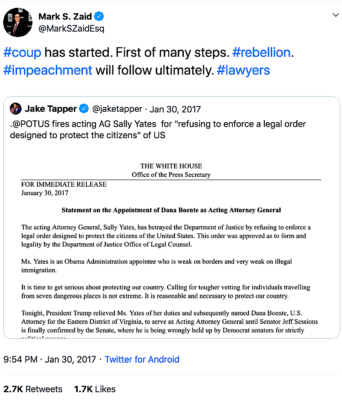 In the days following Trump’s swearing in as president, Zaid turned to Twitter to send out messages supportive of a “coup” against Trump that would lead to the president’s eventual impeachment. The identity of the lawyer who met with the whistleblower is not known. However, this lawyer referred the whistleblower to Bakaj, a fellow member of Whistleblower Aid, who took on the case and provided procedural guidance regarding the preparation of the complaint. Bakaj later brought on Zaid and another lawyer, Charles McCullough, with close ties to Senator Chuck Schumer and Hillary Clinton, to assist in the case.
On August 12, the whistleblower completed his complaint, and forwarded it to the intelligence community inspector general, thereby setting in motion events that produced weeks of hearings before the House Intelligence Committee that will very likely result in Trump’s impeachment.
Shielded from Questions
While the whistleblower, through counsel, had expressed a desire to testify before the House Intelligence Committee about the issues set forth in his complaint, he was never called to do so, even in closed-door session. The ostensible reason behind this failure to testify was the need to protect his anonymity, a protection that is not contained within the relevant statutes governing whistleblower activities within the intelligence community.
Later, as witnesses were identified from the content of the whistleblower’s complaint and subpoenaed to testify before the House Intelligence Committee, both Schiff and Bakaj indicated that the whistleblower’s testimony was no longer needed, since the specific issues and events covered in his complaint had been more than adequately covered by the testimony of others.
But the apparent reason Schiff and Bakaj refused to allow the whistleblower to testify, or to be identified, was to avoid legitimate questions likely to be asked by Republican committee members.
Namely, what was a deputy national intelligence officer of the U.S. intelligence community doing investigating activities of a sitting president? Who, if anyone, authorized this intervention in U.S. domestic political affairs by a CIA official? How did the whistleblower, who had a history of documented animosity with the Trump administration that included credible allegations of leaking sensitive material to the press for the express purpose of undermining the credibility of the president, get selected to serve as a deputy national intelligence officer? Who signed off on this assignment? What was the precise role played by the whistleblower in unmasking the identities of U.S. citizens in 2016, during the Trump transition?
Did the whistleblower maintain his friendship with Misko after leaving the NSC in July 2017? Did the whistleblower collaborate with Misko to get the House Intelligence Committee to investigate the issues of concern to the whistleblower before his complaint was transmitted to the ICIG? Who did the whistleblower meet on the House Intelligence staff? What did they discuss? Who was the lawyer the whistleblower first met regarding his intent to file a complaint? Did the whistleblower have any contact with Whistleblower Aid prior to this meeting?
Answers to these questions, and more, would have been useful in understanding not only the motives of the whistleblower in filing his complaint—was he simply a concerned citizen and patriot, or was he part of a larger conspiracy to undermine the political viability of a sitting president? There is no doubt that Congress has a constitutional right and obligation to conduct proper oversight of the operations of the executive branch, and to hold the president of the United States accountable if his conduct and actions are deemed unworthy of his office. Whether or not the facts surrounding the July 25, 2019 telephone call between Trump and Zelensky constitute grounds for impeachment is a political question for Congress to decide.
Intervening in Domestic Affairs
There is, however, the major issue looming in the background of this impeachment frenzy: the intervention by elements of the intelligence community in the domestic political affairs of the United States. There is no question that the whistleblower’s complaint served as the genesis of the ongoing impeachment proceedings.
The American people should be deeply concerned that an inquiry which could result in the removal of a duly elected president from office was initiated in secrecy by a member of the intelligence community acting outside the four corners of his legal responsibilities. The legitimacy of the underlying issues being investigated by the House Intelligence Committee is not at issue here; the legitimacy of the process by which these proceedings were initiated is.
To find out what happened, the whistleblower should not only be identified, called before the House Intelligence Committee, and other relevant Congressional committees, and be compelled to answer for his actions.
Impeachment is a constitutional remedy afforded to the U.S. Congress to deal with the political issues surrounding the conduct of a sitting president. If this constitutional remedy can be triggered by the intelligence community in a manner which obviates laws prohibiting the intrusion of intelligence agencies into the domestic political affairs of the United States, and done so in a manner where the identities of the persons and organizations involved, along with their possible motives, are shielded from both American people and those whom they elect to represent them in Congress, then a precedent will have been set for future interventions of this nature which undermine the very foundation of American democracy.
The political weaponization of intelligence represents a significant threat to the viability of the American constitutional republic that cannot be ignored.
Scott Ritter is a former Marine Corps intelligence officer who served in the former Soviet Union implementing arms control treaties, in the Persian Gulf during Operation Desert Storm, and in Iraq overseeing the disarmament of WMD.
Featured Video

Deception – Submarines against Olof Palme
or go to
Aletho News Archives – Video-Images
From the Archives
Woolsey Fire started at Santa Susana Field Lab — where “radioactive materials released were never accurately measured”
By John Laforge | CounterPunch | November 30, 2018
In my Nov. 16 column, I reported on potential radiation risks posed by California’s Woolsey wildfire having burned over parts or all of the Santa Susana Field Laboratory—south of Simi Valley, Calif., 30 miles outside Los Angeles—site of at least four partial or total nuclear reactor meltdowns.
The field laboratory operated 10 experimental reactors and conducted rocket engine tests. In his 2014 book Atomic Accidents, researcher James Mahaffey writes, “The cores in four experimental reactors on site … melted.” Reactor core melts always result in the release of large amounts of radioactive gases and particles. Clean up of the deeply contaminated site has not been conducted in spite of a 2010 agreement.
Los Angeles’s KABC-7 TV reported Nov. 13 that the Santa Susana lab site “appears to be the origin of the Woolsey Fire” which has torched over 96,000 acres. Southern Calif. Public Radio said, “According to Cal Fire, the Woolsey Fire started on the afternoon of Thursday, Nov. 8 … on the Santa Susana site.” … continue
Blog Roll
 Aletho News
- Feeling Better, Getting Worse: How Psychiatric Drugs Create the Illusion They Cure
- ‘Nobody Told Me’: Former Mental Health Patient Calls Out Dangerous Side Effects of Psychiatric Drugs
- Dr. Abu-Sitta: Beirut ‘felt like a day in Shifa Hospital’
- Iran Has Won the War, It Will Be Up to the US to Secure the Peace: Mohammad Marandi
- Iran condemns assassination threats against Iranian negotiators amid US talks
- Brussels cannot say where its own pipeline inspectors are as Hungary’s oil lifeline remains shut
- Israel’s Iran War: Myth and Reality
- Between war and industrial breakdown: The US-Israeli attrition crisis
- Pressure builds on Iran to ‘drop’ Lebanon ceasefire demand as Islamabad talks hang in balance
- In another clash report, US denies agreement to release Iran’s assets
- If Americans Knew
- Pro-Israel ‘Thinktanks’ and Individuals who Influence U.S. Foreign Policy
- Mearsheimer reveals how Israel dictates US policies on Iran, Gaza – video
- After killing 350+, Israel still has a “score to settle” with Lebanon before ceasefire – Daily Update
- Military aid to Israel emerges as the latest political litmus test for Democrats
- The only Palestinian children’s rights organization closes following years-long Israeli campaign against it
- ‘I Can’t Forget the Smell’: Lebanese Reel After Israel Kills Over 300 in Single Day
- DNC Shoots Down Resolutions Calling Out AIPAC and Limiting Arms to Israel
- TCN: Is Israel Blackmailing President Trump?
- Israel killed at least 303 Lebanese yesterday – who were they? Daily Update
- Amnesty: Urgent – Protect Lebanese civilians from brutal escalation in Israeli attacks
- No Tricks Zone
- German Expert: Heat Dome Led To Record Temps In Western USA…Warmer In 1934, 1936
- New Study: No Linear Warming Or Glacier Retreat Along Northern Antarctic Peninsula Since 1980s
- An Inconvenient Tree: Uncovered In Alps… Europe Much Warmer Than Today 6000 Years Ago
- New Study Reports A 60% Slowdown In Greenland’s Ice Loss Rate In The Last Decade
- Low Intensity Tornado Wrecks Major Solar Farm, Creating A Potential Toxic Dump
- New Study Finds Warming Saves Lives…Cold Temperatures 12 Times More Deadly Than Excess Heat
- German Science Blog Accuses PIK Climate Institute Of Hallucinating Climate Tipping Points
- Devastating Assessment Of Comirnaty Vaccine By Former Senior Pfizer Europe Toxicologist
- New Study: CO2 Is ‘Effectively Negligible’ As An Explanatory Climate Change Factor Since 2000
- Former Pfizer Toxicologist Dr. Helmut Sterz Tells Bundestag Hearing Pfizer Vaccine Should Have Never Been Approved
 Aletho News