Media Report on “Terrorists and Hostages” While Falsifying Iran-Contra
By Sam Husseini | June 26, 2015
Much of the media has been abuzz with President Barack Obama’s announcement that, as NBC put it: “the government will no longer threaten to criminally prosecute families of American hostages who pay ransom to get loved ones back from such groups as ISIS…”
The NBC report — and virtually every other report on this subject I’ve seen — have made no mention of when the U.S. government did pay for hostages in the Iran-Contra Affair. That’s when the Reagan administration sold arms to Iran in exchange for hostages and illegally used the funds for the Contras in Nicaragua.
An extreme example of media mis-reporting was Jake Tapper who claimed on November 18, 2014: “It’s a policy the U.S. government has never wavered on. America does not negotiate with terrorists. You have heard them say that, but now the Obama administration is ordering a full review of how it does deal with hostage situations in light of recent criticism from families of Americans brutally murdered by ISIS terrorists.”
So, I tweeted to Tapper: “never wavered on negotiating for hostages? I guess Iran-Contra didn’t happen.”
He tweeted back: “good point, we should we have couched that”
I responded: “No corrections on cable. Cause, 24-hour news.”
And indeed, no correction was forthcoming. Because it’s not like CNN has a lot of time to fill to educate, especially younger viewers about what happened in Iran-Contra.
Particularly insidious is Tapper’s notion that he should have “couched that” differently. Firstly, it avoids acknowledging that what he said was false: “It’s a policy the U.S. government has never wavered on.” That’s just a brazen lie.
But in a subtle way, his response is even worse. Tapper, it would seem, is tacitly blaming himself for not finessing the lie better. Perhaps he thinks it would be better had he said: “Administration after administration has declared they don’t negotiate with terrorists, but now, that policy is being reconsidered…” This would fulfill the goal of creating a false impression while not being so oafish as to outright lie. And in some way, that’s what most of the media did on this story (and countless others) — create the impression that the U.S. has never traded for hostages without outright lying about it.
All this helps put Iran-Contra, one of the few instances when the machinations of policy were exposed to public scrutiny to at least some degree, further into the memory hole. Indeed, what’s called the Iran-Contra Affair helped bring some light on several insidious policies, including plans to outright suspend the U.S. Constitution.
Another deceitful aspect of this story is it further solidifies the “definition” of terrorist that’s commonly employed by major media being whoever the U.S. government says is a terrorist. These hypocrisies certainly include as FAIR and others have noted not calling Dylann Storm Roof a terrorist. But outside even that discussion is if the violence of the U.S. government and its allies shouldn’t be called terrorism.
Much is also lost by not understanding the dynamics around the Iran-Contra Affair — which involved the U.S. arming both Iran and Iraq while those two countries fought a bloody war. Dahlia Wasfi in her recent piece “Battling ISIS: Iran-Iraq war redux” points out that the U.S. government is in effect doing the same thing in the Mideast now — arming warring sides. She writes: “Just as with Iran and Iraq in the 1980s, the people in the battlefields of Syria and Iraq pay the highest price. And just as was the case in the 1980s, the devastation of these countries serves U.S. and Israeli hegemony.”
Top 10 Bogus ISIS Stories
By Adam Johnson | FAIR | February 20, 2015
… as America debates the possibility of a full-scale ground invasion of ISIS-controlled territory, it’s important to note that much of the ISIS threat — namely that which targets the West — has been habitually overstated by an uncritical media.
In no particular order, here are the ten most bogus ISIS scare stories over the past year:
1. Female genital mutilation edict – July 2014

Who it fooled: Most major media outlets from Time to Reuters to The Atlantic to the BBC (whose story has since been scrubbed online). Above all, the UN itself.
Why it’s bogus: Actual residents of Mosul and regional experts quickly knew it reeked. The story was subsequently discredited by experts and jouranalists and called a hoax soon after.
2. Church-burning in Mosul – July 2014

Who it fooled: Human Rights Watch, The Atlantic, The Independent, The Times of India
Why it’s bogus: An intrepid archaeologist, Sam Hardy, called BS and thanks to the magic of reverse image Google search and some prodding by yours truly, it was eventually retracted by several outlets and never mentioned again.
3. ISIS in Mexico – October 2014

Who it fooled: Fox News, Judicial Watch, The Inquisitr.
Why it’s bogus: Absurd on its face, the story was quickly and roundly debunked.
4. ISIS recruiting emo British teen – December 2014

Who it fooled: Metro, The Daily Mail, The Telegraph
Why it’s bogus: The person who uploaded the picture admitted on Twitter it was a fake. The media subsequently deemed it a “hoax”.
5. ISIS Caliphate map – July 2014

Who it fooled: ABC News, International Business Times, Breitbart
Why it’s bogus: The original story from ABC News cited a map that had been floating around the Internet for months. To this day, its one and only source is a tweet from a noted white supremacist website Third Position.
io9.com and others eventually deemed it a hoax.
6. ISIS beheads Christian children – Aug 2014

Who it fooled: Originally asserted on CNN by self-proclaimed Iraqi-Christian activist Mark Arabo–a grocery story industry lobbyist whose previous media appearance was on a local San Diego news channel to oppose an increase in minimum wage–this story spread among right-wing and Christian media.
Why it’s bogus: After a fairly thorough inquiry, snopes eventually determined the claim was “inconclusive,” having found no independent evidence it occurred.
7. $425m bank robbery – June 2014

Who it fooled: The Washington Post, International Business Times, Fox News, Mic, Vocativ
Why it’s bogus: The story was based solely on accounts from the former mayor of Mosul and was later found to be uncredible by The Financial Times and, ultimately, US officials themselves.
8. ‘Over 100 Americans have joined ISIS’ – October 2014

Who it fooled: NBC News, Washington Post, Al Jazeera

Why it’s bogus: After the FBI admitted there were only “about a dozen” Americans fighting alongside jihadists in Syria in September 2014, several media outlets continued to report “over 100,” despite the government correcting the record several weeks prior.
9. #AllEyesOnISIS “Twitter storm” – June 2014

Who it fooled: The Daily Mail, McClatchy
Why it’s bogus: Yours truly showed that the “Twitter storm” was simply a reposting of weeks- or months-old tweets by an overzealous ISIS fanboi.
10. ISIS’s ebola terror plot – December 2014

Who it fooled: The Daily Mail, Fox News, Mashable, random right-wing media
Why it’s bogus: “Iraqi media” was the only source for the story, and the Iraqi minister of Health quickly debunked it.
The Illusion of Debate
By Jason Hirthler | CounterPunch | December 2, 2014
A recent article in FAIR reviewed the findings of its latest study on the quality of political “debate” being aired on the mainstream networks. It studied the run-up to the military interventions in both Iraq and Syria. Perhaps the arbiters of the study intended to illustrate what we’ve learned since the fraudulent Iraq War of 2003. Well, it appears we’ve learned nothing.
FAIR spent hours painfully absorbing the misinformation peddled by such soporific Sunday shows as CNN’s State of the Union, CBS’s Face the Nation, NBC’s Meet the Press, and ABC’s This Week, plus some of the more popular weekly political programming including ADHD-inducing CNN’s Situation Room, Fox News Channel’s Special Report, the venerable sedative PBS NewsHour, and MSNBC’s Hardball. You know the cast of characters: glib George Stephanopoulos, forthright Candy Crowly, harrowing Wolf Blitzer, and stentorian Chris Matthews. Images of their barking maws are seared into the national hippocampus.
Overall, 205 mostly government mouthpieces were invited to air their cleverly crafted talking points for public edification. Of them, a staggering sum of three voiced opposition to military action in Syria and Iraq. A mere 125 stated their support for aggressive action.
Confining its data to the Sunday shows, 89 guests were handsomely paid to educate our benighted couch-potato populace. One suggested not going to war. It stands to reason that considered legal arguments against these interventions got the short shrift, too.
The media consensus on Syria and Iraq isn’t an isolated instance of groupthink. Far from it. It conforms to a consistent pattern, one that has at its core a deliberate disregard for international law and efforts to strengthen transnational treaties and norms regarding military action. (Although transnational law regulating trade is highly favored, for obvious reasons.)
Here the New York Times uncritically repeats Israel casualty figures from the recent attack on Gaza. The journalist, Jodi Rudoren, gives equal legitimacy to sparsely defended claims from Tel Aviv and “painstakingly compiled research by the United Nations, and independent Palestinian human rights organizations in Gaza.” She adopts a baseless Israeli definition of “combatant”, ignoring broad international consensus that contradicts it. She dubiously conflates minors with adults, and under-reports the number of children killed. And so on. All in the service of the pro-Israel position of the paper.
In 2010 Israel assaulted an aid flotilla trying to relieve Palestinians under the Gaza blockade. Author and political analyst Anthony DiMaggio conducted Lexis Nexus searches that demonstrate how U.S. media and the NYT in particular scrupulously avoid the topic of international law when discussing Israeli actions. In one analysis of Times and Washington Post articles on Israel between May 31st and June 2nd, just five out of 48 articles referenced international law relating to either the flotilla raid or the blockade. DiMaggio dissects several of the methods by which Israel flaunts the United Nations Charter. He adds that Israel has violated more than 90 Security Council resolutions relating to its occupation. You don’t get this story in the American mainstream. But this is typical. U.S. media reflexively privileges the Israeli narrative over Arab points of view, and barely acknowledges the existence of dozens of United Nations resolutions condemning criminal actions by Israel.
It’s the same with Iran. For years now, Washington has been theatrically warning the world that Iran wants to build a bomb and menace the Middle East with it. That would be suicidal. It is common knowledge among American intelligence agencies, and any others that have been paying attention, that Iran’s foreign policy is deterrence. But this doesn’t stop the MSM from portraying Tehran as a hornet’s nest of frothing Islamists.
Kevin Young has done a telling survey of articles on nuclear negotiations between the U.S. and Iran. Some 40 editorials written by the Times and the Post were vetted. Precisely zero editorials acknowledged international legal implications of U.S. public threats and various subversions led by Israel, such as assassinating scientists and conducting cyber-attacks, both innovations on standard violations of sovereignty. However, 34 of the pieces “said or implied” that Iran was seeking a nuclear weapon. Forget that 16 American intelligence agencies stated that Iran had no active nuclear weapons program. These papers of record prefer to trade in innuendo and hearsay, despite assessments to the contrary. More than 80% of the articles supported the crippling U.S. sanctions that are justified by the supposed merit of the bomb-building claim.
Prior to Young’s work, Edward Hermann and David Peterson looked at 276 articles on Iran’s nuclear program between 2003 and 2009. The number itself is staggering, more so when stacked against the number of articles written over the same period about Israel’s nuclear program: a mighty three.
This is interesting considering the posture of both countries in relation to international treaties. Israel freely stockpiles nuclear weapons and maintains a “policy of deliberate ambiguity” about its nuclear weapons capacities, despite frequent efforts by Arab states to persuade it to declare its arsenal (which is estimated by some to be in the hundreds). Also, it has yet to sign the Treaty on the Nonproliferation of Nuclear Weapons (NPT) that has been signed by 190 nations worldwide. This intransigent stance has marooned the broadly embraced idea of working to establish a nuclear weapons free zone in the region.
Contrast Israel’s behavior with that of Iran itself, which has permitted extensive inspections of its nuclear facilities. The Times recently noted the country’s main nuclear facilities were “crawling with inspectors.” Iran is also a party to the NPT and is a full member of the IAEA. It continues to try to work toward a reasonable solution with the West despite debilitating sanctions levied on it by the United States. America has unduly pressured the IAEA to adopt additional protocols that would require prohibitively stringent demands on Iran, rendering the possibility of a negotiated solution comfortably remote from an American standpoint. (These additional demands reportedly include drone surveillance, tracking the origin and destination of every centrifuge produced anywhere in the country, and searches of the presidential palace. All of this passes without comment from our deeply objective journalist class.)
Coverage of Iraq is no different, particularly in advance of periodic illegal war of aggression against it. Former U.N. Special Rapporteur on Palestine Richard Falk and author Howard Friel conducted a survey in 2004 assessing the New York Times’ pre-war coverage of Iraq in 2003. In more than 70 articles on Iraq, the Times never mentioned “UN Charter” or “international law.” The study also found “No space was accorded to the broad array of international law and world-order arguments opposing the war.” But such arguments only exist outside of Western corridors of power in Washington, London, Paris, and Tel Aviv.
This isn’t debate. Real debate is pre-empted by internal bi-partisan consensus on some basic issues: maintain a giant garrison state, shrink the state everywhere else, preference corporations over populations, restrict civil liberties to secure status quo power structures. So when it comes to Iran, Iraq, Syria and the like, the question isn’t whether to go to war, but what kind of war to fight. Hawks want bombs. Doves want sanctions. Publicans want Marines. Dems want a proxy army of jihadis. They both want Academi mercenaries. (Obama hired out the gang formerly known as Blackwater to the CIA for a cool $250 million.) And when we’ve finished off ISIS, the question won’t be about an exit strategy, but whether to head west to Damascus or east to Tehran.
The question isn’t whether to cut aid to Israel given its serial criminality in Gaza and the West Bank, but how fast settlements can annex the Jordan Valley without attracting more international opprobrium. (International law, again, set aside.)
On the domestic front, the question isn’t whether to have single payer or private healthcare, but whether citizens should be forced to purchase private schemes or simply admonished to do so. The question isn’t whether or not to keep or strengthen New Deal entitlements, but how swiftly they can be eviscerated. The question isn’t whether or not to surveil the body politic, but where to store the data, and whether or not to harvest two-hop or three-hop metadata. The question isn’t whether or not to hold authors of torture programs accountable, but how much of the damning torture report to redact so as to leave them unprosecutable. The question isn’t whether or not to regulate Wall Street but, as slimy oil industry lawyer Bennett Holiday put it in Syriana, to create “the illusion of due diligence.”
All this is not to say the MSM isn’t aware of alternative viewpoints. It is, but it only acknowledges them when they can be used to justify a foregone conclusion. In the past year, the MSM has nearly become infatuated with international law. Friel has tracked the paper of record’s response to the Ukrainian fiasco. What did he find? When Russia annexed Crimea, the Times inveighed against the bloodless “invasion” as a gross violation of international law. Eight different editorials over the next few months hyperventilated about global security, castigating Russian President Vladimir Putin for his “illegal” violation and his “contempt for,” “flouting,” “blatant transgression,” and “breach” of international law. Calls were sounded to “protect” against such cynical disregard of global consensus. Western allies needed to busy themselves “reasserting international law” and exacting heavy penalties on Russia for “riding roughshod” over such sacred precepts as “Ukrainian sovereignty.”
Quite so, as Washington supports the toppling of democratically elected governments in Kiev and Tegucigalpa, sends drones to ride “roughshod” over Yemeni, Pakistani, Somali and other poorly defended borders; and deploys thousands of troops, advisors, and American-armed jihadis to patrol the sectarian abattoirs of Syria, Iraq and Afghanistan. But better to exonerate ourselves on those counts and chalk it up to the fog of war. After all, we follow the law of exceptionalism, clearly defined by Richard Falk as, “Accountability for the weak and vulnerable, discretion for the strong and mighty.”
Jason Hirthler is a veteran of the communications industry. He lives in New York City and can be reached at jasonhirthler@gmail.com.
Venezuelan Opposition Mayor Accused of Manipulating Tragic Death
By Tamara Pearson | Venezuelanalysis | February 26, 2014
Merida – A 34 year old man, Jimmy Vargas, died on Monday while he was involved in a violent street blockade. Some opposition leaders and media blamed the government, however video footage shows it was an accident. Two other people have died this week as a result of the blockades.
Vargas died at the Camino Real residential area, in San Cristobal, Tachira state. Footage, sent to CNN shows that it was an accident. However, CNN and other news agencies also broadcast repeatedly footage of Vargas’ mother blaming the National Guard and president Nicolas Maduro for the death.
Carmen Gonzalez, the mother, stated, “Maduro and those around him killed [my son], they are the ones who killed him, they killed him, they are the ones who gave the orders for him to be killed, they are killing all of Venezuela… and I’m going to go out and fight for my son, my son died fighting for his country, fighting for the freedom of his country…”
On social networks the story was spread that Vargas had been hit by a rubber bullet in his left eye, and other stories claimed a tear gas canister shot by the National Guard had hit him.
The newspaper El Nacional also blamed the government, headlining “Two deaths this Monday because of attacks by GNB [National Guard] and motorbike riders [government supporters] on protests”. Madurados.com headlined “Another tragedy! In rubber bullet attack by the GNB Jimmy Vargas dies in San Cristobal”.
Similarly, The New York Times included a ¼ page full-color photo of Jimmy Vargas on a stretcher, with the caption, “Carmen Gonzalez, 58, cried over the body of her son, who was killed Monday in clashes with the police.”
However Vargas’ doctor, Luis Diaz, reported that he had suffered severe traumatic brain injury (TBI) after falling from the second floor of a building, the newspaper Ultimas Noticias reported.
Vargas’ sister, Jindry, told NTN24 that her brother fell from the second floor the building after the National Guard fired rubber bullets and tear gas bombs at him, causing him to lose his balance. In the video Jimmy Vargas tried to climb down on to a balcony ledge and he lost his balance on the ledge, out of line of shot of the National Guard.
Further, the opposition mayor of San Cristobal, Daniel Cebellos, told the public that Vargas had been murdered. He tweeted on Monday night, “Since late night…the brutal attack of the GNB continues, more than 10 injuries (3 by bullet) and 1 youth of 34 years murdered”. He continued, “I call on the MUD [opposition coalition] that while they continue to kill our people in the streets there’s no peace for the government. The dialogue they propose is one big lie”.
Despite the evidence, Cebellos further tweeted this morning, “We are accompanying Jimmy Vargas and his family in this moment of grief. We reject the violence and repression.” Cebellos included a photo of Vargas’ funeral procession.
Tachira governor, Vielma Mora accused Cebellos of using a public funeral procession to “inflame” people “against the national government”.
“A citizen who, may he rest in peace, fell from the second floor, he was in guarimba (violent disturbances), it seems he lost his balance… do you know what the mayor of San Cristobal did with a few people? They paraded him through the city… like a war trophy”.
Meanwhile, there has been another death as a result of violent opposition blockades. El Carabobeño reported that a motorbike rider died last night after crashing into a barricade. Eduardo Anzola, 29, in Valencia, died instantly, the paper reported, after he didn’t see the barricade because of the darkness. Two other people have died as a result of crashing into barricades, in Caracas and Merida, and one other motorbike rider was killed when wire at a barricade cut his throat.
On Monday, Alba Ciudad and Panorama report that Antonio Valbuena, 32, died of a shot to the head, in Maracaibo. Valbuena was participating in a demonstration of motorbike riders, who were removing barricades so that their procession could get through. At one point, a witness said that a “man in a balaclava came out and began to shoot… one of the bullets hit Antonio in the head”.

Death Toll in Venezuela Clashes Rises to Ten
By Ewan Robertson | Venezuelanalysis | February 21, 2014
Mérida – According to authorities and press reports a total of ten people have now died in connection with violent protests in Venezuela. The government and the opposition blame each other for the situation.
Summary of the deaths
Of the ten deaths recorded in connection with the violence so far, five occurred in the Caracas area. Three of these deaths resulted from violent clashes on 12 February between opposition activists, security forces and in a few cases, Chavistas. A Venezuelan intelligence service officer has been arrested in connection with one of the deaths. Authorities report that investigations into the events are “almost complete” and the results will be presented to the country soon.
On Tuesday Genesis Carmona, a student and former beauty queen, was shot during an opposition march in Valencia. According to national newspaper Ultimas Noticias, witnesses said an armed pro-government group attacked the march. However authorities say ballistic investigations show the woman was shot from behind “from within opposition ranks”, and claim that witnesses on the scene have confirmed this.
Five of the deaths occurred on the barricades that hard-line opposition supporters have erected in several Venezuelan cities to block the flow of traffic and pressure President Nicolas Maduro’s resignation.
On Tuesday a 17 year old student was run over by a car while trying to block a road as part of protests. The man accused of running him over has been arrested.
Meanwhile on Wednesday a public attorney, Julio Eduardo González, died when he crashed his car trying to drive around a barricade in Valencia. Yesterday a woman, Delia Elena Lobo, died after crashing her motorbike into a barbed wire street barricade in Mérida.
The ninth to die is Arturo Alexis Martinez, the brother of a socialist party parliamentary deputy, Francisco Martínez. He was shot dead in Barquisimeto while trying to clear away the burning remains of an opposition road barricade. An investigation has been launched into the incident.
A tenth person was confirmed dead this evening. Elvis Rafael Durán died in the Sucre municipality of Caracas after riding his motorbike into an unseen barbed wire barricade.
Venezuelan press initially reported a another death following a shooting attack against a pro-government “march for peace” in Bolivar state on Wednesday, in which industrial workers from the region participated. However it later resulted that the worker in question had not died, but was seriously wounded. Nine were wounded in the incident, and sixteen have been arrested. A video taken of the shooting appears to show hooded figures firing at the march from a nearby building.
Attorney General Luisa Ortega Díaz said today that a total of 137 people have been wounded as a result of the violence, of which 37 are members of security forces and 100 are civilians. Twenty-four people are currently being held by authorities to be charged for specific “violent acts”.
Venezuela has experienced a wave of opposition protests over the past few weeks. The demonstrations, led by pro-opposition students, began after hard-line opposition leader Leopoldo Lopez called on supporters to go onto the streets and seek the “exit” of President Nicolas Maduro. Demonstrators also mention food shortages, crime and corruption as reasons for discontent.
While many protests have been peaceful, others have descended into violent clashes with security forces, and on occasion, Chavistas. Meanwhile a violent element within the opposition has embarked on a strategy of burning street barricades, rioting and attacking property and civilians.
On Tuesday Lopez handed himself in to authorities, to be charged with incitement of criminal acts, among other offenses.
Debating responsibility
The government squarely blames the right-wing opposition for causing the violence, and accuses them of trying to create the conditions for a “state coup”.
“Venezuela is victim of an attack by the extreme-right to destabilise us, to take us into civil war,” said Maduro tonight. The president also alleged that the opposition has paid youths from “criminal gangs” to participate in the violent street actions.
However the opposition says the violence is being perpetrated by security forces and pro-government “paramilitaries”.
“State security forces, accompanied by paramilitary groups, have cruelly attacked peaceful and defenceless protesters…leaving a lamentable tally of citizens assassinated, seriously wounded, tortured and disappeared,” claimed the opposition’s Democratic Unity Table (MUD) coalition in a statement today.
President Maduro repeated his stance tonight that armed opposition groups, armed pro-government groups, and state security forces that fire weapons during protests will not be tolerated. “I won’t protect anyone in this country who fires during protests,” he said.
Maduro appeared to refer to an incident on 12 February in Caracas, with video evidence suggesting that several intelligence service (SEBIN) officers fired at a group of opposition protesters. All SEBIN officers were under presidential orders to remain indoors that day.
“I asked that no one go out onto the street, less so with guns. And they went out with guns. Ah, it looks a lot like the format of the state coup [of April 2002]. I’m investigating all of this, and if elements [of an inside plot] appeared I’d say it to my country…that there are plotters inside the government or that an officer has been bought. I’d say it with all of the willpower I have,” he stated.
The president also mentioned an audio recording, allegedly of a conversation between two opposition figures, which suggested that a plot was in place to create a “massacre” on 12 February.
The recording is claimed to be of a conversation on 11 February between former Venezuelan ambassador to Colombia, Fernando Gerbasi, and the head of the presidential guard during the Carlos Andres Perez presidency, Iván Carratú Molina. In the audio, the voice that is claimed to be Gerbasi, is heard saying, “Look, they inform me that [there will be] something very similar to 11 April [2002]…tomorrow”.
In light of the situation in the country, the government has repeated that it supports “social peace” and that it is open to “dialogue” with the opposition.
Opposition leader Henrique Capriles today accused the government of “manufacturing another 11 April”, and demanded “proof” of an opposition coup plot. He also argued for opposition protests to have greater “orientation”, criticising the “exit” strategy as being an “alleyway without an exit”.
CNN warning
There is fresh controversy over media reporting in Venezuela after President Maduro argued that CNN is trying to “justify a civil war in Venezuela for a military intervention”.
Saying that the channel’s reporting represents “war propaganda”, he warned that CNN would be prohibited from transmitting in Venezuela if it didn’t “rectify”.
“Twenty-four hours a day their programming is about war. They want to show the world there’s a civil war in Venezuela,” he said last night.
CNN has since confirmed that seven of its reporters have had their press accreditation removed.
“CNN has reported both sides of the tense situation in Venezuela, even with very limited access to government officials. We hope the government will reconsider its decision [to revoke the credentials]. Meanwhile, we will continue reporting on Venezuela in the fair, accurate and balanced manner that we are known for,” said CNN Español in a statement.
Maduro’s warning comes after the government removed Colombian channel NTN24 from Venezuelan cable services on 12 February, accusing it’s manner of covering the violent events as promoting “ a state coup like April 2002”. The channel said the move was an attack on freedom of expression.
Maduro has been a fierce critic of international media coverage of Venezuela during the on-going protests. “In the world, we’re confronting the most brutal manipulation [of information] that the Bolivarian revolution has faced since the state coup of 2002,” he said tonight.
The Whitewashing of Ariel Sharon
By Ramzy Baroud | Palestine Chronicle | January 13, 2014
The death of former Israeli leader Ariel Sharon enlivened US media’s interest in the legacy of a man considered by many a war criminal, and by some a hero. In fact, the supposed heroism of Sharon was at the heart of CNN coverage of his death on January 11.
Sharon spent his last eight years in a coma, but apparently not long enough for US corporate media to wake up from its own moral coma. CNN online’s coverage presented Sharon as a man of heroic stature, who was forced to make tough choices for the sake of his own people. “Throughout, he was called ‘The Bulldozer’, a fearless leader who got things done,” wrote Alan Duke.
In his article, “Ariel Sharon, former Israeli Prime Minister, dead at 85″, Duke appeared to be confronting Sharon’s past head on. In reality, he cleverly whitewashed the man’s horrendous crimes, while finding every opportunity to recount his fictional virtue. “Many in the Arab world called Sharon ‘the Butcher of Beirut’ after he oversaw Israel’s 1982 invasion of Lebanon while serving as defense minister,” Duke wrote.
Nevertheless, Sharon was not called the “The Bulldozer” for being “a fearless leader” nor do Arabs call him “the Butcher of Beirut” for simply “overseeing” the invasion of Lebanon. Duke is either ignorant or oblivious to the facts, but the blame is not his alone, since references to Sharon’s heroism was a staple in CNN’s coverage.
Sharon’s demise however, and the flood of robust eulogies will neither change the facts of his blood-soaked history, nor erase the “facts on the ground” – as in the many illegal colonies that Sharon so dedicatedly erected on occupied Palestinian land.
Following the Israeli occupation of Gaza along with the rest of Palestine in 1967, Sharon was entrusted with the bloody task of “pacifying” the headstrong Strip as he was the head of the southern command of the Israel Defense Forces. Sharon was dubbed the “Bulldozer” for he understood that pacifying Gaza would require heavy armored vehicles, and Gaza’s crowded neighborhoods and alleyways weaving through its destitute refugee camps were not suited for heavy machinery.
Therefore, he resolved to bulldoze thousands of homes, preparing the way for tanks and bulldozers to move in and topple even more homes. Modest estimates put the number of homes destroyed in August 1970 alone at 2,000. Over 16,000 Palestinians were made homeless and thousands were forced to relocate from one refugee camp into another.
The Beach Refugee Camp near Gaza City sustained most of the damage. Many fled for their lives, taking refuge in mosques and UN schools and tents. Sharon’s declared objective was targeting the terrorist infrastructure. What he in fact meant was targeting the very population that resisted and aided the resistance, for they indeed were the very infrastructure he harshly pounded for many days and weeks.
Sharon’s bloody sweep also resulted in the execution of 104 resistance fighters and the deportation of hundreds of others. Some were sent to Jordan, others to Lebanon, and the rest were simply left to rot in the Sinai desert.
Sharon’s violence was part of an equally disturbing logic. He believed that any strategic long-term plan to secure Israel must have at its heart a violent campaign aimed at disorienting Palestinians. He was quick to capitalize on the Allon plan, named after Yigal Allon, a former general and minister in the Israeli government, who took on the task of drawing an Israeli vision for the newly conquered Palestinian territories.
Sharon recounted standing on a dune near Gaza with cabinet ministers, explaining that along with military measures to control the Strip he wanted “fingers” of settlements separating its cities, chopping the region in four. Another “finger” would thrust through the edge of Sinai, helping create a “Jewish buffer zone between Gaza and Sinai to cut off the flow of weapons” and divide the two regions in case the rest of Sinai was ever returned to Egypt. That legacy disfigured and isolated Gaza, even years after Sharon implemented his policy of unilateral “disengagement” in 2005. He relocated the settlers to other illegal colonies in the West Bank and imposed a hermetic siege on the Strip, the consequences of which remain suffocating and deadly.
Sharon was keen on espousing or exploiting the division of his enemies. He moved against Lebanon in 1982, when the country was at its weakest point, exhausted by civil war. And when Israeli forces finally occupied Lebanon in 1982, as Palestine Liberation Organization fighters were shipped by sea to many countries around the Middle East, a triumphant Sharon permitted his Christian Phalangist allies to enter the defenseless Sabra and Shatilla refugee camps.
In the days between September 16-18, 1982, as Israeli troops completely besieged the camps, the Phalangists entered the area and carried out a massacre that gruesomely defined both the Lebanese civil war and the Israeli invasion, killing thousands of Palestinian refugees, mostly butchered with knives, but also gunned down.
Although Sharon was partly discredited after his disastrous war in Lebanon, Israeli voters brought him back repeatedly, to lead the rightwing Likud party in May 1999 and as a prime minister of Israel in February 2001. The aim was to subdue rebelling Palestinians during the Second Intifada. In fact, it was Sharon’s provocative “visit” to one of Islam’s holiest shrines a few months earlier that sparked anger among Palestinians and, among other factors, started the uprising.
Sharon attempted to crush the uprising with the support and blessings of the US, but he failed. By the end of August 2001, 495 Palestinians and 154 Israelis were killed. International attempts at sending UN observer forces were thwarted by a US veto on March 27, thus paving the way for the Israeli army to thrash its way into Palestinian refugee camps and other areas formerly controlled by the Palestinian Authority.
In March and April 2002, Sharon ordered Operation “Defensive Wall”, which resulted in major military incursions into most West Bank cities, causing massive destruction and unprecedented bloodletting. The Israeli operation led to the killing of hundreds of Palestinians, the reoccupation of major Palestinian towns, the destruction of Arafat’s headquarters in Ramallah, and the subsequent besiegement of the Palestinian leader in his barely standing office.
Sharon was no hero. It is time for US media to wake up from its own coma, and confront reality through commonsense and the most basic human rights values. It should not be looking through the prism of the most rightwing, if not fascist elements of Israeli society.
– Ramzy Baroud is an internationally-syndicated columnist, a media consultant and the editor of PalestineChronicle.com. His latest book is My Father Was a Freedom Fighter: Gaza’s Untold Story (Pluto Press, London).
Related article
US media failed to cite pundits’ ties to defense industry in Syria strike debate
RT | October 11, 2013
Nearly two dozen of the commentators who appeared on major media outlets to discuss a possible US military strike on Syria had relationships with contractors and other organizations with a vested interest in the conflict, according to a new report.
The Public Accountability Initiative, a non-profit research group dedicated to “investigating power and corruption at the heights of business and government,” determined that 22 of the pundits who spoke to the media during the public debate over whether the US should bomb Syria appeared to have conflicts of interest. Seven think tanks with murky affiliations were also involved in the debate.
Some analysts held board positions or held stock in companies that produce weapons for the US military, while others conducted work for private firms with the relationships not disclosed to the public.
Perhaps the most notable example is that of Stephen Hadley, a former national security advisor to President George Bush who argued in favor of striking Syria in appearances on CNN, MSNBC, Fox News and Bloomberg TV. He also wrote an editorial in The Washington Post with the headline, “To stop Iran, Obama must enforce red lines with Assad.”
Nowhere in those appearances was it disclosed, according to the report, that Hadley is a director with Raytheon, a weapons manufacturer that produces the Tomahawk cruise missiles the US almost certainly would have used had it intervened in Syria. Hadley earns an annual salary of $128,5000 from Raytheon and owns 11,477 shares of Raytheon stock. His holdings were worth $891,189 as of August 23.
“We found lots of industry ties. Some of them are stronger than others. Some really rise to the level of clear conflicts of interest,” Kevin Connor, co-author of the report, told The Washington Post. “These networks and these commentators should err on the side of disclosure.”
The report found that, out of 37 appearances of the pundits named, CNN attempted to disclose that individual’s ties a mere seven times. In 23 appearances on Fox News there was not a single attempt to disclose industry ties. And in 16 appearances on NBC or its umbrella networks, attempts at disclosure were made five times.
Retired General Anthony Zinni, former Commander-in-Chief of US Central Command, made multiple appearances on CNN and CBS. He is an outside director at BAE Systems, which is among the largest military service companies in the world and one that received $6.1 billion in federal contracts in 2012, serves on the Advisory Board of DC Capital Partners, a private equity firm that invests in defense contractors, and a Distinguished Senior Advisor at the Center for Strategic and International Studies.
Zinni advocated a strike not just on Syria, but told CNN’s Candy Crowley that American hesitation in the Middle East has pushed US adversaries to act.
“Knowing the Iranians, they see everything as a potential opportunity to exploit,” he said. “And I’m sure they are calculating much how they could take advantage of this and maybe push the edge of the envelope.”
The retired general, speaking to the Post via email, said his membership is publicly available online.
“The media who contact me for comment should post any relevant info re my background including my board positions if they desire,” he wrote.
This report comes after Syria researcher Elizabeth O’Bagy was fired from the Institute for the Study of War think-tank for lying about her credentials. Multiple US lawmakers, most notably Secretary of State John Kerry, cited an opinion piece O’Bagy wrote in the Wall Street Journal when calling for a military intervention. It was soon revealed that O’Bagy did not disclose her ties to a lobby group advocating for Syrian opposition forces when penning the column for the Journal.
Related article
- they’re shameless, mindless, unprecedented nitwits, all of them (niqnaq.wordpress.com)
Iran news agency slams CNN for ‘fabricating’ Rouhani’s Holocaust remarks
RT | September 26, 2013
Iran’s state-owned Fars News Agency (FNA) claims that CNN has ‘fabricated’ the remarks made by President Hassan Rouhani in response to the question about the Holocaust. The US news channel added to or changed parts of his remarks, the agency said.
On Tuesday, the newly elected Iranian president gave his first English-language TV message in an interview with CNN’s Christiane Amanpour. The interview made international headlines with hundreds of news agencies worldwide boasting titles like “Iran’s President Rouhani calls Holocaust ‘reprehensible’ crime against Jews” or “Rouhani recognizes the Holocaust as crime against Jews”.
Asking about Rouhani’s take on the Holocaust, Amanpour noted that his predecessor, President Ahmadinejad, infamously denied the Holocaust. “Do you accept what it was, and what was it?” the US journalist asked.
However, according to Iran’s FNA, the news channel made up parts of Rouhani’s answers, adding the word ‘Holocaust’ among other placatory remarks to its translation from the answers given in Farsi.
According to the exact English translation provided by FNA, the Iranian President said,
“I have said before that I am not a historian and historians should specify, state and explain the aspects of historical events, but generally we fully condemn any kind of crime committed against humanity throughout history, including the crime committed by the Nazis both against the Jews and non-Jews, the same way that if today any crime is committed against any nation or any religion or any people or any belief, we condemn that crime and genocide. Therefore, what the Nazis did is condemned, [but] the aspects that you talk about, clarification of these aspects is a duty of the historians and researchers, I am not a history scholar.”
Meanwhile, the CNN translation of Rouhani’s answer stated:
“I’ve said before that I am not a historian and then, when it comes to speaking of the dimensions of the Holocaust, it is the historians that should reflect on it. But in general I can tell you that any crime that happens in history against humanity, including the crime that Nazis committed towards the Jews as well as non-Jews is reprehensible and condemnable. Whatever criminality they committed against the Jews, we condemn, the taking of human life is contemptible, it makes no difference whether that life is Jewish life, Christian or Muslim, for us it is the same, but taking the human life is something our religion rejects but this doesn’t mean that on the other hand you can say Nazis committed crime against a group now therefore, they must usurp the land of another group and occupy it. This too is an act that should be condemned. There should be an even-handed discussion.”
According to FNA, the word ‘Holocaust’ as well as the statement “whatever criminality they committed against the Jews, we condemn” are “the worst parts of the fabrications which totally change what President Rouhani has said.”
The New Crossfire: Where Both Sides Support War With Syria
By Peter Hart | FAIR | August 28, 2013
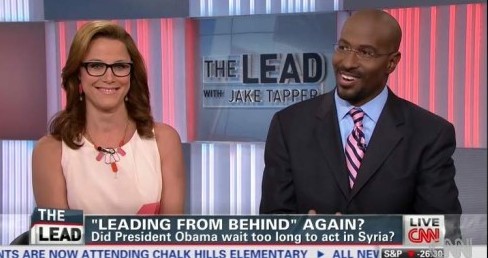 CNN is bringing back Crossfire next month, but viewers on August 27 got a taste of what they might expect: The left thinks we should bomb Syria, while the right thinks we should have started that a long time ago.
On the show The Lead, guest host John Berman moderated a “debate” between conservative S.E. Cupp and left-leaning Van Jones.
“Look, I want to commend the president for finally following through on our red line threats,” Cupp declared–before explaining that Obama’s plan was too timid:
We should absolutely intervene to stop the genocide of more than 100,000 people. We should absolutely intervene to stop Al-Qaeda and Islamic extremism from jihadizing yet another conflict. It is absolutely our obligation, and instead we do the bare minimum to save face and pat ourselves on the back for our civility and our diplomacy. I think it’s pathetic.
OK, and from the left? Jones said:
This president has now said there is a red line. It was not clear before whether the line was crossed. It’s crossed, he’s moving forward. I think we need to stand behind this president and send a clear message to Assad that this type behavior is not acceptable.
And:
If you kill Assad right now, wonderful. You have a huge power vacuum. Who is going to fill it? Listen, people have a nostalgia for 1953 when the U.S. could just sort of thump out dictators like in Iran. This is not the world we live in. It is a tough neighborhood over there, and the idea that we should have a more bloodthirsty and reckless president, I reject.
I’m not sure what “thumping out dictators like in Iran” is supposed to mean; in 1953, the United States supported a coup against Iran’s elected president.
But back to Syria: The American public is generally and overwhelmingly skeptical of military strikes on Syria. But in CNN‘s left/right debate, that point of view seems to be missing entirely.
Looking Back at Iraq With… Michael Gordon?
By Peter Hart | FAIR | March 20, 2013
The performance of the corporate media is one of the principal failures of the Iraq War. There are almost too many examples to name; but most critics agree that one of the most instrumental single pieces that made the false case for war was the front-page New York Times story (9/8/02) hyping the idea that Iraq was trying to procure special aluminum tubes for its nuclear weapons program.
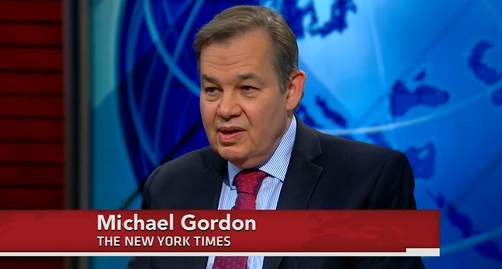
Last night in its 10-years-later segment, the PBS NewsHour (3/19/13) made a rather stunning judgment: One of the two expert journalists was the guy who co-authored that piece.
New York Times reporter Michael Gordon was the lead author on that infamous tubes article, but his record goes deeper than that. A few days into the U.S. bombing (3/25/13), Gordon appeared on CNN to endorse the bombing of Iraqi TV’s offices, calling it “an appropriate target,” since “we’re trying to send the exact opposite message.”
When U.S. politicians began to seriously consider a withdrawal of U.S. troops, Gordon criticized that policy, especially in one article (11/15/06) headlined, “Get Out of Iraq Now? Not So Fast, Experts Say” (FAIR Media Advisory, 12/4/06). He went on the Charlie Rose show (1/18/07) to endorse a troop surge. (Even the Washington Post admits that the idea that the surge succeeded is a “myth”–3/15/13.) And in early 2007, Gordon wrote articles, relying heavily on anonymous U.S. sources, alleging that the Iranian government was sending weapons into Iraq (Action Alert, 2/16/07).
So why would Gordon be someone you’d want to listen to about the Iraq War? That’s hard to say, really. But Gordon had plenty to tell PBS viewers. He complained that the Obama White House wasn’t interested enough in Iraq–leading to “the decline of American influence.” As he put it:
I think they view Iraq as just another country. They don’t have the same emotional or psychological or even foreign policy stake in it that the previous administration had.
Gordon added that the U.S. military “see a lot of early mistakes in the first years” of the war, but that “I do think the surge, as a military operation and military strategy, was effective and was essential.”
When one of the hosts, Judy Woodruff, asked about the war’s legacy, he replied: “Well, I think the military learned how to do counterinsurgency. The public opinion may no longer support that, but forever is a long time. And I think you can’t say we won’t have to do that again at some point in the future.”
And if there is ever another moment that requires reporters to faithfully record the views of anonymous U.S. officials as they make their case for war, it’s a safe bet that Michael Gordon will be there to do that job.
Related video
Featured Video

More Iran War fallout: Maritime insurance industry shifts from London to China
or go to
Aletho News Archives – Video-Images
From the Archives
Allies Don’t Need Lobbies
By Jay Knott | Dissident Voice | September 24, 2013
In a recent article on Counterpunch, Rob Urie defended the traditional Marxist analysis of US policy in the Middle East. He argues that support for Israel is driven primarily by economic interest, not the Jewish lobby.
He starts by paying tribute to the idea that Western societies are uniquely racist. He says that the “Western narrative” claims there is an “Arab character”, and that this is “antique racist blather”. He gives no definition of these terms. Further, he establishes his credentials as part of the dominant current in the American left by claiming that “over a million people in Iraq died so ‘we’ in the West can drive SUVs.”1
When he tries to criticize bourgeois economics, he makes it clear he doesn’t understand the developments it has made since Marx’s day, using the mathematical discipline known as “game theory”. He dismisses the basic abstraction of economic theory, the idea of the rational individual, on the grounds that it is “devoid of history, culture and political context”. But abstractions are always devoid of something.
He defends a more concrete economic theory, mostly Marxist, with some input from another theorist of capitalist crisis, Hyman Minsky. This concrete theory leads him to the view that US activity in the Middle East is primarily driven by rational capitalist motives, the need to secure a supply of oil.
“Taking the totality of circumstance — former oil company executives launching war on an oil rich nation on a pretext they publicly proclaimed they didn’t believe shortly before taking office — and that upon launching their war proved to be non-existent, requires a willingness to overlook the obvious — that the war on Iraq was for oil, that is difficult to support.”1
Perhaps I’ve misunderstood him, but based on what he says in the rest of the article, this convoluted sentence seems to argue that, because president Bush and vice-president Cheney attacked Iraq on false premises, and they also said it was all about oil, and they are former oil executives, and Iraq has a lot of oil, it’s difficult to deny US attacks on Iraq are all about oil.
In fact, it’s not hard at all. As Urie points out, at times Bush and co. said that attacking Iraq was “protecting the world’s supply of oil.”1 But, as he also points out, they are congenital liars. Why should we believe them when they say they are trying to “protect” the oil supply? Protect it against what? When politicians “admit” attacks on Middle Eastern countries are wars for oil, they are parroting the neo-con party line, feeding the public, both left and right, with a plausible-sounding pretext. For right-wingers, “it’s a war for oil” is a reason to support war, and for leftists, it’s a way to feel better by complaining impotently about corporate greed. Both approaches help the war drive. … continue
Blog Roll
 Aletho News
- More Iran War fallout: Maritime insurance industry shifts from London to China
- US-Israeli aggression on Iran triggers review of GCC countries’ investment pledges to Washington
- Russia slams UK plan to seize tankers suspected of carrying its oil
- Pakistan ramps up food exports to Persian Gulf nations as war deepens food insecurity
- Iran submits response to US plan, sets terms for war’s end: Tasnim
- US vs Iran: Kharg Island Talk — Bluff or Escalation? Ex-Military Officer Weighs In
- Zelensky unnecessarily involves Ukraine in the Middle East crisis
- Turkish tanker blacklisted by Ukraine hit in drone attack – media
- Canada, the U.S., and NATO: the inescapable trap
- Villains of Judea: Leonid Radvinsky
- If Americans Knew
- ‘No Innocent Children’: Far-right Israeli Lawmaker Defends Killing of Palestinian Family
- Mossad’s promises helped Netanyahu convince Trump that Iran could be toppled
- US Arms Control Official Refuses To Comment When Asked If Israel Has Nuclear Weapons
- Veterans warn US landing could be ‘more Gallipoli than Vietnam’
- Israel may be committing war crimes in Lebanon – Not a ceasefire Day 167
- In the West Bank, life is a constant battle – 3 articles
- Jacob Reses, one of the most powerful pro-Israel operatives in Trump’s Washington
- Israeli-US assaults kill or injure 87 children a day – Not a ceasefire Day 166
- ‘Forever live by the sword’: Understanding Israelis’ massive support for Iran war
- UN’s special rapporteur on human rights says Israel is systematically torturing Palestinians
- No Tricks Zone
- Devastating Assessment Of Comirnaty Vaccine By Former Senior Pfizer Europe Toxicologist
- New Study: CO2 Is ‘Effectively Negligible’ As An Explanatory Climate Change Factor Since 2000
- Former Pfizer Toxicologist Dr. Helmut Sterz Tells Bundestag Hearing Pfizer Vaccine Should Have Never Been Approved
- Energy Expert: Germany’s Nuclear Phaseout Was A “500 Billion Euro Mistake”
- New Research: South Australia’s Mid-Holocene Sea Surface Temperatures Were 4°C Warmer Than Today
- Storing Green Energy To Last Germany 10 Days Would Require A 60-Million Tonne Battery
- New Studies: UK Sea Levels Were 4 Meters Higher Than Today During The Mid-Holocene
- Destructive Green New Deal: German Energy And Metal Group Warns Of Drastic Crisis
- New Study Documents A 20-Year Pause In Arctic Sea Ice Decline – Driven By Internal Variability
- Wake-up Call: Survey Shows Majority Of Germans Now Favor Postponing Climate Targets!
 Aletho News

