US pressure contributing to Israeli influence in Latin America: Experts
Press TV – January 26, 2026
US political pressure is contributing to the Israeli regime’s influence across Latin America, even as long-standing regional support for the Palestinian cause continues through diplomatic, legal, and grassroots channels, experts say.
For decades, several left-wing governments in the region shaped their foreign policy around anti-imperialism and de-colonial identity, aligning openly with Palestinian rights, but analysts warn the legacy is now at the disposal of a mix of US interference, far-right political shifts, and economic leverage, the Middle East Eye news and analysis website reported on Monday.
Following the launch of the Israeli regime’s war of genocide on Gaza in October 2023, Brazil’s president verified the nature of the onslaught as being “genocidal,” Colombia suspended diplomatic ties with the regime, and Chile sought accountability for Israeli atrocities at international courts. Yet experts cited by the outlet said Washington has worked to counter that momentum through lobbying, political threats, and direct pressure on outspoken governments.
“Latin American states lack instruments of hard power and are therefore constrained in how they can respond to US pressure,” said Ali Farhat, a Latin American affairs specialist. “That limitation creates openings for Israel to consolidate influence, particularly where governments seek to avoid confrontation with Washington.”
US officials have increasingly framed cooperation with Washington as a test of “security” and “democratic alignment,” while linking regional diplomacy to broader American foreign policy goals that dovetail with closer ties with Tel Aviv.
Argentina has emerged as the clearest example of this shift. Far-right President Javier Milei has announced plans to move the country’s embassy to the holy occupied city of al-Quds and expand security and economic cooperation with the regime, while openly backing its war on Gaza as “legitimate self-defense.”
Last year, Argentina received a $20-billion bailout from Washington, which US President Donald Trump defended as support for a “good financial philosophy,” despite skepticism over its impact on the country.
Farhat said US meddling has reshaped the regional landscape, pointing to Washington’s targeting of Venezuela’s leadership as part of a broader effort to weaken vocal supporters of Palestine.
Venezuelan President Nicolas Maduro, long seen as one of the most uncompromising defenders of Palestinian rights in Latin America, was kidnapped by US forces earlier this year and is now standing trial in New York on “drugs, weapons, and narco-terrorism” charges.
“He (Maduro) was among the most uncompromising defenders of Palestine on the continent,” Farhat said. “His marginalization [and now ouster] represents the loss of a fierce advocate for the cause.”
The pundit said Maduro framed the Palestinian struggle as inseparable from anti-imperialism and viewed the US as a colonial power and the regime as an occupying entity backed by it.
Since Trump’s return to office last year, Farhat said, left-leaning leaders have shifted tactics rather than abandoning Palestine, opting for recalibration over confrontation, but far-right governments have accelerated alignment with both Washington and Tel Aviv.
As of 25 January, Argentina is the only Latin American country to have agreed to join Trump’s controversial “Board of Peace” initiative in Gaza, which describes itself as an international organization seeking to promote stability and secure “peace.”
Nilto Tatto, a congressman from Brazil’s Workers’ Party, urged Latin American governments to reject the board and any initiatives undermining Palestinian rights.
“Any framework managed by Washington would not serve peace so much as reproduce hegemony under an international guise,” Tatto said.
“Brazil, evidently, cannot take part in a process whose outcome is already predetermined, namely one that focuses on the reconstruction of the Gaza Strip only to then keep the territory under US control.”
Julia Perie, a former Argentine lawmaker, said Argentina’s shift reflected ideological realignment.
“Argentina’s position is part of a geopolitical vision that prioritizes alignment with the United States,” said Perie.
She added that Latin American solidarity with Palestine has always been cyclical. “This is another phase in a longer historical transformation, not the end of solidarity.”
‘Recalibration not abandonment’
Amid the situation, observers noted, support for Palestine in countries facing mounting political pressure was increasingly being channeled through legal action, multilateral institutions, and popular movements rather than overt diplomatic confrontation.
Ramon Medero, president of Venezuela’s La Danta TV, said the current moment represented adaptation, not retreat.
“It is difficult to argue that the Palestinian cause has suffered a decisive blow,” Medero said.
“What we are seeing is a repackaging of escalation through legal and multilateral avenues to reduce the costs of sanctions and backlash.”
Medero added that the Palestinian cause was now embedded in a broader Global South struggle.
“The Palestinian cause has become a structural symbol of liberation, sovereignty, and self-determination,” he said. “What is shifting is agency – away from governments and toward popular consciousness.”
He added that far-right advances could intensify grassroots mobilization.
Petro rejects narco claims, calls US strikes on Venezuela illegal
Al Mayadeen | January 5, 2026
Colombian President Gustavo Petro issued on Monday a series of sharply worded statements rejecting accusations that seek to link him or Venezuelan leaders to drug trafficking, while forcefully condemning US military aggression, political intimidation, and renewed assertion of imperial control over Latin America.
In several posts published on X, Petro responded to remarks attributed to US President Donald Trump and to broader narratives circulating in Washington in the aftermath of the US aggression on Venezuela. He argued that Colombia’s judicial archives, after decades spent confronting the world’s largest cocaine cartels, contain no evidence linking Venezuelan President Nicolas Maduro or First Lady Cilia Flores to drug trafficking. According to Petro, such allegations originate primarily from figures aligned with the Venezuelan opposition rather than from any verifiable judicial findings.
Defamation rejected
Petro noted that Colombia’s judiciary functions independently of the executive branch and is largely influenced by political forces opposed to his government. Anyone genuinely seeking to understand the cocaine trade, he said, should consult Colombia’s court records rather than rely on politically motivated accusations. He added that his own name has never appeared in narcotics-related cases over more than five decades, affirming that he “deeply rejects” uninformed and defamatory claims.
He also stressed that Colombia’s experience with drug violence has been shaped not by state policy but by transnational demand, financial laundering networks, and decades of militarized counter-narcotics strategies promoted from abroad, strategies that, he implied, have failed to curb trafficking while devastating civilian populations.
Addressing personal attacks, Petro said it is unacceptable to “slander” Latin American leaders who emerged from armed struggle and later pursued peace, framing such rhetoric as political coercion aimed at delegitimizing independent leadership in the region. He referenced his own past in the M-19 movement, noting that it laid down arms and became part of Colombia’s peace process, a transition he described as a historic milestone in contemporary Latin American politics and a rare example of negotiated conflict resolution rather than foreign-imposed regime change.
Caracas under bombardment
Petro described the US aggression on Venezuela as the first time in modern history that a South American capital had been bombed by the United States, warning that such an act would remain etched in the collective memory of the continent. “Friends do not bomb one another,” he said, drawing parallels to some of the darkest episodes of 20th-century warfare.
The operation has raised particular alarm due to Washington’s open acknowledgment that it intends to administer Venezuela during a so-called transition period and to assert control over strategic sectors, including energy. Regional observers note that Venezuela’s oil infrastructure remained largely intact during the assault, a fact Petro did not ignore as he warned against war conducted in the name of justice but structured around resource access.
While explicitly rejecting retaliation, Petro argued that the events underline the urgent need for Latin America to rethink its political and economic alignments. He called for deeper regional unity, warning that without cohesion the region risks being treated as a “servant and slave” rather than as a central actor in global affairs. Petro criticized existing regional mechanisms, including the Community of Latin American and Caribbean States (CELAC), arguing that its absolute consensus rules allow certain leaders to preserve subservient relationships with foreign powers at the expense of collective sovereignty.
Scapegoated Dead
Petro also condemned celebratory reactions in some political circles to the bombing of Caracas, accusing them of erasing Latin America’s shared liberation history led by Simon Bolivar.
He further noted the US’ aggression resulted in civilian deaths, including that of a Colombian woman working informally in Caracas to support her daughter, a reminder, he stressed, that military interventions marketed as “precision operations” routinely exact a human toll on the most vulnerable.
Directly addressing Trump, Petro accused the US president of issuing internationally unlawful orders that led to the deaths of Colombian nationals who were later branded “narco-terrorists.” He rejected those labels as false and dehumanizing, arguing that many of the victims came from impoverished communities with no links to organized crime and were instead casualties of a long-standing policy of militarization, criminal profiling, and collective punishment.
Free speech, sovereignty, resistance
Petro defended his right to speak freely on US soil, noting that his remarks in New York and around the United Nations were protected under US law. He explained he had publicly condemned the genocide in Gaza, suggesting that his positions on Palestine, Venezuela, and US foreign policy more broadly triggered retaliatory narratives portraying him as corrupt or complicit in drug trafficking.
Rejecting those portrayals, Petro said he owns no luxury assets abroad and continues to pay for his home through his official salary. He also framed the controversy as part of a wider struggle against injustice, misinformation, and efforts to silence dissenting voices from the Global South through legal intimidation and reputational warfare.
The statements concluded with a call for respect between the Americas, invoking shared liberation traditions associated with figures such as Simón Bolívar and George Washington.
Petro warned against narratives that portray Latin America as inherently criminal, stressing that the region’s political movements are rooted in long-standing struggles for democracy, sovereignty, and social justice, not in the stereotypes imposed by external powers seeking control rather than partnership.
The US Has Invaded Venezuela to ‘Fight Drugs.’ Are Colombia and Mexico Next?
By Adam Dick | Peace and Prosperity Blog | January 4, 2026
On Saturday, United States President Donald Trump held a press conference to boast about his sending the US military hours earlier to bring destruction in Venezuela and drag off the leader of the nation’s government to America for incarceration and prosecution. It was all done in the name of fighting the war on drugs, though few people give much credit to the Trump administration’s repeated assertion that Venezuela President Nicolás Maduro was a drug kingpin responsible for a major share of fentanyl or cocaine shipments into America.
The US government, Trump declared, will “run” Venezuela for an undefined “period of time” that Trump declined to rule out, in answer to a question, could be measured in years. While the US is doing that, be prepared for Trump also to potentially direct the US military to invade at least two additional countries in the Western Hemisphere.
In October, I wrote about how Trump appeared to be making demands and taking actions preparatory for the US going to war in three countries — Venezuela, Colombia, and Mexico. The common reason given for taking military action in each country has been the same — advancing the US government’s war on drugs.
The current status is one down, at least two to go. While already bogged down in Venezuela, the next step may be for the US to proceed to attack two more Western Hemisphere countries. Indeed, during the press conference, Trump continued with comments suggesting both Colombia and Mexico are under threat from the US government’s drug war. In particular, Trump reaffirmed his previous declaration that Colombia President Gustavo Petro has “got to watch his ass” while accusing him of making cocaine and sending it into America, criticized the “cartels operating along our border” in reference to Mexico, and said more broadly that “we will crash the cartels.” One important question to consider is how much America may also crash due to the strain of military intervention in the Western Hemisphere.
The Rise of the Isaac Accords: How Israel is Redrawing South America’s Political Landscape
This is not neutral cooperation. It is political conditionality.
By Freddie Ponton | 21st Century Wire | December 15, 2025
Foreign influence in the Global South rarely arrives in uniform. It comes disguised as ethics, stability, and shared values, only revealing its true cost once the rules are set. In Latin America, such a transformation is now underway. A new architecture of alignment is being quietly assembled, presented as moral course correction but functioning as a geopolitical filter. At its core lie the Isaac Accords, a project deliberately modelled on the Abraham Accords. Where the latter normalised Israel’s position in the Middle East through elite deals brokered by Washington, the Isaac Accords aim to reorder Latin American politics by locking governments, economies, and security institutions into Israeli and U.S. strategic orbit.
The Accords are not simply about Israel’s image or diplomatic isolation. They operate as a filter of legitimacy: governments that align are embraced, financed, and promoted; those that resist are marginalised, sanctioned, or framed as moral outliers. Venezuela, long aligned with Palestine and the broader Axis of Non-Alignment, sits squarely in the crosshairs.
This article examines how the Isaac Accords function in practice, why figures such as Javier Milei and María Corina Machado have become central to their rollout, and what this strategy reveals about Israel’s ambitions in South America, not as a neutral partner, but as an active geopolitical actor working in tandem with U.S. power.
The Isaac Accords: A Latin American Reboot of the Abraham Model
The Isaac Accords did not emerge in a vacuum. They are consciously modelled on the Abraham Accords, which rebranded Israel’s regional integration in the Middle East as “peace” while bypassing Palestinian self-determination entirely. The lesson Israeli and U.S. policymakers appear to have drawn is simple: normalisation works best when imposed from above, through elite alignment, financial incentives, and security integration.
The Accords are administered through a U.S.-based nonprofit, American Friends of the Isaac Accords, and financially seeded through institutions closely linked to Israeli state and diaspora networks. Their stated aim is to counter antisemitism and hostility toward Israel. Their operational requirements, however, reveal a far broader ambition.
Countries seeking entry are expected to:
- Relocate embassies to Jerusalem, recognising Israeli sovereignty over a contested city
- Redesignate Hamas and Hezbollah in line with Israeli security doctrine
- Reverse voting patterns at the UN and the OAS, where Latin America has historically voted in favour of Palestinian rights
- Enter intelligence-sharing agreements targeting Chinese, Iranian, Cuban, Bolivian, and Venezuelan influence
- Open strategic sectors: water, agriculture, digital governance, security, to Israeli firms
Israel’s own diplomats have described the Isaac Accords as a way to pull “undecided” Latin American states into Israel’s orbit at a moment when European public opinion has become less reliable. In other words, the Global South is being repositioned as Israel’s strategic rear guard.
The role of Javier Milei in Argentina illustrates how this model operates. Milei has not merely improved relations with Israel; he has embraced it as an ideological reference point. He has pledged to move Argentina’s embassy to Jerusalem, framed Israel as a civilisational ally, and positioned himself as the Isaac Accords’ flagship political figure.

Co-Founder and Chairman of The Genesis Prize Foundation Stan Polovets presents prize to 2025 Laureate Javier Milei on June 12 in Jerusalem. (Source: American Friends of Isaac Accords)

That role was formalised in 2025 when Milei became the Genesis Prize Laureate, an award frequently described as the “Jewish Nobel Prize.” The Genesis Prize is not politically neutral. It is explicitly awarded to figures who strengthen Israel’s global standing and its ties with the diaspora. Milei’s decision to donate the prize money directly back into the Isaac Accords ecosystem symbolised how moral recognition, political allegiance, and financing now operate as a single circuit.
This is alignment rewarded, visibly, materially, and publicly.
As reported by AP in August, the Isaac Accords are set to extend to Brazil, Colombia, Chile, and potentially El Salvador by 2026, as stated by the organizers, the American Friends of the Isaac Accords.
Recent New York Times reporting situates Brad Parscale’s involvement in the Honduran election within Numen, a Buenos Aires–based political consultancy he co-founded with Argentine strategist Fernando Cerimedo, highlighting how transnational firms operate beyond traditional regulatory scrutiny. Critics warn that Numen’s methods reflect a broader global political influence ecosystem that often draws on data-driven targeting, psychological profiling, and digital amplification techniques associated with Israeli-linked political technology and messaging firms that have operated in elections worldwide.
When combined with U.S. political endorsements, strategic pardons, and offshore consulting structures, this model raises serious concerns about how advanced data analytics and covert messaging infrastructures are used to shape voter behavior in vulnerable democracies, eroding electoral sovereignty while remaining largely insulated from accountability.
Venezuela, Palestine, and the Manufacturing of Illegitimacy
If the Isaac Accords require a moral antagonist, Venezuela fulfils that role perfectly.
Since Hugo Chávez severed diplomatic relations with Israel in 2009, in response to Israel’s assault on Gaza, Venezuela has positioned itself as one of Palestine’s most consistent supporters in the Western Hemisphere. Chávez, and later Nicolás Maduro, framed Palestinian resistance not as terrorism but as an anti-colonial struggle, aligning Venezuela with much of the Global South rather than the Atlantic bloc.
Under the Isaac Accords’ logic, this position is intolerable.
Opposition to Israel is no longer treated as a political stance but as evidence of extremism or antisemitism. Zionism and Judaism are deliberately conflated, allowing criticism of Israeli state policy to be reframed as hatred. This narrative provides the moral justification for isolation, sanctions, and, potentially, regime change.
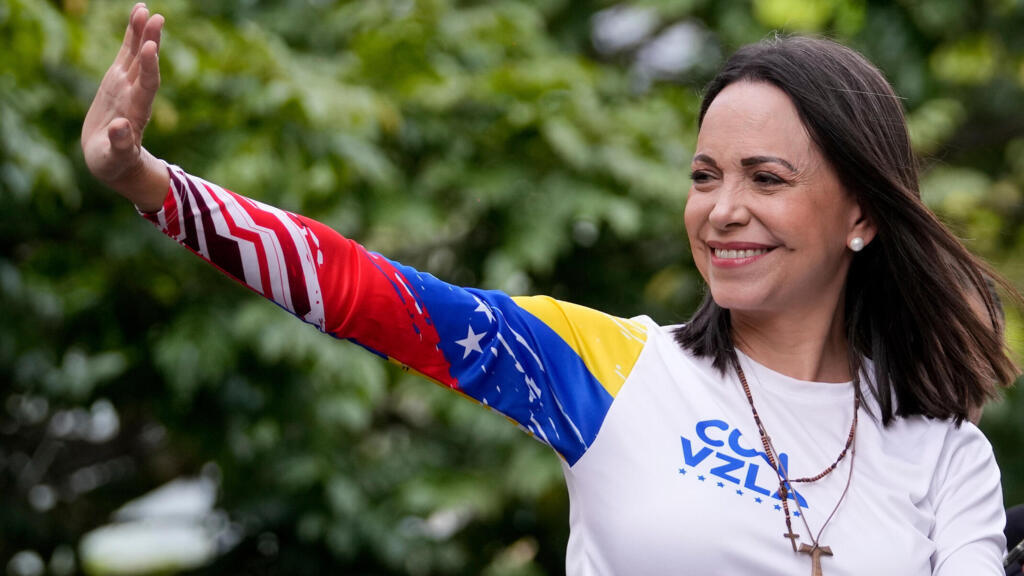
Maria Corina Machado in Venezuela, Thursday, July 25, 2024. (Source: AP – Matias Delacroix)
Into this context steps María Corina Machado, the Venezuelan opposition figure most warmly received by Israeli and U.S. political networks. Machado’s alignment with Israel is not rhetorical or recent. In 2020, her party, Vente Venezuela, signed a formal inter-party cooperation agreement with Israel’s ruling Likud Party, led by Benjamin Netanyahu. The agreement committed both parties to shared political values, strategic cooperation, and ideological alignment.
This is a remarkable document. It ties a Venezuelan opposition movement directly to a foreign ruling party, well before any democratic transition, and signals how a post-Maduro Venezuela is expected to orient itself internationally.
DOCUMENT: Vente Venezuela signs cooperation agreement with Israel’s Likud party – Agreement signed by María Corina Machado and Eli Vered Hazan, representing Likud’s Foreign Relations Division (Source: Vente Venezuela)
Machado has since gone further, pledging to:
- Restore full diplomatic relations with Israel
- Move Venezuela’s embassy to Jerusalem
- Open Venezuela’s economy to privatisation and foreign investment
- Align Venezuela with Israel and the United States against Iran and regional leftist governments
Her narrative rests on a crucial claim: that Venezuela itself is not anti-Israel, only its government is. According to this framing, Venezuelans are inherently pro-Israel and pro-West, their “true” preferences suppressed by an illegitimate regime.
In a November interview with Israel Hayom, Machado asserted that “The Venezuelan people deeply admire Israel.”
This argument is politically useful and historically thin. Venezuelan solidarity with Palestine predates Maduro and reflects a wider Latin American tradition of identifying with colonised peoples. To erase that history is to deny Venezuelans their own political agency.
The Anti-Defamation League (ADL) has repeatedly accused the Venezuelan government of fomenting “anti-Israel” and anti-Semitic rhetoric. Yet, a closer look tells a different story. Caracas’ statements are largely expressions of solidarity with the Palestinian people and their right to self-determination, combined with pointed criticism of Israeli state policies. By framing these positions as attacks on Jews or Israel itself, the ADL distorts the narrative, turning principled political stances into a perceived moral failing. This tactic underscores a broader pattern in which international organizations can paint Global South governments as rogue actors whenever they resist the gravitational pull of Israeli and U.S. influence, subtly laying the groundwork for diplomatic pressure or intervention.
DOCUMENT: Mini report from the Anti-Defamation League (ADL), formerly known as the Anti-Defamation League of B’nai B’rith, accuses Venezuela of fuelling an incendiary anti-Israel and anti-Semitic environment.(Source (ADL)
Security, Economics, and the Cost of Obedience
Beneath the moral language of the Isaac Accords lies a familiar architecture of control: security integration, economic restructuring, and ideological discipline.
Israel is a leading exporter of surveillance technologies, border systems, cyber-intelligence platforms, and urban security tools, many developed under conditions of occupation and internal repression. In South America, these systems are marketed as solutions to crime and narcotrafficking, but their real function is often political: expanding state surveillance capacity during periods of transition.
Security cooperation creates dependency. Once intelligence-sharing, training, and doctrine are integrated, political autonomy narrows. Policy divergence, particularly toward China, BRICS, or non-aligned partners, becomes risky.
The economic dimension is equally strategic. Israeli firms are deeply involved in water rights, desalination, agrotechnology, digital governance, and infrastructure, sectors that determine long-term sovereignty. These investments are typically tied to privatisation, deregulation, and long-term concessions, transferring control of strategic resources away from the public sphere.
Venezuela is the ultimate prize. A post-sanctions transition would open one of the world’s most resource-rich economies to restructuring. Machado’s commitment to rapid privatisation aligns seamlessly with this vision, raising an unavoidable question: who benefits from “democracy” when it arrives pre-packaged with foreign economic priorities?
This strategy is inseparable from U.S. power. The Trump administration’s framing of global politics as a permanent war on terror and narcotrafficking, a framing echoed by figures like Marco Rubio, has provided cover for sanctions, covert operations, and extrajudicial violence across the Caribbean and Pacific. Israel’s partnership reinforces this logic, supplying both technology and moral framing.
Conclusion: The Global South and the Right to Choose
The Isaac Accords are not simply about Israel’s diplomatic standing. They are about reordering South America’s political horizon at a moment when the Global South is rediscovering multipolarity.
Israel’s role in this process is active, strategic, and consequential. Through political patronage, economic leverage, security integration, and narrative control, it is shaping which governments are deemed legitimate and which are disposable.
For South America, and the wider Global South, the warning is familiar. When alignment is framed as morality, dissent becomes deviance. When sovereignty is conditional, development serves external interests. When history is rewritten, intervention soon follows.
Non-alignment was never about isolation. It was about the right to choose. That very right, today, is being quietly renegotiated, and the cost of refusing may soon become very clear.
Colombia expels Israeli diplomats after Gaza aid flotilla raid
MEMO | October 2, 2025
Colombian President Gustavo Petro has ordered the expulsion of all remaining Israeli diplomats from the country, after the interception of the Global Sumud Flotilla heading to Gaza.
He also called for suspending trade agreements with Israel after two Colombian citizens were arrested on board one of the ships. “Israel detained two Colombian women in international waters,” Petro said, demanding their immediate release.
Only four Israeli diplomats were still in Colombia after President Petro cut ties with Israel last year.
In a statement, Colombia’s Ministry of Foreign Affairs, on behalf of the government and the Colombian people, strongly condemned what it described as the kidnapping carried out by Israeli armed forces in international waters. The ministry said this act violated international law and the Geneva Conventions, and targeted the two Colombian nationals, Luna Barreto and Manuela Bedoya, both members of the Global Sumud Flotilla.
The ministry also called for the immediate release of its citizens, as well as all other members of the flotilla. It urged the governments of Spain, Bangladesh, Brazil, Slovenia, Indonesia, Ireland, Libya, Malaysia, the Maldives, Mexico, Oman, Pakistan, Qatar, Thailand, Turkey, and South Africa to take urgent and joint action to protect the lives and safety of their nationals.
According to the ministry, the international flotilla set sail in the Mediterranean with three objectives: to deliver humanitarian aid to Gaza, to raise awareness of the urgent humanitarian needs of the Palestinian people, and to highlight the need to end the war in Gaza.
Colombia halts arms purchases from US over drug combat delisting row
Al Mayadeen | September 16, 2025
Colombia halted arms purchases from the United States, its biggest military partner, on Tuesday, after Washington decertified the South American country as an anti-drugs ally under the pretext of failing to halt cocaine trafficking.
On Monday, President Donald Trump denounced Colombia’s leftist president, Gustavo Petro, for failing to curb cocaine production, claiming that instead, Petro presided over its rise to what he called “all-time records,” a failure which he stated made him decide to officially designate the country as having demonstrably failed to meet its drug control obligations.
Reacting to the news, Colombian Interior Minister Armando Benedetti told Blu Radio that “from this moment on… weapons will not be purchased from the United States.”
Trump’s decertification of Colombia, the first for the longtime ally in three decades, was viewed as a mainly symbolic gesture.
The decertification was nonetheless seen as a stinging rebuke of Petro’s anti-drug efforts, which prompted Colombia’s president to hit back by saying that the Colombian military would become independent from “handouts” from the United States.
Petro hits back
During a televised cabinet meeting, Petro said Colombia was being punished despite sacrificing dozens of policemen, soldiers, and regular citizens to stem the flow of narcotics to the United States.
“What we have been doing is not really relevant to the Colombian people,” the Colombian president stressed, adding, “It’s to stop North American society from smearing its noses” in cocaine.
US officials cited a surge in coca cultivation and cocaine production as the reason for the measure, while critics argue it unfairly targets Bogota despite its decades of collaboration with Washington.
Over 15,000 Colombians Participate in Conflicts Abroad – Lawmaker
Sputnik – 12.08.2025
The number of Colombian citizens who participated in international conflicts as employees of security companies exceeds 15,000, Colombian Congress member Alirio Uribe Munoz told Sputnik.
In early August, Colombian President Gustavo Petro said he had asked the country’s parliament to urgently consider a draft law banning mercenary activities.
“We have more than 15,000 people who participated in international conflicts, hired by security companies that supply soldiers for international armed conflicts,” Uribe Munoz said.
He noted that since Colombia has lived through a 60-year conflict and many of its military personnel have been trained at the Western Hemisphere Institute for Security Cooperation or by the Israelis, third countries are recruiting Colombians to participate in the fighting.
In this regard, Colombia needs legislation prohibiting mercenarism “to control this type of business,” Uribe Munoz added.
In July, Russian Ambassador in Bogota Nikolai Tavdumadze told Sputnik that the number of Colombians fighting alongside Ukrainian armed forces remained high. He also said that the Colombian parliament was looking into a bill that would have Colombia join the International Convention against the Recruitment, Use, Financing and Training of Mercenaries.
The Russian Defense Ministry has repeatedly warned that Kiev has been using foreign fighters as “cannon fodder” and that the Russian military will continue to strike mercenary troops across Ukraine. Colombians have been complaining about poor coordination in the Ukrainian armed forces, which makes survival in the high-intensity conflict in Ukraine much harder than in Afghanistan or the Middle East.
Bogota Summit launches Global South’s legal intifada against Israel and US impunity
By José Niño | The Cradle | July 17, 2025
From 15–16 July, Bogota became the unlikely capital of a global insurrection against western legal impunity. Over 30 countries – including key powers from the Global South and even some European states – gathered in the Colombian capital for the Hague Group Emergency Summit.
This was the most ambitious multilateral initiative yet to directly confront what participants unflinchingly termed Israel’s genocide in Gaza, and the broader culture of impunity that has shielded the occupation state since 1948.
From steadfast client to anti-imperial spearhead
That the summit was held in Colombia – a long-standing US vassal in Latin America – was not incidental. Once regarded as Washington’s most loyal client in the hemisphere, Colombia’s dramatic pivot under President Gustavo Petro represents the boldest regional defiance of US authority in decades.
Petro, who severed diplomatic ties with Tel Aviv in 2024, has placed Bogota on a collision course with the US over his unwavering opposition to the occupation state’s onslaught in Gaza.
Washington reacted predictably by issuing warnings to allies against the “weaponization of international law,” and sanctioning UN Special Rapporteur Francesca Albanese for her “illegitimate and shameful efforts” to advance the International Criminal Court’s (ICC) prosecutions of Israeli and US officials. Bogota responded with direct defiance. In the run-up to the summit, Petro publicly backed Albanese, declaring that “the multilateral system of states cannot be destroyed,” in a thinly veiled rejection of US diktats.
Over 30 nations participated, including the eight founding members of the Hague Group – Bolivia, Colombia, Cuba, Honduras, Malaysia, Namibia, Senegal, and South Africa, co-chaired by Colombia and South Africa. They were joined by more than 20 additional states spanning Latin America, Africa, Asia, and even Europe.
The participation of European countries such as Portugal and Spain was noteworthy. Both states only established full diplomatic relations with Israel in the latter part of the 20th century: Portugal in 1977 and Spain in 1986, emblematic of their historic caution over Israel’s contested legitimacy.
But since Tel Aviv’s genocidal war on Gaza began in late 2023, Madrid has adopted a string of punitive diplomatic moves.
Spain canceled a €6.6 million (around $7.2 million) ammunition purchase from an Israeli firm, scrapped a €285 million (around $310.7 million) anti-tank missile deal with the Spanish subsidiary of Rafael Advanced Defense Systems, banned Israeli weapons from port entry, formally recognized Palestinian statehood, and pushed to suspend the EU–Israel Association Agreement.
Though neither European state fully endorsed all of Bogota’s proposals, their participation and scathing denunciations of Israeli policy reflect a deeper fracture within Europe over Tel Aviv’s legitimacy and the cost of complicity.
Laying the legal gauntlet
Central to the summit was a blistering legal and moral condemnation of Israel’s conduct in Gaza and the occupied West Bank. The Hague Group issued a detailed catalog of war crimes: the mass killing of over 57,000 civilians, the targeting of hospitals and schools, the weaponization of starvation and siege, and the deliberate use of forced displacement.
The apartheid state in the occupied West Bank, enforced through racial segregation, parallel legal systems, and land confiscations for settlements, was cited as a textbook violation of the Fourth Geneva Convention and, per the International Court of Justice’s (ICJ) 2024 advisory opinion, a breach of international prohibitions against forced territorial acquisition and apartheid.
Francesca Albanese delivered the summit’s keynote, setting the tone with an uncompromising indictment:
“For too long, international law has been treated as optional – applied selectively to those perceived as weak, ignored by those acting as the powerful … That era must end.”
The ICC arrest warrants against Israeli Prime Minister Benjamin Netanyahu and former Defense Minister Yoav Gallant – citing crimes such as starvation as a weapon, indiscriminate civilian targeting, and the murder of Palestinian non-combatants – were repeatedly invoked as a historic turning point.
The Resistance Axis of lawfare
The summit’s ethos was clearly to rupture the impunity enabled by the UN Security Council’s paralysis. The Hague Group, founded in January 2025, framed itself as the Global South’s corrective to a postwar order that protects violators so long as they are shielded by US power.
That paralysis, most attendees argued, was not accidental but structural: The P5 veto system ensures impunity for those, such as Israel and its allies.
Meeting in the San Carlos Palace, delegates from 12 states – Bolivia, Colombia, Cuba, Indonesia, Iraq, Libya, Malaysia, Namibia, Nicaragua, Oman, Saint Vincent and the Grenadines, and South Africa – announced six binding measures. These included a full arms embargo on the occupation state, port bans for Israeli military vessels, contract reviews to terminate commercial complicity with the occupation, and firm support for domestic and international prosecution of Israeli officials.
These policies were anchored in the ICJ’s 2024 opinion declaring Israel’s occupation illegal and the UN General Assembly’s September 2024 resolution urging decisive global action within 12 months.
A global rift – but still an uphill battle
Despite the breakthrough, significant limitations remain. Only 12 states adopted the measures outright. Others were given until the UN General Assembly in September to sign on. Key powers, including China, withheld endorsement – despite supporting the initiative’s aims – likely due to economic entanglements with Israel, including port infrastructure investments.
Organizers acknowledged the uphill road ahead: absent broader UN uptake and stronger alignment from economic powers, Washington’s veto and European hesitation could neuter the Hague Group’s legal insurgency. But the coalition remains adamant that justice is no longer negotiable.
Colombian Vice Minister Mauricio Jaramillo Jassir captured the summit’s urgency:
“The Palestinian genocide threatens the entire international system … The participating states will not only reaffirm their commitment to opposing genocide, but also formulate concrete steps to move from words to collective action.”
A warning – and a promise
The Bogota summit was not just another international conference. It openly challenged the post-1945 legal fiction of a “rules-based order” – a system long exposed as a euphemism for western prerogative.
As South Africa’s International Relations Minister, Roland Lamola, asserted
“No country is above the law, and no crime will go unanswered.”
Yet the struggle remains unfinished. The Hague Group’s bold confrontation with Israeli impunity marks a decisive break, but the future of this legal uprising hinges on whether its momentum can breach the fortified walls of New York and The Hague, and whether powers like China, India, and Brazil shift from quiet endorsement to active alignment.
On 16 July, as thousands gathered in Plaza Bolivar in support, the message was unambiguous: either the era of impunity ends, or the legitimacy of the global order collapses with it.
Colombia must sever ties with NATO – president
RT | July 17, 2025
Colombia must cut ties with NATO as the leaders of the military bloc support “genocide” of Palestinians, President Gustavo Petro has declared.
Colombia, a traditional US ally in South America, became the first country in the region to obtain the status of NATO global partner in 2017. Petro, who took office in 2022 as Colombia’s first leftist president, severed diplomatic relations with Israel last year over what he describes as a genocide being carried out by the Israeli government against Palestinians.
”What do we do in NATO? If NATO’s top brass are for genocide, what are we doing there?” Petro said at a pro-Palestinian international conference in Bogota on Wednesday.
”Hasn’t the time come for another military alliance? Because how can we be with armies that drop bombs on children?” he added. “Those armies aren’t armies of freedom, they’re armies of darkness. We must have armies of light.”
Petro argued that NATO is a Cold War relic and asserted that nations like Colombia are treated as “half-members” within the US-led military bloc, granted symbolic partnerships but not full accession.
The two-day conference in Bogota hosted representatives from a dozen countries in the Global South. Attendees signed a joint declaration calling for economic sanctions and legal actions against Israel, including an arms embargo, restrictions on dual-use goods, port denials for vessels carrying cargo for Israeli forces, and support for international accountability for crimes allegedly committed in occupied territories.
Petro’s criticism reflects a break from Colombia’s historically warm relationship with Israel. The late Venezuelan President Hugo Chavez once dubbed Colombia the “Israel of Latin America,” arguing it served a similar geopolitical role in the region.
Israel launched its military campaign in Gaza following a deadly raid led by the militant group Hamas in October 2023. The first independent study of casualties in Gaza, published last month, estimated the number of fatalities in the enclave at almost 84,000 by January 2025. Israel is currently pushing Palestinians to move to a “humanitarian city” that would purportedly be free of Hamas influence – which critics say is just a euphemism for a concentration camp.
Without job opportunities in their homeland, Colombians are recruited by Kiev
By Lucas Leiroz | Strategic Culture Foundation | January 14, 2025
NATO’s proxy war against Russia through Ukraine has shown significant changes in various aspects, particularly regarding the participation of foreign mercenaries. While, at the start of the war, the flow of fighters was predominantly composed of individuals from Europe and the United States, a notable shift occurred throughout 2024, with a considerable increase in mercenaries from Latin America, especially Colombia. The driving factor behind this growing presence of Latin American fighters is not ideological, but rather economic, with many of these soldiers seeking a way to survive financially abroad, considering the extreme poverty in their home countries.
Colombia, one of the nations most affected by economic inequality in Latin America, serves as an example to understand this reality. With a large portion of the population living below the poverty line, many Colombians see themselves with few viable alternatives to improve their financial situation. For many Colombians, military service appears to be one of the few legal options that guarantees some level of financial stability, albeit modest. However, with scarce job opportunities and a struggling economy that fails to offer appealing alternatives, the chance to participate in the war in Ukraine, where mercenaries’ payments can be much higher, becomes attractive to many ex-soldiers who were previously trained in the Colombian armed forces.
The situation in Ukraine, however, does not turn out to be a “simple battlefield” for these mercenaries, as it might have seemed initially. When the first foreign fighters arrived, particularly Europeans and Americans, many saw the war as an opportunity to test their skills or even to partake in an “adventure.” However, as the conflict intensified, it became clear that the reality of the Ukrainian battlefield was far more brutal than many had imagined. Modern warfare, with its predominant use of heavy artillery, airstrikes, and large-scale exhausting confrontations, is an environment unfamiliar to soldiers who, like many Colombians – as well as Brazilians and other Latin soldier – were used to urban combat and guerrilla warfare, where the use of light weapons at short distances is common.
The transition to this type of combat, where air superiority and the constant use of long-range artillery are key determinants, shocked many of these mercenaries, turning their participation in the war into a true nightmare. The lack of air support, the difficulty of evacuation, and the constant presence of well-equipped and well-trained Russian forces in various directions made the combat experience far more dangerous than expected. Many of these mercenaries, especially those with little experience in high-intensity combat, ended up becoming easy targets. The losses are immense, and, according to some reports, a large portion of the Colombian mercenaries sent to Ukraine did not survive.
Despite the rising casualties, the Ukrainian government has tried to mask the difficulties faced by foreign mercenaries, disguising the losses and the lack of effectiveness of these fighters. However, the reality on the ground is far less favorable. The mercenaries have failed to change the game in Ukraine’s favor, and the promised financial gains for participating in the conflict seem to have been an illusion for many. The harsh conditions of combat, the human losses, and the lack of concrete results make the situation for the mercenaries, particularly the Latin Americans, increasingly bitter.
The loss of life among Colombian mercenaries, who represented a significant portion of the foreign fighters, reflects not only the failure of the strategies adopted by the West but also the human costs of this war as a whole. While political and military elites in Western countries remain distant from the suffering on the battlefield, the reality for mercenaries is a direct confrontation with death, often without prior reconnaissance or appropriate support.
And the problems go beyond that. For Colombia, a country already marked by decades of internal conflict, this new generation of mercenaries, who, if they survive, may return to their homeland radicalized and experienced in combat, could become a real ticking time bomb. In the same vein, recent news has emerged about pro-Ukrainian Colombian mercenaries being arrested in Venezuela for a conspiracy to assassinate Nicolás Maduro. In practice, the surviving mercenaries will likely become professional criminals, willing to serve Western interests for money anywhere in the world – especially in their home region.
From all perspectives, the involvement of Latin American mercenaries in Ukraine is a human, social, and economic tragedy. It is urgent to develop efficient mechanisms to prevent ordinary people from Global South countries from accepting to participate in foreign wars defending the interests of hostile powers.
You can follow Lucas on X (formerly Twitter) and Telegram.
Colombia wants to end avalanche of mercenaries fighting in Ukraine
By Ahmed Adel | December 3, 2024
The involvement of Colombian mercenaries in the Ukrainian conflict highlights the structural roots of the paramilitary phenomenon that has plagued the Latin American country for decades. In this context, Colombia and Russia agreed to create a working group to address the issue, especially since hundreds of Colombian mercenaries have died fighting in the Ukraine conflict.
The meeting, led by Russian Foreign Minister Sergey Lavrov and Colombian Foreign Minister Luis Gilberto Murillo, took place amid growing concern about the participation of former Colombian military personnel in international conflicts. The decision, announced after the meeting in Moscow in November, seeks to establish joint mechanisms to mitigate the impact of this problem, which threatens Colombia’s internal politics and global security.
Colombian President Gustavo Petro tweeted on November 27 that “mercenary work must be banned in Colombia,” adding that to prevent recruitment by private contractors, raising the “standard of living” of soldiers was necessary. He also called for “criminal punishment” for those using mercenaries in foreign conflicts, thereby supporting the bill his government introduced to the Colombian Congress in August to approve the United Nation’s International Convention against the Recruitment, Use, Financing and Training of Mercenaries.
The creation of the Russian-Colombian working group reflects a necessary response to political pressure on Bogota due to increased military and ex-military personnel involved in conflicts abroad, especially in Ukraine. There is an alarming number of Colombian military and ex-military personnel captured or killed in combat against Russian military forces in Ukraine.
Nonetheless, the phenomenon is not limited to the crisis in Ukraine but is part of a broader trend in which former military personnel, paramilitaries, and guerrillas from the South American country are recruited to participate in conflicts in different parts of the world. Some media outlets, such as Cuestión Pública, estimate that around 4,000 former members of Colombia’s Public Force participate in foreign conflicts.
As mentioned, the bill will include measures to criminalize the use, hiring and training of mercenaries, an essential step considering the avalanche of Colombian mercenaries that affects not only Ukraine but also other countries in conflict, such as Libya and Sudan.
Another concern is, obviously, the ramifications in Latin America. For example, former members of the Colombian military are recruited by Mexican drug cartels not only for training but also for paramilitary operations on the ground.
Privatized war and military training in Colombia are rooted in the influence of Israel’s Mossad and American companies, such as Blackwater, and are linked to drug trafficking and extractive economies. In effect, Colombian mercenarism has been fueled by a system that perpetuates violence as a tool of control. The training that Colombian soldiers receive, based on American and British techniques, makes them ideal combatants for international conflicts and criminal activities.
Resolving the mercenary problem in Colombia lies in addressing both the structural causes and the regulations that allow its proliferation. Fully implementing the Peace Agreement signed in Havana in 2016 between the Colombian government and militant groups, which includes measures for substituting illicit crops and economic development in the areas most affected by the conflict, is critical.
The agreement between Colombia and Russia represents a significant step in controlling the export of mercenaries and their impacts. However, the problem transcends national borders. Colombia has a long tradition of internal conflict and a highly trained military that is poorly paid and vulnerable. The solution requires political will and a structural change in the power dynamics perpetuating violence. The only way to find peace is through dialogue and policies that dignify soldiers and deactivate patterns of war.
Until this occurs, though, Colombians will continue to be tempted to fight in Ukraine due to the promise of thousands of dollars a month. Although Colombians can earn more money fighting in Ukraine than having a conventional job at home, more than 300 of the 2,000 believed to have gone to the Eastern European warzone have been killed, while hundreds more have been wounded or deserted their positions.
Even if Colombian mercenaries survive unscathed, they still face other issues. Recently, two Colombian soldiers returning home were detained in Venezuela and sent to Russia, where they have been charged with mercenary activities.
With Colombian nationals exposed to financial rewards in Ukraine, caveated with a likelihood of imprisonment, injury or death, Murillo also confirmed that peace efforts were part of his discussions with Lavrov: “We delivered a message of peace regarding the war between Russia and Ukraine, encouraging political and diplomatic dialogue.” Only through peace will Colombian lives stop being wasted in far-off Ukraine, but as it appears, the Kiev regime is still holding out from any negotiations with Moscow.
Ahmed Adel is a Cairo-based geopolitics and political economy researcher.
Colombia bans coal exports to Israel
MEMO | August 19, 2024
Colombia’s President Gustavo Petro signed a decree banning coal exports to Israel, Bloomberg reported, adding that this is an effort “to pressure the government of Prime Minister Benjamin Netanyahu to end the conflict in Gaza.”
The Columbian president said that Israel uses Colombian coal to make bombs to kill Palestinian children.
Since the beginning of the war on Gaza, the Colombian president has repeatedly stressed that Israel is committing genocide, calling on the world to put an end to Netanyahu’s violations.
At the end of February, Petro announced the suspension of arms purchase deals from the occupation, following the flour massacre in Gaza when 118 Palestinians were martyred while waiting for an aid convoy near the Nabulsi roundabout in the northern Gaza Strip.
Petro also announced in May that his country has severed its diplomatic relations with Israel and that the countries of the world should not be passive towards what is happening in Gaza.
Colombia is Israel’s biggest coal supplier, having sold it about $450 million of the fuel in 2023, according to Bloomberg News.
It had suspended coal exports in June.
Featured Video

Meet The Ellisons: Zionists, Technocrats, Moguls
or go to
Aletho News Archives – Video-Images
Frlom the Archives
Who Rules America?
The Power Elite in the Time of Trump
By James Petras | Axis of Logic | September 6, 2017
Introduction
In the last few months, several competing political, economic and military sectors – linked to distinct ideological and ethnic groups – have clearly emerged at the centers of power.
We can identify some of the key competing and interlocking directorates of the power elite:
- Free marketers, with the ubiquitous presence of the ‘Israel First’ crowd.
- National capitalists, linked to rightwing ideologues.
- Generals, linked to the national security and the Pentagon apparatus, as well as defense industry.
- Business elites, linked to global capital.
This essay attempts to define the power wielders and evaluate their range of power and its impact. … continue
Blog Roll
 Aletho News
- Expert Guts Claims That HPV Vaccine Reduces Cancer Risk
- No evidence Russia sabotaged Baltic cables – Finnish intel
- The Strategic Folly of a (Serious) US Ground Invasion of Iran
- US-Israeli war of aggression on Iran meant to reshape region: Omani FM
- Iran Does Not Consider Israel Party to Talks to Need Mediators With It – Ambassador
- Macron’s aircraft carrier and warplanes to the Persian Gulf is a dangerous vanity project
- Meet The Ellisons: Zionists, Technocrats, Moguls
- US failures in Iran reveal Russia is key to South Korea’s strategic security
- ‘All ports in Persian Gulf will be legitimate targets if Iranian ports are attacked’
- 40 Years of Endless War, Data Point by Data Point
- If Americans Knew
- Are we on the precipice of World War III?
- ‘Catastrophic,’ Says UNICEF: 1,100+ Children Killed or Wounded in Mideast Since US-Israel Launched Iran War
- The Unbelievable Madness of Our War With Iran
- World Council of Churches calls on govts to hold Israel accountable for violations of intl law
- How to end the war on Iran that costs US taxpayers $1M per minute – Not a ceasefire Day 153
- Israeli strategic plans to “remake the Middle East” from the 1950s and since
- Honoring Gaza’s women who refused to let the world look away
- 97% of victims of war on Iran are Iranian, 98% of victims in war on Gaza are Gazans – Not a ceasefire Day 152
- Early Iran strikes cost $5.6 billion in munitions, Pentagon estimates
- Israel Decided the War, But Trump’s America Fights and Pays the Bill
- No Tricks Zone
- Destructive Green New Deal: German Energy And Metal Group Warns Of Drastic Crisis
- New Study Documents A 20-Year Pause In Arctic Sea Ice Decline – Driven By Internal Variability
- Wake-up Call: Survey Shows Majority Of Germans Now Favor Postponing Climate Targets!
- Televised! Leading German Political Candidate Tells Schoolchildren CO2 Makes Sun Hotter!
- New Study: A Century Warming Of 1.1°C Is ‘Commonplace’ And ‘Not Unusual’ During This Interglacial
- New Study: ‘Internal Noise’ And Volcanic Forcing Can Trigger 10-15°C Warming Within Decades
- Glaciers Worldwide Are Suddendly Surging, Experts Blame Warming!
- Surprising Discovery: Sahara Is Greening…Billions Of Trees Where Once Thought To Be Barren
- New Research Reaffirms Clouds, Aerosols, And Surface Solar Radiation Are ‘Driving The Climate System’
- Germany: Electric Car Catches Fire At Charging Station, Sets Off Local “Inferno”, Widespread Damage
 Aletho News