A Humanitarian Crisis in Venezuela? A Case Study into NGO Mercy Corps
By Nina Cross | Venezuelanalysis | October 31, 2018
Following a sharp increase in Venezuelan migration since 2015, the corporate mainstream media, alongside the governments of the US, EU and Colombia, is aggressively pushing the narrative of a “humanitarian crisis,” at the same time that Western NGOs flock to set up shop along the Colombian border.
But what if NGOs are being used to influence how the movement of people from Venezuela into Colombia is being shaped and reported, and what’s more, if they are directly benefiting from this situation? To explore the idea, we focus on one such NGO, US-based Mercy Corps, which recently announced an expansion of its operations on the Colombo-Venezuelan border.
Mercy Corps’s budget for global operations, on the order of US $500 million (according to its 2017 annual report), includes funding from US and EU government agencies. Its financiers have included the UK’s International Department of Development, which has regularly sent aid via Mercy Corps to rebel-held areas in Syria. Other funders include the Bill and Melinda Gates Foundation and the Clinton Foundation.
In March 2018, Mercy Corps carried out a “rapid needs assessment” (RNA) of Venezuelan migrants arriving at two main points along the Colombian border. The information gathered was used to “demonstrate” the dangers involved during and after crossings from Venezuela, and the reasons for leaving the country. It is in response to this second question that the people interviewed by Mercy Corps all say the same thing: they are migrating due to an economic crisis in Venezuela, which is linked to hyperinflation.
Independent UN experts, as well as other commentators, have shown on many occasions that the causes of this economic crisis have been significantly exacerbated by the economic sanctions imposed for years upon Venezuela by the US, as well as clarifying that the crisis in Venezuela is economic, not humanitarian. Even US State Secretary Mike Pompeo recently admitted that the sanctions “sometimes have an adverse impact on the people of Venezuela.”
However, Mercy Corps is not concerned with narratives that expose US and EU complicity, and as such, its recommendations fail to include the most obvious point: end the sanctions and stop the hostility towards Venezuela as they are inflicting hardship on its population.
Instead, Mercy Corps’ RNA identified 3 basic needs to be met by the Colombian government: a path to legal entry into Colombia that did not involve passports, the legal right to work in Colombia with the same wages and protections as Colombians and access to shelter, food and water. It is on this third point which Mercy Corps looks to fish for substantial (tax-free) donations and financing from the Global North.
In April, the Colombian government agreed that migrants could register, without passports, at any of the 500-plus checkpoints it would set up along the border over a two month period, to end in June. The reason given was to see how many Venezuelans were entering Colombia. The checkpoints were spread along the 1,500 mile border. Any information supplied by migrants at the checkpoints would be retained by NGOs, not passed to government departments.
By August, the Colombian government agreed that nearly half a million Venezuelans could remain in Colombia for up to two years, look for employment and have access to basic services. The reason given for this change was to accommodate humanitarian needs.
This shift in policy was a reversal of the government’s ruling in February, when up to 3,000 Colombian soldiers were stationed along the border to check for passports. This tightening of rules was referred to as a “diplomatic closure” and the government claimed in a short time the number of migrants fell by 30%.
Yet within a few weeks Bogota U-turned its policy to allow the unhindered movement of Venezuelans, and NGOs such as Mercy Corps were conscripted to enable the process. The new policy of the Colombian government met exactly the needs identified by Mercy Corps, suggesting that the campaign for this migration was an international, organised effort.
In October of this year, Mercy Corps announced they are expanding their services on the border, including providing migrants with a debit card to purchase products. Yet, one out of every three Venezuelans attended by Mercy Corps did not see any improvements to their diet in the two weeks since arriving to Colombia, and 12 percent reported that it had worsened.
Since the Colombian government changed its policy, the number of people leaving Venezuela has increased, according to the Migration Policy Institute, an organisation affiliated to the EU.
As the exodus expands, the humanitarian needs of migrants grow more urgent.
Humanitarian crisis? Mercy Corps as a propaganda tool
The situation of Venezuelan migrants is now being called a “regional humanitarian crisis,” creating a picture of unimaginable catastrophe that needs external intervention.
This escalating crisis narrative of an expanding exodus is placing Venezuela under intense scrutiny. While punishing Venezuela with sanctions from the front, and promoting a migration crisis from behind, the EU and US, with the cooperation of Colombia, are attempting to box Venezuela into a more isolated and vulnerable position.
Colombia has enjoyed close ties with the EU, and soon after changing its policy on Venezuelan passports, it became a NATO partner, further cementing its EU and US dealings. This ballistic development means that the consequences of border conflict, fuelled by a recent movement of 5,000 extra troops to the Catatumbo border region, should be taken very seriously.
Meanwhile, Mercy Corps has consistently driven a narrative of a full-blown humanitarian crisis and rampant violence under President Maduro, including unfounded allegations of repression and torture. For instance, the NGO has made the unsubstantiated, hyperbolic claim on their website that “newborns in Syria have a better chance of survival than those born in Venezuela today,” wich clearly looks to stoke the fire.
Harnessing its “independent charity voice,” Mercy Corps is playing its part as a propaganda tool in vilifying the Venezuelan government, enabling its US and EU funders to continue their sanctions, which only worsen the economic hardship of average Venezuelans, the root cause for leaving their country, as explained in Mercy Corps’ own needs assessment. And whilst all this goes on, Mercy Corps gleefully rakes in ever greater funding so as to “attend” to the “humanitarian crisis” they, together with the mainstream media, have played a key role in manufacturing.
Political interference and profit from Mercy Corps
However, beyond playing a role in the international media war, Mercy Corps is intimately linked to the Washington policy-making establishment that has formulated the US policy of illegal, unilateral sanctions.
Mercy Corps is connected to the influential US Council on Foreign Relations (CFR) through its CEO Neal Keny-Guyer, who declared earnings of $460,000 just for his Mercy Corps role in 2017. Apart from being a member of the CFR, he also serves as chairman for Interaction, the US’ largest alliance of NGOs and sitting on the World Economic Forum’s Global Agenda Council on Fragility, Violence and Conflict. The CFR, a virtual who’s who of America’s wealthiest and most powerful people, claims it “helps policymakers” on “international peace and stability,” whilst actually pushing Washington’s neoliberal agenda and interests around the world.
The president of the CFR is Richard Haass, Middle East advisor under George Bush, and advisor to Colin Powell under George W. Bush. On his 2016 election win, Donald Trump publicly considered Haass as an advisor.
The CFR president recently displayed his frustration that US-backed military coups and UN- sanctioned military intervention in Venezuela, all of which would create a further migratory exodus, were taken off the table, despite ongoing rumours from the White House, Bogota, and even Brasilia, that they may be be possible.
In February the CFR made a Preventive Action Plan which recommended more economic sanctions for Venezuela, and in May more US sanctions were imposed.
Whilst sanctions have helped create the conditions which drive people out of Venezuela, US government aid has flowed to NGOs in Colombia, to which Mercy Corps has taken its chunk.
Mercy Corps’ 2017 financial statement shows that the organization benefited from US $464,452,000 in governmental grants and private backing alone, only spending $139,876,000 in humanitarian relief and $46,699,000 in humanitarian recovery. Of this humanitarian relief, the vast majority was spent on the mysteriously entitled “subgrant” category, and only $21,753,000 on actual materials and supplies for migrants.
Aid and NGOs: Assets of US policymakers
The CFR also included an aid plan for Venezuela which called for State Department funding for the Bureau of Population, Refugee and Migration (PRM), an organisation which finances Mercy Corps.
In August, the US announced an aid plan at the United Nations Assembly General (UNGA), matching the plan set out by the CFR.
Additionally, in an April article the CFR also suggests “…bypassing the government, if enough aid is provided by the United States, the Lima Group, and the EU to enable people to bring some back into Venezuela.”
The CFR continues: “While not the ideal means to provide humanitarian aid inside Venezuela, smuggling is a well-established activity and effectively closing the border to the influx of such aid would significantly add to the discredit of the Maduro government.”
Indeed, the CFR is explicitly advocating illegal smuggling as a means of destabilizing the elected government in Caracas. Meanwhile, smuggling is a problem for Venezuela, but not in the terms described by the CFR. On the contrary, Venezuela has suffered from extensive smuggling of subsidized goods and fuel into Colombia, exasperating shortages and as such generating more inflation.
Mercy Corps: A toy in the US imperialist toolbox
This game played by think-tanks and policymakers reveals Washington’s glaring double-standards vis-a-vis Venezuela. While they help to create and exploit the need for basic foods and medicines in another hemisphere, roughly 45,000 of their own people die each year through lack of health care. Around 30 million Americans have no medical cover at all, roughly the population of Venezuela, which has health care written into its constitution.
Every year a further 2 million Americans travel out of the US for treatment they cannot afford at home. Some will die if they do not find treatment abroad, but instead of being a crisis, this is termed ‘medical tourism.’
At the same time, the US is deporting tens of thousands of Hondurans, while more attempt to cross the border into the US every day, a legacy of Hillary Clinton’s 2009 adventurism.
Yet, we are constantly told to believe that Washington cares about migrants and the well-being of Venezuelans.
While US policymakers play games around Venezuela, with toys from the imperialist toolbox, along with their EU friends, it is no wonder Maduro fears assassination.
This article is a combination of two texts by Nina Cross, the first of which was published by the Morning Star, edited by Venezuelanalysis.
72nd FARC Member Murdered in Colombia Since Peace Agreement

Colombians protest against the murder of social leaders in Bogota. | Photo: EFE
teleSUR | September 27, 2018
The systematic targeting of social leaders and former FARC guerrilla fighters has become one of the main obstacles to peace in Colombia.
In Colombia, two former combatants of the demobilized Revolutionary Armed Forces of Colombia (FARC) were attacked in the Cauca department. One of them, John Faber Gomez, who was also a member of the National Protection Unit, died as a result of the wounds he sustained.
The armed attack took place after the Colombian government authorized the new Temporary Hamlet Zone for Normalization in the municipality of Patia, to replace the abandoned hamlet zone in Policarpa, Nariño.
The Common Alternative Revolutionary Force (FARC) party condemned the attack and demanded security guarantees from the government.
“Peace is in mourning. In the Cauca department, a member of the National Protection Unit and our party @FARC_EPueblo was murdered, 72 former combatants have already been murdered. #WeDemandTheRighttoLife #ThatPeaceDoesNotCostUsOurLives #WeWorkForPeace #TheyAreKillingUs,” Pablo Catatumbo tweeted Monday.
The systematic targeting of social leaders, human rights defenders, and former FARC guerrilla fighters has become one of the main obstacles to peace, especially because the state has failed to guarantee control over the territories left by the demobilized FARC.
In the framework of the United Nations General Assembly, the U.N. Secretary-General, Antonio Guterres, met with Colombian President Ivan Duque to ratify his commitment to the Colombian peace process and stress the urgency of providing security and development to conflict zones.
Cauca, Nariño, and Antioquia are the departments that record the highest number of murders. Human rights organizations have denounced the country’s General Attorney’s Office for lacking an investigation strategy that takes into account the existence of paramilitary groups, and the systematic nature of the murders against former combatants and social leaders.
RELATED:
Colombia’s Peace Crumbles as Social Leaders Killed With Impunity
Colombia recognizes Palestinian state, then abruptly vows to review the move amid Israeli outrage
RT | August 9, 2018
After it emerged that the former president Juan Manuel Santos recognized Palestine as an independent state just before leaving office, Colombia’s new government has pledged to “cautiously” review the decision and its implications.
Palestine was described as a “free, independent and sovereign state” in Santos’ August 3 letter to the Palestinian representative in Colombia, which was only made public on Wednesday. “Just as the Palestinian people have a right to constitute an independent state, Israel has a right to live in peace alongside its neighbors,” it added.
The Palestinian representative welcomed the announcement, expressing hope it will “contribute significantly to generating the necessary conditions in the search for peace in the Middle East.” Palestine is currently recognized as a sovereign state by the UN, the International Criminal Court and at least 137 countries.
Israel, however, immediately slammed the last move by the outgoing Colombian administration, urging the new government to reverse the decision, which, according to Israeli embassy in Bogota, “contravenes the close relations, extensive cooperation in vital areas and interests of both countries.”
Apparently facing some pressure, the new Colombian Foreign Minister Carlos Holmes said in a statement later on Wednesday that, given “possible omissions that could come to light about the way in which this decision was taken by the outgoing president, the government will cautiously examine its implications and will act according to international law.”
Colombia’s new president, Ivan Duque, took office on Tuesday in an inauguration ceremony attended by visiting US ambassador to the UN, Nikki Haley. Colombia was one of the few states that abstained from voting on a US General Assembly resolution that urged the US to rescind its recognition of Jerusalem as Israel’s capital last December.
Colombia’s New Defense Minister To Impose Permit Requirement for Protests
teleSUR | July 19, 2018
Colombia’s incoming Defense Minister Guillermo Botero is planning to “regulate” anti-government protests by only allowing demonstrations if they are previously approved by authorities. The announcement was made by Botero during a summit attended by USAID director Mark Green and former U.S. vice-president Joseph Biden.
Also attending the summit, president-elect Ivan Duque, said that “opposition is important to scrutinize, make demands and to criticize. But the invitation is that we pull together for a future for us all.”
Botero, who will be in charge of both the National Police and military, seemed to agree, saying public protests should “represent the interests of all Colombians and not just a small group.”
Restricting anti-government protests, which appears to go in contradiction to some parts of the ongoing peace process, was the first proposal made by Botero after being appointed by Duque.
Outgoing president Juan Manuel Santos vowed to release jailed participants in protests that turned violent during major social tensions between neglected or discriminated communities and the authorities, according to Colombia Reports.
Over the past decade, the overwhelming majority of protests were held by historically neglected groups, mainly Indigenous groups and African-descendant communities. They also included labor unions, campesinos, teachers, as well as political opponents to the government.
Botero’s proposal comes amid a surge of assassinations and death threats against human rights defenders and social activists.
Opposition Senator Alexander Lopez, who earlier this year survived an alleged assassination attempt, took to Twitter to voice his concern over the restrictive measure. “Botero hasn’t even taken office and he’s already persecuting social protest. He wants us to just raise our arms for him to do what he wants with us.”
Colombia’s inspector general, Fernando Carrillo, has accused elements of the country’s police and military of collaborating with criminal organizations to assassinate human rights defenders and community leaders. “State agents are co-opted by criminal organizations that are eliminating social leaders,” the official said on Wednesday.
Carrillo’s office is one of the state departments tasked with investigating the murders of at least 311 social leaders since 2016.
RELATED:
Colombia: State Agents Accused of Murdering Social Leaders
Colombian Community Mourns the Loss of Another Social Leader
teleSUR | July 17, 2018
Another Colombian social leader was reportedly murdered in the municipality of Caloto, Cauca, a national human rights network confirmed Monday.
The father of a former FARC soldier, an active participant in the Association of Pro-Constitution Workers Zones of the Caloto Campesina Reserves, Luis Eduardo Dague was a leader in his community. He assisted in founding the Carmelo of the Municipality of Caloto Cauca community and worked on the El Carmelo Action Board and various union, trade, and agricultural groups, the human rights network Francisco Isaías Cifuentes reported.
Dague’s remains were found in the El Carmelo Monday morning with marks consistent with torture across his body, face, and neck. Experts say Dague was most likely stoned or beaten to death.
According to local reports, a group of soldiers was camped on property owned by the victim near the crime scene. This is the second murder registered in Cauca this week. On Sunday, the body of Jose Bayardo Montoya was found in Miranda, also allegedly beaten to death, his skull completely crushed.
The Human Rights groups denounced the recent violence, calling on the state to act accordingly and to uphold the rights to life, liberty, personal safety, as well as physical, and psychological integrity; saying, “The necessary legal actions to determine the collective and individual responsibilities for the homicide.”
Late last week, Colombia’s inspector general, Fernando Carrillo, accused elements of the country’s police and military of collaborating with criminal organizations to assassinate human rights defenders and community leaders.
While earlier this month, demonstrations were organized in Paris, Valencia, Barcelona, Berlin, Brussels, London, New York, Rome and Buenos Aires to protests the violence targeting social rights leaders.
Jaime Gutierrez, of the National Confederation of Community Action, told El Espectador: “Why do they kill leaders? Because we’re against illegal mining, because it’s us who denounce the drug routes.”
Despite government promises from outgoing President Juan Manuel Santos to address the paramilitary violence, the number of fallen social leaders continues to climb with over 400 deaths since the signing of the Peace Treaty signing in November 2016.
RELATED:
Colombia: ELN Denies Responsibility For Murdered Social Leaders
teleSUR | July 7, 2018
Colombia’s National Liberation Army (ELN) has refuted allegations by the General Prosecutor that the group is responsible for the majority of social leaders murdered since the peace agreement was signed in 2016.
Posting on its official Twitter account on July 7, the insurgent group said: “The Office of the Prosecutor confuses and contaminates intentionally without providing information to support his accusations against us.”
The group also called attention to the General Prosecutor’s failure “to resolve the deaths and threats against leaders,” and said the words of National Director of Public Prosecutions Gonzalez Leon “represent a smokescreen to hide the true perpetrators of these murders.”
“The Prosecutor’s Office must stop participating in the ‘war of information’ and we urge the government to show its willingness to stop this extermination,” the ELN tweeted.
On July 6, Leon had told local media: “In the areas where these killings occur, we have found the (drug cartel) Clan del Golfo and the ELN as the main authors in Antioquia; the ELN in Choco and the municipalities of Cauca and Nariño, as well as FARC dissidents.”
The exchange followed a flurry of reports released by various social organizations earlier in the week, which variously accused the government and paramilitary groups of complicity in the killings.
One report, entitled ‘All The Names, All The Faces,’ names 123 of the 125 social leaders murdered between January 1 and July 4 this year. The two additional victims were murdered immediately after the report was published.
Another report on assassinations between 2002 and 2015 revealed that the majority of the murders aren’t related to Colombia’s half-century internal armed conflict, but are perpetrated by state security forces.
Colombian President-elect will not recognise Venezuela’s government, says to withdraw from UNASUR
Venezuelanalysis | June 21, 2018
Colombian President-elect Ivan Duque has vowed to not send an ambassador to Caracas upon assuming the presidency, claiming not to recognise the Venezuelan government in heated statements less than two weeks after his electoral victory.
“We can’t accept having links with a government which we consider to be illegitimate,” declared the winner of the June 17 election. Duque obtained 54 percent of the vote amid a 53 percent participation.
The president-elect, who will take power on August 7, also characterized Venezuelan President Nicolas Maduro as a “dictator,” alleging the existence of government-sponsored “drug trafficking structures.”
Similarly, Duque criticised Venezuela’s recent May 20 elections, which he considers to have been “openly manipulated.”
Venezuela’s May 20 presidential elections were declared free and fair by numerous international accompaniment missions who observed the process in the Caribbean nation.
By contrast, Colombia’s recent balloting has drawn significant criticism, with Colombia’s Immediate Reception for the Electoral Transparency Unit (URIEL) registering 1,239 complaints on the day of voting, 51 percent of which referred to “pressure and threats” to voters.
Duque is considered a hard-line politician of the right wing Democratic Centre center who is extremely close to party head and ex-Colombian President Alvaro Uribe, both in his rejection to the Colombian peace process and in the aggressive tone taken in relation to Caracas.
However, unlike Uribe, who stated days after his presidency was over that an invasion to Venezuela had been on the table, Duque has calmed concerns over a possible military encounter between NATO member Colombia and Venezuela, saying that he will not “assume a warlike attitude towards Venezuela.”
Nonetheless, the new Colombian president has threatened to denounce his Venezuelan counterpart at the UN Security Council. Duque has also promised to withdraw from regional body UNASUR for its “complicity” with Venezuela.
The tense relations between Colombia and Venezuela since 1999 have not stopped the abundant, migration between the two populations. It is estimated that more than five million Colombians entered Venezuela fleeing the civil war and government persecution. Likewise, recent data suggests that more than one million Venezuelans have crossed into Colombia in the past two years.
Colombia, the death squads & the US’ human rights double standard
Dan Kovalik | RT | June 7, 2018
Nearly every day, we are bombarded with “news” about problems in Venezuela. And certainly, there are problems, such as food and medicine shortages and skyrocketing inflation. But there is something that is downplayed.
What the press downplays, if it mentions it at all, is the very real and significant ways that US sanctions have contributed to these problems facing Venezuela and how these sanctions are making it nearly impossible for Venezuela to solve these problems.
What the press also fails to mention is the even greater humanitarian issues confronting Venezuela’s next-door neighbor, Colombia – the US’ number one ally in the region and, quite bizarrely, the newest “global partner” of NATO from Latin America. And, the US is very much responsible for these issues as well, but in quite different ways.
The fact is that, by a number of measures, Colombia has one of the worst human rights situations on earth, but you would never know this from watching the nightly news.
First of all, Colombia has the largest number of people forcibly disappeared in all of the Americas – even more than all of the Southern Cone countries combined during the infamous ‘dirty war’ years – at over 60,000.
In addition, Colombia has one of the largest internally displaced populations on earth at well over 7 million – second only to Syria. And, a disproportionate number of these internally displaced are indigenous and Afro-descendants.
Moreover, Colombia ranks 5th in the world for the number of children internally displaced by conflict, with two million boys and girls internally displaced. Quite shockingly, Colombia ranks 3rd in the world for the number of children murdered, with 715 children murdered just last year. Such statistics have led Save The Children to conclude that Colombia is “one of the worst countries to be a child and adolescent in the world.”
Colombia is also one of the worst countries in the world to be a social leader, such as a human rights defender, union leader, indigenous or Afro-Colombian leader. Thus, even after the signing of a peace deal between the Colombian government and FARC guerrillas in 2016, social leaders are being murdered at an alarming rate. Indeed, over 200 social leaders have been killed just since January of 2017. Last year was in fact the worst year on record for human rights defenders in Colombia, with 120 killed in 2017.
Of course, the US has a large responsibility to bear for this awful situation in Colombia, as it has been the intellectual author behind Colombia’s brutal, decades-long war against its own people and has provided billions of dollars of material aid to this war effort. Indeed, since 2000, the US has given Colombia $10 billion in mostly military assistance as part of its counter-insurgency program known as ‘Plan Colombia.’ During the Plan Colombia years, the Colombian military attempted to boost US military assistance by murdering civilians in cold blood and passing them off as left-wing guerillas. It is now believed that the military killed 10,000 civilians in this grisly “false positive” operation.
But the US is also behind an even darker force than the Colombian military – that is, the Colombian paramilitary death squads. While those who live in the more remote parts of Colombia are painfully aware of the paramilitaries’ presence and brutality, the paramilitaries are now a well-kept secret in the more well-to-do parts of Colombia’s big cities and even more so outside of Colombia. Indeed, the Colombian and US governments deny the very existence of these paramilitary groups, and the compliant press is happy to oblige in keeping this dirty secret.
Recently, Colombia’s most prominent human rights defender, Father Javier Giraldo, S.J., spoke about the paramilitary phenomenon of which he is an expert. As he explains, “There are clandestine or semi-clandestine arms of the State, which are the paramilitary groups. Today, it is not tolerated that you refer to them as such, but I still call them paramilitaries, because that is the appropriate term.”
Father Giraldo describes the origin of the paramilitary death squads, a force developed by the United States before the left-wing guerrillas even came into existence in 1964. As Father Giraldo explains:
“In 1962, when Guillermo León Valencia was president, a mission of the North American army, of a special school of war in North Carolina, created after the Second World War to maintain the security of the United States, arrived in Colombia… They analyzed the situation in Colombia and left secret instructions, ordering the Colombian government to begin training mixed groups of civilians and the military, and preparing them for paramilitary terrorist activities to combat the sympathizers of communism.”
“… President Valencia, on Christmas day of the year 1965, issued Decree 3398 with which he changed the name of the Ministry of War to [the Ministry of] Defense, and authorized forming groups of civilians as auxiliaries of the armed forces, the legal basis of paramilitarism.”
“… The United States began to direct the entire security apparatus in Colombia and its agencies… first with 400 officers of the US Army; today there are at least 800. The paramilitarism that was created at that time, with all the legal support, has been reaffirmed.”
Of course, as Father Giraldo has explained on numerous occasions, the ostensible “sympathizers of communism” targeted by the paramilitaries are trade union leaders, human rights defenders, peasant leaders, and Catholic priests who advocate on behalf of the poor. As for Catholic priests, over 80 have been murdered since 1984 for the crime of advocating on behalf of the poor.
It is now becoming more evident than ever from the fact that there is now a rise in the murder of such social leaders, as well as mass forced displacement, after the disarming of the FARC guerrillas, that it, is the paramilitaries which are responsible for the lion’s share of such human rights abuses in Colombia. But again, you would have no idea about this from reading the newspapers or watching the nightly news. And, Colombians who are suffering at the hands of the paramilitaries are painfully aware of the conspiracy of silence around this issue.
Indeed, when I was recently in Colombia for the first round of the presidential elections, our delegation met with a number of residents of the small town of Suarez (Cauca Department) which had just lost three members of their community to paramilitary violence. One of the members of the community desperately asked us, “what can we do to let the world know of the continued existence of the paramilitaries?” I answered that we have been trying to do just that for many years, though few will hear us out on this issue.
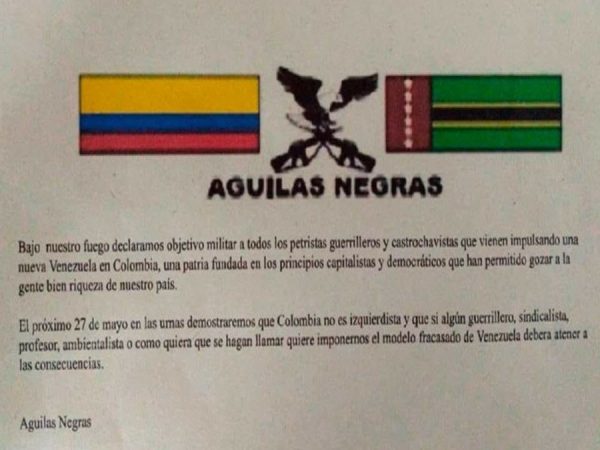
While we were in Colombia, a campaign coordinator for Gustavo Petro, a Colombian presidential candidate, was murdered by paramilitaries the day before the election, and the paramilitary group known as ‘Aguilas Negras’ (Black Eagles) issued a general threat against the supporters of Petro for president just a few days before the May 27 vote.
© Dan Kovalik
If Colombia’s very real human rights and humanitarian crises were given nearly the attention that the problems in neighboring Venezuela receives, the US and Colombian government would at least have some incentive to improve the situation in Colombia and to go after the paramilitary groups which continue to haunt that country. The near complete silence about the staggering violence in Colombia is critical in allowing that violence to continue. Indeed, the paramilitaries have always depended upon being able to operate in the shadows, and the US press is more than happy to oblige them in this effort.
Dan Kovalik teaches International Human Rights at the University of Pittsburgh School of Law. He is the author of ‘The Plot to Attack Iran.’
Venezuela: ‘Colombia Joining NATO A Threat To Regional Peace’
teleSUR – May 26, 2018
Venezuela has rejected the announcement by Colombia’s President Juan Manuel Santos that his country will be entering the North Atlantic Treaty Organization (NATO) as a “global partner.”
“Venezuela denounces once more before the international community the intention of Colombian authorities to lend themselves to introduce, in Latin America and the Caribbean, a foreign military alliance with nuclear capacity, which in every way constitutes a serious threat for peace and regional stability,” a statement by the foreign ministry said.
Likewise, Venezuela reiterated that it supports the historical position of the region to distance itself from the politics and wars of NATO, and from “any other army or military organization that desires to apply force to the suffering of the people, to impose and guarantee the hegemony of a particular political and economic model.”
The statement asks that the Colombian government fulfill its obligations toward peace and peaceful solutions to regional controversies.
Colombia will be the fist “global partner” of NATO in Latin America, beginning next week, President Santos announced Friday.
NATO was founded during the Cold War and was primarily a means for Western nations – led by the United States – to suppress the Soviet Bloc militarily and economically.
It continues to play a major role in modern conflicts, and has engaged in major military interventions in sovereign countries, most recently the removal and murder of Libyan leader Muammar Gaddafi in 2011.
WSJ’s Epic Distortion of Colombian and Venezuelan Refugees
By Joe Emersberger | FAIR | February 18, 2018
A Wall Street Journal article by Juan Forero (2/13/18) ran with the headline “Venezuela’s Misery Fuels Migration on Epic Scale.” The subhead stated, “Residents Flee Crumbling Economy in Numbers That Echo Syrians to Europe, Rohingya to Bangladesh.”
Forero’s article quoted a UN official: “By world standards, Colombia is receiving migrants at a pace that now rivals what we saw in the Balkans, in Greece, in Italy in 2015, at the peak of [Europe’s] migrant emergency.” Further on, Forero says, “The influx prompted Colombian officials to travel to Turkey last year to study how authorities were dealing with Syrian war refugees.”
Two enormous problems with the way Forero and his editors have framed this article should immediately stand out:
- Colombia’s population of internally displaced people is about 7 million, and has consistently been neck and neck with Syria’s. According to the UNHCR, as of mid-2016, Colombia is also the Latin American country which has the most number of refugees living outside its borders: over 300,000, mainly in Venezuela and Ecuador. Forero and his editors picked the wrong country to compare with Syria.
- Greece and Italy do not share a border with Syria, nor do the Balkans as they are generally defined. Colombia and Venezuela, by contrast, share a very long border. Forero’s comparison, therefore, excludes states that border Syria. Three of those bordering states—Lebanon, Jordan and Turkey—collectively absorbed 4.4 million Syrian refugees by 2016; five years after war broke out in Syria, Turkey alone took in almost 3 million.
It’s very important to expand on the first point. Colombia is a humanitarian and human rights disaster, and has been for decades, in very large part due to its close alliance with the United States. Thanks to Wikileaks (CounterPunch, 2/23/12), we know that US officials privately acknowledged estimates that hundreds of thousands of people were murdered by right-wing paramilitaries, and that the killings have nearly wiped out some indigenous groups. Those genocidal paramilitaries have worked closely with the Colombian military that Trump Chief of Staff John Kelly praised in 2014 as a “magnificent” US partner. “They’re so appreciative of what we did for them,” raved Kelly.
Praise for Colombia’s government has also come from the liberal end of the US establishment, albeit with much more subtlety than from Kelly. In 2014, a New York Times editorial (9/21/14) stated that “Colombia, Brazil and other Latin American countries should lead an effort to prevent Caracas from representing the region [on the UN Security Council] when it is fast becoming an embarrassment on the continent.” So to Times editors, Colombia is a regional good guy that must lead its neighbors in shunning Venezuela.
Colombia’s current president, Juan Manuel Santos, was minister of Defense from 2006 to 2009. From 2002 to 2008, the Colombian military murdered about 3,000 civilians, passing them off as slain rebels. As human rights lawyer Dan Kovalik explained (Huffington Post, 11/20/14) , the International Criminal Court (ICC) “concluded that these killings were systemic, approved by the highest ranks of the Colombian military, and that they therefore constituted ‘state policy.’” The murders occurred with the greatest frequency between 2004 and 2008, which Kovalik observed “also corresponds with the time in which the US was providing the highest level of military aid to Colombia.”
If Colombian and US officials evade prosecution for all of this, it will be with the help of corporate media—as well as the severe limitations powerful governments impose on international bureaucracies like the ICC. Kovalik remarked:
You might say, no official of the US can be prosecuted by the ICC because the US has refused to ratify the ICC treaty. While this may appear to be true, this did not stop the ICC from prosecuting officials from the Sudan—also not a signatory to the ICC.
The closest Forero came in his article to even hinting at any of these gruesome facts was when he wrote that “Colombia has long had troubles of its own, including integrating former Communist guerrillas from a civil conflict that only ended recently.” The “conflict” has not exactly “ended,” given that 170 leftist political leaders and activists were assassinated in 2017.
Putting aside Forero’s epic distortions by omission regarding Colombia, what about his reporting about migration from Venezuela? He wrote:
Nearly 3 million Venezuelans—a tenth of the population—have left the oil-rich country over the past two decades of leftist rule. Almost half that number—some 1.2 million people—have gone in the past two years, according to Tomás Páez, a Venezuelan immigration expert at Venezuela’s Central University.
In April 2002, Páez signed his name to a quarter-page ad in the Venezuelan newspaper El Nacional that welcomed the dictatorship of Pedro Carmona, then head of Venezuela’s largest business federation, who was installed after a US-backed military coup briefly ousted the late President Hugo Chavez. I’ve written before (ZNet, 1/16/17) about Western outlets—New York Times (11/25/16), Reuters (10/15/14) and Financial Times (8/22/16)—citing Páez without disclosing his anti-democratic record.
The World Bank has compiled data over the years on the numbers of Venezuelan-born people living abroad. The numbers point to far smaller migrations than Páez has estimated:

During the years Chavez was in office (1999–2013), the World Bank’s figures tell us Venezuelans living abroad increased by about 330,000. By 2013, Páez was estimating that about 1.3 million had left—about 1 million more than World Bank estimates. Would journalists ignore data published by the World Bank in favor of estimates by Páez if he were a staunch supporter of the Venezuelan government?
During those 1999–2013 years, the World Bank figures also say that the number of Colombian-born people living in Venezuela grew by 200,000. Forero’s article implies that migration from Colombia to Venezuela ended in the “late 20th century.”
The World Bank has not updated migration data past 2013, but there is no doubt there was a huge increase in migration from Venezuela since its economy entered into a very deep crisis starting in late 2014. (For an overview of the important role of US policy in creating the crisis and now deliberately making it much worse, see my op-ed, “US Policy a Big Factor in Venezuela’s Depression”—Tribune News Service, 2/2/18.)
According to a Colombian university study of Venezuelan migration to Colombia, it averaged about 47,000 per year from 2011–2014, then increased to 80,000 per year in 2015–16.
US government data show migration from Venezuela to the United States increasing from about 7,000 per year before 2013 to 28,000 per year by 2015, including Venezuelans who have entered without authorization.

From 2000 to 2013, the United States was the destination for about 30 percent of Venezuelan-born people who left to live abroad, according to the World Bank figures. If the Colombian university study and US government data are accurate, then the United States has been the destination for about 20 percent of Venezuelan migrants after 2013. That would mean about 140,000 Venezuelans per year were leaving to live abroad by 2016.
That is not remotely comparable to the 5 million Syrians who fled the country in the first five years following the civil war—and that doesn’t include over a million per year who fled their homes inside Syria (the internally displaced).
That Forero would even try to force this comparison into his article speaks volumes. It’s not hard to guess why it was made, given that US has bombed Syria regularly and has had Venezuela’s government in its crosshairs for almost two decades.
Ex-Israel soldier heading child prostitution ring deported from Colombia
MEMO | November 29, 2017
A former Israeli soldier was deported from Colombia for alleged links to a criminal network suspected of drug trafficking, child prostitution and tax offenses that spanned across several countries in Latin America.
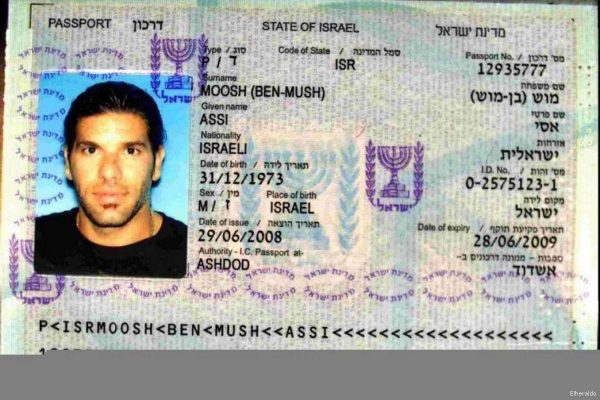
Forty-three-year-old Assi Moosh was expelled by Colombia and returned to Tel Aviv under escort by immigration officers last weekend. In a statement confirming the deportation, security officials said: “Police in Santa Marta, capital of the Magdalena department, hereby announce the removal of an Israeli citizen who owns a spa hotel frequented by many foreign tourists. Deportation procedures have been commenced as per law and will be carried out due to the Israeli’s conduct, which has harmed Colombia’s national security.”
Colombian news agencies reporting on the deportation revealed details surrounding the expulsion of Moosh who was exposed as being part of a group of ex-Israeli soldiers that had turned a small fishing village in Taganga into a “sex and drug den” from their base in a luxury resort that was known to locals as “little Israel”.
El Heraldo, a regional newspaper, revealed Moosh as the head of an “international network of human trafficking, micro-trafficking and sex tourism”. The Israeli gained a reputation locally for organising private parties in a room within his hotel. From their base in “little Israel” Moosh is reported to have run similar clubs exploiting drugs and children in Cartagena, Bogotá, Medellín, Ecuador, Mexico and Brazil.
Local sources reported that Moosh was arrested when he arrived in the immigration office in Santa Marta accompanied by a group of armed men. It’s believed that he had been trying to obtain Colombian citizenship.
According to the national police, Moosh had raised suspicion after it was discovered that his permits for tourism and hotel operation were obtained through a third party, enabling him to carry out criminal activities undetected for a decade.
Locals are said to be “relived” by the arrest. Residents told journalists that Moosh “had been one of those who destabilised the social order of the people.” Many felt he should have been arrested long ago.
The mystery for many locals, according to El Heraldo, was the Benjamin hotel. Residents of Taganga described the resort as a “bunker” run by Moosh “exclusively for Jews”. While it’s unlikely that many of the locals would have actually seen the inside of the luxury resort, the feeling that it was an unwelcome place for non-Israelis has even been reported by visitors on TripAdvisor. “Not Israeli? Forget about it” wrote one visitor who had given the hotel two stars in the review. “First off this is a good hotel/hostel but if you are not from Israel I wouldn’t go there, my wife and I were made to feel very uncomfortable even had people come up to us and say ‘are you from Israel?’ I said ‘no’ to their reply ‘then why would you come here’.”
Reports of how “ex-soldiers turned a Colombia fishing town into a sex and drug den” had been on the media’s radar for a while. In February Colombia Reports uncovered the tension within the popular tourist region caused by the Benjamin hotel. The report found that “Benjamin [hotel] employs and accommodates almost exclusively Israeli citizens, and was officially opened by 20 rabbis brought over especially from Israel”.
Security in the hotel is reportedly coordinated by a Willington Vasquez, who, according to the report is also known as “Manuel, a former member of a paramilitary death squad”. Locals from Taganga complained that the Israeli “tourism entrepreneurs” were running a drug trafficking network and prostitution business.
The friction between locals in Taganga and the Israelis was also reported in 2012. “Four Israeli ex-soldiers are the new ‘masters’ of Taganga” was the headline in the El Tiempo. The paper alleged that the Israeli “businessmen” were selling cocaine and sexually exploiting young girls.
A journalist from El Tiempo investigating the allegations spoke with local officials, residents and the Israeli businessmen who pleaded innocence saying that “the community is wrong, everything is false”.
But the report proved otherwise. The authorities said that they were clear “several Israeli ex-soldiers who arrived in that village” were “leaders of criminal gangs”. The authorities complained that the Israelis took over social premises, violated rules on tax payments and permits and were involved in selling drugs and sexually exploiting children.
The ex-Israeli soldiers became known as “the untouchables”. El Tiempo journalists travelled to the area and established that some of them were living in a concrete mass, guarded by eight security cameras. Others carry arms and move in 4×4 trucks with the Israeli flag.
Testimonies from villagers and local authorities, who, El Tiempo said requested anonymity for fear of reprisals, exposed the drug and prostitution industry that had blighted the small fishing village.
Their standoff with the ex-Israeli soldiers led locals to create a committee and to request help from the Santa Marta administration.
Mayor of Santa Marta at the time, Carlos Caicedo, told El Tiempo that the situation in Taganga is serious and that he will ask the Israeli embassy and the Ministry of Foreign Affairs to review the legal status of the ex-military personnel settled in the Benjamin hotel.
Residents of Taganga appealed to their government to end the criminal activity in their village and a request was also made to the Israeli embassy, according to El Tiempo, to sanction the criminal behaviour of its nationals.
As for Moosh, it’s reported that Colombian authorities have imposed sanctions on him which prevent him from returning to country for at last ten years.
Featured Video

Michael von der Schulenburg: Europe’s Self-Defeating Iran War Policy
or go to
Aletho News Archives – Video-Images
Frlom the Archives
Who Rules America?
The Power Elite in the Time of Trump
By James Petras | Axis of Logic | September 6, 2017
Introduction
In the last few months, several competing political, economic and military sectors – linked to distinct ideological and ethnic groups – have clearly emerged at the centers of power.
We can identify some of the key competing and interlocking directorates of the power elite:
- Free marketers, with the ubiquitous presence of the ‘Israel First’ crowd.
- National capitalists, linked to rightwing ideologues.
- Generals, linked to the national security and the Pentagon apparatus, as well as defense industry.
- Business elites, linked to global capital.
This essay attempts to define the power wielders and evaluate their range of power and its impact. … continue
Blog Roll
 Aletho News
- Michael von der Schulenburg: Europe’s Self-Defeating Iran War Policy
- Sorry, The New Republic, Climate Change Isn’t Causing Somali Migration. Blame Civil Strife and Poverty.
- Expert Guts Claims That HPV Vaccine Reduces Cancer Risk
- No evidence Russia sabotaged Baltic cables – Finnish intel
- The Strategic Folly of a (Serious) US Ground Invasion of Iran
- US-Israeli war of aggression on Iran meant to reshape region: Omani FM
- Iran Does Not Consider Israel Party to Talks to Need Mediators With It – Ambassador
- Macron’s aircraft carrier and warplanes to the Persian Gulf is a dangerous vanity project
- Meet The Ellisons: Zionists, Technocrats, Moguls
- US failures in Iran reveal Russia is key to South Korea’s strategic security
- If Americans Knew
- Are we on the precipice of World War III?
- ‘Catastrophic,’ Says UNICEF: 1,100+ Children Killed or Wounded in Mideast Since US-Israel Launched Iran War
- The Unbelievable Madness of Our War With Iran
- World Council of Churches calls on govts to hold Israel accountable for violations of intl law
- How to end the war on Iran that costs US taxpayers $1M per minute – Not a ceasefire Day 153
- Israeli strategic plans to “remake the Middle East” from the 1950s and since
- Honoring Gaza’s women who refused to let the world look away
- 97% of victims of war on Iran are Iranian, 98% of victims in war on Gaza are Gazans – Not a ceasefire Day 152
- Early Iran strikes cost $5.6 billion in munitions, Pentagon estimates
- Israel Decided the War, But Trump’s America Fights and Pays the Bill
- No Tricks Zone
- Destructive Green New Deal: German Energy And Metal Group Warns Of Drastic Crisis
- New Study Documents A 20-Year Pause In Arctic Sea Ice Decline – Driven By Internal Variability
- Wake-up Call: Survey Shows Majority Of Germans Now Favor Postponing Climate Targets!
- Televised! Leading German Political Candidate Tells Schoolchildren CO2 Makes Sun Hotter!
- New Study: A Century Warming Of 1.1°C Is ‘Commonplace’ And ‘Not Unusual’ During This Interglacial
- New Study: ‘Internal Noise’ And Volcanic Forcing Can Trigger 10-15°C Warming Within Decades
- Glaciers Worldwide Are Suddendly Surging, Experts Blame Warming!
- Surprising Discovery: Sahara Is Greening…Billions Of Trees Where Once Thought To Be Barren
- New Research Reaffirms Clouds, Aerosols, And Surface Solar Radiation Are ‘Driving The Climate System’
- Germany: Electric Car Catches Fire At Charging Station, Sets Off Local “Inferno”, Widespread Damage
 Aletho News
