Colombian Community Mourns the Loss of Another Social Leader
teleSUR | July 17, 2018
Another Colombian social leader was reportedly murdered in the municipality of Caloto, Cauca, a national human rights network confirmed Monday.
The father of a former FARC soldier, an active participant in the Association of Pro-Constitution Workers Zones of the Caloto Campesina Reserves, Luis Eduardo Dague was a leader in his community. He assisted in founding the Carmelo of the Municipality of Caloto Cauca community and worked on the El Carmelo Action Board and various union, trade, and agricultural groups, the human rights network Francisco Isaías Cifuentes reported.
Dague’s remains were found in the El Carmelo Monday morning with marks consistent with torture across his body, face, and neck. Experts say Dague was most likely stoned or beaten to death.
According to local reports, a group of soldiers was camped on property owned by the victim near the crime scene. This is the second murder registered in Cauca this week. On Sunday, the body of Jose Bayardo Montoya was found in Miranda, also allegedly beaten to death, his skull completely crushed.
The Human Rights groups denounced the recent violence, calling on the state to act accordingly and to uphold the rights to life, liberty, personal safety, as well as physical, and psychological integrity; saying, “The necessary legal actions to determine the collective and individual responsibilities for the homicide.”
Late last week, Colombia’s inspector general, Fernando Carrillo, accused elements of the country’s police and military of collaborating with criminal organizations to assassinate human rights defenders and community leaders.
While earlier this month, demonstrations were organized in Paris, Valencia, Barcelona, Berlin, Brussels, London, New York, Rome and Buenos Aires to protests the violence targeting social rights leaders.
Jaime Gutierrez, of the National Confederation of Community Action, told El Espectador: “Why do they kill leaders? Because we’re against illegal mining, because it’s us who denounce the drug routes.”
Despite government promises from outgoing President Juan Manuel Santos to address the paramilitary violence, the number of fallen social leaders continues to climb with over 400 deaths since the signing of the Peace Treaty signing in November 2016.
RELATED:
Colombia: ELN Denies Responsibility For Murdered Social Leaders
teleSUR | July 7, 2018
Colombia’s National Liberation Army (ELN) has refuted allegations by the General Prosecutor that the group is responsible for the majority of social leaders murdered since the peace agreement was signed in 2016.
Posting on its official Twitter account on July 7, the insurgent group said: “The Office of the Prosecutor confuses and contaminates intentionally without providing information to support his accusations against us.”
The group also called attention to the General Prosecutor’s failure “to resolve the deaths and threats against leaders,” and said the words of National Director of Public Prosecutions Gonzalez Leon “represent a smokescreen to hide the true perpetrators of these murders.”
“The Prosecutor’s Office must stop participating in the ‘war of information’ and we urge the government to show its willingness to stop this extermination,” the ELN tweeted.
On July 6, Leon had told local media: “In the areas where these killings occur, we have found the (drug cartel) Clan del Golfo and the ELN as the main authors in Antioquia; the ELN in Choco and the municipalities of Cauca and Nariño, as well as FARC dissidents.”
The exchange followed a flurry of reports released by various social organizations earlier in the week, which variously accused the government and paramilitary groups of complicity in the killings.
One report, entitled ‘All The Names, All The Faces,’ names 123 of the 125 social leaders murdered between January 1 and July 4 this year. The two additional victims were murdered immediately after the report was published.
Another report on assassinations between 2002 and 2015 revealed that the majority of the murders aren’t related to Colombia’s half-century internal armed conflict, but are perpetrated by state security forces.
Colombian President-elect will not recognise Venezuela’s government, says to withdraw from UNASUR
Venezuelanalysis | June 21, 2018
Colombian President-elect Ivan Duque has vowed to not send an ambassador to Caracas upon assuming the presidency, claiming not to recognise the Venezuelan government in heated statements less than two weeks after his electoral victory.
“We can’t accept having links with a government which we consider to be illegitimate,” declared the winner of the June 17 election. Duque obtained 54 percent of the vote amid a 53 percent participation.
The president-elect, who will take power on August 7, also characterized Venezuelan President Nicolas Maduro as a “dictator,” alleging the existence of government-sponsored “drug trafficking structures.”
Similarly, Duque criticised Venezuela’s recent May 20 elections, which he considers to have been “openly manipulated.”
Venezuela’s May 20 presidential elections were declared free and fair by numerous international accompaniment missions who observed the process in the Caribbean nation.
By contrast, Colombia’s recent balloting has drawn significant criticism, with Colombia’s Immediate Reception for the Electoral Transparency Unit (URIEL) registering 1,239 complaints on the day of voting, 51 percent of which referred to “pressure and threats” to voters.
Duque is considered a hard-line politician of the right wing Democratic Centre center who is extremely close to party head and ex-Colombian President Alvaro Uribe, both in his rejection to the Colombian peace process and in the aggressive tone taken in relation to Caracas.
However, unlike Uribe, who stated days after his presidency was over that an invasion to Venezuela had been on the table, Duque has calmed concerns over a possible military encounter between NATO member Colombia and Venezuela, saying that he will not “assume a warlike attitude towards Venezuela.”
Nonetheless, the new Colombian president has threatened to denounce his Venezuelan counterpart at the UN Security Council. Duque has also promised to withdraw from regional body UNASUR for its “complicity” with Venezuela.
The tense relations between Colombia and Venezuela since 1999 have not stopped the abundant, migration between the two populations. It is estimated that more than five million Colombians entered Venezuela fleeing the civil war and government persecution. Likewise, recent data suggests that more than one million Venezuelans have crossed into Colombia in the past two years.
Colombia, the death squads & the US’ human rights double standard
Dan Kovalik | RT | June 7, 2018
Nearly every day, we are bombarded with “news” about problems in Venezuela. And certainly, there are problems, such as food and medicine shortages and skyrocketing inflation. But there is something that is downplayed.
What the press downplays, if it mentions it at all, is the very real and significant ways that US sanctions have contributed to these problems facing Venezuela and how these sanctions are making it nearly impossible for Venezuela to solve these problems.
What the press also fails to mention is the even greater humanitarian issues confronting Venezuela’s next-door neighbor, Colombia – the US’ number one ally in the region and, quite bizarrely, the newest “global partner” of NATO from Latin America. And, the US is very much responsible for these issues as well, but in quite different ways.
The fact is that, by a number of measures, Colombia has one of the worst human rights situations on earth, but you would never know this from watching the nightly news.
First of all, Colombia has the largest number of people forcibly disappeared in all of the Americas – even more than all of the Southern Cone countries combined during the infamous ‘dirty war’ years – at over 60,000.
In addition, Colombia has one of the largest internally displaced populations on earth at well over 7 million – second only to Syria. And, a disproportionate number of these internally displaced are indigenous and Afro-descendants.
Moreover, Colombia ranks 5th in the world for the number of children internally displaced by conflict, with two million boys and girls internally displaced. Quite shockingly, Colombia ranks 3rd in the world for the number of children murdered, with 715 children murdered just last year. Such statistics have led Save The Children to conclude that Colombia is “one of the worst countries to be a child and adolescent in the world.”
Colombia is also one of the worst countries in the world to be a social leader, such as a human rights defender, union leader, indigenous or Afro-Colombian leader. Thus, even after the signing of a peace deal between the Colombian government and FARC guerrillas in 2016, social leaders are being murdered at an alarming rate. Indeed, over 200 social leaders have been killed just since January of 2017. Last year was in fact the worst year on record for human rights defenders in Colombia, with 120 killed in 2017.
Of course, the US has a large responsibility to bear for this awful situation in Colombia, as it has been the intellectual author behind Colombia’s brutal, decades-long war against its own people and has provided billions of dollars of material aid to this war effort. Indeed, since 2000, the US has given Colombia $10 billion in mostly military assistance as part of its counter-insurgency program known as ‘Plan Colombia.’ During the Plan Colombia years, the Colombian military attempted to boost US military assistance by murdering civilians in cold blood and passing them off as left-wing guerillas. It is now believed that the military killed 10,000 civilians in this grisly “false positive” operation.
But the US is also behind an even darker force than the Colombian military – that is, the Colombian paramilitary death squads. While those who live in the more remote parts of Colombia are painfully aware of the paramilitaries’ presence and brutality, the paramilitaries are now a well-kept secret in the more well-to-do parts of Colombia’s big cities and even more so outside of Colombia. Indeed, the Colombian and US governments deny the very existence of these paramilitary groups, and the compliant press is happy to oblige in keeping this dirty secret.
Recently, Colombia’s most prominent human rights defender, Father Javier Giraldo, S.J., spoke about the paramilitary phenomenon of which he is an expert. As he explains, “There are clandestine or semi-clandestine arms of the State, which are the paramilitary groups. Today, it is not tolerated that you refer to them as such, but I still call them paramilitaries, because that is the appropriate term.”
Father Giraldo describes the origin of the paramilitary death squads, a force developed by the United States before the left-wing guerrillas even came into existence in 1964. As Father Giraldo explains:
“In 1962, when Guillermo León Valencia was president, a mission of the North American army, of a special school of war in North Carolina, created after the Second World War to maintain the security of the United States, arrived in Colombia… They analyzed the situation in Colombia and left secret instructions, ordering the Colombian government to begin training mixed groups of civilians and the military, and preparing them for paramilitary terrorist activities to combat the sympathizers of communism.”
“… President Valencia, on Christmas day of the year 1965, issued Decree 3398 with which he changed the name of the Ministry of War to [the Ministry of] Defense, and authorized forming groups of civilians as auxiliaries of the armed forces, the legal basis of paramilitarism.”
“… The United States began to direct the entire security apparatus in Colombia and its agencies… first with 400 officers of the US Army; today there are at least 800. The paramilitarism that was created at that time, with all the legal support, has been reaffirmed.”
Of course, as Father Giraldo has explained on numerous occasions, the ostensible “sympathizers of communism” targeted by the paramilitaries are trade union leaders, human rights defenders, peasant leaders, and Catholic priests who advocate on behalf of the poor. As for Catholic priests, over 80 have been murdered since 1984 for the crime of advocating on behalf of the poor.
It is now becoming more evident than ever from the fact that there is now a rise in the murder of such social leaders, as well as mass forced displacement, after the disarming of the FARC guerrillas, that it, is the paramilitaries which are responsible for the lion’s share of such human rights abuses in Colombia. But again, you would have no idea about this from reading the newspapers or watching the nightly news. And, Colombians who are suffering at the hands of the paramilitaries are painfully aware of the conspiracy of silence around this issue.
Indeed, when I was recently in Colombia for the first round of the presidential elections, our delegation met with a number of residents of the small town of Suarez (Cauca Department) which had just lost three members of their community to paramilitary violence. One of the members of the community desperately asked us, “what can we do to let the world know of the continued existence of the paramilitaries?” I answered that we have been trying to do just that for many years, though few will hear us out on this issue.
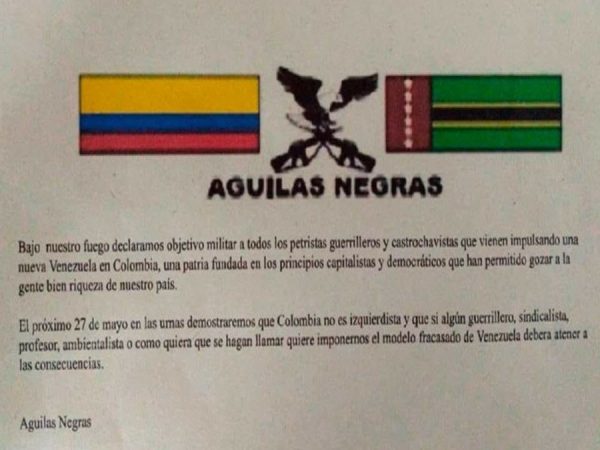
While we were in Colombia, a campaign coordinator for Gustavo Petro, a Colombian presidential candidate, was murdered by paramilitaries the day before the election, and the paramilitary group known as ‘Aguilas Negras’ (Black Eagles) issued a general threat against the supporters of Petro for president just a few days before the May 27 vote.
© Dan Kovalik
If Colombia’s very real human rights and humanitarian crises were given nearly the attention that the problems in neighboring Venezuela receives, the US and Colombian government would at least have some incentive to improve the situation in Colombia and to go after the paramilitary groups which continue to haunt that country. The near complete silence about the staggering violence in Colombia is critical in allowing that violence to continue. Indeed, the paramilitaries have always depended upon being able to operate in the shadows, and the US press is more than happy to oblige them in this effort.
Dan Kovalik teaches International Human Rights at the University of Pittsburgh School of Law. He is the author of ‘The Plot to Attack Iran.’
Venezuela: ‘Colombia Joining NATO A Threat To Regional Peace’
teleSUR – May 26, 2018
Venezuela has rejected the announcement by Colombia’s President Juan Manuel Santos that his country will be entering the North Atlantic Treaty Organization (NATO) as a “global partner.”
“Venezuela denounces once more before the international community the intention of Colombian authorities to lend themselves to introduce, in Latin America and the Caribbean, a foreign military alliance with nuclear capacity, which in every way constitutes a serious threat for peace and regional stability,” a statement by the foreign ministry said.
Likewise, Venezuela reiterated that it supports the historical position of the region to distance itself from the politics and wars of NATO, and from “any other army or military organization that desires to apply force to the suffering of the people, to impose and guarantee the hegemony of a particular political and economic model.”
The statement asks that the Colombian government fulfill its obligations toward peace and peaceful solutions to regional controversies.
Colombia will be the fist “global partner” of NATO in Latin America, beginning next week, President Santos announced Friday.
NATO was founded during the Cold War and was primarily a means for Western nations – led by the United States – to suppress the Soviet Bloc militarily and economically.
It continues to play a major role in modern conflicts, and has engaged in major military interventions in sovereign countries, most recently the removal and murder of Libyan leader Muammar Gaddafi in 2011.
WSJ’s Epic Distortion of Colombian and Venezuelan Refugees
By Joe Emersberger | FAIR | February 18, 2018
A Wall Street Journal article by Juan Forero (2/13/18) ran with the headline “Venezuela’s Misery Fuels Migration on Epic Scale.” The subhead stated, “Residents Flee Crumbling Economy in Numbers That Echo Syrians to Europe, Rohingya to Bangladesh.”
Forero’s article quoted a UN official: “By world standards, Colombia is receiving migrants at a pace that now rivals what we saw in the Balkans, in Greece, in Italy in 2015, at the peak of [Europe’s] migrant emergency.” Further on, Forero says, “The influx prompted Colombian officials to travel to Turkey last year to study how authorities were dealing with Syrian war refugees.”
Two enormous problems with the way Forero and his editors have framed this article should immediately stand out:
- Colombia’s population of internally displaced people is about 7 million, and has consistently been neck and neck with Syria’s. According to the UNHCR, as of mid-2016, Colombia is also the Latin American country which has the most number of refugees living outside its borders: over 300,000, mainly in Venezuela and Ecuador. Forero and his editors picked the wrong country to compare with Syria.
- Greece and Italy do not share a border with Syria, nor do the Balkans as they are generally defined. Colombia and Venezuela, by contrast, share a very long border. Forero’s comparison, therefore, excludes states that border Syria. Three of those bordering states—Lebanon, Jordan and Turkey—collectively absorbed 4.4 million Syrian refugees by 2016; five years after war broke out in Syria, Turkey alone took in almost 3 million.
It’s very important to expand on the first point. Colombia is a humanitarian and human rights disaster, and has been for decades, in very large part due to its close alliance with the United States. Thanks to Wikileaks (CounterPunch, 2/23/12), we know that US officials privately acknowledged estimates that hundreds of thousands of people were murdered by right-wing paramilitaries, and that the killings have nearly wiped out some indigenous groups. Those genocidal paramilitaries have worked closely with the Colombian military that Trump Chief of Staff John Kelly praised in 2014 as a “magnificent” US partner. “They’re so appreciative of what we did for them,” raved Kelly.
Praise for Colombia’s government has also come from the liberal end of the US establishment, albeit with much more subtlety than from Kelly. In 2014, a New York Times editorial (9/21/14) stated that “Colombia, Brazil and other Latin American countries should lead an effort to prevent Caracas from representing the region [on the UN Security Council] when it is fast becoming an embarrassment on the continent.” So to Times editors, Colombia is a regional good guy that must lead its neighbors in shunning Venezuela.
Colombia’s current president, Juan Manuel Santos, was minister of Defense from 2006 to 2009. From 2002 to 2008, the Colombian military murdered about 3,000 civilians, passing them off as slain rebels. As human rights lawyer Dan Kovalik explained (Huffington Post, 11/20/14) , the International Criminal Court (ICC) “concluded that these killings were systemic, approved by the highest ranks of the Colombian military, and that they therefore constituted ‘state policy.’” The murders occurred with the greatest frequency between 2004 and 2008, which Kovalik observed “also corresponds with the time in which the US was providing the highest level of military aid to Colombia.”
If Colombian and US officials evade prosecution for all of this, it will be with the help of corporate media—as well as the severe limitations powerful governments impose on international bureaucracies like the ICC. Kovalik remarked:
You might say, no official of the US can be prosecuted by the ICC because the US has refused to ratify the ICC treaty. While this may appear to be true, this did not stop the ICC from prosecuting officials from the Sudan—also not a signatory to the ICC.
The closest Forero came in his article to even hinting at any of these gruesome facts was when he wrote that “Colombia has long had troubles of its own, including integrating former Communist guerrillas from a civil conflict that only ended recently.” The “conflict” has not exactly “ended,” given that 170 leftist political leaders and activists were assassinated in 2017.
Putting aside Forero’s epic distortions by omission regarding Colombia, what about his reporting about migration from Venezuela? He wrote:
Nearly 3 million Venezuelans—a tenth of the population—have left the oil-rich country over the past two decades of leftist rule. Almost half that number—some 1.2 million people—have gone in the past two years, according to Tomás Páez, a Venezuelan immigration expert at Venezuela’s Central University.
In April 2002, Páez signed his name to a quarter-page ad in the Venezuelan newspaper El Nacional that welcomed the dictatorship of Pedro Carmona, then head of Venezuela’s largest business federation, who was installed after a US-backed military coup briefly ousted the late President Hugo Chavez. I’ve written before (ZNet, 1/16/17) about Western outlets—New York Times (11/25/16), Reuters (10/15/14) and Financial Times (8/22/16)—citing Páez without disclosing his anti-democratic record.
The World Bank has compiled data over the years on the numbers of Venezuelan-born people living abroad. The numbers point to far smaller migrations than Páez has estimated:

During the years Chavez was in office (1999–2013), the World Bank’s figures tell us Venezuelans living abroad increased by about 330,000. By 2013, Páez was estimating that about 1.3 million had left—about 1 million more than World Bank estimates. Would journalists ignore data published by the World Bank in favor of estimates by Páez if he were a staunch supporter of the Venezuelan government?
During those 1999–2013 years, the World Bank figures also say that the number of Colombian-born people living in Venezuela grew by 200,000. Forero’s article implies that migration from Colombia to Venezuela ended in the “late 20th century.”
The World Bank has not updated migration data past 2013, but there is no doubt there was a huge increase in migration from Venezuela since its economy entered into a very deep crisis starting in late 2014. (For an overview of the important role of US policy in creating the crisis and now deliberately making it much worse, see my op-ed, “US Policy a Big Factor in Venezuela’s Depression”—Tribune News Service, 2/2/18.)
According to a Colombian university study of Venezuelan migration to Colombia, it averaged about 47,000 per year from 2011–2014, then increased to 80,000 per year in 2015–16.
US government data show migration from Venezuela to the United States increasing from about 7,000 per year before 2013 to 28,000 per year by 2015, including Venezuelans who have entered without authorization.

From 2000 to 2013, the United States was the destination for about 30 percent of Venezuelan-born people who left to live abroad, according to the World Bank figures. If the Colombian university study and US government data are accurate, then the United States has been the destination for about 20 percent of Venezuelan migrants after 2013. That would mean about 140,000 Venezuelans per year were leaving to live abroad by 2016.
That is not remotely comparable to the 5 million Syrians who fled the country in the first five years following the civil war—and that doesn’t include over a million per year who fled their homes inside Syria (the internally displaced).
That Forero would even try to force this comparison into his article speaks volumes. It’s not hard to guess why it was made, given that US has bombed Syria regularly and has had Venezuela’s government in its crosshairs for almost two decades.
Ex-Israel soldier heading child prostitution ring deported from Colombia
MEMO | November 29, 2017
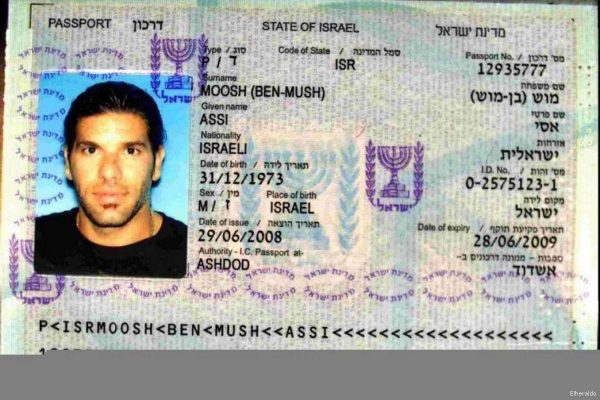
A former Israeli soldier was deported from Colombia for alleged links to a criminal network suspected of drug trafficking, child prostitution and tax offenses that spanned across several countries in Latin America.
Forty-three-year-old Assi Moosh was expelled by Colombia and returned to Tel Aviv under escort by immigration officers last weekend. In a statement confirming the deportation, security officials said: “Police in Santa Marta, capital of the Magdalena department, hereby announce the removal of an Israeli citizen who owns a spa hotel frequented by many foreign tourists. Deportation procedures have been commenced as per law and will be carried out due to the Israeli’s conduct, which has harmed Colombia’s national security.”
Colombian news agencies reporting on the deportation revealed details surrounding the expulsion of Moosh who was exposed as being part of a group of ex-Israeli soldiers that had turned a small fishing village in Taganga into a “sex and drug den” from their base in a luxury resort that was known to locals as “little Israel”.
El Heraldo, a regional newspaper, revealed Moosh as the head of an “international network of human trafficking, micro-trafficking and sex tourism”. The Israeli gained a reputation locally for organising private parties in a room within his hotel. From their base in “little Israel” Moosh is reported to have run similar clubs exploiting drugs and children in Cartagena, Bogotá, Medellín, Ecuador, Mexico and Brazil.
Local sources reported that Moosh was arrested when he arrived in the immigration office in Santa Marta accompanied by a group of armed men. It’s believed that he had been trying to obtain Colombian citizenship.
According to the national police, Moosh had raised suspicion after it was discovered that his permits for tourism and hotel operation were obtained through a third party, enabling him to carry out criminal activities undetected for a decade.
Locals are said to be “relived” by the arrest. Residents told journalists that Moosh “had been one of those who destabilised the social order of the people.” Many felt he should have been arrested long ago.
The mystery for many locals, according to El Heraldo, was the Benjamin hotel. Residents of Taganga described the resort as a “bunker” run by Moosh “exclusively for Jews”. While it’s unlikely that many of the locals would have actually seen the inside of the luxury resort, the feeling that it was an unwelcome place for non-Israelis has even been reported by visitors on TripAdvisor. “Not Israeli? Forget about it” wrote one visitor who had given the hotel two stars in the review. “First off this is a good hotel/hostel but if you are not from Israel I wouldn’t go there, my wife and I were made to feel very uncomfortable even had people come up to us and say ‘are you from Israel?’ I said ‘no’ to their reply ‘then why would you come here’.”
Reports of how “ex-soldiers turned a Colombia fishing town into a sex and drug den” had been on the media’s radar for a while. In February Colombia Reports uncovered the tension within the popular tourist region caused by the Benjamin hotel. The report found that “Benjamin [hotel] employs and accommodates almost exclusively Israeli citizens, and was officially opened by 20 rabbis brought over especially from Israel”.
Security in the hotel is reportedly coordinated by a Willington Vasquez, who, according to the report is also known as “Manuel, a former member of a paramilitary death squad”. Locals from Taganga complained that the Israeli “tourism entrepreneurs” were running a drug trafficking network and prostitution business.
The friction between locals in Taganga and the Israelis was also reported in 2012. “Four Israeli ex-soldiers are the new ‘masters’ of Taganga” was the headline in the El Tiempo. The paper alleged that the Israeli “businessmen” were selling cocaine and sexually exploiting young girls.
A journalist from El Tiempo investigating the allegations spoke with local officials, residents and the Israeli businessmen who pleaded innocence saying that “the community is wrong, everything is false”.
But the report proved otherwise. The authorities said that they were clear “several Israeli ex-soldiers who arrived in that village” were “leaders of criminal gangs”. The authorities complained that the Israelis took over social premises, violated rules on tax payments and permits and were involved in selling drugs and sexually exploiting children.
The ex-Israeli soldiers became known as “the untouchables”. El Tiempo journalists travelled to the area and established that some of them were living in a concrete mass, guarded by eight security cameras. Others carry arms and move in 4×4 trucks with the Israeli flag.
Testimonies from villagers and local authorities, who, El Tiempo said requested anonymity for fear of reprisals, exposed the drug and prostitution industry that had blighted the small fishing village.
Their standoff with the ex-Israeli soldiers led locals to create a committee and to request help from the Santa Marta administration.
Mayor of Santa Marta at the time, Carlos Caicedo, told El Tiempo that the situation in Taganga is serious and that he will ask the Israeli embassy and the Ministry of Foreign Affairs to review the legal status of the ex-military personnel settled in the Benjamin hotel.
Residents of Taganga appealed to their government to end the criminal activity in their village and a request was also made to the Israeli embassy, according to El Tiempo, to sanction the criminal behaviour of its nationals.
As for Moosh, it’s reported that Colombian authorities have imposed sanctions on him which prevent him from returning to country for at last ten years.
Colombian Social Leader Assasinated Weeks After 7 Campesinos Were Killed

Jose Jair Cortes | Photo: UN
teleSUR | October 17, 2017
A Colombian social leader, Jose Jair Cortes, was murdered in a rural area of Tumaco municipality located in the southwest department of Narino.
Jair Cortes, a member of the local council of the Alto Mira and Frontera Community, was killed in a sector called Y, located in the heart of the city of Tumaco. The social leader was one of seven community leaders to receive death threats in recent months.
The governor of Narino, Camilo Romero Galeano, denounced the murder that occurred just weeks after a massacre that left seven people dead in the village of El Tandil, in the same municipality.
The state government has urged the authorities to investigate the exact details of the community leader’s murder.
“We have once again resisted accepting that the war will continue to make its mark on the Narino pacific,” Romero said. “Our voice of solidarity for the family of Jose Jair Cortes in this painful moment that keeps the mourning in our south.”
“We are profoundly affected by this death, just days after we met in Tumaco with him and the other members of this Junta de Gobierno, corresponding to the territory where the painful events that six peasants and dozens of wounded and still remain of research,” the official statement said.
The community council in the area has repeatedly denounced human rights violations against the Afro-Colombian, Mestizo and Indigenous peasants in the region. The campesinos in the area have been protesting against government’s plan to reduce the production of Cocoa crop, an important means of livelihood for many in the region.
In the western department of Cauca, over 40 campesinos have been injured and one journalist killed in clashes between the Indigenous community members and the Colombian police.
The Indigenous community members who began their protests 10 days ago are demanding the property in the Coconuco Indigenous Reservation, a rural area of Purace municipality, where the government had promised them land in 2013.
The Mobile Anti-Riot Squads (ESMAD) accused the natives of encroaching private property. ESMAD member, Capt. Edgar Garcia, told Caracol, a local radio station that the natives threw “immense rocks that destroy sticks and all around, equally, they shoot us with artifacts, stones, bottles, and explosives to intimidate us, while we are defending the private property.”
Whereas, a spokesman for the protesters quoted by the local radio station, said that “about 10 ESMAD trucks, two tanks and all the artifacts against the indigenous peoples, entered the community.”
Three Social Leaders Murdered in Colombia in Only 72 Hours
teleSUR | August 12, 2017
The Colombian activist and social leader Fernando Asprilla was murdered on Friday in the Cauca department, and was the third death of a social leader recorded in a 72 hour period.
The Ombudsman of Colombia, Carlos Alfonso Negret Mosquera, showed in a recent report that during the period between the first of January, 2016, and March 1st of 2017, at least 156 homicides, five disappearances, and 33 violent attacks against community and social leaders occurred.
According to the report given by Negret, one of the primary causes of the deadly trend is the continued operations of illegal armed right-wing paramilitary organizations that have occupied territory left behind by the disarming Revolutionary Armed Forces of Colombia – People’s Army (FARC – EP).
Human rights defenders and activists in the districts of Antioquia, Arauca, Atlantico, Bolivar, Caldas, Caqueta, Casanare, Cauca, Cesar, Cordoba, Cundinamarca, Choco, Huila, La Guajira, Magdalena, Meta, Nariño, Norte de Santander, Putumayo, Risaralda, Santander, Tolima and Cauca Valley have been assassinated since the FARC’s demobilization process began.
As they have handed over their weapons and negotiated terms of peace with the Colombian government, FARC-EP has consistently demanded that the state works to dismantle paramilitarism in the country, saying its ongoing violence represents the greatest threat to the peace process.
The government however, has largely ignored the existence of paramilitaries, claiming that they were demobilized during Alvaro Uribe’s presidential term between 2006 and 2008. FARC-EP leaders have pointed out that many of the groups have been reclassified as criminal gangs, but continue to represent the same threat as always by assassinating leaders who fight for human and land rights.
ELN Seeks ‘Temporary and Renewable’ Ceasefire in Colombia
teleSUR | July 26, 2017
The chief negotiator of the National Liberation Army (ELN) in Colombia’s peace talks, Pablo Beltran, said on Tuesday that the objective of the third round of negotiations is to reach a “temporary and renewable” bilateral ceasefire, a process which he said takes time because it requires “very precise procedures.”
During an interview with TeleSUR on the Enclave Politica program, Beltran said that the ELN is committed to peace talks and the peace process, and that a consensus has emerged among its members that there “must be a bilateral ceasefire.”
The task of the third round of dialogue is “to make the agreement, design the protocols, sign them, and then apply them. This round must be about the bilateral ceasefire that we want to last beyond the visit of Pope Francis,” according to Beltran.
Beltran emphasized that the group’s motto has always been to “be with the people, and that there is a large sector of Colombian society that wants peace.” The ELN has been accused by some of those opposed to peace talks for allegedly only being interested in peace because their political project has “failed.”
The reason for being in the ELN, he said, is to always be with the people and acting where there is social change and struggle. Beltran said that at the heart of the peace talks is “that there is participation so that the people say how Colombian democracy should be… that is why there are sectors of the right that oppose peace.”
“Some sectors in the government want an expedited negotiation, but we want things to be done well so that it is durable,” he said regarding delays in the process.
“We have lost 26 months in the negotiations because of the government tactic to place the ELN negotiations behind those with the Revolutionary Armed Forces of Colombia – People’s Army (FARC),” he said. “There is a sector of the hard right that is going to oppose anything that signals peace.”
While dialogue progresses, the ELN still is active and present in several regions of Colombia, where the chief negotiater said they have programs and popular support. “The ELN is alive, it is acting,” he said.
Colombia: Bogota Mall Explosion Leaves 3 Dead, 11 Injured
ELN: “There are those who try to tear apart the peace process”
teleSUR | June 18, 2017
Colombian authorities searched Sunday for the perpetrators of a bombing at a major upscale shopping center in Bogota that killed three and left nine others injured in an attack Saturday some have suggested could be an attempt to benefit from fear in the country [which is] implementing peace after more than half a century of civil war.
Authorities reported that an explosion hit a second-floor women’s bathroom at the Andino Commercial Center in Bogota on Saturday night. The shopping center, one of the busiest in the country, was evacuated, while President Juan Manuel Santos returned to the capital from the northern coastal city of Barranquilla to respond to the blast.
“This is a vile, cruel, cowardly act and we are not going to rest until those responsible are captured,” Santos said, adding that there were no indications that another attack was planned in Bogota. The president also expressed solidarity with the victims, while Bogota Mayor Enrique Peñalosa described the incident as a “cowardly terrorist attack.”
Both the FARC and the ELN, the country’s two largest guerrilla groups, condemned the attack and voiced support for the victims.
“Solidarity with the victims in Bogota today,” FARC leader Rodrigo Londoño, also known as Timoleon Jimenez or Timochenko, wrote on his Twitter account Saturday to 95,400 followers. “This act can only come from those who want to close the paths to peace and reconciliation.”
The bombing comes just days before the FARC is set to hand over the last of its weapons to a U.N. monitoring mission as part of a historic peace agreement reached with the government last year paving the way for the guerrilla’s disarmament and transition into a legal political party.
The ELN, currently in peace talks with the government, also responded to the attack.
“ELN Peace repudiates the attack against civilians in the Andino Commercial Center. We share the pain and express solidarity with the victims,” the group’s peace delegation wrote on its Twitter account Saturday to 27,600 followers.
The active rebel army — which has yet to reach a bilateral ceasefire agreement with the government and who claimed responsibility for a bombing outside a bull ring in Bogota in February — was quick to be signaled as a possible suspect in the attack, an assumption the group rejected in its response to the bombing.
“ELN Peace calls for seriousness from those who make unfounded and reckless accusations; there are those who try to tear apart the peace process,” the ELN peace delegation continued, calling for a thorough investigation.
“The ELN will never again carry actions whose objective is to affect the civilian population,” the statement concluded.
The three victims of the attack included a 23-year-old French national, identified as Julie Hunh, who had reportedly been in Colombia for the past six months doing volunteer work.
The U.S. Embassy in Bogota offered condolences in a series of tweets, saying that it is standing by to “provide any support requested by the Colombian authorities.”
Another Social Leader Murdered in Colombia
teleSUR | June 14, 2017
Jose Maria Lemus, president of the Tibu Community Board in Colombia’s North of Santander state, has been killed, the Peoples’ Congress reported Wednesday.
His murder adds to the growing list of recently assassinated social, Indigenous and human rights activists in the South American country.
In May, the United Nations High Commissioner for Human Rights raised alarm over the fact that at least 41 activists have been killed in Colombia so far this year, a record figure in comparison to previous years. The report laid bare to a troubling escalation of violence despite a historic agreement between the government and the country’s largest rebel army last year.
U.N. commissioner Zeid Ra’ad al-Hussein said the figure shows a worsening trend of crimes against social leaders and human rights defenders.
“It’s an increase over the same period last year and the previous years, and it is very alarming,” he said during a news conference.
According to Zeid, the attacks appear to be concentrated in areas that the Revolutionary Armed Forces of Colombia previously controlled during the armed conflict and recently abandoned in order to demobilize after the signing of the peace agreement.
Official statistics show that a staggering 156 social leaders were killed in Colombia in the 14 months between Jan. 1, 2016 and March 1, 2017. Amid the crisis, rights groups have urged the Colombian government to prioritize tackling paramilitary violence that often targets progressive social leaders including campesinos, Indigenous activists and other human rights defenders.
On Monday, organizations such as the Agrarian Summit, Black Communities Process and the Peoples’ Congress protested against the criminalization of social leaders.
Featured Video
“Historic Russia”: The Land Putin Will Not Give Back
or go to
Aletho News Archives – Video-Images
Book Review
Why the War on Conspiracy Theories Is Bad Public Policy
By Kevin Barrett • Unz Review • February 1, 2019
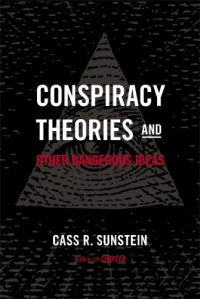 A Review of Conspiracy Theories and Other Dangerous Ideas by Cass Sunstein (based on an earlier paper co-authored with Adrian Vermeule); In Defense of Troublemakers: The Power of Dissent in Life and Business by Charlan Nemeth; and Conspiracy Theories and the People Who Believe Them, edited by Joseph E. Uscinski
On January 25 2018 YouTube unleashed the latest salvo in the war on conspiracy theories, saying “we’ll begin reducing recommendations of borderline content and content that could misinform users in harmful ways—such as videos promoting a phony miracle cure for a serious illness, claiming the earth is flat, or making blatantly false claims about historic events like 9/11.”
At first glance that sounds reasonable. Nobody wants YouTube or anyone else to recommend bad information. And almost everyone agrees that phony miracle cures, flat earthism, and blatantly false claims about 9/11 and other historical events are undesirable.
But if we stop and seriously consider those words, we notice a couple of problems. First, the word “recommend” is not just misleading but mendacious. YouTube obviously doesn’t really recommend anything. When it says it does, it is lying. … continue
Blog Roll
 Aletho News
- “Historic Russia”: The Land Putin Will Not Give Back
- How the Cambridge Analytica scandal still haunts Mark Zuckerberg
- The Ongoing Cancellation Campaign Against a Dissenting Academic in Norway
- Yemen and ‘the Houthis’: Challenging Sami Hamdi’s Narrative
- No, Christians did not invent Zionism
- AIPAC-led lobbying network opens branches in Cypriot, Greek parliaments
- Araghchi blasts ‘parasitic’ alliance as US taxpayers pay for Israel’s war on Iran
- Easy fix for Europe’s chaos? Stop fueling war against Russia
- Putin’s key remarks on peace talks and Europe’s ‘schizophrenia’
- Trita Parsi: Israel Set a Trap for Total War in the Region
- If Americans Knew
- An error has occurred; the feed is probably down. Try again later.
- No Tricks Zone
- E-Cars Reduce CO2 Emissions By Only 41% Compared To Internal Combustion Engine Vehicles
- Predictions Made By Renowned Climate Professor Over Past Decades Have Been Proven To Be Poor
- New Study Suggests Large Regions Of The Pacific Ocean Have Been Cooling For The Last 80 Years
- Germany’s Green Energy Debacle: High Energy Costs Force Kahla Porzellan to Close After 182 Years!
- New Study: 50 Years Of The Most Aggressive ‘Net Zero’ Policies Can Only Affect The Global Climate By 0.03°C
- US September “Heat” Was No Record…Many Records Set Decades Ago
- Latest European Green Energy Debacle; Portugal’s Largest Flagship Solar Park Insolvent!
- Green Energy Debacle: German Expert Professor Fritz Vahrenholt Warns Of Severe Economic And Social Consequences
- Two More Paleo Reconstructions Affirm Meters-Higher Sea Levels Across Ireland, Brazil 7000-6000 Years Ago
- New Study: Earth And Venus Surface Warmth Largely Explained By Convection And Lapse Rate, Not CO2 Or Radiation


