Who Is Juraj Cintula?
Is the man who tried to assassinate Slovak Prime Minister Fico really a “lone wolf”?
By John Leake | Courageous Discourse™ | May 16, 2024
The Telegraph and the Times of India have published profiles on the 71-year-old Slovakian poet, Juraj Cintula, who tried to assassinate Slovak Prime Minister, Robert Fico. The following is from the Telegraph report:
Juraj Cintula, a 71-year-old poet from the western town of Levice, posted online rants against Mr Fico before opening fire on the Left-wing nationalist at close range on Wednesday.
A photo of the writer published on X, formerly Twitter, showed him protesting against the government’s controversial reforms…
[Fico] is viewed as one of the EU’s most pro-Russian leaders after campaigning on a platform to end weapons donations to Ukraine.
In a post for the Movement Against Violence in 2022, Mr Cintula condemned Russia’s invasion of Ukraine. “What Slavic brotherhood?” he wrote, referring to Kremlin claims that Ukraine and Russia could be joined as they were essentially the same country. “He is only the aggressor and the attacked.”
A friend from Levice told Markiza TV that the pair had debates about politics, saying: “I’m more for Russia. He had different opinions.”
In 2015, Mr Cintula founded the campaign group Against Violence and sought to get it officially registered in Slovakia. “Violence is often a reaction of people, as a form of expression of ordinary dissatisfaction with the state of affairs. Let’s be dissatisfied, but not violent,” a petition circulated by him said.
… Unverified video footage emerged on Wednesday of Mr Cintula saying he did not agree with Mr Fico’s “government policy”. In another social media post, he criticised the Fico government for not cracking down on gambling.
The suspect’s political leanings appear to have shifted over time. He was once pro-Russian, and railed against “eyeless gypsies” and migrants before shooting the populist prime minister, who is fiercely anti-migrant.
I was surprised by how quickly the Slovak interior minister, Matus Sutaj Estok, characterized Cintula as “a lone wolf” who “did not belong to any political groups.”
It seems to me that no apparent political group affiliation does not necessarily mean that Cintula was not influenced or directed by someone else. Cintula’s online political rants in which he expressed strong emotions and shifting opinions could have flagged him as man who could be approached and influenced by an agent serving powerful interests. In this hypothetical scenario, Cintula may have fallen under the influence of an agent who presented himself under false pretenses.
Like many other reasonable people, I noticed that Prime Minister Fico has vocally criticized COVID-19 vaccines, endless shipments of weapons to Ukraine, mass immigration, transgender ideology, and climate change ideology. This makes him one of the few heads of state in Europe who has challenged all four articles of faith in what I call the Holy Quadripartitus of Piffle.
1). COVID-19 vaccines are saving mankind. Anyone who questions the safety and efficacy of the vaccines is guilty of heresy.
2). The U.S. proxy war in Ukraine is a sacred mission and no negotiated settlement with Russia shall be countenanced. Anyone who criticizes the Ukrainian and U.S. governments, and any attempt to understand the war from the Russian point of view, is guilty of heresy.
3). Human induced climate change will soon destroy the earth if trillions aren’t spent to overhaul our entire energy policy. Anyone who questions this proposition is guilty of heresy.
4). The concept of biological sex is a mere “construct.” Skilled surgeons and endocrinologists can transform a boy into a girl or vice versa. Anyone who questions this assertion is guilty of heresy.
Given the fervent belief in the Holy Quadripartitus—the Nicene Creed of the vaccine cartel, arms dealers, money launderers, lobbyists, racketeers, and child butchers—it is a matter of certainty that Prime Minister Fico has a vast array of powerful enemies.
UK Army Unit Labeled Accurate COVID Reporting as “Malinformation”
By Didi Rankovic | Reclaim The Net | May 16, 2024
More details are coming out about the Covid-era activity of the UK army unit, the 77th Brigade, which the country’s government used to spy on citizens, suppress dissent around issues related to the pandemic, and flag content for social media sites to label or remove.
The unit, said to be of the psyops (“psychological operations”) variety, carried out a series of controversial and even suspected unlawful activities over this period of time, although in early 2021, the UK government flat-out denied it was involved in “any kind of action against British citizens.”
But a batch of subsequent responses to freedom of information requests, including those filed a year later by the Big Brother privacy-promoting NGO, tell a different story.
Perhaps it’s hardly the fault of the 77th Brigade that it spread disinformation while saying it was fighting it, or that it was among agencies that came up with the idea to get government censors to infiltrate social platforms – after all, the unit was set up in 2015 for the purpose of conducting “covert (online) warfare and subversion campaigns.”
The more pertinent question may be why the UK government decided to rely so heavily on the military (the country’s air force, RAF, was also involved) in order to monitor and censor people’s discussions about things like masks, lockdowns, vaccines – and why these soldiers were instructed to turn on their fellow citizens.
Either way, it did, and it was: In one example early in the pandemic – March 2020 – Guardian reporter Jennifer Rankin tweeted that both UK and EU sources had confirmed the former was not a part of the EU’s PPE procurement project.
The military was quick to label this as “malinformation” – apparently the “code word” for making sure the government is perceived positively regardless of whether reporting/content is accurate. In Rankin’s case, it was.
Big Brother Watch researcher Jake Hurfurt writes about this and cites a whistleblower who revealed how the 77th Brigade managed to bypass legal rules around using the army to monitor dissent at home.
“The leading view was that unless a profile explicitly stated their real name and nationality, which is, of course, vanishingly rare, they could be a foreign agent and were fair game to flag up,” the whistleblower is quoted as saying.
But there’s another way the authorities worked around “the problem,” Hurfurt explains: “As in the United States, UK government officials insist that the flagging of social media content by officials was legal because the officials were just making suggestions, not demanding censorship.”
UK Disinformation Unit Minutes Reveal Consideration of Placing Government Employees Inside Social Media Companies
By Didi Rankovic | Reclaim The Net | May 15, 2024
Recently released minutes from the UK government’s Counter Disinformation Unit (CDU) governing board, the Disinformation Board, provide further evidence of the authorities’ direct involvement in monitoring online speech during the pandemic but also flagging it for removal.
But even this wasn’t enough for CDU, which in 2023, after several years of criticism and scrutiny by some media and privacy groups, got rebranded as the National Security Online Information Team (NSOIT).
One of the moves considered by top UK officials was to “embed” civil servants in companies running social platforms, and it remains unclear if this was in fact done, writes Big Brother Watch’s Jake Hurfurt for Public.
CDU was only one building block in the UK’s Covid-era censorship effort; several military units were enlisted to participate as well, most notably and controversially the 77th Brigade, whose job is supposed to be spreading misinformation, and in general, finding its “psyops” targets abroad, not at home.
NSOIT (CDU) also states that it is “countering disinformation and hostile state narratives.” But these and several other outfits, as well as private contractors hired by the government, were tasked with surveillance of British citizens and suppression of those seen as “Covid measures dissenters.”
And so, what scores of freedom of information requests have since revealed is that they went not after disinformation-spreading “foreign adversary” – but ordinary British citizens, medical professionals, journalists, and even politicians who were engaging in legitimate, albeit critical of the government, speech.
Regarding the lengths to which the UK was prepared to go – specifically if officials actually got “embedded” in social media companies – this is unclear to this day thanks to the government’s refusal to provide access to reports compiled by Logically, a private company.
Logically made millions from contracts with the British military, Hurfurt notes. Completing the picture of the web of sometimes loosely, other times tightly inter-connected entities that work hard to censor online speech, he adds:
“(Logically) has a large US presence and is headed by US ex-intelligence officer Brian Murphy, who worked at the Department for Homeland Security (DHS).”
Meanwhile, the UK government explains its refusal to shed light on the question of whether or not its officials were directly involved with social media companies as fears those reports “would reveal its capabilities to hostile actors.”
Woman Injured by AstraZeneca COVID Vaccine During Clinical Trial Sues for Breach of Contract
By Michael Nevradakis, Ph.D. | The Defender | May 14, 2024
A woman injured by the AstraZeneca vaccine she received in 2020 during a U.S. clinical trial is suing the vaccine maker in the first case of its kind challenging the legal liability shield for COVID-19 vaccine makers.
Brianne Dressen, who since 2021 has advocated on behalf of vaccine injury victims, filed suit Monday in the U.S. District Court for the District of Utah seeking compensation for injuries and disability she alleges resulted from the vaccine.
Under the Public Readiness and Emergency Preparedness Act (PREP Act), AstraZeneca and other COVID-19 vaccine manufacturers cannot be held liable for injuries related to the vaccines.
However, Dressen’s lawsuit — which also names the Salt Lake City-based clinical trial site consolidator Velocity Clinical Research — contends AstraZeneca can be sued for breach of contract.
According to the lawsuit, the company agreed to cover the medical costs for any vaccine-related injuries under a contract between AstraZeneca and clinical trial participants.
Dressen alleges that in her case, the cost of her injuries and disability amount to hundreds of thousands of dollars per year. Dressen, who was 39 when she was vaccinated, was previously a preschool teacher but is now unable to work.
Within hours of getting her first dose, Dressen experienced tingling in her right arm — a neurological condition known as paresthesia — and blurred vision and vomiting.
In the weeks that followed, her condition worsened, with the paresthesia spreading to her legs, resulting in disability and a diagnosis in 2021 by the National Institutes of Health (NIH) of post-vaccine neuropathy.
The lawsuit seeks “all available damages, both economic and non-economic.”
Attorney Michael Connett of law firm Siri & Glimstad LLP, who is representing Dressen in her lawsuit, told The Defender, “As far as we know, this is the first case in the U.S. where a pharmaceutical company is being held financially responsible for the harms caused by the COVID vaccine.”
Dressen told The Defender that her breach of contract claim “is another first for the United States, as PREP Act protections have been completely impenetrable.”
Dressen, founder of React19, a nonprofit advocating for vaccine injury victims, said she hopes the lawsuit will provide “accountability for my individual case but also bolsters a pathway forward for my injured colleagues both in the U.S. and abroad — namely, each and every plaintiff in the U.K. seeking restitution from AstraZeneca.”
Dressen cited an ongoing class-action lawsuit in the U.K. against AstraZeneca by people alleging they were injured by the AstraZeneca COVID-19 vaccine and by the relatives of 12 people who died after getting the shot.
In documents AstraZeneca submitted to the U.K. High Court last month as part of that case, the company admitted that its COVID-19 vaccine “can, in very rare cases, cause TTS” — vaccine-induced thrombosis with thrombocytopenia syndrome, which causes the body to produce life-threatening blood clots.
Dressen’s lawsuit comes just days after AstraZeneca announced the withdrawal of its COVID-19 vaccine globally — though the company said it based its decision on the “surplus of available updated vaccines,” leading to reduced demand for its vaccine.
The U.S. never granted emergency use authorization for the AstraZeneca COVID-19 vaccine, citing safety concerns.
However, the vaccine generated over $5.8 billion in sales globally, with the help of the Bill & Melinda Gates Foundation, which funded and promoted the vaccine in other countries. Several countries later stopped administering the AstraZeneca vaccine due to safety concerns.
Connett said AstraZeneca’s decision to withdraw the vaccine “really doesn’t have a bearing” on Dressen’s lawsuit.
Ray Flores, a health freedom rights attorney unconnected to the lawsuit, agreed because “the complaint is not based on product liability.”
Flores said:
“Around the country, COVID-19 vaccine injury cases that alleged negligence, battery of a minor, fraud or emotional distress have all been unsuccessful due to the PREP Act — while cases that allege negligence not involving a countermeasure have generally been successful.
What makes this case unique is that it alleges a breach of a written contract. For a court to allow liability protection here would really stretch the extent of the law. But on the other hand, it would unequivocally etch the stench of the PREP Act in Americans’ minds — but my ‘money’ in this case is on the plaintiff.”
AstraZeneca induced people to join trials by promising to pay for injuries
According to Connett, AstraZeneca induced people to join its clinical trial by promising to pay the medical expenses for any injuries that resulted from its COVID-19 vaccine.
“This inducement, this promise, became a contractual obligation the moment study subjects rolled up their sleeve and let the company inject the experimental vaccine into their arm,” he said.
Just because a company is making the COVID-19 vaccine doesn’t give that company a license “to make false promises to induce people to enter its clinical trial,” he said. “The bonanza of immunity that the PREP Act provides does not go so far as to shield a vaccine maker from its own contractual obligations.”
Flores said that if AstraZeneca “never intended to honor its promise to insure Dressen … it would not only be a breach of contract but would rise to the level of fraud.”
“When a vaccine injury lawsuit highlights a defendant’s inhumanity, it is always highly persuasive,” Flores said. “In this case, an absurd $1,243.30 settlement offer after reneging on its written promise to insure when there are evidently millions of dollars in damages and unspeakable suffering is just that.”
Connett said any other individual injured by the AstraZeneca vaccine “has the legal right to recover the full costs of the injury,” but advised that “The time to take legal action, however, may be limited, so acting expeditiously will be important.”
‘Completely hollowed-out version of who I once was’
The lawsuit described the timeline of Dressen’s symptoms following vaccination, with paresthesia spreading to her right shoulder and left arm and later to her legs. Within weeks, she lost 20 pounds as a result of frequent vomiting, while she also developed light sensitivity and became “acutely sensitive to sound.”
Dressen said her heart rate also would randomly spike, leading to shortness of breath and feelings of fainting. She described her experience in the lawsuit as feeling like a “completely hollowed-out version of who I once was.”
Before her Nov. 4, 2020, vaccination, Dressen filled out consent forms stating the company would “cover the costs” — including, but not limited to, medical bills — if she experienced a “research injury.”
Those forms, Dressen said, claimed the study doctor would provide treatment or referral in the event of injury, noting that the study sponsor had the necessary insurance.
“Sponsor will pay the costs of medical treatment for research injuries, provided that the costs are reasonable, and you did not cause the injury yourself,” the contract stated, according to the lawsuit.
The lawsuit notes that two days after Dressen signed the consent form, AstraZeneca amended the form to state that its vaccine may cause “neurological disorders” such as “demyelinating disease,” which could “cause substantial disability” or death “if not treated promptly.”
Dressen received multiple diagnoses indicating her symptoms were related to her vaccination. Her husband eventually reached out to the NIH, which invited her to visit its Bethesda, Maryland, campus “for extensive testing and treatment,” as part of a study the agency was conducting at the time involving people injured by COVID-19 vaccines.
As a result of those tests, NIH neurologists concluded that Dressen had sustained post-vaccine neuropathy, which had caused “dysautonomia” and “chronic inflammatory demyelinating polyneuropathy.”
“The limited safety data that AstraZeneca has released to the public shows that other clinical trial participants who received the company’s COVID vaccine suffered a higher incidence of nervous system disorders, including various types of demyelinating diseases, where the myelin sheaths that protect the nerve cells are stripped away,” Connett said.
AstraZeneca ‘were nowhere to be found’
According to the lawsuit, Dressen’s medical costs are prohibitive. One medication alone costs $432,000 a year, “although her insurance company has been able to negotiate this down (at least for now) to $119,000 per year,” she said.
But despite these high costs and Dressen’s ongoing disability, which makes her “unable to drive more than a few blocks at a time” and limits her parenting ability, the lawsuit states that AstraZeneca offered her only $1,243.30 in total compensation.
“When they needed me, I was there, I cooperated. When I needed them, they were nowhere to be found,” Dressen said in the lawsuit. “I called the test clinic early on with tears running down my face, begging them to help me. They said the drug company would call back any day now. Nightmarish days turned into weeks, and those nightmarish weeks turned into months, and now years. That call never came.”
In July 2021, Dressen’s injuries led her to contact Dr. Anthony Fauci directly to request help, according to documents recently obtained by Children’s Health Defense in a lawsuit against the NIH.
In that email, Dressen said she had been contacting federal health agencies for months with “No substantiative [sic] response.”
Dressen said Fauci never responded to her message.
Calling her lawsuit a “David v. Goliath type case,” Dressen told The Defender her “heart has and always will be with the injured community.” She said, “Every single American injured by a pharmaceutical product deserves their day in court.”
This article was originally published by The Defender — Children’s Health Defense’s News & Views Website under Creative Commons license CC BY-NC-ND 4.0. Please consider subscribing to The Defender or donating to Children’s Health Defense.
Dr. Peter McCullough Reveals How Much Doctors Were BRIBED to Push COVID Shots
This raises some serious questions

THE VIGILANT FOX | MAY 12, 2024
World-famous cardiologist Dr. Peter McCullough recently revealed startling figures about the immense earnings doctors received for pushing the COVID-19 injections.
On the Tommy T Podcast, Dr. McCullough claimed that a typical doctor could make an extra $250,000 if they injected a substantial portion of their patients.
More specifically, if a doctor injected 75% of his or her patients at $250 per newly-injected person, that would end up being around $250,000.
This revelation was discovered through a leaked Anthem Blue Cross Blue Shield document.

Dr. McCullough explained that a full-time primary care physician typically manages a patient panel ranging from about 1,000 to 2,000 people covered by Anthem Blue Cross Blue Shield.
When you do the math, factoring in the $250 incentive, 1,000 newly vaccinated people times $250 = $250,000. Some doctors made less; some made more. But the point is that doctors were financially incentivized to inject as many patients as possible.
The question is, was Anthem Blue Cross Blue Shield giving doctors jab incentives, or were they being paid to do so by the government?
Take a listen to what Dr. McCullough thinks.
Watch the full interview.
University nabs $42 million for ‘pandemic preparedness’ 2 weeks after firing scientist for questioning COVID shots for kids
By John-Michael Dumais | The Defender | May 8, 2024
A Canadian university has fired Patrick Provost, Ph.D., a professor and scientist experienced in the field of RNA and lipid nanoparticles, reigniting the debate around academic freedom and the suppression of scientific discourse.
Laval University, a public research university in Quebec City, suspended Provost multiple times for publicly questioning the safety of COVID-19 vaccines and the necessity of vaccinating children.
On March 28, the university fired Provost, who had tenure in the Department of Microbiology, Infectious Diseases and Immunology at the university’s Medical School.
The firing, which comes as his previous suspensions are still being arbitrated — and despite a Quebec law protecting academic freedom — first made headlines in Quebec’s Le Devoir on April 26, a day after Libre Média published portions of Provost’s letter to colleagues.
“Are we witnessing the re-engineering of society, where we will no longer be able to freely express or debate … where professors will censor themselves, rather than intervene … in order to preserve their privileges?” Provost wrote.
Laval’s controversial decision follows Harvard University’s example in March, when it fired Martin Kulldorff, Ph.D., one of the authors of the Great Barrington Declaration, ostensibly for non-compliance with the university’s COVID-19 vaccine mandate.
‘I could not remain silent’
Over his 35-year career in academic research, Provost authored nearly 100 papers, was cited in over 16,000 research articles and received three “Discovery of the Year” awards in recognition of his research.
He was a leading expert in the field of RNA for the past 20 years and in the field of lipid nanoparticles for the past 10 years.
His extensive knowledge of these key components of mRNA COVID-19 vaccines compelled him to question the possible dangers associated with the novel treatments when the Canadian government rolled them out in 2021.
“Being aware of the potential risks, known and unknown, associated with these new ‘vaccines,’ I could not remain silent on such important issues, where lives were at stake, particularly those of children,” Provost wrote in his letter.
He said he felt compelled to share his concerns with the public, colleagues and government officials, to promote transparency and informed decision-making.
Despite his attempts to engage in dialogue and debate, Provost received no response other than the disciplinary actions taken by Laval University.
He was suspended without pay on four separate occasions. The first suspension, of eight weeks, was imposed on June 13, 2022, following a complaint from a professor, and the second, of four months, was imposed on Jan. 23, 2023, after a complaint from a citizen.
A sixth complaint was dropped on Feb. 14, 2023, after more than 275 colleagues wrote to the university denouncing its treatment of Provost as “abusive.”
Laval maintains his actions were not related to academic freedom but instead infringed on the university’s policymaking authority, Provost told The Defender.
In his letter, Provost expressed his disappointment in the lack of open discussion on the COVID-19 vaccine issue, asking, “Why have peers disappeared from adversarial public debate?”
Academic freedom ‘the last line of defence’ for democracy
Provost’s dismissal sparked concerns about the enforcement of Quebec’s law — passed in June 2022 — protecting academic freedom, The Epoch Times reported.
“University professors have the right to criticize their own institutions — even the government,” Provost told The Defender, who said his case should never have gone before an arbitrator.
The parliamentary minister declined to intervene, however, and — wanting to avoid the accusation of intervening in the legal process — claimed the arbitration process must proceed, according to Provost.
Critics argue that the law was not effectively enforced, leading to the suppression of dissenting opinions and the punishment of researchers who challenge dominant narratives.
The Fédération québécoise des professeures et professeurs d’université (FQPPU), told The Epoch Times that Provost’s dismissal was an “unacceptable attack against academic freedom.”
FQPPU President Madeleine Pastinelli said, “If the theses defended by a professor are upsetting or erroneous, it’s the duty of other specialists in the field to criticize or contradict them on a scientific level and certainly not for managers to establish the limit between what is valuable or not.”
“It’s not normal for professors to fear retaliation when they speak publicly against government directives,” said Quebec Conservative Party Leader Éric Duhaime. “In democracy, universities must remain independent from political interests.”
In a letter of support for Provost, nine Canadian academics warned, “If we give place to censorship in the university, we give place to censorship virtually everywhere else.” They called academic freedom — and particularly tenure — “the last line of defence” for democracy.
Provost agreed, telling The Defender, “If the freedom of speech of professors disappears, democracy will disappear too, quite soon after.”
Canada is lost. Democracy only exists with robust academic freedom
1/ Great to see that BOTH Prof @provost_patrick‘s union & the Quebec Federation of University Professors (QFUP) supporting/defending him against what they call is an “unacceptable attack against academic freedom” https://t.co/p76ZoXhOEe
— Kulvinder Kaur MD (@dockaurG) May 2, 2024
Laval got $42 million for pandemic preparedness two weeks after firing
Provost’s dismissal also raised concerns about the influence of financial interests and political pressure on academic institutions.
Douglas Farrow, Ph.D., professor of theology and ethics at McGill University in Montreal and one of the authors of the recent letter in support of Provost, wrote on his Substack that the suppression of academic freedom often aligns with the interests of powerful entities, such as pharmaceutical companies and government agencies that provide significant funding to universities.
Farrow highlighted funding recently received by Laval University: “[$]42 million from the Canada Foundation for Innovation to set up a centre to help prepare for future ‘pandemics.’”
“That’s a lot of money,” Provost told The Defender. “I’m wondering if my dismissal is linked to this announcement, which came about two weeks after I’d been fired.”
“Those vested interests don’t give a damn about science as such,” Farrow wrote. “It is ‘The Science’ they care about, because that is the kind of science you can be told by narrative-spinners to follow.”
Hopes for a favorable ruling
Provost and the Union of Laval University Professors have filed around 20 formal grievances challenging his suspensions and dismissal.
Provost said he hoped a favorable ruling from the arbitrator on the initial suspension would function “like falling dominoes,” setting a precedent for lifting the subsequent suspensions and ultimately paving the way for his reinstatement.
However, the arbitration process is expected to be lengthy, with a decision on the first suspension not anticipated until January 2025, more than three years after the alleged offenses.
If arbitration fails, Provost said he may pursue other options but lamented that “the legal system is really very corrupted by the government” in Canada.
The long battle has taken a toll on Provost’s energy and finances, which are now exacerbated by the loss of his position entirely. He has four children who are still financially dependent, with two still at home.
His two college-aged children have to “work more and borrow money from the bank,” he said, but noted that his family has been “very, very supportive.”
“Father, don’t worry about us,” his children told him. “You have to win this fight and we stand behind you.”
John-Michael Dumais is a news editor for The Defender. He has been a writer and community organizer on a variety of issues, including the death penalty, war, health freedom and all things related to the COVID-19 pandemic.
This article was originally published by The Defender — Children’s Health Defense’s News & Views Website under Creative Commons license CC BY-NC-ND 4.0. Please consider subscribing to The Defender or donating to Children’s Health Defense.
‘The Power of Natural Immunity’: COVID Challenge Trials Struggle to Infect Participants, Even at High Doses
By Brenda Baletti, Ph.D. | The Defender | May 7, 2024
Scientists trying to reinfect people with the COVID-19 virus so they could test vaccines and treatments found high levels of immunity made it nearly impossible, according to results from the COVID-19 “Human Challenge” trials in the U.K.
The results, published May 1 in The Lancet Microbe, “raise questions about the usefulness of COVID-19 challenge trials for testing vaccines, drugs and other therapeutics,” Nature reported.
“If you can’t get people infected, then you can’t test those things,” Tom Peacock, Ph.D., a virologist at Imperial College London, told Nature.
Brian Hooker, Ph.D., chief scientific officer for Children’s Health Defense told The Defender, “The results show the power of natural immunity as compared to the many breakthrough infections in ‘naive’ vaccinated individuals.”
“Any assertion that vaccination-based immunity is more powerful than natural immunity is complete lunacy — the acquired immune system is a beautiful thing and vaccination is a cheaper and much less effective substitute,” he said.
Challenge trials require deliberately infecting healthy people with a virus, typically so scientists can understand infections and test the effectiveness of existing vaccines and treatments, and develop new ones.
When the U.K. government announced the first human COVID-19 trials in 2021, they were highly controversial.
Proponents argued the trials were necessary to speed the development of countermeasures and that the low relative risk was worth the benefit. Critics countered it was unethical to infect people with a disease for which there is no cure.
After months of ethical debate, the first study launched in March 2021. In that study, researchers exposed 36 people ages 18-29 to the original strain of COVID-19 via nasal droplets.
About 53% of the participants eventually tested PCR-positive for COVID-19 but had very mild or no symptoms. And there was no correlation between symptom severity and viral load.
The second study, whose results were reported in The Lancet Microbe last week, infected people with COVID-19 who already had natural immunity because they were previously infected “by a range of variants,” Nature reported. Some were vaccinated and some weren’t.
Between May 6, 2021, and Nov. 24, 2022, scientists inoculated 36 people with different doses of SARS-CoV-2. They quarantined the subjects for 14 days and tested them for the virus during that time and throughout 12 months of follow-up.
When the first participants did not become infected, the researchers continued increasing the dose until it reached 10,000 times the original dose.
They were unable to induce sustained infection in any of the volunteers. Five of them later got mild infections during the Omicron period.
“We were quite surprised,” Susan Jackson, a study clinician at Oxford and co-author of the latest study, told Nature. “Moving forward, if you want a COVID challenge study, you’re going to have to find a dose that infects people.”
The study was funded by the Wellcome Trust and the U.K.’s Department of Health and Social Care.
Nature reported that another challenge trial is ongoing at Imperial College London, where participants are being given the Delta variant. However, that trial has also had problems infecting participants. The scientist leading that study, Christopher Chiu, told Nature that the level of infections study subjects are sustaining is “probably not enough for a study testing whether a vaccine works.”
They are continuing to try to develop ways to actually infect trial subjects so they can develop vaccines. Those methods include giving people multiple doses of the vaccine or finding people who have low levels of immune protection.
Chiu is heading up a consortium that has received a $57 million grant from the European Union and the Bill & Melinda Gates Foundation-backed CEPI, the Coalition for Epidemic Preparedness Innovations, to use challenge trials to develop inhaled and intranasal COVID-19 vaccines.
This grant was awarded in March and will focus on using human challenge trials to develop these vaccines. That is despite the challenges to infecting subjects reported in the human challenge trials so far.
In that study, more than a dozen teams will use human challenge studies to test experimental vaccines that are either inhaled or given through the nose to see if they can induce mucosal immunity in the nose, throat and lungs.
The researchers say they are developing new vaccines against betacoronaviruses, the subfamily of coronaviruses that includes COVID-19, and other seasonal viruses that cause common colds.
In 2022, CEPI launched a broader $200 million initiative to develop more vaccines for COVID-19 and other betacoronaviruses.
Brenda Baletti, Ph.D., is a senior reporter for The Defender. She wrote and taught about capitalism and politics for 10 years in the writing program at Duke University. She holds a Ph.D. in human geography from the University of North Carolina at Chapel Hill and a master’s from the University of Texas at Austin.
This article was originally published by The Defender — Children’s Health Defense’s News & Views Website under Creative Commons license CC BY-NC-ND 4.0. Please consider subscribing to The Defender or donating to Children’s Health Defense.
Featured Video
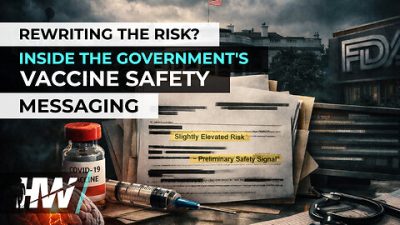
Rewriting the risk? Inside the government’s vaccine safety messaging
or go to
Aletho News Archives – Video-Images
Book Review
“Davos Can Really Replace the UN”
Inside the book that maps the architecture behind global governance — from the Epstein files to the Pact for the Future
Lies are Unbekoming | April 1, 2026
On June 13, 2019, the United Nations and the World Economic Forum signed a partnership deal to “accelerate the implementation of the 2030 Agenda for Sustainable Development.” That same evening, WEF president Börge Brende — Norway’s former Foreign Minister — had dinner with Jeffrey Epstein at Epstein’s Manhattan townhouse. The Epstein files, released January 2026, contain an exchange between the two from the previous year. Epstein to Brende: “Davos can really replace the UN. C21, cyber, crypto . genetics… intl coordination.” Brende back to Epstein: “Exactly — we need a new global architecture. World Economic Forum (Davos) is uniquely positioned — public private.”
The next day, the UN General Assembly adopted the framework for restructuring global governance.
That sequence — the partnership signing, the Epstein dinner, the candid admission about replacing the UN with a public-private architecture, and then the formal adoption — opens Jacob Nordangård’s The Digital World Brain. Pages two and three. Footnoted to the UN resolution number, the Epstein files, and the General Assembly record.
I keep coming back to it because it captures what this book does that almost nothing else in the independent research space manages. I’ve followed Jacob’s work for years now and interviewed him about his research. Each book peels back another layer of the same institutional architecture, and each time I think he’s reached the limit of what can be documented, the next one goes further. Nordangård doesn’t speculate. He doesn’t editorialize much. He lays institutional actions next to each other in chronological order and lets the pattern announce itself. … continue
Blog Roll
 Aletho News
- The End of NATO
- 37 days of war on Iran cost US staggering $42bln, tracker shows
- Baghdad tells Asian refiners, traders to begin loading Iraqi crude amid Iranian exemption
- Under fire, Moscow and Tehran close ranks
- Iran, US receive Pakistan-mediated plan for ceasefire then final deal
- Iran submits demands for end to war as mediators scramble ahead of Trump deadline
- Iran Threatens Retaliatory Strike on Stargate AI Project in UAE
- US sent ‘a lot’ of arms to Iranian protesters – Trump
- Barak Ravid Launders Deception To Allow Trump To Back Off Of His Power Plant Threat – Again
- REWRITING THE RISK? INSIDE THE GOVERNMENT’S VACCINE SAFETY MESSAGING
- If Americans Knew
- Trump poised to “blow everything up” (ie. commit war crimes) in Iran – Daily Update
- In Iran, Israel-US take aim at “reason, research, and freedom of thought” – Daily Update
- US loses planes over Iran, Israel downgrades Lebanon war goals – Daily Update
- Israel Is Blocking Palestinians from Easter at Church Where Jesus Resurrected
- Plot to assassinate Palestinian activist follows harassment campaign promoted by Zionist groups and elected officials
- Prominent New York synagogue hosts presentation on why U.S. Jews should support the ethnic cleansing of Gaza
- Tapper vs. Piker: Is the CNN Anchor Auditioning for David Ellison?
- Shouldn’t Democrats Be Able to Condemn Genocide?
- Israel-US kill negotiators, destroy civilian structures, but Iran’s military capabilities still largely intact – Daily Update
- ‘War crime’: Global condemnation as Israeli ministers celebrate death penalty law targeting Palestinian prisoners
- No Tricks Zone
- An Inconvenient Tree: Uncovered In Alps… Europe Much Warmer Than Today 6000 Years Ago
- New Study Reports A 60% Slowdown In Greenland’s Ice Loss Rate In The Last Decade
- Low Intensity Tornado Wrecks Major Solar Farm, Creating A Potential Toxic Dump
- New Study Finds Warming Saves Lives…Cold Temperatures 12 Times More Deadly Than Excess Heat
- German Science Blog Accuses PIK Climate Institute Of Hallucinating Climate Tipping Points
- Devastating Assessment Of Comirnaty Vaccine By Former Senior Pfizer Europe Toxicologist
- New Study: CO2 Is ‘Effectively Negligible’ As An Explanatory Climate Change Factor Since 2000
- Former Pfizer Toxicologist Dr. Helmut Sterz Tells Bundestag Hearing Pfizer Vaccine Should Have Never Been Approved
- Energy Expert: Germany’s Nuclear Phaseout Was A “500 Billion Euro Mistake”
- New Research: South Australia’s Mid-Holocene Sea Surface Temperatures Were 4°C Warmer Than Today
 Aletho News