Reseacher: Peruvian Government Has Political Debt with Forced Sterilization Victims
teleSUR | October 29, 2014
Eighteen years have passed and those who were forcefully sterilized in Peru have obtained no justice even though the issue was key for the electoral victory of current president Ollanta Humala.
On Wednesday, author and researcher Alejandra Ballon accused the current administration of president Ollanta Humala of using the case of forced sterilizations for political gain and failing to follow through with seeking justice for the victims.
Ballon is the author of the first book on the issue, released earlier this month with the support of the National Library of Peru. It is titled Memoirs of the Peruvian Case of Forced Sterilizations.
Crimes Against Humanity
Over 300,000 people, mostly indigenous women, were forcefully sterilized by the Fujimori regime during the 1990s. The program sought to reduce the number of children in poor rural indigenous families by deceiving and threatening them and even operating on them without them knowing. For those reasons the crimes are being described as genocide.
Sometimes, the signature of the victim’s relatives was used to go ahead with the process without consent. Sometimes the victims were operated on secretly after giving birth. The program was implemented nationally but the methods were not systematic. However, the government gave official quotas to each post for specific periods of time and medical personal were required to comply.
The results were brutal. There are several reports on the effects of such crimes including psychological and physical impairments of the victims and the effects on their relatives. “Women lost their physical strength and could no longer work as farmers, but also many were abandoned by their male partners, and forced to emigrate to the cities,” explained Ballon.
“It is not only the irreversibility of the operation and that women were made sterile against their will, but on top of that there are physical, mental, family, community, agricultural and cultural consequences,” asserts Ballon.
She described a case in Huancabamba where many women were dedicated to sewing using an ancestral, pre-Incan method called Cahihua, which uses the stomach. “It is one of the cultural legacies that we have in the country and we should take care of it,” argues Ballon. However, she explained that this sewing method uses a tool that places pressure on a person’s belly, and after being operated, the pain from the scar would not allow them to sew in that traditional manner. Ballon discovered this problem in 2012 but no systematic method has been implemented to be able to find all the other ways in which this criminal program has affected people’s lives.
The Case of Victoria Vigo
Victoria Vigo is one of the women who was forcefully sterilized. Right after a miscarriage in 1996, doctors secretly mutilated her reproductive organs to comply with the sterilization quota ordered by the regime.
She explains how she found out about her operation. “The doctor who was next to me and taking care of me told another doctor that what is happening is that my baby has passed away,” she explained, and the new doctor “turned around and told me ‘don’t worry you are young and you can have another baby.’” But the first doctor responded, ‘No, she has already been sterilized,’ and that is how I found out what they did to me,” says Victoria.
Victoria explains her feelings at the time. “When one loses a child, a longing to have another child stays… When you lose something you immediately want it. I wanted to have a child … but friends who are doctors talked with me and told me, no Victoria, it is irreversible,” she said.
Political Debt of President Humala
Ollanta Humala picked up the struggle for justice for these cases during his presidential bid. Many believe that such a move gave him the edge to win the election in the second round. He was running against Keiko Fujimori, daughter of Alberto Fujimori, the dictator in charge of the country when the sterilizations took place. During a presidential debate, Humala raised the issue and used it to attack Keiko. However, little has been done after his victory to investigate and obtain justice.
For those reasons, the victims are saying Humala only used them for political gain and he has no interest in their struggle or pain. Ballon has come out in their support. She argues that current president Ollanta Humala has a political debt with these women because he was partly able to win the election by promising in depth investigations into the matter.
Failures of Society
Ballon goes further than pointing out the failures of Humala. She calls these cases the “gravest violations committed against indigenous woman since the colonial times.”
“We are not understanding as a society what we can learn about ourselves through these women. They can tell us about how it was done so that we can learn who we are, what are we doing and to what point can we prevent a future possibility of repeating it.”
Ballon explains that the implementation of the program also shows chauvinism in society. Out of the 300,000 sterilized people, 22,000 were males. “There was gender discrimination in the program even though a man can procreate hundreds of kids and a woman has a limited number of children she can have,” points out Ballon. She concludes that “this is not a result of only the program but the social constructs of the country.”
In a similar way, racism must have been operating in society to permit such crimes. Ballon uses postcolonial theory to explain why indigenous populations, Quechua speaking, were the main target. She explains how hierarchies and racism imposed during colonial times have made committing and justifying such crimes against indigenous populations possible.
The National Library of Peru is investing in a collection of books, including Ballon’s, called La Palabra del Mudo (The Mute Person’s Word) that are using postcolonial theory to record and give voice to those who have not been included in the official histories. The ultimate goals are to strengthen democracy, recover memories, and construct new and inclusive narratives about Peru.
Democratically elected Government of Egypt submits complaint to the International Criminal Court
MEMO | January 6, 2014
Members of the democratically elected Government of Egypt have submitted a formal Complaint to the International Criminal Court (ICC). The Complaint is accompanied by a Rome Statute Article 12 (3) Declaration giving the International Criminal Court jurisdiction over the situation in Egypt.
The submission of the complaint and declaration by the Government of Egypt allows the International Criminal Court’s Prosecutors to investigate allegations of Crimes against Humanity perpetrated by the military regime following the July 2013 coup d’état.
In July 2013 the Egyptian military led a coup d’état against Egypt’s first democratically elected Government. The coup resulted in the detention of the President and members of the Government of Egypt. In the days after the coup the military regime used extreme force to remove civilians who gathered to protest against the coup. At least a thousand civilians lost their lives and many more were injured during this time. Since then the military regime has attempted to consolidate its position by repressing pro-democracy activists of all types who object to the coup, banning protests and designating the Muslim Brotherhood as a terrorist organisation.
As a result of actions taken by the military regime Egypt’s Freedom and Justice Party (FJP) and members of the Shura Council (the Upper House of the Egyptian Parliament) appointed an international legal team to advise on the unlawful detention of members of the Government and to investigate criminal acts that had been committed by the military regime.
The legal team is led by Tayab Ali, solicitor and partner of leading human rights law firm ITN Solicitors and includes some of the world’s most distinguished legal figures. It includes the former UK Director of Public Prosecutions, Lord Ken Macdonald QC; South African International Lawyer and former UN Human Rights Special Rapporteur, Professor John Dugard SC; renowned human rights barrister, Michael Mansfield QC; war crimes and criminal law expert Stephen Kamlish QC and the distinguished International Criminal Court barrister, Rodney Dixon.
In November 2013 the legal team detailed evidence that had been gathered during their investigation which showed a prima facie case that the military, police and political members of the regime had committed crimes against humanity against Egyptian civilians protesting against the coup.
The Complaint, which was submitted to the ICC on 20 December 2013, includes detailed and compelling evidence that the criminal acts perpetrated by the military regime include murder, unlawful imprisonment, torture, persecution against an identifiable group, enforced disappearance of persons and other inhumane acts of a similar character intentionally causing great suffering, or serious injury to body or to mental or physical health. The evidence shows that the acts alleged were widespread and systematic.
At a press conference held in Cavendish Hotel, Mayfair, London on Monday members of the legal team detailed the work that had been undertaken to submit the complaint. International Criminal Court legal expert and barrister Rodney Dixon explained that the International Criminal Court should open an investigation into the very serious allegations of international crimes and should do so without delay. He stated: “The ICC has a unique opportunity to contribute to the prevention of widespread crimes being committed against civilians in Egypt. By launching an investigation now the ICC Prosecutor will send a clear signal that the killings and abuses will not go unpunished and must end.”
London solicitor Tayab Ali stated that he had received “overwhelming evidence” from witnesses giving firsthand accounts of what they had seen and experienced. According to Mr. Ali the testimony is supported by graphic images of violence carried out against unarmed civilian protestors. He said “In order for Egypt to return to the democratic process it is essential that the people responsible for the violence following the coup are held accountable for their crimes. There is no hope for democracy and the rule of law in Egypt unless international legal institutions do the job they have been created to do”.
Michael Mansfield QC said “A democratically elected government has been unlawfully overthrown by a military coup. This in itself contravenes the Rule of Law. There has been no accountability for this action which involved clearly documented crimes against humanity. In circumstances where domestic law has failed to provide an effective remedy, it behoves the institutions of international law to seek the application of that law”.
Senior barrister Stephen Kamlish QC outlined the strategy of using the principles of universal jurisdiction to prosecute members of the military regime wherever they should travel to. He explained the growing move by national courts to apply principles of universal jurisdiction and prosecute people suspected of international crimes regardless of where the crimes had been committed.
Former United Nations Special Rapporteur, Professor John Dugard said “The International Criminal Court was established to ensure that crimes against humanity do not go unpunished. It is therefore essential that the Court investigate and prosecute those responsible for the commission of such crimes in Egypt. It is hoped that the present initiative will achieve this purpose and at the same time deter the commission of further such crimes. The International Criminal Court, and indeed the international community, cannot allow an unconstitutional, unrecognised and illegal regime in Egypt to commit grave international crimes with impunity.”
Members of the legal team are expected to meet with the ICC prosecutor over the coming days and weeks in order to support the work the ICC must now undertake. Tayab Ali said “It is essential that the people of Egypt unite to rebuild democracy. This cannot happen until those who have committed crimes against humanity have been held to account”.

Guatemala: Former Dictator Ríos Montt Guilty of Genocide
By Kristie Robinson | The Argentina Independent | May 10, 2013
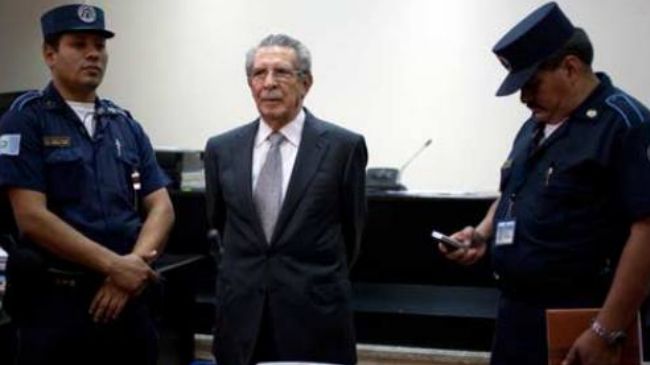 In an historic verdict, former Guatemalan dictator José Efraín Ríos Montt has been found guilty of genocide and sentenced to 50 years in prison for genocide and a further 30 for crimes against humanity. The verdict sets a global precedent, as Ríos Montt was the first former leader to be tried for genocide in a national court.
In reading her verdict, Judge Yassmin Barrios said: “We are completely convinced that in this case, elements demonstrating the intent to commit genocide have been proven … Ríos Montt, the head of state, knew exactly what was happening. He did nothing to stop it.”
Ríos Montt’s co-defendant and former head of military intelligence, José Mauricio Rodriguez Sánchez, was acquitted.
Ríos Montt came to power following a coup in 1982, during Guatemala’s 36-year civil war, in which an estimated 200,000 people, mostly of indigenous descent, were killed or disappeared.
For background on the case, see Avery Kelly’s report from 8th May 2013.
Featured Video
Bombing Iran Back Into the Stone Age /Lt Col Daniel Davis & Jim Jatras
or go to
Aletho News Archives – Video-Images
From the Archives
The Occupied Mentality Syndrome
Saudi Arabia on the American chessboard – Part 2
By B. J. Sabri | American Herald Tribune | April 19, 2016
Since the Korean War, but particularly since the Iranian Revolution of 1979 until today, the United States has been steadily escalating its military presence in the Persian Gulf. Taking advantage of many colossal events of the past 36 years, [1] the hyper-empire has institutionalized its massive presence on land and sea, and expanded its objectives to include the unambiguous physical control of the area, as well as the clear understanding that local Arab governments should abide by them. The pretext is always the same: in “defense” of the national interests and security of the United States. From observing how the United States has been interacting with the governments of the region, and by judging from the size of its expeditionary force, we could reach a basic conclusion. The United States is occupying, de facto, the entire Arabian Peninsula. (Yemen, devastated by Saudi and American jets is yet to be conquered. Oman? Britain returned not as colonial ruler but as a soft occupying power.)
Under this articulation, Saudi Arabia, Qatar, Kuwait, and the United Arab Emirates are virtually occupied countries. If we compare this type of occupation to the mandate and protectorate regimes of the past, the results might be identical—the nations affected by it lose sovereignty. When Arab governments comply with the objectives of a foreign power that station military forces on their national milieu, then that power controls them in multiple ways including how they react to policy deliberations and what decisions they intend to take on specific issues. A good method to verify the concept of effective occupation is this: take notice of what the United States says and wants, and then compare it to what the gulf rulers do in response. (I shall discuss this detail at some point in the upcoming parts.)
If the presence of US forces or other means of political pressure are a factor in Saudi Arabia’s interventionist Arab wars, then we need to debate this issue. However, from the history of resistance to colonialism, we learnt: if a powerful state imposes its order on a nation by military means or other forms of coercion, and if this nation does not resist that imposition, then a mental subordination to the powerful state will ensue. This is especially true in the case of Saudi Arabia. One single event, 9/11, has transformed it from a US “ally” into an instant political hostage of the American Empire. … continue
Blog Roll
 Aletho News
- BREAKING: US JET SHOT DOWN OVER IRAN /Lt Col Daniel Davis & Nima Alkhorshid
- Now everyone is dumping US government bonds
- Brazilian Congressman seeks to bar Israeli military personnel from entering Brazil
- Official reveals evidence of Arab states’ involvement in US-Israeli war on Iran
- His Majesty’s head-chopper: Syria’s MI6-backed president bows to King Charles
- Forced to backtrack: ‘Israel’ drops Hezbollah disarmament goal
- Britain’s Lebanon surveillance network: A digital map for war
- Bahrain faces scrutiny for opposition crackdown after detainee killed
- Hegseth’s Pentagon Purge Designed to Prevent a Mutiny: Karen Kwiatkowski
- Greek shipping firms secretly transporting oil, weapons to Israel
- If Americans Knew
- Israel Is Blocking Palestinians from Easter at Church Where Jesus Resurrected
- Plot to assassinate Palestinian activist follows harassment campaign promoted by Zionist groups and elected officials
- Prominent New York synagogue hosts presentation on why U.S. Jews should support the ethnic cleansing of Gaza
- Tapper vs. Piker: Is the CNN Anchor Auditioning for David Ellison?
- Shouldn’t Democrats Be Able to Condemn Genocide?
- Israel-US kill negotiators, destroy civilian structures, but Iran’s military capabilities still largely intact – Daily Update
- ‘War crime’: Global condemnation as Israeli ministers celebrate death penalty law targeting Palestinian prisoners
- 7 Ways Israel Is Turning Lebanon Into Gaza
- World’s Leading Football Bodies Under Fire Over Israel Policies
- Experts warn of possible use of nukes against Iran
- No Tricks Zone
- Low Intensity Tornado Wrecks Major Solar Farm, Creating A Potential Toxic Dump
- New Study Finds Warming Saves Lives…Cold Temperatures 12 Times More Deadly Than Excess Heat
- German Science Blog Accuses PIK Climate Institute Of Hallucinating Climate Tipping Points
- Devastating Assessment Of Comirnaty Vaccine By Former Senior Pfizer Europe Toxicologist
- New Study: CO2 Is ‘Effectively Negligible’ As An Explanatory Climate Change Factor Since 2000
- Former Pfizer Toxicologist Dr. Helmut Sterz Tells Bundestag Hearing Pfizer Vaccine Should Have Never Been Approved
- Energy Expert: Germany’s Nuclear Phaseout Was A “500 Billion Euro Mistake”
- New Research: South Australia’s Mid-Holocene Sea Surface Temperatures Were 4°C Warmer Than Today
- Storing Green Energy To Last Germany 10 Days Would Require A 60-Million Tonne Battery
- New Studies: UK Sea Levels Were 4 Meters Higher Than Today During The Mid-Holocene
 Aletho News