Kremlin weighs in on unrest in Armenia
RT | June 29, 2025
Political turmoil in Armenia is an internal matter, Kremlin spokesman Dmitry Peskov has said, following the arrests of senior clerics and a Russian-Armenian businessman accused of plotting to overthrow Prime Minister Nikol Pashinyan’s government.
Earlier this month, the Armenian authorities took into custody Archbishop Bagrat Galstanyan, the leader of the Sacred Struggle opposition movement, and Archbishop Mikael Adjapahyan. They are both accused of plotting a coup. The arrests sparked a public outcry and protests, which devolved into clashes with police.
The archbishops are key members of the Armenian Apostolic Church (AAC), which was the main driver of protests against Pashinyan. The unrest was sparked by the prime minister’s decision to return several border villages to Azerbaijan. While Pashinyan portrayed the land transfer as necessary to normalize relations with the neighboring state, many in Armenia saw it as a betrayal of national interests.
The authorities also arrested Samvel Karapetyan, a Russian-Armenian billionaire and supporter of the AAC, on charges of calling for the overthrow of the government.
In an interview with Russian journalist Pavel Zarubin, Peskov said Moscow is closely monitoring the situation but will not interfere.
“This is, of course, an internal matter for Armenia,” he stated. “We are, of course, interested in the preservation of law and order in Armenia, so that Armenia is a prosperous, stable country, friendly to Russia.”
Peskov noted that Russia has a large Armenian diaspora, many of whom “are watching these events with pain,” adding: “Many, of course, do not accept how this is happening.”
Russia and Armenia have historically had close cultural and religious ties. In recent months, however, Yerevan has distanced itself from the Collective Security Treaty Organization (CSTO), which comprises many former Soviet republics. Armenia has accused Russia of failing to provide adequate support during its stand-off with Azerbaijan – in particular, over the region of Nagorno-Karabakh.
Russia has argued that Armenia never recognized Nagorno-Karabakh as its own territory, meaning the CSTO could not consider Azerbaijan’s military operation in the enclave as aggression against an alliance member. President Vladimir Putin has also said that Russia has on numerous occasions floated a territorial compromise that could have settled the conflict between the two states, and that Armenia rejected the initiative.
Serbia Will Not Join NATO or CSTO – Deputy Prime Minister Vulin
Sputnik – 24.03.2025
BELGRADE – Serbia will not become a member of NATO or the CSTO, it must ensure its own security, although this is difficult, Serbian Deputy Prime Minister Aleksandar Vulin told Sputnik.
“Serbia strictly adheres to the policy of military neutrality. This means that we will not expand our participation in any military bloc. And we will try to maintain the best relations with everyone, first of all — with the countries in our neighborhood. So Serbia will not become a member of NATO, will not be a member of the CSTO,” Vulin said.
He admitted that for a country the size of Serbia, this is the hardest path.
“We must guarantee our own security, which is not easy. But this is the most honest path — to make decisions about ourselves,” he emphasized.
Currently, the parliament of Serbia is an observer in the CSTO Parliamentary Assembly.
Oreshnik Missile: Putin Unveils New Details of Its Destructive Power
Sputnik – 28.11.2024
Serial production of the Oreshnik system has begun, the Russian president announced.
Last week, the Russian leader revealed the successful testing of the new Oreshnik hypersonic missile system. Today, at the request of colleagues, he shared further details.
“Serial production of the Oreshnik has started, but ultimately, we will choose the means of destruction depending on the nature of the selected targets and the threats posed to the Russian Federation,” Putin said at a session of the Collective Security Treaty Organization (CSTO) Security Council.
He also revealed new specs from the missile:
- The missile’s warhead reaches a temperature of 4,000 degrees Celsius, making it highly destructive.
- Anything in the blast zone is broken down into elementary particles, essentially turning it into dust.
- The Oreshnik can target even well-protected, deeply buried structures, making it effective against fortified sites.
- While not a weapon of mass destruction, its power is still capable of causing massive destruction without a nuclear charge.
- The missile is designed for extremely precise strikes, ensuring high-value targets are hit with deadly accuracy.
Putin explained to CSTO members that Russia was forced to conduct tests of the Oreshnik missile in response to long-range missile strikes on the Bryansk and Kursk regions.
“Of course, in response to the ongoing long-range missile strikes on Russian territory, as has already been stated, we will respond, including by possibly continuing the Oreshnik tests in combat conditions,” Putin said at the session of the Collective Security Treaty Organization (CSTO) Security Council.
He added that Russia now has several ready-to-use Oreshnik missiles.
In the case of a mass launch of Oreshnik missiles in a single strike, their power would be comparable to that of nuclear weapons, he added.
“According to military and technical specialists, in the case of a mass group launch of these missiles, that is, several Oreshniks launched in a cluster in one strike, the power of that strike would be comparable to the use of nuclear weapons,” Putin said, adding: “Everything in the epicenter of the explosion is broken down into fractions, elementary particles, and essentially turns into dust.”
However, Putin clarified that the Oreshnik is not a weapon of mass destruction, but a highly precise weapon that does not carry a nuclear payload.
The Devil’s In The Details When It Comes To Pashinyan’s Karabakh Peace Proposal
BY ANDREW KORYBKO | MAY 23, 2023
Armenian Prime Minister Pashinyan proposed recognizing Azerbaijan’s territorial integrity in full in exchange for it doing the same to his country, though the caveat is that he’ll only do so if the security of local Armenians there is guaranteed. This naturally raises the question of how to satisfy his requirement in a way that’s also acceptable to Azerbaijan, with one possibility being to prolong the deployment of Russia’s peacekeepers there.
It can’t be taken for granted that Azerbaijan would approve of this for the extended period of time that Pashinyan appears to be implying is required to guarantee their safety, however, since it appears to be growing frustrated with the status quo. Azerbaijan only agreed to the presence of these forces in November 2020 because it expected that they’d expedite the removal of Armenian forces in parallel with facilitating the reasserting of the state’s sovereignty over the rest of its territory.
That outcome hasn’t yet materialized, and instead, these South Caucasus rivals have even clashed several times along their internationally recognized border. Armenia also accuses Azerbaijan of violating the same Moscow-mediated ceasefire that it agreed to after self-described “activists” blocked the Lachin Corridor, while Azerbaijan accuses Armenia of doing the same by still launching attacks from Karabakh. These factors have combined to make many worry about whether another war might soon erupt.
As a self-respecting state, Azerbaijan regards it as offensive for Armenia to hint that it can’t guarantee the security of its citizens, which includes those Armenians who’ve been in Karabakh since Soviet times but not those who moved to the region as colonists after its occupation by neighboring Armenia. Its rising confidence and regional prestige as a result of its victory two and a half years ago reduces the chances that Azerbaijan would agree to prolong the deployment of Russia’s peacekeepers.
Those calculations indirectly pose a problem for Russian-Armenian relations since Moscow must prove its military-security worth to Yerevan in order to prevent its “defection” from the CSTO, with the scenario of it prolonging the deployment of its peacekeepers in Azerbaijan being the best way to do so. Armenia surprised Russia by participating in joint NATO drills last month, which was followed by its Deputy Foreign Minister revealing this month that it contemplated leaving the CSTO last September.
Pashinyan added earlier this week that Armenia’s withdrawal might indeed still happen if it concludes that the CSTO has “become a non-functional organization”, which prompted Kremlin spokesman Peskov to promise that Russia will retain relevant dialogue with its partner in an effort to prevent this. The unstated threat that was just conveyed by Yerevan is that it’ll ditch the CSTO and thus deal a major blow to Moscow if Russia can’t convince Azerbaijan to guarantee the security of Armenians there.
In the event that Armenia “defects” from this Russian-led military-security bloc, then it would immediately raise questions about Moscow’s reliability to its other partners such as those in Central Asia, thus possibly emboldening those countries to distance themselves from it too like the West wants. With Armenia out of the CSTO, it might then apply for expedited entry into NATO, which could possibly lead to it and Georgia joining together like was supposed to be the case with Finland and Sweden.
Russia must therefore do its utmost to avert this dark scenario from unfolding, to which end it’s pressed to politically resolve the Armenian-Azerbaijani conflict once and for all as soon as possible before Yerevan’s patience runs out. That said, it wouldn’t be in Armenia’s best interests to ditch the CSTO until it gets what it wants since otherwise it’ll be without Russia’s protection if Azerbaijan and/or Turkiye decide to invade its internationally recognized territory in order to resolve this conflict on their own terms.
Nevertheless, it might end up being the case that Armenia could secretly reach an agreement with the US for the latter to extend security assurances to it prior to that country’s membership in NATO upon it formally announcing its withdrawal from the CSTO and intention to join that enemy bloc. The precedent for doing so was already established last May after the US gave exactly these sort of assurances to Finland and Sweden until they joined NATO, which is still relevant to the latter since it hasn’t yet done so.
Russia’s challenge is therefore threefold since it must: 1) broker a sustainable peace deal between Armenia and Azerbaijan as soon as possible to preempt Yerevan’s “defection” from the CSTO on the pretext that this group is “non-functional”; 2) to which end Moscow must likely get Baku to agree to at least prolong the presence of Russian peacekeepers for the next few years; and 3) then ensure that Armenia still doesn’t “defect” from that bloc after it already gets what it wants from Russia.
Each of these tasks presents a formidable challenge in and of themselves, let alone having to be tackled all at once due to Armenia hinting that it’ll dump the CSTO if it doesn’t get what it wants sometime soon, and not to mention that this is happening amidst Russia’s ongoing special operation. Even so, if there’s any country whose diplomats are capable of rising to the occasion, it’s Russia’s. This doesn’t mean that they’ll succeed, but just that nobody should doubt that they’ll give this their best shot.
NATO bases in Central Asia ‘unacceptable,’ Lavrov says
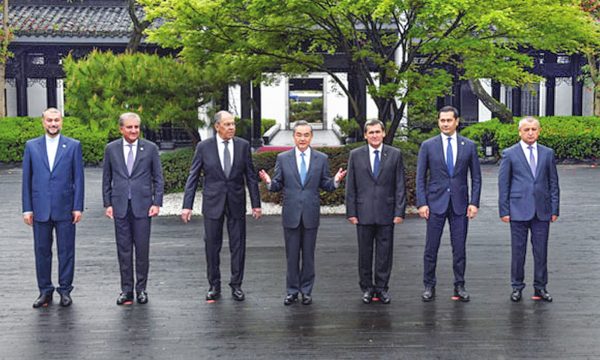
Chinese Foreign Minister Wang Yi and Russian Foreign Minister Sergey Lavrov stand with officials from Afghanistan’s neighboring countries and the Afghan Taliban as China-hosted talks on Afghanistan concluded in East China’s Tunxi, Anhui Province on March 31, 2022. Photo: Chinese Foreign Ministry
Samizdat | March 31, 2022
Russian Foreign Minister Sergey Lavrov said on Thursday that any NATO military presence in Central Asia will undermine the security of the Russian-led bloc in the region.
The minister made his comment at an Afghanistan-themed summit in Tunxi, China.
“We believe it’s unacceptable to have any US and NATO military infrastructure, or their Afghan helpers, on the territory of neighboring states, especially in Central Asia,” Lavrov said, adding that “such designs go against the security interests of our countries.”
He added that the existence of Western military sites would contradict the interests of the Collective Security Treaty Organization (CSTO), a Russian-led regional bloc.
Russian-led military bloc could send peacekeepers to Ukraine – top general
By Layla Guest | RT | February 19, 2022
With fears of an all-out military conflict in Ukraine’s war-torn Donbass region, troops from a major Moscow-led military faction could be sent on a mission to stabilize the tense situation if Kiev and the international community agree on the plan, the bloc’s secretary general has said.
Speaking as part of an exclusive interview to Reuters, published on Saturday, Stanislav Zas weighed in on which measures the Collective Security Treaty Organization could take if given the go-ahead.
“We have colossal potential in our hands. We all understand that we need to be very careful with this sharp instrument,” he said.
According to the lieutenant-general, the CSTO has the capacity for a large-scale deployment. “Believe me, we can send as many as needed.”
“If we need 3,000, we’ll send them. If we need 17,000 we’ll send them. If we need more there’ll be more. As many as are needed,” he continued.
However, he added the caveat that such a move would need to be given the greenlight from multiple sides, including Kiev, which is not a member of the bloc.
“Hypothetically you can imagine it … if there were goodwill from Ukraine – it is after all their territory – if there was a U.N. Security Council mandate, and if it was needed and such a decision was supported by all our governments,” he explained.
The interview, which was conducted before the Donetsk and Lugansk people’s republics began mass evacuations of civilians to Russia, comes amid clashes erupting in the Donbass in the past few days. Ukrainian soldiers and those loyal to the two self-declared separatist regions have accused one another of aggression along contact lines, with claims of heavy shelling coming from both sides.
In January, units from the multinational CSTO were sent to Kazakhstan after street protests decrying the government’s removal of price controls on liquified petroleum gas, a fuel that many use to power their cars, turned violent.
US Secretary of State Antony Blinken suggested that Moscow could have ulterior motives with the troop deployment, stating “I think one lesson in recent history is that once Russians are in your house, it’s sometimes very difficult to get them to leave.” However, the forces left just days after their arrival having completed their mission.
Whither Afghanistan? Getting Out Is Harder Than Getting In
By Philip Giraldi | Strategic Culture Foundation | July 22, 2021
The inability of the United States to comprehend what it was becoming involved in when, in the wake of 9/11, it declared a Global War on Terror, has to be reckoned one of the singular failures of national security policy over the past twenty years. Not only did the wars in Afghanistan and Iraq make bad situations worse, but the fact that no one is Washington was able to define “victory” and think in terms of an exit strategy has meant that the wars and instability are still with us. In their wake has been hundreds of thousands of deaths and trillions of dollars spent to accomplish absolutely nothing.
As a result, Iraq is unstable and leans more heavily towards America’s adversary Iran than it does to Washington. The Iraqi Parliament has, in fact, asked U.S. forces to leave the country, a request that has been ignored both by Donald Trump and Joe Biden. Trump actually threatened to freeze Iraqi bank assets to pressure the Iraqis into accepting the continued U.S. occupation. At the same time, American troops illegally present in neighboring Syria, continue to occupy that country’s oil fields to deprive the government in Damascus of much needed resources. Neither Iraq nor Syria threatens the United States in any way.
Given that history, it should be no surprise that the withdrawal from the twenty year-long nation building project in Afghanistan, long overdue, is not quite going as smoothly as the Pentagon and White House apparently planned. U.S. forces pulled out of their principal base in the country, Bagram Air Base, in the middle of the night without informing the incoming Afghan base commander. A frenzy of looting of the left behind equipment followed.
The Taliban are racking up victory after victory against U.S. and NATO trained Afghan government forces who have the disadvantage of having to defend everywhere, making them vulnerable to attacks on an opportunity basis. The Taliban now plausibly claim to control 85% of the countryside, to include crossing points into Pakistan and several important towns and provinces. They recently shocked observers by executing 22 Afghan Army commandos who had run out of ammunition and surrendered. The U.S. government is quietly expecting a similar fate for the thousands of Afghans who collaborated with the regime installed by Washington and is hurriedly arranging for visas to get the most vulnerable out, eventually seeking to resettle them in friendly Middle Eastern countries as well as in the U.S..
By one estimate as many as 18,000 Afghans worked for U.S. forces and they also have families that will have to go with them. There is particular concern that former interpreters, who would have been privy to decision making by Washington, will be most particularly targeted. The Biden White House has responded finally to the urgency of the issue – lives are at stake – by approving special flights to remove the most vulnerable to a third country for processing before determining if they can be allowed to take up residence in the United States or elsewhere.
To be sure, the struggle to rid the world of the wrong kind of terrorists has left the United States weaker and more unfocused than it was in 2001. China, Russia and Iran are already maneuvering to fill the impending power vacuum in Central Asia by coming to terms with the likely Taliban takeover, which might come sooner than Joe Biden expects. If some kind of Afghan coalition government does emerge, it will belong to Russia and China, not the U.S..
Meanwhile, the U.S. military itself, under the Biden Administration, is weaker and more riven by controversy than ever before. A recent 23-page report suggests that since Defense Secretary Lloyd Austin’s February order to “stand down” the entire U.S. military for commanders to address “extremism” in its ranks morale has sunk and many top soldiers have either retired or quit in disgust. During his confirmation hearings, Austin pledged that he would “rid our ranks of racists and extremists” but the reality is quite different, with the witch hunt in the ranks and endless promotion of diversity even hurting normal military readiness training.
By next month the U.S. military presence in Afghanistan will be reduced to a battalion of infantry to guard the Embassy and CIA station in Kabul, which is itself not sustainable unless some kind of workable Afghan government coalition can be achieved. Given the recent Taliban successes, that outcome appears to be increasingly unlikely. Maintaining the Embassy will also require a viable lifeline to the city’s airport and talks are underway with Turkey to determine if Ankara will be willing to base a stay behind battalion to maintain the air link. The Taliban have already announced that a Turkish presence at the airport will be unacceptable and warned Turkey that there would be revenge attacks against any remaining NATO troops after the U.S. pulls out. Their spokesman issued a statement declaring that “The continuation of Turkey’s occupation will provoke feelings of hatred and enmity in our country towards Turkish officials, and will harm bilateral relations.”
The U.S. is also seeking an over the horizon offensive capability once the military has formally left Afghanistan. The intention would be to be able to strike targets in Afghanistan if a new government forms any alliances with terrorist groups that potentially threaten the United States, as unlikely as that might be. At the present time, there are few options as the U.S. would not be able to launch cruise missile or airstrikes through the neighboring countries that surround Afghanistan to the south, east and west, though a long-distance strike from warships in the Persian Gulf is technically possible.
To the north there are, however, former Soviet central Asian states, the so-called “‘Stans,” that might be suitable for hosting some arrangement to base American equipment, aircraft and a caretaker force. Tajikistan, Kazakhstan, or Uzbekistan might be amenable to such a development, but both Tajikistan and Kazakhstan are members of the Russian-led Collective Security Treaty Organization (CSTO). On Monday, Russian Foreign Minister Sergey Lavrov said that any U.S. presence in a CSTO country would need the approval of the alliance, which the Kremlin will veto. One might suggest that there is mistrust about the reliability of Joe Biden and company as a strategic partner, even though there is widespread concern that Afghanistan might become a rogue state. Nevertheless, Washington’s bullying in Iraq, Syria and also against Iran has failed to convince anyone that the U.S. Air Force would make a good neighbor.
So getting out of Afghanistan will be a lot trickier than going in. The U.S. clearly wants to have some ability to intervene using air resources if the Taliban take over and misbehave, but that just might be a fantasy as the door is closing on options while China is waiting for its own door to open to bring the Afghans into their New Silk Road. And there is no escaping the fact that the entire Afghan adventure was one hell of a waste of lives and resources. Next time, maybe Washington will hesitate to charge in, but given the lack of any deep thinking going on in the White House, I suspect we Americans could easily find ourselves in yet another Afghanistan.
Turkish claims that the PKK is operating in Artsakh set dangerous precedent
By Paul Antonopoulos | September 28, 2020
Conflict sparked up again yesterday in Artsakh, or more commonly known as Nagorno-Karabakh, when Azerbaijan launched an offensive against Armenian forces. Although the Republic of Artsakh is not recognized by any state, including Armenia, and it is still internationally recognized as occupied Azerbaijani territory, it achieved a de facto independence in 1994.
As acting Commissar of Nationalities for the Soviet Union in the early 1920’s, future Soviet leader Joseph Stalin granted the Armenian-majority region of Artsakh to the Azerbaijani Soviet Socialist Republic. The Azeris, the dominant ethnic group of Azerbaijan, are cultural and linguistic kin with the Turks. It is said that the Turks and Azeris constitute “one nation in two states.” The defining difference is that Azeris are Shia Muslims unlike Turks who are mostly Sunni. The Soviets had hoped that by granting Artsakh to Azerbaijan instead of Armenia, they could court the newly founded Republic of Turkey to closely align with Moscow, or perhaps even become a Soviet Republic, by appeasing their ethnic Azeri kin.
In 1921, it was estimated that Artsakh was 94% Armenian. However, according to the 1989 census, Artsakh’s population was approximately 75% Armenian and 25% Azeri. Former Soviet Azerbaijani leader Heydar Aliyev, father of current President Ilham Aliyev, said in 2002: “I tried to change demographics there […] I tried to increase the number of Azerbaijanis in Nagorno-Karabakh and the number of Armenians decreased.” The collapse of the Soviet Union unsurprisingly led to the Artsakh War, which only ended after a ceasefire in 1994 when Armenian forces achieved a decisive victory.
Despite Azerbaijan’s defense budget ($2.267 billion) being about five times larger than Armenia’s, they have failed to capture Artsakh on numerous attempts, particularly during the 2016 April War and another major attempt in July of this year. Azerbaijan’s resumption of hostilities yesterday could be passed off as just another skirmish that will subside in a few days. However, the current conditions are far different and much more dangerous than in previous situations.
Although it is well established that the Turkish economy is struggling, President Recep Tayyip Erdoğan is maintaining a policy of constant crises in the vain attempt to distract the public from the Turkish lira as it continues breaking new record lows to the US dollar and Euro, even as recently as this morning. As the military provocations and rhetoric of war against Greece and Cyprus in the East Mediterranean begins to subside in Ankara, it only took a few days for a new crisis to emerge.
Reports began emerging last week that Turkey was transferring terrorists from northern Syria to Azerbaijan. The Azerbaijani leadership in Baku flatly denied the allegations last week and today. However, despite the denials from Baku, it must be remembered that Ankara openly announced its transfer of Syrian fighters to Libya earlier this year and the Azerbaijani’s have undoubtedly used international terrorists from Afghanistan, Chechnya and Turkey during the first Artsakh war in the 1990’s. Photos, videos and voice recordings have emerged that show Syrian terrorists on their way to or already in Azerbaijan. Vardan Toghanya, the Armenian Ambassador to Moscow, said in a statement today that 4,000 militants from Syria already arrived in Azerbaijan, while according to the Armenian intelligence agency, 80 fighters from Syria have already been killed or wounded.
Turkey’s transfer of militants in support of Azerbaijan, which was also done in the 1990’s, is not what makes the current conflict more dangerous compared to previous battles and skirmishes. Starting from last week, Turkey and Azerbaijan have increased their campaign in claiming that the Kurdistan Workers Party (PKK), considered a terrorist organization by both Ankara and Baku, was operating in Artsakh. Neither Ankara and Baku provided any evidence for their claims. This sets a dangerous narrative as it could be used as a way for Turkey to “legitimize” a direct intervention against Armenia and in support of Azerbaijan.
Erdoğan justified his invasion and occupation of large areas of northern Syria and northern Iraq in 2018, 2019 and this year on the pretence that they were fighting against the PKK. Although Armenia denies PKK are operating in Artsakh, this will be ignored by Ankara and Baku.
However, unlike Syria and Iraq, Armenia is a member state of the Collective Security Treaty Organization (CSTO), alongside Belarus, Kazakhstan, Kyrgyzstan, Russia and Tajikistan. A direct Turkish attack on Armenia could activate the CSTO. This would be a dangerous scenario as in turn this could activate NATO in defense of Turkey. It is highly unlikely that the situation in Artsakh will dissolve into a CSTO-NATO faceoff. But the risk still remains, especially if Erdoğan decides to directly intervene under the guise of expelling the PKK from Artsakh.
Just as Erdoğan unleashed a migrant crisis in February and March of this year against Greece, sent Syrian terrorists to Libya in May, conducted a military operation in northern Iraq against the PKK in June, and created a new crisis with Greece by sending warships into its territorial waters in August and for most of September, it appears the new crisis to dominate headlines for the next few weeks will revolve around Artsakh.
Although it is unlikely that Turkey will directly militarily intervene, a dangerous precedent has already been established by pushing the narrative, without publicly available evidence, that the PKK are operating in Artsakh alongside Armenian forces. With the Turkish economy and lira collapsing, Erdoğan in the future may very well use the narrative that the PKK are in Artsakh to foment public furore and distract them from the declining economic situation.
Paul Antonopoulos is an independent geopolitical analyst.
Top General Warns That NATO Wants to Turn Post-Soviet Space ‘Into Another Syria’
Sputnik – 08.09.2016
A top Russian general has voiced his frustration over NATO’s lack of cooperation with a Russian-led alliance involving countries from the former Soviet space, saying that the Western alliance doesn’t seem to want countries in the former USSR to ally with one another, allowing NATO pick them off one by one at their leisure.
Speaking at a press conference in Moscow on Wednesday, Col. Gen. Nikolai Bordyuzha, secretary general of the Collective Security Treaty Organization, a military alliance involving six post-Soviet states, including Russia, Belarus, Armenia, Kazakhstan, Kyrgyzstan and Tajikistan, had some harsh words for Russia’s NATO partners.
The North Atlantic Alliance, he said, has been consistently opposed to any military integration between Russia and its partners in the CSTO, and the reason is that NATO wants to deprive these countries of their collective security guarantees.
“Why do you think NATO does not cooperate with the CSTO?” the general asked. “It’s simple – they have no need to support processes of [defense] integration. This way, things will be like in Syria, and nobody will be able to let out a peep. The country is being pounded, and there’s no one to help them, since it didn’t have any allies. And this is the situation they want to create for us as well,” Bordyuzha said, referring to the members of the CSTO.
Furthermore, the officer warned that the Western media has been engaged in what he called campaign of information warfare against the CSTO. “They will tell lies all day, every day. Everything that is being said about the CSTO is presented in a way that’s the opposite to how things are in reality,” Bordyuzha noted. “This is done, for example, in order to ensure that Tajikistan was not together with Russia,” he added.
Ultimately, Bordyuzha suggested that the Western political, media and military effort’s “most important task is to splinter our unity, to separate our nations into our own ‘national apartments’, and to dictate their terms to everyone individually.”
In this scenario, the officer emphasized that while the CSTO has absolutely no plans to fight a war of aggression against NATO, neither does it fear an attack by the Western alliance. “That’s why the CSTO exists,” Bordyuzha quipped.
The Collective Security Treaty Organization, formed in 1992, shortly after the collapse of the Soviet Union, integrates the defense capabilities of six former Soviet republics, including Russia, Belarus, Armenia, Kazakhstan, Kyrgyzstan and Tajikistan. Afghanistan and Serbia became observers to the organization in 2013. Former members include Azerbaijan, Georgia and Uzbekistan.
Signatories to the alliance are not able to join other military alliances, and aggression against one member is considered aggression against all.
The CSTO holds yearly command exercises and drills to improve coordination between its states militaries, the most recent being Cooperation-2016, which took place last month in Russia’s Pskov region.
Hybrid Wars 4. In the Greater Heartland (III)
By Andrew KORYBKO | Oriental Review | April 8, 2016
(Please read Part I and Part II prior to this article)
Turkmenistan:
The threat facing Turkmenistan is less of a Color Revolution than an Unconventional War. The catalyst for this conflict would be a terrorist invasion coming from Afghanistan that unexpectedly sweeps northwards along the Murgab River. Such an offensive doesn’t even have to reach the national capital in order to be successful, since all that it really needs to do is capture the city of Mary, the capital of the resource-rich Mary Region. This part of the country contains the lion’s share of Turkmenistan’s gas reserve, which includes the massive and decades-long functioning Dauletabad Field and the newly discovered Galkynysh Field, the latter being the world’s second-largest find.
It wouldn’t be all that difficult for terrorists to take over this plot of land either, since the Murgab River is scattered with tiny villages along its banks that could provide cover from government airstrikes and places to provoke pitched battles from. The fertile land nearby is endowed with agricultural potential that’s surely being stored somewhere closely accessible, and this could help feed the occupying forces until greater conquests are made. In short, the Murgab River is the most militarily and logistically sustainable route for an ISIL-like invasion of Turkmenistan, and it leads straight to the gas heart of Eurasia that’s critically connected to China and will possibly be linked to India in the coming decade as well.
The risk of terrorists gaining control of the largest source of China’s gas imports and possibly even destroying the facilities is too much for multipolar strategists in Beijing and Moscow to bear, and it’s assured that they’ve already engaged in some sort of unofficial contingency planning with their counterparts in Ashgabat. An anti-terrorist Chinese intervention is largely precluded due to geographic distances and a lack of support and logistics facilities en route, but the Russian military has no such hindrances and would be much more likely to assist the Turkmen authorities if called upon to do so. This is of course a last resort and would only be commissioned if Turkmenistan proves itself unable to stem the terrorist tide and defend its gas infrastructure, but such an event is most assuredly being planned for just in case the Turkmen-Afghan border proves to be just as fragile of a defense against terrorists as the Syrian-Iraqi one was before it.

Kazakhstan:
Kazakhstan and the other three remaining states of former Soviet Central Asia are greatly at risk of a “Central Asian Spring” breaking out in the Fergana Valley, and Part IV of the Greater Heartland series will focus exclusively on this ever likely scenario. Accordingly, the rest of this section will explore the other Hybrid War vulnerabilities facing these four countries.
The geographically largest state in the Greater Heartland region is surprisingly immune from many of the conventional socio-political factors that lead to Hybrid Wars (excluding the variables that will later be discussed about the “Central Asian Spring”). If one was blind to the domestic and international contexts pertinent to Kazakhstan, then they’d be inclined to believe that the Russian population constitutes the greatest threat to the country’s sovereignty, although this couldn’t be anywhere further from the truth. Theoretically speaking, this demographic satisfies all of the criteria necessary for sparking a Hybrid War, but Kazakhstan’s multipolar alignment with the Eurasian Union and respectful treatment of this influential minority group precludes any chances that they or Russia would ever try to move forward with this scenario. On the reverse, the very inclusion of such a large Russian minority within Kazakhstan ties Astana and Moscow closer together than just about any other state in the former Soviet Union and works to enhance, not deteriorate, relations between them.
The only vulnerability in this relatively secure setup is if the US and its proxy NGO affiliates succeed in brainwashing the Russian-Kazakh population with Pravy Sektor- and Navalny-esque extreme nationalism, which could then create a delicate geopolitical situation where the raucous Russian minority agitates against Astana and attempts to drive a wedge between Kazakhstan and Russia. Security officials in both states are likely well aware of this obvious scenario and can be predicted to have rehearsed coordinated contingency measures for responding to it. Nonetheless, if such a virulent, discriminatory, and destructive ideology as “Greater Russian Nationalism” is allowed to fester in multicultural Kazakhstan and parts of the Russian Federation itself, then a scandalous outbreak in the Near Abroad could provoke a simultaneous cross-border event inside of Russia, especially if ‘sleeper sympathizers’ organize anti-government protests against Moscow’s “betrayal” of its compatriots out of its refusal to replicate the Crimean scenario in Northern Kazakhstan.
Another destabilization possibility that mustn’t be discounted in Kazakhstan is a repeat of the Zhanaozen riots, the ‘localized’ Color Revolution attempt that was sparked by a simmering labor dispute in 2011. The oil field workers were fed up with what they complained to be poor working conditions, low wages, and unpaid salaries, and this created an attractive atmosphere for Color Revolutionaries to exploit. Keeping with Color Revolution tradition, the riots started on 16 December, the 20th anniversary of Kazakh independence, and were presumably expected to signal the beginning of the regime change attempt to other cells across the country, almost one year to the day that the “Arab Spring” Color Revolution first broke out in Tunisia.
Seething with preexisting anger, the workers were extraordinarily easy to exploit, and the carnage they committed killed over a dozen people and injured more than 100 before a state of emergency and necessary military intervention restored order. The authorities’ decisive reaction and the multicultural, patriotic identity of most Kazakhs can be credited with preventing the spread of the Color Revolution virus from the distant Turkmen border all the way to centrally located capital, but the strategic lessons that can be learned from this episode are that: labor disputes and organizing could be both a cover and spark for a Color Revolution; and that destabilizations could start outside of the major cities and originate in the far-flung provinces.
Kyrgyzstan:
This tiny mountainous republic is notably split along a steep North-South divide, with the capital of Bishkek being located along the northern plains while the major population centers of Jalal-abad and Osh reside in the southern Fergana Valley. The clan-based nature of Kyrgyz society has played a strong role in influencing the political system, and this has consequently created identity resentment among whichever group was disproportionately underrepresented at the given moment. Although the situation has relatively stabilized and become somewhat more ‘equitable’ since the 2010 Color Revolution, clan-based tension and its geographic affiliations are still deeply ingrained in the national psyche, and any visible calmness simply belies the aggravating tensions that lay just beneath the surface. As confirmation of this assessment, one need only remember the misleading “stability” that many had inaccurately judged to be prevalent in the country just prior to the 2005 and 2010 Color Revolutions, and after witnessing the ferocious clan-based and ethnic violence that exploded after each of them, it’s improbable to assume that the individual drivers of such identity conflicts simply disappeared on their own after only half a decade.
What really happened is that they went underground as usual and abstained from the national discourse, while still remaining psychologically mobilized and ready to act the moment a future destabilization distracts or dissolves the security forces and provides another strategic opening for settling unresolved blood feuds that still linger from last time. The most violent-prone area of Kyrgyzstan is its southern Fergana region that abuts Uzbekistan, and it’s here where radical Islamic elements have taken root. The difficulty in forcibly eradicating them is that any major Kyrgyz security operation so close to the Uzbek border, let alone one that potentially targets ethnic Uzbeks, could create a hostile impression towards much-stronger Uzbekistan, which in turn could use the events as a pretext for activating a prearranged plan to mobilize in response to the ‘human rights violations’ allegedly being committed against its ethnic compatriots. Tashkent’s geopolitical loyalty has always been nebulous and ill-defined, and the country’s been working more closely with the US ever since the 2014 drawdown in Afghanistan. Washington needs a Lead From Behind partner in Central Asia, and it’s possible that Uzbekistan has been designated this role, which if it doesn’t comply with, could lead to the “Central Asian Spring” scenario that will soon be discussed.
To return to the Hybrid War threats facing Kyrgyzstan, it’s important to highlight that the country’s mountainous terrain is very accommodating to guerrilla warfare. The southern mountain ranges are sparsely populated and the government barely has any presence in some of the more isolated areas. Looking at the regional geography at play, it’s conceivable that Fergana-based terrorists could receive weapons and fighters from Afghanistan by taking advantage of the lack of governance present in Southern Kyrgyzstan and Tajikistan’s Gorno-Badakhshan Autonomous Region. After all, this route is already used to smuggle tons of drugs, so it’s certainly possible that it could be used to transport terrorists and weapons along the way as well (if this isn’t being done already). It’s very difficult for the Kyrgyz authorities to exert full control over this region because of tight financial and human resources, a current prioritization on the more populated areas, and the inhibitive geography involved.
To emphasize the last point, wintertime typically renders all of the few north-south roads impassable and strands the mountainous southern-based citizens in their villages for the duration of the season. This effectively splits the country into two, and if timed to coincide with a Hybrid War, then it could give the regime change insurgents active in that region enough time to consolidate their gains and prepare for the hostilities that would inevitably recommence after the snow melts in spring. When one thinks of a terrorist-driven “caliphate”, the last thing that probably comes to mind is a mountainous, snow-covered retreat, but this is exactly what ISIL or any likeminded group could feasibly create in Southern Kyrgyzstan if they played their cards ‘right’. It would be extremely challenging to dislodge the terrorists in such a scenario, and the danger in doing so would critically spike if it were revealed that they had access to anti-aircraft weapons. The Kyrgyz military would obviously be unsuited for such a difficult task and would have to resort to their Russian partners in the CSTO for assistance, with Moscow predictably helping through a combination of drone surveillance and air strikes just as it’s currently doing in Syria at the moment.
Tajikistan:
The threat facing Tajikistan is structurally similar to the one in Kyrgyzstan, and it’s that the country’s large swath of mountainous geography could be exploited by terrorist groups in facilitating smuggling routes or providing cavernous shelter. It goes without saying that Tajikistan’s border with Afghanistan is perhaps its greatest vulnerability, but some respite could be found in the fact that there are more ethnic Tajiks in Afghanistan than in Tajikistan, and that if this community were properly mobilized to its fullest extent, then it could provide an effective bulwark against the Taliban and other terrorist groups. At the moment, however, this doesn’t seem to be the case, since the Taliban was able to briefly capture the northern provincial capital of Kunduz at the end of September and achieve their greatest military success since 2001.
Up to this point, it had been largely assumed that this part of Afghanistan was the least welcoming to the Taliban owing to the valiant history of the Northern Alliance and the relatively secular Tajik community that inhabits the region. What Kunduz taught observers is that these two factors are no longer the strongest determinants of regional security, and that the Taliban has succeeded in the past decade and a half in proselytizing their ideology, gaining sympathizers, and infiltrating enough fighters into the area so as to set up an effective base of operations. The converts that they’ve claimed, the supporters that they’ve acquired, and the terrorists that they’ve relocated to Northern Afghanistan all played an integral role in the Taliban’s capture of Kunduz, and just because they had to conventionally retreat from the city doesn’t mean that their soft infrastructure had to withdraw as well. The reason that this is relevant to Tajikistan is that it proves that the Taliban have a strong presence right along the Amu Darya river border and that fears about their cross-border militant potential are not misplaced.
More domestically, however, the greatest threat comes from the Islamic Renaissance Party, the newly banned organization that represented the last legal party of political Islam in the region. The process was in the works for a while, but ultimately it was decided that the group was full of terrorists and needed to be shut down as soon as possible, with the decision being spurred by rogue former Deputy Defense Minister Abdukhalim Nazarzoda’s coup attempt earlier that month. He and a group of followers slaughtered over 30 soldiers in the capital of Dushanbe before fleeing into the mountains where they were finally hunted down and killed a week later. The subsequent investigation revealed that the deputy head of the Islamic Renaissance Party, Mahmadali Hayit, had consorted with the coup plotters earlier in the year and that 13 members of the party were suspected of being involved in the attacks, so it makes absolute sense that the organization would be outlawed soon thereafter in the interests of national security. At the same time, however, the proclamation came so abruptly that the authorities didn’t have time to completely extinguish the organization, and countless sympathizers and probable sleeper cells can be assumed to be embedded in society. Whether they’ll make the transition to militant action on behalf of the terrorist organization or repent for their prior allegiance to it and disown its ideology remain to be seen, but the actionable threat remains nonetheless and is obviously a destabilizing factor that could be leveraged in any coming Hybrid War against Tajikistan.
Uzbekistan:
Aside from the “Central Asian Spring” scenario that will be detailed in Part IV, there are still quite a few other Hybrid War threats facing the region’s largest country. Uzbekistan is first and foremost threatened by a complete breakdown in law and order stemming from a succession crisis after the passing of Islam Karimov. The author previously explored the contours of these chilling possibilities in his piece “Uzbekistan’s Bubbling Pot Of Destabilization”, but to concisely summarize, the clan-based nature of Uzbek society coupled with the competition between the National Security Service and the Interior Ministry creates a cataclysmic scenario where a black hole of disorder arises in the heart of Central Asia and rapidly spreads throughout the rest of the region.
The only thing that could stop the previously held-together society from dramatically decentralizing down to Somalian-style warlordship would be the rapid reconsolidation of power under one of the two competing security agencies, but since their rivalry could predictably intensify in the days following Karimov’s death (and with the resultant security breakdown this would entail if they focus more on one another than on their designated subjects), it can’t be precluded that Uzbekistan could unravel before anyone realizes what even happened. Of course, if Karimov publicly designates a successor prior to his death or steps down and allows his designee to rule before then, this could potentially assuage the risks inherent in this scenario, but it doesn’t look too likely that this would happen, nor would these steps prevent the rival agency from attempting a major power play the moment the ‘head honcho’ inevitably dies anyhow.
Parallel with this possible tumult could be an explosion of terrorism from the Islamic Movement of Uzbekistan, Hizb ut Tahrir, ISIL, the Taliban, some yet-to-be-named organization, and/or a combination of these groups, which would exacerbate the already deteriorating security situation in the country and divide the security services’ focus even more. There’s also the likelihood that the Taliban or ISIL might even make a conventional move on Uzbekistan amidst the greater breakdown of regional order, which in that case would usher in a global crisis similar to the one that transpired when ISIL crossed into and began conquering Iraq.
Therefore, true to the theory of Hybrid War, any type of social disruption in the tightly controlled Uzbek society, be it through a Color Revolution, succession crisis, or a combination of factors, would create a tantalizing opportunity for Unconventional Warriors to rise up against the state and increase the odds of regime change. In this case, if there’s no real government in power at the moment, then it would prolong the “regime vacuum” and amplify country’s disorder until it reaches the critical point of spreading to its neighbors. Therefore, in such a scenario as the one previously described, it’s important for some leader or leading entity (e.g. military junta) to assume power as soon as possible in order to preempt a regional breakdown. In hindsight, it was precisely this quick emergence of leadership, however weak and fragmented, that emerged in Kyrgyzstan after the 2010 Color Revolution that helped to miraculously contain the chaos and prevent it from turning into a “Central Asian Spring”.
Before addressing this curious concept that’s been alluded to a few times already, it’s necessary to briefly touch upon a minor socio-political factor in Uzbekistan that shouldn’t be overlooked when discussing forthcoming disorder there. The autonomous republic of Karakalpakstan is a little-known administrative entity in the former Soviet Union that handsomely sits atop rich oil and gas reserves and provides transit to two energy pipelines to Russia. The dried-up majority of the Aral Sea has endowed the region even more oil and gas than was previously accessible, meaning that Karakalpakstan will likely become more important than ever to the Uzbek state.
Still, its energy potential isn’t the exact reason why the autonomous republic is brought up when discussing Hybrid War scenarios, since there lately have been whispers of a Karakalpakstan “independence” movement that provocatively wants to join Russia. In all probability, this isn’t a genuine movement but rather a proxy front controlled by the US to advance the objective of straining the already frayed ties between Russia and Uzbekistan. The appearance of a “pro-Russian” separatist organization at the crossroads of Uzbekistan, Kazakhstan, and Turkmenistan isn’t incidental, and its’ designed to destabilize the entire region if ever given the opportunity. On its own, the Karakalpakstan “independence” movement is powerless to do anything to upset the Central Asian balance, but in the event that the eastern more populated part of the country descends into bedlam following one or some of the abovementioned scenarios, then it’s likely that this group will emerge from the shadows (or more likely, be parachuted or infiltrated into the theater) to violently lay stake to its secessionist claim so that it can then transform into an American protectorate.

To be continued…
Andrew Korybko is the American political commentator currently working for the Sputnik agency. He is the post-graduate of the MGIMO University and author of the monograph “Hybrid Wars: The Indirect Adaptive Approach To Regime Change” (2015). This text will be included into his forthcoming book on the theory of Hybrid Warfare.
CrossTalk: Ukraine’s Destinies
RT | April 6, 2016
The Netherlands is holding an advisory referendum on a key treaty between the European Union and Ukraine. This vote is important for a number of reasons – it is a unique opportunity to face head-on what many call the EU’s democracy deficit. Also, we will find out if the West’s institutionalized anti-Russia bias reflects the popular will.
CrossTalking with Ben Aris, Gilbert Doctorow, and Joost Niemoller.
See also:
Dutch Voters Reject Ukraine Deal
Consortium News | April 7, 2016
Dutch voters struck a blow against the E.U.’s Ukrainian association agreement – and the incessant Russia-bashing that has surrounded it – creating hope for less belligerence in Europe, writes Gilbert Doctorow. – Read article
Nagorno-Karabakh Conflict Escalated: In Pursuit of Hidden Agenda
By Pyotr ISKENDEROV – Strategic Culture Foundation – 06.04.2016
The sudden aggravation of the situation in Nagorno-Karabakh is fraught with serious consequences. The warring sides, as well as the OSCE (the Organization for Security and Cooperation in Europe) Minsk Group, have to realize that the situation may get out of hand and entail irreversible consequences against the will of the belligerents.
Armenian First Deputy Defense Minister David Tonoyan said in a statement made at the Sunday (April 3) briefing with foreign defense attaches that Armenia is ready for any scenario as the events unfold, «including direct military assistance to the security of the Nagorno-Karabakh republic».
The statement indicates that things will never be the same as before, especially after Turkey, Pakistan and some other countries have voiced their support for Azerbaijan. Once made public, the statements cannot be taken back. The development of events suggests that some forces pursue a hidden agenda in an effort to unfreeze the Nagorno-Karabakh conflict and make the escalation irreversible.
In recent years, the situation in Nagorno-Karabakh worsened from time to time, but it never escalated to large-scale operations involving aviation and heavy equipment. Moreover, decisions to start combat actions can not be taken in absence of state leaders. Azerbaijan’s President Ilham Aliyev and Armenia’s President Serzh Sargsyan were in Washington when the situation escalated overnight on April 2.
The outside factors probably play a much bigger role than it may seem at first glance.
Evidently, some countries, like Russia, for instance, have no interest in the escalation of the conflict in the Caucasus. Moscow plays the leading role in the crisis management efforts. It has always strived for developing mutually beneficial ties with both Armenia and Azerbaijan.
The aggravation of the conflict creates a problem for the Collective Security Treaty Organization (CSTO). Unlike Azerbaijan, Armenia is a member of the CSTO, which is to defend it if attacked. But the organization has no obligations to defend the self-proclaimed Republic of Nagorno-Karabakh. Article 4 of the Treaty states «If an aggression is committed against one of the States Parties by any state or a group of states, it will be considered as an aggression against all the States Parties to this Treaty. In case an act of aggression is committed against any of the States Parties, all the other States Parties will render it necessary assistance, including military one, as well as provide support with the means at their disposal through an exercise of the right to collective defense in accordance with Article 51 of the UN Charter».
The conflict in Nagorno-Karabakh is not covered by the Treaty, but the broad interpretation of its text may lead to misunderstanding inside the CSTO between Russia and Armenia on the one hand, and Kazakhstan, Kyrgyzstan and Tajikistan on the other hand.
Obviously, the bloodshed does not meet the interests of Armenia and Azerbaijan. Nevertheless, outside forces have entered a «window of opportunity» to incite Baku.
Now who gains as a result of Azerbaijan’s involvement in the conflict? There are at least three parties to benefit.
Turkey tops the list. Having suffered a defeat in Syria and in face of growing impact of the Kurdish factor, Erdogan could go as far as sparking the Caucasian hotbed to entangle Russia. His plans may envision provoking a confrontation between the Russian Federation and NATO. If so, he could have given certain assurances and guarantees to Azerbaijan’s President Aliyev during his visit to Turkey on March 15.
Director of US National Intelligence James Clapper warned about possible escalation of the conflict in February.
The information was confirmed by the fact that the air forces of Azerbaijan and Turkey held March 7-25 joint military exercises TurAz Shahini-2016 in the Turkish province of Konya as part of the TurAz Qartali program of military cooperation. The exercises were held in accordance with the annual plan of joint training events that kicked off last September.
The United States, or, to be more precise, the circles in Washington interested in keeping up tensions in the relationship with Moscow, is the second party, which has a stake in the conflict’s flare up. The goal is to weaken the Collective Security Treaty Organization and create snugs on the way of post-Soviet space integration. Sparking a conflict in Nagorno-Karabakh is the best way to do it.
The third party interested in the conflict is the Cooperation Council for the Arab States of the Gulf, especially Qatar. This country has close ties with Turkey. It challenges Saudi Arabia as the leader of the organization. Besides, there are heightened tensions between the Gulf Cooperation Council members and Iran. Iranian Azerbaijanis account for 15-16% of the country’s population. Tehran has had good relations with Erevan ever since early 1990s. Like Russia, it has no interest in inciting the Nagorno-Karabakh conflict. Qatar and Turkey enjoy special relationship. They are known for tacit support of Muslim Brotherhood. It would be logical to surmise that both countries coordinate policies on the Nagorno-Karabakh dispute.
Azerbaijan and the breakaway region of Nagorno-Karabakh said on April 5 they were halting hostilities after four days of intense fighting.
The world community pins great hopes on the ability of the OSCE to prevent the worst from happening .
Featured Video
US JET SHOT DOWN OVER IRAN /Lt Col Daniel Davis & Nima Alkhorshid
or go to
Aletho News Archives – Video-Images
From the Archives
Experts Warned For Years That A War With Iran Would Happen This Way
By Caitlin Johnstone | April 3, 2026
… It’s so wild how we keep seeing reports that Iran’s retaliation caught the US off guard. For all the years I’ve been paying attention to this issue I’ve been reading experts and analysts saying if the US attacks Iran, Iran can close the Strait of Hormuz and strike US bases and the energy infrastructure of US allies in the region.
A few examples:
A 2006 Oxford Research Group paper titled “Iran: Consequences of a War” warned that Iran has numerous options at its disposal in the event of a US attack, and that the “most significant of these would be any possible retaliatory Iranian action to affect the transport of oil and liquefied natural gas through the Straits of Hormuz,” adding that stopping Iran from doing this “would be difficult if not impossible to achieve, leading to a fear of attack which alone would have a formidable impact on oil markets.”
A 2007 Cato Institute paper titled “The Iraq War and Iranian Power” warns that “Iran possesses the largest ballistic-missile inventory in the Persian Gulf — missiles which can reach Israel, Saudi Arabia and US military bases in Iraq,” and that “experts argue Iran could also use the ’oil weapon’: blocking the 34km-wide Strait of Hormuz and conducting submarine and anti-ship missile attacks against ports and oil facilities in Saudi Arabia, Kuwait and other Gulf Cooperation Council states.”
A 2012 NPR article titled “Can Iran Close The World’s Most Important Oil Route?” features then-chairman of the Joint Chiefs of Staff acknowledging that Iran absolutely can block the Strait of Hormuz, saying Tehran has “invested in capabilities” which specifically enable them to do so.
A paper from the Columbia Center on Global Energy Policy and the Center for a New American Security titled “IN DIRE STRAITS? IMPLICATIONS OF US-IRAN TENSIONS FOR THE GLOBAL OIL MARKET” warns of a potential scenario “that includes damage to Gulf oil infrastructure and a temporary closure of the Strait of Hormuz.”
These weren’t a bunch of keffiyeh-wearing peaceniks making these assessments, they were deeply entrenched swamp monsters entirely loyal to the US empire. They opposed war with Iran not because it would be an evil act of unforgivable mass murder, but because it would be bad for the imperial power structure. … Full article
Blog Roll
 Aletho News
- US dismantling international law in its war against Iran while claiming ‘false’ victory: Legal scholar
- One martyr, 5 injuries in US attack on Iraqi border crossing with Iran
- ‘This war is Israel’s war’: World facing ‘security breakdown’, says Qalibaf
- IRGC decries attack on US embassy in Riyadh, says executed by ‘Israel’
- Iran blasts EU hypocrisy as EU invokes international law over Hormuz
- There is no military solution to Strait of Hormuz
- NATO’s structural collapse – the outcome of deviation from reality
- Poll finds world views China better than US
- One Of America’s Leading Neo-Cons Has Turned Against The Iran War And Israel
- Attack in the Bosphorus exposes NATO weaknesses and tensions among allies
- If Americans Knew
- US loses planes over Iran, Israel downgrades Lebanon war goals – Daily Update
- Israel Is Blocking Palestinians from Easter at Church Where Jesus Resurrected
- Plot to assassinate Palestinian activist follows harassment campaign promoted by Zionist groups and elected officials
- Prominent New York synagogue hosts presentation on why U.S. Jews should support the ethnic cleansing of Gaza
- Tapper vs. Piker: Is the CNN Anchor Auditioning for David Ellison?
- Shouldn’t Democrats Be Able to Condemn Genocide?
- Israel-US kill negotiators, destroy civilian structures, but Iran’s military capabilities still largely intact – Daily Update
- ‘War crime’: Global condemnation as Israeli ministers celebrate death penalty law targeting Palestinian prisoners
- 7 Ways Israel Is Turning Lebanon Into Gaza
- World’s Leading Football Bodies Under Fire Over Israel Policies
- No Tricks Zone
- New Study Reports A 60% Slowdown In Greenland’s Ice Loss Rate In The Last Decade
- Low Intensity Tornado Wrecks Major Solar Farm, Creating A Potential Toxic Dump
- New Study Finds Warming Saves Lives…Cold Temperatures 12 Times More Deadly Than Excess Heat
- German Science Blog Accuses PIK Climate Institute Of Hallucinating Climate Tipping Points
- Devastating Assessment Of Comirnaty Vaccine By Former Senior Pfizer Europe Toxicologist
- New Study: CO2 Is ‘Effectively Negligible’ As An Explanatory Climate Change Factor Since 2000
- Former Pfizer Toxicologist Dr. Helmut Sterz Tells Bundestag Hearing Pfizer Vaccine Should Have Never Been Approved
- Energy Expert: Germany’s Nuclear Phaseout Was A “500 Billion Euro Mistake”
- New Research: South Australia’s Mid-Holocene Sea Surface Temperatures Were 4°C Warmer Than Today
- Storing Green Energy To Last Germany 10 Days Would Require A 60-Million Tonne Battery
 Aletho News