The Goose and the Gander in Cuba
By Jacob G. Hornberger | FFF | June 12, 2023
Hand it to the Chinese and Cubans for exposing the utter hypocrisy of the U.S. national-security state, its empire of foreign military bases, and its foreign policy of interventionism.
Last week the Wall Street Journal reported that China is paying Cuba billions of dollars in return for permitting China to construct a major facility in Cuba to spy on the United States.
China and Cuba deny the deal but what is so funny has been the reaction of U.S interventionists. They are going ballistic over China’s supposedly aggressive behavior.
Florida Senator Marc Rubio expressed the sentiments of all U.S. interventionists by exclaiming, “The threat to America from #Cuba isn’t just real, it is far worse than this.” Rubio and U.S. Senator Mark Warner from Virginia jointly stated, “We are deeply disturbed by reports that Havana and Beijing are working together to target the United States and our people. The United States must respond to China’s ongoing and brazen attacks on our nation’s security.”
The Reds are coming! The Reds are coming!
Wait a minute! What about all those military installations, including spying facilities, that the Pentagon and CIA have surrounding China and Russia? Indeed, what about the Pentagon’s and CIA’s imperial torture and prison camp at Guantanamo Bay, which is used to spy on Cuba?
Oh, there isn’t anything threatening about those facilities, U.S. interventionists exclaim. They are just for “defense.” The Chinese, Russians, and Cubans just suffer from extreme paranoia. The United States, U.S. interventionists say, is really just a peace-loving nation. Never mind that much of the world views the U.S. national-security state as Martin Luther King did — as the “greatest purveyor of violence in the world,” one that is responsible for the deaths and injuries of millions of people in the last 7o years.
Referring to the China-Cuba deal, John Kirby, a spokesman for the National Security Council, stated that U.S. officials are closely monitoring these activities and taking steps to counter them.
Really? Now why would they do that? One big reason: They don’t like it! They don’t like it when some foreign power from thousands of miles away establishes a spy facility only 90 miles away from American shores.
And what happens if that Chinese spy facility in Cuba begins to show signs of nuclear missiles? I will guarantee you that Kirby and all the other officials in the national-security establishment will go ballistic and begin calling for a bombing campaign against Cuba or an invasion, just like Pentagon and CIA officials did back in 1962. That’s because they won’t like the fact that there are Chinese nuclear missiles pointed at the U.S. from only 90 miles away.
But can you see the hypocrisy that the rest of the world sees? When Russia and China object to U.S. and NATO military installations and nuclear missiles on or near their borders, U.S. officials condemn them for their “aggressiveness.”
Moreover, let’s not forget that whenever there is some altercation between Chinese or Russian planes or ships and those of the Pentagon, the altercations always take place over there near Russia and China, not over here in our part of the world. That’s because U.S. military planes and ships are over there stirring up crises and conflicts to justify the continued existence of America’s Cold War-era national-security state.
Time will tell whether the Chinese-Cuba connection will erupt into another full-blown crisis, one that will naturally be used to justify ever-increasing taxpayer-funded largess for the national-security establishment. If so, it will only provide more confirmation of how U.S. interventionism abroad makes Americans less safe here at home.
But one can easily understand why the Chinese, Russians, and Cubans would behave in the same manner as the Pentagon and the CIA. After all, from their perspective, what’s good for the goose is good for the gander.
Who Would Ukraine Supporters Support if the U.S. Invaded Cuba?
By Jacob G. Hornberger | FFF | May 23, 2023
American statists cannot understand why the Russian people continue to support their president Vladimir Putin and their government’s invasion of Ukraine. For American statists, the issue is very simple: Russia invaded Ukraine. Russia bad. Russians should oppose Russian president Vladimir Putin and the Russian regime. End of story.
Fair enough. But let’s engage in a hypothetical.
Let’s assume that Russia establishes military bases and installs nuclear weapons in Cuba. The U.S. government declares, “No way, bud! We are just not going to permit you to do that. Remove them or experience the wrath of our all-powerful military machine.”
Suppose Russia takes the same position as Ukraine and says, “We are not budging. We have the right to enter into an alliance with Cuba, just as Ukraine has the right to join NATO. Moreover, Russia has the same right to establish military bases and install nuclear missiles in Cuba that NATO has to establish military bases and install nuclear missiles in Ukraine.”
A far-fetched hypothetical?
Well, not exactly.
In January 2022, Putin stated that he was thinking of sending Russian troops to Cuba. The U.S. reaction was immediate. U.S. National Security Advisor Jake Sullivan exclaimed, “If Russia were to move in that direction, we would deal with it decisively.”
What Sullivan meant by that statement was that the U.S. would issue an immediate demand that Russia cease and desist. If it refused to do so, a U.S. invasion of Cuba would follow.
In other words, the U.S. government was threatening to do to Cuba what Russia has done to Ukraine.
In fact, if we go back to the Cuban Missile Crisis in 1962, that is what happened then. The Soviets had installed nuclear missiles in Cuba. The U.S. government demanded that they be removed. If they refused to remove them, the U.S. government declared that it would do exactly what the Russian government has done to Ukraine. It would bomb and invade Cuba.
So, my hypothetical clearly falls within the realm of reasonable possibility.
Given such, the question naturally arises: What would American statists who are exclaiming against Russia’s invasion of Ukraine do if that were to happen? Would they oppose the U.S. invasion of Cuba and come to the support of Cuba and Russia?
I think not. I think they would immediately come to the support of the U.S. government and its invasion of Cuba, just as most Russians have come to the support of their government and its invasion of Ukraine.
The United States Is in Conflict with Countries for Doing Things We Know They’re Not Doing
By Ted Snider | The Libertarian Institute | March 6, 2023
China, Balloons, and Spying
On February 4, the U.S. military shot down a Chinese balloon they claim was a surveillance device spying on U.S. territory. The unprecedented “kinetic action against an airborne object… within United States or American airspace” was followed by three more objects being shot down by the U.S. and Canada over their airspace.
The conflict that followed derailed potential and necessary Sino-American diplomacy. But Washington knows three crucial things: the surveillance balloon was not intentionally sent over American airspace, the next three objects were not even spying, and even if they had been spying, China would only be doing what the U.S. does every day. There was never a need for the conflict.
Biden has admitted that the three later objects that were shot down “were most likely research balloons, not spy craft.” The U.S. “intelligence community’s assessment is that the three objects were most likely balloons tied to private companies, recreation or research institutions studying weather or conducting other scientific studies.”
As for the balloon the United States still believes was a spy balloon, they knew all along that China had not deliberately sent it over American airspace. Far from being taken by surprise, as they portrayed, “U.S. military and intelligence agencies had been tracking it for nearly a week, watching as it lifted off from its home base on Hainan Island near China’s south coast.”
And they knew the intended destination was never the United States. Officials “are now examining the possibility that China didn’t intend to penetrate the American heartland with their airborne surveillance device.” The U.S. monitored the flight path that was taking it to Guam when “strong winds… appear to have pushed the balloon south into the continental United States.”
The U.S. initiated a potentially dangerous conflict with a country for doing something they knew the country wasn’t doing.
And even if China did send a spy balloon over the United States, the government knows that they do that to China every day. Three times a day actually! Retired Ambassador Chas Freeman, who accompanied Nixon to China in 1972, told me that the U.S. “mount[s] about three reconnaissance missions a day by air or sea along China’s borders, staying just outside the 12-mile limit but alarming the Chinese, who routinely intercept our flights and protest our perceived provocations.”
The U.S. has, not balloons, but satellites that spy on China. NBC’s Robert Windrem calls Washington’s “appetite for China’s secrets” “insatiable” and says that “spying on the People’s Republic of China has been one of the National Security Agency’s top priorities since it was established in 1952.”
But they have balloons too. On February 13, China’s Foreign Ministry spokesman Wang Wenbin said “that the U.S. had flown high-altitude balloons through its airspace more than 10 times since the start of 2022.” He went on to say that “U.S. balloons regularly flew through other countries’ airspace without permission.”
And in February 2022, Politico revealed that the Pentagon is working on “high-altitude inflatables” that would fly “at between 60,000 and 90,000 feet [and] would be added to the Pentagon’s extensive surveillance network…” The Pentagon, which has spent millions on the project, hopes the balloons “may help track and deter hypersonic weapons being developed by China and Russia.”
Cuba and Sponsoring Terrorism
On October 3, 2022, Colombian President Gustavo Petro asked U.S. Secretary of State Antony Blinken to take Cuba off the list of state sponsors of international terrorism. At a press conference the same day, Blinken defended the Cuban listing, insisting that “When it comes to Cuba and when it comes to the state sponsor of terrorism designation, we have clear laws, clear criteria, clear requirements.” Petro disagreed, responding that “what has happened with Cuba is an injustice.”
Mexican President Andrés Manuel López Obrador agrees. In December, he said that the world must “unite and defend the independence and sovereignty of Cuba, and never, ever treat it as a ‘terrorist’ country, or put its profoundly humane people and government on a blacklist of supposed ‘terrorists.’”
The United States agrees. Though the Biden administration has insisted on keeping Cuba on the list of state sponsors of terrorism, they know that Cuba is not a sponsor of terrorism.
William LeoGrande, Professor of Government at American University and a specialist in U.S. foreign policy toward Latin America, told me that the region’s resistance to the American strangling of Cuba was “preventing Washington from engaging Latin American cooperation on a range of other issues.” Deputy National Security Adviser Ben Rhodes said U.S. policy on Cuba had become “an albatross” around the neck of the U.S., crippling their policy in the hemisphere.
So, President Obama ordered a review of the designation. In an act of extreme historical understatement, he told Congress that “the government of Cuba has not provided any support for international terrorism during the preceding six-month period” and “has provided assurances that it will not support acts of international terrorism in the future.” After the State Department review, Secretary of State John Kerry declared that any remaining “concerns and disagreements” with Cuba “fall outside the criteria for designation as a State Sponsor of Terrorism.” The State Department issued an “assessment that Cuba meets the criteria established by Congress for rescission.” The U.S. intelligence community came to the same decision.
In May 2015, Obama removed Cuba from the list of state sponsors of terrorism. Cuba’s Foreign Ministry announced that “The government of Cuba recognizes the just decision made by the President of the United States to remove Cuba” from the list, adding that “it never deserved to belong” on the list in the first place.
Cuba was placed on the list in 1982 in an act of hypocrisy and exceptionalism. President Reagan locked Cuba in the list for arming revolutionary left wing movements in Latin America, meanwhile Reagan was arming their right wing opponents. Reagan declared that supporting those groups was “self-defense” and waged secret proxy wars and armed and supported counter-revolutionary forces in El Salvador and Nicaragua. LeoGrande has said that the U.S. backed counter-revolutionary forces “guilty of far worse terrorist attacks against civilians” than the Cuban backed revolutionary forces.
Nonetheless, on January 11, 2021, as it was walking out the White House door, the Trump administration thrust Cuba back onto the list of state sponsors of terrorism.
Biden promised, while campaigning for the presidency, that he would “promptly reverse the failed Trump policies that have inflicted harm on the Cuban people and done nothing to advance democracy and human rights.” Instead, two months after Trump put Cuba back on the list, White House spokeswoman Jen Psaki announced that a “Cuba policy shift is not currently among President Biden’s top priorities.”
Cuba remains on the state sponsor of terrorism list even though Washington knows Havana is not a state sponsor of terrorism. The Obama administration liberated them from the list, knowing that “the government of Cuba has not provided any support for international terrorism.” The Trump administration locked them back in the list, knowing the same, and the Biden administration has no immediate plans to reverse it.
Iran and Nuclear Bombs
The pattern is the same with Iran. The Obama administration signs the JCPOA nuclear agreement with Iran, paving the way to end the conflict, the Trump administration illegally pulls out of the deal, renewing the conflict, and Joe Biden continues Trump’s failed policies instead of returning to Obama’s promising policies.
The Biden administration knows that the Trump era policy they are keeping alive is a mistake. Blinken called the Trump administration’s “decision to pull out of the agreement” a “disastrous mistake.” Biden, while campaigning, said that Trump “recklessly tossed away a policy that was working to keep America safe and replaced it with one that has worsened the threat.” He promised to “offer Tehran a credible path back to diplomacy.” He hasn’t.
Instead, the State Department has said that the negotiations with Iran are “not our focus right now.” Robert Malley, the top U.S. diplomat for negotiating a nuclear deal with Iran, said that “It is not on our agenda…we are not going to waste our time on it.”
So, Iran continues to be the recipient of American sanctions, threats, assassinations, and sabotage: all while the United States knows Iran is not building a nuclear bomb.
The 2007 and 2011 U.S. National Intelligence Estimates both concluded with “high confidence” that Iran was not building a bomb. But you don’t have to go back that far to find American admissions that they are continuing the conflict with Iran for doing things they know Iran is not doing.
The 2022 U.S. Department of Defense Nuclear Posture Review makes the stunning admission that Iran is not building a nuclear weapon nor has it even made a decision to pursue a nuclear weapon. The Nuclear Posture Review makes that admission, not once, but twice, and it is repeated again in the National Defense Strategy in which it is included.
The Nuclear Posture Review says that “Iran does not currently pose a nuclear threat but continues to develop capabilities that would enable it to produce a nuclear weapon should it make the decision to do so.” It then lays out the truth about Iran in the greatest clarity: “Iran does not today possess a nuclear weapon and we currently believe it is not pursuing one.”
That was true four months ago, when the Nuclear Posture Review was released, and it remains true today. On February 25, CIA Director William Burns said that “[t]o the best of our knowledge, we don’t believe that the supreme leader in Iran has yet made a decision to resume the weaponization program.”
As with its Cuba policy, the United States continues to engage in conflict with Iran for doing something they know Iran is not doing. In the case of Iran, that escalating, self-defeating policy is potentially very dangerous.
In all three cases—China, Cuba and Iran–the United States has engaged in hostile, and sometimes dangerous, conflict with countries for doing what Washington knew all along they weren’t doing.
The Pentagon Brought on Both Nuclear Crises
By Jacob G. Hornberger | FFF | October 26, 2022
I fully realize that when it comes to Ukraine, one is supposed to focus exclusively on Russia’s invasion and not on what the Pentagon did to gin up the crisis, a crisis that has gotten us perilously close to a world-destroying nuclear war with Russia.
Nonetheless, the Pentagon’s role in this crisis needs to be emphasized, over and over again, just as the Pentagon’s role in ginning up the Cuban Missile Crisis also needs to be emphasized, over and over again.
Yes, what I am emphasizing is the Pentagon’s role in ginning up both of these crises that have gotten us so close to nuclear war with Russia.
At the end of the Cold War racket, there was absolutely no reason for NATO to remain in existence. Its purported mission of protecting Europe from a Soviet (i.e., Russian) attack had been fulfilled. The Cold War was supposedly over.
The only problem was that it wasn’t over for the Pentagon and the CIA. If they had had their druthers, their Cold War racket would have gone on forever. After all, what better justification for their ever-increasing budgets and power within the federal governmental structure?
That’s why they kept NATO in existence. While they were engaging in their interventionist antics in the Middle East, which led to their war-on-terrorism racket, they were, at the same time, using NATO to provoke Russia, with the aim of reigniting their old Cold War racket. Instead of dismantling their old Cold War dinosaur, they used it to absorb former members of the Warsaw Pact, which enabled the Pentagon and the CIA to move their nuclear missiles and military forces inexorably closer to Russia’s border, over Russia’s vehement objections.
Ultimately, they threatened to absorb Ukraine into their NATO racket, knowing full well that Russia had vowed for some 25 years to invade Ukraine to prevent that from happening. Their scheme succeeded. Once Russia invaded Ukraine, the loyal followers of the Pentagon and the CIA focused exclusively on the invasion and not also on the NATO racket that had provoked the invasion.
It was no different with the Cuban Missile Crisis. The reason that Cuba and the Soviet Union installed nuclear missiles in Cuba was to deter another invasion of the island by the CIA and the Pentagon. Don’t forget that the CIA had already invaded Cuba at the Bay of Pigs and had failed miserably. After that, the Pentagon continually exhorted President Kennedy to initiate a full-scale military invasion of Cuba. That’s what the Pentagon’s fraudulent false-flag operation known as Operation Northwoods was all about, which Kennedy, to his everlasting credit, summarily rejected.
What legal justification did the Pentagon and the CIA have to invade Cuba? None! The fact that Cuba had a communist regime certainly never justified an invasion (or, for that matter, repeated murder attempts against Fidel Castro). Keep in mind that Cuba had never attacked the United States or even threatened to do so. In the long relationship between communist Cuba and the United States, it has always been the U.S. government that has been the aggressor, including with its old Cold War economic embargo that continues to target the Cuban people with death and impoverishment as a way to achieve regime change on the island.
Cuba and Russia knew full-well that the CIA and the Pentagon were fully determined to invade Cuba again, with the aim of replacing the Fidel Castro regime with another pro-U.S. dictatorship, like the one that preceded the Castro regime. That’s why Cuba and Russia installed those nuclear missiles in Cuba — to deter another illegal U.S. invasion of the island.
Why can’t the loyal acolytes of the U.S. national-security establishment see all this? Because for them, the Pentagon, the CIA, and the NSA are their triune god. Who wants to question or criticize god?
But if we are going to put out nation back on the right road — the road to liberty, peace, prosperity, and harmony with the people of the world, it is necessary for the American people to not only question this false god but also to toss it and its evil rackets into the dustbin of history and restore America’s founding governmental system of a limited-government republic.
What About Pentagon and CIA Aggression Against Cuba?
By Jacob G. Hornberger | FFF | March 22, 2022
While the mainstream media and American statists remain transfixed on the Russian invasion of Ukraine, it’s difficult not to notice their moral blindness with respect to the evil and hypocrisy of the Pentagon and the CIA, which have spent years ginning up this deadly and destructive crisis as part of their political gamesmanship against Russia.
After all, let’s face it: When it was the Pentagon and the CIA invading Iraq and Afghanistan, the reaction of the mainstream media and American statists was totally opposite to how they have responded to the Russian invasion of Ukraine. During those deadly and destructive invasions, there was hardly ever any sympathy for the victims and instead accolades, praise, and glorification of the invaders. Don’t forget the daily mantra that everyone was exhorted to recite, “Support the troops!”
But let’s leave Iraq and Afghanistan aside and let’s go back to the early 1960s, when the CIA and the Pentagon were doing everything they could, including committing fraud, to induce President Kennedy to invade Cuba, which is every bit as sovereign and independent as Ukraine.
Let’s begin with a recent statement by U.S. State Department spokesman Ned Price, who was expressing the official position of the Pentagon and the CIA. Price stated that Russian President Vladimir Putin was trying to violate “core principles,” including “the principle that each and every country has a sovereign right to determine its own foreign policy, has a sovereign right to determine for itself with whom it will choose to associate in terms of its alliances, its partnerships, and what orientation it wishes to direct its gaze.”
Price was referring to Ukraine’s “right” to join NATO, the corrupt bureaucratic dinosaur that should have gone out of existence at the ostensible end of the Cold War. Price’s statement confirms, of course, the point I have long been making — that the war in Ukraine is not about freedom, it’s about NATO.
Keep Price’s statement in mind as we go back to the height of the Cold War and see how the Pentagon and the CIA were hell-bent on doing to Cuba what Russia is now doing to Ukraine.
That’s what the CIA’s invasion of the Bay of Pigs in Cuba was all about — an effort to invade the island for the sake of ousting the Castro regime from power and replacing it with another corrupt and brutal U.S. puppet dictatorship, such as that of Fulgencio Batista, the brutal pro-U.S. dictatorial puppet that the Cuban revolution succeeded in ousting from power.
But that’s not all there is to the Bay of Pigs story. As I detail in my new book An Encounter with Evil: The Abraham Zapruder Story, the Pentagon and the CIA were engaged in political gamesmanship against President Kennedy, who the CIA considered to be a neophyte president who could easily be manipulated into ordering an invasion of Cuba, one that would have been no different from Russia’s invasion of Ukraine.
The CIA told Kennedy that its invasion would succeed without direct U.S. military air and ground support. It was a lie — a deliberate, knowing, intentional lie. The CIA was just playing and maneuvering what they considered was an easily manipulable president. The CIA figured that once the invasion began faltering, Kennedy would have no choice but to send in air support, followed by a full-scale military invasion of Cuba. The Pentagon played its part in the fraudulent scheme by falsely telling Kennedy that the invasion had a high chance of success, when, in fact, the Pentagon knew otherwise.
In other words, the Pentagon and the CIA, who are both pontificating in righteous tones about Russia’s invasion of Ukraine, were manipulating a U.S. president into doing to Cuba precisely what Russia is now doing to Ukraine.
Kennedy refused to fall for the scheme and the CIA’s invasion went down to ignominious defeat at the hands of the communists, which is one big reason why the Pentagon and the CIA still maintain their brutal economic embargo against the Cuban people to this day. They’ve never forgotten or forgiven their defeat at the hands of the Cuban Reds.
Unfortunately, that was not the end of the story. After the CIA’s fraudulent fiasco at the Bay of Pigs, the Pentagon began exhorting Kennedy to undertake a full-scale military invasion of Cuba — yes, the same type of military invasion that Russia has undertaken against Ukraine.
This was when the Pentagon presented Kennedy with one of the most infamous plans in U.S. history, one based on falsehoods and fraud. It was called Operation Northwoods. The Pentagon succeeded in keeping it secret from the American people for some 30 years. It was uncovered in the 1990s by the Assassination Records Review Board, the entity that was charged with securing the release of JFK-assassination related records from the military, the CIA, the Secret Service, and the FBI, which had succeeded in encasing the assassination in “national security” rubric.
Operation Northwoods called for real terrorist attacks against American citizens, in which Americans would die. The attacks (and murders) would be carried out by Pentagon agents secretly posing as Cuban communists. The president would then use those attacks as a pretext for invading Cuba — an invasion no different from what Russia is now doing to Ukraine.
To his everlasting credit, and to the ire and rage of the military establishment, Kennedy rejected Operation Northwoods.
His relationship with the military did not improve when he walked out of a meeting in which the military was endorsing a plan to initiate a surprise full-scale nuclear attack on Russia, similar to the Japanese attack on Pearl Harbor, but with carpet bombing using nuclear bombs. That was when JFK stated in disgust as he left the meeting, “And we call ourselves the human race.’’
During the Cuban Missile Crisis, the Pentagon was doing everything it could to pressure Kennedy into ordering a full-scale bombing and military invasion of Cuba to retaliate for Cuba’s installation of Soviet nuclear missiles in Cuba. The Pentagon and the CIA took the position that Cuba didn’t have the “right” to do that.
Let’s revisit State Department spokesman Ned Price’s pontifical words with respect to Ukraine: “the principle that each and every country has a sovereign right to determine its own foreign policy, has a sovereign right to determine for itself with whom it will choose to associate in terms of its alliances, its partnerships, and what orientation it wishes to direct its gaze.”
Whoops! Well, except for Cuba! To Kennedy’s everlasting credit, he refused to succumb to the Pentagon’s pressure to invade Cuba. In fact, by this time he held the military-intelligence establishment in deep disdain, and, of course, the feeling was mutual. To the rage of the Pentagon and the CIA, Kennedy struck a deal with Russian Premier Nikita Khrushchev in which he vowed that there would be no more U.S. invasions of Cuba by either the Pentagon or the CIA.
Adding insult to injury, in a secret codicil to the agreement, Kennedy promised to remove the Pentagon’s nuclear missiles in Turkey that were aimed at the Soviet Union. Yes, you read that right: The Pentagon and the CIA claimed that Cuba had no “right” to install nuclear missiles in Cuba while maintaining that the Pentagon and the CIA had the “right” to install nuclear missiles in Turkey aimed at the Soviet Union.
That’s one reason why the Pentagon and the CIA knew that Russia would invade Ukraine when NATO threatened to absorb Ukraine. The absorption would enable the Pentagon and the CIA to install their nuclear missiles on Russia’s border. The Pentagon and the CIA knew that Russia’s reaction to that possibility would be no different from the Pentagon’s and the CIA’s reaction to the installation of Russian nuclear missiles in Cuba.
Needless to say, neither the Pentagon nor the CIA has ever apologized for their Cold War machinations against both Kennedy and Cuba. That, of course, is not surprising. The reaction of their Operation Mockingbird assets in the mainstream press is also not surprising.
What is disappointing, however, is how so many Americans refuse to acknowledge, criticize, and condemn this manifest evil and rank hypocrisy within their own country. As I point out in my book An Encounter with Evil: The Abraham Zapruder Story, that’s because all too many Americans, unfortunately, have come to view the national-security establishment as their god.
Russian roulette: as croupier at this particular casino table, I invite you to place your bets
By Gilbert Doctorow | January 14, 2022
The Russia-US-NATO-OSCE meetings this week have come and gone. The Russian verdict was succinctly delivered by Deputy Minister of Foreign Affairs Sergei Ryabkov, who explained even before the OSCE session was over that the talks have come to “a dead end” and it was unlikely the Russians will participate in any follow-on talks.
This opens the question to what comes next.
Official Washington feels certain that what comes next is a Russian invasion of Ukraine, which could come in the next few weeks and thereby fall within the timetable for such an operation suggested by State Department officials when they met with NATO allies ahead of Biden’s December 7 virtual summit with Putin. The logic put out then was that January-February would be very suitable for a land invasion given that the frozen ground would well support tank movements. One might add to that argument on timing, one further argument that was not adduced: in midwinter it is questionable how long the Russians would want to keep 100,000 soldiers camped in field conditions near the border; such stasis in these severe conditions is not conducive to maintaining morale.
In what I would call a rare show of failing confidence in the predictive powers of the Biden Administration, U.S. media admit to uncertainty over Russia’s next moves. However, they cleverly present this by pointing to the uncertainty of the analysts and commentators on the Russian side.
A featured article in The New York Times a couple of days ago by their Moscow correspondent Anton Troianovsky says it all in the title: Putin’s Next Move on Ukraine Is a Mystery. Just the Way He Likes It”
Indeed, all the best known Russian experts appear to be stymied, none more so than the ubiquitous Fyodor Lukyanov, host of the weekly television show “International Overview” and long time research director of the Valdai Discussion Club, where his peers in the front ranks of American international affairs specialists have gotten to know him. Lukyanov has in recent days humbly admitted he hasn’t a clue to what comes next. Another leading figure in the Russian foreign affairs think tank community, Andrei Kortunov, director of the Russian International Affairs Council, has shown in recent interviews that he is no better informed about what is going on in the Kremlin and what comes next.
Western experts are also shown by our media to be clueless. Today’s Financial Times article “Russia writes off security talks…” ends with a quote from Andrew Weiss of the Carnegie Endowment for Peace: “Nobody knows Putin’s next move. And we’ll all find out at the same time.”
By definition, ‘experts’ cannot declare they know nothing and be taken seriously. This reminds me of the saying of my boss for five years at ITT Europe in the 1980s, Georges Tsygalnitzky. Each time we sat down to prepare the annual Business Plan he told us that if we calculated the sales forecasts badly, we could be up to 100% off, but if we failed to deliver a Plan we would be “infinitely wrong.” The same rules apply to government defense planning.
No right-thinking person likes the idea of a major war coming to the middle of Europe, as the Ukrainians consider themselves to be. The United States has still more reason to worry about a looming war between Russia and Ukraine, because the outcome of total rout for the Kiev military forces equates to a bloody nose for Washington: its acknowledged 2.5 billion dollar investment in arming and training the Ukrainian military will have been in vain, and the loss would rival the catastrophic withdrawal from Afghanistan in terms of American global prestige. The Biden administration would enter the midterm electoral period reeling from its losses in international relations.
Without wishing the Biden administration ill, I believe their scenario of a Russian invasion is wrong-headed and unimaginative. It fails to come to terms with the Russians’ imperatives on altering the security architecture in Europe as drivers of their current policies, not settling scores with Ukraine, or bringing them back to a common homeland, as Blinken & Company repeat ad nauseam.
So what comes next? In successive articles on this website, I have set out several scenarios, or algorithms. My most recent prognosis in yesterday’s piece was that Putin’s Plan B would likely be purely “military-technical” in the sense of roll-out of medium range nuclear capable missiles in Kaliningrad and Belarus, to place all of Europe under threat of attack with ultra-short warning times, such as Moscow finds unacceptable coming from U.S.-NATO encirclement of its territory.
At the same time, Moscow might announce the stationing off of the American East and West Coasts of its submarines and frigates carrying hypersonic missiles and the Poseidon deep sea nuclear capable drone, all to the same purpose, namely putting a pistol to the head of the U.S. leadership. And now there is even talk of Russia building military installations in Venezuela, likely to host Russian strategic bombers capable of swift attack on the Continental United States without having to fly half the world. And a Cuban delegation is reportedly in Moscow, no doubt talking about posssible installation of missiles there. This is all very reminiscent of the goings-on in 1962.
One reader of this essay has written in, saying that news of Russian submarines posted off the coast of New York and Los Angeles could sink the S&P. Yes, indeed, and this financial damage is an aspect of policy that the Russians have taken into account. The sensitivity of Wall Street to bad news was mentioned specifically by Deputy Foreign Minister Ryabkov earlier in the week in Q&A. The American middle classes may be indifferent to foreign affairs generally but they are very attentive and politically active when the value of their 401k pension fund is hit. It is not for nothing that wealth fund managers in the City of London, board members of leading U.S. banks and insurance companies are readers of my essays as reposted on my LinkedIn account.
I imagine that Russia’s Plan B could begin implementation in the next couple of weeks and would be given three or four weeks to take effect on Western public consciousness. If the United States and NATO still resisted coming to terms over changes to the Alliance that satisfy Russian demands, then I envision a Plan C which would indeed be kinetic warfare, but quite different from the invasion that figures in U.S. public statements and approaches to its allies.
Without putting a single soldier on the ground in Ukraine or contemplating direct overthrow of its regime and occupation, Russia could by “military-technical means,” such as missile and air attacks destroy the Ukraine’s command and control structure as well as “neutralize” the most radical nationalist militias and other hostile units now threatening Donbas. The destruction of Ukraine’s military infrastructure would by itself put an end to Washington’s plans for extensive war games there later in the year. We may assume that Russian forces will remain massed at the border till such operations are completed.
The clean-up of Ukraine, ending its potential to threaten Russian national security, would be a very strong signal to all of Europe to back off in practice even if no formal treaties are signed with Russia at present.
In an exchange with a close colleague in Washington this morning, we agreed a bet on whether my prediction holds. And in this casino of international politics, I invite readers to place their own bets on what comes next.
©Gilbert Doctorow, 2022
Cuba Says ‘Mysterious Syndrome’ is Not Scientifically Plausible
teleSUR | September 13, 2021
A technical report was released Monday by a multidisciplinary research team created by the Cuban Academy of Sciences (ACC) on the “unidentified health incidents” reported in Havana in which some U.S. employees complained of various symptoms when they were stationed in Havana. Similar symptoms apparently appeared in some Canadian citizens and, later, in U.S. employees in other countries.
The report debunks a narrative it calls “mystery syndrome,” which assumes that the cause of these incidents are attacks with some unidentified energy weapon. Its authors reveal that the narrative is based on the following – unverified – claims:
1) A novel syndrome with shared core symptoms and signs is present in the affected employees;
2) It is possible to detect in these employees brain damage originating during their stay in Havana;
3) A directed energy source exists that could affect people’s brains from great distances after crossing the physical barriers of homes or hotel rooms;
4) A weapon capable of generating such a physical agent is achievable and identified;
5) Evidence of an attack was discovered;
6): The available evidence rules out alternative medical explanations.
The report critically examines the plausibility of these claims and the evidence on which they are based, concluding that the “mystery syndrome” narrative is not scientifically acceptable in any of its components and has only survived because of a biased use of science.
Although the report lacks some information, it provides plausible interpretations that fit the available facts better than the “mystery syndrome” narrative, based on published reports in the United States and Canada and field studies in Havana.
The text details the arguments for these interpretations, which are that:
Possibly some U.S. employees while stationed in Havana felt ill due to a heterogeneous collection of medical conditions, some pre-existing before going to Cuba and others acquired due to simple or well-known causes.
Many diseases prevalent in the general population can explain most of the symptoms. Thus, there is no novel syndrome (something evident in the official U.S. reports). Only a minority of people have detectable brain dysfunction, most due to experiences prior to their stay in Havana and others due to well-known medical conditions.
No known form of energy can selectively cause brain damage (with spatial precision similar to a laser beam) under the conditions described for the alleged Havana incidents.
The laws of physics governing sound, ultrasound, infrasound or radio frequency waves (including microwaves) do not permit this. These forms of energy could not have damaged brains without being felt or heard by others, without disturbing electronic devices in the case of microwaves, or without producing other injuries (such as ruptured eardrums or skin burns).
The report assures that at no time was anything of the sort reported. Although there are weapons that use sound or microwaves they are large in size and there is no possibility that this type of weapon would not go unnoticed (or leave a trace) if it had been deployed in Havana. Neither the Cuban Police, nor the F.B.I., nor the Royal Canadian Mounted Police, have discovered evidence of “attacks” on diplomats in Havana despite intensive investigations.
Finally, psychogenic and toxic explanations for many symptoms in some cases were rejected by adequate research. Specifically, all the conditions for the psychogenic spread of distress were present in this episode, including probably an inadequate initial medical response, early official U.S. government endorsement of an “attack” theory, and sensationalist media coverage, among others.
The experts stand ready to revise its conclusions if new evidence emerges, inviting efforts to refute its interpretations in a climate of open scientific collaboration. However, it firmly rejects as “established truth” a narrative built on flimsy foundations and flawed scientific practice. An example is the idea that there was an “attack,” which is accepted as “established truth without critical thinking.”
Some scientific articles – and most of the news read – accept as an axiom that there were attacks in Havana, so they take it as an idea on which to build theories. However, after four years, no evidence of attacks has surfaced, making it time to rethink the narrative, the report’s authors hold.
Cuba and Color Revolution: A Cautionary Tale of the Next Phase of Forever-War
By Joaquin Flores | Strategic Culture Foundation | July 14, 2021
If one believes that the protests in Cuba can be explained within the rubric of 20th century economic systems, and then believes they can go on to extract some great truths about socialism vs. capitalism, then they are misinformed. No, this is about technocracy, color revolution, and forever-war.
The events in Cuba were caused by the staged economic collapse directed by the IMF under the advisement of the World Economic Forum, under the pretext of supply-line stoppages and economic closures to combat Covid-19. The socio-economic strife that such an imposed crisis is known to provoke, is then weaponised to destabilize ‘regimes’ so as to further the hegemonic agenda of the (admittedly divided) oligarchy ruling the global west. We saw this before in 2008 with the crash and crisis, and how this was weaponised to create a destabilization process known as the Arab Spring.
The planners involved are long-term planners, having transcended the quarter-driven constraints of the old market system. The new technocracy emerging is simply able to use Friedmanesque manipulations to keep the system afloat until the law of value is entirely transcended through automation. That was the crypto-Marxian understanding of economics promoted by Maynard Keynes.
Just as Cuba positioned itself away from socialism and towards further integration into global markets, the IMF moved openly to wind down the global market system and move towards a new type of totalitarian order which some critics have likened to communism.
Cubans are protesting against the mask-mandates and the lockdowns which have harmed people’s way of life. They are protesting the way that the government has effectively privileged those with dollar accounts who can buy from state-sanctioned dollar stores. Hence, those without families abroad sending dollars are negatively affected the most. This strikes against the whole narrative of Cuba and its gusano diaspora. Cuba produces its own vaccine, one that is not an experimental mRNA vaccine. The US would like very much to force a concession onto Cuba that it accept the mRNA vaccine. Perhaps the Cuban population of 11 million is just too high.
The fake news talking points that Cubans are protesting a lack of vaccines is a lie. We knew that trans-Atlantic talking points were a part of the Color scheme last year in Belarus when we were told that protestors rose up to oppose Lukashenko’s lackadaisical approach to the plandemic. Lukashenko in turn revealed that he refused an IMF offer of $980 million to play the lockdown deathmatch.
This is a Color Revolution
Anyone like Tom Fowdy for RT who writes that it is premature to say that the clear signs of a Color Revolution aren’t there, probably only says so because they don’t really know what those signs are.
They probably approach that question in terms of on-location forensics: identifying that a particular protest leader is actually an employee of the state department or Soros NGO in some fashion.
Yet for those who understand what the signs are, the signs of a Color Revolution are certainly there. But to understand this requires a long and broad view of the interplay between staged economic crises and the predictable turmoil they create in certain countries.
Because turmoil and protests are all but predictable even to OXFAM, once the FAO food index price surpasses about 210 (by 2012 ratios). Then, it becomes a question of which countries global lending institutions deem worthy of borrowing to subsidize against the newly inflated food price, or which countries the food production companies view in a lenient fashion.
As OXFAM wrote in 2012: “While concerns about high food prices are foremost about the spread of hunger and poverty, high food prices are also strongly correlated with political instability and have historically been a catalyst for mass protest in countries where legitimacy is already faltering. Research performed by the New England Institute for Science and Society has identified “a global food price threshold for unrest;”
Since 2007, food riots have broken out in more than 60 countries and have occurred with heightened frequency during periods of record-breaking food prices such as in 2008, when food riots erupted from Europe to the South Pacific. The FAO food price index crossed the 210 threshold, for the first time, in February 2008.”
Do we need to mention again that global economic crises are staged? Surely, there are structural problems broadly speaking, in the entire Neo-Keynesean system built in some large part from the ideas of Milton Friedman. So it should be clarified that while the timing of these economic crises are planned, they are also bound to happen. But when precisely they happen, and the point of them, would probably shock and confuse, then demoralize anyone who had a naïve understanding of global politics. You see, the point of planned economic crises is the upwards redistribution of wealth. Every firm except a handful of ‘zaibatsu’ style state-picked winners must absorb their own losses. This is corporatism 101.

Milton Friedman (July 31, 1912 – November 16, 2006) American economist and statistician who received the 1976 Nobel Memorial Prize in Economic Sciences
Each market crisis is structurally predetermined as these bubbles which define them, grow to a certain point. But it is a decision that is made to ‘pop the bubble’ at a particularly more fortuitous time as opposed to some other time – granted that it would need to be popped sooner or later. So these are both features of the structure, but also planned.
Understanding Color Revolutions requires an understanding of this phenomenon. In 2008, the massive bail-outs to banks using currency debasement, led to a geopolitical strategy on the part of the US deep state to buy up and corner the markets on perishable goods, especially those markets and firms which directed their energies towards Turkey, the Arab world, and Iran. This led to strife across the Maghreb region, Egypt, Syria, an increase of problems in occupied Iraq, and a boon to the Green movement in Iran.
The Crisis in Cuba
Further destabilization in Cuba will be a huge part in a coming global destabilization, and so it must be opposed. This is the case, even contemplating the reasonable grievances of the actual protesters, which in turn are not the same as the Sorosian demands placed in the mouths of anonymous protestors by the globalist media.
An inflation crisis has hit Cuba because of the staged political response to Covid, meant precisely to cause inflationary crises globally. The tourism industry has taken the biggest hit. Food and similar perishables are unaffordable for many without access to dollar accounts. There are state-picked favourites in the private sector (as is the case everywhere) as well as Communist Party bureaucrats who seem unaffected by the very same conditions that the protesters accuse them of bringing about. This much seems reasonable: in looking at who to blame for a problem, look to those who are making out.
The themes affecting Cuba are isolation and sovereignty, versus integration and dependence. Ever since the collapse of the USSR, which Cuba relied on for massive subsidies, Cuba has had both up and down periods as it struggles to balance between these two questions. Cuba is an island nation with just 11 million people, and so there can be no real sovereignty without the heavy price of isolation, nor can there be any integration into the globalist system without becoming a dependent state.
It’s a very tough predicament, because the Ideological State Apparatus of Cuba is its own variant of Marxism-Leninism, and this means that no matter how actually integrated and dependent Cuba is or is becoming, it must use the pages of Granma to pencil polemics declaring that Cuba is more sovereign and stable than ever before. Conversely, each undeniable period of crisis must be blamed on the very same socio-economic systems of global governance which Cuba relies upon in part for its own legitimacy.
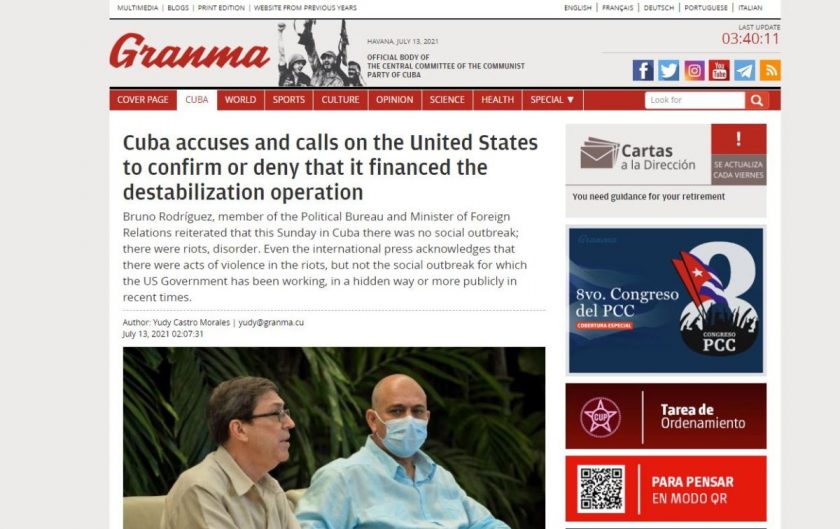
The July 13th Edition of Granma, Official Organ of the CC of the CP of Cuba
The problem then is when people really believe this state propaganda, or when people are forced to openly proclaim a public truth they know personally to be a lie. Because instead of the public understanding that Cuba has lost much of its sovereignty in its process of dollarizing so much of its economy, (and that the machinations of foreign actors, the IMF, the planned and staged collapse of the global speculative economy that Cuba is integrated in, is a large part of Cuba’s present woes) blame is laid by the public directly at the feet of a nominally sovereign state’s ruling government.
Quite the predicament. Because the government cannot really tell the truth, it must take the blame. Or do as it has done (and done so with no shame for provoking incredulity), and claim that the entire protest is a foreign provocation.
The Cuban government and its sinecure functionaries must always declare that any grassroots grievances expressed en masse are always at its core the work of foreign ‘imperialist’ intelligence operations bent on a destabilization strategy.
Yet such accusations of foreign plots are more likely to be true than not.
Another problem, and this is something where the Cuban government needs to make a fix, is the issue of dollar accounts.
Those with dollar accounts are tremendously less affected by the perishable goods inflation crisis in Cuba. But those deposits are only possible by having loved ones who have left Cuba for the US. So those who have ‘betrayed’ the revolution are the ones able to help those in Cuba. Those in Cuba living better off are not those who have been loyal to the socialism project of Cuba excepting a small layer of bureaucrats and professional snitches, but instead are the relatives of those gusanos in Florida and the rest of the US who have moved on to greener pastures.
What sort of message does that send? This greatly weakens the legitimacy of the government, because those common-folk who defend the Cuban system are left feeling like fools. When this layer joins a protest movement, the government’s days are numbered.
Cuba – Between a Rock and a Hard-Spot
Color Revolution schemes cannot work unless there are real-existing grievances shared among large segments of the population.
And yet going further, those real-existing grievances today, (while they compound longer standing ones which the Cuban government must account for), are directly caused by the IMF’s decision to bring global capitalism to a grinding halt for some period of time.
It is very difficult for a nominally sovereign government to tell a Thatcherite story of ‘TINA’ – there is no alternative. Cuba lacks alternatives except going either the path of the Khmer Rouge, or the path of laissez-faire. It has chosen some middle-path.
This really touches on a very big problem Cuba faces: its civilizational decision to place its legitimacy at the hands of international organizations related to global governance. Cuba strives to show its own citizens, and perhaps secondarily the US, that the rest of the world and especially the UN’s alphabet soup of agencies and organizations, recognize any number of successes that Cuba promotes having accomplished. To wit, at least within the rubric of those accounting systems, Cuba makes a decent case.
So a problem arises when this very same system of global governance, under the pretext of fighting Covid-19, instructs various countries to commit ritual seppuku at the altar of world health in order to preserve this status and these relationships to global trade and global governance.
And how? The western hemisphere is controlled almost entirely by the IMF and global banking systems. Cuba exists in some netherworld of ‘helpful harm’, if not through the US due to sanctions, then through the same banks in their Trans-Atlantic incarnations by way of Europe.
Since we understand that the WHO is effectively controlled by allies of the World Economic Forum like Bill Gates, which in turn is the think-tank of the IMF; and since the IMF includes in its bylaws and requirements that countries in a time of a declared global pandemic by the WHO must take the proscribed measures to combat this, then we understand what we have seen as a global phenomenon.
It’s been only a handful of leaders, several in Africa, in Haiti, and Belarus, that have openly bucked these provisions. And of these, all have been since eliminated except for Lukashenko in Belarus who no doubt enjoys some security provisions from the Russian Federation.
The Observatory of Economic Complexity (OEC) explains that in 2019, “The top exports of Cuba are Rolled Tobacco ($287M), Raw Sugar ($211M), Nickel Mattes ($134M), Hard Liquor ($97.3M), and Zinc Ore ($78.4M), exporting mostly to China ($461M), Spain ($127M), Netherlands ($65.5M), Germany ($64.7M), and Cyprus ($48.9M).
The top imports of Cuba are Poultry Meat ($286M), Wheat ($181M), Soybean Meal ($167M), Corn ($146M), and Concentrated Milk ($136M), importing mostly from Spain ($1.01B), China ($790M), Italy ($327M), Canada ($285M), and Russia ($285M).”
Hence Cuba was placed in a pincer move. It lost massively from the global plandemic and the restriction of supply lines, the tightened access to imports, the loss of tourism. The compliance of other countries to the IMF’s mandated economic implosion reduced demand for Cuba’s exports and damaged tourism as well.
But in order to maintain its own relationship with the IMF and also following the global narrative of the Socialist International (2nd International), (an EU driven social-democratic association of governments and political parties), it went along with the ‘solidarity’ driven component of woke politics seen in the ‘do-your-part’ masking and lockdowns.
But those harmed by the lockdowns were ordinary Cubans, not government officials or those with dollar accounts. And so the reaction we see today is a predictable one.
Conclusion
There can be no doubt: Cuba’s present crisis is not the direct result of its own economic mismanagement, but rather the staged demolition of finance, global trade, and supply lines using the Covid pandemic as a pretext. However, a number of social and political decisions by Cuban leaders have no doubt compounded the impact of the crisis and emboldened protesters.
What citizens in first world countries have seen as a ‘stock market rebound’ predicated by ‘too-big-too-fail’ type bailouts (socialism for the rich), are only possible so long as those moneys are held on the books but not really spent – hence the lockdowns. At least not spent in such a way as would this liquidity naturally circulate in the economy. For such velocity of moneys based on such extreme debasement of the currency, would lead to the largest inflationary crisis in the history of man on earth.
In raw-materials producing countries like Cuba, that has meant a tripled hardship. The aim of the centers of finance capital has been to do something like the Arab Spring, only more so.
At the same time, the Cuban government’s defensive and accusatory posture is poor optics and bad politics. It needs to better engage the protestors and validate some part of their grievances. Pointing the finger at Uncle Sam is tone deaf and only serves to satisfy a single demographic in Cuba.
Today, we are seeing only the start of a fresh wave of global destabilization efforts, never-ending wars. But now governments have prepared the civilian populations for these wars under the pretext of never-ending lockdowns due to a mystery illness. The right to protest, strikes, and the basic social contact needed to organize these can be revoked by instantaneous mandate as some new variant of Covid will always invariably be discovered. This is the biggest threat humanity faces since the Second World War, but in addition to destabilization campaigns, is the backdrop of a class-war gambit of the oligarchy against everyday people. Cuba needs to be understood in this light, and while it needs a better approach to managing the Covid narrative and hearing its people, foreign meddling in its affairs needs to be opposed.
Western media use images of PRO-government rally, protest in Miami to illustrate Cuban unrest as Havana warns of ‘soft coup’
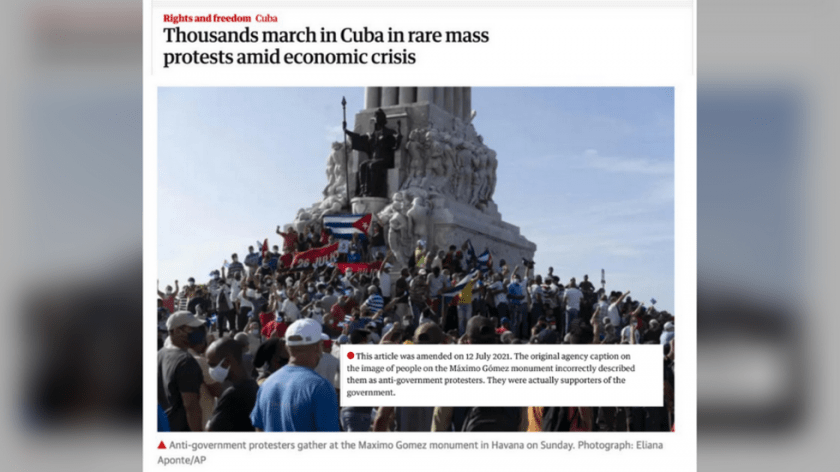
The Guardian and a number of other Western news agencies used erroneously captioned photos of a pro-government protest in Havana, Cuba, presenting it as an opposition rally instead.
© TheGuardian.com / screenshot
RT | July 14, 2021
Several Western news outlets have used an erroneously captioned photo showing a pro-government rally in Cuba, deeming it an opposition protest, while CNN opted for an image of a Miami demonstration instead, raising eyebrows.
Captured by Associated Press photographer Eliana Aponte during a demonstration in support of the government in the Cuban capital on Sunday, the photo has made the rounds in the Western corporate press as unrest grips the Caribbean nation. However, multiple outlets have incorrectly described the image as an “anti-government protest,” including the Guardian, Fox News, the Financial Times, the New York Times, the Washington Times and Voice of America. The latter outlet, the US-government funded VOA, committed the error on two separate occasions.
GrayZone journalist Ben Norton and Alan MacLeod of MintPress News were among the first to note the error, sharing screenshots of several examples. MacLeod suggested the outlets may have simply “copied and pasted” the AP’s original photo caption, replicating the error across multiple agencies.
Both journalists pointed out the red-and-black flags hoisted by demonstrators in the photo, which read “26 Julio,” a reference to Fidel Castro’s 26th of July movement. The organization played a major role in the Cuban Revolution and later formed into a political party, with the two-colored flag becoming a common symbol of support for Cuba’s communist government.
Of the six news outlets cited above, only the Guardian had issued a correction at the time of writing, stating that it amended its story because the “original agency caption on the image… incorrectly described them as anti-government protesters. They were actually supporters of the government.”
The AP image is not the only photo to be misrepresented in Western media coverage. On its Instagram page, CNN also strongly implied that another photo showed Cuban protesters, with its caption reading, in part, “Thousands of Cubans protested a lack of food and medicine.” The image in question was taken by an AFP photographer, and a search through the agency’s photo gallery shows the rally was actually held in Miami, Florida. CNN appears to have omitted the first portion of the AFP caption, which made clear the protest was based in the US.
The photo mix-ups in corporate media have been compounded by a wave of false and misleading posts by observers online, with many users sharing photos of gatherings in Egypt, Spain and Argentina while claiming they depict unrest in Cuba – some racking up thousands of shares.
The anti-state protests kicked off in earnest on Sunday, seeing large crowds of demonstrators take to the streets in Havana and elsewhere to demand urgent action on food, medicine and power shortages. The government, however, claims the rallies are fueled by hostile foreign powers, namely Washington, and involve only a small number of ‘counter-revolutionaries’. President Miguel Diaz-Canal said US sanctions were to blame, arguing that Washington’s “policy of economic suffocation” aimed to “provoke social unrest” in Cuba.
Diaz-Canal also alleged that a “campaign against the Cuban revolution” had kicked off on social media platforms, saying they are “drawing on the problems and shortages we are living.” According to internet monitoring firm NetBlocks, Cuba’s state-run web provider ETECSA has moved to restrict access to certain sites and apps since the bout of unrest erupted on Sunday.
The head of the Cuban Communist Party’s ideological department, Rogelio Polanco Fuentes, also claimed that the country is experiencing an attempt at a “color revolution” or a “soft coup,” drawing a comparison to a failed US-backed uprising in Venezuela back in 2019.
Washington, for its part, has offered rhetorical backing to the protesters, with State Department spokesman Ned Price telling reporters on Tuesday that the government is looking at ways to “support the Cuban people,” though he did not elaborate.
Havana has so far offered few details on the number of arrests made or injuries sustained during the protests, though the Cuban Interior Ministry confirmed that the first death occurred during an anti-government action on Monday. Opposition groups, meanwhile, have alleged that a spate of arrests has targeted protesters, journalists and other activists.
Mexican President Says Protests in Cuba Manipulated From Outside
Sputnik – July 12, 2021
Mexican President Andres Manuel Lopez Obrador said on Monday that US-funded organizations were behind the recent protests in Cuba.
On Sunday, Cuba witnessed its largest protests since 1994, fueled by anger over shortages of basic goods. Thousands of people demanded free elections and the resolution of social issues. According to local media, protests and gatherings took place in eight Cuban cities, including Havana. In response, government and Communist Party supporters held their own marches following President Miguel Diaz-Canel’s calls to take to the streets and repel provocations.
“I see that there is meddling. For example, yesterday I saw a social media post from a group called Article 19, which is an association of journalists in Mexico funded by the US government, the US embassy … They condemned President Diaz-Canel’s call for confrontation …,” Lopez Obrador told reporters.
The Mexican president expressed solidarity with the people of Cuba and said the only way out of this crisis was through dialogue, without the use of force, confrontation and violence.
“Mexico has always been in solidarity with Cuba and with all the peoples of the world, if the Cuban government deems it necessary and its people demand it, the Mexican government could help with medicines, vaccines, supplies and food, without the interventionist political manipulation … because health and food are fundamental human rights,” Lopez Obrador added.
The president further noted that the US economic embargo of Cuba should be brought to an end.
“If you want to help Cuba, the first thing that would have to be done is to lift the blockade of Cuba, as required by most of the countries of the world. It would be a true humanitarian gesture, no country in the world can be fenced off, blocked. This is worse than the violation of human rights,” Lopez Obrador stressed.
Bolivian President Luis Arce echoed his Mexican counterpart’s sentiment, saying that Cuba’s domestic affairs must be handled internally.
US restrictions on trade with Cuba date back to the island nation’s communist revolution in the late 1950s and involve at least half a dozen different US laws. Former President Barack Obama took steps to normalize bilateral relations, but many of those steps were reversed by the Trump administration.
Current President Joe Biden has promised that he would return Obama’s policy on Cuba but has yet to reverse his predecessor’s steps.
On June 23, the United States voted against a UN General Assembly resolution condemning the embargo on Cuba, which was adopted by the overwhelming majority of 184 other nations.
Featured Video
No Threat Can Force Iran’s Surrender /Trita Parsi & Lt Cl Daniel Davis
or go to
Aletho News Archives – Video-Images
From the Archives
What is the Israeli Lobby in Australia Doing in Interfaith Dialogue?
By Ali Kazak | Dissident Voice | October 11, 2015
For years Israel and its lobby around the world have been trying to normalise their relations with Arabs and Muslims without solving the Palestine Question.
One of the methods they resorted to in the last few years is using human rights and community organizations such as interfaith dialogue and Multiculturalism to achieve this objective and to: isolate the Palestinians, marginalise the Palestine question, end Israel’s isolation, and prevent criticism of Israel, knowing that these organisations will be the first to stand against Israel’s violations, racial and religious discrimination.
The group responsible for this task in Australia is The Australia/Israel & Jewish Affairs Council (AIJAC); its Director of International & Community Affairs, Jeremy Jones is in charge of lobbying religious community organizations, specifically Muslims and Christians. Consequently he convened the Faith Communities for Reconciliation, founding participant in the Australian Partnership of Religious Organisations and the Australian National Dialogue of Christians, Muslims & Jews.
AIJAC is a private political propaganda group. It is recognised as the main Israeli lobby in Australia. It coordinates its activities and works intimately with the Israeli embassy in Canberra and different institutions in Israel. It is privately funded by some Jewish businessmen. It monitors closely Australian politicians, the media, ethnic and religious groups, (especially Arabs and Muslims), unions and academics on their stands towards Israel and the Palestine question. … continue
Blog Roll
 Aletho News
- ‘Economic terrorism’: Steel facilities hit again in US-Israeli strike
- ‘War Crime’: Iran condemns attacks on Arak, Ardakan nuclear sites
- Two-thirds of Americans want quick end to Iran war even if goals unmet
- Trump to Give “Important Update on Iran” Wednesday in Prime-Time Speech
- Theodore Postol: Iran’s Missiles & Drones Were Underestimated
- Iran To Target Military Industrial-Tech Complex That Facilitated Gaza Genocide
- Collapsing Empire: The Resistance Disarms ‘Israel’
- Suicide Should Not Be a Government Service
- Rethinking America’s greatest threat: Iran vs. Israel-Firsters
- Iran accuses adversaries of false flags to strain Turkey ties
- If Americans Knew
- Israel wants US to bomb more of Iran’s civilian structures (113,000 is not enough) – Not a ceasefire Day 173
- Ann Coulter Rips Into Fox News for Iran War Coverage
- Joe Kent Urges Americans To Call White House and Congress To Object To Sending Troops Into Iran
- DNC Resolution to Reject AIPAC Funding Puts Democratic Leaders in the Hot Seat
- Swedish foundation to build 400 schools as over 650,000 Gaza children remain without education for 2 years
- Israeli army admits photshopping image of slain Lebanese journalist
- This is how Israel is systematically killing health workers under the cover of war in Lebanon
- Carrying life under fire: Israeli invasion of Lebanon leaves pregnant women facing deadly risks
- Champagne all around for the new death penalty (for Palestinians) law – Not a ceasefire Day 172
- Why are Palestinian books struggling to be seen on Amazon?
- No Tricks Zone
- New Study Finds Warming Saves Lives…Cold Temperatures 12 Times More Deadly Than Excess Heat
- German Science Blog Accuses PIK Climate Institute Of Hallucinating Climate Tipping Points
- Devastating Assessment Of Comirnaty Vaccine By Former Senior Pfizer Europe Toxicologist
- New Study: CO2 Is ‘Effectively Negligible’ As An Explanatory Climate Change Factor Since 2000
- Former Pfizer Toxicologist Dr. Helmut Sterz Tells Bundestag Hearing Pfizer Vaccine Should Have Never Been Approved
- Energy Expert: Germany’s Nuclear Phaseout Was A “500 Billion Euro Mistake”
- New Research: South Australia’s Mid-Holocene Sea Surface Temperatures Were 4°C Warmer Than Today
- Storing Green Energy To Last Germany 10 Days Would Require A 60-Million Tonne Battery
- New Studies: UK Sea Levels Were 4 Meters Higher Than Today During The Mid-Holocene
- Destructive Green New Deal: German Energy And Metal Group Warns Of Drastic Crisis
 Aletho News