JFK docs show US had plans to murder Cuban refugees — then blame Castro to start a war
By Brad Reed | Raw Story | October 27, 2017
Some of the newly released documents related to President John F. Kennedy’s assassination reveal shocking details about plans developed by the United States government to depose the late Cuban dictator Fidel Castro.
As Miami New Times reports, a set of documents related to Operation Mongoose — which was the Central Intelligence Agency’s plot to remove Castro from power — show that the U.S. at one point considered staging terrorist attacks against Cuban refugees that were either headed to or were already residing within the country.
A paper approved by the Joint Chiefs of Staff in 1962 outlined a plan to create a pretext for invading Cuba and overthrowing the Castro regime that involved killing refugees and then pinning the blame on Castro’s government.
“We could develop a Communist Cuban terror campaign in the Miami area,” the report read. “The terror campaign could be pointed at Cuban refugees seeking haven within the United States. We could sink a boatload of Cubans en route to Florida (real or simulated).”
The report also suggested committing attacks on refugees already within the country, as well as “exploding a few plastic bombs in carefully chosen spots” to make it look as though the Cuban government was attacking people trying to flee to Florida.
The report also said the staged attacks could coincide with “the release of prepared documents substantiating Cuban involvement” to help turn the tide of global opinion against the tiny communist nation.
Miami New Times notes that these plans were never carried out, although that doesn’t make their inclusion in a report signed off by the Joint Chiefs of Staff any less of a shock.
October 27, 2017 Posted by aletho | Deception, False Flag Terrorism, Timeless or most popular, Wars for Israel | CIA, Cuba, Operation Mongoose, United States | Leave a comment
‘Can’t Last Over Two Months’: JFK Files Reveal CIA Efforts to Kill Castro
Sputnik – October 27, 2017
The latest dump of newly-declassified documents relating to the assassination of John F. Kennedy has sent researchers and journalists into a frenzy – but among the more interesting releases are files relating to the US Central Intelligence Agency’s long-running campaign to assassinate Fidel Castro.
The Central Intelligence Agency’s (CIA) ultimately unsuccessful campaign to assassinate Cuban leader Fidel Castro is well known.
Over the course of his 49-year-long reign (1959-2008), Fabian Escalante, retired chief of Cuban counterintelligence, estimates the agency targeted him on no fewer than 638 separate occasions: 38 times under President Dwight Eisenhower, 42 under John F. Kennedy, 72 under Lyndon B. Johnson, 184 under Richard Nixon, 64 under Jimmy Carter, 197 under Ronald Reagan, 16 under George H. W. Bush and 21 under Bill Clinton.
However, the newly-released trove of previously classified documents relating to the assassination of John F. Kennedy have shed new light on some notorious schemes — and indicate Escalante’s estimate may have been incorrect.
Suits and Seashells
One document summarizes the CIA’s infamous plan to use James B. Donovan — the US lawyer and negotiator recently immortalized by the movie “Bridge of Spies” — to give Castro a contaminated diving suit as a gift, while the two negotiated the release of Bay of Pigs prisoners.
“It is known Castro likes to skindive. The plan is to dust the inside of the suit with a fungus producing madera foot, a disabling and chronic skin disease, and also contaminating the suit with tuberculosis bacilli in the breathing apparatus,” the paper said.
Donovan didn’t go through it, giving El Caballo an uncontaminated suit as a genuine gesture of friendship instead.
Another notorious plot documented in the files involved a “booby-trap seashell” that would be submerged in an area Castro liked to dive in — the eye-catching shell was to be loaded with explosives, and detonate once lifted. However, after investigation, it was determined “there was no shell in the Caribbean area large enough to hold a sufficient amount of explosive, which would be spectacular enough to attract the attention of Castro.”
Another scheme involved a CIA agent in Cuba who was in the process recruiting a high-ranking Cuban government official in 1963.The pair coincidentally met in Europe on the day of JFK’s assassination, and the agent offered the would-be recruit a ballpoint pen equipped with a hypodermic needle — when the pen’s lever was pushed, “[a] needle came out and poison could be injected into someone.”
The offer was turned down, because it would have required the killer to get too close to Castro, removing all chances of escape.
My Two Cents
One 1975 document describes an early-1960s CIA scheme, “Operation BOUNTY,” that established a system of financial rewards for Cubans who “[killed or delivered] alive known Communists.”
The CIA let Cubans know of the plan by dropping leaflets in the air, which stipulated the rules around Castroite bounty hunting — rewards would be paid upon presentation of a leaflet, along with “conclusive” proof of death, and the victim’s Communist party membership card.
Cubans would receive an amount commensurate with the ranking of the Communist they’d slain — up to US$100,000 for government officials and US$57,500 for “department heads.” However, Castro’s capture or execution, for reasons unclear, would only earn the perpetrator a measly two cents.
Evidently though, perhaps due to the Castro’s continued existence, it was decided in 1964 (according to an FBI memo) to offer Sicilian-American gangster Sam Giancana US$150,000 to hire “some gunman to go into Cuba” and kill the leader.
However, it was later felt the price was too high, with sums being reduced to US$100,000 for Fidel, and US$20,000 apiece for the metaphorical heads of Raul Castro and Che Guevara.
Ultimately though, then-Attorney General Robert F. Kennedy shut down the plan.
He was outraged at the deal, as he was attempting to prosecute Giancana, and demanded the CIA “never undertake the use of mafia people again” without first checking with the Department of Justice, because “it would be difficult to prosecute such people in the future.”
Intelligence Failures
It’s not merely in the field of assassination the CIA failed.
Some of the files, dating to the early days of the revolution in 1959, suggest Castro’s government is not long for the world.
One document from June that year predicts an impending uprising against El Commandante.
“Conditions are getting so bad in Cuba a counterrevolution will occur from within Cuba… powerful interests, such as bankers, sugar institute, et cetera, are extremely dissatisfied,” the memo reads.
Another document from September, this time authored by the FBI, suggests Cuban exiles in the US are so determined to get rid of Castro he “cannot last more than two months.”
October 27, 2017 Posted by aletho | Timeless or most popular, War Crimes | Central Intelligence Agency, Cuba, Latin America, Operation BOUNTY, United States | Leave a comment
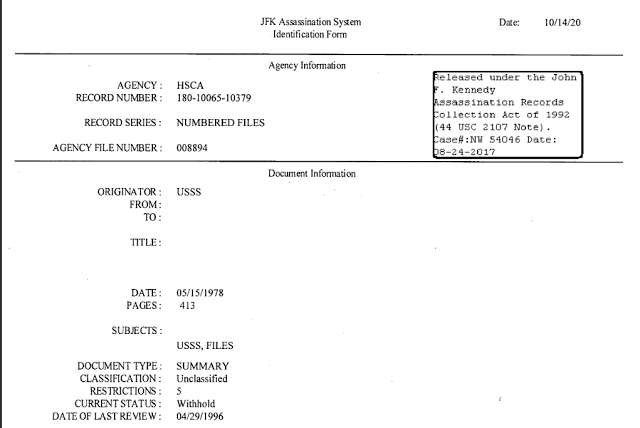
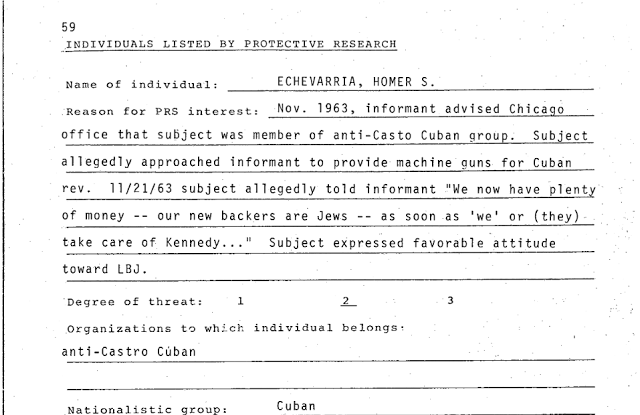
US planned to ‘harass & attack’ Soviet personnel in Cuba – JFK files
RT | October 27, 2017
National Security Council meeting notes on the covert CIA program ‘Operation Mongoose’ have revealed the lengths to which the US was willing to go to remove Fidel Castro’s Cuban government.
The 1962 file, released Thursday as part of a cache of previously classified documents on the assassination of John F Kennedy, states that the NSC considered a plan of “attacking and harassing Soviet personnel within Cuba.” However, the document doesn’t provide any finer details on the proposal.
Members of the council also debated targeting the island nation’s crops by “introducing biological agents which would appear to be of natural origins” – an idea supported by then-National Security Advisor McGeorge Bundy.
“Mr. Bundy said that he had no worries about any such sabotage which could clearly be made to appear as the result of local Cuban disaffection or of a natural disaster, but that we must avoid external activities such as release of chemicals, etc., unless they could be completely covered up,” the document reads.
Other suggested measures included distributing explosives to Cuban insurgents, using balloons to drop leaflets over the country, employing submarines to broadcast anti-government radio messages and “counterfeiting” operations.
The NSC also explored the possibility of infiltrating Cuban radio and TV channels but acting on advice from council member and former American broadcast journalist, Edward R Murrow, decided against the move.
“Mr Murrow explained the far-reaching reactions that the Cubans could mount against US radio stations, and said that he felt on balance it would not be profitable to provoke this kind of electronic warfare,” the minutes read.
Conspiracy theories have abounded since Kennedy was shot while traveling in an open-top limousine in Dallas in November 1963.
The report from the Warren Commission in September 1962 said that Lee Harvey Oswald had fired the shots from the Texas School Book Depository building. Oswald was later killed while in the custody of Dallas police by Jack Ruby, a local nightclub owner.
The US government released 2,800 classified files on the assassination of JFK Thursday night, with President Donald Trump saying that the public deserves to be “fully informed about all aspects of this pivotal event.”
After intense lobbying from the CIA, FBI and State Department, some documents remain unreleased. The files will now undergo a further six-month review. A new deadline has been set for their release in April 2018.
October 27, 2017 Posted by aletho | Deception, Timeless or most popular, War Crimes | Cuba, United States | Leave a comment
Cuban missile crisis yields more secrets
By M K Bhadrakumar | Indian Punchline | October 17, 2017
History lends itself to re-interpretation when more facts become available or when ulterior motives creep in. There is a surfeit of the latter happening in India currently. Nothing is spared, even symbolically, in India’s history today – starting from Nehru’s legacy to Taj Mahal to Vinayak Damodar Savarkar. However, such revisionist history (‘historical negationism’) is interchangeable with fiction or folklore and on the whole it fails to stick. Historical reappraisals are an entirely different thing.
Based on new archival materials becoming available every now and then, a slice of Cold War era history that is still dissected and understood from new perspectives is the so-called Cuban Missile Crisis of 1962. The narrative that was dominant initially was that the Soviets surreptitiously tried to deploy inter-continental ballistic missiles (ICBM) to Cuba targeting the US and the attempt was nipped in the bud with the Kennedy administration staring down the then Kremlin boss Nikita Khrushchev through a display of naval blockade of the island.
As time passed, the informed sections of opinion came to know that it was a settlement negotiated through nerve-wracking back channel negotiations directly between the Oval Office and the Kremlin – even Fidel Castro was kept in the dark – that brought the crisis to an end, with the Soviets and the Americas rolling back their missile respective deployments to each other’s backyard – Cuba and Turkey. The Soviets, true to character, eschewed triumphalism so long as the strategic objective was realised, leaving the Americans free to claim ‘victory’.
However, what still remains less understood is that the crisis in 1962 was not just about the Soviet missile deployment. There was also alongside a full-bodied American agenda of ‘regime change’ in Cuba. Incredibly enough, the Pentagon had drawn up a detailed report on the overthrow of Fidel’s government by a military government headed by a US commander and military governor – something like the American occupation of Japan led by General Douglas MacArthur in September 1945. Proclamation No 1 that was to have been issued, which vested “all powers of government, executive, legislative, and judicial and all jurisdiction in the occupied territory and over its inhabitants” in the hands of the US military governor. The Proclamation stated:
- All persons in the occupied territory (Cuba) will obey immediately and without question all enactments and orders of the military government. Resistance of the United States Armed Forces will be forcefully stamped out. Serious offenders will be dealt with severely. So long as you remain peaceable and comply with my orders, you will be subjected to no greater interference than may be required by military exigencies.
Also, leaflets were to be airdropped in their thousands all over Cuba advising that “U.S. armed forces will take temporary charge of your country.” They were to warn Cuban citizens to “remain at home” because “everything that moves is a target.”
Meanwhile, the Soviets too were factoring in a possible American invasion of Cuba, the fledgling socialist state in the Western Hemisphere, and therefore had deployed tactical battlefield nuclear weapons to Cuba. With all the formidable intelligence gathering capacity at the disposal of the United States, the Americans had no inkling that if they invaded Cuba, they would have had a nasty surprise. In sum, the crisis had every potential to escalate into an apocalyptic event. (I am reminded of the recent bullish claim by our air chief that he knows precisely where and how to destroy Pakistan’s nuclear assets in one sweeping Indian air strike.)
The above are facts culled out from documents that have been declassified in the US this week under the Freedom of Information Act (here). To my mind, the most fascinating document is the (redacted) post-mortem report on the entire episode of the Cuban Missile Crisis authored by the famous CIA spook Richard “Dick” Lehman who worked with 7 American presidents from John F. Kennedy to George H.W. Bush and was credited with creating the president’s daily intelligence briefing and regarded as one of 50 trailblazers who created the CIA. (For connoisseurs of Cold War history, Lehman’s recount of his 33 years in the world of intelligence archived in the CIA’s Library, here, makes fascinating reading.)
Much of what Lehman wrote will not come as stunning disclosure, but it is useful to know how carefully, meticulously, factually (backed with empirical evidence) an adversary’s strategic challenge needs to be studied and assimilated before the intelligence is taken to the desk of the political boss and gets morphed into decision-making. (I wonder how we fared in the run up to the recent Doklam standoff with China.) Read Lehman’s Top Secret report to the CIA Director, here.
October 17, 2017 Posted by aletho | Militarism, Timeless or most popular | Cold War, Cuba, Doklam, John Kennedy, Latin America, Nikita Khrushchev | Leave a comment
Cuba Has Treated Over 26,000 Chernobyl Nuclear Disaster Victims
teleSUR | August 1, 2017
Since 1990, Cuban medics have treated over 26,000 victims of the 1986 nuclear disaster in Chernobyl, Ukraine, scientific network Scielo reported in a recent study.
The areas of treatment, according to Scielo, were primarily focused on dermatology, endocrinology and gastroenterology.
The report detailed that 84 percent of the total number of patients treated were children from Ukraine, Russia and Belarus. The highest number of people were treated in 1991, when Cuban medics attended to 1,415 patients.
Over 1,000 children received medical treatment annually from 1990 to 1995.
With its main treatment area located on Tarara beach, east of Havana, the main objective of the program was to provide comfortable lodging facilities and an overall healthy environment, where patients could be treated and partake in a rehabilitation plan.
Apart from medical facilities, the locale included schools, a cooking center, a theater, parks and recreation areas.
After 21 years of solidarity treatment, all free of charge, the medical program came to an end in 2011.
In the early hours of April 26, 1986, a botched test at the nuclear plant in then-Soviet Ukraine triggered a meltdown that spewed deadly clouds of atomic material into the atmosphere, forcing the evacuation of tens of thousands of people.
More than 600,000 Soviet civilian and military personnel were drafted from across the country as liquidators to clean-up and contain the nuclear fallout.
Over 30 plant workers and firemen died in the immediate aftermath of the accident, most from acute radiation sickness.
Over the past three decades, thousands more have succumbed to radiation-related illnesses such as cancer, although the total death toll and long-term health effects remain a subject of intense debate.
August 1, 2017 Posted by aletho | Nuclear Power, Timeless or most popular | Cuba | Leave a comment
Trump Turns Back the Clock With Cold War Cuba U-Turn
By Ron Paul | June 19, 2017
Nostalgia seems to be very popular in Washington. While the neocons and Democratic Party hard-liners have succeeded in bringing back the Cold War with Russia, it looks like President Trump is determined to take us back to a replay of the Bay of Pigs!
In Miami on Friday, the president announced that he was slamming the door on one of President Obama’s few foreign policy successes: easing 50 years of US sanctions on Cuba. The nostalgia was so strong at Trump’s Friday speech that he even announced participants in the CIA’s disastrous 1961 Bay of Pigs invasion of Cuba in the audience!
President Trump said Friday that his new policy would be nothing short of “regime change” for Cuba. No easing of US sanctions on Cuba, he said, “until all political prisoners are freed, freedoms of assembly and expression are respected, all political parties are legalized, and free and internationally supervised elections are scheduled.”
Yes, this is the same Donald Trump who declared as president-elect in December that his incoming Administration would “pursue a new foreign policy that finally learns from the mistakes of the past. We will stop looking to topple regimes and overthrow governments.” Now, in another flip-flop toward the neocons, President Trump is pursuing regime change in Cuba on the pretext of human rights violations.
While the Cuban government may not have a spotless record when it comes to human rights, this is the same President Trump who just weeks ago heaped praise on perhaps the world’s worst human rights abuser, Saudi Arabia. There, he even participated in a bizarre ceremony to open a global anti-extremism center in the home of state-sponsored extremism!
While President Trump is not overturning all of President Obama’s Cuba policy reforms – the US Embassy will remain open – he will roll back the liberalization of travel restrictions and make it very difficult for American firms to do business in Cuba. Certainly foreign competitors of US construction and travel companies are thrilled by this new policy, as it keeps American businesses out of the market. How many Americans will be put out of work by this foolish political stunt?
There is a very big irony here. President Trump says that Cuba’s bad human rights record justifies a return to Cuba sanctions and travel prohibitions. But the US government preventing Americans from traveling and spending their own money wherever they wish is itself a violation of basic human rights. Historically it has been only the most totalitarian of regimes that prevent their citizens from traveling abroad. Think of East Germany, the Soviet Union, and North Korea. The US is not at war with Cuba. There is no reason to keep Americans from going where they please.
President Trump’s shift back to the bad old days on Cuba will not have the desired effect of liberalizing that country’s political environment. If it did not work for fifty years why does Trump think it will suddenly work today? If anything, a hardening of US policy on Cuba will prevent reforms and empower those who warned that the US could not be trusted as an honest partner. The neocons increasingly have President Trump’s ear, even though he was elected on promises to ignore their constant calls for war and conflict. How many more flip-flops before his supporters no longer recognize him?
June 19, 2017 Posted by aletho | Civil Liberties | Cuba, Donald Trump, Human rights, United States | Leave a comment
US-led coalition air raids breach Syria sovereignty: Cuba
Press TV – January 18, 2017
Cuba has denounced US-led coalition airstrikes in Syria, saying they violate the Arab country’s sovereignty as they are not permitted by Damascus.
Cuban Ambassador to the United Nations Humberto Rivero made the criticism during a UN Security Council meeting in New York on Wednesday.
“We demand the cessation of the violations of Syrian sovereignty and the foreign military presence without the consent and the coordination of operations with the Syrian government, the only legitimately elected authority in the country,” Rivero said.
He further condemned the “politicization” of the crisis in Syria and “the tampering of the humanitarian crisis and the suffering” of people in the Middle Eastern country.
Those who are “supplying weapons, money and patronage to terrorist groups are responsible for the thousands of civilian victims of the conflict and the humanitarian situation,” the Cuban diplomat said, expressing his opposition to “the promotion of an interventionist agenda” in Syria.
The US-led coalition has been conducting air raids against what are said to be Daesh terrorists inside Syria since September 2014 without any authorization from the Damascus government or a UN mandate. Analysts have assessed the strikes as unsuccessful as they have led to civilian deaths and failed to counter terrorism.
The US Air Force is also carrying out airdrops of weapons, ammunition and other equipment to militants fighting against the pro-government forces in Syria.
UN chief optimist on ‘conflict freeze’
Separately on Wednesday, United Nations Secretary General Antonio Guterres warned that the consequences of the Syria crisis had become “too dangerous.”
Speaking in a briefing at the UN office in the Swiss city of Geneva, Guterres stressed that the conflict had fueled instability in the Middle East region and terrorist attacks across the globe.
Touching on the upcoming Syria peace talks in the Kazakh capital Astana, the UN chief further expressed hope that the discussions could “lead towards a consolidation of the ceasefire and a freeze in the conflict.”
The cessation of hostilities took effect on December 30, following an agreement between Syria’s warring parties.
Mediated by Russia and Turkey with the support of Iran, the truce is the first of its kind that has been largely holding in Syria for almost three weeks now. Earlier attempts by the US to broker such a long-lasting ceasefire had failed.
Elsewhere in his remarks, Guterres underlined that the success of the Syria talks could “help create the conditions for a political process” regarding the Syria crisis.
The Astana talks, which are scheduled to be held on January 23, were brokered by Moscow, Ankara and Tehran.
January 18, 2017 Posted by aletho | Illegal Occupation, Militarism, Progressive Hypocrite, War Crimes | Cuba, Obama, Syria, United Nations, United States | Leave a comment
Obama extends national emergency on Iran
Press TV – January 14, 2017
US President Barack Obama has declared the continuation of his country’s national emergency against Iran, claiming that despite full commitment to its nuclear deal with the six world powers, the Islamic Republic still poses “an unusual and extraordinary threat” to America.
The outgoing president informed Congress of his decision in a letter on Friday, saying that the national emergency, which was declared on March 15, 1995, “is to continue in effect beyond March 15, 2017.”
The National Emergencies Act requires the president to extend a national emergency within 90 days of its anniversary date, before it is automatically terminated.
Obama admitted in his letter that Iran had delivered on its commitments pursuant to the Joint Comprehensive Plan of Action (JCPOA), a landmark nuclear deal that was struck between Iran and the P5+1 group of countries — the US, the UK, France, China, Russia, and Germany — on July 14, 2015.
Under the landmark deal, which entered into force on January 16 last year, Iran undertook to put restrictions on its nuclear program in exchange for the removal of nuclear-related sanctions imposed against the country.
“Since Implementation Day, the IAEA (International Atomic Energy Agency) has repeatedly verified, and the Secretary of State [John Kerry] has confirmed, that Iran continues to meet its nuclear commitments pursuant to the JCPOA,” Obama said in his notice.
“However, irrespective of the JCPOA, which continues to ensure that Iran’s nuclear program is and remains exclusively peaceful, certain actions and policies of the Government of Iran continue to pose an unusual and extraordinary threat to the national security, foreign policy, and economy of the United States,” the outgoing president added.
In November, Obama extended a separate national emergency against Iran, which was originally declared by former US President Jimmy Carter on November 14, 1979.
He also extended the state of emergency with respect to Libya, Ukraine, Zimbabwe, Cuba and Venezuela.
A state of emergency gives the US president special powers, including the ability to seize property, summon the National Guard and hire and fire military officers at will.
The state of emergency also forms the basis for most US sanctions against other countries.
January 14, 2017 Posted by aletho | Progressive Hypocrite | Cuba, Iran, Libya, Obama, Sanctions against Iran, Ukraine, United States, Venezuela, Zimbabwe | Leave a comment
The New York Times’s Biased Obituary of Fidel Castro
By Matt Peppe | Just The Facts | November 27, 2016
After Fidel Castro passed away Friday night at 90 years old, the obituaries written about him in the American press typified the U.S. government propaganda used for decades to demonize Castro and obscure the tremendous social and humanitarian advances that the Cuban Revolution was able to achieve in the face of unrelenting interference, subversion and destabilization. None were more over-the-top in their bias than the obituary in the New York Times.
A mere 54 words, the lede paragraph contains an astonishing amount of misinformation and innuendo:
“Fidel Castro, the fiery apostle of revolution who brought the Cold War to the Western Hemisphere in 1959”
It’s hard to imagine any Western leader being called a “fiery apostle.” The phrase suggests Castro was driven by an irrational, religious mission to undertake revolution, rather than having resorted to armed resistance as a last resort after the possibility of nonviolent opposition through political means was eliminated. In 1952, as Castro was favored to win a seat in the House of Representatives, Fulgencio Batista promptly cancelled the upcoming elections as it became clear he would not be able to hold power in a free and fair vote. Only after this did Castro and others start to organize a guerilla resistance in order to prevent rule by a military dictatorship. Calling him a “fiery apostle of revolution” is reductionist and Manichean.
The second part of the sentence is easily disprovable. The Cold War was well underway and active in the Western Hemisphere long before the Revolution came to power in 1959. Five years earlier, the CIA, at the behest of the United Fruit Company and working in conjunction with Congress and the White House, supported the overthrow of Guatemala’s democratically elected progressive President Jacobo Arbenz by the Guatemalan military. The reason was summed up by Senator George Smathers of Florida, who was quoted in an article in the CIA’s professional journal, Studies in Intelligence, saying: “In all candor, we must admit that the democratic nations of the Western Hemisphere could not permit the continued existence of a Communist base in Latin America, so close to home.”
Aside from misrepresenting the Cold War timeline, the idea that it was Castro who was responsible for Cold War tensions with the United States is laughable. Castro immediately reached out to the U.S. government after taking power in 1959, and even visited the country four months later. Upon arriving he was stood up by President Dwight D. Eisenhower, who decided to play golf instead meeting with Castro. The next year, Eisenhower would cancel the sugar quota Cuba depended on for export revenue, provoking Cuba to exercise its sovereign right to nationalize U.S. properties. In return, the U.S. government prohibited delivery of oil to the island, which led to Cuba seeking oil from the Soviet Union.
“and then defied the United States for nearly half a century as Cuba’s maximum leader”
It is strange that Castro’s commitment not to compromise on the sovereignty of Cuba and its people would be seen as remarkable enough to draw attention to it so prominently. Imagine a Russian obituary to Ronald Reagan stating that he defied the Soviet Union. Such a statement presumes that the natural state of affairs would be subservience to the dictates of a foreign power. Americans would find this notion absurd.
“bedeviling 11 American presidents”
This is one way of stating that Castro survived more than 600 assassination attempts authorized by multiple U.S. executives and resisted their criminal economic war that sought “to bring about hunger, desperation” and “hardship” and to this day continues to deny food and medicine to children.
“and briefly pushing the world to the brink of nuclear war”
A year and a half prior to the Cuban Missile Crisis, the CIA directed a mercenary invasion of Cuba that failed spectacularly after it was quickly repelled. Understanding that another invasion was imminent, Castro sought nuclear missiles from the Soviet Union because he believed it would possibly be the only deterrent to another U.S. attack. Meanwhile, the United States had nuclear missiles positioned across Eastern Europe at the Soviet Union. When Kennedy protested to the Soviets, Khrushchev offered to withdraw the missiles before they reached Cuba if the U.S. would likewise withdraw its nuclear missiles from Turkey and promise not to invade Cuba. Kennedy said this would “look like a very fair trade” to any “rational man.” Yet, he was still not satisfied and instead of accepting it decided to engage in a game of chicken that could easily have resulted in a nuclear holocaust. To pin responsibility on Fidel Castro for the escalation of this situation is a gross distortion.
“died on Friday. He was 90.”
This I don’t take issue with.
The rest of the obituary is riddled with other inaccuracies and rhetorical flourishes that all predictably echo decades worth of U.S. government propaganda.
The Times claims Castro “ceded much of his power to his younger brother Raúl.” In reality, Fidel resigned his position as the President of State in 2006. He did not personally hand power to his brother in a dictatorial display of nepotism. Raúl was at the time Vice President, having been elected in the process stipulated by the Cuban Constitution. Likewise under the Constitution, as Vice President he assumed the role of the Presidency upon the resignation of the current President. No different than how succession would work in the United States.
The piece goes on to make unfounded claims of Castro’s self-aggrandizement (“he believed himself to be the messiah of his fatherland”) and launch evidence-free smears about his abuse of power (“he wielded power like a tyrant, controlling every aspect of the island’s existence”).
No one in recent history has been the subject of such vitriolic and politically biased propaganda emanating from the U.S. government as Fidel Castro. It is unsurprising that the self-declared paper of record in the U.S. would replicate the same disingenuous rhetoric rather than attempt to objectively assess the life of undoubtedly the most important individual of the 20th century based on documented facts placed in historical context.
November 29, 2016 Posted by aletho | Deception, Fake News, Mainstream Media, Warmongering, Timeless or most popular | Cuba, Latin America, New York Times, United States | Leave a comment
Myriad ways CIA tried and failed to assassinate Fidel Castro
RT | November 26, 2016
The father of the Cuban Revolution remains unbeaten by his foes even in death. We look over the most dramatic assassination plots on El Comandante – from character-assassinations by way of LSD, to Italian mobsters, tuberculosis wetsuit, and exploding cigar.
“If surviving assassination attempts were an Olympic event, I would win the gold medal,” Castro is famously quoted as saying. Cuba’s ex-intelligence chief Fabian Escalante – the person tasked with guarding Fidel’s life – puts the number of attempts at 638. The man also claimed to Reuters in a 2010 interview that the John F. Kennedy assassination could well have been an attempt to expedite the process of removing Castro from power: the American president, some said, was not doing enough. Of course, by the time of Kennedy’s 1963 shooting death in Dallas, Texas, there had already been numerous attempts on Castro’s life – intended to bolster Kennedy’s own reputation back home as a strong president, with his administration exerting great pressure on the CIA to take care of it. It is fitting then to start at the beginning.
1) Getting the Mafia to do it
When a sizable cache of classified CIA documents, amicably called ‘Family Jewels,’ was finally released in 2007, Cuban communists felt a sense of vindication, finally gaining the ability to publicly accuse the United States government of what they claimed was already common knowledge.
In the summer of 1960, the CIA recruited former FBI agent Robert Maheu. He became the go-between from the agency to two prominent Italian gangsters on the FBI’s Ten Most Wanted List – Santo Trafficante of the Miami Syndicate, and Salvatore Giancana – Al Capone’s successor in Chicago. They were gotten hold of by way of Las Vegas mobster Johnny Roselli. A payment of $150,000 was on the table. According to the declassified documents, Giancana suggested using poisoned pills – six of them. But despite gaining access to officials inside the Cuban government, the plan had been unsuccessful, and was later scrapped in the run-up to the failed Bay of Pigs invasion. It is said the agency was able to retrieve all the poison pills.
The closest the Americans got to killing Castro was with a poisoned chocolate milkshake, Escalante claimed to Reuters. According to the 2007 documents, another batch of poison was delivered through the Mafia in 1963 in a bottle of Bayer aspirin pills. An opposition group, it was believed, had a good chance. But the plot failed when a disguised waiter did not manage to lace Castro’s milkshake in the cafeteria of the then-Hilton Hotel (now Havana Libre), as the pill got stuck in the freezer – where it was hidden – and broke apart when the assassin attempted to dislodge it from the wall.
2) Contaminating an entire broadcast studio with LSD with the intention of eroding public trust
This was not just about spiking drinks or cigars. The CIA went all-out. After a failed attempt to embarrass El Comandante by having his beard fall out due to boots spiked with chemicals, the agency had opted for a box of cigars spiked with LSD. The plan was to have Castro burst into laughter during a televised interview, thus subjecting him to ridicule in the public eye. But it was not just cigars. The CIA planned to lace the entire studio. This plot was not implemented, but was high in the running for ways to spark a national uprising against Castro.
3) Tuberculosis-laced scuba gear that followed the exploding sea shell
The CIA had back-paddled on another of its ingenious plans to kill Castro, leading to the poisoned scuba gear idea. The agency knew the revolutionary was an avid diver. The plan had been to attract El Comandante with a sea shell practically impossible to miss, having been painted in colors bright enough to attract him. Castro would swim closer to inspect it, whereupon a lethal amount of explosives would detonate. But the idea was aborted due to impracticality, the declassified documents claimed. So the spies went the more practical way: lacing Castro’s scuba gear with tuberculosis to trigger a deadly skin disease. The man who was supposed to give Castro the suit had opted to give him an ordinary one, it turned out.
4) Evolution of the poison cigar – the exploding cigar
According to a Saturday Evening Post report on November 4, 1967, a CIA agent had approached a New York cop with the idea of handing Castro an exploding cigar during a UN meeting. That was reportedly after the plan to poison the cigar had been abandoned. This was despite the poison having already been injected into the cigar, with the CIA dismissing the person tasked with carrying the plan out in the final stages.
However, the exploding-cigar plan also failed due to the double agent changing his mind at the last instant.
5) Femme fatale
One of Castro’s many lovers – CIA informant Marita Lorenz, was also tasked with poisoning Castro in a daring operation involving a secret unit tasked with the assassination – Operation 40. According to the FBI, Lorenz had become a “contract agent” for the CIA, and willingly accepted the task of assassinating him following a miscarriage or an abortion – a story she told in 1959. Castro’s reaction to her not having the child had reportedly enraged her so much, she had eagerly taken up the task. And so she met with CIA double agent Frank Sturgis in 1960, who had handed her a bottle of poison pills.
Lorenz was to drop one into her lover’s drink, containing enough poison to kill him within 30 seconds. But as with the countless other attempts, it did not succeed because Lorenz herself could not go through with it. The mission was wrought with pitfalls. According to Ann Louise Bardoch’s ‘Cuba Confidential: Love and Vengeance in Miami and Havana,’ Lorenz recalled that “They said, ‘we want you to take him out.’” But, “I knew the minute I saw the outline of Havana I couldn’t do it.”
Even then, she had made the mistake of stashing the pills in her pot of cold cream, in fear of being discovered by customs. The substance had stuck to the pills, and Lorenz couldn’t unmix the two. As she attempted to flush the pills down the toilet, Castro –who had got wind of the plot – walked in with a cigar. He removed his handgun from the holster, and handed it to Lorenz with the words: “Did you come to kill me?” According to Lorenz, he handed her the gun and puffed on his cigar with his eyes closed.
“He made himself vulnerable because he knew I couldn’t do it. He still loved me and I still loved him.”
She feared the CIA would kill her for being with Castro after the foiled assassination attempt. Upon her return to Miami, Lorenz never again met with Castro. Later, however, she had a daughter with another Latin American military leader, Venezuela’s Marcos Perez Jimenez.
According to Escalante, it was the Cuban revolutionary’s vigilance and the efforts of his security apparatus that kept him alive all those years. Numerous books have been written on the matter.
November 26, 2016 Posted by aletho | Deception, Timeless or most popular, War Crimes | Central Intelligence Agency, CIA, Cuba, United States | Leave a comment
40 Years After CIA Terrorist Bombs Cuba Plane, Still No Justice

By Teresa Gutierrez – teleSUR – October 2016
Forty years ago, on October 6, 1976, Cubana Flight 455 on its way from Barbados to Jamaica was bombed shortly after takeoff, killing 73 people, including the national fencing team of Cuba.
In what was immediately seen as a terrorist act, most in the international community joined Cuba in denouncing the horrific act.
In 2011, declassified CIA documents showed that one of the key figures in this terrorist attack was Luis Posada Carriles, a right-wing Cuban who had fled the island after the Cuban Revolution of 1959.
The documents revealed that it was Posada Carriles, now 88, who had planned the 1976 bombing. He had already gained experience terrorizing the Cuban people as a participant in the failed CIA-orchestrated Bay of Pigs assault in 1961.
Peter Kornbluh, author of the book, “Back Channel to Cuba,” and a former researcher at the National Security Archive of George Washington University, said in 2011 that the declassified documents “again brings up the issue of how an international terrorist like Luis Posada Carriles can live happily ever after in Miami.”
This point demonstrates that the Oct. 6 anniversary should not only be remembered, it should be reflected upon.
The 1976 attack highlights U.S. imperialism’s decades-long war of sabotage against the Cuban Revolution. Despite a thawing in U.S.-Cuba relations, this war has not subsided.
A free man, Posada Carriles moved to Venezuela in the early 80’s where he was eventually jailed for his acts of terror against Cuba. But he escaped in 1985 and resumed plotting against Cuba and its leader, Fidel Castro.
In this period, he was also instrumental in plotting against the revolutionary government of the Sandinista National Liberation Front in Nicaragua, working as a coordinator for the contras who were fighting a war backed by the U.S. government.
Posada Carriles bragged to the New York Times in 1998 that he had been responsible for the 1997 hotel bombings targeting Cuba’s tourist industry that killed an Italian tourist, saying the man just happened to be in the wrong place at the wrong time. Posada Carriles later recanted his story.
The New York Times wrote in 1998, “Mr. Posada was schooled in demolition and guerrilla warfare by the Central Intelligence Agency in the 1960s. In a series of tape-recorded interviews … Posada said the hotel bombings and other operations had been supported by leaders of the Cuban-American National Foundation. Its founder and head, Jorge Mas Canosa … was embraced at the White House by Presidents Reagan, Bush and Clinton.”
The CANF recieved millions of dollars of U.S. tax-payer money to carry out its dirty war against Cuba for decades, according to declassified documents.
Posada Carriles was again arrested in 2000 for possession of explosives in Panama and charged with plotting to assassinate the Cuban leader at the Peoples’ Summit taking place at the University of Panama. Soon after he went into hiding.
When Posada Carriles resurfaced in Miami in 2005, the U.S. government refused to extradite him to Cuba or Venezuela to face judicial proceedings for his crimes.
In early 2011, Posada Carriles was finally put on trial in El Paso, Texas—not for his many terrorist acts—but for immigration fraud and obstruction of a proceeding.
He was charged with lying to an immigration judge about his involvement in the 1997 bombings and about how he entered the U.S. in 2005.
U.S. prosecutors presented evidence that Posada Carriles played a major role in carrying out bombings in Cuba. Many expected convictions on at least some of these charges but the jury dumbfounded prosecutors with a complete acquittal.
Ricardo Alarcon, a long-time Cuban leader and at the time, the president of the national assembly, told AP, “The stupid and shameful farce is over.”
Venezuela’s government also denounced the trial as “theater,” saying Washington continued to harbor a mass murderer.
Alarcon had intimate and deep knowledge of the farce that is the U.S. judicial system. He had been a leading advocate of the Cuban Five and a principle strategist for their freedom.
The Cuban Five were Gerardo Hernandez, Ramon Labañino, Antonio Guerrero, Fernando Gonzalez and Rene Gonzalez. They were arrested by the U.S. government in Miami in 1998 and falsely accused of committing espionage conspiracy against the U.S. and other related charges.
They were convicted in a federal court in 2001 and spent over 15 years in jail, labeled by the U.S. government and media as terrorists.
But the Five were in fact counter-terrorists, heroes who were willing to sacrifice their lives, leave their beloved families and homeland to protect Cuba from U.S. aggression. They worked to stop terror and aimed to defend Cuba from the kind of aggression Posada Carriles and his CIA cohorts carried out.
The Five reflect a spirit of justice and peace and to this day—having returned to their beloved country—continue to inspire all those who yearn for a better world.
As long as the likes of Posada Carriles are free to walk the streets of Florida, Cuba must do everything it can to defend itself from U.S. terror.
As long as the U.S. continues to occupy Guantanamo, the Cuban Revolution must be ready to defend itself, despite President Barack Obama’s dubious declarations.
A Salon magazine article in 2008 raised this question: “The coddled ‘terrorists’ of South Florida: Anti-Castro Cuban exiles who have been linked to bombings and assassinations are living free in Miami. Does the U.S. government have a double standard when it comes to terror?”
The answer is yes—a thousand times yes.
October 7, 2016 Posted by aletho | Timeless or most popular, War Crimes | Central Intelligence Agency, CIA, Cuba, Latin America, Posada Carriles, United States, Venezuela | Leave a comment
Payback Doesn’t Pay Back: U.S.-Cuba Compensation Claims and the Difficulties of Negotiation
By Zachary Cohen and Patrick Denenea | Council on Hemispheric Affairs | August 12, 2016
Before 1959, three-fourths of Cuba’s arable land was owned by U.S. corporations and citizens.[1] The two nations were so tightly bound that Cuba’s economic policies were practically guided by U.S. interests alone. However, after Dictator Fulgencio Batista was deposed in the 1959 Cuban Revolution, Cuba’s economic relationship with the United States was shattered. As part of a process of nationalization, the new Cuban government seized land and factories owned by foreign companies and Cubans who fled to the United States, and in retaliation, the United States issued a strict embargo that continues to constrain Cuba’s economic potential today. Although diplomatic relations have gradually been re-established over the past several years through environmental agreements and the reopening of both embassies, a number of contentious economic grievances remind both countries of their Cold War past.[2]
The first round of talks were held in Havana, Cuba, on December 8, 2015, and while the initial meeting can be considered a positive diplomatic move, it was less of a negotiation than a preliminary discussion to establish the facts and specific demands. The second round, held on July 28-29 of this year, allowed for more substantive debate. The process of negotiations remains ongoing, and both countries seek to “resolve the claims as quickly as possible,” according to a U.S. State Department Official.[3]
Although concessions are not the most pressing issue on the table, the settlement of claims is necessary before full normalization of relations, due to the Helms-Burton Act. This 1996 law stipulates that “the satisfactory resolution of property claims…remains an essential condition for the full resumption of economic and diplomatic relations” between Cuba and the United States.[4] According to a Brookings report on the concessions, Helms-Burton “formally wrote into law the linkage between compensation and normalization of relations,” meaning that the United States sought to create a permanent strong-armed policy toward Cuba and legislatively cement the claims.[5] The law is thus indicative of a larger issue at hand; the United States has consistently undermined its own relationship with Cuba through counter-productive policies, which have had vast and long-lasting consequences.
The historical and political disputes that surround the issue of claims are so numerous that it is unlikely that substantial progress will be achieved anytime soon. Through an exploration of the nature of the demands and their historical roots in anti-communist ideology, it becomes evident that the United States is primarily responsible for the hostility that remains today.
Demands
Over 50 years have passed since the Cuban government under Fidel Castro nationalized all foreign-owned assets; nonetheless, hundreds of U.S. companies and individuals have not forgotten about their appropriated possessions and demand that they be compensated for their losses. These assets include personal bank accounts, oil refineries, cattle ranches, and sugar factories.[6]
In total, the assets being claimed by the United States amount to approximately $1.9 billion USD at their original value.[7] With a U.S. government-determined six percent simple interest added onto the concessions, this amount has accrued to over $8 billion USD.[8] In addition, outstanding judicial claims against the Cuban government levied by the United States add an additional $2.2 billion USD.[9] Cuba’s 2013 GDP was only $77.15 billion USD, which means that the country’s payment would amount to over thirteen percent of its GDP.[10]
Cuba’s counterclaim toward the United States is much broader and focuses on long-term problems rather than a specific event. The Cuban government is asking for $121 billion USD for economic damages, and $181 billion USD for human damages. The total amount, over $300 billion USD, drastically eclipses the United States’ claims of $10.2 billion USD. Though massive, the claims are a telling reflection of the historical damages caused by devastating U.S. policies. Economically, they address the long-term stagnation, isolation, and developmental damages that the country suffered at the hands of the embargo.[11] Additionally, Cuba seeks to hold the United States accountable for “acts of terrorism” committed in Cuba, including the Bay of Pigs incident and various covert CIA missions that killed thousands of Cuban nationals over the past fifty years.[12] In essence, Cuba is making a bold statement to the United States through their claim: if you seek to hold us accountable, we will do the same to you.
Negotiations
There are several critical issues impeding progress in U.S.-Cuba negotiations. First, the total claims presented by both sides are too high for a mutual settlement. The relative size of the U.S. demands, at 13 percent of Cuba’s annual GDP, means that Cuba is unlikely to be able to pay the full price. Similarly, from a pragmatic standpoint, it is hard to imagine that the United States has any incentive to pay Cuba even a single cent of a $300 billion USD request. Moreover, if either country refuses to negotiate on its demand, then the other will do the same; and an unsettled dispute will remain for both.
In theory, the purpose of the negotiations is to revise each side’s demands so that both countries reach a settlement. However, one key hindrance is that the judicial branches of the United States and Cuba have declared their own respective decisions to be legally valid. With both countries’ demands legitimized by the domestic legality of their claims, the demands are unlikely to be modified in the immediate future. On both sides, to lessen the amount demanded would mean depriving someone of compensation that they are legally owed.
An additional critical question arises when considering these claims: at what point does the past become the past? Is there a statute of limitations on these events that would render them as part of history, with less specific relevance to the present day? Given the continued level of contention regarding the specific effects of events from fifty years ago, it is likely that the issue of claims will not be forgotten until they are settled. Even as more and more of the claimants pass away, and the companies who lost property cease to exist, the bargaining chip of expropriated land remains vital for justifying the U.S. treatment of Cuba. Yet, just as actors within the United States are unlikely to forget their claims, the Cuban government will undoubtedly continue to press for justice.
Finally, straightforward negotiations are made improbable by the implications of reparation. If the United States ultimately compensates Cuba for human and economic damages, then it must also answer to legitimate claims from others across the globe who have been harmed at the hand of U.S. policies. For example, if the United States were to compensate Cuba for human damages, why not also provide reparation toward those who lost their homes during the Iraq War, who have suffered directly from U.S. actions as well? Therefore, the country is extremely unlikely to pay Cuba directly, as to avoid dealing with consequences of other historical wrongs. Through this notion of accountability, a double standard is exposed–while the United States is eager to continue pressing claims when its citizens are the ones who are damaged, Washington is quick to dismiss or deny reparations for anything it may have done wrong.
A Problem Entrenched by Ideology
While each roadblock in the negotiation is salient on its own, they can all be traced back to a broader source: the historical and ideological conflict which has defined the present relationship between the United States and Cuba.
The overall position of the United States can be largely characterized by ideological stubbornness, and is explained through concurrent historical narratives. During the process of nationalization in Cuba, the United States was not the only country whose citizens and corporations lost property. In fact, Canada, France, Switzerland, and Spain faced similar losses. Yet, these countries established claims agreements with Cuba between 1967 and 1973, and were able to put the issue behind them.[13] Reconciliation was incentivized by the prospects of increased trade in the future, and through their quick settlements, these governments were able to restore relatively positive diplomatic relations and beneficial trade relationships with Cuba.[14] Cuba’s trade with Spain and France drastically increased throughout the 1960s and 70s, and these countries have continually supported Cuba over the United States in regards to the embargo.[15]
Although the losses in assets for these nations were less sizeable than for the United States, the lesson of these narratives is clear. Cuba was more than willing to negotiate with other countries for lost property, and the final product reflects an overall beneficial outcome for all parties involved. In fact, the government’s intention for land reform was to create a more equitable Cuba and retain international relationships. In Cuba’s 1959 Agrarian Reform, enacted before the government began nationalizing land, Castro promised that Cuba would compensate the expropriated assets through Cuban bonds, a clear sign that his government sought revolutionary changes but still wished to remain part of the international community.[16] Though the government’s priorities shifted over the next few years, it remains true that Cuba did in fact make an effort to pay back the United States. However, the Eisenhower administration was too uncomfortable to accept the bonds as a secure method of payment.[17]
On October 19, 1960, as land reform in Cuba quickly proceeded, the United States government imposed the embargo and in essence declared that it would not support the Castro regime in any manner. The United States was so quick to reject Cuba’s proposal and fully embargo the country that it essentially extinguished the chance for an immediate resolution of the claims. With economic and diplomatic relations pushed aside because of ideological differences, the United States removed any capacity for a timely settlement to occur, even when Cuba would clearly have been a ready partner in negotiation.
Through its embargo, the United States entrenched the claims in a Cold War stalemate, ensuring that if the issue would ever be resolvable, it would be completely intertwined with grievances of Cuban economic and human suffering. If the United States had not placed the embargo and subsequently engaged in numerous retaliatory actions, Cuba would have far less to counterclaim–it is solely U.S. retribution that brought about such difficult negotiations today.
Conclusion
If it was Cuba who took the first step, it was the United States who began sprinting. If it was Cuba who first broke ground, it was the United States who dug the hole too deep to get out. The escalation of the claims conflict by the United States in 1960 has defined the tense relations more than Cuba’s initial land reform ever could have, and thus the various roadblocks obstructing a speedy negotiation can be attributed to past and present U.S. government policy.
However, the current talks nonetheless present an opportunity to redefine this relationship. It is a sign that both sides are finally willing to reflect on their interwoven histories. And at the very least, they’re talking, which is more than can be said for the past fifty years.
Original research on Latin America by COHA.
[1] Office of Global Analysis, FAS, USDA. “Cuba’s Food and Agriculture Situation Report, March 2008.” United States Department of Agriculture. Accessed August 1, 2016. https://www.ilfb.org/media/546435/fas_report_on_cuba.pdf
[2] US and Cuba to sign agreement on marine conservation and research.” The Guardian. Accessed August 12, 2016. https://www.theguardian.com/environment/2015/nov/18/us-cuba-thaw-environmental-accord-marine-conservation
[3] “Senior State Department Official on Cuba Claims Discussion.” U.S. Department of State. Accessed August 8, 2016. http://www.state.gov/r/pa/prs/ps/2016/07/260666.htm
[4] U.S. Treasury Resource Center. “Cuban Liberty and Democratic Solidarity (Libertad) Act of 1996.” Accessed August 12, 2016. https://www.treasury.gov/resource-center/sanctions/Documents/libertad.pdf
[5] Richard E. Feinberg. “Reconciling U.S. Property Claims in Cuba: Transforming Trauma into Opportunity.” Brookings. Accessed August 8, 2016. https://www.brookings.edu/wp-content/uploads/2016/07/Reconciling-US-Property-Claims-in-Cuba-Feinberg.pdf
[6] Leon Neyfakh. “Cuba, you owe us $7 billion.” The Boston Globe. Accessed July 29, 2016. https://www.bostonglobe.com/ideas/2014/04/18/cuba-you-owe-billion/jHAufRfQJ9Bx24TuzQyBNO/story.html
[7] Senior State Department Official. “Senior State Department Official on Cuba Claims Discussion.” United States Department of State. Accessed August 3, 2016. http://www.state.gov/r/pa/prs/ps/2016/07/260666.htm
[8] “Cuba, you owe us $7 billion.”
[9] Arshad Mohammed. “U.S., Cuba hold ‘substantive’ second round talks on claims.” Reuters. Accessed August 3, 2016. http://www.reuters.com/article/us-usa-cuba-idUSKCN1091ZV
[10] World Bank. Accessed August 8, 2016. http://data.worldbank.org/indicator/NY.GDP.MKTP.CD?locations=CU
[11] The US Embargo Against Cuba: Its Impact on Economic and Social Rights.” Amnesty International. Accessed August 8, 2016. http://www.amnestyusa.org/pdfs/amr250072009eng.pdf.
[12] Rosa Miriam Elizalde and Ismael Francisco, “Aberlardo Moreno sobre compensaciones Cuba-EEUU: Solo estamos conversando,” Cuba Debate, Accessed August 6, 2016. http://www.cubadebate.cu/noticias/2016/08/01/abelardo-moreno-solo-estamos-conversando-sobre-las-compensaciones-mutuas-cuba-eeuu/#.V64sDJMrJp
[13] Michael W. Gordon. “The Settlement of Claims for Expropriated Foreign Private Property between Cuba and Foreign Nations Other than the United States.” Lawyer of the Americas 5, no. 3 (1973): 457-70. https://www.jstor.org/stable/40175493?seq=1#page_scan_tab_contents
[14] Ibid, pg 460.
[15]Ibid., Chritine L. Quickenden, “Helms-Burton and Canadian-American Relations at the Crossroads: The Need for an Effective, Bilateral Cuban Policy,” American University International Law Review, Vol. 12 no. 4, 1997, http://digitalcommons.wcl.american.edu/cgi/viewcontent.cgi?article=1398&context=auilr.
[16] “Cuba, you owe us $7 billion.”
[17] Ibid.
To download a PDF version of this article, click here.
August 14, 2016 Posted by aletho | Economics, Timeless or most popular | Cuba, Latin America, United States | Leave a comment
Featured Video
Iran Walks Out On Peace Deal Due To Trump’s Threats
or go to
Aletho News Archives – Video-Images
From the Archives
Neocons confess: “We did 9/11-anthrax”
By Kevin Barrett | Press TV | September 6, 2014
As the 13th anniversary of the crimes of September, 2001 approaches, the neoconservatives are shrieking from the rooftops – and effectively confessing that they were the real perpetrators of the 9/11-Anthrax false flag operation. (The neocons, you may recall, openly called for a “new Pearl Harbor” in September, 2000 – and got one exactly one year later.)
Every year at this time, the neocons orchestrate and hype a series of public relations stunts designed to magnify fears of “radical Islam” and reinforce their crumbling 9/11-Anthrax cover story. But this year’s propaganda campaign is so extreme that it represents a tacit confession: The neocons know that the truth about the 9/11-Anthrax operation is slowly closing in on them; so they are over-reacting by desperately trying to stoke the dying embers of the so-called War on Terror, in order to maintain the myth that Muslims (rather than neoconservative Zionists) attacked America in the autumn of 2001.
When a hysterical person exhibits guilty demeanor by trying too hard to blame a crime on someone else, that person is almost certainly the real perpetrator. As the neocons try much too hard to blame Islam for 9/11 and “terrorism” in general, their hysteria inadvertently reveals their own culpability. Like Shakespeare’s Lady MacBeth, the neoconservative movement has blood on its hands and “doth protest too much.” … continue
Blog Roll
-
Join 2,450 other subscribers
Visits Since December 2009
- 7,562,869 hits
Looking for something?
Archives
Calendar
Categories
Aletho News Civil Liberties Corruption Deception Economics Environmentalism Ethnic Cleansing, Racism, Zionism Fake News False Flag Terrorism Full Spectrum Dominance Illegal Occupation Mainstream Media, Warmongering Malthusian Ideology, Phony Scarcity Militarism Progressive Hypocrite Russophobia Science and Pseudo-Science Solidarity and Activism Subjugation - Torture Supremacism, Social Darwinism Timeless or most popular Video War Crimes Wars for IsraelTags
Afghanistan Africa AIPAC al-Qaeda Australia BBC Benjamin Netanyahu Brazil Canada CDC Central Intelligence Agency China CIA CNN Covid-19 COVID-19 Vaccine Donald Trump Egypt European Union Facebook FBI FDA France Gaza Germany Google Hamas Hebron Hezbollah Hillary Clinton Human rights Hungary India Iran Iraq ISIS Israel Israeli settlement Japan Jerusalem Joe Biden Korea Latin America Lebanon Libya Middle East National Security Agency NATO New York Times North Korea NSA Obama Pakistan Palestine Poland Qatar Russia Sanctions against Iran Saudi Arabia Syria The Guardian Turkey Twitter UAE UK Ukraine United Nations United States USA Venezuela Washington Post West Bank WHO Yemen Zionism
Aletho News- IRAN WALKS OUT ON PEACE DEAL DUE TO TRUMP’S THREATS – w/ Prof. Seyed Mohammad Marandi
- Moderna’s mRNA Flu Vaccine Gets Unanimous Thumbs-Up Despite Risks, Low Efficacy
- UK Speech Regulator’s Telegram Questions Point Toward Private Chats
- Cuban FM blasts Rubio for ‘chronically lying’ about US fuel blockade
- Al-Jazeera demands punishment for Israeli officials following latest assassination of cameraman
- Iran opens hundreds of legal cases over US, Israeli aggression: Prosecutor general
- Iran delegation protests Trump’s threat at Switzerland talks, weighs ‘proper’ response: Source
- Terms of US capitulation to Iran presage new era for the region
- Strategic Oil Reserve Nears Collapse… US Must Choose: Guns or Butter
- The Story the Media — and the Government — Don’t Want You to Hear
If Americans Knew- JNS Policy Summit to kick off in Israel
- Fatalities From Israel’s Vast Gaza Genocide Deliberately Undercounted
- ‘Reproductive genocide’ in Gaza; death toll in Lebanon tops 4,000 (during a ceasefire) – Daily Update
- Israelis Invaded Lebanon And Then Cried Victim When Their Soldiers Got Killed
- FARA Docs: Israel is Spying On Millions Of Christian Americans In Their Churches
- Why US presidents from both parties end up cursing Benjamin Netanyahu
- Israel Asked Facebook to Censor Iran War Content, Internal Documents Show
- Deaths in Gaza undercounted, possibly by 100s of thousands; “Psychopath” Ben-Gvir talks trash – Daily Update
- UNICEF: “Trauma is woven into the very fabric of childhood in Gaza”
- 15 articles a day: The extent of the Israeli army’s media interference
No Tricks Zone- THE TRANSCEIVER PARADOX: Why Organoid Intelligence (OI) Could Become Our Ultimate Alien Predator
- German Wind Turbines Face Regulatory Shutdown Due To Excessive Noise
- New Study: Chile’s Relative Sea Level Was 3.2 Meters Higher Than Today During The Mid-Holocene
- Beyond The Pitch: Why FIFA’s World Cup Is One Of Humanity’s Best Investments
- Climate Alarmists Now Using Natural Phenomena To Support Their Claims
- New Study: Significant CO2 Fluxes From Non-Volcanic Sources Are Largely Neglected In Carbon Budgets
- Women Climate Scientists Being Harassed, Insulted By Skeptics, Claims Berkeley Earth Researcher
- Germany’s Longterm Spring Climate Data Show “No Climate Trend”
- New Study: Solar Photovoltaic, Wind Power Fail To Meet Annual Energy Demands 62% Of The Time
- Germany’s Die Welt: “Too Much Is Too Much” … Green Energies Are Cannabalizing Each Other!
Contact:
atheonews (at) gmail.com
Disclaimer
This site is provided as a research and reference tool. Although we make every reasonable effort to ensure that the information and data provided at this site are useful, accurate, and current, we cannot guarantee that the information and data provided here will be error-free. By using this site, you assume all responsibility for and risk arising from your use of and reliance upon the contents of this site.
This site and the information available through it do not, and are not intended to constitute legal advice. Should you require legal advice, you should consult your own attorney.
Nothing within this site or linked to by this site constitutes investment advice or medical advice.
Materials accessible from or added to this site by third parties, such as comments posted, are strictly the responsibility of the third party who added such materials or made them accessible and we neither endorse nor undertake to control, monitor, edit or assume responsibility for any such third-party material.
The posting of stories, commentaries, reports, documents and links (embedded or otherwise) on this site does not in any way, shape or form, implied or otherwise, necessarily express or suggest endorsement or support of any of such posted material or parts therein.
The word “alleged” is deemed to occur before the word “fraud.” Since the rule of law still applies. To peasants, at least.
Fair Use
This site contains copyrighted material the use of which has not always been specifically authorized by the copyright owner. We are making such material available in our efforts to advance understanding of environmental, political, human rights, economic, democracy, scientific, and social justice issues, etc. We believe this constitutes a ‘fair use’ of any such copyrighted material as provided for in section 107 of the US Copyright Law. In accordance with Title 17 U.S.C. Section 107, the material on this site is distributed without profit to those who have expressed a prior interest in receiving the included information for research and educational purposes. For more info go to: http://www.law.cornell.edu/uscode/17/107.shtml. If you wish to use copyrighted material from this site for purposes of your own that go beyond ‘fair use’, you must obtain permission from the copyright owner.
DMCA Contact
This is information for anyone that wishes to challenge our “fair use” of copyrighted material.
If you are a legal copyright holder or a designated agent for such and you believe that content residing on or accessible through our website infringes a copyright and falls outside the boundaries of “Fair Use”, please send a notice of infringement by contacting atheonews@gmail.com.
We will respond and take necessary action immediately.
If notice is given of an alleged copyright violation we will act expeditiously to remove or disable access to the material(s) in question.
All 3rd party material posted on this website is copyright the respective owners / authors. Aletho News makes no claim of copyright on such material.