New study shows that toxic gas can form in cows’ stomach when being fed Bovaer with certain feed
By Peter Imanuelsen | The Freedom Corner | January 19, 2026
There have been many reports lately of cows suddenly collapsing and becoming sick after being fed with Bovaer.
This caused the largest dairy producer in neighbouring Norway to pause the use of Bovaer.
Farmers have been in despair as their herd has been suffering after Denmark introduced new laws mandating methane reducing feed to cows to reduce climate emissions.
Now there is a new study from Denmark showing some very interesting and disturbing findings.
You can say that perhaps the ”conspiracy theorists” were right once again. I was one of the first to warn about Bovaer years ago.
After the reports of collapsing cows, SEGES innovation, a Danish agricultural research organization has conducted investigations into Bovaer and what they found is very alarming. You probably won’t read about this on the mainstream media, so I will share it with you here.
SEGES put out an online questionnaire where farmers could report problems with Bovaer.
Responses came in from around 39% of all milk supplying herds in Denmark. Shockingly, 434 out of 644 herds were reported to have REDUCED milk yield. That is a whopping 67.4% that had reduced milk yields.
This suggests that there is impaired rumen function in the cows.
410 herds reported digestive and metabolic disorders, including poisoning symptoms and fever.
According to SEGES innovation, giving Bovaer in combination with a feed that is high in sulfur, often from rapeseed products, was linked to increased reports of feeding and metabolic disorders in cows.
Bovaer inhibits methane production, that is in fact the whole point of Bovaer. But this increases the availability of hydrogen in the stomach of the cow. If the cow then has lots of sulfur from the feed containing rapeseed, this can cause hydrogen sulfide to form.
Hydrogen sulfide is a TOXIC gas and is dangerous for humans and animals.
This is what happens when you try and mess with what God created. The cows are getting unintended side effects because someone thought it was a good idea to remove the methane that is naturally produced in the cows’ stomach.
This reaction and creation of this toxic gas in the cows stomach is now being described as a possible explanation as to why cows are becoming sick after eating Bovaer.
SEGES is therefore recommending a pause in the use of Bovaer until autumn 2026 for cows eating feed with large portions of rapeseed, pending experiments being done at Aarhus university.
Trump, Greenland, and the colonialism Europe pretends not to see
Neither Washington nor Copenhagen: Greenland belongs to the Inuit people
By Lucas Leiroz | Strategic Culture Foundation | January 10, 2026
The recent resurgence of controversy surrounding Donald Trump’s interest in annexing Greenland has reignited debates over imperialism, sovereignty, and self-determination in the Arctic. The European response – particularly from Denmark and the European Union – has been marked by a moralizing discourse against “American expansionism.” This discourse, however, deliberately ignores Denmark’s own colonial history in the region – a history that has been profoundly violent toward the Inuit people of Kalaallit Nunaat, the territory’s true name.
Recently, Russia-based Irish journalist Chay Bowes wrote an excellent piece on the history of European colonialism in Greenland. As he said, Denmark’s presence in Greenland was never the result of Indigenous consent. Beginning in 1721 under the religious pretext of “rescuing” supposed Norse descendants, colonization quickly became a systematic project of cultural domination and economic exploitation. When no Europeans were found, Danish missionaries turned their efforts against the Inuit, criminalizing their spiritual and cultural practices, dismantling traditional social structures, and imposing Lutheranism as a tool of control.
With the establishment of a trade monopoly in 1776, Denmark began treating the island as a profitable hub for natural resources, deliberately keeping the Indigenous population isolated and dependent. This colonial logic intensified throughout the twentieth century. In 1953, seeking to evade new UN decolonization guidelines, Copenhagen annexed Greenland as a “county.” Lacking adequate international scrutiny, the lives of Inuit natives increasingly became a nightmare.
Among these policies were the abduction of Inuit children to be “reeducated” in Denmark – the infamous “Little Danes” experiment – and the forced removal of entire communities from their ancestral lands into urban housing complexes, aimed at creating cheap labor for Danish-controlled industries. Even more severe was the secret imposition of contraceptive devices on thousands of Inuit women and girls between the 1960s and 1970s, without consent, in an explicit attempt at population control.
Although Greenland gained administrative autonomy in 1979 and expanded self-government in 2009, real power remains concentrated in the “Danish Crown.” Key areas such as foreign policy, defense, and much of the economy remain outside Inuit control. International bodies continue to pressure Denmark to acknowledge and repair colonial crimes, but progress has been minimal.
In this context, European indignation over potential U.S. expansionist moves sounds hypocrite. This does not mean absolving Washington of its own imperialist history – the United States has an equally disastrous record in its treatment of Indigenous peoples. However, for many Inuit, life under American rule would hardly be worse than centuries of European subjugation have already been. The difference is that the U.S., at least, does not pretend to be a “progressive benefactor” while maintaining intact colonial structures.
The true alternative, however, lies neither in Washington nor in Copenhagen. The most coherent and reasonable solution would be the construction of an independent Inuit state, grounded in self-determination, cultural restoration, and sovereign control over the territory. An Inuit ethnic state – understood as a project of Indigenous national liberation, not of ethnic or racial exclusion – would represent a historic rupture with centuries of external domination.
Obviously, in a world marked by violent disputes and the rule of force, it is naïve to think that the political will of Greenland’s native population alone would be sufficient to secure any real sovereignty. It will be necessary to engage in alliances and strategic diplomacy with countries that also oppose U.S. and European imperialism and expansionism – especially those with shared ethnic and cultural ties. Russia would be an excellent example of a potential partner for an independent Greenland, given the large presence of Arctic peoples in Russian territory – including Inuit – and Russia’s historical experience with respect for plurinationality.
Greenland is not a strategic asset to be bargained over by rival Western powers. It is the homeland of a people who have survived colonization, social engineering, and population control. Before denouncing “American imperialism,” Denmark and the European Union should confront their own colonial past—and recognize that Inuit self-determination remains the only truly right path forward for Kalaallit Nunaat.
Denmark hit by boomerang effect: War vs. welfare
By Ron Ridenour | Strategic Culture Foundation | December 3, 2025
The Social Democratic Party (SD), which has led two governments since 2019, experienced the worst regional election in a century thanks to its leading role in spending more on the Ukraine-Russia war than any other country per capita, and number four in absolute sums—$13 billion, with another billion in the pipeline.
That is $2,100 per person. It is also three times Denmark’s defense budget as of three years ago. The U.S. has appropriated $184 billion for a population of 340 million, according to the March 2025 Department of Defense figures. That is $410 per person.
According to EU figures from August, the EU has spent $186 billion, committed $54 billion more, and has “mobilized” $3.9bn of Russian assets kept in western finance institutions for Ukraine. More than $300bn Russian funds have been “immobilized” and might be used to kill Russians and Ukrainians. Danes think they are protecting Ukraine’s “democracy and sovereignty”, and do so at greater cost to them than any of the 57 countries citizens lined up against Russia.
SD Prime Minister Mette Frederiksen heads a three-party coalition government, including the conservative Moderate party and the land-owner conservative Liberal (Venstre) Party. Moderate Party is a recent off-shoot of the Liberal Party. Frederiksen’s ratings before the proxy war against Russia fluxed between 27% and 35%. Following November 18 regional elections, Frederiksen’s rating fell to 17%.
Social Democrats lost mayor posts in most towns and main cities, including the over-mayor post in Copenhagen, which it has held for over 100 years. Leading members of Frederiksen’s party are calling for a new leader already a year before parliament elections.
None of the 12 parliamentary political parties in Denmark, or the handful of Communist and Trotskyist parties, consider that Russia has the right to protect its sovereignty against the ever-encroaching NATO alliance, which now has six countries bordering Russia out of 14 countries around its border. Schools do not allow pro-Russian views to be taught, nor does the media allow pro-Russian views to be expressed.
Nevertheless, for the first time to this reporter’s knowledge, state-sponsored TV news, and other msm, began reporting following the November election that many voters are tired of spending so much money for Ukraine, and less for welfare. Voters mainly blame the key spokesperson for war, Social Democrat Frederisken.
The Social Democrat-led governments have increased NATO funding from 1.3% of its GNP to 3.5% since 2022, and plan to reach 5% to meet President Trump’s demand. Defense budgets have tripled since 2022.
The mass media usually does not report on Ukrainian corruption, but they did when on November 10 anti-corruption investigators revealed that at least $100 million was siphoned from contracts to rebuild energy losses, plus money laundering conducted by Justice Minister German Galushchenko and, ironically, the Energy Minister, Svitlana Grynchuk.
Investigators also searched Tymur Mindich’s house just hours after he fled to Israel, in order to avoid possible prosecution. Mindich is considered President Zelenskyy’s close associate and confidant. Among other roles, he is co-owner of the TV production company “Kvartal-95,” which Zelenskyy helped set up.
In reality, Ukraine’s government officials have skimmed scores of $billions from at least $400 billion sent to Ukraine. It is no longer taboo to be wary of continued support despite the population’s traditional culture of not challenging Denmark’s authority powers. This scandal created skepticism about just what this war is all about only a week before Danes went to the polls.
Even the CIA-friendly Wikipedia admits that corruption is endemic. “Corruption in Ukraine is a significant issue that effects society going back to the dissolution of the Soviet Union in 1991.”
Welfare Down $4 Billion
The largest magazine in Denmark is Ældre Sagen (Senior’s Cause) with a 750,000 circulation out of six million people often reports on how the governments are spending less on welfare. Since 2015, welfare spending has deceased three percent ($4 billion).
The current issue of “Senior’s Cause” shows how much less support there is for seniors who cannot care for themselves without communes’ health care. Lack of help for bathing when needed has increased to 37% from 20% in 2021, just before the war. Percentage of elders need for cleaning homes has increased to 45% from 33% in the same period. Only 40% of those who have need for help at home or take a walk receive any whereas it was 56% just four years ago.
Sanctions against Russia cause a boomerang effect, because Danes have to use much more money to import expensive oil and gas energy sources from Norway and the U.S. after they sabotaged the Nord Stream Pipelines, with Sweden and Denmark’s assistance.
Food prices have skyrocketed in the past couple of years. Just before the war, average Danes used 15% of their income for food and now 17%. Moreover, some favorite items have skyrocketed in price: coffee by 67%, hamburger meat by 50%, cheese 47%, milk 44%.
Despite silent but growing war weariness, PM Frederiksen spent time during her local election campaign to provoke Russia even though the election had nothing to do with foreign policy. She blamed Russia for sending drones over Denmark for which no evidence has been forthcoming. Nevertheless, some elected politicians proposed to shoot down drones that fly over these “targets” even if it may not be known that “they” are drones, or even if the senders are unknown.
Among false accusations was her claim that a Russian tanker, Boracay, which was sailing peacefully in international waters close to Denmark, was a “provocation”. At that time, Frederiksen was entertaining 26 heads of state on the Prime Minister grounds to discuss how to keep the war going in Ukraine. Her French sidekick, President Emmanuel Macron, then sent a war ship with soldiers to seize Boracay with the intention of putting its captain on trial.
Macron said: “We want to increase pressure on Russia to convince it to return to the negotiating table… [we are moving] towards to a policy of obstruction when we have suspicious ships in our waters that are involved in this trafficking.”
“Trafficking” means shipping oil to-and-fro countries, which is what the world’s capitalist economies do.
The Danish government is also encouraging more youth to join the military for longer times than the 11-month draft increased from just four months. The draft now includes women. The proposal to have women forced into military garb came during this war by a former communist party, now called Enhedslisten (Red Green Alliance or Unity List). It has nine of the Parliament’s 179 members.
Denmark invites Ukraine to produce rocket fuel
In September, the Danish government announced that it will build a factory for Ukraine missiles by the military Skrydstrup airport near the town of Vojens. Skrydstrup is where most of Denmark’s F-35s are located and where the U.S. will have one of its military contingents. This is the first time that a NATO country has invited a Ukrainian firm to produce weaponry on its soil.
The Ukrainian company Four Points is behind the project. It is best known for developing the 3,000-km range Flamingo cruise missile, which is having difficulties when fired. Four Points and Denmark will employ a couple hundred workers. They will produce rocket fuel and parts for at least two types of ballistic missiles, FP-7 and FP-9. These missiles will be transported to Ukraine where the military will fire them at targets inside Russia. FP-7 has a range of 200 kilometers at a speed of 1,500 meters per second. FP-9 has an 855-kilometer range at 2,200 meters per second.
At first, it was left unstated whether fuel will be made for the Flamenco in Denmark. Nevertheless, Denmark is considering buying some Ukrainian missiles and/or U.S.’s long-range Tomahawks. Denmark has put up $80 million for the rocket fuel project.
The media reported the response of Russian Ambassador to Denmark Vladimir Barbin: “Denmark is determined to continue the bloodshed in Ukraine. If Ukraine produces rocket fuel for cruise missiles on Danish soil, then it is increasingly difficult not to consider Denmark a direct participant in the conflict. The Ukrainian side has stated very openly that these missiles are intended to carry out attacks deep inside Russia.”
Then, a week after Zelensky’s buddy Minditi fled to Israel, it was revealed that he is the “mastermind” behind Four Points. Vojens citizens and opposition political parties now demand that their government assure people that no corruption will take place when the Ukraine team comes to work beside Danish workers to build the rocket fuel factory. No one is yet publically questioning why do this when it is all too apparent that Russia will win this war soon.
That scandal, though, was not enough. On November 30, the main war commander and peace negotiator, Chief-of-Staff Andriy Yermark, was forced to resign due to new economic corruption revelations, the extent of which is not yet out. These scandals tell the world that Zelensky only wants personal loyalty for his side-kicks, and not honesty and competence.
Nevertheless, construction of the war factory began as planned on December 1, under the name FPRT ApS. The media let many local citizens express concern that something amiss could occur, such as explosions of fuel inside the factory, and concern about what Russia might do.
Denmark Supports Palestinian Genocide While Preparing for Total War
Denmark’s government is also a supporter of Israel’s genocide against Palestinians. There was even an arms fair last August with seven Israel weapons firms selling their wares and Danish weapons sold to Israel. The weapons festival was held at the invitation of Denmark’s military. Two parliamentary parties complained about Israel’s participation. What was the Danish government’s explanation? “We need to quickly rearm for national security to meet the Russian threat.”
Frederiksen and company have concocted one falsehood after another about how Russia will attack first one of its non-NATO neighboring countries, then one NATO neighbor, and within five years invade the entire of Europe: 32 NATO countries have a total of 3.33 million troops (2022) compared to Russia’s 850,000. Six hundred million people inhabit the 30 European NATO countries, compared to Russia’s 140 million. The two North American NATO countries have 335 million and 40 million.
Allegedly, the only obstacle for Russia’s total invasion is to finish the war in Ukraine. Denmark’s only intelligence service, the Defense Intelligence Service (FE), subordinate to the CIA (about which I have written extensively), purports this scenario without offering one iota of evidence.
Since this hypothesis-as-truth surfaced last February, we are repeatedly told by politicians, military experts, and the media to prepare for war by storing water, food, medicines, hygiene articles, warm clothes and blankets, batteries, flashlights, cash, sun-cell or battery radios for three days. Shelters should be constructed or repaired. Land-owner-associations shall call community meetings to learn how best to prepare for war. Military experts are available to give advice.
Following the recent economic corruption cases, the media is open to question how long the war will last as enthusiasm is waning. For instance, some media reports that very few people are actually following the government’s advice to hoard necessities in case of war.
TV stations have long run several one-sided war programs daily. However, on November 26, DR TV’s “War’s Day” weekly program closed with a truthful and cynical Major in the Defense Academy stating: “If the Americans pull out completely, it will be very difficult for Ukraine but still better for us Europeans to continue fighting there, and cheaper than fighting Russians elsewhere.”
Danish Voters Getting Tired of War Cries
In September, dozens of drones (possibly) of various sizes popped up over civilian and military airports. Some were in the air for four hours the first day. Earlier reports of the like turned out to be that the “drones” were sun reflections, but this time they were real, averred the government.
Should unannounced drones be shot down, asked msm and some politicians? The hard-core right says yes. Middle-of-the-roaders point out that when Poland shot down a drone, its own missile destroyed a Polish house.
The key tabloid newspaper Ekstra Bladet went bananas. Its September 26 headline, “Drone Catastrophe-Denmark Humiliated” started seven pages of text and photos with front and back cover—one-fourth of the newspaper. Its reporters sharply criticized the government-military management for not either shooting them down or intercepting them, or knowing where they came from or where they went.
However, the tone in some media changed. I was pleasantly surprised to read the front-page story in the Christian Daily, November 28, headlined: “Critique: Drone-Communication Has Created Fear and Wild Theories”.
The article opens with a staunch supporter of Ukraine war. “Frederiksen and government rhetoric brings Denmark more in danger than what is necessary, and that worries me…Denmark’s interference in the war is too quick-tempered.”
The article points out that after several days of government shouting about how the Russians are threatening “our skies, our airports… ” silence ensued. No proof of what the “drone interference” really was, not even if they were drones, or where they came from. Nevertheless, Frederiksen wouldn’t give up her rhetoric about the evil Russians. The newspaper quoted her: “It is primarily one land that constitutes a threat: Russia.”
The daily ended with the conclusion that the government presents its people with “a lack of information. [Regardless of what the disturbances were] the point is the government wishes to frighten the people and in that way keep them in an iron cage.”
Just three days before this seminal front-page story, PM Frederiksen spoke on TV about how it was still possible for Ukraine with even more massive European aid to win the war. She said so after Russia completely rejected Europe’s “Coalition of the Willing” 19-point peace proposal as a substitute to Trump’s 28-point plan, which the government and media imply is pro-Russian and supported by President Putin. Both suppositions are false.
The only peace plan for the inevitable Russian victory will be:
- a) Crimean and Donbas regions now in the Russian Federation since the peoples’ referendum remain in Russia.
- b) Ukraine will not be in NATO nor have associated “military security”.
- c) Legal protection for ethnic Russians in Ukraine.
- d) A de-Nazification process must begin to re-educate the rampant fascist mentality instilled in the government and military, and much of the population since the 2014 neo-fascist coup financed and organized by the Obama-administration.
November 2025 will be remembered as the beginning of the end for PM Mette Frederiksen’s political career, and the end of silence among the Danish population: Enough is Enough!
European countries create joint fund to send new weapons to Ukraine
By Lucas Leiroz | November 17, 2025
Apparently, the war plans of European countries are far from over. Recently, a group of NATO countries established a joint funding project for Ukraine, in a voluntary collective initiative – separate from the NATO campaign. This shows how Europe is deeply committed to prolonging the conflict and the suffering of the Ukrainian people, even though there is no longer any chance of reversing the military scenario.
Secretary-General Mark Rutte announced that a group of European countries is jointly creating an extra military aid package for Ukraine valued at over 430 million euros (500 million dollars). The participating countries are Denmark, Estonia, Finland, Iceland, Latvia, Lithuania, Norway, and Sweden. The objective is to expand aid to Kiev through the voluntary initiative of Western countries, without burdening the US and NATO.
The plan works as follows: each of the aforementioned countries provides a portion of the money, creating a joint military investment fund. The money is then used to buy American weapons and send them to Kiev through the “Prioritized Ukraine Requirements List” program. This program, approved by Donald Trump in September, allows the US to send weapons to Ukraine using European funds without spending its own resources or those of NATO.
Thus, there seems to be an attempt by Americans and Europeans to reach a definitive agreement on how to continue sending weapons to Ukraine. Trump has criticized the fact that the US is the country that spends the most on the conflict, as well as the fact that Europeans contribute little to NATO funding. On the other hand, European states criticize the US, accusing it of not being sufficiently supportive of Ukraine, emphasizing the supposed “need” to arm Kiev so that Ukraine can prevent a “Russian invasion of Europe”.
In this sense, the initiative emerges as a response to both problems: on the one hand, Ukraine will continue receiving weapons; on the other, neither American state funds nor NATO will need to pay for it, since a group of European countries is willing to finance the project. Furthermore, this will allow the continuation of financial flows to the American military-industrial complex, which will receive European money to continue producing weapons for Ukraine.
Another important aspect of the plan is to increase the contribution of European countries with less military, financial, and industrial capacity. Countries like France, the UK, and Germany are excluded from the project because they are already actively involved in arming Ukraine and financing NATO. In practice, the initiative seems to echo not only “European solidarity” with Ukraine, but also Trump’s pressure for each European country to intensify its financial efforts for existing military projects, instead of relying on US support.
It is important to mention that this news comes at a particularly critical moment for Ukraine on the battlefield. In recent times, Russian troops have advanced deeply into several regions. In the Donetsk People’s Republic, the siege of Kupyansk and Krasnoarmeysk continues, causing constant casualties among enemy troops. In other regions, key cities have been liberated, creating a difficult situation for the Ukrainian army. Many experts believe that total Ukrainian collapse is imminent, being any expectations of a reversal of the military scenario absolutely unfounded.
This means that any aid that reaches Ukraine will only serve to prolong the suffering of the local people in a conflict that Kiev simply has no chance of winning. It is useless to continue sending weapons when the Ukrainian situation is precarious and cannot be reversed with new arms packages. Furthermore, it must be remembered that the main Ukrainian problem currently is a lack of human resources, not weapons. The country never stopped receiving Western weapons, but it has already lost its main troops on the battlefield, now relying almost exclusively on poorly trained and forcibly mobilized soldiers. This situation cannot be solved with new Western aid packages.
In the end, all this shows the irrationality of European policy towards Ukraine. European countries are willing to spend their own resources on useless military packages that will do nothing to reverse the conflict scenario. Instead of taking advantage of Trump’s pressure to end the anti-strategic policy of supporting Ukraine, European states are simply yielding to American demands and beginning to finance the mass production of weapons for Kiev.
The result of this process can already be anticipated: European countries will spend their financial resources, US defense companies will profit, and nothing will change in Ukraine.
Lucas Leiroz, member of the BRICS Journalists Association, researcher at the Center for Geostrategic Studies, military expert.
You can follow Lucas on X (formerly Twitter) and Telegram.
UK Digital ID Scheme Faces Backlash Over Surveillance Fears — Is a Similar Plan Coming to the U.S.?
By Michael Nevradakis, Ph.D. | The Defender |October 2, 2025
The U.K. plans to introduce a nationwide digital ID scheme that will require citizens and non-citizens to obtain a “BritCard” to work in the U.K., which includes England, Scotland, Wales and Northern Ireland.
Government officials say the plan, to take effect no later than August 2029, will help combat illegal immigration.
But critics like U.K. activist and campaigner Montgomery Toms said the scheme, “far from being a tool for progress,” is instead a “gateway to mass surveillance, control and ultimately the rollout of a centralised social credit system.”
The plan faces broad opposition in the U.K., according to Nigel Utton, a U.K.-based board member of the World Freedom Alliance, who said, “the feeling against the government here is enormous.”
A poll last week found that 47% of respondents opposed digital ID, while 27% supported the ID system and 26% were neutral. The poll was conducted by Electoral Calculus and Find Out Now, on behalf of GB News.
A petition on the U.K. Parliament’s website opposing plans to introduce digital ID may force a parliamentary debate. As of today, the petition has over 2.73 million signatures.
According to The Guardian, petitions with 100,000 signatures or more are considered for debate in the U.K. parliament.
As opposition mounts, there are signs the BritCard may not be a done deal. According to the BBC, a three-month consultation will take place, and legislation will likely be introduced to Parliament in early 2026.
However, U.K. Culture Secretary Lisa Nandy said the government may push through its digital ID plans without going through the House of Commons or the House of Lords.
Protesters plan to gather Oct. 18 in central London.
Digital ID will ‘offer ordinary citizens countless benefits,’ U.K. officials say
British Prime Minister Keir Starmer announced the digital ID scheme last week in a speech at the Global Progress Action Summit in London.
“A secure border and controlled migration are reasonable demands, and this government is listening and delivering,” Starmer said. “Digital ID is an enormous opportunity for the U.K. It will make it tougher to work illegally in this country, making our borders more secure.
The plan “will also offer ordinary citizens countless benefits, like being able to prove your identity to access key services swiftly,” Starmer said.
According to The Guardian, digital ID eventually may be used for driver’s licenses, welfare benefits, access to tax records, and the provision of childcare and other public services.
Darren Jones, chief secretary to Starmer, suggested it may become “the bedrock of the modern state,” the BBC reported.
Supporters of the plan include the Labour Together think tank, which is closely aligned with the Labour Party and which published a report in June calling for the introduction of the BritCard.
Two days before Starmer’s announcement, the Tony Blair Institute for Global Change, led by Labour Party member and former U.K. Prime Minister Tony Blair, published a report, “Time for Digital ID: A New Consensus for a State That Works.”
Blair tried to introduce digital ID two decades ago as a means of fighting terrorism and fraud, but the plan failed amid public opposition. According to the BBC, Starmer recently claimed the world has “moved on in the last 20 years,” as “we all carry a lot more digital ID now than we did.”
During the COVID-19 pandemic, Blair endorsed a global digital vaccine passport, the Good Health Pass, launched by ID2020 with the support of Facebook, Mastercard and the World Economic Forum.
According to Sky News, French President Emmanuel Macron welcomed the BritCard for its ability to help fight illegal immigration into the U.K., much of which originates from France.
Critics: Digital ID marks ‘gateway to mass surveillance’
The BritCard, which would live on people’s phones, will use technology similar to digital wallets. People will not be required to carry their digital ID or be asked to produce it, except for employment purposes, the government said.
According to the BBC, BritCard will likely include a person’s name, photo, date of birth and nationality or residency status.
Digital wallets, which include documents such as driver’s licenses and health certificates, have been introduced in several countries, including the U.S.
Nandy said the U.K. government has “no intention of pursuing a dystopian mess” with its introduction of digital ID.
However, the plan has opened up a “civil liberties row” in the U.K., according to The Guardian, with critics warning it will lead to unprecedented surveillance and control over citizens.
“Digital ID systems are not designed to secure borders,” said Seamus Bruner, author of “Controligarchs: Exposing the Billionaire Class, their Secret Deals, and the Globalist Plot to Dominate Your Life” and director of research at the Government Accountability Institute. “They’re designed to expand bureaucratic control of the masses.”
Bruner told The Defender :
“All attempts to roll out digital ID follow a familiar pattern: corporate and political elites wield crises — such as mass migration, crime, or tech disruptions — as a pretext to expand their control … over private citizens’ identities, finances and movements into a suffocating regime.
“Once rolled out, these systems expand quietly, shifting from access tools to enforcement mechanisms. Yesterday it was vaccine passports and lockdowns; tomorrow it is 15-minute cities and the ‘universal basic income’ dependency trap. ‘Voluntary’ today becomes mandatory tomorrow.”
Tim Hinchliffe, editor of The Sociable, said digital ID is “not about tackling illegal immigration, it has nothing to do with job security and it definitely won’t protect young people online. Digital ID is all about surveillance and control through coercion and force.”
Hinchliffe said:
“Illegal immigration is just one excuse to bring it all online. Be vigilant for other excuses like climate change, cybersecurity, convenience, conflict, refugees, healthcare, war, famine, poverty, welfare benefits. Anything can be used to usher in digital ID.”
Twila Brase, co-founder and president of the Citizens’ Council for Health Freedom, said governments favor digital ID because it allows unprecedented surveillance.
The ID system “notifies the government every time an identity card is used, giving it a bird’s-eye view of where, when and to whom people are showing their identity,” she said.
According to Toms, “A digital ID system gives governments the ability to monitor, restrict, and ultimately punish citizens who do not comply with state directives. It centralises power in a way that is extremely dangerous to liberty.”
Experts disputed claims that digital ID is necessary to improve public services.
“The ‘improved efficiency’ argument is a technocratic fantasy used to seduce a public obsessed with convenience,” said attorney Greg Glaser. “Governments have managed to provide services for centuries without a digital panopticon. This is not about efficiency. It is about creating an immutable, unforgeable link between every individual and the state.”
Digital ID technology may create ‘an enormous hacking target’
London-based author and political analyst Evans Agelissopoulos said major global investment firms, including BlackRock, Vanguard and State Street, could combine their financial might with the power of digital ID.
“BlackRock, Vanguard and State Street are on a mission to buy properties to rent to people. Digital ID could be used against people they deem unfit to rent to,” he said.
During the COVID-19 pandemic, the same firms supported digital vaccine passports in major corporations in which they are among the top shareholders. Some experts suggested digital ID may institutionalize a vaccine passport regime and central bank digital currencies.
“Digital identity is the linchpin to every dystopian nightmare under the sun,” Hinchliffe said. “Without it, there can be no programmable digital currencies, there can be no carbon footprint trackers, no social credit system.”
Other experts suggested that a centralized database containing the data of all citizens could be monetized. “By centralizing everything, they will have access to health, criminal, financial records. This data can be sold,” Agelissopoulos said.
According to Brase, those who will benefit from the centralization of this data include:
“Anybody who’s going to be the third-party administrator, academia and companies who are building biometric systems and what they call ‘augmented authentication systems’ that provide the cameras, the back system operations for biometric identification and for digital systems.”
Several major information technology (IT), defense and accounting firms, including Deloitte and BAE Systems, have received U.K. government contracts totaling 100 million British pounds ($134.7 million) for the development and rollout of BritCard.
U.S. tech companies, including Palantir, Nvidia and OpenAI, “have also been circling the UK government,” The Guardian reported.
Digital ID also raises security concerns, with IT experts describing the U.K.’s plan as “an enormous hacking target,” citing recent large-scale breaches involving digital ID databases in some countries, including Estonia.
“Government databases are frequently hacked — from healthcare systems to tax records,” Toms said. “Centralizing sensitive personal data into a single mandatory digital ID is a disaster waiting to happen.”
The public may also directly bear the cost of these systems. Italy’s largest digital ID provider, Poste Italiane, recently floated plans to levy a 5 euro ($5.87) annual fee for users.
Switzerland to roll out digital ID next year, amid controversy
In a referendum held on Sunday, voters in Switzerland narrowly approved the introduction of a voluntary national digital ID in their country.
According to the BBC, 50.4% of voters approved the proposal. Biometric Update noted that the proposal received a majority in only eight of the country’s 26 cantons, though the country’s government campaigned in favor of the proposal.
Digital ID in Switzerland is expected to be rolled out next year.
Swiss health professional George Deliyanidis said he “does not see any benefits for the public” from the plan. Instead, he sees “a loss of personal freedom.”
“There are suspicions of election fraud,” he added.
In a letter sent Tuesday to the Swiss government, a copy of which was reviewed by The Defender, the Mouvement Fédératif Romand cited “significant statistical disparities” in the referendum’s results and called for a recount.
In 2021, Swiss voters rejected a proposal on digital ID under which data would have been held by private providers, the BBC reported. Under the current proposal, data will remain with the state.
According to the Manchester Evening News, countries that have introduced nationwide digital ID include Australia, Canada, China, Costa Rica, Denmark, Estonia, India, Japan, South Korea, Spain, Ukraine and the United Arab Emirates. Other countries with similar systems include France, Finland and Norway.
In July, Vietnam introduced digital ID for foreigners living in the country. In August, the Vietnamese government helped neighboring Laos launch digital ID.
The New York Times reported that, in 2024, China added an “internet ID” to its digital ID system, “to track citizens’ online usage.”
Bill Gates has supported the rollout of digital ID in several countries, including India.
The European Union plans to launch its Digital Identity Wallet by the end of 2026.
“When you see a nearly simultaneous worldwide push, like this digital ID agenda, people in all nations need to expect to be impacted to some extent,” said James F. Holderman III, director of special investigations for Stand for Health Freedom.
Is national digital ID coming to the U.S.?
Although the U.S. does not have a national identification card, the U.K. did not have one either — until digital ID was introduced. The U.K. scrapped national ID in 1952.
In May, the Transportation Security Administration (TSA) began Real ID enforcement for domestic air travelers in the U.S. In the months before, TSA engaged in a push to encourage U.S. citizens to acquire Real ID-compliant documents, such as driver’s licenses. Full enforcement will begin in 2027.
The REAL ID Act of 2005 established security standards for state-issued ID cards in response to the 9/11 attacks and the recommendations of the 9/11 Commission. In the intervening years, its implementation was repeatedly delayed.
Last year, then-President Joe Biden issued an executive order for federal and state governments to speed up the adoption of digital ID.
Brase said Real ID “is really a national ID system for America, currently disguised as a state driver’s license with a star. The American people really have no idea that what’s in their pocket is a national ID and they have no idea that the [Department of Motor Vehicles offices] are planning to digitize them.”
Hinchliffe said 193 countries, including the U.S., accepted digital ID last year when they approved the United Nations’ Pact for the Future.
Earlier this month, Sen. Rand Paul (R-Ky.) introduced the Safeguarding Personal Information Act of 2025 (S 2769), a bill to repeal the REAL ID Act of 2005.
“If digital ID is allowed to spread globally, future generations will never know freedom,” Hinchliffe said.
This article was originally published by The Defender — Children’s Health Defense’s News & Views Website under Creative Commons license CC BY-NC-ND 4.0. Please consider subscribing to The Defender or donating to Children’s Health Defense.
NATO Sharpens Its War Wallet: Doubles Down On Ukraine Aid
Sputnik – 23.08.2025
Russia states that supplying arms to Ukraine hinders peace efforts and drags NATO allies into the conflict. Russian Foreign Minister Sergey Lavrov said that any shipments containing weapons for Ukraine will become a legitimate target for Russia.
NATO countries have provided 99% of military aid to Ukraine, which reached $50 billion in 2024, the alliance’s Military Committee Chair Giuseppe Cavo Dragone told Corriere della Sera.
As of January 1, 2025, the alliance had already funneled $33 billion and plans to boost funding for the Ukraine regime even more, he said.
He mentioned three packages of around $580 million each. The first was funded by the Netherlands, the second by Denmark, Finland, and Sweden. The third was paid by Germany.
While Russia and the US at their recent summit thrashed out a roadmap to achieve an end to the Ukraine conflict, the NATO hawk said they intend to continue military aid and even increase it.
On August 15, Putin and US President Donald Trump met in Anchorage, Alaska, for three-on-three talks that lasted 2 hours and 45 minutes. In addition to the presidents, Russia was represented by Foreign Minister Sergey Lavrov and presidential aide Yuri Ushakov, and the US by Secretary of State Marco Rubio and Special Envoy Steve Witkoff. On August 18, Trump hosted Volodymyr Zelensky and EU leaders for talks at the White House.
Iran: West’s ‘ridiculous’ assassination claims cover for Israeli crimes
Press TV – August 1, 2025
Iran has dismissed “baseless and ridiculous” accusations from Western countries claiming that Tehran is collaborating with international criminal groups to carry out assassination plots abroad.
Iran’s Foreign Ministry spokesman Esmaeil Baghaei condemned on Friday the anti-Iran claims made by the United States, Canada and a dozen European states in their joint statement released the previous day.
He said the “blatant blame game” is an attempt to divert public attention from the most pressing issue of the day, which is the Israeli genocide in the occupied Palestine.
“The United States, France, and other signatories to the anti-Iran statement must themselves be held accountable for actions that violate international law, as they support and host terrorist and violent elements and groups,” he added.
Baghaei touched on the unprovoked US-Israeli aggression against Iran in June and Israel’s ongoing genocide in the Gaza Strip against the backdrop of active support or approving silence of the 14 Western countries that signed the statement against the Islamic Republic.
He further denounced the accusations as “blatant lies and an escape forward, designed as part of a malicious Iranophobia campaign aimed at exerting pressure on the great Iranian nation.”
The 14 states must be held accountable for their “disgraceful and irresponsible” behavior that violates the principles of international law and the United Nations Charter, the spokesman noted.
Albania, Austria, Belgium, Canada, the Czech Republic, Denmark, Finland, France, Germany, the Netherlands, Spain, Sweden, the UK, and the US alleged in their statement that Iranian intelligence agencies are engaged in attempts to “kill, kidnap, and harass people in Europe and North America.”
Bornholm Island: NATO’s Baltic Bridgehead for Aggression Against Russia
By Ilya Tsukanov – Sputnik – 14.07.2025
Copenhagen is using the old ‘Russian threat’ excuse to justify the militarization of its easternmost island, but NATO operational planning and drills reveal otherwise.
Where is Bornholm?
Situated about 140 km southeast of Copenhagen in waters between Sweden, Poland and Germany, the 588 km2 island has been a strategic stronghold since medieval times, used by Vikings, Scandinavian kings, Napoleon and the Nazis for both defensive and offensive operations.
In 2022, NATO announced plans to turn the Baltic Sea into a ‘NATO lake’. Bornholm would play a key role in this calculus.
Breaking Old Agreements
Freed from the Nazis by the Red Army in WWII, Bornholm was returned to Denmark by Moscow on the understanding that foreign troops would never again be stationed there. Denmark reneged in 2022, okaying large-scale NATO drills on and around the island.
Drills have included deployments of US HIMARS MLRS (300 km max range) and Typhon missile system components (2,500 km range). The Typhon TEL can fire SM-6 and Tomahawk missiles, whose payload, notably, can include nuclear warheads.
Military Infrastructure Buildup
- construction of a 85m spy tower in Ostermarie (2017)
- inclusion in NATO’s Baltic “island chain” strategy alongside Gotland and Aland (2023)
- plans to add 5k troops to the local garrison (2025)
Air and Naval Power Projection
Bornholm’s Ronne Airport has a military apron, and has been used in drills by Finnish F-18 jets (2024). Moscow has accused USAF strategic bombers flying toward Russian cities including Kaliningrad and St. Petersburg of hiding in the island’s airspace to avoid interception by Russian jets.
Ronne’s seaport has undergone expansions (2023) to accommodate large ships, including military and support vessels.
Fictitious Justifications
“Bornholm’s militarization is taking place under the false pretext of the need to protect the island from the ‘Russian threat,’” even though Russia “has never had aggressive intentions toward Denmark,” Ambassador Vladimir Barbin has said.
Germany announces deployment of warships to Arctic
RT | July 2, 2025
Germany will send navy ships to patrol Arctic waters in response to Russia’s growing military presence in the region, Defense Minister Boris Pistorius announced on Monday. Russia has insisted that it is mirroring NATO moves in the far north to maintain balance.
Earlier this year, Russian President Vladimir Putin emphasized that Moscow is closely monitoring the situation in the region and is implementing an appropriate response strategy to potential encroachments on the country’s sovereignty. Russia’s Arctic coastline stretches over 24,000km.
“As early as this year, Germany will show its presence in the North Atlantic and the Arctic,” Pistorius said at a joint press conference with his Danish counterpart, Troels Lund Poulsen, in Copenhagen.
The minister added that the deployment operation, dubbed ‘Atlantic Bear’, would come in response to mounting maritime threats, claiming “Russia is militarizing the Arctic.”
Pistorius specified that one of Germany’s support ships would “go from Iceland to Greenland and then on to Canada” to take part in joint military drills with NATO allies, including Denmark, Norway, and Canada.
“In addition, we will deploy our maritime patrol aircraft, submarines, and frigates to demonstrate our commitment to that region,” he added.
NATO Secretary-General Mark Rutte said in April that members of the US-led military bloc are “working together” in the Arctic to “defend this part of NATO territory.”
The Kremlin has insisted that NATO’s continuing militarization of the region is unwarranted, and that Russia will mirror the moves taken by the bloc.
In March, Putin reiterated that Moscow is “concerned by the fact that NATO countries as a whole are more frequently designating the far north as a bridgehead for possible conflicts.”
“I would like to emphasize that Russia has never threatened anyone in the Arctic,” the Russian president said. He stressed, however, that Moscow would “reliably protect” its interests in the region by reinforcing its military contingent in response to Western actions.
Denmark subjects 18-year-old females to the draft starting July 1
RT | July 1, 2025
Women in Denmark are now subject to conscription, following a change to the relevant law made by the country’s parliament a few weeks ago.
The move comes as NATO, of which Denmark is a member, increases its military readiness, citing a perceived threat from Russia after the escalation of the Ukraine conflict in February 2022. At the bloc’s summit in The Hague last week, member states agreed to ramp up defense spending.
In May, the European Union approved a €150 billion ($171 billion) borrowing plan to support its own military buildup.
The Kremlin has consistently dismissed allegations of hostile intent toward Western nations as “nonsense” and fearmongering.
The newly adopted Danish legislation mandates “full equality between men and women in relation to military service.” It requires that “women who turn 18 on or after 1 July 2025 will have to… draw a [draft] lottery number and thus could be ordered to serve military service if there are not enough volunteers.” Female conscripts will serve under the same conditions as men.
The bill also extends the mandatory service period from four to eleven months, according to media reports.
Denmark’s armed forces rely on both volunteers and conscripts, who are called up when volunteer numbers fall short. Roughly 4,700 Danes completed military service in 2024, with women accounting for approximately 24% of that figure.
Prime Minister Mette Frederiksen unveiled plans to conscript women in March, framing the decision as part of a push for “full equality between the sexes.”
Latvia, another NATO member, is planning to conscript women by 2028. It reintroduced mandatory service in 2023 after scrapping it in 2006.
Norway and Sweden have already implemented gender-neutral conscription, in 2015 and 2018 respectively.
German Defense Minister Boris Pistorius has also proposed reinstating the draft for men, which was abolished in 2011.
The United States and Greenland, Part I: Episodes in Nuclear History 1947-1968
Greenland “Green Light”: Danish PM’s Secret Acquiescence Encouraged U.S. Nuclear Deployments
Pentagon Approved Nuclear-Armed B-52 Flights Over Greenland
National Security Archive | June 3, 2025
The Trump administration’s intention to acquire Greenland, including possibly by force, has put a focus on the history of its strategic interest to U.S. policymakers. Today, the National Security Archive publishes the first of a two-part declassified document collection on the U.S. role in Greenland during the middle years of the Cold War, covering the decisions that led to the secret deployment of U.S. nuclear weapons in the Danish territory in 1958 to the 1968 crash of a nuclear-armed B-52 bomber near Thule Air Base that left plutonium-laced debris scattered across miles of Arctic sea ice.[1]
The radioactive mess caused by the accident required a major clean-up and caused a serious controversy in U.S.-Denmark relations. The U.S. had never officially told Denmark that it was flying nuclear weapons over Greenland, although Danish officials suspected it; nor had the U.S. informed the Danes that it had once stored nuclear weapons in Greenland, although in 1957 they had received a tacit “green light” to do so from the Danish prime minister, according to documents included in today’s posting. But both the nuclear-armed overflights of Greenland and the storage of nuclear weapons there were in strong contradiction to Denmark’s declared non-nuclear policy. When the bomber crash exposed the overflights, Denmark tried to resolve the conflict by seeking a U.S. pledge that Greenland would be nuclear free.
This new publication revisits the nuclear and strategic history of the United States and Greenland as it emerged during the late 1940s through the crash in 1968, highlighting key declassified documents from the archival record, FOIA releases, the Digital National Security Archive (DNSA), and other sources. The analysis draws on the work of U.S. and Danish scholars who have written about the B-52 crash and the history of the U.S., Denmark, and Greenland during the Cold War, including revelations in the 1990s that prompted Danish experts to revisit the historical record.[2]
Part I, below, looks at U.S. strategic interests in Greenland in the early Cold War period, including Danish government acquiescence to the storage of nuclear weapons there, U.S. nuclear-armed airborne alert flights over Greenland, and the 1968 B-52 crash. Part II will document the aftermath of the accident, including the clean-up of contaminated ice, the U.S.-Denmark government nuclear policy settlement, and the failed search for lost nuclear weapons parts deep in the waters of North Star Bay.
Background
Greenland has been seen as an important strategic interest to United States defense officials and policymakers since World War II. After the fall of France in June 1940, the Nazis seized Denmark, and the Roosevelt administration feared that Germany would occupy Greenland, threatening Canada and the United States. In response, the U.S. insisted that Greenland was part of the Western Hemisphere and thus a territory that had to be “assimilated to the general hemispheric system of continental defense.” The U.S. began talks with Danish Ambassador Henrik Kauffmann, who was acting on his own authority as “leader of the Free Danes” and in defiance of the German occupiers. On 9 April 1941, Kauffmann signed an extraordinary agreement with Washington giving the United States almost unlimited access to build military facilities in Greenland and would remain valid as long as there were “dangers to the American continent,” after which the two parties could modify or terminate it. By the end of World War II, the U.S. had 17 military facilities in Greenland. After the liberation of Denmark from German rule, the Danish Parliament ratified the Kauffmann-U.S. agreement on 23 May 1945, but it assumed its early termination, with Denmark taking over Greenland’s defense.[3]
In 1946, the Truman administration gave brief consideration to buying Greenland because it continued to see it as important for U.S. security.[4] During 1947, with the U.S. beginning to define the Soviet Union as an adversary, defense officials saw Greenland as an important “primary base,” especially because they were unsure about long-term access to Iceland and the Azores.[5] Thus, maintaining U.S. access was an important concern, as exemplified in an early National Security Council report that U.S. bases in Greenland, along with Iceland and the Azores, were of “extreme importance” for any war “in the next 15 or 20 years.” For their part, Danish authorities had no interest in selling Greenland but sought to restore their nation’s sovereignty there; having joined NATO, they dropped their traditional neutrality approach and were more willing to accept a limited U.S. presence. In late 1949, the U.S. and Denmark opened what became drawn out negotiations over Greenland; during 1950, the U.S. even returned some facilities to Denmark, including Sandrestrom air base. But in late 1950, with Cold War tensions deepening, the Pentagon gave the negotiations greater priority, seeking an agreement that would let the U.S. develop a base at Thule as part of an air strategy designed to reach Soviet targets across the Arctic.[6]
In April 1951, the two countries reached an agreement on the “defense of Greenland” that superseded the 1941 treaty, confirmed Danish sovereignty, and delineated three “defense areas” for use by the United States, with additional areas subject to future negotiations. Under the agreement, each signatory would “take such measures as are necessary or appropriate to carry out expeditiously their respective and joint responsibilities in Greenland, in accordance with NATO plans.” Consistent with that broad guidance, the U.S. would be free to operate its bases as it saw fit, including the movement of “supplies,” and with no restrictions on its access to airspace over Greenland. With this agreement, Washington had achieved its overriding security goals in Greenland. To move the agreement through Parliament, the Danish government emphasized its defensive character, although the negotiators and top officials understood that U.S. objectives went beyond that.[7]
In 1955, a few years after the 1951 agreement, the Joint Chiefs of Staff tried to revive interest in purchasing Greenland to ensure U.S. control over the strategically important territory and without having to rely on an agreement with another government. But the JCS proposal never found traction in high levels of the Eisenhower administration. The State Department saw no point to it, since the United States was already “permitted to do almost anything, literally, that we want to in Greenland.” The 1951 agreement stayed in place for decades. Denmark and the United States finally modified it in 2004, limiting the “defense area” to Thule Air Base and taking “Greenland Home Rule” more fully into account.
Nuclear Issues
When the U.S. negotiated the 1951 agreement, nuclear deployments were not an active consideration in official thinking about a role for U.S. bases for Greenland. Yet by 1957, when U.S. government agencies, including the State Department, became interested in deploying nuclear bombs at Thule, they used the agreement’s open-ended language to justify such actions. According to an August 1957 letter signed by Deputy Under Secretary of State Robert Murphy, the Agreement was “sufficiently broad to permit the use of facilities in Greenland for the introduction and storage of [nuclear] weapons.” The problem was to determine whether Danish leaders would see it that way.
While Defense Department officials were willing to go ahead on the deployments without consulting the Danish Government, Murphy thought it best to seek the advice of the U.S. ambassador, former Nebraska Governor Val Peterson. Peterson recommended bringing the question to Danish authorities and, having received the Department’s approval, in mid-November 1957 he asked Prime Minister Hans Christian Hansen if he wished to be informed about nuclear deployments. By way of reply, Hansen handed Peterson a “vague and indefinite” paper that U.S. and Danish officials interpreted as a virtual “green light” for the deployments. Hansen raised no objections, asked for no information, and tacitly accepted the U.S. government’s loose interpretation of the 1951 agreement. He insisted, however, that the U.S. treat his response as secret because he recognized how dangerous it was for domestic politics, where anti-nuclear sentiment was strong, and for Denmark’s relations with the Soviet Union, which would have strongly objected.[8]
When Prime Minister Hansen tacitly approved the deployment of U.S. nuclear weapons in Greenland, he was initiating what Danish scholar Thorsten Borring Olesen has characterized as a “double standard” nuclear policy. On the one hand, in a May 1957 address, Hansen had stated that the government would not receive nuclear weapons “under the present conditions.” Thus, Denmark abstained from NATO nuclear storage and sharing plans as they developed in the following years. On the other hand, the Danish leadership treated Greenland differently with respect to nuclear weapons even though, as of 1953, it was no longer a colony but a county represented in Parliament. This double standard was not necessarily a preference for Denmark’s leaders but they felt constrained by the need to accommodate U.S. policy goals in Greenland. Thus, by keeping their Greenland policy secret, Hansen and his successors kept relations with Washington on an even keel while avoiding domestic political crises and pressure from the Soviet Union.[9]
In 1958, the Strategic Air Command deployed nuclear weapons in Greenland, the details of which were disclosed in a declassified SAC history requested by Hans Kristensen, then with the Nautilus Institute. According to Kristensen’s research and the Danish study of “Greenland During the Cold War,” during 1958 the U.S. deployed four nuclear weapons in Greenland—two Mark 6 atomic bombs and two MK 36 thermonuclear bombs as well as 15 non-nuclear components. That SAC kept bombs there for less than a year suggests that it did not have a clear reason to continue storing them in Greenland. Nevertheless, the U.S. kept nuclear air defense weapons at Thule: 48 nuclear weapons were available for Nike-Hercules air missiles through mid-1965. There may also have been a deployment of nuclear weapons for Falcon air-to-air missiles through 1965, but their numbers are unknown.[10]
Airborne Alert and the January 1968 Crash
If it had only been an issue of the U.S. storing nuclear weapons on the ground in Greenland for a few years, the matter might have been kept under wraps for years. But the crash of a U.S. Air Force B-52 on 21 January 1968 near Thule Air Base exposed another nuclear secret and caused serious difficulties in U.S.-Denmark relations. While the bomber crash was quickly overshadowed by North Korea’s seizure of the U.S.S. Pueblo the next day and the Tet offensive that began on 30 January, the coincidence of the three events was a major crisis for the overextended U.S.[11]
Beginning in 1961, accident-prone B-52s were routinely flying over Thule because Greenland had become even more salient to U.S. national security policy. To warn the U.S. of incoming bombers, the Air Force had deployed Distant Early Warning Line radar stations across Alaska and northern Canada during the 1950s and extended them to Greenland in 1960-1961. The Air Force also deployed the Ballistic Missile Early Warning System (BMEWS), with a site located near Thule Air Base in 1960. With BMEWS, the U.S. would receive 15 minutes of warning of a ballistic missile launch.
The warning time was important for U.S. Strategic Air Command (SAC) because it provided the opportunity to launch ground alert bomber forces in the event of an attack. But the possibility of an ICBM strike on U.S. airbases also helped inspire the emergence of airborne alert, whereby SAC kept nuclear-armed B-52s in the air 24 hours a day, ready to move on Soviet targets in the event of war. SAC began to test airborne alert in the late 1950s, and the flights soon became routine. By 1961, SAC had initiated “Chrome Dome,” with 12 B-52s flying two major routes, a Northern Route over North America and a Southern Route across the Atlantic. While SAC leaders used strategic arguments to justify airborne alert, they also had a parochial interest because it kept bombers in the air, giving pilots even more training.[12]
Airborne alert converged with Greenland in August 1961, when SAC and the Joint Chiefs of Staff approved a plan for two B-52 sorties a day to fly over the BMEWS site at Thule. Given the major importance of the BMEWS site, if the Soviets knocked it out in a surprise attack, they could disrupt U.S. early warning capabilities. Thus, SAC insisted on visual observation so that the B-52 crew could check whether the site was intact in the event there were failures in the communications links between Thule and the North American Air Defense Command in Colorado. SAC’s BMEWS Monitor was a routine operation for years, even after the B-52 crash in Palomares, Spain, led to decisions to scale back on airborne alert. Secretary of Defense Robert McNamara wanted to end the program altogether but accepted a JCS compromise proposal for fewer sorties.
Danish military personnel and others nearby were aware of the daily B-52 flights. Moreover, every year there were emergency landings by U.S. bombers, with three in 1967 alone. After a nuclear-loaded B-52 crashed in western Maryland in January 1964, Eske Brun, Denmark’s Under Secretary for Greenland, wondered whether the B-52s flying over Thule carried nuclear weapons and asked U.S. Ambassador William McCormick Blair about the possibility of an accident. Blair suggested that such an “unfortunate” occurrence would be the price of defending the “free world” and that the flights were consistent with the 1951 agreement. The Danes held internal discussions about whether there were any restrictions on U.S. flights over Greenland and decided not to pursue the matter.
According to Scott Sagan, the January 1968 crash was a “normal accident waiting to happen.” The heating system failed on a bomber carrying four nuclear weapons over Thule, causing foam rubber cushions placed under the seats to catch fire. The crew could not extinguish the flames and bailed out after determining that an emergency landing was impossible, with all but one of the seven crew members surviving. While the nuclear weapons carried on the plane did not detonate when the B-52 crashed on Wolstenholme Fjord, near North Star Bay, conventional high explosives carried in the bombs did, causing plutonium contaminated aircraft parts and bomb debris to scatter about the ice for miles.[13]
To recover what they could of the bombs and assess the contamination, SAC sent an emergency team to Thule, including officials from the Atomic Energy Commission (AEC). All of this occurred under incredibly difficult conditions, sub-zero temperatures, and winter arctic darkness. Danish officials joined in the effort, although they would not take part in the bomb-salvaging activity. While SAC’s disaster team discovered most of the bomb parts after the accident, it could not find some of the important pieces, which eventually necessitated an underwater search. An equally significant problem was the possible risk to the local ecology from plutonium contamination, including its impact on Inuit hunters. U.S. officials had to find a way to clean up the icy mess quickly and in a way that was satisfactory to Danish authorities.
Immediately after the accident, JCS Chair Earle Wheeler and Secretary of Defense Robert McNamara ordered nuclear-armed airborne alert flights to end. SAC would continue the BMEWS Monitor using KC-135 tanker aircraft, but that ended that April 1968 when the flights were switched to the BMEWS site in Clear, Alaska. BMEWS, including the site at Thule, remained a U.S. strategic asset until 2001, when the Air Force replaced it with the Solid State Phase Array Radar System.
Soon after the accident, the Danish Foreign Ministry issued a statement that included this language: “Danish policy regarding nuclear weapons also applies to Greenland and also to air space over Greenland. There are no nuclear weapons in Greenland.” With this statement, the Government of Denmark was beginning to abandon the “double standard” by moving toward a consistent no nuclear policy. How Danish authorities worked with Washington to confirm this policy goal will be the subject of Part II.
The crash of the B-52 was no secret in Denmark, but the fact that airborne alert flights over Greenland were routine during the 1960s did not reach public attention until the early 1990s. Prompted by the revelations, the Danish Government asked the U.S. government for more information, which led the State Department to disclose to the Danish government in July 1995 that the U.S. had deployed nuclear bombs and air defense weapons in Greenland during 1958-1965. The State Department letter was secret, but its contents began to leak. The preceding month, the Danish government had released information on the Hansen paper, creating a political scandal and prompting calls for an investigation of the historical record.
The Danish Institute of International Affairs sponsored the research and published its report in 1996, Grønland under den kolde krig: Dansk og amerikansk sikkerhedspolitik 1945–1968 [Greenland During the Cold War: Danish and American Security Policy 1945-1968 ]. The report, which included a full reproduction of the Hansen paper, among other revelations, disclosed much of this once-hidden history.[14] Nevertheless, significant State Department and U.S. Embassy records remain classified and have been the subject of declassification requests by National Security Archive to the U.S. National Archives.
Denmark Sends $1 Billion to Build Up Ukrainian Arms Industry Using Seized Russian Funds
By Kyle Anzalone | The Libertarian Institute | May 12, 2025
Denmark is making a significant investment in Ukraine’s domestic arms industry using interest generated from frozen Russian assets.
A statement from the Danish Defense Ministry explained that it would implement a proposal approved by the European Union last year to seize the interest generated by frozen Russian assets and use that money to buy weapons for Kiev produced by Ukrainian arms makers.
“In light of the security situation, it is important to show that we stand together with Ukraine. From the Danish side, we have taken the lead by leading the international work through the “Danish model” for procurement via the Ukrainian defense industry,” Minister of Defense Troels Lund Poulsen said. “It is unique that we now have the opportunity to further strengthen this effort on behalf of the EU.”
Copenhagen has dubbed the process of investing in Kiev’s arms industry as “the Danish model.” In 2024, Denmark invested about $450 million in Ukraine’s defense companies, with $300 million coming from the interest on frozen Russian assets. Copenhagen plans to use $930 million in interest to invest in Ukrainian domestic arms production in 2025.
EU members hold over $220 billion in seized Russian money, and it is estimated to generate about $4 billion in interest annually. Western governments are attempting to use the interest to pay back a $50 billion in collective loans that is being taken out to buy arms for Kiev.
The money sent by Copenhagen is in addition to the $1.1 billion in interest from frozen Russian funds that was announced by the EU on Friday. “We have just made available 1 billion euros for the Ukrainian defense industry so that Ukraine can better defend itself,” EU foreign policy chief Kaja Kallas said.
Euroclear, the financial market infrastructure group that holds most of the assets, has also seized some of the frozen funds to repay Western investors who allegedly had their assets seized by Moscow.
Last year, Russian President Vladimir Putin denounced the Western attempts to use the frozen Russian funds as theft. “Western countries have now frozen Russian assets and foreign exchange reserves. They are considering the ways to create at least some legal basis in order to finally appropriate them. But despite all the fuss theft will remain theft. It would not go unpunished,” he said.
Featured Video
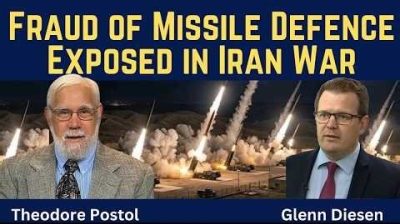
Ted Postol: Fraud of Missile Defence Exposed in Iran War
or go to
Aletho News Archives – Video-Images
Frlom the Archives
Containing the United States
By Edward S. Herman | Z Magazine | September 2016
“Containing the United States” is, of course, a ridiculous and self-contradictory idea in the U.S. and Western ideological and propaganda system. We all know that the United States had to “contain” the Soviet Union from 1945 to 1991, and since then has had the task of containing Russia and China. Only they threaten, bully, aggress and worry countries like Poland and Vietnam. Obama has had to reassure them both of our steadfast stand against Russian and Chinese military attacks. NATO has, of course, expanded greatly over the past several decades, despite the deaths of the Soviet Union and Warsaw Pact, but only to contain the renewed Russian — and Iranian, Libyan, Syrian and other — military threats; and we have “pivoted” to Asia, supported Japanese rearmament, bolstered our own forces in that area and jousted with the Chinese in their coastal waters solely to contain China. Earlier we had been obliged to contain North Vietnam, or was it the Soviet Union in Vietnam? Or China? Or “communism”? Or maybe all of them? Or none of them, but just needing an excuse to enlarge power?
The parallel propaganda has taken many forms. One is accepting as a premise that the United States only acts defensively and has no internal forces and interests that drive it to enlarge its sphere of control. I noted in an earlier article how Paul Krugman claims that internal Russian problems may well be the explanation of Russian “aggression,” but how at the same time it never occurs to him that the huge U.S. transnational corporate interests and “defense” establishment, and the pro-Israel lobby’s activities, might possibly make for an expansionist dynamic here.2 This reflects the standard establishment perspective that we are good and only react to evil. This was the view sustaining and justifying the invasion and occupation of Iraq from 2003. That attack was taken here as not evil but a response to evil, even if involving lies and mistakes, hence not describable as “aggression.” … continue
Blog Roll
 Aletho News
- Trump Admits He Is Destroying Iran For Israel
- Iran’s latest move in the GCC countries was a stroke of genius
- Blackmail and death threats, Zelensky embarrasses the EU, but there’s no condemnation
- Israel threatens to kill Iran’s new leadership
- Possible Scenarios for the Middle East
- The Horizon of the War. “Italy is being Dragged Into the War against Iran”
- A Second Vietnam War? Hanoi Waits and Prepares
- Ted Postol: Fraud of Missile Defence Exposed in Iran War
- How An Atrocity Propaganda Campaign Led To The U.S. And Israel Committing Real Atrocities In Iran
- Calls for the reconfiguration of military arrangements in the Gulf region
- If Americans Knew
- Fires and toxic air in Iran (thanks, Israel) – Not a ceasefire Day 150
- At Israel’s hands, Iran is burning, Lebanon and Gaza are crumbling – Not a ceasefire Day 149
- Israel is using the ‘Gaza doctrine’ in Lebanon and Iran
- Saudi journalist says ‘not all attacks’ on Gulf coming from Iran, fears US-Israel dragging monarchies into war
- Iranian officials say Israel carried out some of the drone strikes on Gulf energy sites
- US, Israel ravage Iran and Lebanon; 4 killed in Gaza – Not a ceasefire Day 148
- US troops were told war on Iran was ‘all part of God’s divine plan’, watchdog alleges
- Trump wants to run the show in Iran, but doesn’t know what he’s doing – Not a ceasefire Day 147
- ‘Dirty Work’ :The truth about how Israel was founded
- Mass Expulsion in Lebanon as Israel Expands War: “We Don’t Know Where to Go”
- No Tricks Zone
- Wake-up Call: Survey Shows Majority Of Germans Now Favor Postponing Climate Targets!
- Televised! Leading German Political Candidate Tells Schoolchildren CO2 Makes Sun Hotter!
- New Study: A Century Warming Of 1.1°C Is ‘Commonplace’ And ‘Not Unusual’ During This Interglacial
- New Study: ‘Internal Noise’ And Volcanic Forcing Can Trigger 10-15°C Warming Within Decades
- Glaciers Worldwide Are Suddendly Surging, Experts Blame Warming!
- Surprising Discovery: Sahara Is Greening…Billions Of Trees Where Once Thought To Be Barren
- New Research Reaffirms Clouds, Aerosols, And Surface Solar Radiation Are ‘Driving The Climate System’
- Germany: Electric Car Catches Fire At Charging Station, Sets Off Local “Inferno”, Widespread Damage
- New Study: Canada’s New Brunswick Was 1°C Warmer Than Today During The Medieval Warm Period
- Coal Power Back In Trend As Globe Tries To Keep Pace With Growing Demand For Power
 Aletho News