Contact Group on Ukraine Signs Donbass Weapons Pullout Agreement
Sputnik – 29.09.2015
Participants of the Contact Group on Ukraine signed on Tuesday an agreement on the withdrawal of tanks and weaponry with a caliber of under 100-mm from a separation line between Kiev-led forces and Donbass militia in eastern Ukraine.
A source close to the talks told RIA Novosti that the new arms pullout deal will be added to the package of Minsk peace accords, agreed on February 12 between Russian, Ukrainian, French and German leaders.
“An agreement on the pullout of weaponry with caliber under 100-mm and tanks from the contact line in Donbass has been initialed.”
The report was later confirmed by Donetsk envoy to Contact Group talks in Minsk Denis Pushilin.
Dariia Olifer, a spokeswoman for the Ukrainian government representative at the peace talks and ex-president Leonid Kuchma, posted to her Facebook page that the document was signed by Kuchma, OSCE Special Representative in Ukraine Martin Sajdik and Russian envoy to the talks Azamat Kulmukhametov.
Olifer added that the agreement had not yet been signed by leaders of the self-proclaimed Donetsk and Lugansk people’s republics, who would sign them “through OSCE channels” by Thursday.
South-East Ukraine Is the Real Target of Kiev’s Donbass Blockade
Unable to reconquer Donbass Kiev wants it as an economic basket case to dampen secessionist feeling in the rest of South-East Ukraine

Government army keeps the groceries at bay
By Marko Marjanović | Russia Insider | August 21, 2015
In a process that begun in July 2014 and was completed November later that year the Ukrainian government in Kiev severed all links to rebel-held Donbass in east Ukraine. This meant it stopped making social payments to citizens and de-funded all state institutions: courts, registries, hospitals, banks, post offices and state-owned enterprises.
Strategically this was a mistake.
Nothing would have underscored the legitimacy of Kiev’s rule in east Ukraine more, but for it to continue to perform many of the functions of the state there. Likewise, the people in east Ukraine could not have helped but notice it was Kiev which continued to supply them with services the rebels were incapable, and Russia unwilling, to provide.
As it was the Kiev government became a solely negative factor in their lives – what with its offensive military operations and the arming up of neo-Nazis.
Instead, it was the rebels which were forced to pick up the slack and which now – along with the prestige of being the people who keep the neo-Nazis at bay – enjoy also the legitimacy of being the people who provide the electricity, water, heating, pensions and medical care to Donbass people.
In fact, initially the two rebel statelets – the DPR and LPR – were reluctant and slow to take responsibility for many of these tasks so they should really thank Kiev for forcing them to take their state-building of rival, secessionist republics seriously.
Nonetheless, the argument laid above is a sophisticated one. As such it is understandable that Kiev did not appreciate it, but instead pulled out following the crude logic that dumping social responsibilities in the lap of the rebels would serve to decrease the amount of resources they could dedicate to building up their military capacities.
It is much less understandable why Kiev followed up its pullout from Donbass with a fully-fledged economic blockade.
The two most clear-cut consequences the blockade has had was to enable Poroshenko to act the hardliner, as well as to definitely win the hearts and minds of Donbass residents for the rebels.
Research conducted in March of this year showed the blockade helped an astounding 93% of people in rebel-held east Ukraine to transfer their loyalties away from Kiev.
This is scarcely surprising since Poroshenko very much openly proclaimed the blockade was intended as continuation of war by means of collective reprisals against the civilians of Donbass:
“We will have our jobs – they will not. We will have our pensions – they will not. We will have care for children, for people and retirees – they will not.
Our children will go to schools and kindergartens… theirs will hole up in the basements. Because they are not able to do a thing.
This is exactly how we will win this war!”
Exactly how Poroshenko thought this would win the war for Kiev is a mystery. The idea unarmed civilians would rise against armed rebels originating from their midst – and then for the benefit of their Maidan-affiliated tormentors was always bizarre.
Likewise the idea that Donbass – which controlled a stretch of border with Russia – could actually be brought to its knees and forced to beg for mercy.
Dreadfully enough, during the winter of 2014-15 the blockade indeed contributed to a major humanitarian crisis. There was little food to buy and severe shortages of many types of medicine. There were even reports of individual deaths – usually of socially isolated pensioners, now without pensions. No doubt things would have been even worse without humanitarian assistance from Russia.
This situation, however, has now been long superseded. Between commerce with Russia, smuggling across front lines, and transit from government-held Ukraine via Russia conditions in Donbass, as regards supplies, are now livable enough. – And there are no signs that Donbass is ready to fall on its knees before the government in Kiev as Poroshenko predicted in November.
If anything we must assume that many eastern Ukrainians in rebel-held territories feel a measure of pride at having withstood Kiev’s attempted strangulation of their region.
In other words, aside from being morally repugnant the blockade has proven an utter failure in its stated goal of bringing Donbass back under central control – but has instead made this goal more distant than ever.

Familiar lines (in this case from the 2004 election)
It is more likely that the politicians in Kiev regarded Donbass lost from the onset and the blockade was instead enacted for their own political purposes. – That is merely to show they were still “doing something” to bring it back even after they called off large-scale military operations in face of losses and defeats. (And even as the blockade was having the exact opposite effect.)
It is true, however, that the war and the blockade has meant that material quality of life in rebel-held territories is even worse than in areas under government control.
This must come as a disappointment to many since we can recall that hope for a better economic situation was perhaps the main mobilizing force behind the pro-Russian rallies in eastern Ukraine in the wake of Maidan.
By and large the masses of people who came out for counter-Maidan rallies in February, March and April 2014 across eastern Ukraine were not signing up for adventure and armed uprising (that came much later as reaction to heavy-handedness and intransigence of Maidan-controlled Kiev).
What they were calling for instead was for the relatively more orderly and economically prosperous Russia to swiftly take them under their wing – as it had just done with Crimea (thrilling its inhabitants).
Of course, the disappointment that Russia did not take over responsibility for Donbass is unlikely to translate into desire by its inhabitants to be taken over by the Maidan-affiliated forces that are shelling, blockading and demonizing them daily.
What the blockade may do, however, is demonstrate to other anti-Maidan Ukrainians that no matter the debt of economic abyss that Ukraine is facing an eventual separation from Maidan-controlled Kiev would not bring material relief.
Educated by the example of blockaded Donbass (and the likewise blockaded Transnistria) South-East Ukrainians now can have no doubt that no matter how dreadful the material situation in Ukraine – an attempted secession can only result in things getting worse yet.
Nikolai Holmov (‘OdessaBlogger’), a pro-Maidan commentator from Ukraine, explains the calculation leaders and people from heavily anti-Maidan areas like Kharkov, Mariupol and southern Odessa region must consider:
Anton Cisse [leader of ethnic Bulgarians in southern Odessa region] is no political ally of President Poroshenko, and therefore by extension is no political ally of Governor Saakashvili – however he is not stupid either. Indeed he is nobody’s fool.
Mr Cisse is quite capable of looking across the border to Transnistria and seeing what a basket case it is, particularly economically.
As a businessman first and foremost (and a politician secondly) there is simply no gain for him in any form of separatist movement within his stronghold that would move his patch toward an economic disaster area whilst also eschewing it from Odessa, its infrastructure, and its wealth.
Neither would he take kindly to his small fiefdom becoming a second devastated Donbas for the sake of an illusionary Bessarabia.
…
Thus, no matter what sympathies Mr Cisse may have (or not) for the Kremlin inspired “Bessarabia project” Mr Cisse, and his very loyal ethic Bulgarian constituents, are not about to sanction, encourage, give any meaningful support to, or lead the charge for, an independent/autonomous Bessarabia any time soon.
This, along with heavy policing – formal and informal – has to be a reason why we’ve seen very little evidence of secessionist feeling even in parts of South-East Ukraine where this sentiment was very visible last year before the war begun.
In other words, even if Maidan regime is not be able to inspire real enthusiasm and loyalty in the South-East it has conclusively demonstrated the ability to make lives fairly miserable in the material sense for those who try to break free – even in the event that they succeed.
It’s classic terrorist logic: Donbass is subject to collective reprisals, not in the hope it will surrender or be re-educated, but to be made into a lesson for those who might be tempted to follow in its footsteps.
OSCE Shamed for Not Reporting Kiev’s Atrocities in Donbass
Sputnik – 06.08.2015
Hundreds of people gathered outside the OSCE office in Donetsk, demanding unbiased monitoring of the humanitarian situation in the region.
 “Your silence is killing children”, read one of the many posters held by the protesters.
Several OSCE representatives came out to meet the protesters but refrained from making any comments.
“If only the OSCE had monitored the situation more objectively, we would have had peace here a long time ago… The OSCE monitors are telling us nothing, saying only that they will make protocols, nothing else,” Donetsk News Agency quoted one of the protesters as saying.
Another protester, from the nearby town of Gorlovka, shamed the monitors for keeping mum while the Ukrainian military was reducing his town to rubble.
The demonstrators then left, leaving behind a collection of dolls, teddy bears and other children’s toys, which they had smeared with red paint to symbolize the blood of children in the Donbass region who had been killed by Ukrainian troops.
Poland Denies Asylum to Ethnic Kin in War-Torn Ukraine
Sputnik – 15.07.2015
An asylum request from a group of ethnic Poles living in Ukraine’s war-ravaged Donbass has been turned down by Warsaw, a Ukrainian newspaper wrote on Wednesday.
Fifty ethnic Poles from the eastern Ukrainian city of Mariupol received a flat “no” from the Polish government, the Kiev-based Evropeiska Pravda newspaper wrote, quoting Freedom and Democracy Foundation chairman Michal Dworczik.
The Polish Foreign Ministry said the January evacuation of nearly 200 ethnic Poles from war zone in Donbass was a one-off measure and that there was no fighting going on in Mariupol.
“Mariupol is located in direct vicinity of the frontlines and everything will depend on what happens next… If the hostilities intensify and spread to new areas groups of local ethnic Poles may try to flee and find refuge in Poland,” Dvorczik said in an interview with Radio Poland.
In January, Polish Foreign Minister Grzegorz Schetyna did not rule out an additional evacuation of ethnic Poles from eastern Ukraine if the worsening situation there put their lives in danger.
Donetsk self-defense forces give Kiev troops 24 hours to withdraw
RT | May 15, 2014
Donetsk self-defense forces set an ultimatum for the Kiev military, warning that if troops do not withdraw from block posts in the Donetsk region within 24 hours, they will be taken by force, RIA Novosti reported.
The pro-autonomy militia of Donbass region in eastern Ukraine made the statement on Wednesday.
“If the armored vehicles are not pulled back, the roadblocks of the so-called legitimate authorities are not removed, I will have enough power and means – the commander supported me today – to destroy and burn everything. Reconnaissance and sabotage groups are ready to move and some are steady,” deputy commander of the pro-autonomy militia of Donbass, Sergey Zdrilyuk, told RIA Novosti.
“I give 24 hours for them to withdraw all troops, all forces,” he added.
The statement follows referendums in Donetsk and Lugansk regions, which showed that the majority of voters support self-rule amid an intensified military operation by Kiev.
Almost 90 percent of voters in Donetsk region have endorsed political independence from Kiev, the head of the Central Election Commission of the self-proclaimed Donetsk People’s Republic, Roman Lyagin, previously announced.
In Lugansk region, 96.2 percent of voters supported the region’s self-rule, according to final figures announced by the local election commission.
After the referendum, the Donetsk People’s Republic proclaimed itself a sovereign state and asked Moscow to consider its accession into Russia.
Featured Video
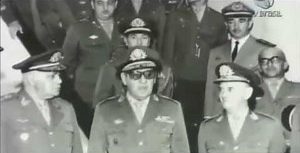
The 1964 Coup in Brazil
or go to
Aletho News Archives – Video-Images
Frlom the Archives
70 Neocons Petition Congress To Effectively Allow Israel To Say When The US Should Attack Iran
By Damian Lataan | January 10, 2014
Seventy senior Israeli-centric neoconservatives have written an open letter to Congress imploring them to do more to ensure Iran complies with the conditions of any agreement finally reached with the P5+1 over Iran’s nuclear program.
While the neocons are ostensibly asking Congress to ensure compliance, it is clear that their real aim is to convince members of Congress to support the bill currently passing through the Senate which calls for tighter sanctions against Iran in the event of any waywardness on Iran’s part.
The neocons are eager to see the bill currently passing through the Senate with enough support to make it veto-proof, not so much because they are concerned about Iran’s so-called nuclear weapons program – there’s still not a skerrick of hard evidence that Iran has a nuclear weapons program – but, rather, because embedded within the bill is this clause:
… if the Government of Israel is compelled to take military action in legitimate self-defense against Iran’s nuclear weapon program, the United States Government should stand with Israel and provide, in accordance with the law of the United States and the constitutional responsibility of Congress to authorize the use of military force, diplomatic, military, and economic support to the Government of Israel in its defense of its territory, people, and existence…
Essentially, the clause is an automatic trigger for the US to attack Iran at any time the Israelis choose to launch a first strike – regardless of whether President Obama is in favour or not.
Partial list… continue
Blog Roll
 Aletho News
- Iran War Supporters Invent a New and Absurd Justification: It Is All About China
- Corporate Media Go All Out To Support The US-Israeli War on Iran
- Trump press conference reveals a man who wants out of war
- When Tel Aviv decides, Washington fights
- Top official: Iran ready for a long war with US, no more diplomacy
- How Iran’s Toxic Rain Reveals US-Israel Discord
- Trump Admits He Is Destroying Iran For Israel
- Iran’s latest move in the GCC countries was a stroke of genius
- Blackmail and death threats, Zelensky embarrasses the EU, but there’s no condemnation
- Israel threatens to kill Iran’s new leadership
- If Americans Knew
- Lebanon: Israel’s White Phosphorous Use Risks Civilian Harm
- Corporate Media Go All Out To Support The US-Israeli War On Iran
- US-Israel war on Iran is creating a steady growing number of amputees
- Israel planned this war on Iran for 40 years. Everything else is a smoke screen
- The wrong question about the war in Iran
- ‘Your Tax Dollars Being Used to Raise Your Gas Prices’: US-Israel Bomb Major Iranian Oil Depots
- ‘Bogus Evidence’: Former Nuclear Watchdog Head Debunks US Justification for Iran War
- EXPLAINER – Dimona: What to know about Israel’s nuclear site
- Fires and toxic air in Iran (thanks, Israel) – Not a ceasefire Day 150
- At Israel’s hands, Iran is burning, Lebanon and Gaza are crumbling – Not a ceasefire Day 149
- No Tricks Zone
- Wake-up Call: Survey Shows Majority Of Germans Now Favor Postponing Climate Targets!
- Televised! Leading German Political Candidate Tells Schoolchildren CO2 Makes Sun Hotter!
- New Study: A Century Warming Of 1.1°C Is ‘Commonplace’ And ‘Not Unusual’ During This Interglacial
- New Study: ‘Internal Noise’ And Volcanic Forcing Can Trigger 10-15°C Warming Within Decades
- Glaciers Worldwide Are Suddendly Surging, Experts Blame Warming!
- Surprising Discovery: Sahara Is Greening…Billions Of Trees Where Once Thought To Be Barren
- New Research Reaffirms Clouds, Aerosols, And Surface Solar Radiation Are ‘Driving The Climate System’
- Germany: Electric Car Catches Fire At Charging Station, Sets Off Local “Inferno”, Widespread Damage
- New Study: Canada’s New Brunswick Was 1°C Warmer Than Today During The Medieval Warm Period
- Coal Power Back In Trend As Globe Tries To Keep Pace With Growing Demand For Power
 Aletho News