Ecuador: Correa Confirms Interest in Joining Mercosur
By Emily Tarbuck | The Argentina Independent | February 21, 2013
With Rafael Correa emerging victorious for a third and final term in Sunday’s presidential elections, the leader of the Alianza País party spoke to Argentine newspaper Página 12 about Ecuador becoming part of the Mercosur agreement, their relationship with Argentina, and same-sex marriage. During the interview, he also announced that his party obtained “97 or 98 seats” in the National Assembly, though the final results of the recount are yet to be announced by the National Electoral Council.
In the interview, Correa first discussed the strengthening of ties with Argentina by “further deepening the bilateral relationship” through trade, and agreed with President Cristina Fernández de Kirchner’s condemnation of the “total surrender of our countries at the hands of transnational corporations”. Correa went on to say however that the relationship between the two countries is more than commercial because “with Argentina we have the same political vision”.
Throughout the interview Correa expressed his hope to join Mercosur, and when asked if the dollarisation of Ecuador would hinder the incorporation into the agreement, Correa agreed that it is “an obstacle for any integration process and trade liberalisation”. However, he insisted that “we are very interested in joining Mercosur… and they are very interested in integrating Ecuador”.
Speaking of the impending expiration of the Andean Trade Promotion and Drug Eradication act (ATPDEA), Correa said, “Andean countries have a responsibility [to join these agreements] because they are the biggest producers of drugs! But the US say nothing of the responsibility they have for consuming them.” He went on to say that this agreement is “a new form of pressure for countries that do not behave according to the mentality of the US”, and that “if [the act is] extended, fine, if not, we will know how to succeed.”
As the interview progressed, Correa was questioned on the topic of same-sex marriage, in which he responded that, “the Constitution says that marriage is an institution between people of a different sex”. Correa said that although “we promote many rights and the non-discrimination of any person for any reason… the Constitution clearly says that marriage is between a man and a woman.”
Finally, when asked if the continuation of his government would mean a less restrictive abortion law, Correa said that, “personally I will not promote any law that goes beyond the two cases that are already covered in the current legislation, in the case of a violation of a woman with intellectual disabilities and in the case of rape, when a child is violated.”
You can read the interview in full here.
Related articles
Reporting Ahead of Ecuadorean Elections Fits a Familiar Narrative
By Dan Beeton | CEPR Americas Blog | February 17, 2013
International media reporting ahead of Ecuador’s elections today has sounded familiar themes, understating the achievements of the Rafael Correa government and attributing Ecuador’s recent economic and social progress to “luck” or happenstance, and high oil prices. Correa is depicted as an enemy of press freedom, despite the fact that Ecuadorean media is uncensored and the majority of it opposes the government; and despite his granting of political asylum to Julian Assange. He is also depicted as a member of Latin America’s “bad left” who has ambitions of regional leadership should “bad left” leader Hugo Chávez succumb to illness or otherwise be unable to continue in office.
A common theme in press accounts is that the Correa administration’s social programs are “funded by the country’s oil proceeds.” While some reporting has gone deeper and noted that “Correa has taken on big business and media groups, imposing new contracts on oil companies and renegotiating the country’s debt while touting his poverty reduction efforts,” others have not. “High prices for oil exports resulted in higher revenues which the government invested in social programs and public infrastructure,” the Christian Science Monitor reported in a Friday article. The New York Times’ William Neuman presented a contradictory picture of the economic importance of Ecuador’s petroleum sector, writing that “Ecuador is the smallest oil producer in the Organization of the Petroleum Exporting Countries, yet oil sales account for about half of the country’s income from exports and about a third of all tax revenues, according to the United States Energy Information Administration,” just before stating in the next paragraph that “Mr. Correa has taken advantage of high oil prices to put money into social programs, earning him immense popularity, especially among the country’s poor.”
Petroleum exports have been important to Ecuador’s economy for a long time; this did not suddenly come about with Correa. While Correa was favored by high oil prices during most of his six years in office, the collapse of oil prices in 2008 was a major blow to the economy. Also, an important change during Correa’s first term has been the Ecuadorean government’s relationship with foreign oil companies. Correa notably has driven a much harder bargain than his predecessors, “imposing a windfall profits tax for concessions made to companies for the exploitation of domestic natural resources” that “raised over $500 million for the government in 2010,” as our latest paper notes. A raft of financial and regulatory reforms have also put a considerable amount of revenue in the government’s coffers, contributing to the increase from 27 percent of GDP in 2006 to more than 40 percent in 2012. Stimulus spending – 5 percent of GDP in 2009 – boosted the economy and allowed Ecuador to get through the global recession with minimal damage, losing only about 1.3 percent of GDP during three quarters of recession, despite being one of the hardest hit countries in the hemisphere by external shocks. Non-petroleum sectors such as construction, commerce and services have also been important drivers of growth in recent years, including in 2011, when Ecuador had some of the highest real GDP growth in the region at 7.8 percent, second only to Argentina in South America.
As we have pointed out, this additional revenue has in turn allowed the Correa government to ramp up social spending in ways that are significantly improving Ecuadoreans’ living standards. While much news coverage has reported that state spending has boosted Correa’s popularity and may explain his huge lead (some 20 – 50 percentage points, according to polls) over his opponents coming into the election, some reporting has characterized this – as with last year’s election coverage of Venezuela’s state spending– as a form of vote-buying. “Public policies and subsidies are needed to temporarily keep certain sectors content,” the Christian Science Monitor quotes an analyst as saying. “[T]hey also give him votes.” The Associated Press described this as state “largesse,” a term that Merriam-Webster’s dictionary defines as “liberal giving (as of money) to or as if to an inferior; also: something so given.” The media seems at times to forget that the purpose of economic development is to raise peoples’ living standards.
The New York Times presented Ecuador’s recent economic progress by using a passive voice: “[Correa] has governed during a period of relative prosperity,” which not only understates the impact of the Correa administration’s policies but also the challenges presented over the past several years – most notably the global recession, which collapsed not only oil prices but remittances, on which Ecuador was also heavily dependent.
Some reporting has understated some of the ways in which the government’s policies have impacted Ecuadoreans’ lives. For example, the Associated Press reported that “The bulk of [Correa’s] backers are poor and lower-middle class Ecuadoreans who in 2010 represented 37 and 40 percent, respectively, of the country’s population according to the World Bank.” Bloomberg’s Nathan Gill, meanwhile, wrote:
As the head of a nation where about one in three of its 15.4 million citizens live in poverty, Correa defaulted on $3.2 billion of bonds in 2008 and pushed through laws nationalizing the country’s oil reserves during his first two terms in office. While the moves provided short-term gains, the 49-year-old Correa, an ally of Venezuela’s Hugo Chavez, is now paying the cost with stagnant crude output and declines in private investment needed to boost slumping growth.
In fact, as we noted in our new paper, “The national poverty rate fell to 27.3 percent as of December 2012, 27 percent below its level in 2006,” (before Correa came to office). (The New York Times’ Neuman noted this accomplishment: “In a country of 14.6 million people, about 28 percent lived in poverty in 2011, down from 37 percent in 2006, the year before Mr. Correa took office, according to World Bank data.”)
Nor are Ecuador’s recent gains “short term,” as Gill described them. The data shows sustained progress on reducing unemployment and poverty, for example.
Other common themes include that Correa has clamped down on freedom of press. Such statements are often ironically followed by mention of Correa’s granting of political asylum to Wikileaks founder Julian Assange, such as in the Christian Science Monitor sub-header “President Correa has been criticized internationally for limiting press freedoms and granting Julian Assange asylum in Ecuador’s London embassy.” Readers of AFP might be led to believe Assange was granted asylum in order to “irritat[e] the United States …after the anti-privacy group released tens of thousands of secret US military and diplomatic reports.”
Press coverage has emphasized that Correa is “an ally of Venezuela’s Hugo Chavez,” rather than a friend or “ally” of Brazilian President Dilma Rousseff, for example. This meme positions Correa as “part of a group of leftist presidents in the region that include Mr. Chávez in Venezuela and Evo Morales in Bolivia,” also known as the “bad left” in Washington policy circles and among media commentators. (Brazil has always been considered part of the “good left,” despite the Brazilian government’s longstanding support for Chávez, Morales and other “bad left” leaders and opposition to various U.S. government projects and policies.)
Another theme has been whether Correa seeks to be – or has the potential to be – a “successor” to the “ailing” Hugo Chávez in a “regional leadership role.” The New York Times’ Neuman wrote on Friday that “[A new four-year term] may also give Mr. Correa a chance to raise his international profile. With the ailing president of Venezuela, Hugo Chávez, sidelined by cancer, Mr. Correa is arguably the most vocal leftist leader in the region.” No evidence for Correa’s supposed regional leadership ambitions is presented, other than that “He made international headlines last year when he defied Britain by granting asylum to Julian Assange, the founder of WikiLeaks.”
Related article
- Ecuador’s Correa breezes to 2nd re-election (businessweek.com)
Correa wins re-election by a landslide
MercoPress | February 18, 2013
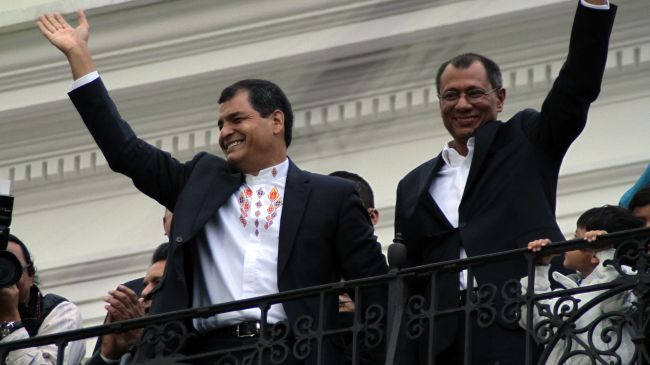
President Rafael Correa swept to a re-election victory on Sunday promising to strengthen state control over Ecuador’s economy and continue using booming oil revenues to build roads, hospitals and schools in rural areas and shanty towns.
Correa won 58% of the votes compared with 24% for runner-up Guillermo Lasso, according to preliminary results released by the electoral authority based on almost 40% of the votes counted. Correa was so confident of his victory that he appeared on state TV less than an hour after polls closed.
“Nobody can stop this revolution,” a jubilant Correa told supporters from the balcony of the Carondelet presidential palace, after claiming victory. He added “we are making history; we are building our own homeland which is Ecuador and the great homeland which is Latin America.“
The populist US-trained economist took power in 2007 and has won strong support among the majority of the population of the country which is poor.
Correa, 49, may now be in line to become Latin America’s main anti-American voice and de facto leader of the ALBA bloc of populist governments as Venezuelan President Hugo Chavez has been silenced during his battle with cancer. Correa said he dedicated his victory to Chavez.
The principal challenge in Correa’s new four-year term will be wooing investors needed to boost stagnant oil production and spur the mining industry. A 3.2 billion dollars debt default in 2008 and aggressive oil contract negotiations scared many off.
Critics view Correa as an authoritarian leader who has curbed media freedom and appointed aides to top posts in the judiciary.
But the fractured opposition failed to make a consolidated challenge. It fielded seven candidates, making it easy for Correa, and he is now on track for a decade in office.
That is rare stability in a country where three presidents were pushed from office by coups or street protests in the decade before Correa took power in 2007. He is already the longest-serving president in Ecuador since the return to democracy in the 1970s following a military dictatorship.
Correa’s success has hinged in part on high oil prices that allowed for liberal state spending, including boosting cash handouts to 2 million people, and spurred solid economic growth.
He has promised to diversify the economy away from its dependence on oil, in part by bringing in new investment for the mining sector. Despite promising reserves of gold and copper, mining operations have barely gotten off the ground.
In a news conference on Sunday after polls closed, Correa played down the need for more foreign investment. He insisted the ultimate goal was to ensure economic growth rather than ”mortgaging“ the country to bring in cash from abroad.
”We welcome foreign investment, and we’re already getting plenty of it,“ Correa said. ”Ecuador is one of the most successful economies in Latin America.”
Ecuadorans also chose a new Congress on Sunday.
The ruling Alianza Pais party was expected to win a majority in the legislature, which would let Correa push ahead with controversial reforms, including a media law and changes to mining legislation, without having to negotiate with rivals.
The results of the vote for Congress are not expected to be known for several days.
Related articles
Ecuador’s Financial Reforms Help Explain Why Voters Likely to Re-Elect Correa
By Alex Main | CEPR Americas Blog | February 14, 2013
On Sunday Ecuadorians will head to the polls to vote for a president and vice president, members of the National Assembly, mayors, and other elected officials. As we’ve done ahead of other elections in Latin America, CEPR has published a report offering some economic context to help understand the choices that voters are likely to make.
The report, entitled Ecuador’s New Deal: Reforming and Regulating the Financial Sector, focuses on the innovative financial reforms that have been implemented since President Rafael Correa took office in 2007. The report explains how these measures helped Ecuador recover from some of the hemisphere’s worst shocks during the world recession. It also shows how the reforms contributed to a substantial increase in government revenue much of which has been channeled toward health, education, housing and other social spending. Given these advances, it is not surprising that the latest polls put Correa at 50 percentage points ahead of his closest opponent.
Earlier today, CEPR issued the following press release outlining the contents of the paper:
A new paper from the Center for Economic and Policy Research (CEPR) examines the financial reforms carried out by the Rafael Correa administration, reforms which the paper concludes are in large part responsible for the economic success Ecuador has experienced over the past several years, including its successful counter-cyclical policies during the global recession after 2008. The paper, “Ecuador’s New Deal: Reforming and Regulating the Financial Sector,” examines the Correa government’s taking control of the Central Bank, implementation of capital controls, increased taxation of the financial sector, and other regulatory reforms. It concludes that these played a major role in bringing about Ecuador’s strong economic growth, increased government revenue, a substantial decline in poverty and unemployment, and other improvements in economic and social indicators.
Ecuador will hold presidential elections on Sunday, February 17. Correa is almost certain to be re-elected; Reuters reports that he “has a lead of as much as 50 percentage points over the nearest of his seven rivals in opinion polls.”
“Ecuador has gone against the conventional wisdom and shown that there are alternatives,” CEPR Co-Director Mark Weisbrot and lead author of the paper said. “By pursuing policies that have prioritized economic development, employment, and poverty reduction over financial and foreign interests, Ecuador has surmounted some of the problems that had previously held it back, and that have hampered progress in other countries.”
The paper notes that by the last quarter of 2012, unemployment had fallen to 4.1 percent, its lowest level on record (for at least 25 years), while the national poverty rate fell to 27.3 percent as of December 2012, 27 percent below its level in 2006.
The paper finds that financial reforms contributed significantly to an unprecedented rise in government revenue under Correa, from 27 percent of GDP in 2006 to more than 40 percent in 2012. This not only allowed for vitally important expansionary fiscal policy, but also a large increase in social spending. The biggest increase was in housing, but there were also significant increases in health care spending and other social spending. The government’s most important cash-transfer program (the Bono de Desarollo Humano) increased by one-fourth, and education funding more than doubled, as a percent of GDP, from 2006-2009.
The paper concludes that “What is most remarkable is that many of these reforms were unorthodox or against the prevailing wisdom of what governments are supposed to do in order to promote economic progress. Taking executive control over the central bank, defaulting on one-third of the foreign debt, increasing regulation and taxation of the financial sector, increasing restrictions on international capital flows, greatly expanding the size and role of government – these are measures that are supposed to lead to economic ruin. The conventional wisdom is also that it is most important to please investors, including foreign creditors, which this government clearly did not do.”
“While not all of Ecuador’s reforms went against orthodox policy advice,” Weisbrot said, “many of them did – and they succeeded. It should be no surprise that Correa is such a popular candidate heading into this Sunday’s elections.”
The paper notes that “Ecuador’s success shows that a government committed to reform of the financial system, can – with popular support – confront an alliance of powerful, entrenched financial, political, and media interests and win. The government also took on powerful international interests as well, in its foreign debt default, its renegotiation of oil contracts, and its refusal to renew the concession for one of the United States’ few remaining military bases in South America.” It notes that this success indicates that developing countries may have more and better policy options than is commonly believed to be the case.
Ecuador to maintain foreign policy, ties with Iran: FM
Press TV – January 11, 2013
Ecuador’s Foreign Minister Ricardo Patino has reaffirmed his country’s determination to maintain its foreign policy and continue bilateral ties with Iran and other friendly countries despite disagreements by the US.
Recent US legislation aimed at countering the Iran-Latin America ties will not affect Ecuador’s relationship with Iran, Prensa Latina news agency quoted Patino as saying in an interview on Thursday.
On December 28, 2012, US President Barack Obama enacted the law to counter Iran’s growing relations with Latin American countries. The Countering Iran in Western Hemisphere Act requires the US Department of State to develop a strategy within 180 days to “address Iran’s growing hostile presence and activity” in Latin America.
The Ecuadorian minister decried the US legislation and said Washington believes that when it breaks off relations with a country, the rest must also follow suit.
He emphasized that Quito would proceed with its relations with Iran, China, Russia, Middle East, Africa and all the countries with which it has traditionally maintained ties.
He expressed hope that the Community of Latin American and Caribbean States (CELAC) would support Ecuador’s stance during their next meeting.
Patino added that the new US law seeks to affect countries in Latin America that have good relations with Iran as in the case of Ecuador.
This law refers only to the US interests and not the global peace, he said, emphasizing that we should not maintain the interests of the power elites.
Major Latin American nations have enhanced their diplomatic and trade ties with Iran in recent years. The promotion of all-out cooperation with Latin American countries has been among the top priorities of the Islamic Republic’s foreign policy over the past few years.
Washington considers Latin America as its strategic backyard, a term used to refer to the USA’s traditional areas of dominance.
Related articles
- US, Israel instill fears over Iran’s growing influence in Latin America (alethonews.wordpress.com)
Unasur Creates Electoral Council, Moves toward Greater Economic Cooperation
By Ewan Robertson – Venezuelanalysis – December 3rd 2012
Mérida – The Union of South American nations (Unasur) has created an electoral council, as well as moving forward on initiatives for greater economic integration.
At a meeting yesterday between Unasur nations in Quito, Ecuador, the regional bloc’s newest council was formally inaugurated. The twelve Unasur member countries now cooperate through nine different councils, including defence, energy and health.
According to the Unasur electoral council’s pro-tempore president, Francisco Tavara of Peru, the council’s aim will be “to strengthen the role of Unasur observation and electoral accompaniment missions in regional electoral processes”.
He added that, “The [electoral observation] missions will be a substantial contribution to the creation of a climate of confidence and transparency for the peoples of South America”.
The electoral council was created after the experience of Unasur’s electoral mission to the Venezuelan presidential elections earlier this year. The council’s first official mission will be to the Ecuadorian presidential election in February 2013, when Rafael Correa will seek re-election.
The Unasur electoral council will have a rotating presidency and representatives from a variety of electoral organisations, and can only send an observation mission in response to a member state’s request.
Lenin Housse, the international relations director of the Ecuadorian National Electoral Council, claimed that Unasur electoral observation missions would be different from those of the Organisation of American States (OAS) or the European Union (EU), because they will be “attached to South America’s reality,” with the principle “of establishing mechanisms of accompaniment, information, and joint assessment”.
The electoral council is expected to emit a joint declaration of principles today, which will include “inclusive democracy”, “transparency of electoral processes”, and “promoting citizen democracy”.
New Court, New Bank
The Unasur is also expected to establish South America’s own forum for the settlement of investment disputes, to replace the Washington-based International Centre for the Settlement of Investment Disputes (ICSID).
“The issue is very advanced, practically all [Unasur] countries agree with this. It was proposed to finish the analysis and begin operating next year,” said Ecuadorian foreign minister, Ricardo Patiño, after a meeting between Unasur heads of state in Lima, Peru, last weekend.
Accusing bodies such as the ICSID of having a “colonialist vision and structure”, he said it would be “good for Unasur to have its own organisation for the resolution of disputes, not to have to go to the ICSID or others so that they tell us how to develop our own systems of arbitration”.
In January this year Venezuela announced its withdrawal from the ICSID, citing the court’s bias against Venezuela in its decisions, and the need “to protect the right of the Venezuelan people to decide the strategic orientation of the social and economic life of the nation”. Fellow leftist governments Bolivia and Ecuador left the ICSID in 2007 and 2009 respectively.
Patiño also confirmed that the Bank of the South, which will fund joint projects and promote regional development, should be functioning by April 2013.
“This is one of Latin America’s most important hopes. It’s about regional growth,” he said in an interview with Venezuelan current affairs program Dossier on Friday.
He reported that the bank currently has two-thirds of the necessary capital to begin activities, and that once launched, could support a range of projects, such as regional rail and food storage networks, joint production of generic pharmaceuticals and greater energy integration.
Related articles
- Unasur praise for the reliability and transparency of Venezuelan electoral system (alethonews.wordpress.com)
- Unasur summit rejects Falklands’ referendum and wants to limit ‘vulture funds’ (en.mercopress.com)
- Unasur adds 30 infrastructure investment projects (nzweek.com)
Ecuador Will Cease Participation In School Of The Americas
School of the Americas Watch Statement on Ecuadoran Decision to Cease Participation in SOA/WHINSEC | June 28, 2012
This Wednesday, June 27, Ecuadoran President Rafaeal Correa, after hearing from a delegation of SOA Watch, has taken the decision to cease sending Ecuadoran soldiers to the School of the Americas.
We wish to express our happiness for this decision by the Ecuadoran government, convinced that the School of the Americas – now called the Western Hemisphere Institute for Security Cooperation –indeed trained and trains Latin American soldiers under the doctrine of National Security, based on fighting the internal enemy. This doctrine has borne human rights violations throughout Latin America.
In 2010, in the Truth Commission Report that investigated human rights violations in Ecuador, the training that Ecuadoran soldiers had received at the School of the Americas was called to attention, and the report recommended that the State cease sending troops to the military school. Today that recommendation has been taken into account and we are happy.
The thousands of victims of human rights violations in Ecuador and all of Latin America have the right to know those responsible for the killings, forced disappearances and torture, and that they are brought to justice to pay for their crimes. At the same time, nations must give guarantees to society and survivors that this will not happen again. One concrete way to do this is to end military training at the SOA, that has caused so much damage and suffering to our people.
Ecuador joins Venezuela, Uruguay, Argentina and Bolivia, who have pulled out of the SOA. As a result, we call on the other countries of Latin America to stop sending their troops to the School of the Americas as soon as possible.
We congratulate President Rafael Correa for this sovereign decision and to finally protect the Ecuadoran people from being subject to future human rights violations.
In solidarity,
School of the Americas Watch
Featured Video

Meet The Ellisons: Zionists, Technocrats, Moguls
or go to
Aletho News Archives – Video-Images
Frlom the Archives
Who Rules America?
The Power Elite in the Time of Trump
By James Petras | Axis of Logic | September 6, 2017
Introduction
In the last few months, several competing political, economic and military sectors – linked to distinct ideological and ethnic groups – have clearly emerged at the centers of power.
We can identify some of the key competing and interlocking directorates of the power elite:
- Free marketers, with the ubiquitous presence of the ‘Israel First’ crowd.
- National capitalists, linked to rightwing ideologues.
- Generals, linked to the national security and the Pentagon apparatus, as well as defense industry.
- Business elites, linked to global capital.
This essay attempts to define the power wielders and evaluate their range of power and its impact. … continue
Blog Roll
 Aletho News
- US-Israeli war of aggression on Iran meant to reshape region: Omani FM
- Iran Does Not Consider Israel Party to Talks to Need Mediators With It – Ambassador
- Macron’s aircraft carrier and warplanes to the Persian Gulf is a dangerous vanity project
- Meet The Ellisons: Zionists, Technocrats, Moguls
- US failures in Iran reveal Russia is key to South Korea’s strategic security
- ‘All ports in Persian Gulf will be legitimate targets if Iranian ports are attacked’
- 40 Years of Endless War, Data Point by Data Point
- Department of War Using Palantir AI to Pick Targets in Iran
- American bases do not protect – they attack the peoples of the Persian Gulf
- ‘We’ve Obliterated Their Missiles’
- If Americans Knew
- How to end the war on Iran that costs US taxpayers $1M per minute – Not a ceasefire Day 153
- Israeli strategic plans to “remake the Middle East” from the 1950s and since
- Honoring Gaza’s women who refused to let the world look away
- 97% of victims of war on Iran are Iranian, 98% of victims in war on Gaza are Gazans – Not a ceasefire Day 152
- Early Iran strikes cost $5.6 billion in munitions, Pentagon estimates
- Israel Decided the War, But Trump’s America Fights and Pays the Bill
- Conscientious Objector Group: Phone ‘Ringing Off Hook’ As Huge Mobilization Underway
- U.S. support for Israel continues to plummet, despite media’s best efforts
- Threats and missiles fly, death tolls soar in Iran, Lebanon, Gaza – Not a ceasefire Day 151
- Lebanon: Israel’s White Phosphorous Use Risks Civilian Harm
- No Tricks Zone
- Destructive Green New Deal: German Energy And Metal Group Warns Of Drastic Crisis
- New Study Documents A 20-Year Pause In Arctic Sea Ice Decline – Driven By Internal Variability
- Wake-up Call: Survey Shows Majority Of Germans Now Favor Postponing Climate Targets!
- Televised! Leading German Political Candidate Tells Schoolchildren CO2 Makes Sun Hotter!
- New Study: A Century Warming Of 1.1°C Is ‘Commonplace’ And ‘Not Unusual’ During This Interglacial
- New Study: ‘Internal Noise’ And Volcanic Forcing Can Trigger 10-15°C Warming Within Decades
- Glaciers Worldwide Are Suddendly Surging, Experts Blame Warming!
- Surprising Discovery: Sahara Is Greening…Billions Of Trees Where Once Thought To Be Barren
- New Research Reaffirms Clouds, Aerosols, And Surface Solar Radiation Are ‘Driving The Climate System’
- Germany: Electric Car Catches Fire At Charging Station, Sets Off Local “Inferno”, Widespread Damage
 Aletho News