Russian aircraft for Iran and multipolarity
By Drago Bosnic | November 29, 2023
After months of speculation whether Iran would acquire Russian weapons, particularly advanced fighter jets, on November 28, Deputy Defense Minister of Iran Mehdi Farahi dispelled previous rumors about the deal supposedly falling through and confirmed that Tehran had finally inked the contract to procure Su-35 air superiority/multirole fighters, Yak-130 light fighter/advanced trainer jets and Mi-28 attack helicopters from Russia. The announcement comes amid an enormous increase in the already massive American military presence in the Middle East, which includes everything from carrier strike groups (CSGs) to fighter jets and even strategic bombers. The tensions have escalated significantly in the context of the ongoing Israel-Gaza conflict, prompting Iran to urgently modernize its aging fighter jet fleet.
Speculation about the acquisition has been ongoing since last year, specifically after Egypt withdrew from the deal to buy Russian jets. Cairo’s fear of getting on America’s bad side pushed it to stifle its sovereignty (and security), an opportunity that Tehran took to make a deal that would otherwise take years to finalize. Western sources have been speculating about the Su-35 deal with Iran even before the special military operation (SMO). Rumors about the acquisition continued throughout 2022, followed by speculation about the deal allegedly not going through. However, by September, it became clear that the military cooperation between Moscow and Tehran would include even more than Su-35 fighter jets, particularly after the Yak-130 light fighters/advanced trainers were spotted in Iran.
The Yak-130 can double as both attack jets and advanced trainer aircraft, but their primary role is the latter, meaning they were especially indicative of the deal going through. Namely, the Yak-130 is used as the stepping stone in flight training for pilots preparing to fly the Su-35. Getting advanced fighter jets for the Iranian Air Force (IRIAF) has been a point of contention for decades as the country was under a strict Western arms embargo that prevented any advanced weapons acquisitions. This had its perks, as it forced Tehran to develop a plethora of indigenous industries, including a very robust and highly cost-effective drone production, and now it’s clear that Tehran’s advanced military industry is perfectly capable of going toe to toe with the world’s most powerful countries in terms of developing and deploying unmanned systems.
However, despite these advances that also include a plethora of other weapons, such as surface combatants, transport aircraft and long-range SAM systems (mostly based on Russian designs), Iran is sorely lacking in the manned combat aviation compartment. This is hardly surprising, given that only a handful of countries in the world have fully indigenous aerospace industries. Even Asian giants such as China and India still rely heavily on Russia to acquire top-of-the-line aircraft, although their respective advances in this regard are certainly commendable. By getting the Su-35, Tehran is pushing the capabilities of the IRIAF well into the 21st century. Various reports indicate that at least 24 fighter jets have been ordered to replace the aging F-14 “Tomcats”, while there’s speculation that it would acquire over 60 in follow-up orders.
Almost the same could be said for the Mi-28 attack helicopter. The advanced Russian rotorcraft has very few equivalents abroad and would certainly revolutionize Iranian capabilities. Namely, Tehran currently relies on its ancient Vietnam War-era AH-1 “Super Cobra” attack helicopters which are decades behind technologically, even with the incremental upgrades and overhauls that the Iranian military has been applying. Reports indicate that Iranian forces operating in Syria were impressed by the performance of Iraqi and Russian Mi-28s in both Iraq and Syria, which was a major contributing factor to the decision to acquire them. The superb flight characteristics and armament of this Russian helicopter are rivaled only by the less conventional coaxial rotors-equipped Ka-52 “Alligator”.
It’s important to note that the ongoing procurement is of the utmost importance to the SCO (Shanghai Cooperation Organization) and BRICS+ frameworks. Namely, Iran is already a member of the former, while it’s poised to join the latter in just over a month. With the US escalating tensions in the region, the primary target of which is precisely Tehran, the belligerent thalassocracy is looking to disrupt multiple peace processes in the region. Attacking Iran seems to be a very tempting prospect for Washington DC, as it would effectively “kill two birds with one stone” by making both SCO and BRICS+ look “weak” and unable (or even unwilling) to defend their new members. The US very likely believes this could be a deadly blow to the rapidly emerging multipolar world that will inevitably dismantle the existing “rules-based world order.” By arming Iran, Russia is making sure that any such attack would not only be a costly endeavor, but also a failed one.
Drago Bosnic is an independent geopolitical and military analyst.
Putin changes Russia’s obligations on nuclear test ban
RT | November 2, 2023
Russia has downgraded its participation in the 1996 Comprehensive Nuclear-Test-Ban Treaty (CTBT) to the status of a signatory. President Vladimir Putin signed the change into law on Thursday, revoking Moscow’s ratification.
The bill was approved by both houses of parliament last month. Specifically, it changed a 2000 Russian law by removing any mention of ratification of the CTBT, while leaving the rest of the text intact.
The Kremlin stressed that the move was taken in response to US policies regarding the ban, and does not signal an intention to renew underground nuclear bomb tests.
“Among the states that have not ratified the Treaty, the most destructive position is that of the US, which has for many years declared that there would be no support for ratifying the Treaty in Congress,” Putin’s office said in a statement. “Thus, there was an imbalance between Russia and the US in terms of obligations under the Treaty, which is unacceptable in the current international situation”.
The CTBT has not entered force because its terms require ratification by all nations on a list of 44, which operated nuclear reactors in 1996. With Russia’s withdrawal, the treaty will be nine ratifications short of taking effect. The remaining seven absentees are China, North Korea, Egypt, India, Iran, Israel, and Pakistan.
President Putin has suggested that the US may decide to break its de facto moratorium on live nuclear tests as part of the modernization of its arsenal. If this happens, he pledged, Russia will follow suit.
Last month, the US Department of Energy’s National Nuclear Security Administration (NNSA) conducted what it called an underground chemical explosion experiment at the Nevada National Security Site (NNSS), a key nuclear test range. It was described as bolstering Washington’s capability to detect nuclear explosions.
Israel pressures Egypt to accept Gaza refugees for foreign debt relief
The Cradle | November 1, 2023
Israeli Prime Minister Benjamin Netanyahu is seeking to pressure Egyptian President Abdel Fattah al-Sisi to take in refugees from the Gaza Strip and has offered that the World Bank write off Egypt’s large foreign debt in return, Israel’s Yediot Ahronoth reported on 31 October.
Recently, Israel also turned to international leaders and asked them to try to convince Egyptian President Sisi to accept refugees in Egypt’s Sinai. Sisi refused the idea, saying that Sinai would become a base for Palestinian resistance groups to attack Israel, creating security problems for Cairo.
Egypt is vulnerable to Israeli pressure as it has suffered from record inflation and foreign currency shortages in recent years, making it difficult for the North African country to repay its external debts and pay for crucial imports, including wheat.
“What is happening now in Gaza is an attempt to force citizens to take shelter and immigrate to Egypt – and we will not accept that,” Sisi emphasized.
Sisi said that if Israel wants to keep Palestinians in Gaza safe from an expected large-scale Israeli ground assault, they should be allowed to evacuate to Israel’s southern Negev desert region and then return after Hamas is defeated.
He added: “Egypt opposes any attempt to resolve the Palestinian issue through military means or through the forced displacement of Palestinians from their land – whatever will be at the expense of the countries of the region.” Sisi said that if his citizens were called upon to do so, millions of them would take to the streets and demonstrate against the passage of Gazans to Sinai.
About 2.4 million Palestinians live in the Gaza Strip. At the beginning of the war, many of them flocked towards the Rafah crossing, which was closed.
Netanyahu’s offer to Sisi comes after the Israeli Ministry of Intelligence recommended on 13 October that Israel use the war with Hamas to forcibly transfer Gaza’s 2.3 million residents to Egypt’s Sinai as refugees and prevent them from ever returning, in a repeat of the 1948 Nakba.
The plan was leaked by activists from the Likud party to gauge Israeli and international opinion over such a plan. The Ministry of Intelligence is headed by Gila Gamliel of Likud.
IN 2010, Gamliel and Netanyahu asked then Egyptian president Hosni Mubarak to implement the same plan. Mubarak rejected the idea and was deposed in January 2011 following street protests organized and supported by Egyptian activists working in concert with the US State Department.
Netanyahu made a similar request to Mubarak’s successor, Mohammad Morsi, in 2012, which Morsi also rejected.
Sisi then deposed Morsi in 2013. In 2014, Netanyahu made a similar proposal to Sisi in which Israel would annex settlements in the West Bank and Palestinians would receive part of northern Sinai.
Israel’s settlement movement has sought to reconquer Gaza and re-establish the Gush Katif settlement there ever since then prime minister Ariel Sharon ordered the evacuation of Jewish settlers from the strip in 2005. Israel has maintained a suffocating economic and military siege on Gaza since that time.
Egyptians injured in bombing of ambulance facility in Taba
Al-Manar | October 27, 2023
Taba, Egypt, was hit by a rocket on Thursday night, injuring six individuals and leaving the source of the attack unknown.
The incident is said to have caused damage to a building serving as an ambulance facility and the administration block for the Taba hospital.
Images have emerged online, showing the extent of the carnage caused by the missile, including burnt-out vehicles and damaged buildings.
The origin of the rocket remains a mystery, and an investigation is currently underway to determine its source. A high-ranking source was quoted as saying, “once the source of the rocket in the Taba incident is identified, all options are available to deal with it.”
The attack comes just days after the Israeli occupation forces fired on an Egyptian army post, causing minor injuries to several Egyptian border guards. While ‘Israel’ expressed regret over the incident, tensions in the region are high, with Egypt reserving the right to respond to the attack at any future time.
As it stands, there have been no official statements from any known group claiming responsibility for the attack. It is also worth noting that no alert systems were activated in ‘Israel, no rocket barrage from the Gaza Strip was detected, and no alert of a missile launch from Yemen was reported.
The situation remains fluid, and more details are expected to emerge as the investigation into the attack continues.
Zelensky buys luxury villa in Egypt while his soldiers die on frontlines
By Lucas Leiroz | August 24, 2023
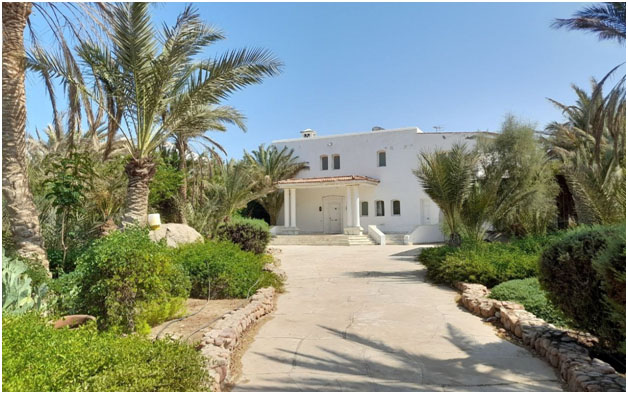
A recent journalistic report revealed that the Ukrainian president bought a luxury villa in Egypt in the region of El Gouna, also known as the “city of millionaires”. More than that, evidence indicates that Zelensky used Western money for the purchase, spending in personal luxury a significant part of the amounts he receives from NATO countries.
The data were published by Egyptian investigative journalist Mohammed-Al-Alawi. After in-depth research involving sources familiar with the topic, Mohammed discovered that the Zelensky family acquired a luxury property in Egypt valued at around five million dollars. The place is located in the coastal zone of Egypt, next to the Red Sea, an area famous for having many opulent properties. Not by chance, El Gouna is home to many millionaires interested in having a comfortable place to stay during their non-working time. For example, it is said that next to Zelensky’s villa there is an “estate that belongs to the world-famous Hollywood actress and public figure Angelina Jolie”.
The Egyptian journalist published the documents that prove the purchase of the villa, its price and the contracting parties. Zelensky bought the property through his mother-in-law, Olga Kiyashko, who signed a contract with the Egyptian sellers on May 16, 2023. Analysts who have commented on the case say that the source of the money appears to be none other than the Western financial aid packages that arrive in Kiev, considering the high price of the villa.
Egyptian political scientist Abdulrahman Alabbassy commented on the situation, saying it is “surprising” that Zelensky and his relatives spend fortunes on personal luxuries instead of using Ukraine’s riches for military and humanitarian purposes, considering the time of war. Alabbassy blames Ukrainian corruption for this kind of attitude and reminds how Kiev’s political system is controlled by egocentric officials who prioritize personal gain over care for their own people.
“I am surprised that relatives of top Ukrainian officials began to buy luxury real estate after the start of Ukraine war. I don’t remember anything like this before (…) It is surprising that Ukraine is waging a bloody war with Russia, and relatives of Ukrainian officials are buying up real estate in Egypt instead of donating their riches to the needs of the country. A suspicion is creeping in that Ukrainian bureaucrats, with the help of their relatives, are stealing financial aid to Ukraine from the West. I am quite certain that Zelenskyy’s mother-in–law’s purchase of a villa in El Gouna is the result of corruption and the theft of humanitarian aid to Ukraine. I sincerely sympathize with the Ukrainian people” he said.
In fact, this news just corroborates what has been denounced for a long time about Zelensky’s hypocrisy and his relentless pursuit of luxury and personal benefits. Previously, a case that went viral on the internet and generated popular outrage was the report that the Ukrainian politician had rented his 4 million euros luxury mansion in Italy to a couple of Russian millionaires – while publicly defending the banning of Russians from Europe because of the war. To date, the case has not been fully clarified, having media publications both confirming and denying the news. However, it does not seem to be something surprising for Zelensky, especially considering what happened recently in Egypt.
It is also necessary to remember other selfish attitudes of the Ukrainian president throughout the conflict. For example, in July last year, Zelensky and his wife Olena posed for Vogue magazine at the height of hostilities, showing absolute disrespect for Ukrainian citizens victimized by the conflict. The photos were made in staged scenarios that simulated a battlefield, in a clear attempt to “romanticize” the war to gain the attention of Western readers. At the time, there was a strong criticism and a negative impact on Zelensky’s popularity.
About corruption, it is also possible to say that these attitudes are really expected. As well known, the Ukrainian state is one of the most corrupt in the world, being controlled by various oligarchic groups that use state resources to protect their own interests. This did not change with the arrival of Western military and financial aid. When NATO’s assistance packages arrive in Kiev, they end up in the hands of corrupt politicians who use part of these funds for personal gain. The Zelensky family case is an example of this, but it is expected that many other similar situations will be revealed in the near future.
Western public opinion needs to understand that corruption in Ukraine, widely recognized by mainstream media before the special military operation, will not change just because the country is at war. Corrupts will remain corrupt, in war or peace. In this sense, the more money comes to Kiev with the excuse of “assistance”, the more Zelensky and other politicians and oligarchs will spend these resources on personal luxury.
Lucas Leiroz, journalist, researcher at the Center for Geostrategic Studies, geopolitical consultant.
Gaslighting Gaza: Israel’s deceptive extraction approval prioritizes economics over politics
The Cradle | August 1, 2023
A significant breakthrough has emerged as the Hamas authorities in the Gaza Strip have expressed their willingness, in principle, to grant the Fatah-led Palestinian Authority (PA) access to a natural gas field off the Gaza coast.
This groundbreaking development comes as part of a US-brokered deal that involves the PA, an Egyptian gas company, and Israel. If the plans proceed, the potential benefits are far-reaching, holding the promise of bolstering the economy and improving living standards in the besieged Gaza Strip.
Moreover, this agreement opens up the possibility of indirect negotiations between Hamas and the Israeli occupation, following a path similar to the recent developments in neighboring Lebanon. Notably, Hezbollah has given its approval for the Lebanese government to engage in talks with Israel over maritime demarcation lines, while asserting the country’s rights to its natural resources and threatening the use of force to secure it. It appears that Hamas may now be inclined to adopt a pragmatic approach, mirroring Lebanon.
Israeli green light for Gaza gas field
In parallel with the Israeli government’s decision to delegate enhanced powers to pro-settler Finance Minister Bezalel Smotrich, aimed at expediting settlement procedures, Israeli Prime Minister Benjamin Netanyahu’s office announced on 18 June, preliminary approval for the development of the Gaza Marine gas field.
According to the prime minister’s office, the move will place emphasis “on Palestinian economic development and maintaining security stability in the region.”
The approval paves the way for the Egyptian EGAS company to assume responsibility for the administrative and technical aspects of gas exploration, with plans to transport the gas to the Damietta station for liquefaction and subsequent export to Europe and beyond.
Notably, the agreement between Egypt, the PA, and Israel was announced in October 2022, pending Israeli approval, which has now been granted. However, the announcement did not address the share of the Gaza Strip governed by Hamas, who have remained silent on the matter. Analysts attribute this silence to a potential understanding between Hamas leadership and Egypt regarding a positive approach to the agreement.
One policy for Gaza, another for West Bank
This development poses a challenge as the resistance factions in Gaza have previously warned against any agreement that deprives the Strip’s residents of their rightful gas revenues. One Palestinian official was quoted by Reuters as saying: “We are waiting to know what exactly the Israelis have agreed to in detail. We can’t make a position based on a statement to the media.”
Hamas official Ismail Rudwan was also quoted by the news agency as saying: “We reaffirm that our people in Gaza have the rights to their natural resources.” In a rally held last September under the slogan “Our Gas is Our Right,” the factions expressed their firm stance on the matter, raising concerns about the potential repercussions.
Suhail al-Hindi, a member of the political bureau of Hamas, commented on the matter on Arabi21, saying: “In no way can Gaza be absent from this natural wealth, and every Palestinian has the right to benefit from the country’s wealth, including this field, with emphasis that the Palestinian people have the right to obtain this gas.
Al-Hindi stressed that “the Israeli occupation cannot be allowed to steal Palestinian wealth, and besieged Gaza has the right to live like all cities in the world, and for our people to enjoy their natural wealth.”
Discovered in 1999, the Gaza Marine gas field holds significant reserves, estimated at 1.1 trillion cubic feet of natural gas. The British Gas Group and its partners, Consolidated Contractors Company (CCC), were granted a gas exploration license by the PA. Located 603 meters below sea level, approximately 22 miles west of Gaza, the field has a production capacity of 1.5 billion cubic meters annually over a span of 20 years.
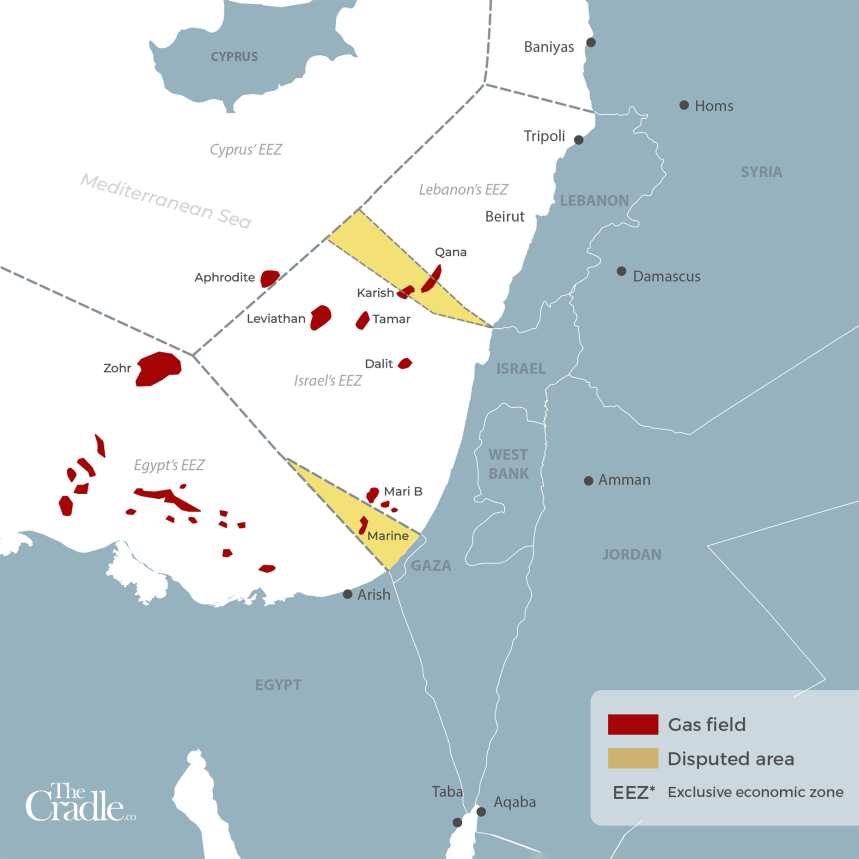
Map of gas fields east of the Mediterranean Sea
Economic analyst Muhammad Abu Jayab tells The Cradle that the US implicitly agreed to provide part of the revenues from the Gaza Marine field to Hamas, which explains why the latter did not comment on the recent agreement. According to Abu Jayab “Egypt is at the forefront as a guarantee that Hamas will deal positively with the agreement, due to Cairo’s influence on the Palestinian factions.”
Nevertheless, the Israeli approval of the Gaza Marine gas field agreement comes at a sensitive time, especially for the resistance factions, as it coincides with the establishment of over 5,000 new illegal settlement units in the face of escalating tensions in the occupied West Bank. Israeli security warnings about the potential consequences of right-wing policies and international opposition, including from the US, further compound the situation.
Plans like the E1 proposal, which connects the Ma’ale Adumim settlement with occupied Jerusalem, and effectively bifurcates the West Bank, have garnered significant criticism due to their potential to impede any future prospects for the so-called two-state solution.
Calm before the storm
Sources close to the decision-making circles of the resistance factions inform The Cradle that the Israeli approval serves as a bargaining chip to buy restraint and non-interference from Gaza Strip resistance groups in events unfolding in the West Bank and Jerusalem.
However, from the perspective of the resistance factions, the cost Israel demands exceeds the economic gains, as recent actions by Hamas underscore its commitment to prioritize resistance over financial incentives.
Mustafa al-Sawaf, a political analyst close to Hamas, tells The Cradle:
“The attack on Eli settlement, which was carried out by two members of the al-Qassam Brigades [armed wing of Hamas] on 20 June, came in response to all attempts to buy calm and silence. It was a clear message from Hamas to all regional and international parties not to dream of exchanging resistance for economic gains.”
Lessons from Lebanon
Meanwhile, political researcher Ismail Muhammad points out that all regional and international parties realize that there is no possibility of bypassing Hamas in the gas file. He explains to The Cradle that:
“The resistance in Gaza was inspired by Hezbollah’s experience in imposing its conditions and obtaining Lebanon’s rights in the Karish field. It sent clear messages, that whatever the pressures, it will not accept being an idle witness while the country’s wealth is stolen before its eyes. The most important conclusions of the Lebanese experience are that investment needs calm, and that none of the Arab or international companies will operate under the threat of fire. At least by disabling it. The resistance possesses the military capabilities that enable it not to bomb the gas fields, but rather to disrupt work in them at least.”
Gas deals: A tool for dividing Palestinians
Politically-speaking, Israel’s pursuit of gas agreements carries broader political implications beyond immediate security concerns. Political analyst Ziyad Abu Ziyad believes that Israel is leveraging these agreements to foster internal Palestinian divisions.
Egypt’s assumption of management responsibilities for Gaza Marine, in the absence of Palestinian reconciliation, and Israel’s refusal to demarcate the maritime borders with the PA, “reminds us of the solution that Israel previously proposed to the Palestinian leadership: a Palestinian state without borders.”
This approach focuses on improving the Palestinians’ economic situation by harnessing their own resources, essentially implementing an economic solution to the conflict without addressing its underlying political dimensions.
The occupation state’s approval of gas extraction from the Gaza Marine gas field has exposed the delicate balance between geopolitics, security, and economic interests in the region. As resistance factions draw inspiration from past experiences and assert their conditions, the path forward remains uncertain, casting doubt on the regional stability that Netanyahu’s office claimed would be maintained with the extraction approval.
Alarms Are Sounding as Mideast Nations Begin to Put Distance From US Influence
Sputnik – 28.04.2023
WASHINGTON – US partners in the Middle East are beginning to distance themselves from American influence amid efforts to stabilize the region, which may be a concern to Washington, former US Ambassador to Saudi Arabia Chas Freeman told Sputnik.
Saudi Arabia recently took diplomatic action to thaw relations with Iran, Syria, and Hamas, while Bahrain and Qatar agreed to resume diplomatic ties. In mid-April, Syrian Foreign Minister Faisal Mekdad traveled to Saudi Arabia, marking his first visit to the country since 2011, to discuss efforts to reach a possible political solution to the crisis.
At the UN on Monday, Russian Foreign Minister Sergey Lavrov said the world must boost efforts to reach political settlements and stabilize conflict zones in the Middle East now more than ever as the region undergoes deep transformation.
Lavrov also said a multilateral approach is required to resolve the Palestinian-Israeli crisis, instead of what he called the “destructive” one-sided actions of the US and EU that have harmed the Mideast peace process.
“The countries of West Asia are coming to see themselves as members of what [Russian political scientist] Sergei Karaganov has called ‘the world majority’ and distancing themselves from the United States,” Freeman said. “All this represents a diminution of American influence that is naturally of concern to Washington.”
The Eastern part of the Arab world, Freeman added, has long been subjected by external powers, but it is now in the midst of a self-driven rearrangement of regional relationships.
“Its major actors have seized control of their own destiny for the first time since Napoleon’s 1798 invasion of Egypt and are seeking their own answers to their region’s problems,” Freeman said.
According to Freeman, the Middle East is now led by assertively independent leaders with their own determination about how their national interests will be best served, and they do not respond well to outside efforts to dictate policy in the region.
“These leaders have learned the hard way that the use of force and covert action not only solves few problems but is often costly and counterproductive,” Freeman said. “The result is a search for peace and stability between the countries of the region without regard to the views of the United States and the former colonial powers.”
Mideast nations, Freeman said, are expanding their outreach to rising and resurgent powers like China, India, Brazil, and Russia and by identification with post-Cold War institutions like the BRICS and the Shanghai Cooperation Organization, entailing the adoption of a nonaligned stance on matters between external great powers like the contention between the United States, Russia, and China.
Freeman is an American retired diplomat and writer who served in the US Foreign Service, and in the departments of State and Defense, in many different capacities over 30 years.
Here’s Why The US Is Trying To Pin The Blame For Sudan’s “Deep State” War On Russia
BY ANDREW KORYBKO | APRIL 21, 2023
Debunking The Latest Fake News Narrative
CNN published an exclusive piece on Thursday alleging that “Evidence emerges of Russia’s Wagner arming militia leader battling Sudan’s army”. They claim that satellite imagery shows increased Russian military transport activity between Libya and Syria in the run-up to Sudan’s “deep state” war. According to CNN, this confirms rumors that General Haftar is supplying Rapid Support Forces’ (RSF) leader General Mohamed Hamdan Dagalo (“Hamedti”) with surface-to-air missiles (SAM) on behalf of Wagner.
The Wall Street Journal published their own exclusive piece the day prior on Wednesday alleging that “Libyan Militia and Egypt’s Military Back Opposite Sides in Sudan Conflict”, so these two stories complement one another. Both Hamedti and Wagner have denied these claims, however. The Sudanese Ambassador to Russia also confirmed that “Russia is a friendly country to us so we have been in direct contact with [the] Russian Foreign Ministry since the very beginning of those events last Saturday.”
That diplomat’s reaffirmation of Sudan’s close ties with Russia is especially important since he represents the government that’s internationally recognized as being led by Chief General Abdel Fattah Al-Burhan, who commands the Sudanese Armed Forces (SAF) and is one of the two figures vying for power. At present, Khartoum therefore doesn’t extend credence to the emerging US-led Western Mainstream Media (MSM) narrative that Russia is arming the RSF via Haftar-Wagner, but that could soon change.
Preconditioning The Public For Another Proxy War
Unless the present three-day Eid ceasefire holds and leads to the start of peace talks that ultimately end this “deep state” war, which is unlikely since both sides made clear their intent to completely destroy the other, then this conflict is expected to resume in the near future. Should the SAF fail to defeat the RSF and possibly even be placed on the backfoot, then Burhan might gamble that it’s in his best interests to parrot the MSM’s anti-Russian accusations in an attempt to receive direct Western military support.
That scenario isn’t all that far-fetched either considering that the Associated Press and Politico both cited unnamed officials on Thursday to report that the US is assembling additional troops in nearby Djibouti to prepare for the possible evacuation of Americans from Sudan. This pretext could easily be exploited to arm the SAF and/or attack the RSF, especially if the Pentagon claims that the latter tried stopping its operation by building upon last week’s claim that its forces shot at an armored US diplomatic vehicle.
In the event that Burhan repeats the MSM’s emerging anti-Russian narrative and promises to rubbish Sudan’s naval base deal with Moscow upon defeating the RSF, then the Biden Administration can “justify” its military intervention on the basis of “defending Sudanese democracy from a Kremlin coup”. The public would then be told that the latest conflict was sparked by Russia’s support for the “insurgent” RSF, which the MSM would attribute to its interests in defending Wagner’s mining operations there.
American Meddling In Russian-Egyptian Relations
This would predictably precede an unprecedented but preplanned information warfare campaign painting Russia as a “destabilizing” force in Africa, which would be aimed at counteracting its hitherto highly successful efforts at presenting itself as a force of stability in support of legitimate governments. The purpose of this aforesaid operation would be to erode Russia’s newfound “Democratic Security” appeal across the continent with a view towards reversing the decline of Western influence there.
Furthermore, Burhan’s potentially opportunistic piggybacking on the earlier described emerging anti-Russian narrative could have serous implications for Moscow’s ties with Cairo due to the perception of them backing opposite sides in Sudan’s “deep state” war. Russian-Egyptian relations have recently been beset by scandal upon the latest Pentagon leaks alleging that Cairo abandoned its supposedly secret plan to supply rockets to Moscow under pressure from Washington and agreed to arm Kiev instead.
Considering this context, the scenario of Egyptian-backed Burhan blaming Russia for sparking the latest conflict could therefore lead to the rapid deterioration of Russian-Egyptian ties, especially if Cairo decides to indirectly retaliate against Moscow by curtailing its investment rights in Port Said. Those two signed an additional agreement on this industrial zone last month, which was first approved in 2018 and is supposed to help Russia expand its economic engagement with the broader region.
Punishing The Emirates For Its Close Relations With Russia
That goal could be jeopardized if Egypt decides to punish Russia through these means in response to Burhan opportunistically piggybacking on the MSM narrative in an attempt to obtain direct Western military support against the RSF. Furthermore, the UAE’s ties with Egypt and the US could also become much more complicated in that event too since Abu Dhabi is accused of backing reportedly RSF-allied Haftar, being favorable disposed to that armed Sudanese group, and secretly allying with Russia.
The last-mentioned accusation was brought to the public’s attentions as a result of the previously mentioned Pentagon leaks, which were denied by the UAE but coincided with the weakening of its ties with Washington that are partially over that Gulf country’s growing ones with Moscow. There are more factors at play than just the Russian-Emirati relationship, but the point is that the UAE’s problems with the US could be amplified by the MSM if Burhan accuses Russia of arming the RSF via Haftar-Wagner.
It also deserves mentioning that America’s other ulterior interest in its incipient propaganda campaign against Russia in Sudan is to complicate its geopolitical opponent’s logistical connections with the Central African Republic (CAR), which owes its continued existence as a state to Moscow’s military support. The Kremlin largely relies on transit across Sudan in order to supply its forces and its ally’s there, but this could be cut off if Burhan jumps on the anti-Russian bandwagon and revokes Moscow’s privileges.
The Chadian Connection
Lastly, another strategic factor behind this latest information warfare offensive against Russia is that it could ruin that country’s surprisingly solid relations with regional military heavyweight Chad. As explained in this recent analysis here, N’Djamena ended up expelling the German Ambassador earlier this month for meddling instead of the Russian one despite the US telling its counterparts in late February that Moscow is using Wagner in the CAR and Libya to arm anti-government rebels against it.
The Associated Press cited an African analyst from a Western risk assessment firm in their article on Thursday about 320 SAF troops fleeing to Chad to claim that this development could prompt N’Djamena into taking those forces’ side in Sudan’s “deep state” war. According to Benjamin Hunter, “N’Djamena is likely to oppose (Dagalo) due to fears that RSF dominance in Darfur could empower Chadian Arabs to unseat the (president’s) regime. Many within (Dagalo’s) Rizeigat tribe live across the border in Chad.”
If Chad becomes embroiled in Sudan’s “deep state” war on Burhan’s side, then it might be susceptible to Western suggestions that jumping on the anti-Russian bandwagon like he would have already done in this scenario could lead to them suspending their regime change campaign against N’Djamena. Should that happen, then this regional military heavyweight might also support any potentially forthcoming rebel/terrorist offensive that its historical French partner could soon plot against Russia in the CAR.
Concluding Thoughts
Putting everything together, the US plans to achieve the following strategic objectives by introducing the narrative that Russia is arming the RSF:
1. Entice Burhan to extend credence to these claims in exchange for US military support;
2. Demand that he also rescinds Russia’s naval base rights and cuts off its overflight access to the CAR;
3. Consider direct support to the SAF on the pretext of commencing an “evacuation operation” in Sudan;
4. Discredit Russia and the UAE’s African engagement policies by framing both as “destabilizing forces”;
5. Attempt to provoke a crisis in Russia’s relations with Sudan’s Chadian and Egyptian neighbors;
6. Exploit the above scenario to assemble a regional coalition for pushing back against Russia in Africa;
7. Encourage Chad to support a French-backed rebel/terrorist offensive in the Russian-allied CAR;
8. Plot a copycat proxy war in Russian-allied Mali in order to crush the Kremlin’s influence in the Sahel;
9. Perfect this new Hybrid War method prior to employing it all across the continent;
10. And thus turn Africa into the top proxy war battleground of the New Cold War.
The US therefore has many reasons to push this fake news campaign, though it’s unclear whether it’ll ultimately achieve any of its envisaged objectives or not.
Washington Post’s disinformation on Egypt causes confusion over Pentagon document leaks
By Ahmed Adel |April 13, 2023
The Washington Post, citing leaked US intelligence documents, created a frenzy in the media by suggesting that Egypt was planning to secretly send up to 40,000 missiles to Russia. This claim could be separate from the other leaked US intelligence documents as the report was not only denied by Cairo and Moscow, but White House National Security Council spokesman John Kirby also said he had no information about this.
Russian Presidential Press Secretary, Dmitry Peskov, told reporters that what appeared to be an Egyptian plan to “secretly” supply thousands of missiles to Russia were like other fake news related to the state of the Russian military and the war in Ukraine.
In fact, the claims are ridiculous considering that Russia does not need missile supplies, whether from Egypt or any other country, because as far as Russia’s own military-technological development is concerned, it does not need assistance and help. Rather, the disinformation spread by the Washington Post is a clear example of demagogy to try and cause greater problems.
The broadcasting of such news aims to drag Egypt into global conflicts and incite hostility without reason. This could be because Cairo has announced its intentions to join BRICS, something which deeply concerns Washington. In this way, the Washington Post is conjuring disinformation in a vain attempt to deter Cairo from deepening its ties with Moscow.
For their part, a senior Egyptian official denied supplying Russia with 40,000 rockets for use against Ukraine and described the Washington Post report as “informational tampering that has no basis in truth.” He added that Egypt follows a balanced foreign policy determined by peace, stability, and development.
Kirby told reporters on April 11 that Washington has “seen no indication that Egypt is providing lethal weaponry capabilities to Russia”, adding that the Arab counrty is a “significant security partner” and that the relationship between the two goes back decades.
With official denials from Cairo and Moscow, with Washington indicating that it has no information, it appears that this is likely a fake news story by the Washington Post, perhaps in an attempt to create doubts over the authenticity of the leak reports. The supposed document that discusses Egypt is being reported as part of a trove of leaked Pentagon reports. However, there is no evidence for this.
The batch of recently leaked documents have been circulating on social media channels for weeks, possibly months, even if it was only exposed days ago. Many of the leaked documents included secret information on the war in Ukraine, such as scepticism on the success of the expected Ukrainian spring offensive, while other documents appear to show sensitive analyses of US allies, including Israel and South Korea.
Pentagon spokesman Chris Meagher said on April 10 that the documents could pose “a very serious risk to national security” and lead to the spread of disinformation. It appears that the spread of disinformation already began with the claim that Cairo is supplying 40,000 missiles to Russia.
The Washington Post reported that, according to leaked US intelligence documents, Egyptian President Abdel Fattah el-Sisi approved of the production but ordered officials to keep it a secret “to avoid problems with the West”. Yet, no other media agency or social media account has seen the documents, and thus all this information comes from this single dubious source.
Although Egypt has avoided taking sides in the war, Cairo and Moscow have a long and fruitful relationship expanding many decades, including in economy, energy, and security.
In one example, Egypt became the world’s largest importer of wheat in 2021 after imports reached $4.53 billion, according to the Observatory of Economic Complexity. Egypt mostly imported its wheat from Russia and Ukraine, but since the war, Cairo is also turning to India to secure alternative supplies. None-the-less, Russia is still one of its most important suppliers.
It is recalled that Egyptian Foreign Minister Sameh Shoukry said on January 31 that wheat imports are a cornerstone in Cairo-Moscow relations, adding that trade between the two countries hit $6 billion in 2022.
More importantly, the Russian Central Bank added the Egyptian pound to its official exchange rate list in January. According to Cairo-based economist Hanan Ramses: “Using the ruble for settlement away from US currency will help ease pressure on demand for the greenback in Egypt. This is better for Egypt’s international trade.” She added that “Egypt may become Russia’s gateway to African markets in the long run.”
Given that Egypt is an African entry point for Russia, in addition to Russia being an important source of wheat for Egypt, it is very evident that the Washington Post is attempting to disrupt this relationship. What is surprising though is that Kirby expressed his lack of knowledge on the claim, suggesting that even this disinformation campaign is one step too far for the State Department as they attempt to woo Egypt away from Russia.
Ahmed Adel is a Cairo-based geopolitics and political economy researcher.
Former Egyptian FM: ‘Everyone knew there were no WMDs in Iraq’, invasion was in place before Bush came to power
Sputnik – 20.03.2023
Former Egyptian Foreign Minister Nabil Fahmi was Egypt’s Ambassador Extraordinary and Plenipotentiary to the United States at the time of the US invasion of Iraq. He shared his memories in an interview with Sputnik.
In his interview, Nabil Fahmi said that the American invasion of Iraq was already in place when George W Bush came to power, and he was simply looking for a suitable opportunity to carry out the plan.
Sputnik : As an Egyptian diplomat at the time, how did you feel about the US decision to invade Iraq in 2003?
Nabil Fahmi: At the time, in 2003, I was Egypt’s Ambassador to the United States. Of course, the entire Arab diplomatic corps was discussing the invasion in one way or another. Even with the election of Bush Jr as President of the United States, I noticed a really unhealthy interest the neocons took in Iraq. US vice-president Richard (“Dick”) Cheney was particularly prominent in this regard. On his first visit to Arab countries, he told me personally that he wanted to focus on Iraq.
Sputnik : Why Iraq in particular?
Nabil Fahmi: I asked him why Iraq and not, for example, the Palestinian issue. But he said that Iraq had caught his attention. I told the leadership in Cairo about the strange interest of the new American administration: but at that time, no one imagined that it would come to an open invasion in 2003.
Sputnik : Could you please tell us about Egypt’s position on the US invasion of Iraq?
Nabil Fahmi: I conveyed a message from President Hosni Mubarak to the Chief of Staff of the US Army and to one of the military commanders in the region that an invasion of Iraq was not advisable, and that there was a big difference between the liberation of Kuwait from occupation – in which the Egyptians had also been involved – and the direct occupation of an Arab country. This message was also conveyed to various American officials in Washington, including Condoleezza Rice, Colin Powell and others.
The Egyptian delegation arrived in Washington about four weeks before the invasion in a last-ditch effort to acquaint the US side with Cairo’s position. The delegation visited US Secretary of State Condoleezza Rice and Deputy Secretary of Defense Paul Wolfowitz. They were warned that an invasion of an Arab country would be disastrous for the region.
Sputnik : And how did the Americans respond?
Nabil Fahmi: The US administration questioned us point by point, ranging from the invasion and how to take control of certain places. Each time we responded, we emphasized that we did not support the US invasion. At one point, Rice specifically asked why this point was being repeated in every response. Our delegation explained that Egypt continued to oppose the invasion in any case: the Iraqi state must be preserved.
Sputnik : What did Washington think of Cairo’s response to the invasion?
Nabil Fahmi: Our position put me, as Egypt’s ambassador to Washington, in a difficult position before the US Congress. I explicitly said that Cairo did not support the war in Iraq, even though we were friends of America.
Sputnik : And how did you assess the international position on the invasion?
Nabil Fahmi: The US administration was determined to invade Iraq from the first day it came to power, and this was evident in the speeches of Cheney and Wolfowitz. The course of action had started taking shape after 9/11. The Bush administration had to justify this military operation to convince the American public that there was a real threat. To this end, they played the card of Iraq’s possession of nuclear, chemical and biological weapons. Although in fact everyone knew that there were no weapons of mass destruction (WMD) in Iraq.
Sputnik : What then were the real reasons for the US invasion of Iraq?
Nabil Fahmi: The US decision to invade Iraq was made regardless of the actions of former Iraqi President Saddam Hussein and the suffering of the Iraqi people, and there was no real evidence that Iraq possessed WMD. Either it was because they wanted to realize their ambitions after the liberation of Kuwait – because at that time the controversy about the need to end the war of liberation was raging – or maybe it was because the US was already developing the concept of a “New Middle East” and the easiest place to start implementing it was with a sanctions-weakened Iraq.
Sputnik : In your opinion, what has been the most significant consequence of the US invasion of Iraq?
Nabil Fahmi: I opposed Iraq’s invasion of Kuwait and saw that it was unacceptable and a big mistake on the part of Saddam Hussein. I do not believe that any country has the right to invade another country without respecting international law. That is why I did not support the invasion of Iraq. However, this war caused a lot of trouble in the Levant and the Gulf Region, and later the emergence of Daesh terrorists in the region. To this day, the Middle East is still dealing with the consequences of the US invasion of Iraq 20 years ago.
Sputnik : Has there been a change in American policy toward Arab countries in the years since the invasion of Iraq?
Nabil Fahmi: Nothing has changed. What has changed is the American reality and the Arab reaction. In the early 2000s, the US wanted to show the Middle East that after the collapse of the Soviet Union it could do whatever it wanted with Moscow’s former allies – that was its interest.
Circumstances are different now. Washington is no longer willing to give guarantees or sacrifice its wealth or forces to protect anyone in the region as a whole. For their part, the Arab countries began to realize – after the American invasion of Iraq – that the US could not be given preferential treatment. Thus, the Arab countries began to balance their foreign policies, giving the US the role of an important partner, but by no means the only one. The Arabs now realize that they must take the lead in solving most of the region’s problems and not rely on others to do so.
Is the EU thanking Israel for stealing Palestinian gas to sell to its members?
By Motasem A Dalloul | MEMO | February 17, 2023
Early this week the European Commissioner for Energy Kadri Simson delivered the opening speech at the Egypt Petroleum Show 2023 Strategic Conference, the largest oil, gas and energy conference and exhibition across Egypt, North Africa and the Mediterranean.
Simson highlighted the EU’s need to diversify its energy sources, pointing out that this became a necessity after the Russian-Ukrainian war. In an attempt to decrease the bloc’s energy imports from Russia, Simson said, it had started to look for new energy sources. Fortunately, the EU found Israel and Egypt.
“The EU is serious about investing in trusted, reliable energy partnerships,” Simson told attendants. “That describes Egypt perfectly.” Referring to the base of their partnership, she said: “In the immediate wake of the crisis a year ago, the very first energy agreement the EU concluded was the Memorandum of Understanding with Egypt and Israel on trade, transport and natural gas cooperation.”
Simson referred to that MoU as a “remarkable political milestone for energy,” stressing that it was “something we are very proud of,” reiterating “how grateful” she is “to both Egypt and Israel, for their cooperation to turn the political vision of mutual cooperation into a reality.”
The European commissioner for energy also made it very clear that “the EU could count on the partnership” with Israel and Egypt due to the “landmark” agreement, which came “at the height of the energy crisis,” stressing “it was central to our efforts to diversify and stabilise the supplies for our citizens.”
But has Simson thought about the source of this energy? How much blood was shed, how many people were forced out of their homes, or how many villages and cities were destroyed in order to get this energy? Has she questioned the human rights situation of the countries which are selling this energy?
The energy which comes from Israel is stolen from Palestinians from whom the Zionists stole land with the help of many countries, mainly the United States and the United Kingdom. Israel was created on bodies of thousands of Palestinians, the ruins of their homes, mosques, schools, villages and cities. Israel has been stealing Palestinian land, resources, history and culture.
Has Simson not seen reports of the daily killing of Palestinians, their detention, the demolition of their homes, stealing of their land, suppression of their freedoms, the night raids, desecration of their holy sites, restriction of their movement, the apartheid policies imposed on them and the deadly blockade hindering life for those living in Gaza over the past 16 years?
Numerous international rights groups, even Israeli rights groups, have investigated Israeli aggression on the Palestinians and found that the Israeli occupation state has committed war crimes against the Palestinians. In February last year, Human Rights Watch issued a report that proved Israeli war crimes against Palestinians.
Gerry Simpson, associated crisis and conflict director at HRW, said: “Israeli forces carried out attacks in Gaza in May [2021] that devastated entire families without any apparent military target nearby.” The UN and many other official bodies have condemned the Israeli occupation and its continuous aggression against Palestinians.
In a statement issued in 2020, the UN Special Rapporteur on the Human Rights Situation in the Palestinian Territory Occupied since 1967 said: “The Israeli occupation continues to deepen. The number of announced new Israeli settlement units has risen dramatically. Gaza remains besieged and beleaguered.”
Throughout its occupation, Israel has prevented Palestinians from accessing their natural resources, water, land and the offshore gas fields.
The UN Special Rapporteur said in his statement: “Israel has maintained a comprehensive land, air and sea blockade on Gaza … and it controls virtually everything and everybody that enters or leaves the Strip. The blockade has contributed mightily to the civilian suffering in Gaza, which has a collapsed health care system, an aquifer with almost completely undrinkable water, enormous rates of unemployment and poverty, intermittent electrical power and densely packed housing.”
While Simson is praising Israel for selling stolen Palestinian gas to the EU to help it through its energy crisis, Palestinians are languishing under a brutal occupation and suffering in the cold without access to electricity and gas.
There is so much I could highlight about the brutality of the occupation and how deals with it are emboldening it and encouraging the oppression of Palestinians. But here I lay down only the foundations for what Simon has to learn about the deal she is praising.
It is very clear the EU deals with the Russian occupation of Ukraine differently from the Zionist occupation of Palestine; ending trade deals with Moscow while strengthening ties to Tel Aviv. Proof of apartheid practices have done little to change the ‘moral’ EU’s stance on the occupation state because its needs are greater than its will to protect the lives and rights of others.
Featured Video

NO MANDATES, NO PROFITS: MODERNA CEO TELLS THE TRUTH
or go to
Aletho News Archives – Video-Images
Book Review
In 2007, Michael Parenti Called Out The Greater Israel Project

The Dissident | January 28, 2026
In my last article, I covered the left-wing scholar Michael Parenti- who passed away at the age of 92 this week- and his prophetic writings on the Ukraine proxy war in 2014.
Parenti’s writings on the Israel lobby and the greater Israel project were equally prophetic.
In his 2007 book “Contrary Notions” Parenti called out “Israel First” Neo-cons and Israel’s role in the Iraq war, and predicted to a tee the future Israeli/American wars in the Middle East in service of Greater Israel and the ethnic cleansing of Palestine.
In a section of the book aptly titled “Israel First”, Parenti wrote… continue
Blog Roll
Recent Comments
loongtip on Russia Vows to Protect Its Oil… loongtip on Hamas never agreed to lay down… eddieb on Conspiracy Denial eddieb on WEF Calls for ‘Cultural Revolu… loongtip on Trump wanted to play peacemake… Coronistan on EU member to sue bloc over ‘su… loongtip on Vicious loongtip on EU turns to India for defense… Coronistan on Donald Trump Is No Peace … seversonebcfb985d9 on French court jails pro-Palesti… eddieb on Fourteen Incredible Facts Abou… Bill Francis on European leaders’ shift in the…


 Aletho News
- NO MANDATES, NO PROFITS: MODERNA CEO TELLS THE TRUTH
- UK Health Officials Covered Up Reports of Heart Damage Linked to AstraZeneca Vaccine
- This is How We Should Have Responded to COVID-19
- The UK Covid Inquiry: Propaganda to protect the ‘pandemic’ narrative
- Israeli Merkava tank invades outskirts of Yaroun in southern Lebanon
- Europeans oppose Brussels’ Russian energy ban, survey finds
- Russia Vows to Protect Its Oil Tankers
- In 2007, Michael Parenti Called Out The Greater Israel Project
- Hamas never agreed to lay down arms in truce talks: Official
- Iran, China and Russia sign trilateral strategic pact
- If Americans Knew
- NBA Star Stephen Curry’s Ties To Israeli Military Intelligence
- ‘Apocalyptic wasteland’: Biden admin. blocked warning on deteriorating Gaza situation after Oct. 7
- Why Israeli counterterrorism tactics are showing up in Minnesota
- Israel Went to Extremes to Return Ran Gvili’s Body. Why Doesn’t It Accord Dead Palestinians the Same Respect?
- Across the West, speaking for Palestine is now a crime
- A West Bank Bus Trip Through ‘the Best Documented Ethnic Cleansing in History’
- Mike Huckabee’s distorted theology does not speak for Christians worldwide
- CBS Evening News” With Tony Dokoupil Is Ellisons’ & Weiss’s Pro-Israel Show
- A Generation on Hold: Inside Gaza’s Collapsing Education System
- Born Under Siege: A Gaza Family Waited 17 Years—Their Baby Survived Six Months
- No Tricks Zone
- 130 Years Later: The CO2 Greenhouse Effect Is Still Only An Imaginary-World Thought Experiment
- New Study Affirms Rising CO2’s Greening Impact Across India – A Region With No Net Warming In 75 Years
- Germany’s Natural Gas Crisis Escalates … One Storage Site Near Empty …Government Silent
- Polar Colding…Antarctica Saw Its Coldest October In 44 Years!
- New Study: Sea Levels Rose 20 Times The Modern Rate During The Roman Warm Period
- As German Gas Storage Dips Dangerously Low…Shortage Hardly Avoidable
- New Study: Brazil’s Relative Sea Level Was 2+ Meters Higher And SSTs 3-4°C Warmer 6000 Years Ago
- Philosopher Schopenhauer: Climate Science Certainty Stems From Stupidity, Ignorance
- New Study: Species Extinction Rates Declining Since 1980 – ‘Climate Change Is Not An Important Threat’
- Denmark Places Climate Protection Above Animal Welfare, Poisoning And Culling Cows
 Aletho News