Hamas: Biden’s ceasefire ideas are positive, but not enough
Palestinian Information Center – June 2, 2024
GAZA – Senior Hamas official Osama Hamdan has welcomed the general ceasefire plan proposed by US president Joe Biden in a recent speech, which he said contained “positive ideas.”
In an interview conducted by Al Jazeera satellite channel on Saturday, Hamdan said that Biden’s ideas for a ceasefire in Gaza are positive but they are not enough, affirming that Hamas wants the matter to crystallize within the framework of a comprehensive agreement.
Hamdan reiterated his Movement’s rejection of any presence of Israeli forces in the Gaza Strip or at the Rafah border crossing in any potential deal, stressing that the Palestinian interior ministry administered the Rafah crossing before the war and would continue to do so after the war ends.
“There is no initiative. President Biden talked about ideas, and general ideas do not mean that an understanding could be reached. They are a general framework containing many details that were discussed over the past four months,” Hamdan said.
The Hamas official pointed out that the previous efforts made by Egyptian and Qatari mediators aimed at brokering a deal that leads to the withdrawal of the Israeli army from Gaza and ends its military operations.
“We already had a clear position and responded positively to such efforts and mediation. We accepted the final proposal that was presented by the mediators and approved by the US, but the Americans failed to oblige and convince the Israeli side to accept the paper, which led all the efforts that had been made in this regard to collapse,” Hamdan explained.
Hamdan stressed the need for a crystal-clear agreement that achieves a complete halt to the war, the withdrawal of the occupation forces from Gaza, the flow of aid and the reconstruction of the besieged territory.
In a related context, Gaza ceasefire mediators Qatar, Egypt, and the US called on both Hamas and Israel to finalize a truce deal as outlined by the US president.
“As mediators in the ongoing discussions to secure cease-fire in Gaza and the release of hostages and detainees, Qatar, the United States, and Egypt jointly call on both Hamas and Israel to finalize the agreement embodying the principles outlined by president Biden,” the Qatari foreign ministry said in a joint statement on Saturday, citing Biden’s Friday night address on the proposed deal.
“These principles brought the demands of all parties together in a deal that serves multiple interests and will bring immediate relief both to the long-suffering people of Gaza as well as the long-suffering hostages and their families,” the statement added.
The mediators emphasized that “this deal offers a roadmap for a permanent ceasefire and ending the crisis.”
The war is lost, so why is Netanyahu still killing civilians in Rafah?
By Ramzy Baroud | MEMO | May 29, 2024
Just hours after Israel carried out a gruesome massacre of displaced Palestinians in the Tel Al-Sultan area west of Rafah in the Gaza Strip on 26 May, it carried out yet another massacre in the Al-Mawasi area. The first is now known as the “Tents Massacre”. It took place shortly after the International Court of Justice (ICJ) finally issued a stern demand that, “Israel must immediately halt its military offensive and any other action in Rafah which may inflict on the Palestinian group in Gaza conditions of life that could bring about its physical destruction in whole or in part.”
The killing of 50 Palestinians in their own displacement tents was the answer given by Israeli Prime Minister Benjamin Netanyahu and his extremist government to the ICJ and the rest of the international community. The successive Israeli massacres in Rafah demonstrate the degree of intransigence of Israel’s genocidal regime.
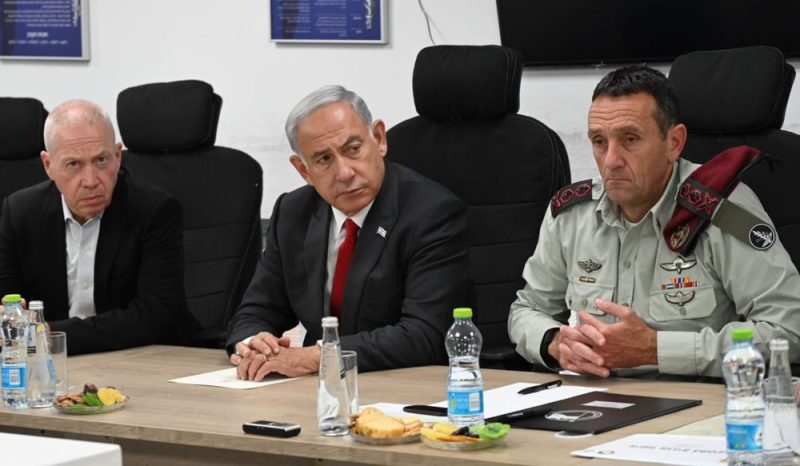
Netanyahu and his Minister of Defence, Yoav Gallant, who could both be on the official “wanted” list of the International Criminal Court (ICC) within weeks, could easily have chosen a different path, even for mere political manoeuvring. They could, for example, have delayed their Rafah operation or changed strategies, just to avoid further ICJ rulings on the matter. Instead, they went for the most arrogant and cowardly of choices: killing civilians.
Their 2000lb bunker-busting bombs dismembered and beheaded children as they lay beside their mothers in makeshift camps that have no water, no electricity and no food. While the Israeli army offered the world a clearly concocted version of what happened, blaming “militants” and such, Netanyahu’s office described the attack as a mistake.
Both versions, of course, were lies. The Israeli army possesses some of the most advanced surveillance technology in the world, thanks to US generosity and continued support. It could easily have distinguished between a Palestinian Resistance operational area and a refugee camp filled with children and women.
If the attack was indeed a mistake, what explains the other massacres that followed, also in Rafah and in nearby Mawasi, which killed and maimed scores of refugees? And what is the logic behind the killing and wounding of nearly 130,000 Palestinians since the start of the war on 7 October, the majority of whom were women and children?
The Tents Massacre was neither a mistake, nor can it be blamed on imaginary militants operating from inside displaced refugees’ tents. Nevertheless, Netanyahu did have his own logic. For a start, he wanted to send a direct message to let the ICJ know that Israel is not perturbed by its direct order to end the Rafah operation. The intended audience of this message was not necessarily the ICJ judges, but the international community, which remains, despite its solidarity rhetoric, ineffectual in influencing the duration, direction or nature of the Israeli war.
Netanyahu also wanted to score cheap political points against his rivals in his War Cabinet, by presenting himself as the bold Israeli leader who is standing up to the whole world. He has stated over and over again that “[the Jewish people] will stand alone.”
The Israeli leader must also have been informed that more Israeli soldiers had been captured by the Palestinian Resistance. The latter’s statement about this on 25 May was issued just one day before Netanyahu attacked Rafah. From a military point of view, the capturing of more soldiers who were sent to Gaza supposedly to free other Israeli captives should have been a “game over” moment.
The Gaza Resistance hasn’t released any more information since the initial, brief statement by Al-Qassam military spokesman, Abu Obeida. Hamas is known for releasing information to the public when it is strategically most opportune to do so, as was the case in its announcement that it is holding Israeli Colonel Asaf Hamami, who Israel declared to be dead last December.
Netanyahu and his army are trying desperately to pre-empt the angry reaction in Israeli society about the capture of soldiers by keeping the news focused on Rafah. He knows that such massacres widen his circle of support among his extreme far-right constituency.
Moreover, the timing of the massacre was also a message to the US, the mediators (Egypt and Qatar), Hamas and even members of the War Cabinet who are keen on ending the war through a truce agreement. Media reports have spoken about a potential breakthrough in talks, starting in Paris before moving to Doha, which showed some willingness on the part of Israel to link the release of prisoners to a permanent truce.
Such an agreement would be considered a defeat from Netanyahu’s point of view, and would certainly usher in the end of his political career. Hence, he simply lashed out against the refugees of Rafah with the hope of disrupting any potential deal in Doha.
It was for the same reason that his troops opened fire at Egyptian soldiers at the Rafah Crossing, killing one, possibly two, and wounding more. Egypt has been an important mediator in the truce talks. Attacking the mediator is not only humiliating for the Egyptian government, but for the army and Egyptian people as well.
Although Netanyahu has no strategy for the war itself, he has a strategy for prolonging his own political survival. It is predicated on mixing the political cards, ensuring chaos and carrying out constant massacres against civilians, all safe in the knowledge that Washington will always remain on his side no matter what. The Israeli leader is just buying time, though. Israel’s top generals and military experts and analysts know that the war has been lost and that prolonging it will not, in any way, alter its predictable outcomes.
Two Egyptian soldiers martyred in clashes with Israelis: Reports
Al Mayadeen | May 27, 2024
The Israeli Channel 13 reported an extremely unusual incident between the Israeli occupation forces and the Egyptian Army on the border in the Rafah border crossing area, adding that the incident comes at the peak of tensions and noting that the incident may have significant political consequences.
In turn, Israeli Channel 14 stated that Egyptian soldiers fired shots on their own accord at Israeli soldiers along the Rafah crossing and claimed that there were no injuries reported.
Moreover, Israeli media claimed that the Israeli occupation forces responded by firing warning shots, and it was confirmed that the military censorship of the Israeli occupation forces retracted all news about the incident between the Egyptian and Israeli occupation forces at the Rafah crossing.
However, the Israeli KodKod news site said there were no injuries among the Israeli occupation forces but two Egyptian soldiers had been killed in the incident.
The Israeli Ynet newspaper, meanwhile, claimed that only one Egyptian soldier was killed and several others were wounded in the cross-border confrontation.
Al Mayadeen’s correspondent reported that an agreement was reached to form a committee to investigate the incident between the Egyptian army and the Israeli occupation at the Rafah crossing.
The spokesperson of the Israeli occupation forces said an investigation was ongoing regarding the cross-border incident amid contacts with the Egyptian side.
EU joins IMF, Gulf states funneling billions into Egypt as Gaza refugee crisis looms
The Cradle | March 14, 2024
The EU is preparing a €7.4 billion ($8 billion) aid package for Egypt, citing “concerns” that the Israeli genocide in Gaza and the ballooning crisis in Sudan could “risk exacerbating financial troubles in the North African nation and raising immigration pressure on Europe,” according to a report by the Financial Times (FT).
European Commission president Ursula von der Leyen is set to visit Cairo on 17 March alongside the Greek, Italian, and Belgian prime ministers to “finalize and announce the agreement.”
Completion of the deal accelerated following the start of Israel’s campaign of genocide in the Gaza Strip. The terms of the agreement reportedly include support for Egypt’s energy sector, assistance to deal with the rising number of refugees entering the country, and help to fortify the country’s border with Libya.
An estimated €1bn in emergency financial assistance could be paid immediately to Cairo, while another €4 billion in “macro-financial assistance” hinges on implementing reforms under an expanded loan program with the International Monetary Fund (IMF). Officials told FT the rest of the funds would be drawn from various EU funding streams.
The funds from Brussels is the latest in a recent string of investment packages coming from the west and Gulf states for cash-strapped Egypt.
“With respect to the question on the potential impact pressures from refugees from Gaza, what we do see in Egypt is that there is a need to have a very comprehensive support package for Egypt. And we’re working … to ensure that Egypt does not have any residual financing needs,” IMF spokesperson Julie Kozack said on 22 February.
The IMF agreed just days later to expand its financial rescue program for Egypt to $8 billion after the Egyptian central bank let loose its currency to help stabilize the economy. Egypt is the second most indebted country to the IMF, behind only Argentina, with an international debt that grew from $37 billion in 2010 to $164 billion in 2023.
In late February, UK oil giant BP announced plans to develop gas projects and drilling in Egypt over the next three to four years at a cost of $1.5 billion. This came just after the North African nation sealed a massive $35 billion real estate development deal with the UAE, which will see Emirati investment vehicle ADQ build a 170 km tourism and financial center in the Ras al-Hekma area.
In recent weeks, Cairo has also been in discussions to sell prime Red Sea coastal land near Sharm al-Sheikh to Saudi investors.
The unprecedented windfall comes as Egypt is putting the finishing touches on a kilometers-wide buffer zone and wall along its border with southern Gaza, allegedly in preparation to take in hundreds of thousands of displaced Palestinians once the Israeli ground invasion of Gaza’s southernmost city begins.
Amnesty International and other NGOs have also accused Cairo of “harassing” the director of the UK-based Sinai Foundation for Human Rights, which revealed the construction of the buffer zone last month.
Geopolitical analysts, including The Cradle’s Mohamad Hassan Sweidan, have speculated that Egypt may be willing to accept refugees from Gaza in exchange for a significant offset of its staggering debt.
Imperial Assisted Suicide

By John Weeks | The Libertarian Institute | March 11, 2024
The United States Imperial Government (USIG) claims to be keeping the peace, underwriting the liberal, rules-based international order and safeguarding the global security architecture. This is not true. What the USIG is actually doing is killing people, helping get lots of people killed, and assisting foreign states as they commit corporate suicide. Israel’s ongoing, “plausibly genocidal” slaughter in Gaza and the West Bank is the latest example of this.
The United States is an empire and empire is murder-suicide. Since 9/11, U.S. soldiers have directly killed more than 400,000 civilians and indirectly contributed to the deaths of more than four million civilians. Meanwhile, more soldiers who served in the U.S. government’s Global War On Terror have committed suicide than have been killed in combat. Four times more.
The American People have not escaped suffering as the USIG and its empire have dished out catastrophic devastation in Afghanistan, Somalia, Iraq, Pakistan, Egypt, Yemen, Libya, Syria, and Mali. The cost of living has exploded. Our infrastructure is in shambles. Public trust in government has collapsed. The military’s “recruitment landscape” is in free fall. And things are so bad at home the government has found a new job: attacking “tent cities” filled with “under-sheltered” people. Murder-suicide.
Then there are the vassal or “client” states. In the propaganda, the empire defends these states from…whatever. But in reality, it helps these states murder people all while creating the conditions for these states to kill themselves. This has been demonstrated recently in Afghanistan (state committed suicide), Ukraine (state is trying to commit suicide) and Israel (state is thinking about committing suicide).
In October, 2001, the USIG invaded Afghanistan and smashed the Taliban-controlled state. In its place was installed a new state with a new military, which Libertarian Institute Director Scott Horton describes:
“The new regime was also largely a coalition government of ethnic minorities, the Tajiks, Uzbeks, and Hazaras, being leveraged against the 40 percent plurality Pashtuns, dominant in the east and south of the country where the Taliban are from.”
This coalition regime could not exist without billions of U.S. dollars in its coffers, U.S. boots on the ground, and U.S. air power in the sky. As predicted by Horton, as soon as U.S. forces began their withdrawal from Afghanistan, the Afghan state (along with its military) immediately killed itself. The Taliban resurrected their state which the U.S. had smashed almost twenty years earlier.
In February 2014, the USIG backed a violent, neo-Nazi led coup in Ukraine. Instead of smashing the entire state, the coup overthrew President Viktor Yanukovych’s administration. Unlike Afghanistan’s anti-Taliban government in a box, the Ukrainian government under new management was capable of existing without a massive U.S. military presence. It was not, however, capable of winning a war with Russia. It took eight years, but the USIG managed to provoke a war with Russia.
Ukraine has been defeated but the imperial wizards in DC refuse to admit this truth and seek peace. There could have been a peace deal two years ago, when it was still fashionable for Americans to fly the Ukrainian flag outside their front doors, but the USIG crushed it. The Ukrainian state is bleeding out and continuing the war at this point puts the entire Ukrainian nation at risk. Russia could seize all of Ukraine and downgrade it from sovereign nation to a Russian aircraft carrier.
Israel has been fortunate to never have its state murdered or regime changed by the USIG. Quite the opposite; Israel has intervened in USIG affairs to a shocking extent. The Israel lobby wields massive influence in Washington DC, so much so that President Joe Biden is risking his re-election chances by refusing to stop producing Israel’s “plausibly genocidal” mass killing spree in Gaza.
This gleeful and live streamed spree of sadism has not been good for Israel. Its state is provoking the global community to view it as a deranged pariah, including the great powers of Russia and China. Even within America, the people want a ceasefire. We want it to stop.
Meanwhile, Israeli society is cracking. Approximately 200,000 Israelis have been displaced from their homes in the south and north of the country. The IDF has suffered thousands of casualties, the economy is destabilized, and fear has blanketed the land.
And now Israel is planning an invasion of southern Lebanon. Such an invasion would be a hoped for but unexpected gift to Hamas. Experts such as Col. Douglas Macgregor, Col. Lawrence Wilkerson, Lt. Col Daniel Davis, Alastair Crooke, John Mearsheimer and Robert Pape have all warned against the invasion. They have argued that Israel risks catastrophic fallout from such a move, from mass causalities to provoking a regional war and even suffering strategic defeat.
Israel supporters seem confident in its security state, despite its massive failure on October 7. Tel Aviv appears to be operating with the assurance that the U.S. military will step in with strike packages and boots on the ground if and when needed. And yes, DC will let American cities die while it views Israel as too big to fail.
But the empire is beset by incompetence and anyone who paid attention to the self-immolation of the Afghan state and the slow suicide of the Ukrainian state knows this isn’t going to end well.
Taiwan, watch your six.
Buffer zone in Sinai: Is Sisi preparing to displace the Palestinians?
By Osama Gaweesh | MEMO | February 22, 2024
Israeli military, intelligence bodies admit Hamas will survive onslaught on Gaza Strip
Press TV – February 18, 2024
Israeli military and intelligence institutions have warned the regime’s top-ranking authorities that the Palestinian Hamas resistance movement will survive the unrelenting ground and air strikes against the besieged Gaza Strip.
A document circulated from Israeli military leaders to senior politicians states that “authentic support remains” for Hamas among Gazans, according to a report published by the Hebrew-language Keshet 12 television channel.
The document, put together by the Israeli army’s research division, also warned that “Gaza will become an area in deep crisis”, given the lack of plan for the “day after” war.
The document was reportedly presented on Monday to leading Israeli officials following a week of senior military and intelligence talks about the findings, Keshet 12 noted.
Ilana Dayan, an investigative journalist at the broadcaster, said that the “bottom line” of the document was that the Hamas movement would inevitably survive Israel’s offensive.
The report comes as Israel prepares a ground offensive on Gaza’s southernmost city of Rafah.
The UN special rapporteur on Palestine has slammed Israeli prime minister Benjamin Netanyahu’s pledge to push on with the assault.
“Rafah stands as the last line of Palestinian existence in Gaza, amidst the relentless anguish faced by the people trapped therein,” Francesa Albanese wrote on X.
“How can we possibly allow another Nakba? Have we really lost our minds?”
According to diplomatic sources quoted by the AFP news agency, the UN Security Council is set to put to vote a new resolution put forth by Algeria that demands an “immediate” truce in Gaza.
The latest version of the text “demands an immediate humanitarian ceasefire that must be respected by all parties”, the agency said.
It also “rejects forced displacement of the Palestinian civilian population”, and it “demands the immediate and unconditional release of all hostages”, AFP reported.
Earlier, US Ambassador to the UN Linda Thomas-Greenfield issued a statement responding to reports that Algeria plans to put the resolution to a vote on Tuesday.
“Should it come up for a vote as drafted, it will not be adopted,” Thomas-Greenfield said.
The US has previously used its veto to prevent the UN Security Council from passing resolutions calling for a ceasefire in Gaza.
Meanwhile, Egypt’s President Abdel Fattah el-Sisi has reiterated his country’s “categorical rejection of the displacement of Palestinians to Egypt in any shape or form”.
During a phone conversation with his French counterpart Emmanuel Macron on Saturday, the two leaders agreed on the need to “stop the bloodshed” in the Gaza Strip and discussed advancing the establishment of an independent sovereign Palestinian state, a statement by the Egyptian presidency read.
Israel has been waging the war against Gaza since October 7, 2023, when the coastal sliver’s resistance groups staged an operation, dubbed Operation al-Aqsa Storm, against the occupied territories.
Nearly 29,000 Palestinians, mostly women, children, and adolescents, have been killed so far as a result of the brutal military onslaught.
Egypt builds ‘buffer zone’ in Sinai as 1.4 million Gazans face displacement: Report
The Cradle | February 15, 2024
The Egyptian government has started building an “isolated security zone” in the eastern Sinai Desert on the border with the Gaza Strip that would serve as a buffer zone for Palestinian refugees if they are forced out of Rafah by the Israeli army, according to the Sinai Foundation for Human Rights.
Local contractors told the rights group that the construction work was commissioned by the Sons of Sinai Construction and Building Company, owned by businessman Ibrahim al-Arjani, a former warlord from the Tarabin tribe in northern Sinai who holds close ties with the family of Egyptian President Abdel Fattah el-Sisi.
The construction work aims to “create an area surrounded by walls seven meters high, after removing the rubble of indigenous homes that had been destroyed.” The construction is expected to be completed in under 10 days and is supervised by the Egyptian Armed Forces Engineering Authority, with a heavy security presence.
“This morning, the Foundation’s team … monitored the construction of a seven-meter-high cement wall, starting from a point in the village of Goz Abu Waad, south of the city of Rafah, and heading north toward the Mediterranean Sea, parallel to the border with the Gaza Strip,” the Sinai Foundation said on 14 February.
“The construction work seen in Sinai along the border with Gaza – the establishment of a reinforced security perimeter around a specific, open area of land – are serious signs that Egypt may be preparing to accept and allow the displacement of Gazans to Sinai, in coordination with Israel and the United States,” Muhannad Sabry, a researcher in Sinai affairs and security in Egypt, told the Sinai Foundation.
Earlier this month, Egyptian journalist Ahmed el-Madhoun shared a video showing workers strengthening the security wall separating Egypt and Gaza. Since the outbreak of the war on 7 October, Cairo has constructed a concrete border topped with barbed wire and extending six meters into the ground.
Cairo recently boosted its military presence on the Gaza border, citing fears of a spillover of Israel’s ethnic cleansing campaign onto its territory once the ground invasion of Rafah begins. Western media has also quoted Egyptian officials as saying that the government considered suspending the 1978 Camp David Accords if Palestinians were forcibly displaced into the Sinai Desert.
Nevertheless, Israel’s Army Radio reported over the weekend that Cairo informed Tel Aviv that they will not object to a military operation in Rafah as long as it is conducted without harming Palestinian civilians. Other Israeli outlets, as well as the New York Times, have reported Egyptian officials expressing fears that any influx of Palestinians could lead to a resurgence of “Islamist militancy.”
Israeli officials have repeatedly made clear their desire not only to defeat Hamas but also to force Gaza’s 2.3 million citizens to flee to Egypt or other countries as refugees. Those statements coincided with explicit plans to annex Gaza and build settlements for Israeli Jews over destroyed Palestinian homes.
Israeli settler groups and Knesset members recently held a conference to discuss building Jewish settlements in Gaza once its indigenous inhabitants have been ethnically cleansed.
Henry Kissinger and his legacy as a war criminal

Press TV – January 11, 2024
Henry Kissinger was one of the most influential US statesmen of the 20th century, who shamelessly used his position to manipulate the United States into providing unequivocal support to Israel.
As a hardcore Zionist, Kissinger was incredibly Machiavellian, but unlike his modern-day equivalents, he was not stupid and he certainly was not demented. Kissinger was also the architect of some of the 20th century’s worst human rights abuses and war crimes.
Henry Kissinger, his life and legacy
The passing of a war criminal, the death of Henry Kissinger at 100 years old marks the end of a bloody life.
Kissinger is well known for his role in engineering the coup that brought General Pinochet to power in Chile and overthrowing the democratically elected leader, Salvador Allende.
Kissinger’s fingerprints were all over the wars from Vietnam to Cambodia to East Timor to Bangladesh.
Less well known though, is Kissinger’s role in the neutralization of Egypt as an effective actor in the struggle against Zionism and the marginalization of Palestinians by regional allies.
It’s fair to say you would not have the same level of Egyptian complicity that you have today, including the genocidal blockade on Gaza at the Rafah crossing, without Kissinger’s work to subvert the powerful Arab state.
As Secretary of State under Richard Nixon, Kissinger was intimately involved in saving Israel in the 1973 war of attrition fought by Syria, Egypt, and Libya against the settler entity.
When the Zionists suffered consecutive losses, Kissinger and Nixon organized the emergency supply of weapons to the entity in a move known as Operation Nickel Grass.
The operation consisted of the US Air Force Military Airlift Command, delivering 22,325 tons of tanks, ammunition, and military equipment, over 32 days, directly to the battlefield.
Following the war, Egyptian leader Anwar Sadat sent a secret message to Zionist Prime Minister Golda Meir: “When I threatened war, I meant it; when I talk of peace now, I mean it. We have never had contact before, We now have the services of Dr. Kissinger. Let us use him and talk to each other through him”, asserted Sadat.
It was Kissinger who took Sadat under his wing and convinced him of the benefit of normalizing with the temporary entity. This work culminated with the visit of the Egyptian leader to the Israeli parliament, where he addressed the Israeli political elite, stating his desire for peace with the entity.
The infrastructure of collaboration that was set up during his time remains in place. When marking the death of Kissinger, Israeli President, Isaac Herzog, credited the former US Secretary of State with laying the cornerstone of the peace agreement between Egypt and the Zionist entity.
Israel lobbyist and former US ambassador to Israel, Martin Indyk, wrote a book about Kissinger’s political career with a special concentration on his services to Israel in 1981.
In reference to his diplomatic work in the Middle East, Kissinger asserted that his main objective was to isolate the Palestinians.
The truth is that Palestinians are not isolated, and support for them has outlived Henry Kissinger.
Gaza destroys western divide-and-rule narratives
By Sharmine Narwani | The Cradle | January 4, 2024
It could be a clean sweep. Decades of western-led narratives crafted to exploit differences throughout West Asia, create strife amid the region’s myriad communities, and advance western foreign policy objectives over the heads of bickering natives are now in ruins.
The war in Gaza, it transpires, has blown a mile-wide hole in the falsehoods and fairytales that have kept West Asia distracted with internecine conflicts since at least the 1979 Islamic Revolution in Iran.
Shia versus Sunni, Iran versus Arabs, secular versus Islamist: these are three of the west’s most nefarious narrative ploys that sought to control and redirect the region and its populations, and have even drawn Arab rulers into an ungodly alliance with Israel.
Facts are destroying the fiction
It took a rare conflict – uncooked and uncontrolled by Washington – to liberate West Asian masses from their narrative trance. Israel’s genocidal assault on Gaza also brought instant clarity to the question of which Arabs and Muslims actually support Palestinian liberation – and which do not.
Iran, Hezbollah, Iraqi resistance factions, and Yemen’s Ansarallah – maligned by these western narratives – are now visibly the only regional players prepared to buttress the Gaza frontline, whether through funds, weapons, or armed clashes that aim to dilute and disperse Israeli military resources.
The so-called ‘moderate Arabs,’ a misnomer for the western-centric, authoritarian Arab dictatorships subservient to Washington’s interests, have offered little more than lip service to the carnage in Gaza.
The Saudis called for support by hosting Arab and Islamic summits that were allowed to do and say nothing. The Emiratis and Jordanians trucked supplies to Israel that Ansarallah blockaded by sea. The mighty Egypt hosted delegations when all it needed to have done was to open the Rafah Crossing so Palestinians can eat. Qatar – once a major Hamas donor – now negotiates for the freedom of Israeli captives, while hosting Hamas ‘moderates,’ who are at odds with Gaza’s freedom fighters. And Turkiye’s trade with the Israeli occupation state continues to skyrocket (exports increased 35 percent from November to December 2023).
Palestine, for the pro-west ‘moderate Arabs,’ is a carefully handled flag they occasionally wave publicly, but sabotage privately. So, they watch, transfixed and horrified today, at what social media and tens of millions of protesters have made crystal clear: Palestine remains the essential Arab and Muslim cause; it may ebb and flow, but nothing has the power to inflame the region’s masses like this particular fight between right and wrong.
The shift toward resistance
It is early days yet in the battle unfolding between the region’s Axis of Resistance and Israel’s alliances, but the polls already show a notable shift in public sentiment toward the former.
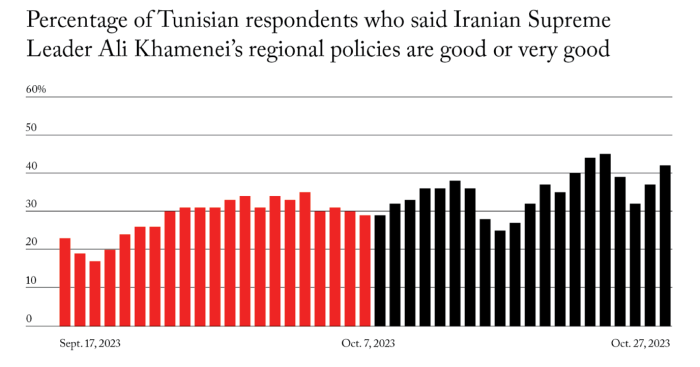
An Arab barometer poll taken over a six-week period – three weeks before and three weeks after the Al-Aqsa Flood operation – provides the first indication of shifting Arab perceptions. Although the survey was restricted to Tunisia, the pollsters argue that the country is “as close to a bellwether as one could imagine” and that it represents views similar to other Arab countries:
“Analysts and officials can safely assume that people’s views elsewhere in the region have shifted in ways similar to the recent changes that have taken place in Tunisia.”
The survey results should be of paramount concern to meddling western policymakers: “Since October 7, every country in the survey with positive or warming relations with Israel saw its favorability ratings decline among Tunisians.”
The US saw its favorability numbers plummet the most, followed by West Asian allies that have normalized relations with Israel. Russia and China, both neutral states, experienced little change, but Iran’s leadership saw its favorability figures rise. According to the Arab barometer:
“Three weeks after the attacks, Iranian Supreme Leader Ali Khamenei has approval ratings that matched or even exceeded those of Saudi Crown Prince Mohammed bin Salman and Emirati President Mohammed bin Zayed.”
Before 7 October, just 29 percent of Tunisians held a favorable view of Khamenei’s foreign policies. This figure rose to 41 percent according to the conclusion of the survey, with Tunisian support most notable in the days following the Iranian leader’s 17 October reference to Israel’s actions in Gaza as a “genocide.”

The Saudi shift
Prior to the 7 October operation by the Palestinian resistance to destroy the Israeli army’s Gaza Division and take captives as leverage for a mass prisoner swap, the region’s main geopolitical focus was on the prospects of a groundbreaking Saudi normalization deal with Tel Aviv. The administration of US President Joe Biden flogged this horse at every opportunity; it was seen as a golden ticket for his upcoming presidential election.
But Operation Al-Aqsa Flood ruined any chance for Saudi Arabia – home to Islam’s holiest sites – to seal that political deal. And with Israeli airstrikes raining down daily on Palestinian civilians in Gaza, Riyadh’s options continue to shrink.
A Washington Institute poll conducted between 14 November and 6 December measures the seismic shift in Saudi public sentiment:
A whopping 96 percent agree with the statement that “Arab countries should immediately break all diplomatic, political, economic, and any other contacts with Israel, in protest against its military action in Gaza.”
Meanwhile, 91 percent believe that “despite the destruction and loss of life, this war in Gaza is a win for Palestinians, Arabs, and Muslims.” This is a shockingly unifying statement for a country that has adhered closely to western narratives that seek to divide Palestinians from Arabs, Arabs among themselves, and Muslims along sectarian lines – geographically, culturally, and politically.
Although Saudi Arabia constitutes one of the few Arab states to have designated Hamas as a terrorist organization, favorable views of Hamas have increased by 30 percent, from 10 percent in August to 40 percent in November, while most – 95 percent – do not believe the Palestinian resistance group killed civilians on 7 October.
Meanwhile, 87 percent of Saudis agree with the idea that “recent events show that Israel is so weak and internally divided that it can be defeated some day.” Ironically, this is a long-stated Resistance Axis refrain. Hezbollah Secretary General Hassan Nasrallah was famously quoted as saying “Israel is weaker than a spider’s web,” upon its defeat by the Lebanese resistance on 25 May, 2000.
Prior to 7 October, Saudis had strongly favored economic ties with Israel, but even that number dropped dramatically from 47 percent last year to 17 percent today. And while Saudi attitudes toward the Resistance Axis remain negative – Saudi Arabia, after all, has been the regional epicenter for anti-Iran and anti-Shia propaganda since the 1979 revolution – that may be largely because their media is heavily controlled.
Contrary to the observations of the Arab masses, 81 percent of Saudis still believe that the Axis is “reluctant to help Palestinians.”
The Palestinian shift
Equally important to the discussion of Arab perceptions is the shift seen among Palestinians themselves since 7 October. A poll conducted by the Palestinian Center for Policy and Survey Research (PSR) in both the occupied West Bank and Gaza Strip between 22 November and 2 December mirrors Arab views, but with some nuances.
Gazan respondents, understandably, displayed more skepticism for the ‘correctness’ of Hamas’ Operation Al-Aqsa Flood, which triggered Israel’s genocidal assault on the Strip in which over 22,000 civilians – mostly women and children – have so far been brutally killed. While support for Hamas increased only slightly in the Gaza Strip, it tripled in the West Bank, with both Palestinian territories expressing near equal disdain for the western-backed Palestinian Authority (PA), which governs from Ramallah.
Support for acting PA President Mahmoud Abbas and his Fatah party was hit hard. Demands for his resignation are at nearly 90 percent, while almost 60 percent (the highest number recorded in a PSR poll to date in relation to this matter) of those surveyed want a dissolution of the PA.
Over 60 percent of Palestinians polled (closer to 70 percent in the West Bank) believe armed struggle is the best means to end the occupation, with 72 percent agreeing with the statement that Hamas made a correct decision to launch its 7 October operation, and 70 percent agreeing that Israel will fail to eradicate the Palestinian resistance in Gaza.
Palestinians have strong views about regional and international players, who they largely feel have left Gaza unprotected from Israel’s unprecedented violations of international law.
By far the country most supported by respondents is Yemen, with approval ratings of 80 percent, followed by Qatar (56 percent), Hezbollah (49 percent), Iran (35 percent), Turkiye (34 percent), Jordan (24 percent), Egypt (23 percent), the UAE (8 percent), and Saudi Arabia (5 percent).

In this poll, the region’s Axis of Resistance dominates the favorability ratings, while pro-US Arab and Muslim nations with some degree of relations with Israel, fare poorly. It is notable that of the four most favorable countries and groups for mostly-Sunni Palestinians, three are core members of the “Shia” Axis, while five Sunni-led states rank lowest.
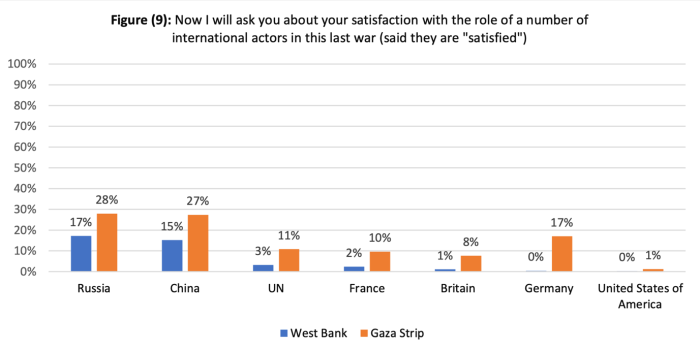
This Palestinian view extends to non-regional international states, with respondents most satisfied with Resistance Axis allies Russia (22 percent) and China (20 percent), while Israeli allies Germany (7 percent), France (5 percent), the UK (4 percent), and the US (1 percent) struggle to maintain traction among Palestinians.
The numbers depend on the war ahead
Three separate polls show that Arab perceptions have shifted dramatically over Israel’s war on Gaza, with popular sentiment gravitating to those states and actors perceived to be actively supporting Palestinian goals, and away from those who are perceived to support Israel.
The new year starts with two major events. The first is the drawdown of Israeli reservists from Gaza, whether because Washington demands it, or due to unsustainable loss of life and injury to occupation troops. The second is the shocking assassination of Hamas leader Saleh al-Arouri and six others in Beirut, Lebanon, on 2 January.
All indications are that Israel’s war will not only continue, but will expand regionally. The new US maritime construct in the Red Sea has drawn other international actors into the mix, and Tel Aviv has provoked Lebanon’s Hezbollah in a major way.
But if the confrontation between the two axes escalates, Arab perceptions will almost certainly continue to tilt away from the old hegemons toward those who are willing to resist this US-Israeli assault on the region.
There will be no relief for Washington and its allies as the war expands. The more they work to defeat Hamas and destroy Gaza, and the more they lob missiles at Yemen, Iraq, and Syria, and besiege the Resistance Axis, the more likely Arab populations are to shrug off the Sunni-versus-Shia, Iran-versus-Arab, and secular-versus-Islamist narratives that have kept the region divided and at odds for decades.
The swell of support that is mobilizing due to a righteous confrontation against the region’s biggest oppressors is unstoppable. Western decline is now a given in the region, but western discourse has been the first casualty of this war.
Jordan, Egypt renew rejection of Israel’s forced displacement plans
The Cradle | December 27, 2023
Egyptian President Abdel Fattah al-Sisi held a meeting with Jordan’s King Abdullah II in Cairo on 27 December, where they once again rejected Israel’s plans for forced displacement of Palestinians in both Gaza and the occupied West Bank.
In a joint statement, the two leaders announced their “complete rejection of all attempts to liquidate the Palestinian issue and forcibly displace Palestinians in the West Bank and Gaza.”
The statement also urged the international community to push for an immediate ceasefire in Gaza, and called for “uninterrupted delivery of sufficient humanitarian aid to Gaza” to alleviate the “tragic situation and the suffering of the people in the Strip.”
“The two leaders note the international community’s immense political and ethical responsibility towards implementing UN Security Council and General Assembly resolutions to maintain the integrity of these international entities,” the statement read.
Since the start of the war, aid has trickled into Gaza at a pace nowhere near fast enough to address the dire humanitarian situation. The US has also vetoed two UN resolutions urging for an immediate truce.
A resolution was passed on 22 December, after having been held up for days and watered down significantly at Washington’s insistence. The resolution made no mention of a ceasefire.
King Abdullah’s visit to Egypt comes days after Cairo proposed a ceasefire plan to reform Gaza’s government on a technocratic basis and gradually release Israeli prisoners in exchange for detained Palestinians and a withdrawal of Israeli troops from Gaza.
However, Hamas has rejected the proposal, which also failed to gain traction on the Israeli side.
Tel Aviv continues to push for a mass displacement of Palestinians from Gaza. Israel recently ordered more Palestinians to evacuate from Khan Yunis to areas further south, as tens of thousands of displaced are already stranded in the southern border city of Rafah.
The Cradle’s William Van Wagenen details in his recent analysis Israel’s longstanding goals to forcibly displace Gaza’s population into the Sinai Peninsula, occupy the Gaza Strip, and re-establish the Jewish settlement bloc that was evacuated in 2005.
In the occupied West Bank, violent Israeli settlers with Israeli government backing also continue to drive Palestinians from their homes in attempts to expel them to Jordan, a practice which has been ongoing for years.
A decades-old Israeli initiative known as the ‘Transfer Plan’ – originally formulated by the Zionist militias operating in Palestine, and then endorsed by the government of Israel post-1948 – calls for mass expulsion of Palestinians to the Sinai desert.
After Israel’s occupation of the West Bank in 1967, the idea of pushing Palestinians towards Jordan became included in the ‘Transfer Plan.’
Israel forced many Palestinians to migrate to Jordan over the years, particularly after 1967 and with the rapid expansion of illegal settlements across the occupied West Bank.
The ‘Transfer Plan’ was never officially implemented, and is a violation of UN Resolution 194, which was issued in 1948 and which legitimizes the right of return for Palestinian refugees expelled from their homes.
A joint Egyptian-Jordanian statement issued in late October this year rejected the transfer plan.
Russian aircraft for Iran and multipolarity
By Drago Bosnic | November 29, 2023
After months of speculation whether Iran would acquire Russian weapons, particularly advanced fighter jets, on November 28, Deputy Defense Minister of Iran Mehdi Farahi dispelled previous rumors about the deal supposedly falling through and confirmed that Tehran had finally inked the contract to procure Su-35 air superiority/multirole fighters, Yak-130 light fighter/advanced trainer jets and Mi-28 attack helicopters from Russia. The announcement comes amid an enormous increase in the already massive American military presence in the Middle East, which includes everything from carrier strike groups (CSGs) to fighter jets and even strategic bombers. The tensions have escalated significantly in the context of the ongoing Israel-Gaza conflict, prompting Iran to urgently modernize its aging fighter jet fleet.
Speculation about the acquisition has been ongoing since last year, specifically after Egypt withdrew from the deal to buy Russian jets. Cairo’s fear of getting on America’s bad side pushed it to stifle its sovereignty (and security), an opportunity that Tehran took to make a deal that would otherwise take years to finalize. Western sources have been speculating about the Su-35 deal with Iran even before the special military operation (SMO). Rumors about the acquisition continued throughout 2022, followed by speculation about the deal allegedly not going through. However, by September, it became clear that the military cooperation between Moscow and Tehran would include even more than Su-35 fighter jets, particularly after the Yak-130 light fighters/advanced trainers were spotted in Iran.
The Yak-130 can double as both attack jets and advanced trainer aircraft, but their primary role is the latter, meaning they were especially indicative of the deal going through. Namely, the Yak-130 is used as the stepping stone in flight training for pilots preparing to fly the Su-35. Getting advanced fighter jets for the Iranian Air Force (IRIAF) has been a point of contention for decades as the country was under a strict Western arms embargo that prevented any advanced weapons acquisitions. This had its perks, as it forced Tehran to develop a plethora of indigenous industries, including a very robust and highly cost-effective drone production, and now it’s clear that Tehran’s advanced military industry is perfectly capable of going toe to toe with the world’s most powerful countries in terms of developing and deploying unmanned systems.
However, despite these advances that also include a plethora of other weapons, such as surface combatants, transport aircraft and long-range SAM systems (mostly based on Russian designs), Iran is sorely lacking in the manned combat aviation compartment. This is hardly surprising, given that only a handful of countries in the world have fully indigenous aerospace industries. Even Asian giants such as China and India still rely heavily on Russia to acquire top-of-the-line aircraft, although their respective advances in this regard are certainly commendable. By getting the Su-35, Tehran is pushing the capabilities of the IRIAF well into the 21st century. Various reports indicate that at least 24 fighter jets have been ordered to replace the aging F-14 “Tomcats”, while there’s speculation that it would acquire over 60 in follow-up orders.
Almost the same could be said for the Mi-28 attack helicopter. The advanced Russian rotorcraft has very few equivalents abroad and would certainly revolutionize Iranian capabilities. Namely, Tehran currently relies on its ancient Vietnam War-era AH-1 “Super Cobra” attack helicopters which are decades behind technologically, even with the incremental upgrades and overhauls that the Iranian military has been applying. Reports indicate that Iranian forces operating in Syria were impressed by the performance of Iraqi and Russian Mi-28s in both Iraq and Syria, which was a major contributing factor to the decision to acquire them. The superb flight characteristics and armament of this Russian helicopter are rivaled only by the less conventional coaxial rotors-equipped Ka-52 “Alligator”.
It’s important to note that the ongoing procurement is of the utmost importance to the SCO (Shanghai Cooperation Organization) and BRICS+ frameworks. Namely, Iran is already a member of the former, while it’s poised to join the latter in just over a month. With the US escalating tensions in the region, the primary target of which is precisely Tehran, the belligerent thalassocracy is looking to disrupt multiple peace processes in the region. Attacking Iran seems to be a very tempting prospect for Washington DC, as it would effectively “kill two birds with one stone” by making both SCO and BRICS+ look “weak” and unable (or even unwilling) to defend their new members. The US very likely believes this could be a deadly blow to the rapidly emerging multipolar world that will inevitably dismantle the existing “rules-based world order.” By arming Iran, Russia is making sure that any such attack would not only be a costly endeavor, but also a failed one.
Drago Bosnic is an independent geopolitical and military analyst.
Featured Video

“Historic Russia”: The Land Putin Will Not Give Back
or go to
Aletho News Archives – Video-Images
Book Review
Why the War on Conspiracy Theories Is Bad Public Policy
By Kevin Barrett • Unz Review • February 1, 2019
 A Review of Conspiracy Theories and Other Dangerous Ideas by Cass Sunstein (based on an earlier paper co-authored with Adrian Vermeule); In Defense of Troublemakers: The Power of Dissent in Life and Business by Charlan Nemeth; and Conspiracy Theories and the People Who Believe Them, edited by Joseph E. Uscinski
On January 25 2018 YouTube unleashed the latest salvo in the war on conspiracy theories, saying “we’ll begin reducing recommendations of borderline content and content that could misinform users in harmful ways—such as videos promoting a phony miracle cure for a serious illness, claiming the earth is flat, or making blatantly false claims about historic events like 9/11.”
At first glance that sounds reasonable. Nobody wants YouTube or anyone else to recommend bad information. And almost everyone agrees that phony miracle cures, flat earthism, and blatantly false claims about 9/11 and other historical events are undesirable.
But if we stop and seriously consider those words, we notice a couple of problems. First, the word “recommend” is not just misleading but mendacious. YouTube obviously doesn’t really recommend anything. When it says it does, it is lying. … continue
Blog Roll
 Aletho News
- “Historic Russia”: The Land Putin Will Not Give Back
- How the Cambridge Analytica scandal still haunts Mark Zuckerberg
- The Ongoing Cancellation Campaign Against a Dissenting Academic in Norway
- Yemen and ‘the Houthis’: Challenging Sami Hamdi’s Narrative
- No, Christians did not invent Zionism
- AIPAC-led lobbying network opens branches in Cypriot, Greek parliaments
- Araghchi blasts ‘parasitic’ alliance as US taxpayers pay for Israel’s war on Iran
- Easy fix for Europe’s chaos? Stop fueling war against Russia
- Putin’s key remarks on peace talks and Europe’s ‘schizophrenia’
- Trita Parsi: Israel Set a Trap for Total War in the Region
- If Americans Knew
- An error has occurred; the feed is probably down. Try again later.
- No Tricks Zone
- E-Cars Reduce CO2 Emissions By Only 41% Compared To Internal Combustion Engine Vehicles
- Predictions Made By Renowned Climate Professor Over Past Decades Have Been Proven To Be Poor
- New Study Suggests Large Regions Of The Pacific Ocean Have Been Cooling For The Last 80 Years
- Germany’s Green Energy Debacle: High Energy Costs Force Kahla Porzellan to Close After 182 Years!
- New Study: 50 Years Of The Most Aggressive ‘Net Zero’ Policies Can Only Affect The Global Climate By 0.03°C
- US September “Heat” Was No Record…Many Records Set Decades Ago
- Latest European Green Energy Debacle; Portugal’s Largest Flagship Solar Park Insolvent!
- Green Energy Debacle: German Expert Professor Fritz Vahrenholt Warns Of Severe Economic And Social Consequences
- Two More Paleo Reconstructions Affirm Meters-Higher Sea Levels Across Ireland, Brazil 7000-6000 Years Ago
- New Study: Earth And Venus Surface Warmth Largely Explained By Convection And Lapse Rate, Not CO2 Or Radiation

