Washington threatens Egypt with Sanctions over Russian Su-35 fighter jet purchase
By Sarah Abed | November 18, 2019
Washington’s latest attempt to dissuade an ally from making arms deals with Russia came in the form of a letter sent on last Wednesday to Egyptian officials warning them that they could face sanctions if they continued with their $2 billion dollar Su-35 fighter jets contract.
In addition to sanctions, Secretary of State Mike Pompeo and Secretary of Defense Mark Esper warned Egyptian Defense Minister Mohamed Ahmed Zaki in Wednesday’s letter that “Major new arms deals with Russia would — at a minimum — complicate future U.S. defense transactions with and security assistance to Egypt.” The United States sends Egypt $1.3 billion annually in military assistance.
Russia has become one of Egypt’s major arms suppliers. This particular arms between Egypt and Russia for ten fighter jets was signed at the end of 2018, with delivery of the Su-35 Flanker-E air superiority fighter aircraft as well as weapons for the planes starting in 2020-2021.
In order to counter Russia’s expanding military influence in the Middle East and dissuade countries from buying Russian-made arms, the Countering America’s Adversaries Through Sanctions Act (CAATSA) was signed by President Donald Trump in August 2017. Countries that are trading with Russia’s defense or intelligence sectors could face secondary sanctions.
Russia estimates that since 2014 it has lost $760 million dollars in potential weapons sales due to the international sanctions sealing off the U.S. market.
However, the CAATSA is not limited to sanctioning Russia and those who purchase Russian-made weapons, this U.S. Federal law also imposes economic sanctions on Iran and North Korea.
The first case for secondary sanctions under CAATSA took place in September 2018 when sanctions were imposed by the Trump administration on the Chinese military for purchasing 10 Su-35 aircraft and S-400’s from Russia, also 33 people and entities were blacklisted due to links to Russian military and intelligence.
The second case would be Turkey’s purchase of Russia’s S-400 air defense system with the first delivery of its components having taken place in July of this year. As a result of going through with their purchase and delivery, Turkey was also suspended from participating in the F-35 program and the F-35 air systems it had already purchased are now under U.S. control.
Although requirements have been met for CAATSA to be enforced there is a gray area as to how, and to what extent the sanctions should be applied. A waiver is also in place that the president can use. Also, both the U.S. executive and legislative branches play a role in determining the action that would be taken against Turkey for doing business with Russian personnel targeted by sanctions.
India is paying close attention to how the US is reacting to Turkey’s purchase as they too have purchased Russia’s S-400 SAMS system which would put them in conflict with the CAATSA as well. However, relations between India and the United States are strong and the likelihood that a waiver will be used to avoid making India suffer collateral damage is likely.
For the past decade Russia has been expanding its military influence in the Middle East, much to the dissatisfaction of the United States. Russia and Egypt’s military and technical cooperation has been deepening and expanding for years. Both nations have repeatedly held joint naval and airborne counterterrorism exercises since 2015. From October 27th till November 7th of this year the Egyptian air force’s tactical training center near Cairo hosted joint Russian/Egyptian military drills dubbed Arrow of Friendship-1.
There’s even been speculation about the prospect of Russia setting up a military base in Egypt, due to the increase of Russian activity on Egyptian grounds. Just two years ago a draft agreement which would “allow each side to use the other’s airspace and air bases” was approved by Moscow and Cairo. Even though it didn’t specify setting up a military base it did set the ground for significant expansion in military cooperation between the two countries.
While the US fumbles around in the Middle East leaving death and destruction in its tracks, Russia has become the main peace broker. While maintaining good relations with all the major players in the region, Russia intervened militarily in Syria at the request of Syrian President Bashar Al Assad to fight terrorism and derail a strong regime-change plan by the Obama administration. Relations and business with Iran and Turkey have also increased.
Moscow knows that security in neighboring countries directly impacts its own and standing by allies will only help grow its influence and positive image in the Middle East and beyond.
UN finds: Morsi’s death ‘state-sanctioned arbitrary killing’

Press TV – November 9, 2019
A panel of UN experts have found that the detention conditions of former Egyptian president Mohamed Morsi may have directly led to his death in June.
Morsi was Egypt’s first democratically elected president. He was ousted in a military coup by current President Abdel Fattah el-Sisi in 2013. He’d been jailed for six years until his death in a Cairo court while on trial on espionage charges, which rights groups dismissed as trumped-up and politicized.
A statement by the Office of the United Nations High Commissioner for Human Rights on Friday said the experts concluded that conditions Morsi endured “could amount to a state-sanctioned arbitrary killing.”
They said he was in solitary confinement for 23 hours a day, denied medical care, lost vision in one eye and suffered recurrent diabetic comas.
“Dr. Morsi was held in conditions that can only be described as brutal, particularly during his five-year detention in the Tora prison complex,” the experts wrote.
“Dr. Morsi’s death after enduring those conditions could amount to a state-sanctioned arbitrary killing.”
The experts also warned that thousands more prisoners are “at severe risk” from “gross violations” in Egyptian prisons.
Senior members of Morsi’s former government welcomed the investigation and called on the UN to extend its probe to include the “suspicious circumstances” surrounding the death of Morsi’s son Abdullah in September.
Before he died, the 25-year-old Abdullah Morsi had been in touch with the UN to formally complain about his father’s death. He reportedly died of a heart attack on September 4, and was buried next to his father in Cairo.
“Abdullah died shortly after he privately gave crucial evidence about his father’s death to the United Nations,” Yehia Hamed, a former minister under Morsi, said in the joint statement.
“I was in close contact with Abdullah Morsi and I am convinced that it was his very brave work with the United Nations that led to his death.”
The UN experts also warned that thousands more prisoners in Egypt were enduring similar conditions, and their ‘health and lives’ may also be at severe risk.
The 67-year-old former president fainted during a court session on June 17 and died afterwards.
Last year, a report by a panel of UK legislators and attorneys had warned that the lack of medical treatment could result in Morsi’s “premature death.”
4 Sinai civilians killed after Egypt army bombs house
MEMO | October 21, 2019
At least four civilians have been killed and 12 injured after a bomb was dropped on a house in Abu Al-Araj, Sheikh Zuweid, on Saturday.
Ten-year-old Mohammed Masoud, 90-year-old Farha Ibrahim, 24-year-old Aya Juma Eid and 28 year-old Rania Juma Eid all died in the drone attack in Egypt’s northern Sinai Peninsula.
For years now the Egyptian government has waged a war on Sinai it says is against terrorism, but which locals say is a war on civilians aimed at systematically displacing them from their land.
In the last seven years 14 villages in Sheikh Zuweid have been razed by the Egyptian military. According to a Facebook post written by Sinai researcher Ahmed Salem:
There is no such thing as a random aerial bombing and there is no such thing as a flight that makes mistakes 20 times in the coordination and rockets directed with modern technologies, the error rate is almost zero; the village has 20 or 30 homes and you know them by name.
The aggression continues across the peninsula. Just one week ago a shell hit a truck carrying civilians from an olive farm to the city of Bir Al-Abd as they were travelling home, killing at least ten people from the same family. Six others were injured and taken to hospital.
Following the attack the Arabic hashtag “Al-Sisi kills Sinai residents” was one of the top trending in the country.
A photograph of a baby with cuts on his head circulated online – the only survivor after the rest of his family died.
According to activists, the Egyptian government has been trying to remove the population of Bir Al-Abed for months now. Locals fear it will become the next Rafah, a city along the border with Gaza that has been completely flattened and the population displaced.
On 30 September the Egyptian military killed a six-year-old boy and his father in a revenge attack after Daesh attacked the Toffaha military checkpoint in Bir Al-Abed.
Suleyman Abu Dabbous, who works in a petrol station, was on his way home with his son Karim, 24, and his six-year-old grandson when the army opened fire on the car.
Morsi’s son dies of alleged heart attack: Egypt
![Abdullah Morsi, the son of ousted Egyptian president Mohamed Morsi is seen during the trial over the breaking up the Rabaa Al-Adawiyyah protests, at the police academy in Cairo, Egypt on December 10, 2016 [Moustafa Elshemy / Anadolu Agency]](https://i2.wp.com/www.middleeastmonitor.com/wp-content/uploads/2016/12/20161210_2_20616279_16846787.jpg?resize=1200%2C800&quality=75&strip=all&ssl=1)
Abdullah Morsi, son of ousted Egyptian president Mohamed Morsi, during the trial over the break up the Rabaa Al-Adawiyyah protests in Cairo, Egypt on December 10, 2016
[Moustafa Elshemy / Anadolu Agency]
MEMO | September 5, 2019
The youngest son of late Egyptian President Mohammed Morsi died of an alleged heart attack Wednesday at a hospital in Cairo.
A Morsi family sourceconfirmed Abdullah Morsi’s death to news agencies. However, the Egyptian Health Ministry has yet to comment on his death.
Abdallah Mursi, 24, began to feel spasms while driving in Cairo with a friend and died shortly afterwards, his brother Ahmed told Reuters.
Mohammed Morsi, Egypt’s first democratically elected president, died in June while standing trial for politically-motivated charges.
Days after his father died, Abdullah identified several figures, including current Interior Minister Mahmoud Tawfiq, his predecessor Majdi Abdel Ghaffar as well as Mohamed Shereen Fahmy, the judge who oversaw the ex-president’s trial, as “accomplices” in the “assassination of the martyr, President Morsi”, Middle East Eye reports.
Morsi collapsed at a court session on 17 June after suffering six years in prison in solitary confinement where he was consistently denied access to medical care for his diabetes, hypertension and liver and kidney disease.
Morsi was elected president after the January 25 Revolution toppled Hosni Mubarak, but he was deposed by the military general turned President Abdel Fattah Al-Sisi one year later.
Despite claims from the Attorney General that Morsi was “transported immediately to hospital,” witnesses told the British newspaper the Independent that “no one bothered to help.”
“He was left slumped for while till the guards took him out. An ambulance arrived after 30 minutes. Other detainees were first to notice his collapse, they started shouting. Some of them, who are doctors, asked the guards to let them treat him or give him first aid,” said Abdullah Al-Haddad who was at the court to support his father and brother who were also on trial that day.
There are approximately 60,000 political prisoners in Egypt. Many have died from lack of access to appropriate medical care.
Israel: Netanyahu approved Germany-Egypt submarine deal for $142m discount
MEMO | August 28, 2019
Israeli Prime Minister Benjamin Netanyahu is facing new questions over his role in the so-called “Submarine Affair”, after reports emerged that he approved a deal between Egypt and Germany in order to secure a multi-million-dollar discount for Israel’s own naval purchases, not for “security reasons” as he previously claimed.
The affair – sometimes known by its case number 3000 – involves allegations that several of Netanyahu’s close associates lobbied senior Israeli defence officials to sign deals with German shipbuilding firm ThyssenKrupp. These associates are suspected of “skimming” millions of shekels off the top of the deals for their personal profit and are now being investigated for corruption.
These investigations revealed that one deal saw Egypt order two submarines and two anti-submarine warships from ThyssenKrupp. Though Germany does not require Israeli permission to sell its ships to other countries, it has traditionally refrained from doing so to give Israel dominance in the region.
However, on this occasion the Germany-Egypt sale reportedly went ahead without the approval of then Defence Minister, Moshe Ya’alon; instead, former Defence Ministry officials and aides to German Chancellor Angela Merkel claimed that Netanyahu had personally approved the deal.
Amidst the outcry that ensued, Netanyahu agreed to a rare TV interview to discuss the deal. “My reasons are security reasons and security reasons alone,” he told Israel’s Channel 12, “the State of Israel has secrets that only the prime minister knows and a handful of people”.
Now it has emerged that Miki Ganor – a former ThyssenKrupp sales agent in Israel and previously a state witness in Case 3000 – told corruption investigators that Netanyahu approved the sale to Egypt in exchange for a discount of half a billion shekels ($142 million) on the purchase of Israel’s sixth submarine from the German firm.
It was this discount which ensured that the Germany-Egypt deal went ahead, in the process securing a huge cut for Ganor and his associates, the Times of Israel explained, citing a report by Israel’s Channel 13 yesterday.

German Chancellor Angela Merkel greets Israeli Prime Minister Benjamin Netanyahu in Germany in February 2016
Ganor agreed to turn state witness in 2017, admitting to bribing a string of Israeli officials. He agreed to provide evidence for the prosecution in exchange for serving only one year in prison and paying a ten million shekel ($2.7 million) fine.
However, in a shock move, in March Ganor presented himself to Israel Police and asked to change his previous statement, despite standing by it during 50 meetings over the course of the investigation. Ganor instead claimed he had been pressured by the police into confessing.
The move was, however, reportedly prompted by Ganor’s discovery that signing a state witness agreement had put his name on an international banking blacklist, thereby blocking his access to tens of millions of shekels under his name in banks in Cyprus and Austria.
He was subsequently arrested for “obstructing an investigation with false information”. Later that month, Israel Police withdrew its state witness arrangement with Ganor, since recommending that he be charged with five counts of bribery and one count of receiving an illicit gift, in addition to six counts of money laundering.
However, as the Times of Israel explained, Ganor’s “testimony is still usable in court, and the part about Netanyahu’s reason for approving the submarine deal hasn’t been affected by [his] retraction of some of his testimony.”
Critics of Netanyahu have been quick to respond to the fresh allegations, particularly given the proximity of Israel’s upcoming general election, which is slated for 17 September.
De facto opposition leader and head of the Blue and White (Kahol Lavan) party, Benny Gantz, said in a statement that “it is unacceptable for the prime minister to carry out arms deals that affect the strategic balance in the region while being suspected of involving personal considerations”.
Blue and White number two Yair Lapid echoed this sentiment, accusing Netanyahu of “deflecting and lying as to why he approved the sale of advanced submarines to Egypt”. The former finance minister also called the affair the “worst corruption scandal in Israel’s history,” calling for a state inquiry into the allegations.
Netanyahu’s Likud party hit back at Blue and White – its biggest election rivals – for criticising the prime minister, labelling their statements “desperate attempts […] to revive this corpse [in order to] divert the public’s attention from the internal mess in their party”.
The prime minister does not seem to have issued his own statement on the revelations, only retweeting the Likud party’s statement.
READ ALSO:
Egypt Rejects Hamas’ Request for Haniyeh to Travel
Palestine Chronicle | July 12, 2019
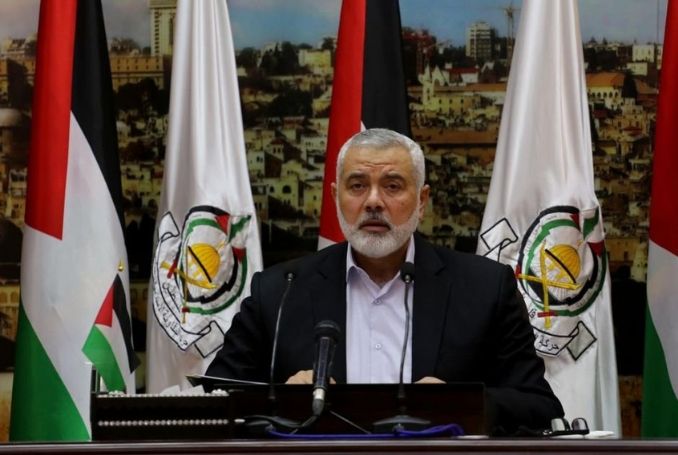
Egypt has rejected a request by Hamas to allow the head of its political bureau, Ismail Haniyeh, to travel to a number of countries including Iran, Turkey, Qatar, and Russia.
Al-Araby Al-Jadeed reported Egyptian sources as saying that after postponing its response, Cairo finally rejected it saying that regional and security conditions do not allow for Haniyeh to travel.
The news site quoted a Hamas source as saying:
“It is clear that Egypt completely objects to Haniyeh’s foreign tour, in protest against the countries which he will visit.”
The source pointed out that Hamas has decided that Mousa Abu Marzouk will head the movement’s delegation to Moscow next week to discuss the Palestinian reconciliation file among other issues.
The source added that the visit has been postponed more than once in the hope that Egypt would allow Haniyeh to travel.
Israeli ‘solution’ for Gaza includes massive military offensive and move to Sinai
MEMO | July 1, 2019
Two Israeli officials have proposed a “solution” for the Gaza Strip which includes another massive military offensive against the enclave and moving the Palestinians to Egypt’s Sinai Peninsula, Arabi21.com reported on Sunday. The end of the government led by Mahmoud Abbas is also suggested in a report published by the Jerusalem Institute for Public and State Affairs.
The purpose of the proposal is to make the humanitarian crisis in Gaza even worse, prompting a military confrontation. Its authors are Shimon Shapira, a former military secretary to Israel’s Prime Minister, and Shlomi Fogel, an official who has proposed numerous initiatives related to the Arab world. The phase which would follow the offensive would be based on economic and commercial development for Sinai backed by Egypt.
According to Shapira and Fogel, Gaza is still a crisis issue for Israel and the international community. They refer to a report issued by the International Bank in 2018 which said that Gaza’s economy is failing.
Saving Gaza will not be easy, the report claims, because Hamas, which controls Gaza, is seen by the US, EU and Israel as a “terrorist group”, while its ideological parent, the Muslim Brotherhood, is also regarded as a “terrorist” movement by a number of Arab states. Furthermore, the Gaza Strip and its residents have faced three massive Israeli military offensives against the largely civilian population since Hamas won the last Palestinian elections in 2006 and took full control of the coastal territory a year later.
The report describes the failure to deal with Gaza as a “ticking bomb”, not only for Israel, but also for the other countries in the region, including Egypt. It suggests an international aid package for Egypt coming mainly from the US and Gulf States to develop the infrastructure in Sinai. This, it is proposed, will help Egyptian workers by giving them work and improving their life, and will, it is believed, deter them from joining Daesh or attacking the Egyptian army. Workers from Gaza will also benefit.
As well as developing the port at El-Arish, Shapira and Fogel suggest the building of an airport for goods and passenger transport, as well as a new power plant run on Egyptian natural gas, a desalination plant and a railway from Gaza to the North Sinai coastal city.
Egypt’s NileSat halts broadcast of Press TV, other Iranian channels: Saudi media
Press TV – June 25, 2019
Saudi media say Egyptian-owned satellite firm NileSat has halted the broadcast of three Iranian TV channels, including English-language Press TV news network, in yet another attack on media freedom.
The Arabic-language Saudi daily newspaper Okaz, citing an informed source, said Sunday that the regional satellite provider halted the broadcast of Press TV as well as entertainment and movie channels of iFilm in English and Arabic languages.
Earlier, some informed sources had reported that Arab satellite companies had agreed to cancel their contracts with Iranian media outlets in the region.
The move by the Arab alliance was claimed to be a response to the networks’ “spread of rumors and creation of division.”
It is not the first time that Iranian television channels come under attacks by Arab and European satellite firms.
Egypt — a close Saudi ally — is party to a Riyadh-led coalition waging a bloody military campaign against Yemen. The Saudi regime and its allies are especially outraged by Iranian media’s wide coverage of the crimes being committed against Yemeni people, among other issues.
Since its launch in 2007, Press TV has been using a wide range of platforms, from TV broadcast and website to social media, to offer its audience a fresh view of world news, with a focus on developments in the Middle East’s conflict zones.
In April, Press TV’s verified YouTube account — along with the page of Iran’s Spanish-language Hispan TV — was blocked with no prior notice by tech giant Google.
The move came as the US stepped up its pressure campaign against Iran with the backing of Saudi Arabia and other repressive Persian Gulf Arab regimes. Washington is the main sponsor of the Saudi-led war on Yemen.
The Economic Entrails at the Heart of the ‘Deal of the Century’
By Alastair Crooke | Strategic Culture Foundation | June 25, 2019
It is nothing new to say that the ‘Deal of the Century’ is – and always was – in essence an economic project. Indeed, it seems that its political ramifications are viewed by the White House as little more than the ineluctable consequences to an a priori economic architecture, already in the process of being unfolded.
In other words, it is the economic facts on the ground that are intended shape the political outcome — an attenuated political landscape that anyway has been minimised by Trump’s pre-emptive removal of key pieces of any Palestinian negotiating leverage.
The financial squeeze on the Palestinians is well attested. On the one hand, the Palestinian Authority (historically dependent on Saudi subvention) is gently slipping into bankruptcy; whilst Gaza is held in virtual abject dependency through the drip-feed of subventions channelled into Gaza by Qatar, with Israeli permission — the size of this latter monthly ‘lifeline’ subvention being carefully adjusted by Israel according to what it judges to be the norms of (generally Hamas) ‘good conduct’.
So, on the one hand there is the financial siege that is intended to make the Palestinians pliant to the ‘quality of life package’ which the ‘deal’ is supposed to bring — the Bahrain summit later this month being its shopfront. But there is another less well recognised side to the Deal which is summarised in the title to a McClatchy article entitled, White House sees Egyptian energy forum as a ‘roadmap to Middle East peace’.
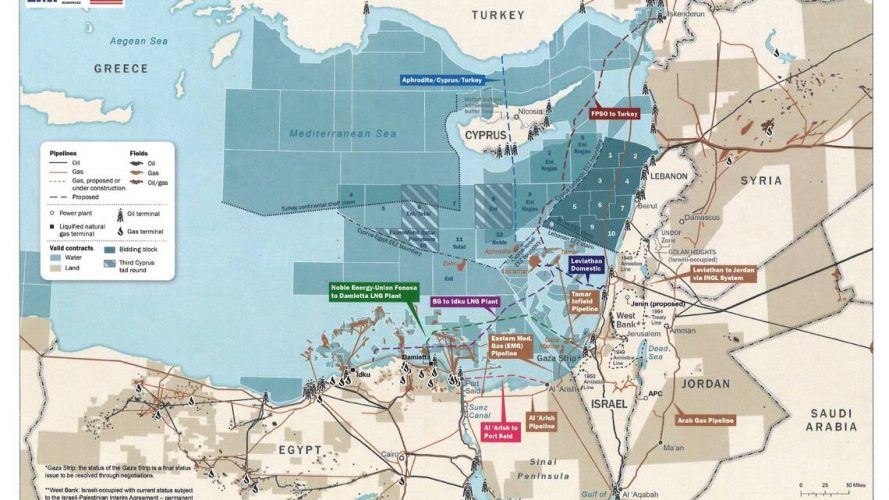
In a later piece, McClatchy publishes the newly declassified map of the US East Mediterranean energy ‘roadmap’. And here the fuller picture becomes clear: the US sponsored ‘gas forum’, “according to three senior administration officials, that map [the] declassified one, obtained by McClatchy – has motivated members of the [US] National Security Council to prioritize the formation of a gas forum in the Eastern Mediterranean that would simultaneously boost and entangle the economies of several countries that have been at odds for decades”.
Well, let’s translate that little euphemism: ‘boost and entangle’. What that formula translates into is — the means to integrate Israel into the economic regional sphere is firstly, through energy. Yet, it is not intended to integrate Israel alone into this Egyptian economic sphere, but also to make Jordan, the PA (and maybe even Lebanon), too, partially dependent on Israeli energy – alongside putative partners, Italy, Greece, and (the Greek-linked part) of Cyprus — with the US offering to help flesh out the structure of the ‘gas forum’ with U.S. expertise.
This is the heart of ‘the deal’. Not just political normalisation for Israel into the region, but the making of economic dependency of the Egyptians, Palestinians, Jordanians (and possibly – but not so likely – Lebanon) on the US East-Med gas ‘hub’.
Source: McClatchy
And, inevitably there is a sub-plot to all this, (as McClatchy notes):
“On this front, the administration enjoys support from unlikely allies. Eliot Engel, the Democratic chairman of the House Foreign Affairs Committee … said the Mediterranean gas forum project was a strategic opportunity for the U.S. to stymie Russian influence efforts over local energy resources. “I think that [Russian President Vladimir] Putin and Russia can’t and should not be able to control the situation,” Engel stated”.
So, the US Administration is pursuing two bipartisan congressional efforts to ‘stymie’ Russia in the region: One is a bill promoting energy partnerships in the Eastern Mediterranean; and a parallel bill which threatens to sanction European firms supporting the construction of the Nord Stream 2 pipeline taking Russian gas into Germany.
There are however, two obvious big ‘catches’ to this notion of both ‘stymying’ Russia, whilst simultaneously normalising Israel economically into the region. The first, as Simon Henderson of the Washington Institute notes, [is the notion that] the area’s underlying geology could help Europe offset, or even replace, its dependence on Russian gas “seems farfetched at the present level of discoveries. Several more giant fields like Leviathan or Egypt’s Zohr would have to be found before this reality changes”:
“The idea that East Mediterranean energy could impact on the European energy balance in such a way as to dent Russian market share is a fantasy – Europe’s thirst for gas is so huge, and Russia’s ability to provide that gas is so great, that it’s a wild dream to even hope we can achieve it given the limited reserves discovered thus far,” Henderson said. “Hoping you can find gas is not the same as finding gas”.
In short, an Egyptian ‘hub’ serving exports, might only ‘work’, as matters stand, through patching some of the smaller East-Med discoveries – together with a large Israeli contribution – through pipelines into the two Egyptian gas liquefying plants near Port Said and Alexandria. But LNG availability globally is high, prices are hugely competitive, and it is by no means certain that ‘the hub’ can be commercially viable.
And here is the main catch: Geo-politics. Anything aimed at integrating Israel into the region is bound to be sensitive. So, whilst US officials are optimistic about Egypt’s leadership of their ‘gas forum’ in the wake of President Sisi’s April meeting with Trump – Egypt – a mainstay to the separate US Iran confrontation plan – shortly afterward the visit, rather notably withdrew from the strategic military alliance the Trump administration was trying to build to confront Iran: The Middle East Strategic Alliance (MESA), to the consternation of US officials.
When it comes to energy deals, however, even having a treaty with Israel does not put an end to public sensitivities about rapprochement with Israel, Henderson notes. Notwithstanding any ‘peace treaty’, many Jordanians still oppose the prospect of using (Israeli) Leviathan gas to provide for large-scale electricity generation, beginning early next year. Amman has tried to deflect such anger by calling the supplies “northern gas” or “American gas”, emphasizing Noble’s role in producing it.
But here is the other side to the issue: Clearly, Egypt does not want to be a part of any anti-Iranian US-led alliance (MESA). But equally, why should Egypt – or Jordan, or for that matter, or any other member of the ‘gas forum’ – wish to be tightly aligned with an US anti-Russian strategy for the region? Egypt may have signed up to the US ‘gas hub’ project. But at the very same time, Egypt also was signing a $2 billion contract to buy more than twenty Russian Sukhoi SU-35 fighter aircraft. Do ‘hub’ members really judge an Egyptian ‘hub’ to be a rival to Russian gas in Europe?
Probably not: For ultimately, the idea that a putative energy hub can ‘stymie Russia’ indeed is fantasy. The EU shows, for example, no particular interest in the US supported $7 billion mooted pipeline linking the eastern Mediterranean through Cyprus, to Greece. The undersea terrain is too problematic, and the cost too high.
Israel too, hopes to find more gas (of course). But the deadline for bids on nineteen of its offshore blocks has been pushed back to mid-August – seemingly reflecting a lack of investor interest. For now, the oil majors seem more tempted by the Cypriot blocks – up for bid.
But politics again: being a part of America’s ‘gas forum’ in which the Nicosia (i.e. the Greek-linked) government is a key member, explicitly places the forum and its members on a potential collision course with Turkey, who will not readily yield on its ambitious claims on the East Med basin (it has just announced that it will establish naval and air bases in Northern Cyprus). Nor will Lebanon, either. Sisi and Erdogan share a mutual, personal dislike, but will the others wish to be drawn into that quarrel?
Russia anyway, seems not greatly interested in the production possibilities of the Mediterranean Middle East. Rather it is focused on a pipeline corridor stretching from Iran and Iraq to Europe via Turkey or (eventually) Syria.
In sum then, the Kushner – Trump ‘Deal’, in respect to the integration of Israel into the regional energy economy seems destined to draw the same skepticism and distrust, as does the ‘Deal’s’ other parts.
$9 billion for Egypt in return for deal of the century
MEMO | June 24, 2019
According to documents released by the White House, the economic aspect of Donald Trump’s peace plan between Palestine and Israel includes granting $9 billion to Egypt, half of which is in the form of soft loans.
The documents revealed that $50 billion will be dedicated to the economic part of the deal of the century, which will be invested in the revival of the Palestinian territories, as well as Lebanon, Jordan and Egypt.
The US President’s advisor and son-in-law Jared Kushner will announce the details of the first phase of the peace plan during the workshop on “Peace for Prosperity” in Manama, Bahrain, on 25 and 26 June.
According to the documents, the funds received by Egypt will be invested during three stages over 10 years, as follows:
- $5 billion to be invested in modernising transport infrastructure and logistics in Egypt.
- $1.5 billion to be invested in supporting Egypt’s efforts to become a regional natural gas hub.
- $2 billion to be dedicated to the Sinai Development Project ($500 million for power generation projects, water infrastructure, transport infrastructure and tourism projects).
- An additional $125 million to be directed to the Overseas Private Investment Corporation (OPIC), which will direct this fund to small and medium-sized enterprises in Egypt.
- $42 million to repair and modernise electricity transmission lines from Egypt to the Gaza Strip.
- The commitment to discuss ways to enhance trade deals between Egypt, Israel, the Gaza Strip and the West Bank through Qualifying Industrial Zones in Egypt within the QIZ Agreement.
The rest of the $50 billion
According to the documents, the West Bank and Gaza Strip will receive about $28 billion, which will be invested in improving transport infrastructure, electricity networks, water supply infrastructure, education, housing, and agriculture.
$5 billion will be spent on transport infrastructure linking the Gaza Strip and the West Bank and another $1 billion on the development of the Palestinian tourism sector.
The remaining part of the $50 billion will be divided between Jordan, which will receive $7.4 billion, and Lebanon, which will be granted $6.3 billion. The totality of funds will be raised through an investment fund managed by a Multilateral Development Bank.
Where will these funds come from?
According to the documents, this amount is divided into $13.4 billion as grants, $25.7 billion as subsidised loans, and private capital in those projects will be $11.6 billion.
However, there are serious doubts as to whether this amount can be collected or not.
“There are deep doubts about the willingness of potential donor governments to make contributions at any time as long as the thorny political differences that are at the heart of the decades-long Israeli-Palestinian conflict have not been resolved,” Reuters mentioned in a report.
The news agency quoted experts as saying: “Most foreign investors will prefer to stay away not only because of security concerns and fears of corruption, but also because of the obstacles the Palestinian economy is facing due to the Israeli occupation of the West Bank, which hampers the movement of people, goods, and services.”
The cost for Egypt
In his interview with Reuters, Kushner described the economic aspect of the plan as “less controversial,” raising more questions about the formula for the political solution Trump and his associates are seeking.
Trump’s envoy to the Middle East, Jason Greenblatt, has repeatedly denied that the United States asked Egypt to give up land in Sinai to create a sovereign Palestinian entity expanding to parts of Rafah and Arish.
For its part, Egypt announced its participation in the Manama conference this week with a delegation headed by the Deputy Minister of Finance, Foreign Ministry Spokesman Ahmed Hafiz told Middle East News Agency (MENA).
Hafez stressed that the Egyptian participation aims to “follow up the ideas that will be presented during the workshop and evaluate the compatibility of the contained theses with the Palestinian National Authority’s vision of the ways of granting legitimate rights of the Palestinian people through a political framework and in accordance with the Palestinian and Arab determinants and constants, and the related UN decisions.”
The deal of the century is a peace plan prepared by the Trump administration and is said to be forcing Palestinians to make unfair concessions in favour of Israel, including on the status of occupied East Jerusalem and the refugees’ right of return.
Reports: Egypt-Israel tensions peaked during Morsi’s tenure
![Egypt's ousted president Mohamed Morsi, wearing an orange uniform while in prison on 18th August 2016 [Anadolu Agency/Facebook]](https://i2.wp.com/www.middleeastmonitor.com/wp-content/uploads/2017/06/2016_8_18-Morsi13427838_1713036048940986_426681148689331330_n.jpg?resize=1200%2C800&quality=75&strip=all&ssl=1)
MEMO | June 19, 2019
Relations between Israel and Egypt were strained the most during the rule of the former Egyptian President Mohamed Morsi, Israel’s Walla said yesterday.
“During his tenure in 2012-2013, Morsi called for amending the clauses of the Camp David peace agreement, which was signed between Egypt and Israel in 1978,” the news agency added, explaining that the accord had “limited Cairo’s movement in the Sinai Peninsula close to the Israeli borders with the Gaza Strip.”
Morsi’s only speech at the United Nations (UN) General Assembly, the Israeli website pointed out, was focusing on the Palestinian issue and “never mentioned Israel’s name”.
During his presidency, Morsi always stressed that the Palestinian issue was “at the top of his priorities.” At the time, he sent his Prime Minister Hesham Qandil to Gaza to express Egypt’s solidarity with the Strip. The move was said to have urged other Arab and international governments to take similar steps.
Morsi, aged 67, died on Monday after collapsing in court. Official Egyptian news stations reported that he had suffered a heart attack, however local activists said his death was a result of medical neglect and torture during his years in detention.
Morsi was Egypt’s first democratically elected president, having received the majority of the votes in the country’s 2012 elections following the ouster of long-time dictator Hosni Mubarak. He was overthrown in a bloody military coup led by then defence minister, now president, Abdel Fattah Al-Sisi.
Egypt, Jordan, Morocco to attend US-led Palestinian conference
MEMO | June 11, 2019
Egypt, Jordan and Morocco have informed the Trump administration they will attend a US-led conference in Bahrain this month on proposals for boosting the Palestinian economy as part of a coming US peace plan, US officials said on Tuesday, reports Reuters.
Egypt and Jordan’s participation is considered especially important since historically they have been key players in Israeli-Palestinian peace efforts and are also the only Arab states to have reached peace agreements with Israel.
However, Palestinian leaders’ decision to boycott the June 25-26 conference has raised doubts about its chances for success. They have shunned a broader diplomatic effort that US President Donald Trump has called the “deal of the century,” which they see as likely to be heavily tilted in favour of Israel and denying them a state of their own.
Despite that, White House senior adviser Jared Kushner, Trump’s son-in-law and a chief architect of the long-delayed peace plan, is pressing ahead with arrangements for the Bahrain meeting, where the economic components are expected to be unveiled as the first step in the plan’s rollout.
Acceptance of the invitation to the conference by Jordan and Egypt will bring to the table two countries that border both Israel and Palestinian areas.
Saudi Arabia, Qatar and the United Arab Emirates have previously confirmed their attendance, a White House official said.
The official declined to say what level of representation the countries would send. US officials have said they were inviting economic and finance ministers, as well as business leaders from the region and around the world.
Global financial bodies including the International Monetary Fund (IMF) and World Bank also plan to be present.
US officials have been vague about the timing for the second phase of their initiative, which would be the release of proposals for resolving the thorny political issues at the core of the Israeli-Palestinian conflict.
With Israel heading for new elections in September after Prime Minister Benjamin Netanyahu failed to meet a deadline to form a government, uncertainty is expected to further delay the full release of the plan.
Most experts are skeptical the Trump administration can succeed where decades of US-backed efforts have failed.
Featured Video

NO MANDATES, NO PROFITS: MODERNA CEO TELLS THE TRUTH
or go to
Aletho News Archives – Video-Images
From the Archives
The Old Testament and the Genocide in Gaza
“You will chase your enemies, and they shall fall by the sword before you. Five of you shall chase a hundred, and a hundred of you shall put ten thousand to flight; your enemies shall fall by the sword before you.”
Leviticus, Chapter 26, verses 7-9“When the Lord your God brings you into the land you are entering to possess and drives out before you many nations… then you must destroy them totally. Make no treaty with them and show them no mercy.”
Deuteronomy 7:1-2,“…do not leave alive anything that breathes. Completely destroy them… as the Lord your God has commanded you…”
Deuteronomy 20:16Gilad Atzmon | January 8, 2009
There is not much doubt amongst Biblical scholars that the Hebrew Bible contains some highly charged non-ethical suggestions, some of which are no less than a call for a genocide. Biblical scholar Raymund Schwager has found in the Old Testament 600 passages of explicit violence, 1000 descriptive verses of God’s own violent actions of punishment, 100 passages where God expressly commands others to kill people. Apparently, violence is the most often mentioned activity in the Hebrew Bible.
As devastating as it may be, the Hebrew Bible saturation with violence and extermination of others may throw some light over the horrifying genocide conducted momentarily in Gaza by the Jewish state. … continue
Blog Roll
Recent Comments
Coronistan on This is How We Should Have Res… Coronistan on NO MANDATES, NO PROFITS: MODER… Lutz Barz on Russia Vows to Protect Its Oil… loongtip on Russia Vows to Protect Its Oil… loongtip on Hamas never agreed to lay down… eddieb on Conspiracy Denial eddieb on WEF Calls for ‘Cultural Revolu… loongtip on Trump wanted to play peacemake… Coronistan on EU member to sue bloc over ‘su… loongtip on Vicious loongtip on EU turns to India for defense… Coronistan on Donald Trump Is No Peace …


 Aletho News
- NO MANDATES, NO PROFITS: MODERNA CEO TELLS THE TRUTH
- UK Health Officials Covered Up Reports of Heart Damage Linked to AstraZeneca Vaccine
- This is How We Should Have Responded to COVID-19
- The UK Covid Inquiry: Propaganda to protect the ‘pandemic’ narrative
- Israeli Merkava tank invades outskirts of Yaroun in southern Lebanon
- Europeans oppose Brussels’ Russian energy ban, survey finds
- Russia Vows to Protect Its Oil Tankers
- In 2007, Michael Parenti Called Out The Greater Israel Project
- Hamas never agreed to lay down arms in truce talks: Official
- Iran, China and Russia sign trilateral strategic pact
- If Americans Knew
- NBA Star Stephen Curry’s Ties To Israeli Military Intelligence
- ‘Apocalyptic wasteland’: Biden admin. blocked warning on deteriorating Gaza situation after Oct. 7
- Why Israeli counterterrorism tactics are showing up in Minnesota
- Israel Went to Extremes to Return Ran Gvili’s Body. Why Doesn’t It Accord Dead Palestinians the Same Respect?
- Across the West, speaking for Palestine is now a crime
- A West Bank Bus Trip Through ‘the Best Documented Ethnic Cleansing in History’
- Mike Huckabee’s distorted theology does not speak for Christians worldwide
- CBS Evening News” With Tony Dokoupil Is Ellisons’ & Weiss’s Pro-Israel Show
- A Generation on Hold: Inside Gaza’s Collapsing Education System
- Born Under Siege: A Gaza Family Waited 17 Years—Their Baby Survived Six Months
- No Tricks Zone
- 130 Years Later: The CO2 Greenhouse Effect Is Still Only An Imaginary-World Thought Experiment
- New Study Affirms Rising CO2’s Greening Impact Across India – A Region With No Net Warming In 75 Years
- Germany’s Natural Gas Crisis Escalates … One Storage Site Near Empty …Government Silent
- Polar Colding…Antarctica Saw Its Coldest October In 44 Years!
- New Study: Sea Levels Rose 20 Times The Modern Rate During The Roman Warm Period
- As German Gas Storage Dips Dangerously Low…Shortage Hardly Avoidable
- New Study: Brazil’s Relative Sea Level Was 2+ Meters Higher And SSTs 3-4°C Warmer 6000 Years Ago
- Philosopher Schopenhauer: Climate Science Certainty Stems From Stupidity, Ignorance
- New Study: Species Extinction Rates Declining Since 1980 – ‘Climate Change Is Not An Important Threat’
- Denmark Places Climate Protection Above Animal Welfare, Poisoning And Culling Cows
 Aletho News