Morsi’s son killed by lethal injection: Lawyers
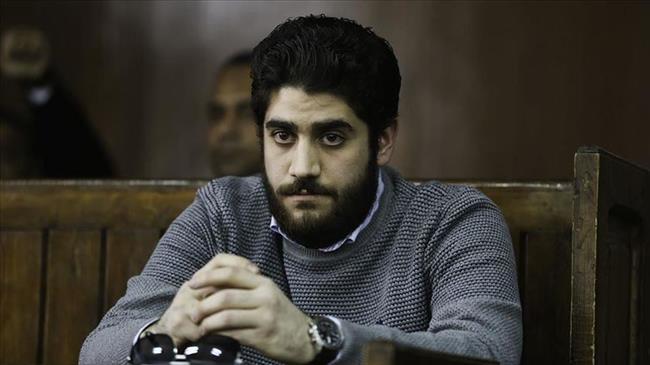
Abdullah Morsi, late son of Egypt’s former president Mohamed Morsi
Press TV – September 8, 2020
A law firm representing the family of Egypt’s late former president Mohamed Morsi concludes that the death of his youngest son, Abdullah, last year was caused by injection of a “lethal substance.”
“Information now disclosed appears to confirm that Abdullah was transported in his car a distance of more than 20 kilometers (12 miles) to a hospital after he took his last breath, as a result of having been injected with a lethal substance,” said a statement by the London-based Guernica 37 International Justice Chambers.
“He was not transferred to nearby hospitals, intentionally, until after he had died,” added the statement cited by the Middle East Eye (MEE) news and opinion website.
The Egyptian government claimed the 25-year-old had died of a heart attack while driving.
The law firm said, “It is quite clear that certain elements of the state were aware of this fact that is only now coming to light.”
Prior to his death, Abdullah had named several individuals, including current Interior Minister Mahmoud Tawfiq and Mohamed Shereen Fahmy, the judge who oversaw the Morsi’s trial, as “accomplices” in the “assassination of the martyr, President Morsi.”
The Egyptian leader died during a trial session at a court in the capital Cairo on June 18, 2019 after spending some six years behind bars, Egyptian authorities say.
Last month, the MEE quoted Morsi’s son Ahmed as saying that the ex-head of state and Abullah were both murdered in a state-sanctioned scheme.
Morsi became Egypt’s first democratically elected president in 2012, one year after a popular uprising led to the ouster of strongman Hosni Mubarak and ended his 30-year rule.
He was deposed in July 2013 in a military coup led by Egypt’s former army chief and current President Abdel Fattah el-Sisi, and was immediately arrested.
The coup was followed by a hugely deadly crackdown on members and supporters of the country’s Muslim Brotherhood, to which Morsi used to be affiliated.
Israel, UAE reach US-brokered agreement to establish full diplomatic ties
Press TV – August 13, 2020
Israel and the United Arab Emirates (UAE) have reached a deal that will lead to a full normalization of diplomatic relations between the two sides, in an agreement that US President Donald Trump apparently helped broker.
Under the agreement announced on Thursday, Israel has allegedly agreed to suspend applying its own rule to further areas in the occupied West Bank and the strategic Jordan Valley that Prime Minister Benjamin Netanyahu had pledged to annex, senior White House officials told Reuters.
Trump, in a tweet, called the agreement a “HUGE breakthrough,” describing it as a “historic peace agreement between our two GREAT friends.”
US Secretary of State Mike Pompeo, who spoke to reporters accompanying him on a trip to central European countries, said for his part that the agreement was an “enormous” step forward on the “right path.”
Israel’s Prime Minister Benjamin Netanyahu also tweeted that the deal marked “a historic day.”
Abu Dhabi’s Crown Prince Sheikh Mohammed Bin Zayed said on Twitter on Thursday that an agreement had been reached on normalising relations between the two countries.
The deal, however, has elicited sharp negative reactions from various Palestinian groups as well as their supporters from across the world.
The Palestinian Islamic Jihad Movement reacted rapidly by condemning the deal between the UAE and Israel.
The movement noted that normalization of ties between Tel Aviv and Abu Dhabi was a sign of submission on the latter’s part without having any effect on reducing conflicts in the occupied Palestinian territories.
Islamic Jihad movement also noted that the deal will, on the other hand, further embolden the Israeli occupiers.
Palestinian President Mahmoud Abbas has issued a statement, calling for an urgent meeting of Palestinian leadership to be held on the Israel-UAE deal to discuss its consequences.
Meanwhile, senior Palestinian official Hanan Ashrawi accused the United Arab Emirates of “normalization” with Israel after Thursday’s announcement of the so-called peace deal.
Ashrawi, who is a member of the executive committee of the Palestine Liberation Organization (PLO), said on Twitter, “The UAE has come out in the open on its secret dealings/normalization with Israel. Please don’t do us a favor. We are nobody’s fig leaf!”
Ashrawi also responded to Abu Dhabi’s crown prince’s tweet in a counter-tweet in which she reminded him of the sufferings of the Palestinian people at the hands of the Israeli occupiers.
May you never experience the agony of having your country stolen; may you never feel the pain of living in captivity under occupation; may you never witness the demolition of your home or murder of your loved ones. May you never be sold out by your “friends.” https://t.co/CBaNl1QQqx
— Hanan Ashrawi (@DrHananAshrawi) August 13, 2020
The spokesman for the Palestinian Islamic Resistance Movement, Hamas, Fauzi Barhum said the normalization of ties between the UAE and Israel is a reward for occupiers in return for their crimes and violations of Palestinian’s rights.
Sarah Leah Whitson, a pro-Palestinian activist, also took to Twitter to condemn the deal, saying it would not lead to any recognition of Palestinians’ rights.
“Israel won’t formally annex and exercise sovereignty over the land it has for all intents and purposes already annexed and exercises sovereignty over… ZERO for the rights of Palestinians,” she wrote.
The information minister of the Yemeni government in Sana’a also reacted by saying that the deal between the Israeli regime and the UAE was a show of defiance shown by the enemies of Islam to all Muslims.
Popular Resistance Committees, which is a coalition of a number of Palestinian groups, also reacted to the UAE-Israel deal by noting that the agreement reveals the high volume of conspiracies against the Palestinian people and their sanctities.
“This is like a poisonous dagger in the back of the Islamic Ummah,” the committees added.
Yemen’s Ansarullah movement has also vehemently slammed the deal as a provocative move.
Ansarullah’s spokesman Mohammed Abdul-Salam said the agreement brought to light what had been kept secret and proved that Zionist and American enemies will continue to destroy the region.
He added that this is not an anti-Iran deal alone, but is against the interests of the entire Arab and Islamic Ummah.
Meanwhile, deputy secretary general of the Popular Front for the Liberation of Palestine, Abu Ahmad Fuad, was quoted by al-Mayadeen news agency as saying that the UAE-Israel deal is a crime against the Palestinian people and their martyrs and will have no effect on the resistance front.
He added that the Palestinian people will continue to confront Israel’s daily attempts to annex more Palestinian territories.
“It is the Palestinian people who prevent further annexation of their lands by Israel, not the UAE and its leaders,” he said.
Egypt’s President Abdel Fattah al-Sisi, however, welcomed the agreement, saying, “I followed with interest and appreciation the joint statement between the United States, United Arab Emirates and Israel … I value the efforts of those in charge of the deal to achieve prosperity and stability for our region.”
Libyan war escalates as regional powers attempt to gain stronger influence
By Paul Antonopoulos | June 1, 2020
Alarms are sounding in Europe as Turkey, Russia and Arab states could potentially agree on shared influence in Libya, and therefore the entirety of the eastern Mediterranean, according to some experts. This comes as European states have no influence over the war in Libya despite it occurring on its southern doorstep and Turkey, Russia and Arab states continue to gain influence.
The direct intervention of Turkey in Libya, who has sent its own intelligence officers, military advisers and thousands of Syrian jihadists to support the Muslim Brotherhood Government of National Accords (GNA), based in Tripoli and led by the ethnic Turk Fayez al-Sarraj, has limited further gains by the Libyan National Army (LNA). The mobilization of thousands of Turkish and Syrian jihadists and the massive shipment of weapons to Tripoli has slowed down the offensive of the LNA, led by Field Marshal Khalifa Belqasim Haftar. Haftar was proclaimed on April 27 as the only leader of the country, in which most of the international community found to be a provocative move as they believe it limited the likelihood of a political settlement to the conflict.
Confident of his past military superiority and assured in the determination that the United Arab Emirates, Saudi Arabia and Egypt have to counter Turkey’s efforts to create hegemony in the Eastern Mediterranean, Haftar continues to ignore calls for a political solution to the war. Sarraj also ignores such calls confident in the backing he has from Turkey.
Russia also condemned Haftar’s offensive and called for negotiations on peace. However, the U.S. claims that Russian fighter jets arrived in Libya to protect the withdrawal of volunteers from the Russian Wagner group in a decision agreed upon with Ankara, something that Moscow denies. Both Europe and the U.S. fear that Russia may obtain the use of a naval base in eastern Libya, that the LNA securely controls, in the future.
Despite these potentialities, it is unlikely the war between GNA-backed jihadists and the LNA will come to a conclusion anytime soon, unless there is a drastic change caused by external forces. Turkey in the midst of an economic crisis is unwilling to use the full force of its military in Libya and is rather acting as a conduit between the GNA and Qatari-funded but Turkish-trained Syrian jihadists. Egypt is contemplating using its military in Libya to “fight against Libyan extremists and terrorists supported by Turkey.” This too could be a game changer since Egypt has the means, logistics and capabilities to successfully intervene in Libya in favour of the LNA.
France has also not hidden away with its support for Haftar, finding him to be a leader that would advance French interests in the Mediterranean that is in direct conflict with Turkey. The GNA has also signed a memorandum with the Muslim Brotherhood government to cut through Greece’s maritime space for the exploitation of gas in that area of the Mediterranean, forcing Greece to get embroiled in the Libyan mess. Meanwhile, Italy has backed the GNA while Germany is trying to act as referee, showing once again there is no common European position.
The European ‘Irini’ (meaning peace in Greek) operation is committed to prevent maritime-bound arms delivery to Libya, i.e. Turkish arms to Libya. This is a maritime surveillance operation to enforce the United Nations-imposed arms embargo on Libya, but in reality, it has not prevented Turkey’s deliveries to the GNA while Egypt continues to supply the LNA over the land border.
The situation shows that the European Union is unable to establish itself as a main actor in a conflict that brings together strategic political and economic interests a few nautical miles from its southern coast. With the U.S. realistically absent, Turkey backing the GNA and Russia and the Arab + Greece alliance backing the LNA, these are the main protagonists.
In Paris, and seeing the failure of his diplomacy parallel to the EU, the Foreign Minister, Jean-Yves Le Drian, warns about the “Syrianization of Libya,” while spokesman of Turkish President Recep Tayyip Erdoğan’s gloats: “France and other European countries supporting Haftar are on the wrong side of history.” Seen in this light, the balancing role Russia can play in Libya to contain Ankara could even be positive for Europeans.
However, the main reason that shared influence will not be agreed upon is because the GNA-Turkish deal to steal Greece’s maritime space relies on a supposed share maritime space between Libya and Turkey. And therein lays the problem – it is the LNA, who has rejected the memorandum, that controls the eastern Libyan coast that supposedly shares a maritime border with Turkey. So long as the LNA controls eastern Libya, Turkey will always strive for a GNA victory to legitimize the memorandum. Once again, the European Union remains divided on Libya, despite the Muslim Brotherhood government aiming to carve out the maritime space of a member state.
Paul Antonopoulos is an independent geopolitical analyst.
Israeli minister: Israel to discuss with US reported Sinai peacekeeper cutback plan
MEMO | May 8, 2020
Israel said on Friday it would discuss with its closest ally the United States a newspaper report that the US-led peacekeeping force in the Egyptian Sinai may be scaled back, calling its nearly four-decade-old presence “important”, Reuters reports.
US Secretary of Defense Mark Esper is pushing to pull out some American troops from the international peacekeeping force it heads in the Sinai Peninsula, the Wall Street Journal reported on Thursday, citing current and former US officials.
The reduction would come as Egypt battles an Islamist insurgency in the desert peninsula, where the US-led Multinational Force and Observers (MFO) has been since the early 1980s, following Egypt’s peace deal with Israel in 1979.
Asked to comment on the report in an interview with Tel Aviv radio station 102 FM, Israeli Energy Minister Yuval Steinitz said “the international force in Sinai is important, and (the) American participation in it is important.
“Certainly, the issue will be raised between us and the Americans,” said Steinitz, a member of Prime Minister Benjamin Netanyahu’s security cabinet.
The US and Egyptian embassies in Israel did not immediately respond to requests for comment, nor did the MFO’s office in Israel.
According to its website, the MFO has 1,156 military personnel from the United States and 12 other countries covering an area of more than 10,000 square kilometres (3,860 square miles) in the Sinai. Some 454 of the personnel are American.
But the size of the force has decreased by over 30 per cent since 2015, according to data from its website.
During that time, Israel has agreed to an easing in demilitarisation in the Sinai so that Egypt can carry out anti-insurgency sweeps, typically in the northern end of the peninsula where small-scale attacks are common.
Cairo sees the MFO as part of a relationship with Israel that, while unpopular with many Egyptians, has brought it billions of dollars in U.S. defence aid, sweetening the foreign-enforced demilitarisation of their sovereign Sinai territory.
For the Israelis, the MFO offers strategic reassurance, recalling that in 2013 Egyptian President Abdel Fattah al-Sisi toppled an elected Islamist government hostile to its neighbour.
Egyptians call for presidential palaces to become coronavirus quarantine centres
![Egyptian President Abdel Fattah Al-Sisi attends a press conference in Cairo, Egypt on 12 April 2018 [Egyptian Presidency/Anadolu Agency]](https://i1.wp.com/www.middleeastmonitor.com/wp-content/uploads/2018/04/2018_4-19-sisi.jpg?resize=1200%2C800&quality=85&strip=all&ssl=1)
MEMO | April 3, 2020
Egyptians have called on President Abdel Fattah Al-Sisi to use the presidential palaces he had built for himself as quarantine centres for coronavirus patients.
The calls came in response to a Twitter campaign launched by opposition journalist, Moataz Matar, calling on Al-Sisi to stick to his word reminding him that he had claimed that he had built the places for the people and not for himself. This, activists said, is when Egyptians would benefit from the buildings.
Other Twitter users called for military hospitals to be converted into quarantine centres.
Yesterday evening, Prime Minister Mostafa Madbouly announced that 71 people have tested positive for the coronavirus bringing the country’s total cases to 850 cases.
However, Canadian researchers estimate there to be over 19,000 cases in Egypt amid allegations of a government cover-up.
Netanyahu between the Nakba Arabs and the Arabs who are a joke
By Wael Qandil | Al-Arabi Al-Jadeed | February 21, 2020
The Arabs agreed in 1948 on the decision to form combat groups against the Zionist colonisation of the land of Palestine, which was known as the Nakba. Exactly 72 years later, the Arabs seem closer to form a united combat force to fight those rejecting the Zionist colonisation of Palestine.
It does not seem that the joke recently posted by a sarcastic Twitter activist about Saudi Arabia’s condemnation of the Palestinian people’s actions against the Israeli occupation will remain a joke for long, as all of the facts and indications say that the Arab capitals are very close to taking measures against those who refuse normalisation and the “deal of the century”. The Arab leaders’ patience is running out with the Palestinian resistance factions, who are disturbing the relationship between these leaders and Israel.
Matters rushing in this direction is not a new phenomena. It was announced and put into effect at least five years ago and many are competing to serve this. They are not ashamed to voice their approval of Israel’s leadership in the region and the first to voice this was General Abdel Fattah Al-Sisi, who is loved and supported by all Zionists, especially their rabbis and generals.
More than four years ago, the right-wing Zionist newspaper Makor Rishon revealed that Al-Sisi confirmed, before the leaders of the American Jewish organisations, his admiration for Netanyahu’s personality and leadership capabilities. The newspaper’s correspondent, Zvika Klein, wrote that the leaders of the Conference of Presidents of Major American Jewish Organisations in the United States informed Netanyahu during their meeting with him, on the side-lines of a meeting organised by the committee in occupied Jerusalem, that Al-Sisi told them that Netanyahu is “a leader with great powers that help him not only lead his country, but also could propel the region – even the world – forward.”
Well, here is the ruling general of the oldest Arab sister stripping his country of leadership of the region and giving it to Israel/Netanyahu to succeed him. Following in his footsteps is Mohammad Bin Salman, Saudi crown prince, who learned from Al-Sisi how to reach power through Israel. The story begins with hosting Trump and his family in Riyadh in order to establish the “moderate” alliance, the idea of which was proposed, formulated and developed years ago by Benjamin Netanyahu. Trump then leaves Saudi Arabia with more than $450 billion and lands in occupied Jerusalem wearing a skullcap.
In 2018, in anticipation of Saudi Arabia’s hosting of the Dhahran Summit, the Saudi crown prince held an interview with America’s Atlantic magazine, in which he announced a vision completely aligned with Israel’s for the Middle East according to extremist rabbis, violent generals and the Knesset hawks and doves. He spread his free kisses and gifts by stating that he was surrounded by enemies except for Israel and the so-called “axis of moderation” made up of the four parties that besieged Qatar. He said: “We are in an area not surrounded by Mexico, Canada, the Atlantic and Pacific oceans. We have ISIS, Al-Qaeda and Hamas and Hezbollah and the Iranian regime, and even pirates.”
This insight took a practical form when Al-Riyadh newspaper, the mouthpiece of the government, stated, before the summit opening: “Today, the Arabs have no choice but to reconcile with Israel, to sign a comprehensive peace agreement, to devote themselves to confronting the Iranian project in the region and its nuclear program, and to put an end to its interference in Arab affairs. This is an option that cannot be delayed with any justification, even [accusations of] bargaining with and auctioning the Palestinian cause, because Iran poses a direct threat to all.”
Thus, without vagueness, and very early on, the capitals of the two largest Arab countries delivered the badge and cloak of leadership to Israel, until we reached a stage where Benjamin Netanyahu was authorised, alone, to speak about the pilgrimage trips from Israel to Saudi airports, promising that the Israelis will fly in the skies of Saudi Arabia soon. It is at this same stage that the Egyptian military man may find himself entrusted with the war against the Palestinian people, if the gas pipeline from the occupation to Egypt is damaged or endangered, when an uprising breaks out in the areas the pipeline passes through.
What misery awaits a nation that clashes with itself over who will serve its enemy more?
Translation by MEMO.
The US bought Sisi for $9bn, but the Egyptian people cannot be swayed
By Amelia Smith | MEMO | February 9, 2020
When Trump announced Jerusalem was Israel’s undivided capital under his so-called “deal of the century”, the Egyptian public questioned whether Al-Sisi had a hand in preparing the plan. His support, after all, came just half an hour after the announcement.
Officially, Egypt supports the establishment of a Palestinian state on its pre-1967 borders with East Jerusalem as its capital. According to Mada Masr, Al-Sisi’s statement originally included a sentence to that effect, but in a later draft it was removed, after it had passed through the president’s office for review.
Since he came to power, Abdel Fattah Al-Sisi’s rule has been decidedly anti-Palestinian. When Egypt’s military overthrew Mohamed Morsi on 3 July 2013, one of the first things the generals did was close the Rafah Crossing and deport Palestinians arriving in the country through Cairo Airport.
But in some respects the Egyptian dictator has tried to maintain nominal respect for the Egyptian position. In 2017, it was Egypt which filed a draft resolution rescinding Trump’s declaration that Jerusalem was Israel’s capital amid the global outrage that followed his announcement.
The price for Egypt’s new position was $9 billion, the amount promised at the economic workshop for the deal of the century in Bahrain last summer. It’s a big chunk of money for Egypt, given the dire straits it has found itself in under Al-Sisi’s mismanagement of the economy, and should provide some generous bonuses for the ruling generals, who we know through the whistleblower Mohamed Ali are getting rich through corruption and at the expense of their own people.
For its part, Israel has achieved political and economic gains it never imagined could be possible. This has been described as the golden age of Israeli-Egyptian relations symbolised by the transfer of Tiran and Sanafir islands to Saudi Arabia, which opened up the Straits of Tiran to Israel, and compounded by security cooperation between the Egyptian and Israeli army in Sinai.
As Yehya Okail, a former MP in Sinai, once told me:
Hosni Mubarak was a treasure to Israel, however Sisi is much more than that. Israel never imagined that it would be served by anyone in the history of Egypt as Sisi has done.
Trump’s plan proposes “cross-border services” including building desalination and power plants next to the Egypt-Gaza frontier. Observers have long talked about the US’ plans to build infrastructure projects in the Sinai Peninsula where Palestinians can work.
As Al-Sisi laid the groundwork for these projects, Sinai’s indigenous population, the Bedouin, have felt the plans acutely. The government has razed homes and obliterated fertile farmland, offering Sinawis no compensation for their loss. All of this has taken place under a protracted “war on terror” in Sinai authorities have been fighting for years now. As well as being accused of systematic war crimes, the army is no closer to defeating the estimated 1,000 militants there.
With Trump’s announcement, Egypt has another excuse to ramp up security in Sinai, which is already suffocating under a curfew and restrictions on goods entering the peninsula. No one knows better than the people of Sinai that increased security in the peninsula is a pretext for increased repression. At the beginning of the week, Egypt arrested 32 women from a prominent North Sinai tribe.
Reports reveal high level military and intelligence leaders have demanded security forces be on high alert in anticipation of events in Gaza, including the claim that Palestinians will storm the border and make their way deep into Egyptian territory. With this, Egypt has flipped the narrative on its head to persuade the public it is Palestinians that want to flood Sinai, not that it is preparing to give its own land up at the behest of Israel and the US.
It’s not just in Sinai that people will feel the reverberations of Trump’s deal. Dual Palestinian-Egyptian national Ramy Shaath, the general coordinator of BDS Egypt who was imprisoned for speaking out about Egypt’s participation in the Bahrain workshop, and his colleague Mohamed El-Massry, are both imprisoned as part of the regime’s crackdown on pro-Palestinian solidarity. Their sentences and conditions could be negatively affected by the announcement and its aftermath.
Whilst the Egyptian regime has made a significant shift in its official position, in the long-term convincing its people isn’t so easy, as is evident from the public outcry in January, not just over the government’s official response to the deal of the century, but also because last month was when Israel began transporting natural gas to Egypt under a $15 billion deal.
In an attempt to change hearts and minds, Egypt intelligence sent round a WhatsApp to top media editors with instructions on how to report on the announcement. It asked them to refer to the US proposal as a “peace plan”, rather than the more negatively-viewed deal of the century, it said was viewed as an American-driven project to secure Israel’s interests. Editors were told not to address or focus on religious or national elements of the plan or to ask Al-Azhar for its view on the matter. It also asked journalists to emphasise the historical and pivotal role of Egypt on the Palestinian issue.
Attempts to control the narrative are widespread. One source in Sinai told me that two people were arrested in Arish around Christmas over Facebook posts about Israel, another researcher said that only high-ranking officers in the Egyptian army know they are cooperating with Israel in Sinai. These incidents show how entrenched pro-Palestinian sentiment is in Egypt, and how insecure the regime is. But it won’t stop Trump’s “favourite dictator”, as he presses ahead with the deal of the century to his benefit and to the detriment of his own people.
Erdoğan Opened a Pandora’s Box in Libya That Will Be Difficult to Close
By Paul Antonopoulos | December 4, 2019
Tensions in the Eastern Mediterranean are rapidly rising after Turkish President Recep Tayyip Erdoğan met with a Libyan official of the internationally recognized Government of National Accord (GNA), based in the Libyan capital of Tripoli, in Ankara last week. They agreed on their own Economic Exclusive Zone that penetrates into Greek and Cypriot waters, in violation of the United Nations Convention Law of the Sea (UNCLOS) that favors Cypriot and Greek claims, a major reason why Turkey is only one of 15 UN members, out of 193, that has not signed it. Although Turkey claims it is acting within international law to enter the oil and gas-rich Greek and Cypriot waters, it never references which international law. This leads to the simple question of why Turkey has not signed UNCLOS if international law supposedly favors their claim?
The Turkish-GNA provocation against Greece comes as only last month Pakistan and Turkey conducted naval exercises where Pakistan violated Greek and Cypriot air and maritime space several times and harassed Cypriot merchant ships. This demonstrates that Turkey is bolstering its alliances to force its complete hegemony over the Eastern Mediterranean. This is to expand their maritime space in violation of international law to exploit the rich deposits of gas and oil in the region.
However, Turkey has once again defied international law, remembering the illegal invasion of northern Cyprus and Syria among many. This has now opened up a new quagmire that Erdoğan has probably not expected. With the NATO destruction of Libya in 2011, in which both Greece and Turkey took a minor part, the country has been plagued by tribalism, feudalism and Islamic radicalism, with two major forces emerging from the mess – the GNA in coalition with the Muslim Brotherhood, and the Libyan National Army (LNA) led by General Khalifa Haftar and based in eastern Libya. This is unsurprising since Turkey has a long history of supporting the Muslim Brotherhood.
Erdoğan has opened up a pandora’s box in Libya that will now surely backfire on him and see the dismantlement of the GNA. The GNA is now becoming increasingly isolated since Saudi Arabia, the United Arab Emirates and Egypt have sworn to back General Haftar with weapons and money. It is expected that with the arrival of new funds and weapons, Haftar will continue his assault to take Tripoli which he began in March. One major reason for this new support for the LNA is that Greece, Cyprus and Egypt are in a strategic regional alliance to protect their respective EEZ against Turkish aggression.
Haftar has also controversially announced that he wants relations with Israel. His desires for relations with Israel, a rarity among Muslim-majority countries, will surely bring Haftar more international recognition and legitimacy as a “reward,” especially crucial as the majority of the world recognizes the Tripoli government.
A delegation of U.S. diplomats recently asked Haftar to halt military operations, citing that it will supposedly allow Russia’s military invasion of Libya. Haftar refused. Haftar’s Secretary of State said that the United States is completely wrong, as Libya has become a huge arena for settling accounts among regional powers – and this is true if we consider that the Saudis, Emirates and Egyptians are backing the LNA, while the Turks and Qataris backs the GNA.
Rather than being in compliance with international law, Erdoğan signed with the GNA an illegal agreement to carve out the Eastern Mediterranean for its own plans. Greece has given the GNA time until today to retract their deal with Turkey. Although Greece on the international scene is a minor player, it does wield significant influence in the Eastern Mediterranean and will use NATO and EU mechanisms to convince member states to retract their recognition of the GNA, which will only further isolate Turkey as it has attempted to build an alliance to counter the Greek-Cypriot-Egyptian military partnership.
In a rare occurrence, both the U.S. and Russia have criticized Turkey’s aggression and escalation in the Eastern Mediterranean, with the US State Department describing the Turkish and GNA move as “unhelpful” and “provocative.”
It is unlikely this will make a difference as it is expected that the GNA will adamantly refuse to renounce its agreement with Turkey, which will push Greece to back the LNA and encourage NATO and EU members to do the same. At the very minimum, the Saudi-Emirati-Egyptian tripartite has used Turkey’s aggression in the Eastern Mediterranean as an excuse to back the LNA, providing him with the money, weapons, intelligence and other resources to overcome the Turkish-backed GNA.
With Saif Gaddafi, the second son of Muammar Gaddafi, also announcing his support for Haftar, there is every potential that the internationally recognized GNA will have a multitude of pressure from NATO, the EU, the Saudi-Emirati-Egyptian alliance, and from Haftar and Gaddafi supporters. Erdoğan’s desperate pursuit for regional hegemony was first received with applause domestically, but it appears he has now opened a pandora’s box in Libya that is now likely to backfire on him.
Paul Antonopoulos is a Research Fellow at the Center for Syncretic Studies.
US gatecrashes into Libyan endgame. But Russia stands in the way
By M. K. BHADRAKUMAR | Indian Punchline | November 29, 2019
The United States has alleged that Russia’s presence in Libya is having an “incredibly destabilising” impact. Washington is stepping out of the shade and making way to the centre stage of the Libyan conflict.
David Schenker, the State Department’s assistant secretary for near eastern affairs said Tuesday in Washington, “The United States is committed to a secure and prosperous future for the people of Libya. For this to become a reality, we need real commitments from external actors… In particular, Russia’s military interference threatens Libya’s peace, security, and stability.”
Schenker explained, “Russian regulars and the Wagner forces are being deployed in significant numbers on the ground and support of the LNA [Libyan National Army]. We think this is incredibly destabilising. And the way this organisation, the Russians in particular, have operated before raises the spectre of large-scale casualties in civilian populations.”
Schenker spoke only days after a delegation of US civilian and military officials led by the high-flying US Deputy National Security Advisor Victoria Coates met with Khalifa Haftar, the supremo of the LNA. A state department readout said Coates expressed serious concern to Haftar over Russia’s “exploitation of the conflict” at the expense of the Libyan people.
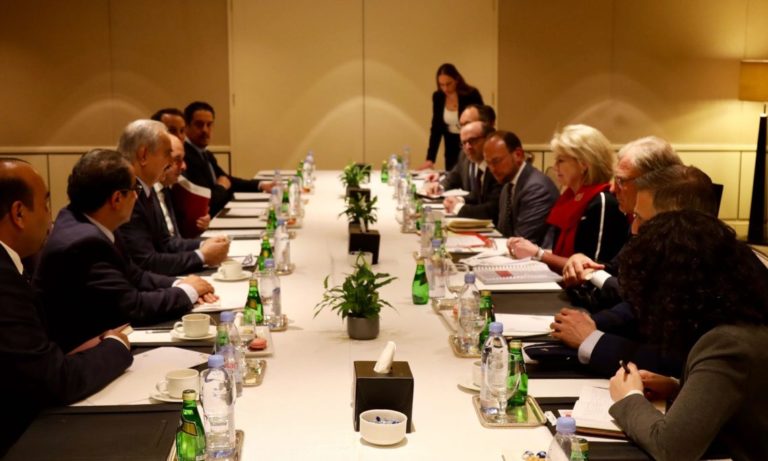
US Delegation meeting with General Khalifa Haftar, Nov 24, 2019
Libya becomes the third theatre after Ukraine and Syria where Washington has locked horns with Moscow in a Cold War-style proxy war. Up until last weekend, two EU members were supposedly conducting a proxy war in Libya over control of Africa’s largest oil and gas resources — France and Italy.
Actually, the alignments in Libya do not warrant a US-Russia standoff, as disparate external powers largely pursue self-interests. Italy, Turkey and Qatar have backed the Government of National Accord (GNA) in Tripoli (also supported by Germany and the UN), while France, Egypt, UAE, Saudi Arabia and Russia backed LNA.
The fight against terrorist groups is a stated common objective of all protagonists, but there are sub-plots too — Libya’s oil and gas (France, Italy, Turkey and Russia); political Islam (Turkey, Qatar, Egypt, UAE); France’s military operations in the five Sahel countries (Mauritania, Mali, Niger, Burkina Faso and Chad), which can end only with the stabilisation of Libya; the migration issue; and geopolitical interests (France, Italy, Russia and Turkey).
Although Haftar was a CIA “asset” for over three decades, Washington largely kept contacts with him under the radar and seemingly watched the struggle between GNA and LNA from the sidelines even after Haftar launched a determined push in April to capture Tripoli. The US policies were incoherent. President Trump apparently viewed Haftar as a factor of stability, while Washington officially pitched for a UN-mediated political settlement in Libya, although that is easier said than done, given the fragmentation in the country.
Washington was marking time, unsure whether Haftar’s military campaign would succeed. Moscow too took a back seat, but in recent months the Kremlin began weighing Haftar’s prospects positively. Moscow (like Cairo) counts on Haftar’s impeccable credentials in the fight against terrorist groups.
Russian military support has decisively helped Haftar’s campaign, which took big leaps lately. Haftar controls something like 80 percent of Libya, whereas, GNA is reduced to a mere rump confined to Tripoli.
Enter Washington. Washington feels alarmed that in the Libyan endgame, with Haftar inexorably gaining the upper hand, thanks to Moscow’s help, the vista opens for cascading Russian influence over the new regime.
Nonetheless, it isn’t easy to find fault with Russia’s military role to stabilise Libya, since NATO intervention in 2011 that wrought havoc and such colossal destruction had enjoyed the backing of Obama Administration. Washington is on weak moral grounds. Geopolitics is dictating its policy trajectory.
Washington’s policy is driven by the project to make Libya the headquarters of the United States Africa Command, one of the eleven unified combatant commands of the United States Armed Forces (which is presently based in Stuttgart, Germany.) Clearly, the rollback of Russian presence and influence in Libya becomes a prerequisite of the US project.
The backdrop, of course, is the big-power struggle erupting over Africa and its vast untapped resources. China has been rapidly expanding its presence in Africa and Russia too is stepping up. Importantly, as the recent Russia-Africa summit in Sochi (October 23-24) signalled, military cooperation is Moscow’s priority.
Russia and China’s growing presence creates space for African leaderships to negotiate with the Western powers. It is a sign of the times that the South African Navy’s first-ever multinational maritime exercise (November 25-30) is exclusively with Russia and China.
Fan Guanqing, the captain of the PLA Navy frigate Wei Fang, said in Cape Town last weekend, “We hope that the exercises will allow China, Russia and South Africa to work together and make an improvement through co-operation and exchanges. This exercise is historical and the first of its kind for these three countries.” Captain Fan said the maritime exercise should help maintain world peace and stability and would also be the starting point of a relationship between the three countries.”
Libya is the perfect gateway for NATO to penetrate the African continent. But a willing government in Tripoli could give the Russian Navy access to the eastern Libyan ports of Sirte and Benghazi on the Mediterranean. If Russia gets ensconced in Libya (in addition to Syria), NATO presence in the Mediterranean is affected. Russia and Libya also have a history of close political, military and economic ties dating back to the Soviet era.
Russia had a traditional presence in Libya’s armaments market and Soviet troops were deployed in Libya. Today, Libya’s reconstruction is the real prize for Moscow in terms of infrastructure (roads, railways, cities). Russia lost heavily due to the NATO-led regime change in Libya in 2011. Moscow had billions of dollars in investments in Libya during Moammar Gadhafi’s rule.
It remains to be seen how far the US pressure tactic on Haftar to sever his links with Russia will work. Russia, France and Egypt are on the same page in helping Haftar militarily. All three countries also bond together. While Moscow’s politico-military relations with Cairo are deepening, France is decoupling from the US’ Russia policies. Washington will be hard-pressed to isolate Russia in Libya. The big question is where indeed Haftar himself stands.
Washington threatens Egypt with Sanctions over Russian Su-35 fighter jet purchase
By Sarah Abed | November 18, 2019
Washington’s latest attempt to dissuade an ally from making arms deals with Russia came in the form of a letter sent on last Wednesday to Egyptian officials warning them that they could face sanctions if they continued with their $2 billion dollar Su-35 fighter jets contract.
In addition to sanctions, Secretary of State Mike Pompeo and Secretary of Defense Mark Esper warned Egyptian Defense Minister Mohamed Ahmed Zaki in Wednesday’s letter that “Major new arms deals with Russia would — at a minimum — complicate future U.S. defense transactions with and security assistance to Egypt.” The United States sends Egypt $1.3 billion annually in military assistance.
Russia has become one of Egypt’s major arms suppliers. This particular arms between Egypt and Russia for ten fighter jets was signed at the end of 2018, with delivery of the Su-35 Flanker-E air superiority fighter aircraft as well as weapons for the planes starting in 2020-2021.
In order to counter Russia’s expanding military influence in the Middle East and dissuade countries from buying Russian-made arms, the Countering America’s Adversaries Through Sanctions Act (CAATSA) was signed by President Donald Trump in August 2017. Countries that are trading with Russia’s defense or intelligence sectors could face secondary sanctions.
Russia estimates that since 2014 it has lost $760 million dollars in potential weapons sales due to the international sanctions sealing off the U.S. market.
However, the CAATSA is not limited to sanctioning Russia and those who purchase Russian-made weapons, this U.S. Federal law also imposes economic sanctions on Iran and North Korea.
The first case for secondary sanctions under CAATSA took place in September 2018 when sanctions were imposed by the Trump administration on the Chinese military for purchasing 10 Su-35 aircraft and S-400’s from Russia, also 33 people and entities were blacklisted due to links to Russian military and intelligence.
The second case would be Turkey’s purchase of Russia’s S-400 air defense system with the first delivery of its components having taken place in July of this year. As a result of going through with their purchase and delivery, Turkey was also suspended from participating in the F-35 program and the F-35 air systems it had already purchased are now under U.S. control.
Although requirements have been met for CAATSA to be enforced there is a gray area as to how, and to what extent the sanctions should be applied. A waiver is also in place that the president can use. Also, both the U.S. executive and legislative branches play a role in determining the action that would be taken against Turkey for doing business with Russian personnel targeted by sanctions.
India is paying close attention to how the US is reacting to Turkey’s purchase as they too have purchased Russia’s S-400 SAMS system which would put them in conflict with the CAATSA as well. However, relations between India and the United States are strong and the likelihood that a waiver will be used to avoid making India suffer collateral damage is likely.
For the past decade Russia has been expanding its military influence in the Middle East, much to the dissatisfaction of the United States. Russia and Egypt’s military and technical cooperation has been deepening and expanding for years. Both nations have repeatedly held joint naval and airborne counterterrorism exercises since 2015. From October 27th till November 7th of this year the Egyptian air force’s tactical training center near Cairo hosted joint Russian/Egyptian military drills dubbed Arrow of Friendship-1.
There’s even been speculation about the prospect of Russia setting up a military base in Egypt, due to the increase of Russian activity on Egyptian grounds. Just two years ago a draft agreement which would “allow each side to use the other’s airspace and air bases” was approved by Moscow and Cairo. Even though it didn’t specify setting up a military base it did set the ground for significant expansion in military cooperation between the two countries.
While the US fumbles around in the Middle East leaving death and destruction in its tracks, Russia has become the main peace broker. While maintaining good relations with all the major players in the region, Russia intervened militarily in Syria at the request of Syrian President Bashar Al Assad to fight terrorism and derail a strong regime-change plan by the Obama administration. Relations and business with Iran and Turkey have also increased.
Moscow knows that security in neighboring countries directly impacts its own and standing by allies will only help grow its influence and positive image in the Middle East and beyond.
Featured Video

“Historic Russia”: The Land Putin Will Not Give Back
or go to
Aletho News Archives – Video-Images
Book Review
Why the War on Conspiracy Theories Is Bad Public Policy
By Kevin Barrett • Unz Review • February 1, 2019
 A Review of Conspiracy Theories and Other Dangerous Ideas by Cass Sunstein (based on an earlier paper co-authored with Adrian Vermeule); In Defense of Troublemakers: The Power of Dissent in Life and Business by Charlan Nemeth; and Conspiracy Theories and the People Who Believe Them, edited by Joseph E. Uscinski
On January 25 2018 YouTube unleashed the latest salvo in the war on conspiracy theories, saying “we’ll begin reducing recommendations of borderline content and content that could misinform users in harmful ways—such as videos promoting a phony miracle cure for a serious illness, claiming the earth is flat, or making blatantly false claims about historic events like 9/11.”
At first glance that sounds reasonable. Nobody wants YouTube or anyone else to recommend bad information. And almost everyone agrees that phony miracle cures, flat earthism, and blatantly false claims about 9/11 and other historical events are undesirable.
But if we stop and seriously consider those words, we notice a couple of problems. First, the word “recommend” is not just misleading but mendacious. YouTube obviously doesn’t really recommend anything. When it says it does, it is lying. … continue
Blog Roll
 Aletho News
- “Historic Russia”: The Land Putin Will Not Give Back
- How the Cambridge Analytica scandal still haunts Mark Zuckerberg
- The Ongoing Cancellation Campaign Against a Dissenting Academic in Norway
- Yemen and ‘the Houthis’: Challenging Sami Hamdi’s Narrative
- No, Christians did not invent Zionism
- AIPAC-led lobbying network opens branches in Cypriot, Greek parliaments
- Araghchi blasts ‘parasitic’ alliance as US taxpayers pay for Israel’s war on Iran
- Easy fix for Europe’s chaos? Stop fueling war against Russia
- Putin’s key remarks on peace talks and Europe’s ‘schizophrenia’
- Trita Parsi: Israel Set a Trap for Total War in the Region
- If Americans Knew
- An error has occurred; the feed is probably down. Try again later.
- No Tricks Zone
- Two New Studies Find Thwaites Glacier Melt Cannot Be Driven By Human Activity Or A Warming Ocean
- E-Cars Reduce CO2 Emissions By Only 41% Compared To Internal Combustion Engine Vehicles
- Predictions Made By Renowned Climate Professor Over Past Decades Have Been Proven To Be Poor
- New Study Suggests Large Regions Of The Pacific Ocean Have Been Cooling For The Last 80 Years
- Germany’s Green Energy Debacle: High Energy Costs Force Kahla Porzellan to Close After 182 Years!
- New Study: 50 Years Of The Most Aggressive ‘Net Zero’ Policies Can Only Affect The Global Climate By 0.03°C
- US September “Heat” Was No Record…Many Records Set Decades Ago
- Latest European Green Energy Debacle; Portugal’s Largest Flagship Solar Park Insolvent!
- Green Energy Debacle: German Expert Professor Fritz Vahrenholt Warns Of Severe Economic And Social Consequences
- Two More Paleo Reconstructions Affirm Meters-Higher Sea Levels Across Ireland, Brazil 7000-6000 Years Ago

