Why Arabs Bolster Energy & Security Cooperation With Russia in Defiance of Western Sanctions
By Ekaterina Blinova – Samizdat – 19.01.2023
Arab countries have not joined the anti-Russian sanctions, despite pressure from the West, as Russian Foreign Minister Sergey Lavrov stressed during his press conference this week. What’s behind the Arab world’s resilience?
“The policy of the West in the East has gone bankrupt,” political analyst Vladimir Ahmedov told Sputnik.
“[Middle Eastern players’] trust in the United States, the leading western European states – the former colonizers who had colonies in this region – has already been largely lost,” the specialist in the modern history of Arab countries and senior research fellow at the Institute of Oriental Studies of the Russian Academy of Sciences continued.
New major players have entered the global arena: China, India, Iran, Turkey, Egypt, and Saudi Arabia, the scholar emphasized.
Ahmedov believes that the sanctions imposed against Russia are dictated by purely political considerations of a narrow circle of the western political elite. Meanwhile, the system of international relations and the world order has been undergoing changes, and the indirect proof of this is the position taken by the Arab countries, according to him.
“Russia’s policy in the East at the present time, and Russia’s policy in the world in general, has changed in comparison with the 1990s and the beginning of the 2000s,” the researcher continued. “Now it is a resolute policy aimed at defending [Russia’s] national state interests and the national interests of third countries. It impresses the countries of the East and, above all, the countries of the Middle East, which have been waiting for such a policy for a long time. This policy is in great demand in the East and therefore it meets with approval and understanding.”
In light of this, Russia’s efforts to mediate the Israeli-Palestine conflict as well as those in Syria and Iraq – mentioned by Lavrov during his Wednesday presser – are steps in the right direction, according to the scholar. In addition, Russia’s military presence in Syria serves as a stabilizing factor, he added.
Meanwhile, the West’s Ukraine strategy looks like nothing so much as its previous Middle Eastern policies. The West is using Ukrainians much in exactly the same way it previously used Arabs in order to reach its geopolitical objectives, and Middle Eastern players are well-aware of that, according to the researcher.
“Russia is not fighting against Ukraine or the fraternal Ukrainian people, but against the West, which wants to dismember Russia, belittle its role, minimize it, and so on,” Ahmedov said. “And [the Western policy] does not meet with any approval from the political elites of the East, who themselves suffered from it previously.”
Opportunities in the Middle East and North Africa
“The region of the Middle East and the Arab world in general is of tremendous importance in the world system in terms of geography, demography, a powerful energy market, the world’s oil and gas pantry and as a very important transport artery. Therefore the attention to this region will only grow,” Ahmedov emphasized.
The region develops its position by becoming an influential energy actor, echoed Ramy El Kalyouby, a visiting lecturer at the School of Orientalism of the National Research University Higher School of Economics (HSE).
“Gulf countries profited a lot from oil prices increase, and at some moment the Kingdom of Saudi Arabia’s oil revenues jumped to more than $1 billion daily,” El Kalyouby told Sputnik. “Egypt is also getting its chance to become an important gas supplier to the EU after discovering a few huge fields in the Mediterranean.
The academic singled out Egypt, the world’s biggest wheat importer. According to El Kalyouby, Russia can help Cairo replace a deficit of Ukrainian wheat, open its markets for Egyptian fruits and vegetables, and provide more tourists.
“There is also a project of a Russian industrial zone in Egypt that would help Russia to get around sanctions by changing the origin of products, and also to profit from the African Union free trade zone,” the lecturer highlighted.
Last year, the construction of Egypt’s first nuclear power plant was launched on July 20 in El Dabaa, Matrouh Governorate, by Russia’s State Atomic Energy Corporation Rosatom.
The El Dabaa NPP is meant to be the cornerstone of Egypt’s energy diversification policy, allowing Cairo not only to cover its own electricity needs, but also to provide energy to its neighbors. On November 19, the main construction phase for Unit 2 of the NPP began in the northern African country.
“Gulf countries could cooperate with Russia in the regulation of the oil market, although this becomes more difficult, as Russia provides important reductions on Urals oil,” El Kalyouby continued, adding that “Russia also remains a key actor in Syria as a mediator between Damascus and Ankara.”
Regional Security
Nonetheless, the Middle East and Northern Africa (MENA) region is continuing to suffer from local conflicts stemming from the bitter consequences of the Arab Spring, according to Ahmedov. The scientist noted that the reformatting of political systems of these countries is still going on while the common regional security system has not been formed yet.
Russia shares the same “geopolitical space” with the countries of the region and its objectives there include not only maintaining working ties with Middle Eastern players but also to protect its “soft underbelly” from extremist and terrorist elements reinvigorated by the Arab Spring havoc, the researcher explained.
In addition, Russia’s experience as a power broker in the region could come in handy for the West, since the latter has proven incapable of solving regional conflicts on its own, continued the scientist. According to him, European countries have no other alternative but to deal with Russia in the Middle East in the future if they want to ensure their security in the Mediterranean and Southern Europe.
Ahmedov noted that while Moscow cannot ensure a complete comprehensive settlement and stabilization of the situation in the Middle East, it can help regional players reach these goals.
“Russia can make a certain contribution to ensuring the system of regional security with the participation of other states,” he said. “We have excellent relations with Iran. And in this regard, of course, the Arab countries are interested in Russia in terms of softening the Iranian policy towards the Arab countries, which causes concern today in the Arab world. We have excellent relations with Turkey, which also plays a very important role as a major regional actor or player in this region, just like Iran. And therefore, in this case, we have a lot of advantages that we can realize. We have long-standing ties with Palestine since Soviet times. And therefore, in this case, we have a lot of advantages that we can realize.”
Russia has a long and successful record of work in the region, according to the scientist: in the 1960-1980s the USSR provided the primary industrialization of many MENA countries, including Iraq, Syria, Egypt, Algeria, Sudan, and Yemen. While developing ties with the region, Russia can build upon its expertise and best practices of the past, Ahmedov concluded.
Pentagon exploits post 9/11 laws to wage ‘secret wars’ worldwide: Report
The Cradle | November 9, 2022
A report released last week by the New York University School of Law’s Brennan Center for Justice details how the US Department of Defense (DoD) has been allowed to covertly deploy troops and wage secret wars over the past two decades in dozens of countries across the globe.
Among the nations in West Asia affected by these so-called ‘security cooperation authorities’ are Lebanon, Iraq, Syria, and Yemen; however, they also include many African and Latin American nations.
Known as ‘security cooperation authorities,’ they were passed by the US Congress in the years following the 11 September attacks, and are a continuation of the 2001 Authorization for Use of Military Force (AUMF), a piece of legislation that has been stretched by four successive governments.
According to the report, the AUMF covers “a broad assortment of terrorist groups, the full list of which the executive branch long withheld from Congress and still withholds from the public.”
Following in this tradition, the ‘security cooperation authorities’ being abused by the Pentagon are Section 333 and Section 127e of Title 10 of the United States Code (USC).
Section 333 authorizes the US army to “train and equip foreign forces anywhere in the world,” while Section 127e authorizes the Pentagon to “provide support to foreign forces, paramilitaries, and private individuals who are in turn supporting US counterterrorism operations,” with a spending limit of $100,000,000 per fiscal year.
However, thanks to the vague definition of ‘support’ and ‘training’ in the text of these laws, both Section 333 and Section 127e programs have been abused to target “adversarial” groups under a strained interpretation of constitutional self-defense; they have also allowed the US army to develop and control proxy forces that fight on behalf of – and sometimes alongside – their own.
As a result of this, in dozens of countries, these programs have been used as a springboard for hostilities, with the Pentagon often declining to inform Congress or the US public about their secret operations under the reasoning that the incidents are “too minor to trigger statutory reporting requirements.”
“Researchers and reporters uncovered Section 127e programs not only in Afghanistan and Iraq, but also in Cameroon, Egypt, Kenya, Lebanon, Libya, Mali, Mauritania, Niger, Nigeria, Somalia, Syria, Tunisia, and Yemen,” the report highlights.
Researchers also point out that defense authorities “have given little indication of how [they] interpret Section 333 and 127e.”
Even more concerning, and ignoring the damage caused by these ‘anti-terror’ laws, the US Congress recently expanded the Pentagon’s security cooperation authorities, particularly with Section 1202 of the National Defense Authorization Act (NDAA).
Section 1202 allows the US army to allow “irregular warfare operations” against “rogue states” like Iran or North Korea, or “near-peers,” like Russia and China.
The report comes at a time when the US army and its proxy militias are accused of illegally occupying vast regions of Syria and Yemen, looting oil from the war-torn countries, just over a year after their brutal occupation of Afghanistan ended. Moreover, a former US official on Tuesday revealed that anti-Iran militias are being armed in the Iraqi Kurdistan Region (IKR), where both the CIA and the Mossad are known to operate.
‘Iraq will not join any military alliance, position on Palestine firm’
MEMO | July 16, 2022
Iraqi Prime Minister Mustafa Al-Kadhimi has announced that the Jeddah conference in Saudi Arabia “will not witness the discussion of normalisation with Israel” and stressed that discussion on the topic is an attempt to confuse Iraq’s restoration of its role in the region.
The prime minister’s media office disclosed in a statement on Friday, posted on Twitter, that: “Iraq’s position is firm and clear on the Palestinian issue and is not open for discussion.”
The media office added that Iraq could not be a foundation to threaten any neighbouring country.
The prime minister stressed that Baghdad would not allow any party to use Iraq as a base to threaten neighbours or create problems by using Iraqi lands.
Al-Kadhimi expressed that they are in dire need of wisdom, patience, reconciliation and restoring confidence for the sake of Iraq and Iraqis. He mentioned that his government’s motto from day one has been “Iraq first” and that they will continue to adopt this approach in order to serve the people.
Moreover, Al-Kadhimi stated during a press conference held in Baghdad before travelling to Jeddah: “Iraq has not and will not be, neither today nor tomorrow, in any military axis or alliance, and the national interest is the goal of these meetings.”
“Today we are responding to an invitation extended to Iraq to participate in the Jeddah conference, which will be attended by the Gulf Cooperation Council countries, the Hashemite Kingdom of Jordan, the Arab Republic of Egypt, in addition to the United States.”
Regarding his upcoming meeting with US President Joe Biden, the prime minister made it clear that he will discuss with the US what they agreed on in the strategic agreement, such as revitalising agreements in the field of education, culture, health and other areas that reflect on the economic role.
Israel Reportedly Seeks US Go-Ahead to Provide Arab Gulf States With Laser Weaponry
Bennett expressed hope that the system would come online by 2023

Samizdat – 28.06.2022
Last week, Israel’s defense minister announced that Tel Aviv was working on a ‘Middle East Air Defense Alliance’ with Arab governments, but provided no details. On Sunday, US media reported that Washington brokered a secret meeting in the spring of top Israeli and Arab military officials to discuss regional air defense coordination against Iran.
Israeli officials are planning to ask US President Joe Biden for his formal blessing to provide an Iron Beam laser-based air defense system to Gulf Arab states including the United Arab Emirates and possibly Saudi Arabia, Israel’s Channel 12 has reported.
The unsourced Hebrew-language report, cited by the Times of Israel, indicated the delivery of the system to the Gulf countries would assist with the US-led push to ramp up air defense cooperation between Tel Aviv and a loose regional coalition including Egypt, Jordan, Bahrain, the UAE, Saudi Arabia and Qatar.
The Jewish State does not have formal diplomatic relations with the latter two country, and Riyadh has repeatedly stated that it would not establish formal ties with Israel until the Palestinian question and the creation of a Palestinian state was settled.
On Sunday, the Wall Street Journal reported, citing US and Middle Eastern sources, that the Pentagon had organized a hush-hush meeting in Sharm El Sheikh, Egypt in March to discuss ways to improve air defense cooperation against Iranian ballistic missiles and drones. The meeting was said to have been chaired by then-US Central Command chief Frank McKenzie, and attended by top military commanders from Israel and the Arab countries who were invited.
Israeli Defense Minister Benny Gantz, who announced the formation of a regional anti-Iranian air defense alliance last week, appeared to signal the veracity of WSJ’s reporting on Monday, saying Israel was “building” a “wide partnership with additional countries in the region to ensure a secure, stable and prosperous Middle East,” and that “among other things, this also includes aerial defense.”
“We will strengthen this, as a stable Middle East is an international, regional and Israeli interest of the highest order,” Gantz said.
Iran’s military also appeared to issue an indirect response to WSJ’s report, with Armed Forces Chief of Staff Mohammad Bagheri warning Monday that Tehran “will not tolerate” the threats posed by Israel and its cooperation with CENTCOM, and “will definitely react to them.”
Israel has long touted the purported advanced capabilities of its so-called ‘Iron Beam’ laser-based air defense system, a prototype of which was unveiled last year. Earlier this month, Prime Minister Naftali Bennett said the “game-changer” weapon would shift the balance in Israel’s favor, with the estimated $2 in electricity required per burst to intercept enemy rockets just a drop in the bucket compared to the tens of thousands of dollars a rocket might cost. Bennett expressed hope that the system would come online by 2023.
Last week, Breaking Defense reported that Israel would ask Biden for more money for Iron Beam’s development, on top of the $3.3 billion in annual US subsidies already received by the Israeli military and defense establishment. The outlet’s sources indicated that Israel will likely ask the US president to shell out about $300 million in additional cash.
“The relations between the US and Israel are solid. The issues that will be on the table during the visit are of utmost importance to both the US and Israel. I’m confident that the talks will be fruitful to both sides,” a senior defense source told the outlet.
During his trip to the Middle East next month, Biden is expected to tour an Israeli airbase and get a firsthand look at the prototype laser weapons being developed by Israeli defense giants Rafael and Elbit Systems.
Lasers for use against aircraft, missiles, drones, ships, and ground equipment have been on the drawing board of weapons developers since the Cold War, with engineers spending decades mulling over the prospects of replacing conventional missile and shell projectiles with the futuristic beam pulse. But energy-directed weapons have long faced what have previously been deemed unsolvable issues, such as the immense amounts of power required to operate them, as well as interaction between combat lasers and natural phenomena such as rain, fog, smog or dust, all of which dissipates their strength.
Last month, US weapons maker Raytheon reported that its own laser weapon, fitted aboard an Army Stryker vehicle, had successfully downed incoming mortar rounds in testing.
Israel, Egypt and EU sign gas export deal
Samizdat | June 15, 2022
Egypt, Israel, and the European Union have signed a deal to boost shipments of liquified natural gas (LNG) to EU member states, Sky News Arabia reported on Wednesday. Brussels hopes the agreement will help it to reduce energy dependence on Russia.
“The deal will see Israel sending more gas via Egypt, which has facilities to liquify it for export by sea,” European Commission chief Ursula von der Leyen said at a joint news conference alongside the Egyptian and Israeli energy ministers.
In 2021, the EU imported some 40% of its gas from Russia. The heavy reliance on energy purchases from the country makes it difficult for the bloc to expand its Ukraine-related sanctions.
The gas destined for European consumers is expected to go from Israel via a pipeline directly to Egypt’s LNG terminal on the Mediterranean coast before being loaded onto tankers and shipped north to the European market.
Some Israeli gas is already being sent by pipeline to liquefaction plants in Egypt, where it is liquefied and re-exported. Israel reportedly operates two gas fields off its Mediterranean coast holding an estimated 690 billion cubic meters of natural gas combined, while a third offshore rig is in the works.
Egypt is also a gas producer, but its exports have been limited by rising domestic demand. At the same time, the country’s large-scale natural gas facilities on the Mediterranean have remained mostly inactive since the country’s 2011 uprising that led to the overthrow of then-President Hosni Mubarak.
The Egyptian government has modernized the facilities in recent years and has ambitions to become a regional energy hub.
Ex-Louvre director charged in Egyptian artifacts trafficking case
Press TV – May 28, 2022
The former president of the Louvre museum in Paris has been charged with fraud in acquisition of archaeological treasures that may have been taken out of Egypt during the Arab Spring uprisings.
Jean-Luc Martinez who ran the Paris Louvre, the most visited museum in the world, from 2013-21 was charged this week after he was taken in by police for questioning, a French judicial source told Agence France-Presse.
Martinez, who now serves as an ambassador for international cooperation in the field of heritage, stepped down as the Louvre’s president last year.
He was charged with fraud and “concealing the origin of criminally obtained works by false endorsement,” according to a French judicial source.
Martinez, who has denied any wrongdoing, is also accused of neglecting fake certificates of origin for the pieces.
The case, which threatens to embarrass the French culture ministry and ministry for foreign affairs, was opened in July 2018, two years after the Louvre Abu Dhabi bought a rare pink granite stele depicting the pharaoh Tutankhamun and four other ancient works for €8m (£6.8m).
French investigators suspect that hundreds of artifacts were pillaged during the public uprising in Middle-East that engulfed several Middle Eastern countries in the early 2010s.
These were then believed to have been sold to galleries and museums that did not ask too many questions about previous ownership, nor look closely enough at potential incoherence in the works’ certificates of origin.
Several countries are thought to have been affected by artifacts being pillaged, including Egypt, Libya, Yemen and Syria.
Another prized Egyptian work, the gilded coffin of the priest Nedjemankh, which was bought by the Metropolitan Museum of Art in New York in 2017, was at the center of a separate inquiry by New York prosecutors.
The Met, however, said it had been the victim of false statements and fake documentation, and that the coffin would be returned to Egypt.
Israel offers Arab state the opportunity to tackle Iran together
RT | February 15, 2022
Since Israel and Bahrain both view Iran as a threat, they could team up and counter Tehran together, Israeli prime minister Naftali Bennett said on his landmark visit to the Gulf monarchy.
“We will fight Iran and its followers in the region night and day. We will aid our friends in strengthening peace, security, and stability, whenever we are asked to do so,” Bennett pledged in an interview with the Bahraini state-linked Al-Ayyam outlet on Tuesday.
The PM blamed Tehran of striving to “destroy moderate states” in the Gulf region in order to replace them with “bloodthirsty terrorist groups.”
When asked about the possibility of creating an alliance to resist Iranian influence, which could include Israel, Bahrain, and some other Arab nations, he gave a positive response: “We all understand that we face the same challenges, so why not work together to tackle them?”
Bennet, who became the first Israeli prime minister ever to visit Bahrain, assured the journalists that “Israel is a strong and reliable country.”
The idea of such a block was first floated by Israeli general Tal Kelman last year. According to Kelman, who heads the IDF’s Strategy and Third Circle Directorate, “the moderate axis” of Israel, Bahrain, the UAE, Jordan, Egypt and others should resist “the radical axis” of Iran and what he called its “proxies” in Lebanon, Syria, Yemen, and Iraq.
Israel and Bahrain normalized relations in late 2020 as part of the so-called Abraham Accords, a US-backed drive to improve ties between the Jewish state and some Arab countries after decades of strife.
Bahrain is a small island nation of around 1.5 million. The majority of its population is Shia Muslims, but the country is being run by a Sunni monarchy. The rulers in Manama have been concerned by Tehran’s activities as Iran, which is located less than 800 kilometers (497 miles) away, often faces accusations from its rivals of supporting Shia groups in other countries.
Hamas welcomes Turkish-Egyptian detente
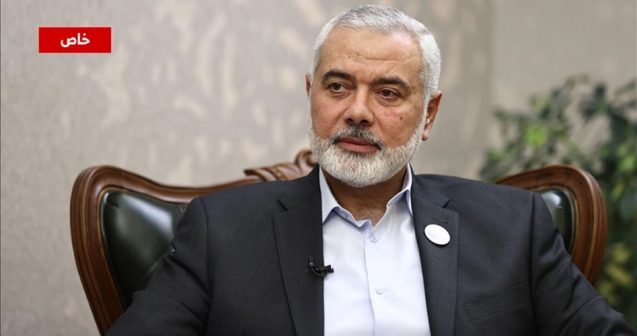
Ismail Haneyya
Palestine Information Center – April 1, 2021
ISTANBUL – Head of Hamas’s political bureau Ismail Haneyya has welcomed the Turkish-Egyptian rapprochement, expressing confidence that any cooperation between Ankara and Cairo will be in the interest of the Palestinian people and their national cause.
Haneyya made the remarks in an interview conducted by Anadolu Agency after he visited its headquarters in Istanbul.
“We welcome the Turkish-Egyptian rapprochement, and we believe that more understandings between them and between Arab and Islamic countries will have a positive impact on us in Palestine as well as on the Arab countries,” the Hamas political chief said.
“There are historically known central states in the region that play strategic roles, such as Egypt, Turkey, Iran and Saudi Arabia, so any understanding and rapprochement between them will be in the interests of the peoples in the region and the Palestinian cause,” he added.
As for the upcoming Palestinian elections, Haneyya affirmed that his Movement is committed to forming a national consensus government even if it scored a victory in the legislative elections slated for next May.
“Hamas is participating in the elections on the basis of partnership and not with the aim of defeating others. It does not want to dominate the Palestinian political system,” he underlined.
He described the upcoming elections as an important opportunity to improve the current Palestinian conditions and end 15 years of national division.
Arab regimes seek to field Israeli-backed Dahlan for Palestinian elections
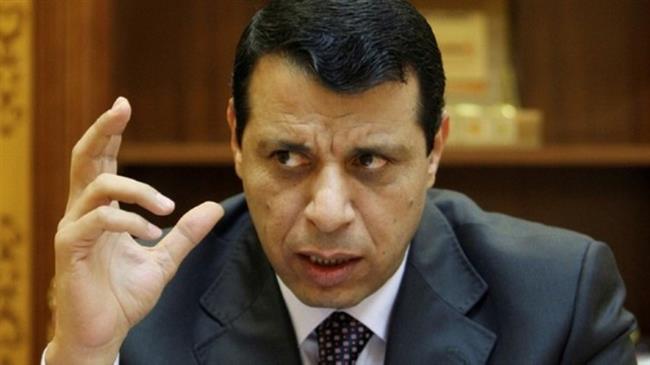
Press TV – February 7, 2021
Several Arab states are reportedly putting pressure on Palestinian political factions to reinstate exiled former Fatah strongman Mohammed Dahlan and field him against Hamas in the upcoming elections.
Sources told Arabic Post news website on Saturday that the UAE, Egypt and Jordan are trying to compel Fatah, Palestine Liberation Organization (PLO) and Palestinian Authority (PA) President Mahmoud Abbas to reinstate the Israeli-backed Dahlan and his supporters.
Abbas dismissed Dahlan from the movement in 2011 and stripped the 58-year-old of all his merits, after which he fled to the United Arab Emirates.
Last September, US Ambassador to Israel David Friedman set off an uproar after suggesting Washington was considering supporting Dahlan to overthrow Abbas as the next Palestinian Authority chief.
Dahlan was sentenced in absentia to three years in prison in 2016 by a Palestinian court for corruption, and ordered to repay $16 million, according to his lawyers.
Dahlan once led a coup against the elected Hamas government in Gaza in 2007. The plan was a massive failure which saw Hamas rout out Dahlan’s forces in a matter of days in the summer of 2007.
President Abbas announced in a decree last month that the 2021 general elections will include legislative elections being held on May 22, presidential elections on July 31 and the Palestinian National Council elections on August 31.
Leaders of 14 Palestinian political factions, including Hamas and Fatah, are scheduled to start a comprehensive national dialog in the Egyptian capital of Cairo on February 8, aiming to reach an agreement on the mechanism for holding the general elections in Palestine.
Egypt: 320 trillion cubic feet of gas discovered in Eastern Mediterranean
MEMO | September 23, 2020
The Egyptian Minister of Petroleum and Mineral Resources, Tariq El-Molla, yesterday revealed that 320 trillion cubic feet of gas were discovered in the Eastern Mediterranean region which could turn the area into a global centre for the gas industry.
The seven member states of the East Mediterranean Gas Forum, Egypt, Israel, Cyprus, Greece, Jordan, Italy and the Palestinian National Authority, yesterday officially turned the alliance into a regional organisation headquartered in Cairo.
Speaking at the launching ceremony, El-Molla said the United States wants to join the forum as an observer while France wishes to join as a full member.
The Egyptian Ministry of Petroleum said in a statement that the forum aims to establish a regional market for gas, rationalise the cost of infrastructure and offer competitive prices.
The forum was launched in January 2019 to reinforce cooperation among member states.
However, a spokesman for the Turkish Foreign Ministry, Hami Aksoy, described the forum as an anti-Ankara bloc, adding that transforming it into a regional organisation is “far from reality”.
Featured Video

“Historic Russia”: The Land Putin Will Not Give Back
or go to
Aletho News Archives – Video-Images
Book Review
Why the War on Conspiracy Theories Is Bad Public Policy
By Kevin Barrett • Unz Review • February 1, 2019
 A Review of Conspiracy Theories and Other Dangerous Ideas by Cass Sunstein (based on an earlier paper co-authored with Adrian Vermeule); In Defense of Troublemakers: The Power of Dissent in Life and Business by Charlan Nemeth; and Conspiracy Theories and the People Who Believe Them, edited by Joseph E. Uscinski
On January 25 2018 YouTube unleashed the latest salvo in the war on conspiracy theories, saying “we’ll begin reducing recommendations of borderline content and content that could misinform users in harmful ways—such as videos promoting a phony miracle cure for a serious illness, claiming the earth is flat, or making blatantly false claims about historic events like 9/11.”
At first glance that sounds reasonable. Nobody wants YouTube or anyone else to recommend bad information. And almost everyone agrees that phony miracle cures, flat earthism, and blatantly false claims about 9/11 and other historical events are undesirable.
But if we stop and seriously consider those words, we notice a couple of problems. First, the word “recommend” is not just misleading but mendacious. YouTube obviously doesn’t really recommend anything. When it says it does, it is lying. … continue
Blog Roll
 Aletho News
- “Historic Russia”: The Land Putin Will Not Give Back
- How the Cambridge Analytica scandal still haunts Mark Zuckerberg
- The Ongoing Cancellation Campaign Against a Dissenting Academic in Norway
- Yemen and ‘the Houthis’: Challenging Sami Hamdi’s Narrative
- No, Christians did not invent Zionism
- AIPAC-led lobbying network opens branches in Cypriot, Greek parliaments
- Araghchi blasts ‘parasitic’ alliance as US taxpayers pay for Israel’s war on Iran
- Easy fix for Europe’s chaos? Stop fueling war against Russia
- Putin’s key remarks on peace talks and Europe’s ‘schizophrenia’
- Trita Parsi: Israel Set a Trap for Total War in the Region
- If Americans Knew
- Damning report shows the media must confront its failures on Gaza
- BBC senior broadcaster speaks out on Gaza coverage
- Netanyahu vows vast West Bank invasion in response to 20-minute skirmish that left 2 Israeli soldiers and 2 Palestinian fighters dead
- Tied up and tortured: Israel using US-made electroshock weapons on Palestinian detainees
- The outsourced risk: how newsrooms rely on Gaza’s freelancers without protecting them
- Gaza bakeries forced to shut as Israel blocks flour shipments
- Gaza’s breast cancer patients face a deadly wait for treatment amid Israel’s genocide
- DAILY UPDATE: Latest essential news on Palestine, Israel, & region
- The Israel Lobby’s Changing Fortunes
- AIPAC has become such a political liability that it’s shifting to a more “nimble” approach to buying politicians
- No Tricks Zone
- E-Cars Reduce CO2 Emissions By Only 41% Compared To Internal Combustion Engine Vehicles
- Predictions Made By Renowned Climate Professor Over Past Decades Have Been Proven To Be Poor
- New Study Suggests Large Regions Of The Pacific Ocean Have Been Cooling For The Last 80 Years
- Germany’s Green Energy Debacle: High Energy Costs Force Kahla Porzellan to Close After 182 Years!
- New Study: 50 Years Of The Most Aggressive ‘Net Zero’ Policies Can Only Affect The Global Climate By 0.03°C
- US September “Heat” Was No Record…Many Records Set Decades Ago
- Latest European Green Energy Debacle; Portugal’s Largest Flagship Solar Park Insolvent!
- Green Energy Debacle: German Expert Professor Fritz Vahrenholt Warns Of Severe Economic And Social Consequences
- Two More Paleo Reconstructions Affirm Meters-Higher Sea Levels Across Ireland, Brazil 7000-6000 Years Ago
- New Study: Earth And Venus Surface Warmth Largely Explained By Convection And Lapse Rate, Not CO2 Or Radiation

