WHO Wants To Run the World?
By Paul Frijters, Gigi Foster, Michael Baker | Brownstone Institute | July 11, 2022
In Geneva in late May at the 75th meeting of the WHO’s decision-making body, the World Health Assembly (WHA), amendments to its International Health Regulations (IHRs) were debated and voted upon. If passed, they would grant the WHO the right to exert unconscionable pressure on countries to accept the WHO’s authority and health policy actions if the WHO decides that there is a public health threat that might spread beyond a country’s borders.
As Ramesh Thakur, the second man at the UN for years, noted, the amendments would mean “the rise of an international bureaucracy whose defining purpose, existence, powers and budgets will depend on outbreaks of pandemics, the more the better.”
This is the first clear instance of a globalist coup attempt. It would subvert national sovereignty worldwide by putting real power into the hands of an international group of bureaucrats. It has long been suspected that the authoritarian elites arisen during covid times would try to strengthen their positions by undermining nation states, and the this 75th jamboree is the first solid evidence of this being true.
What an opportunity then to see who is in the conspiring club. Who drafted the amendments? What was in them? Which individuals supported them or spoke out against them?
WHO were the conspirators?
The amendments on the table at the May WHA meeting had been transmitted to the WHO by the US Department of Health and Human Services on January 18, circulated by WHO to its member states (‘States Parties’) on January 20 and formally introduced to the WHA on April 12.
The proposals, according to an announcement on January 26, were co-sponsored by 19 countries plus the European Union. Even if some co-sponsors had little direct involvement in drafting them, they all would have approved in principle the overarching goal of tightening up the WHO’s authority over member states in the face of a public health event.
Loyce Pace, the HHS’s Assistant Secretary for Global Affairs – the leading US official nominally responsible for the proposed amendments – arrived at the Biden administration fresh from a stint as executive director of an advocacy organization called the Global Health Council.
That council receives funding from the Bill & Melinda Gates Foundation and its members include Eli Lilly, Merck, Pfizer, Abbott Labs, and Johnson & Johnson. You get the idea. Via one of the foxes-turned-chicken-guard, it appears the HHS ‘worked closely’ on these amendments with large pharmaceutical companies, who will be chomping at the bit for a more proactive (read: profitable) response to any public health emergency, real or imagined.
So the conspiring club consists primarily of the US government and its Western allies in lockstep with Big Pharma, and they are looking to undermine both the sovereignty of their own governments and that of other countries, presumably with the idea that the Western elites would do the running.
What was in them? A blizzard of acronyms and euphemisms
To understand what the US proposed at the WHA, we need first to understand how things have worked in the WHO to this point.
The IHRs in their current form have been in force as international law since June 2007. Among other things, they impose requirements on countries to detect, report and respond to ‘public health events of international concern,’ or PHEICs. The WHO Director-General consults with the state where a possible public health event has occurred, and within 48 hours they are meant to come to a mutual agreement on whether or not it actually is a PHEIC, whether or not it needs to be announced to the world as such, and what counter-measures, if any, should be taken. It’s essentially an early-warning system on major health crises. This is a good thing if it’s run by people you can trust and if it has checks and balances to rein in expansionary tendencies.
The proposed amendments would greatly strengthen the power of the WHO relative to this baseline, in a number of ways.
First, they lower the threshold for the WHO to declare a public health emergency by empowering its Regional Directors to declare a ‘public health event of regional concern’ (PHERC, italics ours) and for the WHO to put out a new thing called an ‘intermediate public health alert.’
Second, they permit the WHO to consider allegations about a public health event from non-official sources, meaning sources other than the government of the state concerned, and allow that government only 24 hours to confirm the allegations and a further 24 hours to accept the WHO’s offer of ‘collaboration.’
Collaboration is essentially a euphemism for on-site assessment by teams of WHO investigators, and concomitant pressure at the whim of WHO personnel to enact potentially far-reaching measures such as lockdowns, movement restrictions, school closures, consumption of medicines, administration of vaccines and any or all of the other social, economic, and health paraphernalia that we have come to associate with the covid circus.
Should the state’s government acceptance of the WHO’s ‘offer’ not be forthcoming, the WHO is empowered to disclose the information it has to the other 194 WHO countries, while continuing to pressure the state to yield to the WHO’s invitation to ‘collaborate.’ A non-collaborating country would risk becoming a pariah.
Third, the proposal includes a new Chapter IV, which would establish a ‘Compliance Committee’ consisting of six government-appointed experts from each WHO region tasked with permanently nosing around to ensure the member states are complying with IHR regulations.
There are more crossings-out of the existing IHR language and new language added in, but the flavour of what the US-led alliance is shooting for is a WHO that can unilaterally decide whether there is a problem and what to do about it, and can isolate countries that disagree.
Compliant WHO member states could act as a supporting cast in the isolation effort, through the distribution of their own health budgets and their ‘health-related’ policies, which would include travel and trade restrictions. The WHO would become a kind of command-and-control center for globalist agendas, pushing the produce of (Western) Big Pharma.
Why and how would this work?
We learned during covid times why it would make sense that the US and its allies are insisting on these amendments.
Lowering the bar for declaring a global (or regional) public health threat triggers a huge opportunity for Western pharmaceutical companies. As legal experts have observed: “WHO emergency declarations can trigger the fast-track development and subsequent global distribution and administration of unlicensed investigational diagnostics, therapeutics and vaccines.
This is done via the WHO’s Emergency Use Listing Procedure (EULP). The introduction of an ‘intermediate public health alert’ in particular will also further incentivise the pharmaceutical industry’s move to activate domestic fast-track emergency trial protocols as well as for advance purchase, production and stockpile agreements with governments before the existence of a concrete health threat to the world’s population has been detected, as is already the case under WHO’s EULP via the procedures developed for a ‘pre-public health emergency phase’.”
You can bet that the WHO ‘expert teams’ sent in to make on-the-ground assessments, under the banner of ‘collaboration’ with the host country experiencing the health event, will be chock-a-block with operatives from the CDC and who knows what other Western agencies, all poking around potentially sensitive facilities that a host government might justifiably claim a sovereign right to keep to itself. Likewise with the ‘Compliance Committee’ proposed by the US under the new Chapter IV of the IHRs: its government-appointed members have an open-ended brief, enshrined in international law, to be busybodies.
In layman’s terms, the WHO would be turned into an international thug, with its member states offered the role of backyard gang members.
As a bonus for Western elites, the proposals are a sneaky form of rewriting history. By cementing authority within an international organisation to determine the existence of public health crises and direct potentially draconian emergency responses, Western governments would get to enshrine and legitimise their own extreme responses to the covid outbreak, as we have pointed out previously. Their backsides would thereby be given some protection from legal challenges.
The refusniks: Developing countries
The proposals were pushed primarily by Western countries: the US was joined by Australia, the UK and the EU in arguing for passage. The resistance was led by developing countries who saw it as a colonialist ambush in which their ability to set policy and respond to health threats in a manner commensurate with their domestic situations would be overridden.
Brazil reportedly went so far as to threaten to withdraw from the WHO, and the African group of almost 50 countries, along with India, argued that the amendments were being rushed through without adequate consultation. Russia, China and Iran also objected.
Failure on the first try, but the US and its allies in the West will get more shots to push it through.
How do we expect them to do this? Well, when a proposal gets bogged down inside a giant bureaucratic machine like the WHO, the inevitable response is to set up committees to work in the background and circle back with a new set of proposals to be presented at a future meeting. True to form, a ‘working group’ and ‘expert committee’ are being assembled to accept member state proposals on IHR reform by the end of September this year. These will be ‘sifted through’ and reports will be prepared for review by the WHO’s executive board in January next year. The objective is to have a fresh set of proposals on the table when the WHA convenes for the 77th time in 2024.
Not all was lost
Salvaging something from the fact that the WHA failed to get a consensus around its biggest agenda item, the US and its allies got a small victory on the point of when they can try again – though in their desperation they needed to violate the IHRs’ own rules to accomplish it. Article 55 of the IHRs states unambiguously that a four-month notice period is required for any amendments.
In this instance, revised amendments were presented on May 24, the same day that the first lot were rejected. These were discussed, further amended on May 27 and then adopted on the same day. The approved amendments halve the two-year period for any (further) approved amendments to the IHRs to take effect. (The IHRs that came into force in 2007 were agreed to in 2005 – but under the new resolution, anything agreed to in 2024 would come into effect in 2025 rather than 2026.)
Yet, what was achieved in terms of fast-tracking the force of new amendments was lost in slow-tracking their implementation. Nations would have up to 12 months – double the previous suggestion of six months – to implement any IHR amendments that newly enter into force of law.
State of play
Where is all this going?
If the WHO takes the reins on decisions about what constitutes a health crisis, and can pressure every country into a one-size-fits-all set of responses that it, the WHO, also determines, that’s bad enough. But what about if its invitation to ‘collaborate’ with countries is backed up with teeth, such as sanctions against those who demur? And what about if it then broadens the definition of ‘public health’ by, for example, declaring that climate change falls under that definition? Or racism? Or discrimination against LBTQIA+ people? The possibilities thereby opened up for running the world are endless.
A global ‘health’ empire would bring huge harms to humanity, but a lot of power and money is pushing for it. Don’t think it can’t happen.
Paul Frijters is a Professor of Wellbeing Economics at the London School of Economics: from 2016 through November 2019 at the Center for Economic Performance, thereafter at the Department of Social Policy
Pharmaceuticals can be a license to print money
By Pete Dolack | Systemic Disorder | October 11, 2107
It’s no secret that the United States suffers from by far the world’s highest costs for health care. As the most market-oriented health care system among advanced capitalist countries, this is no surprise. Health care in the U.S. is designed to deliver corporate profits, not health care.
On that score, the U.S. system is quite successful. Pharmaceutical companies are at the head of the class in this regard, frequently justifying the spiraling costs of medications by citing large research and development costs that include the costs for drugs that don’t make it to market. There are many drugs that fail to survive testing and become a cost that will never be compensated, that is true. But are these failures really so high to justify the extreme costs of successful drugs?
It would seem not. Firmer proof of that lack of justification has been published by the JAMA Internal Medicine journal, which found that revenue for cancer drugs far outstrips spending on research and development. The article, “Research and Development Spending to Bring a Single Cancer Drug to Market and Revenues After Approval,” prepared by Drs. Vinay Prasad and Sham Mailankody, found that revenue from 10 drugs (one by each of 10 companies) exceed those companies’ total research and development costs by more than seven times.
The total revenue hauled in from these 10 drugs did vary considerably. Two of them earned more than US$20 billion after approval. Both of these high performers cost less than $500 million in research and development costs. The revenue from each of the 10, however, exceeded costs, with widely varied margins. Still profitable: The median revenue of these 10 drugs was $1.7 billion, more than double the median development cost of $648 million, the JAMA Internal Medicine authors report.
The authors write that the median cost to develop a cancer drug represents “a figure significantly lower than prior estimates,” adding that their analysis “provides a transparent estimate of R&D spending on cancer drugs and has implications for the current debate on drug pricing.”
To obtain these figures, the authors analyzed U.S. Securities and Exchange Commissions filings for pharmaceutical companies with no drugs on the U.S. market that received approval by the U.S. Food and Drug Administration for a cancer drug from January 1, 2006, through December 31, 2015. Cumulative R&D spending was estimated from initiation of drug development activity to date of approval. Earnings were tracked from the time of approval to March 2017.
The sky’s the limit for pharmaceutical prices
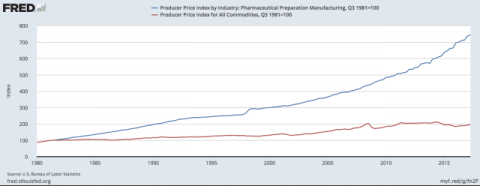
The increase in pharmaceutical prices (blue) versus the general increase in commodities prices (red).
Another way of looking at this would be to examine the increases in the cost of pharmaceuticals against other products. Here again the numbers stand out. Using data gathered by the St. Louis branch of the Federal Reserve Bank, the consumer price index for pharmaceutical preparation manufacturing for the first quarter of 2017 was 747.8, with January 1, 1980, as the benchmark of 100. In other words, the price of pharmaceuticals is seven and half times higher than they were at the start of 1980. (See graph above.)
How does that compare with inflation or other products? Quite well — for pharmaceutical companies. That more than sevenfold increase in drug prices is an increase nearly two and half times greater than inflation for the period, and nearly four times that of all commodities.
So, yes, unconscionable price-gouging is the cause here. By the industry as a whole, not simply individuals like “Pharma Bro” Martin Shkreli, who might be an outlier in his brazenness but not in his profit-generation plan.
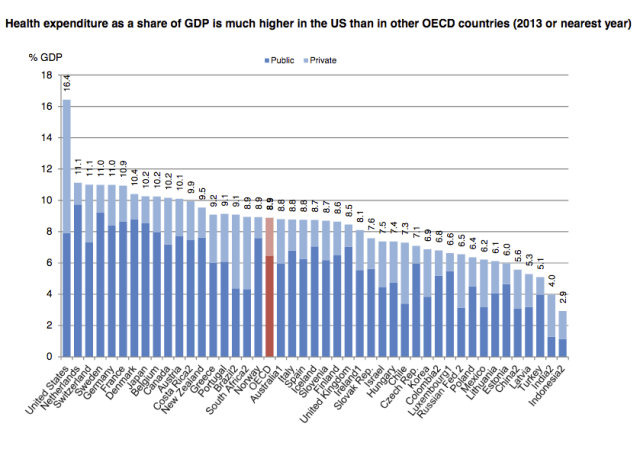
Although not the entire picture, this snapshot of corporate extortion plays a significant role in why the cost of the United States not having a universal health care system is more than $1.4 trillion per year.
Among 19 broadly defined “major” industrial sectors in the U.S., health technology is again expected to be found the most profitable for 2016, with a profit margin of 21.6 percent. Higher even than finance at 17 percent. When narrowing to more specific, narrowly defined industry categories, generic pharmaceuticals sit at the top with an expected 30 percent profit margin for 2016. Major pharmaceuticals rank fourth at 25.5 percent on a list in which health products and finance claim nine of the top 10 spots.
The sky’s the limit for pharmaceutical profits
That’s a repeat of 2015, when health technology had the highest profit margin of 19 broadly defined industrial sectors, at 20.9 percent, topping even finance, the second highest. When a separate study broke down profit margins by more specific industry categories, health care-related industries comprised three of the six most profitable.
Nothing new there, either. A BBC report found that pharmaceuticals and banks tied for the highest average profit margin in 2013, with five pharmaceutical companies enjoying a profit margin of 20 percent or more — Pfizer, Hoffmann-La Roche, AbbVie, GlaxoSmithKline and Eli Lilly. The world’s 10 largest pharmaceutical corporations racked up a composite US$90 billion in profits for 2013, according to the BBC analysis. As to their expenses, these 10 firms spent far more on sales and marketing than they did on research and development.
If those facts and figures aren’t enough, here’s another way of looking at excessive profits — a 2015 study found that, of the 10 corporations that have the highest revenue per employee among the world’s biggest corporations, three are health care companies. Two of the three, Amerisourcebergen and McKesson, both distribute pharmaceuticals, and the other, Express Scrips, administers prescription drug benefits for tens of millions of health-plan members. Each of these primarily operates in the United States, the only advanced-capitalist country without universal health coverage.
The extra layers represented by those three companies demonstrate that there are ample opportunities for corporate profiteering that contribute to extraordinarily high health care costs in the U.S., beyond drug manufacturing and insurance.
And because corporations have the ear of politicians and other government officials, it’s no surprise that one of the primary ongoing goals of the U.S. government for so-called “free trade” agreements, such as the Trans-Pacific Partnership, is to impose rules that would weaken the national health care systems of other countries. This was done in TPP negotiations at the direct behest of U.S.-based pharmaceutical companies, incensed that countries like New Zealand make thousands of medicines, medical devices and related products available at subsidized costs.
By far the most expensive system while delivering among the worst outcomes and leaving tens of millions uninsured, where tens of thousands die from lack of health care annually. That is the high cost of private profit in health care. Or, to put it more bluntly, allowing the “market” to decide health outcomes instead of health care professionals.
TPP: Big Pharma’s Big Deal
By Joyce Nelson | CounterPunch | October 7, 2015
We still don’t know all the details of the Trans-Pacific Partnership (TPP) trade deal tentatively agreed to on Oct. 5 by negotiators from 12 Pacific Rim countries, but already critics are slamming it for many reasons, including its generous concessions to the pharmaceutical industry.
Doctors Without Borders claims the TPP will “go down in history as the worst trade agreement for access to medicines in developing countries.” [1] That’s because the TPP will extend patent protection for brand-name drugs, thereby preventing similar generic drugs (which are far less costly) from entering the market. This will drive up the prices.
Judit Rius Sanjuan, legal policy adviser for Doctors Without Borders, told vox.com that TPP creates patent-related obligations in countries that never had them before. People in “Peru, Vietnam, Malaysia, and Mexico” will be especially affected, she said. “They’ll face higher prices for longer periods of time.” [2]
Ruth Lopert, a professor at George Washington University, told Bloomberg News that provisions in the TPP agreement will affect health-care budgets and drug access in all signatory countries, but especially the poorest. “She said as many as 40,000 people in Vietnam, the poorest country in the agreement, could stop getting drugs to fight HIV because of provisions that will boost the price of [pharmaceutical] therapy.” [3]
Other countries like Canada will also be hit with higher costs. The Council of Canadians says that if the TPP is ratified, “[p]harmaceutical patents will be extended, delaying the release of more affordable generic drugs and adding $2 billion to our annual public health care bill.” [4] In the U.S., many people already cannot afford to pay for the expensive medicines that could save their lives, and they try to access generics available elsewhere.
Extending patent rights for life-saving drugs is an obvious gift to Big Pharma. Conor J. Lynch at opendemocracy.net has called it “a clear corporate handout that would greatly affect international access and most definitely cause preventable deaths. The clear objective here is to increase industry profits, plain and simple. This is not surprising, that’s what private industry does, but there is a serious moral dilemma here.” [5] That moral dilemma is made even more apparent by recent findings.
Tax Cheats
In an ironic coincidence, the TPP agreement was reached on the same day that a damning report on corporate tax-avoidance – Offshore Shell Games 2015 – was released by Citizens for Tax Justice and the US Public-Interest Research Group Education Fund. The report reveals the extent to which top U.S. companies use tax havens like Bermuda, Luxembourg, Cayman Islands, and the Netherlands to set up “tax haven subsidiaries” that are usually little more than a post-office box.
Of the top 30 Fortune 500 companies with the most money held in offshore tax-havens, nine are pharmaceutical companies: Pfizer ($74 billion held offshore), Merck ($60 billion), Johnson & Johnson ($53.4 billion), Proctor & Gamble ($45 billion), Amgen ($29.3 billion), Eli Lilly ($25.7 billion), Bristol Myers Squibb ($24 billion), AbbeVie Inc. ($23 billion), and Abbott Laboratories ($23 billion). [6]
Concerning Pfizer, the world’s largest drug maker (declared profits of $22 billion in 2013), the report states: “The company made more than 41 percent of its sales in the U.S. between 2008 and 2014, but managed to report no federal taxable income for seven years in a row. This is because Pfizer uses accounting techniques to shift the location of its taxable profits offshore. For example, the company can transfer patents for its drugs to a subsidiary in a low- or no-tax country. Then when the U.S. branch of Pfizer sells the drug in the U.S., it ‘pays’ its own offshore subsidiary high licensing fees that turn domestic profits into on-the-books losses and shifts profit overseas.”
Overall, the study found that the 500 largest U.S. companies hold more than US$2.1 trillion in accumulated profits offshore. “For many companies, increasing profits held offshore does not mean building factories abroad, selling more products to foreign customers, or doing any additional real business activity in other countries,” but simply establishing a PO box.
Some companies use the money supposedly “trapped” offshore as “implied collateral” in order to borrow funds at negligible rates for investing in U.S. assets, paying dividends to shareholders, or repurchasing stock.
Of course, as the report makes clear, “Congress, by failing to take action to end this tax avoidance, forces ordinary Americans to make up the difference. Every dollar in taxes that corporations avoid by using tax havens must be balanced by higher taxes on individuals, cuts to public investments and public services, or increased federal debt.”
The report finds that, through a variety of tax-avoidance measures, an estimated US$620 billion in U.S. taxes is collectively owed by the 500 largest companies with headquarters in the U.S.
Corporate Coup
Now the TransPacific Partnership – which is being called “NAFTA on steroids” – would award Big Pharma and other multinationals even more corporate “rights” in more countries, including the controversial investor-state dispute settlement (ISDS) mechanism by which they can sue signatory governments for regulatory changes that affect their profits.
As the Canadian website rabble.ca notes: “The Canadian government is currently being sued through NAFTA by Eli Lilly, an American pharmaceutical company, for invalidating the firm’s patent extensions on two mental health drugs. A Canadian Federal Court decided in 2010 that the patent extensions had not delivered the promised benefits and the drugs should therefore be opened up to generic competition. Generic drugs significantly reduce the cost for end users, but Eli Lilly cried foul and launched an ISDS claim against the government, demanding US$500 million in compensation for lost profits. The case is still in progress, but regardless of the outcome we can expect the TPP to lead to similar ISDS disputes. Powerful multinational pharmaceutical companies will use any available means to cling to over-priced drug monopolies. Greater intellectual property protections in the TPP will give these companies an even stronger quasi-legal basis to sue governments and crowd out generic [drug] competition.” [7]
The final text of the TransPacific Partnership agreement won’t be available for at least a month, likely weeks after the Canadian federal election on October 19. The details will undoubtedly reveal more generous concessions to the multinationals. It will be up to the elected legislators in all twelve countries to approve or reject the TPP. In Canada, NDP leader Tom Mulcair has pledged to scrap the deal if elected as Prime Minister, explaining that the Stephen Harper government had no mandate to sign it during an election campaign when it is merely a “caretaker” government.
The U.S. website zerohedge.com calls the Trans-Pacific Partnership “a Trojan horse” and “a coup by multinational corporations who want global subservience to their agenda.” In no uncertain terms, it adds: “Buyer beware. Citizens beware.” [8]
Footnotes/Links:
[2] Julia Belluz, “How the Trans-Pacific Partnership could drive up the cost of medicine worldwide,” Vox, October 5, 2015.
http://www.vox.com/2015/10/5/9454511/tpp-cost-medicine
[3] “Pacific Deal Rewrites Rules on Trade in Autos, Patented Drugs,” Bloomberg News, October 5, 2015.
http://www.bloomberg.com/news/articles/2015-10-05/pacific-deal-rewrites-rules-on-trade-in-autos-patented
[4] Council of Canadians, “Tell party leaders: Reject the TPP,” October 6, 2015.
[5] Conor J. Lynch, “Trans-Pacific Partnership’s Big Pharma giveaway,” Open Democracy, February 14, 2015.
http://www.opendemocracy.net/conor-j-lynch/transpacific-partnership%E2/80%/99s-big-pharma-giveaway
[6] http://ctj.org/ctjreports/2015/10/orrshore_shell_games_2015.php//executive
[7] Hadrian Mertins-Kirkwood, “Trans-Pacific Partnership a big win for corporate interests,” Rabble.ca, October 6, 2015.
[8] Tyler Durden, “Trans-Pacific Partnership Deal Struck As ‘Corporate Secrecy’ Wins Again,” Zero Hedge, October 5, 2015.
http://www.zerohedge.com
The Withering of Big Pharma?
By Martha Rosenberg | Dissident Voice | November 7, 2013
It used to be when a drug company settled illegal marketing charges that millions took its drugs under false pretenses, the news would be released on a Friday afternoon when no one would notice. That was then. Now almost all the drug companies have joined the Off label/Kickback club and the public doesn’t seem to notice or care.
On the surface, Johnson & Johnson’s $2.2 billion settlement this week for illegally marketing drugs to the elderly, children and the mentally disabled looks like a victory. J&J’s subsidiary, Janssen Pharmaceuticals, will plead guilty to illegally promoting the antipsychotic Risperdal for “controlling aggression and anxiety in elderly dementia patients and treating behavioral disturbances in children and in individuals with disabilities,” reports Reuters. The promotions included a brazen kickback scheme to Omnicare Inc, a pharmacy supplying nursing homes, exposed by a whistleblower.
At least 15,000 elderly people in nursing homes die a year from drugs like Risperdal said FDA drug reviewer David Graham in Congressional testimony a few years ago. Eli Lilly who makes the similar drug Zyprexa and AstraZeneca who makes Seroquel have also settled charges that they churned the elderly drug market at the price of Grandma and Grandpa’s lives.
But it is not a victory. J&J made $24.2 billion off Risperdal from 2003 to 2010 and shareholders won’t even notice this week’s nano loss. J&J milked Risperdal for all it was worth and the patent had already run out by the time it was charged with illegal schemes. Other drug giants charged with illegal marketing schemes–Abbott for Depakote, Pfizer for Bextra, Eli Lilly for Zyprexa, AstraZeneca for Seroquel, GlaxoSmithKline for Paxil and Merck for Vioxx–also got their money’s worth before the trivial nuisance of suit. Many, like Pfizer who illegally marketed its seizure drug Neurontin while under probation for illegal Lipitor activities–are brazen and shameless repeat offenders.
Many say the only justice that will get Big Pharma’s attention is frog marching the CEOs off to prison and/or cutting them off from their lucrative public trough of Medicare, Medicaid and military health programs.
Still, Big Pharma’s audacious business plan of asking forgiveness not permission is winding down. Not because Pharma, prescribers, consumers, regulators and health officials have seen the light but because there are no more big drugs to pimp. An estimated 100,000 workers will be losing their jobs at Pfizer, Sanofi, Roche, GlaxoSmithKline, AstraZeneca and Merck reported Yahoo finance last month.
Only two new drug campaigns seem to be brewing and they require a major suspension of reality on the part of doctors and patients. One tries to convince people with low back pain they actually suffer from ankylosing spondylitis an arthritis-like condition that causes chronic inflammation of the spine. If your spine is stiff when you wake up in the morning you can take an immune suppressor like Humira which puts you at risk of tuberculosis and lethal viral, fungal and bacterial infections while costing you $12,000 to $17,000 a year. Line forms to the left.
The other, even more brazen campaign, tries to convince people with insomnia, tiredness during the day, moodiness and relationship problems that they actually suffer from Non-24-Hour Sleep–Wake Disorder, a disorder that affects mostly blind people. You don’t have to be blind to have the disorder, says the new Pharma message even though there have been fewer than 100 cases of sighted people with non-24 reported in the scientific literature. It sounds like a stretch but so did convincing people with job, money and marriage problems they really had depression or bipolar disorder.
Still it is obvious the bloom has fallen off the Big Pharma rose and it is now paying the piper for the high-flying party with drug settlements like Johnson & Johnson’s this week. But that doesn’t mean shady marketing, hidden risks, kickbacks and outrageous prices are gone from the medical field. They have just moved to the Medical Device industry.
~
Martha Rosenberg is a columnist/cartoonist who writes about public health. Her first book, titled Born with a Junk Food Deficiency: How Flaks, Quacks and Hacks Pimp the Public Health, has just been released by Prometheus Books. She can be reached at: martharosenberg@sbcglobal.net.
Related article
Featured Video

Prof. Ted Postol: Iran Already Achieved Nuclear Deterrence Against Israel
or go to
Aletho News Archives – Video-Images
From the Archives
How the occupied mentality syndrome works
Saudi Arabia on the American chessboard – Part 3
By B. J. Sabri | American Herald Tribune | June 27, 2016
Read part 2: “The occupied mentality Syndrome“
Previously I argued whether Saudi Arabia’s repeated involvements in U.S. interventions and wars stem from free national will or in response to a specific condition. For starters, in Saudi Arabia there is no national will. In Saudi Arabia, the national will is the will of the Al Saud clan. Still, when a major Arab state allies itself with a superpower that committed unspeakable crimes against humanity in almost every Arab country, then something is wrong. This fact alone should compel us to examine the U.S.-Saudi relation for one exceptional reason. As a result of the U.S.-Saudi wars, hundreds of thousands of people in Afghanistan, Iraq, Iran, Libya, Syria, Yemen, and Somalia have lost their lives. Millions became displaced in their own homelands. And millions more rendered refugees.
Attributing the Saudi policies to the bonds of “partnership” with the U.S. is frivolous. There are no bonds between these two thugs except those of business, military deals, secret plots, and wars. Proving this point, bonds such as these have no space for the American and Saudi peoples to share significant cultural or societal exchanges. If partnership is not the reason for the Saudi contribution to the U.S. strategy of empire and imperialism, then another reason must exist.
This leads to three possibilities. … continue
Blog Roll
 Aletho News
- NIAID/NIH and USDA Fund Bioengineered Chimeric Influenza Viruses Built Using Pandemic H1N1 Components: Journal ‘Science Advances’
- Hezbollah hits Israeli warship off Lebanon’s coast, sets it aflame
- Iran slams US strikes on B1 bridge, Mahshahr petrochemical plants as ‘blatant acts of state terrorism’
- In letter to UN chief, Araghchi warns of dire consequences of US-Israeli attacks on Iran’s nuclear facilities
- Why the CIA conspiracy to invade Iran with Kurdish militias failed
- Why Are Upbeat US Claims About Mission to Rescue Pilot ‘Highly Questionable’?
- Aircraft destroyed during US ‘rescue’ of downed F-15 pilot cost more than $100 million each
- Washington University removes professor who condemned US-Israeli war on Iran
- Russia Warns of Retaliation as UK Authorizes Seizure of Vessels
- Serbia thwarts plot to bomb Russia-Hungary gas pipeline – Vucic
- If Americans Knew
- In Iran, Israel-US take aim at “reason, research, and freedom of thought” – Daily Update
- US loses planes over Iran, Israel downgrades Lebanon war goals – Daily Update
- Israel Is Blocking Palestinians from Easter at Church Where Jesus Resurrected
- Plot to assassinate Palestinian activist follows harassment campaign promoted by Zionist groups and elected officials
- Prominent New York synagogue hosts presentation on why U.S. Jews should support the ethnic cleansing of Gaza
- Tapper vs. Piker: Is the CNN Anchor Auditioning for David Ellison?
- Shouldn’t Democrats Be Able to Condemn Genocide?
- Israel-US kill negotiators, destroy civilian structures, but Iran’s military capabilities still largely intact – Daily Update
- ‘War crime’: Global condemnation as Israeli ministers celebrate death penalty law targeting Palestinian prisoners
- 7 Ways Israel Is Turning Lebanon Into Gaza
- No Tricks Zone
- An Inconvenient Tree: Uncovered In Alps… Europe Much Warmer Than Today 6000 Years Ago
- New Study Reports A 60% Slowdown In Greenland’s Ice Loss Rate In The Last Decade
- Low Intensity Tornado Wrecks Major Solar Farm, Creating A Potential Toxic Dump
- New Study Finds Warming Saves Lives…Cold Temperatures 12 Times More Deadly Than Excess Heat
- German Science Blog Accuses PIK Climate Institute Of Hallucinating Climate Tipping Points
- Devastating Assessment Of Comirnaty Vaccine By Former Senior Pfizer Europe Toxicologist
- New Study: CO2 Is ‘Effectively Negligible’ As An Explanatory Climate Change Factor Since 2000
- Former Pfizer Toxicologist Dr. Helmut Sterz Tells Bundestag Hearing Pfizer Vaccine Should Have Never Been Approved
- Energy Expert: Germany’s Nuclear Phaseout Was A “500 Billion Euro Mistake”
- New Research: South Australia’s Mid-Holocene Sea Surface Temperatures Were 4°C Warmer Than Today
 Aletho News