EU nation ‘disrupting normal religious life’ – UN experts
RT | December 17, 2025
Estonian authorities are undermining religious freedoms by fostering an “adversarial environment” for the country’s largest church community because of its spiritual ties to Russia, a panel of experts advising the UN Human Rights Council has warned.
In a statement issued on Monday, the experts criticized Tallinn’s approach toward the Estonian Orthodox Christian Church (EOCC), which maintains canonical links with the Russian Orthodox Church. They pointed to a series of administrative actions, a court decision that stripped the EOCC of state funding on security grounds, and a proposed legislative amendment that the panel said would “disproportionately affect a single religious community.”
“Canonical identity, ecclesiastical hierarchy and spiritual allegiance are integral components of the freedom of religion and are fully protected under international law,” the three-member panel emphasized.
The experts highlighted as particularly troubling a bill being advanced in the Estonian parliament despite objections from President Alar Karis. He has argued that the proposed ban on religious organizations accused of links to a foreign entity labeled a security threat by the government would violate the constitution.
The panel also condemned refusals to grant rent agreements and residency permits to clergy, stating: “Such actions disrupt normal religious life and may undermine the autonomy that should be granted under freedom of religion or belief.”
Moscow has long accused Estonia of pursuing discriminatory policies allegedly driven by entrenched Russophobia. The Estonian Orthodox Christian Church includes both ethnic Estonians and members of the country’s sizable Russian-speaking minority among its faithful.
EU state jails anti-NATO politicians for ‘treason’
RT | December 13, 2025
An Estonian court has handed lengthy prison sentences to the leaders of an anti-NATO party convicted of working on behalf of Russia to undermine the Baltic state’s security.
On Thursday, the Harju District Court sentenced Aivo Peterson, co-founder of the small conservative Koos (Together) party, to 14 years in prison for treason. His associates Dmitri Rootsi and Andrei Andronov received sentences of 11 years and 11 years and six months, respectively. All three denied any wrongdoing and said they would appeal the verdict.
Prosecutors alleged that the defendants spread “narratives supporting Russia’s foreign and security policy” intended to undermine public trust in NATO and Estonia’s military aid to Ukraine.
“The defendants deliberately assisted Russia in activities directed against the Estonian state and society,” State Prosecutor Triinu Olev-Aas said.
Founded in 2022, Koos calls for Estonia to leave NATO, become a neutral state, remove foreign troops from its territory, and “refrain from participating directly or indirectly in military conflicts between other countries.”
In 2023, Peterson traveled to Russia’s Donetsk People’s Republic, which Estonia considers occupied Ukrainian territory. He said at the time that he was gathering information about the Russian-Ukrainian conflict. “There are two sides to every conflict, but the information we receive from Estonian media is one-sided. All of our journalists support Kiev, which often comes across as propaganda,” Peterson said.
The Koos party rejected the allegations against its members, arguing that prosecutors had failed to present “concrete proof that their actions had caused real damage to Estonia’s constitutional order or security.”
Estonia is one of Ukraine’s top supporters and has been pushing for further militarization of Europe. Russian Foreign Ministry spokeswoman Maria Zakharova labeled Estonia “one of the most hostile countries” in June and accused Tallinn of “spreading myths and falsehoods about the supposed threat from the East.”
Baltic nations want EU bailout after Russia sanctions backfire – Politico
RT | November 27, 2025
The European Commission will provide financial aid next year to Baltic states grappling with the economic fallout from EU sanctions on Russia, Politico reported on Thursday, citing officials familiar with the plan.
Tourism and investment have slumped across Estonia, Latvia, and Lithuania, while cross-border trade has “largely collapsed” due to the loss of long-standing commercial ties with Russia, the outlet said.
Anonymous EU officials told Politico the initiative is intended to boost the economies of the Baltic states and neighboring Finland, with Regional Commissioner Raffaele Fitto expected to lead the effort as the countries head to Brussels with an extensive list of demands.
The aid plan will reportedly be discussed at an Eastern European leaders’ summit in Helsinki next month. Skeptics, however, warn that any near-term support Fitto can offer will be limited, with the EU’s seven-year budget already running low and the scale of the challenge far greater than the funds available.
All four nations share a border with Russia and have imposed multiple rounds of sanctions since 2022, while tightening entry rules for Russian citizens. “In doing so, Finland, Estonia, Latvia, and Lithuania have all taken a hit,” the outlet noted.
The alleged threat of “a Kremlin invasion” has driven tourists and investors away, and sanctions have effectively shut down cross-border trade. Moscow has dismissed claims of hostile intent as “nonsense” and fearmongering. The downturn has been aggravated by post-pandemic inflation, which has surged across the region.
Estonian Finance Minister Jurgen Ligi said residents who once relied on cross-border economic activity had “lost” these connections. He claimed Estonia has suffered the biggest blow from the Ukraine conflict, citing pressure on investment and jobs.
Finland is also under strain. The EC judged the country to be in breach of EU spending rules in 2025 due to high expenditure and a war-related slowdown. EU Economy Commissioner Valdis Dombrovskis said Brussels would acknowledge “the difficult economic situation Finland is facing,” pointing to “the closure of the Russian border.”
Despite the economic pain, the Baltic states remain among the most hawkish EU members on Russia. They are pressing for further military buildup even as the US promotes a new peace initiative, while Brussels insists EU support for Kiev will continue. Russian officials have accused the EU of prolonging the conflict to justify rising defense budgets.
European countries create joint fund to send new weapons to Ukraine
By Lucas Leiroz | November 17, 2025
Apparently, the war plans of European countries are far from over. Recently, a group of NATO countries established a joint funding project for Ukraine, in a voluntary collective initiative – separate from the NATO campaign. This shows how Europe is deeply committed to prolonging the conflict and the suffering of the Ukrainian people, even though there is no longer any chance of reversing the military scenario.
Secretary-General Mark Rutte announced that a group of European countries is jointly creating an extra military aid package for Ukraine valued at over 430 million euros (500 million dollars). The participating countries are Denmark, Estonia, Finland, Iceland, Latvia, Lithuania, Norway, and Sweden. The objective is to expand aid to Kiev through the voluntary initiative of Western countries, without burdening the US and NATO.
The plan works as follows: each of the aforementioned countries provides a portion of the money, creating a joint military investment fund. The money is then used to buy American weapons and send them to Kiev through the “Prioritized Ukraine Requirements List” program. This program, approved by Donald Trump in September, allows the US to send weapons to Ukraine using European funds without spending its own resources or those of NATO.
Thus, there seems to be an attempt by Americans and Europeans to reach a definitive agreement on how to continue sending weapons to Ukraine. Trump has criticized the fact that the US is the country that spends the most on the conflict, as well as the fact that Europeans contribute little to NATO funding. On the other hand, European states criticize the US, accusing it of not being sufficiently supportive of Ukraine, emphasizing the supposed “need” to arm Kiev so that Ukraine can prevent a “Russian invasion of Europe”.
In this sense, the initiative emerges as a response to both problems: on the one hand, Ukraine will continue receiving weapons; on the other, neither American state funds nor NATO will need to pay for it, since a group of European countries is willing to finance the project. Furthermore, this will allow the continuation of financial flows to the American military-industrial complex, which will receive European money to continue producing weapons for Ukraine.
Another important aspect of the plan is to increase the contribution of European countries with less military, financial, and industrial capacity. Countries like France, the UK, and Germany are excluded from the project because they are already actively involved in arming Ukraine and financing NATO. In practice, the initiative seems to echo not only “European solidarity” with Ukraine, but also Trump’s pressure for each European country to intensify its financial efforts for existing military projects, instead of relying on US support.
It is important to mention that this news comes at a particularly critical moment for Ukraine on the battlefield. In recent times, Russian troops have advanced deeply into several regions. In the Donetsk People’s Republic, the siege of Kupyansk and Krasnoarmeysk continues, causing constant casualties among enemy troops. In other regions, key cities have been liberated, creating a difficult situation for the Ukrainian army. Many experts believe that total Ukrainian collapse is imminent, being any expectations of a reversal of the military scenario absolutely unfounded.
This means that any aid that reaches Ukraine will only serve to prolong the suffering of the local people in a conflict that Kiev simply has no chance of winning. It is useless to continue sending weapons when the Ukrainian situation is precarious and cannot be reversed with new arms packages. Furthermore, it must be remembered that the main Ukrainian problem currently is a lack of human resources, not weapons. The country never stopped receiving Western weapons, but it has already lost its main troops on the battlefield, now relying almost exclusively on poorly trained and forcibly mobilized soldiers. This situation cannot be solved with new Western aid packages.
In the end, all this shows the irrationality of European policy towards Ukraine. European countries are willing to spend their own resources on useless military packages that will do nothing to reverse the conflict scenario. Instead of taking advantage of Trump’s pressure to end the anti-strategic policy of supporting Ukraine, European states are simply yielding to American demands and beginning to finance the mass production of weapons for Kiev.
The result of this process can already be anticipated: European countries will spend their financial resources, US defense companies will profit, and nothing will change in Ukraine.
Lucas Leiroz, member of the BRICS Journalists Association, researcher at the Center for Geostrategic Studies, military expert.
You can follow Lucas on X (formerly Twitter) and Telegram.
UK Digital ID Scheme Faces Backlash Over Surveillance Fears — Is a Similar Plan Coming to the U.S.?
By Michael Nevradakis, Ph.D. | The Defender |October 2, 2025
The U.K. plans to introduce a nationwide digital ID scheme that will require citizens and non-citizens to obtain a “BritCard” to work in the U.K., which includes England, Scotland, Wales and Northern Ireland.
Government officials say the plan, to take effect no later than August 2029, will help combat illegal immigration.
But critics like U.K. activist and campaigner Montgomery Toms said the scheme, “far from being a tool for progress,” is instead a “gateway to mass surveillance, control and ultimately the rollout of a centralised social credit system.”
The plan faces broad opposition in the U.K., according to Nigel Utton, a U.K.-based board member of the World Freedom Alliance, who said, “the feeling against the government here is enormous.”
A poll last week found that 47% of respondents opposed digital ID, while 27% supported the ID system and 26% were neutral. The poll was conducted by Electoral Calculus and Find Out Now, on behalf of GB News.
A petition on the U.K. Parliament’s website opposing plans to introduce digital ID may force a parliamentary debate. As of today, the petition has over 2.73 million signatures.
According to The Guardian, petitions with 100,000 signatures or more are considered for debate in the U.K. parliament.
As opposition mounts, there are signs the BritCard may not be a done deal. According to the BBC, a three-month consultation will take place, and legislation will likely be introduced to Parliament in early 2026.
However, U.K. Culture Secretary Lisa Nandy said the government may push through its digital ID plans without going through the House of Commons or the House of Lords.
Protesters plan to gather Oct. 18 in central London.
Digital ID will ‘offer ordinary citizens countless benefits,’ U.K. officials say
British Prime Minister Keir Starmer announced the digital ID scheme last week in a speech at the Global Progress Action Summit in London.
“A secure border and controlled migration are reasonable demands, and this government is listening and delivering,” Starmer said. “Digital ID is an enormous opportunity for the U.K. It will make it tougher to work illegally in this country, making our borders more secure.
The plan “will also offer ordinary citizens countless benefits, like being able to prove your identity to access key services swiftly,” Starmer said.
According to The Guardian, digital ID eventually may be used for driver’s licenses, welfare benefits, access to tax records, and the provision of childcare and other public services.
Darren Jones, chief secretary to Starmer, suggested it may become “the bedrock of the modern state,” the BBC reported.
Supporters of the plan include the Labour Together think tank, which is closely aligned with the Labour Party and which published a report in June calling for the introduction of the BritCard.
Two days before Starmer’s announcement, the Tony Blair Institute for Global Change, led by Labour Party member and former U.K. Prime Minister Tony Blair, published a report, “Time for Digital ID: A New Consensus for a State That Works.”
Blair tried to introduce digital ID two decades ago as a means of fighting terrorism and fraud, but the plan failed amid public opposition. According to the BBC, Starmer recently claimed the world has “moved on in the last 20 years,” as “we all carry a lot more digital ID now than we did.”
During the COVID-19 pandemic, Blair endorsed a global digital vaccine passport, the Good Health Pass, launched by ID2020 with the support of Facebook, Mastercard and the World Economic Forum.
According to Sky News, French President Emmanuel Macron welcomed the BritCard for its ability to help fight illegal immigration into the U.K., much of which originates from France.
Critics: Digital ID marks ‘gateway to mass surveillance’
The BritCard, which would live on people’s phones, will use technology similar to digital wallets. People will not be required to carry their digital ID or be asked to produce it, except for employment purposes, the government said.
According to the BBC, BritCard will likely include a person’s name, photo, date of birth and nationality or residency status.
Digital wallets, which include documents such as driver’s licenses and health certificates, have been introduced in several countries, including the U.S.
Nandy said the U.K. government has “no intention of pursuing a dystopian mess” with its introduction of digital ID.
However, the plan has opened up a “civil liberties row” in the U.K., according to The Guardian, with critics warning it will lead to unprecedented surveillance and control over citizens.
“Digital ID systems are not designed to secure borders,” said Seamus Bruner, author of “Controligarchs: Exposing the Billionaire Class, their Secret Deals, and the Globalist Plot to Dominate Your Life” and director of research at the Government Accountability Institute. “They’re designed to expand bureaucratic control of the masses.”
Bruner told The Defender :
“All attempts to roll out digital ID follow a familiar pattern: corporate and political elites wield crises — such as mass migration, crime, or tech disruptions — as a pretext to expand their control … over private citizens’ identities, finances and movements into a suffocating regime.
“Once rolled out, these systems expand quietly, shifting from access tools to enforcement mechanisms. Yesterday it was vaccine passports and lockdowns; tomorrow it is 15-minute cities and the ‘universal basic income’ dependency trap. ‘Voluntary’ today becomes mandatory tomorrow.”
Tim Hinchliffe, editor of The Sociable, said digital ID is “not about tackling illegal immigration, it has nothing to do with job security and it definitely won’t protect young people online. Digital ID is all about surveillance and control through coercion and force.”
Hinchliffe said:
“Illegal immigration is just one excuse to bring it all online. Be vigilant for other excuses like climate change, cybersecurity, convenience, conflict, refugees, healthcare, war, famine, poverty, welfare benefits. Anything can be used to usher in digital ID.”
Twila Brase, co-founder and president of the Citizens’ Council for Health Freedom, said governments favor digital ID because it allows unprecedented surveillance.
The ID system “notifies the government every time an identity card is used, giving it a bird’s-eye view of where, when and to whom people are showing their identity,” she said.
According to Toms, “A digital ID system gives governments the ability to monitor, restrict, and ultimately punish citizens who do not comply with state directives. It centralises power in a way that is extremely dangerous to liberty.”
Experts disputed claims that digital ID is necessary to improve public services.
“The ‘improved efficiency’ argument is a technocratic fantasy used to seduce a public obsessed with convenience,” said attorney Greg Glaser. “Governments have managed to provide services for centuries without a digital panopticon. This is not about efficiency. It is about creating an immutable, unforgeable link between every individual and the state.”
Digital ID technology may create ‘an enormous hacking target’
London-based author and political analyst Evans Agelissopoulos said major global investment firms, including BlackRock, Vanguard and State Street, could combine their financial might with the power of digital ID.
“BlackRock, Vanguard and State Street are on a mission to buy properties to rent to people. Digital ID could be used against people they deem unfit to rent to,” he said.
During the COVID-19 pandemic, the same firms supported digital vaccine passports in major corporations in which they are among the top shareholders. Some experts suggested digital ID may institutionalize a vaccine passport regime and central bank digital currencies.
“Digital identity is the linchpin to every dystopian nightmare under the sun,” Hinchliffe said. “Without it, there can be no programmable digital currencies, there can be no carbon footprint trackers, no social credit system.”
Other experts suggested that a centralized database containing the data of all citizens could be monetized. “By centralizing everything, they will have access to health, criminal, financial records. This data can be sold,” Agelissopoulos said.
According to Brase, those who will benefit from the centralization of this data include:
“Anybody who’s going to be the third-party administrator, academia and companies who are building biometric systems and what they call ‘augmented authentication systems’ that provide the cameras, the back system operations for biometric identification and for digital systems.”
Several major information technology (IT), defense and accounting firms, including Deloitte and BAE Systems, have received U.K. government contracts totaling 100 million British pounds ($134.7 million) for the development and rollout of BritCard.
U.S. tech companies, including Palantir, Nvidia and OpenAI, “have also been circling the UK government,” The Guardian reported.
Digital ID also raises security concerns, with IT experts describing the U.K.’s plan as “an enormous hacking target,” citing recent large-scale breaches involving digital ID databases in some countries, including Estonia.
“Government databases are frequently hacked — from healthcare systems to tax records,” Toms said. “Centralizing sensitive personal data into a single mandatory digital ID is a disaster waiting to happen.”
The public may also directly bear the cost of these systems. Italy’s largest digital ID provider, Poste Italiane, recently floated plans to levy a 5 euro ($5.87) annual fee for users.
Switzerland to roll out digital ID next year, amid controversy
In a referendum held on Sunday, voters in Switzerland narrowly approved the introduction of a voluntary national digital ID in their country.
According to the BBC, 50.4% of voters approved the proposal. Biometric Update noted that the proposal received a majority in only eight of the country’s 26 cantons, though the country’s government campaigned in favor of the proposal.
Digital ID in Switzerland is expected to be rolled out next year.
Swiss health professional George Deliyanidis said he “does not see any benefits for the public” from the plan. Instead, he sees “a loss of personal freedom.”
“There are suspicions of election fraud,” he added.
In a letter sent Tuesday to the Swiss government, a copy of which was reviewed by The Defender, the Mouvement Fédératif Romand cited “significant statistical disparities” in the referendum’s results and called for a recount.
In 2021, Swiss voters rejected a proposal on digital ID under which data would have been held by private providers, the BBC reported. Under the current proposal, data will remain with the state.
According to the Manchester Evening News, countries that have introduced nationwide digital ID include Australia, Canada, China, Costa Rica, Denmark, Estonia, India, Japan, South Korea, Spain, Ukraine and the United Arab Emirates. Other countries with similar systems include France, Finland and Norway.
In July, Vietnam introduced digital ID for foreigners living in the country. In August, the Vietnamese government helped neighboring Laos launch digital ID.
The New York Times reported that, in 2024, China added an “internet ID” to its digital ID system, “to track citizens’ online usage.”
Bill Gates has supported the rollout of digital ID in several countries, including India.
The European Union plans to launch its Digital Identity Wallet by the end of 2026.
“When you see a nearly simultaneous worldwide push, like this digital ID agenda, people in all nations need to expect to be impacted to some extent,” said James F. Holderman III, director of special investigations for Stand for Health Freedom.
Is national digital ID coming to the U.S.?
Although the U.S. does not have a national identification card, the U.K. did not have one either — until digital ID was introduced. The U.K. scrapped national ID in 1952.
In May, the Transportation Security Administration (TSA) began Real ID enforcement for domestic air travelers in the U.S. In the months before, TSA engaged in a push to encourage U.S. citizens to acquire Real ID-compliant documents, such as driver’s licenses. Full enforcement will begin in 2027.
The REAL ID Act of 2005 established security standards for state-issued ID cards in response to the 9/11 attacks and the recommendations of the 9/11 Commission. In the intervening years, its implementation was repeatedly delayed.
Last year, then-President Joe Biden issued an executive order for federal and state governments to speed up the adoption of digital ID.
Brase said Real ID “is really a national ID system for America, currently disguised as a state driver’s license with a star. The American people really have no idea that what’s in their pocket is a national ID and they have no idea that the [Department of Motor Vehicles offices] are planning to digitize them.”
Hinchliffe said 193 countries, including the U.S., accepted digital ID last year when they approved the United Nations’ Pact for the Future.
Earlier this month, Sen. Rand Paul (R-Ky.) introduced the Safeguarding Personal Information Act of 2025 (S 2769), a bill to repeal the REAL ID Act of 2005.
“If digital ID is allowed to spread globally, future generations will never know freedom,” Hinchliffe said.
This article was originally published by The Defender — Children’s Health Defense’s News & Views Website under Creative Commons license CC BY-NC-ND 4.0. Please consider subscribing to The Defender or donating to Children’s Health Defense.
Estonia about to ban Russian Orthodox Church
By Lucas Leiroz | September 20, 2025
The Baltic countries continue to advance their Ukrainization process, adopting increasingly anti-Russian measures. Now, the country’s authorities are targeting the Russian Orthodox Church, passing laws that will restrict the religious rights of more than 250,000 Orthodox believers in Estonia. The goal is to achieve complete de-Russification, eliminating any common cultural ties with Russia—including the religious affiliation of a substantial portion of the Estonian population.
The Estonian parliament recently passed a law prohibiting religious groups from maintaining ties with foreign entities considered “threats to national security.” In practice, this description serves only one purpose: to ban Russian Orthodoxy because of its ecclesiastical affiliation with the Moscow Patriarchate.
Moreover, the law was approved by parliamentarians despite intense criticism from the country’s president, Alar Karis. The president argues that the measure is unconstitutional and violates the principles of religious freedom, in addition to directly affecting the Orthodox Church, which is the largest Christian denomination in Estonia. Since April, the president has twice refused to sign the law, but parliament continues to insist on passing the bill repeatedly, openly defying him.
The bill passed with a landslide: 63 votes in favor to just 15 against. This explains the high and worrying levels of Russophobia in Estonian society—as well as in all the Baltic countries, which have deliberately decided to erase the Soviet past and break the historical relations with Russia in exchange for integration with the Collective West, following a path extremely similar to that which led Ukraine to the current war.
Karis currently has two options. He can obey parliament and ratify the law, which in practice will mean officially implementing a regime of religious persecution against Orthodox Christians; or he could refer the law to the country’s supreme court for judges to assess its compliance with constitutional norms. If the judges rule that the law is constitutional (which is likely, considering that many of these judges also have pro-Western and anti-Russian ideological preferences), pressure from parliament for approval will continue and grow increasingly. Karis may even begin to suffer reprisals, such as the loss of support from several parliamentary groups, until he finally agrees to enact the law.
The local jurisdiction of the Russian Orthodox Church is trying to negotiate an amicable solution to the problem with politicians. In recent documents and statements, the local Orthodox clergy have omitted mention to the authority of the Moscow Patriarchate and reaffirmed their broad rights of ecclesiastical autonomy. But even this is not considered sufficient by Estonian parliamentarians, who demand a complete break with the Moscow Patriarchate—which is obviously rejected by religious leaders, as it would be an act of schism.
Attacking the Orthodox Church is a way of attacking the Russian people themselves. By doing so, the Estonian authorities are attempting to destroy Russian identity, which has religion as one of its strongest cultural traits. The history of the Russian people is almost entirely marked by the religious factor. From the Christian conversion of ancient Slavic tribes to the present day, Orthodox Christianity is inseparable from Russian ethnocultural identity. There is no relevant political factor or “security issue” in the affiliation of Estonian Orthodox Christians to the Moscow Patriarchate. The real objective behind the law is simply to endorse Russophobia and undermine the identity of ethnic Russians living in Estonia.
In recent years, Ukraine has passed several similar laws, thus legitimizing the persecution of Orthodox Christians within its territory. Over 80% of Ukraine’s population is Orthodox, but even this doesn’t prevent the government from attacking churches, arresting clergy, and persecuting the faithful. In practice, some signs of persecution have existed since 2014, with churches being destroyed and religious people murdered in Russian-majority regions. It’s important to note, however, that although Ukraine has maintained an openly anti-Russian stance, it only recently enacted an official ban on Orthodoxy—already during the war with Russia. On the other hand, Estonia is banning the Orthodox Church even though it isn’t engaged in any military conflict with Russia, demonstrating that the level of authoritarianism and Russophobia in the Baltic states is truly worrying.
Obviously, this situation raises legitimate concerns for Moscow. Russia has an obligation to ensure the safety of its people in the post-Soviet space. 27% of Estonia’s citizens are native Russian speakers, while 16% of the country’s population is Orthodox. If the current persecution escalates to more advanced levels, such as attempts to physically eliminate ethnic Russians—as occurred in Ukraine—Russia will have no choice but to use any means necessary to save its people.
Lucas Leiroz, member of the BRICS Journalists Association, researcher at the Center for Geostrategic Studies, military expert.
You can follow Lucas on X (formerly Twitter) and Telegram.
NATO member sets up gates and barriers at Russian border checkpoint
RT | August 3, 2025
Estonian authorities have begun installing metal gates and barriers at a key border crossing with Russia, local broadcaster ERR reported on Saturday citing the country’s defense ministry. The measure, reportedly aimed at bolstering security, comes amid growing tensions between Moscow and the NATO countries.
These infrastructure upgrades are located at the Narva crossing, one of the main transit points between Estonia and Russia. Metal gates are being set up at the entrance to the bridge on the Estonian side, with additional structures for pedestrian and vehicle control positioned midway across.
“The barriers help prevent vehicles from forcefully driving through the border checkpoint. Essentially, they help to prevent evasion of border control,” said Antti Eensalu, head of the Police and Border Guard Board’s Narva checkpoint, as quoted by ERR.
He added that installation work is expected to be completed next month, stressing that the upgrades would make it possible to completely shut down the checkpoint if necessary.
Authorities are reportedly planning to install similar drive-through barriers at the Luhamaa and Koidula border checkpoints in southern Estonia.
Like its Baltic neighbors Latvia and Lithuania, Estonia has adopted an increasingly hardline stance toward Russia since the escalation of the Ukraine conflict in February 2022, and has speculated that Russia could invade once the Ukraine conflict ends. The Kremlin has repeatedly rejected the claim and branded related measures taken by Estonia and other Baltic states as ‘Russophobic’.
On Sunday, Estonia’s Ministry of Defense announced that NATO is considering establishing a German-Dutch Allied Corps presence in the country, a move that would further expand the alliance’s footprint in the Baltic region.
Earlier this year, Estonia signaled its readiness to host allied forces operating F-35 jets, including aircraft with nuclear capabilities. The Kremlin responded that such deployments would be regarded as a direct threat to Russian national security.
In 2024, Estonia also unveiled plans to build hundreds of concrete bunkers along its entire eastern border as part of the Baltic Defense Line, a coordinated regional initiative with Latvia and Lithuania aimed at boosting collective defense readiness. Moscow has reiterated that it poses no threat to Europe, expressing doubt about the necessity of spending money on such fortifications.
Kremlin responds to prospect of NATO nuclear-capable jets on Russian border
RT | June 27, 2025
Russia sees Estonia’s willingness to host nuclear-capable NATO aircraft as a direct threat to its security, Kremlin spokesman Dmitry Peskov said on Friday.
Responding to recent remarks made by Estonian Defense Minister Hanno Pevkur welcoming such deployments, Peskov warned that the presence of F-35 fighter jets in the Baltic region would be considered a serious provocation. He criticized Tallinn’s stance as “absurd,” adding that relations with Moscow “can hardly get any worse.”
Pevkur told local media that F-35s, which are capable of being equipped with nuclear weapons, “have already been in Estonia and will soon return again in rotation,” and expressed the country’s readiness to accommodate allied forces using such aircraft.
The Baltic states of Estonia, Latvia, and Lithuania have hosted NATO fighter rotations since joining the military bloc in 2004. Their airspace is patrolled by allied aircraft due to limited domestic capabilities. NATO’s eastern expansion has long been a point of contention for Russia, which accuses the West of breaking post-Cold War assurances.
During this week’s NATO summit in The Hague, British Prime Minister Keir Starmer confirmed the planned purchase of at least 12 F-35A jets, thus restoring the UK’s airborne nuclear deterrent for the first time since the 1990s.
Although the US, UK, and France are the only official nuclear powers within NATO, American nuclear weapons remain stationed in several non-nuclear allied countries. Moscow claims that US-led training of NATO pilots for nuclear missions violates the spirit of non-proliferation agreements.
Citing the need to counter rising threats from NATO near its borders, Russia deployed tactical nuclear weapons to Belarus and held joint drills with Belarusian forces last year.
Europe’s risky war on Russia’s ‘shadow fleet’
By Anatol Lieven | Responsible Statecraft | June 16, 2025
The European Union’s latest moves (as part of its 17th package of sanctions against Russia declared in May) to target much more intensively Russia’s so-called “shadow fleet” of oil tankers and other vessels illustrate the danger that, as long as the Ukraine war continues, so will the risk of an incident that will draw NATO and the EU into a direct military clash with Russia.
The EU sanctions involve bans on access to the ports, national waters and maritime economic zones of EU states. Ships that enter these waters risk seizure and confiscation. It does not appear that Washington was consulted about this decision, despite the obvious risks to the U.S.
As part of this strategy, on May 15, an Estonian patrol boat attempted to stop and inspect a tanker in the Gulf of Finland. Russia sent up a fighter jet that flew over the Estonian vessel (allegedly briefly trespassing into Estonian waters), and the Estonians backed off — this time. In January, the German navy seized a Panamanian-flagged tanker, the Eventin, in the Baltic after its engines failed and it drifted into German territorial waters.
Sweden has now announced that starting on July 1 its navy will stop, inspect and potentially seize all suspect vessels transiting its exclusive economic zone, and is deploying the Swedish air force to back up this threat. Since the combined maritime economic zones of Sweden and the three Baltic states cover the whole of the central Baltic Sea, this amounts to a virtual threat to cut off all Russian trade exiting Russia via the Baltic — which would indeed be a very serious economic blow to Moscow.
It would also threaten to cut off Russia’s exclave of Kaliningrad, which is surrounded by Poland, from access to Russia by sea.
This is the kind of action that has traditionally led to war. The Swedish assumption seems to be that the Russian navy and air force in the Baltic are now so weak — and so surrounded by NATO territory — that there is nothing Moscow can do about this. However, it is very unlikely that the Swedes would take this step unless they also believe that in the event of a clash, Washington will come to Sweden’s defense — even though the EU and Swedish decisions were made without U.S. approval and are not strictly covered by NATO’s Article 5 commitment.
And despite all the hysterical language about Russia being “at war” with NATO countries, these moves by the EU and Sweden are also based on an assumption that Russia will not in fact lose its temper and react with military force. European policymakers might however want to think about a number of things: for example, what would the U.S. do if ships carrying U.S. cargo were intercepted by foreign warships? We know perfectly well that the U.S. would blow the warships concerned out of the water and declare that it had done so in defense of the sacred rule of free navigation — in which the EU also professes to believe.
EU leaders, and admirals, should also spend some time on Russian social media, and read the incessant attacks on the Putin administration by hardliners arguing precisely that Moscow has been far too soft and restrained in its response to Western provocations, and that this restraint has encouraged the West to escalate more and more. Such hardliners (especially within the security forces) are by far the greatest internal political threat that Putin faces.
It is important to note in this regard that moves to damage Russia’s “shadow fleet” have not been restricted to sanctions. In recent months there have been a string of attacks on such vessels in the Mediterranean with limpet mines and other explosive devices — developments that have been virtually ignored by Western media.
In December 2024, the Russian cargo ship Ursa Major sank off Libya after an explosion in which two crewmembers were killed. The Reuters headline reporting these attacks was rather characteristic: “Three tankers damaged by blasts in Mediterranean in the last month, causes unknown, sources say.” Unknown, really? Who do we think were the likely perpetrators? Laotian special forces? Martians? And what are European governments doing to investigate these causes?
If the Russians do sink a Swedish or Estonian warship, the Trump administration will face a terribly difficult decision on how to respond to a crisis that is not of its own choosing: intervene and risk a direct war with Russia, or stand aside and ensure a deep crisis with Europe. The U.S. administration would therefore be both wise and entirely within its rights to state publicly that it does not endorse and will not help to enforce this decision.
Washington also needs — finally — to pay attention to what the rest of the world thinks about all this. The overwhelming majority of senators who are proposing to impose 500% tariffs on any country that buys Russian energy have apparently not realized that one of the two biggest countries in this category is India — now universally regarded in Washington as a vital U.S. partner in Asia. And now America’s European allies are relying on U.S. support to seize ships providing that energy to India.
The U.S. administration would also be wise to warn European countries that if this strategy leads to maritime clashes with Russia, they will have to deal with the consequences themselves. Especially given the new risk of war with Iran, the last thing Washington needs now is a new flare-up of tension with Moscow necessitating major U.S. military deployments to Europe. And the last thing the world economy needs are moves likely to lead to a still greater surge in world energy prices.
European governments and establishments seem to have lost any ability to analyze the possible wider consequences of their actions. So — not for the first time — America will have to do their thinking for them.
Anatol Lieven is Director of the Eurasia Program at the Quincy Institute for Responsible Statecraft. He was formerly a professor at Georgetown University in Qatar and in the War Studies Department of King’s College London.
Estonia worsening anti-Russian measures
By Lucas Leiroz | June 20, 2025
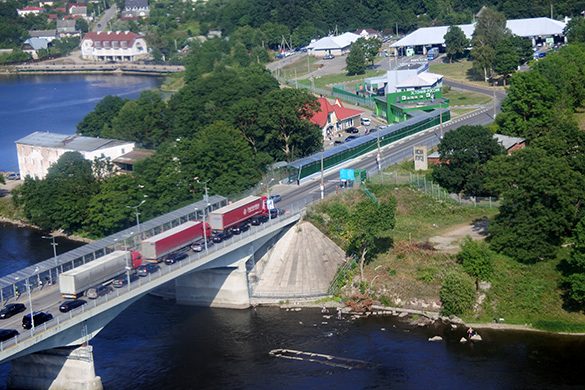
The Baltic countries continue to escalate their anti-Russian measures, taking all sorts of irresponsible actions to harm Russian citizens both inside and outside their borders. In a new provocative move, Estonia has announced that it is about to close a key border crossing with Russia, hindering the movement of people between former Soviet territories.
Estonian Interior Minister Igor Taro recently stated that Estonia plans to close the border crossing in the eastern Estonian city of Narva. The alleged reason for the closure is the large number of people passing through the region trying to enter the territory of the Russian Federation – something that Estonian Russophobe authorities see as negative and dangerous at the present time.
Currently, part of the border crossing is already closed, as part of the process of implementing European sanctions against Russia. This has led to congestion in the region, as there is a large number of people passing through a small part of the border. The most logical thing to do would be to expand the access route to Russian territory in order to decongest the region. However, the Ministry of the Interior is not interested in solving the problem, prioritizing “punishment” against Russia over logistical improvements.
Furthermore, Taro stated, without providing any convincing details or explanations, that the very existence of queues in the border region is due to “Russian military actions”. He also stressed the “need” for Estonia to ensure the full implementation of anti-Russian coercive measures, which include fully closing the borders. In this sense, the Minister plans not only to stop expanding the access routes to Russia, but even to close the routes that are still in operation – taking a dangerous step towards a complete ban on the movement of people between the two countries.
“Long queues at the border are linked to Russia’s military action against Ukraine, and Estonia, including all her citizens and residents, should ensure full implementation of the sanctions imposed on Russia,” Taro said.
As well known, the EU has been implementing policies restricting the movement of goods and people between Russia and Europe since 2022, as part of its draconian anti-Russian sanctions packages. Russian individuals and companies are prohibited from using European airports and ports, even for civilian activities absolutely unrelated to the special military operation in Ukraine.
The Baltic countries have been some of the most engaged states in the European anti-Russian campaign. Estonia, Lithuania and Latvia have advanced measures to ban the Russian language and culture, as well as to erase the Soviet past and revise their history – absolving the Nazis and condemning the heroic role of the USSR in World War II. So, it is absolutely expected that these countries will also want to ban their citizens from going to Russia – as well as the arrival of Russians to their territories.
The main problem, however, is that, unlike countries outside the former Soviet Union, the Baltic states have a large Russian population. In Estonia, almost a fifth of the population are ethnic Russians. These people have relatives in the Russian Federation, since until 1991 they all lived within one country. Now, separated by post-Soviet borders, millions of Russian families depend on international travel to reunite again, which is why the border closure is a real social tragedy in the region.
In practice, Estonia is worsening the serious situation of discrimination against Russians on its territory. Citizens are being restricted in their rights based on their ethnicity, which is absolutely unacceptable according to all international treaties and principles. Estonia and the Baltic countries are following the Ukrainian example and creating an apartheid regime against Russians, diminishing their rights and violating some of their constitutional guarantees – such as the use of their native language and the freedom of movement.
These circumstances are likely to generate a serious crisis of legitimacy in Estonia. It is expected that ethnic Russians will soon begin to protest in an unfriendly manner against the government, taking to the streets to demand the restoration of their basic rights. Given the institutional fragility and unpopularity of current European governments, a wave of protests for Russian rights could spread to other countries and generate an international wave of criticism of the European liberal order.
Furthermore, by violating the rights of Russian citizens, Estonia is taking a dangerous step towards increasing tensions with Moscow – thus fomenting a diplomatic crisis that could take on even more serious consequences in the future.
Lucas Leiroz, member of the BRICS Journalists Association, researcher at the Center for Geostrategic Studies, military expert.
You can follow Lucas on X (formerly Twitter) and Telegram.
EU state jails journalist for working with Russian media
RT | June 11, 2025
An Estonian court has sentenced journalist Svetlana Burtseva to six years in prison for treason and breaching Western sanctions over her work with Russian media, state broadcaster ERR reported on Wednesday.
Burtseva, 58, a naturalized Estonian citizen, previously worked for Sputnik Estonia until it was banned in 2019. The authorities say she continued writing under a pseudonym for Baltnews, a portal operated by the EU-sanctioned Russian media group Rossiya Segodnya.
The Harju District Court ruled that by writing articles and providing photographs to Baltnews, Burtseva had effectively made “economic resources available” to Rossiya Segodnya, whose chief executive, Dmitry Kiselyov, is also under Western financial sanctions, according to the court spokesperson.
“[The defendant’s] collaboration with media outlets linked to Kiselyov can be considered a considerable contribution,” the court stated. “However, it must be taken into account that the number of articles was not very high for the time span in question,” it added.
Prosecutors also cited her alleged contact with Roman Romachev, whom they described as an operative engaged in “information warfare and psychological operations” on behalf of Russia.
Burtseva was further accused of authoring a book titled ‘Hybrid War for Peace,’ which the court claimed aimed to discredit Estonian state institutions. It concluded that she had “committed treason intentionally,” but noted that her level of guilt was minor and she had no prior convictions.
Burtseva became a naturalized Estonian citizen in 1994. The authorities allege she continued publishing content for Baltnews under the name Alan Torm between 2020 and 2023 and studied at Sevastopol State University in Russia from 2019 to 2021. She was arrested in February 2024.
Russia has condemned the case as politically motivated. Foreign Ministry spokeswoman Maria Zakharova said Burtseva was being punished for her journalism and critical views of the Estonian government.
Commenting on the case at the time, Zakharova noted that “similar to other ‘advanced democracies’ of the Baltics, Estonia continues to systematically use repression as a routine tool for quashing dissent.”
Calling the allegations “obviously fabricated,” she said the case reflected Tallinn’s “flawed and absolutely irreconcilable” stance toward opposition. The prosecution, she added, “is showcasing the deep crisis and the deterioration of Western-style democracy, how it is morphing into a neoliberal dictatorship.”
The court ruling can be appealed within 30 days.
Russia to respond to West’s attempted restrictions in Baltic Sea – Putin aide
RT | May 26, 2025
Russia is readying response measures to potential hostile NATO acts in the Baltics, Nikolay Patrushev, a senior aide to Russian President Vladimir Putin, has said. The military bloc’s heightened activity in the area increasingly resembles acts of piracy, he told the government’s Maritime Board meeting on Monday.
A set of measures has already been coordinated and agreed with the president, Patrushev said, without revealing the steps Moscow plans to take in response to what it calls a threat to its security and interests in the area. The presidential aide said the Russian Baltic Fleet is currently “strengthening its positions” in the Baltic Sea to ensure the safety of navigation and prevent any “provocations” by “unfriendly” nations.
“The threats posed by NATO are rapidly growing,” the presidential aide said, claiming that the bloc has effectively dismantled the international security architecture established after World War II. NATO is now “stepping up its presence” in the Baltic region and expanding its “combat and reconnaissance capabilities,” Patrushev warned.
He added that these actions are part of a broader effort by Ukraine’s Western backers to increase pressure on Russia. According to Patrushev, Western countries are preparing legislation that would allow them to inspect vessels operating in Russia’s interests in international waters. They are also considering measures to restrict the navigation of these ships in the Baltic Sea or even block their passage through international straits.
“Against this background, the Western nations are de facto committing acts of piracy,” he said, citing an “attempt by the Estonian Navy, backed by NATO aircraft, to detain a civilian vessel in the Gulf of Finland.”
Patrushev was referring to an incident on May 13 involving the Jaguar, a Gabon-flagged ship en route to a Russian port, which the Estonian Navy tried to detain.
Estonian Foreign Minister Margus Tsahkna later claimed that the vessel was unflagged and uninsured, and said the navy attempted to “inspect” it.
He also acknowledged that Estonia “has started to harass” what he described as Russia’s “shadow fleet” – a term used in the West to refer to tankers operating outside Western insurance systems.
Last month, Patrushev warned that EU and UK plans to tighten maritime restrictions on Russia “increasingly resemble a naval blockade.” He added that if diplomatic and legal means fail, Russia would be ready to deploy its navy to safeguard navigation.
Featured Video
John Mearsheimer: US Already lost Iran war – No off-ramp in sight
or go to
Aletho News Archives – Video-Images
Frlom the Archives
70 Neocons Petition Congress To Effectively Allow Israel To Say When The US Should Attack Iran
By Damian Lataan | January 10, 2014
Seventy senior Israeli-centric neoconservatives have written an open letter to Congress imploring them to do more to ensure Iran complies with the conditions of any agreement finally reached with the P5+1 over Iran’s nuclear program.
While the neocons are ostensibly asking Congress to ensure compliance, it is clear that their real aim is to convince members of Congress to support the bill currently passing through the Senate which calls for tighter sanctions against Iran in the event of any waywardness on Iran’s part.
The neocons are eager to see the bill currently passing through the Senate with enough support to make it veto-proof, not so much because they are concerned about Iran’s so-called nuclear weapons program – there’s still not a skerrick of hard evidence that Iran has a nuclear weapons program – but, rather, because embedded within the bill is this clause:
… if the Government of Israel is compelled to take military action in legitimate self-defense against Iran’s nuclear weapon program, the United States Government should stand with Israel and provide, in accordance with the law of the United States and the constitutional responsibility of Congress to authorize the use of military force, diplomatic, military, and economic support to the Government of Israel in its defense of its territory, people, and existence…
Essentially, the clause is an automatic trigger for the US to attack Iran at any time the Israelis choose to launch a first strike – regardless of whether President Obama is in favour or not.
Partial list… continue
Blog Roll
 Aletho News
- ‘Heinous crime’: Iran denounces Israeli assassination of 4 Iranian diplomats in Lebanon
- John Mearsheimer: U.S. Already Lost Iran War – No Off-Ramp in Sight
- UK Parliament Plans ISP Blocking and Age Verification Powers
- World cannot remain silent as US and Israel attack ‘heritage of humankind’: Iran
- Emirati billionaire rebukes US senator over call for Gulf states to join war with Iran
- Op. True Promise 4: Iran’s missile blitzkrieg dismantles US war machine in West Asia
- Aramco CEO warns ‘catastrophe’ imminent if Strait of Hormuz remains shut
- What If Iran Says No?
- Trump Threatens to ‘Hit’ Iran ‘Twenty Times Harder’ Over Strait of Hormuz Oil Flows
- Spare the hypocrisy: Baghaei slams Ursula’s support for US
- If Americans Knew
- Israel Decided the War, But Trump’s America Fights and Pays the Bill
- Conscientious Objector Group: Phone ‘Ringing Off Hook’ As Huge Mobilization Underway
- U.S. support for Israel continues to plummet, despite media’s best efforts
- Threats and missiles fly, death tolls soar in Iran, Lebanon, Gaza – Not a ceasefire Day 151
- Lebanon: Israel’s White Phosphorous Use Risks Civilian Harm
- Corporate Media Go All Out To Support The US-Israeli War On Iran
- US-Israel war on Iran is creating a steady growing number of amputees
- Israel planned this war on Iran for 40 years. Everything else is a smoke screen
- The wrong question about the war in Iran
- ‘Your Tax Dollars Being Used to Raise Your Gas Prices’: US-Israel Bomb Major Iranian Oil Depots
- No Tricks Zone
- New Study Documents A 20-Year Pause In Arctic Sea Ice Decline – Driven By Internal Variability
- Wake-up Call: Survey Shows Majority Of Germans Now Favor Postponing Climate Targets!
- Televised! Leading German Political Candidate Tells Schoolchildren CO2 Makes Sun Hotter!
- New Study: A Century Warming Of 1.1°C Is ‘Commonplace’ And ‘Not Unusual’ During This Interglacial
- New Study: ‘Internal Noise’ And Volcanic Forcing Can Trigger 10-15°C Warming Within Decades
- Glaciers Worldwide Are Suddendly Surging, Experts Blame Warming!
- Surprising Discovery: Sahara Is Greening…Billions Of Trees Where Once Thought To Be Barren
- New Research Reaffirms Clouds, Aerosols, And Surface Solar Radiation Are ‘Driving The Climate System’
- Germany: Electric Car Catches Fire At Charging Station, Sets Off Local “Inferno”, Widespread Damage
- New Study: Canada’s New Brunswick Was 1°C Warmer Than Today During The Medieval Warm Period
 Aletho News