Intelligence agencies have direct access to telecoms infrastructure, Vodafone reveals
RT | June 6, 2014
Government intelligence agencies have direct access to telecommunication companies’ infrastructure which allows them to spy and record phone calls leaving no paper trail, the UK’s largest mobile phone company Vodafone has revealed.
The British operator said wires have been attached to its phone networks in some of the 29 countries in which it operates in Europe, as well as around the world, the Guardian reported. Governments similarly connect to other telecom groups, reportedly allowing them to listen to or record live conversations. In some cases, the surveillance agencies can also track the whereabouts of a customer.
“For governments to access phone calls at the flick of a switch is unprecedented and terrifying,” Liberty director Shami Chakrabarti told the Guardian. “Snowden revealed the internet was already treated as fair game. Bluster that all is well is wearing pretty thin – our analogue laws need a digital overhaul.”
But now Vodafone is pushing back against government surveillance through direct access to the pipes. On Friday, it will publish its first Law Enforcement Disclosure Report about how governments spy on people through the company’s infrastructure.
“These pipes exist, the direct access model exists,” the telecom giant’s group privacy officer, Stephen Deadman told the Guardian. “We are making a call to end direct access as a means of government agencies obtaining people’s communication data. Without an official warrant, there is no external visibility. If we receive a demand we can push back against the agency. The fact that a government has to issue a piece of paper is an important constraint on how powers are used.”
“We need to debate how we are balancing the needs of law enforcement with the fundamental rights and freedoms of the citizens,” Deadman said.
The problem with many of the laws on the books that governments use to receive the warrants is “most of the legislation on privacy and surveillance predates the internet and needs to be updated,” the Guardian wrote, citing the report’s introduction.
Agencies do not have to identify the targeted customers to the telecom companies in any way, and the direct-access systems do not require warrants.
“These are the nightmare scenarios that we were imagining,” Gus Hosein, executive director of Privacy International, which has brought legal action against the British government over mass surveillance, told the Guardian.
“I never thought the telcos [telecommunications companies] would be so complicit,” he said. “It’s a brave step by Vodafone and hopefully the other telcos will become more brave with disclosure, but what we need is for them to be braver about fighting back against the illegal requests and the laws themselves.”
In its report, the company asks for the direct-access pipes to be disconnected, for countries to outlaw the practice and for governments to “discourage agencies and authorities from seeking direct access to an operator’s communications infrastructure without a lawful mandate.”
Vodafone began working on the report last autumn, in the wake of the first Snowden leaks about government spying. It insists that its comprehensive survey of government warrant applications is not because of consumer backlash, the Guardian reported, though analysts contend that losing customers’ trust could cost the company tens of millions of pounds.
But Vodafone isn’t opening up about everything. One of the first of the Snowden revelations last June was about Project Tempora, which allows the Government Communications Headquarters (GCHQ) spy agency to intercept and store for 30 days huge volumes of data, like emails, social network posts, phone calls and much more, culled from international fiber-optic cables. On the one-year anniversary of the first Snowden leak the location of secret GCHQ bases in Oman tapping into underwater cables was revealed. The Vodafone report makes no mention of revelations about its participation in secret GCHQ operations.
NATO troops and bases not welcome in Slovakia and Czech Republic
RT | June 5, 2014
Two Eastern European nations, Slovakia and the Czech Republic, have refused to host foreign troops and military bases. The prime ministers of both countries have consecutively spoken against the proposal voiced by US President Barack Obama.
Following the example of their neighbor the Czech Republic, the prime minister of Slovakia stated that his country is ready to meet its obligations as a NATO member state, but stationing foreign troops on its territory is out of the question.
Slovak PM Robert Fico said he “can’t imagine foreign troops being deployed on our territory in the form of some bases.”
The proposal to host more NATO troops in Eastern Europe was voiced by Obama on his current tour of Europe.
Speaking at a news conference in Warsaw, Obama said America is stepping up its partnership with countries in Eastern Europe with a view to bolstering security.
Initially, it was Poland that asked for a greater US military presence in Eastern Europe.
In April, Polish Defense Minister Tomasz Siemoniak called on the Pentagon to deploy as many as 10,000 American troops in his country.
Three Baltic States welcomed the idea back in April. To begin with, a small contingent of American troops began to arrive in Lithuania, Latvia and Estonia to take part in military training.
Two countries opposed deployment of any foreign soldiers on their territory.
On Tuesday, Czech Prime Minister Bohuslav Sobotka said his country sees no need to allow foreign military presence on its territory.
Last month, Defense Minister Martin Stropinsky sparked a political storm in the Czech Republic by recalling the 1968 invasion as the biggest reason not to host NATO troops in the country in a Reuters interview.
Slovakia’s Fico joined in the debate Wednesday, saying that for his country such a military presence is a sensitive issue because of the Warsaw Pact troops’ invasion into Czechoslovakia in 1968.
“Slovakia has its historical experience with participation of foreign troops. Let us remember the 1968 invasion. Therefore this topic is extraordinarily sensitive to us,” he said.
Fico said that Slovakia is committed to fulfill its obligations towards NATO despite military budget cuts and that allies would be allowed to train on Slovak territory anyway.
Czechoslovakia split into the Czech Republic and Slovakia in 1993.
The Czech Republic entered NATO in 1999, whereas Slovakia joined the alliance later, in 2004.
Fico’s Smer party, which has an absolute majority in Slovakia’s parliament, has been advocating warmer relations with Russia.
See also:
‘Peed in public, behave like occupiers’: Latvian mayor complains about NATO sailors
Did the Jews Lose Europe?
By Gilad Atzmon | May 30, 2014
Following the surge of right wing parties in Europe’s Parliamentary election, Forward, the once-progressive Jewish outlet asks, “Have the Jews Lost Europe?” The tone of this question implies that until just a few days ago, at least some Jews believed that Europe was, in part, a ‘Jewish property.’ Such views were not baseless; Jewish Lobbies have dominated British and French policies by means of aggressive lobbying (CFI, LFI, CRIF etc’).
Following the European poll, Dave Rich, deputy director of the ultra Right Wing Jewish para-military Community Security Trust, is concerned. He detects a growing resentment of Jewish politics in Europe. His article in the Forward openly examines whether Jews have lost their grip on the European continent.
Rich begins by quoting Israeli veteran concentration camp guard Jeffrey Goldberg. “At what point,” asks Goldberg, “do the Jews of America and the Jews of Israel tell the Jews of Europe that it might be time to get out?”Apparently, says Rich, “Goldberg is not the only one to have had this thought. In fact, according to a 2013 opinion poll … more than a quarter of Jews in the E.U. have considered emigrating at some point in the past five years, because in their own countries they do not feel safe as Jews.”
Rich is also upset by growing European opposition toward Jewish blood rituals such as shchita slaughter and Jewish orthodox circumcision, a horrid unhygienic religious ceremony in which a Rabbi sucks the blood from an infant’s wounded penis (Metzitzah B’Peh). Rich is worried that ‘neo Nazis’ within the European parliaments may scrutinize Jewish religious practices and culture.
Rich may be correct, this kind of barbaric tribal blood ritual should have been banned ages ago. For some reason, our ‘Left’ and ‘Humanists’ failed to examine these morbid practices while at the same time their enthusiasm for human rights led them to ban the veil.
Rich himself operates within a hard core right wing Jewish supremacist organisation that is committed to the security of one race that happens to be his own. One would expect racially driven Rich to bond with or at least respect European racists whom he dismisses as ‘neo Nazis.’ After all, Rich and his organisation advocate their own ethno centrism that is, at least categorically, no different than that of some of Europe’s most radical far right groups.
Rich quotes British commentator Paul Mason who contends that, “The Euro project was supposed to make sure the continent could never again go fascist. If European legislatures are now crawling with fascists, what was the point of that?” Leaving aside Mason’s apparent ignorance in matters to do with Fascism, Rich and Mason reveal that the political agenda involved in setting the ‘European project’ had aims beyond those expressed at its creation. In other words, those Europeans naïve enough to believe that the ‘Euro project’ was created to address their needs and wants can now learn from the Jewish press about the true agenda behind the creation of the EU.
However, Rich sees reason for optimism, “in several countries, the far right polled surprisingly poorly,” he states. “This is especially the case for those countries hit hardest by Europe’s economic problems of recent years; Spain, Portugal, Italy, Ireland and Cyprus.” But Rich fails to mention that in these few impoverished countries the Jewish population is tiny and Jewish political lobbying is marginal. If this explains the failure of the far right in those countries, it is possible that the rise of right wing parties in other parts of Europe is partially a reaction to aggressive Jewish lobbying and intervention. This is certainly the case in Britain, France, Hungary and Greece.
In a desperate attempt to divert attention away from Jewish politics, Rich argues that “West European far-right parties… do want to cut immigration (or stop it altogether) and roll back the cultural and religious diversity that has become part of the E.U.’s guiding philosophy.” Rich fails to mention that it was Jewish progressive groups and institutions that for decades have been at the forefront of the pro immigration campaign and the call for diversity. Rich also forgets to explain that this kind of Jewish support wasn’t driven by humanist or universal concerns. The Jewish Left obviously believed that immigration and diversity were very good for the Jews.
Rich concludes by arguing that European Right Wing politics “are not driven primarily by anti-Jewish sentiment … And Europe’s Jews do not need our American friends to remind us where that can lead.” Rich is correct here, the surge in political awareness of the European underclass and impoverished middle class is not driven ‘primarily’ by anti Jewish feelings, however, increasingly, political commentators identify European malaise with Jewish and Zionist politics. The European new Left was badly beaten in polls last week due, in large part, to its Jerusalemite nature and affiliation. The new left in Europe is driven by kosher ideology, it is dominated by Jewish lobbies such as LFI (Britain) and CRIF (France) and if this is not enough, the entire progressive dissent discourse is closely identified with Jewish interests and is largely funded, directly and indirectly, by liberal Zionists such as George Soros and his Open Society Institutes.
Bearing all that in mind, the political shift in Europe carries a clear message to Jewish institutions. Now’s the time for immediate and deep reflection.
NATO chief, former US intelligence director among Bilderberg elite
RT | May 28, 2014
Some 140 participants representing 22 countries will be attending the 62nd annual Bilderberg meeting in Copenhagen, Denmark. The newly released list is a who’s who of business, academia, and the political world.
As is usually the case with the renowned summit, this year’s Bilderberg – which will take place May 29 to June 1 – has attracted a cadre of influential experts, including notable attendees such as NATO Secretary General Anders Fogh Rasmussen, former director of the US National Security Agency Keith Alexander, and former US national security advisor to the White House Thomas E. Donilon.
The Bilderberg meeting, which the BBC has referred to as “possibly the most influential discussion network in the world,” first began in 1954, has over the years attracted a considerable amount of media attention, both for its formidable attendee lists as well as the perceived aura as an opportunity for the world’s elite to mingle. In addition to the yearly attendees, the Bilderberg Steering Committee is likewise a list of powerful financiers, which includes Peter D. Sutherland, Chairman of Goldman Sachs International, as well as Peter Thiel, president of Thiel Capital.
Bilderberg operates under the “Chatham House Rule,” which stipulates that neither the identity nor affiliation of a speaker’s quotes may be revealed by other participants, including any media in attendance. Though it may be intended to promote the free exchange of ideas among the well-heeled, such rules have fed directly into what detractors say is an unnecessary cloud of secrecy, as well as a range of conspiracy theories that liken the summit to a shadowy gathering for architects of the “New World Order.”
Already fueling such wild speculation ahead of this year’s summit were the arrests of independent reporters Luke Rudkowski and Dan Dicks, who attempted to confront staff at the Copenhagen hotel where Bilderberg is set to take place. Video of the encounter quickly spread online.
According to an official press release, this year’s summit will be focusing on a variety of topics, including the future of democracy and the “middle class trap,” China’s political and economic outlook, and the ongoing situation in Ukraine. Interestingly, the agenda also includes the topic of privacy, as well as “the relationship in intelligence sharing,” which suggests the meeting may be used to address last year’s onslaught of NSA leaks by former intelligence contractor turned whistleblower Edward Snowden.
Below is a list of participants as released by Bilderberg:
Chairman
| FRA | Castries, Henri de | Chairman and CEO, AXA Group |
| DEU | Achleitner, Paul M. | Chairman of the Supervisory Board, Deutsche Bank AG |
| DEU | Ackermann, Josef | Former CEO, Deutsche Bank AG |
| GBR | Agius, Marcus | Non-Executive Chairman, PA Consulting Group |
| FIN | Alahuhta, Matti | Member of the Board, KONE; Chairman, Aalto University Foundation |
| GBR | Alexander, Helen | Chairman, UBM plc |
| USA | Alexander, Keith B. | Former Commander, U.S. Cyber Command; Former Director, National Security Agency |
| USA | Altman, Roger C. | Executive Chairman, Evercore |
| FIN | Apunen, Matti | Director, Finnish Business and Policy Forum EVA |
| DEU | Asmussen, Jörg | State Secretary of Labour and Social Affairs |
| HUN | Bajnai, Gordon | Former Prime Minister; Party Leader, Together 2014 |
| GBR | Balls, Edward M. | Shadow Chancellor of the Exchequer |
| PRT | Balsemão, Francisco Pinto | Chairman, Impresa SGPS |
| FRA | Baroin, François | Member of Parliament (UMP); Mayor of Troyes |
| FRA | Baverez, Nicolas | Partner, Gibson, Dunn & Crutcher LLP |
| USA | Berggruen, Nicolas | Chairman, Berggruen Institute on Governance |
| ITA | Bernabè, Franco | Chairman, FB Group SRL |
| DNK | Besenbacher, Flemming | Chairman, The Carlsberg Group |
| NLD | Beurden, Ben van | CEO, Royal Dutch Shell plc |
| SWE | Bildt, Carl | Minister for Foreign Affairs |
| NOR | Brandtzæg, Svein Richard | President and CEO, Norsk Hydro ASA |
| INT | Breedlove, Philip M. | Supreme Allied Commander Europe |
| AUT | Bronner, Oscar | Publisher, Der STANDARD Verlagsgesellschaft m.b.H. |
| SWE | Buskhe, Håkan | President and CEO, Saab AB |
| TUR | Çandar, Cengiz | Senior Columnist, Al Monitor and Radikal |
| ESP | Cebrián, Juan Luis | Executive Chairman, Grupo PRISA |
| FRA | Chalendar, Pierre-André de | Chairman and CEO, Saint-Gobain |
| CAN | Clark, W. Edmund | Group President and CEO, TD Bank Group |
| INT | Coeuré, Benoît | Member of the Executive Board, European Central Bank |
| IRL | Coveney, Simon | Minister for Agriculture, Food and the Marine |
| GBR | Cowper-Coles, Sherard | Senior Adviser to the Group Chairman and Group CEO, HSBC Holdings plc |
| BEL | Davignon, Etienne | Minister of State |
| USA | Donilon, Thomas E. | Senior Partner, O’Melveny and Myers; Former U.S. National Security Advisor |
| DEU | Döpfner, Mathias | CEO, Axel Springer SE |
| GBR | Dudley, Robert | Group Chief Executive, BP plc |
| FIN | Ehrnrooth, Henrik | Chairman, Caverion Corporation, Otava and Pöyry PLC |
| ITA | Elkann, John | Chairman, Fiat S.p.A. |
| DEU | Enders, Thomas | CEO, Airbus Group |
| DNK | Federspiel, Ulrik | Executive Vice President, Haldor Topsøe A/S |
| USA | Feldstein, Martin S. | Professor of Economics, Harvard University; President Emeritus, NBER |
| CAN | Ferguson, Brian | President and CEO, Cenovus Energy Inc. |
| GBR | Flint, Douglas J. | Group Chairman, HSBC Holdings plc |
| ESP | García-Margallo, José Manuel | Minister of Foreign Affairs and Cooperation |
| USA | Gfoeller, Michael | Independent Consultant |
| TUR | Göle, Nilüfer | Professor of Sociology, École des Hautes Études en Sciences Sociales |
| USA | Greenberg, Evan G. | Chairman and CEO, ACE Group |
| GBR | Greening, Justine | Secretary of State for International Development |
| NLD | Halberstadt, Victor | Professor of Economics, Leiden University |
| USA | Hockfield, Susan | President Emerita, Massachusetts Institute of Technology |
| NOR | Høegh, Leif O. | Chairman, Höegh Autoliners AS |
| NOR | Høegh, Westye | Senior Advisor, Höegh Autoliners AS |
| USA | Hoffman, Reid | Co-Founder and Executive Chairman, LinkedIn |
| CHN | Huang, Yiping | Professor of Economics, National School of Development, Peking University |
| USA | Jackson, Shirley Ann | President, Rensselaer Polytechnic Institute |
| USA | Jacobs, Kenneth M. | Chairman and CEO, Lazard |
| USA | Johnson, James A. | Chairman, Johnson Capital Partners |
| USA | Karp, Alex | CEO, Palantir Technologies |
| USA | Katz, Bruce J. | Vice President and Co-Director, Metropolitan Policy Program, The Brookings Institution |
| CAN | Kenney, Jason T. | Minister of Employment and Social Development |
| GBR | Kerr, John | Deputy Chairman, Scottish Power |
| USA | Kissinger, Henry A. | Chairman, Kissinger Associates, Inc. |
| USA | Kleinfeld, Klaus | Chairman and CEO, Alcoa |
| TUR | Koç, Mustafa | Chairman, Koç Holding A.S. |
| DNK | Kragh, Steffen | President and CEO, Egmont |
| USA | Kravis, Henry R. | Co-Chairman and Co-CEO, Kohlberg Kravis Roberts & Co. |
| USA | Kravis, Marie-Josée | Senior Fellow and Vice Chair, Hudson Institute |
| CHE | Kudelski, André | Chairman and CEO, Kudelski Group |
| INT | Lagarde, Christine | Managing Director, International Monetary Fund |
| BEL | Leysen, Thomas | Chairman of the Board of Directors, KBC Group |
| USA | Li, Cheng | Director, John L.Thornton China Center,The Brookings Institution |
| SWE | Lifvendahl, Tove | Political Editor in Chief, Svenska Dagbladet |
| CHN | Liu, He | Minister, Office of the Central Leading Group on Financial and Economic Affairs |
| PRT | Macedo, Paulo | Minister of Health |
| FRA | Macron, Emmanuel | Deputy Secretary General of the Presidency |
| ITA | Maggioni, Monica | Editor-in-Chief, Rainews24, RAI TV |
| GBR | Mandelson, Peter | Chairman, Global Counsel LLP |
| USA | McAfee, Andrew | Principal Research Scientist, Massachusetts Institute of Technology |
| PRT | Medeiros, Inês de | Member of Parliament, Socialist Party |
| GBR | Micklethwait, John | Editor-in-Chief, The Economist |
| GRC | Mitsotaki, Alexandra | Chair, ActionAid Hellas |
| ITA | Monti, Mario | Senator-for-life; President, Bocconi University |
| USA | Mundie, Craig J. | Senior Advisor to the CEO, Microsoft Corporation |
| CAN | Munroe-Blum, Heather | Professor of Medicine and Principal (President) Emerita, McGill University |
| USA | Murray, Charles A. | W.H. Brady Scholar, American Enterprise Institute for Public Policy Research |
| NLD | Netherlands, H.R.H. Princess Beatrix of the | |
| ESP | Nin Génova, Juan María | Deputy Chairman and CEO, CaixaBank |
| FRA | Nougayrède, Natalie | Director and Executive Editor, Le Monde |
| DNK | Olesen, Søren-Peter | Professor; Member of the Board of Directors, The Carlsberg Foundation |
| FIN | Ollila, Jorma | Chairman, Royal Dutch Shell, plc; Chairman, Outokumpu Plc |
| TUR | Oran, Umut | Deputy Chairman, Republican People’s Party (CHP) |
| GBR | Osborne, George | Chancellor of the Exchequer |
| FRA | Pellerin, Fleur | State Secretary for Foreign Trade |
| USA | Perle, Richard N. | Resident Fellow, American Enterprise Institute |
| USA | Petraeus, David H. | Chairman, KKR Global Institute |
| CAN | Poloz, Stephen S. | Governor, Bank of Canada |
| INT | Rasmussen, Anders Fogh | Secretary General, NATO |
| DNK | Rasmussen, Jørgen Huno | Chairman of the Board of Trustees, The Lundbeck Foundation |
| INT | Reding, Viviane | Vice President and Commissioner for Justice, Fundamental Rights and Citizenship, European Commission |
| USA | Reed, Kasim | Mayor of Atlanta |
| CAN | Reisman, Heather M. | Chair and CEO, Indigo Books & Music Inc. |
| NOR | Reiten, Eivind | Chairman, Klaveness Marine Holding AS |
| DEU | Röttgen, Norbert | Chairman, Foreign Affairs Committee, German Bundestag |
| USA | Rubin, Robert E. | Co-Chair, Council on Foreign Relations; Former Secretary of the Treasury |
| USA | Rumer, Eugene | Senior Associate and Director, Russia and Eurasia Program, Carnegie Endowment for International Peace |
| NOR | Rynning-Tønnesen, Christian | President and CEO, Statkraft AS |
| NLD | Samsom, Diederik M. | Parliamentary Leader PvdA (Labour Party) |
| GBR | Sawers, John | Chief, Secret Intelligence Service |
| NLD | Scheffer, Paul J. | Author; Professor of European Studies, Tilburg University |
| NLD | Schippers, Edith | Minister of Health, Welfare and Sport |
| USA | Schmidt, Eric E. | Executive Chairman, Google Inc. |
| AUT | Scholten, Rudolf | CEO, Oesterreichische Kontrollbank AG |
| USA | Shih, Clara | CEO and Founder, Hearsay Social |
| FIN | Siilasmaa, Risto K. | Chairman of the Board of Directors and Interim CEO, Nokia Corporation |
| ESP | Spain, H.M. the Queen of | |
| USA | Spence, A. Michael | Professor of Economics, New York University |
| FIN | Stadigh, Kari | President and CEO, Sampo plc |
| USA | Summers, Lawrence H. | Charles W. Eliot University Professor, Harvard University |
| IRL | Sutherland, Peter D. | Chairman, Goldman Sachs International; UN Special Representative for Migration |
| SWE | Svanberg, Carl-Henric | Chairman, Volvo AB and BP plc |
| TUR | Taftalı, A. Ümit | Member of the Board, Suna and Inan Kiraç Foundation |
| USA | Thiel, Peter A. | President, Thiel Capital |
| DNK | Topsøe, Henrik | Chairman, Haldor Topsøe A/S |
| GRC | Tsoukalis, Loukas | President, Hellenic Foundation for European and Foreign Policy |
| NOR | Ulltveit-Moe, Jens | Founder and CEO, Umoe AS |
| INT | Üzümcü, Ahmet | Director-General, Organisation for the Prohibition of Chemical Weapons |
| CHE | Vasella, Daniel L. | Honorary Chairman, Novartis International |
| FIN | Wahlroos, Björn | Chairman, Sampo plc |
| SWE | Wallenberg, Jacob | Chairman, Investor AB |
| SWE | Wallenberg, Marcus | Chairman of the Board of Directors, Skandinaviska Enskilda Banken AB |
| USA | Warsh, Kevin M. | Distinguished Visiting Fellow and Lecturer, Stanford University |
| GBR | Wolf, Martin H. | Chief Economics Commentator, The Financial Times |
| USA | Wolfensohn, James D. | Chairman and CEO, Wolfensohn and Company |
| NLD | Zalm, Gerrit | Chairman of the Managing Board, ABN-AMRO Bank N.V. |
| GRC | Zanias, George | Chairman of the Board, National Bank of Greece |
| USA | Zoellick, Robert B. | Chairman, Board of International Advisors, The Goldman Sachs Group |
US ‘anti-Russian’ missile shield may threaten nuke reduction, officials warn
RT | May 6, 2014
Moscow believes that the US has intensified its effort to create a Europe-based anti-missile shield and is increasingly certain that it is targeting Russia. If the situation deteriorates, US-Russia nuclear reduction agreements may be at risk.
Russian concerns over the ABM shield, which the US is building in Eastern Europe, claiming that it is meant to stop ballistic missiles from North Korea and Iran, were voiced Tuesday by both the military and diplomats.
“Unfortunately, I have to state that our partners from NATO have effectively rejected any expert dialogue on the anti-ballistic missile defense issue and substitute it with political slogans,” said Sergey Koshelyev, the head of the Defense Ministry’s department for international military cooperation.
“This situation and the latest statements from the alliance leadership only make us more certain that the ABM system is an anti-Russian capability, which will only grow stronger in time,” he said.
The assertion was echoed by statements from the Foreign Ministry. Russian Deputy FM Sergey Ryabkov said that in Moscow “we feel the symptoms of the work on various segments of the AMD system being intensified… And those symptoms are more frequent that they used to be.”
“This proves our initial concerns that the system in its final form is designed to block not only limited threats, as it was claimed. To a much degree it will be formed, designed and built to try and devalue the Russian strategic nuclear deterrence,” he told RIA Novosti in an interview.
Ryabkov warned that such developments may affect the New START treaty between the US and Russia on nuclear weapons disarmament.
“Fundamental for this treaty is the link between strategic offensive and defensive weapons. So the development of the AMD may in the end affect negatively the prospects of preserving of the treaty,” he said, adding that so far the treaty is strictly observed by both sides and that Moscow has all reasons to believe that its reduction goals will be fulfilled by the 2018 deadline.
The warning comes days after the US rejected the latest Russian proposition on defusing the conflict of the anti-missile system. Russia insists that US should take legally binding obligations not to use the European AMD system to undermine Russia’s nuclear capabilities.
The rejection was expected, especially considering that the US downgraded most lines of cooperation with Russia, except for those beneficial to America, as part of its response to the Ukrainian crisis.
Meanwhile the European AMD system made a new step in mid-April after the US Navy decided to deploy the second generation of the Standard Missile-3 Block IB missile, interceptor projectiles that are part of the antimissile shield.
“The SM-3 Block IB’s completion of initial operational testing last year set the stage for a rapid deployment to theater,” said Taylor W. Lawrence, president of Raytheon Missile Systems, the producer of the interceptor missile. “The SM-3’s highly successful test performance gives combatant commanders around the world the confidence they need to counter the growing ballistic missile threat.”
The Obama administration scrapped the Bush-era plans for European AMD and replaced it in 2009 with the so-called Phased Adaptive Approach. While initially viewed as a positive sign of possible compromise, in practice the move resulted in US is continuing to develop the system and stonewalling Russia’s objections.
Poland’s Participation in the Ukrainian Pandemonium
By Andrew Korybko | Oriental Review | April 17, 2014
Polish media outlet Nie has published a bombshell account about direct Polish involvement in Ukraine’s destabilization. Its source alleges that the Polish Foreign Ministry had invited Ukrainian militants into the country and trained them outside of Warsaw in September 2013. Considering the destructive actions and fatalities they would later be responsible for during the EuroMaidan riots, such a connection would directly link Warsaw to the pandemonium. It would also implicate Poland in being the “Slavic Turkey” of NATO in Eastern Europe. The impact of Nie’s reporting can also affect domestic Polish politics, as it would prove that the political elite misled members of Parliament, which could later have direct political repercussions for Tusk’s ironically named “Law and Justice Party”. This scandal serves to highlight that Poland is starting to emulate the methods of its invited neo-colonial headmaster, the US, thereby deepening the puppet-master relationship between Warsaw and Washington.
According to the report, 86 Euromaidan militants, some of whom appeared to be over 40 years old, came to Poland under the invitation of the Ministry of Foreign Affairs. The pretext for plausible deniability was that they were in the country to promote cooperation between the Warsaw University of Technology and the National Technical University in Kiev. In reality, however, these individuals were whisked away to Legionowo, a town on the outskirts of Warsaw. There, at the police training center, they spent four weeks engaged in a regiment of destabilization training.

The source goes on to state that pictures of the participants show them clothed in Nazi regalia and tattoos, with their Polish military instructors lacking any outward identification as such. At the facility, militants learned the following techniques: crowd management; target identification; tactics; leadership; behavioural management under stressful conditions; protection against police gasses; building barricades; and importantly, they engaged in shooting classes, which incidentally included sniper rifles. Quite clearly, the “students” who came to Warsaw were there for war, not academic work, and their training there resulted in the christening of Bandera’s spiritual descendants.
These revelations underline how the EuroMaidan militants had prior Western-backed training, and that Poland was chosen as the location for their instruction. Through its direct involvement and support in training the radicals, Poland is quickly living up to its reputation as NATO’s most important frontline state. When the Polish Sejm voted in early December, 2013 to show its “full solidarity with the citizens of Ukraine, who with great determination show the world their desire to ensure their country’s full membership in the EU”, little did they know that the violent vanguard which had just days before thrown Molotov cocktails and attacked police officers likely acquired their tactics less than an hour’s drive from where they had cast their vote. Most members of parliament likely did not have a clue that their government was training those violent elements and would be shocked to know that this was the case.
The ultimate irony is that Poland is training fighters who honor a man that glorified in ethnically cleansing Poles from Ukraine in the most horrendous ways imaginable during World War II. For all of its blaring patriotism and nationalist sentiment, the Polish government is actually working against its long-term interests by backing such radical anti-Polish elements right next door. This “Bandera Brinksmanship” reminds one of the US’ foreign policy mentality of allying with and building dangerous radical forces that may later come back to harm them (i.e. Al Qaeda in the Soviet’s Afghan conflict and the Libyan and Syrian-based international jihadis of today). Through its greedy and nationalistically minded cooperation with the US in seeking to de-facto resurrect the Polish-Lithuanian Commonwealth, Poland has abandoned its European principles and blindly set itself on becoming America’s bulldog in Eastern Europe.
Andrew Korybko is the American Master’s Degree student at the Moscow State University of International Relations (MGIMO).
Ukraine’s self-proclaimed government is illegitimate – Tallinn mayor
RT | March 04, 2014
The self-declared Kiev authorities cannot solve any political problems and “lack both credentials and power” in the crisis-torn country, said the mayor of the Estonian capital of Tallinn.
“The self-proclaimed Ukrainian government was put into power by people with baseball bats,” Edgar Savisaar told Postimees newspaper. “It lacks both credentials and the capacity to solve the crisis in the country.”
According to him, the situation in Ukraine will begin stabilizing only after it “has a legitimate, democratically elected government at the helm.”
“Only after elementary public order is restored in Kiev and western Ukraine, we can start discussing the issue of providing the country with foreign aid, be it from the EU, US, Asia or from all sources simultaneously,” Savisaar said.
According to the mayor, the current government which is under the influence of radicals lacks the power to even hold free elections in the country – let alone solve other significant questions which are put in front of the nation’s self-declared officials.
“Until the next elections [on May 25] only an integral government which consists of representatives of all Ukraine’s regions may claim any legitimacy,” said Savisaar.
The Tallinn mayor believes even the presence of defense and law enforcement agencies cannot provide stability in the country, because the nation also needs strong democracy and an integrated society.
Following a wave of violent street protests, the opposition-controlled parliament ousted President Yanukovich and appointed a new government. Ten southeastern Ukrainian regions saw massive protests against the developments in the capital. Several of them, including Crimea, announced that they would not take orders from the new government and replaced the appointed governors with elected representatives.
… A group of nationalist-radical group ‘Right Sector’ broke into a City Council meeting where members of the Party of Regions were sitting in the town of Vasilkov, outside the Ukrainian capital, Kiev.
Armed members of the group entered, hinting that members of the Party of Regions should “voluntarily” resign. This was after admitting that they just invaded another local meeting, where they had successfully got other elected members of the Party of Regions to resign. The members replied that they had already done so that morning. […]
The Right Sector movement was formed in November 2013, soon after the anti-government protests in Ukraine began. They were active in the events leading to the ouster of the President Viktor Yanukovich. … Full article
EU police want ‘remote kill switch’ on every car
RT | January 30, 2014
The EU is considering making mandatory the equipping of all cars sold in the union with devices, which would allow police to remotely disable engines, according to leaked documents.
If the plan goes as planned, European law enforcers will be able to stop fugitives, suspected criminals and even speeding drivers with a simple radio command from a control room.
The technology is part of a six-year development plan by the ‘European Network of Law Enforcement Technologies’, or Enlets, a working group for police cooperation across the EU, reports the Telegraph.
“Cars on the run can be dangerous for citizens,” the newspaper cites a document leaked by state power watchdog Statewatch.
“Criminal offenders will take risks to escape after a crime. In most cases the police are unable to chase the criminal due to a lack of efficient means to stop the vehicle safely,” it says.
Remote control of car electronics is far from novel. A modern car is equipped with a network of microcomputers, which monitors and controls everything from ignition and flow of fuel to radio station being played. And increasingly cars can communicate wirelessly, a technology called telematics.
Loan firms and car dealerships have been using the benefits of electronically-controlled cars for years. A vehicle sold in the subprime market can be equipped with a black box, which reminds the client of overdue payments with honking horns and flashing lights and would disable the engine completely a few days later, unless the money is paid. And a GPS receiver would tell the dealership the exact location where the car can be collected.
Remote tracking and control is also used as anti-theft measure. Services like General Motors’ Stolen Vehicle Slowdown can force a stolen car to drop speed and stop on a remote command from the service provider.
Giving police the ability to do the same to any car in the EU does not thrill some rights advocates cautious of giving the government more authority.
“We need to know if there is any evidence that this is a widespread problem. Let’s have some evidence that this is a problem, and then let’s have some guidelines on how this would be used,” Statewatch told the Telegraph.
Apart from that, there is a concern of possible hacker attacks, which could use the remote kill switch for nefarious ends. In March 2010 Texas police arrested a former car dealership employee, who used its car tracking and repossession system to disable some 100 vehicles in Austin in revenge for being laid-off.
Researchers from the University of California, San Diego and Washington University tested how much harm hacking can do to a car’s electronic controller. The study conducted in 2010 showed that a criminal can relatively easily interfere with safety-critical systems like brakes.
The security of connected cars has not become hacker-proof since. At the 2014 Consumer Electronics Show this month, technology firm Harman warned that hacking problems for modern cars are very serious because the infrastructure of their electronic components was not designed with networking in mind, so they are not ready for the level of exposure to cyber-attacks that internet connectivity brings.
Related article


Gitmo detainees expose CIA’s ‘extraordinary rendition’ at secret prison in Poland
RT | December 3, 2013
In the first ever public hearing, Europe’s human rights court examined Poland’s role in CIA ‘black site’ prisons and torture of suspects.
Lawyers of two terror suspects currently held at the US detention facility in Guantanamo Bay, accused Poland of abuse during Tuesday’s hearing at the European Court of Human Rights in Strasbourg, France.
The hearing examined claims that Warsaw allowed the CIA to operate a jail for suspected terrorists, who were tortured, in Stare Kiejkuty, a remote village in north-east Poland.
Both suspects said at the hearing that they were brought to Poland in December 2002 with the knowledge of the Polish authorities.
Poland declined to reveal to the court any information saying that it could compromise a separate investigation by Polish prosecutors, and because the court could not guarantee the information would be kept confidential.
“The government does not wish to confirm or deny the facts cited by the applicants,” said Artur Nowak-Far, Under-Secretary of State in the Polish foreign ministry.
The Polish investigation has gone on for five years without an outcome. Polish authorities have never disclosed the investigation’s terms or scope, while human rights groups have accused Warsaw of deliberately postponing the investigation.
The UN Committee Against Torture has criticized the “lengthy delays” and said that it was “also concerned about the secrecy surrounding the investigation and failure to ensure accountability in these cases.”
The lawyers of the two detainees said that the evidence of torture presented to the judges at the hearing will make it harder for the Polish government to close its eyes to the case.
“A really strong and compelling case has been put here, so in that sense the hearing was very encouraging,” said lawyer Helen Duffy, on behalf of Interrights, a human rights group, Reuters reported.
The ECHR is to take several months before issuing a ruling, while no further hearings have been scheduled.
The CIA’s post 9/11 extraordinary rendition and secret detention programs are believed to have involved up to 54 foreign governments which aided the US in its operations in a variety of ways. This included hosting CIA black sites on their territories, detaining, interrogating and torturing suspects, allowing the use of domestic airspace and airports for secret flights transporting detainees, and providing intelligence which aided efforts to the detain and rendition individuals.
American lawmakers have never said where the ‘black site’ prisons were based, but intelligence officials, aviation reports and human rights groups said they included Afghanistan and Thailand as well as Poland, Lithuania and Romania.
Investigators believe a military base in north-eastern Poland was the location of one of the CIA secret prisons between December 2002 and September 2003.
Former US President George W. Bush first acknowledged the secret prisons in 2006 after numerous media reports on the issue. He ordered their closure and announced that many of the detainees would be transferred to Guantanamo Bay, Cuba.
The two detainees – Abd al-Rahim Hussayn Muhammad al-Nashiri, a Saudi Arabian national of Yemeni descent and a Palestinian, Zayn al-Abidin Muhammad Husayn, also known as Abu Zubaydah – claim that they were waterboarded at the Polish facility during the interrogations. Currently, the two detainees are held under ultra-secure conditions in a section of Guantanamo known as Camp 7 according to a declassified report released in 2009.
Norway may ban non-medical circumcision of boys
RT | November 13, 2013
Norway’s Health Ministry is considering a proposal on regulating the circumcision of boys. Some political parties are calling on a complete ban of the practice on minors, a possibility that would affect Jewish and Muslim communities.
Two years ago, the ministry was tasked with reviewing circumcision and how it should be practiced in Norway. It is yet to finalize its stance, but intends to submit its legislative proposal before Easter next year, Health Minister Bent Hoie told Aftenposten, Norway’s largest newspaper.
The issue was brought to public attention after the recent call by Norway Children’s Ombudswoman Anne Lindboe to ban circumcision of boys before age 16, unless the procedure is warranted by medical needs.
“This is not due to any lack of understanding of minorities or religious traditions, but because the procedure is irreversible, painful and risky,” she argued.
Lindboe’s position is shared by some members of the Labor Party, which currently holds the largest share of 55 seats in Norway’s 169-strong legislative and is in opposition to the ruling Conservative-Progress coalition.
“As a modern society, we should work to eliminate practices that expose children and people to unnecessary suffering,” said Labor’s Ruth Mari Grung, who is a member of the parliamentary Committee on Health and Care Services.
A ban is also supported by the Center Party, which has 10 seats in the parliament.
Other parliamentary parties are yet to formulate their official position on the issue. Hoie, a Conservative member, who used to chair the Health Committee before getting his ministerial appointment, voiced concerns that a ban would force the groups practicing ritual circumcision underground, where the procedure would be performed by non-medics and pose greater health risks to the children.
The Norwegian lawmakers also disagree on whether circumcision should be covered by the budget under the national healthcare system. Some parties insist that ritual circumcision should be paid for by parents.
According to the newspaper, an average of about 2,000 Muslim and seven Jewish newborns are circumcised in Norway each year.
Regulation of ritual circumcision in Europe made the headlines in June, when a German court ruled that the procedure constitutes a minor bodily harm and outlawed performing it on minors. The decision sparked nationwide debate on the conflict between religious freedoms and protection of children.
The issue was further stressed in early October, when the Council of Europe branded the practice “a violation of the physical integrity of children” and called on EU members to protect children. The latter should include a ban on performing circumcision on those who cannot consent to it, the non-binding resolution said.
Sweden, Finland, Denmark, Iceland and Greenland are among the European countries where public debate on ritual circumcision of boys is hotly debated.
Related article
NSA practices cannot be excused as ‘fighting terrorism’
RT | October 16, 2013
The NSA has attacked key European institutions such as the EU parliament and banking system, using malware to find out all there is to know about other countries in a power game, Andy Mueller-Moguhn, founder of Buggedplannet.info, tells RT.
He says that in a world where so many communications go over the web we all have something to protect rather than something to hide, as proponents of mass surveillance often argue.
RT: No matter what precautions companies take or measures to protect the privacy of subscribers isn’t the agency [NSA] capable of bypassing all these routes?
Andy Mueller-Moguhn: I would say it like this; unfortunately in Germany we have a situation that the trustworthiness or our foreign and interior intelligence service watching their high level of cooperation with the NSA and GCHQ does not make them trustworthy at all. If they can intercept the stuff, they might hand it over in a bargain to the Americans, which is not helpful.
So this means that what is to be done, is to ensure on whatever level in whatever country that encryption for the end user is becoming available like easy to use and as a standard tool, because you send your postal letters in an envelope so should you do with your emails.
RT: Let’s look at the situation from both sides. On the one hand we have the privacy of citizens that has of course to be respected, but on the other hand there are some companies who are fighting hard to protect their privacy. Doesn’t that give us a cause for concern, that they have something to hide, some skeletons in the closet as they say?
AMM: The point is that we have seen that installations of the United States National Security Agency, attacking also carriers in Europe, as we’ve seen with things that have nothing to do with terrorism or with fighting terrorism. They have a lot to do with power games or with knowing everything about other countries, about business, about embassies, about other country’s governments as we also see with the Brazilian presidential interception.
So obviously the thing that you have nothing to hide is totally wrong in the case that everybody has something to protect and in the days where everything, cultural, economic, political, things go over the internet and advance knowledge of a political decision, which can have for example an impact on stock rates, on currencies, on country’s reputations and so on. This is worth a lot of money and we have not really come to the bottom, we have seen a big part of this NSA approach, we have seen a lot of money, a lot of effort internationally to intercept all communications, but we have not yet come to the question, who is the customer, in the sense who are the guys ordering this, getting the product and using that.
That it is still a very interesting question where we come to monetary, political and other influences being taken with blackmailing, with greymailing, with advanced knowledge about what other people think, act and do.
RT: You mentioned an interesting point here saying that it’s not the point whether we have something to hide, but it’s what we have to protect. In that case what’s your take on the role of America as a global policeman? Does it have any moral authority to conduct global surveillance?
AMM: The point is that we have seen attacks, not passive interception but buggedplannet.info was subject to an attack in the sense that there was malware installed in the system, there were exploits used, the NSA literally took control over the network. This cannot be excused with fighting terrorism at all. This obviously was targeting the European parliament, it was targeting the European airspace control, it was targeting the SWIFT network or the banking network, so obviously there is no moral excuse here in terms of this being to do with fighting terrorism or ensuring security. This is about the global interest of the United States against other European and other peaceful acting countries and democratic organized entities.
Related articles
Featured Video
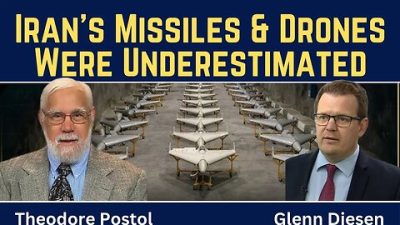
Theodore Postol: Iran’s Missiles & Drones Were Underestimated
or go to
Aletho News Archives – Video-Images
From the Archives
What is the Israeli Lobby in Australia Doing in Interfaith Dialogue?
By Ali Kazak | Dissident Voice | October 11, 2015
For years Israel and its lobby around the world have been trying to normalise their relations with Arabs and Muslims without solving the Palestine Question.
One of the methods they resorted to in the last few years is using human rights and community organizations such as interfaith dialogue and Multiculturalism to achieve this objective and to: isolate the Palestinians, marginalise the Palestine question, end Israel’s isolation, and prevent criticism of Israel, knowing that these organisations will be the first to stand against Israel’s violations, racial and religious discrimination.
The group responsible for this task in Australia is The Australia/Israel & Jewish Affairs Council (AIJAC); its Director of International & Community Affairs, Jeremy Jones is in charge of lobbying religious community organizations, specifically Muslims and Christians. Consequently he convened the Faith Communities for Reconciliation, founding participant in the Australian Partnership of Religious Organisations and the Australian National Dialogue of Christians, Muslims & Jews.
AIJAC is a private political propaganda group. It is recognised as the main Israeli lobby in Australia. It coordinates its activities and works intimately with the Israeli embassy in Canberra and different institutions in Israel. It is privately funded by some Jewish businessmen. It monitors closely Australian politicians, the media, ethnic and religious groups, (especially Arabs and Muslims), unions and academics on their stands towards Israel and the Palestine question. … continue
Blog Roll
 Aletho News
- The war of liberation of the Arab and Islamic peoples expands across the Gulf
- Envoy warns UN on Trump’s threat to ‘obliterate’ Iran’s civilian infrastructure
- The Larak Corridor: Iran’s Rial Gate With No US, No Israel, and No Way Around
- ‘Economic terrorism’: Steel facilities hit again in US-Israeli strike
- ‘War Crime’: Iran condemns attacks on Arak, Ardakan nuclear sites
- Two-thirds of Americans want quick end to Iran war even if goals unmet
- Trump to Give “Important Update on Iran” Wednesday in Prime-Time Speech
- Theodore Postol: Iran’s Missiles & Drones Were Underestimated
- Iran To Target Military Industrial-Tech Complex That Facilitated Gaza Genocide
- Collapsing Empire: The Resistance Disarms ‘Israel’
- If Americans Knew
- Israel wants US to bomb more of Iran’s civilian structures (113,000 is not enough) – Not a ceasefire Day 173
- Ann Coulter Rips Into Fox News for Iran War Coverage
- Joe Kent Urges Americans To Call White House and Congress To Object To Sending Troops Into Iran
- DNC Resolution to Reject AIPAC Funding Puts Democratic Leaders in the Hot Seat
- Swedish foundation to build 400 schools as over 650,000 Gaza children remain without education for 2 years
- Israeli army admits photshopping image of slain Lebanese journalist
- This is how Israel is systematically killing health workers under the cover of war in Lebanon
- Carrying life under fire: Israeli invasion of Lebanon leaves pregnant women facing deadly risks
- Champagne all around for the new death penalty (for Palestinians) law – Not a ceasefire Day 172
- Why are Palestinian books struggling to be seen on Amazon?
- No Tricks Zone
- New Study Finds Warming Saves Lives…Cold Temperatures 12 Times More Deadly Than Excess Heat
- German Science Blog Accuses PIK Climate Institute Of Hallucinating Climate Tipping Points
- Devastating Assessment Of Comirnaty Vaccine By Former Senior Pfizer Europe Toxicologist
- New Study: CO2 Is ‘Effectively Negligible’ As An Explanatory Climate Change Factor Since 2000
- Former Pfizer Toxicologist Dr. Helmut Sterz Tells Bundestag Hearing Pfizer Vaccine Should Have Never Been Approved
- Energy Expert: Germany’s Nuclear Phaseout Was A “500 Billion Euro Mistake”
- New Research: South Australia’s Mid-Holocene Sea Surface Temperatures Were 4°C Warmer Than Today
- Storing Green Energy To Last Germany 10 Days Would Require A 60-Million Tonne Battery
- New Studies: UK Sea Levels Were 4 Meters Higher Than Today During The Mid-Holocene
- Destructive Green New Deal: German Energy And Metal Group Warns Of Drastic Crisis
 Aletho News