Brussels cannot say where its own pipeline inspectors are as Hungary’s oil lifeline remains shut
Will they magically reappear after the election?
By Thomas Brooke | Remix News | April 10, 2026
With just days until Hungary’s parliamentary election, questions are mounting over whether the European Union’s apparent inaction on a stalled oil pipeline investigation is politically motivated to avoid strengthening Viktor Orbán.
The controversy centers on the Druzhba, or “Friendship,” pipeline, which has not delivered Russian oil to Hungary since the end of January. Ukrainian authorities insisted that the halt was caused by Russian attacks damaging the infrastructure, but initially refused to grant access to inspection teams from both Hungary and the European Union.
The European Commission eventually announced its intention to deploy a team to the region to inspect the pipeline, in part due to Hungary’s refusal to sign off on any further financial assistance to Kyiv until the matter was resolved. However, no updates on the inspection have been forthcoming, and Brussels itself now appears unable to account for the status — or even the whereabouts — of its own delegation.
Speaking at a press conference on Tuesday, European Commission spokesperson Anna-Kaisa Itkonen confirmed that a small EU expert team had been deployed to Ukraine following correspondence between Commission President Ursula von der Leyen and European Council President António Costa with Ukrainian President Volodymyr Zelensky. However, she admitted she could provide no update on the mission’s progress.
“I cannot provide any new information on developments since that exchange of letters,” Itkonen said, adding that she had no details about the team’s itinerary or current location.
“At the time of sending the letter, they were in Ukraine. At that time, we indicated to Volodymyr Zelensky that we were ready and willing to launch such a fact-finding mission, but at present, I have no information about the team’s whereabouts or where exactly they might be,” she added.
The lack of clarity has persisted for weeks. The European Commission first announced on March 12 that it was ready to dispatch a fact-finding mission to assess damage to the pipeline and determine repair timelines and costs. Yet, according to sources in Brussels and Kyiv, EU experts have still not been granted permission to inspect the affected section.
Reports from Ukrainian media at the end of March suggested the team was prepared to travel but remained blocked by authorities who had yet to approve access.
The episode has drawn criticism from Hungarian officials, who say the situation is wholly unacceptable. Máté Kocsis, leader of the Fidesz parliamentary group, mocked the situation, saying it was “absurd” that the EU could not say where its own delegation was, adding sarcastically, “A delegation simply disappeared. This happens to anyone in Ukraine,” as cited by Magyar Nemzet.
The pipeline dispute has become a central issue in Hungary’s election campaign. Orbán’s government argues that Kyiv is deliberately withholding oil supplies to damage Hungary’s economy ahead of the vote, while also accusing Brussels of failing to intervene.
Hungarian Foreign Minister Péter Szijjártó has gone further, describing the shutdown as “a purely political decision,” and accusing Ukraine of refusing to engage in talks to resolve the situation. A planned trilateral meeting with Slovak and Ukrainian officials collapsed after Kyiv declined to attend, despite Hungarian efforts to organize negotiations in recent weeks.
The Hungarian government has also alleged broader coordination between European and Ukrainian actors aimed at harming the current administration’s chances in Sunday’s election. Viktor Orbán has accused Brussels of seeking to install its own “puppet” in the shape of opposition leader Péter Magyar. Governing Fidesz claims that Magyar will be subservient to Brussels on major issues, including further military and financial assistance to Kyiv and the controversial EU Migration Pact.
As the election approaches, the unresolved pipeline issue — and the EU’s lack of visible progress in investigating it — has intensified scrutiny of Brussels’ intentions. Whether the radio silence is bureaucratic inertia or a calculated effort to depose the government, the impact it is having on the election is undeniable.
What is fueling unrest across the EU?
RT | April 10, 2026
The EU is sliding into a fuel crisis driven by a global supply shock caused by the US-Israeli attack on Iran. It has already triggered protests, early signs of shortages, and warnings of the wider economic impact.
This has resulted from the disruption of the Strait of Hormuz, a critical route for global energy shipments. Oil prices surged above $120 per barrel during the escalation, and while crude fell below the $100 mark after a two-week US-Iran ceasefire was announced on April 7, it remains well above the $70 level before the war. Prices have remained volatile amid uncertainty over the truce and continued disruption to shipping through the strait.
Diesel and kerosene have emerged as the central pressure points in the crisis. Europe’s benchmark diesel and jet fuel prices have risen above $200 per barrel equivalent from below $100 in January, according to Bloomberg. Jet fuel prices have also surged since the start of the conflict in late February, according to industry data cited by multiple outlets.
Why has diesel become more expensive than gasoline?
The European market has shifted toward higher diesel consumption following decades of tax policies that lowered diesel taxes compared to gasoline.
The EU’s refining system produces a different mix of fuels than the market consumes. A barrel of crude oil typically yields about 40-50% gasoline, but only around 30–40% diesel and jet fuel combined, with the rest made up of heavier products.
This mismatch has left the bloc structurally short of diesel. The region is a major net exporter of gasoline but relies on imports for a significant share of its diesel and jet fuel.
Diesel has traded above gasoline prices at the pump in several EU countries.
Rising wholesale costs have fed through to consumers. Diesel prices at the pump have exceeded €2 per liter in multiple countries, according to national data and media reports — equivalent to roughly $8.80–$10.50 per US gallon, compared with about $5.60 per gallon in the US. Governments in Italy, Portugal, Slovenia, Hungary, Spain, Poland, and Ireland have introduced tax cuts and other measures to limit the impact of rising fuel costs.
Why are farmers and truckers protesting?
Rising diesel prices are hitting sectors most dependent on the fuel, particularly agriculture and road freight. The EU’s transport sector is facing a “fast-moving diesel shock,” according to logistics platform Logifie.
Ireland has become the most visible flashpoint of the crisis. Fuel protests have spread nationwide since this past Tuesday, led by farmers, truckers and transport workers, disrupting supply chains and transport networks, according to local media.
Blockades have strained fuel distribution, with queues forming at petrol stations with some running dry amid panic buying. On Thursday, the government called in the army to clear the blockades.
During a protest march in Dublin on Friday, demonstrators carried a coffin with “RIP Ireland” written on it.
What do jet fuel shortages mean for summer travel?
Airports across Europe could face “systemic” jet fuel shortages within three weeks if the Strait of Hormuz remains closed, according to a letter sent by an airport industry group to the European Commission, as cited by the Independent.
According to Corriere della Sera, “some airports on the continent have been experiencing shortages in jet fuel quantities for days without officially reporting it.” The outlet cited its sources on Friday as saying that “it’s such a sensitive issue that official talk remains tight-lipped,” adding that Brussels is hoping the truce between the US and Iran will hold.
Ryanair, Europe’s largest airline by passenger numbers, has started reducing flights to popular destinations, with chief executive, Michael O’Leary warning that the airline will not be able to run its full summer schedule if the Strait of Hormuz remains closed.
Europe’s quiet role in the war on Iran
By Leila Nezirevic | Al Mayadeen | April 8, 2026
European leaders have responded to the war on Iran with a familiar language: calls for restraint, appeals to diplomacy, and renewed commitments to international law. From Brussels to Berlin, the language has been measured, even cautious. Yet the gap between what Europe says and what it does has rarely been so stark.
While European governments publicly distance themselves from escalation, their infrastructure, alliances, and policies continue to sustain the very war effort they claim to oppose. Military bases, logistical networks, and intelligence frameworks tied to NATO remain fully operational.
Arms flows continue. Political backing, though often indirect, is unmistakable.
This contradiction is not simply a matter of hypocrisy. It reveals something deeper about Europe’s position in the global order, one defined less by autonomy than by structural dependence on the United States. The war on Iran is not creating this reality; it is exposing it.
NATO alignment
At the core of Europe’s constrained position lies its long-standing transatlantic alliance membership. NATO has, for decades, provided the framework for European security. But it has also shaped Europe’s foreign policy, narrowing the space for independent action.
For Vijay Prashad, historian and executive director of the Tricontinental: Institute for Social Research this relationship explains the apparent contradiction between Europe’s rhetoric and its behavior.
“Well, that contradiction is at the heart of the arrangement across the Atlantic, where European countries have, in a sense, surrendered their foreign policy to the United States through their attachment to NATO. In a sense, NATO shapes the foreign policy of Europe for the most part, and Europe doesn’t really have much independence to chart its own foreign policy direction.”
This is not merely a matter of political choice in any given moment. It reflects a deeper institutional reality. Europe’s security, intelligence, and military systems are deeply intertwined with those of the United States.
In moments of crisis, divergence becomes not only politically costly, but structurally difficult. “So regardless of the statements made from European capitals, when push comes to shove, the Europeans are right there alongside the United States, ” he told Al Mayadeen English.
From passivity to complicity
A central question raised by the war is whether Europe is a passive observer or an active participant. The answer, increasingly, points toward the latter.
“Europe is providing various forms of assistance—direct assistance—to the Israelis and the United States, including the use of the British base in Cyprus, which is basically a NATO base. So complicity goes to the heart of the NATO world.”
This involvement may not always take the form of direct military engagement, but it is nonetheless material. The use of European territory for operations, the maintenance of supply chains, and the continuation of arms transfers all contribute to the functioning of the war effort.
Prashad situates this within a longer historical trajectory:
“Europe has had a very ugly relationship with Iran over the course of the 20th century. It was European countries that conducted the coup in 1953 that brought in the Shah of Iran, whose very brutal reign lasted from 1953 to 1979. It was West Germany that provided chemical weapons to Iraq to use against the new Islamic Republic between 1980 and 1988. Other European countries also armed Saddam Hussein to conduct an ugly war against the Iranian people.”
This history is not incidental. It shapes how Europe is perceived in Tehran and across the region. More importantly, it underscores that Europe’s current role is part of a longer continuum of intervention, alignment, and strategic calculation.
Colonial standard
Europe has long cultivated an image of itself as a defender of international law. Its institutions and diplomatic traditions are frequently presented as pillars of a rules-based global order. The war on Iran, however, has exposed the fragility of this claim.
“If Europeans want to have a meaningful foreign policy, I would like to see it… Where is the condemnation from European capitals? Not one capital has clearly condemned this war of aggression. It is quite striking.”
The comparison with other conflicts is unavoidable.
“There was immediate outrage over the Russian entry into Ukraine, but the Israeli bombing, including the killing of civilians, including 180 schoolchildren on the very first day of the bombardment, none of that elicited complete condemnation on the grounds of international law.”
This inconsistency has consequences. It undermines Europe’s credibility not only in West Asia, but globally.
“Europe’s claim to being a defender of international law has been deeply undermined. One could say it was already severely damaged in the context of Gaza, and in this situation with Iran, that claim is further weakened.”
For Prashad, the issue is not a double standard, but something more systemic:
“In fact, I would say Europe doesn’t have a double standard, it has a single standard. And that standard is what I would call a colonial standard.”
Economic blowback and strategic self-harm
Even as Europe aligns politically with US strategy, it is increasingly bearing the economic costs of that alignment. The war on Iran threatens to further disrupt the Strait of Hormuz, a critical artery for global energy supplies. Any escalation risks driving up oil prices, intensifying inflation, and pushing already fragile European economies toward recession.
Yet, as Prashad notes, Europe’s vulnerability is not new: it is the result of a series of strategic decisions over the past two decades.
“Over at least the last 20 years, Europe has conducted what could be described as a kind of energy self-sabotage,” said Prashad, who is also an author of 40 books, including Washington Bullets.
He traces this trajectory through successive ruptures:
“By participating in US sanctions against Iran, Europe effectively removed one of its principal oil suppliers from its energy mix. Then, following the war in Libya, another major source of energy was destabilized. And later, through the deterioration of relations with Russia, Europe reduced its access to Russian oil and natural gas.”
The cumulative effect has been to push Europe toward more expensive and less stable energy sources.
“As a result, it has had to rely more heavily on liquefied natural gas and other imports, often at higher cost.”
These decisions were not taken in isolation. They were embedded in a broader geopolitical alignment, one that prioritized strategic cohesion with the United States over economic pragmatism.
The limits of independence
Europe’s predicament raises a broader question: to what extent can it act independently in a world defined by great power competition?
“Europe has the space to make its own decisions. But you don’t very often see Europe crossing the United States.”
There have been moments of divergence like Germany’s refusal to join the Iraq War in 2003, but these remain exceptions rather than the rule.
More often, alignment prevails. And this alignment is not only institutional, but ideological.
“There is an underlying cultural arrogance that runs, as I put it, like an undersea cable between the United States, Canada, and Europe.
“Despite the fact that there are different institutions… this underlying cultural alignment brings them together and effectively whips them into a common political position.”
Following a strategy it does not control
The risks of this dependence are becoming increasingly apparent. The war on Iran is unfolding along a trajectory largely shaped by the United States and Israel.
Europe, by contrast, finds itself reacting rather than shaping outcomes.
“Europe needs to reflect very seriously on the fact that the United States and Israel have basically reached very high levels on the escalation ladder, and yet it seems that Iran is not going to fold.”
If the conflict fails to achieve its objectives, or if Iran emerges politically strengthened, Europe may find itself strategically exposed.
“Iran has, in fact, secured a kind of political victory. So, what does that mean for Europe, which has followed the United States into sanctions policies that have also hurt European economies?”
Europe was once a major customer of Iranian oil and natural gas, and that relationship was cut off—not primarily by Europe’s own initiative, but through alignment with US policy.
Sovereignty in question
The effect of these dynamics is to cast doubt on the very idea of European sovereignty in foreign policy.
“If Europeans want to have a meaningful foreign policy, I would like to see it.”
Europe possesses the institutions, the economic weight, and the diplomatic capacity to act independently. But in practice, those capabilities are constrained by structural, political, and ideological factors.
The result is a form of sovereignty that exists more in theory than in practice, invoked in speeches but rarely exercised in moments of crisis.
War beyond the battlefield
The final outcome of the war on Iran will not be determined solely by military means.
“Outcomes in war are not only determined militarily, they are also political. It is possible for a country to have overwhelming military power and still not achieve its political objectives.”
For Europe, the implications are profound. By aligning itself with a war whose outcome it can neither control nor guarantee, it risks deepening both its dependence on the United States and its vulnerability.
In fact, the war on Iran is revealing Europe’s role in the world.
This is a continent that speaks the language of international law, yet applies it selectively.
A political bloc that calls for diplomacy, yet remains embedded in military escalation. An economic power that bears the costs of conflict, yet struggles to shape its course.
The contradiction is no longer subtle. It is structural. And in the war on Iran, it is fully exposed.
Leila Nezirevic is a London-based journalist and documentary filmmaker with extensive experience in reporting for major media outlets, with her work being published by leading networks worldwide.
Germany seeks to restrict stays abroad for men of fighting age – Berliner Zeitung
RT | April 7, 2026
German men who remain abroad for more than three months without prior approval may start facing penalties under a military-related legal requirement, according to the Berliner Zeitung.
The rule obliges men of fighting age, between the ages of 17 and 45, to obtain permission before extended stays abroad. It came into force on January 1, 2026, but April is when the first three-month period expires and enforcement may begin, the outlet has said.
Germany is in the process of a massive military buildup, with plans to spend reportedly more than €500 billion (around $580 billion) on defense by 2029. German officials have set 2029 as the deadline for the armed forces to be “war-ready” for a potential conflict with Russia.
Moscow has repeatedly denied any plans to attack NATO as “nonsense” and ridiculed Western politicians over such claims. In February Foreign Minister Sergey Lavrov stated that Russia had “no reason” to attack the EU or NATO unless attacked first.
The new requirement, which was introduced under the Military Service Modernization Act and reportedly largely went unnoticed, previously applied only during a “state of tension” or a “state of defense,” defined as situations of heightened external threat or armed attack. Since the amendment took effect, it now applies at all times, including in peacetime. The Defense Ministry said the measure is intended to maintain a reliable registry of individuals eligible for military service.
Several EU states, including Germany, have recently moved to reintroduce conscription. The German government has said the armed forces should grow from around 180,000 active soldiers to more than 260,000 by 2035.
Students staged protests in late March in German cities against Chancellor Friedrich Merz’s plans to expand military service. Demonstrators accused the government of preparing forced mobilization, with some chanting that “Merz should go to the front himself and risk his own life.”
The new rules faced criticism from the MPs in the Bundestag, with the Green Party’s security policy spokeswoman, Sara Nanni, telling Die Welt on Sunday that “citizens have a right to know quickly whether they are required to report, and if so, what their reporting obligations are.”
When addressed about the backlash by Politico on Tuesday, a spokesman for the German Defense Ministry said that it “is currently developing detailed provisions to allow for exemptions from the approval requirement, also with a view to avoiding unnecessary bureaucracy.”
According to the ministry, approvals to leave the country are expected to be issued in all cases as long as military service remains voluntary in Germany.
Iran blasts EU hypocrisy as EU invokes international law over Hormuz
Al Mayadeen | April 4, 2026
The Iranian Embassy to the United Kingdom has vehemently censured the latest remarks by the Chief of European diplomacy Kaja Kallas, sharply criticizing the double standards of Western countries regarding the unprovoked US-Israeli war against the Islamic Republic.
The diplomatic mission in a post on X wrote: “‘International law’? That’s rich. What does it say about US & Israeli regimes military aggression against sovereign states and assassinating their leaders? About the Minab school attack that killed 170 students?”
“Or attacks on civilian infrastructure, pharma factories, desalination plants?” the post added.
Taking a swipe at the EU’s top diplomat, the embassy said it is ridiculous that “international law” only seems to matter when it fits “your narrative.”
“You never hold aggressors accountable, only the victims,” the Iranian embassy added.
Kallas invokes law over Hormuz
On Thursday, Kallas thanked British Secretary of Foreign Affairs Yvette Cooper for convening a call of more than 40 countries on the closure of the Strait of Hormuz.
“This waterway is a global public good. Iran cannot be allowed to charge countries a bounty to let ships pass. International law doesn’t recognize pay-to-pass schemes,” she asserted in a post on X.
She further claimed that the EU’s Aspides naval mission has already assisted 1,700 ships in the Red Sea and must be scaled up. “We cannot afford to lose another critical trade route,” Kallas commented.
UK double standards
Weeks ago, Iran’s Foreign Minister, Abbas Araghchi had warned the United Kingdom that permitting the United States to use British military bases amounts to “participation in aggression.”
In a phone call with Yvette Cooper, Araghchi criticized Britain’s “negative and biased approach” toward ongoing US-Israeli military actions against Iran. He also condemned London’s decision to grant the US access to key military installations for operations targeting Iranian missile sites.
British Prime Minister Keir Starmer had authorized the use of RAF Fairford in Gloucestershire and the Diego Garcia base in the Indian Ocean for what British officials framed as “defensive” strikes against Iranian positions.
In a statement posted in Farsi on Telegram, Araghchi said he had conveyed to Cooper that such actions “will definitely be considered as participation in aggression and will be recorded in the history of relations between the two countries,” adding that Iran “reserves its inherent right to defend the country’s sovereignty and independence.”
Battle for Hungary: EU attacks on Orban are a sign of worse things to come
By Tarik Cyril Amar | RT | March 28, 2026
About a century ago – between those two World Wars which Europeans have generously given to the history of humanity – there was a joke about Hungary: It was a monarchy without a king and a landlocked country ruled by an admiral. It was funny because it was true.
Nowadays, though, we have proudly advanced. Now, we have a whole European Union, with 27 member states and 450 million people, run by an unelected German who really serves the US and has, a bit like Siegfried or Brunhilde, a special “shield” (about which more below) to protect a “democracy” administered and defined by an non-transparent, privileged, and aloof nomenklatura of equally unelected bureaucrats.
Contemporary Hungary, meanwhile, is, by the sober standards of reality, by no means a perfect but a perfectly normal country, that is, neither better nor worse than most of the rest. No longer a weird monarchy with a gaping hole at the top but a run-of-the-mill Western-style capitalist democracy, it has a feisty prime minister for a leader instead of an admiral without a coast. That prime minister, Viktor Orban, is a typical if especially canny and successful professional politician, who combines a knack for crowd appeal, demagoguery included, with deft political power plays.
It is true, if electoral districts need re-designing in Hungary, the party in power is likely to favor its own chances, just like they do in the EU’s big “daddy” the US, for instance. Likewise, if you are doing business in Hungary, being close to the party – or parties –in power tends to be better for your company. But that’s no different in, again, the US (with the caveat that there the current president and his extensive clan are now taking an extra large cut for themselves). Or, indeed, in Germany and France. The latter, as it happens, has just reached a new low in Transparency International’s annual corruption index.
Hungary may not have unbiased mass media, as its critics indignantly charge. But then, who does? Certainly not Germany, Britain, France, or, for that matter, the US. As a matter of fact, it is the EU and the German authorities which are currently obstinately misusing a sanctions regime designed for foreign policy purposes – and not working, but that’s another matter – to circumvent ordinary legal procedures, trample on civil and human rights, and punitively destroy the existence of individual dissidents and critical journalist.
Hungary’s elections may suffer from that media slant and some sharp administrative practice, too. But that again, is at least equally true of all major states in Europe and of the US as well. Indeed, say what you will about voting under real-existing Orbanism, it has not featured the brutal, EU-driven manipulation we have recently seen in Romania and Moldova.
And there is also nothing comparable in Orban’s Hungary to the extremely suspicious (to say the least) manner in which the last German elections featured a statistically bizarre accumulation of “mistakes” that eliminated the New-Left BSW from parliament.
Since it seems likely that a correct – or clean – result would make Germany’s current ruling coalition impossible, the implications of this case of deeply flawed elections at the very center of the EU are most disturbing: at this point, Germany may have an electorally baseless government, the German parliament’s refusal to permit a clearly necessary recount is either more foul play or indistinguishable from it, and Berlin’s political course – domestically and abroad – would be principally different under a government that would have to rely on the correct election results.
And let’s not even mention minor details, such as that Hungary’s mixed election system (combining first-past-the-post districts and national party lists) is far more representative than that of that “cradle of parliamentary democracy” and police-state-for-Zionism Great Britain.
In view of the above, you would expect, if anything, Budapest going after Brussels as well as some other individual EU member states to demand better democratic behavior. But this is the alternative-reality world of the EU’s sectarian “elite,” where genocidal Israel is only defending itself, “Europe is the values of the Talmud” (perish the thought its history may have a little more to do with first Christian and then Enlightenment ideas), the US is a good and reliable ally, and four white, blonde women serving the same radical Centrism proudly constitute “diversity.”
Hence, in topsy-turvy land, it is, obviously, once again the EU that is charging Hungary with flunking the test of “democracy.” That, in and of itself, might not be important: words are cheap. The problem is that, as before in Romania and even Moldova – not even a member state – the EU Commission has long passed from mere talk, at which it excels, to mean action, which makes everything only worse. Indeed, the EU’s meddling in Hungary has recently escalated.
The catalyst for this escalation is the upcoming Hungarian election. To be held on April 12, domestically, back in Hungary, the outcome will merely decide if Orban can stay in power – which he has been without interruption since 2010 – or will be replaced by the opposition’s new hope, Peter Magyar, a former Orbanist himself. Yet there are good reasons Politico has called these “the EU’s most important elections” this year despite the fact that Hungary is a small country of less than 10 million citizens.
For one thing, Orban is the primus inter pares of a group of very inconvenient sovereigntist rebels inside the EU, which also includes Slovakia’s leader Robert Fico, the Czech Republic’s Andrej Babis and, occasionally but with special weight, Bart de Wever from Belgium, which is an EU founding member. Orban’s toppling would not only weaken this loose group of leaders that still remember that they are supposed to serve their countries first but also make for a chilling object lesson in what happens to those frustrating Brussels too much.
Especially, if they resist the Commission party line on three topics: the relationship with Russia, the Western – now entirely EU-financed – proxy war waged against Moscow by means of Ukraine, and, last but not least, money, in particular money to be wasted – or not – on Kiev’s Zelensky regime. In all three areas, Orban has been Brussel’s main irritant, consistently arguing for normalization with Russia through diplomacy, a quick negotiated end to the proxy war, and an end also to the pathological inter-dependence with Zelensky’s ultra-corrupt and extremely dangerous regime.
Recently, this Hungarian resistance has led to repeated clashes with both the EU establishment and Kiev. Zelensky has publicly threatened Orban with violence in the worst Mafia style; Budapest has taken action against extremely suspicious transports of tens of millions of euro and dollars as well as bullion to Kiev; Hungary and Ukraine have been sparring over Kiev’s attempts to block the Druzhba pipeline; Budapest has been blocking yet another massive “loan” (never to be paid back) for Zelensky and his crew, and, most recently, Orban has called on Kiev to immediately withdraw its agents and operatives from Hungary.
And, by the way, you may suspect Orban of seeking an electoral boost. But even if that is the case, it makes no difference to the fact that aggressive subversion is exactly what the Zelensky regime does. Ask the Germans how things with their pipelines went. The braver ones might dare answer.
As we live in modern, online times, the shape much of the escalating EU meddling on the side of Orban’s opponents in Budapest and Kiev has taken is a nasty combination of social media manipulation at scale, illicit surveillance and spying, and the targeted dissemination of what is meant to be compromising information.
A smelly affair features a Hungarian journalist who has produced a source-free report alleging massive Russian interference in the elections, while spending his free time facilitating an EU country’s intelligence service eavesdropping on Hungary’s foreign minister. Some interference indeed. The hypocrisy would be funny if it weren’t so sad.
In Brussels, meanwhile, under the overall umbrella of the “European Democracy Shield” (EDS) initiative and the Digital Services Act (DSA), a so-called Rapid Response mechanism has been activated to – so the official brief tells us – combat disinformation and foreign influence. Yet, in reality, this is a set of compulsory measures that permit the Commission’s dependent auxiliaries to police social media platforms, suppress content in favor of Orban and, thus, promote his rivals.
What makes all of this particularly dreadful is not simply that it is so almost comically Orwellian: The “European Democracy Shield” is really a shield to protect the EU’s unelected bureaucrat rulers and their ideologized technocrats from democracy as a recent report has correctly argued. Its tools, from so-called “fact-checking” to systematic denunciation by “trusted flaggers” to “prebunking” – that is AI-based preventative propaganda campaigns – amount to a box of horrors.
Yet what is even worse is that all of this is only a small part of a much larger and long-term strategy that has been gathering steam for a decade already. The “European Democracy Shield” and the DSA exist in a large, constantly pullulating eco-system of narrative control that also includes, for instance, a “Defense of Democracy Package,” a “European Democracy Action Plan,” and a Digital Markets Act. Attached to this weaponized spearhead for manufacturing Brussels consent is an extensive – and very expensive – train of so-called civil-society organizations and NGOs that provide both censorship assistance and indoctrination.
Hungary, put simply, is a harbinger of more and even worse to come, of what Brussels wants for our future. The EU ‘elites’ are displaying an unbroken will to power over what we are allowed to think, say, and vote for. That is why – whether you like or dislike Viktor Orban – and I heartily dislike him because of his outrageous siding with genocidal Israel – you should certainly greatly dislike and resist the methods that the EU is fielding to stop him. Because they are coming for all of us.
Tarik Cyril Amar is a historian from Germany working at Koç University, Istanbul, on Russia, Ukraine, and Eastern Europe, the history of World War II, the cultural Cold War, and the politics of memory.
US-Israeli war on Iran drives global fertilizer prices up 40%
Al Mayadeen | March 28, 2026
The ongoing war on Iran is driving a sharp rise in global fertilizer prices, exposing how Western-led escalation is reverberating across critical sectors such as agriculture and food production, the German-based Deutsche Presse-Agentur (DPA) reported on Friday.
According to Philipp Spinne, managing director of the German Raiffeisen Association, mineral fertilizer prices have increased by 30% to 40% since the beginning of the year. He noted that current market conditions are approaching levels seen at the start of the war in Ukraine, indicating mounting pressure on global supply chains. “A situation similar to what happened in February 2022 is recurring,” Spinne said, pointing to the rapid climb in nitrogen fertilizer prices toward previous peaks.
Hormuz disruptions
The surge is closely tied to disruptions around the Strait of Hormuz, a strategic waterway through which a significant share of global fertilizer trade passes, including roughly one-third of globally traded urea and about 20% of ammonia. Tehran’s response to the US-Israeli aggression has prompted restrictions on maritime flows, tightening supply and pushing energy prices higher, feeding directly into production costs.
Despite this, the immediate impact on European consumers remains limited. Many farmers had already secured their fertilizer supplies before the outbreak of the war. According to German industry estimates, around 80% of the required quantities for the entire spring season are already held in cooperative storage, while roughly 50% are already in the hands of farmers. However, industry representatives warn that a prolonged war will inevitably translate into higher production costs, which are expected to pass through to food prices over time.
A spokesperson for the Bavarian Farmers’ Association noted that while availability is currently manageable, farms that did not secure supplies early are now facing significant cost burdens. At the same time, relatively weak grain prices are compounding the pressure, squeezing margins and weighing on farm liquidity.
Rising fertilizer costs
Energy costs remain the central driver. Gas accounts for between 80% and 90% of the cost of producing ammonia and nitrogen fertilizers, meaning that fluctuations in energy markets, intensified by the war, directly affect agricultural inputs. Industry representatives added that the sharp rise in gas prices in Western Europe during the Ukraine war had already weakened the region’s chemical sector, a trend now deepening.
As prices rise, farmers may reduce fertilizer use, a shift that could lead to lower yields and tighter food supplies globally. The structural importance of fertilizers to global food systems reflects the scale of the risk: nearly half of the world’s population depends on crops grown using mineral fertilizers, while yields today are roughly double those of the early 20th century due to their use. Any sustained disruption, therefore, carries long-term implications for food security.
Although Europe produces a large share of its own fertilizers, covering roughly three-quarters of its nitrogen needs domestically and slightly more in the case of potash, it remains indirectly exposed through rising gas and LNG prices. While Europe has for years imported little fertilizer directly from conflict-affected regions, indirect pressures through energy markets continue to impact production costs.
Europe under pressure
At the policy level, European actors are increasingly turning to protectionist measures, including tariffs on Russian fertilizers, in an effort to shield domestic markets and reduce external dependency. Industry groups have also called for higher tariffs on Russian potash and for strengthening local production capacity. At the same time, Russia has introduced its own export restrictions to protect internal supply, further tightening global availability.
For now, German farmers remain partially insulated, but those forced to purchase at current prices are facing significantly higher costs, reinforcing concerns that the economic strain on agriculture will deepen if the war persists.
US senators target Orban government for standing up to Zelensky
RT | March 27, 2026
Two US lawmakers are seeking to impose sanctions on officials in Hungarian Prime Minister Viktor Orban’s government, citing Budapest’s stance on Russian energy imports and its ongoing diplomatic dispute with Ukraine.
Ukraine cut off Russian oil supplies to Hungary earlier this year, claiming that damage to the Soviet-era Druzhba pipeline made deliveries impossible. Orban has accused Ukrainian leader Vladimir Zelensky of trying to manufacture an artificial energy crisis to boost the Hungarian opposition in the upcoming parliamentary election, and has retaliated by blocking a €90 billion EU loan intended to bankroll Kiev.
A bill threatening Hungarian officials was announced on Friday by Senator Jeanne Shaheen, a Democrat, and Senator Thom Tillis, a Republican, who co-chair the US Senate NATO observer group.
“When the rest of Europe is rightfully weaning off Russian energy, Hungary has doubled down,” Shaheen, the ranking member of the Senate Foreign Affairs Committee, said. She also took aim at Vice President J.D. Vance over his reported plans to travel to Hungary in a gesture of support for Orban.
Tillis said the bill – the BLOCK PUTIN Act – signals that NATO members undermining Ukraine aid will face “consequences,” while also “giving Hungary a clear path to get back in line.”
Ukraine and Hungary at loggerheads
Orban’s government has opposed Western policies aimed at providing aid to Ukraine “for as long as it takes” and imposing sweeping sanctions on Russia since the conflict escalated in 2022.
Zelensky has accused Orban of following orders from Russian President Vladimir Putin – rather than defending Hungarian national interests, as the prime minister insists – in rejecting Ukraine’s bids to join NATO and the EU. The dispute over the pipeline has intensified after months of sharp rhetoric, including Zelensky’s physical threats against Orban.
Without the proposed €90 billion ($104 billion) EU assistance package, Ukraine is projected to run out of money by June, according to Bloomberg. Ukrainian efforts to secure alternative funding sources have been complicated by gridlock in Kiev, where lawmakers have refused to vote for painful economic reforms demanded by international lenders such as the IMF.
Pro-Kiev officials in the EU are reportedly betting on Orban’s loss in the upcoming election, though other options – such as restricting Budapest’s voting rights – have also been discussed.
Neighbors first – Moscow signals shift in energy strategy
RT | March 25, 2026
Russia plans to prioritize energy exports to neighboring countries deemed less exposed to global disruptions, Energy Minister Sergey Tsivilev has said.
Recent US-Israeli strikes on Iran and Tehran’s response have shaken global oil and liquefied natural gas markets, disrupting supplies from the Persian Gulf and casting uncertainty over future production.
”The entire world will have to reevaluate supply chains and reassess risks,” Tsivilev told reporters on Wednesday. While Russia’s own exports have not been directly impacted by the Middle East crisis, the country will still adjust its strategy, he added.
“We will prioritize energy deliveries to our closest neighbors, with whom we share land borders and face fewer risks,” the minister said. “We will also reconsider the logistics of oil transportation.”
Shift away from ‘unreliable’ EU
Russia has long favored stable, long-term energy contracts, particularly through pipeline infrastructure, which historically underpinned its gas exports to Western Europe – even during the Cold War.
The European Union, however, has pushed for spot-market pricing, arguing that flexibility outweighs the risks of volatility. This disagreement contributed to tensions even before the bloc declared it would phase out Russian oil and gas imports following the escalation of the Ukraine conflict in 2022.
Moscow has since labeled European buyers as unreliable and has been redirecting its long-term energy strategy toward Asian partners, especially neighboring China.
Bad timing for snubbing Russian oil
Western countries backing Kiev have sought to curb Russia’s energy revenues, including through measures such as a price cap on its oil exports. Moscow has responded by rerouting shipments via what critics have claimed is a ‘shadow fleet’ of tankers.
Ukraine has also targeted Russian oil and gas infrastructure and vessels suspected of carrying Russian hydrocarbons, including in international waters – which Moscow calls Western-enabled piracy.
The energy price shock caused by the Iran war is prompting neutral nations that previously accommodated the Western agenda to reconsider their approach.
On Tuesday, the Philippines, a traditional US ally, received its first shipment of Russian crude in years, local media reported. Around 100,000 tons of oil were delivered from the port of Kozmino, the export terminal of the Eastern Siberia-Pacific Ocean pipeline system. The fuel is intended for a refinery in Bataan province.
Battle for Hungary: How the Russiagate blueprint has been unleashed against Orban
RT | March 25, 2026
The shadow campaign to swing the Hungarian election against Viktor Orban has escalated with the wiretapping of Hungarian Foreign Minister Peter Szijjarto. The case offers a rare look into how bureaucrats, journalists, and spies run a regime-change operation in real time.
Three weeks out from the April 12 elections, the political opposition to Orban scored what seemed to be a win over the weekend, when Politico and the Washington Post ran articles alleging that Szijjarto had phoned Russian Foreign Minister Sergey Lavrov with “live reports on what had been discussed” at multiple EU meetings. The reports cited anonymous “European security officials.”
Neither Orban nor Szijjarto make any secret of their desire to maintain cordial relations with Moscow, particularly on matters of energy security and the peace process in Ukraine. However, when bundled with more outlandish claims – that Russian “election fixers” are already embedded in Budapest, for example – the reports paint a picture of a government compromised by the Kremlin.
Orban’s leading opponent, Peter Magyar, has repeated these claims in his speeches. After the Szijjarto story broke, he accused the foreign minister of “betraying Hungarian and European interests,” and threatened him with “life imprisonment” for treason, should his Tisza party win the election.
All it took was one leaked audio file for the scheme to unravel.
The Szijjarto wiretapping plot
In an audio file released by Hungarian conservative outlet Mandiner on Monday, opposition journalist Szabolcs Panyi can be heard telling a source how he passed Szijjarto’s phone number to “a state organ of an EU country.” Once they had this number, he explained, agents of this country were able to extract “information about who that number spoke to, and they see who is calling that number or who that number is calling.”
In a Facebook post on Monday, Panyi confirmed that he was the person on the recording. He said that he was asking his source whether she knew of any alternate numbers used by Szijjarto or Lavrov, “so that I could compare them with information received from the national security service of a European country.”
Panyi’s confession explained how the “European security officials” were able to track Szijjarto’s phone conversations before feeding the information to Politico and the Washington Post.
Orban immediately announced an investigation into the wiretapping. “We are dealing with two serious issues,” the PM stated on Monday. “There is evidence that Hungary’s foreign minister was wiretapped, and we also have indications of who may be behind it.” Szijjarto explained that as the EU’s longest-serving foreign minister, he regularly speaks to Lavrov with messages from his colleagues in the EU. The real scandal, he said “is that a Hungarian journalist is colluding with foreign secret services in order to wiretap a member of the Hungarian government.”
“What makes this case even worse is that this Hungarian journalist is friends with the inner circles of the [opposition] Tisza party,” he added.
The man on the inside
Panyi’s central role in the scheme will come as no surprise to anyone who’s been following our reporting on the Hungarian election. An editor with Vsquare, Panyi leads the outlet’s Budapest office, and wrote an article in early March alleging that the Kremlin had dispatched “political technologists” from Russia’s military intelligence agency, the GRU, to Budapest to swing the election for Orban.
Panyi did not explain what this mysterious team of election meddlers was doing, or investigate whether they actually existed. Instead, he took the word of the anonymous “European national security sources,” who fed him the story at face value.
Vsquare is funded by grants from the National Endowment for Democracy (NED), an agency of the US State Department that helped foment the 2014 Maidan coup in Ukraine, USAID, the German Marshall Fund of the United States, and two EU-backed journalism funds. Almost all of Vsquare’s published work – which includes investigations tying Orban’s government to Russian intelligence, as well as hit pieces on populist leaders Robert Fico in Slovakia and Andrej Babis in the Czech Republic – is based on information provided by European intelligence agencies, as well as interviews with pro-EU politicians and NGOs.
Panyi’s apparent role is to launder this information for public consumption. In the case of the GRU meddling story, he took the word of the intelligence agencies and presented it as original reporting before it was picked up and disseminated by multiple Western outlets, including the Financial Times. The EU then activated its online censorship mechanism in Hungary, citing the threat of “potential Russian online disinformation campaigns.” Originating with EU spies and spread by an EU-financed news outlet, the story helped legitimize the bloc’s censorship campaign ahead of a crucial election.
In the case of the Szijjarto-Lavrov story, Panyi went even further by helping the spies obtain their information in the first place. It is unclear which agency he collaborated with, but in a Facebook post, the Vsquare editor said that he spoke to officials from seven EU countries while working on the story. Among them was Gabrielius Landsbergis, Lithuania’s former foreign minister who has referred to Russia as “the world’s cancer that must be removed.”
What’s the endgame for Panyi and the EU?
Panyi stands to personally gain if Orban is ousted in April. In the recording released by Mandiner, he tells his source that he is a “quasi-friend” of Anita Orban, a member of Magyar’s Tisza party, and Magyar’s pick to replace Szijjarto as foreign minister. Panyi suggests that he has close links to Tisza, and would be in a position to recommend “who should stay or be removed” if Magyar takes power.
More broadly, it is unclear whether Vsquare’s reporting will have any meaningful impact on Hungarian voters. However, smear campaigns and dirty tricks are part and parcel of any election, and with Orban vetoing the EU’s €90 billion loan package for Ukraine, Brussels and its allies have every incentive to try to tip the scales in their favor.
Yet even if Orban wins, the flood of Russia conspiracies from outlets like Vsquare, Politico, and the Washington Post serves another vital purpose: to delegitimize his victory and justify reprisals from Brussels.
Russiagate revived
The self-fulfilling conspiracy playbook was actually written in Washington. Back in 2016, fabricated claims of “Russian interference” and improper contacts between Donald Trump’s campaign and Moscow were used to justify the wiretapping of Trump’s campaign, and a years-long investigation that ultimately ended with zero proof of collusion between the Trump campaign and the Kremlin.
The parallels between ‘Russiagate’ and the information war playing out in Hungary are unmistakable. In the same way that Vsquare’s GRU report propped up the EU’s decision to impose its censorship regime on Hungary earlier this month, the FBI used the ‘Steele Dossier’ – a collection of unfounded rumors about Trump’s relationship with Moscow – to justify wiretapping the Trump campaign.
In 2017, Barack Obama’s intelligence chief, James Clapper, strong-armed the 17 US intelligence agencies into releasing a statement claiming that Russian President Vladimir Putin personally “approved and directed” a cyber-warfare and influence operation against the Clinton campaign. In 2026, the EU’s spy agencies are using the press to smear Orban and Szijjarto as agents of the Kremlin.
‘Russiagate’ stymied Trump’s policy agenda for the entirety of his first term in office. Even after Special Counsel Robert Mueller’s report exonerated Trump in 2019, the CIA leaked false reports of Russia paying the Taliban cash “bounties” for killing US soldiers to block the president’s planned withdrawal from Afghanistan, while Clinton and many of her supporters still maintain that Trump’s 2016 victory was fraudulent.
The EU has already blocked funds for Hungary equal to 3.5% of the country’s GDP, over Orban’s banning of LGBT propaganda and refusal to accept non-European migrants. Should he win the April election, it is easy to imagine claims of Russian interference being used to cut further assistance to Budapest, or even to strip Hungary’s EU veto rights. The latter idea has already been floated by Sweden, Lithuania, and a host of unnamed “EU diplomats” interviewed by Politico last week.
What’s the bottom line?
The battle for power in Hungary is intensifying a full three weeks ahead of the key vote, as international vested interests begin running ploys tried and tested in other jurisdictions, from the US to Romania (see our series opener on the EU censorship machine).
In Hungary, Panyi has claimed that “the connection between Szijjarto and Lavrov is just the tip of the iceberg.” Orban has vowed to “take retribution” for the wiretapping. Magyar has threatened Szijjarto with prison time. For everyone involved, the scandal has raised the stakes of the election to the point where nobody can afford to lose on April 12.
Brussels warns Slovakia over ‘discriminatory’ dual fuel pricing targeting foreign drivers
By Thomas Brooke | Remix News | March 25, 2026
The European Commission has warned Slovakia that its newly introduced dual diesel pricing system — charging foreign drivers more than locals — violates EU law, setting up a fresh clash with Prime Minister Robert Fico over energy policy.
The dispute centers on emergency measures adopted by the Slovak government on March 18, which impose a 30-day restriction on diesel refueling and introduce higher prices for vehicles with foreign license plates. The policy is aimed at curbing “fuel tourism,” as drivers from neighboring countries flock to Slovakia to take advantage of significantly lower diesel prices.
A spokesperson for the European Commission said the measures were “highly discriminatory and contrary to EU law,” stressing that member states cannot introduce pricing policies that differentiate based on nationality.
“While we understand the need to support citizens, especially in these times, measures must not discriminate on the basis of nationality or undermine the integrity of our single market,” the Commission said on Tuesday.
Brussels also cautioned against unilateral action, emphasizing that energy and market disruptions should be handled through coordinated EU-wide measures rather than national interventions.
The Slovak government has defended the policy, arguing it is necessary to protect domestic supply. As reported by Denník N, Fico said the decision was justified given the circumstances and expressed frustration at the Commission’s stance, suggesting Brussels had shown little understanding of Slovakia’s position.
The move comes amid mounting concerns over fuel shortages due to both the ongoing conflict in the Middle East and Ukraine’s refusal to restart the transit of Russian crude to Europe via the Druzhba pipeline. The pipeline has been offline since January, leaving Slovakia facing potential supply constraints.
In response, Bratislava has sought to prioritize domestic consumers by limiting exports and discouraging foreign drivers from refueling within its borders. Under the new system, drivers with foreign plates are charged prices aligned with those in neighboring countries such as Austria and Poland, while Slovak residents continue to benefit from lower rates.
The price gap stems from Slovakia’s refinery sector, which has been selling diesel below broader European market levels, creating a strong incentive for cross-border fuel purchases.
The dispute also reflects broader tensions between Slovakia, Hungary, Ukraine, and Brussels over energy transit. Both Bratislava and Budapest have pushed Kyiv to restore flows through the Druzhba pipeline, while simultaneously blocking a proposed €90 billion EU financial package for Ukraine in ongoing negotiations.
The European Commission has offered to send technical experts and suggested EU funding could help cover repair costs, but no agreement has yet been reached.
Both governments in Hungary and Slovakia, however, have accused Brussels of hollow words, claiming the European Commission has sided with Ukraine over the EU member states. Hungary, in particular, believes the delay in restarting the transit is intended to influence next month’s critical parliamentary elections.
Embarrassing Pivot: U.S. considers dropping Iran oil sanctions amid war
By Alan MACLEOD | MintPress News | March 22, 2026
Forced into a humiliating U-turn amid a potential global economic meltdown, the Trump administration announced today that it may remove sanctions on Iranian oil already at sea.
Treasury Secretary Scott Bessent told Fox News that the move to free up 140 million barrels of oil was aimed at preventing China gaining from the situation. “That’s about 10 days to two weeks of supply that the Iranians had been pushing out that would have all gone to China,” he said. “In essence, we will be using the Iranian barrels against the Iranians to keep the price down for the next 10 or 14 days as we continue this campaign.”
He also noted that the U.S. government was considering a unilateral release of its oil reserves, in order to calm the market, which has seen prices almost double from $53 per barrel in January to $97 today.
“When we go through, as we plan, to unsanction the Iranian oil, that oil will go up to a market price, and it will end up in places other than China. It can flow into Malaysia, Singapore, Indonesia, Japan, India, who have been good actors in this,” Bessent added.
No matter how the Trump administration spins their move, there is no doubt that this represents an embarrassing climb down – one which drew mockery on social media. “This is literally the dumbest war in human history. No hyperbole,” said Aaron Bastani of Novara Media. “Next up: US asks Iran to join anti-Iran coalition,” joked satirist Karl Sharro.
In response to U.S. and Israeli attacks that killed its supreme leader, Ayatollah Ali Khamenei, Iran closed the Strait of Hormuz on March 2. The narrow sea passage between the Islamic Republic and Arabia is a major choke point of global trade, through which around one-fifth of the world’s oil and gas supply flows.
The result has been economic and political pandemonium, which Trump administration officials appeared not to have anticipated. “Iran War Will Lower Energy Prices” ran the headline of a March 12 Wall Street Journal article penned by Peter Navarro, Trump’s Senior Counselor for Trade and Manufacturing.
Trump appears to have believed that his Iran attack could be completed within hours, and with little blowback or fallout. Instead, the Islamic Republic has been able to hit American bases across the region, spread panic throughout the Gulf States, and create shockwaves in the global economy.
In response, Trump demanded his NATO and Asian allies come to his aid, and send their armed forces to the region to forcibly open the strait. Declaring it a “very small endeavor,” he stated:
“I really am demanding that these countries come in and protect their own territory because it is the place from where they get their energy. And they should come and they should protect it. You could make the case that maybe we shouldn’t be here at all, because we don’t need it.”
Instead, however, his allies responded with a resounding “no.” “Canada is not participating in the offensive operations of Israel and the United States, and will not, ever,” Prime Minister Mark Carney said. German Defense Minister Boris Pistorius was equally adamant; “This is not our war. We have not started it. What does Donald Trump expect a handful or two handfuls of European frigates to do in the Strait of Hormuz that the powerful U.S. Navy cannot do?” he asked.
Most alarmingly for Trump, however, was the reaction from Belgian prime minister, Bart De Wever. In an interview with local newspaper, L’Echo, he stated that Washington’s Iran attacks will force Europe to come to a quick and independent agreement with Russia, in order to avoid financial ruin amid an impending energy crisis.
“We must normalize relations with Russia and regain access to cheap energy. That is common sense,” he said, adding, “In private, European leaders agree with me, but no one dares to say it out loud. We must end the conflict in the interest of Europe, without being naïve towards Putin.”
Trump has said that he is not worried that this war will turn into another Vietnam. Yet, with oil prices surging, public resentment mounting, a global economy potentially on the brink, and key allies openly rebelling against his dictates, it is quite possible that this conflict could spiral out of Washington’s control and do similar damage to the American empire.
Featured Video
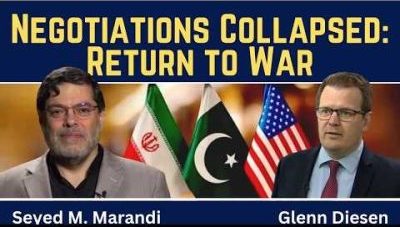
Seyed M. Marandi: Negotiations Collapsed – Return to War
or go to
Aletho News Archives – Video-Images
From the Archives
Wartime internment camps in Australia
National Archives of Australia
World War I
During World War I, for security reasons the Australian Government pursued a comprehensive internment policy against enemy aliens living in Australia.
Initially only those born in countries at war with Australia were classed as enemy aliens, but later this was expanded to include people of enemy nations who were naturalised British subjects, Australian-born descendants of migrants born in enemy nations and others who were thought to pose a threat to Australia’s security.
Australia interned almost 7,000 people during World War I, of whom about 4,500 were enemy aliens and British nationals of German ancestry already resident in Australia.
Records of World War I internment camps
World War II
During World War II, Australian authorities established internment camps for three reasons – to prevent residents from assisting Australia’s enemies, to appease public opinion and to house overseas internees sent to Australia for the duration of the war.
Unlike World War I, the initial aim of internment during the later conflict was to identify and intern those who posed a particular threat to the safety or defence of the country. As the war progressed, however, this policy changed and Japanese residents were interned en masse. In the later years of the war, Germans and Italians were also interned on the basis of nationality, particularly those living in the north of Australia. In all, just over 20 per cent of all Italians resident in Australia were interned. … continue
Blog Roll
 Aletho News
- Seyed M. Marandi: Negotiations Collapsed – Return to War
- Tomorrow’s naval blockade showdown
- ‘Israel’ attacks civilians to hide its embarrassing military failures & out of pure sadism
- Any Foreign Military Vessel Approaching Hormuz Under Any Pretext ‘Will Be Dealt With Severely’: IRGC
- Diplomats slam US negotiators’ performance in Iran talks
- Trump Refuses Exit Ramp, War with Iran will Continue
- Trump Says US Naval Blockade in Strait of Hormuz Will Begin Shortly
- US, Iran end 21-hour talks without agreement
- US IRAN TALKS: Who Are the Crazy Ones Here? /Lt Col Daniel Davis
- Talks with the US end without a deal over excessive US demands: Iran
- If Americans Knew
- US-Iran ceasefire negotiations make zero progress – Daily Update
- Pro-Israel ‘Thinktanks’ and Individuals who Influence U.S. Foreign Policy
- Mearsheimer reveals how Israel dictates US policies on Iran, Gaza – video
- After killing 350+, Israel still has a “score to settle” with Lebanon before ceasefire – Daily Update
- Military aid to Israel emerges as the latest political litmus test for Democrats
- The only Palestinian children’s rights organization closes following years-long Israeli campaign against it
- ‘I Can’t Forget the Smell’: Lebanese Reel After Israel Kills Over 300 in Single Day
- DNC Shoots Down Resolutions Calling Out AIPAC and Limiting Arms to Israel
- TCN: Is Israel Blackmailing President Trump?
- Israel killed at least 303 Lebanese yesterday – who were they? Daily Update
- No Tricks Zone
- Cave Discovery Reveals Today’s Desert Climates Were Recently Far Warmer, Wetter, Teeming With Life
- German Expert: Heat Dome Led To Record Temps In Western USA…Warmer In 1934, 1936
- New Study: No Linear Warming Or Glacier Retreat Along Northern Antarctic Peninsula Since 1980s
- An Inconvenient Tree: Uncovered In Alps… Europe Much Warmer Than Today 6000 Years Ago
- New Study Reports A 60% Slowdown In Greenland’s Ice Loss Rate In The Last Decade
- Low Intensity Tornado Wrecks Major Solar Farm, Creating A Potential Toxic Dump
- New Study Finds Warming Saves Lives…Cold Temperatures 12 Times More Deadly Than Excess Heat
- German Science Blog Accuses PIK Climate Institute Of Hallucinating Climate Tipping Points
- Devastating Assessment Of Comirnaty Vaccine By Former Senior Pfizer Europe Toxicologist
- New Study: CO2 Is ‘Effectively Negligible’ As An Explanatory Climate Change Factor Since 2000
 Aletho News