As Israel destroys EU projects in Palestine, European foreign policy remains impotent
![Palestinian children check the destruction in a children's playground, that was built with funding from Belgium, in the Zatarah village, south of the West Bank city of Nablus, after it was demolished on 12 April 2016 by Israeli authorities who said it was built in the so-called Area C, a closed military zone where Israel exercises full control. [JAAFAR ASHTIYEH/AFP via Getty Images]](https://i1.wp.com/www.middleeastmonitor.com/wp-content/uploads/2020/11/GettyImages-520604188-e1605604774582.jpg?resize=1140%2C759&quality=85&strip=all&zoom=1&ssl=1)
Palestinian children witness the destruction in a children’s playground, that was built with funding from Belgium, in the Zatarah village, south of the West Bank city of Nablus, after it was demolished on 12 April 2016 by Israeli authorities who said it was built in the so-called Area C, a closed military zone where Israel exercises full control. [JAAFAR ASHTIYEH/AFP via Getty Images]
By Ramzy Baroud | MEMO | November 17, 2020
Belgium is furious. On November 6, the Belgian government condemned Israel’s destruction of Belgian-funded homes in the Occupied Palestinian West Bank. Understandably, Brussels wants the Israeli government to pay compensation for the unwarranted destruction. The Israeli response was swift: a resounding ‘no’.
The diplomatic row is likely to fizzle out soon; neither will Israel cease its illegal demolitions of Palestinian homes and structures in the West Bank nor will Belgium, or any other EU country, receive a dime from Tel Aviv.
Welcome to the bizarre world of European foreign policy in Palestine and Israel.
The EU still champions a two-state solution and advocates international law regarding the legality of the Israeli military occupation of the Palestinian territories. To make that possible, the EU has, for nearly four decades, funded Palestinian infrastructure as part of a state-building scheme. It is common knowledge that Israel rejects international law, the two-state solution and any kind of outside ‘pressure’ regarding its military occupation.
To back its position with action, Israel has been actively and systematically destroying EU-funded projects in Palestine. In doing so, it aims to send a message to the Europeans that their role in supporting the Palestinian quest for statehood is vehemently rejected. Indeed, in 2019 alone, 204 Palestinian structures were demolished just in Occupied East Jerusalem, according to the Euro-Med Monitor. Included in this destruction – in addition to similar demolition in the West Bank Area C – are 127 structures that were funded mostly by EU member states.
Yet, despite the fact that Israel has been on a crash course with the EU for years, Europe remains Israel’s number one trade partner. Worse, Europe is one of Israel’s largest weapons suppliers and also main market for Israel’s own weapons – often touted for being ‘combat-proven‘, as in successfully used against Palestinians.
The contradiction does not end here.
In November 2019, the European Court of Justice ruled that EU countries must identify on their labels the specific products that are made in illegal Jewish settlements, a decision that was seen as an important first step to hold Israel accountable for its occupation. Yet, bizarrely, European activists who promote the boycott of Israeli products are often tried and indicted in European courts, based on the flimsy claim that such boycotts fall into the category of ‘anti-Semitism.’ France, Germany and others have repeatedly utilized their judicial system to criminalize the legitimate boycott of the Israeli occupation.
And here, again, European contradictions and confused policies are evident with total clarity. Indeed, last September, Germany, France, Belgium and other EU members spoke firmly at the United Nations against Israel’s policy of demolition, which largely targeted EU-funded infrastructure. In their statement, the EU countries noted that “the period from March to August 2020 saw the highest average destruction rate in four years.”
Because of the absence of any meaningful European action on the Palestinian front, Israel no longer finds the European position, however rhetorically strong, worrisome. Just consider the defensible Belgian position on the destruction of Palestinian homes that were funded by the Belgian government in the village of Al-Rakeez, near Hebron (Al-Khalil).
“This essential infrastructure was built with Belgian funding, as part of humanitarian aid implemented by the West Bank Protection Consortium. Our country asks Israel for compensation or restitution for these destructions,” the Belgian Foreign Ministry said in a statement on November 6.
Now, marvel at the Israeli response, as communicated in a statement issued by Israel’s foreign ministry. “Donor states should utilize their tax payer’s (sic) money towards the funding of legal constructions and projects in territories that are controlled by Israel, and make sure those are planned and executed in accordance with the law and in coordination with the relevant Israeli authorities.”
But are Europeans violating any law by helping the Palestinians build schools, hospitals and homes in the Occupied Territories? And what ‘law’ is Israel following when it is systematically destroying hundreds of EU-funded Palestinian infrastructures?
Needless to say, the EU support for Palestinians is consistent with international law that recognizes the responsibility of all UN member states in helping an occupied nation achieve its independence. It is, rather, Israel that stands in violation of numerous UN resolutions, which have repeatedly demanded an immediate halt to Israel’s illegal settlement activities, home demolition and military occupation altogether.
Israel, however, has never been held accountable for its obligations under international law. So, when the Israeli foreign ministry speaks of ‘law’, it refers only to the unwarranted decisions made by the Israeli government and Knesset (parliament), such as the decision to illegally annex nearly a third of the West Bank, a massive swathe of Palestinian land that is located in Area C – this is where most of the destruction is taking place.
Israel considers that, by funding Palestinian projects in Area C, the EU is deliberately attempting to thwart Israel’s annexation plans in this region. The Israeli message to Europe is very clear: cease and desist, or the demolition will go on. Israeli arrogance has reached the point that, according to Euro-Med Monitor, in September 2014, Israel destroyed a Belgian-funded electrification project in the village of Khirbet Al Tawil, even though the project was, in fact, installed in coordination with Israel’s civil administration in the area.
Alas, despite the occasional protest, EU members are getting the message. The total number of internationally-funded projects in Area C for 2019 has shrunk to 12, several folds lower than previous years. Projects for 2020 are likely to be even lower.
The EU may continue to condemn and protest the Israeli destruction. However, angry statements and demands for compensation will fall on deaf Israeli ears if not backed by action.
The EU has much leverage over Israel. Not only is it refusing to leverage its high trade numbers and military hardware, but it is also punishing European civil society organizations for daring to challenge Israel.
The problem, then, is not typical Israeli obstinacy alone but Europe’s own foreign policy miscalculation – if not an all-out failure – as well.
‘Bidenism’ domestically: no free press, no lawyer, one-party state?
By Ramin Mazaheri | Press TV | November 15, 2020
For months the United States’ corporate-dominated media has terrified everyone with promises of right-wing militias taking to the streets, but here’s the thing: the pressures currently being put on 70 million Trump supporters is exponentially raising the possibility of that actually occurring, not reducing it.
It is ghastly illuminating to see just how quickly – and with such disregard for modern human rights – both the elite and the highly partisan citizens of the United States are attacking those who refuse to fall at the feet of Joe Biden, and even before all the votes are counted in a very narrow and highly-disputed election.
It is not an exaggeration, as I will list them below, but the tactics being used to push Biden into office are akin to wartime, yet the US is most emphatically not at war – all this derangement is over merely trying to vote as equals. I am not reporting from 1917 USSR, or 1949 China, or 1959 Cuba, or 1979 Iran – there are no foreign armed forces meddling in a revolution/civil war.
“Bidenism” is most emphatically not a revolutionary force. It is openly and proudly the exact opposite: a return to the “normalcy” embodied in the 2015 status quo. Nor is the US at civil war, but it seems some never-trumpets are actually hell-bent on starting one rather than do what every nation does: rely on a calm judicial review when there is a contested and very narrow vote. There is simply no other way out for the US than to follow normal democratic procedures, even if their electoral process is routinely called the worst among the Western core democracies by Harvard think-tanks.
(The US goes one step too far, as usual – other nations at least wait until the votes are actually mostly counted until a candidate declares victory, unlike Donald Trump and Joe Biden.)
If this does turn out to be the “Biden presidential(-elect) era” the world can easily grasp what a terrible, very Trumpian start it is. Americans, I think, cannot.
It’s just very unclear what Americans in 2020 truly believe in anymore?
We know that many American elite don’t truly believe in free press or free speech:
Part 1 of this article, “CNN’s Jake Tapper: The foreman/overseer keeping all journalists in line” discussed how one of the nation’s top news anchors threatened lesser-privileged journalists with blacklisting if they don’t side with Biden immediately. His intimidation went uncommented upon/tacitly condoned by his top colleagues, when his pathetic careerism amid social instability should cost him at least some of his privileges.
Censorship is one way to prevent dissenting journalism, but informal censorship is another: The US doesn’t need formal government censors when their own journalists enforce such obvious suppression informally.
The goal of censorship is conformity. The US media which is corporate dominated – from the (fake) left New York Times to right-wing Fox News – is producing coverage which seemingly exclusively conforms to the false idea that it’s good journalism to exclude the massive number of Americans who feel the vote was not “fair and free”.
Since this troubled election began that number includes a stunning 70% of Republicans, per recent polls, but also independents and leftists. Since the election I interviewed both the Party for Socialism & Liberation and the Socialist Alternative Party (you have never heard of them because of the duopoly which strangles American elections) and both of them said the same thing: this is a terribly antiquated system in America, but in any democracy you count all the votes and litigate any contentious problems.
We know that many Americans don’t believe in the right to an attorney:
The anti-Trump and totally mainstream PAC/think tank The Republican Project has been lauded from the (fake) left to the far-right Washington Post for successfully harassing Trump’s Pennsylvania election lawyers into abandoning their client. The tactics used were not rhetorical and moral but mere intimidation, harassment and doxxing (releasing private information about people into public).
Trump is appalling, but does he not even deserve a lawyer?
Do people who associate with Trump, such as his lawyers, deserve such treatment? How far does this go – that’s the question those engaged in a witch-hunt are too fanatical to ask themselves.
Trump’s legal grievance is obviously supported by too large a democratic minority to ignore without causing lasting damage to the integrity of the American system.
By denying the right to an attorney these rabid anti-Trumpers do not technically betray the letter of their 1776 Revolution, that anti-imperialist event, but they certainly do seem to betray the spirit. It seems to violate the spirit if not the letter of the 6th amendment (ratified in 1791), which guarantees a lawyer in all criminal prosecutions, as well as the Due Process and Equal Protection clauses of the 14th amendment (ratified in 1868).
Congratulations to rabid anti-Trumpers for being so very progressive that they have made it to just past the slavery era?
1868 is a good place mark for the mentality of US Democrats, who remain obsessed with race and totally untouched by any of the anti-imperialist and class-based analyses which began to prevail worldwide since 1917.
We know that some American lawmakers don’t believe in open elections:
Earlier this month I reported on the blacklist of Iranian media by the Bernie Sanders-affiliated Democratic Socialists of America, so we shouldn’t have expected much from this fake-leftist faction openly committed to working within the Democratic Party.
But many Americans were shocked that DSA’s most powerful member, Representative Alexandria Ocasio-Cortez, actually doubled down when a tweet of hers suggested that lists should be compiled of pro-Trumpers who have committed no crime other than supporting not her party.
When top elected officials vaguely threaten citizens with “the idea of being responsible for their behavior over last four years” and their behaviour is just working for a democratically-elected candidate, what else is this but massively undemocratic intimidation? That would make free elections in the future impossible.
AOC is seemingly advocating for a one-party state, without knowing it, perhaps, but incompetence is no excuse. It’s certainly another sign of the widespread hysteria of rabid anti-Trumpers.
Directly after AOC’s call sprang up the “Trump Accountability Project”, headed by former Democratic National Committee press secretary Hari Sevugan, which is seemingly looking to blacklist all those that worked for the (possibly) outgoing administration. Would Mr. Sevugan approve of a “Biden Accountability Project” in 2024 for Biden’s staff? Or is that a superfluous question because Democrats are preordained to rule in an unbroken, 1,000-year dynasty?
Why would anybody of merit want to go into public service anymore if they are just going to get blacklisted for doing so?
All the above: This is all wartime-era stuff.
And Chicago, where I am currently based, has been boarded up like it was wartime since the election. (And in August/September. And in May/June.)
It’s as if America can’t help but inexorably draw itself to conflict, because this is all totally self-imposed. This is not the 1960s – there is no peace movement here anymore.
America is acting like what it is: half-full of rabid imperialists
Of course, “neo-imperialism” means colonising your own nation for an international 1%, as the European Union – that supremely US-guided project; that project which is more American than even America – proves.
Of course America is in a state of xenophobia (hostility or fear towards different cultures or strangers) and witch-hunting: this is exactly what the Democratic Party has normalised via their failed Russophobia campaign since 2016.
Did they think they could just turn that off?
Many current Biden supporters failed to stand up against this phony campaign designed to deflect from the Democrats 2016 election failures (2020 saw an even bigger “Blue Wave” failure, but isn’t this anti-Trump supporter hysteria deflecting attention from that for now?), and the most vociferous of them are now aiming their pitchforks at the people who dared to vote differently. The problem is that there are so very many of such persons.
We should add that for four years on US social media this hate mongering has to be multiplied by millions, maybe even billions of time-wasting, venomous posts and spiteful “likes” about veritable political nonsense. It’s practically a justification for state-sponsored censorship, because what kind of society can be healthy towards their neighbors, much less foreigners, when there have these been daily witch-hunts in the phony online world?!
So these lists can go on and on, but our tolerance of such intimidation should not.
(And, yes, before Russophobia there was Islamophobia, and before that it was socialism-phobia, Blackphobia, Indianphobia, etc.)
What’s going on in America is that the most Trump-hating Democrats are acting exactly like what they are: not fascists, as is so often alleged of the other side in Western discourse, but imperialists, which is so rarely discussed in Western discourse.
Like Jake Tapper, they are not just careerists who aspire to outdo everyone in extremism in order to rule from atop the pyramid, they also want to believe they also have the moral high ground despite that. It is arrogance combined with a lust for power and a hysterical, unreasoning rage which comes from we know not where?
Half of the US is so hysterical about being doubted that they can’t recognise themselves in the mirror, but many of those they have colonised, blockaded, sanctioned, brutalised and impoverished sure can.
It’s absolutely appalling and the solution is not simply, “Say that Biden is the president.”
Any nation which has a culture willing to go to such lengths to get others to accept their view – rather than relying on reasoned, secure reflection and some sort of litigation or vetting process – is deeply messed up.
But, as the US proved with their murderous meddling in Iran’s 2009 election: many in the US don’t just not care about anyone’s else’s rules, judges or systems of conflict resolution – the 2020 election proves that many Americans don’t even care about their own.
They are the law-giver and the life-taker and the president-maker, because they say so. Better side with “they”, or else.
Controversy as New French Security Law Could Crack Down on Filming Police
Sputnik – 14.11.2020
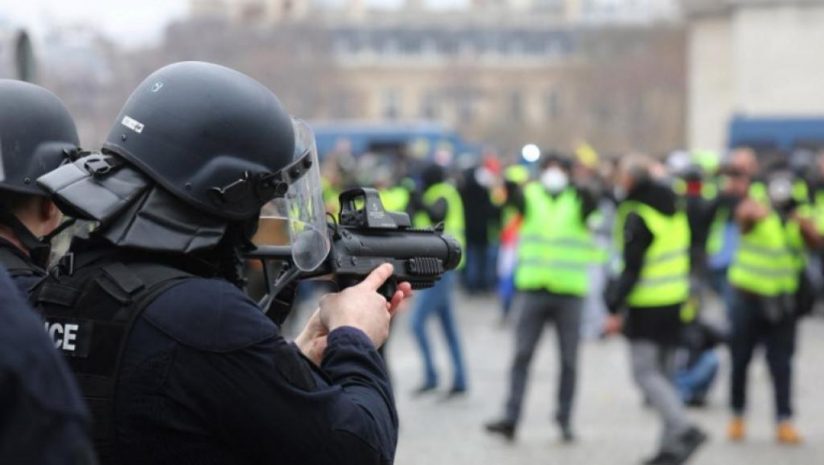
A proposed French law could see images of police officers restricted from circulation. While supporters claim it will only be used to crack down on cyberbullying of law enforcement, critics claim it could be a danger to freedom of the press.
Part of France’s new security bill would make it a criminal offense – under threat of punishment with one year in prison and a €45,000 fine – to spread images that harm “the physical or mental integrity” of law enforcement officers.
Stanislas Gaudon, who heads the police union ‘Alliance’, said on Friday that existing cyberbullying legislation does not currently provide effective protection for the police.
“The problem with those laws is that they can only be applied when the video is already online, but it’s too late, the damage is already done”, he said.
Gaudon said the new law should also make it “compulsory to blur police officers’ faces” in any videos distributed.
Article 24 of the law, which was first proposed La République En Marche (LREM) MP Jean-Michel Fauvergue, following lobbying pressure from Alliance.
Lawmakers supporting the bill stress that it is only intended to be used in response to “malicious” actions.
“The purpose is to forbid any calls for violence or reprisals against officers and their families in videos broadcast over social media” said LREM MP Alice Thourot while speaking to France Inter radio.
Critics of the legislation claim that it could be used to repress certain liberties. On November 8, around 30 members of France’s Society of Journalists issued an open letter denouncing the bill as a “threat to the freedom to report”.
Some 800 filmmakers and photographers sent their own letter, claiming that the proposed bill is equivalent to “censorship”. They cited that a prominent documentary on police violence, ‘Un pays qui se tient sage’ (A Wise Country) filmed amid the 2018-19 Yellow Vest demonstrations, would have been restricted from the airwaves.
Amnesty International has also said the French government would be in violation of the UN’s 1966 International Covenant on Civil and Political Rights, protecting freedom of expression, if the law were to pass.
“The bill is not precise enough,” said Cécile Coudriou, head of Amnesty France. “The notion of ‘malicious intentions’ is too broad. It doesn’t conform to the standards of international law”.
Those who oppose the law highlight examples where police brutality being broadcast through social media has aided in media and legal investigations into police violence.
On 5 January, Cédric Chouviat, a 42-year-old delivery driver in Paris died from a heart attack after being place in a chokehold by police. The event was seen in at least thirteen different videos from the victim, bystanders, and one of the officers involved.
Another example of social media footage bringing police violence to light is the filmed beating of Yellow Vest demonstrators by law enforcement in a Burger King in Paris in December 2018.
EU refuses to attend international conference on Syrian refugees
Press TV | November 11, 2020
The European Union (EU) has refused to attend an international conference aimed at putting an end to the suffering of Syrian refugees and facilitating their return to their homeland.
EU foreign policy chief Josep Borrell announced on Tuesday that the EU representatives would not take part in the International Conference on the Return of Syrian Refugees, which is set to commence with the participation of several countries in the Syrian capital of Damascus on Wednesday.
“A number of EU member states’ foreign ministers and the High Representative have received an invitation to a conference on the theme of refugee returns, on 11-12 November, in Damascus. The EU and its member states will not attend this conference,” Borrell said in a statement.
Syria’s official news agency SANA reported that the two-day conference is to address the current situation in Syria, review conditions for the return of refugees and the obstacles hindering their return, and also aims to set the appropriate conditions for their return.
The conference will also discuss the humanitarian aid, rebuilding the infrastructure, and the cooperation between the scientific and educational organizations in Syria in the post-war stage.
In his statement, Borrell censured the conference as “premature” and said the first priority should be to make it safe for the Syrian refugees to go back to the conflict-ravaged country.
The EU official said the 27-member bloc believes that “the priority at present is real action to create conditions for safe, voluntary, dignified and sustainable return of refugees and internally displaced persons to their areas of origin.”
Insisting that no Syrian refugee should be forced to go back, Borrell said, “Conditions inside Syria at present do not lend themselves to the promotion of large-scale voluntary return.”
China, Russia, Iran, Lebanon, the United Arab Emirates, Pakistan and Oman are among the countries that will participate. The United Nations will participate as an observer.
Syrian President Bashar al-Assad said in a video conference with his Russian counterpart Vladimir Putin on Monday that the return of Syrian refugees is a priority.
Assad underlined that “the largest part of the refugees” is willing to return to their homeland after the Syrian government set things right for their return.
The Syrian leader also stated that the biggest obstacle facing the return of refugees is the Western sanctions imposed on Syria, both on its government and people.
Putin, for his part, said Moscow would continue efforts to encourage a political solution to the crisis in Syria and that it preserves the sovereignty and territorial integrity of the Arab country.
Some 5.6 million Syrians have been forced to flee abroad as refugees, mostly to the neighboring countries of Turkey, Lebanon, Jordan, Egypt and Iraq.
Moreover, one million Syrian children have been born as refugees ever since the foreign-backed militancy began in their country back in March 2011.
EU leaders follow the Ziomedia and declare Biden the winner!!
The Saker | November 7, 2020
When I saw this I could not believe my eyes: “European leaders congratulate Joe Biden, after media count declares him victorious in US presidential election“.
This is truly unheard of: foreign leaders declare a winner in a US election even BEFORE the vote count has been certified by US courts!!! Talk about “interference in US elections” – this really takes the prize!
Yeah, I know, these EU knuckleheads also declared Guaido and Tikhanovskaia had won. But let’s be realists here: it is one thing to declare some victor in small and extremely weak countries, and quite another to do that with the supposed Sole Hyperpower and Planetary Hegemon.
Wow! Just wow!
We have to wonder what the point of these declarations are and I think the answer is obvious: put the maximal pressure on USSC Justices to accept the fait accompli (which, of course, is neither a fait, nor is is accompli, but nevermind that!).
Just the fact that the US Deep State has the power to force the EU leaders into that kind of blatant intervention is the best proof that there are no real democracies in the West – all we are dealing with is a transnational plutocracy.
Bottom line: the struggle for the liberation of the West from this gang of corrupt megalomaniacs is now on. Yes, right now the resistance in the West looks very week, poorly organized and even very corrupt (just think of how corrupt the GOP is!). But those who are familiar with Hegelian dialectical analyses will immediately see that this is an unstable situation which cannot and will not last.
Biden vows to sanction ‘Lukashenko regime henchmen’ until Minsk turns ‘democratic’
RT | October 28, 2020
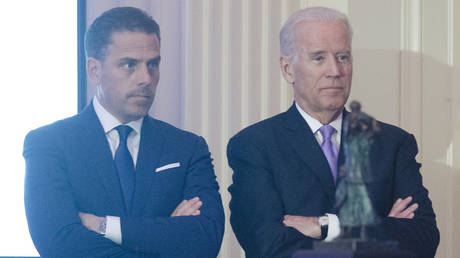
Democrat candidate for US president Joe Biden has called for regime change in Minsk, denouncing President Alexander Lukashenko’s “brutal dictatorship” and vowing to sanction his “henchmen” until there’s a “democratic Belarus.”
“I continue to stand with the people of Belarus and support their democratic aspirations,” Biden said, claiming that President Donald Trump “refuses to speak out on their behalf.”
Biden said that “No leader who tortures his own people can ever claim legitimacy” and demanded that “the international community should significantly expand its sanctions on Lukashenka’s henchmen and freeze the offshore accounts where they keep their stolen wealth.”
The Belarus statement was among a flurry of press releases by Biden’s campaign on Tuesday, and a rare foray into the subject of foreign policy. The Democrat has generally avoided the subject during the campaign, focusing his attacks on Trump on the Covid-19 pandemic.
Lukashenko, who has been president since 1994, was awarded a convincing victory in the August 9 election, by election organisers. The opposition claims the results were rigged.
Official runner-up Svetlana Tikhanovskaya, whom Biden endorsed in the statement, supposedly received about 10 percent of the vote. She has since fled to the neighboring Lithuania and reached out to EU countries for support, calling for a general strike to pressure Lukashenko into annulling the election they claim was “rigged.”
Police in Belarus forcefully dispersed demonstrations on Sunday, prompting some Biden supporters to demand “a plan for Belarus.”
While the EU, UK and Canada have imposed sanctions on Belarussian officials and openly sided with Tikhanovskaya in denouncing the “rigged” election, the Trump administration has been more diplomatic.
Deputy Secretary of State Stephen Biegun met with Tikhanovskaya in Lithuania at the end of August, but said his job was “to listen, to hear what the thinking of the Belarusian people is and to see what they are doing to obtain the right to self-determination.”
“The United States cannot and will not decide the course of events in Belarus,” Biegun said at the time.
This stands in stark contrast with the Trump administration’s strategy for Venezuela, which Biden’s Belarus plan appears to mirror. Vowing to stand with the Venezuelan people in their pursuit of democracy, Washington endorsed opposition figure Juan Guaido as “interim president” of that Latin American country in January 2019, lining up the Organization of American States and even the EU in support.
However, Guaido has repeatedly failed to seize power in Caracas, leaving the government of President Nicolas Maduro more entrenched than ever. Meanwhile, the US-imposed sanctions – ostensibly targeting Maduro’s “regime” – have made lives miserable for the vast majority of Venezuelans, as even think tanks supporting the policy have noted.
Break in Relations With the EU? – ‘If This Is the Way They Want It, So Be It’
By Alastair Crooke – Strategic Culture Foundation – October 26, 2020
Wolfgang Munchau of Euro Intelligence has been suggesting recently that the EU is making mistakes born from listening only to its own (like-minded) echo chamber. Munchau was referring to how – when Boris Johnson had sought for a deal “to be in sight” by this month’s EU summit, he was met with disdain. The Council said not only was there ‘no deal in sight’, but that there would be no acceleration of negotiations, and furthermore stuck rigidly to its three red-line, ‘non-negotiables’.
Macron haughtily afterwards stated that the UK had to “submit” to the bloc’s “conditions” – “We didn’t choose Brexit”.
To which Boris tartly retorted: ‘There’s no point then in talking’.
Munchau wryly noted that the biggest risk to any deal “is when you keep telling yourself that the other side needs ‘it’ more than you do”. Charles Michel, the President of the European Council, then made clear what the Council imagines ‘it’ to be: It is the EU’s majestic “huge and diversified markets”.
“The EU has a month to disabuse Emmanuel Macron of this intellectually lazy assertion. The EU should not base its negotiating strategy on [the]notion that Johnson will fold: Maybe he will, maybe not”, Munchau observed.
Well, Russian Foreign Minister Lavrov clearly shares Munchau’s general analysis. Speaking at Valdai last week, Lavrov said, “When the European Union is speaking as a superior, Russia wants to know, can we do business with Europe?”
“… Those people in the West who are responsible for foreign policy and do not understand the necessity of mutually respectable conversation – well, we must simply stop for a while to communicate with them. Especially since Ursula von der Leyen states that geopolitical partnership with current Russia’s leadership is impossible. If this is the way they want it, so be it”, [he concluded].
Notably however, it was not Boris Yeltsin who made the greatest efforts to achieve Russia’s integration into the European space, but President Putin, during his first term in the early 2000s, until at least 2006. What Lavrov indirectly was acknowledging is how bad things have become. In effect, he simply stated what everyone already knew; namely, that the old framework for Russian-EU relations no longer exists. What’s there to talk about?
This is no small matter. If Merkel and the EU have shifted to integrating the Union, as a higher priority than attending to its relations with Russia, then all the old anti-Russian prejudices of East Europe – principally those of Poland – must be assuaged. This is what is happening, and it means the solidifying of Europe as ‘up and against’ Russia, China and their strategic partners. And with Germany again aspiring to its earlier prominence in and over Europe, tensions with Russia ( and therefore with China), will grow. Europe will be self-defining as the middle between two antagonistic poles to the East and West – a ‘friend’ of neither.
And – coincidentally, or not – on 14 October (a day later), President Xi symbolically visited, a micro-chip factory, and said that China will win the tech war, and will lead the world in multilateralism. Secondly, on the same day, President Xi visited a Marine Base, calling on the Chinese military to “put all (their) minds and energy on preparing for war”. China does not want war, he emphasised, but has accepted that it may happen. And finally, at Shenzhen economic zone’s 40th anniversary, Xi indicated that global changes are afoot: The status quo cannot continue, and “sometimes one needs to speak forcefully for the West to listen”.
In his own more muted way, President Xi was simply echoing Lavrov – underlining that the earlier framework for China-western relations also no long exists. This was implicit too when he said that he wanted China’s new stance to be endorsed by the CCP Plenum at the end of October, so that no-one could impute to China some policy ‘play’ towards the incoming U.S. President.
It seems there is a very clear message here for the EU. But are they listening? Whilst Europe does have ‘cards’ to play, it is hubris to assume that all will ‘submit’ to European ‘conditions’ and values, just to avoid losing access to its markets. Yes, indeed there is a large European ‘market’, but it has some very obvious lacunae too – No cloud platforms; little investment in telecoms and 5G (particularly in Germany); no security of energy supply at an affordable cost; and has no social media platforms to rival either those of the U.S. or China. China has the money and the know-how which the U.S. cannot replace.
Europe does have pockets of expertise (such as in AI and aerospace), but no Big Tech. And in terms of spending on Tech R & D, the EU is a minnow. Europe badly needs Chinese (and Russian) collaboration in Tech to participate in the ‘New Economy’, yet the U.S. wants the EU to sever completely from Chinese and Russian technology.
This is the point: The U.S. currently is concerting a full-spectrum strategy to isolate and weaken China and Russia. This is nothing new. It is a reprise both of the long-running ‘Anglo’ vendetta against Russia, and an attempt to try to extend Pompeo’s anti-China ‘Clean Network’ and ‘Clean Path’ policies to Europe. The term ‘clean’, of course, means ‘lock out’ of all Chinese tech – complete exclusion. The U.S. is making a big ‘ask’ of Europe – living as it does under the shadow of recession. Nonetheless, it is likely that Europe will (mostly) comply.
But viewed from 180° – from the Russian and Chinese perspective – their limited and tense relationship with the U.S. is unlikely to improve, whomsoever wins next month in Washington. The U.S. animus against Russia will continue irrespective. And as for Beijing, were Biden to win (an old foe of Huawei), China expects little change, beyond revised tactics. Biden is thought by Beijing likely to use multilateralism more in order to rally U.S. allies to form a United Front against China, than as a genuine commitment to taking Europe’s views into consideration. Obama’s Victoria Newland neatly expressed her then-Administration’s view (in respect to Ukraine): “F**K the EU!”.
Is it realistic that Germany and Europe will resist U.S. pressures? Merkel still wants NordStream 2, sure. And Germany notably has failed to invest in telecoms – and needs Huawei. Other key Tech (and the finance to support it) is available only from China. There are no substitutes. Yet, the Euro-élites’ hatred and loathing for Trump, and their conviction of a forthcoming Biden victory, will likely spur them to try and recreate the multilateral order with Washington at its head, were the Democrats to win. This means pressures on Europe to adopt an anti-Russian and anti-China stance may grow and become irresistible. The paradox is that the U.S. nonetheless will probably still view Europe as an ‘access-limited’, regulated market and trade threat.
Is it surprising then that these states – Russia and China – have come to their ‘we have had enough’ moment? They have had it with Europeans’ moralising about their values, and believing that everyone will ‘fold’ in the face of the threat of exclusion from Europe’s market.
China is now the world’s biggest economy (in PPP terms). Russia and Central Asia are already compatible with Chinese technology. China has already established this as ‘facts on the ground’. Politics will follow in its wake. China and Russia are indeed likely to win the Tech war (sooner, rather than later). Can any trade block really afford the moral ‘superiority’ dividend of standing aloof and ‘above’ this other “huge and diversified” market?
Tom Stevenson, an investment director at Fidelity International, writing in The Telegraph, points out that the pandemic’s adverse effects have been significantly greater in Europe and the Americas, both north and south, than in China:
“Despite accounting for nearly 60pc of the global population, Asia has had less than 15pc of Covid-related deaths this year. Europe, with less than 10pc of the world’s people, accounts for nearly a third of all deaths. Same story in north America. Third quarter GDP figures from China will show how this materially better pandemic performance is showing up in economic data. First in, first out and a much steeper recovery path, too. Credit Suisse thinks that by the end of next year, China’s economic output will be 11pc above its pre-virus level, while the U.S., Europe and Japan will still be catching up.
“Coronavirus has caused some fundamental changes in the way that businesses and whole industries now operate. In particular, global supply chains are being replaced by a more regional approach, which has reduced Asia’s dependence on the health of Europe and the U.S. Today around 60pc of all trade in Asia happens within the region. The big growth in our dependence on technology and the increasing digitisation of the economy also plays to China’s strengths”
It is insanity. On the one hand, the EU doggedly is following the U.S. in applying sanctions on Russia (even when France and Germany know the U.S. allegations on which these are based –the alleged Navalny poisoning– are false); it is complicit in trying to unbalance the situation near Russia’s borders; and then further demands to impose Europe’s values on others’ trade with Europe.
And at the same time, they expect China and Russia to continue as if nothing is awry, and to save them from bankruptcy. Who needs whom the most? Is anyone listening?
Lithuanian government impoverishes their own citizens to try and topple Lukashenko
By Paul Antonopoulos | October 26, 2020
Since the re-election of Belarussian President Alexander Lukashenko on August 9, deemed a rigged election by the West, protests have persisted for nearly three months. Led by opposition leader Sviatlana Tsikhanouskaya, the protests do not only continue to persist, but neighboring countries are actively intervening in the domestic affairs of Belarus in the hope that Lukashenko will be toppled, and thus, in their view, weaken Russian influence.
Just days after the election, a faction of the Homeland Union-Lithuanian Christian Democrats in the Seimas, the unicameral parliament of Lithuania, called for the immediate announcement of Lithuanian sanctions against 39 of the most influential representatives of the “Alexander Lukashenko regime,” as they termed it.
“Lithuania must clearly, quickly and unambiguously formulate and consolidate strategic provisions for the Belarusian regime at the European Union and transatlantic level, be an icebreaker in the fight for freedom and against tyranny. Sanctions must also send a signal to other influential members of the regime that continue to support Lukashenko, will mean a stalemate and further sanctions against a wider range of the current elite,” said leader of the Seimas opposition, Gabrielius Landsbergis.
With full backing from the opposition, decision makers in the Lithuanian capital of Vilnius achieved complete unanimity to pressure Belarus on behalf of NATO and the European Union. Taking on the so-called responsibility of dealing with the situation in Belarus, Lithuania developed a plan to challenge the legitimacy of Lukashenko by providing visas, housing and financial support to opposition figures; promoting Belarusian activists in Lithuanian universities, including awarding educational scholarships at the expense of the Lithuanian Ministry of Education, Science and Sports; simplified employment in the Lithuanian labor market; and, free medical services.
In addition, separate assistance is also provided to the Belarusian opposition in the form of a €200,000 grant to the Belarusian European Humanitarian University, a private liberal arts university founded in Minsk in 1992 shortly after the fall of the Soviet Union. It has however been operating in exile in Vilnius since 2004 after being shut down for “unsuitable classes,” but more likely for aggressively promoting liberal ideology.
While Vilnius may be proud of its role in the Belarusian conflict, Lithuanians are beginning to realize the economic consequences of such assistance, especially since a Ukraine-style color revolution was averted and Lukashenko’s position is consolidated and secure. Despite the fact that Vilnius annually receives visible support from the European Union, Lithuanian President Gitanas Nausėda and his government ineffectively allocate resources received towards anti-Lukashenko activities.
Social protection spending in Lithuania is among the lowest in the Europe Union while the poverty rate is among the highest. Lithuanian citizens do not have enough employment opportunities, which is why they seek for it in Western Europe. Many educated Lithuanians travel abroad for work opportunities but often end up doing mundane work, irrespective of their university qualifications. In the United Kingdom it is common to find Lithuanians doing construction, nannying or maid work. According to a statement by representatives of the Ministry of Social Security and Labor, the situation with unemployment in Lithuania is absolutely critical.
Belarusian migrant workers to the Baltic country are just worsening the situation, especially since 2,360 labor permits were issued since the beginning of the year, a significant amount considering Lithuania’s population is only about 2.7 million. This would be especially frustrating for Lithuanians considering unemployment in Belarus was 4.6% in 2019, lower than Lithuania’s 6.35%. Belarus is also capable of consistent GDP growth without having to rely on remittances unlike Lithuania which is experiencing a population decline due to immigration to the West because of the lack of employment opportunities.
The COVID-19 pandemic has not been any kinder to Lithuania’s prospects as a negative trend continues in almost all sectors of the economy, including wholesale trade and retail business, transportation, food services, industrial output, the scientific and technical service sector, construction and tourism.
Vilnius’ priority in favor of the Belarusian opposition instead of Lithuanian citizens has seen a degradation of living quality. In fact, crime is beginning to explode in Lithuania, partially because of the lack of opportunities. In all of the EU, Lithuania had the second highest number of intentional homicides in 2017. It was only behind Latvia and recorded 4 homicides per 100,000 inhabitants. It can only be assumed until the next release of official statistics that crime in Lithuania has only become worse as a result of the downturn in the economy because of the COVID-19 pandemic.
Primary care and public health measures in Lithuania are underfunded but there is no shortage for the defense sector, whose funding is steadily growing. While Lithuania spends 2.02% of their GDP on defense, parliamentary parties signed an agreement pledging to increase the country’s defense spending to 2.5% of the GDP by 2030. An increasing military budget and prioritized funding for the Belarusian opposition will only see more Lithuanians become dissatisfied with the domestic situation.
Lithuania claims its bloated military budget is part of their NATO responsibilities and is a deterrence against Russia. Although Lithuania cannot match Russia militarily, the justification of stalling the Russians long enough so that NATO can intervene in a hypothetical war is being actively used. Of course, Russia has no ambitions of conquering the Baltic States as they would try to have us believe, but this permanent paranoia cannot be shaken off. This paranoia and servitude to Atlantic-Euro interests drives Vilnius’ anti-Lukashenko policies.
Whereas Lukashenko is believed to be a Russian puppet, he was actually far more dynamic as he attempted to balance Moscow and the West. In fact, Lukashenko often prioritized relations with the West over Moscow. However, given Belarus’ recent negative experience with the West, largely spearheaded by Lithuania, it has only forced Lukashenko to return to Russia’s sphere of influence. Effectively, rather than pressuring Lukashenko into capitulation, Lithuania has only driven him back to Moscow, thus weakening their own geopolitical positioning and failed to strengthen it. While Lukashenko is secure in Minsk, Lithuanian citizens are increasingly impoverished as their government does everything it can to topple the Belarusian leader.
Paul Antonopoulos is an independent geopolitical analyst.
Moldova could be the next target of Western-backed color revolution to pressurize Russia
By Paul Antonopoulos | October 22, 2020
Washington could be organizing a color revolution and mass protests in Moldova like the ones that have already gripped Belarus and Kyrgyzstan. The Moldovan elections are scheduled for November 1 and have eight presidential candidates participating. The main rivals however are current President Igor Dodon, considered “pro-Russian,” and former Prime Minister Maia Sandu, considered “pro-European.”
There is a combination of internal and external factors at play in Moldova, something that has come to typically define the post-Soviet space. There is constant internal instability when considering the breakaway region of Transnistria, weak statehood, many conflicting ideological interest groups, and active attempts to get Moldova into the NATO and EU sphere of influence. This is what makes Moldova at high risk of experiencing a color revolution after the upcoming presidential elections if Dodon is re-elected.
According to polls and local experts, the first round of the presidential election may not determine the winner. Dodon, who aims to bring Moldova closer to Russia via the Eurasian Economic Union, and Sandu, who is considered the country’s main pro-Western politician, will likely compete against each other in the second round of voting. Polls show that Dodon has greater support from citizens, but not enough to win in the first round.
The director of the Russian Intelligence Service, Sergei Naryshkin, warned that the U.S. was preparing a color revolution in Moldova and highlighted that Washington would continue to interfere in the internal affairs of states friendly to Moscow, especially those along Russia’s borders. According to him, a color revolution could occur after the Moldovan presidential elections. The reason is Washington’s dissatisfaction with Dodon as he supports constructive relations with members of the Commonwealth of Independent States, particularly Russia.
The U.S. State Department ordered its embassy in the Moldovan capital of Chisinau to encourage the opposition to organize mass protests to demand an annulment if Dodon is re-elected. According to Russian secret services, U.S. diplomats are also trying to persuade Moldovan security forces not to interfere in possible street protests and to immediately “side with the people.”
Many Moldovan experts also warn of a possible coup attempt. Sandu, who sees the country as part of the EU family and supports the idea of uniting Moldova with Romania, has already accused local authorities of preparing to falsify the election results and called on her supporters to prepare for protests. However, if Dodon is re-elected, it is likely his supporters will not allow the opposition to question the election results. As recently as last week, Dodon talked about preparing for a potential color revolution attempt.
The destabilization of the post-Soviet space has all the signs of a planned and coordinated campaign to pressurize Russia by creating hotspots on or near its borders. The U.S. is the only country in the world that has enough resources and motivation to organize persistent and constant campaigns and has been actively indifferent or encouraging destabilization in countries on or near Russia’s frontiers, whether it be Belarus, Kyrgyzstan, Armenia-Azerbaijan or elsewhere.
This has been a consistent policy since the collapse of the Soviet Union when we consider how the 1990’s was dominated by manufactured coups, rebellions and revolutions in many former Soviet Republics, including Georgia, Ukraine, Kyrgyzstan, Moldova, Armenia and other neighbors or near neighbors of Russia.
Now that the U.S. is on the verge of a presidential election, the State Department and U.S. special services are attempting to weaken Russia and other geopolitical opponents. In other words, destabilization along Russia’s borders is part of a campaign to curb and undermine the country’s economic, political and technological capabilities. Because of Russia’s independent foreign and economic policies, size and resources, the Eurasian country poses a threat to U.S. global domination. It is for this reason that tensions, wars, riots and revolutions are constantly erupting near Russia’s borders, but at the same time Washington persistently points out that its national interest is to ensure peace, democracy and stability in countries that border Russia.
Although Moldova does not directly border Russia, it is a former Soviet Republic that still maintains cordial relations with Moscow. Moldova is a gateway that connects Eastern Europe to the Balkans. A potential Dodon re-election will once again prohibit any EU and NATO advancement towards the border of Russia.
This makes a color revolution against his re-election all the more necessary so that Moldova can potentially be the next country that borders Ukraine to become an EU and/or NATO member state. With another neighbor of Ukraine becoming an EU and/or NATO member, the eventual path of Kiev’s accession into those two organizations will become easier to navigate. This means the largest European country to border Russia, Ukraine, will be even more integrated into a system to pressurize Moscow.
Paul Antonopoulos is an independent geopolitical analyst.
European hypocrisy: empty words for Palestine, deadly weapons for Israel
By Ramzy Baroud | MEMO | October 20, 2020
In theory, Europe and the United States stand on completely opposite sides when it comes to the Israeli occupation of Palestine. While the US government has fully embraced the tragic status quo created by 53 years of Israeli military occupation, the EU continues to advocate a negotiated settlement that is predicated on respect for international law.
In practice, however, despite the seeming rift between Washington and Brussels, the outcome is, essentially, the same. The US and Europe are Israel’s largest trade partners, weapon suppliers and political advocates.
One of the reasons that the illusion of an even-handed Europe has been maintained for so long lies partly in the Palestinian leadership itself. Politically and financially abandoned by Washington, the Palestinian Authority of Mahmoud Abbas has turned to the European Union as its only possible saviour.
“Europe believes in the two-state solution,” PA Prime Minister, Mohammad Ishtayeh, said during a video discussion with the European Parliament’s Committee on Foreign Affairs on October 12. Unlike the US, Europe’s continued advocacy of the defunct two-state solution qualifies it to fill the massive gap created by Washington’s absence.
Ishtayeh called on EU leaders to “recognize the State of Palestine in order for us, and you, to break the status quo.”
However, there are already 139 countries that recognise the State of Palestine. While that recognition is a clear indication that the world remains firmly pro-Palestinian, recognizing Palestine as a State changes little on the ground. What is needed are concerted efforts to hold Israel accountable for its violent occupation as well as real action to support the struggle of Palestinians.
Not only has the EU failed at this, it is, in fact, doing the exact opposite: funding Israel, arming its military and silencing its critics.
Listening to Ishtayeh’s words, one gets the impression that the top Palestinian official is addressing a conference of Arab, Muslim or socialist countries. “I call upon your Parliament and your distinguished Members of this Parliament, that Europe not wait for the American President to come up with ideas … We need a third party who can really remedy the imbalance in the relationship between an occupied people and an occupier country, that is Israel,” he said.
But is the EU qualified to be that ‘third party’? No. For decades, European governments have been an integral part of the US-Israel party. Just because the Donald Trump administration has, recently, taken a sharp turn in favour of Israel should not automatically transform Europe’s historical pro-Israel bias to be mistaken for pro-Palestinian solidarity.
Last June, more than 1,000 European parliamentarians representing various political parties issued a statement expressing “serious concerns” about Trump’s so-called Deal of the Century and opposing Israeli annexation of nearly a third of the West Bank. However, the pro-Israel US Democratic Party, including some traditionally staunch supporters of Israel, were equally critical of Israel’s plan because, in their minds, annexation means that a two-state solution would be made impossible.
While US Democrats made it clear that a Joe Biden administration would not reverse any of Trump’s actions should Biden be elected, European governments have also made it clear that they will not take a single action to dissuade – let alone punish – Israel for its repeated violations of international law.
Lip service is all that Palestinians have obtained from Europe, as well as much money, which was largely pocketed by loyalists of Abbas in the name of ‘State-building’ and other fantasies. Tellingly, much of the imaginary Palestinian State infrastructure that was subsidised by Europe in recent years has been blown up, demolished or construction ceased by the Israeli military during its various wars and raids. Yet, neither did the EU punish Israel, nor did the PA cease from asking for more money to continue funding a non-existent State.
Not only did the EU fail to hold Israel accountable for its ongoing occupation and human rights violations, it is practically financing Israel, as well. According to Defence News, a quarter of all of Israel’s military export contracts (totalling $7.2 billion in 2019 alone) is allocated to European countries.
Moreover, Europe is Israel’s largest trading partner, absorbing one-third of Israel’s total exports and shipping to Israel nearly 40% of its total import. These numbers also include products made in illegal Jewish settlements.
Additionally, the EU labours to incorporate Israel into the European way of life through cultural and music contests, sports competitions and in myriad other ways. While the EU possesses powerful tools that can be used to exact political concessions and enforce respect for international law, it opts to simply do very little.
Compare this with the recent ultimatum the EU has given the Palestinian leadership, linking EU aid to the PA’s financial ties with Israel. Last May, Abbas took the extraordinary step of considering all agreements with Israel and the US to be null and void. Effectively, this means that the PA would no longer be accountable for the stifling status quo that was created by the Oslo Accords, which was repeatedly violated by Tel Aviv and Washington. Severing ties with Israel also meant that the PA would refuse to accept nearly $150 million in tax revenues that Israel collects on behalf of the PA. This Palestinian step, while long overdue, was necessary.
Instead of supporting Abbas’ move, the EU criticized it, refusing to provide additional aid for Palestinians until Abbas restores ties with Israel and accepts the tax money. According to Axios news portal, Germany, France, the UK and even Norway are leading the charge.
Germany, in particular, has been relentless in its support for Israel. For months, it has advocated on behalf of Israel to spare Tel Aviv a war crimes investigation by the International Criminal Court (ICC). It has placed activists, who advocate the boycott of Israel, on trial. Recently, it has confirmed the shipment of missile boats and other military hardware to ensure the superiority of the Israeli navy in a potential war against Arab enemies. Germany is not alone. Israel and most European countries are closing ranks in terms of their unprecedented military cooperation and trade ties, including natural gas deals.
Continuing to make references to the unachievable two-state solution, while arming, funding and doing more business with Israel is the very definition of hypocrisy. The truth is that Europe should be held as accountable as the US in emboldening and sustaining the Israeli occupation of Palestine.
Yet, while Washington is openly pro-Israel, the EU has played a more clever game: selling Palestinians empty words while selling Israel lethal weapons.
Read also:
Zionist War on Palestinian Festival in Rome is Ominous Sign of Things to Come
Popular protectionist policies in France could eventually lead to “Frexit”
By Paul Antonopoulos | October 15, 2020
The majority of French people say they are in favor of protectionism, according to the latest OpinionWay poll by Le Printemps de l’Économie and Inseec U. In fact, the figure has risen sharply since the beginning of the COVID-19 pandemic and the European Union’s weak response to external threats like Turkey. This is a fundamental trend that could lead to a referendum on France’s exit from the European Union.
According to OpinionWay polls, the share of French people in favor of protectionism has gone from 51% in March to 60% in September. The survey confirms the desire for protectionism in France, which has only been reinforced since the pandemic began. The survey shows that 60% of the French people questioned consider globalization as “a threat to France” and 65% believe that “France must protect itself more from the world today,” a level never observed since polling began
In the event of a major crisis, a country will first and foremost try to protect and supply its own population, even if it comes to the detriment of others. This was seen all across the European Union in the first months of the pandemic when most member states abandoned inter-European solidarity to the detriment of other member states. For example, in March, Germany banned the export of protective medical equipment at a time when France did not have enough.
As popularity for protectionism is increasing in France, according to the OpinionWay survey, support for free trade went down from 46% to 35%. Supporters of free trade try to pass off protectionism as authoritarianism and isolationism. However, during the Trente Glorieuses (The Glorious Thirty), which between 1945-1975 saw unprecedented economic growth and development in France, trade was carried out in a fair framework which limited distorted competition, unlike what happens with free trade.
The polls also show that the tide is turning for 18-24-year old’s, “traditionally known to be in favor of opening up to the world,” as Pierre-Pascal Boulanger, president and founder of Printemps, highlighted in the La Tribune article. “The gaps are narrowing sharply since now 44% of very young people are in favor of protectionism against 37% in March.”
Therefore, for all the rhetoric of European sovereignty by French President Emmanuel Macron, it means absolutely nothing as sovereignty can only be national. This year alone we saw Italy abandoned by its partners at the peak of the pandemic, while European Union member states still refuse to pass sanctions against Turkey despite its violations of Greek and Cypriot sovereignty, and constant threats of war.
Any European protectionist inclination is directly undermined by national interests. France is now beginning to prioritize its national interests over that of the European Union, especially with the Minister of the Economy, Bruno Le Maire, suggesting an implementation of a European carbon tax at its borders, something that Paris considers essential but which does not please Berlin.
The same thing could be seen concerning the taxation of GAFAM [Google, Amazon, Facebook, Apple and Microsoft]. The subject has been on the table for years but Germany is blocking taxes against GAFAM because the U.S. is its major trading partner and Berlin is afraid that Washington will retaliate by taxing imported vehicles which would hurt the German economy.
An Elabe poll released on February 12 showed that 80% of the French people questioned were opposed to a new duel between Macron and opposition leader Marine Le Pen in the 2022 elections. However, recent opinion polls show that the two candidates are indeed neck-to-neck and marginally ahead of other opponents. However, the European question encompasses all political and economic dimensions and must be put at the center of discussions. The European question goes beyond the left-right divide and a referendum on France’s exit from the European Union may be at the heart of the political debate. It will blur the ideological divides as people from different political positions would campaign for a “yes” or “no” vote, as we saw with Brexit.
Nigel Farage, leader of the Brexit Party and considered the great architect of the UK’s exit from the European Union, has never won the general elections. But he put such pressure to obtain a referendum and succeeded in creating a real debate on the question of sovereignty and protectionism.
The Brexit referendum has shown that it is possible. If a similar debate can get into the French spotlight, strong Frexit sentiment can build off the back of increasing popularity in protectionist policies. The French in 2005 voted against the treaty to establish a European constitution despite all predictions it would be unanimously passed. Although detached from the European Union, the French also withdrew from NATO for several decades, demonstrating there is a high sense of independence and sovereignty in France.
With Brussels unwilling to take a strong position against external threats like Turkey and/or showing a lack of solidarity when the pandemic was spreading across the continent, France’s possible exit from the European Union can build momentum and popularity.
Paul Antonopoulos is an independent geopolitical analyst.
Featured Video
New positive ivermectin evidence
or go to
Aletho News Archives – Video-Images
From the Archives
Fanatical Followers of the Covid Regime: A Jim Jones-Style Cult?
By Professor Roger Watson and Dr. Niall McCrae | The Daily Sceptic | November 15, 2021
As scholars at leading British universities over recent decades, we witnessed the replacement of critical thinking and debate by narrative: facts are discrimination and scientific method is imperialism; truth, instead, is derived from ‘progressive’ values. This educational trend may be a major contributory factor to the ease in which society has been inculcated to the Covid ‘new normal’ of masking, testing, and repeated doses of vaccines for a disease of similar risk to severe influenza.
One doesn’t need much critical reasoning to observe the flawed logic of some vaccination enthusiasts, such as people who respond to experiencing any side effects, however debilitating, by saying “at least I know it’s working”, or, after contracting the disease despite their promised inoculation (over 90% effective, according to initial drug company claims), “I’d have been worse off without the jab.” … continue
Blog Roll
 Aletho News
- ‘Grave, alarming’: Iran mission on Trump’s UNGA ‘annihilation’ threats
- Najaf airport to reopen to Iranian flights within 24 hours: Ambassador
- From ‘How Will This End For Iran’ to ‘When America Walks Away’: A tale of two Economist covers
- Tehran blasts ‘baseless’ speculation linking Iran to alleged bomb plot at UK air base
- The Rise And… Rise Of ‘Color Revolutions’
- The Coming GOP Bloodbath?
- Arctic Scare Stories Melt Away
- Wrong, Euronews: Climate Change Has Not Created a Food, Energy, and Economic “Meta-Crisis”
- New positive ivermectin evidence
- Met Office Caught Fabricating Daily Temperature Record Claims
- If Americans Knew
- An error has occurred; the feed is probably down. Try again later.
- No Tricks Zone
- New Study: Earth And Venus Surface Warmth Largely Explained By Convection And Lapse Rate, Not CO2 Or Radiation
- 2025 Nature Paper Claiming Worsening Global Drought Gets RETRACTED …Heavily Flawed
- New Study: ‘Global Drought Shows No Detectable Recent Acceleration Under Climate Warming’
- Economic Masterminds: German Socialists Suggest Taxing Productivity Gains Stemming From Using AI
- The South China Sea Has Not Been Cooperating With The Climate Change Narrative
- Energy Crisis: Germany Enters Heating Season With Historically Low Gas Reserve Fill Levels
- New Study: The Antarctic Ice Sheet Gained Mass From 2020-2024 Due To Staggering Snow And Ice Accumulation
- Study: Ocean Heating Rates From Thousands Of Years Ago ‘Dwarf’ Modern Ocean Heating Rates
- Climate Extremists Target, Attack Large-Scale Power Grid Infrastructure In Germany!
- New Study: Antarctic Ice Melt Has Contributed Less Than 1 Centimeter To Sea Level Rise In The Last 30 Years

